
(December, 2025 | No. 12 | Vol. 69)
12/1/2025
Truth Magazine (ISSN 1538-0793) is published once a month by Truth Publications, Inc., 103 W. Washington St., Athens, AL 35611.
© 2025 Truth Publications, Inc. All Rights Reserved.
Manuscripts should be sent to the editor, Mark Mayberry, at mark@truthpublications.com. Link.
Subscriptions, renewals & other correspondence should be sent to: Truth Magazine, 103 W. Washington St., Athens, AL 35611 or by emailing us at subscriptions@truthmagazine.com. Link.
Book orders should be sent to: CEI Bookstore | truthbooks.com | Street Address: 103 W. Washington St., Athens, AL 35611 | Phone: (855) 492-6657 | Email: sales@truthbooks.com Link.
Online Website: truthmagazine.com
DISCLAIMER: Books in ads are screened, but an ad does not mean unqualified endorsement. All books should be tested by Scripture. We appreciate readers notifying us if they find some glaring fault in the ads.
By Mark Mayberry
Synopsis: Bruce Reeves warns against compromising doctrinal distinctiveness for superficial unity, arguing that true unity must be rooted in adherence to truth rather than emotionalism or cultural trends. He critiques the growing influence of Calvinistic doctrines within the church and urges open, respectful debate to preserve conviction and clarity. In contrast, Matthew Allen advocates for a more inclusive approach that prioritizes unity but avoids addressing doctrinal errors directly, which Reeves views as a dangerous evasion of accountability.
The October 2025 issue of Truth Magazine contained an article by brother Bruce Reeves that addresses the growing trend within our fellowship to compromise doctrinal distinctiveness for the sake of superficial unity, warning that such compromise leads to the erosion of conviction and doctrinal clarity. Drawing from Ephesians 4 and other Scriptures, Reeves argues that genuine unity must be grounded in adherence to biblical truth, not emotionalism or cultural adaptation. He critiques the influence of Calvinistic doctrines—especially regarding justification, imputation, and the nature of sin—within the Lord’s church, urging open discussion and scriptural examination rather than silence or personal attacks. Reeves calls for a return to the biblical pattern of faith, obedience, and accountability, emphasizing that grace does not nullify the necessity of living faithfully, while warning that doctrinal compromise historically leads to apostasy.
Bruce specifically cited erroneous teaching by Matthew Allen, and challenged him to discuss these issues in on open and organized debate. On November 11, 2025, Matthew Allen published an article entitled “A Better Path Forward” on From Fear to Faith, his personal blog and online information portal. Allen serves as the pulpit minister for the Cornerstone church of Christ in Centerville, Ohio.
Below we examine the arguments that Matthew Allen used to justify his refusal to defend his teaching. Allen calls for a more peaceful, inclusive approach to resolving conflict, emphasizing unity over division and proposing a nebulous pathway toward reconciliation. However, his version of supposedly constructive dialogue involves a refusal to address his error.
Matthew Allen emphasizes unity through love, humility, and a shared identity in Christ. In Ephesians 4:1-3, Paul enjoins Christian unity that is rooted in humility and love. However, the inspired apostle also strongly affirms that unity is based on truth and obedience, not tolerance for divergent opinions (vv. 4-6).
Allen rightly cites Galatians 3:26-29 to affirm a shared identity in Christ. Through faith and obedience to the Lord’s will in baptism, we become part of God’s family and are clothed with Christ—taking on His identity rather than relying on ethnic, social, or gender distinctions. Paul makes it clear: from the standpoint of salvation, there is no Jew or Greek, slave or free, male or female, because we are all one in Christ Jesus. Those who belong to Him share in God’s promises as heirs and as Abraham’s offspring. This unity calls us to live as one covenant family, reflecting the inclusive nature of the gospel in how we treat and love one another.
However, believers not only embrace the teaching of Christ that results in their initial conversion, but must also faithfully adhere to the teachings of Christ as reflected in New Testament revelation as a whole:
And Jesus came up and spoke to them, saying, “All authority has been given to Me in heaven and on earth. Go therefore and make disciples of all the nations, baptizing them in the name of the Father and the Son and the Holy Spirit, teaching them to observe all that I commanded you; and lo, I am with you always, even to the end of the age” (Matt. 28:18-20).
Genuine unity cannot exist apart from mutual acceptance and submission to biblical truth. Allen’s article implies that relational harmony is sufficient, which dilutes the scriptural concept of unity. Unity is not achieved by ignoring differences in doctrine but by submitting to the same standard—the word of God.
Allen rejects public debates as unhelpful and divisive. He appeals to Titus 3:9 to avoid “foolish debates.” Some controversies are indeed foolish. However, saints can determine whether an issue is rooted in misguided opinion or authoritative divine revelation. In Acts 15, the apostles and elders of the Jerusalem church settled the question of Gentile accountability to the Law by appealing to Bible authority—contextually communicated by direct divine command, approved apostolic examples, and through drawing the required necessary inference.
Not all debates are foolish, and not all religious discussions involve ignorant speculations (2 Tim. 2:25). Contextually, Paul is warning against strife and disputes that arise over genealogies and the Law. While the Law of Moses governed Israel for 1,500 years, it was taken out of the way and nailed to the cross (Col. 2:14). Therefore, disciples of Christ should not be distracted or divided over the Mosaic Law—with its emphasis on genealogies and requirement of circumcision—neither of which were incorporated into the gospel of Christ. The Judaizers fostered division because they were binding where God had not bound.
However, Allen’s categorical rejection of debate overlooks Jude 3, which says:
Beloved, while I was making every effort to write you about our common salvation, I felt the necessity to write to you appealing that you contend earnestly for the faith which was once for all handed down to the saints.
The Greek term epagōnizomai in Jude 3, translated “contend earnestly,” conveys the idea of exerting intense, sustained effort on behalf of something, as BDAG defines it, and Swanson further clarifies as “struggle for, contend, fight” (BDAG, 356; DBL Greek, #2043). This verb underscores the seriousness and urgency of defending “the faith once delivered to the saints,” indicating an ongoing, deliberate commitment rather than a passive stance. In this and similar contexts, “the faith” refers to the entire gospel system, not just one’s personal beliefs, and defending it is essential for salvation.
While the imagery is combative, the New Testament frames this struggle as spiritual and intellectual, not physical, emphasizing weapons that are “not of the flesh, but divinely powerful for the destruction of fortresses” (2 Cor. 10:3-6, esp v. 4) and urging believers to uphold truth through teaching, reasoning, and open discussion (John 18:20-21; 2 Tim. 4:2).
Epagōnizomai calls for a militant stance in conviction—holding firmly to the truth, effectively exposing error, and diligently engaging in apologetics—while reflecting Christlike character by speaking the truth in love (Eph. 4:15). In practical terms, this means defending doctrinal truth with unwavering resolve through diligent, sustained effort, as did Jesus Christ and the early saints. Several other passages reinforce this same principle:
1 Timothy 6:12 speaks of struggle and perseverance, echoing Jude’s call to contend earnestly for the faith. Paul demonstrates the same mindset Jude urges: Christians must stand firm and defend the truth when error arises, yet do so without a contentious spirit that could damage unity among like-minded brethren (Phil. 1:16-17, 27). Paul’s refusal to compromise with the Judaizers mirrors Jude’s call for steadfastness (Acts 15:1-2; Gal. 2:5).
In setting forth the qualification of elders, the inspired apostle declared that one who serves in this capacity must “[hold] fast the faithful word which is in accordance with the teaching, so that he will be able both to exhort in sound doctrine and to refute those who contradict” (Titus 1:9). Evangelists are similarly charged: Timothy was duty bound to “preach the word; be ready in season and out of season; reprove, rebuke, exhort, with great patience and instruction” (2 Tim. 4:2-5).
While contentious attitudes are sinful, defending the truth is necessary when error threatens the flock. Public discussion, when conducted in love and fairness, has historically clarified truth and exposed error. Contending for the faith is not passive; it requires active defense, clear teaching, and a call to correction.
When Paul came to Thessalonica, he found a synagogue of the Jews. Following his usual practice, he met with them and, over three Sabbaths, reasoned from the Scriptures—explaining and proving that the Messiah had to suffer and rise from the dead. Then Paul declared, “The Jesus I’m telling you about is the Messiah” (Acts 17:2-3). Arndt defines dialegomai, here rendered “reasoned,” as “(1) to engage in speech interchange, converse, discuss, argue; (2) to instruct about something, inform, instruct” (BDAG, 232). Paul did not shy away from open discussion:
Now while Paul was waiting for them at Athens, his spirit was being provoked within him as he was observing the city full of idols. So he was reasoning in the synagogue with the Jews and the God-fearing Gentiles, and in the market place every day with those who happened to be present (Acts 17:16-17).
Allen advocates unconditional forgiveness, even without request, citing Mark 11:25 and Ephesians 4:32, which affirm that we should forgive as God forgave us. While forgiveness is essential for peace and sharing fellowship with God and His family, Sacred Scripture consistently conditions such on repentance and conformity to His divine plan and pattern.
Regarding forgiveness, it appears that Matthew is arguing that we can extend the right hand of fellowship to brethren whom we believe are in error because they practice things for which they have no authority or believe doctrines that we think are inconsistent with divine revelation. Yet, even though we believe they are wrong, we forgive them and share fellowship with them.
When it comes to fellowship, there is a difference between full forgiveness—which results in divine pardon because the offender has met the terms of pardon set forth in God’s Word—and a forgiving spirit manifested on the part of the one who was wronged.
As Jesus hung on the cross, He said, “Father, forgive them.” Stephen, as he was dying as the first Christian martyr, said, “Lay not this sin to their charge.” Yet the men who crucified Jesus and those who stoned Stephen were guilty before God and needed to repent.
When the gospel was preached on Pentecost, and those who believed Peter’s message were cut to the heart and asked, “What must we do?” his response was not, “Well, nothing, because God’s already forgiven you.” Their faith had to be followed up by repentance and obedience to the Lord’s will in seeking forgiveness through baptism for the remission of sins (Acts 2:36-38).
In like manner, Saul of Tarsus and others who were associated with the martyrdom of Stephen were not automatically forgiven because of Stephen’s magnanimous prayer. Saul had to hear the gospel, believe in Christ, manifest repentance, and yield to the Lord’s will in baptism: “Why tarriest thou? Arise and be baptized and wash away your sins.” Even though Stephen prayed that God not lay this sin to their charge, Saul was not forgiven until he obeyed the command of Ananias in Acts 22:16.
If we have a misconception about God’s forgiveness, then by extension, we often misunderstand our own duty regarding forgiveness and our subsequent interaction with the offender. While we should manifest a forgiving spirit and not allow bitterness to fill our hearts, repentance is necessary for relationships to be made whole.
Be on your guard! If your brother sins, rebuke him; and if he repents, forgive him. And if he sins against you seven times a day, and returns to you seven times, saying, ‘I repent,’ forgive him (Luke 17:3-4).
When Simon the magician thought he could obtain the gift of God with money, Peter rebuked him, saying:
You have no part or portion in this matter, for your heart is not right before God. Therefore repent of this wickedness of yours, and pray the Lord that, if possible, the intention of your heart may be forgiven you. For I see that you are in the gall of bitterness and in the bondage of iniquity (Acts 8:21-23).
If we adopt Matthew Allen’s apparent approach, where are we going to draw the line? Will we justify extending the right hand of fellowship to those who worship with instruments of music by saying, “Well, I know they’re wrong, I forgive them, and will fellowship them anyway”? What about those who embrace the social gospel? What about those who have departed from the biblical pattern governing the work, worship, and organization of the church, along with its terms of membership, standard of faith, and discipline?
Will we follow the current trends of the broader religious world and eventually apply these same principles to those who have embraced an LGBTQ lifestyle? No doubt, the time is coming when compromising brethren—who don’t want to offend others engaged in such behavior—will say, “Well, it’s wrong behavior, but it would be better if it were handled privately and not exposed publicly.” Are we going to pursue the path that mainstream denominations are currently following—first tolerating, then embracing, and finally promoting all forms of sexual deviancy? Where does the line stop?
Allen promotes private, peace-oriented approaches over public forums. While we concur that social media often proves inadequate as platforms for deep, focused spiritual discussions, this does not invalidate the concept of open discussion of differences. While Matthew 18:15-17 is how believers should handle private disputes, it is not applicable to error that is publicly promoted. According to the biblical pattern, public error can and must be exposed publicly (Gal. 2:11-14).
How should religious discussions be conducted? Engaging in religious discussions on social media carries several weaknesses: conversations can easily be misinterpreted, leading to division and broken relationships; gossip and negativity often spread quickly; platforms foster shallow understanding and echo chambers; hostile environments may pressure believers to compromise convictions; and the lack of accountability enables distortions of the truth and uncharitable behavior. While these discussions can offer teaching opportunities, they require caution to avoid harm to unity, credibility, and spiritual growth.
In contrast, engaging in a formal, structured religious debate has real benefits. It pushes us to think critically and dig deeper into what we believe, while keeping the conversation respectful and organized. It also helps improve how we communicate and defend our ideas, gives us confidence through solid preparation, and ensures the discussion stays focused with clear boundaries. Plus, working through the process often leads to deeper learning. Overall, it’s a much more productive and meaningful approach than casual, unmoderated exchanges.
Consider the following case in point: In the recently completed Reeves-Ellis Debate on Election and Free Will, Bruce Reeves offered a critique of Calvinism’s five-point framework (TULIP) and defended the concept of conditional, faith-based election. He argues that Scripture teaches God’s sovereignty alongside genuine human freedom, rejecting the Calvinist view of unconditional individual election, limited atonement, and the idea that God meticulously decrees every act—including evil. Bruce emphasizes that biblical election is corporate and conditional, accessible to all through faith and obedience, and that God’s love and salvific desire are universal. He contends that Calvinism’s deterministic logic undermines genuine assurance, human responsibility, and the relational nature of God. In contrast with Calvinistic theology, Reeves affirmed the biblical portrayal of God as One who is loving, just and gracious—offering salvation to all without coercion, while holding individuals accountable for their choices.
This discussion, held over four successive nights, proved valuable in distinguishing between the biblical doctrine of election and salvation, versus the Calvinistic model that is embraced by so many in the religious world, and sadly, by a growing number of brethren in our own fellowship—including Matthew Allen.
No doubt Matt will object to this characterization by saying, “I’m not a classic Calvinist.” Perhaps not, but he is sounding more and more like one every day! And yet the reality is that even though he and his fellow travelers don’t like to hear about neo-Calvinism or soft Calvinism, whether it is soft, moderate, or high Calvinism, it always ends up in the same place. They may not knowingly—or at least openly—embrace all five points of Calvinistic doctrine, but they end up accepting the underlying assumptions that lead necessarily to those positions if followed logically to their end. The “T.U.L.I.P.” of Calvinism is rooted in soil tainted by a misconception of divine sovereignty, and the notion of human inability and sinful nature.
Allen implies reliance on Scripture for principles, but lacks emphasis on doctrinal precision. While he quotes Scripture extensively, the article lacks an explicit call to submit every opinion to biblical authority. Our Lord Himself stated that doctrinal clarity is the foundation for unity and peace (John 17:17-23). Paul affirmed, “All Scripture is inspired by God and profitable for teaching. . .” (2 Tim. 3:16-17).
Sanctify them in the truth; Your word is truth. As You sent Me into the world, I also have sent them into the world. For their sakes I sanctify Myself, that they themselves also may be sanctified in truth. I do not ask on behalf of these alone, but for those also who believe in Me through their word; that they may all be one; even as You, Father, are in Me and I in You, that they also may be in Us, so that the world may believe that You sent Me (John 17:17-21).
All Scripture is inspired by God and profitable for teaching, for reproof, for correction, for training in righteousness; so that the man of God may be adequate, equipped for every good work (2 Tim. 3:16-17).
Allen’s Negative Assessment of Critics
On his website From Fear to Faith, Matthew Allen positions himself as a proponent of grace-centered theology while sharply critiquing what he views as rigid, traditionalist interpretations of Scripture. While the site’s homepage and “About” section emphasize encouragement and freedom in Christ, several posts reveal Allen’s negative assessment of his critics. He frequently frames opposition as rooted in misunderstanding, harmful traditions, and even sinful behavior. Articles such as “The Quiet Poison of Envy,” “The Quiet Poison of Slander,” and “Humility Works: Handling Conflict in a Godly Way” suggest that Allen sees criticism not merely as doctrinal disagreement but as a manifestation of arrogance, gossip, hypocrisy, and divisiveness.
Allen’s critique operates on three levels. First, he dismisses traditional hermeneutics—particularly the “command, example, and necessary inference” model—as philosophically contaminated and spiritually sterile. He portrays these approaches as mechanistic relics of Enlightenment rationalism rather than tools of authentic biblical exegesis. Second, Allen frames his opponents in moral terms, associating them with slander and ungodliness, which shifts the debate from theological substance to character judgment. Third, he often constructs a victim narrative, presenting himself as misunderstood or unfairly attacked by harsh brethren. This rhetorical move invites empathy but distorts legitimate objections into personal hostility.
Allen’s Problematic Rhetorical Strategy
Allen’s rhetorical strategy is designed to appeal to readers disillusioned with “legalism.” By emphasizing relational faith and emotional well-being over “cold” doctrinal precision, he taps into the contemporary trend in Christendom that diminishes doctrinal distinctiveness and prioritizes subjectivism and self-justifying authenticity under an umbrella of grace. This approach makes his message feel liberating and resonates with those seeking freedom from rigid patterns. However, it also creates an “us versus them” dynamic, alienating those who are seeking a feel-good faith from those who seek a “Thus saith the Lord” for all they preach and practice. By caricaturing faithful brethren as mechanistic legalists, Allen deepens division and discourages constructive dialogue.
Moreover, Allen’s reliance on moral framing and victimization polarizes discourse. While these tactics strengthen his appeal to sympathetic readers, they undercut opportunities for honest engagement and mutual understanding. His dismissal of pattern theology echoes earlier movements within Churches of Christ that abandoned biblical authority for subjective spirituality—a trajectory that history shows leads to doctrinal compromise rather than renewal.
Overall Evaluation
Allen’s approach reflects a broader cultural shift among Churches of Christ toward grace-oriented discourse and away from rigid patternism. While his emphasis on relational faith may seem refreshing to those who, like the Athenians, “spent their time doing nothing but talking about and listening to the latest ideas” (Acts 17:21, NIV), it minimizes the importance of careful interpretation and biblical authority. By framing critics as morally deficient and clinging to dead traditions, he positions himself as a reformer—yet travels a path that many others have previously walked, often with tragic consequences. In the end, Allen’s strategy appeals to those who are predisposed to travel the pathway of apostasy. They may not know where this journey will take them, but they know they no longer want to be associated with faithful churches of Christ who do Bible things in Bible ways, call Bible things by Bible names, and seek book, chapter, and verse for all that they preach and practice.
In summary, Matthew Allen’s response lacks a solid scriptural foundation. He presents unity as relational rather than doctrinal, whereas the Bible affirms that genuine unity must be grounded in truth. By categorically rejecting debate, he downplays the necessity of contending for the faith and offers no clear guidance on addressing false teaching—an omission that inevitably leads to compromise and the acceptance of error. Appeals to peace without doctrinal clarity foster a false peace, not the biblical peace rooted in truth. While the authority of Scripture is assumed, it is never explicitly reinforced as the ultimate standard for measuring doctrinal accuracy.
Often, people who are opposed to honorable debate of biblical issues (i.e., the anti-honorable-controversy crowd) prove to be the most intolerant of those who engage in respectful dialogue. So Matthew Allen is on an anti-debate kick. He engages in a one-sided discussion (i.e., a non-debate debate) without allowing an open exchange in which both sides could be fairly presented, enabling truth seekers to examine the arguments and evidence and determine which position is consistent with biblical teaching.
Allen, Matthew. “A Better Path Forward.” From Fear to Faith, November 21, 2025. https://substack.com/home/post/p-179545040%20%22A%20Better%20Path%20Forward%20-%20by%20Matthew%20Allen%22.
Arndt, William, et al. A Greek-English Lexicon of the New Testament and Other Early Christian Literature (BDAG). Chicago, IL: University of Chicago Press, 2000.
New American Standard Bible: 1995 Update (NASB). La Habra, CA: The Lockman Foundation, 1995.
Swanson, James. Dictionary of Biblical Languages with Semantic Domains: Greek New Testament (DBL Greek). Second Edition. Oak Harbor, WA: Logos Research Systems, Inc., 1997, 2001.
The Holy Bible: New International Version (NIV). Grand Rapids, MI: Zondervan, 1984.
Mark Mayberry has labored with the Adoue Street church of Christ in Alvin, TX, since 1998, where he serves as the evangelist and an elder. The church website is here. His website is here. He can be reached here.




By Kyle Pope
Synopsis: What do we know about the place Jesus called “Paradise” while He was on the cross? Are there different ways this term is used? Do all refer to the same place or condition? What may we learn about the spiritual condition of the man Jesus spoke to about Paradise?
When Jesus was crucified, Scripture records that His cross was positioned between two others (Matt. 27:38; Mark 15:27; Luke 23:33; John 19:18). Luke tells us the men on these crosses were “criminals” (Luke 23:33), using a word that literally means “ones doing evil.” Matthew and Mark call them “thieves” (KJV) or “robbers” (ASV, NASB, NKJV, ESV). Brother David McClister, in an article entitled “And with Him Two Other Men,” pointed out that the word Matthew and Mark use could also mean “insurrectionists” or “rebels.” Whether their crime was rebellion against Rome or simply theft, one of these men acknowledged, “We receive the due reward of our deeds” (Luke 23:41a, NKJV).
The Bible tells us that initially both men mocked Jesus (Matt. 27:44; Mark 15:32). However, Luke records that at some point one of the men had a change of heart. As the other continued to mock Jesus (Luke 23:39), this man rebuked him, saying, “Do you not even fear God, seeing you are under the same condemnation?” (Luke 23:40). After acknowledging that they deserved their condemnation (Luke 23:41a), this criminal declared of Jesus, “This Man has done nothing wrong” (Luke 23:41b).
We are not told why he said that. Did he know what Jesus had said and done during His ministry? Had he followed Jesus at some point, only to stumble into theft or insurrection? Was this the first time he encountered Jesus? From all that was happening around Him, did the thief come to the realization that this was no ordinary man? The Holy Spirit has no limitations and works through every circumstance to reveal truth and convict hearts.
Whatever the source of this man’s knowledge about Jesus, the Holy Spirit preserved for us a very important request he made to Jesus. He begged, “Lord, remember me when You come into Your kingdom” (Luke 23:42). What a striking request! These men were both about to die. What kingdom could either of them expect to experience? Did this man realize what the modern religious world has missed—that Jesus’s kingdom would not be an earthly, political dominion but a spiritual realm made up of those in submission to Him as King (cf. John 18:36; Luke 17:21)? That seems unlikely—Jesus’s own disciples did not yet understand that reality (see Acts 1:6). Did he believe that Jesus would rise from the dead and then establish an earthly kingdom? That appeared to be the expectation of the Lord’s apostles. After His resurrection, they asked, “Will You at this time restore the kingdom to Israel?” (Acts 1:6). If so, how would that have helped the thief? Did he hope Jesus would resurrect him too? Alternatively, was he speaking of a kingdom in the afterlife, assuming they were both about to go there upon their death? Once again, the Holy Spirit has not provided answers to these questions—only the fact that this man saw in Jesus One who would be a King who would at some point “come into” His own kingdom.
What we are told is the Lord’s response to the man’s request: “Assuredly, I say to you, today you will be with Me in Paradise” (Luke 23:43). How are we to understand these words? Where (or what) is this “Paradise” to which Jesus refers?
The word paradise is a transliteration of the Greek paradeisos, which literally refers to an enclosed preserve, grove, park, or hunting ground. The New Testament uses this word only three times. The first is in our text in Luke 23:43. The last appears in a short letter in the book of Revelation addressed to the church in Ephesus. After giving this church both praise and rebuke (Rev. 2:1-6), the letter ends with this charge: “He who has an ear, let him hear what the Spirit says to the churches. To him who overcomes I will give to eat from the tree of life, which is in the midst of the Paradise of God” (Rev. 2:7). This connection to the “tree of life” is interesting. It is what stood in Eden before the sin of Adam and Eve (Gen. 2:9). It was accessible to them before their sin, but they were cast out of the garden to prevent them from having access to it, lest they “take also of the tree of life, and eat, and live forever” (Gen. 3:22). The Greek Old Testament, translated before the time of Christ, used paradeisos thirteen times in Genesis in reference to Eden (Gen. 2:8, 9, 10, 15, 16; 3:1, 2, 3, 8 [twice], 10, 23, 24). At the end of Revelation, when describing the dwelling place of those saved by Jesus’s blood after the final judgment (Rev. 20:11-15) and the destruction of the present heaven and earth (Rev. 21:1), twice we are told that the “tree of life” will again be accessible to God’s people. In this place, it grows on either side of the “river of life,” yielding fruit constantly (Rev. 22:2). Jesus declares, “Blessed are those who do His commandments, that they may have the right to the tree of life, and may enter through the gates into the city” (Rev. 22:14). This suggests that the “Paradise of God” promised to the church in Ephesus refers to the place of final reward, where God’s children enjoy eternal life. Was this what Jesus meant when He spoke to the thief, or are there other ways the term is used?
A second instance is found in Paul’s second letter to the church in Corinth. As Paul urged the brethren to recognize the futility of boasting in fleshly accomplishments (2 Cor. 11:16-33), he then spoke of “such a one” whom he said, “I will boast” (2 Cor. 12:5). He describes him as “a man in Christ” whom he claimed to have known “fourteen years ago” (2 Cor. 12:2). It is evident from the context that Paul is speaking humbly about himself. He describes this man as receiving “visions and revelations” (2 Cor. 12:1), but then goes on to describe his own “thorn in the flesh,” which was given to him “lest I should be exalted above measure by the abundance of the revelations” (2 Cor. 12:7). Paul is talking about what he was allowed to see. He twice acknowledges that God had not revealed whether this was a bodily transportation or an out-of-body experience (2 Cor. 12:2-3), but states that this “man in Christ” was “caught up to the third heaven” (2 Cor. 12:2). The Jews conceived of three distinct realms of heaven—the first where the birds and clouds are, the second where the stars, sun, and moon are, and the third where God is. Paul uses a parallel term to describe this same place, declaring of the same man, “he was caught up into Paradise” (2 Cor. 12:4a). In this remarkable experience, Paul was allowed to see, as brother Melvin Curry puts it, the very “abode of God” (409). Is this what Jesus meant when He spoke to the thief on the cross, or is there yet another way of understanding Jesus’s words?
To answer this, we must consider two things: (1) what does the New Testament teach about where Jesus went upon His death? and (2) is there anything in the wording of Jesus’s promise that helps us narrow its meaning?
On the Day of Pentecost, when the Holy Spirit came upon the apostles and they declared Jesus as the resurrected Messiah, Peter appealed to Psalm 16 as a prophecy of the Messiah’s resurrection. He quotes verse 10, saying, “For You will not leave my soul in Hades, nor will You allow Your Holy One to see corruption” (Acts 2:27). Peter explained that this prophetically pointed to Jesus (Acts 2:29-32). So, where did Jesus go when He died? To “Hades,” the place of all departed souls prior to judgment. Is this the “Paradise” to which Jesus refers?
On one occasion, Jesus told an account of a rich man and a poor man named Lazarus, describing events after their deaths (Luke 16:19-31). People often call this a “parable,” but it is never identified as such in Scripture. Like Acts 2, it describes all who die (prior to judgment) as going to Hades (Luke 16:23). However, while final sentencing and judgment have not yet occurred, there is a separation of the righteous and the wicked. Lazarus went to the region of Hades called “Abraham’s bosom” (Luke 16:22), where he was “comforted” (Luke 16:25). The rich man went to a region “in Hades” called simply “torments” (Luke 16:23). Jesus describes a “great gulf” between these two areas, preventing souls from passing from one to the other (Luke 16:26). Since Scripture states that Jesus entered Hades upon His death (Acts 2:31), is it reasonable to conclude that the “Paradise” Jesus promised the thief—“you will be with Me” (Luke 23:43)—is the same region of Hades described as “Abraham’s bosom” (Luke 16:22)?
Someone might ask how we know that Jesus wasn’t referring to Paradise in either of the ways Paul or Revelation used the term. Let’s examine Jesus’s wording: “Assuredly, I say to you, TODAY you will be with Me in Paradise” (Luke 23:43, emphasis mine). In Revelation 2:7, the connection with “the tree of life” indicates a condition after the final judgment (cf. Rev. 20:11-15; 22:14). However, what about before final judgment? To appear before the “great white throne” of judgment (Rev. 20:11), the dead must be resurrected: “Death and Hades delivered up the dead who were in them. And they were judged, each one according to his works.” Afterward, “Death and Hades” are cast into the lake of fire (Rev. 20:13b-14). Only after this does the “new heaven and new earth” appear (Rev. 21:1), and God’s dwelling with humanity is established (Rev. 21:3).
The Paradise of Revelation 2:7 is a place of eternal life after judgment. The Paradise of 2 Corinthians 12:4 is the present “abode of God”—something Paul was allowed to see but no one can enjoy until after judgment (cf. Rev. 21:3). Since Jesus is clearly stated to have gone into Hades upon His death (Acts 2:27, 31), and Hades must be cast into the lake of fire before the final judgment, the Paradise Jesus referred to must be the region of Hades called “Abraham’s bosom” (Luke 16:22). This suggests that Paradise does not refer to the formal proper name of a single place or condition, but rather describes a wondrous realm of beauty, joy, comfort, and peace—whether in the realm of the saved prior to judgment, the present “abode of God,” or the eternal dwelling of God’s people after judgment.
This discussion clarifies where the man went after death, but what does it say about his soul? Was he saved? If so, does that imply that people today can be saved without baptism?
We noted that the text does not specify how the man came to know that Jesus had “done nothing wrong” (Luke 23:41) or that He was a King who would “come into” His kingdom (Luke 23:42). It is possible he followed Jesus at some point and then fell into sin. The Bible states that Jesus’s disciples baptized people before His death (John 4:1-2). It is possible this man was baptized by them.
However, the command to “make disciples of all nations, baptizing them in the name of the Father and of the Son and of the Holy Spirit” (Matt. 28:19) was given after Christ’s death and resurrection. Baptism into Christ—by which one is “buried with Him in baptism” (Col. 2:12) and “united in the likeness of His death” (Rom. 6:5)—was not possible before Jesus’s death.
The nature and purpose of the baptism performed prior to His death are not explicitly revealed. It may have been similar to John’s baptism, “a baptism of repentance, telling people to believe in Him who was to come after” (Acts 19:4). The disciples taught following Jesus but likely did not teach baptism into His death. Their baptism was probably preparatory, not a baptism into Christ by which one could “put on Christ” (Gal. 3:27).
The Hebrew writer states that for a testament to be in effect, “the death of the testator” must occur (Heb. 9:16). This indicates that until Christ’s death, the New Covenant was not in place. When Jesus spoke to the thief, the Mosaic Law was still in effect. If the thief was a Jew, he would have been subject to Mosaic principles, including restitution (Exod. 22:1-4). We are not told if he made restitution or if his crimes were against Rome, in which case, he would have been under the jurisdiction of Roman authority to determine guilt and punishment.
Whatever the nature of the man’s crimes—whatever the man’s nationality or past contact with Jesus, Scripture reveals to us something about the authority of Jesus that resolves all questions we might raise: Jesus’s authority to forgive sins was evident. When He healed the paralytic, He said it was “so that you may know that the Son of Man has power on earth to forgive sins” (Matt. 9:6; Mark 2:10; Luke 5:24). As God incarnate, Jesus knew “all things” (John 16:30; 21:17) and “knew what was in man” (John 2:25). He knew this man’s life, heart, and disposition. He had the power to grant forgiveness to whomever He chose.
This does not show partiality on the part of Jesus; rather, it demonstrates that, as God, He knows the hearts of men and has the right to make judgments and extend mercy. This does not dismiss our responsibility to obey the commands given after the New Covenant was established. It also shows that God is merciful even to those who least deserve it. The promise that the man would be with Jesus “in Paradise” (Luke 23:43) indicates his soul was saved. The Bible teaches that everyone will give an account for deeds done in the body (2 Cor. 5:10), not for deeds after the spirit leaves the body. If this man was promised a place of comfort in Hades awaiting final judgment, that condition cannot be altered after death (Luke 16:26).
We conclude that this man’s soul was saved by the mercy and gracious forgiveness of a dying Savior. The lesson for us is that if Jesus, while suffering on the cross, was willing to forgive the sins of a man who mocked Him only a short time earlier, then He is ever willing to forgive our sins if we come to Him.
Curry, Melvin. Truth Commentary on Second Corinthians. Bowling Green, KY: Guardian of Truth Foundation, 2008.
McClister, David. “And with Him Two Other Men.” Focus Online, April 12, 2016. Online.
Kyle Pope preaches for the Vestavia church of Christ in Vestavia Hills, AL. He has written several books published by Truth Publications. Go here for more information. The church website is here. He can be reached here.




By Rachel Reeves
Synopsis: This article emphasizes that living with active faith means embracing God’s truth as the foundation for strength and integrity. It calls women to stand firm in truth daily, resisting deception and allowing God’s word to transform both heart and conduct. Anchored in truth, a woman after God’s heart finds freedom, grace, and victory by living faithfully and courageously in a world of compromise.
Living in this world requires more than just a belief in God; it calls for an active faith. As Paul reminds us in Ephesians 6:10-11, we must “Be strong in the Lord and in the strength of His might. Put on the full armor of God, so that you will be able to stand firm against the schemes of the devil.”
When Paul wrote these words, he chose imagery that the early Christians could easily understand: that of a Roman soldier. Soldiers were everywhere at that time—on the roads, in the cities—a constant reminder of power, discipline, and battle. Paul knew that his readers would immediately understand the strength of a legion working together and the vital importance of each piece of armor. Just as a Roman soldier could never afford to enter battle unprepared, we too cannot step into our spiritual battles without the armor of God.
Paul begins with the belt of truth. Roman soldiers wore a strong leather belt with a protective apron that guarded the lower abdomen. Small brass plates were often attached, adding extra defense. The belt wasn’t just protective; it also held the soldier’s garments tightly so nothing would hinder him in battle.
How fitting that Paul compares this to truth. Without truth, everything else falls apart. Truth keeps us from being entangled and unprepared. We know that all truth comes from Christ and will set us free from this world of darkness (John 8:32). In Ephesians 6:14, Paul urges us to stand firm, but let’s be honest—standing firm in truth can feel like fighting an uphill battle in today’s world. Lies, half-truths, and compromises swirl around us, often packaged in ways that seem harmless. Yet the apostle John assures us that our God and His truth are greater than any deception in the world.
We must not only desire the truth but also embrace the whole of God’s commands, even the parts that challenge us. Truth and integrity hold everything else in our faith together. Satan’s attacks often begin with trying to shake our integrity, slipping small compromises into our hearts until the foundation is weakened. In the end, we will all be judged—not by our truth, but by God’s truth (Ps. 96:13). Truth sanctifies us from this ungodly world and the influence of sin (John 17:17-20; 2 Thess. 2:13).
Before we can embrace the belt of truth, we must first understand where truth comes from and what it is. We may think that is a simple answer: of course, the word of God is truth. The psalmist writes, “The sum of your word is truth, and every one of your righteous rules endures forever” (Ps. 119:160). Yet, how often do we see others—or even ourselves—trying to redefine truth to fit our needs?
Sisters, the truth is always narrow; it cannot be navigated by our assumptions, desires, or emotions (Prov. 14:12; Jer. 10:23; Isa. 55:8-9). We understand this concept when we look at math: we know 2 + 2 = 4. No matter how much we want it to equal 6, it will not. In American history, we know the first President of the United States was George Washington, not Abraham Lincoln. We accept these truths without a doubt, but sometimes when it comes to the Bible, we think we can reshape God’s truth to conform to our opinions. This will lead us down a path of spiritual destruction (Rom. 1:25).
God’s truth is always consistent and never contradicts itself (Ps. 33:4). When a man wants to create his own version of truth, it will not be consistent because it is not based on God’s divine pattern.
Ladies, we understand how to use a recipe or a pattern to make a specific piece of clothing or a quilt. My grandma was a talented seamstress. Through the years, she made dolls and beautiful quilts for her grandchildren and great-grandchildren. I had always wanted her to make my wedding dress, and I will always cherish that gift. We went to a fabric store to pick out the pattern. She carefully took all the measurements, and we discussed how short or long to make the train. We lived in different states, so I had to return home. She brought the wedding dress on the wedding day. Friends, when I put on my beautiful wedding dress, it fit perfectly. Do you know why the dress fit perfectly? My grandma carefully followed the pattern that she had measured and cut out. If she had just “eyeballed” the measurements while cutting the fabric, the dress would not have fit and probably wouldn’t have looked like a wedding dress. The same can be said for how we understand God’s truth. We cannot substitute human opinions for the truth of the Lord (1 Cor. 1:18-25).
Peter encourages us to prepare our minds for action and fix our hope completely on Jesus Christ (1 Pet. 1:13). Living in truth requires more than knowing Scripture; it requires letting God’s word transform us from the inside out (Rom. 12:1-2). As Psalm 51:6 says, “Behold, You desire truth in the innermost being, and in the hidden part You will make me know wisdom.” Let us pray that God will lead us into His truth, and we will accept it as we reverence Him, being the Creator of all (Ps. 86:11). James declares that we are saved by the implanted word of God and Christ’s powerful gospel (Rom. 1:16; Jas. 1:18-21).
Truth doesn’t only shape what we know; it changes how we live. In 1 Peter 2:12, we are reminded that when others see our conduct, shaped by the truth, it points them toward God. When we live in truth, we’re not just defending faith with words; we’re showing the reality of Christ through our actions. Paul encourages us to be diligent in carefully and accurately handling the word of truth as a faithful workman who does not need to be ashamed (2 Tim. 2:15). If we know the truth, we will always be prepared and equipped to give an answer and defense for the hope within us—with gentleness and respect (1 Pet. 3:15).
Our spiritual enemy hates the truth. Jesus calls the devil the father of lies and deceit (John 8:44). Deception is his native language and natural protocol. You know the saying, “We eat with our eyes first.” If we see a plate of brown gruel and then a plate of beautiful, lush vegetables and fruit, which one is more appealing? I know which one I would choose first. That is exactly what happens with the lies and darkness of this world (1 John 2:15-17). Satan will always make the lie look more appealing than the truth by tempting us with our carnal attitudes and desires to fulfill the flesh.
I love working in my flowerbeds. I plant flowers that will attract hummingbirds and butterflies. Earlier this summer, a beautiful butterfly flitted from flower to flower. A little later, I walked past some zinnias, and there was that beautiful butterfly in the mouth of a spider. That spider had been waiting under the petals for its prey. In a similar way, Satan hides in the shadows to entrap us. We see the shiny new doorknob but are unaware of what lurks behind the door because we have lost our focus on God’s truth. 2 Corinthians 11:14 states, “And no wonder, for even Satan disguises himself as an angel of light.” Remember, the great deceiver will not be waving a flag to say “Here I am.” Paul warns us that if we do not abide in the truth of Jesus, we will be led away from our single-minded devotion to Christ (2 Cor. 11:3). This is a warning to all of us that the enemy of truth can silently creep into our minds through to a lack of praying, studying the word, and hiding it deep within our hearts (Ps. 119:11). We must always listen and read with a discerning and open mind (Acts 17:10-11).
Here’s the encouragement: Satan cannot stand against the truth of our Savior (Matt. 4:1-11; Eph. 6:17). Every time we cling to the truth, we are resisting him. Every time we speak the truth in love, we shine light into the darkness. Every time we live out the truth with integrity, we are standing firm in the strength of the Lord.
Putting on the belt of truth is not a onetime decision; it’s a daily act of faith. Just as a soldier tightens his belt before battle, we must fasten God’s truth around our hearts and minds each day. The world will always offer shortcuts, compromises, and easier paths, but truth keeps us grounded, protected, and ready to stand firm against evil (Eph. 6:10-13; Col. 1:23).
As women of faith, may we not only know God’s truth but love it, live it, and stand firm in it. There is no greater joy for daughters of the Almighty King than to be found walking in His truth (3 John 1:4). For in truth, we find freedom, strength, grace, and victory in Jesus Christ. Let us, therefore, live each day with an active faith.
Rachel is the wife of Bruce Reeves, an evangelist and elder at the Hwy 65 congregation in Conway, AR. She is a homemaker and teaches Bible classes for children and various ladies’ classes. She and Bruce have one son, and she is passionate about gardening and advocating for children with dyslexia. She can be reached here.





By Bruce Reeves
Synopsis: This article examines the story of Ruth as a powerful example of God’s unwavering faithfulness during a time of hardship and uncertainty. It acknowledges that God is the central figure in the narrative, working through Ruth, Naomi, and Boaz to bring redemption and restoration. May we trust in God’s providence and reflect His love by manifesting loyalty, support, and hope to others.
The story of Ruth is a diamond in the darkness of a time marked by departure from God. The book of Judges reveals the despair and ugliness of turning away from the Lord (Judg. 2:10-13; 21:25). Yet, amidst a time of spiritual anarchy and rebellion, we read an amazing story of loyalty and faithfulness (Ruth 1:1a). Our God has promised to be faithful to His people: “For He Himself has said, ‘I will never leave you, nor will I ever forsake you. . .’” (Heb. 13:5).
Who and what is this story about? Some love the story of Ruth because they find it “romantic.” There are indeed valuable lessons to learn for those seeking a godly husband or wife. Yet, there is much more for us in this narrative. Perhaps we should ask ourselves: “Who is the main character of this story? Is it Ruth? Is it Naomi? Or is it Boaz?” As important as all these characters are, none of them is the central figure of the story. The main character is God, whose gracious covenant faithfulness shines through Ruth, Naomi, and Boaz! Even in times of crisis and deep despair, God works through those who are open to His purposes.
Elimelech and his family sojourned in the land of Moab due to a famine in their homeland. Sadly, Elimelech died, and Naomi was left with two sons, who took Moabite wives: Orpah and Ruth. After about ten years, Mahlon and Chilion also died, leaving Naomi in the grief of losing both her husband and sons. Not only was she in mourning, but she was also without any male provider or protector. When Naomi heard that the famine in Judah had ended, she had no reason to stay in Moab and decided to return to her people (Ruth 1:5-6). She encouraged her daughters-in-law to return to their homeland as well and find rest with new husbands (Ruth 1:8-9). Naomi kissed her daughters-in-law goodbye, but they were reluctant to leave. She wanted them to start new lives and reminded them that she could not provide them with new husbands (Ruth 1:11-13; cf. Deut. 25:5-10).
Orpah wept as she bade Naomi farewell, while Ruth clung to her. What a powerful testimony to Naomi’s love for her daughters-in-law, as they clearly cherished her heart and life. Although Naomi did not realize it at the time, Ruth’s determined loyalty and steadfast love were a manifestation of God’s love for her. It is remarkable to see that the Lord was working through a Moabite woman to bless a daughter of Israel:
. . .for where you go, I will go, and where you lodge, I will lodge. Your people shall be my people, and your God, my God. Where you die, I will die, and there I will be buried. Thus, may the Lord do to me, and worse, if anything but death parts you and me (Ruth 1:16-17).
Naomi had made a transformative impression on her daughter-in-law. Ruth knew of the true and living God and the importance of being among His people because of her mother-in-law. As God’s chosen nation, Israel was meant to be a light to other peoples. In this story, set in a time of dark and tragic unfaithfulness to God, we see that Ruth became a member of God’s community largely because of the examples of faithful people in the Israelite family.
Naomi was a righteous woman who had suffered great anguish in losing her husband and two sons. Although Orpah and Ruth shared her grief, Naomi felt disoriented. It was as though God had turned against her, bringing only bitterness into her life. She declares, “I went out full, but the Lord has brought me back empty” (Ruth 1:21). Can we not understand why she felt this way? The book of Ruth develops the tension between Naomi’s feelings of emptiness and the spiritual reality of God bringing her to fullness.
As we read the second chapter of Ruth, we begin to see the hope of God’s blessings. Despite the misrepresentations of God by many skeptics, we read of the Lord’s faithful provision for “the needy and the stranger” (Lev. 19:9-10). The barley harvest represented God’s grace and kindness toward Ruth and Naomi (Ruth 2:2). Providentially, Ruth found herself working in a field belonging to Boaz, a man of good reputation, high integrity, and a relative of Elimelech (Ruth 2:1, 3). He noticed Ruth and went beyond his obligation to help her, demonstrating that faithfulness does not simply perform the minimum but goes above and beyond (Ruth 2:5-9).
Ruth showed respect, humility, and kindness toward Boaz because of his compassion, and he appreciated her steadfast devotion and tenderness toward her mother-in-law (Ruth 2:10-13). Boaz assured Ruth that the Lord would provide for her through His people: “May the Lord reward your work, and your wages be full from the Lord, the God of Israel, under whose wings you have come to seek refuge” (Ruth 2:12). Though Naomi may have felt empty, Boaz prays that God’s blessings will fill her life. When Naomi learns of Boaz’s mercy toward Ruth, she begins to see the faithful love of God through him. Boaz is a channel of God’s blessing and will be blessed by the Lord (Ruth 2:14-23).
Naomi’s hopes for Ruth centered on Boaz as a kinsman-redeemer (Ruth 3:1-9). Ruth purified and anointed herself, and prepared her clothing and appearance in the best possible way. Naomi encouraged her to seek a pledge of marriage from Boaz. There is nothing ungodly about Ruth’s conduct—both Boaz and Ruth have shown high character throughout the story. The expression “spread your covering over your maid” is also used of God’s relationship with His people (Ruth 3:9; cf. Ezek. 16:8). Considering Naomi’s feelings of emptiness, it is significant that Ruth’s comment about Boaz offering abundant provisions was because he did not want her to return to her mother-in-law “empty-handed” (Ruth 3:17).
Boaz was such an upright man that he realized there was a closer relative who had the right to marry Ruth first, according to levirate law. Once the closer relative refused, Boaz was free to marry Ruth (Ruth 4:1-10). The Lord enabled Ruth to conceive, and she gave birth to a son. The women praised God for Boaz as a “redeemer” and “restorer of life, and sustainer of your old age” (Ruth 4:14-15). They also thanked God for Ruth, saying she was “better to you than seven sons” (Ruth 4:15). We read: “Then Naomi took the child and laid him in her lap and became his nurse” (Ruth 4:16).
What a beautiful picture of God’s blessing as Naomi, after all of her losses, held her grandchild lovingly in her arms. God’s faithfulness was realized toward Naomi, as a representative of Israel, through Ruth, a Gentile. Ruth, who had been an outsider, became the ultimate woman of blessing by being included in the Messianic lineage (Ruth 4:16-22; cf. Matt. 1:5). God’s grace is amazing!
The story of Ruth portrays love and faithfulness on both a divine and human level. God’s redemption and restoration through Christ are foreshadowed through Boaz, and the Lord’s steadfast love to His people is demonstrated in His providence through Ruth.
Ruth knew that going with Naomi meant surrendering to God and living among His people (Ruth 1:16-17). It was in the community of Israel that she found refuge under God’s wings. As the Lord’s church, we too must strive to be a means of God’s refuge, redemption, restoration, and healing. Let us never think we can have a healthy relationship with the Lord while abandoning His people (Acts 2:42; 1 Cor. 12:12-27; Heb. 10:24-25). Let us choose today to be a Ruth to those around us who are suffering from grief and loss, as we walk together with those of like-precious faith under the wings of God’s refuge.
The Lord can transform emptiness into fullness, mourning into joy, death into life, despair into hope, brokenness into restoration, alienation into fellowship, pain into healing, lostness into redemption, and anxiety into peace. Our God can accomplish purposes we never imagined, and sometimes, we may never fully understand. Indeed, the Lord never fails!
Let’s make it our goal to show God’s covenant faithfulness by manifesting steadfast love and loyalty toward our brethren and family. Decide today to be a source of comfort and renewal for others—just as Ruth was for Naomi and as God is for His people. No matter what season of life you’re in, remember that the Lord never fails, and let Himwork through you to bring hope, healing, and redemption to a world that desperately needs it.
Bruce Reeves has labored with the Highway 65 church of Christ in Conway, AR, since 2000. He and his wife, Rachel, have one child. The church website is here. He can be reached here.


By Shawn Chancellor
Synopsis: The article shows how God’s pattern for Israel’s camp kept the Tabernacle at the center, reminding the people to stay focused on holiness and worship. It draws a clear connection to the New Testament church, stressing that simple, Christ-centered organization and worship help us avoid distractions and keep our purpose clear. In the end, following God’s pattern equips His people—then and now—to stay faithful and endure whatever challenges come their way.
In our previous article, we noted the pattern provided for the Tabernacle (Exod. 40:34-38). That pattern was extensive and precise; however, when Moses did everything “according to all that the Lord commanded him” (Exod. 40:16), “the glory of the Lord filled the tabernacle” (Exod. 40:34), and the people were able to have intimate fellowship with God in a way they had not previously enjoyed.
In Numbers 2, we see another precise pattern. This pattern was for the arrangement of the camp. While such an arrangement may seem unimportant in the grand scheme of salvation history, when considered in the context of the whole book, we see a valuable tool that helped Israel maintain its identity and direction.
Twice in the book of Numbers, Israel came to the brink of the Promised Land. The first time resulted in a national failure of faith as the people refused to enter (Num. 14:1-10). Accordingly, God sent the nation back into the wilderness to wander for forty years until that faithless generation died (Num. 14:20-35). Despite this, when Israel came to the Promised Land the second time, they responded with faith; the nation had not lost its identity or its direction.
Numbers begins with a census of the men of fighting age among the tribes. The goal was to identify those who could “go out to war in Israel,” and they were to be numbered “by their armies” (Num. 1:2-3). The census was carried out as instructed, and 603,550 males of fighting age were found among the tribes (Num. 1:45-46). The tribe of Levi was exempted from this census, as God had a different purpose for them (Num. 1:47-51).
The text moves to a description of the pattern given for the arrangement of the camp (Num. 1:52-2:34). The tabernacle was placed in the center of the camp, and the Levites formed a ring around it (Num. 1:53). The tribes were then placed in a particular order. Beginning on the east side of the Tabernacle, the tribes were arranged in a clockwise pattern with three tribes on each side. Judah, along with Issachar and Zebulun, was to the east. Reuben, Simeon, and Gad were on the south side. Ephraim, Manasseh, and Benjamin camped to the west. On the north, Dan was joined by Asher and Naphtali. This also represented the marching order, which had the effect of placing the largest armies at the front and rear, with the majority of the Levites and the tabernacle between the armies and the nation led by the Ark of the Covenant.
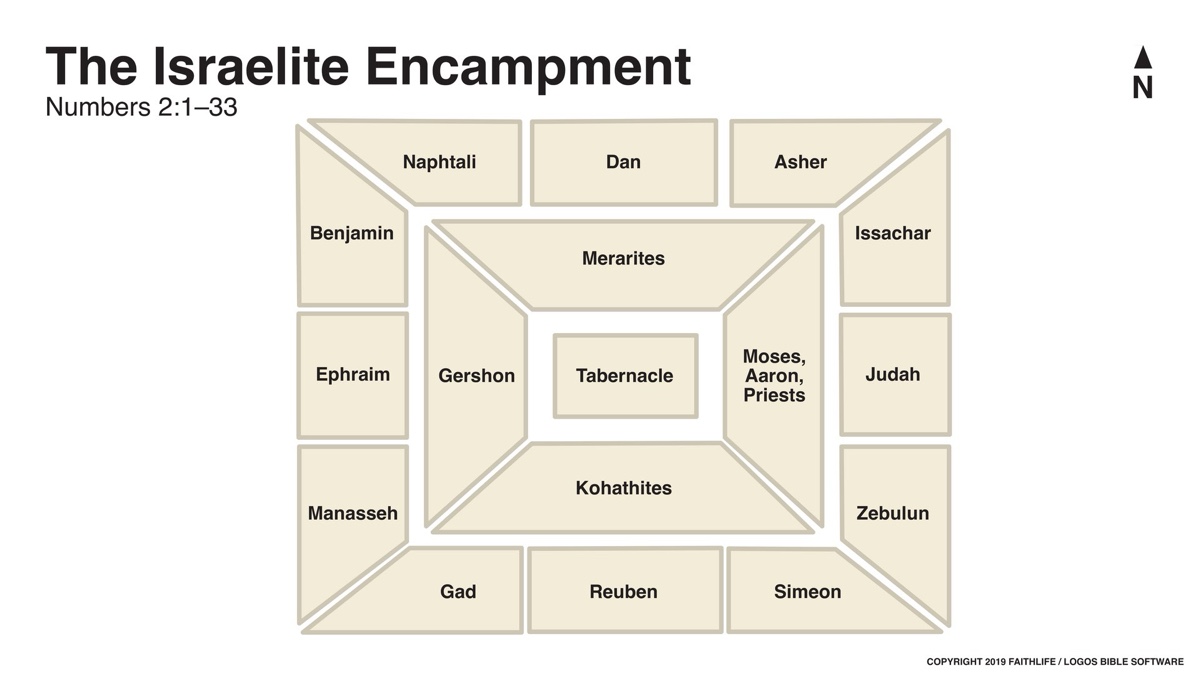
We should note that the text twice informs us that Israel complied completely with the Lord’s instructions regarding this pattern: “Thus the sons of Israel did; according to all that the Lord commanded Moses, so they camped by their standards, and so they set out, every one by his family according to his father’s household” (Num. 2:34; cf. 1:54).
As noted above, the Levites were not included in this census (Num. 1:47; 2:33). They were counted separately, divided by family (the three sons of Levi), and assigned different responsibilities related to the tabernacle.
The sons of Kohath were to carry the Ark of the Covenant, the table of the bread of the presence, the golden altar, and the utensils of service. They were to cover each item with porpoise skin and blue cloth and carry them with poles on their shoulders (Num. 4:4-16). The sons of Gershon carried the fabrics of the Tabernacle, and they used four oxen and two carts for their service (Num. 4:21-28; 7:7). The sons of Merari carried the structural elements of the Tabernacle and used eight oxen and four carts (Num. 4:29-33; 7:8). These commands were carried out just as given (Num. 4:49).
We might wonder what is the significance of all of this? There is no call for later generations in Israel or for the church to reenact this arrangement. Why record this pattern in such detail? Could it be that the text is intended to draw our attention to the center of the camp? God was literally at the center of every aspect of Israelite life during their time in the wilderness. The camp was arranged so that the Tabernacle became the central focal point of the entire nation. The ring formed around the tabernacle by the Levite camp reminded the people of God’s holiness and the essentiality of serving Him (Num. 1:53).
We see this even more clearly when we consider the fact that Israel was a nation marching to war, yet thousands of Levites were exempted from military service. God planned to use His people to eradicate the iniquity of the Amorites (Gen. 15:14-21). While we know that Israel would refuse to enter the Promised Land and the current generation would die in the wilderness, the intent was for this group to march on Canaan and dispossess the nations dwelling therein. Despite this, thousands of Levites were exempted from military service. Instead, they were responsible for assembling and transporting the Tabernacle and its related elements.
Throughout the first ten chapters of Numbers, we encounter various commandments and practices that underscore the importance of holiness, sincere worship, and a God-centered perspective. For example, Numbers 3:40-51 describes the redemption of the firstborn. Every firstborn male in Israel had to be redeemed, or bought back, from the Lord. It was only because of God’s gracious intervention during the Passover that Israel stood before Him at Sinai, and this redemption rite would remind them to be grateful for His grace.
In Numbers 5:1-8, we read that all who were ritually defiled were to be sent out of the camp. In some instances, this defilement occurred through no fault of the defiled person. However, these regulations emphasized the holiness of God and Israel’s responsibility to recognize and reflect that holiness; thus God said, “They will not defile their camp where I dwell in their midst” (Num. 5:3).
The Nazarite vow reminded Israel of their consecration before the Lord in much the same way a wedding ring reminds us of our vows. The requirements of this vow demonstrated the kind of dedication the Lord requires. Nazarites had to meet all the standard offerings in addition to their vows, including forgoing any mourning rituals that would bring them near a dead body, even if their close family members were to die (Num. 6:6-7).
The offerings made by the leaders to the tribes for the Levites emphasized the significance of worshipping God. The text’s deliberate listing of these offerings (Num. 7) connected each tribe and person to the Tabernacle’s work. Without the appropriate offerings, the Tabernacle could not function. The importance of this is seen in verse 89 as Moses entered the Tabernacle to hear the voice of God.
Every aspect of this pattern identified Israel as God’s people; they belonged to God, and their primary purpose was to worship and follow Him. Despite the importance of defeating their enemies on the battlefield, serving God was of paramount importance. Everything else flowed from their relationship with and worship of God.
The simplicity of the pattern for both the organization and the worship of the local church lends itself to identifying us as God’s people. Autonomous local churches, whose head is Jesus, serve as a constant reminder that we serve no one other than the Lord, and our allegiance belongs to Him alone (Phil. 1:1; Eph. 1:1).
Simple New Testament worship consists of studying God’s word, singing praises to Him, praying, partaking of the Lord’s Supper, and giving of our means to promote the Lord’s work. When done as prescribed, these elements put Christ at the center and eliminate self-elevation.
Consider the pattern of preaching demonstrated by Paul (1 Cor. 2:1-5; Acts 17:22-31). His preaching focused on the message, on the Lord and His wisdom. It was intended to drive the hearer to faith in Jesus. Paul did not seek to be clever or find the perfect “hook.” His preaching was never about himself, creating a cult of personality, or achieving personal exaltation. He always pointed to and glorified God through the glory of the gospel.
Too often, there seems to be a willingness to dismiss Old Testament examples simply because they are from a previous covenant. However, before we dismiss them, we might want to stop and consider why God revealed and preserved these things for us.
For example, the pattern contained in Numbers included the precise numbers of oxen and carts used by the different families of Levites to carry out their work (Num. 7:1-9). As noted above, the sons of Gershon received two carts and four oxen, the sons of Merari received four carts and eight oxen, while the sons of Kohath received none. This was based on the materials carried and the particular needs of the work.
This principle carries over to the pattern for the church and its work. In His pattern, God has given us precisely what we need to do the work He has assigned. The New Testament pattern does not include missionary societies or parent churches that allow us to accomplish more than individual congregations can accomplish on their own. Why? Individual congregations are not responsible for evangelizing the entire world any more than the sons of Kohath were responsible for moving the entire Tabernacle.
Likewise, the pattern of worship laid out in the New Testament is essential. Much like the arrangement of the camp, simple a cappella music helps put the focus on God. Modern worship, with its instrumental music, choirs, and solos, often becomes performance-based appeals to the senses instead of directing one’s attention to God. Paul’s concern for edifying reverent worship that reflects the nature of the God we serve in 1 Corinthians 14 should help us to see that our worship is at the very heart of what the church is intended to be about. Proper, reverent worship reminds us of His holiness and our need for Him. Losing this central focus means losing our purpose and identity (Num. 16:1-11, 23-31).
The people who entered the land were not the people whom Moses spoke to in Numbers 1-10. The nation spent forty years wandering in the wilderness, and the entire generation that initially refused to enter the land gradually died. Despite this, the generation that entered the land was more faithful than the one that first received the pattern.
While we often focus on Israel’s failures, we should note that the generation that grew up in the wilderness stuck to the pattern and entered the Promised Land. Likewise, today, adherence to God’s pattern will allow local congregations to endure the trials that every church will face. The pattern God has given the church creates a Christ-focused body that serves and worships the Lord.
God’s pattern was never given without purpose, and the same is true for the pattern revealed for the church today. We must examine whether Christ truly stands at the center of our worship, work, and priorities, or if we have allowed distractions to take His place. The challenge is simple yet profound: commit to following God’s pattern so that we remain faithful and focused, no matter what trials come our way. By so doing, He will faithfully lead us through this present wilderness to enter our eternal heavenly home.
Shawn Chancellor has worked with the South Georgia Street church of Christ in Amarillo, TX, since 2014. He and his wife, Bonnie, have one daughter and were recently blessed with their first granddaughter. The church website is here. He can be reached here.



By Bobby Graham
Is it scriptural for a wife to worship somewhere besides the congregation where her husband worships?
I’m unsure of all the circumstances surrounding this situation and cannot know about it. For this reason, I would be slow to judge. While there might be an exceptional situation where one might need to worship elsewhere temporarily, that lies beyond the scope of this answer.
I would say, in general, that any husband and wife will do much better in their efforts to live with each other, encourage each other, pray for each other, teach each other, and warn each other if they regularly worship with each other. These actions should be practiced in a marriage relationship where the two are “heirs together of the grace of life,” as Peter described them in 1 Peter 3:7.
Why does the Creator and Designer of marriage call husband and wife “joint heirs” or “heirs together of the grace of life”?
He designed them for each other—physically/sexually, spiritually, mentally, and emotionally.
Each needs what the other can provide; they are complementary and beneficial to one another.
He requires a commitment from both of them.
They must cooperate to be successful in all phases of marriage—procreation, child training, maturing, religious devotion/worship, influence/exemplifying Christ in life, and supportiveness in their respective roles.
How can a husband and wife fulfill responsibilities in any of these areas without the other?
This same question must cause both husband and wife to consider seriously his or her role and responsibility. It is impossible to separate the spiritual from other areas because the spiritual forms the underpinning for all other areas. Worshiping, studying, and working together in a local church is essential to the fullest influence for good. Worshiping, studying, and working together in a local church is essential to spiritual maturity. Worshiping, studying, and working together in a local church is essential to the love and harmony that should characterize their marriage.
Truly, “heirs together” pictures their spirit of cooperation, reflects their divine design for their work together, and demands their combined endeavor in a lifetime of marriage. Neither without the other can succeed!
Bobby L. Graham actively participates in fill-in preaching, Belize trips, teaching an hour each day at Athens Bible School, and in gospel meeting work. He and his wife, Karen, have three children. He can be reached here.




By Mike Willis
Synopsis: The book of Esther, though questioned in progressive circles for its historicity, contains detailed chronological markers and references to real historical figures, suggesting the author intended to record actual events during the reign of Xerxes I of Persia. This article focuses on the deliverance of the Jewish people from Haman’s plot, with the casting of lots (pur) playing a pivotal role in determining the date of the planned massacre, a practice deeply rooted in ancient Near Eastern culture. Ultimately, the story underscores a biblical truth that divine providence overrules human attempts at fate, which became memorialized in the Jewish festival of Purim.
The book of Esther is the last of the historical books (Joshua-Esther) in the English Bible; it is immediately followed by the five books of wisdom literature (Job, Psalms, Proverbs, Ecclesiastes, and the Song of Solomon). In the Hebrew Bible, the book of Esther appears in the Kethubim (Writings), more specifically the Five Megillot (Scrolls): Song of Songs, Ruth, Lamentations, Ecclesiastes, and Esther.
In 1969, R. K. Harrison wrote regarding the book of Esther: “Despite the fact that some modern scholars have defended the historicity of the composition, the majority have deemed it to be without historical foundation” [Note #1]. One taking a course in Old Testament studies at most state universities would likely be presented with the liberal approach to the book. I think that there is sufficient evidence to indicate that the author of the book of Esther, whoever he might be, thought that he was writing about historical events. He roots the events he narrates with rather precise dates: “in the days of Ahasuerus” (1:1), in the third year of his reign (1:3), in the tenth month of the seventh year of his reign (2:16), in the first month of the twelfth year of his reign (3:7); on the thirteenth day of the first month (3:12), etc. This is not like the writings of fairy tales: “long, long ago, far, far away. . . .”
The Persian ruler is a historical person. Most English translations give his name as Ahasuerus, although a few identify him by his better-known Greek name, Xerxes [Note #2]. To help keep the historical period for Esther before us, here is a list of the Persian rulers and the years when they ruled:
| PERSIAN RULERS | YEARS RULED |
|---|---|
| Cyrus the Great | (559-530 BC) [Note #3] |
| Cambyses II | (530-522 BC) |
| Smerdis (Bardiya) | (for 7-8 months in 522 BC) |
| Darius I (the Great) | (522-486 BC) [Note #4] |
| Ahasuerus or Xerxes I | (485-465 BC) [Note #5] |
| Artaxerxes I (Longimanus) | (464-424 BC) [Note #6] |
| Xerxes II | (424 BC) |
| Sogdianus | (424 BC, a usurper who ruled briefly) |
| Darius II | (423-405 BC) |
| Artaxerxes II (Mnemon) | (404-359 BC) |
| Artaxerxes III (Ochus) | (358-338 BC) |
| Artaxerxes IV (Arses) | (337-336 BC) |
| Darius III | (336-330 BC) [Note #7] |
Mervin Breneman wrote: “According to the first verse, the events of the Book of Esther took place during the reign of Xerxes (who is sometimes called Ahasuerus), king of Persia (486-465 BC). That would place the events between the completion of the temple construction under Zerubbabel (in 516 BC, during the reign of Darius I) and the arrival of more returnees to Jerusalem under Ezra in 458 BC (during the reign of Artaxerxes I)” [Note #8].
Ahasuerus is best known in history for his ambitious but failed invasion of Greece in 480 BC. He led one of the largest military forces of the ancient world across the Hellespont (not a small feat by itself) to avenge his father’s (Darius I) defeat at Marathon [Note #9]. Xerxes I was the Persian ruler who defeated the Greeks in the battle of Thermopylae, a battle famous for the heroic last stand of the 300 Spartans. The invasion moved further south to the turning point battle of Salamis, where the Greek navy defeated Xerxes’ fleet in a narrow strait, primarily because the larger Persian ships could not maneuver the straits as well as the smaller Grecian ships and their more experienced navy. The Battle of Plataea (479 BC) marked the end of Persian hopes of conquering mainland Greece.
The royal gathering in the opening chapter of Esther in 483 BC is best interpreted as Xerxes’ assembly of advisors to plan out the Persian invasion of Greece. His choice of Esther to be his new queen in the seventh year of his reign (478 BC) occurred after his defeat at the hands of the Greeks.
The focus of the book of Esther is to describe how the Jews were saved from the conniving attempt by Haman to destroy the Jewish people. We recall the events when Haman cast lots to determine on which day of the year to destroy the Jews. The ESV reads as follows: “In the first month, which is the month of Nisan, in the twelfth year of King Ahasuerus, they cast Pur (that is, they cast lots) before Haman day after day; and they cast it month after month till the twelfth month, which is the month of Adar” (Esther 3:7). Casting of lots was not new with the Persians. The Hebrews also used the lot to make decisions on various occasions. William W. Hallo wrote:
And the Bible records many different uses for casting of lots, from the division of the Promised Land among the twelve tribes by Joshua, to the finding of the culprit in the tale of Jonah, to the gambling for the garment of the condemned man in Psalm 22—an image taken over by the Gospels in connection with the crucifixion (Matt. 27:35; Mark 15:24; Luke 23:34; John 19:24). The noun for “lot” in all these and numerous other passages is gôral, a word which originally meant simply “stone, pebble,” and which ultimately came to signify “fate, destiny” much like the English equivalent (lot) or for that matter the Sumerian and Babylonian ones as well.
There is, however, one biblical book which employs, not the usual Hebrew noun for lot, but rather the Assyrian word pur(u). For in the Scroll of Esther 3:7, we read, following the text of the Septuagint: “In the twelfth year of King Ahasuerus, in the first month, i.e., the lot, in the presence of Haman, day by day and month by month (LXX: and the lot fell on the fourteenth day of) the twelfth month, i.e., the month of Adar.” Later in the same book (9:26) we read: “Therefore they called these days Purim, after the word (or: on account of the) pur” [Note #10].
The practice of casting lots was widespread in ancient times. The die of Iahali is dated hundreds of years before Esther, during the reign of the Assyrian King Shalmaneser III (858-824 BC). Archaeologists have uncovered hundreds of ancient dice (and other gaming tokens) across the Middle East and broader ancient world, but the die of Iahali is the exclusive one to have the noun “pur” written on it. Here is a translation of the words written on the die:
Oh Assur the great lord, oh Adad the great lord, the lot of Iahali the grand vizier of Salmaneser (sic) king of Assyria, governor-of-the-land (for) the city of Kibshuni (in the land of Qumeni, the land of Mehrani, Uqu and the Cedar Mountain, and minister of trade—in his year assigned to him by lot may the harvest of the land of Assyria prosper and thrive, in front of the gods Assur and Adad may his lot fall [Note #11].
The technique of casting lots in Assyria was this: the inscribed dice were thrown by someone (either Iahali himself or some impartial person) and priority was determined by the location in which they fell. In this case, the die landed nearest to the gods Assur and Adad. Landing near these gods was apparently a favorable throw of the dice. It must have been through a practice similar to this that Haman determined on which day to murder all the Jews in the Persian empire [Note #12].
In the context of discussing how the annual feast of the Jews on Adar 14 and 15 came to be named “Purim,” Hallo wrote: “Thus the biblical derivation of the name of the festival from the lots called pur remains the best available, and what I hold in my hands are (in replica) the oldest—indeed the only—lots of this name yet recovered by archaeology, the first Purim” (22).
There are significant theological reasons for the casting of lots (purim) related to the message of the book of Esther. Joyce Baldwin highlights its message as she emphasizes the significance of “casting lots” to the ancient world. She wrote:
The dice serves a wider purpose, in that it illustrates how widespread was belief in a predetermined fate, with which it was considered important for men to co-operate if they were to succeed in their enterprises. Events for a year were predetermined on New Year’s Day in Shalmaneser’s reign, a fact which sheds light on Esther 3:7. Evidently on that day the court diary was still, some 350 years later, being filled in for the year with the help of dice, thrown to establish auspicious dates for all the known events. This detail removes one of the regularly cited problems of the book, and, by filling in background, forces a revision of previous misconceptions.
Given that the Jews lived in a fate-ridden culture while they inhabited Persia and the other lands of exile, we can readily appreciate that their theology needed to comprehend a belief in the power of their God to overrule the way the dice fell (Prov. 16:33). The book of Esther took the matter further: even when the dice had fallen, the Lord was powerful to reverse its good omen into bad, in order to deliver his people [Note #13].
Along the same lines, Debra Reid added: “. . .it may infer that the religious meaning of the story includes the idea that the fate of God’s people is not decided by evil men throwing dice, but by God alone who assigns to his people their portion (see Ps. 16:5-6)” [Note #14]. Gary V. Smith added this thought: “Remembering to celebrate this festival would remind people that God was watching over and protecting his people in ways they often did not see or understand, so that others would not lose hope when days looked dark and they were being persecuted” [Note #15].
Caption: Die of Iahali. Cube. Lot of Yahali, puru. Neo-Assyrian. Clay. (YPM BC 021122). Courtesy of the Babylonian Collection of the Yale Peabody Museum. I wish to thank Agnete Lawson for granting this permission in such a timely manner.

Caption: Colossal Bull head from Palace of Xerxes & Artaxerxes.

Note for preachers and other Bible class teachers: Archaeologists have uncovered Xerxes’ palace in Persepolis. If you wish to take the time, visit here for hundreds of photos that you can use in your classes and sermons.
Baldwin, Joyce G. Esther: An Introduction and Commentary. Vol. 12 of Tyndale Old Testament Commentaries. Downers Grove, IL: InterVarsity Press, 1984.
Breneman, Mervin. Ezra, Nehemiah, Esther. Vol. 10 of The New American Commentary. Electronic ed. Nashville, TN: B&H Publishing Group, 1993.
Hallo, William W. “The First Purim.” Biblical Archaeologist. Winter 1983, pp. 19-26.
Harrison, R. K. Introduction to the Old Testament. Grand Rapids, MI: William B. Eerdmans Publishing Company, 1969.
Reid, Debra. Esther: An Introduction and Commentary. Vol. 13 of Tyndale Old Testament Commentaries. Downers Grove, IL: InterVarsity Press, 2008.
Smith, Gary V. Ezra-Nehemiah & Esther of Cornerstone Biblical Commentary. Carol Stream, IL: Tyndale House Publishers, Inc., 2010.
Thiele, Edwin R. The Mysterious Numbers of the Hebrew Kings. Grand Rapids, MI: Zondervan Publishing House, 1983.
[Note #1] Introduction to the Old Testament, 1090.
[Note #2] These translations use the name Xerxes: New International Version, New Living Translation, Contemporary English Version, Good News Translation, and Common English Bible.
[Note #3] In the first year of his reign, Cyrus issued a decree that allowed the Jewish exiles to return to Palestine (2 Chron. 36:22-23; Ezra 1:1).
[Note #4] The Jewish temple was completed on the third day of Adar in the sixth year of Darius I’s reign, 516 BC (Ezra 6:15).
[Note #5] The events of Esther occur during the reign of Ahasuerus.
[Note #6] Ezra returned to Judah in the seventh year of the reign of Artaxerxes I, in 458 BC (Ezra 7:7); in the twentieth year of his reign, Nehemiah returned to build the walls of Jerusalem (Neh. 2:1).
[Note #7] I have checked several chronologies, and there is close agreement on the years of reign for these Persian rulers. The rule of Smerdis and Sogdianus are omitted in some of the Persian king lists, but the others are nearly identical (with variations of 1-2 years). See The Mysterious Numbers of the Hebrew Kings by Edwin R. Thiele, 227-228, or Introduction to the Old Testament, 193, by R. K. Harrison, for comparisons.
[Note #8] Mervin Breneman, Ezra, Nehemiah, Esther, Vol. 10 of The New American Commentary, 278.
[Note #9] This was the second time Persia had invaded Greece. The first invasion was initiated by King Darius I. The invasion ended with a Greek victory in 490 BC.
[Note #10] William W. Hallo, “The First Purim,” Biblical Archaeologist, Winter 1983, 21.
[Note #11] Ibid. Hallo credits the translation to “Michel 1949:261-64.”
[Note #12] The text indicates that Haman threw the die on the twelfth day of Nisan in the twelfth year of Ahasuerus and made a public announcement on the thirteenth day of Nisan, the day before the Jews celebrated their Passover (Esth. 3:7, 12). No doubt this announcement made them recall the circumstances of their ancestors under Pharaoh when the Passover feast originated. The Jews needed the Lord’s deliverance from Haman/Ahasuerus just as much as their ancestors needed deliverance from Pharaoh!
[Note #13] Joyce G. Baldwin, Esther: An Introduction and Commentary, 23.
[Note #14] Esther: An Introduction and Commentary, 148.
[Note #15] Ezra-Nehemiah & Esther, 286.
Mike Willis served as editor of Truth Magazine for forty years. He can be reached here.



By David Weaks
Synopsis: The author emphasizes the importance of uncompromising gospel preaching that clearly identifies sin, calls for repentance, and exposes false teachers. He warns against spiritual complacency and the tendency to satisfy spiritual hunger with superficial, feel-good messages instead of the truth of God’s word. Finally, he urges Christians to resist following the crowd toward moral destruction and to remain steadfast in pursuing righteousness and reverencing God.
A man once declined an invitation to attend services with me because he said he didn’t like “hard preaching.” I asked what he meant, and he said, “I want preaching that makes me feel good, not preaching that reminds me I’m a sinner.” I am afraid that his viewpoint is all too common today.
People dislike uncompromising preaching. Many want a political gospel that is customizable for every special interest group. However, if preaching compromises, it isn’t gospel preaching. The Lord, the author of the gospel, does not change (Mal. 3:6). With God, the “Father of lights,” there is “no variation or shadow of turning” (Jas. 1:17), and so the inspired record cannot be altered to please men (Gal. 1:6-9; Rev. 22:18-19). Compromise removes the power from the gospel (Rom. 1:16).
People dislike preaching that identifies sin with clarity and power. John said that sin is lawlessness (1 John 3:4) and that “all unrighteousness is sin” (1 John 5:17). The Bible says that all men sin (Rom. 3:23) and that the wages of sin is death (Rom. 6:23). Unfortunately, sinners love sin, and the last thing they want is someone telling them their sins condemn them. Yet that is the job description of a gospel preacher! Preachers must preach the word of God with urgency even when sinners don’t want to hear it (2 Tim. 4:2; Ezek. 2:7-8).
Consider the boldness and directness of the prophets. They preached the truth without favor toward men. Evil men and women hated the prophets, but the prophets preached boldly anyway. They did not soften their message so people would be more inclined to listen; they simply preached the truth, and when they did, it was evident to the people that a prophet was among them (Ezek. 2:1-5). Nathan condemned David for his sin with Bathsheba, saying to him, “You are the man!” (2 Sam. 12:7). Elijah accused Ahab of troubling Israel by leading the people to worship Baal (1 Kings 18:17-18). Amos bluntly called the women of Israel “cows of Bashan” because they oppressed the poor while seeking luxury for themselves (Amos 4:1-2).
Sinners hate preaching that demands repentance. No sermon reaches its mark if it doesn’t lead sinners to ask, “Men and brethren, what shall we do?” (Acts 2:37). Paul told the idolaters of Athens that “God commands all men everywhere to repent” (Acts 17:30). Jesus said to the Jews that they must repent or perish (Luke 13:3, 5). A sermon that soothes an unrepentant sinner’s conscience is worthless.
People dislike preaching that ties error to its teachers. False teachers exist, and they are a very real threat to men’s souls (2 Pet. 2:1-3, 12-14). They must be exposed and their mouths stopped (Titus 1:11). Jesus bluntly denounced the scribes and Pharisees as hypocrites (Matt. 23:1ff). Paul identified Hymenaeus and Philetus by name because their doctrine “ate like cancer” (2 Tim. 2:17). Paul delivered Hymenaeus and Alexander “to Satan that they might learn not to blaspheme” (1 Tim. 1:20). John exposed the Nicolaitans’ error (Rev. 2:6, 15), and he condemned “that woman Jezebel” who presented herself as a prophet while seducing Christians to commit sexual immorality (Rev. 2:20). Where is the sense in leaving out the names of false teachers while preaching to expose their error? False teachers want to be anonymous so they can “secretly bring in destructive heresies” (2 Pet. 2:1). It is the duty of gospel preachers to warn people not to “follow their destructive ways” (v. 2).
Dear reader, there is nothing negative about gospel preaching when it condemns sins that separate men from God (Isa. 59:1-2). There is nothing “hard” about gospel preaching when it is true to the Bible. A good and honest heart craves preaching that is presented as plainly as possible. Good and honest hearts do not run from “hard preaching;” they demand it.
One of the weirdest words in the English language is borborygmus (pronounced bor-ber-IG-mus). This bizarre little term refers to what happens when you are hungry. Your stomach rumbles and makes disturbing noises loud enough to be heard across the room. You need to eat, and you need to do it fast. Convenience stores thrive by providing hungry people with aisle after aisle of junk food to calm their hunger. These stores are not health-food stores. They provide quick calories filled with lots of fat and sugar. Gas station fare tastes good, goes down easy, boosts energy quickly, but it all leads to a big crash later in the day.
There is a spiritual equivalent to these hunger pangs: it is the craving of every human heart for the Lord. The psalmist described himself like a deer that pants for the water brooks, concluding, “So pants my soul for You, O God” (Ps. 42:1-2). Jesus called this need “hungering and thirsting for righteousness” (Matt. 5:6). It is the hunger that can only be fed by a steady diet of the word of God, but it can also be ignored until starvation occurs and one falls away from the faith (Jas. 5:19-20). This intense spiritual hunger for the word of God, for stronger faith, for fellowship with God, fellowship with the saints, and worship needs to be stoked constantly, like a coal fire in a furnace. Otherwise, the fire will go out and your heart will grow cold (Rev. 2:4-10; 3:15).
Unfortunately, people often feed their constant and unrelenting spiritual hunger with the equivalent of junk food. A lazy man, whose heart is starving for the meat of the word, will read sappy books filled with religious-sounding slogans, or he will scour the internet looking for little one-sentence squibs that are the emotional equivalent of a powdered donut, having no value for his soul. His heart is dulled by these little snacks, but he gets a quick “high”—a false sense of spiritual fullness. In truth, he has received no nutrition from the word of God (1 Pet. 2:1-3; Heb. 5:11-14).
The best possible food for the hungry rumblings of your heart is the Bible when it is preached without addition or subtraction. Love the law of God and meditate on it (Ps. 119:97). Fill your mind with the word of God and determine to live by it so you don’t sin against Him (Ps. 119:11).
Don’t starve yourself. Listen for the signs of your spirit’s hunger and feed it! If you ignore your hunger and thirst for righteousness, the possibility of spiritual death is 100 percent. Why would any Christian choose to follow the crowd toward hell?
When Jesus hung dying on the cross, He interacted with two thieves who were crucified on either side of Him. One of the criminals “blasphemed Him, saying, ‘If You are the Christ, save Yourself and us’” (Luke 23:39), but the other criminal rebuked the first one and asked him pointedly: “Do you not even fear God, seeing you are under the same condemnation? And we indeed justly, for we receive the due reward of our deeds; but this Man has done nothing wrong” (v. 41). The blasphemous criminal demonstrated by his attitude and words that he did not properly fear God.
I wonder if we have proper fear for our Creator? Fear can refer to our reverence and awe for God (Heb. 12:28), it can refer to respect for His authority (Deut. 6:2; Eccl. 12:13), or it can refer to the fear of His wrath and judgment (Matt. 10:28). All of these ought to be present in the heart of a child of God. Each individual is accountable to God and will face Him in judgment someday. Do you fear God as you should?
Do you not fear falling short of the glory of God (Rom. 3:23)? Sin is lawlessness (1 John 3:4). That perfect standard of God is clearly revealed. Does it bother you when you miss the mark?
Do you not fear the darkness of sin that accompanies your sins? The word of God illuminates the righteous path we should walk, and Christians are supposed to radiate the light of truth (Ps. 119:105; Matt. 5:14-15). However, the shadowy dimness that accompanies our descent into sin surely ought to alert us to the danger we are in so that we can awake to righteousness (1 Cor. 15:34). You and I should fear growing comfortable outside of the light.
Do you not fear the dangerous influence of unbelievers? Paul the apostle warned about the danger of those whose evil will corrupt your good habits (1 Cor. 15:33). We are to refrain from being “unequally yoked together with unbelievers” (2 Cor. 6:14). When you get too comfortable with the world, you ought to fear God.
Do you not fear God when you neglect your Christian duties? You once read your Bible every day, but maybe not so much now (Eph. 3:3-4). You once prayed without ceasing, but now maybe only when you need something from God (1 Thess. 5:17). You once attended all worship services without fail, but now you attend sporadically at best (Heb. 10:25). Do these things not stir up dread and fear within you at the thought of impending judgment?
So we finish with the question with which we started: “Do you not even fear God?” Have you drifted that far?
A crowd is a bother because you are more or less forced to move with it, wherever it goes. If you want to go in the opposite direction, you must turn and fight against that crowd, pushing and shoving your way through it in order to get where you want to go. Most people just give up and go with the crowd.
This is dangerous for a Christian. Crowds move inexorably and without thought in a direction that is seldom the best moral destination. Rarely does the crowd move toward Jesus Christ and righteousness. We are taught in the Bible that there are few who are saved (Luke 13:23). There is a narrow gate that few enter because it is hard, and there is a wide, easy-flowing gate that the crowd jostles through (Matt. 7:13-14). We are taught to go through the narrow gate and to struggle against the crowd to get there because the narrow way leads to eternal life. You and I must not follow the crowd to destruction. The cost to our souls is too great to bear (Rev. 21:8).
All of us have various groups to which we are closely tied—associates at work, friends at school, clubs to which we belong, neighbors, and family members. As Christians, it behooves us to evaluate those groups and the direction they’re moving; if those crowds are not moving toward the Lord, we need to fight against the tide. We need to stand out in the crowd. We need to be the salt and the light guiding that crowd toward Jesus (Matt. 5:13-14).
We cannot afford to be statistics. We dare not be “one of the number.” We wear the name of Jesus Christ daily. We look toward heaven as our home (Phil. 3:20). We pray every day for God to help us to be more like Him. Let us set our minds on things above, where Christ is (Col. 3:1-3), and so we must not behave, think, or talk like any group of friends or family if the group leads us away from God. We cannot afford to go with the flow.
Every day of our lives, you and I have the great privilege of living for the Lord (Phil. 1:21; Rom. 13:8; Col. 3:3). Each Lord’s Day, Christians are blessed to assemble with the saints of God and be part of the most wonderful group of people on earth. That group, the Lord’s church, was purchased with the blood of Jesus Christ (Acts 20:28). Among the people of the earth, the church of Christ loves the Lord and is the group that is marching toward heaven. That is the direction I want to go.
This month’s musings have focused on how people view the righteousness taught in God’s word. True righteousness demands bold preaching that confronts sin and calls for repentance, while spiritual hunger must be fed with God’s truth rather than empty substitutes. Every Christian must choose to fear God, resist the crowd, and live a life of faith marked by holiness and genuine devotion.
David Weaks, a former Catholic, obeyed the gospel in February 1985, and began preaching later that year. David and his wife, Perri, live in West Columbia, TX, where he has labored with the church since August 1997. They raised their two daughters in West Columbia. He can be reached here.




By Danny Linden
Synopsis: Luke 7:11-17 relates the account of Jesus raising a young man from the dead, demonstrating His compassion toward those who are suffering, and manifesting His power to alleviate their distress.
Jesus’ miracles provide evidence of the truth of His claims, particularly His divinity and supreme authority. Each miracle also reveals something about His character. The resurrection of the widow’s son at Nain reveals His compassion and power.
Soon afterward He went to a town called Nain, and His disciples and a great crowd went with Him. As He drew near to the gate of the town, behold, a man who had died was being carried out, the only son of his mother, and she was a widow, and a considerable crowd from the town was with her. And when the Lord saw her, He had compassion on her and said to her, “Do not weep.” Then He came up and touched the bier, and the bearers stood still (Luke 7:11-14a).
Jesus came upon a funeral procession as He approached the small town of Nain. A young man—an only son—had died, leaving his widowed mother alone. This was a tragic and tenuous situation for the widow. The death of a son is always devastating for a parent, but for a widow it also meant the loss of financial and familial support. This widow had no husband or child to provide for her, so she could potentially starve to death if she did not find a way to earn an income in her old age. Most likely, she would be dependent on her community to support her. God expected His people to be kind and generous to such vulnerable individuals (Deut. 24:17-22), but it did not always happen that way.
The widow’s neighbors recognized her tragedy, and many accompanied her to the burial. The body would have been carried on a simple board and wrapped in cloth, and the burial likely took place the same day because decomposition started quickly. When Jesus met the procession, He said something startling: “Do not weep” (7:13b). From any other individual, this would have been thoughtless at best. From Jesus, it came from compassion and showed that He intended to act in an amazing way.
Jesus did something else that was unexpected. He reached out and touched the bier. This is not an insignificant detail. Touching a corpse, a bone, or a grave made one ritually unclean under the law. It was not a sin to do so, of course, but it required special cleansing and separation from others for seven days:
Whoever touches the dead body of any person shall be unclean seven days. He shall cleanse himself with the water on the third day and on the seventh day, and so be clean. But if he does not cleanse himself on the third day and on the seventh day, he will not become clean. Whoever touches a dead person, the body of anyone who has died, and does not cleanse himself, defiles the tabernacle of the LORD, and that person shall be cut off from Israel; because the water for impurity was not thrown on him, he shall be unclean. His uncleanness is still on him. This is the law when someone dies in a tent: everyone who comes into the tent and everyone who is in the tent shall be unclean seven days. Every open vessel that has no cover fastened on it is unclean. Whoever in the open field touches someone who was killed with a sword or who died naturally, or touches a human bone or a grave, shall be unclean seven days (Num. 19:11-16).
All the people involved in the preparation of the young man’s body and carrying it out for burial would have to perform those cleansing rites, but that was considered a service to the family and part of the mourning process. Jesus was just a passing stranger, and this would be a nuisance to Him. He had no reason to bring that uncleanness on Himself, but He did anyway. He lowered Himself to the level of those who served the grieving, identifying with their compassion for the widow. Combined with His instruction to stop weeping, His touch shows that He was personally invested in her sorrow and determined to help.
And He said, “Young man, I say to you, arise.” And the dead man sat up and began to speak, and Jesus gave him to his mother (Luke 7:14b-15).
With nothing more than a brief command, Jesus raised the widow’s son. From anyone else, those words would be an arrogant and impotent command. From Jesus, they were words filled with power. The young man sat up and spoke to the people around him. He was alive and well, as if nothing had ever happened.
To us, death is a cavernous, yawning void that severs us from our loved ones. No matter what we do to try to avoid it, it touches each one of us. We watch older generations depart as the years pass. We see how even young people die “before their time” (so to speak). We experience aging that we cannot reverse. One day, the specter that looms over us will separate us from everything and everyone we know here on earth. Yet, where death feels insurmountable to us, Jesus simply says, “Arise.”
This miracle resembles two well-known resurrections recorded in the Old Testament. Elijah once entered the city of Zarephath in a time of drought, only for a widow to share her last morsel of food with him (1 Kings 17). As a reward for her faith and hospitality, God supplied her and her household with endless flour and oil, preserving their lives when they fully expected to die. Sadly, the widow’s only son died from a terrible illness, and she accused Elijah of playing a cruel trick. Elijah pleaded with God again and again and stretched himself over the boy’s body, unwilling to let him go. Eventually, God heard his prayer and the boy breathed again.
Similarly, Elisha regularly stayed in the guest room of a wealthy family in Shunem (2 Kings 4). The Shunammite woman showed him great hospitality and convinced her husband that they should be generous toward the prophet. Elisha offered to put in a good word for them with the king or the commander of the army, but she declined. She refused to ask for anything, but Elisha learned that she did not have a son. He promised her that the LORD would give her a son the following year, and she indeed bore a son. Some years later, the boy was out working with his father and suddenly complained of pain in his head. By midday, he was dead. The Shunammite woman grieved and told Elisha that this was worse than never having a son. Elisha tried multiple times to raise the boy from the dead. He was unable to do anything from afar, and even when he came in person, it did not happen immediately. Eventually, God heard his prayer and the boy arose, alive and well.
These accounts are difficult to understand in isolation. Why did the prophets have apparent difficulty raising these boys from the dead? If they were not approved by God, they would not be able to do anything. If they were true prophets, then God’s power would be sufficient to do anything He wanted to do by their hands. The best way to answer this is to consider Elijah, Elisha, and Jesus together. God did truly work through the hands of His prophets. That divine power was a stamp of approval on their message and work. Jesus is greater than Elijah and Elisha. He raised the son of the widow with ease, so we are primed to see Him and His work as far above even the greatest prophets in Israel’s history.
Fear seized them all, and they glorified God, saying, “A great prophet has arisen among us!” and “God has visited His people!” And this report about Him spread through the whole of Judea and all the surrounding country (Luke 7:16-17).
The people recognized that the impossible had happened before their eyes, causing them to be frozen in fear and glorify God. Yet even in this moment, they remained on the precipice of full realization. “A great prophet has risen among us!” Indeed, but not just a great prophet. That was the point of comparing Jesus to Elijah and Elisha. That was the point of Jesus healing the centurion’s son without being anywhere near (Luke 7:1-10). That was the point of the report of John’s disciples, who observed that “the blind receive their sight, the lame walk, lepers are cleansed, the deaf hear, the dead are raised up, and the poor have good news preached to them” (Luke 7:22). Jesus was the great Prophet promised so long ago:
The LORD your God will raise up for you a prophet like Me from among you, from your brothers—it is to Him you shall listen—just as you desired of the LORD your God at Horeb on the day of the assembly, when you said, “Let me not hear again the voice of the LORD my God or see this great fire any more, lest I die.” And the LORD said to me, “They are right in what they have spoken. I will raise up for them a prophet like you from among their brothers. And I will put My words in His mouth, and He shall speak to them all that I command Him. And whoever will not listen to My words that He shall speak in My name, I Myself will require it of him (Deut. 18:15-19).
The people in Nain also said, “God has visited His people!” This was more literal than they realized. Jesus was the Word who became flesh (John 1:14), the Immanuel (“God with us”) who came down to be among us and save us (Matt. 1:23; Luke 19:10). This miracle in Nain, as incredible as it was, foreshadowed what Jesus would accomplish for humanity.
Accounts like this one give us a fuller picture of God’s attitude toward mankind. He is a “consuming fire” (Heb. 12:29) who “dwells in unapproachable light” (1 Tim. 6:16), yet He is also intimately concerned with our sorrow. In our distress, we know we have a God who cares for us and has the power to solve our greatest problems. Jesus promises to raise us from the dead and bring us to heaven to be with Him forever. I believe that He has enough compassion and power to accomplish that!
Unless otherwise noted, all Scripture quotations come from The Holy Bible: English Standard Version (ESV). Wheaton, IL: Crossway Bibles, 2016.
Danny Linden has worked with the Hebron Lane church of Christ in Shepherdsville, KY, since March 2023. He and his wife, Lauren, have four children. The church website is here. His website is here. He can be reached here.




By John Paschall
Synopsis: Jesus wasn’t just a teacher—He was a master storyteller. Through His parables, He shared deep spiritual truths in ways people could understand and remember. These stories reveal God’s plan for redemption, challenge worldly thinking, and highlight values like forgiveness, humility, and the priceless worth of His kingdom. When we reflect on these parables, we gain insight into God’s wisdom—so different from human wisdom—and learn how to share His message with others.
Among the many titles Jesus carries, one that could be easy to overlook is “Good Teacher.” Throughout His ministry on earth, Jesus spent substantial time teaching—not just His disciples, but also anyone curious about God’s word. He challenged people to rethink their ideas about sin, their attachment to material things, and their hypocrisy in their attempts to appear holy before others, without true commitment to God.
Jesus was also known for telling parables—simple yet powerful stories that taught meaningful lessons about His mission, His Father in heaven, and how to live in accordance with His will. Throughout His ministry, Jesus shared dozens of these parables. They weren’t just interesting stories; they were tools to teach about sin, forgiveness, and ultimately the plan for redemption.
While few fully understood these parables, it became clear that Jesus wasn’t just like any other teacher. For those who believed, His parables revealed His true identity as the long-awaited Messiah, the Son of God.
So, what can we learn from these parables today?
We are naturally drawn to stories. We all have favorite books, movies, or songs that we connect with. Stories often spark our imagination—inspiring us, helping us understand one another and better comprehend the world around us. Stories are an excellent way to teach.
God, who created us, knows how to speak to our hearts. Through Scripture, He tells us of the world and His plan for us living in it. He reveals so much—from creation to redemption. In the Bible, we see how stories lead us to recognize sin in our own lives; they also show God’s faithfulness and reveal the beauty of His plan of redemption through Jesus Christ.
In Luke 15:11-32, we read one of the most famous parables that Jesus told:
Then Jesus said, “A certain man had two sons. The younger of them said to his father, ‘Father, give me the share of the inheritance that belongs to me.’ So, the father divided his property between them. Not long after, the younger son gathered everything he had and set off for a distant country, where he wasted all his wealth in reckless living. When he had spent everything, a severe famine hit the land, and he began to be in need.
So, he went and hired himself out to a man in that country, who sent him to feed pigs. He was so hungry that he longed to eat the pods the pigs were eating, but no one gave him anything.
When he came to his senses, he said, ‘How many of my father’s hired servants have food to spare, and here I am starving to death! I’ll go back to my father and say to him, “Father, I have sinned against heaven and against you. I am no longer worthy to be called your son; make me like one of your hired servants.”’
So he got up and went to his father. But while he was still a long way off, his father saw him and was filled with compassion. He ran to his son, threw his arms around him, and kissed him.
The son said to him, ‘Father, I have sinned against heaven and against you. I am no longer worthy to be called your son.’
But the father said to his servants, ‘Quick! Bring the best robe and put it on him. Put a ring on his finger and sandals on his feet. Bring the fatted calf and kill it. Let’s have a feast and celebrate. For this son of mine was dead and is alive again; he was lost and is found.’ So they began to celebrate.
Meanwhile, the older son was in the field. When he came near the house, he heard music and dancing. He called one of the servants and asked what was going on. The servant replied, ‘Your brother has come home, and your father has killed the fatted calf because he has him back safe and sound.’
The older brother became angry and refused to go in. So his father went out and pleaded with him. But he answered his father, ‘Look, all these years I’ve been slaving for you and never disobeyed your orders. Yet you never gave me even a young goat so I could celebrate with my friends. But when this son of yours, who has squandered your property with prostitutes, comes home, you kill the fatted calf for him!’
“My son,” the father said, “you are always with me, and everything I have is yours. But we had to celebrate and be glad because this brother of yours was dead and is alive again; he was lost and is found” (Luke 15:11-32).
No matter how far we’ve wandered, just like the prodigal son, we always have the opportunity to return to Him, and He will welcome us back with open arms.
It should be no surprise that Jesus, the perfect teacher, was a brilliant storyteller. Instead of simply telling people about God’s love for sinners, He communicated spiritual truths through parables like the prodigal son.
Rather than simply “command” people to recognize the value of the kingdom of heaven, He illustrated its worth through the parables of the hidden treasure and the priceless pearl (Matt. 13:44-46):
The kingdom of heaven is like treasure hidden in a field. When a man found it, he hid it again, and then in his joy went and sold all he had and bought that field. Again, the kingdom of heaven is like a merchant looking for fine pearls. When he found one of great value, he went away, sold everything he had, and bought it (Matt. 13:44-46).
By reflecting on Jesus’s parables, we can learn, at least partially, how to share the invaluable message of the gospel with others. In His ministry, Jesus often explained His parables to His disciples, breaking them down for better understanding. For those who continually rejected His message, these stories remained a mystery. Jesus made a clear distinction between those who had “ears to hear” and those who were unreceptive to spiritual truth: “ever hearing but never understanding” (2 Tim. 3:7).
Sacred Scripture, given by inspiration, is of great benefit (2 Tim. 3:16-17). The Bible contains all that we need for life and godliness (2 Pet. 1:2-3). Thankfully, if we approach God’s word with the proper attitude, the truths contained therein are within our ability to understand and apply (Eph. 3:1-5; 5:17). Through Scripture, God opens our eyes to the truth and our ears to the most important message we could ever hear: the words of eternal life.
Divine truth doesn’t always make sense to the world. As a teacher—and as Jesus Himself—He always spoke the truth, even when it went against people’s expectations. To many, His parables would have seemed like nonsense. How could the kingdom of heaven grow from something as tiny as a mustard seed? Why would the first be last and the last be first? Was it really worth leaving ninety-nine sheep behind to search for the one gone astray?
The Bible teaches us that the wisdom of the world isn’t true wisdom. God’s ways are different; He often works through things that the world sees as weak or foolish to show His greater glory.
The disciples, a small group of unassuming men, spread the gospel around the world. Without God’s help, they could never have accomplished anything of this magnitude. Yet, like the mustard seed, their efforts grew far beyond what they ever imagined.
Through Jesus’s parables, we see that God’s wisdom doesn’t follow the world’s logic. It’s a reminder that with God, anything is possible—even the things that seem impossible to us. If we have “ears to hear,” we can find that hidden treasure or priceless pearl, just like in these parables, if we are willing to fully surrender our lives to God.
John Paschall has been a member of the Blue Ridge church of Christ in Roanoke, VA, since 2008. He is a homeschool student in his senior year and is employed at Overstreet General Repair. John is the son of Brent and Rachel Paschall, and one of five children. The church website is here. He can be reached here.




By Mike Willis
Synopsis: In this article, Mike Willis reviews a recent post by Matthew Allen, which argues that God’s grace was shown to Noah before his righteousness or obedience, emphasizing that divine favor is unconditional and initiated by God. Brother Willis critiques this interpretation and warns that misunderstanding the sequence set forth in Genesis can lead to Calvinist doctrines of unconditional election and salvation, which are contrary to biblical teaching.
My friend, Matthew Allen, recently posted on his Fear to Faith website that my commentary on Genesis was incorrect concerning God’s grace and Noah’s righteousness. He wrote that Noah’s prior obedience to God’s commands had nothing to do with God calling him to build an ark to preserve the human race and all air-breathing animals. He accuses those who believe that Noah’s obedience had anything at all to do with God’s extending grace to Noah of being guilty of believing in righteousness through works or perfect obedience [Note: 1].
I have noticed several brethren are preaching a doctrine of grace that, from my understanding of Scripture, is contrary to the word of God. When their erroneous views are challenged, these men flee online to cry, “Feel sorry for me,” claiming victimization by unscrupulous and unloving brethren. Sympathy, if not discernment, is plentiful; their hundreds of followers then comfort and console the preacher whose doctrines are questioned.
It is not my desire to offend Matthew Allen. I have known him for over twenty years and have never had a personal clash. I will try to treat him with respect, even though I disagree with what he is preaching and practicing. Some brethren are more sensitive than others when disagreement is expressed, so please allow me the latitude to use my own best judgment in my disagreement with brother Allen’s teaching. Had he not quoted me by name and avowed that I am teaching a false understanding of grace, I probably would have ignored his article, even though I disagreed with it.
I view it my obligation as a preacher of the gospel of Christ to provide book, chapter, and verse when brethren accuse me of misrepresenting God’s word. The Scriptures commend the give-and-take that allows brethren to learn from one another about what God requires of us. Luke wrote, “Now these Jews were more noble than those in Thessalonica; they received the word with all eagerness, examining the Scriptures daily to see if these things were so” (Acts 17:11). So, let’s examine together what Scripture teaches.
Let’s start by examining brother Allen’s main argument regarding the grace shown to Noah.
But then, in one breathtaking sentence, everything shifts: “But Noah found favor in the eyes of the Lord” (Gen. 6:8). That small conjunction, but, may be one of the most hope-filled words in the Bible. It marks the moment when divine mercy interrupts human ruin. Before there was a boat, before a command was given, before a single tree was felled, grace had already spoken. The text itself makes that order unmistakable: it places God’s action of bestowing favor before it ever describes Noah’s character and conduct.
The Favor (Grace): “But Noah found favor in the eyes of the Lord.” The literal Hebrew means “the Lord looked favorably upon Noah.” This idiom points to God’s initiative, not Noah’s merit.
The Righteousness (Conduct): Only afterward does the text say, “Noah was a righteous man, blameless in his time; Noah walked with God.”
The sequence is theology. God’s decision to show favor comes before the description of Noah’s character. If Noah’s righteousness had caused God’s favor, the story would begin with his conduct and end with divine reward. Instead, it starts with unmerited grace: the foundation on which righteousness is built.
Some have it backwards:
“Whereas other men grieved God’s heart because of their ethical unrighteousness, Noah found acceptance with God because he was a man who was righteous and blameless (6:9)” [Note: 2].
That interpretation flips the order. It assumes righteous deeds produced grace. But even if we granted that argument, Noah’s righteousness alone could not have saved him from judgment. His uprightness distinguished him from his corrupt generation, yes—but it provided no means of deliverance.
Let’s examine Matthew’s argument.
First, let me reply to brother Allen’s statement that I am guilty of “flipping the order” of grace and faith. Note what Matthew wrote:
“But Noah found favor in the eyes of the Lord.” The literal Hebrew means “the Lord looked favorably upon Noah.” This idiom points to God’s initiative, not Noah’s merit [Note: 3].
The first point, “The literal Hebrew means ‘the Lord looked favorably upon Noah’” is blatantly false. Brother Allen’s argument is based on his acceptance of a translation of Genesis 6:8 that reads, “the Lord looked favorably upon Noah.” This is not how the Hebrew text reads. The Hebrew sentence is a simple sentence composed of five easily defined words. The Hebrew text has “Noah” as the subject of the Qal third person form of the verb “to find” (mātsā’); the word “grace” or “favor” is the direct object of the verb “to find.” “In the eyes of God” is an embedded prepositional phrase with “eyes” as the object of the first preposition “in” and “God” is the object of the second prepositional phrase “of.”
The translation quoted by Matthew flips the order of the Hebrew sentence. In the translation cited by brother Allen, “The Lord,” who is the object of the Hebrew preposition, is flipped into the subject of the verb “looked favorably;” “Noah,” the subject of the Hebrew verb “to find” is flipped into the object of the preposition “upon” in the English translation he recommended. Ironically, the one who is “flipping the order” is brother Allen himself. His assertion that “the literal Hebrew means ‘the Lord looked favorably upon Noah’” [Note: 4] flips the sentence and changes its meaning.
Second, Matthew argues that God’s selection of Noah had nothing to do with God’s choice of Noah to build the ark based on the order of verses 8-9. This is a flawed argument based on an inaccurate reading of Hebrew narrative. Brother Allen either does not understand or did not correctly represent the structure of Genesis. The book of Genesis is structured around a “these are the generations of. . .” formula. Genesis 6:8 is a concluding statement to the textual division introduced by “This is the book of the Generations of Adam” in Genesis (5:1-6:8) [Note: 5]. The next verse begins the “These are the generations of Noah” section (Gen. 6:9).
Brother Allen mistakenly concludes that the last sentence of “the book of the Generations of Adam” must describe something that occurred before the first sentence expressed in “These are the generations of Noah” section [Note: 6]. “Noah found grace in the eyes of the Lord” serves as a prelude to the following section, “These are the generations of Noah.” The details are explained in the following verses.
The book of the Generations of Noah begins with its description of the character of Noah: “Noah was a righteous man, blameless in his generation. Noah walked with God” (Gen. 6:9). This is followed by the summary statements of what God saw: “Now the earth was corrupt in God’s sight, and the earth was filled with violence. And God saw the earth, and behold, it was corrupt, for all flesh had corrupted their way on the earth” (Gen. 6:12-13). If verses 9-12 are in chronological order, then Noah’s character was highlighted prior to God seeing the sinful corruption existing prior to the flood. Brother Allen emphasizes that the order of the narrative makes the point that Noah found grace in the eyes of the Lord (Gen. 6:8), before Noah was righteous and blameless (v. 9). The argument is that God’s grace is extended to Noah before and without him being righteous and blameless. The point is that God chose Noah without regard to his character. Based on the order of these verses, one could logically argue that God showed grace to Noah (“found grace in the eyes of the Lord” [Gen. 6:8]) before He even “saw the earth, and behold, it was corrupt, for all flesh had corrupted their way on the earth” (Gen. 6:12). Obviously, that is not the case, but it is a faulty rule that can only be applied arbitrarily based on the previously assumed theological presuppositions of the reader.
Brother Allen’s interpretation overlooks several other pertinent facts. This was not the first time God spoke to mankind and gave them instructions about how to live. God gave instructions to Adam and Eve when He placed them in the Garden and told them not to eat of the fruit of the tree of the knowledge of good and evil (Gen. 2:16-17). He gave instructions to mankind about how to worship, as demonstrated by the Lord’s acceptance of the worship of Abel but not that of Cain (Gen. 4:4-5). The writer of Hebrews comments, “By faith Abel offered to God a more acceptable sacrifice than Cain, through which he was commended as righteous, God commending him by accepting his gifts. And through his faith, though he died, he still speaks” (Heb. 11:4). Paul wrote, “Faith comes by hearing the word of God” (Rom. 10:17). Prior to Noah, Enoch was commended for “walking with God” (Gen. 5:21-24). Each of these texts necessarily implies that God had revealed Himself to man sufficiently to hold him responsible for his disobedience to divine directives. Cain was condemned for his worship as well as his subsequent murder of his brother. The Genesis text requires one to realize that humans are responsible for their sinful conduct. The people in Noah’s day were said to be wicked, implying that God had revealed moral law to them (Gen. 6:5), and this was the situation before the text mentions, “Noah found favor in the eyes of the Lord” (Gen. 6:8).
Are we to understand that Noah knew nothing about God’s moral law? He was about 480 years old when the Lord appeared to him, giving him instructions about building the ark. Did Noah make any righteous or unrighteous decisions during those 480 years, or is brother Allen presuming that Noah was just as wicked as the others prior to God’s appearance to him? The Bible specifically answers this question by stating that, like Enoch before him, Noah “walked with God” (Gen. 6:9). This does not mean that Noah earned his salvation, any more than it means we earn our salvation when we walk with the Lord (John 8:12; Rom. 4:12; 6:4; 8:1, 4; 13:13; etc.). The phrase “walked with God” uses the Hithpa’el third masculine singular verb “to walk” (hālak). The meaning is this:
“Noah is ‘culticly and ethically faultless (tāmîm); he is a man ’who stands upright before the bar of justice’ (tsaddîq). This description culminates in the statement that Noah walked with God—either a summation of the detailed characterization, or a new element going beyond what has already been said about Noah. If the expression means no more than ‘lead a life pleasing to God’ or wishes to state merely ‘that his manner of life was such as God approved,’ we are dealing with a summary. Gunkel sees in the expression a reference to Noah’s intimate relationship with the Deity, illustrated by God’s revelations to him in the Deluge story” [Note: 7].
The point made ad nauseam in brother Allen’s article can be condensed simply into “God acted first, then man responded,” a point which I affirm as well as all good students of Scripture. The Scripture teaches that God’s plan for human redemption began before the world was created. Paul wrote that God’s gracious plan for human redemption was God’s eternal purpose (Eph. 3:1-11). Any person saved is saved by God’s grace. I do not know a gospel preacher among us who believes that one can earn his way to heaven, despite numerous allegations against named or unnamed preachers [Note: 8]. Though some have worded articles poorly when discussing grace and obedience, I am not aware of anyone among us who teaches that one’s obedience to God in baptism or continued obedience after baptism earns his salvation.
No human could have merited God’s gracious warning and gift of the ark’s blueprints, so we are agreed that Noah’s salvation from sin was not achieved by the merit of perfect obedience. Noah did not earn his salvation, but his salvation was conditional. Consider what it means if God arbitrarily and unconditionally chose Noah. It would depict a God who looked down on the wickedness of antediluvian humanity and, without any regard to anyone’s choice to obey or disobey God, He arbitrarily chose Noah and his family to be saved. At the same time, that same choice would depict a God who arbitrarily and unconditionally closed His heart against all other sinners, except Noah and his family. In this case, salvation is solely a matter of God’s grace being shown toward one family. The Westminster Confession of Faith expresses this concept as follows:
Those of mankind that are predestinated unto life, God, before the foundation of the world was laid, according to his eternal and immutable purpose, and the secret counsel and good pleasure of his will, hath chosen, in Christ, unto everlasting glory, out of his mere free grace and love, without any foresight of faith, or good works, or perseverance in either of them, or any other thing in the creature, as conditions, or causes moving him thereunto; and all to the praise of his glorious grace [Note: 9].
If what brother Allen says is correct—that God’s grace was extended to one family before and without their choice to serve God—he agrees with the Calvinists that man’s salvation is based on unconditional election, whether or not he acknowledges that reality. I am not saying that brother Allen believes in unconditional election, but that is the logical conclusion to what he wrote!
I have shown that the logical implications of salvation by grace alone, before and without faith in and obedience to God’s word, are the Calvinist doctrine of unconditional election. It is true that the atonement price was planned from all eternity and fulfilled at Calvary, but forgiveness is received on the conditions of faith, repentance, confession, and water baptism, not at the moment God planned or executed the atoning sacrifice. Preaching that one is made righteous the moment that the grace of God is revealed to men makes salvation unconditional. Neither one’s initial forgiveness (John 3:16; Mark 16:15-16; Acts 2:38; 22:16) nor one’s sins committed after baptism (Acts 8:22-23; 1 John 1:7-10) are forgiven unconditionally. Until one learns that he is dead in sin and turns to the Lord to receive forgiveness, he is lost. The preacher who promises forgiveness without meeting the conditions God prescribed is speaking on his own authority and not representing the revelation of God. One who teaches that one can practice what God has not authorized, continue in his sins, and invite others to join him in the practice of those sins has departed from the faith once delivered to the saints (Jude 3). The one who receives those who continue in their sins, invites others to join them in the practice of their sins, and defends their sinful conduct as acts of righteousness is acting in violation of 2 John 9-11.
By following a dynamic equivalence translation, Matthew Allen found what he was looking for—a means to further his theological assumption that God accepts men who continue in their sins (without repenting of his sins). Brother Allen wrote in the last few sentences of his article: “Many people today see obedience as the price of salvation. But the gospel flips that logic: obedience is the proof of salvation.” Proof is defined by Merriam-Webster as “the cogency of evidence that compels acceptance by the mind of a truth or a fact.” There must first have been the truth or the fact (salvation) before there could be “proof” of it! Brother Allen uses Noah’s righteousness and blamelessness as evidence of salvation by grace alone, before and without obedience. In this, he is arguing like the Calvinists that God saved Noah unconditionally, before and without faith or repentance! Noah’s salvation existed before he did anything! Was Noah saved (from the flood) upon receiving the favor of God, or upon construction and utilization of the ark? The repeated emphasis of grace prior to obedience throughout this article proves too much—that salvation comes prior to obedience to the gospel. After all, brother Allen concludes by saying that “Grace builds the ark.” This is blatantly incorrect. By grace, Noah was informed of God’s intent to “make an end of all flesh” due to their wickedness (Gen. 6:13) and then revealed the means by which he and his family could escape: the Ark (Gen. 6:14). It was “by faith” that “Noah, being warned by God concerning events as yet unseen, in reverent fear constructed an ark for the saving of his household” (Heb. 11:7). Note that Noah’s house was not saved from the flood prior to building and entering the ark! The Bible describes the response to God’s grace as conditions for salvation, while the popular religious world deems that human response as optional or negligible.
One might anticipate that the argument that God saved Noah before he was “a righteous man, blameless in his generation” would lead to other logical conclusions. How did God react to Noah when he later stumbled into sin? The text of Genesis relates that Noah “began to be a man of the soil, and he planted a vineyard. He drank of the wine and became drunk and lay uncovered in his tent” (Gen. 9:20-21). Was Noah required to repent of his sin to continue in God’s grace? I ask brother Allen to tell us if Noah’s sin separated him from God or if he was unconditionally forgiven. Was Noah still saved while he lay naked in his drunkenness? Or was he lost until he repented and sought God’s forgiveness for his sinful acts? It seems that brother Allen is logically compelled to endorse the conclusion that Noah’s sin did not separate him from God. Throughout his article, brother Allen argues that God looked favorably upon Noah before he did anything and that Noah’s obedience was just proof of his previously and unconditionally received grace. Therefore, he is logically compelled to conclude that God’s previously received grace automatically covered Noah’s drunkenness and nakedness, so that he was not alienated from God by his sins. If he accepts that logical conclusion—that Noah’s sins did not separate him from God—brother Allen has accepted another Calvinist doctrine: “once in grace, always in grace.”
If salvation can be found prior to obedience, then one can be saved unconditionally, without faith in Jesus, repentance of his sins, confession of his faith in Jesus, and being baptized into Christ. Faith, repentance, confession, and baptism are not human works by which one earns his salvation, but conditions for receiving the free gift of God’s grace. It is not difficult to see why brother Allen’s false notion of grace is attractive and popular, but spiritually toxic.
[Note: 1] Brother Allen’s article references a post from Clay Gentry that gave him the idea for his article. A link was provided to brother Gentry’s article. When I read brother Gentry’s article, it was so similar to brother Allen’s article that the latter borders on plagiarism.
[Note: 2] Brother Allen’s footnote cites my commentary on Genesis (Vol. 1, 309).
[Note: 3] Let’s be sure to note that “Noah’s merit” is brother Allen’s description, not the Bible’s nor that of any brother among us, so far as I know. The consistent scriptural picture of mankind is that “all have sinned and fall short of the glory of God” (Rom. 3:23). There is no salvation available to man based on human perfection.
[Note: 4] The translation quoted by brother Allen is a “dynamic equivalence” translation (such as the Contemporary English Version, Good News Translation, and perhaps a few others), not a “formal equivalence” (literal) translation. Clay Gentry’s original article notes that the translation quoted is a “dynamic equivalence” translation, but brother Allen does not acknowledge this fact.
[Note: 5] For a summary of the structural layout of the book of Genesis based on “these are the generations of. . .” see my commentary on Genesis (I:59-66).
[Note: 6] To illustrate the inaccuracy of this assumption, I will provide two examples: (a) Genesis 2:3 is the last verse in the section about the seven days of creation. This is followed by Genesis 2:4 which begins, “These are the generations of the heaven and the earth. . . .” Are we to conclude that Genesis 2:3 occurred before the events in Genesis 2:4ff? The last verse of the creation narrative is, “So God blessed the seventh day and made it holy, because on it God rested from all his work that he had done in creation” (2:3). The first time I can find where the seventh day was blessed is the “test sabbath” (Exod. 16) followed by the fourth commandment given at Mt. Sinai (Exod. 20:8-11), thousands of years later. (b) Look at the section “this is the book of the generations of Adam. . . .” The last sentence of that section (“these are the generations of the heaven and earth. . .”) is this: “At that time people began to call upon the name of the Lord” (4:26). This comment described what occurred long after the account of Cain killing Abel and subsequently building a city that he named Enoch. The next section begins with “These are the generations of Adam” and begins with this sentence, “When God created man, he made him in the likeness of God.” Were we to use the same reasoning as Allen applied to Noah, one would conclude that God first began to create man in His own image in Genesis 5:2, which then would contradict the statement in 1:27. The rule of interpretation used by brother Allen is that “since this verse follows the preceding verse” it demands that what happened in the preceding verse occurred before the event described in the following verse. That “rule” is not always true and to base one’s argument upon that sequence without supporting evidence is mistaken. One can find similar problems of sequencing chronological events in the various “these are the generations of. . .” divisions in Genesis.
[Note: 7] Theological Dictionary of the Old Testament, 3:394.
[Note: 8] I remind brethren that one of the Ten Commandments is, “You shall not bear false witness against your neighbor” (Exod. 20:16).
[Note: 9] The Westminster Confession of Faith, Chapter 3:5, p. 14. This is the Calvinist doctrine of “unconditional election.”
Allen, Matthew. “Grace on Dry Ground: Noah’s Example.” From Fear to Faith, November 19, 2025. https://www.fromfearto.faith/p/grace-on-dry-ground-noahs-example.
Botterweck, G. Johannes, Helmer Ringgren, and Heinz-Josef Fabry, eds. Theological Dictionary of the Old Testament. 15 vols. Grand Rapids, MI: Wm. B. Eerdmans, 1977-2012.
Gentry, Clay. “Which Came First: God’s Favor or Noah’s Righteousness?” Jackson Heights Church, a Church of Christ in Columbia, TN. November 11, 2025. https://members.thebibleway.org/blog/2025/11/10/which-came-first-gods-favor-or-noahs-righteousness.
Westminster Assembly. The Confession of Faith. London: Printed for the Commissioners of the Assembly of Divines, 1646.
Willis, Mike. Truth Commentaries: Genesis 1 (1-25a). Edited by Mike Willis. Athens, AL: Truth Publications, 2021.
Mike Willis served as editor of Truth Magazine for forty years. He can be reached here.




By Brenden Ashby
Synopsis: The work of elders, deacons, and preachers is important. However, God’s word has a lot to say about the responsibilities ordinary Christians. In this article, the author considers five responsibilities God has given every member of a local church.
“Paul and Timothy, servants of Christ Jesus, to all the saints in Christ Jesus who are at Philippi, with the overseers and deacons” (Phil. 1:1, ESV). What I find interesting about Paul’s words here is that he does not list elders, then deacons, then members. The saints are listed first. Before a Christian is ever an elder or a deacon, he is first a saint in a local church. While the work of elders and deacons is immensely valuable to the church, each Christian has a work that is equally valuable to the local church.
The idea of work implies there are responsibilities that I must fulfill if I am to accomplish the work that God has given me. We want to briefly consider five responsibilities God has given me as a local church member.
As a church member, I have the responsibility to regularly attend the assemblies of the local church. The Hebrew writer wrote,
Let us hold fast the confession of our hope without wavering, for he who promised is faithful. And let us consider how to stir up one another to love and good works, not neglecting to meet together, as is the habit of some, but encouraging one another, and all the more as you see the Day drawing near (Heb. 10:23-25).
New Testament Christians and modern-day disciples are admonished to hold fast to the promise of Christ (v. 23). Two ways the Hebrew writer says we can “hold fast” are by thinking of ways to encourage our brethren (v. 24) and to keep on assembling with the local church (v. 25). Why? Because I need to be around my brethren, and they need me. I need their encouragement, and I need to be encouraging them.
We should note from Hebrews 10:24-25 that the main idea is not attendance for attendance’s sake. Rather, the Hebrew writer’s exhortation is based on the fact that my presence when the saints assemble is what makes my other work and responsibilities as a Christian possible. It is what allows me to receive sound teaching, to encourage and be encouraged, and to edify and be edified.
If I, as a local church member, have not made the assemblies of the saints a priority in my life, I will have a difficult time fulfilling any of my other responsibilities the Lord has given me.
As a member of a local church, I have the responsibility to follow the leaders God has placed over me. The Hebrew writer at the end of the letter wrote,
Obey your leaders and submit to them, for they are keeping watch over your souls, as those who will have to give an account. Let them do this with joy and not with groaning, for this would be of no advantage to you (Heb. 13:17).
It is to my benefit as a Christian to follow my leaders because they are looking out for my best interest, my spiritual health, and are watching for spiritual dangers.
Another reason we are to follow our leaders is that, as scripturally appointed elders, they have the responsibility of teaching so that I, as a member, can be equipped for my work of service (cf. Eph. 4:11-13). While many congregations have a located evangelist who does much of the teaching, it is still the elders who oversee the teaching and provide opportunities for further growth (e.g., gospel meetings, Bible classes, small groups, private studies, mentoring, etc.).
As a church member, I ought to be availing myself of the leadership of the congregation and making use of the opportunities they are providing for my growth as a Christian.
As a local church member, I have a responsibility to know sound doctrine. Paul instructed Timothy to “Follow the pattern of the sound words that you have heard from me, in faith and love that are in Christ Jesus” (2 Tim. 1:13). In Paul’s previous letter to Timothy, he commended him for following sound doctrine (1 Tim. 4:6). While Timothy was a preacher of the gospel, these letters were preserved for all Christians for our instruction (cf. 1 Timothy 3:15), so we should take to heart the command to retain sound words and to know sound doctrine.
I have an obligation to know what is right and true, so I am not deceived into believing what is false. Paul does not call out only the preacher or elders at Galatia for going after a different gospel; rather, he rebukes the whole congregation for being duped by false teaching (Gal. 1:6-9). The whole congregation had a responsibility to know what was true. By knowing what is true, you should be able to discern what is false and reject it. A congregation thrives when its members are practiced in training their senses to “discern both good and evil” (Heb. 5:14).
As a local church member, I have the responsibility to build up other members. In Ephesians 4:7-13, Paul stated that when Christ ascended, He gave roles in the church that are responsible for teaching. Those who perform these duties do so in order that every saint may be equipped “for the work of service, to the building up of the body of Christ” (Eph. 4:12). Every saint has a responsibility to be involved in the work of building up the local church.
One way that I can do that is to be involved in teaching. An application that Paul makes in Ephesians 4:15 is that those who are mature are to “speak the truth in love.” Do I know the word of God well enough that I could teach a new convert? Am I willing to tell the truth to my brother or sister for their edification? As a man of the congregation, am I able to step up to cover a class or a lesson if the preacher is out of town or sick? On the reverse side of this point, am I willing to have the truth spoken to me?
Another way that I can build up my brethren is to be an encourager. I cannot tell you how many times a brother or sister in Christ shared with me a word of encouragement at just the right moment. Such encouragement does wonders for other saints. Discouragement is one of Satan’s favorite weapons he uses against the people of God. It weighs us down and makes us ineffectual in our work for the Lord. We can destroy Satan’s work when we share encouraging words with one another.
We would all do well to remember Proverbs 12:25, which says, “Anxiety in a man’s heart weighs it down, but a good word makes it glad.” We all can encourage our brethren with kind words. We can all be involved in the work of building up one another.
As a local church member, I have the responsibility to share the good news with those outside of Christ. Jesus gave clear instructions in Matthew 28:19, which says, “Go therefore and make disciples of all the nations, baptizing them in the name of the Father and the Son and the Holy Spirit.” We who have been redeemed and reconciled to God have been given “the ministry of reconciliation” (2 Cor. 5:18). Let us actively share Christ with the world.
I speak from personal experience when I say that sharing the gospel with someone can seem intimidating or beyond our abilities, but it is not. One of the most effective ways of sharing the gospel with someone is to ask them if they would be willing to read a gospel account with you. I highly recommend using the Gospel of Mark for this. Here is the advantage of this method: they can see Jesus for who He is, what He did, and His offer of eternal life firsthand. In a sense, this is what Philip did when he said to Nathanael, when he said, “Come and see” (John 1:46). He was inviting Nathanael to see Jesus firsthand. Can you read with someone? Can you say like Philip did, “Come and see Jesus”?
Another way to be involved in the work of evangelism is inviting people to services. According to Church Answers research on the unchurched in this country, most people are willing to attend services! In a recent study, Church Answers found that a majority of Americans, “if invited [to church] and accompanied, eighty-two percent of the unchurched are open to attending church with a friend or acquaintance” (Rainer). Knowing that most Americans are willing to attend services should encourage us to invite more people to services!
As a member of a local church, I can contribute to the work of saving souls. Even if I am not yet comfortable teaching or reading with someone, I can invite people to services. Each local church needs every one of us doing what we can, when we can, to advance the cause of Christ and His kingdom.
As a member of a local church, I have a God-given work to do. That work includes responsibilities that, when carried out, make for a strong local church and healthy Christians!
Rainer, Sam. “A Few Surprising Perspectives About Your Unchurched Neighbors.” Church Answers Blog. 21 July 2021, https://churchanswers.com/blog/a-few-surprising-perspectives-about-your-unchurched-neighbors/.
Brenden Ashby has been preaching the gospel since 2014 and currently works with the Market Street church of Christ in Salem, Oregon. He can be reached here.




By Titus Davis
Synopsis: This article examines whether Christians can “Agree to Disagree,” showing from Scripture that unity is required in matters of doctrine, while freedom is permitted in matters of personal judgment.
There are tens of thousands of different denominations of Christianity in the world around us—millions of people who believe in the God found in the Bible but interpret His commands differently. The attitudes these separate groups have toward each other can vary significantly. Each group most likely has its own view of eternal life and what it takes to obtain it. When the core beliefs of an individual are challenged, it can evoke strong emotional reactions. Consequently, this often leads to friction between individuals and even entire denominations. However, some denominations are very inclusive, claiming that as long as other groups focus on what may be described as “common ground” within differing Christian beliefs (e.g., agreement that God exists, Jesus died for our sins and rose again, etc.), then we really shouldn’t worry about the particulars. This raises the question: Should New Testament Christians be concerned with division among other believers, or should we all just “agree to disagree”?
First, we must understand God’s expectations for man when He gives us a command. When reading Scripture, do we find that God’s commands leave room for dispute and adjustment, or do they demand strict adherence? Let’s consider a few examples.
In Leviticus 10, we read of a story where two sons of Aaron are consumed by fire because of their disobedience. In verse 1, it states that Nadab and Abihu offered up “strange fire before the Lord.” The specific fire they were commanded to offer was replaced by this strange fire. While we may not know the specific nature of their transgression, Nadab and Abihu disobeyed God by offering unauthorized fire [Note #1]. A seemingly small deviation from God’s command cost these men their lives. The rest of the people understood the need for honoring and revering God’s commands, and even Aaron himself remained silent (v. 3).
Even a foreign commander came to the realization that God’s commands are indisputable. In 2 Kings 5, we read the story of Naaman the leper. When Elisha gives him the instructions, he needs to be cured of his leprosy, Naaman hesitates. The command was so simple: “Wash in the Jordan seven times. . .” (v. 10). However, Naaman didn’t want to wash in the dirty Jordan River, but preferred the rivers of Damascus. Yet, in the end, Naaman was cleansed by doing exactly what the prophet commanded him, not by performing a variation of it.
If God has always desired strict adherence, then He would certainly oppose different groups of Christians following different variations of His commands. In Ephesians 4:4-5, we read that there is “one body, one Spirit. . . one Lord, one faith, one baptism.” While the idea of “Agreeing to Disagree” might suggest accepting differences in beliefs and obedience, Paul assures the Ephesians that there is only one body (i.e., church), one faith (i.e., doctrinal standard), and one baptism (i.e., terms of pardon, pattern of admission). A statement like this leaves no room for us to “agree to disagree” on these foundational concepts of the gospel.
In 1 Corinthians 3:3, Paul points out that if “envy, strife, and divisions” existed among them, they are carnal. Paul continues to say that such behavior is acting like “mere men.” If these divisions among Christians come from man and not from God, can we truly assert that God would be comfortable with us “agreeing to disagree”? Conversely, 1 Corinthians 1:10 states, “Now I exhort you. . . that you all agree and that there be no divisions among you. . .” Division originates with man, but it is not tolerated by God.
The writers of the New Testament epistles often urge their readers to reject any doctrine contrary to what was taught by the inspired apostles. In Romans 16:17, Paul instructs the saints concerning this: “Keep your eye on those who cause dissension and hindrances contrary to the teaching which you learned, and turn away from them.” Evidently, there was only one doctrine Paul wanted his readers to accept—the one they had previously learned. Nothing else suffices. This passage certainly does not support the idea of “agreeing to disagree.”
In 2 John 9-11, the plurality of accepted doctrines is not mentioned. On the contrary, only one is: the doctrine of Christ. The nature of this doctrine is clear: “Whoever does not abide in the doctrine of Christ does not have God.” What attitude should we manifest toward someone not following this doctrine? Can we just agree to disagree? “If anyone comes to you and does not bring this doctrine, do not receive him into your house or greet him; for he who greets him shares in his evil deeds.” The New Testament writers did not encourage diversity in beliefs but unity. One can only “have God” if they adhere to the one true gospel preached by the apostles.
Are Christians then obligated to agree on all things? Admittedly, this level of unity would be insurmountable and impossible to uphold. Must we all agree on the timing of worship services or the color of the church building? On the contrary, Scripture provides examples and guidance to help Christians understand which elements we should be in agreement on and where variation is acceptable.
When disagreements arose among the early Christians, they often reasoned with one another to seek the truth. Furthermore, some topics in the New Testament require resolution, while others are not worth arguing about.
In Acts 15, a clear example shows that Christians were required to do more than simply “agree to disagree.” An issue arose over whether one could be saved without being circumcised according to the Mosaic custom (v. 1). This issue directly impacted the gospel and obedience to it. Verse 24 indicates that this disagreement “unsettled their souls” and caused disturbance. Christians reasoned and debated to find the truth through Scripture (vv. 2, 7, 15-18). This is a perfect example of early believers ensuring they adhered to the doctrine of Christ.
Near the end of Acts 15, another disagreement occurs over whether to take Mark on the next missionary journey with Paul and Barnabas. Barnabas favored Mark, but Paul did not. Neither was willing to yield: “There occurred such a sharp disagreement that they separated from one another, and Barnabas took Mark with him and sailed away to Cyprus” (v. 39). This disagreement was left unresolved. Unlike the previous case, this issue did not directly impact the gospel message or obedience to it.
While we cannot simply “agree to disagree” on essential gospel truths, some matters are not worth the time and effort spent debating them. Paul instructs Timothy in 1 Timothy 1:4: “Nor to pay attention to myths and endless genealogies, which give rise to mere speculation rather than furthering the administration of God, which is by faith.” Timothy was to avoid disputes over genealogies and focus on the administration of God.
Paul acknowledges in 1 Corinthians 8 that compromise can sometimes be appropriate. Disagreements over personal convictions or judgments may require flexibility to maintain peace. In 1 Corinthians 8:13, Paul states, “Therefore, if food causes my brother to stumble, I will never eat meat again, so that I will not cause my brother to stumble.” Though Paul did not necessarily agree with the weaker brother’s judgment, he was willing to compromise to prevent him from stumbling.
In contrast, some issues demand action and resolution. In 1 Corinthians 5, a man had his father’s wife. Despite the group’s differing judgments, they tolerated this sin, which they should have addressed. Paul rebuked them: “You have become arrogant and have not mourned, so that the one who had done this deed would be removed from your midst” (v. 2). This sin directly impacted obedience to the gospel, and tolerance was condemned.
Many Christians today adopt the idea of “agreeing to disagree,” believing they can hold their own truths while respecting others. However, when it comes to the doctrine of Christ, the Scriptures make it clear that it is the one and only truth. Disciples are commanded to be in agreement on topics that directly influence the gospel message.
Nevertheless, individual believers are justified in holding personal judgments and convictions on matters that do not contradict the gospel. They are not obligated to resolve such differences. By following these New Testament examples, Christians can fulfill Ephesians 4:3 which affirms that we should “[be] diligent to preserve the unity of the Spirit in the bond of peace.”
The Law of Moses gave detailed instructions for the incense offering in tabernacle worship—including the incense itself (Exod. 30:34-38), when and where it was to be burned (Exod. 30:6-7), and who was authorized to perform this ritual (Exod. 30:9; Num. 16).
Titus Davis has been a member at Pepper Road church of Christ in Athens, AL, since 2011. He currently preaches by appointment in the North Alabama area. He can be reached here.



By Jonathan Chaffin
Synopsis: As the pinnacle of God’s creation, humanity was entrusted with both authority and responsibility, yet often turns away from its Creator in pursuit of self-centered paths. Still, despite our failures, God remains mindful of us—providing for our physical needs and longing for a personal, spiritual relationship with those made in His image, a relationship that gives life true meaning and purpose. Lasting fulfillment is not found in material success but in knowing God, embracing His truth, and living in harmony with His will.
In the very beginning of the earth, one being was created that stood above everything else God made: man. The Genesis account describes how this world came into existence and then this one made in the image of God (Gen. 1:26-27). He was given charge of the earth and all it contains. After all that God had done to provide for them on this earth, they still rejected His word and gave attention to one who only deceives. The pinnacle of God’s creation, the provider and sustainer of all that they needed, rejected Him and His instruction. That has not changed since the creation: man still rejects his Provider and Sustainer, while listening to the one who deceives.
The Hebrew writer quotes the psalmist in asking this question: “What is man, that thou art mindful of him?” (Heb. 2:6; cf. Ps. 8:4; ). There is no doubt in David’s question, but a sense of awe. It is beyond our comprehension to understand why God, who is self-sufficient and eternal, chose to have such regard for man. In view of all that man has done to refuse and reject God’s will, God should reject man. Nevertheless, He loved the world and sent His Son to die for our sins. Such love is hard for us to comprehend. God blesses mankind abundantly and gives us more than sufficient reason to love Him in return. In what ways, then, is God mindful of man?
Being mindful of man suggests an awareness that is intentional. Why should an infinite, almighty, powerful God have such an awareness of finite man? Just like everything God has created, we are temporary in physical nature. Why should He concern Himself with our lives? God is not particular to the wealthy or the great of this world, but His love and compassion extend to everyone. Jesus expresses that very point in the Sermon on the Mount: “He maketh his sun to rise on the evil and the good, and sendeth rain on the just and the unjust” (Matt. 5:45). In the following chapter, He repeats this sentiment by saying that God is going to provide for His creation so that we can focus our attention on the spiritual things (Matt. 6:19-34).
Man is worth more than any other creature or thing that has been planted. He was given rule over all other created things. God has instilled in him the ability to alter nature. We build dams to harness water for recreational purposes, and at the same time, this provides hydroelectric power to millions of others. We are able to discover things in the heavens with the help of a telescope. With a microscope, we can examine the smallest particles. Man has the ability to build complex machines for good. However, with all this knowledge, the one thing that many lack is the knowledge of God.
God seems far away to many. It is not that they lack the ability to know Him; rather, they consciously choose not to know Him. In Romans 1:21-32, Paul describes man’s lack of knowledge of God and His ways. In doing so, they became vile and wicked in every way. Paul states in verse 21 that their reasoning became vain and “their senseless heart was darkened.” They are like men in the days of Noah: “Every imagination of the thoughts of his heart was only evil continually” (Gen. 6:5). Knowledge is of great importance to man. It is required for him to grow in understanding—not only in his competency regarding material goods but, more importantly, in his knowledge of God and His will. Knowledge is not evil, but the wrong kind of knowledge will lead man down a road that ultimately rejects God.
God wants us to acquire the right kind of knowledge. Both the Old and New Testaments speak extensively about the importance of having knowledge. It is one of the virtues we are to add to our faith (2 Pet. 1:5-6). The American Standard Version reads, “. . .adding on your part all diligence, in your faith. . .” The emphasis God places on acquiring the right kind of knowledge is unmistakable. Later in this text, Peter says that if knowledge is added to our faith, along with the other six virtues he mentions, we will “never stumble” (v. 10). He says we should abound in them (v. 8) and give diligence to them (v. 10). God is not indifferent to knowledge. Remember that the people were destroyed for a lack of knowledge, and God rejected them (Hos. 4:6). If God did not want man to have knowledge of other things, then He would not have given us the capacity to acquire any knowledge. Nevertheless, God wants man to know Him, have knowledge of His truth, and be saved (1 Tim. 1:4). In all of man’s achievements, many fail in the most important achievement of all: having God in their knowledge and life. Despite all that is given to man by God, he still chooses to focus on himself!
Although God knows all people, His desire is for us to have a personal relationship with Him. His interest in us goes beyond our physical attributes. He knows us physically—even the very number of hairs on our heads (Matt. 10:30). Matthew 6 shows God’s care for things in nature—the lilies, the grass, the birds—and also for mankind. God takes care of His creation, especially man. He has provided and will provide “all things that pertain to life and godliness” (2 Pet. 1:3). The psalmist recognizes God’s care for man, especially those who are His: “I have been young, and now am old; yet have I not seen the righteous forsaken, nor his seed begging bread” (Ps. 37:25). The Hebrews writer quotes Deuteronomy 31:6 when he says, “I will in no wise fail thee, neither will I in any wise forsake thee” (Heb. 13:5). All of this shows that God cares for our every need.
As much as He cares for us physically, God demonstrates even more His love and concern for our spiritual well-being. After all, He sent His only begotten Son to die for man, not for the lower creation. In answer to our original question, what in nature was created in the image of God? The pinnacle of God’s creation was man. Being made in the image of God (Gen. 1:26), we were created to spend eternity with Him. We are not an accident but have been entrusted with honor and responsibility. God’s mindfulness of us has enabled us to have meaning and a moral purpose. When we meditate on His mindfulness, our response should be to worship. When this realization sets in—that the omniscient God of heaven descends to care for us—we can no longer live with pride or despondency. We can be lifted up because we are called to holiness. The words of the psalmist should be uttered from our mouths: “O Jehovah, our Lord, how excellent is thy name in all the earth!” (Ps. 8:9). We should be provoked to praise and humility. Our value does not rest in our wealth, power, or fame but in knowing that we are loved and known by God.
Man’s spirituality refers to his awareness of and relationship with the spiritual realm, especially his relationship with God. It is in his nature to seek meaning and purpose. Solomon sought meaning and purpose in his life among the things of this world but ultimately discovered that they cannot be found in power, possessions, or pleasure. His conclusion was that he—and we—need to look beyond this world for our true purpose. He became aware of the meaning and purpose in life with his final declaration: man’s duty is to “fear God and keep His commandments” (Eccl. 12:13-14). Paul reminds the Colossians to set their minds on the things that are above (Col. 3:2). Man’s spirituality is not just an awareness of the physical or intellectual but the possession of a spirit capable of having a relationship with God. Our worship is to be in “spirit and truth” (John 4:24), a distinguishing characteristic from all other creatures.
Inherent in man is his desire to have meaning and purpose in life. Pilate asked Jesus, “What is truth?” (John 18:38). The search for truth has extended to the four corners of the earth, seeking what man has to say on the subject while ignoring what God has revealed. False messages are what Paul warned the Colossians about when he told them to be alert to “philosophy and vain deceit” (Col. 2:8). Only God knows truth, and He has communicated it to us. He has affirmed it in His written word, which is given to us to diligently search so we can discover our meaning and purpose in this life. Therefore, we must “give diligence to present thyself approved unto God, a workman that needeth not to be ashamed, handling aright the word of truth” (2 Tim. 2:15, ASV). Giving diligence to our study of God’s word and living it will have its reward in the end: the full realization of eternal life.
On some level, most men recognize that there is a higher power, although some mistakenly exalt evolution or nature. Even those who deny God experience emptiness in their lives (Eccl. 3:11). Being separate from God does not negate His existence. Our conscience, or moral compass, gives us the ability to discern right and wrong based on the knowledge and values we have assimilated. The spirit of man responds to circumstances that test his moral compass (Rom. 2:15). Our decisions are weighed, and the conclusions we reach are either justified or condemned in our hearts. If our conscience is guided by God’s principles, it will serve us well; if not, it will fail. We have been given both the ability and the resources to make proper decisions, which should be made according to God’s truth (John 17:17; 2 Tim. 3:16-17).
Another part of man’s spirituality is the capacity to worship our Creator. God’s desire for us is to be true worshippers of Him. Jesus said, “The hour cometh, and now is, when the true worshippers shall worship the Father in spirit and in truth: for such doth the Father seek to be his worshippers” (John 4:23). Too many want to worship God on their own terms, and in doing so, one cannot be a true worshipper of God. The following verse indicates how we are to worship God: “in spirit and truth.” To be truly spiritual, in the way God intended, is to be obedient to all He has said. This is what is pleasing to our Creator.
The spiritual nature within man is created with a desire for eternal life. Throughout the ages, man has sought the things that would bring him longer life. Like the Athenians in Acts 17, he has failed to know the one true and living God. To fail to know God is to fail to have eternal life. Jesus reveals what eternal life is: “This is life eternal, that they should know thee, the only true God, and Him whom thou didst send, even Jesus Christ” (John 17:3). If we fall short of obtaining eternal life, it will not be the fault of God. He has given us every resource and every opportunity. If we are lost, we can blame only ourselves. Our rejection and refusal to heed His will shall be our downfall.
Into man was breathed the breath of life, giving him the capability to know right and wrong, to love and to serve the God of heaven. The Provider and Sustainer of every human need gives us “all things that pertain to life and godliness” (2 Pet. 1:3). Our life should be lived in a grateful manner toward Him who gives every good and perfect gift (Jas. 1:17).
Jonathan Chaffin has preached in West Virginia, Alabama, and Texas. Currently working with the Pruett and Lobit congregation in Baytown, TX. The church website is here and he can be reached here.



By Luke Hayes
Synopsis: Poetry plays a crucial role in the Bible, serving as the “language of the heart” to express emotions and truths that simple prose cannot capture. Unlike modern Western poetry, it relies on parallelism rather than rhyme or meter, creating a rhythm of thought that draws readers deeper into themes such as praise, petition, lamentation, and thanksgiving. It also serves as a tool of divine revelation. Its goal is not merely to share information—it is to stir the heart, inspire worship, and help readers connect more fully with the message through vivid imagery and powerful expression.
Edgar Allan Poe once said, “Poetry is the rhythmical creation of beauty in words.” The language of the heart can often be overlooked in our examination of the Bible. Many may not understand poetry or why the author is portraying his circumstances in such a way. People tend to group poetry with the book of Psalms and assume that is where it is only contained. However, poetry is intertwined throughout the entire Bible, as nearly one-third of the Bible is written in poetic language. Therefore, that begs the question: Why is poetry used throughout the Bible instead of other literary styles?
Why is poetry called the language of the heart? Poetry is describe in this way because it allows for a certain style of writing that cannot be found in narrative or other types. When words fall short of what is desired to express, poetry provides the answer. Poetry allows the author to express feelings in an honest light without having to form a narrative or alter what one truly wishes to speak. It provides a voice when all words fail to manage. Biblical poetry is unlike today’s Western poetry, as it does not utilize meter and rhyme. Instead, it often follows parallelism, which is essentially where successive thoughts are mirrored. Therefore, instead of rhyming words, there forms a rhythm of thought.
Parallelism is often seen in three different general forms. There is synonymous, where the second line and the first line share the same idea in different words. There is antithetic, where the second line presents a contrasting idea to what the first line posed. Lastly, there is synthetic, where the second line completes the thoughts of the first line.
The beautiful part of all this is that poetry is not used solely for lamentation, although it is frequently employed in this way. Poetry also expresses love, praise, thanksgiving, and much more. Every emotion one can imagine can be written and is evident throughout the poetic language of the Bible.
In Exodus 15, for example, Moses sings a song to the Lord after crossing the Red Sea. This song is one of jubilation, where Moses and the children of Israel can express their gratitude and honor the Lord for what He has done. In Luke 1, there is a similar example, as Mary sings her song of praise. She is glorifying the Lord for what He has done for her family.
The opposite end of the poetic outpouring is also evident. The book of Lamentations contains much of what its title suggests. The author pours out his heart as tragedy engulfs Jerusalem. The language includes graphic images that no one enjoys imagining. It is truthful and cuts to the heart, which is exactly what poetry is designed to do.
Another similar example is seen with David in 2 Samuel 1, as he pours out his heart to the Lord over the deaths of Saul and Jonathan. David was distraught over the events that had taken place. Poetry gave him an avenue to express such emotions before his Lord. The language of the heart provides an avenue for the psalmist to express feelings, whether in prayer or in writing.
While there are many more examples of different emotions being portrayed beyond the two kinds listed here, one point needs to be emphasized: regardless of how one feels, the Lord wants to hear from His people—whether in fear, faith, anger, anxiety, joy, or whatever else arises in their hearts.
Within the Bible, there are few examples of individuals being rebuked for what they express. Job’s friends were rebuked because they did not speak rightly before the Lord, while Job was not rebuked for his initial response because he spoke rightly before the Lord. Only later did he stray from this pattern, and incur divine displeasure.
Many of the laments written in the book of Psalms follow a similar pattern. By the end of the psalm, many will express a line of confidence in the Lord and declare His glory. Psalm 88, however, does not follow this pattern. There is no a direct line of confidence within this psalm. It can be implied by the constant crying out to the Lord, but, this psalm is a direct lament toward the Lord.
The psalmist has been shunned by friends and feels defeated by his present circumstances. The psalmist goes even further, as he perceives the Lord as the cause of his situation, expressing that the Lord’s hiding and His wrath have caused him pain. The point of the psalm points its singers to always turn to the Lord, even when it appears as if He is not there.
The Lord wants to hear the cries of His people, so they should not hold them back or pretend they do not exist. We should poured out our hearts to Him morning and night, as the psalmist does here. The Lord should never be neglected in prayer.
Putting aside the emotions within poetry for just a second, the language of the heart also utilizes divine revelation and theological argument. Poetry is often associated with expressing grief and joy, yet its roots go much deeper. God’s response to Job is written in poetic form. It is utilized by the Lord to communicate His word, which alone should tell the importance of such language.
By the end of the Lord’s response, Job saw where he stood in comparison to the Lord. He realized his place and how trust is involved. The Lord’s poetic challenge to the patriarch conveyed such a marvelous message that it forced Job to consider His questions. More importantly, and especially for readers today, it allows a picture to form in the mind of God’s great power. The language paints a vivid image of the Lord’s work where a simple narrative might fall short. The same is seen in the book of Psalms, as creation is personified and portrays the glory of God. Poetic language allows a deeper understanding of who the Lord is than if the author offered only a historical account. The Lord and His prophets used poetic words to reveal His truth to the people.
Another utilization of poetic language is in the Messianic prophecies. From Genesis onward, the language of the heart is used to display the coming Messiah. In Genesis 3, the Lord speaks in a poetic tone and gives the first prophecy of the one who will bruise the head of the serpent. From the first mention to the prophecy of His death in Isaiah 52 and 53, the Messiah is frequently revealed in poetic language.
Having it written in this particular style engages the heart instead of reading it as a historical document. Reading Isaiah 52 and 53 is not an emotionless process. These words should cut to the heart instead of reading like a simple checklist. Poetry reveals mystery through expression just as much as through the words themselves. The poetic imagination displays deeper biblical truth behind the images conveyed to the audience.
These Messianic prophecies are written in the same poetic form as Lamentations, allowing readers to feel a deeper connection to the events compared to narrative. Such prophecies are not simply written to provide information; they are composed in poetic language to engage the reader with the text. The reader is invited to dig deeper than a surface-level reading and to feel the words as they are read. Just as art tells a story, poetry also conveys its own story.
Poetic language directs the heart toward worship. This is most evident in the Psalms, as they were sung just as hymns are sung today. The language found in the Psalms displays marvelous praise toward the Lord. The personification of creation, the understanding of what the Lord does for His children, and more all serve to honor the Lord.
The language of the heart allows for effective and honorable praise when general writing would fall short of its purpose. The Lord deserves praise forever, and poetry conveys such wonderful imagery. Psalm 146 is a perfect example of praise that is due to the Lord. This psalm is the first of the Hallelujah Psalms to conclude the book. It portrays the Lord as the sole protector, steadfast in all that He does, and the eternality of His reign. These descriptions would not be possible without the poetic language that is used.
Worship the Lord with all your strength, for He is worthy of praise each day. The language of the heart is an effective way for such a message to be conveyed, so it should never be overlooked.
Poetry is used throughout the Bible because it aids in conveying a message in a way that the simple method of sharing information ever could. A great disservice is done when poetic language is read merely as prose. It is the sharing of information, but it is so much more than that as well. It conveys emotions and creative imagery that are not possible within other writing styles.
While poetry may not be everyone’s favorite form of communication, the Bible employs it extensively. The Lord uses it to convey His will and word; therefore, it should not be grouped with everything else. This principle applies to every writing style present, as each was chosen for a specific purpose. It would be a shame not to take the time to understand and connect with the word in its different forms.
While none of this may be groundbreaking information, it is often the case that poetry is overlooked for various reasons. Poetry may not be of interest to every reader, but the Lord deemed it worthy to include throughout the Bible. Therefore, it should be important to connect with the language written in Scripture.
The language of the heart is essential for understanding the Word of the Lord, for without it, one would fail to connect with the message He established. Poetry occupies a significant portion of the Bible; therefore, those pages should never be ignored or glossed over. Rather, they should be given the respect and honor they deserve so that all of His Word may be comprehended and consumed, not just the parts that are liked best. Consume the Word in its entirety and allow poetry to cut through to the heart.
Luke Hayes has worked with the Rock church of Christ located in Charlotte, TN, since June of 2025. The church’s website is here. He can be reached here.


By Jonathan Reeder
Synopsis: Some argue that the law of jealousy in Numbers 5 amounted to an abortion, but through study of the anatomical vocabulary of the curse and consideration of the context, one can soundly rule out any intention on God’s part to terminate an illegitimate pregnancy or to sanction abortion.
It has become common for some advocates of abortion to claim biblical justification for the practice from the law of jealousy in Numbers 5. Even some Christians question whether this passage amounts to divine sanction for a husband to procure an abortion if his wife has conceived in unfaithfulness to him. However, a careful study of the text shows that in no way can the law (or trial) of jealousy be taken as justification for abortion, or even the softening of one’s stance against it in heartbreaking cases of sexual violence or infidelity. After careful examination of the anatomical vocabulary in this chapter, one cannot conclude that God intended the curse to entail a terminated pregnancy. Furthermore, the context in the book of Numbers shows that what God is addressing has nothing to do with the termination of life within the womb, but rather an education for Israel in the ongoing task of preserving holiness.
In Numbers 5:11-31, we read of the procedure for conducting the trial of jealousy. The trial was initiated by a man who suspected his wife of unfaithfulness but had no eyewitness proof to convict her. He would bring her to the priest with an offering of one-tenth of an ephah of barley meal as a “grain offering of jealousy” (5:15). The priest would prepare a mixture consisting of holy water and dust from the floor of the tabernacle. Then the priest would announce the curse for guilt:
. . .the Lord make you a curse and an oath among your people, when the Lord makes your thigh rot and your belly swell; and may this water that causes the curse go into your stomach, and make your belly swell and your thigh rot. Then the woman shall say, “Amen, so be it” (Num. 5:21b-22, NKJV).
Once the priest recited the curse, he would write it down and rinse off the writing into the mixture of water and tabernacle dust. Then the woman would drink the mixture and the divine verdict would be obvious. If guilty, then her “belly will swell, her thigh will rot” and the curse becomes a matter of public sanction: “. . .and the woman will become a curse among her people” (5:27). However, if innocent, she is acquitted and “may conceive children” (5:28).
What is controversial about the trial is the precise meaning of the curse: what anatomical locations and functions are the “thigh” and “belly,” and what does it mean for them respectively to “rot” and “swell?” The question at hand is whether the thigh and belly refer to the reproductive organs, and if what happens to them is irreversible trauma, then would not abortion be the inevitable fate if she had conceived in her infidelity? The anatomical references in the curse are crucial to understanding the punishment God intended.
According to the New International Version, the curse explicitly involves the termination of pregnancy:
. . .here the priest is to put the woman under this curse—“may the Lord cause you to become a curse among your people when he makes your womb miscarry and your abdomen swell. May this water that brings a curse enter your body so that your abdomen swells or your womb miscarries” (Num. 5:21-22, NIV).
This varies significantly from the NKJV previously cited. The following table shows how different versions render the anatomical terminology in verse 22:
| Hebrew | NIV | CSB | NKJV | ESV | NASB1995 |
|---|---|---|---|---|---|
| beten | abdomen | belly | belly | womb | abdomen |
| tsabah | swell | swell | swell | swell | swell |
| yarek | womb | womb | thigh | thigh | thigh |
| naphal | miscarry | shrivel | rot | fall away | waste away |
Table: Comparison of Hebrew terms across different Bible translations
The NIV rendering is not without support in scholarship. Although quite dated, a study by Julius Bewer renders the curse as follows: “. . .her body shall swell and her womb miscarry.” In commentary, he adds: “The woman is already pregnant. The husband’s suspicion is aroused by her pregnancy” (Bewer, 47). This interpretation is not uncommon, even among more recent scholarly studies of the text.
In contrast to the NIV and others, there are versions that render the text differently. The Hebrew yarek, which the NIV translates as “womb,” is translated as “thigh” in the ASV, NKJV, ESV, LSB, and in editions of the NASB, among other versions. Although yarek can indeed refer to the concept of physical descent (Gen. 46:26; Exod. 1:5; Judg. 8:30), it also is used literally for where a man wears a sword (Exod. 32:27; Judg. 3:16) or the part of the leg one might hit in anger or shame (Jer. 31:19). Even when used figuratively to express physical ancestry, yarek is not the child or descendant himself, but the source of offspring. In the context of the curse of jealousy, yarek is a physical reference to the woman’s body. “Thigh” may very well be euphemistic, so I believe specific anatomical labeling is not possible with absolute confidence.
Whatever yarek is, it clearly is distinguished from beten, which is most likely the womb. It is true that the verb naphal (to fall) in verse 22 is related to the noun nephel, the term for a miscarriage (Job 3:16; Ps. 58:8; Eccl. 6:3-5). Whatever is happening in the curse, there is no mention of a child that “falls away,” but a part of the woman’s anatomy. If a miscarriage had been what God intended to communicate, then other expressions and terms were available to articulate that meaning explicitly (Exod. 21:22; Job 3:10-12, 16). So while the curse would entail obvious and irreversible reproductive trauma—perhaps even her death is implied as a result—it applies only to what the woman suffers, with no mention of another life sharing the penalty for her sin. In fact, the closing comments in the passage seem to rule out the possibility that the woman might be pregnant at the time of the trial, because the outcome for the innocent woman was that she “may conceive children” (5:28). To argue that the curse is a divinely supplied abortion is to base a position completely on silence and definitions stretched to the point of distortion.
There is another problem with the position that the curse resulted in a terminated pregnancy. If miscarriage is implied, then there is a contradiction with the impact God intended the punishment to have on the community. As noted twice in the oath, God would make the guilty woman “a curse and an oath among your people” (5:21, 27). Because miscarriages are a tragic reality in communities of all times and places, and often a matter kept private, there would have been nothing obvious, scandalous, or unnatural about miscarriage that would signal to the community that the guilty woman had experienced God’s wrath. Whatever the exact condition of the cursed woman—if indeed the curse matches any natural medical condition—it certainly was a public affliction, or at least one that would inevitably become known to her disgrace.
Even if it can be assumed that the woman was pregnant and that the child conceived in the adulterous union would perish from the curse, it still would not be considered an abortion (as we think of it) because it would be purely God’s intervention and not man’s. The mixture of holy water and dust from the tabernacle, where God manifested His glory, indicated His direct involvement. There is a principle throughout Scripture that God alone has the right to give and take life (Gen. 3:19; Deut. 32:39; Ps. 104:27-30; Eccl. 12:7). Even in matters of capital punishment outlined in the Law, the authority to take life resides exclusively in God’s sanctioned channels.
An example of this principle at work, in a case of God’s direct intervention, is the death of the child born from the adulterous relationship of David and Bathsheba (2 Sam. 12:14-23). The punishment of David and Bathsheba is not an exact parallel with the trial of jealousy, because the focus in the text is not on Bathsheba or her grief over the death, although that is mentioned. The spotlight is on David’s punishment. Nevertheless, the principle remains the same: the Lord alone retains the right to kill and make alive. So even if, for the sake of argument, one reads a miscarriage into the law of jealousy, it would not be man’s intervention, but God’s. Such could not be further away from the practice of abortion in which man attempts to usurp the Almighty’s right over life and death.
Full appreciation of the law of jealousy depends on its context in Numbers. Chapters 1-10 address the fitness of Israel to serve as the holy people of the Holy One:
Who is authorized to carry the holy objects (chs. 1-4)
Keeping the camp holy from defilement, the law of restitution, and the law of jealousy (ch. 5)
Law for the Nazirites, or “consecrated ones,” who were to strengthen the spiritual fabric of the nation (ch. 6)
Provisions for the sustainability of the tabernacle order (chs. 7-8)
Preparation for the nation to live and move with God’s presence directing them (chs. 9-10)
The entire section informs us on the understanding of chapter 5, which deals with defilements threatening the nation’s standing as the holy people of God. The law of jealousy, then, was a way to preserve Israel’s holiness down to the most intimate of relationships and one which symbolized the unique covenant relationship between God and His people. In that sense, as Numbers 5:29 terms it, the trial was a “law” (torah), that is, the kind of law which serves as an education or instruction. God is teaching us how seriously He takes holiness in the camp and in the home.
The law of jealousy, then, was God’s intervention to preserve the holiness of marriage. Cases of proven adultery were dealt with by capital punishment for both the guilty man and woman (Lev. 20:10; Deut. 22:22). The situation under consideration in Numbers 5, however, deals with suspicion and the unknown. It is a case in which God alone would be able to secure justice. So the law of jealousy stands as an emphatic expression of God’s expectations for holiness in that most sacred union which teaches us about Christ and His church (Eph. 5:22-33). It is a profound failure of understanding, and spiritually destructive, to read into this ritual a justification for a most unholy practice.
Bewer, Julius A. “The Ordeal in Num., Chap. 5,” in The American Journal of Semitic Languages and Literatures, 30, no. 1 (1913): 36-47.
Jonathan Reeder has worked with the Jones Road church of Christ in Athens, AL, since June 2023. He and his wife, Kate, have one son. The church website is here. He can be reached here.



Note: Please send additions, corrections and updates here.
Updated: 12/1/2025
17312 Jones Rd, Athens, AL 35613
Sun. Bible Study 9:30 am | Sun. Worship: 10:20 am & 5:00 pm | Wed. Bible Study 7:00 pm
Evangelist: Jonathan Reeder | Website | 256-233-3160
24190 Wooley Springs Rd, Athens, AL 35613
Sun. Worship 9:30 am & 5:15 pm | Wed. Bible Class 7:00 pm
Evangelists: Bob Watson & Matt Taylor | Website
3955 Pine Lane, Bessemer, AL 35022
Sun. Bible Study 9:10 am | Sun. Worship 10:00 am & 5:00 pm | Wed. Bible Class 7:00 pm
Evangelist: David Deason | 256-497-8127 205-425-2352 | Email | Website
2325 Old Columbiana Rd. (near I-65 & Hwy. 31)
Sun. Bible Study 9:00 am | Worship 10:00 am & 5:00 pm | Wed. Bible Study 7:00 pm
Evangelist: Kyle Pope | 205-822-0018 | Website
19965 Sandlin Rd. Elkmont, AL 35620
Sun. Worship 9:30 am & 3:00 pm | Bible Classes: 10:45 am | Wed. Bible Study 7:00 pm
Evangelist: Lance R. Taylor | 256-777-0990 | Website
851 N. Pine St. (Located next to University campus)
Sun. Bible Study 9:30 am | Worship 10:15 am & 5:00 pm | Wed. Bible Study 7:00 pm
Evangelist: Kenny Moorer | 256-766-0403
601 Pineywood Road, Gardendale, AL, 35071 (Located 10 miles N of Birmingham)
Sun. Bible Study 9:30 am | Worship: 10:25 am & 5:00 pm | Wed. Bible Study: 7:00 pm
Evangelists: Andrew Smith & Jason Shackleford | 205-631-2131 | Website
129 Hillcrest Rd, Mobile, AL 36608
Sun. Worship 9-9:30 am | Bible Study 9:30-10:30 am | Worship 10:30-11:30 am | Wed. Bible Study 7:00 pm
Evangelist: Ken Sils | 765-307-8048 | 251-342-4144 or 342-2041 | Website
271 Highway 65 N, Conway, AR 72032
Sun. Bible Study 9:00 am | Worship 10:00 am & 5:00 pm | Wed. Bible Study 7:00 pm
Evangelist: Bruce Reeves | Bldg: 501-336-0052 | Website
2655 Prince St., Conway, AR 72034
Sun. Worship 9:00 pm | Bible class 9:50 am | Worship & Lord’s Supper: 10:40 am | Wed. Bible Class 7:00 pm
501-450-8640
2323 South 46th St.
Sun. Bible Study 9:45 am | Worship 10:30 am | Wed. Bible Study 7:00 pm
407 Bella Vista Dr.
Sun. Bible Study 9:30 am | Worship 10:15 am & 5:00 pm | Wed. Bible Study 7:00 pm
Evangelist: Norman E. Sewell | 870-741-9104 or 870-741-5151 | Website
514 Airport Rd.
Sun. Bible Study 10:00 am | Worship 11:00 pm & 6:00 pm | Wed. Bible Study 7:00 pm
Evangelist: Dick Blackford | 870-933-9134
17903 Ibbetson Ave.
Sun. Bible Study 9:45 am | Worship 10:50 am & 6:00 pm | Wed. Bible Study 7:30 pm
562-866-5615 | Website
3433 Studebaker Rd.
Sun. Bible Study 9:50 am | Worship 10:45 am & 5:30 pm | Wed. Bible Study 7:00 pm
JP Flores | 562-420-2363 or Mark Reeves | 562-377-1674 | Website
449 W. Allen Ave., Suite 120, San Dimas, CA 91773
Sun. Bible study 10:00 am | Worship 11:00 pm & 4:00 pm | Wed. Bible Study 7:30 pm
909-788-9978 | Website
Meets at the Fort Collins Senior Center, 1200 Raintree Dr., Fort Collins, CO 80526
Sun. Bible Study 9:30 am | Worship 10:30 am
Evangelist: Richie Thetford | Website
64 Casting Lake Rd.
Sun. Bible Study 9:00 am | Worship 10:00 am & 6:00 pm | Wed. Bible Study 7:00 pm
850-622-3817 | Website | Location change coming in 2022: 497 Church St Santa Rosa Beach, FL 32459
196 Ave C, Geneva, FL 32732
Sun. Bible Study 10:00 am | Worship 10:45 am
(689) 229-9888 | Website
6 Lane Dr., Mary Esther, FL 32569
Sun. Bible Study 9:30 am | Worship 10:30 am & 5:00 pm | Wed. Bible Study 7:00 pm
850-244-9222 | Website | Evangelist: Chris Simmons | Email
3940 S. Bumby Ave.
Sun. Bible Study 9:30 am | Worship & Communion Service 10:30 am (No pm Service) | Wed. Bible Study 7:00 pm
Evangelist: Shawn Jeffries and Jared Rosado
Office: 407-851-8031 | Website | Note: Please call for current worship and Bible study times.
621 E. Wheeler Rd.
Sun. Bible Study 10:00 am | Worship 10:50 am & 6:00 pm | Wed. Bible Study 7:30 pm
Evangelist: Bobby Witherington | 813-684-1297 | Website
Route 116 (near Callaway Gardens)
Sun. Bible Study 10:00 am | Worship 11:00 pm & 6:00 pm | Wed. Bible Study 7:30 pm
Evangelist: Tommy W. Thomas | 706-628-5117 or 628-5229 |
Meeting at 321 2nd St. S., Ste. 103, Nampa ID 83651
Sun. Bible Study 10:00 am | Worship 11:15 am | Wed. Bible Study 7:00 pm
208-461-1318 | Email | Website or here
Note: Please see website for most current information.
370 N. Shilling | P.O. Box 158-83221
Sun. Bible Study 10:00 am | Worship 11:00 pm | Wed. Bible Study 7:30 pm
208-785-6168 or 681-1552
1310 NE 54th Ave, Des Moines, IA 50313
Sun. Bible Study 9:45 am | Worship 10:40 am | Wed. Bible Study 7:00 pm
515-262-6799 | Website
1236 63rd St. (Dir: 1.5 miles E of I355)
Sun. Bible Study 9:00 am | Worship 9:55 am & 6:00 pm | Wed. Bible Study 7:30 pm
Evangelist: Steve Wolfgang | 630-968-0760 | Website
1100 S. 17th St.
Sun. Bible Study 9:30 am | Worship 10:30 am & 6:00 pm | Wed. Bible Study 7:00 pm
217-234-3702
16224 S Vincennes Ave.
Sun. Bible Study 9:00 am | Worship 10:00 am & 4 pm | Wed. Bible Study 7:00 pm
Evangelist: Donald Hawkins | 708-339-1008 | Website
Meeting @ Sleep Inn Suites and Motel | 1101 North Cummings Lane, Washington, IL 61571
Sun. Worship: 11:30 am | Bible Study: 12:30 pm | Wed. Bible Study 6:30 pm @ home of Tim Sundlie, call for address
Evangelist: Tim Sundlie | 608-796-9028 | Email | Website
407 W Lewis and Clark Parkway, Clarksville, IN 47129
Sun. Bible Study 9:30 am | Worship 10:30 am & 6:00 pm | Wed. Bible Study 7:30 pm
Elders: Allen L. Morris (812) 989-5838 and Stephen W. Nale (502) 727-7559 or (812) 944-2305 | Website
Sun. Bible Study 9:30 am | Worship 10:30 am | Wed. 7:00 pm
765-676-6404 | Website
15530 Herriman Blvd, 46060
Sun. Bible Study 10:00 am | Worship 11:00 am | Wed. Bible Study 7:00 pm
Evangelist: John Smith | Email | 317-501-8035 or 317-501-0249 or 317-701-1204
400 Lafayette Ave. | P.O. Box 34
Sun. Bible Study 9:45 am | Worship 10:30 am & 6:00 pm | Wed. 7:00 pm
812-279-4332
(First St. & Karnes Ct.)
Sun. Bible Study 9:45 am | Worship 10:30 am & 5:00 pm | Wed. Bible Study 7:00 pm
Evangelist: Jeremy Goen | 812-967-3437 or 967-3520 | Website
302 S. Fourth Ave., Mulvane KS 67110 | Mail: PO Box 11
Sun. Bible Classes: 10:00 am | Worship 11:00 am | Wed. Bible Study 7:00 pm
Evangelist: Jay Horsley | 316-644-8503 | Website | Email
5600 SW 17th St, Topeka, KS 66604
Sun. Bible Study 9:15 am | Sun. Worship 10:30 am | Wed. Bible Study 7:00 pm
785-235-8687 or 785-273-7977 | Website
1235 Williams St.
Sun. Worship 10:00 am | Bible Study After am Worship & 6:00 pm | Wed. Bible Study 7:00 pm
Evangelist: Jerid Gunter | 270-274-4451
8081 US Hwy 68-East, Benton, KY 42025
Sun. Bible Study 9:00 am | Worship 10:00 am | Wed. Bible Study 6:00 pm
270-354-9451 | Email | Website | Conveniently located near Kenlake State Resort Park on the western shore of Kentucky Lake.
612 Broadway
Sun. Bible Study 9:45 am | Worship 10:30 am & 5:00 pm | Wed. Bible Study 6:30 pm
Evangelist: Charles J. White | 270-422-3878
107 Sunny Hill Dr.
Worship 9:30 am & 11:30 am | Bible Study 10:30 am | Wed. Bible Study 7:00 pm
Evangelist: Steve Lee | 270-789-1651 | Website
103 N. Main St. | P.O. Box 233
Sun. Bible Study 10:00 am | Worship 10:45 am & 5:00 pm | Wed. Bible Study 7:00 pm
Evangelist: Jarrod Jacobs | 270-589-4167 or 270-274-3065
385 E. Lexington Ave.
Sun. Worship 10:00 am | Bible Study 11:15 am & 5:00 pm | Wed. Bible Study 7:00 pm
Evangelist: B.J. Sipe | 859-236-4204
18 Scott Drive, Florence, KY 41042
Sun. Worship 9:30 am & 5:30 pm | Sun. Bible Study 10:30 am | Wed. Bible Study 7:00 pm
859-371-2095 | Website
1733 Bowling Green Rd.
Sun. Bible Study 9:00 am | Worship 10:00 am & 6:00 pm | Wed. Bible Study 7:00 pm
Evangelist: Steve Monts | 270-776-9393 | Website
733 Mill St. Leitchfield, KY 42754
Sun. Bible Study 9:30 am | Worship 10:00 am Communion 10:55 am | Wed. Bible Study 6:00 pm
270-230-6144 | Website
1803 Dixie Garden Dr.
Sun. Bible Study 9:30 am | Worship 10:30 am & 6:00 pm | Wed. Bible Study 7:00 pm
Evangelist: Michael Hardin | Email | 502-937 2822
405 Orice Roth Rd. | 70737 (Baton Rouge area)
Sun. Bible Class 9:30 am | Worship 10:30 am & 6:00 pm | Wed. Bible Study 7:00 pm
Evangelist: R.J. Evans | Email | 225-622-4587
856 Brighton Ave. (Breakwater School) | Leave Maine Turnpike at Exit 48
Sun. Bible Study 10:00 am | Worship 11:00 pm w/ second service immediately following am worship | Mid-week Bible Study (please call for times & places)
207-839-3075 or 839-8409
3084 Creek Drive SE, #1-C, Kentwood, MI 49512 | P.O. Box 8446, Kentwood, Mich. 49508 (Grand Rapids area)
Sun. Worship 11:00 am | Sun. Bible Study 12:30 pm | Wed. Bible Study 7:00 pm
Evangelist: Joseph Gladwell | Email
414 South Main Street
Sun. Bible Study 10:00 am | Worship 11:00 am | Wed. Bible Study 6:00 pm
Evangelist: Ryan Thomas | 810-837-1302 or 989-389-3226 | Website
2110 E State Line Rd. (Exit I-55) (Memphis area)
Sun. Bible Study 9:30 am | Worship 10:30 am | Wed. Bible Study 7:00 pm
Evangelist: James A. Brown | Bldg: 662-342-1132
805 Meadow Rd, Severn, MD 21144
Sun. Bible Study 10:00 am | Sun. Worship 11:00 pm & 6:00 pm | Wed. Bible Study 7:30 pm
Evangelist: Brandon Trout | 410-969-1420 or 410-551-6549 | Website
4000 SW Christiansen
Sun. Worship 9:00 pm | Bible Study 10:00 am | Worship 11:00 pm | Wed. Bible Study 7:00 pm
Evangelist: Brett Hogland | 816-228-9262
432 Eagle Rock Rd, Branson, MO 65616
Sun. Worship 9:30 am | Bible Study 10:30 am | Sun. Evening Worship 5:00 pm | Wed. Bible Study 6:00 pm
Evangelist: Philip North | 417-239-1036 | Email | Website
2912 Bloomfield Rd
Sun. Bible Study 9:15 am | Worship 10:00 am | Wed. Bible Study 7:00 pm
Seth McDonald & Jerry Lee Westbrook | 573-837-1001 | Email | Website
703 Harrison St.
Sun. Bible Study 10:00 am | Worship 11:00 pm & 6:00 pm | Wed. Bible Study 7:00 pm
Evangelist: Nolan Glover | 870-650-1648 | Website
685 Sidney St.
Sun. Bible Study 9:30 am | Worship 10:15 am & 5:00 pm | Wed. Bible Study 7:00 pm
Evangelist: Lynn Huggins | 573-265-8628
2727 County Line Rd.
Sun. Bible Study 9:00 am | Worship 9:50 am | Wed. Bible Study 7:00 pm
816-279-4737 | Website
Bell St & S 7th St. Beatrice, NE 68310
Sun. Bible Study 9:00 am | Worship 10:00 am & 6:30 pm
402-233-4102 or 402-228-3827 | Website
5327 S. Tryon Street, Charlotte, NC 28217
Sun. Bible Study 9:30 am | Sun. Worship 10:30 am | Wed. Bible Study 7:00 pm
704-525-5655 | Website
3781 East Highway 27, Iron Station, NC 28080
Sun. Bible Study: 10:00 am | Sun. Worship 11:00 am & 6:00 pm | Wed. Bible Study 7:00 pm
Evangelist: Stan Adams | 704-748-9777 (Bldg) & 704-748-3747 (Jerry) | Email | Website
1031 Welford Dr, Beavercreek, OH 45434 (located a few miles E of Dayton)
Sun. Short Worship: 9:30 am | Bible Study 10:05 am | Sun. Worship 11:00 am | Wed. Bible Study Adults: 1:00 pm & All ages: 7:00 pm
Evangelist: Heath Rogers | 937-426-1422 | Website
13501 Lorain Ave, Cleveland, OH 44111
Sun. Bible Study 10:00 am | Worship 11:00 am | Wed. Bible Study 7:00 pm (Call)
Evangelist: John Dicus | (330) 723-0111 or (330) 590-0227 or (216) 322-9392 | Website
28 W. Main St., Dayton, OH 45449
Sun. Worship 9:00 pm | Bible Study 9:30 am | Worship 10:25 am | Wed. Bible Study 7:00 pm
Evangelists: Michael Grushon 937-866-5162 or Alan Beck 937-469-3311 | Website
6417 Franklin-Lebanon Rd. Franklin, OH 45005
Sun. Bible Study 10:00 am | Worship 10:45 am | Tues. Bible Study 6:30 pm
Evangelist: Josh Lee | 937-789-8055 or 937-746-1249 | Website
1973 W Main St. New Lebanon, OH 45345
Sun. Bible Study 9:30 am | Worship 10:30 am, & 5:00 pm | Wed. Bible Study 7:00 pm
Evangelist: Bruce Hastings | 937-687-7150 or 937-478-0367
80 Sandhill Rd. Reno, OH 45773
Sun. Bible Study 9:30 am | Worship 10:30 am & 6:30 pm | Wed. Bible Study 7:00 pm
Evangelist: Mark Childers | 304-615-1091 | 740-374-9827 | Website
4110 Frey Rd., Northwood, OH 43619 (Toledo Area)
Sun. Worship 11:00 pm
Evangelist: Donald Jarabek | 419-893-3566 & 567-331-2269
33226 Children’s Home Rd., Pomeroy, OH 45769
Sun Worship 10:00 am & 5 pm | Bible Study 11:00 am | Wed. Bible Study 6:00 pm
Jack Hunt | Email | 740-645-4612 | Website
2120 No. A St.
Sun. Bible Study 9:45 am | Worship 10:45 am & 5:30 pm | Wed. Bible Study 7:00 pm
Evangelist: Rob Lungstrum | 918-931-1362 or 918-423-3445
4110 NE 122nd Ave #101, Portland, OR 97230
Sun. Bible Study 10:00 am | Worship 11:00 am | Thur. Bible Study 7:00 pm
Evangelist: Samuel A. Matthews | 971-331-2838 | Bldg: 503-432-8697 | Email | Website
3702 E. Long St.
Sun. Bible Study 9:30 am | Worship 10:30 pm & 5:30 pm | Wed. Bible Study 7:30 pm
Bldg: 541-367-1599 | Email | Website
7222 Germantown Ave, Philadelphia, PA 19119
Sun. Bible Study 10:15 am | Sun. Worship: 11:15 am | Tues. Bible Study: 7:00 pm
Evangelist: James H. Baker, Jr. | 215-248-2026 | Website
3000 Trotter Rd. Hopkins, SC 29061
Sun. Bible Study 10:00 am | Worship 11:00 am & 3:00 pm
Building Phone: Bldg: 803-600-2297
Contacts: Brad McCleary | Email | 803-587-2774
Charles Foxworth | Email | 360-303-2029
David Gibson | Email | 803-419-4802
3370 Broad St. Extension
Sun. Bible Study 9:30 am | Worship 10:30 am & 5:30 pm | Wed. Bible Study 7:00 pm
Evangelist: A.A. Granke, Jr. | 803-499-6023
4013 Edmund Hwy., West Columbia, SC 29170
Note: Our website displays our current assembly schedule.
Evangelist: Jerry Cleek | 219-313-1108 | Website
326 Powell Road, Collierville, TN 38017
Sun. Bible Study 9:00 am | Worship 10:00 am | Wed. Bible Study 7:00 pm
Evangelist: Doug Seaton | 901-854-6816 or 901-634-7840
417 Mooresville Pike | (Located .8 mi. N. of Hwy. 50/Jas. Campbell)
Sun. Bible Study 9:30 am | Worship 10:30 am & 3:30 pm | Wed. Bible Study 7:00 pm
931-388-5828 or 931-381-7898 | Website
4894 Hooper Hwy. | 37722 | (Located 15 mi. E. of Gatlinburg on Hwy. 321)
Sun. Bible Study 10am | Worship 11:00 pm & 5:00 pm | Wed. Bible Study 6:00 pm
Evangelist: Olie Williamson | 423-487-5540 or 423-748-0844
350 N Main St. Kingston Springs, TN 37082
Sun. Bible Study 9:00 am | Worship 10:00 am & 5:00 pm | Wed. Bible Study 7:00 pm
108 Locust St.
Sun. Bible Study 9:30 am | Worship 10:30 am & 5:00 pm | Wed. Bible Study 7:00 pm
Evangelist: Daniel H. King, Sr. | 931-379-3704 or 931-964-3924 | Website
1110 Cason Lane
Sun. Bible Study 9:00 am | Worship 10:00 am & 5:00 pm | Wed. Bible Study 7:00 pm
Bldg: 615-896-0090 | Website
2091 Pitts Ln, Murfreesboro, TN 37130 (located at the corner of Northfield Blvd and Pitts Lane)
Sun. Bible Study 9:30 am | Sun. Worship 10:30 am & 6:00 pm | Wed. Bible Study 7:00 pm
Evangelist: David Bunting | 615-893-1200 | Website
7471 Charlotte Pike
Sun. Bible Study 9:00 am | Worship 10:00 am & 5:00 pm | Wed. Bible Study 7:00 pm
Evangelist: Lee Wildman | 615-952-5458 or 615-356-7318
1414 W. Exchange Pkwy
Sun. Bible Study 9:00 am | Worship 10:00 am & 5:00 pm | Wed. Bible Study 7:00 pm
Evangelist: Jerry King 214-504-0443 or 972-727-5355 | Website
4343 S Interstate 35, Alvarado, TX 76065 (Located on the East Service Road off I-35 North of Alvarado)
Mail: I-35 church of Christ, P.O. Box 1269, Alvarado, TX 76009
Sun. Bible Study 10:00 am | Worship 11:00 am | Wed. Bible Study 7:00 pm
682-202-9741 or 817-739-3402 | Website
605 E. Adoue St., Alvin, TX 77511
Sun. Bible Study 9:30 am | Worship 10:30 am & 5:00 pm | Wed. Bible Study 7:30 pm
Evangelist: Mark Mayberry | Email | Website
701 North Pruett St.
Sun. Bible Study 9:45 am | Worship 10:40 am & 6:30 pm | Wed. Bible Study 7:00 pm
Bldg: 281-422-5926 | Weldon: 713-818-1321 | Website
2919 Main St/FM 517 E., Dickinson, TX 77539
Sun. Bible Study 10:00 am | Sunday Worship 11:00 am & 6:00 pm | Wed. Bible Study 7:00 pm
713-298-6673
301 Robison St.
Sun. Bible Study 9:30 am | Worship 10:30 am & 6:00 pm | Wed. Bible Study 7:00 pm
Evangelist: Phillip Stuckey | 361-782-5506 or 361-782-2844 | Website
6110 White Settlement Rd. 76114
Sun. Bible Study 9:30 am | Worship 10:30 am & 6:00 pm | Wed. Bible Study 7:30 pm
817-738-7269
4303 18th St, Bacliff, TX 77518
Sun. Bible Study 9:00 am | Sun. Worship 10:00 am & 6:00 pm | Wed. Bible Study 7:00 pm
Evangelist: Richard Lay | Website
Old Granbury Rd Church of Christ
4313 Old Granbury Rd, Granbury, TX 76049
Sun. Bible Study 9:30 am | Sun. Worship 10:30 am | Wed. Bible Study 7:00 pm
Evangelist: Chip Foster | 817-913-4209 or 817-279-3351 | Website
2510 Fry Rd, Houston, TX 77084
Sun. Bible Study 9:45 am | Worship 10:30 am & 6:00 pm | Wed. Bible Study 7:00 pm
Evangelist: David Flatt | Email | Website
6111 Indiana Ave, Lubbock, TX 79413
Sun. Bible Study 10:00 am | Sun. Worship 9:00 am & 11:00 am | Wed. Bible Study 7:00 pm
806-795-3377 | Website
1820 Mansfield Webb Rd, Mansfield, TX 76063
Sun. Bible Study 9:30 am | Sun. Worship: 10:20 am & 5:00 pm | Wed. Bible Study 5:30 pm.
Evangelist: Tom Roberts | 817-996-3926 | Website
612 S Shawnee St, Nacogdoches, TX 75961
Sun. Bible Study 9:45 am | Worship 10:30 am & 6:00 | Wed. Bible Study 6:00 pm
Minister: Van Dennis | 936-615-2950
3831 N.E. Stallings Dr.
Sun. Bible Study 9:30 am | Worship 10:20 am & 6:00 pm | Wed. Bible Study 7:00 pm
Evangelists: Randy Harshbarger & Jay Taylor
314 N. Tolbert
Sun. Bible Study 9:30 am | Worship 10:30 am & 5:00 pm | Wed. Bible Study 7:00 pm
Evangelist: Ronald Stringer
4404 Twin City Blvd.
Sun. Bible Study 9:30 am | Worship 10:30 am & 6:00 pm | Wed. Bible Study 7:30 pm
Evangelist: Jason Garcia Email or Email | 254-939-0682 | Website
2301 Franklin Dr., Texarkana, AR 71854
Sun. Bible Study 9:30 am | Worship 10:15 am | Wed. Bible Study 7:00 pm
870-772-0746 | Website
340 E Warren St. (in Hewitt, a suburb of Waco)
Sun. Bible Class 9:30 am | Worship 10:30 am | Wed. Bible Study 7:00 pm
Evangelist: Marc Smith | 254-292-2482 or 652-7698
4500 Kell West Blvd, Wichita Falls, TX 76309
Sun. Bible Class 9:30 am | Worship 10:30 am & 3:30 pm | Wed. Bible Study 6:30 pm
Evangelist: Dennis L. Scroggins | 512-626- 5702 | Email | Website
Please mail all correspondence to 1504 Hayes St, Wichita Falls, TX 76309
Meeting in the Capital City Grange Hall, 6612 Route 12 Berlin, VT 05602
Sun. Bible Study 9:00 am | Worship 10 am | Tues. Evening in Homes
Evangelist: Open | Website | P.O. Box 70, Williamstown, VT 05679 | For questions or directions: Wade Holt 802-485-4311
217 Taxus St., Chesapeake, VA 23320
Sun. Bible Study 10:00 am | Worship 11:00 am & 5:00 pm | Wed. Bible Study 7:00 pm
Evangelist: Steven Matthews | 757-436-6900 | Website
8330 Doublecreek Court, Chesterfield, VA 23832 (Located in teh Metro Area; Courthouse Rd. at Double Creek Ct. 2.2 miles S of Rt. 288)
Sun. Bible Study 9:30 am | Worship 10:30 am & 5:00 pm | Wed. Bible Study 7:00 pm
Evangalist: Nathan L. Morrison | 804-778-4717 | Website
1208 W. 41st St.
Sun. Bible Study 10:00 am | Worship 11:00 pm & 6:00 pm | Wed. Bible Study 7:00 pm
Evangelist: Jack Bise, Jr.
2970 Old Leaksville Rd.
Sun. Bible Study 10:00 am | Worship 11:00 pm & 5:30 pm | Wed. Bible Study 7:00 pm
276-956-6049 | Website
929 Indiana Ave. NE (5 min. from Roanoke Convention Center)
Sun. 1st Lesson 9:15 am | Bible Study 10:00 am | Worship 11:00 pm | Wed. Bible Study 7:30 pm
Evangelist: Brent Paschall | 540-344-2755 | Website
5652 Haden Rd.
Sun. Bible Study 10:00 am | Worship 11:00 am
Robert Mallard | 757-464-4574
1860 Mt Baker Hwy, Bellingham, WA 98226,
Sun. Bible Study 9:30 am | Worship 10:30 am & 6:00 pm | Wed. Bible Study 7:00 pm
Evangelist: Steven J. Wallace | 360-752-2692 or 806-787-5088 | Website & Website
Meeting at Gray Middle School, 6229 S. Tyler St., Tacoma, WA 98409
Note: Please see webpage for updated meeting location and times.
Sun. Bible Study 10:00 am | Worship 11:00 pm | Wed. Bible Study 7:00 pm (Online)
253-242-3098 | Email | Website
7 Old Davisson Run Rd, Clarksburg, WV 26301
Sun. Bible Study 9:30 am | Worship 10:20 am
304-622-5433 | Website | Email
1929 Morgantown Ave.
Sun. Bible Study 10:00 am | Worship 10:45 am & 6:00 pm | Wed. Bible Study 7:00 pm
304-363-8696 or 304-844-2437
210 Cedar Ave, Moundsville, WV 26041
Sun. Bible Study 9:30 am | Sun. Worship 10:30 am & 6:00 pm | Wed. Bible Study 7:00 pm
Evangelist: Tony Huntsman | 304-845-4940 | Website