(October, 2025 | No. 10 | Vol. 69)
10/1/2025
Truth Magazine (ISSN 1538-0793) is published once a month by Truth Publications, Inc., 103 W. Washington St., Athens, AL 35611.
© 2025 Truth Publications, Inc. All Rights Reserved.
Manuscripts should be sent to the editor, Mark Mayberry, at mark@truthpublications.com. Link.
Subscriptions, renewals & other correspondence should be sent to: Truth Magazine, 103 W. Washington St., Athens, AL 35611 or by emailing us at subscriptions@truthmagazine.com. Link.
Book orders should be sent to: CEI Bookstore | truthbooks.com | Street Address: 103 W. Washington St., Athens, AL 35611 | Phone: (855) 492-6657 | Email: sales@truthbooks.com Link.
Online website: truthmagazine.com
DISCLAIMER: Books in ads are screened, but an ad does not mean unqualified endorsement. All books should be tested by Scripture. We appreciate readers notifying us if they find some glaring fault in the ads.
By Danny Linden
Theme Synopsis: This issue of Truth Magazine focuses on the theme of “Reassessing Beliefs.” The process of reconsidering previously held beliefs is necessary and a part of growth, but it can also be a cloak for apostasy if it is done without careful regard for God and His word. Thanks to Mark Mayberry for the invitation to put together the topics and authors for this subject. These articles are urgent and necessary at a time when we see so many departing from the truth.
Editorial Synopsis: God’s faithfulness sharply contrasts with man’s inconstancy but gives us motivation to learn daily faithfulness in our Christian walk.
It is so common that it has become a cliché: An eldership announces that the congregation will begin a process of reassessing their stance on instrumental music in worship, or women in leadership roles in the church, or homosexuality, or some other issue. Over the next few weeks, there will be sermons, studies, classes, and prayers all about the subject at hand.
Or, in another version: A preacher begins a lesson by saying that he has always preached on this topic in the same way, but now he feels compelled to approach it from a new perspective.
Or, more quietly: A family that has always upheld a faithful stance on church discipline faces an agonizing decision when one of their own becomes the wayward brother from whom fellowship must be withdrawn. Although it was easy to do the right thing in times past, now there is a scramble to study the same passages again and come to a different conclusion.
Studying the Bible is a good thing, and we should continually assess our standing before God and our commitment to truth. Yet, all too often, these situations lead to overt apostasy dressed up as concern for accuracy. Reassessing our beliefs should be done carefully and with full awareness of the biases and emotional pulls that Satan would to use against us.
Faithfulness is not defined in a single moment. It requires consistency and reliability regardless of the passing of time or changing circumstances. God is unchangeable and faithful in His very character and constitution. Consider the example of His promise to Abraham:
For when God made a promise to Abraham, since He had no one greater by whom to swear, He swore by Himself, saying, “Surely I will bless you and multiply you.” And thus Abraham, having patiently waited, obtained the promise. For people swear by something greater than themselves, and in all their disputes an oath is final for confirmation. So when God desired to show more convincingly to the heirs of the promise the unchangeable character of His purpose, He guaranteed it with an oath, so that by two unchangeable things, in which it is impossible for God to lie, we who have fled for refuge might have strong encouragement to hold fast to the hope set before us. We have this as a sure and steadfast anchor of the soul, a hope that enters into the inner place behind the curtain, where Jesus has gone as a forerunner on our behalf, having become a high priest forever after the order of Melchizedek (Heb. 6:13-20).
God made three great promises to Abraham—all of which required the patriarch to trust that God would keep His word (Gen. 12:1-3). The promised land was far away and had never been seen by Abraham. There was no child to even start the lineage that could develop into a nation in the future. Abraham would live to see the land, and he would eventually have the child the Lord promised him, but he had to accept by faith that there would be a nation and that somehow his descendant would bless the world. God gave proof by appealing to His own nature. When men want to show gravity and a strict promise, we swear by something greater than ourselves. God can only swear by His own character—what else would be more believable?
The Lord has also made many significant promises to us. He promises that the world will be destroyed and that all people will be judged. Though many scoff at such statements, we can count on their certainty (2 Pet. 3:1-13). He promises guidance through life (Prov. 3:5-6; Ps. 119:105), physical provision (Matt. 6:25-34), forgiveness of sins when we repent (1 John 1:9), victory over temptation (1 Cor. 10:13), and salvation in the end (Rom. 10:9-11). Because God is unchangeable and eternally faithful, we can count on each of these promises to be fulfilled according to His will. Why? “Jesus Christ is the same yesterday and today and forever” (Heb. 13:8).
Man, under the curse of sin, is not like God. We are often vacillating and inconsistent—sometimes from moment to moment. The way we use oaths is a prime example of this. In the Sermon on the Mount, Jesus warned against swearing oaths:
Again you have heard that it was said to those of old, “You shall not swear falsely, but shall perform to the Lord what you have sworn.” But I say to you, Do not take an oath at all, either by heaven, for it is the throne of God, or by the earth, for it is His footstool, or by Jerusalem, for it is the city of the great King. And do not take an oath by your head, for you cannot make one hair white or black. Let what you say be simply “Yes” or “No;” anything more than this comes from evil (Matt. 5:33-37).
This whole section of Jesus’s sermon dealt with misapplications of the law of Moses. Jesus did not contradict the law nor did He lessen its importance (Matt. 5:17-20), but He did expose multiple ways that the people misused it. Examples include:
The prohibition against murder became license to do anything short of it (5:21-26).
They allowed lust as long as it did not progress to adultery (5:27-30).
They cheapened divorce and allowed it for any reason with the appropriate paperwork (5:31-32; cf. 19:3-9).
The legal standard of lex talionis (i.e., the punishment should fit the crime) became an excuse for personal vengeance (5:38-42).
The call to holiness became a reason to hate others (5:43-48).
In the middle of this discussion, Jesus addressed their misuse of oaths. The law of Moses allowed them to swear oaths but demanded strict commitment to keeping them (Lev. 19:12; Num. 30:2; Deut. 23:21). God swore oaths and made solemn covenants on several occasions (Gen. 9:9-17; 22:15-18; cf. Heb. 6:13-20). Paul also made oaths and vows at various times (2 Cor. 1:18; Gal. 1:20; Acts 18:18).
Jesus’s prohibition of oaths was offered in the context of confronting a spirit that looks for loopholes (cf. Matt. 23:16-22). If you carefully make a vow in an attempt to deceive someone into believing something you have no intention of doing, you are not being honest. If it is necessary for you to invoke the name of God just to be believed because you routinely lie and are known to be a liar, there is a deeper problem. Christians should be people of truth and transparency whether or not they swear an oath. The examples of oaths made by God or righteous people like Paul are not for either of those reasons.
That this discussion is even necessary proves how fickle man really is. It is sadly normal for us to deceive others outright or otherwise go back on our word. If that is true for the promises we make, what about the standard we live by?
Hebrews 13:8 was cited above to show the unchangeable nature of Jesus, but consider what the next verse says: “Do not be led away by diverse and strange teachings, for it is good for the heart to be strengthened by grace, not by foods, which have not benefited those devoted to them” (Heb. 13:9). These disciples needed to be wary of false teachings that would lead them away from truth and grace.
This is a struggle that every Christian must face as he serves God. False teachers appeal to the desires of the flesh, but always include some amount of truth. In fact, the distinction between their teaching and the unadulterated gospel may be quite subtle. Nevertheless, it is dangerous all the same (2 Tim. 4:1-5).
We must resist the urge to give in to temptation and false doctrine and instead imitate the faithfulness of our God:
“This is the covenant that I will make with them after those days,” declares the Lord: “I will put my laws on their hearts, and write them on their minds,” then He adds, “I will remember their sins and their lawless deeds no more.” Where there is forgiveness of these, there is no longer any offering for sin. Therefore, brothers, since we have confidence to enter the holy places by the blood of Jesus, by the new and living way that He opened for us through the curtain, that is, through His flesh, and since we have a great priest over the house of God, let us draw near with a true heart in full assurance of faith, with our hearts sprinkled clean from an evil conscience and our bodies washed with pure water. Let us hold fast the confession of our hope without wavering, for He who promised is faithful (Heb. 10:16-23).
God’s covenant is written in our hearts and minds and established beyond any whim or change. We rely on God staying the same and keeping His promises. Without that, we have no hope. Perhaps this helps us see the value of daily, unwavering faithfulness in our service to God. We are merely imitating the character of our Lord—and is this not what it means to be a Christian?
We give thanks to God always for all of you, constantly mentioning you in our prayers, remembering before our God and Father your work of faith and labor of love and steadfastness of hope in our Lord Jesus Christ. For we know, brothers loved by God, that He has chosen you, because our gospel came to you not only in word, but also in power and in the Holy Spirit and with full conviction. You know what kind of men we proved to be among you for your sake. And you became imitators of us and of the Lord, for you received the word in much affliction, with the joy of the Holy Spirit, so that you became an example to all the believers in Macedonia and in Achaia (1 Thess. 1:2-7).
Since God is faithful, we must hold fast without wavering (Heb. 10:23). The commitment we made when we put on Christ should not have been done lightly (Luke 14:26-33). It must be kept until the end.
It is vitally important that we remain faithful to God from the beginning to the end. He has given us the promise of fellowship with Him now and in the life to come, but we cannot wander away and still hope to obtain that promise. When you are tempted to give in to sinful desires and alter the beliefs, you know to be true, remember the unchanging God who calls you to greater faithfulness.
Unless otherwise noted, all Scripture quotations come from The Holy Bible: English Standard Version (ESV). Wheaton, IL: Crossway Bibles, 2001.
Danny Linden has worked with the Hebron Lane church of Christ in Shepherdsville, KY, since March 2023. He and his wife, Lauren, have four children. The church website is here. His website is here. He can be reached here.




By Kyle Pope
Synopsis: Witnessing a new birth into Christ is a thrilling experience, but what truly happens when this occurs? When are the spiritual changes it promises fully realized? What should result in a person’s subsequent life?
Often, when a child is born, the event is so moving that it affects many who hear about it—far beyond just those related to the child. The knowledge of a new life can regenerate even the most bitter and cynical heart. There is something about a new birth that reminds us of our own days of youth and innocence. This is true not only of physical birth but of spiritual birth as well. It is a joyous thing when a sinner turns from the darkness of sin, puts faith in Christ, and has his sins washed away in baptism by the blood of Christ. Sometimes brethren who may have felt discouraged or downhearted can have their spirits lifted by seeing a new soul brought to the Lord. The encouragement of a new life in Christ can lift the gloom and burdens we carry. The next time you share in this joyous moment, here are a few things to consider.
Those who witness a person being baptized into Christ know well enough what can be seen with the eyes. The person repents of past sins (Acts 3:19). In the presence of those around them, confession is made of faith in Jesus Christ as the Son of God (Rom. 10:8-10). This culminates in immersion in water for the remission of sins (Acts 2:38), in the name of the Father, the Son, and the Holy Spirit (Matt. 28:19). Yet beyond what the eyes can see, the Bible teaches that other very important things happen spiritually.
Paul told the Ephesians that apart from the grace of God that comes through Christ, all accountable souls are dead in a spiritual sense. Because of God’s love, “even when we were dead in trespasses,” through obedience to the gospel, He “made us alive together with Christ (by grace you have been saved)” (Eph. 2:5, NKJV). This grace is not extended to us because of our works of merit. Paul affirms it is “not of works, lest anyone should boast” (Eph. 2:9). It is Christ’s blood that merits salvation. When sinners turn to Christ in obedience to the gospel, divine mercy and grace revive them spiritually. The soul, spiritually dead and separated from God because of sin, lives again in a reconciled relationship to God. Paul told the Corinthians, “All things are of God, who has reconciled us to Himself through Jesus Christ” (2 Cor. 5:18).
Paul also taught the Christians in Galatia, “For you are all sons of God through faith in Christ Jesus. For as many of you as were baptized into Christ have put on Christ” (Gal. 3:26-27). In baptism, a person does not join a denomination; instead, he puts on Christ. There are several ways that this may be understood. First, through baptism we are said to be united with Christ in His death and resurrection. Paul explained to the Colossians that we are “buried with Him in baptism, in which you were raised with Him through faith in the working of God” (Col. 2:12). He told the Romans that in baptism we have been “united together in the likeness of His death,” granting us hope that one day we may be united together “in the likeness of His resurrection” (Rom. 6:5). Second, we put on Christ in the relationship that we share with others who are in Christ. After the preaching on the Day of Pentecost, the Holy Spirit tells us, “those who gladly received his word were baptized,” resulting in “about three thousand souls [being] added to them” (Acts 2:41). These disciples are identified as “the church” in the verses that follow (Acts 2:47, KJV, NKJV; cf. 5:11; 8:1). In the New Testament, the church is identified as Christ’s body (Eph. 1:22-23). When one is baptized into Christ, the Lord adds him to the people identified as Christ’s body in this world, which must be understood as another sense in which the new convert is said to put on Christ.
Another change unseen to the eyes that takes place in obedience to the gospel concerns the soul. Peter spoke of Christians as having “purified your souls in obeying the truth” (1 Pet. 1:22). He described this as one being “born again, not of corruptible seed but incorruptible” (1 Pet. 1:23). A soul who turns to Jesus Christ in true faith and obedience not only dies but is spiritually reborn unto a new life. Paul, once again speaking of baptism, explains that in it “our old man was crucified with Him” (i.e., Christ), “that the body of sin might be done away with” (Rom. 6:6). When the old self is done away with, a new life begins. Paul told the Corinthians, “If anyone is in Christ, he is a new creation; old things have passed away; behold, all things have become new” (2 Cor. 5:17). No matter what may have plagued our life in the past, the new convert has the promise that in conversion to Christ “all things have become new.”
Our world thrives on trying to change things. We either want to redefine things that have been clearly revealed, or we want to consider something complete when it is only partially fulfilled. So it is with spiritual birth. Millions of souls have been convinced that this “new creation” is complete at a stage long before the babe has come out of the womb (so to speak). In physical birth, life begins at conception, but a child is not said to have been born until it opens the womb, the cord is cut, and the baby boy or girl starts to breathe on its own. We would find it strange indeed if a mother and father spoke of a child still growing in the womb as if it had already been born. In Paul’s letter to the Galatians, he did not stop with the words, “You are all sons of God through faith in Christ Jesus”—he went on to describe when they became sons of God: “For as many of you as were baptized into Christ have put on Christ” (Gal. 3:26-27). Paul himself was not born again when he first spoke of Jesus as “Lord” (Acts 9:5; 22:8; 26:15), but after Ananias told him, “Arise and be baptized, and wash away your sins, calling on the name of the Lord” (Acts 22:16).
This is not to say that our world does not go through the motions of things it calls baptism. Our world immerses babies long before they are even capable of belief. Jesus said, “He who believes and is baptized will be saved” (Mark 16:16). Our world sprinkles or pours infants and adults and calls it baptism. When both Jesus and the Ethiopian eunuch were baptized, they went down into the water and came up out of the water (Matt. 3:16; Mark 1:9-10; Acts 8:38-39). New Testament baptism was always a complete immersion. Still others in our world are baptized long after they are told by religious leaders that they are “saved,” in order to join a denomination or as “an act of obedience.” The Bible teaches that baptism is part of salvation. Peter said clearly, “Baptism now saves you—not the removal of dirt from the flesh, but an appeal to God for a good conscience through the resurrection of Christ” (1 Pet. 3:21, NASB). New Testament baptism was not to join a denomination, and baptism for a purpose not taught in the New Testament is not obedience.
So what must one do if he has faith but was not baptized into Christ? What must one do if he was baptized but at the wrong time, for the wrong reason, or in an unscriptural manner? Thankfully, the New Testament addresses this very problem. When Paul came to Ephesus, he encountered some who had followed John the Baptist. John had prepared the Jews for the coming of Jesus. The disciples Paul met in Ephesus didn’t yet know about the gospel of Jesus Christ. Paul explained that “John indeed baptized with a baptism of repentance, saying to the people that they should believe in Him who would come after him, that is, on Christ Jesus” (Acts 19:4a). These disciples had been baptized, but not into Christ (Acts 19:3). So, what were they to do? The Holy Spirit tells us, “When they heard this, they were baptized in the name of the Lord Jesus” (Acts 19:4b). One must be baptized for the right reason and at the proper stage of accountability to be born again into Christ.
Far too often, even within the church, brethren work hard to baptize a soul into Christ—only to leave the new convert without guidance or support. What will happen if they are left like a fish floundering on shore? New converts must grow and be encouraged. Simply immersing a person in water means nothing if he does not continue to “grow in the grace and knowledge of our Lord” (2 Pet. 3:18). Peter speaks of new Christians as “newborn babes” who should “desire the pure milk of the word, that you may grow thereby” (1 Pet. 2:2). Being a Christian involves a continual process of maturation. Peter outlines a helpful blueprint for this growth in his second epistle. He speaks of building upon one’s faith knowledge, self-control, perseverance, godliness, brotherly kindness, and love (2 Pet. 1:5-7), warning that if we fail to do this, we are “shortsighted, even to blindness,” having forgotten that we were purged from old sins (2 Pet. 1:9). The Hebrew writer speaks of this as growing in order to have our “senses exercised to discern both good and evil” (Heb. 5:14).
Beyond just remembering the importance of growth, we must also keep in mind the danger of falling. As appealing as it might be to believe that once a person obeys the truth he is eternally secure, the Bible does not teach that. Yes, if we remain within the grace of God by walking in the light (1 John 1:7) and appealing to Him for forgiveness when we sin (1 John 1:9), God will certainly forgive. However, if we choose to reject His grace and return to the world, there are some fearful warnings given to us. The Hebrew writer warns, “If we sin willfully after we have received the knowledge of the truth, there no longer remains a sacrifice for sins” (Heb. 10:26). Such a person has “trampled the Son of God underfoot,” “counted the blood of the covenant by which he was sanctified a common thing,” and “insulted the Spirit of grace” (Heb. 10:29). Christians who do this “crucify again for themselves the Son of God and put Him to an open shame” (Heb. 6:6). The new convert is reconciled to God but must remain faithful to the Lord in order to continue in that relationship.
Finally, although the babe in Christ must grow and remain faithful, Christians can always have the assurance that they are never alone. Jesus promised His disciples that He would be with them until the very “end of the age” (Matt. 28:20). For the believer, there is the promise of peace and comfort from God through prayer (Phil. 4:6-7). In writing to the Romans, Paul spoke of the comfort we receive from the Scriptures as we look to its examples and instructions (Rom. 15:4). Additionally, the fellowship we share with those of common faith is another way God helps us. The Hebrew writer urges us, “Let us consider one another in order to stir up love and good works, not forsaking the assembling of ourselves together, as is the manner of some, but exhorting one another—and so much the more as you see the Day approaching” (Heb. 10:24-25). May we who are Christians strive to remember who we are in Christ, what truly happened in our conversion, and what that challenges us to be from this point forward, looking unto the goal of our faith—an eternal home in heaven with God.
Kyle Pope preaches for the Vestavia church of Christ in Vestavia Hills, AL. He has written several books published by Truth Publications. Go here for more information. The church website is here. He can be reached here.



By Diana Dow
Synopsis: The current trend of allowing children to be leaders in the home not only goes against God’s design, but is also damaging to the child, resulting in temper tantrums and meltdowns. Clear boundaries and expectations allow children to feel safe and secure as they navigate the challenges of growing up.
It’s a jungle out there
Disorder and confusion everywhere
No one seems to care
Well, I do
Hey, who’s in charge here?
These words, written by Randy Newman as the opening theme song for the television show Monk, perfectly describe the situation in many homes across our country—especially when the phrase “It’s a jungle at home” is substituted for the first line. Chaos reigns, and it is unclear who is in charge.
God has spelled it out plainly for all to understand: Parents are to train their children (Prov. 22:6). Children are to obey their parents (Eph. 6:1). For some reason, though, many families have this backwards. Children end up training their parents, and parents end up doing the bidding of their children.
It begins simply enough. When a newborn enters the family, the baby is quite demanding. Everyone in the household seeks to keep the little one comfortable and happy. God has instilled in infants an extremely efficient communication system that cannot be ignored. When an infant cries, everyone jumps into action: Is the baby hungry? Wet? In pain? Lonely? Everyone is keyed into that one little person’s desires and does whatever it takes to calm the baby. The child is learning that those who love him will respond when he cries. This is a good thing—survival depends on it.
As babies mature, they learn that their actions cause reactions from their parents. They smile, and parents smile back, encouraging pleasant behavior. They coo, and parents coo back, encouraging communication. They cry, and parents seek to appease them. Wait a minute—something is not right here. When children smile, the response encourages positive behavior. When they coo, the response encourages more efficient communication. When they cry, the response can encourage them to cry more often by doing whatever it takes to stop the crying.
To be clear, this is not about crying from pain or a genuine need. The crying in question is a learned action carried over from infancy, when the child was, rightfully so, the center of attention. Initially, an infant’s crying is designed by God as the only means of communication. As children mature, so should their communication methods. Yet, in many cases, crying becomes a means of controlling the situation. This is when parents may begin to refer to their child’s behavior as a meltdown or a temper tantrum and feel at a loss for what to do.
We have all seen it:
The three-year-old at the store who sees a toy she wants. Mom says, “No.” The child cries, demanding to have it. Mom repeats, “No.” The child persists, escalating with increased volume, a reddened face, pinching, hitting, and kicking. To avoid a meltdown, the haggard and embarrassed mother gives in and buys the toy. The child has won—she is in charge.
The four-year-old who never cleans up messes at home knows his parents’ weaknesses. He knows that when they say he will be punished if his room is not cleaned, they do not mean it. His parents have never followed through on the threat, so he continues to do as he pleases. The child has won—he is in charge.
The five-year-old whose behavior depends on the bribe she has agreed to—a sticker, a treat, or watching her favorite show. The more parents desire good behavior, the more extravagant the bribe becomes. She is in the driver’s seat. Her parents stand there begging someone half their size to do what she should have done with just a simple request. The child has won—she is in charge.
Parents who do not take seriously their God-given role as provider, teacher, and leader are not doing their children any favors. While “giving in” just once might not seem so bad, it only confuses the child, who is just learning how the world works and where she fits in it. Without firm, consistent guidance, children are left to make their own choices about what is best for them. This is not God’s design, and children instinctively sense it is not natural. Children do not want to be in charge. The stress level for these children is extremely high. You can see it in the way they respond to a wishy-washy parent. Defiant disobedience can be their way of communicating that, instead of giving them responsibility for decision-making, they need someone to lead them. Children want parents who will tell them plainly, consistently, and firmly what the expectations are. They want to feel safe within the boundaries set by their parents. They want parents who love them enough to do the hard thing, who are brave enough to discipline appropriately, and who will slow down and take the time to teach through words and actions what it means to be a mature follower of God.
When a parent threatens punishment but does not follow through, the child learns that it is acceptable to be untrustworthy and becomes distrustful of others. When a parent gives in to demands to appease a child’s meltdown, the child learns to be selfish and callous toward others’ feelings. When a parent uses bribery to get the behavior they want, the child learns that obedience is unimportant because everything is negotiable. Untrustworthy, distrustful, selfish, callous, disobedient—these are not the traits we desire in our children. Children learn what they live.
I recently had a young student return to violin lessons after summer break. The previous year, we had experienced some behavior issues. When she walked in the door, I was unsure how her first lesson back would go. To my relief and surprise, she came in happily. Her mother then prompted her to tell me what they had worked on over the summer. Sweetly, in her four-year-old voice, the child listed the fruits of the Spirit. Her mother emphasized that they had worked hard on patience—such a challenging concept for a young child to learn. Patience involves self-control and empathy for others, resulting in a peaceful and joyous life. Lessons went from difficult to pleasant. What had changed? Aside from being a few months older, her mother had raised the bar from behavior based on bribes to behavior based on God’s word. The student felt safe because the boundaries were clear, and negotiations were gone. Chaos had turned into calmness, which allowed learning to take place. What a beautiful thing it was to see.
Children should never wonder who is in charge in their home. When parents become the leaders they are meant to be, children flourish. Give every child a beautiful childhood based on the principles of parenting as God designed. Teach through words and actions how to live according to God’s word.
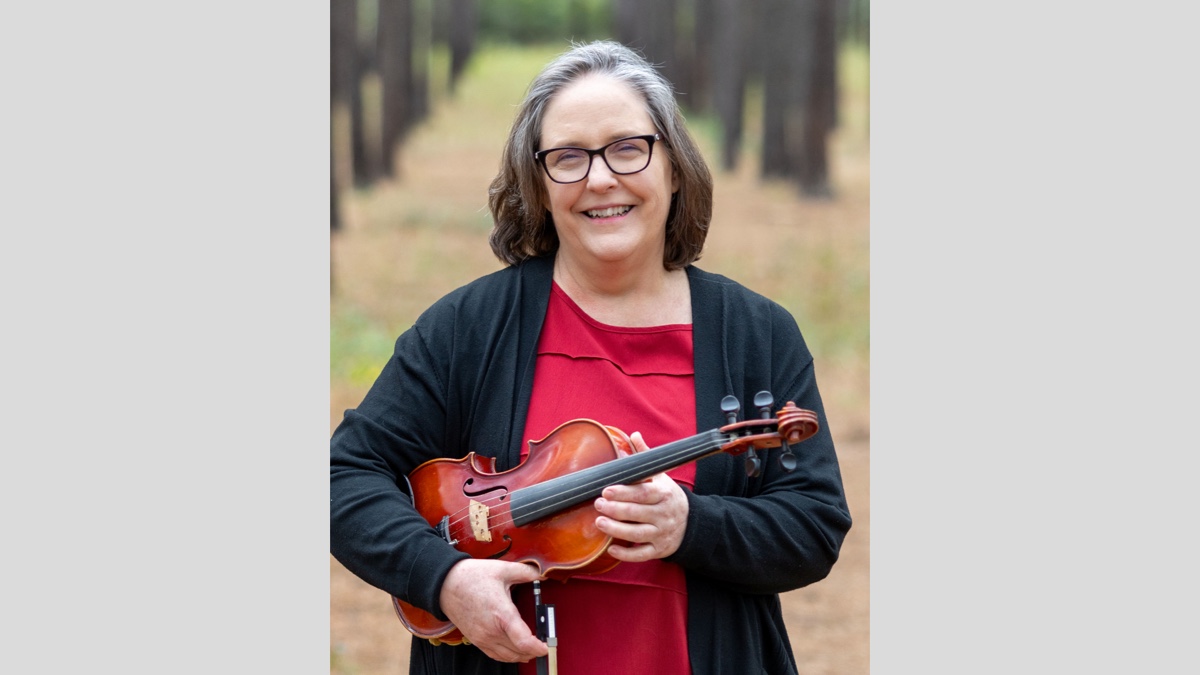
Diana Dow lives in Amarillo, TX, where she teaches private music lessons in her home, online, and at the local community college. She maintains a website about teaching Bible classes here, one about homeschooling here, and one about her music studio here. Diana can be reached here.


By Bruce Reeves
Synopsis: This article addresses a significant issue within our fellowship. In Ephesians chapter 4, the inspired apostle Paul emphasizes the importance of maintaining both a proper attitude toward our brethren and adherence to fundamental truths. Unfortunately, some brethren have a tendency to sacrifice doctrinal distinctiveness for superficial unity, which ultimately undermines the true foundation of unity. This is a crucial topic that warrants careful consideration and reflection.
In every generation, God’s people face pressures—both subtle and overt—to adapt the gospel to cultural expectations. The temptation to soften convictions in the name of progress, acceptance, or unity persists. Those who seek to revise, deconstruct, or dismantle biblical teaching often present themselves as insightful pioneers, yet in truth, they merely repackage old, recycled errors—which have been encountered and answered in times past.
False teaching seldom appears in a genuinely new form. It typically returns in waves, restyled with modern terminology and adapted to cultural preferences, but always following a familiar trajectory: the collapse of conviction, critical thinking, and the erosion of doctrinal clarity. What is sometimes celebrated as theological innovation is, in reality, a return to decrepit paths of compromise—paths that have led to spiritual destruction in the past and will do so again unless countered with the truth.
While we all desire oneness among believers, today’s doctrinal errors often come under the guise of bridge-building, unity, peace, and inclusivity. In practice, these ideas can become instruments of compromise—redefining truth in the name of tolerance and “unity in diversity.” This is nothing new. The apostolic warning endures: some “creep in unnoticed” (Jude 4), distort the gospel (Gal. 1:7), and gather followers who have “itching ears” (2 Tim. 4:3).
Ironically, many who profess a desire for a “unified brotherhood” are the very ones introducing division by advancing doctrines contrary to the truth. Paul cautioned that false teachers “by smooth talk and flattery. . . deceive the hearts of the naive” (Rom. 16:17-18). Such teachers exploit emotional touchstones, giving people what they desire rather than affirming the gospel truths they need. Their arguments are grounded in feelings and experiences rather than objective truth. Personal relationships can then lead some to defend error regardless of what is said, and those who object to what has been taught are vilified as “mean-spirited;” these are not abstract or hypothetical dangers, but real, active, present threats to the Lord’s people today.
Our unity is not merely relational; we find true spiritual fellowship when we meet at the word of God (Eph. 2:12-22; 1 John 1:3-7; 2 John 9-11). In a culture shaped by emotionalism and conflict avoidance, serious doctrinal discussions are frequently dismissed as divisive or unloving. However, faithfulness to the truth demands that we oppose error, no matter how it is framed (2 Tim. 2:24).
True peace and lasting unity cannot be built on ambiguous teaching. When the doctrine of Christ is softened to avoid offense, God’s people quickly lose their identity and mission. Apostasy rarely begins with open rebellion; rather, it starts with the quiet erosion of conviction. Over time, individuals who have privately held questionable views begin to voice them publicly, often emboldened by the inaction of others. Tragically, when gospel preachers, elders, and brethren in general choose to remain quiet, that silence becomes fertile soil in which false teaching can take root.
When error is tolerated under the banner of love and peace, the gospel message is diluted. Jeremiah warned against proclaiming “Peace, peace,” where there is no peace with God (Jer. 6:14). We must not mistake emotional comfort for spiritual soundness. Each of us bears responsibility to test the teachings we receive and to welcome examination of our own (1 Tim. 4:15-16; 1 John 4:1, 6; Jas. 3:1).
The current controversy among our brethren concerning the imputation of the righteousness of Christ, justification, and the role of grace, faith, and works in our salvation highlights the urgent need for open discussion and careful study. This need is not merely theoretical but has been brought to the forefront by specific claims among us. For instance, brother Matt Allen has asserted that “when God looks at those embracing His grace, He sees Jesus’ righteousness” (By Law or Grace, 46). While brother Allen frames this as a recovery of biblical grace, his language echoes longstanding Calvinistic doctrines (Matthew Allen, Justification, 64-65; R. C. Sproul, What Is Reformed Theology? 59-63; Charles Hodge, Systematic Theology, 3:145; James White, The God Who Justifies, 114; John Piper, Counted Righteous in Christ: Should We Abandon the Imputation of Christ’s Righteousness? 81-83).
The current issue is not peripheral. The doctrine of imputed righteousness touches the very heart of the gospel, for it reframes the basis of our standing before God. Brother Allen rightly insists that “justification is the cornerstone of our faith” (Allen, Justification, 66; cf. Sproul, Faith Alone, 95-113, What is Reformed Theology? 61-63). We may therefore say without hesitation that the question of imputation and justification—and the role of grace, faith, and works in our salvation—is not a minor theological nuance but a matter of fundamental conviction.
Brother Allen has been forthright in criticizing those with whom he disagrees on his blog, on social media, in Bible classes, and in sermons. It is therefore appropriate to offer a careful scriptural response, not only for his benefit but for the sake of those his teaching may influence. I have reached out to arrange a private meeting with brother Allen in an email I sent on December 28, 2023, but received no response. On July 1 of this year, I invited him to engage in a public discussion based on his published material. To date, my emails remain unanswered. Since his teaching has been public, it warrants a public response.
For transparency, here are the propositions I have offered for public study:
[Proposition 1]
Resolved: “The Scriptures teach that the sinner is actually made righteous in justification by faith.”
Affirm: Bruce Reeves | Deny: (Open for response)
[Proposition 2]
Resolved: “The Scriptures teach that justification in Christ is conditioned and dependent on the sinner’s personal obedience to the gospel.”
Affirm: Bruce Reeves | Deny: (Open for response)
These propositions arise from statements brother Allen has written for public consideration. Let us examine these matters openly and in the light of Scripture.
For example, he has written:
A better understanding is that justification does not mean “to make righteous” but “to be declared righteous” (Allen, Justification: The Basis Upon Which God Justifies Sinners, 64). Any belief system that ties justification to personal obedience and good works will lead to uncertainty about one’s salvation (Allen, Justification: The Basis Upon Which God Justifies Sinners, 65).
Such statements warrant careful analysis and open dialogue—not silence. This is not a personal dispute; it is a doctrinal issue that affects our foundational understanding of the gospel and salvation. Interestingly, brother Allen and those who share his views have charged faithful brethren with minimizing grace and overemphasizing the importance of obedience, yet have been reluctant to engage in a public, moderated exchange where both sides can be heard and the Scriptures can be deeply considered.
It has become common to hear, “Don’t label us; we’re just preaching grace,” even as they pejoratively stigmatize others: “Pharisee,” “legalist,” “law-dog,” advocates of “works-based salvation,” or “Galatianism.” Such double standards are unhelpful. Ambiguous labels like “legalist” often marginalize those who emphasize the need for faithfulness in teaching on these weighty and significant questions.
It is both inconsistent and concerning when those calling for unity use divisive labels to discredit questioners, yet take offense when their own teachings are accurately identified. Jesus did not rebuke the Pharisees because they emphasized obedience to God. Rather, He condemned their hypocrisy, duplicity, arrogance, and disobedience (Matt. 23). To call someone a “legalist” merely for insisting that obedience is essential to salvation is not only a misrepresentation, but an attempt to evade addressing the questions before us.
These maneuvers do not answer the serious issues under consideration. Calvinism, for instance, is not monolithic. There are “soft,” “low,” “moderate,” and “high” forms. Therefore, it is fair to ask whether brethren have adopted key Calvinistic tenets when they promote doctrines such as:
human inability to consistently resist sin
automatic and continuous cleansing of sins without confession and repentance
imputation or transfer of Christ’s personal righteousness to the believer
denial that faithful works of obedience are a condition for justification and salvation
Whether such views arise from unfamiliarity with Calvinism or a conscious effort to avoid scrutiny, the substance of any teaching must be weighed by Scripture and, if found wanting, should be refuted and rejected.
The core issue is not how a doctrine is described, but whether it aligns with God’s word. If our understanding of grace and law, faith and works, or justification and salvation is shaped more by K. C. Moser, John MacArthur, R. C. Sproul, Tim Keller, John Piper, or J. I. Packer than by Christ and His apostles, we must reevaluate our foundational assumptions. One can teach Calvinistic theology in part or in full, knowingly or unknowingly. The outcome is the same: error that leads Christians away from the truth and opens the door to a broader, more ecumenical approach to fellowship, weakening the distinctiveness of the gospel and purity of the Lord’s people. In the name of “grace” and “unity,” such compromise has historically led brethren to become dissatisfied with those who teach the truth and more comfortable with those who have departed from the New Testament pattern (2 Tim. 1:13; 1 John 2:19).
To be fair, brother Allen does not affirm inherited total depravity, and on that point we agree. However, in his comments under the heading “The Second Curse of Sin: A Sick, Diseased Sinful Nature” (Grace’s Double Cure, Lesson 11, Sunday Auditorium Class, February 25, 2024, 89), he frames acquired human depravity in striking terms:
. . .The Bible unmistakably speaks of our sinful nature. . . When we reach the age of accountability and choose to sin, we become spiritually depraved. . . when we yield to temptation and commit sinful deeds, we become evil. This produces a vicious cycle in us, as our sinful nature then gives rise to more and more sinful acts. . . A sinner is not just guilty concerning God’s law; he or she is sinful in his or her very nature or being.
Here, strong disagreement must be expressed. While sin devastates our relationship with God, and Adam’s sin brought physical consequences into the world (Gen. 3:16-19), the idea that we become sinful in our human nature is unbiblical. We may develop sinful habits, but such has not corrupted our “very nature or being,” nor is consistent obedience morally impossible. Scripture defines sin as the transgression of God’s law (1 John 3:4). Paul affirms that all have sinned (Rom. 3:9, 23) and that salvation is by grace through faith (Eph. 2:8-9); but to assert that we are sinful in our very being implies an ongoing slavery after conversion, which is contrary to the believer’s freedom in Christ (Rom. 6:3-11, 16-18).
Allen’s view closely resembles the Calvinistic understanding of human nature. R. C. Sproul wrote, “We are not sinners because we sin; we sin because we are sinners. . . our acts of sin flow out of this corrupted nature” (What Is Reformed Theology? 118). He goes on to expand on his view of human corruption: “We sin out of a kind of moral necessity because we act according to our fallen nature. We do corrupt things because we are corrupt people. This is the essence of what it means to be fallen” (Sproul, 123). This is the language of the staunchest of Calvinism’s defenders, yet such language has increasingly appeared among brethren in sermons, blogs, and class material. These concepts are not sustained by God’s word and ought to be corrected.
Some interpreters use Ephesians 2:3 to teach inherited corruption, while others argue that even faithful Christians retain an acquired sinful nature. In context, the term “nature” (phusis) refers to the sinful patterns of life characteristic of those outside of Christ. It could be appropriately described as a second nature learned through repeated sinful choices and habit (Thayer, Greek-English Lexicon of the New Testament, 660; cf. also BDAG, 1069-1070, s.v. “phusis”). Paul contrasts the former manner of life when we were living according to “the desires of the flesh and of the mind” outside of Christ with the gracious deliverance God provides in His Son (Eph. 2:1-10). Again, sin does not alter our human nature; rather, it changes our relationship with God (Isa. 59:1-2).
Paul’s series of quotations from the Old Testament in Romans 3 underscore the reality of sin and universal guilt (Rom. 3:19-20, 23). This, however, does not negate human moral capacity. Elsewhere, he affirms that men can “seek God” (Acts 17:27) and demonstrates that God does not allow superhuman or irresistible temptation (1 Cor. 10:13). To interpret Romans 3:23 as teaching an inescapable cycle of sin for the Christian misreads Paul’s point entirely, which is that the guilt of sin is universal and the availability of grace is through faith in Jesus (Rom. 3:24). Thus, Paul is affirming the reality of sin and our need for Christ’s forgiveness, but he is not teaching that man lacks the moral power to resist temptation.
One must read Romans 6-8 to appreciate the full context. Brother Allen argues that Romans 7 presents the Christian’s ongoing condition of necessary sinning and calls interpretations contrary to his own a “dangerous misunderstanding” after citing only two passages out of the immediate context (From Fear to Faith: Does Sin Still Dwell in the Christian, July 18, 2025). If he objects to this characterization, at least it must be acknowledged that this is the logical conclusion of his argument. Yet Romans 6 emphasizes freedom from sin’s dominion, and Romans 8 proclaims deliverance “in the law of the Spirit of life in Christ Jesus,” which frees believers from “the law of sin and of death” (v. 2). The person in Romans 7 is “sold under sin” and cries, “Wretched man that I am!” (vv. 14, 24). These descriptions are at odds with the liberated Christian of Romans 6 and 8 [Note #1].
Christians sometimes struggle in their battle against sin, but struggle is not bondage (1 John 1:5-2:2). The gospel proclaims release from slavery to sin, not lifelong imprisonment to its power (Rom. 6:17-18). To treat Romans 7 as the normative, necessary state of the Christian risks normalizing the very bondage from which the gospel frees us; the cry of despair in Romans 7:24 finds its answer in 8:1-4. It is interesting that brother Allen argues that the man of Romans 7 is simply struggling, not in despair. He writes: “That is not the cry of a lost man. That is the voice of a Spirit-led believer, one who longs to please God and yet feels the ongoing tension between the mind and the flesh. Romans 7 isn’t about despair; it’s about realism” (Allen, From Fear to Faith: “Does Sin Still Dwell in the Christian?” July 18, 2025). Yet the truth is quite the opposite. The man in Romans 7 is in slavery, not merely struggling [Note #2]. Readers should note that the Holy Spirit is not mentioned in Romans 7:14-25, whereas He is mentioned fourteen to seventeen times in the following chapter. This is compelling, as Paul is describing the non-Christian in Romans 7, and the faithful child of God in Romans 8. While there is room for discussion among brethren regarding this chapter, there is not room to argue that faithful Christians have an acquired sinful nature and cannot consistently resist temptation to sin.
Many with a Calvinistic background reduce justification to a merely forensic verdict in which God declares sinners righteous although sin remains in them. Biblically, to “justify” is to put one right with God; believers are declared righteous because their sins are forgiven and they receive the benefits of Christ’s death and resurrection (Rom. 4:1-8; 5:1-11; 6:3-11; Heb. 10:10, 14). Paul cites Psalm 32: “Blessed are those whose lawless deeds are forgiven. . . Blessed is the man against whom the Lord will not count his sin” (Rom. 4:7-8). Declaration and deliverance belong together. We are counted righteous by God because He has forgiven us of our sins.
Brother Allen writes:
Justification is not about becoming inherently righteous or perfect but about being declared righteous by God. . . We must distinguish between justification (being declared righteous) and sanctification (becoming more like Christ) (Allen, Justification: The Basis upon Which God Justifies Sinners, 65).
However, the apostle Paul says: “Through the obedience of the One the many will be made righteous” (Rom. 5:19; cf. Phil. 2:8). In Scripture, God’s declarative act of justification reflects the reality accomplished in Christ; we are declared righteous because God truly makes us right with Himself by forgiving our sins, reconciling us to Himself, and cleansing us. Brother Allen repeatedly insists that justification does not mean to be “made righteous,” yet in the passage under consideration, Paul states the exact opposite. Just as we are truly made sinners by following in the footsteps of Adam (Rom. 3:23), so we are truly made righteous by obeying the gospel of Jesus Christ (Rom. 5:19). To attempt to deny that this verse speaks of justification is a distortion of the text.
When the Lord declares us righteous, this is not merely a legal declaration, but a reality grounded in the cleansing power of the blood of Christ. Scripture affirms that justification is more than an external pronouncement; it involves the transformation of the inner person. The Hebrew writer says that the blood of Christ “cleanses our conscience from dead works” (Heb. 9:14), and that through His offering we have been “sanctified. . . once for all” (Heb. 10:10, 14). This shows that God’s declaration of righteousness is inseparably tied to the moral and spiritual renewal that His grace accomplishes. Justification, therefore, is not a hollow verdict, but a divine declaration of the true cleansing we have in Christ. The hard and fast distinction between justification and sanctification is well known among denominational writers, but it is not found in Scripture (1 Cor. 6:9-11).
Classic Reformed voices explicitly make the merely forensic argument: “When righteousness is imputed to the believer, he does not thereby become subjectively righteous” (Hodge, Systematic Theology, 3:145); “It [justification] produces no change in the individual. . . it simply alters his relation to the law” (White, The God Who Justifies, 114); “We are just by imputation, even while sin remains in us” (Sproul, Faith Alone, 102). Likewise, brother Allen teaches “justification does not mean ‘to make righteous’ but ‘to be declared righteous’” (Allen, Justification, 64).
Critics have rightly called this a “legal fiction” because it reduces justification to a mere legal declaration. While it is true that the term “justification” on some level refers to such, it is so much more. The Bible binds justification to forgiveness, reconciliation, and the new life. The hard distinction between justification and sanctification is found in Calvinistic teaching, but not in Scripture (1 Cor. 6:9-11). The Bible never separates saving faith from an obedient response. The “obedience of faith” stands as bookends in Romans to emphasize the theme of the entire epistle (1:5; 16:26). Penitent believers confess Christ and are baptized into His death and raised with Him to spiritual life (Acts 2:38; 22:16; Rom. 6:3-4; 10:9-10). To this point, brother Allen has written, “Any belief system that ties justification to personal obedience and good works will lead to uncertainty about one’s salvation” (Allen, Justification, 65). This statement divorces what God has inseparably joined to our justification and fails to appreciate the assurance found in the sufficient sacrifice of Christ and the forgiveness it provides (Rom. 5:6-11).
Brother Allen further argues:
Some wrestle with the idea that justification means to be made righteous. . . Justification isn’t about us becoming righteous through our actions, but about being declared righteous because of Jesus’ action at Calvary. It’s not an internal transformation of character but an external adjustment in our legal standing before God (Allen, Acquitted: The Complete Forgiveness of Justification, Feb. 2, 2024).
Yet elsewhere he acknowledges that faith, repentance, confession, and baptism are acts of obedience (Allen, Baptism and Grace, 81). Jesus identifies believing itself as a work of God (John 6:28-29). Peter says to Cornelius as a non-Christian, “In every nation anyone who fears Him and works righteousness is acceptable to Him” (Acts 10:35). Peter then preaches forgiveness in Jesus’s name (10:43) and commands baptism (10:48). James is explicit: “A person is justified by works and not by faith alone” (Jas. 2:24). Paul’s contrast is not between “anything you do” versus “faith;” it is “works of the Law” as a system of justification versus the “obedience of faith” to the gospel of Christ (Rom. 1:5; 3:27; 4:12; 6:16-18; 16:26).
Our brother again tries to resolve the tension by saying, “Works flow from faith. They are not the prerequisite for salvation but the product” (Allen, Balancing Faith and Works, Dec. 18, 2023). However, the “works” or “working” of an obedient faith in repentance, confession, and baptism are not post-salvation proofs; they are God-ordained conditions for entering Christ (Acts 2:38; Rom. 6:3-4; Gal. 3:26-27). We must recognize the biblical harmony of the gospel: salvation is by grace through faith, and that faith repents, confesses, and is baptized; thus it is “faith working through love” (Gal. 5:6). If we agree that this is the case, how could one argue that there are no actions or works on our part that are prerequisites for justification? These conditions are met by those who love the Lord. How can we accept the notion that Abraham was justified by faith, not by his actions? This does not fit with the nature of an active faith and the conditions of the gospel for the sinner to be justified before the Lord.
Brother Allen also teaches an unbiblical view of imputation—the transfer of Christ’s perfect life to the believer—the very mechanism that empowers Calvinistic theology.
The essence of grace is a profound exchange. . . it’s as if Jesus swapped places and identities with us. On the cross, God saw our sins in Jesus and inflicted our deserved punishment on Him. Consequently, when God looks at those embracing His grace, He sees Jesus’ righteousness (Allen, By Law or Grace, 46).
Our brother goes on to say that Christ “allowed our sins to be counted as His own” (Allen, “Penal Substitution,” 22).
This is not “soft Calvinism;” rather, it reflects core principles of Classic Calvinism. Sproul states: “God declares Christ to be ‘guilty’ of sin after the Son willingly bears for His people the sins that are imputed or transferred to Him. . . this is the heart of the NT message” (Sproul, 104). K. C. Moser, on whom brother Allen admittedly relies heavily, wrote: “The obedience of Christ becomes the righteousness of the believer. . . Christ is his righteousness” (The Way of Salvation, 118). To argue that God literally “sees our sins in Jesus” and that “He made our sins His own” is blasphemous.
Scripture never teaches that our personal sins or guilt were transferred to Christ, nor that Christ’s perfect law-keeping was transferred to us as our own moral record. Christ “bore our sins” by offering Himself as the sin-bearing sacrifice (Isa. 53:10-12; Heb. 10:10-14; 1 Pet. 2:24; 3:18) so that our sins might be forgiven. Paul’s statement that “He made Him who knew no sin to be sin for us” (2 Cor. 5:21) is best understood as “sin-offering,” a well-attested sacrificial usage of hamartia in the LXX and New Testament (Garland, 297-298; BDAG, 50-51, s.v. “hamartia”). The result is not that Jesus “swapped. . . identities with us.” He brought about reconciliation through His sacrifice, providing real cleansing, justification, and sanctification for all those who obey the gospel (Rom. 3:24-26; 1 Cor. 6:9-11). Peter writes, “He Himself bore our sins in His body on the cross, so that we might die to sin and live to righteousness; for by His wounds you were healed” (1 Pet. 2:24).
Historically, “exchange” language has functioned to minimize doctrinal boundaries and widen fellowship as the essential mechanism for Calvinistic theology. Arnold Hardin rejected the label “Calvinist,” but then openly embraced the Calvinistic model of imputation, teaching that the “perfect life of Christ. . . [is] credited to his account” (The Persuader, Vol. XIII, No. 1). In the present controversy, we have observed similar responses. One may deny being a “Calvinist,” even ridiculing the meaning of “soft Calvinism,” while yet strongly advocating Calvinistic ideas [Note #3].
Another Calvinistic assumption is the idea of automatic, continuous cleansing for Christians without confession. Yet the apostle John ties forgiveness to clear conditions: cleansing comes as we “walk in the light” and “confess our sins” (1 John 1:7, 9). When Simon sinned after baptism, Peter did not say, “Your ongoing status covers this automatically,” but “repent of this wickedness of yours, and pray. . . that the intent of your heart may be forgiven you” (Acts 8:22). God’s grace is abundant, but the covenant pattern is clear: sin is forgiven as we turn from it and seek God’s pardon (2 Cor. 7:10-11). Peter required Simon the sorcerer, after his sin, although a Christian, to “repent. . . and pray. . . that the intent of your heart may be forgiven you” (Acts 8:12-13, 22). To claim otherwise is to normalize sin in the life of a disciple and to undermine the biblical conditions of forgiveness. As Paul insists, grace is never a license to continue in sin (Rom. 6:1-2). In practice, the continuous cleansing doctrine erodes accountability, minimizes the seriousness of sin, and removes the urgency of repentance—ultimately contradicting, mischaracterizing, and diluting the very warnings of Scripture against falling away in the name of “grace” and “assurance.”
Ben M. Bogard, a well-known Baptist preacher, argued for continuous cleansing in defending the Calvinistic doctrine of the “Impossibility of Apostasy.” In a sermon entitled “Love’s Obligation,” he wrote:
He keeps them constantly clean by Jesus’ blood, 1 John 1:7. Constant cleansing is our portion. The blood is upon us all the time and hence the impossibility of sin making a stain or mark. They are kept so safe that none of His children ever leave Him (Ben Bogard, Sermon Outlines, 6).
The blood of Christ is constantly available to the Christian, but it is accessed through repentance, confession, and prayer according to the New Testament (Acts 8:22; 1 John 1:9). John does not tell us simply to confess that we are sinful, but to confess our “sins.” This is not a matter of remembering the time, place, and date of our sin, but it is a matter of being sensitive to sin and turning away from it. While our brethren would not go so far as Ben Bogard, that is the logical conclusion of the teaching and sounds much like the things we are hearing from some pulpits within our fellowship.
Brother Allen traces his emphasis on grace to K. C. Moser and references mid-20th-century “grace-unity” writers of the 1960s and 1970s (e.g., Carl Ketcherside, Edward Fudge, Leroy Garrett, Bruce Edwards, Arnold Hardin, etc.) [Note #4]. The record of these movements shows the predictable trajectory when “personal obedience” is disconnected from justification. As Dub McClish observed of K. C. Moser, we are dealing with “Calvinism-lite, antinomian tendencies, imputed righteousness, and a direct-operation soteriology” (McClish, Commentary and Review of K. C. Moser’s The Way of Salvation and The Gist of Romans, 2021). This sounds quite familiar, does it not? Errors regarding a modified version of Calvinistic teachings, the imputation of the personal righteousness of Christ to believers, and a direct operation of the Holy Spirit in salvation are present today, but they are not new.
Both K. C. Moser, in his book, The Gist of Romans, and some brethren today, have accepted faulty definitions of biblical terms that will only lead to unscriptural conclusions. Paul does not define “works” in Romans as “anything you do,” nor does he define “faith” as “non-doing trust.” While it is true that Abraham was not justified by flawless performance (Rom. 4:1-4), neither was he justified without a working, obedient faith (Jas. 2:21-24). Paul and James each appeal to Genesis 15:6 as the principle of a life that trusts God by acting on His word. This is why the verse is applied to various moments in Abraham’s life (Rom. 4:3, 9, 22; Gal. 3:6-9; Jas. 2:21-23). Yet brother Allen argues that “Abraham’s righteousness was credited to him because of his belief, his faith, not his actions,” and “good works are the result of salvation, not a prerequisite for it.” These concepts reflect Reformed and Calvinistic categories rather than the New Testament pattern in conversion.
The notion that Paul is not describing what Abraham did in Romans 4 is a fundamental denial of what the text says and how Paul defines faith [Note #5]. It also ignores the clear teaching of Romans 4:12 when the apostle encourages us to walk in the steps of our father Abraham. When one defines grace, faith, justification, righteousness, imputation, and works as our Calvinistic friends do, rather than the way Paul does, we should be highly concerned. Simply denying that one is teaching Calvinism, while continuing to advance Calvinistic concepts, does not resolve the problem.
History provides sobering confirmation of our legitimate concerns. When doctrinal clarity gives way to ecumenical union, the result has always been wholesale denominational assimilation. What begins as a push for “unity” ends with a rejection of biblical authority.
This drift is not merely doctrinal but also practical. The objective is to broaden fellowship on many levels. Congregations begin to embrace those who have never obeyed the gospel in scriptural baptism and open their pulpits to those who have departed from the biblical pattern in the worship and work of local churches. In such a climate, error is no longer refuted but welcomed under the banner of “grace.” Instead of Paul’s warning, “Do not be conformed to this world” (Rom. 12:2), a spirit of compromise begins to reign.
In short, the line between faithful congregations of God’s people and the Protestant denominational world blurs until it disappears altogether. What begins with the rhetoric of “fresh grace theology” ends with the abandonment of the gospel’s distinctive call to repent, be baptized, and walk faithfully in Christ. If history teaches us anything, it is that compromise never ends in renewal, but always in apostasy. This is not a case in which departure may happen; it has already happened and threatens to get worse.
Brothers and sisters, it does not have to be this way. Let us teach the whole counsel of God—correcting and refuting error, and also exhorting and encouraging one another in the love of the Lord Jesus Christ as we abide in His teaching and pattern (2 Tim. 1:13; 2 John 9-11). We must proclaim the transforming power of God’s grace and the eternal value of His truth.
[Note #1] It is revealing when some act as though the interpretation of Romans 7 as describing the despair of a man living under the Law, rather than the experience of the Christian, is unworthy of serious consideration. While there is room for discussion on the matter, to suggest that this perspective lacks contextual foundation betrays a disregard for the depth of historical and exegetical scholarship behind it. Far from being a fringe view, this interpretation has been advanced by notable thinkers throughout church history and respected modern commentators. Scholars who support this understanding include Ernst Käsemann (Romans, 1980), James D. G. Dunn (WBC: Romans 1-8, 1988), Douglas J. Moo (NICNT: Romans, 1996), Robert Jewett (Hermeneia: Romans, 2007), N. T. Wright (Paul and the Faithfulness of God, 2013), Richard B. Hays (Echoes of Scripture in the Letters of Paul, 1989), Anthony C. Thiselton (Romans Through History and Culture, 2007), J. Louis Martyn (Theological Issues in the Letters of Paul, Romans Through History and Culture, 2007), Michael J. Gorman (Romans: A Theological Pastoral Commentary, 2022).
[Note #2] Regardless of one’s view of this chapter, to assert that the term “flesh” (sarx) should be translated “sinful nature” has been dispelled by even the 2011 edition of the NIV.
[Note #3] There has been a defense by some that one is only teaching that which is Calvinistic if he affirms the entire system of High or Classic Calvinism, i.e., TULIP. This is a gross misunderstanding of how influential these doctrines can be, even on those who do not accept the entire theology. Informed Calvinists recognize that there are different shades of Calvinistic thought. Would that some of our own brethren were as perceptive. If one is teaching the mechanism of Calvinism and several of the tenets of this theological system, it is concerning because it is unbiblical and logically leads to other errors. Many of our denominational friends reject a few of the doctrines of Calvinism but accept most of them, and historically, we have seen these same tendencies in those among us who wanted to broaden fellowship unscripturally.
[Note #4] Brother Steve Wolfgang rightly noted to me that the phrase “Grace-Unity” was misapplied to the movement in the 1960s and 1970s, as it neither reflected biblical grace nor fostered scriptural unity.
[Note #5] As Matt Allen has written, “Abraham’s righteousness was credited to him because of his belief—his faith—not his actions” (Allen, From Fear to Faith blog, n.d.). In this framework, Romans 4 is taken as excluding Abraham’s faithful works from justification, reducing the text to a declaration about belief alone.
Allen, Matt. Appreciating Our Salvation. n.p., n.d.
________. “Balancing Faith and Works.” From Fear to Faith (blog). n.d.
________. “By Law or Grace.” Week 5 class material. Centerville, OH: Cornerstone church of Christ, n.d.
________. “Complete Forgiveness of God.” From Fear to Faith (blog). n.d.
________. “Grace’s Double Cure.” Lesson 11. Sunday Auditorium Class. February 25, 2024.
________. “Justification: The Basis upon Which God Justifies Sinners.” From Fear to Faith (blog). n.d.
________. “Penal Substitution.” Class notes, December 2023.
Arndt, William, Frederick W. Danker, and Walter Bauer. A Greek-English Lexicon of the New Testament and Other Early Christian Literature. 3rd ed. Chicago, IL: University of Chicago Press, 2000.
Bird, Michael F. The Saving Righteousness of God: Studies on Paul, Justification and the New Perspective. Eugene, OR: Wipf & Stock, 2007.
Bruce, F. F. The Epistles to the Colossians, to Philemon, and to the Ephesians. New International Commentary on the New Testament. Grand Rapids, MI: Eerdmans, 1984.
Brueggemann, Walter. The Message of the Psalms. Minneapolis, MN: Augsburg, 1984.
Garland, David E. 2 Corinthians. New American Commentary. Nashville, TN: B&H, 1999.
Gorman, Michael J. Romans: A Theological and Pastoral Commentary. Grand Rapids, MI: Eerdmans, 2022.
Hardin, Arnold. The Persuader. (Aug. 23, 1977); Vol. XIII, No. 1.
Harris, Murray J. The Second Epistle to the Corinthians. New International Greek Testament Commentary. Grand Rapids, MI: Eerdmans, 2005.
Hays, Richard B. Echoes of Scripture in the Letters of Paul. New Haven: Yale University Press, 1989.
Hodge, Charles. Systematic Theology. Vol. 3. Grand Rapids, MI: Eerdmans, 1979 reprint.
Jewett, Robert. Romans: A Commentary. Hermeneia. Minneapolis, MN: Fortress Press, 2007.
Käsemann, Ernst. Commentary on Romans. Translated and edited by Geoffrey W. Bromiley. Grand Rapids, MI: Eerdmans, 1980.
Lard, Moses E. Commentary on Paul’s Letter to the Romans. Nashville, TN: Gospel Advocate, 2001 reprint.
Martyn, J. Louis. Theological Issues in the Letters of Paul. Nashville, TN: Abingdon Press, 1997.
McClish, Dub. Commentary on and Review of K. C. Moser’s The Way of Salvation and The Gist of Romans. Spring, TX: Spring Lectureship Series, 2021. Link
McGarvey, J. W. A Treatise on the Eldership. Lexington, KY: Transylvania Printing, 1870.
Moo, Douglas J. The Epistle to the Romans. NICNT. Grand Rapids, MI: Eerdmans, 1996.
Moser, K. C. The Way of Salvation. Austin, TX: Firm Foundation, 1932.
Piper, John. Counted Righteous in Christ: Should We Abandon the Imputation of Christ’s Righteousness? Wheaton, IL: Crossway, 2002.
Schreiner, Thomas R. Romans. Baker Exegetical Commentary on the New Testament. Grand Rapids, MI: Baker, 1998.
Sproul, R. C. Faith Alone: The Evangelical Doctrine of Justification. Grand Rapids, MI: Baker, 1995.
________. What Is Reformed Theology? Grand Rapids, MI: Baker, 1997.
Thayer, Joseph H. Greek-English Lexicon of the New Testament. Grand Rapids, MI: Zondervan, 1977 reprint.
Thiselton, Anthony C. Romans Through History and Cultures: A Hermeneutical Perspective. Grand Rapids, MI: Baker Academic, 2007.
White, James R. The God Who Justifies. Minneapolis, MN: Bethany House, 2001.
Whiteside, R. L. A New Commentary on Paul’s Letter to the Saints at Rome. Denton, TX: Cogdill Foundation, 1988.
Wright, N. T. Justification: God’s Plan and Paul’s Vision. Downers Grove, IL: IVP Academic, 2009.
________. Paul and the Faithfulness of God. 2 vols. Minneapolis, MN: Fortress Press, 2013.
Bruce Reeves has labored with the Highway 65 church of Christ in Conway, AR, since 2000. He and his wife, Rachel, have one child. The church website is here. He can be reached here.




By Shawn Chancellor
Synopsis: The building of the ark demonstrates that pattern theology does not undermine grace, love, or zeal; rather, from Noah’s example, we learn that God’s patterns are the result of His grace and channel our love and zeal in a way that allows us to have an intimate relationship with Him.
In our study so far, we have noted that Jehovah is a God of order who reveals Himself through a grand narrative, while also communicating through patterns. Thus, it is appropriate for us to seek to know Him through the story while also looking to Scripture for patterns to direct us in carrying out His will.
We have also noticed that when men abandon God’s patterns, the world becomes chaotic. God ordered His creation for perfect fellowship with Him, providing a pattern for eternal life. Man abandoned that pattern, and the result was chaos and death. This is the lesson of the flood narrative. God formed Israel to be His covenant people. They needed to understand that life was found within the pattern of that covenant, and outside of it, there was spiritual death. The same is true of the church today. In the body of Christ, we find eternal life, fellowship with God, and all the blessings of salvation. Outside of God’s pattern for the church, we see chaos and spiritual death.
In Genesis 6:14-17, we find the dimensions of the ark, the type of wood, the general structure, and instructions for waterproofing. We learn that it was to have a door and a window, three levels, and rooms throughout. While not a complete blueprint, when Noah did “all that God had commanded him” (Gen. 6:22), the result was a boat that allowed him to survive the flood.
The dimensions of the ark were approximately 450 feet long by 75 feet wide and 45 feet high. This is roughly 97,000 square feet—the size of twenty basketball courts. These dimensions maximize the comfort, stability, and strength of a seafaring vessel, even by today’s standards (Lovett, “Thinking Outside the Box: Size and Shape of the Ark”).
Furthermore, the ark would have been sufficient to carry the animals, people, and supplies necessary for the voyage. The biblical term kind is often understood to equate to the family level in modern taxonomy. At the family level, the total number of living and extinct land animals and birds is approximately 1,400. By this measure, it’s estimated that about 7,000 animals were on the ark. The average size of all land animals ever known to exist is roughly that of a sheep. It is logical to assume that many of these animals would have been very young to save space and care (Belknap & Chaffey, “How Could All the Animals Fit on the Ark?”). The cubic footage of the ark would have comfortably accomodate all of these animals, along with supplies, with considerable space left over. Scripture affirms the ark’s sufficiency by noting that after spending a year aboard, Noah and the animals survived the flood (Gen. 7:11; 8:13-19).
God’s patterns allow us to participate in and express our relationship with Him. We see this from the beginning in the creation of man as an image bearer (Gen. 1:26-27). This principle is found in the pattern for the temple, which was to be a visible reminder of God’s fellowship with Israel. We see this again in the pattern of the church, designed and created by God, wherein both man and God can dwell together in “a holy temple. . . the dwelling of God in the Spirit” (Eph. 2:13-22). It is only when God’s patterns shape our will and our actions that we truly express our relationship with Him.
It is also important to note that the pattern of the ark took into account Noah’s abilities (Gen. 6:22). Notice that God did not ask Noah to do anything he was incapable of doing (for example, the pattern did not include an engine). The pattern was also broad enough for Noah to utilize his own talents and ingenuity to serve God. There is no commandment regarding how Noah was to fell and transport the timbers used in the ark, or how to cut and join the boards. God left these details in the realm of liberty, allowing Noah freedom of choice.
When we understand that building the ark required Noah’s faith, labor, and ingenuity, we see that divine patterns are designed for active human participation, not passive compliance. Rather than promoting cold formalism, a proper understanding of patterns in Scripture enables us to participate in a relationship with God through divine wisdom.
We see this principle in many divine patterns. For example, the pattern of marriage—one man for one woman—is unalterable. However, we are at liberty to choose our own spouse. Furthermore, when we delve more deeply into what God says about marriage, we find that marital partners should love and respect each other as well as aid each other in their spiritual development. When we understand the importance of the elements of this pattern, we choose carefully whom we wed. The pattern itself is intended to bring us closer to God and provide us with an intimate relationship that helps us navigate this life.
There is a pattern describing the work, worship, and organization of the local church. Within that pattern, there is considerable liberty and room for individuals to bring their personal talents and abilities to bear. We also see that the pattern of the local church includes love for one another and concern for each other’s spiritual welfare (Heb. 10:23-25).
Too often, this is how the difference between the Old and New Covenants is expressed. We often speak of the Old Testament as a list of laws that were too burdensome to fulfill. Many speak of the New Testament in terms of grace (often grace alone), in which obedience is more a result than a necessity. However, we consistently see people in the Old Testament relating to God through His established patterns (Gen. 6:22; Exod. 25:9, 40; 40:16, 19, 23, 25, 27, 29). The assumption is that the Old Testament pattern required sinless perfection, but this is contradicted by the examples of men like Abraham and David (Rom. 4:3, 6-9). Far from being an impossible burden, the divine pattern is a complete guide that shows us how to act justly before God (Micah 6:8), love Him completely (Deut. 6:5; Luke 10:27), and find redemption when we fail (Acts 2:37-38).
Pattern theology is often described in terms of strict, rigid obedience. It is frequently set in contrast to concepts like grace, mercy, and love. However, in Genesis 6, we see that adherence to pattern and divine grace are far from incompatible.
Genesis 6:9 describes Noah from three perspectives. First, we see that he was righteous, which describes his relationship with the moral law under which he lived. Second, he was “blameless in his time.” This statement describes his relationship to the world around him and demonstrates that he stood alone in terms of his character. Finally, we are told that he “walked with God.” We should point out that this verse in no sense indicates Noah was sinlessly perfect, and more importantly, Noah could not, through his actions alone, save himself from the flood. Noah’s salvation was found in God’s grace.
This grace was manifested in the pattern for the ark, “in which a few, that is, eight persons, were brought safely through the water” (1 Pet. 3:20). Outside of the ark was judgment and destruction. Inside the ark was life—life made possible through the pattern God gave. “Thus Noah did according to all that God had commanded him, so he did” (Gen. 6:22).
No sooner does God give Noah the pattern for the ark than He enters into a covenant with him (Gen. 6:18). Throughout Scripture, God uses covenants to share His grace. These typically consist of divine promises and human expectations (Exod. 19:3-6). This is precisely what we see in Genesis 6:18. The promise of the covenant was salvation from the flood. The covenant was conditioned on Noah building the ark according to God’s pattern.
As previously noted, Peter draws a direct comparison between our salvation and Noah’s. In 1 Peter 3:20-21, we find that baptism is an antitype of the ark. Just as Noah was saved by grace through faith, we are saved by the grace of God shown on the cross and faith in the gospel. Just as Noah was saved from the flood in the ark, we are saved from sin in baptism. Just as Noah was saved by the power of God, not a boat, we are saved by the power of God, as seen in the resurrection of Jesus—not by water.
Likewise, we see a pattern in the New Testament for the work and worship of the church. In 1 Timothy 3:15, Paul tells Timothy, “I write so that you will know how one ought to conduct himself in the household of God. . .” The letter addresses a wide range of subjects, ranging from the role of women in the assembly (1 Tim. 2:11-12) to how one should confront an elder who is in sin (1 Tim. 5:19-20). We will explore this pattern in more detail in upcoming discussions, but for now, notice this pattern allows the church to maintain its focus as “the pillar and support of the truth” (1 Tim. 3:15).
When my wife and I were expecting our daughter, we decided to decorate the nursery in a Noah’s ark theme. Bonnie began gathering samples of various wallpapers, borders, and pictures. As we sorted through the samples, we quickly noticed a theme. It seemed that none of the artists had actually read Genesis 6. The ark was depicted with multiple doors and windows. Animals were often seen poking their heads out or walking about on the deck of the ship. The ark was always the color of finished wood; it certainly did not look to be covered with pitch. It became a bit of a joke between us to hold up a sample and shout, “This boat won’t float.”
I doubt a biblically accurate ark would make a great theme for decorating a nursery (we went with teddy bears). However, it does illustrate an important point. If Noah had built the ark according to his own desires, he would not have survived the flood. The text of Genesis 6 draws a clear distinction between the rebellious world, which was lost, and the obedient man, who survived. By adhering to the pattern, Noah demonstrated he was not like the rebellious world; he kept his covenant with God, and “he was blameless in his time” (Gen. 6:9).
[Note #1] “Noah’s Ark was the focus of a major 1993 scientific study headed by Dr. Seon Hong at the world-class ship research center KRISO, based in Daejeon, South Korea. . . The research team found that the proportions of Noah’s Ark carefully balanced the conflicting demands of stability (resistance to capsizing), comfort (‘sea-keeping’), and strength. In fact, the Ark has the same proportions as a modern cargo ship. . . The study also confirmed that the Ark could handle waves as high as 100 ft (30 m)” (Lovett, “Thinking Outside the Box: Size and Shape of the Ark”).
Belknap, Michael, and Tim Chaffey. “How Could All the Animals Fit on the Ark?” Answers in Genesis, April 2, 2019. https://answersingenesis.org/noahs-ark/how-could-all-animals-fit-ark/
Lovett, Tim. “Thinking Outside the Box: Size and Shape of the Ark.” Answers in Genesis, March 19, 2007. https://answersingenesis.org/noahs-ark/thinking-outside-the-box/
Shawn Chancellor has worked with the South Georgia Street church of Christ in Amarillo, TX, since 2014. He and his wife, Bonnie, have one daughter and were recently blessed with their first granddaughter. The church website is here. He can be reached here.


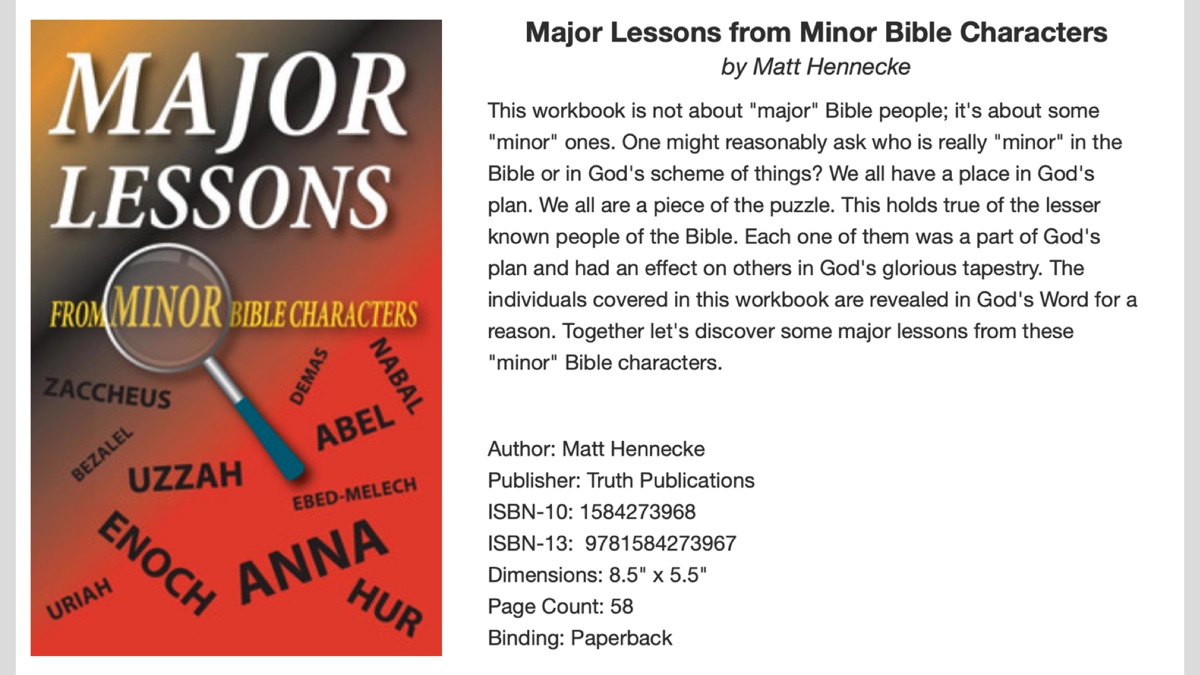
By Bobby Graham
Synopsis: The article explores four key questions about the account of the rich man and Lazarus: It affirms the existence of an intermediate state after death, where spirits await final judgment in a temporary realm distinct from eternal punishment. The “great gulf” described in the story represents an unbridgeable separation between the righteous and unrighteous in the hadean realm. At resurrection, believers will receive a transformed, spiritual body, while in the intermediate state, spirits exist without physical bodies. The article concludes that Jesus’s resurrected body was physical, retaining the marks of His crucifixion and interacting with others, which qualified the apostles as witnesses to His resurrection.
Some time ago, I received a group of related questions about Luke’s account of the rich man and Lazarus in Luke 16. I answered the basic one concerning the account’s nature—whether historic or parabolic. In this article, I wish to address the other questions:
How can we know there is an intermediate state?
What is the “great gulf” mentioned in Luke 16?
When we are resurrected, will we have a new, spiritual body? Before the resurrection, are spirits in the realm of the dead disembodied, or is there some kind of body for that state of being?
What was the nature of the body of Jesus after He was resurrected? Was it the body He had before His death or some kind of spiritual body?
When Jesus died, His soul went into Hades, not heaven. According to Acts 2:31, “His soul was not left in Hades, nor did His flesh see corruption.” We also know from Jesus’s statement to the penitent thief that both the Savior and the thief went to paradise, which apparently describes the part of Hades named Abraham’s bosom (Luke 23:43). From the record of the rich man and Lazarus in Luke 16:19-31, we learn that the rich man was “in torments in Hades,” while Lazarus was in Abraham’s bosom.
Thayer and other Greek experts indicate that hadēs is “the common receptacle of disembodied spirits.” In other words, spirits who have left their earthly bodies at death abide in Hades temporarily until the final judgment. Their partition of Hades (the realm of the unseen) is determined by their earthly life, because both the righteous and the unrighteous are found there, as seen in the passages cited in this answer.
Jesus was in the Hadean realm far shorter than most, because of His approaching resurrection, which the Father had planned for Him. To be clear, Hades is not Hell, which is a translation of gehenna, meaning the eternal abode of the wicked—a place of eternal fire, the opposite of heaven (Matt. 18:8; 25:46). Further, it can be seen that Hades is temporary in Revelation 20:14-15, for it will be destroyed, and the lost therein will be cast into the lake of fire for eternal punishment.
The great gulf fixed between Abraham’s bosom and the tormented rich man in Hades simply means a gaping opening or chasm (Thayer), which was not passable or movable. Luke’s medical background might be the basis for his use of this word, which sometimes meant the large cavity in a wound.
This great gulf separated the rich man from the beggar Lazarus, somewhat like their separation from each other occasioned by life’s circumstances. Lazarus had little, while the rich man had much. The latter fared sumptuously, but the former begged crumbs from the table of the other. The second wore expensive linen clothes, but the poor beggar had sores that were exposed to the community dogs.
What a difference they bore both in this life and in their latter state pictured in Luke 16:19-31. While their separation was great, it did not prevent the rich man from seeing Lazarus and Abraham, who were “afar off” from him in that other world. Of course, seeing Lazarus in his state of bliss did not help the rich man feel any better. He knew—and was also reminded by father Abraham—that his good things of earthly life were now replaced by his tormented condition.
Those who drift through life unmindful of God’s goodness and care—and thus heedless of His instructions—should awaken from their spiritual sleep of indifference, lest they eventually go to the rich man’s place of torment. Once there, no one can move to another, more desirable state, because there is no migration in either direction. The rich man learned that lesson too late to help him!
Under the then-current covenant of Moses’ Law, the rich man’s five brothers could do no better than listen to Moses and the prophets, God’s instructors of that economy. A thunderous lesson resounds from that account down to our own day: such spiritually deaf people will give no more heed to one arising from the dead (like Jesus during His forty days after arising) than they give to the vital, life-giving words coming from God!
Certainly, this exhaled encomium attributed to the Scriptures—whatever the covenant might be—ought to cause all humans to reconsider their attitude and position in life in relation to the word of God. After all, it will confront us in the last days (John 12:48).
When we are resurrected, we will have a new, spiritual body. Before the resurrection, are spirits in the realm of the dead disembodied, or is there some kind of body for that state of being?
Answer: The individual asking these questions is correct in saying that the new body will come at the resurrection, because both Paul and John taught that the body of each one will be changed, whether dead or alive, when the Lord comes again (Phil. 3:20-21; 1 John 3:2). Paul’s explanation provides us with more detailed information concerning the transformation of the body in 1 Corinthians 15:35-49.
The following sub-points contrast the three states of existence: Earthly, Intermediate, and Eternal.
EARTHLY EXISTENCE → PHYSICAL DEATH → CHRIST’S RETURN
Our physical bodies gradually weaken with age.
When we die, our bodies will return to dust.
When Christ returns, we will be raised and receive a living and changed body.
OUR CURRENT BODY → OUR NEW BODY
Corruption → Incorruption
Dishonor → Glory
Weakness → Power
Natural → Spiritual
Mortal → Immortality
FOLLOWING THE FINAL JUDGMENT
We will be welcomed into heaven and enjoy eternal life if we have been faithful disciples of Jesus.
We will be cast into hell and suffer eternal death if we have not believed and obeyed the gospel.
The most outstanding feature of this passage is its contrast between the nature of the earthly body and that of the new, eternal body. The body sown in the earth at burial is not the same as that which shall be raised. The words depicting that contrast simultaneously disclose something about that new body and also leave questions about it. As John tells us in 1 John 3:2, it has not been revealed what we shall be then, but it is enough to know that we shall be like Him.
My conclusion concerning whether the spirits in the realm of the dead are disembodied is that they have no body. The body is buried in the earth to decompose after death, while the spirit returns to God’s care and management (Eccl. 12:7). The apostle Paul spoke of the body as a building, habitation, or dwelling that perishes (2 Cor. 4:16; 5:1). Then he also speaks of a building, house, or habitation from God, so that we will not be found naked or unclothed (2 Cor. 5:3-4). The clothing pertains both to this earthly body and to the eternal one. Between these two states, there is a time—or state of being—in which one is unclothed. This, it seems to me, would be the disembodied state.
I remember hearing a few brethren say years ago that Jesus’s body after His resurrection was a spiritual one. Apparently, they based their opinion on Jesus’s miraculous passing through the wall of a room or a similar occurrence (John 19:26). I disagree with their conclusion because I believe that His body was fully physical, still retaining the print of the nails and the spear’s wound in His side (John 19:27).
The mention of the spiritual body gained when the dead are raised at Jesus’s second coming was in no way meant to extend backward to Jesus’s own body after He arose. At least, the Lord did not so indicate. Jesus also walked, talked, and ate during His forty days on earth before His ascension; and even in ascending into heaven, His body was discernible to the physical eyes of the apostles as they watched Him leave (John 21:1-14).
Another reason I hold to the belief that His body was physical lies in the qualification required for apostleship. According to Acts 1:21-22, an apostle must have seen Jesus both before and after His crucifixion, so that he might testify that the one who arose also was the one who had died and been buried in the tomb. Hereby, the apostles were qualified to serve as witnesses of Jesus as our risen Savior (Acts 1:8, 22).
Bobby L. Graham actively participates in fill-in preaching, Belize trips, teaching an hour each day at Athens Bible School, and in gospel meeting work. He and his wife, Karen, have three children. He can be reached here.



By Barry Britnell
Synopsis: An isolated and unassuming plateau in the wilderness can serve as a reminder of the importance of standing up for what is right.
King Herod was a builder. As one travels around Israel, that fact becomes obvious—from the incredible expansion of the Temple Mount in Jerusalem to the miles of aqueducts that transported fresh water throughout the land. The fact that you can travel there and see these construction projects two thousand years after they were built is awe-inspiring.
His construction projects were not limited to those that benefited others. He had plenty of projects for his own enjoyment and protection. Consider the palaces of King Herod. While most people might be content with a single palace, King Herod wanted to live in luxury wherever he went. To name a few, he had palaces in Jerusalem, Jericho, Caesarea, Samaria, Masada, and the Herodium (near Bethlehem).
King Herod also had a palace at a site named Machaerus. Machaerus is not located in modern-day Israel; it is situated on the eastern side of the Jordan River in the modern country of Jordan. Consequently, it is a site that is not often visited by tourists. The site sits on a hilltop on the eastern side of the Dead Sea, approximately 3,000 feet above the surface of the water.
At the beginning of the first century BC, the site of Machaerus was originally used by the Hasmoneans. Once the Romans took over the land, the site was destroyed but later rebuilt by King Herod. The palace included cisterns to hold water, courtyards, mikvehs, and dining halls.
Its strategic location allowed for the monitoring of activity on the eastern side of the Jordan River. On a clear day, the site is within visible range of other palaces at Masada and the Herodium.
Upon the death of King Herod, the land over which he ruled was divided and overseen by three of his sons. The area where Machaerus is located was allocated to Herod Antipas.
This brings us to the accounts of the beheading of John the Baptist in Matthew 14 and Mark 6. As you may recall, Herod Antipas had married Herodias, the wife of his brother Philip—his sister-in-law. John the Baptist, aware of this relationship, condemned it as immoral and sinful. Herod Antipas responded by having John thrown into prison.
At a later date, Herod Antipas threw a party for himself in honor of his birthday. During the party, Herodias’s daughter danced before everyone in attendance. Herod, pleased by the performance, made a rash vow and promised her anything she desired, up to half of the kingdom. After consulting with her mother, she requested the head of John the Baptist on a platter. Despite his initial hesitancy, Herod Antipas ultimately ordered the execution of John the Baptist, thus ending the life of a true servant of God.
The Jewish historian Josephus mentions in his writings that these events took place at Machaerus. While this cannot be completely confirmed, it is a reasonable assumption.
Due to its isolated location, visiting the site of Machaerus takes some effort. It is located about a ninety-minute drive southwest of the capital city of Amman. Once you leave the city, you travel for nearly an hour into the barrenness of the countryside. Along the way, you may pass a small city or an occasional village, but other than that, you are truly out in the middle of nowhere.
As you near the site, the importance of its location becomes evident. This standalone plateau is not only easily defensible but also allows visitors to enjoy commanding views in nearly every direction.
Once you arrive at the parking lot, there is a small visitor center on one side and a covered viewing platform on the other. From that platform, the plateau stands in front of you to the northwest.
If you want to walk around the site, then although you have already come a long way, your journey is not over. From the viewing platform, you immediately descend over 100 feet down a long rock staircase to reach the smooth path to the top.
As you begin to ascend, a small path to your right leads to a few underground caves or rooms. Signage along the path suggests that these small rooms were used for storage of goods and people (when needed). Therefore, the possibility that John the Baptist was held in one of these rooms becomes plausible.
The main path continues around the western side of the plateau. With each step, you gain elevation, and consequently, your view of the Dead Sea and the land of Israel improves.
The final 150 yards of the path are fairly steep, requiring you to pause and catch your breath before making the final push. Upon arriving at the top, you are greeted with ruins from several time periods, the most evident being those from the Roman occupation. There are remains of a large room that could have easily served as a banquet hall. Is this the room where Herodias’s daughter danced and Herod Antipas made his rash vow? Perhaps.
Regardless, it is a wonderful place to visit and a vivid reminder of what life was like during the time of the Roman occupation and when Jesus lived on this earth.
Is this the location of the beheading of John the Baptist? No one knows for sure, but it is certainly possible. In any case, as you walk around the site, it is natural not to think about the events surrounding John’s death. Standing up for what is right is rarely the easiest thing to do, and more often than not, it comes with consequences. I believe John understood the possible consequences of confronting Herod Antipas concerning his sin. As we conclude our visit to Machaerus, let us remember the wonderful example that John left for us as we are continually called to stand up for what is right.




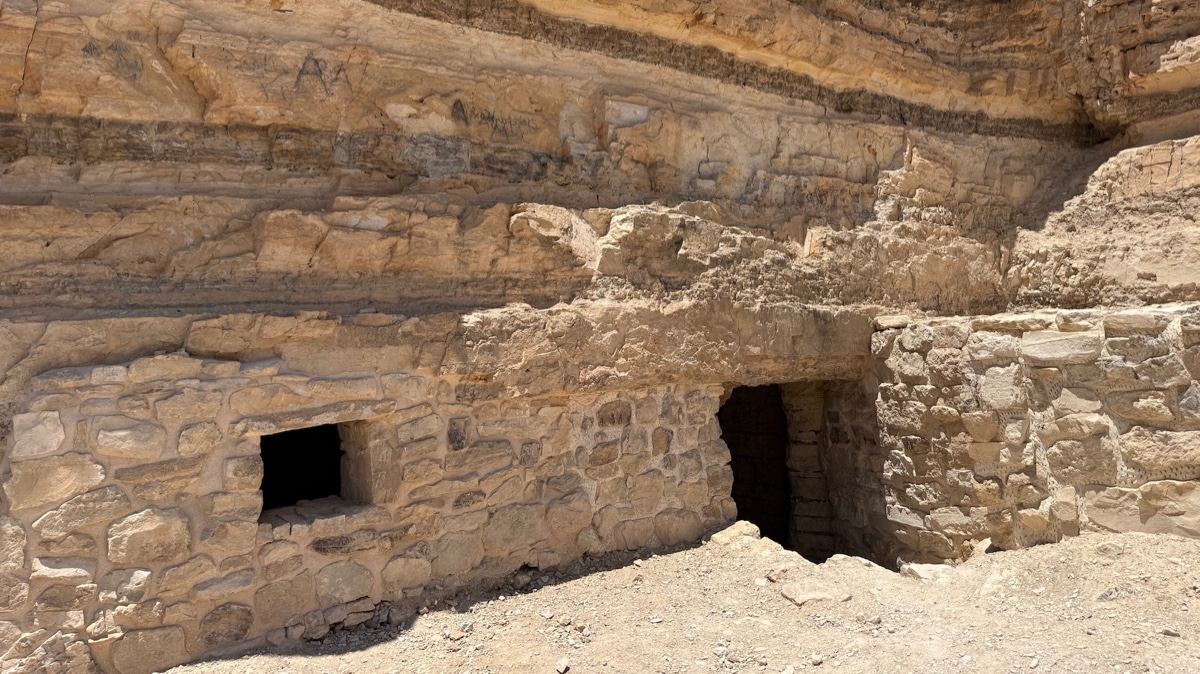

Barry Britnell is the founder of Exploring Bible Lands, LLC and leads Bible Study tours to the land of Israel. He also works with Appian Media to produce biblically sound videos used in teaching others about the Bible. He and his wife, Tabatha, have three children. They live in Athens, AL, and worship with the Capshaw church of Christ. He can be reached here.


By David Weaks
Synopsis: This month’s collection all relate in some way to the power and authority of God and Christ.
Where in the Bible can denominational beliefs be found? The Bible teaches a thing only when it is stated directly, communicated through approved examples, or plainly implied. Consider these popular doctrines, and see if you can find them taught in the Bible.
“We are saved by faith only.” You can search the Bible from top to bottom, but you will never find a single verse that teaches we are saved by faith only. James, on the other hand, said plainly that we are not justified—saved—by faith only: “You see then that a man is justified by works, and not by faith only” (Jas. 2:24).
“Once a man is saved, he is always saved.” Here is another widely held doctrine that is not in the Bible. In fact, the opposite is true. The author of Hebrews writes that those who willfully reject Christ, after having believed in him, will continue to resist all calls to repentance (Heb. 6:4-6). Paul also said that he buffeted his body daily lest, after preaching to others, he should be disqualified (1 Cor. 9:27). Paul also said that one who returns to the law has “fallen from grace” (Gal. 5:4).
**One church is as good as another!“** This popular sentiment is simply incorrect; nothing like it is found in the Bible. Paul said there is”one body” (Eph. 4:4), and he defined the “one body” as the church over which Jesus is the head (Eph. 1:22-23). In denominational thinking, every church is merely a branch of the Lord’s vine. Nature denies this as a sensible explanation. What vine in nature has branches that produce grapes, others that produce bananas, potatoes, or kumquats? Moreover, the whole illustration is unsound. Denominationalism did not enter the picture until centuries after Pentecost. How could any man-made church be as good as the genuine article that Jesus built (Matt. 16:18)?
“We are all going to the same place (heaven); we are just taking different roads to get there.” This sounds wise, but is it accurate? Are there really thousands of different roads to heaven? Can one be a Muslim and go to heaven while another is a Mormon, a Baptist, a Catholic, or a Methodist? If so, the Bible must teach it. However, if you study the Bible for a thousand years, you will never find anything resembling the “different roads” doctrine anywhere in its sixty-six books. Instead, you will find the direct opposite taught: “I am the way, the truth, and the life. No one comes to the Father except through Me” (John 14:6).
Where in the Bible can you find several people taking different roads to heaven? If you are even moderately directionally competent, you must question the sense of this doctrine. If you leave Dallas, TX, and want to get to Oklahoma City, you cannot travel east. You will never reach your destination. Should you circle the globe on any heading other than north, you will miss Oklahoma City by miles. Is there any sense in claiming that many roads lead to heaven?
This should be a cause for concern. If these popular doctrines are not in the Bible, what else might be missing from it that you hold as a principle of faith?
False teachers play word games in order to promote unbiblical doctrines. One of their favorites is, “God’s love is unconditional!” The vastness of God’s love is actually not being scrutinized in this statement, as sectarians would have us believe. Only a misguided person would argue that God limits His love to some people and withholds it from others. What men are really pushing is the false doctrine that fellowship with God is unconditional.
God is love (1 John 4:8), and God loved the world so much that He sent His Son to die for the sins of all people (John 3:16). Whoever believes in Him shall not perish, but have everlasting life. Those whom God loved were sinners and His enemies (Rom. 5:8 ff.). Jesus exemplified God’s love when He asked His Father to forgive those who nailed Him to the cross (Luke 23:34).
What about apostates? God does not stop loving them because they stop loving Him; rather, He wants them to return, be faithful again, and be saved. Strong Christians must attempt to bring them back (Jas. 5:19-20). Paul said that those who are spiritual must “restore such a one in a spirit of gentleness, considering yourself lest you also be tempted” (Gal. 6:1). Consider the Parable of the Prodigal Son (Luke 15:11-24). The erring son dove headfirst into depravity, and it was not until he hit “rock bottom” that he realized he must return home and repent (vv. 18-19, 21). The father’s waiting with a robe and a ring shows his love for his son never waned; however, the robe and ring remained with the father until the prodigal son returned and confessed his sins. The wayward son was dearly loved, but could not enjoy his father’s fellowship while living as a rebel.
Word games do not bring people closer to the truth; rather, they twist the teachings of the Bible, confuse the hearers, and foster error. This is true with the question of God’s “unconditional love.” People should not be misled when others “preach to the choir” and insist that “God loves everyone, even sinners!” God indeed loves saints and sinners, but all sinners will be lost eternally if they do not obey God and repent (cf. Matt. 7:21-23; Acts 17:30-31; Heb. 5:8-9).
I am terrible at math and always have been. My math teachers used to annoy me when they explained a complicated formula and then said, “That’s all there is to it!” In my mind, I responded: “If only it were that simple!” Well, when it comes to one’s spiritual life, the simplest instruction truly is all there is to it! Here are some excuses we have all heard, and their simple answers.
“I can’t seem to quit sinning.” Then commit yourself to holiness (1 Pet. 1:16). Recognize that everyone is tempted by something evil, and whatever you struggle with is common to all (1 Cor. 10:13). Commit to departing from evil (Prov. 16:17) and resisting the devil with all your might (Jas. 4:7; 1 Pet. 5:9). Separate from those who tempt you (Prov. 1:10-16), and remove from your life what tempts you. If it is alcohol, avoid places where it is served or sold; if it is lust of the eyes, make a covenant with your eyes not to look with lust (Job 31:1). Remove the cell phone, computer, or tablet with which you access inappropriate images or videos if you must (Matt. 5:29). Simply put, lay aside every weight and the sin that so easily entangles you (Heb. 12:1). That’s all there is to it!
“I can’t get to services on time, and I just can’t make it every Lord’s day.” You can if you love the Lord! Put the Lord first in your life (Mark 12:30). Show your love by keeping His command to assemble (John 14:15; Heb. 10:25). His commandments are not burdensome (1 John 5:3). Prepare your mind and heart for worship and make it the most important part of your week, as it should be (Ps. 122:1; Acts 2:42). Remove whatever keeps you from assembling with the saints. Get to bed earlier Saturday night, set your alarm clock earlier on Sunday morning, and when it rings, get out of bed and focus on the joys of the Lord’s day. That’s all there is to it!
“I just can’t seem to learn more about the Bible.” Decide today to know more about the Bible tomorrow than you do today. If you stick to that daily routine, your knowledge will grow dramatically. Starting today, in one year you will have learned 365 more things than you know now. Bible study is hard, and it is meant to be (Eccl. 12:12). What comes easily does not stay with you; what is gained easily often evaporates, including Bible knowledge. When you struggle methodically, day by day, the truth becomes part of your thinking—your spiritual DNA. Bible knowledge is not a mountain to be climbed but is the result of steady, constant commitment to growth. That’s all there is to it!
“No matter how hard I try, I can’t get anyone to study the Bible with me.” The answer here is simple: keep at it. Our responsibility as disciples is to plant the seed of God’s word and water it, leaving the fruit production to the Lord (1 Cor. 3:6). We cannot force people to study the Bible, but we can make the opportunity available and encourage them. Show enthusiasm for God’s word, talk about it often, and make sure everyone sees the light of the gospel in your daily life (Matt. 5:14-15). If you want to influence others to love the Lord, radiate Christ’s love in your actions and words. When they respond, teach them. That’s all there is to it!
People are good at making excuses, but excuses offer only hollow comfort for our failures. To grow spiritually is simple: love God with all your heart, soul, strength, and mind, and live like it. That truly is all there is to it.
God’s authority is taught throughout the Bible. Throughout the Scriptures, we see God’s patterns. Noah had to build the ark according to God’s pattern (Gen. 6:14-16). When God told Noah, “This is how you shall make it. . .” (v. 15), Noah had no room to improvise. The Ten Commandments provided the Hebrews with a list of things that were authorized and others that were forbidden (Exod. 20:1-17).
Consider God’s pattern for building Solomon’s temple. Solomon took great care in building the temple exactly as God instructed. “The foundation Solomon laid for building the temple of God: the length was sixty cubits long and twenty cubits wide (using the cubit of the old standard). The portico at the front of the temple was twenty cubits long across the width of the building and twenty cubits high. He overlaid the inside with pure gold. He paneled the main hall with juniper and covered it with fine gold and decorated it with palm tree and chain designs. He adorned the temple with precious stones. The gold he used was gold of Parvaim. He overlaid the ceiling beams, doorframes, walls and doors of the temple with gold, and he carved cherubim on the walls. He built the Most Holy Place, its length corresponding to the width of the temple—twenty cubits long and twenty cubits wide. He overlaid the inside with six hundred talents of fine gold. The gold nails weighed fifty shekels. He also overlaid the upper parts with gold” (2 Chron. 3:3-9). Solomon’s temple was beautiful, but more importantly, Solomon carefully attended to every detail of its construction.
All of this demonstrates the necessity of respecting divine authority regarding the Lord’s church. In everything, the Lord’s people must “build all things according to the pattern” given by God (Heb. 8:5). The church must preach only the gospel of Christ (Rom. 1:16; 1 Pet. 4:11). The church has only one head (Eph. 1:22-23). It has no hierarchy, but only saints, bishops, and deacons (Phil. 1:1). Its worship is “in spirit and in truth” (John 4:24). Singing must be with voice only, not with instrumental accompaniment, because God said so, not because it is unique (Eph. 5:19; Col. 3:16). The Lord’s Supper must be observed only on the Lord’s day because God commanded it, not because men decided to limit themselves (1 Cor. 11:23-26; Acts 20:7).
The Bible presents God’s authority and the authority He invested in Jesus Christ (Matt. 28:18). Nowhere in the Bible does it teach that we can do things our own way when God has specified what He wants.
David Weaks, a former Catholic, obeyed the gospel in February 1985, and began preaching later that year. David and his wife, Perri, have lived in West Columbia, TX, where he has labored with the church since August 1997. They raised their two daughters in West Columbia. He can be reached here.




By Danny Linden
Synopsis: The story of Zacchaeus in Luke 19:1-10 shows how to seek Jesus, the nature of true repentance, and Jesus’s mission to seek and save the lost.
During His ministry, Jesus interacted with people from every walk of life and received every kind of response imaginable. One fascinating account is in Luke 19, when Jesus was in Jericho and met a man named Zacchaeus. Although he was not the typical seeker of Jesus, Zacchaeus portrayed the penitent spirit necessary to receive forgiveness from God.
He entered Jericho and was passing through. And behold, there was a man named Zacchaeus. He was a chief tax collector and was rich. And he was seeking to see who Jesus was, but on account of the crowd he could not, because he was small in stature. So he ran on ahead and climbed up into a sycamore tree to see Him, for He was about to pass that way (Luke 19:1-4).
The Romans had little interest in directly governing their distant vassals any more than necessary. They were mostly concerned with keeping the peace and keeping the tax revenue flowing into Rome. To expedite the process, they frequently auctioned off large blocks of tax rights to wealthy locals. A resident with enough capital could purchase the right to collect taxes on behalf of Caesar. He would need to pay the taxes for all those people upfront (with a discount for his trouble), but then he would have the legal right to collect the taxes to reimburse himself and to turn a profit. These wealthy citizens were called publicans (ESV: “chief tax collector”). The publicans would then hire tax collectors to go door to door and do the actual collecting. Both the publicans and tax collectors were hated by their communities because they were seen as traitors to their own people and profiting from Roman oppression. It also did not help that the publicans and tax collectors routinely inflated the taxes they collected to pad their profits. Zacchaeus was one of these publicans, and Matthew appears to have been a tax collector further down the organizational chain (Matt. 9:9; 10:3).
Although Zacchaeus had plenty of wealth and success, he was very interested in Jesus’s arrival in Jericho. He made considerable effort just to catch a glimpse of Jesus. Many people didn’t have enough interest in Jesus to do this—they ignored Him or ridiculed Him. Some, like Herod, had ulterior motives (Luke 23:8-11). Will Zacchaeus show enough sustained interest to change his life?
And when Jesus came to the place, He looked up and said to him, “Zacchaeus, hurry and come down, for I must stay at your house today.” So he hurried and came down and received Him joyfully (Luke 19:5-6).
Jesus looked at Zacchaeus and saw more than just the novelty of a man in a tree—or even a publican. There was an opportunity in Zacchaeus’ heart, but there were some hard decisions to make first.
When Jesus ordered Zacchaeus to come down and bring Him to his house, Zacchaeus could have balked or arrogantly declined to open his home to Jesus. He would not have been the first person to have a passing interest in Jesus that fizzled at the first real decision point. Of course, he quickly and enthusiastically came down from the tree to receive Jesus into his home.
This is the kind of interest that God requires of us. The parables of the treasure in the field and the pearl of great price (Matt. 13:44-46) show that some people stumble across the kingdom of God while others deliberately search for it. Either way, once they find it, they must decide to pursue that desire to know God and discover what He commands. We cannot just be curious about Jesus.
And when they saw it, they all grumbled, “He has gone in to be the guest of a man who is a sinner” (Luke 19:7).
The crowd could not believe that Jesus singled out a publican to talk to privately. Zacchaeus was a sinner, a thief, a traitor, and not an honorable part of the community! Why would Jesus go into his home and spend time with him?
This was not a new complaint. Jesus’s enemies grumbled that John the Baptist was a recluse who made people come to him, but they also criticized our Lord for spending too much time with the wrong kinds of people:
For John the Baptist has come eating no bread and drinking no wine, and you say, “He has a demon.” The Son of Man has come eating and drinking, and you say, “Look at Him! A glutton and a drunkard, a friend of tax collectors and sinners!” Yet wisdom is justified by all her children. One of the Pharisees asked Him to eat with him, and He went into the Pharisee’s house and reclined at table. And behold, a woman of the city, who was a sinner, when she learned that He was reclining at table in the Pharisee’s house, brought an alabaster flask of ointment, and standing behind Him at His feet, weeping, she began to wet His feet with her tears and wiped them with the hair of her head and kissed His feet and anointed them with the ointment. Now when the Pharisee who had invited Him saw this, he said to himself, “If this man were a prophet, He would have known who and what sort of woman this is who is touching Him, for she is a sinner” (Luke 7:33-39).
The Pharisee couldn’t understand why Jesus would deign to be in the presence of a wicked woman. He concluded that Jesus must not be a prophet and must not know who she was. Of course, Jesus loves even wicked people. It is why He came to the earth!
And Zacchaeus stood and said to the Lord, “Behold, Lord, the half of my goods I give to the poor. And if I have defrauded anyone of anything, I restore it fourfold.” And Jesus said to him, “Today salvation has come to this house, since he also is a son of Abraham” (Luke 19:8-9).
Most of the conversation between Jesus and Zacchaeus is not recorded for us, but the important part is. Zacchaeus realized that he was guilty and needed to repent. Apparently, money had been too important to him, and some of it may have been obtained dishonestly. He was ready and willing to address both sides of the problem. He dedicated himself to greater generosity toward the poor and committed to fourfold restitution of everything that he had stolen. By choosing a fourfold restitution, he classed himself with the shameless thieves who were punished most severely under the law (compare Exodus 22:1 and 2 Samuel 12:6 with Leviticus 5:16 and Numbers 5:7).
Jesus’s assessment of Zacchaeus is very positive. Salvation came to that house that day! Even though Zacchaeus was guilty of many offenses, Jesus was willing to extend forgiveness.
For the Son of Man came to seek and to save the lost (Luke 19:10).
Jesus summed up not only this interaction but also His purpose in coming to the earth. His mission was to seek and save the lost. Zacchaeus was seeking Jesus, but Jesus was also seeking Zacchaeus.
Jesus could have remained on His heavenly throne, leaving us to our own devices and the indignity of sin. Instead, He chose to come to us, to show us how to be righteous, and to die so that we might be forgiven. There is no greater love He could have shown us.
We can learn from Zacchaeus’ eagerness. Jesus has something to offer that is worth our enthusiasm and our dedication to find. Our interest cannot be fleeting but must turn into action. Wherever the Bible reveals our sin, we must put it to death and truly change. Jesus gives us the opportunity to be forgiven and to learn righteousness.
The church should also consider the people who are seeking Jesus today. Are we too much like the critical crowd, assuming that Jesus is only for the right kind of person? When a modern Zacchaeus climbs the tree to see Jesus, we must invite him to be with us and see what he is missing—even if he is wicked and even if there is much he would need to give up. Don’t make the decision for him. Fulfill Jesus’s mission by seeking and saving the lost wherever they can be found.
Unless otherwise noted, all Scripture quotations come from The Holy Bible: English Standard Version (ESV). Wheaton, IL: Crossway Bibles, 2001.
Danny Linden has worked with the Hebron Lane church of Christ in Shepherdsville, KY, since March 2023. He and his wife, Lauren, have four children. The church website is here. His website is here. He can be reached here.



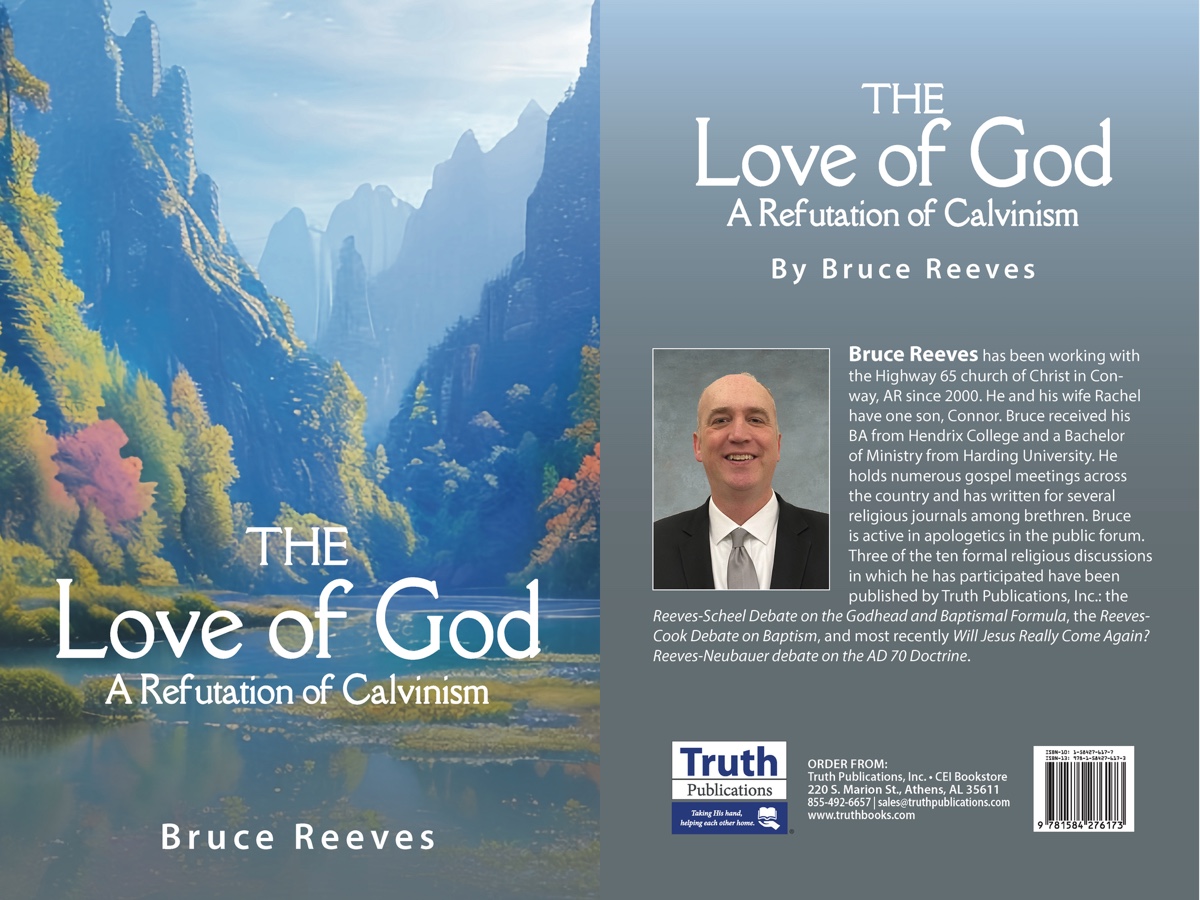
By Ben Mayberry
Synopsis: As followers of Christ, it is our duty to be an accurate representation of Jesus Christ to the sinful world around us.
The word Christian means “follower of Christ.” When we become Christians, we make a promise to God that we will act like Jesus in all aspects of our lives (1 John 2:6). Every Christian’s goal should be to represent our Lord Jesus Christ accurately in all aspects of their life. We will briefly look at seven of Christ’s characteristics to better mirror them in our own lives.
He willingly left His position in heaven to become a man. He did not inherit a position of worldly authority but became a servant. He was the perfect, eternal Son of God, and He spent His entire time on earth serving mankind. The majority of people are looking for ways to be served. In contrast, Jesus said that it is the one who serves who is the greatest in the kingdom of heaven (Matt. 23:11-12). All of our abilities and talents are gifts from God. So the next time we are tempted to be proud of our accomplishments, remember Jesus and the perfect example of humility that our Lord set for us.
He gave His life for each and every one of us. Jesus commanded us to love not only our friends and brothers—“Do not even the Gentiles do the same?”—but also those who hate us and treat us poorly (Matt. 5:43-47). He set the perfect example of love for all mankind even while suffering on the cross. So the next time we are tempted to show a lack of love to those around us, think of Jesus and His love for others.
He was set apart from the world and its evils. Hebrews 4:15 reminds us that Jesus was “tempted in all things as we are, yet without sin.” He remained pure even while being tempted by the devil himself. He relied on God’s word to help Him overcome those temptations. Too often, we see how close we can be to the world and still be right with God, yet this is the complete opposite of Christ’s attitude. We must flee the lustful things of the world and despise the sin and wickedness within it. So the next time you are tempted by impurity, think of Jesus and how He was holy.
Whenever Jesus saw a person in need, He didn’t hesitate but immediately did what He could to help. He healed countless physical ailments, but more importantly, He tended to the spiritual needs of thousands. He put the needs of others far above His own. We should follow Christ’s example. There are many opportunities to help people physically, and yet many more people are in need of spiritual aid. It is our job as Christians to be on alert for opportunities to help others—especially our brothers and sisters in Christ (Gal. 6:10). So the next time you see someone in need, think of Jesus and the example He set for us.
He set the perfect example for us in obedience. When God gave Jesus a job to perform, He completed it no matter the cost. Obedience is what God wants from people today (Matt. 7:21-23). We can see the importance that God places on complete obedience. Without obedience, it is impossible to please God. Jesus set the perfect example by submitting to His Father’s will—even though it led to the cross. Whenever we think that God’s commandments are too difficult or burdensome, think of Jesus and His obedience to God in all things.
When people wronged Jesus, He did not retaliate. When His enemies lied about Him, He didn’t get angry or react wrongly. He patiently endured all the injustices thrown upon Him by His own countrymen. Too often, when people today are wronged—or even when they merely believe they have been treated poorly—they lose their temper and respond with physical or verbal retaliation. As Christians, we must overcome such rash reactions. If those of the world see you act in this way, they will think negatively of your professed religion and be turned away. The appropriate reaction to a wrong done to you is one of the best ways to shine your light to the world. If you are wronged, it is Jesus’s command not to retaliate but to do good to that person (Matt. 5:38-48). So the next time someone wrongs you, follow Jesus’s example and respond in the right way.
While He was hanging on the cross and the crowd was mocking Him, He was praying to God that He would forgive those people. As a Christian, Christ has forgiven us of our sins. Every time we sin, we are ignoring our Lord’s sacrifice, but He desires to forgive us. The next time someone wrongs you, think of Jesus and the example of complete forgiveness He has set for us.
Christ was humble, loving, holy, compassionate, obedient, patient, forgiving—and so much more. He lived a perfect life so as to be the perfect sacrifice for us. Although we cannot attain His perfection, we should be seeking to emulate His example in all things. He sacrificed Himself so that we could be saved, but the only way to salvation is through a life spent in following Christ’s example.
For to this you have been called, because Christ also suffered for you, leaving you an example, so that you might follow in His steps (1 Pet. 2:21).
Ben Mayberry has been a member of Collegevue church of Christ in Columbia, TN, since 2016. He is homeschooled and is also taking dual enrollment classes at Columbia State Community College. He can be reached here.



By John Bass
Synopsis: A Christian’s faith must be firmly grounded in the fundamentals of God’s word so that through maturity, discernment, and steadfastness in the truth, he can assess his beliefs rightly when life’s spiritual storms bring confusion and doubt.
Therefore whoever hears these sayings of Mine, and does them, I will liken him to a wise man who built his house on the rock: and the rain descended, the floods came, and the winds blew and beat on that house; and it did not fall, for it was founded on the rock. But everyone who hears these sayings of Mine, and does not do them, will be like a foolish man who built his house on the sand: and the rain descended, the floods came, and the winds blew and beat on that house; and it fell. And great was its fall (Matt. 7:24-27).
Concluding His Sermon on the Mount, Jesus compares those who hear His sayings to two types of builders: wise builders and foolish builders. What made each builder different was not specifically the type of house he built, nor the materials used to build it, but the foundation upon which his house rested. Rain, floods, and wind came and beat upon both dwellings, but only one was standing when the storms passed—the one built on the rock!
Spiritually speaking, storms come in various forms: trials rain down (2 Cor. 4:8-9), temptations flood in (Jas. 1:12-15), and false doctrines buffet a Christian’s faith (Eph. 4:14). While storms like tornadoes and hurricanes can make one question the physical safety of himself and his family, spiritual storms can make one doubt the beliefs he and his loved ones hold. This may lead to moments of reflection and a reassessment of long-held convictions.
Like the builders in Matthew 7, what will matter most when we are faced with storms that bring doubt is the foundation we have laid for our faith. This leads us to an important question: How can we be sure we are grounded in truth when we are assessing our beliefs?
Christians are expected to grow toward maturity in Christ. Paul, in explaining their need for maturity, exhorts the Ephesians “that we should no longer be children, tossed to and fro and carried about with every wind of doctrine” (Eph. 4:14). God expects His children not to remain babes in their faith, believing whatever they hear (1 Cor. 3:1). Rather, He expects them to grow and become grounded in His word so that they may discern what is truth and what is error. The Holy Spirit gives us insight in Hebrews 5:
For though by this time you ought to be teachers, you need someone to teach you again the first principles of the oracles of God; and you have come to need milk and not solid food. For everyone who partakes only of milk is unskilled in the word of righteousness, for he is a babe. But solid food belongs to those who are of full age, that is, those who by reason of use have their senses exercised to discern both good and evil (Heb. 5:12-14).
There are three important things we must do to mature in our faith:
When a newborn baby is hungry, you don’t grab a steak from the fridge to feed them; you give them milk to drink. When someone is born again, he is a babe in Christ who needs the milk of the word. Peter commands newborn babes in 1 Peter 2:2 to “desire the pure milk of the word, that you may grow thereby.” After laying aside the consumption of impure sin, Christians need to hunger for the pure milk of the word.
The milk of God’s word consists of doctrines such as those listed in Hebrews 6:1-2:
Repentance from Dead Works
Faith Toward God
The Doctrine of Baptisms
Laying on of Hands
Resurrection of the Dead
Eternal Judgment
Milk must be the “foundation” (Heb. 6:1) upon which we build an understanding that will eventually enable us to consume solid food. If we fail to partake consistently of milk, we will remain babes, unable to teach and needing to be retaught what we ought to know (Heb. 5:12). We will have trouble assessing whether our beliefs align with the truth if we don’t know the fundamentals of God’s word.
One cannot expect to have the discernment necessary to handle the meat of God’s word without first putting forth a constant effort to use the milk properly. It is not enough to know God’s word—it must be applied in how we think and in how we discern good and evil (Heb. 5:14). Paul prayed that the Philippians’ love “may abound still more and more in knowledge and all discernment” (Phil. 1:9). Like the saints at Philippi, we must be sure that our love grows in knowledge and discernment so that the fog surrounding so-called “gray areas” can be cleared. Only then can we assess our beliefs with a true understanding of good and evil.
Clearly, these disciples had not been consistently partaking of a balanced spiritual diet, as evidenced by the rebuke administered by the writer of Hebrews. Even if they had been partaking of the milk of the word, it was not enough to continue maturing in their faith—they needed solid food! We must recognize the need to study deeper topics so that we may continue growing “in the grace and knowledge of our Lord” (2 Pet. 3:18) instead of “laying again the foundation” of the first principles (Heb. 6:1). The one who partakes only of milk is “unskilled in the word of righteousness” (Heb. 5:13) and will fail to “come to the unity of the faith and of the knowledge of the Son of God, to a perfect man, to the measure of the stature of the fullness of Christ” (Eph. 4:13).
A steady diet of both the milk and meat of God’s word will prepare us for properly assessing our foundation as we grow in discerning what is good and evil.
At times, Christians may reevaluate their beliefs. As one grows in his knowledge of God’s word, he can more ably discern if any beliefs need realignment. In Acts 18, we read of Apollos, a man who reassessed his beliefs.
Apollos was described as an “eloquent man and mighty in the Scriptures” (v. 24), who “spoke and taught accurately the things of the Lord, though he knew only the baptism of John” (v. 25). When two Christians, Aquila and Priscilla, heard his teaching, they “explained to him the way of God more accurately” (v. 26). This was an opportunity for Apollos to reassess his beliefs and become more accurate in his preaching going forward.
Although Apollos taught accurately the things of the Lord, he needed fuller instruction about the gospel—especially concerning baptism. Once taught, he powerfully refuted the Jews publicly by pointing them to the Scriptures to prove that Jesus is the Christ (v. 28). Proverbs 9:9 says, “Give instruction to a wise man, and he will be still wiser; teach a just man, and he will increase in learning.” Apollos demonstrated how to reassess one’s beliefs without being led into false doctrine or losing faith. Like the Ephesians in Acts 19, he understood how both John’s baptism and baptism into Christ fit into God’s unfolding plan.
Sometimes reassessment involves attaining a greater understanding of God’s plan and how something fits within it. We must be careful that our assessment does not contradict foundational truths that do not change.
When a mature Christian reassesses his stance on a doctrinal issue, he cannot accept a conclusion that contradicts other fundamental beliefs he knows to be true. Without the elementary principles as our foundation (Heb. 6:1), any building of doctrine we erect on it will crumble when it’s tested.
We must be like the Christians in Berea who “received the word with all readiness, and searched the Scriptures daily to find out whether these things were so” (Acts 17:11). An important principle is revealed in their example: we must test any doctrine we hear against what we know from the Holy Scriptures. John the apostle admonished Christians to “not believe every spirit, but test the spirits, whether they are of God; because many false prophets have gone out into the world” (1 John 4:1). We must examine what we are hearing to determine whether it aligns with “the oracles of God” (1 Pet. 4:11) or with the oracles of the devil.
Also, we must be careful not to allow the personalities of preachers and teachers to blind us to the truth and to the implications of their doctrine. Any conclusion that undermines God’s unchanging nature, Christ’s deity, the design of the church, the plan of salvation, the authority of the Scriptures, the seriousness of sin, or the reality of judgment violates fundamental truths of God’s word. A deep understanding of these fundamental truths will guide one’s assessment of personal beliefs and help prevent knee-jerk changes of opinion.
It is especially important for those who preach and teach God’s word to be grounded in truth. Paul exhorted Timothy to “take heed to yourself and to the doctrine. Continue in them, for in doing this you will save both yourself and those who hear you” (1 Tim. 4:16). A preacher’s conduct and teaching affect more than just himself—they affect the salvation of his hearers. He will either be a help or a hindrance—guiding his followers on the straight and narrow path or leading them into the ditch of false doctrine (Matt. 7:13-14; 15:13-14). It is no wonder James says concerning teachers:
My brethren, let not many of you become teachers, knowing that we shall receive a stricter judgment (Jas. 3:1).
As preachers and teachers, we must be well-grounded in the fundamentals of God’s word, lest we leave the truth and lead others astray. When assessing personal convictions, we must not teach conclusions that conflict with the principles of God’s righteousness. Careless conclusions endanger precious souls (Mark 8:37).
In examining our faith, only a foundation grounded in the fundamentals of God’s word upholds the building of deeper doctrines. Through maturing in Christ, a Christian can assess any belief with confidence by anchoring his conclusions in truth amid the storms of false doctrine.
Unless otherwise noted, all Scripture quotations come from The New King James Version (NKJV). Nashville, TN: Thomas Nelson, 1982.
John Bass is a member of the Mount Baker church of Christ in Bellingham, WA. He is currently working in a one-on-one training program to prepare to become an evangelist. The church website is here. He can be reached here.


By Steven J. Wallace
Synopsis: This article warns that emotional pressure—whether from personal failure, grief, or affection—can distort faith and doctrine. It urges Christians to anchor their convictions in God’s unchanging word rather than shifting feelings. May we learn how to resist emotion-driven temptations.
The heart is deceitful above all things, and desperately wicked; who can know it? (Jer. 17:9).
As humans created in God’s image, we were designed to be both intelligent and emotional beings. Solomon observed: “To everything there is a season, a time for every purpose under heaven: . . .a time to weep, and a time to laugh; a time to mourn, and a time to dance; . . .a time to love, and a time to hate. . .” (Eccl. 3:1, 4, 8). David penned: “You number my wanderings; put my tears into Your bottle; are they not in Your book?” (Ps. 56:8). This shows that God recognizes, remembers, and even honors our tears.
However, we live in an age where feelings are enthroned as truth. The phrases “Follow your heart,” “Do what feels right,” and “Trust your gut” sound noble but are dangerous when treated as moral compasses. Culture constantly encourages: “Live your truth,” “Listen to your heart,” “Go with your feelings.” However, feelings, no matter how sincere, are not a safe guide. “He who trusts in his own heart is a fool, but whoever walks wisely will be delivered” (Prov. 28:26).
Sacred Scripture warns that the heart, when untethered from God’s word, leads to the shipwreck of one’s faith (1 Tim. 1:19). In the heat of emotionally charged moments—pain, loss, love, fatigue—Satan whispers ruinous rationalizations that seek to reshape truth into palatable lies. This article addresses how temptation, through emotional manipulation, becomes a potent weapon in Satan’s arsenal, causing us to lose our footing.
From Eden to today, Satan’s strategy has remained consistent: appeal to desire, twist God’s word, and sow doubt. Eve was not merely tempted by knowledge—she was emotionally drawn in. She saw that the tree was good for food, pleasant to the eyes, and desirable to make one wise (Gen. 3:6), despite God’s clear command. Her heart was stirred before her mind was deceived.
Peter, emotionally attached to the Lord’s physical presence, reacted strongly when Jesus spoke of His coming death (Matt. 16:21-22). Though motivated by affection, Peter’s rebuke revealed a heart misaligned with heaven’s purpose. Jesus responded, “Get behind Me, Satan,” exposing how even well-meaning emotions can become instruments of opposition when they prioritize human concern over divine will (Matt. 16:23). Peter’s failure came from being mindful of the things of man, not the things of God—a caution to all who let sentiment override Scripture.
The same failure occurs today when the tidal waves of grief, loneliness, affection, fear of loss, or shame overwhelm the senses to reinterpret God’s word. When someone claims to have gained a better understanding of a doctrinal matter, only to contradict decades of clear preaching while offering nothing but ambiguity, it is likely not honest reevaluation but doctrinal retreat. Such shifts often reflect a desire to reshape truth around personal feelings, a loved one’s sin, or some other emotional or ulterior motive, rather than a genuine pursuit of divine will. This frequently involves what can only be called lexical butchery—where biblical words like love, grace, faithfulness, and other doctrinally loaded terms are mangled to excuse human weakness rather than confront it. In such moments, the Lord’s rebuke still echoes: “You are not mindful of the things of God, but the things of men” (Matt. 16:23).
Emotional pressure to protect someone (or something) we love can easily eclipse our allegiance to truth. Jesus warned: “He who loves father or mother more than Me is not worthy of Me” (Matt. 10:37). Here, Jesus identifies a sobering principle: affection must never outrank authority. When our bloodlines blur divinely drawn lines, we lose. Reader, beware: when Satan cannot succeed through argument, he often prevails through affection—subtly reshaping convictions through the ones we cherish most.
Fighting sin can leave one fatigued and emotionally drained. Wearied by lust, some begin to justify flirtation or question the sinfulness of pornography. Another, battling same-sex attraction, may start reinterpreting Scripture to find permission rather than truth, asking: “Did God really mean that?” or “Wouldn’t a loving God understand?” What begins with temptation often ends in revision.
James warned: “Each one is tempted when he is drawn away by his own desires and enticed. Then, when desire has conceived, it gives birth to sin” (Jas. 1:14-15). God’s revealed will does not change in seasons of fatigue. Such times test our resolve—will we trust and obey God’s will or play the hypocrite? We must ask: “What is it that I truly want?” Moses reminded Israel that God allowed hardship “to humble you and test you, to know what was in your heart, whether you would keep His commandments or not” (Deut. 8:2). Trials expose the true object of our devotion.
When someone we love is caught in sin—unscriptural divorce, homosexuality, false teaching, withdrawal from the church—the temptation is to soften, reinterpret, or excuse their behavior. Some reevaluate their view of church discipline, divorce, modesty, worship, or even gender roles because someone close to them is negatively affected by what Scripture teaches. Tragically, convictions erode, and tolerance topples truth. Why? Because it affects them on a deeply personal level.
Remember, our Lord did not let misguided family actions obscure the clarity of His teaching or His obedience (Mark 3:21, 31-35). We must ask: “Am I letting personal sorrow rewrite Scripture?”
We can become skilled at talking ourselves into disobedience—not for others’ sake, but for our own. Guilt whispers: “You’ve already blown it.” Grief insists: “You deserve happiness after all you’ve suffered.” Scripture warns that the heart not only deceives but also speaks: “Your heart will utter perverse things” (Prov. 23:33). When feelings—not truth—lead us, the heart rehearses justifications, minimizes sin, and rationalizes retreat. The longer we listen, the more distorted the path becomes.
Jesus warned against being driven by the past, saying: “No one, having put his hand to the plow, and looking back, is fit for the kingdom of God” (Luke 9:62). Broken people must press forward in obedience rather than retreat into compromise.
It is not good to show partiality in judgment (Prov. 24:23).
Consider Aaron and the Golden Calf (Exod. 32). Aaron caved to the emotional demands of the people. He knew better, but pressure swayed his judgment. His excuse—“You know the people, that they are set on evil” (v. 22)—shifted blame rather than owning guilt. Even worse, he claimed, “I cast it into the fire, and this calf came out” (v. 24). Such evasions insult both truth and accountability. Do we craft idols of our own, then feign innocence when exposed?
Consider Eli and His Sons (1 Sam. 2:12-29). Although Eli rebuked his sons, he did not remove them from priestly service. His emotional leniency brought ruin. God’s rebuke was clear: “You honor your sons more than Me.” Does this apply to us in our family relationships?
Consider King Saul (1 Sam. 15). Saul disobeyed out of fear (v. 24). Through Samuel, God reminded him: “To obey is better than sacrifice” (v. 22). Emotional impulse eclipsed faithful obedience.
How can we remain faithful when emotions tempt us to compromise?
Stay Anchored in God’s Unchanging Word. Emotions are like crashing waves—unstable and shifting. Doubt is likened to “a wave of the sea driven and tossed by the wind” (Jas. 1:6). Paul warned that we must no longer be “children, tossed to and fro and carried about with every wind of doctrine” (Eph. 4:14). In contrast, faith anchors the soul. God’s word is settled forever (Ps. 119:89). Let us measure everything by what is written, and stand firmly on the eternal.
Let God Define Love. Do not confuse permissiveness with love. True love does not rejoice in iniquity (1 Cor. 13:6). Instead of overlooking sin, love speaks the truth (Eph. 4:15) and wounds faithfully if needed (Prov. 27:6). The best way to love a wayward family member is to tell them the truth—even when it hurts.
Secure Your Refuge Before the Storm. Daniel “purposed in his heart” (Dan. 1:8) before temptation came. Convictions must be forged in calm, not chaos. When trials strike, it is too late to be unprepared. “The name of the Lord is a strong tower; the righteous run to it and are safe” (Prov. 18:10).
Remember the Cost of Compromise. Jesus asks: “What will it profit a man if he gains the whole world, and loses his own soul?” (Matt. 16:26). The price of compromise—whether for comfort, peace, or relationships—is always too high. Solomon reminds us, “There is a way that seems right to a man, but its end is the way of death” (Prov. 14:12).
Guard Your Heart by Questioning It. Ask yourself, Would I believe this if it did not affect someone” I love? Am I reading Scripture to discover God’s will or to find loopholes? Does this interpretation glorify God or ease my discomfort?” “Keep your heart with all diligence, for out of it spring the issues of life” (Prov. 4:23). Guard your heart—especially when it is hurting.
Refuse Tears That Drown Truth. We cannot stop the heart from feeling, but we must not let feelings govern theology. Saying “no” to our desires—or to the desires of those we love—is painful, but it will be far more painful to stand before the Lord ashamed because we traded truth for relief. Therefore, let us “buy the truth, and do not sell it” (Prov. 23:23).
In Gethsemane, Jesus faced the ultimate emotional temptation. He prayed, wept, and pleaded—yet He submitted: “Not My will, but Yours, be done” (Luke 22:42). So must we.
Unless otherwise noted, all Scripture quotations come from The New King James Version (NKJV). Nashville, TN: Thomas Nelson, 1982.
Steven J. Wallace has worked with the Mount Baker church of Christ in Bellingham, WA, since July 2023. He and his wife, Kelly, have three children. The church website is here, and his personal website is here. He can be reached here.



By Heath Rogers
Synopsis: Christians, especially preachers, should seek wise counsel and stay rooted in Scripture, measuring all advice against the Bible and keeping loyalty to Christ. Diligent study and careful choice of influences help maintain sound faith. While many counselors offer safety, discernment is needed to avoid simply hearing what one wants. Ultimately, steadfastness in Scripture and wise counsel guard against drifting from the faith.
While Christians greatly benefit from surrounding themselves with wise counsel, they must be careful how they treat this valuable resource.
The New Testament establishes the pattern that preachers, elders, and all Christians must follow. In his farewell letter to Timothy, Paul admonished the young evangelist to “hold fast the pattern of sound words which you have heard from me, in faith and love which are in Christ Jesus” (2 Tim. 1:13). It was important that Timothy not depart from this pattern. “But you must continue in the things which you have learned and been assured of, knowing from whom you have learned them, and that from childhood you have known the Holy Scriptures, which are able to make you wise for salvation through faith which is in Christ Jesus” (2 Tim. 3:14-15).
Timothy was encountering false doctrine in Ephesus. Hymenaeus and Alexander are identified among those who had strayed from the faith and were teaching error regarding the resurrection (2 Tim. 2:17-18). This erroneous doctrine, presented in the form of “profane and idle babblings” (v. 16), was generating “foolish and ignorant disputes” (v. 23) and taking souls captive (3:6). Timothy had his hands full, but he was equipped for the task—he knew the Scriptures.
Two thousand years later, Satan continues his assault on God’s word and His church. We no longer have access to living apostles, nor can we “stir up” (2 Tim. 1:6) miraculous gifts of the Holy Spirit that will provide us with answers to today’s questions. We are left with the same pattern of sound words that Paul gave Timothy. Each generation of Christians must honestly and accurately apply the Scriptures to the various situations they face in this ongoing assault.
Today, the Lord’s church is burdened by members who are not content with the old paths. This can be a problem with preachers as well. I was converted out of denominationalism. I rejoiced that I had found the truth. When I started preaching, I purposely filled my library with books written by those who were holding fast to the pattern of sound words. I would turn to denominational authors to fill gaps in my library but would read them with discernment. Even today, I look first to what sound brethren have written on Bible passages and issues when I need help in my studies.
Every Christian should be careful about the books, podcasts, sermons, and videos they consume. All of these influence our thinking and our approach to God’s word. We must keep the heart with all diligence, for out of it springs the issues of life (Prov. 4:23). I occasionally read articles and hear sermons by preachers today that contain the wording and ideas I heard when I was in denominationalism. I know where these men got these things: They have been drinking water from the wrong well and passing it on to unsuspecting brethren as sound doctrine. When challenged by faithful brethren, they cry foul, find solace in their supporters, and proudly march onward as martyrs in their cause.
Timothy was told to study, to be diligent in presenting himself as an unashamed workman to God with the ability to rightly divide the word of truth (2 Tim. 2:15). There is no shortcut or substitute for reading and studying the Bible. The best way to spot counterfeit currency is to familiarize oneself with the real thing. The more you see and handle real dollar bills, the easier it will be to recognize a fake. Satan’s errors abound today because some brethren have set aside their Bibles in favor of the latest and greatest book or podcast. Paul told Timothy, “You must continue in the things which you have learned and been assured of, knowing from whom you have learned them, and that from childhood you have known the Holy Scriptures, which are able to make you wise for salvation through faith which is in Christ Jesus” (2 Tim. 3:14-15). Timothy learned the Scriptures and was assured of the truths they set forth. This foundation equipped Timothy to do his work.
While preachers must be diligent in their own study of God’s word, they benefit greatly in their understanding and application by reaching out to others. “Listen to counsel and receive instruction, that you may be wise in your latter days” (Prov. 19:20). A preacher should find strength and support in his peers. “As iron sharpens iron, so a man sharpens the countenance of his friend” (Prov. 27:17). Years ago, some older preachers encouraged a group of younger preachers (including myself) to become a source of support for one another. We have done so, and I have benefitted greatly from these men. We continue to bounce questions, problems, and ideas off one another.
Peers are great, but there is an even better resource for young preachers. On one occasion, when I was first considering full-time preaching, I asked a preacher who was a few years older than me some questions about the work. He pointed to the other side of the room and said, “You need to go ask my dad—he has been preaching longer than I have been alive.” Younger preachers need to hear the voice of wisdom. While not all older people are wise, wisdom is found with the aged (Job 12:12; 32:7). Young preachers should seek experienced men who can provide advice and counsel regarding the questions they encounter in their studies, the problems they face in their work, and the issues that arise both inside and outside their local congregations.
A young preacher will benefit greatly from a faithful mentor. A mentor is someone who takes a special interest in another person, sharing personal wisdom, insight, and experiences to make them better. While all disciples must be careful about who influences them, it is especially important for young preachers to choose their mentors and counselors wisely. These individuals shape their hearts and minds. “He who walks with wise men will be wise, but the companion of fools will be destroyed” (Prov. 13:20).
Young Christians who have found mentors may encounter certain challenges.
They must be careful not to turn their mentor into an idol. In my early preaching years, I was amazed when older preachers could provide instant answers to problems I had been wrestling with for days or weeks. I respected them highly for their knowledge and skill. When someone cares enough to sacrifice their time to help us in significant ways, it is difficult not to develop a strong loyalty to them. Yet we all know the danger of putting an imperfect person on a pedestal. Sometimes older preachers change their minds regarding important doctrinal matters, or their lifelong erroneous positions suddenly become public. Those who have placed such preachers on a pedestal must choose—remain loyal to the Lord or to the man who is no longer abiding in the doctrine of Christ. While it is proper to honor and respect those who have helped us, we must always remain loyal to Christ.
A Christian mentor must always point others to Christ (1 Cor. 11:1). Some Christians—even preachers—enjoy making their own disciples. My wife and I attended a lectureship several years ago, where I remember seeing a well-known preacher constantly followed by the same group of men. I never saw him without his entourage and rarely saw any of them apart from him. He made it clear that he had gained a following. What happens to these other men if their mentor “strays concerning the truth,” as did Hymenaeus and Philetus?
It is also important to learn to “outlive” our mentors. If we are blessed to live our “threescore years and ten” (Ps. 90:10), we will probably lose our mentors. We need to develop a faith that can survive and thrive without them. The tragedy of King Joash was that he “did what was right in the sight of the Lord all the days of Jehoiada the priest” (2 Chron. 24:2), but when his mentor died, he listened to others and followed them into apostasy (2 Chron. 24:15-18). If they are truly serving the Lord and truly love us, our mentors will want us to have our own faith—convictions that will endure after they are gone.
It is natural to develop a special relationship with a trusted mentor, but it is important never to confine your source for scriptural advice to just one person. “Where there is no counsel, the people fall; but in the multitude of counselors there is safety” (Prov. 11:14). “Without counsel, plans go awry, but in the multitude of counselors they are established” (Prov. 15:22). Even Absalom sought advice from multiple sources (2 Sam. 16-17). Regardless of how wise and experienced a mentor may be, no one is perfect. No one has a perfect understanding of every verse in the Bible. No one has experienced every possible situation. If we are seriously trying to understand a difficult subject, it is worth the effort to seek more than one person’s opinion. “The first one to plead his cause seems right, until his neighbor comes and examines him” (Prov. 18:17). If they are mature Christians, mentors will not be offended if you look to others for answers and advice.
Nevertheless, having a large pool of counselors presents its own special challenge: knowing who to approach to receive the answer we prefer to hear. Over time, as I have served—first as a Christian, then as an evangelist, and now as an elder—I have come to know many preachers and elders.I have a good idea of what kind of advice I can get from most of them. If I need special help with Hebrew or Greek, there are specific brethren I will ask. For help with matters regarding church history, I know who to ask. For effective methods in reaching the lost, I know brethren who excel in this work. If I seek to hold fast to the pattern of sound words, I know who to ask. However, if I am no longer content with the old paths and am becoming more progressive, I know where to find brethren who will guide and encourage me in that direction as well. All counsel and advice must be judged in light of the Scriptures. The noble-minded Bereans are an example to preachers, too (Acts 17:11).
All Christians need room to study and grow in understanding. Preachers must be especially careful, as they will give an answer for the things presented from the pulpit. Diligence in study is required to ensure we are rightly dividing the word of truth (2 Tim. 2:15). The word “diligent” means to endeavor or exert oneself. Bible study is an essential part of the preacher’s work. Sometimes, sermons need to be set aside until the text or issue is studied more completely. Preachers should not be floating trial balloons from the pulpit or on social media. The church is not edified by sermons or podcasts filled with phrases like “this is uncertain to me,” “we can’t be clear on this,” or “I may be misunderstanding this.” Many in the world are asking, seeking, and knocking. True gospel preaching stands out in this wishy-washy world when it rings with clarity and certainty.
As stated earlier, preachers do themselves a favor by establishing a group of brethren they trust to ask difficult questions, bounce ideas off, and receive honest feedback. If these men question your conclusions and tell you that you are off base, take it seriously and redirect your studies. I remember telling a couple of elders about a conclusion I had reached on a difficult passage of Scripture. One of them told me, “You need to go back and study that again.” I needed to hear and heed that advice.
There will be times and circumstances that cause us to stop and reassess our beliefs regarding certain issues. Like Timothy, we need to make sure our faith is firmly anchored in the pattern of sound words. Otherwise, in our effort to reexamine Scriptures and issues, we may drift and suffer shipwreck concerning the faith. Grounding ourselves in the truth of God’s word, surrounding ourselves with numerous counselors, and continuing steadfastly in the things we have learned and been assured of will keep us from drifting away from the faith.
Heath Rogers has preached for the Knollwood church of Christ in Beavercreek, OH, since 2011. He has also served as one of their elders since 2024. Heath and his wife, Christy, married in 1994 and have two adult children. The church’s website is here. He can be reached here.

By Kyle Campbell
Synopsis: In a world of shifting cultural influences, the word of God remains sure and steadfast—but will modern-day Christians?
An ever-present tension in living godly is the conflict between the morals of the world and the morals of the gospel. Most of the time, Christians align with biblical truth on various moral issues. But what about over time? Can Christians reject unbiblical moral changes at first, only to adopt them later? Can God’s standards shift with time or social acceptance?
I remember in 2015 when the White House was lit in rainbow colors to celebrate the Supreme Court’s ruling that same-sex marriage must be recognized nationwide. For decades, Christians lived with the knowledge that same-sex relationships existed, but since 2015, the acceptance of them has accelerated. Now, ten years on, things seem very different. Just last year, Christopher and Richard Hays published The Widening of God’s Mercy, arguing for full inclusion of “LGBTQ+ Christians” in churches and faith communities. There are even churches of Christ that are “open and affirming” to “LGBTQ+ Christians.”
While society’s moral standards evolve rapidly, often normalizing what was once deemed unacceptable, the greater danger arguably lies in the potential for the church’s delayed adoption of these changes. In the end, delayed compromise is still compromise.
In this article, we examine how biblical beliefs have shifted over time, provide examples of those changes, affirm that God’s standards of sin and righteousness remain constant, and suggest solutions for helping God’s people remain faithful to His word.
The sexual revolution was a watershed event for most people reading this article. The social and cultural changes of the 1960s and 1970s still produce profound effects on society in general and the church in particular.
Whenever a new threat emerges in society, initial resistance often takes the form of strong, bold, and resistant preaching. However, over time, culture normalizes the change, and disciples become accustomed to the existence of sin. This leads to less shock value and frequent subconscious acceptance. Eventually, churches shift to gradual adoption of the sin in question, often accompanied by changes in teaching, tone, and priorities. This is currently playing out in controversies surrounding LGBTQ+ relationships at Abilene Christian University.
Of course, even when God’s people accept sin later than the surrounding culture, it does not make it any less sinful. Softer positions still compromise God’s standard.
God is consistent with His principles. His character and will for mankind remain constant. In the Old Testament, we read, “For I am the Lord, I do not change” (Mal. 3:6), and in the New Testament, the writer of Hebrews says, “Jesus Christ is the same yesterday, today, and forever” (Heb. 13:8). These consistent principles and character necessarily extend to God’s unchanging instructions for mankind.
Sin is defined by God, not by culture. Isaiah warns, “Woe to those who call evil good, and good evil; who put darkness for light, and light for darkness; who put bitter for sweet, and sweet for bitter!” (Isa. 5:20). Likewise, Paul says, “Do not be conformed to this world. . .” (Rom. 12:2). Therefore, God’s saints must remain holy, regardless of cultural trends. In Numbers 15:40, God commanded the Israelites to wear tassels on their garments to “remember and do all My commandments, and be holy for your God.” The New Testament concisely repeats the command from Leviticus 11:44: “Be holy, for I am holy” (1 Pet. 1:14-16).
Churches often lag behind society by years or even decades in adopting cultural changes. However, this can give a false sense of steadfastness. The lag does not last forever; through generational shifts, pressure for relevance, fear of irrelevance, or reinterpretation of Scripture to fit culture, churches can eventually drift along with society.
Abortion: In 2022, the Supreme Court overturned nearly 50 years of precedent in its Dobbs v. Jackson Women’s Health Organization decision, returning abortion regulation to the states. For years, public opinion on abortion remained relatively unchanged, but in the last three years, it has swung in favor of pro-abortion rights. Regardless of public opinion, Christians understand that human life is sacred (Gen. 1:26-27), and that God is involved in the formation of physical life and the spirit within (Ps. 139:13-16; Isa. 44:24; Jer. 1:5).
Divorce: Prior to the 1960s and 1970s, public opinion strongly opposed divorce, but that has shifted over the last several decades. Though divorce rates have recently declined, positive public opinion for the practice remains high (cf. Mal. 2:16). Churches continue to struggle with the breakdown of families, often compromising Christ’s strict marriage and divorce instructions (Matt. 19:9).
Entertainment: While not as risque as Europe’s offerings, American entertainment has gradually incorporated more profane and obscene language, along with “adult” themes such as drug abuse and suicide, now presented to younger audiences via streaming. Solomon said to “Keep your heart with all diligence” (Prov. 4:23), but today’s leisure options make this much harder.
Gender Identity: In the recent past, gender identity has shifted from a binary understanding to a broad spectrum of nonbinary or transgender identities. These developments are explained not biologically, but culturally and socially, causing major changes in mainstream denominations and posing a threat to biblical steadfastness in churches of Christ.
Materialism: The pursuit of wealth and status has always been tempting, but social media in the last twenty years has exacerbated this issue. People now flaunt their achievements and possessions, fueling materialistic attitudes among viewers. Constant comparison intensifies the desire to match the goods of others (Matt. 6:24; Luke 12:15; 1 Tim. 6:9-10). Silence about this issue allows covetousness to grow unchecked.
Modesty: The prevailing standard for modesty around the world in recent decades equates the exposure of more skin with greater normalcy. Previously, 1 Tim. 2:9-10 and 1 Pet. 3:3-4 were forcefully preached, but now these standards are frequently dismissed as “legalistic.” Churches that ignore modesty blur the line between holiness and worldliness, increasing struggles with objectification and lust.
Obscene Language and Coarse Humor: Vulgarity and irreverent language have increased dramatically in entertainment, music, literature, and social media over recent years. Such language is largely accepted—and rewarded—under the guise of “authenticity” or “relatability.” However, this language reflects a carnal heart (Matt. 12:34), and it weakens Christian influence (Eph. 4:29; 5:4; cp. Col. 4:6).
Pornography: Few sins have become as socially accepted over the last 30 years as pornography. The internet has made it accessible and anonymous for men and women—creating ungodly lust (Matt. 5:28; cp. Job 31:1). In recent years, OnlyFans has made the production and distribution of amateur pornography as easy as selling items on Amazon or Facebook Marketplace. Churches often downplay these sins, leaving members vulnerable.
Sexual Immorality: Sins such as adultery, fornication, cohabitation, and homosexuality continue largely unabated and even glorified in popular “hookup” culture. Since 2010, the “Sex Positivity” movement has promoted the pursuit and fulfillment of sexual desires in a safe, consensual manner—without judgment. Yet Scripture clearly prohibits such behaviors (Rom. 1:26-27; 1 Cor. 6:18; Heb. 13:4). While efforts have been made to promote chastity (e.g., ‘purity culture’ and ‘True Love Waits’), sinful actions persist. Most mainstream and ecumenical churches readily accept people in adulterous marriages into fellowship.
These examples reveal a pattern—society leads, and eventually some churches follow. No matter how many cultural changes occur, compromising with sin never aligns with God’s will.
God’s people should remember that holiness often looks countercultural. Imagine how a faithful Israelite, hearing admonitions against idolatry in Canaan, would have appeared to the average Girgashite or Amorite, who worshipped Baal and other deities.
The risks of compromise amid shifting cultural influences are significant. First, it erodes biblical authority by undermining Scripture as the ultimate moral standard. Second, it leads to spiritual complacency by allowing unrepented sin. Third, it fosters moral confusion in future generations—children growing up with watered-down truth and unclear boundaries. Fourth, it weakens the testimony of Christians and blurs the distinction between the gospel and the world. Fifth, it can result in eternal consequences by advocating judgment according to societal rather than divine standards.
If cultural drift is real and dangerous, how can Christians resist it? The answer is not to withdraw from society, but to remain firmly anchored in God’s word while living as salt and light (Matt. 5:13-16).
Several commitments can help:
Build a foundation in Scripture; regular Bible study grounds us in unchanging truth (Ps. 119:160; John 17:17).
Promote proactive preaching and teaching; encourage elders, preachers, and teachers to address emerging issues early, not just react after behavior becomes widespread (Prov. 4:4-5).
Emphasize personal vigilance; call for self-examination and repentance when necessary (2 Tim. 4:2; 2 Cor. 13:5).
Foster an environment in the local church that prioritizes holiness above cultural relevance and acceptance (1 Cor. 5:1, 4-5, 7, 9-11).
Culture may change, but God’s people must not. It is easy to slowly accept what God still rejects. Even a delayed cultural adoption poses a subtle but serious threat to the integrity of faith and fellowship. Therefore, commit to God’s eternal standard, understanding that familiarity can breed compromise. His standard alone leads to true freedom and blessing. Be a Christian shaped by the word—not by the world.
Kyle Campbell has worked with the Loop 287 church of Christ in Lufkin, TX, since 2004. He and his wife, Jennifer, have two children. The church website is here. He can be reached here.



By Chase Byers
Synopsis: This article explores the biblical perspective on marriage, specifically addressing how believers should handle situations where one’s spouse may not be a believer, is struggling with their faith, or is a new Christian.
Proverbs has much to say about choosing a spouse, and its warnings are clear. On one hand, it highlights the blessings that follow a man who marries a woman who loves the Lord. We are told that while a house and wealth are inherited, “a prudent wife is from the Lord” (Prov. 19:14), and “a woman who fears the Lord will be praised” (Prov. 31:30). On the other hand, Proverbs gives a stark warning, stating twice that it is “better to live on the corner of a roof than to share a house with a nagging wife” (Prov. 21:9; 25:24).
Why does the Bible emphasize the good and bad outcomes so strongly when it comes to whom we marry—especially for Christians? In this article, we will examine what the Bible says about marriage and the different situations one might encounter.
The New Testament addresses this question twice. The first instance is found in 1 Corinthians 7, where the inspired apostle said, “But I (not the Lord) say to the rest: If any brother has an unbelieving wife and she is willing to live with him, he must not divorce her. Also, if any woman has an unbelieving husband and he is willing to live with her, she must not divorce her husband” (vv. 12-13).
If this describes your situation, Paul makes it clear that you should not divorce your spouse. There is a reason Paul gives for this. Later in verse 16, Paul writes: “Wife, for all you know, you might save your husband. Husband, for all you know, you might save your wife.”
A person may find themselves married to a non-Christian (or a Christian who has fallen away) for one of three reasons: (1) You were both non-Christians when you married, and one of you has now converted; (2) One of you was a Christian and the other was not at the time of marriage; (3) You were both Christians at one time, but one of you has since fallen away. In any of these cases, what does Paul want you to work toward? “You might save your husband or wife.”
How does one go about doing that? The New Testament speaks to this again in 1 Peter 3: “In the same way, wives, submit yourselves to your own husbands so that, even if some disobey the word, they may be won over without a word by the way their wives live when they observe your pure, reverent lives” (vv. 1-2). Yes, Peter is instructing wives here; however, the principles can be applied if you are a husband married to an unbelieving woman. Three applications suffice from this text:
If you are a wife, continue to submit to and love your husband, despite his unbelief. If you are a husband, continue to lead, love, and sacrifice for your wife. When you do that, you are showing her Christ Jesus Himself (Eph. 5:25-29).
It is a frequent occurrence in the kingdom for a person to marry a non-Christian, only to have their spouse obey the gospel years later. When this occurs, it is never because the believing spouse hounded them or issued an ultimatum. It is always the result of consistent actions and lifestyle choices. They chose to serve Christ first—not their spouse.
The catch to this is important. They must see us leading a life that exemplifies the Lord we serve. We strive for purity in the name of Jesus, and through that, they will be able to see Him (Acts 4:13).
There is no doubt that if someone finds himself in this scenario, it will be difficult. The other side of this coin shows us that the unbelieving spouse can sway the faithfulness of the believing spouse. What the believer needs is endurance (Heb. 10:36), as well as an awareness of Paul’s teaching: “Bad company corrupts good morals” (1 Cor. 15:33). Be determined to move an unbelieving spouse from unstable ground; do not let them move you from the stable ground in which you have been planted.
Although the “two become one flesh” (Matt. 19:5) when they are married, it does not mean that they share the same soul. Each person in a marriage is responsible for their own actions, desire, and determination to grow closer to God. However, questions can arise as we walk the road with God. Some wrestle with the existence of God Himself, others begin to question the accuracy of the Bible, while some start to doubt the Lord’s church and its practices and seek denominational churches as an alternative place to worship. How do I hold the hand of my spouse when these questions arise?
Often when we begin to doubt, we do not take those questions to the One who can answer them. John the Baptizer had some questions concerning Jesus in Matthew 11. Specifically, he asked, “Are you the One who is to come, or should we expect someone else?” (Matt. 11:3). John’s question was clear and concise, but more than that, he took it to the right source: Jesus Himself. When he did that, he received a full answer: “Jesus replied to them, ‘Go and report to John what you hear and see: The blind receive their sight, the lame walk, those with leprosy are cleansed, the deaf hear, the dead are raised, and the poor are told the good news. And blessed is the one who isn’t offended by me’” (Matt. 11:4-6). Jesus’s answer was clear: Go observe the evidence!
Sometimes when people have doubts, the evidence is never sufficient to answer their questions. When this happens, we begin to “deliberately overlook” things (2 Pet. 3:5). Encourage them to be honest students and to accept the conclusions when they come. If we reach the end of the rope, be thankful to God that your doubts and questions have been answered.
Some questions take time to answer and to settle. Perhaps Paul’s encouragement to Timothy would be of some use: “The Lord’s servant must not quarrel, but must be gentle to everyone, able to teach, and patient, instructing his opponents with gentleness. Perhaps God will grant them repentance leading them to the knowledge of the truth. Then they may come to their senses and escape the trap of the devil, who has taken them captive to do his will” (2 Tim. 2:24-26).
Having a spouse who begins to doubt God can be scary, but remember to hold their hand through the process and cling tighter to God’s hand. He will never leave you or forsake you (Heb. 13:5).
When a spouse obeys the gospel, it is a day of great rejoicing—one to which many can relate. This moment of excitement and joy deepens the commitment between husband and wife, uniting them in a more profound way. However, the process of discipleship has only just begun for your spouse. If this is a race, then we need to learn to run it together. There are three things you can do to help your spouse grow:
This should be at the heart of a disciple of Jesus (John 13:14-15). For a great example of a Christian couple who served together, consider the lives of Priscilla and Aquila. Of the six times they are mentioned in the New Testament, their names are always right next to one another. We find them working together when they pulled Apollos aside in Ephesus to explain the way of God to him more accurately (Acts 18:26). Again, we see them mentioned in Paul’s greeting section of Romans 16, where we learn that brethren gathered in their home, and at one time they had “risked their own necks” for Paul’s sake (Rom. 16:3-5). Throughout the nearly twenty years of history we have of Priscilla and Aquila, they are consistently found serving the Lord and His people in at least three different cities. That should be the goal for any Christian couple, no matter where they live.
Jesus placed us in a body for a reason; individuals need more than just their spouse to encourage them on this journey. If the new believer is a man, encourage the brothers in your local church to include him in studies and invite him out to build stronger relationships. If the new believer is a woman, ask the local sisters to do the same (Titus 2:3-5).
We grow closer to each other and to God when we dedicate time to listen to Him together. This could be each of you reading the same chapter quietly to yourselves and then sharing your thoughts and what challenges you. Couples who read together stay together.
The bottom line is to stay with them and love them through the process. Remember what it was like when you were a new Christian. They may be on the milk for a while, but they will soon learn and grow to desire and appreciate the meat (Heb. 5:13-14).
There is no doubt that when you find yourself in one of these three positions, it will have its challenges. Remember what Paul said regarding his work in the kingdom: “What then is Apollos? What is Paul? They are servants through whom you believed, and each has the role the Lord has given. I planted, Apollos watered, but God gave the growth. So, then, neither the one who plants nor the one who waters is anything, but only God who gives the growth” (1 Cor. 3:5-7). You keep planting and watering—God will give the growth.
Unless otherwise noted, all Scripture quotations are taken from the Christian Standard Bible (CSB). Nashville, TN: Holman Bible Publishers, 2020.
Chase D. Byers has worked with the Fishers church of Christ in Fishers, IN, since the beginning of 2023. He and his wife, Rebecca, have been married for eight years and have two daughters. The church website is here. He can be reached here.



By Eric Parker
Synopsis: The difficulties of correcting a false belief are multifaceted, involving confession and repentance in private and/or public ways, but they are absolutely worthwhile because of the perfect mercy and justice of God.
You are at a turning point. Grounded in the fundamentals of the faith, you have reevaluated your stance on a particular belief and found that you are indeed in the wrong. The temptation to compromise has been powerful. The voices of culture, family, and friends pleading for you to join them in falsehood echo in your mind. To counteract their seductive biddings, you have gone to your trusted allies, who have fought the good fight for many years and have proven themselves trustworthy. They came to your aid and steered you effectively through the Scylla of compromise and the opposing destruction of your Charybdis—prideful assertions of perfect knowledge. You have successfully and worthily journeyed so far. What happens next?
You have internally acknowledged your error—but is that the full remedy? Not quite; you lack the ability to forgive yourself of sin. Humbled by the gravity of your mistake, you are reminded that you are human. You are faulted. You are deficient. You make mistakes. So, you go to His throne of grace in your time of need and make your plea for forgiveness. Through God’s incomprehensibly vast mercies, all believers have access to the atoning blood of Jesus, our perfect High Priest (Heb. 4:14-16). In doing this, we are taught to specify what we have falsely believed, practiced, and even taught. In His great faithfulness, He casts our sins as far as the east is from the west (Ps. 103:12). He is compassionate, merciful, and gracious, forgiving our wrongs against Him and trampling them under foot (Micah 7:18-19). What an awesome God who is able to triumph over all our sin! As promised: “If we confess our sins, He is faithful and righteous to forgive us our sins and to cleanse us from all unrighteousness” (1 John 1:9).
We have come home, but we likewise bear the responsibility of making adjustments to our mindset, spiritual outlook, and pattern of behavior to ensure that we do not follow the same course in the future. Repentance builds on confession and elevates it to the next level.
Repentance is a primary facet of kingdom citizenship: it begins our journey, yet it also remains a constant companion as we battle our own weaknesses and willful proclivities. When John the Baptizer preached repentance, he spoke of “bearing fruit in keeping with repentance” (Matt. 3:8; Luke 3:8). Repentance is a commitment to, and faithful execution of, a total renovation and renewal of mind according to the perfect will of God. Romans 12:1-2 states: “Therefore I urge you, brethren, by the mercies of God, to present your bodies a living and holy sacrifice, acceptable to God, which is your spiritual service of worship. And do not be conformed to this world, but be transformed by the renewing of your mind, so that you may prove what the will of God is, that which is good and acceptable and perfect.”
What repentance looks like for each person can depend on the specific situation. John’s message of repentance, in application, varied according to the needs of his audience. Listen to his message for the people: “And the crowds asked him, ‘What then shall we do?’ And he answered them, ‘Whoever has two tunics is to share with him who has none, and whoever has food is to do likewise.’ Tax collectors also came to be baptized and said to him, ‘Teacher, what shall we do?’ And he said to them, ‘Collect no more than you are authorized to do.’ Soldiers also asked him, ‘And we, what shall we do?’ And he said to them, ‘Do not extort money from anyone by threats or by false accusation, and be content with your wages.’”
So, what does repentance from your false position entail? To a degree, it depends on what your position was and what it related to. You may have formerly believed that becoming a Christian absolves one of unscriptural marriage, divorce, and remarriage issues. You may have had a mistaken view of grace. You may have leaned toward Calvinistic tendencies. You may have thought it was acceptable to listen to certain kinds of music or to visit places that are prohibited for Christians. You may have thought social drinking was permissible. Some of these require lifestyle and behavioral changes, including the pursuit of sobriety and self-control. Some of these involve interpersonal relationships and may require letting some relationships go, or reconciling relationships that you ended prematurely. Some corrections will be visible to outsiders, whereas others will be more internal. Study the Scriptures that speak on the subject. Seek the counsel of those who have struggled with similar issues and persevered. Ask for prayer (Jas. 5:16). Seek out confidants and allies, accountability partners, and friends. This is the path of remedy laid out in the Scriptures. There is perfect healing and overwhelming grace freely available for penitent hearts.
Is that everything? It may be, but you may have at least one more area to evaluate. You see, sin often has devastating—and often unforeseen—interpersonal consequences. False beliefs do not occur in a vacuum; they are sometimes shared with others, whether with confidants, in small groups, or publicly. Personal confession and conscientious repentance to our Almighty God is the perfect place to start, but the nature of our sins may dictate an additional step—one that many fail to take when they have fallen short.
In our lightning-fast age of communication, and amidst our typical unwillingness to be slow to speak, false beliefs and teachings can spread like wildfire. Sermons, classes, podcasts, blogs, texts, phone calls, online publications, livestreams, social media, and more—these outlets spread teaching far and wide with tremendous efficiency. Recall the old adage: “Error can spread around the world faster than truth can get its boots on.” As technology advances at breakneck speed, we hasten the disadvantage of spreading false beliefs whenever we are deceived and in error. What responsibilities do we bear in mitigating the devastating effects arising from our false positions, which become dispersed like dandelion puffballs in the wind?
We are not always finished when we approach God on our own behalf. Those in positions of influence who publicly teach—no matter the context or forum—are held to a strict standard. Wrong behavior and wrong teaching are sinful and have repercussions. Beyond adjusting personal convictions, we must evaluate the scope of how our false beliefs have impacted others. Preachers and teachers especially must consider how they have taught the false belief and how this has impacted those who received such spiritual instruction. James was correct in boldly telling us: “Let not many of you become teachers, my brethren, knowing that as such we will incur a stricter judgment. For we all stumble in many ways. If anyone does not stumble in what he says, he is a perfect man, able to bridle the whole body as well.”
We are tempted to slow down or even stop at this point. Personal conviction, confession, and repentance are one thing, but admitting error to the public, to our followers, to the brotherhood, or to whatever other group is another level of difficulty. What if we lose our followers? What if we lose our friends? What if it divides the congregation we are part of? Maybe personal confession is enough? No, it is not enough when our sins have been broadcast far and wide. Such is the consequence of speaking in a capacity of influence and failing to walk circumspectly, pursuing sound doctrine at all times.
Whatever avenues of communication we used to spread our former belief are the same starting points for mitigating the effect. If we have a podcast, website, social media profile, blog, or any outlet where we shared these wrong convictions, we must use those platforms to publicly admit our errors. We should also delete content that is false. That is true repentance—real action, showing measurable fruit. If we spoke in a congregation as a preacher or teacher, served as an elder or deacon, or helped teach Bible classes for adults or children, we must use those same forums to admit our error and publicly commit to resolving as much damage as possible.
The God we serve is exceedingly wonderful and beyond mortal comprehension. He is zealous for His people and will fight for them (Zeph. 3:17), especially in their weakness and infirmities. He takes pleasure in the one who does good, seeks good, and shares good things (Ps. 84:11). He is avenging and just toward those whose boastful pride and sinful pleasures are given free rein (Rom. 2:5-11). Jesus is both just and the justifier (Rom. 3:26).
Each day, we have the opportunity to bring Him joy by humbling ourselves, evaluating our beliefs in a safe and healthy way, and sharing those biblical beliefs with the world. Let us always be diligent to test ourselves to see whether we are in Christ and whether our feet remain on the narrow and straight path of His keeping (2 Cor. 13:5). Let us always heed His voice. If we ever find in these self-evaluations that we are in error, let us speedily rectify these wrongs through the available avenue of Jesus’s cleansing blood. Let us put in the work to personally correct those errors and, if applicable, strive to eliminate or at least mitigate the harm we may have caused others. Let’s be humble and brave as we work out our salvation in reverence (Phil. 2:12-13).
Eric Parker has worked with the Taylorsville Road church of Christ in Louisville, KY, as an evangelist since February 2015. He and Olivia have three children. The church website is here. He can be reached here.


Note: Please send additions, corrections and updates here.
Updated: 10/1/2025
17312 Jones Rd, Athens, AL 35613
Sun. Bible Study 9:30 am | Sun. Worship: 10:20 am & 5:00 pm | Wed. Bible Study 7:00 pm
Evangelist: Jonathan Reeder | Website | 256-233-3160
24190 Wooley Springs Rd, Athens, AL 35613
Sun. Worship 9:30 am & 5:15 pm | Wed. Bible Class 7:00 pm
Evangelists: Bob Watson & Matt Taylor | Website
3955 Pine Lane, Bessemer, AL 35022
Sun. Bible Study 9:10 am | Sun. Worship 10:00 am & 5:00 pm | Wed. Bible Class 7:00 pm
Evangelist: David Deason | 256-497-8127 205-425-2352 | Email | Website
2325 Old Columbiana Rd. (near I-65 & Hwy. 31)
Sun. Bible Study 9:00 am | Worship 10:00 am & 5:00 pm | Wed. Bible Study 7:00 pm
Evangelist: Kyle Pope | 205-822-0018 | Website
19965 Sandlin Rd. Elkmont, AL 35620
Sun. Worship 9:30 am & 3:00 pm | Bible Classes: 10:45 am | Wed. Bible Study 7:00 pm
Evangelist: Lance R. Taylor | 256-777-0990 | Website
851 N. Pine St. (Located next to University campus)
Sun. Bible Study 9:30 am | Worship 10:15 am & 5:00 pm | Wed. Bible Study 7:00 pm
Evangelist: Kenny Moorer | 256-766-0403
601 Pineywood Road, Gardendale, AL, 35071 (Located 10 miles N of Birmingham)
Sun. Bible Study 9:30 am | Worship: 10:25 am & 5:00 pm | Wed. Bible Study: 7:00 pm
Evangelists: Andrew Smith & Jason Shackleford | 205-631-2131 | Website
129 Hillcrest Rd, Mobile, AL 36608
Sun. Worship 9-9:30 am | Bible Study 9:30-10:30 am | Worship 10:30-11:30 am | Wed. Bible Study 7:00 pm
Evangelist: Ken Sils | 765-307-8048 | 251-342-4144 or 342-2041 | Website
271 Highway 65 N, Conway, AR 72032
Sun. Bible Study 9:00 am | Worship 10:00 am & 5:00 pm | Wed. Bible Study 7:00 pm
Evangelist: Bruce Reeves | Bldg: 501-336-0052 | Website
2655 Prince St., Conway, AR 72034
Sun. Worship 9:00 pm | Bible class 9:50 am | Worship & Lord’s Supper: 10:40 am | Wed. Bible Class 7:00 pm
501-450-8640
2323 South 46th St.
Sun. Bible Study 9:45 am | Worship 10:30 am | Wed. Bible Study 7:00 pm
407 Bella Vista Dr.
Sun. Bible Study 9:30 am | Worship 10:15 am & 5:00 pm | Wed. Bible Study 7:00 pm
Evangelist: Norman E. Sewell | 870-741-9104 or 870-741-5151 | Website
514 Airport Rd.
Sun. Bible Study 10:00 am | Worship 11:00 pm & 6:00 pm | Wed. Bible Study 7:00 pm
Evangelist: Dick Blackford | 870-933-9134
145 N. Country Club Rd.
Sun. Bible Study 9:00 am | Worship 10:00 am & 6:00 pm | Wed. Bible Study 7:00 pm
Evangelist: Brenden Ashby | 520-326-3634 | Website
17903 Ibbetson Ave.
Sun. Bible Study 9:45 am | Worship 10:50 am & 6:00 pm | Wed. Bible Study 7:30 pm
562-866-5615 | Website
3433 Studebaker Rd.
Sun. Bible Study 9:50 am | Worship 10:45 am & 5:30 pm | Wed. Bible Study 7:00 pm
JP Flores | 562-420-2363 or Mark Reeves | 562-377-1674 | Website
449 W. Allen Ave., Suite 120, San Dimas, CA 91773
Sun. Bible study 10:00 am | Worship 11:00 pm & 4:00 pm | Wed. Bible Study 7:30 pm
909-788-9978 | Website
Meets at the Fort Collins Senior Center, 1200 Raintree Dr., Fort Collins, CO 80526
Sun. Bible Study 9:30 am | Worship 10:30 am
Evangelist: Richie Thetford | Website
1414 Hawk Parkway, Unit C
Sun. Worship 11:00 pm | Bible Study 2 pm & 1:30 pm
970-249-8116 |
64 Casting Lake Rd.
Sun. Bible Study 9:00 am | Worship 10:00 am & 6:00 pm | Wed. Bible Study 7:00 pm
850-622-3817 | Website | Location change coming in 2022: 497 Church St Santa Rosa Beach, FL 32459
196 Ave C, Geneva, FL 32732
Sun. Bible Study 10:00 am | Worship 10:45 am
(689) 229-9888 | Website
6 Lane Dr., Mary Esther, FL 32569
Sun. Bible Study 9:30 am | Worship 10:30 am & 5:00 pm | Wed. Bible Study 7:00 pm
850-244-9222 | Website | Evangelist: Chris Simmons | Email
3940 S. Bumby Ave.
Sun. Communion: 9:30 am | Bible Study 10:00 am | Praise & Preaching: 10:55 am (No pm Service) | Wed 7:00 pm
Evangelist: Ken Chapman
Office: 407-851-8031 | Website | Note: Please call for current worship and Bible study times.
621 E. Wheeler Rd.
Sun. Bible Study 10:00 am | Worship 10:50 am & 6:00 pm | Wed. Bible Study 7:30 pm
Evangelist: Bobby Witherington | 813-684-1297 | Website
Route 116 (near Callaway Gardens)
Sun. Bible Study 10:00 am | Worship 11:00 pm & 6:00 pm | Wed. Bible Study 7:30 pm
Evangelist: Tommy W. Thomas | 706-628-5117 or 628-5229 |
Meeting at 321 2nd St. S., Ste. 103, Nampa ID 83651
Sun. Bible Study 10:00 am | Worship 11:15 am | Wed. Bible Study 7:00 pm
208-461-1318 | Email | Website or here
Note: Please see website for most current information.
370 N. Shilling | P.O. Box 158-83221
Sun. Bible Study 10:00 am | Worship 11:00 pm | Wed. Bible Study 7:30 pm
208-785-6168 or 681-1552
1310 NE 54th Ave, Des Moines, IA 50313
Sun. Bible Study 9:45 am | Worship 10:40 am | Wed. Bible Study 7:00 pm
515-262-6799 | Website
1236 63rd St. (Dir: 1.5 miles E of I355)
Sun. Bible Study 9:00 am | Worship 9:55 am & 6:00 pm | Wed. Bible Study 7:30 pm
Evangelist: Steve Wolfgang | 630-968-0760 | Website
1100 S. 17th St.
Sun. Bible Study 9:30 am | Worship 10:30 am & 6:00 pm | Wed. Bible Study 7:00 pm
217-234-3702
16224 S Vincennes Ave.
Sun. Bible Study 9:00 am | Worship 10:00 am & 4 pm | Wed. Bible Study 7:00 pm
Evangelist: Donald Hawkins | 708-339-1008 | Website
Meeting @ Sleep Inn Suites and Motel | 1101 North Cummings Lane, Washington, IL 61571
Sun. Worship: 11:30 am | Bible Study: 12:30 pm | Wed. Bible Study 6:30 pm @ home of Tim Sundlie, call for address
Evangelist: Tim Sundlie | 608-796-9028 | Email | Website
407 W Lewis and Clark Parkway, Clarksville, IN 47129
Sun. Bible Study 9:30 am | Worship 10:30 am & 6:00 pm | Wed. Bible Study 7:30 pm
Elders: Allen L. Morris (812) 989-5838 and Stephen W. Nale (502) 727-7559 or (812) 944-2305 | Website
Sun. Bible Study 9:30 am | Worship 10:30 am | Wed. 7:00 pm
765-676-6404 | Website
15530 Herriman Blvd, 46060
Sun. Bible Study 10:00 am | Worship 11:00 am | Wed. Bible Study 7:00 pm
Evangelist: John Smith | Email | 317-501-8035 or 317-501-0249 or 317-701-1204
400 Lafayette Ave. | P.O. Box 34
Sun. Bible Study 9:45 am | Worship 10:30 am & 6:00 pm | Wed. 7:00 pm
812-279-4332
(First St. & Karnes Ct.)
Sun. Bible Study 9:45 am | Worship 10:30 am & 5:00 pm | Wed. Bible Study 7:00 pm
Evangelist: Jeremy Goen | 812-967-3437 or 967-3520 | Website
302 S. Fourth Ave., Mulvane KS 67110 | Mail: PO Box 11
Sun. Bible Classes: 10:00 am | Worship 11:00 am | Wed. Bible Study 7:00 pm
Evangelist: Jay Horsley | 316-644-8503 | Website | Email
5600 SW 17th St, Topeka, KS 66604
Sun. Bible Study 9:15 am | Sun. Worship 10:30 am | Wed. Bible Study 7:00 pm
785-235-8687 or 785-273-7977 | Website
1235 Williams St.
Sun. Worship 10:00 am | Bible Study After am Worship & 6:00 pm | Wed. Bible Study 7:00 pm
Evangelist: Jerid Gunter | 270-274-4451
8081 US Hwy 68-East, Benton, KY 42025
Sun. Bible Study 9:00 am | Worship 10:00 am | Wed. Bible Study 6:00 pm
270-354-9451 | Email | Website | Conveniently located near Kenlake State Resort Park on the western shore of Kentucky Lake.
612 Broadway
Sun. Bible Study 9:45 am | Worship 10:30 am & 5:00 pm | Wed. Bible Study 6:30 pm
Evangelist: Charles J. White | 270-422-3878
107 Sunny Hill Dr.
Worship 9:30 am & 11:30 am | Bible Study 10:30 am | Wed. Bible Study 7:00 pm
Evangelist: Steve Lee | 270-789-1651 | Website
103 N. Main St. | P.O. Box 233
Sun. Bible Study 10:00 am | Worship 10:45 am & 5:00 pm | Wed. Bible Study 7:00 pm
Evangelist: Jarrod Jacobs | 270-589-4167 or 270-274-3065
385 E. Lexington Ave.
Sun. Worship 10:00 am | Bible Study 11:15 am & 5:00 pm | Wed. Bible Study 7:00 pm
Evangelist: B.J. Sipe | 859-236-4204
18 Scott Drive, Florence, KY 41042
Sun. Worship 9:30 am & 5:30 pm | Sun. Bible Study 10:30 am | Wed. Bible Study 7:00 pm
859-371-2095 | Website
1733 Bowling Green Rd.
Sun. Bible Study 9:00 am | Worship 10:00 am & 6:00 pm | Wed. Bible Study 7:00 pm
Evangelist: Steve Monts | 270-776-9393 | Website
733 Mill St. Leitchfield, KY 42754
Sun. Bible Study 9:30 am | Worship 10:00 am Communion 10:55 am | Wed. Bible Study 6:00 pm
270-230-6144 | Website
1803 Dixie Garden Dr.
Sun. Bible Study 9:30 am | Worship 10:30 am & 6:00 pm | Wed. Bible Study 7:00 pm
Evangelist: Michael Hardin | Email | 502-937 2822
3221 East Hebron Lane
Sun. Bible Study 9:00 am | Worship 10:00 am & 5 pm | Wed. Bible Study 7:30 pm
Evangelist: Danny Linden & Ron Halbrook | 502-957-5115 or 502-955-1748 | Website
405 Orice Roth Rd. | 70737 (Baton Rouge area)
Sun. Bible Class 9:30 am | Worship 10:30 am & 6:00 pm | Wed. Bible Study 7:00 pm
Evangelist: R.J. Evans | Email | 225-622-4587
856 Brighton Ave. (Breakwater School) | Leave Maine Turnpike at Exit 48
Sun. Bible Study 10:00 am | Worship 11:00 pm w/ second service immediately following am worship | Mid-week Bible Study (please call for times & places)
207-839-3075 or 839-8409
3084 Creek Drive SE, #1-C, Kentwood, MI 49512 | P.O. Box 8446, Kentwood, Mich. 49508 (Grand Rapids area)
Sun. Worship 11:00 am | Sun. Bible Study 12:30 pm | Wed. Bible Study 7:00 pm
Evangelist: Joseph Gladwell | Email
414 South Main Street
Sun. Bible Study 10:00 am | Worship 11:00 am | Wed. Bible Study 6:00 pm
Evangelist: Ryan Thomas | 810-837-1302 or 989-389-3226 | Website
2820 Grandview Ave, Meridian, MS 39305
Sun. Bible Study 10:00 am | Sun. Worship 11:00 pm | Wed. 6:30 pm
Ron Cooper: 601-934-3675 | Email
Ricky Ethridge: 601-737-5778 | Email
2110 E State Line Rd. (Exit I-55) (Memphis area)
Sun. Bible Study 9:30 am | Worship 10:30 am | Wed. Bible Study 7:00 pm
Evangelist: James A. Brown | Bldg: 662-342-1132
805 Meadow Rd, Severn, MD 21144
Sun. Bible Study 10:00 am | Sun. Worship 11:00 pm & 6:00 pm | Wed. Bible Study 7:30 pm
Evangelist: Brandon Trout | 410-969-1420 or 410-551-6549 | Website
422 N Linton St., Blodgett, MO 63824
Sun. Worship 10:00 am | Wed. Bible Study 7:00 pm
Evangelist: Russell Rice | 573-475-0417
4000 SW Christiansen
Sun. Worship 9:00 pm | Bible Study 10:00 am | Worship 11:00 pm | Wed. Bible Study 7:00 pm
Evangelist: Brett Hogland | 816-228-9262
432 Eagle Rock Rd, Branson, MO 65616
Sun. Worship 9:30 am | Bible Study 10:30 am | Sun. Evening Worship 5:00 pm | Wed. Bible Study 6:00 pm
Evangelist: Philip North | 417-239-1036 | Email | Website
2912 Bloomfield Rd
Sun. Bible Study 9:15 am | Worship 10:00 am | Wed. Bible Study 7:00 pm
Seth McDonald & Jerry Lee Westbrook | 573-837-1001 | Email | Website
703 Harrison St.
Sun. Bible Study 10:00 am | Worship 11:00 pm & 6:00 pm | Wed. Bible Study 7:00 pm
Evangelist: Nolan Glover | 870-650-1648 | Website
685 Sidney St.
Sun. Bible Study 9:30 am | Worship 10:15 am & 5:00 pm | Wed. Bible Study 7:00 pm
Evangelist: Lynn Huggins | 573-265-8628
2727 County Line Rd.
Sun. Bible Study 9:00 am | Worship 9:50 am | Wed. Bible Study 7:00 pm
816-279-4737 | Website
Bell St & S 7th St. Beatrice, NE 68310
Sun. Bible Study 9:00 am | Worship 10:00 am & 6:30 pm
402-233-4102 or 402-228-3827 | Website
5327 S. Tryon Street, Charlotte, NC 28217
Sun. Bible Study 9:30 am | Sun. Worship 10:30 am | Wed. Bible Study 7:30 pm
704-525-5655 | Website
3781 East Highway 27, Iron Station, NC 28080
Sun. Bible Study: 10:00 am | Sun. Worship 11:00 am & 6:00 pm | Wed. Bible Study 7:00 pm
Evangelist: Stan Adams | 704-748-9777 (Bldg) & 704-748-3747 (Jerry) | Email | Website
1031 Welford Dr, Beavercreek, OH 45434 (located a few miles E of Dayton)
Sun. Short Worship: 9:30 am | Bible Study 10:05 am | Sun. Worship 11:00 am | Wed. Bible Study Adults: 1:00 pm & All ages: 7:00 pm
Evangelist: Heath Rogers | 937-426-1422 | Website
13501 Lorain Ave, Cleveland, OH 44111
Sun. Bible Study 10:00 am | Worship 11:00 am | Wed. Bible Study 7:00 pm (Call)
Evangelist: John Dicus | (330) 723-0111 or (330) 590-0227 or (216) 322-9392 | Website
28 W. Main St., Dayton, OH 45449
Sun. Worship 9:00 pm | Bible Study 9:30 am | Worship 10:25 am | Wed. Bible Study 7:00 pm
Evangelists: Michael Grushon 937-866-5162 or Alan Beck 937-469-3311 | Website
6417 Franklin-Lebanon Rd. Franklin, OH 45005
Sun. Bible Study 10:00 am | Worship 10:45 am | Tues. Bible Study 6:30 pm
Evangelist: Josh Lee | 937-789-8055 or 937-746-1249 | Website
1973 W Main St. New Lebanon, OH 45345
Sun. Bible Study 9:30 am | Worship 10:30 am, & 5:00 pm | Wed. Bible Study 7:00 pm
Evangelist: Bruce Hastings | 937-687-7150 or 937-478-0367
80 Sandhill Rd. Reno, OH 45773
Sun. Bible Study 9:30 am | Worship 10:30 am & 6:30 pm | Wed. Bible Study 7:00 pm
Evangelist: Mark Childers | 304-615-1091 | 740-374-9827 | Website
4110 Frey Rd., Northwood, OH 43619 (Toledo Area)
Sun. Worship 11:00 pm
Evangelist: Donald Jarabek | 419-893-3566 & 567-331-2269
33226 Children’s Home Rd., Pomeroy, OH 45769
Sun Worship 10:00 am & 5 pm | Bible Study 11:00 am | Wed. Bible Study 6:00 pm
Jack Hunt | Email | 740-645-4612 | Website
2120 No. A St.
Sun. Bible Study 9:45 am | Worship 10:45 am & 5:30 pm | Wed. Bible Study 7:00 pm
Evangelist: Rob Lungstrum | 918-931-1362 or 918-423-3445
4110 NE 122nd Ave #101, Portland, OR 97230
Sun. Bible Study 10:00 am | Worship 11:00 am | Thur. Bible Study 7:00 pm
Evangelist: Samuel A. Matthews | 971-331-2838 | Bldg: 503-432-8697 | Email | Website
3702 E. Long St.
Sun. Bible Study 9:30 am | Worship 10:30 pm & 5:30 pm | Wed. Bible Study 7:30 pm
Bldg: 541-367-1599 | Email | Website
7222 Germantown Ave, Philadelphia, PA 19119
Sun. Bible Study 10:15 am | Sun. Worship: 11:15 am | Tues. Bible Study: 7:00 pm
Evangelist: James H. Baker, Jr. | 215-248-2026 | Website
3000 Trotter Rd. Hopkins, SC 29061
Sun. Bible Study 10:00 am | Worship 11:00 am & 3:00 pm
Building Phone: Bldg: 803-600-2297
Contacts: Brad McCleary | Email | 803-587-2774
Charles Foxworth | Email | 360-303-2029
David Gibson | Email | 803-419-4802
3370 Broad St. Extension
Sun. Bible Study 9:30 am | Worship 10:30 am & 5:30 pm | Wed. Bible Study 7:00 pm
Evangelist: A.A. Granke, Jr. | 803-499-6023
4013 Edmund Hwy. (Hwy. 302), West Columbia, SC 29170
Sun. Bible Study 9:30 am | Sun. Worship 10:30 am & 5:00 pm | Wed. Bible Study 7:00 pm
Evangelist: Jerry Cleek | 219-313-1108 | Website
326 Powell Road, Collierville, TN 38017
Sun. Bible Study 9:00 am | Worship 10:00 am | Wed. Bible Study 7:00 pm
Evangelist: Doug Seaton | 901-854-6816 or 901-634-7840
417 Mooresville Pike | (Located .8 mi. N. of Hwy. 50/Jas. Campbell)
Sun. Bible Study 9:30 am | Worship 10:30 am & 3:30 pm | Wed. Bible Study 7:00 pm
931-388-5828 or 931-381-7898 | Website
4894 Hooper Hwy. | 37722 | (Located 15 mi. E. of Gatlinburg on Hwy. 321)
Sun. Bible Study 10am | Worship 11:00 pm & 5:00 pm | Wed. Bible Study 6:00 pm
Evangelist: Olie Williamson | 423-487-5540 or 423-748-0844
350 N Main St. Kingston Springs, TN 37082
Sun. Bible Study 9:00 am | Worship 10:00 am & 5:00 pm | Wed. Bible Study 7:00 pm
108 Locust St.
Sun. Bible Study 9:30 am | Worship 10:30 am & 5:00 pm | Wed. Bible Study 7:00 pm
Evangelist: Daniel H. King, Sr. | 931-379-3704 or 931-964-3924 | Website
1110 Cason Lane
Sun. Bible Study 9:00 am | Worship 10:00 am & 5:00 pm | Wed. Bible Study 7:00 pm
Bldg: 615-896-0090 | Website
2091 Pitts Ln, Murfreesboro, TN 37130 (located at the corner of Northfield Blvd and Pitts Lane)
Sun. Bible Study 9:30 am | Sun. Worship 10:30 am & 6:00 pm | Wed. Bible Study 7:00 pm
Evangelist: David Bunting | 615-893-1200 | Website
7471 Charlotte Pike
Sun. Bible Study 9:00 am | Worship 10:00 am & 5:00 pm | Wed. Bible Study 7:00 pm
Evangelist: Lee Wildman | 615-952-5458 or 615-356-7318
1414 W. Exchange Pkwy
Sun. Bible Study 9:00 am | Worship 10:00 am & 5:00 pm | Wed. Bible Study 7:00 pm
Evangelist: Jerry King 214-504-0443 or 972-727-5355 | Website
4343 S Interstate 35, Alvarado, TX 76065 (Located on the East Service Road off I-35 North of Alvarado)
Mail: I-35 church of Christ, P.O. Box 1269, Alvarado, TX 76009
Sun. Bible Study 10:00 am | Worship 11:00 am | Wed. Bible Study 7:00 pm
682-202-9741 or 817-739-3402 | Website
605 E. Adoue St., Alvin, TX 77511
Sun. Bible Study 9:30 am | Worship 10:30 am & 5:00 pm | Wed. Bible Study 7:30 pm
Evangelist: Mark Mayberry | Email | Website
701 North Pruett St.
Sun. Bible Study 9:45 am | Worship 10:40 am & 6:30 pm | Wed. Bible Study 7:00 pm
Bldg: 281-422-5926 | Weldon: 713-818-1321 | Website
2919 Main St/FM 517 E., Dickinson, TX 77539
Sun. Bible Study 10:00 am | Sunday Worship 11:00 am & 6:00 pm | Wed. Bible Study 7:00 pm
713-298-6673
301 Robison St.
Sun. Bible Study 9:30 am | Worship 10:30 am & 6:00 pm | Wed. Bible Study 7:00 pm
Evangelist: Phillip Stuckey | 361-782-5506 or 361-782-2844 | Website
6110 White Settlement Rd. 76114
Sun. Bible Study 9:30 am | Worship 10:30 am & 6:00 pm | Wed. Bible Study 7:30 pm
817-738-7269
4303 18th St, Bacliff, TX 77518
Sun. Bible Study 9:00 am | Sun. Worship 10:00 am & 6:00 pm | Wed. Bible Study 7:00 pm
Evangelist: Richard Lay | Website
Old Granbury Rd Church of Christ
4313 Old Granbury Rd, Granbury, TX 76049
Sun. Bible Study 9:30 am | Sun. Worship 10:30 am | Wed. Bible Study 7:00 pm
Evangelist: Chip Foster | 817-913-4209 or 817-279-3351 | Website
2510 Fry Rd, Houston, TX 77084
Sun. Bible Study 9:45 am | Worship 10:30 am & 6:00 pm | Wed. Bible Study 7:00 pm
Evangelist: David Flatt | Email | Website
6111 Indiana Ave, Lubbock, TX 79413
Sun. Bible Study 10:00 am | Sun. Worship 9:00 am & 11:00 am | Wed. Bible Study 7:00 pm
806-795-3377 | Website
1820 Mansfield Webb Rd, Mansfield, TX 76063
Sun. Bible Study 9:30 am | Sun. Worship: 10:20 am & 5:00 pm | Wed. Bible Study 5:30 pm.
Evangelist: Tom Roberts | 817-996-3926 | Website
612 S Shawnee St, Nacogdoches, TX 75961
Sun. Bible Study 9:45 am | Worship 10:30 am & 6:00 | Wed. Bible Study 6:00 pm
Minister: Van Dennis | 936-615-2950
3831 N.E. Stallings Dr.
Sun. Bible Study 9:30 am | Worship 10:20 am & 6:00 pm | Wed. Bible Study 7:00 pm
Evangelists: Randy Harshbarger & Jay Taylor
268 Utopia Ave. (Dir: I-37 S.E. Exit Pecan Valley)
Sun. Bible Study 9:30 am | Worship 10:30 am & 5:00 pm | Wed. Bible Study 7:00 pm
Evangelist: Jesse Garcia | 210-660 0409
314 N. Tolbert
Sun. Bible Study 9:30 am | Worship 10:30 am & 5:00 pm | Wed. Bible Study 7:00 pm
Evangelist: Ronald Stringer
4404 Twin City Blvd.
Sun. Bible Study 9:30 am | Worship 10:30 am & 6:00 pm | Wed. Bible Study 7:30 pm
Evangelist: Jason Garcia Email or Email | 254-939-0682 | Website
2301 Franklin Dr., Texarkana, AR 71854
Sun. Bible Study 9:30 am | Worship 10:15 am | Wed. Bible Study 7:00 pm
870-772-0746 | Website
340 E Warren St. (in Hewitt, a suburb of Waco)
Sun. Bible Class 9:30 am | Worship 10:30 am & 5:00 pm | Wed. Bible Study 7:00 pm
Evangelist: Marc Smith | 254-292-2482 or 652-7698
4500 Kell West Blvd, Wichita Falls, TX 76309
Sun. Bible Class 9:30 am | Worship 10:30 am & 3:30 pm | Wed. Bible Study 6:30 pm
Evangelist: Dennis L. Scroggins | 512-626- 5702 | Email | Website
Please mail all correspondence to 1504 Hayes St, Wichita Falls, TX 76309
Meeting in the Capital City Grange Hall, 6612 Route 12 Berlin, VT 05602
Sun. Bible Study 9:00 am | Worship 10 am | Tues. Evening in Homes
Evangelist: Open | Website | P.O. Box 70, Williamstown, VT 05679 | For questions or directions: Wade Holt 802-485-4311
217 Taxus St., Chesapeake, VA 23320
Sun. Bible Study 10:00 am | Worship 11:00 am & 5:00 pm | Wed. Bible Study 7:00 pm
Evangelist: Steven Matthews | 757-436-6900 | Website
8330 Doublecreek Court, Chesterfield, VA 23832 (Located in teh Metro Area; Courthouse Rd. at Double Creek Ct. 2.2 miles S of Rt. 288)
Sun. Bible Study 9:30 am | Worship 10:30 am & 5:00 pm | Wed. Bible Study 7:00 pm
Evangalist: Nathan L. Morrison | 804-778-4717 | Website
1208 W. 41st St.
Sun. Bible Study 10:00 am | Worship 11:00 pm & 6:00 pm | Wed. Bible Study 7:00 pm
Evangelist: Jack Bise, Jr.
2970 Old Leaksville Rd.
Sun. Bible Study 10:00 am | Worship 11:00 pm & 5:30 pm | Wed. Bible Study 7:00 pm
276-956-6049 | Website
929 Indiana Ave. NE (5 min. from Roanoke Convention Center)
Sun. 1st Lesson 9:15 am | Bible Study 10:00 am | Worship 11:00 pm | Wed. Bible Study 7:30 pm
Evangelist: Brent Paschall | 540-344-2755 | Website
5652 Haden Rd.
Sun. Bible Study 10:00 am | Worship 11:00 am
Robert Mallard | 757-464-4574
1860 Mt Baker Hwy, Bellingham, WA 98226,
Sun. Bible Study 9:30 am | Worship 10:30 am & 6:00 pm | Wed. Bible Study 7:00 pm
Evangelist: Steven J. Wallace | 360-752-2692 or 806-787-5088 | Website & Website
Meeting at Gray Middle School, 6229 S. Tyler St., Tacoma, WA 98409
Note: Please see webpage for updated meeting location and times.
Sun. Bible Study 10:00 am | Worship 11:00 pm | Wed. Bible Study 7:00 pm (Online)
253-242-3098 | Email | Website
7 Old Davisson Run Rd, Clarksburg, WV 26301
Sun. Bible Study 9:30 am | Worship 10:20 am
304-622-5433 | Website | Email
1929 Morgantown Ave.
Sun. Bible Study 10:00 am | Worship 10:45 am & 6:00 pm | Wed. Bible Study 7:00 pm
304-363-8696 or 304-844-2437
210 Cedar Ave, Moundsville, WV 26041
Sun. Bible Study 9:30 am | Sun. Worship 10:30 am & 6:00 pm | Wed. Bible Study 7:00 pm
Evangelist: Tony Huntsman | 304-845-4940 | Website