(June, 2025 | No. 6 | Vol. 69)
6/1/2025
Truth Magazine (ISSN 1538-0793) is published once a month by Truth Publications, Inc., 103 W. Washington St., Athens, AL 35611.
© 2025 Truth Publications, Inc. All Rights Reserved.
Manuscripts should be sent to the editor, Mark Mayberry, at mark@truthpublications.com. Link.
Subscriptions, renewals & other correspondence should be sent to: Truth Magazine, 103 W. Washington St., Athens, AL 35611 or by emailing us at subscriptions@truthmagazine.com. Link.
Book orders should be sent to: CEI Bookstore | truthbooks.com | Street Address: 103 W. Washington St., Athens, AL 35611 | Phone: (855) 492-6657 | Email: sales@truthbooks.com Link.
Online Website: truthmagazine.com
DISCLAIMER: Books in ads are screened, but an ad does not mean unqualified endorsement. All books should be tested by Scripture. We appreciate readers notifying us if they find some glaring fault in the ads.
By Mark Mayberry
Synopsis: In this article, we explore the role of the Holy Spirit throughout the ministry of Jesus Christ, as presented in the Four Gospels and the early chapters of Acts. It emphasizes the need for doctrinal teaching to counteract modern confusion and false doctrines. The Holy Spirit is shown to be active in Jesus’s miraculous birth, baptism, ministry, and in empowering prophetic utterances. Jesus possessed the Spirit without measure, in contrast to the apostles, who received the baptismal measure at Pentecost, enabling them to preach with divine authority. The article also discusses the unforgivable sin of blaspheming the Holy Spirit, the Spirit’s role in the Great Commission, and the universal gift of salvation through the Spirit, promised to all believers. Finally, believers are urged to obey the gospel and uphold the faith once for all delivered to the saints.
In recent decades, there has been less teaching on doctrinal matters and more emphasis on personal growth and cultivating relationships. While there is certainly a place for sermons that address such themes, we also need to preach the whole counsel of God. Sadly, when distinctive doctrinal subjects are not addressed, false teaching that was once clearly recognized as such creeps back into our thinking.
In yesteryear, faithful brethren exposed the errors of groups like the Jehovah’s Witnesses that espoused a materialistic view of man and affirmed the annihilation of the wicked. Brethren were familiar with the distortions of premillennialism, which suggests the church is an afterthought or substitute measure, and teaches a literal thousand-year reign of Jesus Christ upon the earth. When we don’t hear lessons that present the truth in contrast with error, we become vulnerable to accepting the prevailing views taught in the broader religious world. This cycle has occurred time and time again.
On the subject of the Holy Spirit, there is considerable confusion. Some might wonder how brethren could backtrack and (knowingly or unknowingly) begin espousing denominational concepts. It is because of a lack of distinctive biblical teaching.
In this lesson, let us engage in a brief survey of the Four Gospels and look at how the Holy Spirit functions in Matthew, Mark, Luke, and John. We will conclude our study in the opening chapters of Acts, which provide the proper context for understanding what is taught in the gospels.
First, let us consider the Holy Spirit’s activity at the beginning, middle, and end of Jesus’s earthly ministry.
When Christ took on human form and lived among us, His entrance into the world was miraculous. Matthew records the birth of Jesus: “When His mother Mary had been betrothed to Joseph, before they came together, she was found to be with child of the Holy Spirit.” Christ’s birth did not occur through the normal process of conception, but Mary was with child of the Holy Spirit (Matt. 1:18, 20; Luke 1:35). Certainly, this manifestation of the Holy Spirit was unique.
Our Lord’s ministry began when He was baptized by John in the Jordan River. When this event occurred, several things simultaneously happened: Jesus was in the Jordan, being baptized by John; the heavens opened, a glorious visual spectacle occurred, and the Spirit descended like a dove. In Luke 3:22, it says, “The Holy Spirit descended upon Him in bodily form like a dove, and a voice came out of heaven saying, ‘You are My beloved Son in whom I am well pleased.’” All three members of the Godhead were present on this occasion and are separately identified—with the Father speaking, the Holy Spirit descending, and Jesus Christ being immersed in water and subsequently engaging in prayer. Certainly, this manifestation of the Holy Spirit was unique.
Jesus was empowered by the Holy Spirit in His ministry, message, and miracles. The first thing that occurred after His baptism was the temptation in the wilderness, in which He is described as being full of the Spirit (Luke 4:1). Later in the same chapter, after overcoming the devil’s enticements—the lust of the flesh, the lust of the eyes, the pride of life—He comes to Nazareth, enters the synagogue on the Sabbath, stands up and reads from the book of Isaiah, quoting chapter 61 and verse 1, which says, “The Spirit of the Lord is upon Me.” After adding other statements made by Isaiah, Jesus sat down and said, “Today this Scripture has been fulfilled in your hearing.” In Luke 10:21, Jesus rejoiced greatly in the Holy Spirit, praising the Lord of heaven and earth for revealing truths to the humble—–those like infants—rather than to those who consider themselves wise and intelligent.
As stated in John 3:31-34, Jesus possessed the Spirit “without measure.” Our Lord shared fully in all the attributes of deity because He was God in the flesh. As such, Jesus was one with the Father, and one with the Spirit.
In Scripture, the term seal can mean to secure, conceal, or authenticate. In this context, the emphasis is on authentication. Followers of Christ affirm the truth of God because Jesus—God’s Son and their Master—faithfully communicates the message from heaven, since He has been fully empowered by the Holy Spirit. In contrast to the inspiration given to Old Testament prophets—who were entrusted with specific but limited messages, the meaning of which they did not fully understand (1 Pet. 1:10-12)—Jesus fully understood God’s redemptive plan and perfectly reveals it to mankind. The Father has entrusted everything to the Son, granting Him full authority in both word and deed (Beasley-Murray, 53-54).
John compares his ministry with that of his master, the Lord Jesus Christ. John, who said, “I’m not worthy to untie His shoelaces,” contrasts Christ from above and John from the earth. Christ, who is from above, possesses absolute authority. He testifies to what He has seen and heard, yet no one (who was disobedient and unbelieving) accepts His testimony. Although He was the incarnate Son of God, and spoke truth, wicked men rejected that truth. In contrast, the godly man who accepts the message certifies that God is truthful. Jesus Christ, the One whom God has sent, speaks the word of God, for God gives the Spirit without limit. Jesus, being deity, possessed the Spirit without measure! There were no limits on the relationship He shared with the other members of the Godhead. Nor were there any limits on the authority/power that He possessed, or the miracles and mighty signs that He performed. Jesus’s relationship with the Holy Spirit was complete—unrestricted and unfettered.
In contrast, the apostles received the baptismal measure of the Holy Spirit, which was poured out on the twelve on the day of Pentecost. They possessed the second most powerful impartation of the Spirit, in which they were able to perform miracles and also impart various gifts to other believers through the laying on of their hands.
Those who received specific gifts of the Spirit through the apostles were empowered to either prophetically reveal divine truths or confirm the truth of the gospel by performing signs and wonders. However, they could not pass along those gifts.
Finally, there is a sense in which all believers enjoy fellowship with the Godhead—God the Father, Christ the Son, and the Holy Spirit abiding in their hearts by faith. We are filled with the Spirit as we submit to the gospel message, study to show ourselves approved by God, grow in wisdom and spiritual understanding, bearing the fruit of the Spirit, and perfecting holiness in the fear of God.
The sin of blaspheming against the Holy Spirit became an issue during the Lord’s ministry, as He performed amazing signs and wonders. The corrupt, unbelieving Jewish religious leaders criticized Christ and sought to trap Him, misrepresenting His deeds. They couldn’t deny the miracles, so their fallback position was, “He casts out demons by Beelzebul, prince of the demons.” As a result, they attributed the power of the Holy Spirit to Satan himself.
In Matthew 12:32, Jesus responded to that slanderous statement, saying, “Whoever speaks a word against the Son of Man, it shall be forgiven him; but whoever speaks against the Holy Spirit, it shall not be forgiven him, either in this age or the age to come.”
While there are several ways to understand this statement, I have viewed this distinction between sinning against the Father, the Son, and the Spirit in the following manner:
Jesus came to seek and save the lost, focusing considerable effort on converting sinners, tax-collectors, and harlots. Many who had rejected God the Father as He revealed Himself in the Old Testament through Moses and the prophets came to believe through the teaching and example of Jesus Christ.
Others refused to believe in Jesus until they witnessed the outpouring of the Holy Spirit on the day of Pentecost, and were convinced that Jesus was the resurrected Christ, through the signs and wonders that confirmed the apostolic message, through the evidence of fulfilled prophecy, and through the credible eyewitness testimony of the apostles.
These self-same apostles and prophets left behind the completed New Testament revelation, through which individuals today are led to salvation. However, if we foolishly and stubbornly reject the confirming signs and completed message that came through the agency of the Holy Spirit—manifested in the ministry of Jesus and afterwards in the work of the inspired apostles and prophets—there is nothing else God will give us. There is no other sign He will provide.
For those who did not believe the testimony of the Father, they had the Son. Jesus said, “He who has seen the Son has seen the Father.” For those who rejected Christ, as did the multitude who shouted, “Let Him be crucified,” they were given a second chance: Many came to believe through the miraculous power and inspired message preached by the apostles on the day of Pentecost, and cried out, “What must we do?” They were told to repent and be baptized, and 3,000 obedient souls were added to the church. However, if we reject the combined testimony of God the Father, Christ the Son, and the Holy Spirit, nothing else is left for us. That is the sin that puts us beyond the pale, with no hope of forgiveness, because we have rejected the gospel message that brings salvation (Rom. 1:16-17).
At the end of the Lord’s earthly ministry, Jesus sent forth His disciples to preach and teach the saving gospel. The Great Commission appears in all four accounts in one form or another. Matthew records, Jesus came to them and said, “All authority has been given unto Me in heaven and on earth. Go therefore and make disciples of all the nations, baptizing them in the name of the Father and the Son and the Holy Spirit, teaching them to observe all that I have commanded you, and lo, I am with you always, even to the end of the age.”
The apostles were commanded to share the gospel message; by extension, that duty falls on us today as well. The Great Commission involves baptism performed in the name of (i.e., by the authority of) the Godhead in its entirety, because that is where the message ultimately comes from: God. In fact, every command, divinely approved example, and necessary inference in the New Testament has the full endorsement and support of the Father, the Son, and the Holy Spirit.
In considering the role of the Holy Spirit in prophetic utterances, we observe, especially early in the ministry of Jesus, several people who spoke prophetically. David, for example, is referred to by Jesus as one who, by the Holy Spirit, identified the superiority of his messianic descendent. The sweet psalmist of Israel was inspired, as were the other prophets of the Old Testament.
When the angel Gabriel announced the birth of John the Baptist, his father Zacharias responded with disbelief and was rendered mute until John’s birth. Afterward, his speech was restored. In Luke 1:67, filled with the Holy Spirit, Zacharias prophesied about the role his son would play in preparing the way for the coming Savior.
Similarly, when Mary came into Elizabeth’s presence, Luke 1:41 says, “The babe” (John), who was gestating in the womb of his mother (Elizabeth), “leaped in her womb,” and she was “filled with the Holy Spirit.” She spoke prophetically about the Christ child and the glorious position that Mary occupied as the one through whom the Messiah entered the world.
After Jesus was born, Simeon, an aged disciple who served in the temple at Jerusalem, met Joseph, Mary, and their newborn Son. He had been told by the Holy Spirit that he would hold the Christ child before he died. When that personal revelation was fulfilled, Simeon said, “Let Your servant depart in peace,” because he had been thus blessed.
John the Baptist, in Luke 1:15, is also described as one who would be filled with the Holy Spirit from his mother’s womb. Although John did not perform miracles, he spoke by inspiration. He was the last of the Old Testament era prophets.
Once again, none of these examples find parallels in our lives.
Jesus repeatedly affirmed that the apostles would be empowered by the Holy Spirit. This promise was realized on the day of Pentecost, as recorded in Acts 2.
In Mark 13:11, Jesus speaks to the disciples about the future when they will carry out the Great Commission and face opposition—including persecution and imprisonment. He tells them not to worry about what to say when arrested, for the Spirit would speak through them on such occasions. The apostle Paul (when tried before the Jewish Sanhedrin or Roman authorities, like Felix, Festus, Agrippa, and Nero) was miraculously empowered by the Holy Spirit to speak the message that needed to be proclaimed on each occasion. Once again, these assurances of being granted inspired utterances have no parallel in the present era.
The apostles were empowered in understanding through the Holy Spirit, who was poured out upon them at Pentecost. They were no longer hindered by a lack of comprehension or the fading memory that so often afflicts people over time. On the night of His betrayal, Jesus comforted the disciples with the promise of the Holy Spirit, who would teach them all things and bring to their remembrance all that He had said (John 14:25-26). The Holy Spirit would guide them to all truth, solving the problem of their previously held misconceptions (John 16:12-15). Once again, these promises were given only to the apostles, not to us.
These verses distinguish between the baptism performed by John the Baptist (which was administered in anticipation of the Messianic kingdom) and the baptism that Jesus would bring (that marked the arrival of the Messianic kingdom). John the Baptist acknowledges his role in baptizing with water for repentance, but he points to someone greater than himself, Jesus, who will baptize with the Holy Spirit and fire.
Before ascending to heaven, Jesus instructs His disciples to remain in Jerusalem and wait for the promise of the Father, i.e., the baptism of the Holy Spirit. He explains that they will receive power when the Holy Spirit comes upon them, enabling them to be His witnesses in Jerusalem, Judea, Samaria, and to the ends of the earth (Acts 1:4-8).
In Luke’s earlier parallel account, Jesus reminds them that everything written about Him in the Scriptures must be fulfilled, including His suffering, resurrection on the third day, and the proclamation of repentance and forgiveness of sins in His name to all nations, starting from Jerusalem. He emphasizes that they are witnesses to these events and will receive the promised power from the Father (Luke 24:44-49).
After returning to Jerusalem from the Mount of Olives, which is close to the city, the disciples went to the upper room where they were staying. This group included Peter, John, James, Andrew, Philip, Thomas, Bartholomew, Matthew, James, the son of Alphaeus, Simon the Zealot, and Judas the son of James. They were united in their continual prayers for the imminent outpouring of the Spirit, which Jesus had promised. They were accompanied by the women, Mary, the mother of Jesus, and His brothers (Acts 1:12-14).
On the day of Pentecost, the disciples were gathered together when a sudden noise like a violent wind filled the house, and tongues of fire appeared and rested on each of them. The apostles were all filled with the Holy Spirit and began to speak in different languages as the Spirit enabled them (Acts 2:1-4). Later, as Peter concluded his sermon, he declared that Jesus, having been exalted to the right hand of God and having received the promise of the Holy Spirit from the Father, has poured out what the people are witnessing and hearing (Acts 2:33).
The baptism of the Holy Spirit in Acts 2 is a pivotal event in God’s eternal scheme of redemption. It fulfilled Old Testament prophecies of the coming Messianic kingdom (cf. Psa. 2; Isa. 2; Dan. 2; Joel 2). It also fulfilled the promise that Christ made to the apostles. After the apostles were baptized in the Holy Spirit, they enjoyed complete and perfect recollection of all that He had taught and done. They enjoyed a full understanding of the spiritual truths they were commanded to proclaim. They were guided to reveal the gospel completely (Jude 3).
In Matthew 3:11, John contrasts his ministry with that of Jesus, saying, “I baptize you with water for repentance, but He who is coming after me is mightier than I. He will baptize you with the Holy Spirit and with fire.” John, who heralded the coming Messiah, points forward to the arrival of the kingdom of God, which occurred simultaneously with the establishment of the church on the day of Pentecost.
In John 1:33, John recognizes Jesus as the One who baptizes in the Holy Spirit when he sees the Spirit descending like a dove. In John 20:22, Jesus breathes upon the disciples and says, “Receive the Holy Spirit,” anticipating the events of Pentecost. In Acts 1:4-8, Jesus commands the disciples to wait for the promise of the Father—the baptism of the Holy Spirit—who whould empower them to be witnesses to the ends of the earth.
In Acts 2:4, the apostles are filled with the Holy Spirit, speaking in other tongues as the Spirit gives them utterance. Three distinct signs are given on Pentecost: an audible sign (the sound of a rushing mighty wind), a visual sign (cloven tongues like as of fire), and an intellectual sign (empowerment to speak words of truth in the native dialects of those who were assembled).
When the Holy Spirit is poured out on Pentecost, the apostles were no longer confused about certain biblical concepts, but were inspired to teach the truth clearly, convincingly, and completely.
From Acts 2 onward, they no longer expressed any confusion about the spiritual nature of the kingdom (Acts 1:6), nor did they manifest an inadequate understanding of prayer, as was still the case in Luke 11:1-13. After receiving the Holy Spirit, the apostles clearly affirm that the kingdom/church is a present reality (Rom. 14:17; Col. 1:13). Additionally, the book of Acts and the New Testament epistles are filled with instruction about the proper objects and subjects of prayer and the attitude that saints should manifest when they pray.
When men cried out, “What must we do?”, Peter responded by commanding them to “Repent, and each of you be baptized in the name of Jesus Christ for the forgiveness of your sins; and you will receive the gift of the Holy Spirit” (Acts 2:38). This gift is not the one that Christ possessed (i.e., having the Spirit without measure or limits). Nor is it the one that the apostles possessed (i.e., the baptismal measure of the Holy Spirit). Nor is it the one that was received by New Testament disciples through the laying on of the apostles’ hands (i.e., specific spiritual gifts of revelation and confirmation). Rather, it is the universal gift of salvation that is promised to all those who obey the gospel.
Hopefully, this lesson has helped clarify the Holy Spirit’s role throughout the Lord’s ministry—from beginning to end—working through Jesus Christ (who possessed the Spirit without measure), through the apostles (who received the baptismal measure of the Holy Spirit), and through select saints who were granted specific gifts of revelation or confirmation by the laying on of the apostles’ hands. Today, we have access to the completed canon of Scripture and are therefore obligated to: (1) obey the conditions of pardon set forth in the New Testament so that we may be forgiven and brought into fellowship with God, thus enjoying universal gift of the Holy Spirit (i.e., salvation) and (2) “contend earnestly for the faith which was once for all handed down to the saints” (Jude 3).
Beasley-Murray, George R. John, Vol. 36, Word Biblical Commentary. Dallas, TX: Word, Incorporated, 1999.
Mark Mayberry has labored with the Adoue Street church of Christ in Alvin, TX, since 1998, where he serves as the evangelist and an elder. The church website is here. His website is here. He can be reached here.



By Kyle Pope
Synopsis: The most influential figure in human history is Jesus of Nazareth. We count our years looking ahead to His second coming or back to His life on earth. Yet not all see Him the same way. To some, He is God in the flesh, the Messiah, the King, our High Priest, and Savior. To others, He is a charlatan, a fraud, or a lunatic. Who was Jesus and what is so special about Him?
In 2013, Time Magazine listed Jesus Christ as number one in a list of the 100 most significant people in human history. Similar polls usually rank Jesus in the same way. Who was Jesus of Nazareth? He Himself once asked His own disciples, “Who do men say that I am?” (Mark 8:27). Some thought He was John the Baptist, Elijah, or one of the prophets (Matt. 16:14). One of the most important questions we will ever confront in life is who was Jesus? Was He a fraud? Was He a liar? If so, scores of people have lost their lives for faith in a fraud and a liar! What if He was not a fraud? What if He was everything the Bible says about Him? If so, who was He?
The Bible makes remarkable claims about Jesus. Among these is the claim that He was the promised Messiah of the Old Testament (John 1:41-42).
A. The Old Testament promised a Messiah.
He would be one who would come after the rebuilding of the temple in 6th century BC but before its destruction in AD 70 (Dan. 9:25-26). “Messiah” (or “Christ”) means “anointed One.” The anointed Messiah would be. . .
A prophet like Moses (Deut. 18:18-19)—Jesus’s disciples applied this Scripture to Jesus (Acts 3:22).
Born in Bethlehem (Micah 5:2)—Jesus was born in Bethlehem (Matt. 2:1).
Of the tribe of Judah (Gen. 49:10)—Jesus was of the tribe of Judah (Matt. 1:2).
B. Claims that Jesus was the Messiah
Jesus said He was the Messiah (Mark 14:61-62).
His apostles claimed He was the Messiah (Acts 2:36).
Jesus was executed, but death could not keep its hold on Him. After three days in the tomb, He brought Himself back to life, never to die again (1 Cor. 15:3-5).
A. The Messiah’s death in prophecy
His hands and feet would be pierced (Ps. 22:16)—Jesus fulfilled this (Luke 24:39).
They would cast lots for His clothing (Ps. 22:18)—This happened to Jesus (Matt. 27:35).
B. Details prophesied in Isaiah 53
He would be silent before His accusers (Isa. 53:7)—Jesus was silent before His false accusers (Matt. 26:63).
He would die with sinners, but be buried with the rich (Isa. 53:9)—Jesus was crucified with criminals and buried in a rich man’s tomb (Luke 23:32; Matt. 27:57-60).
He would die (Isa. 53:8), but “prolong His days” (Isa. 53:10)—Jesus rose from the dead (Acts 1:3).
After His resurrection, when one of His apostles first saw Him, he confessed His deity (John 20:27-28), as promised in Micah 5:2.
A. His virgin conception
Isaiah foretold that the Messiah would be born of a virgin (Isa. 7:14)—This was fulfilled in the birth of Jesus (Matt. 1:18, 20).
The Messiah would be called “Immanuel” (Isa. 7:14), which means “God with us” (Matt. 1:23).
B. His apostles affirmed His deity.
The apostle Paul said that He possessed all the “fullness of the Godhead bodily” (Col. 2:9).
The Hebrew writer said He is the “express image of His person” (Heb. 1:3)
The apostle John identified Him as “the Word,” declaring “the Word was God” (John 1:1, 14).
A final claim that is personally important to each of us is the claim the Bible makes that Jesus is the only way to salvation.
A. There is salvation in no other name.
The apostles told the Jewish leaders that Jesus is the only way to salvation (Acts 4:12).
B. Jesus is the only way to a relationship with God.
Jesus said He is the only way to salvation and to a relationship with God the Father (John 14:6).
Who is Jesus to you? Peter answered Jesus’s question by affirming that Jesus was “the Christ, the Son of the Living God” (Matt. 16:16). If the claims of the Bible are true, how each of us answers this question determines our salvation or our condemnation. Have you put your faith in Jesus Christ? Have you been buried with Him in baptism? Are you a part of His body—the church? Who is Jesus to you?
Kyle Pope preaches for the Vestavia church of Christ in Vestavia Hills, AL. He has written several books published by Truth Publications. Go here for more information. The church website is here. He can be reached here.



By Rachel Reeves
Synopsis: The biblical story reveals God’s love for humanity. Woven within its history, we repeatedly see the folly of man’s wisdom when he strays from the word of his Creator.
To live as daughters of our Lord and King, we must know our God and Redeemer, recognize His revelation, wisdom, love, and power, and identify our enemy, Satan, and his deceptive tactics. If we do so, we can be victorious as His children through the Lord’s grace.
In the beginning, God created the world in six days and saw that it was good. God blessed them and said to them, “Be fruitful and increase in number; fill the earth and subdue it. Rule over the fish in the sea and the birds in the sky and over every living creature that moves on the ground” (Gen. 1:28, NIV). Every living creature God created had a purpose to fulfill. In Job 39, we see that the horse was made strong enough to take into battle. God gave even the smallest creature of His creation a purpose and design for His glory. Ants work as a colony; they work tirelessly to gather food all summer to survive the winter. Humanity has been made in God’s image; we have been created with an immortal soul into which God breathed life. We share in His emotions, such as love, joy, sadness, and forgiveness. The Lord told Adam to both name and rule over the animals of creation (Gen. 1:26; 2:20). Is humanity’s only purpose in life to rule over the animals and to have children? Absolutely not! God created us to have a relationship with Him. He longs for us to choose to accept Him, obey Him, and love Him. Our heavenly Father has shown us the greatest love by sending His Son, Jesus, to die so His blood might redeem us (Eph. 1:7). Before the world was ever created, the Father, Son, and Holy Spirit were united in their purpose for the salvation of humanity (Eph. 1:3-11; 3:8-11). Ephesians 1 teaches us the mercy of Christ, who was willing to leave His place in heaven to come to earth, live in the flesh as He overcame His temptations, was humiliated and sacrificed for our sins, and provided victory over Satan through His resurrection. We have been designed to bring our Father honor and glory in all that we do (1 Pet. 4:11). It is beautiful when we, as His daughters, recognize God’s eternal purpose for His people.
In Psalm 8, David begins and ends with praising our Lord and King, “O Lord, our Lord, how majestic is Your name in all the earth!” In verses 2-8, David writes about the power and might of God, which we see every day when we look at His creation. “The term ‘majestic’ in the context of the Bible refers to the grandeur, splendor, and supreme authority of God. It is a descriptor that captures the awe-inspiring nature of God’s presence, His creation, and His divine attributes” (Bible Hub).
David proclaimed the praise of God for His awesome glory, power, and love for His creation. We have many opportunities to give God adoration and glory. We can do this by recognizing His power in creation, the greatest gift of sacrificial love, and the blessings we have in our lives as we wear the name of Christ in a way that honors Jesus as our Savior (Acts 11:26).
In addition to being created in God’s image, the almighty Creator has placed eternity in our hearts so we will desire and long to be with Him in heaven (Eccl. 3:11). People pursue many things in life due to their fleshly desires without thinking of the eternal consequences. They seek money, promotions, acclamation from their peers, or worldly possessions to fill the void in their hearts. Material things provide satisfaction only for a short time. Have you ever craved your favorite food or dessert, and once you have eaten that dessert, it is so satisfying? But later, you may be hungry or crave it again because the satisfaction does not last forever. Anyone who knows me knows I love dark chocolate. Whether it is the most decadent chocolate dessert or a morsel of dark chocolate, it quenches that desire for sweetness for a little while. Sometimes, the things we crave or desire in this life are not best for us. Spiritually, if we want the eternal home God has prepared for us, we must desire His word like the sweetness of honey (Ps. 119:103). Only then will we seek a relationship with Him and flee the wicked one (Matt. 6:33; Col. 3:1-2; 1 John 2:15-17).
In 2 Corinthians 6, Paul addresses the Christians in Corinth, asking them not to be bound to the unbelieving world. We have the privilege of being a living temple of God. If we allow God to be our Father, we will be His daughters. What a beautiful thought that our heavenly Father desires to have us as His children. To be the daughters of the King, we must be prepared for the spiritual warfare we face in this world (2 Cor. 10:3-4). We are in a spiritual battle for our own souls, as well as the souls of our loved ones, and those who have not yet put on Christ. Let us, therefore, put on the whole armor of God to withstand Satan’s fiery darts. As the book of Ephesians mentions, we are to be united in Christ, rooted in the word, and standing firmly against Satan.
When we encounter adversity, we must identify the root cause of the problem. There is a clear way of recognizing our enemy. As we have studied, everything God made in the beginning was good. There was no evil in the world when Adam and Eve were created. Although God permits difficulties and pain, He is not the cause of evil. Have you ever heard someone say during a tragedy, “That was God’s plan for your life,” or “God needed that baby, child, parent, or spouse in heaven more than we do”? Sisters, God does not desire to leave children without their parents at a young age or cause a loved one to have a terminal illness. The Lord Himself is brokenhearted about mankind’s rebellion. Yet the Lord will sustain us in our most painful experiences. Due to Adam and Eve’s sin in God’s perfect world, we now live in a world in which suffering comes to us all. Satan is a wicked spiritual being, but we can overcome him through the God’s power and grace (1 Cor. 10:13). The devil will use our deepest fears, insecurities, and anxiety to lead us away from the Lord and isolate us from all that is good and pure. There is no truth in the devil; he is the father of all lies (John 8:44). Satan cleverly deceived Eve in the Garden of Eden as he used her pride to entice her into disobeying God (2 Cor. 2:11). Satan is clever; he uses our weaknesses as opportunities to advance his evil agenda. In 1 Peter 5:8, he is described as prowling around like a roaring lion, seeking someone to devour. He will do whatever he can to ensnare us in his traps.
We have all watched a nature program showing a lion’s stealth and brute strength. Does the lion carelessly run through the tall grass to alert his prey? Does he gently nudge his prey? No, the lion is crafty, planning his attack down to the last second. As he studies his prey, he runs in for the kill, and at last, he devours the poor animal. The Bible describes Satan as a lion. Ladies, he wants to consume us, our spouses, children, and loved ones completely, until he destroys each one of us. God’s word has given us ways to identify Satan’s tactics in this fight for our souls.
Consider those in the Bible who fell prey to Satan’s devious schemes: Eve, David, Peter, Saul, Lot’s family, Ananias, Sapphira, and even Judas. Satan used their pride, insecurities, desires, fears, peer pressure, and greed to bring them under his control. In 1 Corinthians 10:13, Paul says God gives us a way to escape every temptation. In the previous verses, he refers to Israel’s pattern of behavior and tendency to rebel against His goodness. God provided a way for them to escape slavery in Egypt and cared for them in every way. Yet, again and again, they fell into sin and idolatry, but their selfishness was at the root of their sin. Paul pleads with us not to become idolaters as Israel did, but to flee from sin. When we put our wants and desires above the will of God, we are serving ourselves, not our Creator. We read: “Submit yourselves therefore to God. Resist the devil, and he will flee from you” (Jas. 4:7). If we follow God’s word and draw closer to Him, we can overcome Satan.
The biblical story reveals God’s love for humanity. Woven within its history, we see over and over the folly of man’s wisdom when he strays from the will of his Creator. We all prepare daily for our events, such as work, college classes, education, appointments, babysitting, teaching our children, helping others, etc. We spend much time researching for our education, marriages, hobbies, recipes, health concerns, better ways to organize our homes, and gardening. Then there is our spiritual well-being and nourishment. When we decide that we can overcome sin without the strength of Christ, we make a terrible and strategic mistake (1 Cor. 1:20, 21, 25, 27). The Lord has given us His word to prepare us for every attack Satan launches against us. If we “fear the Lord,” we will have the desire to follow His word and grow in knowledge (Prov. 1:7). Solomon pleads with us to be attentive to wisdom, for she is a hidden treasure that will reveal the knowledge of God (Prov. 2:1-7). The word of God is the sword of the Spirit, and it is living, powerful, and active (Heb. 4:12). When we exalt man’s wisdom over God’s wisdom, it is as if we are attempting to fight against the devil with “play swords” (2 Cor. 10:3-5). Reading books, commentaries, listening to podcasts, or even seeking advice from a friend is not inherently wrong; in fact, it can be helpful—–if we read and listen with discernment. We cannot protect our children or those spiritually weak against Satan with the wisdom of this world. The church was created in God’s eternal purpose and wisdom (Eph. 3:10, 11; 1:4). We are going to face many battles in our homes, families, jobs, and relationships through temptation, crisis of faith, cultural shifts, grief, ethical choices, addiction, etc. These battles are fought in the spiritual realm. We must look to the Bible for guidance.
We can be prepared as daughters of the Almighty King if we put on the full armor of God. Therefore, let us hear and heed Paul’s counsel:
Finally, be strong in the Lord and the strength of His might. Put on the full armor of God so that you can stand firm against the schemes of the devil. Our struggle is not against flesh and blood, but against the rulers, against the powers, against the world forces of this darkness, against the spiritual forces of wickedness in the heavenly places. Therefore, take up the full armor of God, so that you will be able to resist in the evil day, and having done everything, to stand firm (Eph. 6:11-13).
“Topical Bible: Majestic.” Bible Hub. https://biblehub.com/topical/m/majestic.htm.
Rachel is the wife of Bruce Reeves, an evangelist and elder at the Hwy 65 congregation in Conway, AR. She is a homemaker and teaches Bible classes for children and various ladies’ classes. She and Bruce have one son, and she is passionate about gardening and advocating for children with dyslexia. She can be reached here.



By Bruce Reeves
Synopsis: This story serves as a reminder and a warning that we must cling faithfully to the Lord, placing Him above all else. What would it look like for us to recommit ourselves to true devotion to our God? It also points forward to the ministry of our great High Priest, who offered an astonishing sacrifice and demonstrated transformative love and grace (Rom. 6:3-4; 12:1-2; 2 Cor. 3:17-18). Thank God for Jesus’s life, sacrifice, resurrection, and mediating work as our perfect High Priest (Heb. 2:17-18; 4:14-16).
Just when one might have thought the Israelites had learned the dangers of disobedience and the blessings of serving the Lord, they sinned against God in a jarring and disappointing manner. After hearing and seeing the wonderful ways Yahweh had blessed His people, we would have expected further good news in Numbers 25. However, Israel met God’s gracious provision with ingratitude and disobedience. Balak had attempted to get Balaam to manipulate God into cursing Israel, but the Lord refused (Num. 22-24). Yet God’s enemies were able to seduce His people into unfaithfulness, sexual immorality, and idolatry. Israel’s final sin in the book of Numbers had severe consequences, as does all sin, and there are vital lessons we can learn from this story.
There are parallels between the journey from Egypt to Sinai and the journey from Kadesh to the plains of Moab. In both cases, expressions of covenantal principles follow revelations from God—censuses, laws about sacrifices, and festivals. Sadly, idolatry appears in both Exodus 32 and Numbers 25. Both episodes involve the worship of other gods (Exod. 32:8; Num. 25:2), and in each, divine wrath is appeased by the deaths of the sinners (Exod. 32:26-28; Num. 25:7-8). While the Lord could not be enticed to curse His people, His people were enticed to curse their God (Num. 25:1-3). Their acts of physical fornication reflected their spiritual adultery against the Lord (Exod. 34:15-16; Num. 25:2). God had joined Himself in spiritual marriage to Israel, and they had joined themselves in spiritual adultery with the pagan and idolatrous peoples around them (Num. 25:3). The Moabite women invited the Israelites to engage in sexual immorality, and some accepted. Such immorality was often practiced as part of pagan idolatry. The Midianites and Moabites, closely associated in the Balaam story (Num. 22:4, 7), shared these idolatrous and immoral behaviors (Num. 25:6, 15, 17-18). God commanded that those who had sinned be put to death in broad daylight before the people (Num. 25:8-2). Atonement would occur by punishing Israel’s leaders, who were foremost in this sin (Num. 25:4, 14). These events are referenced in both the Old and New Testaments, describing Balaam’s counsel to seduce the Israelites (Num. 31:15-16; Rev. 3:16).
Coy D. Roper comments, “This is the first explicit reference to Baal worship in the Old Testament; Baal became the major competitor with the Lord for the hearts of Israel” (Truth for Today, Numbers, 374). He was the great Canaanite fertility god, whose worship Israel found alluring due to sensuality and lust (Judg. 2:13; 1 Kings 18; 2 Kings 17:16; Jer. 2:8). By joining themselves to false religion and immorality, Israel violated the essential heart of their covenant with God, which called for total and exclusive allegiance (Deut. 6:5). As challenging as the Lord’s judgment on the rebellious may be to modern Western readers, His holiness must be reverenced today as it was in Old Testament times (Heb. 12:28-29). The method of execution used in Numbers 25 is not specified in the NASB. Modern versions translate this passage differently: “Kill them and expose them in broad daylight before the Lord” (NIV); “Hang them in the sun before the Lord” (ESV); or “Impale them facing the sun” (NJB). Deuteronomy 21:22-23 shows that it most probably was either through their bodies being hanged on a tree or impaled by a tree. The offending leaders were to be killed and then their bodies were to be displayed publicly to demonstrate the seriousness of the sin. It is no wonder the Lord’s “fierce anger” burned against them since they had so severely betrayed His goodness and faithful love (Num. 25:4, 9). Leaders who guide the Lord’s people into sin today must recognize that they will incur the righteous judgment of God in eternity (Jas. 3:1). They may not receive the physical consequences that Israel did, but their subverting and compromising actions will have great and everlasting consequences upon themselves and others (Acts 20:28; Heb. 13:17; 1 Pet. 5:1-4).
As the plague began, Moses and the Israelites wept at the Lord’s tent, undoubtedly seeking His mercy (Num. 25:6). In full view of the crowd, an Israelite man brought a Midianite woman into the camp to commit the very sin that had provoked God’s judgment (Num. 25:6a; cf. vv. 1-2). Phinehas, son of Eleazar the high priest, saw this and, filled with righteous anger, took a spear and entered the tent. He drove the spear through both individuals, implying they were engaged in sexual intercourse at the time.
The plague stopped, but only after 24,000 people had died (Num. 25:9). This severe punishment, occurring just before Israel’s entry into the land, underscored the importance of heeding God’s warning not to intermingle with the nations (Exod. 34:15-16). The Lord commended Phinehas and promised him a spiritual legacy (Num. 25:11-13). The words “zealous” and “zeal” derive from the Hebrew word for “jealous.” Phinehas had a righteous jealousy for His God and sought to uphold the holiness of His people (Exod. 20:5; Deut. 4:24; 5:9; 32:16).
Consider the nature of this sin:
It was rebellious sexual immorality and a violation of Israel’s covenant with the Lord.
It occurred in the holy camp of Israel, disregarding God.
It was committed openly and shamelessly.
It threatened to corrupt God’s revealed religion.
It was tied to pagan idolatry.
God accepted the death of the Israelite man and Midianite woman as atonement (Num. 25:11, 13). The Lord rewarded Phinehas and his descendants with a lasting priesthood, described as a “covenant of peace,” presuming continued faithfulness.
The story concludes by identifying the guilty parties who came from leading families (Num. 25:14-15). This highlights the guilt of Israel’s leaders (Num. 25:4-5), the righteousness of Phinehas (Num. 25:4, 7-9), and the culpability of Midian’s leaders (Num. 25:16-18; cf. 31:15-16).
Just as Phinehas’s actions turned away the Lord’s fierce anger, Jesus Christ’s perfect sacrifice demonstrates His mercy toward us (Rom. 5:5-11; Heb. 10:10, 14). The Lord’s severe judgment is often the counterpart to His extravagant love (Rom. 3:23-26).
This story serves as a reminder and a warning that we must cling faithfully to the Lord, placing Him above all else. What would it look like for us to recommit ourselves to true devotion to our God?
It also points forward to the ministry of our great High Priest, who offered an astonishing sacrifice and demonstrated transformative love and grace (Rom. 6:3-4; 12:1-2; 2 Cor. 3:17-18). Thank God for Jesus’s life, sacrifice, resurrection, and mediating work as our perfect High Priest (Heb. 2:17-18; 4:14-16).
Roper, Coy D. Truth for Today Commentary: Numbers. Resource Publications, 2012.
Bruce Reeves has labored with the Highway 65 church of Christ in Conway, AR, since 2000. He and his wife, Rachel, have one child. The church website is here. He can be reached here.




By Shane Carrington
Synopsis: As two disciples walked the road to Emmaus with the resurrected Christ, they learned valuable lessons about Jesus and His word that can also strengthen our faith today.
We have all traveled many roads, but the Emmaus road was different. On this path, two disciples encountered the Christ who had just arisen from the dead. Walking with Jesus was a surprise to them, and it revolutionized their faith. If we tread that road with them and Jesus, it will also revitalize ours.
Jesus had recently died at Golgotha (Luke 23:33-46). Some disciples requested His remains (Luke 23:50-52), and placed His body in Joseph’s tomb (Luke 23:53). Godly ladies worked toward embalming it (Luke 23:54-56; 24:10), but when they returned on Sunday morning to finish the burial process, He had arisen (Luke 24:1-8)! They ran to tell the apostles, who came to the tomb (Luke 24:9-12). Their story is the most common one told, but Luke includes a unique narrative about two other disciples learning some amazing things as they walked the road to Emmaus and encountered the resurrected Christ (Luke 24:13-35).
For first century Jewish people, Jesus was not the king they expected (Luke 24:16-21). They thought the Christ would inherit an earthly throne like king David. Even the disciples struggled with this notion, with James and John requesting positions on His left and right (Mark 10:35-41). Then all the apostles argued about who would take the preeminent positions in Christ’s kingdom (Luke 22:24). Jesus was hidden from many, because He was not the Messiah for which they longed. In order for us to walk with Jesus, it is essential that we understand the spiritual nature of His kingdom and purposes (John 18:36; Col. 1:13-20).
In the case of these two disciples on the Emmaus road, Jesus’s presence with them was a revelation.
While they were talking and discussing, Jesus Himself approached and began traveling with them. But their eyes were prevented from recognizing Him (Luke 24:15-16).
God temporarily prevented them from seeing Him, but when it fit His purposes, they realized Christ’s identity. In the case of faithful disciples today, Jesus has promised to walk with us and never forsake us (Matt. 28:18-20; Heb. 13:5-6). We must focus on this truth to be strengthened in our walk with Him.
God revealed His word with purpose: that we might read, understand, and follow Him.
that by revelation there was made known to me the mystery, as I wrote before in brief. By referring to this, when you read you can understand my insight into the mystery of Christ, which in other generations was not made known to the sons of men, as it has now been revealed to His holy apostles and prophets in the Spirit (Eph. 3:3-5).
Therefore, be careful how you walk, not as unwise men but as wise, making the most of your time, because the days are evil. So then do not be foolish, but understand what the will of the Lord is (Eph. 5:15-17).
God expects us to concentrate upon what He has revealed, while admonishing us to avoid speculations about the unrevealed, “secret things” (Deut. 29:29).
As these two disciples walked with Jesus toward Emmaus, they needed Him to explain God’s word. Jesus first chided them for their lack of discernment (Luke 24:25-26), and. . .
Then, beginning with Moses and with all the prophets, He explained to them the things concerning Himself in all the Scriptures (Luke 24:27).
There are at least three aspects of explaining Scripture well:
1. Its intentions. The Jewish leaders sometimes failed to discuss the kind of heart that pleases God. They focused on the externals (which Jesus also commands us to observe [Matt. 5:18-19; 23:23]) without properly considering the heart of God behind those commandments—and the kind of heart God was trying to instill in His people (see Matt. 5:17-48). While God does not always reveal His specific intentions for every precept, we trust that His motivations are “for our good always” (Deut. 6:24).
2. Its meaning. What does a passage actually say? What does it mean? And what are the proper applications of Scripture? Rather than glib generalizations, we need specific applications, and Jesus provided many of those (Matt. 5:21-48, etc.).
3. Its depth. Scripture touches every aspect of life from home and family (Eph. 5:22-6:4) to morality (Gal. 5:19-21) to interpersonal relationships (Rom. 12:3-21) to the organization of the local church (1 Tim. 3:1-13) to worship (John 4:23-24) and many other things. The depth of Scripture is sometimes revealed in types and shadows (Heb. 8-10), apocalyptic sayings (Isa. 13), and other figures of speech. There are deeper applications in God’s word that someone with only a surface-level view will not recognize (Matt. 5:21-48).
A quick glance at Scripture provides limited benefit to the reader. We must drink deeply from the well-spring of Christ’s teachings to develop spiritually in the manner that He desires. Observing how Jesus taught and applied God’s word helps us understand it better, follow Him closely, and grow in heart and life to reflect Him more fully in the way we live.
As these two disciples walked the Emmaus road with Jesus, their conversation with Him touched them deeply.
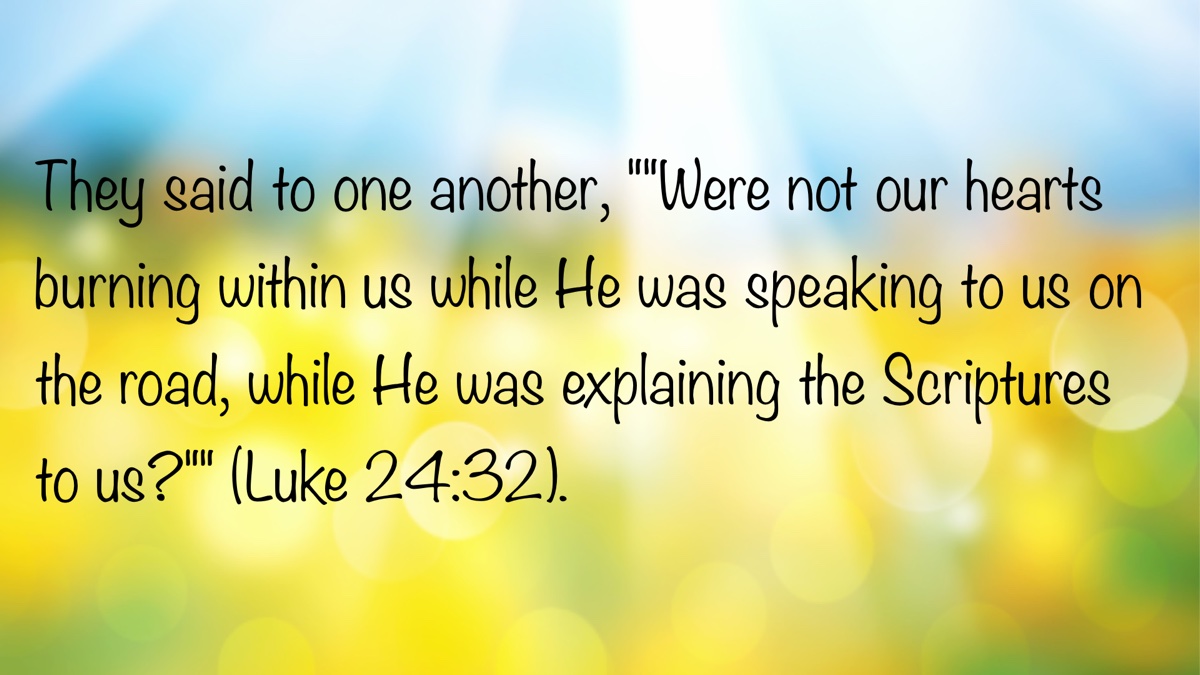
They said to one another, “Were not our hearts burning within us while He was speaking to us on the road, while He was explaining the Scriptures to us?” (Luke 24:32).
Before they even knew it was Jesus, His word impacted them profoundly. Imagine how much more their hearts burned once they realized that they had been speaking with Him!
May our hearts burn within us when we. . .
. . .have not yet been baptized into Christ. May our consciences long to be right with Him, leading us to repent and be baptized for the forgiveness of our sins (Acts 2:36-38).
. . .have sinned and need to repent and pray. As disciples who occasionally falter, God wants the sting of guilt to lead us into repentance and prayer, forgiveness, and a cleansed conscience (Acts 8:20-24).
. . .gather in worship. May we zealously yearn to honor Him, be moved to worship God in spirit and truth (John 4:23-24), and desire to help each other grow more faithful in the areas of love and good works (Heb. 10:24-25).
. . .perform acts of service for others. May we want to make a difference in the lives of others like Jesus taught us by word and example (Rom. 12:13).
These two disciples came face-to-face with Christ, witnessed evidence of His divinity, and heard Him explain how He fulfilled Old Testament prophecies. They came to realize more completely what our crucified, resurrected Lord came to provide: conviction, hope, comfort, peace, and strength.
These disciples literally walked on the road with Jesus, but He is also with us as we journey through this life. While unseen with our earthly vision, He is revealed to us in the power of the written word. He is profoundly impacting the world by people who truly listen to and obey. May we walk in His footprints through life, and live with Him in eternity.
Shane Carrington has worked with the Southside church of Christ in Sulphur Springs, TX, since 1999. He has two children and four grandchildren. The church website is here. He can be reached here.


By Bobby Graham
How do I address the idea of Monday being the first day of the week, as it is considered so by many around the world, including those living in European and Middle Eastern countries?
You have asked me a new question, one that nobody has ever asked me before. I had not thought about it until now. I remember seeing a calendar that began the week on Monday in recent years and found it repulsive. I am not sure why some calendars now indicate the week starting on Monday, unless it is because some countries view it that way. It has long been the case that the world has more influence than the Bible.
We must learn what the expression “first day of the week” meant to people in the first century, just as we must determine how they understood the words “baptism,” “sing,” “married,” and “male/female.” Whatever it meant to them, it must mean the same thing to us if we are trying to follow the Lord’s will. Regardless of many attempts to redefine these and other biblical words and concepts, we must stay where God places them. In other words, we must allow the divine boundaries to stand; otherwise, we change the Bible to mean whatever we want it to mean. Such an approach is dishonest!
It is clear from Luke’s account that Jesus arose from the dead on the first day of the week (24:1-2, 7, 21, 46). The combination of the resurrection on the third day (not of the week, but since He died) with the first day of the week forever seals that day as the one when Christians gather in the name of Christ to remember His death (Acts 20:7). Regardless of popular thought about which day is the first day of the week, it is clear that the first day of the week, now called “Sunday,” was the day of Jesus’s resurrection from the dead. Just as men have changed immersion to sprinkling or pouring, some have attempted to change the first day of the week to another day. In either case, no such change is permitted.
It is always important to emphasize that truth does not depend on changing calendars, differing interpretations, or evolving word definitions and expressions, but on the unchanging words spoken by the Lord (Matt. 24:35). While an English dictionary is useful for understanding a word’s contemporary meaning, modern definitions are not the basis for determining how the Bible uses ancient words. That understanding must come from the biblical text itself, supported by consulting Greek and Hebrew lexicons and Bible dictionaries.
Bobby L. Graham actively participates in fill-in preaching, Belize trips, teaching an hour each day at Athens Bible School, and in gospel meeting work. He and his wife, Karen, have three children. He can be reached here.




By Barry Britnell
Synopsis: Just because we see well-watered valleys doesn’t mean we should dwell in them. Observing the lush Jordan Valley near Jericho, the author reflects on the story of Abram and Lot in Genesis 13:8–13, drawing parallels to Lot’s choice—which, though practical, led to spiritual danger. The reflection offers three key lessons: use God-given choices wisely, be cautious of temptation, and seek redemption when mistakes are made.
For anyone who has ever met me, you know that I am fascinated by geography. Growing up, I was a big fan of the Rand McNally Atlas of the United States, which would be released every fall.
This is one reason why I love traveling to Israel. The geography of Israel is incredibly diverse. Within this small piece of land, you have coastlines that hug the Mediterranean Sea. You have a mountain that is over 9,000 feet in elevation. You have hills, valleys, and waterfalls. You have parts of the country that receive a couple of feet of rain each year, while other parts of the country receive only a few inches. Finally, you have the lowest place on the face of the earth with the Dead Sea.
When given the opportunity, I encourage people to learn as much as they can about the geography of the lands of the Bible. In many biblical accounts, the geography is not specifically detailed by the writer. However, if you are familiar with the geography of the region where the story takes place, you can better understand what the characters were experiencing.
In Genesis 13, we have the story of the families of Abram and Lot and the strife between them. Beginning in verse 8, we read:
Then Abram said to Lot, “Let there be no strife between you and me, and between your herdsmen and my herdsmen, for we are kinsmen. Is not the whole land before you? Separate yourself from me. If you take the left hand, then I will go to the right, or if you take the right hand, then I will go to the left.” And Lot lifted up his eyes and saw that the Jordan Valley was well watered everywhere, like the garden of the Lord, like the land of Egypt, in the direction of Zoar. (This was before the Lord destroyed Sodom and Gomorrah.) So Lot chose for himself all the Jordan Valley, and Lot journeyed east. Thus, they separated from each other. Abram settled in the land of Canaan, while Lot settled among the cities of the valley and moved his tent as far as Sodom (vv. 8-13).
In this story, Abram and Lot are located between Bethel and Ai in the hill country. This conversation occurs and the Scriptures state that “Lot lifted up his eyes and saw that the Jordan Valley was well watered.”
Here is a refined version of your paragraph for clarity, grammar, and punctuation, following Chicago Manual of Style guidelines:
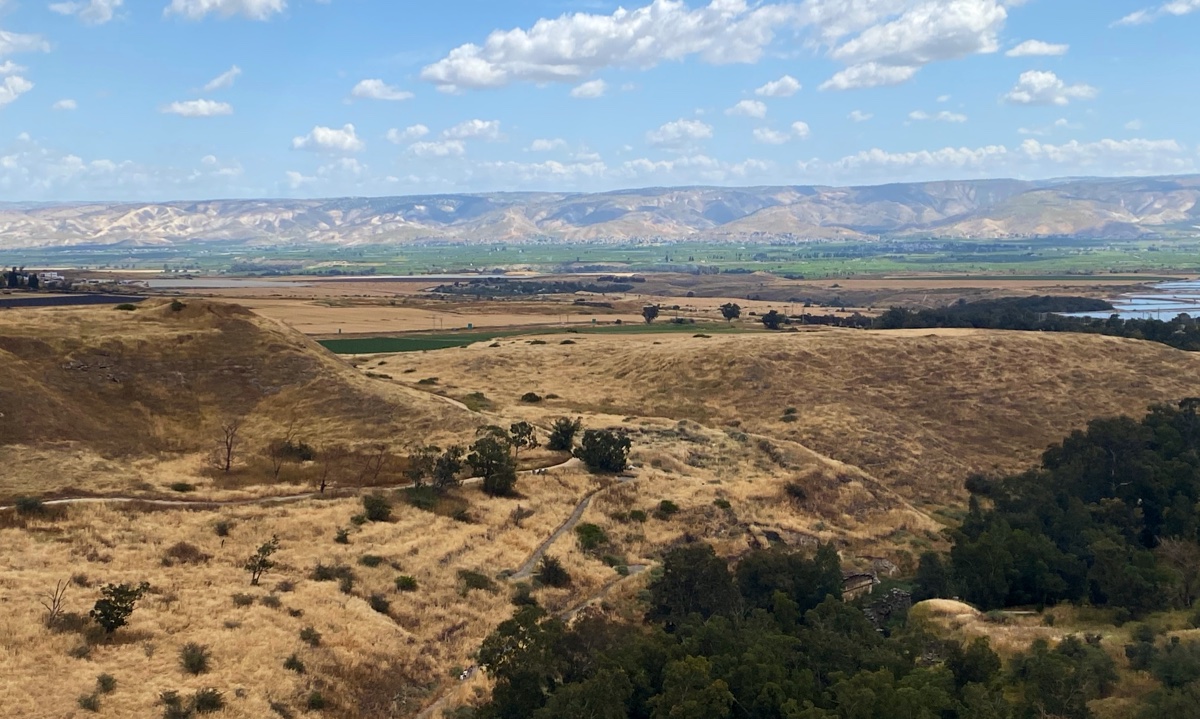
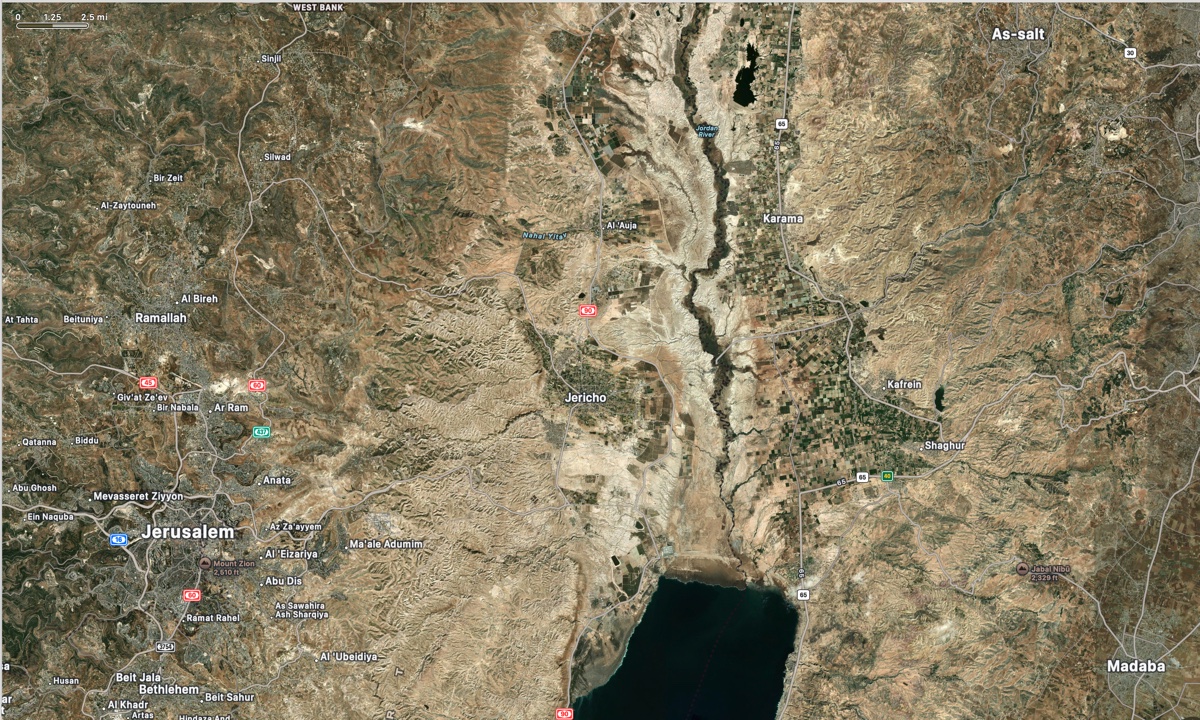
In April, I was in Israel with my tour group, traveling south along Highway 90 toward Jericho. From that road, you typically have a wonderful view to the east across the Jordan Rift Valley toward the Transjordan Plateau. On this particular day, the view was especially clear, as a northern breeze had dissipated the morning haze. As you can see from this picture, the scene closely resembles what Lot may have witnessed—the plain of the Jordan Valley appearing green and “well-watered.” Without a doubt, it is easy to understand the appeal of this location, given Lot’s need to care for his family and livestock.
Nevertheless, we have the benefit of knowing how the story ends. The area where Lot chose to settle exposed his family to evil influences that would ultimately have a spiritually detrimental effect on them all. Later, as Abram and God discussed ways of saving the city, they agreed that if only ten righteous souls were found, then the city would be spared (Gen. 18:32). As we know, ten righteous souls were not found. This means that not only did most of Lot’s family succumb to the temptations of the city, but also all the servants and shepherds that were traveling with Lot fell to the same fate.
Seeing this view of the Jordan Valley reminds me of several things:
First, we have choices in our life. Those choices are provided to us by God. I am thankful that I have choices. It allows me the opportunity to consider the many ways in which God has blessed me in my life and use that knowledge to make decisions that would benefit others.
Second, we need to recognize that temptations are out there and we should not make decisions too quickly. Satan is cunning. It is amazing how quickly we can forget years of learning for a momentary lapse of judgement. It is easy for me to see how Lot made the choice he did. He had a problem and saw a solution. What Lot needed to do was to ask a few more questions before making his final decision. Perhaps if he had done that, he would have recognized the perils he would have to face.
Third, even if we make wrong decisions, we can and should make amends. There is a lot of this story that we do not know. Once Lot moved into the Jordan Valley, at what point did he realize that he had made a mistake? Why didn’t he show leadership by moving his family once again to a place that would have been more suitable for their spiritual life?
It is easy for us to get into difficult situations and think that we are trapped and that there is no way out. That certainly is not true. God has always been there for us and will always be there for us. And even when we make wrong decisions, thanks to the grace of God, we have the opportunity to fix ourselves and walk in the path where we need to be.


Barry Britnell is the founder of Exploring Bible Lands, LLC and leads Bible Study tours to the land of Israel. He also works with Appian Media to produce biblically sound videos used in teaching others about the Bible. He and his wife, Tabatha, have three children. They live in Athens, AL, and worship with the Capshaw church of Christ. He can be reached here.
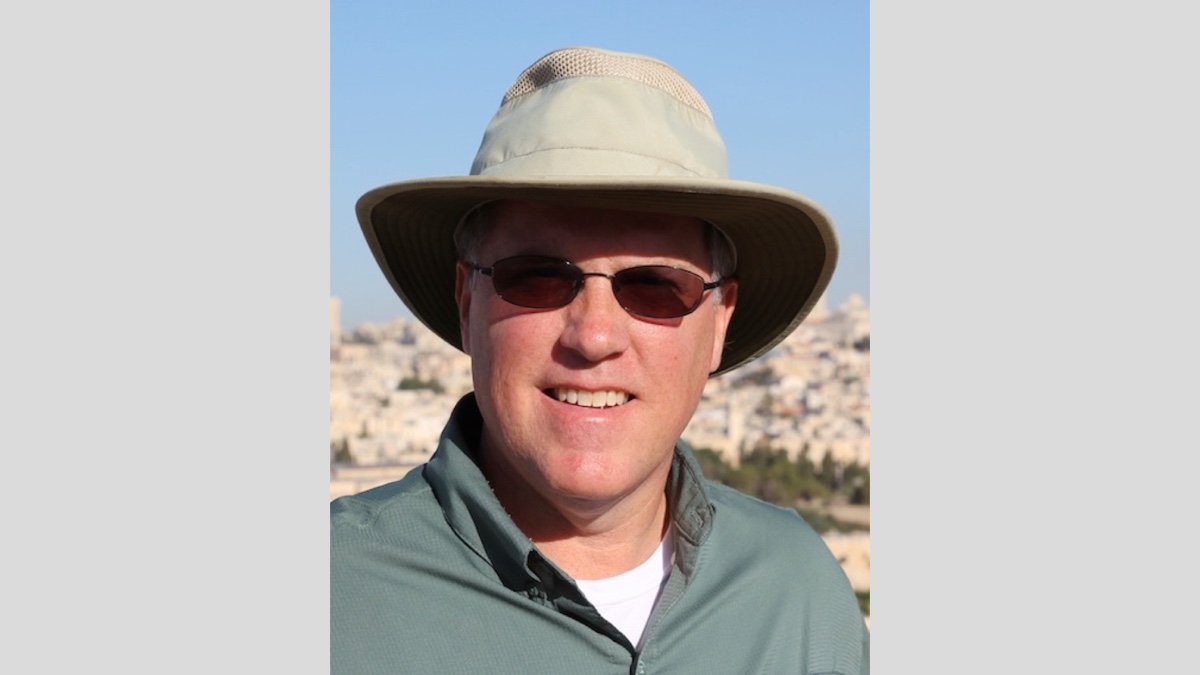



By Chris Reeves
Note to the reader: With this article, I close this series on Bible couples. I would like to thank Mark Mayberry for the opportunity to write about various Bible couples. My hope is that we can learn from them—the good and the bad—in order to be better spouses to each other and better servants of Christ.
Synopsis: Among all the couples in the Bible—–from Adam and Eve to Priscilla and Aquila—–the most important “couple” everyone must know today is Jesus Christ and His bride, the church. Understanding the relationship they share is vital, as your eternal destiny depends on being part of the bride of Christ.
One analogy used in the New Testament to describe the church is that of marriage. John, for example, described Jesus as a “bridegroom” (John 3:29) and the church as a “bride” (Rev. 21:2, 9; 22:17). Paul also used marital language to describe the church. He wrote that the church has been “espoused” to “one husband,” who is Christ (2 Cor. 11:2). The word “espoused” comes from the Greek verb meaning “to betroth” or “to give one in marriage.” Truly, the relationship between Christ and His church is “a match made in heaven.” Let us consider this great marriage relationship between Christ and His church. What kind of bride is Christ joined to, and what can we learn from this for our marriages today?
Jesus Christ is joined to a single bride. He is joined to just one church and built only one church. Jesus said, “I will build My church”—singular (Matt. 16:18). He did not join Himself to multiple brides, nor did He build multiple churches. The New Testament church is one bride, not many. It is “one body,” not many (Rom. 12:4-5; 1 Cor. 10:17; 12:12-13, 20; Eph. 2:16; 4:4; Col. 3:15).
When the first believers were baptized on the day of Pentecost, they were added to the Lord’s church (Acts 2:47)—the one bride of Christ. They did not join various denominations, as those did not exist. Nor did they wear denominational names such as Baptist, Catholic, Mormon, Presbyterian, or Lutheran. Because they were the bride of Christ, they took on His name and His name only. These disciples were called “Christians” (Acts 11:26; 26:28; 1 Pet. 4:16). Faithful Christians will not dishonor the noble name by which they have been called (Jas. 2:7).
Yes, there are many religious denominations in the world today, but Jesus neither established these groups nor approves of them. Are you a member of the one bride, the one church—the church of Christ that is joined to Him? If not, you need to be washed with the water of baptism (Eph. 5:26). Baptism is the believer’s “wedding ceremony,” so to speak, that joins you to Christ the bridegroom (Matt. 9:15). [Note #1]
In the same way, a God-authorized marriage today is between one man and one woman only. Yes, bigamy and polygamy are practiced in various cultures, including our own, but monogamy is what God intended from the beginning (Gen. 2:18-24), and it is what He still desires today. Paul wrote:
Now concerning the things whereof ye wrote: It is good for a man not to touch a woman. But, because of fornications, let each man have his own wife, and let each woman have her own husband” (1 Cor. 7:1-2) [Note #2].
Jesus Christ is joined to a loyal and devoted bride. First, Jesus is totally devoted and committed to His bride. He will never be unfaithful to His church or mistreat her. He will never forsake her. He will always love her, sacrifice for her, cherish her, and provide for her. Paul wrote:
Therefore I endure all things for the elect’s sake, that they also may obtain the salvation which is in Christ Jesus with eternal glory. Faithful is the saying: For if we died with Him, we shall also live with Him: if we endure, we shall also reign with Him: if we shall deny Him, He also will deny us: if we are faithless, He abides faithful; for He cannot deny Himself (2 Tim. 2:10-11).
Second, the true bride joined to Jesus will be loyal and devoted to Him as well. Faithful members of the church—the bride of Christ—will be joined to Christ and no other. The faithful church will not be joined to false gods, false teaching, or any person or thing. The faithful church will truly love Christ and will never lose its love for Him (Eph. 6:24; Rev. 2:5). Paul wrote:
For I am jealous over you with a godly jealousy: for I espoused you to one husband, that I might present you as a pure virgin to Christ. But I fear, lest by any means, as the serpent beguiled Eve in his craftiness, your minds should be corrupted from the simplicity and the purity that is toward Christ. For if he that cometh preaches another Jesus, whom we did not preach, or if ye receive a different spirit, which ye did not receive, or a different gospel, which ye did not accept, ye do well to bear with him (2 Cor. 11:2-4).
Today, there must also be loyalty and devotion between a husband and wife. When you “tie the knot,” don’t untie it. When you decide “to have and to hold,” don’t let go. When you promise “till death do us part,” don’t leave. Both husband and wife should direct their love, attention, and devotion toward each other and toward no one else. There is to be no “open marriage” among us.
Here is how a husband and wife can show their loyalty to each other:
Loyalty to their marriage vows: Matthew records that the Pharisees came to Jesus, trying Him, and saying, “Is it lawful for a man to put away his wife for every cause?” He answered and said, “Have ye not read, that He who made them from the beginning made them male and female, and said, ‘For this cause shall a man leave his father and mother, and shall cleave to his wife’; and the two shall become one flesh? So that they are no more two, but one flesh. What therefore God hath joined together, let not man put asunder” (Matt. 19:3-6; see also John 4:16-18; Rom. 7:2-4; 1 Cor. 7:10-11, 39; 1 Tim. 3:2, 12; Titus 1:6).
Loyalty to their sexual purity: “Let marriage be had in honor among all, and let the bed be undefiled: for fornicators and adulterers God will judge” (Heb. 13:4; see also 1 Cor. 7:3-5).
Loyalty to their God: “Ye husbands, in like manner, dwell with your wives according to knowledge, giving honor unto the woman, as unto the weaker vessel, as being also joint-heirs of the grace of life; to the end that your prayers be not hindered” (1 Pet. 3:7).
Jesus Christ is joined to a submissive and obedient bride. Since He is the head of the body—and the body is the church—He is the head of the church. The church must obey Jesus in all things. Paul wrote:
And He put all things in subjection under His feet, and gave Him to be head over all things to the church, which is His body, the fulness of Him that filleth all in all (Eph. 1:22-23).
And He is the head of the body, the church: who is the beginning, the firstborn from the dead; that in all things He might have the preeminence (Col. 1:18).
And not holding fast the Head, from whom all the body, being supplied and knit together through the joints and bands, increases with the increase of God (Col. 2:19).
As Head, Jesus has all authority over the body—the church—and the church is subject to Him. His authority is expressed in His words recorded in the New Testament. The church does not rebel against Christ’s authority or ignore it, nor does it turn to other so-called authorities—–such as religious councils, creeds, human traditions, or “latter-day revelations.”
In the same way, the husband today is to be a loving head, and his wife is to be submissive and respectful. Paul wrote:
Wives, be in subjection unto your own husbands, as unto the Lord. For the husband is the head of the wife, as Christ also is the head of the church, being Himself the savior of the body. But as the church is subject to Christ, so let the wives also be to their husbands in everything. Husbands, love your wives, even as Christ also loved the church, and gave Himself up for it. . . . Even so ought husbands also to love their own wives as their own bodies. He that loveth his own wife loveth himself: for no man ever hated his own flesh; but nourisheth and cherisheth it, even as Christ also the church; because we are members of His body. For this cause shall a man leave his father and mother, and shall cleave to his wife; and the two shall become one flesh. This mystery is great: but I speak in regard of Christ and of the church. Nevertheless, do ye also severally love each one his own wife even as himself; and let the wife see that she fear her husband (Eph. 5:22-25, 28-33).
Wives, be in subjection to your husbands, as is fitting in the Lord. Husbands, love your wives, and be not bitter against them (Col. 3:18-19).
That they may train the young women to love their husbands, to love their children, to be sober-minded, chaste, workers at home, kind, being in subjection to their own husbands, that the word of God be not blasphemed (Titus 2:4-5).
Peter wrote:
In like manner, ye wives, be in subjection to your own husbands; that, even if any obey not the word, they may without the word be gained by the behavior of their wives; beholding your chaste behavior coupled with fear. Whose adorning let it not be the outward adorning of braiding the hair, and of wearing jewels of gold, or of putting on apparel; but let it be the hidden man of the heart, in the incorruptible apparel of a meek and quiet spirit, which is in the sight of God of great price. For after this manner aforetime the holy women also, who hoped in God, adorned themselves, being in subjection to their own husbands: as Sarah obeyed Abraham, calling him lord: whose children ye now are, if ye do well, and are not put in fear by any terror (1 Pet. 3:1-6).
Jesus Christ is joined to a pure and holy bride. In 2 Corinthians 11:2, Paul described the church as a “pure virgin.” Members of the church must live holy and pure lives, free from sin and worldly influences. Paul wrote:
That He might sanctify it, having cleansed it by the washing of water with the word, that He might present the church to Himself a glorious church, not having spot or wrinkle or any such thing; but that it should be holy and without blemish (Eph. 5:26-27).
John wrote:
. . . even they that had been purchased out of the earth. These are they that were not defiled with women; for they are virgins. These are they that follow the Lamb whithersoever He goeth. These were purchased from among men, to be the first-fruits unto God and unto the Lamb. And in their mouth was found no lie: they are without blemish (Rev. 14:3-5).
Likewise, husbands and wives should live pure and holy lives for each other and for God. May we all guard our thoughts (Phil. 4:8), our actions (1 Tim. 5:22), and our wisdom (Jas. 3:17) to ensure they remain pure at all times. Wives, be pure and chaste in your demeanor and dress (Titus 2:5; 1 Pet. 3:2). Let us all strive to be pure, just as Christ is pure (1 John 3:3).
Jesus Christ is joined to an eternal bride. The faithful in the Lord’s church will one day hear heavenly “wedding bells” as they dwell with Jesus for all eternity in heaven. There, they will live “happily ever after.” Faithful Christians who are watching and ready for Jesus, the Bridegroom, to return will be able to join Him at the wedding feast (Matt. 25:1-13; Luke 12:36).
Loyal disciples must be living righteously when Jesus returns. They must overcome sin, false teaching, worldliness, persecution, and anything else the devil throws at them. John wrote:
And I heard as it were the voice of a great multitude, and as the voice of many waters, and as the voice of mighty thunders, saying, “Hallelujah: for the Lord our God, the Almighty, reigneth.” Let us rejoice and be exceeding glad, and let us give the glory unto Him: for the marriage of the Lamb is come, and His wife hath made herself ready. And it was given unto her that she should array herself in fine linen, bright and pure: for the fine linen is the righteous acts of the saints. And He saith unto me, “Write, Blessed are they that are bidden to the marriage supper of the Lamb.” And He saith unto me, “These are true words of God” (Rev. 19:6-9).
And I saw the holy city, new Jerusalem, coming down out of heaven from God, made ready as a bride adorned for her husband. . . . And there came one of the seven angels who had the seven bowls, who were laden with the seven last plagues; and He spake with me, saying, “Come hither, I will show thee the bride, the wife of the Lamb” (Rev. 21:2, 9).
The marital relationship of a husband and wife is not eternal. Marriage is for this life, not the next (Matt. 22:30; Mark 12:25; Luke 20:34-35). However, married couples can encourage those around them to be joined eternally to Jesus Christ. Christians today should help others—family, friends, coworkers, neighbors, and more—see the importance of obeying the gospel and becoming part of the grand and glorious church, the bride of Christ (Eph. 5:27).
Faithful couples should invite the lost to come to Jesus. Invite all to “the marriage supper of the Lamb” (Rev. 19:9). John wrote:
And the Spirit and the bride say, “Come.” And he that heareth, let him say, “Come.” And he that is athirst, let him come: he that will, let him take the water of life freely (Rev. 22:17; see also Matt. 22:1-14).
Jesus and His bride—what a “perfect couple”! The picture of Christ and His bride (the church) in the New Testament is beautiful. Nevertheless, they are not just a “beautiful couple;” they also teach us how husbands and wives should act toward each other today. Husbands, be like Christ in your marriage. Wives, be like the church in your marriage.
If you have been married only a short while, know that Christ and His church are your role model. Follow this example in the New Testament, not the example of the world around you.
If you have been married for a few decades, remind yourself how Christ would have you live as a husband or wife. Sometimes you must reassess your marriage to see whether it aligns with what Christ desires—and be willing to change if necessary. You may need to remember your “wedding day” with Christ and your spouse (Jer. 2:13, 32). You may need to “rekindle your marriage” to Christ and your spouse (Rev. 2:4-5).
If you have been married for fifty years or more, continue to show younger couples that it is indeed possible to remain committed and loving in marriage all the way to the end. And a big “thank you” to all the godly and faithful couples out there for your example!
[Note #1] For “bridegroom” as it relates to Christ, see also Matthew 25:1, 5-6, 10; Mark 2:19-20; and Luke 5:34-35.
[Note #2] All quotations are taken from the American Standard Version of 1901 (ASV).
Chris Reeves has preached for the Warfield Blvd. church of Christ in Clarksville, TN, since 2016. He and his wife, Cheri, have four children and two grandchildren. His Bible study website is here. The church website is here. He can be reached here.



By Danny Linden
Synopsis: Ezekiel 34 describes God as a Perfect Shepherd who will punish evil leaders and properly direct and provide for His people.
God is frequently described as the Good Shepherd over His people (e.g., John 10:1-18). This depiction is better understood when compared to the evil shepherds of Israel depicted in Ezekiel 34. This chapter helps us to see God’s care for His people, His anger toward those who abuse their power, and His perfect leadership.
The word of the LORD came to me: “Son of man, prophesy against the shepherds of Israel; prophesy, and say to them, even to the shepherds, Thus says the Lord GOD: Ah, shepherds of Israel who have been feeding yourselves! Should not shepherds feed the sheep? You eat the fat, you clothe yourselves with the wool, you slaughter the fat ones, but you do not feed the sheep. The weak you have not strengthened, the sick you have not healed, the injured you have not bound up, the strayed you have not brought back, the lost you have not sought, and with force and harshness you have ruled them. So they were scattered, because there was no shepherd, and they became food for all the wild beasts. My sheep were scattered; they wandered over all the mountains and on every high hill. My sheep were scattered over all the face of the earth, with none to search or seek for them” (Ezek. 34:1-6).
God instructed Ezekiel to prophesy against the “shepherds of Israel,” a common expression for the leaders of the people (cf. 2 Sam. 5:2; 7:7; 1 Pet. 5:1-3). This could include kings, civil authorities, and other community and religious leaders. When God looked at the leaders of His people, He saw shepherds who neglected and exploited their flock.
Throughout the Bible, God consistently pairs power and position with duty. Leaders are due respect and obedience, but in return they are to fulfill many responsibilities. Kings must uphold righteousness, punish evil, defend the oppressed, and protect the innocent (cf. 1 Sam. 10:25, “the rights and duties of the kingship”). The kings in Ezekiel’s day ruled with “force and harshness” (Ezek. 34:4), which is the same term used to describe the ruthless behavior of the Egyptian taskmasters (Exod. 1:13-14) and was expressly forbidden by God (Lev. 25:43, 46).
God’s people suffered terribly at the hands of their evil shepherds. Though they could do nothing about it, He promised to step in—–to preserve the remnant and punish their corrupt leaders.
“Therefore, you shepherds, hear the word of the LORD: As I live,” declares the Lord GOD, “surely because my sheep have become a prey, and my sheep have become food for all the wild beasts, since there was no shepherd, and because my shepherds have not searched for my sheep, but the shepherds have fed themselves, and have not fed my sheep, therefore, you shepherds, hear the word of the LORD: Thus says the Lord GOD, Behold, I am against the shepherds, and I will require my sheep at their hand and put a stop to their feeding the sheep. No longer shall the shepherds feed themselves. I will rescue my sheep from their mouths, that they may not be food for them” (Ezek. 34:7-10).
God’s concern for His people is evident. He saw them in danger, had pity on them, and would not allow them to be abused any longer. The evil shepherds would not escape judgment for their mistreatment. They had made themselves enemies of God, and He would not turn aside His wrath.
God has very little patience with abusive leaders. He holds them to a high standard and expects them to behave righteously. He told Jeremiah to go to the king and command by the authority of God to “do justice and righteousness” (Jer. 22:1-5). If he refused, God swore to destroy his house. Even when they seem untouchable, leaders do not get a free pass from God!
Corrupt leadership led to the spread of evil in Israel and ultimately brought about God’s inevitable judgment. Of course, each person is responsible for his own choices and stands before God as an individual. Yet, it is noteworthy that God singles out the leaders for their evil influence. This reflects the outsized effect their decisions have on others.
For thus says the Lord GOD: “Behold, I, I myself will search for my sheep and will seek them out. As a shepherd seeks out his flock when he is among his sheep that have been scattered, so will I seek out my sheep, and I will rescue them from all places where they have been scattered on a day of clouds and thick darkness. And I will bring them out from the peoples and gather them from the countries, and will bring them into their own land. And I will feed them on the mountains of Israel, by the ravines, and in all the inhabited places of the country. I will feed them with good pasture, and on the mountain heights of Israel shall be their grazing land. There they shall lie down in good grazing land, and on rich pasture they shall feed on the mountains of Israel. I myself will be the shepherd of my sheep, and I myself will make them lie down, declares the Lord GOD. I will seek the lost, and I will bring back the strayed, and I will bind up the injured, and I will strengthen the weak, and the fat and the strong I will destroy. I will feed them in justice” (Ezek. 34:11-16).
Even in His wrath, God wanted to gather His people up again and give them a new start. There would be a restoration in Judah out of the seemingly hopeless situation they were in during the Babylonian captivity. They would finally be led by a proper Shepherd who would care for them in all the ways they needed.
Israel never should have stopped trusting in God’s ability and willingness to lead them. He proved His grace toward them by rescuing them from Egypt, leading them safely across the Red Sea, supplying their every need in the wilderness, and giving them an abundant and bountiful land of their own. The only reason evil leaders arose in the first place was that the people asked for them (1 Sam. 8:4-9).
Where once they were oppressed and abused, now they could be healed and sustained. It is always good to be led by the Lord (Prov. 3:5-6)!
As for you, my flock, thus says the Lord GOD: Behold, I judge between sheep and sheep, between rams and male goats. Is it not enough for you to feed on the good pasture, that you must tread down with your feet the rest of your pasture; and to drink of clear water, that you must muddy the rest of the water with your feet? And must my sheep eat what you have trodden with your feet, and drink what you have muddied with your feet? Therefore, thus says the Lord GOD to them: Behold, I, I myself will judge between the fat sheep and the lean sheep. Because you push with side and shoulder, and thrust at all the weak with your horns, till you have scattered them abroad, I will rescue my flock; they shall no longer be a prey. And I will judge between sheep and sheep. And I will set up over them one shepherd, my servant David, and He shall feed them: He shall feed them and be their shepherd. And I, the LORD, will be their God, and my servant David shall be prince among them. I am the LORD; I have spoken (Ezek. 34:17-24).
When God leads you, there is a standard that must be uphold. He does not allow His people to behave in any way that they please. This shows that it is not only the actions of the leaders that God is concerned with.
If they want to be God’s sheep and enjoy His blessings, they must be cleansed. If a sheep pollutes the pasture and the water with muddy feet, he ruins it for the rest of the flock. If he pushes weaker sheep aside, he is just as abusive as the evil shepherds—only without their position of leadership. God will not stand for it! He judges between sheep and sheep. Which ones are allowed to remain in the flock and which ones go to slaughter? It depends on their own willingness to submit to the Shepherd.
This entire chapter is about the restoration of Judah, but there is also messianic foreshadowing. Jesus is our Good Shepherd (John 10:1-18). He proved His love for us by dying for us—far beyond what any other shepherd would do.
The lessons from this chapter apply to modern-day disciples. God will not allow wicked leaders to get away with their sin. In this life, we often have very little recourse when powerful people abuse us, yet God sees and will judge.
The Lord leads and sustains us, providing exactly what we need. While this certainly includes our physical necessities, His spiritual guidance is even more valuable. In Christ, we have every spiritual blessing (Eph. 1:3-14) and receive personal attention from God so that we may grow and carry out good works.
To be in God’s church, we must abide by His standard. All are guilty of sin (Rom. 3:23), so we all come in with muddy feet. God knows that and expects us to confess our spiritual poverty and submit to Him (Matt. 5:3-4). We can be cleansed in baptism (Acts 2:38) and be made pure before God in the church. “Blessed are those who wash their robes, so that they may have the right to the tree of life and that they may enter the city by the gates” (Rev. 22:14).
Danny Linden has worked with the Hebron Lane church of Christ in Shepherdsville, KY, since March 2023. He and his wife, Lauren, have four children. The church website is here. His website is here. He can be reached here.



By Timothy Williams
Synopsis: The author emphasizes the importance of Christian fellowship and the value of building strong, godly relationships through regular worship, Bible studies, gospel meetings, and other spiritual gatherings. Drawing on biblical examples such as Joshua and Caleb, David and Jonathan, and Paul’s missionary work, he highlights how mutual encouragement and shared faith can strengthen believers and help them grow closer to God.
While Christ’s church is universal, its members worship in many individual congregations, such as the one that you likely attend. Hebrews 10:24-25 admonishes: “Let’s consider how to encourage one another in love and good deeds, not abandoning our own meeting together, as is the habit of some people, but encouraging one another; and all the more as you see the day drawing near.”
While this doesn’t mean you have to attend every single singing, gospel meeting, or Bible study in your area, it does remind us of something very important. Meeting with other Christians—both from our home congregations and from neighboring churches—is one of the most effective ways to encourage one another. It should not be something that we feel like we have to do, but it should be something we enjoy doing. When we attend worship and study with other Christians, it is very encouraging for both you and everyone in attendance.
Let’s look at some examples in the Bible of people who built relationships that were very helpful. Joshua and Caleb are mentioned in Numbers 13-14. Numbers 20, in discussing the census, reiterates of that entire generation, only Joshua and Caleb would gain entry to the Promised Land (Num. 14:24; Deut. 1:36; Josh. 14:8-9). The example of Caleb and Joshua is an amazing one. They were both Israelites; however, they were from different tribes. They are first mentioned together in Numbers 13 when Moses is designating leaders of each tribe to go and spy out the land of Canaan. Caleb was selected from Judah and Joshua from Ephraim. Later, when the spies returned, Joshua and Caleb were the only two who gave a favorable report. All the other spies lamented that they would not be able to take the land. Caleb silenced the people with an admonition to go up and take the land. “For we can certainly take it” (Num. 13:30). Except for Joshua, the others repined. “We are not able to go up against the people, because they are too strong for us” (Num. 13:31).
Then, Joshua and Caleb tore their clothes and reiterated to all the people that the land was fruitful and promised prosperity. “If the Lord is pleased with us, then He will bring us into this land and give it to us—a land which flows with milk and honey. Only do not rebel against the Lord; and do not fear the people of the land, for they will be our prey. Their protection has been removed from them, and the Lord is with us; do not fear them” (Num. 14:6-10). Then the whole assembly talked about stoning them. After going through that together, we can safely assume that Joshua and Caleb were very close. Wouldn’t you be if you went through something like that with someone? Eventually, they both entered the Promised Land as God had promised because they followed Him. While we rarely go through trials as extreme as this, we can still form strong relationships with people around us. Relationships that are encouraging, strengthening, and helping our relationship with God are ultimately helping us to heaven with as many others as possible. One great way to do that is by going to Bible studies and gospel meetings in your area, including at other congregations.
Another well-known example is that of David and Jonathan. David was chosen to be the next king of Israel, while Jonathan’s father Saul was king. After this, Saul hated David, was jealous of him, and tried to kill him. However, Jonathan was David’s friend and warned him of his father’s evil intentions. Then Jonathan tried to reason with Saul, saying, “Do not let the king sin against his servant David, since he has not sinned against you, and since his deeds have been very beneficial to you. For he took his life in his hand and struck the Philistine, and the Lord brought about a great deliverance for all Israel; you saw it and rejoiced. Why, then, will you sin against innocent blood by putting David to death without a cause?” (1 Sam. 19:4-5).
In 1 Samuel 19:6, Saul vowed that he would spare David’s life. He kept the oath for a while, and life went on. David won victories against the Philistines in battle again. Then an evil spirit came on Saul, and David came to play music to soothe him, but Saul threw a spear at David in another attempt on his life. David had to flee the next day to avoid capture and death at Saul’s hands. Jonathan did not know about Saul’s malicious actions. When he talked to David and learned what had happened, he assured David, “Whatever you want me to do, I’ll do for you.” They reaffirmed their care and trust for each other and developed a plan to keep David from being killed. Their strong relationship saved David’s life. Strong relationships with godly people can, and generally will, be very beneficial for both parties.
There are multiple biblical examples of brethren visiting other Christians.
Paul traveled to meet with and encourage other Christians often and sent Timothy to encourage people in Thessalonica in 1 Thessalonians 3:1-5. Paul met and taught a myriad of people on his travels. Many of the people he met on his journeys became dear friends, like Aquila and Priscilla (Rom. 16), Timothy (1 Tim. 1:2), Epaphras (Col. 4:12; Phile. 1:23), and others mentioned in Romans 16. Ananias visited Saul and helped start him on the true path to doing God’s will (Acts 9:10-19). If you are traveling, even in another country, don’t miss the opportunity to worship with faithful brethren. You will see how they conduct services differently, but still according to God’s word. You will encourage them, and you will be encouraged.
Elijah thought he was the only one left serving God. King Ahab, who wanted him dead, was pursuing him. Seemingly alone in a cave, Elijah talked to God. “I have been very zealous for the Lord, the God of armies; for the sons of Israel have abandoned Your covenant, torn down Your altars, and killed Your prophets with the sword. And I alone am left; and they have sought to take my life” (1 Kings 19:10). God encouraged Elijah and told him to get up. He then told him that there were thousands more who had not bowed their knee to Baal. Sometimes we feel like Elijah did. It may seem there is no one else to help encourage us to keep looking to God and remind us of everything He does for us. By visiting other congregations and Bible studies in the area, we—like Elijah—can be reminded that we are not alone. Even when we cannot be with many others who want to help us, we can always remember that God is with us, and if we follow Him, we will make it through hard times and be stronger on the other side. Visiting other congregations is helpful and encouraging, especially to combat the misleading feeling that we are all alone. Even if you don’t struggle in that way, someone at a congregation in your area may very well be struggling—just as Elijah was. By visiting other congregations, you can help the people there immensely.
Attending gospel meetings and singings are great ways to get to know people at other congregations. You may get to know people your age, but getting to know older, wiser people is very beneficial, too. You can encourage them a ton, be encouraged, and you will probably learn more from these relationships than most or any other. By going to gatherings like that at other congregations, you can learn a lot. Seeing how different groups conduct services can be beneficial. One of the greatest benefits of attending services at other congregations is that you can encourage the people there and be encouraged. This not only is encouraging to those hosting the meeting, but you can be encouraged by hearing different lessons and different styles of preaching. Through this, you may hear something explained or taught in a way that finally makes sense and/or is extremely helpful and impactful to you.
Another way to meet with other Christians is by going to Bible studies in people’s homes. The early Christians frequently met in each other’s houses (Acts 2:46). This is a great way to grow relationships, and it allows for different scenarios compared to only going to church worship services. In this original setting, it may be easier to ask questions, and there may be different ways you will learn, be encouraged, and strengthen relationships with other Christians and even with people who may be interested in learning about the gospel.
There are also many camps led by Christian individuals, and going to those can be immensely beneficial and enlightening. Some examples include preacher training courses/camps, young men’s leadership camp, Florida college camps, and much more. There are Bible camps specifically for girls as well as some for boys, and also some for both. They give you a chance to spend a week or weekend surrounded (mostly) by others with a common goal to serve God. It is extremely encouraging. You can learn a ton, and they’re loads of fun too. I have met some amazing people and some of my best friends at camps like these.
While most of these camps only happen once a year, there may be Bible studies and events for young people that occur more frequently. Going to these, you can grow relationships with people closer to your area, learn and worship God, and have lots of fun. Bible studies and these other opportunities mentioned are a great way to encourage, be encouraged, and grow. With all of these, you will meet different people with various personalities, varied communication skills, and contrasting temperaments. It is beneficial to learn how to associate with, work with, and befriend different kinds of people, especially as we look forward to talking to or trying to teach others about the gospel throughout our lives.
If you do not have these activities available in your area, do not let that discourage you. You may have other options. You might try to make use of the Internet and try to start an online Bible study with a few people in other states or countries. I would be happy to help you find a Christian pen pal. Start reading the Bible weekly at the same time and same bookstore or coffee shop in your area, and maybe a stranger will approach you with questions that could lead to future studies. Choose an elderly Christian whom you can serve (Lev. 19:2) and maybe even a younger child to teach (You are always leading by example.) Always remember God will provide everything we need. We just have to accept His gifts (Phil. 4:19; 1 Cor. 10:13; Matt. 6:30-33; Luke 12:24-26).
Attending Bible studies, camps, singings, gospel meetings, and the like are some of the best possible ways to encourage each other. Even if you do not know of anything in your area, you can start something yourself! Early Christians often met daily. Paul and others traveled and encouraged any disciples they could find. We should love and care for each other, and one amazing way to show that is by getting together to study and worship God. Not only will we learn, it is usually fun to hang out with people, get to know each other, and grow closer to each other. Even just being together with other Christians in general is a great way to encourage each other by being around godly influences.
Like Joshua and Caleb, David and Jonathan, and so many others, you also can grow relationships that will help you tons throughout your life and ultimately help you strive to better serve God and receive the gift of eternal life in heaven. So next time you hear about a gospel meeting, singing, or Bible study you could attend, remember: You could meet someone there who will be one of your best friends for the rest of your life, you will encourage the people there, you will be encouraged, and these encouragements will, if you let them, ultimately help you continue serving God.
Loving and serving Him is infinitely more important than anything else you could ever do. Not only did God create you and me, He loved us so much that He sent His own Son, His only Son, to save us from eternal hellfire, even though we were sinners! God gives us a chance to be given eternal life, and He loves you and wants to reward everyone who will serve Him. So remember, no matter what, serving God is the most important and rewarding thing you can ever do (Eccl. 12:13; Ps. 100:2; Deut. 10:12; Col. 3:17; Rom. 12:11; 1 John 5:3; Luke 6:46; Luke 11:28; Rom. 12:1-2; Rev. 21:1-5).
Timothy Williams is a member of the Northeast church of Christ in Crosby, TX, and has visited many congregations in America, as well as the Philippines, Malaysia, Italy, and Australia. He lives with his parents, one brother, and two sisters in Crosby. He just completed ninth grade, being homeschooled with Classical Conversations. He can be reached here.




By Jeremiah Cox
Synopsis: Paul’s gratitude toward God for the obedience of the Roman saints in Romans 6:17 shows how a relationship with Christ cannot exist except through the pattern revealed in His word.
A central theme of God’s word is His desire to have a relationship with mankind. His efforts to reconcile man to Himself are revealed with flawless precision and timing throughout human history. However, despite the clarity of Scripture, men have continued to exhibit their ability to blind themselves to God’s plan by their own wisdom (Isa. 29:9-16). Rather than honestly assessing Scripture by allowing it to harmonize itself, men create paradigms by human tradition. These require certain interpretations despite Bible passages which are contradictory to them. From these man-made presuppositions come certain dichotomies which are blindly accepted, but which are exposed as erroneous by a simple assessment of the broader context of Scripture.
One such false dichotomy stems from the notion that the relationship between God and man is counter to the emphasis placed on law. Therefore, either one pursues a relationship with the law that is self-righteous and arrogant, or one pursues a relationship with God. Those who stress the importance of pursuing right standing with God by carefully following what He has revealed are often disparaged as cold legalists who do not know the love of God. However, if we let God speak to us through His word, we will discover that His revealed law—whether it be that from Sinai (2 Tim. 3:15), or the law of Christ (Rom. 1:16-17; 1 Cor. 9:21; Gal. 6:2)—is the avenue through which we come and sustain a relationship with Him.
It is commonly concluded that the problem observed among the Jews and exposed by Jesus was an overemphasis on the law. Somehow, men were missing God in their aim by caring too much about what He had asked of them. However, abundant statements of Jesus contradict this. For example, rather than possessing a negative view of law-keeping, Jesus claimed to have come to fulfill the law, and required a righteousness which exceeded that assumed by the spiritual leaders of the day (Matt. 5:17-20). An emphasis on law-keeping was not the problem.
Long before Jesus’s ministry, the law of Moses anticipated the failure of the Israelites, and identified the problem—“If you do not obey Me, and do not observe all these commandments. . . I will set My face against you. . . [but] if their uncircumcised hearts are humbled, and they accept their guilt—then I will remember My covenant with Jacob” (Lev. 26:14, 17, 41, 42). The conflict between Jehovah and His people revealed in the annals of Jewish history was not a result of their overly strict view of the law. It was their failure to observe it faithfully because of the hardness of their hearts. God desired a relationship with the Israelites and revealed Himself to them through the law. However, they consistently rejected the true knowledge of God for their own ways. This led to unfaithfulness, and finally God’s rejection of them (Hos. 4:4-6; 6:4-7).
Of course, this was not true for every Jew. There was always a faithful remnant. They were not those who ignored God’s law, but who loved God with their entire being and were faithful to Him. They were not those who thought mere proximity to the temple delivered them to work abominations (Jer. 7), but those who were faithful to God’s will out of love (Deut. 6).
The apostle Paul addressed the typical failure of the Jew in his epistle to the Romans. He exposed the irony of their boasting in God through receiving the law and circumcision with their simultaneous blasphemy of God, and love for the praise of men (Rom. 2:17-29). This attitude toward the basic markers of Judaism (like circumcision) ultimately led to them stumbling at the prophesied cornerstone (Rom. 9:30-33). Their preference and longing were not for God, but for social status (John 5:41-47), especially in stark contrast to the uncircumcised (Acts 13:44-48; Eph. 2:11-12). When the Messiah came with insurmountable evidence supporting His claim (Rom. 1:3-4), they rejected Him because they did not truly have a love for His Father (John 8:42).
The New Covenant under the reign of the Christ would require a heart response as standard for those who would enter it (Jer. 31:31-34). It would necessitate a spiritual birth of choice, not a fleshly birth of chance (John 3:1-8). Yet this does not amount to choosing a relationship with God over the law, as though the two were mutually exclusive—“not being without law toward God, but under law toward Christ” (1 Cor. 9:21). It includes an understanding and appreciation that the divine law reveals the mind of its author (Ps. 19; 1 Cor. 2). There is an inseparable connection between knowing God, and sincere, transformative interaction and participation in His revelation (2 Pet. 1:2-8).
This connection is emphasized by Paul in his grateful reflection on the change the Roman saints had experienced:
But God be thanked that though you were slaves of sin, yet you obeyed from the heart that form of doctrine to which you were delivered (Rom. 6:17)
There are some noteworthy nuances in the text which offer powerful insight into the relationship with the Son of God we sustain through His law:
They were obedient “from the heart.” This was not a matter of superficial ritual, social custom, or man-made tradition. It is likely that the saints in Rome were converted as a result of the events of Pentecost (Acts 2:5, 10). The gospel preached on that day cut them to the heart and elicited a sincere response to the truth of Christ (Acts 2:36-41). They returned to Rome in newness of life and spirit to bear fruit to God (Rom. 6:4; 7:4, 6).
The King James Version translates eis hon paredothēte as “which was delivered to you,” making the Romans the recipients of “that form of doctrine.” However, the context lends credence to the translation, “to which you were delivered” (NKJV), which makes the Romans the subjects being delivered rather than the “form of doctrine.” Paul says, “I speak in human terms” (Rom. 6:19), relating the known relationship of a slave and master to spiritual matters. The slaves in context are the Romans. They were slaves of sin because they presented themselves as servants to obey sin (Rom. 6:16). However, Paul’s thanksgiving to God is based on their deliverance as slaves from the master of sin to “that form of doctrine,” and becoming “slaves of righteousness” (Rom. 6:18).
Paul personified sin in the context and would continue to do so in the next chapter. Scripture is clear that when we present ourselves as slaves to sin, there is a personal being to whom we are made captive (2 Tim. 2:26). The devil becomes our master when we choose to do what he desires (John 8:44). In the same way, the Christian who is a slave of righteousness, who has been delivered to that form of doctrine, is also made captive to a personal being (2 Cor. 2:14; 10:4-6; Phil. 3:12). The relative pronoun hon, translated “which” in Romans 6:17, is masculine, providing for a personal reference. Typically, the same form is translated “whom,” though context plays a major part in this determination. The previous context included a shift from imitating Adam’s disobedience and inviting sin and death into our lives to imitating Christ’s obedience and receiving grace, righteousness, and life (Rom. 5:12-21). The following context showed the importance of dying to the law to be married to Christ, thus being bound to Him (Rom. 7:1-6). The challenge comes with considering typon didachēs, “form of doctrine,” as a personal reference. This is eased by the obvious fact that though we are submissive to the word of God, it is God Himself to whom we ultimately surrender (1 Thess. 2:13; Phil. 2:12-13). Additionally, typos is often used in reference to an individual providing an example or pattern to learn from and follow (Phil. 3:17; 1 Thess. 1:7; 2 Thess. 3:9; 1 Tim. 4:12; Titus 2:7; 1 Pet. 5:3). The immediate context was in reference to the pattern of Christ’s death to sin, and His resurrection to a life lived for God (Rom. 6:1-11). The Christian is one who has been united with Christ in His death and resurrection through baptism, but who also imitates Him as a pattern throughout the rest of his days. He is our pattern of teaching, the word of life, who reveals the message of God and salvation for us to follow (1 John 1:1-7; Col. 2:6-7, 9-10). Ultimately, it is Christ Himself to whom we were delivered as slaves to obey. The Christian, like Paul, is “a slave of Jesus Christ” (Rom. 1:1, LSB); and “a prisoner of Christ Jesus” (Phile. 1).
We have fellowship with God through faithfulness to the person of Christ who revealed Himself fully in the inspired writings of the apostles and prophets (Eph. 3:3-5, 14-19; 2 Pet. 1:2-4, 19-21). This is not a relationship with paper and ink, but with the One whose mind is revealed by His choice of words to convey the deep things belonging to Him (1 Cor. 2:6-16). Those who seek to divorce God from His revealed word attempt the impossible. They only alienate themselves from the sole source of knowledge concerning Him, and therefore from a relationship with Him.
God desires a relationship with each of us. He created us in His image to have fellowship with Him. He is the One who sets the conditions and boundaries of that relationship and communicates such through His inspired word (2 Tim. 3:16-17). Any claim to have a relationship with God that does not align with the pattern revealed in His word is false. Those who dismiss the careful and exact following of the Lord’s instructions as “pharisaical” or “prideful” show a misunderstanding of the very God whom they profess to love. God speaks of obedience from the heart. He requires full surrender, the willing presentation of our hearts, souls, and minds to the heavenly rule of Christ Jesus, our King. The only way to establish a relationship with God is in submission to Jesus, our pattern of teaching, allowing Him to live in us by faith (Gal. 2:20).
Jeremiah Cox has worked with the 84th Street church of Christ in Oklahoma City, OK, since April 2022. He and his wife, Zoe, have three children. The church website is here. He can be reached here.



By Shawn Smith
Synopsis: Rather than viewing young people with a negative bias, let us offer them encouragement and guidance. May we recognize the importance of helping young Christians live purposefully and joyfully before God. Citing examples like Timothy and Joseph, the author urges older generations to support and uplift youth, acknowledging their spiritual potential and value within the church.
I haven’t always given teenagers and twenty-something-year-olds today, including young Christians, very much credit for anything. This is a shortcoming of mine that I’ve been working to correct. I had fallen into the trap of comparing “Gen Zer’s” (those born between 1997 and 2012 or 2015) to past generations of young people, judging them to be generally lazy, irresponsible, self-absorbed, inattentive, and not of much use to society. This is the generation, after all, that grew up with a cell phone in their hands. I’ve certainly heard many business owners express their exasperation at trying to find young people that are reliable, time-conscious, and trainable enough to work any reasonable length of time. Truth be told, every previous generation undoubtably felt the same about the next one! Clearly, I need to exhort and encourage young people to not waste their youth.
While each of us within our generation shares certain attitudinal and communication traits, social tendencies, and similar likes and dislikes, we are still individuals. I try very hard to look at every person as an individual and not judge them according to their generation’s characteristics. In short, I often find myself intrigued and encouraged by young people that I encounter.
Recently, my wife and I heard a twenty-three-year-old man preach at a small West Texas congregation. I found him to be articulate, engaging well with brethren three and four times his age, with a good general grasp of truth, and probably better informed in the Bible than I was at his age. After encouraging him, I left encouraged, not so much by the sermon (as it was not particularly deep, though he was on point with Scripture as he dealt with John 3:16—expounding upon Jesus’s death), but because this young man was willing to labor in the gospel with just a handful of brethren while also holding down a full-time secular job fifty miles away. May God bless him and the many other Gen-Zers who are not wasting their youth on their phones.
Our young people today need much encouragement, not just because they live in difficult times, but because they are just that—young. Encouragement (exhortation) is an essential part of teaching. In the New Testament, the word “exhort” (Greek: parakaleo) means to call for, to invite to come, to call to one’s side, to send for, exhort, admonish, persuade, entreat, or implore. Paul commanded Timothy, “Preach the word! Be ready in season and out of season. Convince, rebuke, exhort, with all longsuffering and teaching” (2 Tim. 4:2). In his work as an evangelist (2 Tim. 4:5), Timothy was to “give attention to reading, to exhortation, to doctrine” (1 Tim. 4:13). Clearly, preaching includes exhortation. A vital part of a local church is its young people. They need to hear the word preached, and yes, they need to be exhorted!
Examples of teaching in the form of exhortation or encouragement in the New Testament are common. The Lord exhorted His disciples (John 14-16). In the first gospel message, Peter exhorted the Jews (Acts 2:40). Joses, named Barnabas or “Son of Encouragement” by the apostles (Acts 4:36), encouraged Paul by bringing him to his side before the apostles in Jerusalem (Acts 9:27-28). Barnabas later exhorted the new church in Antioch of Syria (Acts 11:22-23). Together, Paul and Barnabas exhorted the saints in Antioch of Pisidia “to continue in the grace of God” (Acts 13:43). Paul exhorted the Romans by letter (12:1), the Ephesians by letter (4:1), and personally reminded the Ephesian elders that while he was with them, he “kept back nothing that was helpful, but proclaimed it to you” (Acts 20:20). The Hebrew writer appealed to the brethren to “bear with the word of exhortation” (13:22). This is somewhat humorous because he concluded, “I have written to you in few words” (Hebrews is the third longest New Testament epistle by Greek word count). Evidently, the brethren needed even more encouragement.
Paul exhorted Timothy, “Let no one despise your youth, but be an example to the believers in word, in conduct, in love, in spirit, in faith, in purity” (1 Tim. 4:12). The phrase “Let no one despise your youth” is not merely a personal reflection on Timothy; rather, it reflects the nearly universal and timeless attitude of disdain that older folk often hold toward the young. If anything, Paul is exhorting Timothy to rise above his youth, his peer group, and the low expectations others may have of him because of his youth.
Solomon exhorted young people as he draws Ecclesiastes to a close, warning of the coming days of darkness and vanity, that is, old age (11:8). With what may be called “A Grand Permission,” Solomon exhorts the young: “Rejoice, O young man, in your youth, and let your heart cheer you in the days of your youth; Walk in the ways of your heart, and in the sight of your eyes; but know that for all these God will bring you into judgment” (11:9). He follows up with “An Urgent Duty,” declaring, “Therefore remove sorrow from your heart, and put away evil from your flesh” (11:10a), finishing with “A Serious Reason”—“for childhood and youth are vanity” (Eccl. 11:10b).
George Bernard Shaw, when asked his opinion as to what the most beautiful thing in the world is, perhaps leaned into Solomon and supposedly replied, “Youth is the most beautiful thing in this world—and what a pity that it has to be wasted on children!” This reply has been shortened to the popular adage: “Youth is wasted on the young.” Solomon urges young people to live in the moment, enjoy their life, while being aware of their relationship and responsibilities to God Almighty. In an expository sermon from Ecclesiastes 11-12 preached many years ago in Russellville, Alabama, brother Ed Bragwell stated it like this, “Young man, live carefree, not careless!” Put another way, “Enjoy your youthful life, but with God in mind! Accept your circumstances and be accountable to God. Life is transitory; old age comes quickly!”
Earlier Solomon had counseled, “cast your bread upon the waters” (11:1), “give a serving to seven and also to eight” (11:2), and “in the morning sow your seed and in the evening do not withhold your hand” (11:6a). In other words, “Act while you can. Life is short; You must take risks.” This is why he continues the exhortations into chapter twelve, “Remember now your Creator in the days of your youth, before the difficult days come and the years draw near when you say, ‘I have no pleasure in them’” (12:1), signing off with the well-known: “Let us hear the conclusion of the whole matter: Fear God and keep His commandments, for this is man’s all. For God will bring every work into judgment, including every secret thing, whether good or evil” (12:13-14). In all of this, Solomon keeps God at the forefront (11:9; 12:1, 6-7, 13-14). Young man or woman: God is present; Consider Him in all that you do while you have the physical strength and ability of youth to do it.
Joseph’s young life, recorded in Genesis 37-50, exhorts and encourages both young and old alike. For the sake of space, I reluctantly limit myself to just a few observations. Luke, by inspiration, recorded Stephen’s defense: “And the patriarchs, becoming envious, sold Joseph into Egypt. But God was with him and delivered him out of all his troubles, and gave him favor and wisdom in the presence of Pharaoh, king of Egypt; and he made him governor over Egypt and all his house” (Acts 7:9-10). In Genesis 37, Joseph comes on the scene as an obedient seventeen-year-old son to his aged father. Tragically, Jacob’s favoritism towards Joseph brought much of “his troubles” on him at a very young age. Joseph’s multicolored tunic served as a literal “in-your-face” reminder to his brothers of their father’s partiality, earning their hatred (Gen. 37:4b). His prophetic dreams stirred even more hatred and envy (v. 11).
When Jacob asked Joseph to go and see how his brothers were doing as they shepherded his flock in Shechem and report back, Joseph submissively replied, “Here I am” (v. 13). This response echoes that of his grandfather Abraham (Gen. 22:1, 11) and his own father (Gen. 31:11; 46:2) when they answered God’s call. It is used again by future notable servants of God such as Moses (Exod. 3:4), Samuel (1 Sam. 3:4), Isaiah (6:8), and Ananias (Acts 9:10). After suffering through his brothers’ conspiracy to kill him (37:18), their mocking and mistreatment, stripping him of his tunic, casting him into a pit (37:19-24), and finally selling him to Ishmaelite slave traders who, in turn, sold him in Egypt to Potiphar (37:28, 36), Joseph puts the words “Here I am” into action in Egypt serving distinctively in Potiphar’s house with great success (39:1-4).
He answered God’s call when made steward, a position of authority, repeatedly refusing Mrs. Potiphar’s adulterous offers, finally confronting her with words no doubt strange to her ears: “How then can I do this great wickedness and sin against God?” (39:9b). Framed by her false accusations of attempted rape, Joseph was imprisoned indefinitely. Yet Joseph’s “Here I am” mentality led to his stewardship of the prison, giving him the opportunity to reveal God to an entirely new class of Egyptians, interpreting the dreams of Pharaoh’s servants (Gen. 40). After suffering the indignity of being forgotten by the butler for two more years, Joseph answers Pharaoh’s call, one of his first words to the world’s most powerful ruler being, “God” (41:16).
This is a pattern Joseph follows as governor of Egypt, respecting God’s power and place, honoring his own work obligations as he stores grain through the seven plentiful years. When revealing himself to his brothers, Joseph acknowledges and submits to God’s will and plan, exhorting them with these words, “Do not therefore be grieved or angry with yourselves because you sold me here; for God sent me before you to preserve life” (45:5). He repeats this twice (45:7, 8). By remembering God in the days of his youth, Joseph brought about the salvation of his family and all of Egypt (cp. Gen. 47:12, 25).
Joseph lived his best years before turning forty. He did the best with what he was given. He lived in the moment. While Joseph lived his first seventeen years in Canaan, the next thirteen, which were the bulk of his youth, strength, and prime of life, were spent in a foreign land as a slave and a confined prisoner. He suffered many “troubles,” more than most of us could ever imagine. The world would say, “What a tragedy, a waste even!” I imagine Joseph would respond: “I did not waste my youth.”
Shawn Smith has been working with the Crescent Park congregation in Odessa, TX, since 2018. Besides other churches in Texas, he has worked with churches in Arizona and also served as an elder and evangelist with the formerly known East Florence church of Christ, in Florence, AL, for nineteen years. He and his wife, Marti, have four grown married children and currently have seven grandchildren. He can be reached here.



By Heath Rogers
Synopsis: This article discusses the importance of the oral reading of Scripture in the worship assemblies of the church. The simple charge to “give attention to the public reading of Scripture” (1 Tim. 4:13) is a continuation of a practice that was rooted in the worship of the Jews.
Until I come, give attention to the public reading of Scripture, to exhortation and teaching (1 Tim. 4:13).
This verse provides an excellent summary of a portion of the preacher’s responsibilities. He is to give attention (occupy or devote himself) to reading, exhorting, and teaching from the Scriptures.
The original Greek text contains only the word for reading, as is rendered in translations such as the King James Version—“Till I come, give attendance to reading, to exhortation, to doctrine.” However, there is strong evidence that the instruction pertains to the audible reading of Scripture in a public setting.
The Greek word in the passage is anagnosis. This is a compound word (ana—“again” and gnosis—“knowledge”) thus signifying knowledge gained through repeated reading. This is not the common word for reading in the New Testament. Anagnosis appears only two other times (Acts 13:15; 2 Cor. 3:14), both of which refer to the reading of the Old Testament Scriptures.
But going on from Perga, they arrived at Pisidian Antioch, and on the Sabbath day, they went into the synagogue and sat down. And after the reading of the Law and the Prophets, the synagogue officials sent to them, saying, “Brethren, if you have any word of exhortation for the people, say it” (Acts 13:14-15).
But their minds were hardened; for until this very day at the reading of the old covenant the same veil remains unlifted, because it is removed in Christ (2 Cor. 3:14).
W. E. Vine has a lengthy and enlightening entry on the word anagnosis. “In nonbiblical Greek denoted ‘recognition’ or ‘a survey’ (the latter found in the papyri); then, ‘reading’; in the New Testament, the public ‘reading’ of Scripture (Acts 13:15; 2 Cor. 3:14; 1 Tim 4:13), where the context makes clear that the reference is to the care required in reading the Scriptures to a company, a duty ever requiring the exhortation”take heed.” Later, readers in churches were called anagnostai” (508).
The public reading of Scripture has always played an important role in educating and promoting faithfulness in God’s people. The Law was to be read to all the people once every seven years when they assembled for the Feast of Tabernacles (Deut. 31:10-13). Nehemiah had Ezra read the Law to all the Jews who had returned from captivity (Neh. 8:1-8).
Reading selections from the Law and Prophets became a regular part of the Sabbath synagogue service. “For Moses from ancient generations has in every city those who preach him, since he is read in the synagogues every Sabbath” (Acts 15:21). Even Jesus participated in this practice when He read from Isaiah in the synagogue in Nazareth (Luke 4:16-21).
Given Paul’s instruction to Timothy, it appears that this practice continued in the Lord’s church. False teachers were appealing to myths, genealogies, and worldly fables (1 Tim. 1:4; 4:7). Timothy was to combat this error, in part, with the oral reading of Scripture.
Although he did not specify that it be done in an assembly, Paul charged the churches in Colossae and Thessalonica to make sure his letters were read by all the brethren (Col. 4:16; 1 Thess. 5:27). Evidently, the Lord intended His letters to the seven churches of Asia to be read in the assemblies: “Blessed is the one who reads aloud the words of this prophecy, and blessed are those who hear, and who keep what is written in it, for the time is near” (Rev. 1:3, ESV). His admonition, “He who has an ear, let him hear what the Spirit says to the churches,” is repeated to all seven churches (Rev. 2:7, 11, 17, 29; 3:6, 13, 22).
History tells us the early church continued the synagogue practice of reading Scripture. As the inspired writings of the apostles began to be copied and circulated, the church incorporated them into their public reading as well. “. . .on the Lord’s day in the Lord’s assembly there would be two public readings, first from the Old Testament Scriptures (from the law or the prophets or both) and then from the apostolic writings” (Stott, 121). Justin Martyr (writing about 150 AD) indicated the writings of the apostles were read when the Christians gathered together in one place every Sunday (Apologia I:67).
Denominational commentator William Hendriksen makes the following observation: “In the early church, when very few individuals owned private copies of the sacred writings, and all such material had to be copied by hand, one can imagine how important was the public reading of Scripture” (159). Such readings would also have been helpful to those who were illiterate. Today, the Scriptures are more accessible than ever before, but this has not diminished the need for their reading in the assemblies.
Time spent reading Scripture text to the church is not wasted time. I remember a story told by an older preacher who has since gone to his reward. When he was young, he read a lengthy portion of Scripture during his sermon, then apologized to the congregation for the lengthy reading. Later, his father challenged him about this apology. The gist of his rebuke was, “As long as you are reading Scripture, we know what you are saying is true.” The oral reading of Scripture is an important part of our assemblies. Let’s make sure we give it the attention and respect it deserves.
Unless noted, all Scripture quotes are taken from the New American Standard Bible: 1995 Update (NASB). La Habra, CA: The Lockman Foundation, 1995.
Hendriksen, William. New Testament Commentary: Exposition of the Pastoral Epistles. Grand Rapids, MI: Baker Book House, 1957.
Roberts, Alexander, and James Donaldson, trans. Logos Virtual Library: Saint Justin Martyr: First Apology, 67. https://logoslibrary.org/justin/apology1/67.html.
Stott, John R. W. The Message of 1 Timothy & Titus. Downers Grove, IL: InterVarsity Press, 2001.
Vine, W. E. Vine’s Complete Expository Dictionary of Old and New Testament Words. Nashville, TN: Thomas Nelson, 1996.
Heath Rogers has preached for the Knollwood church of Christ in Beavercreek, OH, since 2011. He and his wife, Christy, have two adult children. Many of his sermons and articles can be found at here. He can be reached here.



By Lance Taylor
Synopsis: The author highlights the spiritual battle between good and evil, urging believers to demonstrate their faith through visible good works. True faith is revealed through action, not merely words, as Christians are called to reflect Christ’s character, serve others sacrificially, and shine as lights in a dark world.
Let your light so shine before men, that they may see your good works and glorify your Father in heaven (Matt. 5:16).
Recently, I heard some things on a podcast that made me think deeply about the battle between good and evil in the world. If you were the devil, there are a couple of important things you could try to accomplish. One would be to convince the world that there’s no such thing as good, that it doesn’t matter what you do. When you look at the world around us, it’s hard to argue that this isn’t what the devil has been doing: convincing much of the world that there’s no distinguishing line between good and evil. If you were the devil, your goal would be to convince people there is no God. If you succeeded, then nothing else would matter.
But there is hope because good people are rising up in certain areas of the world and still trying to do what’s good and right despite the surrounding evil. This is an important message for us as brothers and sisters in Christ today: to not forget that we live in a world where the devil is at work, trying to convince people that there is no God, that good does not exist, and that it doesn’t matter how you live or what you do. In reality, it matters! It greatly matters because, for those who believe in God, it’s eternally important. We must understand this battle between good and evil.
What about you and me? We should grow every day—in faith, in maturity in Christ, and in ways of letting our light shine in the evil world in which we live.
Many people today say they have faith in God, faith in Jesus, and believe in the Bible. But you and I both know that saying something has only limited value. What is truly valuable is what we do and show in our actions. That’s what the writer in James 2 tells us. He asks in verse 14, “What does it profit, my brethren, if someone says he has faith but does not have works? Can faith save him?” It’s another way of saying, “Can what he says save him versus what he does?” There’s much controversy over this in the religious world because many have tried to say, “Well, there’s nothing you can do to be saved; Jesus did it all!” Certainly, there’s some truth in that, but it misunderstands the complete picture. What Jesus did calls for an appropriate response from us. It should at least. Not only because of what He did, but because of what the Scriptures say. The Scriptures clearly call us to respond. They call us to take action, render obedience, and do good works.
I want to emphasize that we are the potential good in the world. Some have said, “If you want to see how bad things can be, then just watch when good people do nothing.” One of the more famous quotes in our nation’s history is from John F. Kennedy when he said, “Ask not what your country can do for you; ask what you can do for your country.” At the heart of that statement is the “you.” That’s the point. We live in a wonderful country with great potential and resources, but it still takes a “you” doing something with it. The same can be said when we look at the Scriptures and see what Christianity should be. Again, Matthew 5:16 says, “Let your light so shine before men that they may see your good works and glorify your Father in heaven.”
The things we do in this life should cause people to respond by saying, “They’re doing what their heavenly Father has shown them.” Do people see God in us? Do people see Christ in us? We observe this truth in many Bible verses, we sing it in many songs, and we say it like James said in chapter 2. We say it, but are we really showing it?
In 1 Peter 2:12, we read, “Having your conduct honorable among the Gentiles, that when they speak against you as evildoers, they may, by your good works which they observe, glorify God in the day of visitation.” Think about that verse for a minute. Having your conduct honorable among the Gentiles means acting honorably among those not of the faith. When people in the world try to say something evil about you, they ultimately will have to recognize the foolishness of their charge, and glorify God. It may not be now, but someday (in one way or another), they will have to recognize God too, and they’ll recognize God in part because they saw Him shining forth in us.
Another verse that comes to mind is Ephesians 2:10, which says, “For we are His workmanship, created in Christ Jesus for good works, which God prepared beforehand that we should walk in them.” See the “we” in there, and at the heart of that is an understood “you.” You are His workmanship. You have been created for good works. If you ever have the thought cross your mind of “Why am I here?” then look at Ephesians 2:10. This is at least part of it. You’re here for good works. That’s why God created you. When we are not fulfilling that, we’re not fulfilling what we were created for by God. It’s important to note that “we should walk in them” because we’re not obligated to take that path. We’re not pre-programmed robots that automatically do good. No one is forcing us to do good—it’s a choice. So again, we are the good in this world of evil only if we choose to be. We’re often our own worst enemy by simply not choosing to do what we could.
Remember what Jesus said about those who came to Him when He was hungry and fed Him, or thirsty and gave Him a drink, or without clothes and gave Him clothing, or in prison and they visited Him in Matthew chapter 25. Everyone would look around thinking, “What are You talking about, Lord?” The explanation Jesus gave in that text was that “When you did it to the least of these, My brethren, you did it to Me.” The actual point was, “Go and do these things!” You are the good that can be done, even in a world full of evil.
In Galatians 6:9, the Scripture says, “Let us not grow weary while doing good, for in due season we shall reap if we do not lose heart.” Again, we are at the heart of that verse. Often, we talk about the reality of how we will grow weary and how we have to battle through things. Yet we could look at that and miss the heart of it: you and me. Let us not grow weary. We shall reap if we do not lose heart.
In Hebrews 13, the Hebrew writer said, “But do not forget to do good and to share, for with such sacrifices God is well pleased.” Such a basic verse, but again, there’s an understood “you.” Remember that in English class? The understood “you,” it is implied, even though he doesn’t say it there, could have read, “But you do not forget to do good and to share, for with such sacrifices God is well pleased.” Our doing good and our sharing are our sacrifices today. The Hebrew writer made many comparisons of the old law versus the new law, the Old Testament versus the New Testament, the old covenant versus the new covenant, the old tabernacle, temple, high priests, sacrifices versus the coming of Jesus as our High Priest and as our sacrifice. Amid all of that, he states that we should do good and share, and that’s our sacrifices.
I’m glad we don’t have to take sheep and animals of whatever kind to an altar today. I’m glad we don’t have to see that kind of bloodshed and its associated gruesomeness. Yet I believe it spoils us to forget that there are sacrifices we still can and need to make in our service to God. Too often, we think about what’s in it for us and cannot see what should be in it for others because of what we’re able to do. Too much of the world has turned worship, church, Christianity, faith, and religious practice of any kind into something that is all about what’s in it for the individual. That’s completely upside down from what we read in the New Testament: Our faith and spirituality, our coming together under one belief, in one place as an assembly of people, is actually all about God, not all about us. It’s about sacrificing everything individually that we can or need to in order to benefit everyone else and show our complete reliance on God.
I think we have to admit on some level, we may have lost that, we may be missing it, and we need to get it back. God desires for us to be that good that He made us to be from the very beginning. Remember, when God ended each of the days of creation and said, “And God saw that it was good.” I believe in God’s creation, you and I, especially made in the image of God, have the ability, the potential, and dare I say, the obligation to be the good in the world over which God has given us dominion.
In Colossians 3:23-24, we read, “And whatever you do, do it heartily, as to the Lord and not to men, knowing that from the Lord you will receive the reward of the inheritance; for you serve the Lord Christ.” Again, there’s a lot of “you” in that verse. Whatever you do, it’s from the Lord that you will receive, for you serve the Lord Christ. So why do you do what you do? I hope you do it because you’re in service to your Lord, doing it heartily, recognizing that from the Lord you’ll receive the inheritance.
In 1 Timothy 6:17-19, we find a similar statement: “Command those who are rich in this present age not to be haughty, nor to trust in uncertain riches, but in the living God, who gives us richly all things to enjoy. Let them do good, that they be rich in good works, ready to give, willing to share, storing up for themselves a good foundation for the time to come, that they may lay hold on eternal life.” Again, this verse contains an understood “you.” It’s by Paul telling Timothy to tell the brethren all these things. So, imagine if you were Timothy, and you went to tell the assembly of brethren exactly what Paul told you. Could we reread it that way? Timothy would say, “You who are rich in this present age, don’t be haughty. Don’t trust in uncertain riches, but trust in the living God. The living God who gives you richly all things to enjoy. So, do good. You should be rich in good works. You should be ready to give. You should be willing to share. You should be storing up for yourself a good foundation for the time to come that you may lay hold on eternal life.”
We should read these verses and take them personally—because the message calls us to become what God wants us to be, to live up to what He has made us capable of being, and ultimately to fulfill the purpose for which He created us.
How is the world going to see the grace, mercy, riches, goodness, and love of God? Friends, they see it through us. God puts it in our hearts by His word, and it comes out in what we do. Then, we truly are an influence for good in this evil world.
Lance Taylor and his wife, Moriah, live in Toney, AL with their four children: Maicy, Leo, Dolly, and Palmer. Lance works with the Sandlin Road church of Christ in Elkmont, AL. The church website is here. He is also the Director of Operations for CEI Bookstore and Truth Publications, Inc. The bookstore is located at 103 W. Washington St., Athens, AL 35611 and is accessible online. Lance can be reached at here.




By Drew Nelson
Synopsis: It’s easy to romanticize discipleship before we’ve counted the cost, and it is essential that we romanticize it after we’ve begun to pay its price.
Noble undertakings are easy to romanticize before they begin, but once they’re underway and reality asserts itself, the romance quickly fades. A young engaged couple imagines they’ll spend the rest of their lives in love-struck bliss without so much as a disagreement. When the honeymoon is over, they soon find that the reality of marriage differs from their naive romanticization of it.
Young men attracted to preaching often approach their prospective vocation with stars in their eyes. Zealous for God’s work, they imagine preaching to be a never-ending stream of stirring sermons and brotherly appreciation. However, a few months in, they realize that a stirring sermon is the product of many lonely hours of study. They learn that not every sermon will stir, and criticism may be a more common reaction than appreciation. Romance gives way to reality.
A young married couple dreams of children. The wife begins decorating the baby’s room, dreaming of the time she’ll have with her bundle of joy. The husband imagines playing catch in the backyard and going camping with “Jr.” They are not daydreaming about the three hours of sleep they’ll get for the first few months. The noble undertakings of marriage, child-rearing, and preaching are easy to romanticize before they begin, and often difficult after.
But here’s the twist: while it’s dangerous to romanticize these undertakings beforehand, it’s vital to learn how to romanticize them afterward. Once the initial illusions are stripped away by the demands of reality, we must recover a deeper kind of romance, not rooted in naiveté, but in nobility. It’s precisely after the parents’ sleepless nights, the couple’s strained conversations, the preacher’s frustrated wrestling with the text that we should lift our eyes again to the beauty of the task.
It is a discipline to see the glory in the ordinary: To see a diaper changed as an act of love and kingdom faithfulness. To see a labored-over sermon as a faithful offering to God. To see thirty years of ordinary life together as more glorious than a wedding day. The romance must return. Yet this time, it must be shaped by truth and anchored in sacrifice. Then romance becomes reality.
There’s no undertaking where this is more true than becoming and being a Christian. If ever there were a calling prone to pre-beginning romanticism, it’s this one. The promise of new life, of sins forgiven, of peace, purpose, and belonging—what’s not to love? And these promises are true, but if we come to Christ expecting only ease and affirmation, we are not responding to His actual call. We’re responding to a fantasy.
Jesus never romanticized the beginning. He urged would-be disciples to count the cost. “Whoever does not bear his own cross and come after Me cannot be My disciple” (Luke 14:27). He warned that the road would be narrow, that foxes have holes, but the Son of Man has nowhere to lay His head, that following Him could divide families and cost everything. He told the story of a man building a tower who first sits down and calculates the expense, lest he lay a foundation and cannot finish. Jesus was not interested in emotional impulse or starry-eyed fervor. He didn’t want fans. He called for followers. He invited them to eternal joy, but only by way of the cross. This is the realistic sobriety required at the start. A disciple of Jesus must know what he’s signing up for. It’s a call to self-denial, not self-fulfillment. It leads to cross-shaped obedience, not comfortable spirituality.
But—and this is just as vital—once we’ve begun the road to discipleship, we must learn to romanticize again. Yes, there are crosses to carry, but there is joy set before us. Yes, we die daily, but we are being remade. The path of obedience is often hard, obscure, and thankless, but it is radiant with purpose. It looks like unseen faithfulness, quiet repentance, small mercies, and ordinary obedience. Yet all of it is suffused with glory, if we have eyes to see.
This is why Paul, after cataloging his trials—beatings, shipwrecks, imprisonment, hunger—could still speak of “this light momentary affliction preparing us for an eternal weight of glory beyond all comparison” (2 Cor. 4:17). He saw not just the cost, but the glory. He didn’t romanticize the Christian life before it began; Jesus made sure of that. But he romanticized it after. We must do the same. The Christian life may not always be glamorous, but it is profoundly beautiful. Therefore, let us forgive when it’s hard, hold fast when tempted, pray when we’re dry, and serve when we’re tired. Believing when we don’t yet see. These things shimmer in heaven’s eyes, and ought to in ours. Count the cost before you begin down the way of Christ. But then see the glory as you walk it.
Drew Nelson has worked with the Southside church of Christ in Mount Pleasant, TX, since 2017. He and his wife, Meagan, have three children. The church’s website is here. He can be reached at here.




By Ethan Jennings
Synopsis: The author contends that God’s grace is neither a license to sin nor a guarantee against falling away, but rather a teacher of righteous living that requires repentance and confession for forgiveness. Using Simon the sorcerer as an example, he argues that even a single unrepented sin can endanger salvation, rejecting the notion that grace covers sin without repentance. He concludes that while only God judges the dead, Christians are called to faithfully teach the living according to Scripture.
Grace is a topic of much discussion and debate in the religious world. Many view grace as something that keeps people from falling away. This is a false doctrine that faithful brethren have refuted by pointing to what the Scriptures say concerning grace. The grace of God doesn’t keep us from falling away, but it teaches us what to do to avoid falling away (Titus 2:11-13, 2 Pet. 1:4-10).
Before we delve into this subject, let’s understand what the grace of God is. When looking at the Greek definition of the word, grace is defined as “kindness which bestows upon one what he has not deserved” (Thayer’s Lexicon). In other words, a person doesn’t earn any favor or kindness from God. The works we do to receive salvation (repent, confess, be baptized) or to keep salvation (Christian growth) are not earned.
However, among some of our own brethren, there are those who have taken an erroneous view of grace. They believe that it allows the Christian to sin once or a few times and not be in danger of hellfire. In this article, I will explain why this is not the case. What may be a doctrine that would relax the hearts of many Christians is not a Bible doctrine. To top that off, it turns grace into a license to sin.
For example, those who teach that one can sin and not be in danger of losing one’s soul say that Simon the former sorcerer (Acts 8:5-13) had not fallen away in Acts 8:18-24 and that if he died without repentance of his sin, he would still enter heaven on Judgment Day. The argument is that since he only sinned once, or maybe a few times, he had not really fallen away. With Simon the sorcerer, the text answers whether or not he had fallen away. Consider six statements Peter made to Simon when he rebuked him in Acts 8:20-24:
“Thy money perish with thee”—Why would Peter say something as harsh as “perish” if Simon didn’t fall away?
“Thy heart is not right in the sight of God.”—Can a person whose heart is not right before God go to heaven? If grace is a license to sin, then the answer is “yes.”
“Repent therefore of this thy wickedness”—If Simon was going to heaven, that means the wicked shall enter heaven. Yet Paul wrote in 1 Corinthians 6:9, “Know ye not that the unrighteous shall not inherit the kingdom of God?” Was Paul wrong when he wrote to the Corinthians? Was Peter wrong when he said what he did to Simon? Was the Holy Spirit who inspired these men wrong?
“Pray God, if perhaps the thought of thine heart may be forgiven thee”—Can a person with sinful thoughts get to heaven? If so, why pray? Why ask for God’s forgiveness if he is going to heaven regardless of whether he repents or not?
“Thou art in the gall of bitterness”—Shall the bitter enter heaven? Paul told the Ephesians that they needed to “put away” bitterness (Eph. 4:31). Why tell them to put away bitterness if it’s not going to put them in danger of hell?
“And in the bond of iniquity”—Can a person who is in the bond of iniquity (e.g., a slave to sin) get to heaven without repenting? Paul certainly did not teach that when he wrote, “For the wages of sin is death; but the gift of God is eternal life through Jesus Christ our Lord” (Rom. 6:23).
All these words Peter spoke to Simon prove beyond any doubt that Simon had lost his salvation. Simon’s example serves as a warning to be careful, just as Paul wrote, “Wherefore let him that thinketh he standeth take heed lest he fall” (1 Cor. 10:12).
The arguments of those who teach that one can sin and not be in danger of losing one’s soul appear to showcase a new form of the doctrine of “continual cleansing.” Although one might call it “partial continual cleansing,” it is a belief that if we only sin a few times, those sins get washed away because of the grace of God. This is a distortion of 1 John 1:7, which states “But if we walk in the light, as He is in the light, we have fellowship one with another, and the blood of Jesus Christ His Son cleanseth us from all sin.” The twist comes from the idea that if we only sin a few times and are still doing other parts of God’s will, that sin is not held to our account because “the blood of Jesus Christ His Son cleanseth” those sins, even if there is no repentance or praying to God for forgiveness. This ignores the very context of the verse. Continue reading what John had to say in verses 8-9: “If we say that we have no sin, we deceive ourselves, and the truth is not in us. If we confess our sins, He is faithful and just to forgive us our sins and to cleanse us from all unrighteousness.” Notice, the Holy Spirit who inspired John did not say, “the blood cleanses us from unrepentant sin.” It says, “If we confess our sins, He. . . will cleanse us from all unrighteousness.” If we do not repent, confess our sins, and pray for God’s forgiveness, then there is no forgiveness for those sins which we have committed (Acts 8:22).
Even though people are shown the truth, some will still argue that it is impossible to lose one’s salvation from committing just one sin. Is that true? What if I commit murder just one time; do I still get to go to heaven if I die before repenting? It is just one sin. Yet John wrote, “Whosoever hateth his brother is a murderer: and ye know that no murderer hath eternal life abiding in him” (1 John 3:15). What if instead of murder, I decide to hate a brother in Christ? Do I still get to go to heaven if I do not repent before I die? Does God turn a blind eye to some unrepentant sins, and not others? This anti-scriptural teaching on grace falls flat when compared with the truth in God’s word.
This belief that one can have unrepentant sin and still get to heaven has not one Bible verse to stand on. Let us follow the pattern of grace as found in the Bible. God’s word doesn’t teach that God forgives unrepentant sin. It teaches us to avoid sin! Titus 2:11-13 states, “For the grace of God that bringeth salvation hath appeared to all men, teaching us that, denying ungodliness and worldly lusts, we should live soberly, righteously, and godly, in this present world; Looking for that blessed hope, and the glorious appearing of the great God and our Saviour Jesus Christ.” How can grace teach us to avoid sin if grace allows us to sin a few times and still get to heaven? This not only makes God’s word contradict but also His grace!
The purpose of this doctrine may be to try to make us not worry about those who die who may have sinned once or twice and not had the chance to repent. One preacher once put it best when he said, “We can only preach to the living. Not the dead.” Such a question is answered by God because that person is dead. Too many brethren want to whittle on God’s end of the stick when it comes to grace and judgment.
Rather than trying to usurp God’s position for judging the dead, let’s have God deal with the dead—that’s His job. We will teach the living—that’s our job. Preach what His word says. Preach what His grace does, not what we would prefer it to do.
Ethan Jennings has worked with the Rhea church of Christ in Dayton, TN, since February 2025. He is happily married to his wife Katie. He can be reached here.



Note: Please send additions, corrections and updates here.
Updated: 6/3/2025
17312 Jones Rd, Athens, AL 35613
Sun. Bible Study 9:30 am | Sun. Worship: 10:20 am & 5:00 pm | Wed. Bible Study 7:00 pm
Evangelist: Jonathan Reeder | Website | 256-233-3160
24190 Wooley Springs Rd, Athens, AL 35613
Sun. Worship 9:30 am & 5:15 pm | Wed. Bible Class 7:00 pm
Evangelists: Bob Watson & Matt Taylor | Website
3955 Pine Lane, Bessemer, AL 35022
Sun. Bible Study 9:10 am | Sun. Worship 10:00 am & 5:00 pm | Wed. Bible Class 7:00 pm
Evangelist: David Deason | 256-497-8127 205-425-2352 | Email | Website
2325 Old Columbiana Rd. (near I-65 & Hwy. 31)
Sun. Bible Study 9:00 am | Worship 10:00 am & 5:00 pm | Wed. Bible Study 7:00 pm
Evangelist: Kyle Pope | 205-822-0018 | Website
19965 Sandlin Rd. Elkmont, AL 35620
Sun. Worship 9:30 am & 3:00 pm | Bible Classes: 10:45 am | Wed. Bible Study 7:00 pm
Evangelist: Lance R. Taylor | 256-777-0990 | Website
851 N. Pine St. (Located next to University campus)
Sun. Bible Study 9:30 am | Worship 10:15 am & 5:00 pm | Wed. Bible Study 7:00 pm
Evangelist: Kenny Moorer | 256-766-0403
601 Pineywood Road, Gardendale, AL, 35071 (Located 10 miles N of Birmingham)
Sun. Bible Study 9:30 am | Worship: 10:25 am & 5:00 pm | Wed. Bible Study: 7:00 pm
Evangelists: Andrew Smith & Jason Shackleford | 205-631-2131 | Website
129 Hillcrest Rd, Mobile, AL 36608
Sun. Worship 9-9:30 am | Bible Study 9:30-10:30 am | Worship 10:30-11:30 am | Wed. Bible Study 7:00 pm
Evangelist: Ken Sils | 765-307-8048 | 251-342-4144 or 342-2041 | Website
271 Highway 65 N, Conway, AR 72032
Sun. Bible Study 9:00 am | Worship 10:00 am & 5:00 pm | Wed. Bible Study 7:00 pm
Evangelist: Bruce Reeves | Bldg: 501-336-0052 | Website
2655 Prince St., Conway, AR 72034
Sun. Worship 9:00 pm | Bible class 9:50 am | Worship & Lord’s Supper: 10:40 am | Wed. Bible Class 7:00 pm
501-450-8640
2323 South 46th St.
Sun. Bible Study 9:45 am | Worship 10:30 am | Wed. Bible Study 7:00 pm
407 Bella Vista Dr.
Sun. Bible Study 9:30 am | Worship 10:15 am & 5:00 pm | Wed. Bible Study 7:00 pm
Evangelist: Norman E. Sewell | 870-741-9104 or 870-741-5151 | Website
514 Airport Rd.
Sun. Bible Study 10:00 am | Worship 11:00 pm & 6:00 pm | Wed. Bible Study 7:00 pm
Evangelist: Dick Blackford | 870-933-9134
145 N. Country Club Rd.
Sun. Bible Study 9:00 am | Worship 10:00 am & 6:00 pm | Wed. Bible Study 7:00 pm
Evangelist: Brenden Ashby | 520-326-3634 | Website
17903 Ibbetson Ave.
Sun. Bible Study 9:45 am | Worship 10:50 am & 6:00 pm | Wed. Bible Study 7:30 pm
562-866-5615 | Website
3433 Studebaker Rd.
Sun. Bible Study 9:50 am | Worship 10:45 am & 5:30 pm | Wed. Bible Study 7:00 pm
JP Flores | 562-420-2363 or Mark Reeves | 562-377-1674 | Website
449 W. Allen Ave., Suite 120, San Dimas, CA 91773
Sun. Bible study 10:00 am | Worship 11:00 pm & 4:00 pm | Wed. Bible Study 7:30 pm
909-788-9978 | Website
Meets at the Fort Collins Senior Center, 1200 Raintree Dr., Fort Collins, CO 80526
Sun. Bible Study 9:30 am | Worship 10:30 am
Evangelist: Richie Thetford | Website
1414 Hawk Parkway, Unit C
Sun. Worship 11:00 pm | Bible Study 2 pm & 1:30 pm
970-249-8116 |
64 Casting Lake Rd.
Sun. Bible Study 9:00 am | Worship 10:00 am & 6:00 pm | Wed. Bible Study 7:00 pm
850-622-3817 | Website | Location change coming in 2022: 497 Church St Santa Rosa Beach, FL 32459
196 Ave C, Geneva, FL 32732
Sun. Bible Study 10:00 am | Worship 10:45 am
(689) 229-9888 | Website
6 Lane Dr., Mary Esther, FL 32569
Sun. Bible Study 9:30 am | Worship 10:30 am & 5:00 pm | Wed. Bible Study 7:00 pm
850-244-9222 | Website | Evangelist: Chris Simmons | Email
3940 S. Bumby Ave.
Sun. Communion: 9:30 am | Bible Study 10:00 am | Praise & Preaching: 10:55 am (No pm Service) | Wed 7:00 pm
Evangelist: Ken Chapman
Office: 407-851-8031 | Website | Note: Please call for current worship and Bible study times.
621 E. Wheeler Rd.
Sun. Bible Study 10:00 am | Worship 10:50 am & 6:00 pm | Wed. Bible Study 7:30 pm
Evangelist: Bobby Witherington | 813-684-1297 | Website
Route 116 (near Callaway Gardens)
Sun. Bible Study 10:00 am | Worship 11:00 pm & 6:00 pm | Wed. Bible Study 7:30 pm
Evangelist: Tommy W. Thomas | 706-628-5117 or 628-5229 |
Meeting at 321 2nd St. S., Ste. 103, Nampa ID 83651
Sun. Bible Study 10:00 am | Worship 11:15 am | Wed. Bible Study 7:00 pm
208-461-1318 | Email | Website or here
Note: Please see website for most current information.
370 N. Shilling | P.O. Box 158-83221
Sun. Bible Study 10:00 am | Worship 11:00 pm | Wed. Bible Study 7:30 pm
208-785-6168 or 681-1552
1310 NE 54th Ave, Des Moines, IA 50313
Sun. Bible Study 9:45 am | Worship 10:40 am | Wed. Bible Study 7:00 pm
515-262-6799 | Website
1236 63rd St. (Dir: 1.5 miles E of I355)
Sun. Bible Study 9:00 am | Worship 9:55 am & 6:00 pm | Wed. Bible Study 7:30 pm
Evangelist: Steve Wolfgang | 630-968-0760 | Website
1100 S. 17th St.
Sun. Bible Study 9:30 am | Worship 10:30 am & 6:00 pm | Wed. Bible Study 7:00 pm
217-234-3702
16224 S Vincennes Ave.
Sun. Bible Study 9:00 am | Worship 10:00 am & 4 pm | Wed. Bible Study 7:00 pm
Evangelist: Donald Hawkins | 708-339-1008 | Website
Meeting @ Sleep Inn Suites and Motel | 1101 North Cummings Lane, Washington, IL 61571
Sun. Worship: 11:30 am | Bible Study: 12:30 pm | Wed. Bible Study 6:30 pm @ home of Tim Sundlie, call for address
Evangelist: Tim Sundlie | 608-796-9028 | Email | Website
407 W Lewis and Clark Parkway, Clarksville, IN 47129
Sun. Bible Study 9:30 am | Worship 10:30 am & 6:00 pm | Wed. Bible Study 7:30 pm
Elders: Allen L. Morris (812) 989-5838 and Stephen W. Nale (502) 727-7559 or (812) 944-2305 | Website
Sun. Bible Study 9:30 am | Worship 10:30 am | Wed. 7:00 pm
765-676-6404 | Website
15530 Herriman Blvd, 46060
Sun. Bible Study 10:00 am | Worship 11:00 am | Wed. Bible Study 7:00 pm
Evangelist: John Smith | Email | 317-501-8035 or 317-501-0249 or 317-701-1204
400 Lafayette Ave. | P.O. Box 34
Sun. Bible Study 9:45 am | Worship 10:30 am & 6:00 pm | Wed. 7:00 pm
812-279-4332
(First St. & Karnes Ct.)
Sun. Bible Study 9:45 am | Worship 10:30 am & 5:00 pm | Wed. Bible Study 7:00 pm
Evangelist: Jeremy Goen | 812-967-3437 or 967-3520 | Website
302 S. Fourth Ave., Mulvane KS 67110 | Mail: PO Box 11
Sun. Bible Classes: 10:00 am | Worship 11:00 am | Wed. Bible Study 7:00 pm
Evangelist: Jay Horsley | 316-644-8503 | Website | Email
5600 SW 17th St, Topeka, KS 66604
Sun. Bible Study 9:15 am | Sun. Worship 10:30 am | Wed. Bible Study 7:00 pm
785-235-8687 or 785-273-7977 | Website
1235 Williams St.
Sun. Worship 10:00 am | Bible Study After am Worship & 6:00 pm | Wed. Bible Study 7:00 pm
Evangelist: Jerid Gunter | 270-274-4451
8081 US Hwy 68-East, Benton, KY 42025
Sun. Bible Study 9:00 am | Worship 10:00 am | Wed. Bible Study 6:00 pm
270-354-9451 | Email | Website | Conveniently located near Kenlake State Resort Park on the western shore of Kentucky Lake.
612 Broadway
Sun. Bible Study 9:45 am | Worship 10:30 am & 5:00 pm | Wed. Bible Study 6:30 pm
Evangelist: Charles J. White | 270-422-3878
107 Sunny Hill Dr.
Worship 9:30 am & 11:30 am | Bible Study 10:30 am | Wed. Bible Study 7:00 pm
Evangelist: Steve Lee | 270-789-1651 | Website
103 N. Main St. | P.O. Box 233
Sun. Bible Study 10:00 am | Worship 10:45 am & 5:00 pm | Wed. Bible Study 7:00 pm
Evangelist: Jarrod Jacobs | 270-589-4167 or 270-274-3065
385 E. Lexington Ave.
Sun. Worship 10:00 am | Bible Study 11:15 am & 5:00 pm | Wed. Bible Study 7:00 pm
Evangelist: B.J. Sipe | 859-236-4204
18 Scott Drive, Florence, KY 41042
Sun. Worship 9:30 am & 5:30 pm | Sun. Bible Study 10:30 am | Wed. Bible Study 7:00 pm
859-371-2095 | Website
1733 Bowling Green Rd.
Sun. Bible Study 9:00 am | Worship 10:00 am & 6:00 pm | Wed. Bible Study 7:00 pm
Evangelist: Steve Monts | 270-776-9393 | Website
733 Mill St. Leitchfield, KY 42754
Sun. Bible Study 9:30 am | Worship 10:00 am Communion 10:55 am | Wed. Bible Study 6:00 pm
270-230-6144 | Website
1803 Dixie Garden Dr.
Sun. Bible Study 9:30 am | Worship 10:30 am & 6:00 pm | Wed. Bible Study 7:00 pm
Evangelist: Michael Hardin | Email | 502-937 2822
3221 East Hebron Lane
Sun. Bible Study 9:00 am | Worship 10:00 am & 5 pm | Wed. Bible Study 7:30 pm
Evangelist: Danny Linden & Ron Halbrook | 502-957-5115 or 502-955-1748 | Website
405 Orice Roth Rd. | 70737 (Baton Rouge area)
Sun. Bible Class 9:30 am | Worship 10:30 am & 6:00 pm | Wed. Bible Study 7:00 pm
Evangelist: R.J. Evans | Email | 225-622-4587
856 Brighton Ave. (Breakwater School) | Leave Maine Turnpike at Exit 48
Sun. Bible Study 10:00 am | Worship 11:00 pm w/ second service immediately following am worship | Mid-week Bible Study (please call for times & places)
207-839-3075 or 839-8409
3084 Creek Drive SE, #1-C, Kentwood, MI 49512 | P.O. Box 8446, Kentwood, Mich. 49508 (Grand Rapids area)
Sun. Worship 11:00 am | Sun. Bible Study 12:30 pm | Wed. Bible Study 7:00 pm
Evangelist: Joseph Gladwell | Email
414 South Main Street
Sun. Bible Study 10:00 am | Worship 11:00 am | Wed. Bible Study 6:00 pm
Evangelist: Ryan Thomas | 810-837-1302 or 989-389-3226 | Website
2820 Grandview Ave, Meridian, MS 39305
Sun. Bible Study 10:00 am | Sun. Worship 11:00 pm | Wed. 6:30 pm
Ron Cooper: 601-934-3675 | Email
Ricky Ethridge: 601-737-5778 | Email
2110 E State Line Rd. (Exit I-55) (Memphis area)
Sun. Bible Study 9:30 am | Worship 10:30 am | Wed. Bible Study 7:00 pm
Evangelist: James A. Brown | Bldg: 662-342-1132
805 Meadow Rd, Severn, MD 21144
Sun. Bible Study 10:00 am | Sun. Worship 11:00 pm & 6:00 pm | Wed. Bible Study 7:30 pm
Evangelist: Brandon Trout | 410-969-1420 or 410-551-6549 | Website
422 N Linton St., Blodgett, MO 63824
Sun. Worship 10:00 am | Wed. Bible Study 7:00 pm
Evangelist: Russell Rice | 573-475-0417
4000 SW Christiansen
Sun. Worship 9:00 pm | Bible Study 10:00 am | Worship 11:00 pm | Wed. Bible Study 7:00 pm
Evangelist: Brett Hogland | 816-228-9262
432 Eagle Rock Rd, Branson, MO 65616
Sun. Worship 9:30 am | Bible Study 10:30 am | Sun. Evening Worship 5:00 pm | Wed. Bible Study 6:00 pm
Evangelist: Philip North | 417-239-1036 | Email | Website
2912 Bloomfield Rd
Sun. Bible Study 9:15 am | Worship 10:00 am | Wed. Bible Study 7:00 pm
Seth McDonald & Jerry Lee Westbrook | 573-837-1001 | Email | Website
703 Harrison St.
Sun. Bible Study 10:00 am | Worship 11:00 pm & 6:00 pm | Wed. Bible Study 7:00 pm
Evangelist: Nolan Glover | 870-650-1648 | Website
685 Sidney St.
Sun. Bible Study 9:30 am | Worship 10:15 am & 5:00 pm | Wed. Bible Study 7:00 pm
Evangelist: Lynn Huggins | 573-265-8628
2727 County Line Rd.
Sun. Bible Study 9:00 am | Worship 9:50 am | Wed. Bible Study 7:00 pm
816-279-4737 | Website
Bell St & S 7th St. Beatrice, NE 68310
Sun. Bible Study 9:00 am | Worship 10:00 am & 6:30 pm
402-233-4102 or 402-228-3827 | Website
5327 S. Tryon Street, Charlotte, NC 28217
Sun. Bible Study 9:30 am | Sun. Worship 10:30 am | Wed. Bible Study 7:30 pm
704-525-5655 | Website
3781 East Highway 27, Iron Station, NC 28080
Sun. Bible Study: 10:00 am | Sun. Worship 11:00 am & 6:00 pm | Wed. Bible Study 7:00 pm
Evangelist: Stan Adams | 704-748-9777 (Bldg) & 704-748-3747 (Jerry) | Email | Website
1031 Welford Dr, Beavercreek, OH 45434 (located a few miles E of Dayton)
Sun. Short Worship: 9:30 am | Bible Study 10:05 am | Sun. Worship 11:00 am | Wed. Bible Study Adults: 1:00 pm & All ages: 7:00 pm
Evangelist: Heath Rogers | 937-426-1422 | Website
13501 Lorain Ave, Cleveland, OH 44111
Sun. Bible Study 10:00 am | Worship 11:00 am | Wed. Bible Study 7:00 pm (Call)
Evangelist: John Dicus | (330) 723-0111 or (330) 590-0227 or (216) 322-9392 | Website
28 W. Main St., Dayton, OH 45449
Sun. Worship 9:00 pm | Bible Study 9:30 am | Worship 10:25 am | Wed. Bible Study 7:00 pm
Evangelists: Michael Grushon 937-866-5162 or Alan Beck 937-469-3311 | Website
6417 Franklin-Lebanon Rd. Franklin, OH 45005
Sun. Bible Study 10:00 am | Worship 10:45 am | Tues. Bible Study 6:30 pm
Evangelist: Josh Lee | 937-789-8055 or 937-746-1249 | Website
1973 W Main St. New Lebanon, OH 45345
Sun. Bible Study 9:30 am | Worship 10:30 am, & 5:00 pm | Wed. Bible Study 7:00 pm
Evangelist: Bruce Hastings | 937-687-7150 or 937-478-0367
80 Sandhill Rd. Reno, OH 45773
Sun. Bible Study 9:30 am | Worship 10:30 am & 6:30 pm | Wed. Bible Study 7:00 pm
Evangelist: Mark Childers | 304-615-1091 | 740-374-9827 | Website
4110 Frey Rd., Northwood, OH 43619 (Toledo Area)
Sun. Worship 11:00 pm
Evangelist: Donald Jarabek | 419-893-3566 & 567-331-2269
33226 Children’s Home Rd., Pomeroy, OH 45769
Sun Worship 10:00 am & 5 pm | Bible Study 11:00 am | Wed. Bible Study 6:00 pm
Jack Hunt | Email | 740-645-4612 | Website
2120 No. A St.
Sun. Bible Study 9:45 am | Worship 10:45 am & 5:30 pm | Wed. Bible Study 7:00 pm
Evangelist: Rob Lungstrum | 918-931-1362 or 918-423-3445
4110 NE 122nd Ave #101, Portland, OR 97230
Sun. Bible Study 10:00 am | Worship 11:00 am | Thur. Bible Study 7:00 pm
Evangelist: Samuel A. Matthews | 971-331-2838 | Bldg: 503-432-8697 | Email | Website
3702 E. Long St.
Sun. Bible Study 9:30 am | Worship 10:30 pm & 5:30 pm | Wed. Bible Study 7:30 pm
Bldg: 541-367-1599 | Email | Website
7222 Germantown Ave, Philadelphia, PA 19119
Sun. Bible Study 10:15 am | Sun. Worship: 11:15 am | Tues. Bible Study: 7:00 pm
Evangelist: James H. Baker, Jr. | 215-248-2026 | Website
3370 Broad St. Extension
Sun. Bible Study 9:30 am | Worship 10:30 am & 5:30 pm | Wed. Bible Study 7:00 pm
Evangelist: A.A. Granke, Jr. | 803-499-6023
4013 Edmund Hwy. (Hwy. 302), West Columbia, SC 29170
Sun. Bible Study 9:30 am | Sun. Worship 10:30 am & 5:00 pm | Wed. Bible Study 7:00 pm
Evangelist: Jerry Cleek | 219-313-1108 | Website
326 Powell Road, Collierville, TN 38017
Sun. Bible Study 9:00 am | Worship 10:00 am | Wed. Bible Study 7:00 pm
Evangelist: Doug Seaton | 901-854-6816 or 901-634-7840
417 Mooresville Pike | (Located .8 mi. N. of Hwy. 50/Jas. Campbell)
Sun. Bible Study 9:30 am | Worship 10:30 am & 3:30 pm | Wed. Bible Study 7:00 pm
931-388-5828 or 931-381-7898 | Website
4894 Hooper Hwy. | 37722 | (Located 15 mi. E. of Gatlinburg on Hwy. 321)
Sun. Bible Study 10am | Worship 11:00 pm & 5:00 pm | Wed. Bible Study 6:00 pm
Evangelist: Olie Williamson | 423-487-5540 or 423-748-0844
350 N Main St. Kingston Springs, TN 37082
Sun. Bible Study 9:00 am | Worship 10:00 am & 5:00 pm | Wed. Bible Study 7:00 pm
108 Locust St.
Sun. Bible Study 9:30 am | Worship 10:30 am & 5:00 pm | Wed. Bible Study 7:00 pm
Evangelist: Daniel H. King, Sr. | 931-379-3704 or 931-964-3924 | Website
1110 Cason Lane
Sun. Bible Study 9:00 am | Worship 10:00 am & 5:00 pm | Wed. Bible Study 7:00 pm
Bldg: 615-896-0090 | Website
2091 Pitts Ln, Murfreesboro, TN 37130 (located at the corner of Northfield Blvd and Pitts Lane)
Sun. Bible Study 9:30 am | Sun. Worship 10:30 am & 6:00 pm | Wed. Bible Study 7:00 pm
Evangelist: David Bunting | 615-893-1200 | Website
7471 Charlotte Pike
Sun. Bible Study 9:00 am | Worship 10:00 am & 5:00 pm | Wed. Bible Study 7:00 pm
Evangelist: Lee Wildman | 615-952-5458 or 615-356-7318
1414 W. Exchange Pkwy
Sun. Bible Study 9:00 am | Worship 10:00 am & 5:00 pm | Wed. Bible Study 7:00 pm
Evangelist: Jerry King 214-504-0443 or 972-727-5355 | Website
4343 S Interstate 35, Alvarado, TX 76065 (Located on the East Service Road off I-35 North of Alvarado)
Mail: I-35 church of Christ, P.O. Box 1269, Alvarado, TX 76009
Sun. Bible Study 10:00 am | Worship 11:00 am | Wed. Bible Study 7:00 pm
682-202-9741 or 817-739-3402 | Website
605 E. Adoue St., Alvin, TX 77511
Sun. Bible Study 9:30 am | Worship 10:30 am & 5:00 pm | Wed. Bible Study 7:30 pm
Evangelist: Mark Mayberry | Email | Website
701 North Pruett St.
Sun. Bible Study 9:45 am | Worship 10:40 am & 6:30 pm | Wed. Bible Study 7:00 pm
Bldg: 281-422-5926 | Weldon: 713-818-1321 | Website
2919 Main St/FM 517 E., Dickinson, TX 77539
Sun. Bible Study 10:00 am | Sunday Worship 11:00 am & 6:00 pm | Wed. Bible Study 7:00 pm
713-298-6673
301 Robison St.
Sun. Bible Study 9:30 am | Worship 10:30 am & 6:00 pm | Wed. Bible Study 7:00 pm
Evangelist: Phillip Stuckey | 361-782-5506 or 361-782-2844 | Website
3277 Pendleton Rd.
Sun. Bible Study 9:30 am | Worship 10:30 am & 5:00 pm | Wed. Bible Study 7:00 pm
915-855-1524
4303 18th St, Bacliff, TX 77518
Sun. Bible Study 9:00 am | Sun. Worship 10:00 am & 6:00 pm | Wed. Bible Study 7:00 pm
Evangelist: Richard Lay | Website
6110 White Settlement Rd. 76114
Sun. Bible Study 9:30 am | Worship 10:30 am & 6:00 pm | Wed. Bible Study 7:30 pm
817-738-7269
Old Granbury Rd Church of Christ
4313 Old Granbury Rd, Granbury, TX 76049
Sun. Bible Study 9:30 am | Sun. Worship 10:30 am | Wed. Bible Study 7:00 pm
Evangelist: Chip Foster | 817-913-4209 or 817-279-3351 | Website
2510 Fry Rd, Houston, TX 77084
Sun. Bible Study 9:45 am | Worship 10:30 am & 6:00 pm | Wed. Bible Study 7:00 pm
Evangelist: David Flatt | Email | Website
6111 Indiana Ave, Lubbock, TX 79413
Sun. Bible Study 10:00 am | Sun. Worship 9:00 am & 11:00 am | Wed. Bible Study 7:00 pm
806-795-3377 | Website
1820 Mansfield Webb Rd, Mansfield, TX 76063
Sun. Bible Study 9:30 am | Sun. Worship: 10:20 am & 5:00 pm | Wed. Bible Study 5:30 pm.
Evangelist: Tom Roberts | 817-996-3926 | Website
612 S Shawnee St, Nacogdoches, TX 75961
Sun. Bible Study 9:45 am | Worship 10:30 am & 6:00 | Wed. Bible Study 6:00 pm
Minister: Van Dennis | 936-615-2950
3831 N.E. Stallings Dr.
Sun. Bible Study 9:30 am | Worship 10:20 am & 6:00 pm | Wed. Bible Study 7:00 pm
Evangelists: Randy Harshbarger & Jay Taylor
268 Utopia Ave. (Dir: I-37 S.E. Exit Pecan Valley)
Sun. Bible Study 9:30 am | Worship 10:30 am & 5:00 pm | Wed. Bible Study 7:00 pm
Evangelist: Jesse Garcia | 210-660 0409
314 N. Tolbert
Sun. Bible Study 9:30 am | Worship 10:30 am & 5:00 pm | Wed. Bible Study 7:00 pm
Evangelist: Ronald Stringer
4404 Twin City Blvd.
Sun. Bible Study 9:30 am | Worship 10:30 am & 6:00 pm | Wed. Bible Study 7:30 pm
Evangelist: Jason Garcia Email or Email | 254-939-0682 | Website
2301 Franklin Dr., Texarkana, AR 71854
Sun. Bible Study 9:30 am | Worship 10:15 am | Wed. Bible Study 7:00 pm
870-772-0746 | Website
340 E Warren St. (in Hewitt, a suburb of Waco)
Sun. Bible Class 9:30 am | Worship 10:30 am & 5:00 pm | Wed. Bible Study 7:00 pm
Evangelist: Marc Smith | 254-292-2482 or 652-7698
4500 Kell West Blvd, Wichita Falls, TX 76309
Sun. Bible Class 9:30 am | Worship 10:30 am & 3:30 pm | Wed. Bible Study 6:30 pm
Evangelist: Dennis L. Scroggins | 512-626- 5702 | Email | Website
Please mail all correspondence to 1504 Hayes St, Wichita Falls, TX 76309
Meeting in the Capital City Grange Hall, 6612 Route 12 Berlin, VT 05602
Sun. Bible Study 9:00 am | Worship 10 am | Tues. Evening in Homes
Evangelist: Open | Website | P.O. Box 70, Williamstown, VT 05679 | For questions or directions: Wade Holt 802-485-4311
217 Taxus St., Chesapeake, VA 23320
Sun. Bible Study 10:00 am | Worship 11:00 am & 5:00 pm | Wed. Bible Study 7:00 pm
Evangelist: Steven Matthews | 757-436-6900 | Website
8330 Doublecreek Court, Chesterfield, VA 23832 (Located in teh Metro Area; Courthouse Rd. at Double Creek Ct. 2.2 miles S of Rt. 288)
Sun. Bible Study 9:30 am | Worship 10:30 am & 5:00 pm | Wed. Bible Study 7:00 pm
Evangalist: Nathan L. Morrison | 804-778-4717 | Website
1208 W. 41st St.
Sun. Bible Study 10:00 am | Worship 11:00 pm & 6:00 pm | Wed. Bible Study 7:00 pm
Evangelist: Jack Bise, Jr.
2970 Old Leaksville Rd.
Sun. Bible Study 10:00 am | Worship 11:00 pm & 5:30 pm | Wed. Bible Study 7:00 pm
276-956-6049 | Website
929 Indiana Ave. NE (5 min. from Roanoke Convention Center)
Sun. 1st Lesson 9:15 am | Bible Study 10:00 am | Worship 11:00 pm | Wed. Bible Study 7:30 pm
Evangelist: Brent Paschall | 540-344-2755 | Website
5652 Haden Rd.
Sun. Bible Study 10:00 am | Worship 11:00 am
Robert Mallard | 757-464-4574
1860 Mt Baker Hwy, Bellingham, WA 98226,
Sun. Bible Study 9:30 am | Worship 10:30 am & 6:00 pm | Wed. Bible Study 7:00 pm
Evangelist: Steven J. Wallace | 360-752-2692 or 806-787-5088 | Website & Website
Meeting at Gray Middle School, 6229 S. Tyler St., Tacoma, WA 98409
Note: Please see webpage for updated meeting location and times.
Sun. Bible Study 10:00 am | Worship 11:00 pm | Wed. Bible Study 7:00 pm (Online)
253-242-3098 | Email | Website
7 Old Davisson Run Rd, Clarksburg, WV 26301
Sun. Bible Study 9:30 am | Worship 10:20 am
304-622-5433 | Website | Email
1929 Morgantown Ave.
Sun. Bible Study 10:00 am | Worship 10:45 am & 6:00 pm | Wed. Bible Study 7:00 pm
304-363-8696 or 304-844-2437
210 Cedar Ave, Moundsville, WV 26041
Sun. Bible Study 9:30 am | Sun. Worship 10:30 am & 6:00 pm | Wed. Bible Study 7:00 pm
Evangelist: Tony Huntsman | 304-845-4940 | Website