(May, 2025 | No. 5 | Vol. 69)
5/1/2025
Truth Magazine (ISSN 1538-0793) is published once a month by Truth Publications, Inc., 103 W. Washington St., Athens, AL 35611.
© 2025 Truth Publications, Inc. All Rights Reserved.
Manuscripts should be sent to the editor, Mark Mayberry, at mark@truthpublications.com. Link.
Subscriptions, renewals & other correspondence should be sent to: Truth Magazine, 103 W. Washington St., Athens, AL 35611 or by emailing us at subscriptions@truthmagazine.com. Link.
Book orders should be sent to: CEI Bookstore | truthbooks.com | Street Address: 103 W. Washington St., Athens, AL 35611 | Phone: (855) 492-6657 | Email: sales@truthbooks.com Link.
Online Website: truthmagazine.com
DISCLAIMER: Books in ads are screened, but an ad does not mean unqualified endorsement. All books should be tested by Scripture. We appreciate readers notifying us if they find some glaring fault in the ads.
By Mark Mayberry
Synopsis: In Acts 15, the apostles, prophets, and leaders of the Jerusalem church confronted the Judaizers, who insisted that Gentile converts must follow the Law of Moses to be saved. Paul, Peter, and James, guided by the Holy Spirit, defended the truth that salvation is the same for both Jews and Gentiles, emphasizing faith and obedience to the gospel rather than adherence to the Law. The council at Jerusalem resolved the issue by drafting a letter to the Gentiles, affirming their acceptance without the need for circumcision, and encouraging them to maintain their spiritual integrity. This chapter highlights the importance of establishing Bible authority through divine commands, approved apostolic examples, and necessary inferences, and serves as a model for addressing doctrinal conflicts with courage and conviction.
In Acts 15, we read how the inspired apostles, prophets, and leaders of the Jerusalem church “stepped up” to address an error that originated from misguided brethren in their midst. In contrast with some compromising elderships today, who rally around individuals promoting error (not only at their home congregation but throughout the brotherhood), these spiritual leaders directly confronted those who promoted error and supported those standing for the truth. Their noble example reminds us of the need for courage and conviction.
As we consider this chapter, which is central to the book of Acts, we note that the gospel message was the same for Jew and Gentile alike. The terms of salvation are consistent for all: men and women, Jew and Gentile, rich and poor, slave or free, male and female. However, this central truth began to be challenged by some.
In response, Paul and Peter, who served as apostles, and James, the brother of the Lord, stood united in their defense of the truth. The Jerusalem elders also addressed the problem at hand. Their collective actions exemplified the attributes of initiative, leadership, and the courage to confront error—qualities we, as the people of God, must also embody.
The church of Christ, established on the day of Pentecost, was forged in conflict. After experiencing remarkable initial growth, it soon faced opposition from the corrupt Jewish hierarchy, which demanded that the apostles cease preaching and teaching in the name of Christ. Ultimatums quickly escalated into persecution. The Sanhedrin viewed Christianity as a rival religion that needed to be stamped out. In reality, the church reflects the manifold wisdom of God and is central to His eternal purpose—revealed through the ages and realized through the work of Jesus Christ and the outpouring of the Holy Spirit.
When certain men came from Judea to Antioch and began teaching the brethren, “Unless you are circumcised according to the custom of Moses, you cannot be saved” (v. 1), Paul and Barnabas had “great dissension and debate with them” (v. 2). Some arguments are inconsequential and should be avoided (2 Tim. 2:23), while others involve significant biblical truths that must be defended. The Greek word stasis, here translated “dissension,” refers to “an insurrection” (Thomas, 4714b). Instead of being satisfied with God’s established order, in which adherence to a divinely revealed body of truth provides stability for His people, false teachers, like the Judaizers, were moving toward a new state of affairs, in which they bound the Old Testament upon Gentile converts. Paul and Barnabas did not agree with this approach and strenuously opposed it. The Greek word zētēsis, here translated “debate,” reflects the militance of New Testament Christianity. Paul and Barnabas disputed with the Judaizers, exposing their false position by publicly discussing their differences. Debating is an honorable activity. Our search for truth demands that we test man’s teaching against the infallible standard of divine revelation.
Paul and Barnabas were chosen to represent the brethren at Antioch and the Gentile converts, as they presented the case that both Jew and Gentile are saved on the same basis.
Peter demonstrated couragoue leadership. He reminded the assembly of how the gospel message extended to the Gentiles—recounting his preaching to Cornelius’s household and the confirmation of these Gentiles as suitable candidates for baptism through the pouring out of the Holy Spirit. He boldly challenged the assembly, asking, “Why are you trying to place a standard upon the Gentiles that we as Jews were unable to bear?” The Law of Moses did not provide a real solution to the problem of sin. The commencement of the Christian era resulted in a better sacrifice, a better Savior, a better High Priest, and a better covenant. “Why do you want to revert to that which was insufficient to deal with our basic problem?” he asked.
James, too, stepped up—demonstrating wisdom in how to address the conflict. He carefully phrased his observations to ensure everyone was clearly informed. As Peter, Paul, and James all spoke under the Holy Spirit’s guidance, they presented a unified message without conflict. James proposed drafting a letter to the Gentiles, outlining their responsibilities before God. The elders also demonstrated collective responsibility by agreeing to send this letter, offering their endorsement and encouragement, although their congregation was primarily composed of Jewish believers.
The impact of this council was significant: confusion was eliminated; the consistency of the apostolic message was made manifest. The fundamental principle was reasserted that both Jew and Gentile stand united in adherence to the same pattern. There is not a separate church for Gentiles and one for the Jews with differing standards; rather, both groups are subject to the same divine standard.
From time to time, we should revisit the concept of establishing Bible authority (Matt. 28:18-20; Eph. 1:20-23; Col. 3:17). Some have dismissed the method that faithful churches of Christ have taken toward authority—seeking commands (or direct statements), approved apostolic examples, and using necessary inferences as the three means of establishing divine authority for a given practice. Critics argue that these methods are human constructs, perhaps influenced by the empirical thinking prevalent in Western culture. Such is not the case. Acts 15 illustrates how the early church addressed significant issues, specifically regarding the inclusion of Gentiles. The council at Jerusalem involved inspired leaders like Paul, Peter, and James, discussing how to establish fellowship between Jewish believers and Gentile converts.
Exegesis and eisegesis are two distinct approaches to interpreting texts, especially Sacred Scripture. Exegesis involves drawing out the meaning from a text based on its context, language, and historical background. It is an objective method where the interpreter seeks to understand the original intent of the author. Its goal is to uncover the true meaning of the text as intended by its original author. Eisegesis involves reading one’s own ideas or biases into the text. It is a subjective method where the interpreter imposes his own perspective on the text. Its goal is to find support for personal beliefs or ideas within the text. In studying Scripture, we should draw the meaning from the text itself rather than reading our own ideas and thoughts into it.
Faithful brethren seek to establish Bible authority for their faith and works by appealing to (1) divine commands or direct statements, (2) approved apostolic examples, and (3) conclusions that must be necessarily inferred by the context. This approach should not be conceived of as coming from outside Scripture, or discounted as a man-made grid superimposed upon God’s word; rather, it emerges from the Scripture itself. This is how God communicates with mankind; it is how we communicate with each other.
In this regard, Acts 15 is critically important. During this council, the apostles and elders gathered—not to formulate a human creed, as seen in later councils like Nicaea—instead, they sought divine guidance as inspired apostles and prophets governed by God’s will. As previously noted, the primary issue was circumcision. Some Jewish converts, particularly those from a Pharisaical background, insisted that Gentiles must be circumcised and follow the Law of Moses to be saved.
When the assembly was convened, Peter stood and recounted how God had chosen him to preach the gospel to Jews and Gentiles alike. He reminded them that, after he had preached to the household of Cornelius, the Holy Spirit fell upon the Gentiles, necessarily inferring their acceptance into the family of God without requiring circumcision. Peter proved his point by relying upon a divinely approved apostolic example. He emphasized that God made no distinction between Jews and Gentiles, cleansing their hearts by faith. He questioned why they would test God by imposing a burden that neither they nor their fathers could bear—namely, the Law of Moses.
Following Peter, Paul and Barnabas shared their experiences, detailing the signs and wonders God performed among the Gentiles through them. These miracles necessarily inferred divine approval of Paul’s preaching and practice. His testimony bolstered the argument that Gentiles are accepted by God based on their faith and do not need to adhere to the Law of Moses.
James then summarized the proceedings, affirming that God’s concern for the Gentiles had long been evident. He quoted from the prophet Amos, reinforcing God’s purpose to bless all nations through Abraham’s seed. He proved his point by a direct statement from a divine prophecy that foreshadowed the gospel message of salvation (with its conditions of pardon) was for all mankind—Jew and Gentile alike. James concluded that they should not trouble the Gentiles with unnecessary requirements but instead encourage them to maintain their spiritual integrity and moral purity amid a largely pagan environment.
The council ultimately decided to compose a letter to the Gentiles, affirming their decision. It proclaimed that Gentiles were not required to observe the Law of Moses and was received with great joy and encouragement.
Like the noble-minded Bereans, we should test all things by God’s word. They received the word with eagerness and examined the Scriptures daily to verify the teachings they heard. As a result, many of them believed, including several prominent Greek women and men (Acts 17:11-12). In 2 Timothy 3:16-17, Paul affirms the divine inspiration of all Scripture. God’s word is beneficial for teaching, reproof, correction, and training in righteousness. Its purpose is to ensure that the person of God is fully equipped and prepared for every good work. In 2 Peter 1:2-3, the author extends a blessing of grace and peace, which is multiplied through the knowledge of God and Jesus. It acknowledges that God’s divine power has provided everything necessary for life and godliness through the true knowledge of Him, who called believers by His own glory and excellence.
Our continued reliance on command, example, and inference is essential for establishing authority based on Scripture. This method reflects God’s way of communicating truth, not a mere human construct. This was how the problem was solved in Acts 15.
We learned valuable lessons from this text: the importance of courage and conviction as exemplified by Paul, Peter, James, and the Jerusalem elders. Their willingness to stand for truth amid societal pressures should inspire us today.
We are challenged to step up in every aspect of our lives—taking the initiative to serve God, showing leadership in our responsibilities, and demonstrating wisdom in our choices. Collectively, we are called to embrace our duties and responsibilities in serving God. This also involves having the courage to stand up against error—even when it is being promoted by our brethren.
Mark Mayberry has labored with the Adoue Street church of Christ in Alvin, TX, since 1998, where he serves as the evangelist and an elder. The church website is here. His website is here. He can be reached here.




By Kyle Pope
Synopsis: What is the textual basis, translation philosophy, and religious perspective of the editors of the popular translation known as the English Standard Version, and what are some of its strengths and weaknesses?
Recent years have seen more and more brethren in churches around the country using one of the newest formal equivalence (or “word for word”) translations of the English Standard Version (Standard Bible Society. Wheaton, IL: Crossway Books and Bibles, 2001). Choosing a Bible translation is not like choosing a shirt color; it should involve a careful examination of the textual basis, translation philosophy, religious perspective, and strengths and weaknesses of the translation under consideration.
The textual basis of the English Standard Version (ESV) rests on the popular modern eclectic critical Greek texts, the United Bible Societies’ Greek New Testament, 4th ed., and the Nestle-Aland Novum Testamentum Graece, 27th ed., rather than the traditional Textus Receptus—–the edition of the Greek New Testament first edited by Erasmus and revised by various subsequent editors on which the King James Version was based, reflecting the textform used throughout much of the world for centuries and in many ancient translations. In this, the ESV is very similar to the New American Standard Bible and virtually all modern translations except the New King James Version. The reader will see this in shortened verses and phrases familiar in the King James Version, such as Romans 8:1, which reads, “There is therefore now no condemnation for those who are in Christ Jesus” (ESV) rather than “There is therefore now no condemnation to them which are in Christ Jesus, who walk not after the flesh, but after the Spirit” (KJV).
The ESV was produced by editors with a conservative view of the inspiration of Scripture and an essentially fundamentalist Protestant religious perspective. A number of notable religious figures contributed to its production, such as Max Lucado and R. C. Sproul, biblical scholars Craig Blomberg and Moises Silva, and Greek scholars Daniel Wallace and Robert and William Mounce. The editors describe their aim as seeking to produce a translation that is “essentially literal,” striving to be “transparent to the original text.” Born out of concerns over the growing trend towards “gender-neutral” (or “inclusive”) language translations, the editors deliberately retain gender distinctions present in the original text. That is to say, “all men” rather than “all people.” The editors of the ESV are critical of a “dynamic equivalence” (“thought for thought”) approach to translation (such as seen in the New International Version, New Living Bible Translation, and Holman Christian Standard Bible). Unfortunately, the editors of the ESV made the decision to reject the custom of italicizing words supplied by translators. This can lead the reader to think that a word or phrase inferred in the text is actually present in the original Greek when it is not. For example, the ESV renders Romans 8:5, “For those who live according to the flesh set their minds on the things of the flesh, but those who live according to the Spirit set their minds on the things of the Spirit” (ESV). In this example, the second phrase “set their minds on” is not duplicated in the original text (though it is inferred). If the editors had italicized the phrase (or used some similar indication such as brackets), it would have truly been more “transparent to the original text.”
The ESV also makes some unfortunate translation choices. In Matthew 16:18, it incorrectly translates hades as “hell,” even though it correctly renders it “hades” in Acts 2:31 and Luke 16:23. In 1 Peter 4:3, it translates the word kōmos as “orgies” (giving it an exclusively sexual emphasis) when it actually refers to Mardi Gras—like “half-drunken” (Thayer) “revellings” (KJV, ASV) or “revelries” (NKJV, NASB). Occasionally, the ESV betrays the denominational bias of its editors. In Galatians 5:6, it adds the word “only” (which is not in the Greek) to Paul’s reference to “faith working through love,” making faith the only thing that “counts for anything.” In Revelation 13:8, although the natural order of the Greek makes Christ “the Lamb slain from the foundation of the world” (NKJV), in the ESV it changes the order and the meaning to say, “everyone whose name has not been written before the foundation of the world in the book of life of the Lamb who was slain” (ESV).
Despite of these shortcomings, the ESV in general maintains a careful respect for the content of the original text and avoids biased translations of many controversial passages.
Kyle Pope preaches for the Vestavia church of Christ in Vestavia Hills, AL. He has written several books published by Truth Publications. Go here for more information. The church website is here. He can be reached here.



By Jennifer Maxey
Synopsis: This article emphasizes the importance of maintaining godly femininity in both the physical and digital realms. Jennifer discusses how God’s holy women should walk in steps of faith, ensuring their digital footprints reflect God’s wisdom and grace. She outlines the need for digital integrity, focusing on what is pure and true, listening for God’s voice, speaking life, engaging diligently, and walking righteous paths.
From age to age, God’s holy women walk in steps of faith, trusting God to direct. Metaphorically, “steps of faith” encompass not only where feet may tread but particularly how eyes, ears, mouth, and hands engage with the world, as fruit of the intentions of the heart. Until approximately 1991, those steps led through a physical realm. Today, however, footprints are no longer limited to marks left in the earth’s dust. Because the digital realm only entered our collective consciousness within the last three decades, God’s holy women of today must walk carefully in a digital domain. Each of us must consider our “steps” as we leave digital footprints. As a mark of where you have been, and an indication of where you are going, what does your digital footprint say about you?
Godly femininity bears the image of God’s wisdom and grace—both offline and online. In the digital age, maintaining a gracious presence extends beyond the borders of our physical communities and includes the spaces we occupy online.
God’s call to integrity is a call to “be one thing,” and it manifests itself in consistency of heart and motive, no matter the surroundings. It is easy to tell ourselves that the content of various websites, videos, or polarizing political chats does not affect or damage our relationship with Christ. But is that true? Jesus teaches us that the soil of our hearts dictates the destiny of our souls (Matt. 13:3-9). What are you feeding your heart? Are you selective about what you allow to enter, careful to “guard your heart with all diligence” (Prov. 4:23)? Digital grace turns the heart away from content that conforms to the pattern of this world, desensitizes to sin, and encourages pride, addiction, fear, and anxiety. The gracious heart precedes digital integrity.
Committed to God’s vision for their lives, holy women direct their eyes toward what is pure and true. God crafted your eyes for the good and beautiful. “Let thine eyes look right on, and let thine eyelids look straight before thee; give careful thought. . .” In the digital world, countless distractions reach for us, grab at us, and pull at us. Hanging out online without direct focus—to escape, relax, or pass the time—sets you as prey for every digital trick. Be honest with yourself. Are your eyes focused, led by the instruction of the Lord? Or are your eyes wandering, unfocused, always roaming here and there? Digital grace fixes one’s eyes on God’s ways (Ps. 119:15, 37). Gracious eyes regard the pure and true, not vanity.
Jesus is the truth. He is the way. Are your ears attuned to His voice while you scroll? Gracious women of God seek His voice, avoiding foolishness. He promises that you will be able to hear Him.
“My sheep hear My voice, and I know them, and they follow Me” (John 10:27). When you belong to Jesus, you can be confident that you will be able to discern His voice above all others and follow Him. Jesus promised that you shall know (John 7:17). Jesus declared to those who had believed Him, “If you abide in My word, you are truly My disciples, and you shall know the truth, and the truth will set you free” (John 8:31-32). It is God’s truth that sets free—not the next scandalous news report, not the latest shocking morsel, not airing it out publicly online with all the people who agree with your perspective. Jesus is the truth.
Instead, “A gracious woman retains honor” (Prov. 11:16), applying ears to words of knowledge and wisdom, not hype and drama (Prov. 23:12). In the digital space, gossip and slander often spread like wildfire. God’s woman avoids being part of the rumor mill—whether it’s in private messages, group chats, or social media discussions. She listens carefully to God alone, and not too carefully to online drama. Outrageous statements and in-your-face displays inevitably ignite an emotionally charged response. Here is the good new news about that—you do not have to participate. “Where there is no wood, the fire goes out” (Prov. 16:20). Digital grace discerns God’s voice above all others. Gracious ears attune to truth, rejecting slander and drama.
How might it change your digital footprint if you read Proverbs 31:10-31 before you type or respond to anything online? “She openeth her mouth with wisdom; and in her tongue is the law of kindness” (Prov. 31:26). For women of God whose words are yielded to God, digital interactions promote respect and resolution, not anger and escalation. Godly femininity wields words of encouragement, not harm. In emails, social media posts, and online comments, digital grace displays kindness and truth.
Have you ever been swept up into a post or thread, fuming in your chair over the typed words of a nameless stranger 1,000 miles away—many of whom are literally receiving paychecks to generate online outrage? Strife derives from a proud heart and displays trust in self, rather than trust in God (Prov. 28:25). The fruit of strife is fury and abundant transgression (Prov. 29:22). I encourage you to turn away, especially if you cannot control your urge to respond and add your voice. Just stop. Read Proverbs 31:10-31. Let God reign over your mouth, even in cyberspace. Gracious mouths speak life, not strife.
Consider the work of your hands as you scroll and type. Certainly, many engage in valuable, purposeful work through the computer—and this is not what is under consideration. Apart from work, how are your hands engaging diligently in your home, community, and world while you are online shopping, media scrolling, or picture pinning? “Looking well to the ways” of your household requires applied hands.
Consider the sluggard and the ant. The sluggard lives for the present moment, not preparing for the future. No food or supplies; no meal plan or nutrition plan; no budget or financial process. In contrast, the ant “provides her supplies and gathers her food” (Prov. 6:8). Too much time online threatens to transform even the well-intentioned woman of faith into a sluggard. Gracious hands prioritize diligence, not sluggish scrolling.
“Ponder the path of thy feet and let all thy ways be established. Turn not to the right hand nor to the left: remove thy foot from evil” (Prov. 4:26-27). A godly woman carefully chooses her path, even in the digital space. She walks in righteousness, rejecting paths that lead her away from God’s truth. Whether creating or consuming content, godly femininity rejects sin, pride, and folly, remaining in alignment with the image of God in Christ. Gracious feet tread paths of righteousness, even online.
From age to age, God’s holy women walk in steps of faith, trusting God to direct. Where have your steps trod in the digital space? Have your eyes, ears, mouth, and hands engaged in alignment with the glory of God? Just as a godly woman walks in physical dust with wisdom, she also builds her digital presence with grace, truth, and diligence. Every action, post, message, or comment can either glorify God or detract from His character. By applying the principles of godly femininity to the digital realm—through integrity, kindness, and discernment—she creates a virtual house that reflects her identity in Christ. Gracious femininity bears the image of God’s wisdom and grace, even in digital footprints.
Jennifer Maxey has been a member of the Port Royal church in Spring Hill, TN, since 2009. The church website is here. She can be reached here.




By Bruce Reeves
Synopsis: The story of Balaam and Balak not only provides us with spiritual warnings, but it also offers us great encouragement. We see the Lord’s powerful blessings for those who live in covenant with Him. It is important to recognize that His blessings were never meant to end with Israel, but would ultimately spread to the entire world. Those who were blessed were to be a channel of God blessing others and an instrument of His mercy and grace (Gen. 12:3; Matt. 5:3-11).
God pronounced His blessings over humanity in the very beginning of creation (Gen. 1:26-28). After the flood, He repeated His words of blessing over humanity’s new representative, Noah (Gen. 9:1-3, 7). The Lord’s blessings were offered to Abraham, not only for him and his family, but for all those who would see the promise fulfilled in Christ (Gen. 12:1-3; Gal. 3:14, 22-29). God’s purpose in bringing this blessing upon Israel is underscored in Numbers 23-24 when the words of Balaam, who was hired to curse Israel, made use of the promises from Genesis (Num. 23:10, cf. Gen. 13:16; 28:14; Num. 24:9; Gen. 12:3; 27:29; Num. 24:17; Gen. 49:10).
Chapters twenty-three and twenty-four of Numbers describe four different times Balaam delivered an oracle from the Lord. After the third oracle, Balak fires Balaam, who responds with a final message speaking of other nations’ destruction due to their opposition to Yahweh and Israel’s victory through the Lord’s faithfulness. In fact, God’s blessing of Israel unifies this entire section, and the certainty of God’s providence for His people is underscored by the fact that it is pronounced by the very one who had been hired to curse Israel.
The exact location of Bamoth Baal is unknown but was evidently near the plains of Moab and had an elevation which allowed Balaam a good view of one end of the Israelites’ camp (Num. 22:41). Gane compares it to having a clear line of sight “in order to aim his imprecatory ‘smart bombs’” (Leviticus, Numbers, 693). At Balaam’s direction, Balak builds seven altars, gets seven bulls and rams ready, and then he and Balaam offer them (Num. 23:1-2). Perhaps, the sacrifices were intended to bring the favor of God to Balak’s plans and Balaam did not want to approach the Lord empty-handed. The Lord then “put a word in Balaam’s mouth” and told him to give Balak “this word” (Num. 23:5).
Balaam gives Balak a message that shocked him! He had brought Balaam to curse Israel, and yet he had done the very opposite (Num. 23:11). Apparently, Balaam had not forgotten the Lord’s warning (Num. 22:35). He tells Balak that he can only speak God’s words; thus, if he is going to be angry with anyone, it will have to be the Lord, not Balaam (Num. 23:12).
Interestingly, Balak decided to take Balaam to a different vantage point located “on the top of Pisgah” overlooking the valley where the Israelites were encamped (Num. 23:14). We are not told exactly why Balak thinks a change in locations and vantage point will help his cause, but we do know that he desperately desires for Israel to be cursed. Ironically, Balak wants Balaam to curse God’s people from Mount Pisgah, which would be the place from which Moses would view the Promised Land before his death (Deut. 34:1-5).
Balaam’s second message is a victory cry for Israel rather than a curse; it is a promise of victory, not defeat; and it is a proclamation of the true and living God of Israel. Balaam declares the Lord’s faithfulness in contrast to the faithlessness of men. When God promises His blessings, He does not vacillate as mankind does. The Lord cannot be manipulated or taken advantage of for selfish or fleshly motives. God is for His people, and therefore, they will be victorious. So Balak is warned that if he fights against Yahweh, he will be defeated. He then asks Balaam to not bless or curse Israel; however, Balaam tells him that he can only do what God has commanded him to do.
Balak just would not give up! Many times, people refuse to hear or see what they simply do not want to hear or see. Yahweh was absolutely committed to the good of His people and Balak’s foolish efforts to manipulate the true God of heaven would not change the Lord’s mind. Balak took Balaam to Peor, which overlooked a wasteland, and all the people of Israel were encamped there (Num. 23:27-28). However, after the sacrifices were offered, a striking contrast was made (Num. 23:29-30). Balak had hoped it would “please God to let Balaam curse Israel” (Num. 23:27), but “Balaam saw that it pleased the Lord to bless Israel” (Num. 24:1). When the Lord sees Israel, He does not see a wasteland but a beautiful and fruitful garden because they are His people (Num. 24:3-9).
Balak erupts in anger and says, “The Lord is holding you back from honor.” This appeal is much like that of Satan in the garden of Eden. The wicked one appeals to us morally and doctrinally in the same way today as he appeals to fleshly compromises to betray the sacrifice of discipleship (Matt. 16:24). Balaam reminds Balak that he had consistently told him and his servants that he could only speak what God told him to speak (Num. 23:11-13).
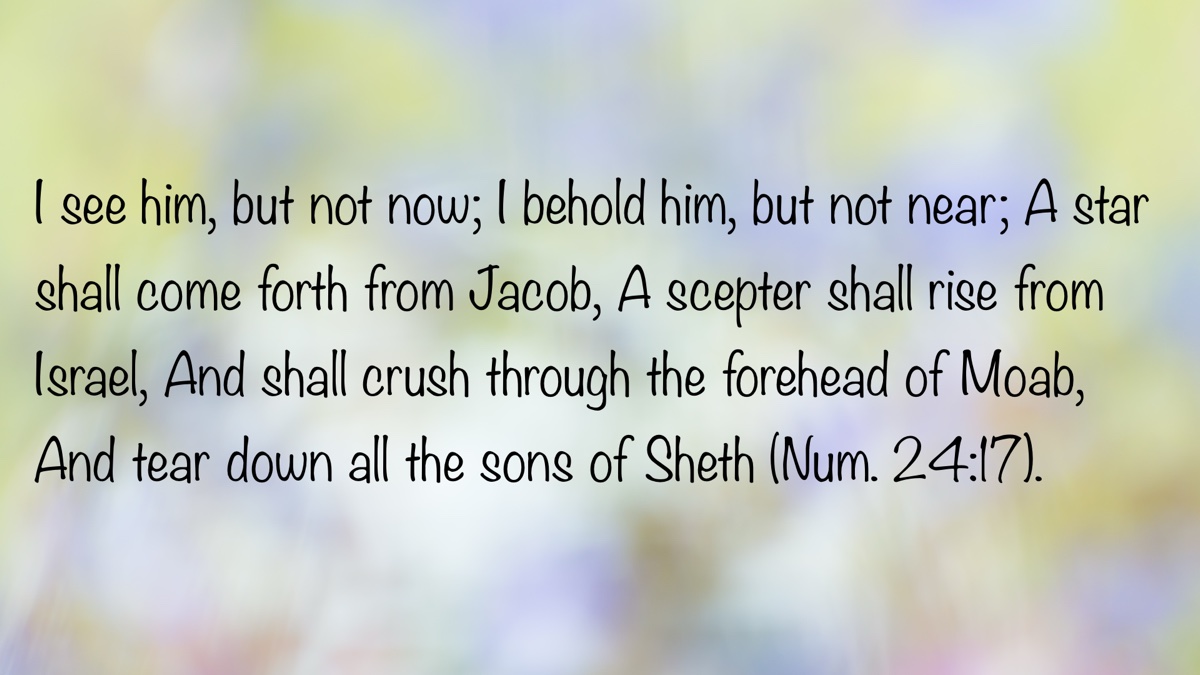
Balaam prophesied that a ruler would descend from Jacob to conquer the enemies of God’s people, expressing the Lord’s reign. Focus on a descendant recalls the Lord’s original promises regarding the seed of woman, which was announced first to the adversary of God’s plan and purposes, the serpent (Gen. 3:15). The reference to a ruler points to the divine promise that kings would spring from Abraham (Gen. 17:6; cf. 17:16; 35:11). This offered a promise and genealogy that would eventually blossom forth through the line of Judah, as Jacob proclaimed, “The scepter shall not depart from Judah, nor the ruler’s staff from between his feet until Shiloh comes, and to Him shall be the obedience of the peoples” (Gen. 49:10). Both Numbers 24:17 and Genesis 49:10 refer to a “scepter,” indicating royal authority. Historically, these passages have been interpreted as promising the advent of the Messiah (Morales, 195). Perhaps this is why the apostle John records: “I, Jesus, have sent My angel to testify to you those things for the churches. I am the root and the descendant of David, the bright and morning star” (Rev. 22:16). While many view this section as referring to David, it must be remembered that David serves as a type of the Christ to come, and the fullness of this typology and language is found in Jesus Christ. There are also several thematic links between Balaam’s fourth poetic discourse and Psalm 110, which portray the divine enthronement and exaltation of the Messiah through the lineage of David. Even the historical enemies of Israel foreshadow the Lord’s victory over all anti-God powers and adversaries. Israel’s blessing was ultimately fulfilled in Jesus Christ in His salvation and covenant of mercy for all those who would believe in His anointed Son (Ps. 2:2-8, 12; Heb. 8:6-13). Balaam tells of God’s judgment on those who attempt to harm His people, including Edom, Amalek, the Kenites, Ashur, and Eber (Num. 24:15-24). Several prophetic books in the Old Testament also include oracles against foreign nations, and the purpose of those oracles was the encouragement of God’s people. As Israel was faithful to the true and living God, He would grant them victory over all their ungodly enemies (2 Sam. 8:1-14). He likewise grants victory to believers who put on the full armor of His power and grace in their spiritual battles (Eph. 6:10-17).
The first warning is for those who would say they know and believe God’s truth and yet trade the blessing of a relationship with God for the things of this world. When we consider Balaam, we see a man who insists at least four times that he can only speak what the Lord tells him (Num. 22:38; 23:12, 26; 24:12-13). Two times he makes clear that God had spoken directly to him, and he was faithfully passing on His word (vv. 3-4, 15-16). He even finishes his first oracle by expressing his desire to enjoy God’s blessings: “Let me die the death of the righteous, and may my final end be like theirs!” (Num. 23:10).
However, things do not go well for Balaam in the long run because greed and selfishness were ruling his heart. In Numbers 25, the Midianites will lead Israel into deep sin and rebellion against the Lord, and we will later find out that the author of their plan was none other than Balaam (Num. 31:16). Peter explained that Balaam acted in disobedience to the Lord and deceived God’s people because he “loved the wages of unrighteousness” (2 Pet. 2:15). We, too, can be deceived by the riches and greed of this world on many levels (Mark 8:36). Christians must have a grounded understanding of the gospel and then live it out in purity (Col. 1:23; Titus 2:6-8, 11-15). Our greatest purpose is to manifest the spirit of Christ and His cross to the world (1 Cor. 2:1-5). The second warning of this story is for those who oppose God’s faithful people. Balaam’s pronouncement makes it clear that those who position themselves against the Lord’s devoted people are, in reality, positioning themselves against the Lord (Acts 8:1-4; 9:4).
The story of Balaam and Balak not only provides us with spiritual warnings, but it also offers us great encouragement. We see the Lord’s powerful blessings for those who live in covenant with Him. It is important to recognize that His blessings were never meant to end with Israel, but would spread to the entire world. Those who were blessed were to be a channel of God blessing others and an instrument of His mercy and grace (Gen. 12:3; Matt. 5:3-11). We, too, are to reflect the light of God’s presence and truth (Phil. 2:14-16). While we often view God in very impersonal terms, this story reveals His faithfulness, mercy, and love toward those who are wholly devoted to Him, in contrast with those who serve the flesh. As children of God, we must live in fellowship with our Savior and strive to share and proclaim His love to the world (John 3:16; Rom. 5:6-8; 1 John 2:1-2).
In Jesus, all the warnings and encouragement of this story come together. In terms of warnings, we must never put our own desires before the Lord’s will (Matt. 16:24). To fight against God’s word and His followers is to fight against the Creator Himself (Matt. 12:30). Let us always give our loyalty, allegiance, and steadfast love to our divine King who gave Himself for our sins and He will lead us to glory! We can trust that He will never turn away from those who give their hearts to Him.
Gane, Roy. Leviticus, Numbers. The NIV Application Commentary. Grand Rapids: Zondervan, 2004.
Morales, Michael L. Numbers 20-36. Apollos Old Testament Commentary 4b. London: Inter-Varsity Press, 2024.
Bruce Reeves has labored with the Highway 65 church of Christ in Conway, AR, since 2000. He and his wife, Rachel, have one child. The church website is here. He can be reached here.



By Shane Carrington
Synopsis: By walking with Jesus to Golgotha, we see His devotion to the Father and us, and how this kind of sacrificial love affects our journey through life.
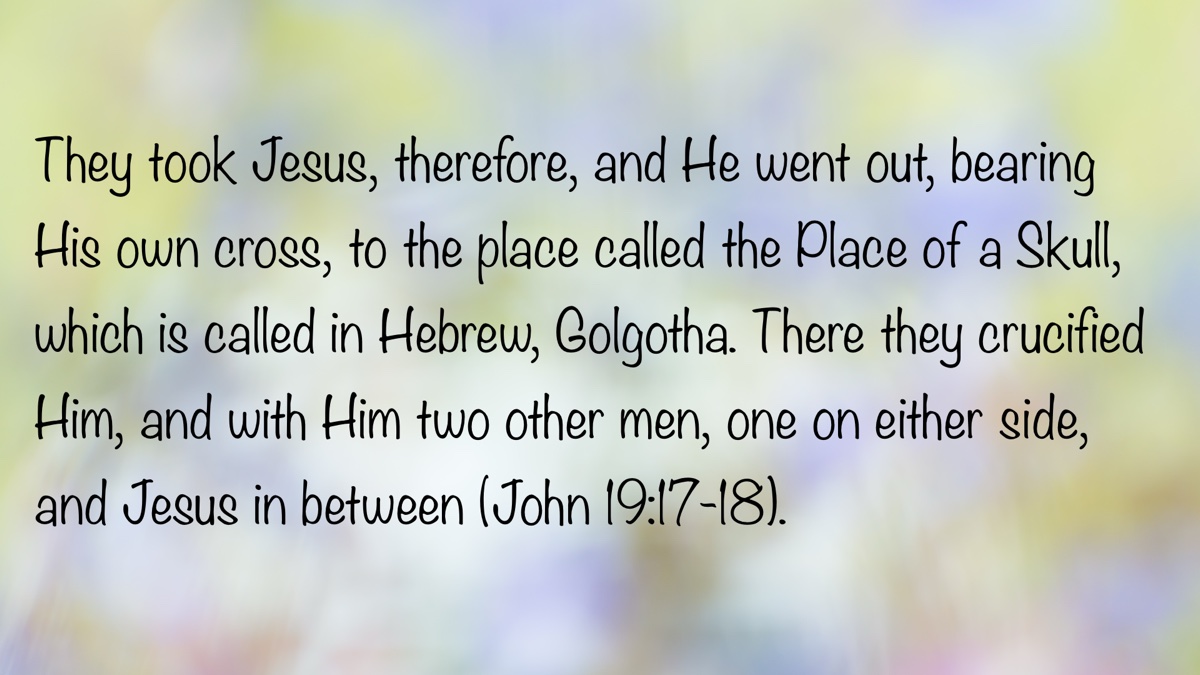
Then they brought Him to the place Golgotha, which is translated, Place of a Skull (Mark 15:22).
It was as ominous as it sounds because Golgotha was where they crucified criminals. They traded the life of Jesus for that of “a notorious prisoner” (Matt. 27:15) named Barabbas (Mark 15:11). Jesus healed, liberated, and brought godly peace. In contrast, Barabbas was associated with insurrection and murder (Mark 15:7). Yet they chose Barabbas over Jesus.
The steps Jesus traveled in the days immediately leading to Golgotha reveal a great deal about Him. As we walk that road with Him, His journey reveals a lot about us.
Now it came to pass, when the time had come for Him to be received up, that He steadfastly set His face to go to Jerusalem (Luke 9:51, NKJV).
Jesus resolved to go where the Father’s mission determined that He would go. While on this journey, the locals did not receive Him (Luke 9:52-53). This aroused the anger of the “sons of thunder,” and they asked Jesus if He wanted them to perform an action like Elijah and “command fire to come down from heaven and consume them” (Luke 9:54). Jesus did not consent to this, so they went on to another village to rest. He allowed neither the local population nor His own disciples to discourage Him from His mission.
As they traveled further, “Someone said to Him, ‘I will follow You wherever You go’” (Luke 9:57). Jesus certainly heard well-intentioned statements like this often, but His response declared His own determination and the necessity of counting the cost of discipleship.
The foxes have holes and the birds of the air have nests, but the Son of Man has nowhere to lay His head (Luke 9:58).
Following Jesus requires a high cost, and some are not willing to pay it (Luke 9:59-61).
But Jesus said to him, “No one, after putting his hand to the plow and looking back, is fit for the kingdom of God” (Luke 9:62).
Christ’s resolve requires commitment from us. His actions declared His love for His Father and all of humanity. Jesus calls us to “go and proclaim everywhere the kingdom of God” (Luke 9:60b) in both word and deed.
Earlier in His ministry, Christ showed His allegiance to His Father with several powerful statements.
I can do nothing on My own initiative. As I hear, I judge; and My judgment is just because I do not seek My own will, but the will of Him who sent Me (John 5:30).
For I have come down from heaven, not to do My own will, but the will of Him who sent Me (John 6:38).
Jesus did not come to glorify Himself, but to fulfill the will of His Father. His mission was submission. The outcome was redemption.
Although He was a Son, He learned obedience from the things which He suffered. And having been made perfect, He became to all those who obey Him the source of eternal salvation (Heb. 5:8-9).
Christ is the perfect redeemer offering Himself as the perfect sacrifice. His example of obedience shows that our obedience is also necessary if we hope to receive the “eternal salvation” which He made possible (1 Pet. 1:22-23).
Later, when He was heading toward Golgotha, Jesus revealed the depth of His commitment to the will of His Father through a powerful prayer. While suffering in the Garden of Gethsemane, just before the soldiers took Him into a night of trials, Jesus prayed agonizing words that reverberate in our hearts.
“Father, if You are willing, remove this cup from Me; yet not My will, but Yours be done” (Luke 22:42).
Jesus was willing to fulfill whatever the Father said, even though the “cup” He drank involved inexorable agony.
Ultimately, Jesus revealed the depth of His commitment to the Father’s will through powerful actions: suffering and death.
But we do see Him who was made for a little while lower than the angels, namely, Jesus, because of the suffering of death crowned with glory and honor, so that by the grace of God He might taste death for everyone. For it was fitting for Him, for whom are all things, and through whom are all things, in bringing many sons to glory, to perfect the author of their salvation through sufferings (Heb. 2:9-10; see also Isa. 53).
Through the power of Jesus’s suffering and death, He brought about destruction for the devil and his plans for our spiritual demise (1 John 3:8; cf. Gen. 3:15). What a Savior!
As Golgotha loomed in view, Jesus considered what would come beyond the cross with “joy.”
. . .let us run with endurance the race that is set before us, fixing our eyes on Jesus, the author and perfecter of faith, who for the joy set before Him endured the cross, despising the shame. . . (Heb. 12:1-2).
As Jesus faced the excruciating death of the cross, the joyous results that would come from His indescribable suffering would make that agony worthwhile.
Jesus endured the cross because He knew that in dying there, the joyous results He would accomplish would provide an opportunity for redemption for the lost. Christ “. . .made purification of sins. . .” (Heb. 1:3), completing our hope as “the author and perfecter of faith” (Heb. 12:2).
And having been made perfect, He became to all those who obey Him the source of eternal salvation (Heb. 5:9).
He considered redeeming us as “the joy set before Him,” though in doing so, He paid dearly.
Christ also faced Golgotha considering “the joy set before Him,” because, by comparison to crucifixion, He was “despising the shame” (Heb. 12:2) of that death. As David McClister noted, rather than “despise” meaning to “loathe” or “hate,” as it does in our culture,
It. . . has the milder sense of “to disregard” or “to think little or nothing” of something. It is as when we say that something is “no big deal” (Hebrews, 446).
Jesus’s focus on the joy of redeeming us was of greater value and concern to Himself than the price He suffered in His shameful and agonizing death on a cross. As horrific as crucifixion was, He treasured honoring His Father and redeeming us as more valuable than the horrors of the cross. While Jesus thought about these things, He determined to focus upon “the joy set before Him,” and think “little or nothing” (Hebrews, 446) of what He would suffer.
Jesus journeyed toward Golgotha by walking that path with determination and joy in the will of His Father. Truly, as He told the disciples, Jesus walked in love.
Greater love has no one than this, that one lay down his life for his friends (John 15:13).
Jesus Christ not only provided salvation through His suffering and death, but He also showed us how to live. He said,
You are My friends if you do what I command you” (John 15:14).
May we walk with Jesus to Golgotha by surrendering our lives to Him, dying to the love and practice of sin (Gal. 2:20), rising to “walk in newness of life” (Rom. 6:4), and learning to walk with Him in all we do (Rom. 6:12-14).
McClister, David. Hebrews. Temple Terrace: Florida College Press, 2010.
Shane Carrington has worked with the Southside church of Christ in Sulphur Springs, TX, since 1999. He has two children and four grandchildren. The church website is here. He can be reached here.



By Bobby Graham
Synopsis: In this chapter, brother Graham outlines the division within the Poplar Street church in Florence, Alabama, during the 1950s and 1960s. It describes the previously peaceful environment, which was disrupted by disagreements over financial support for orphan homes and institutional practices. Curtis E. Flatt’s preaching and teaching played a significant role in maintaining stability during this period. Differing views within the membership ultimately led to the formation of the College View church. Bobby highlights the role of faithful elders in maintaining peace and the impact of debates and public teaching on the church’s stance on institutional practices.
The story of division in the Poplar Street church in Florence cannot be told without reference to the somewhat halcyon days of the 1950s. For me, those days in rural elementary school, followed by moving into junior high school, and even into my high school years in 1960 in town, meant having school teachers who were also my Bible class teachers on Sundays and Wednesdays. Good examples and encouragement to serve God came even more frequently in this situation.
There was little disruption of our peaceful and calm surroundings, at least in appearance, during most of the 1950s. Toward the end of the decade, there would be a marked change in the environment. A divided eldership and a divided church at Poplar Street meant some change in how the church handled financial support for the orphan homes and how Christians related to each other concerning the questions. There had been some irregular support sent to such homes over a good many years until 1951. It would also mean some disruption of peace in relationships among brethren.
The peaceful environment of the 50s depended partly on some adjustment in how the congregation operated relative to the care of orphans. Special printed envelopes placed on the backs of church pews allowed members to specify where their contributions should be directed: Childhaven, Tennessee Orphan Home, or other. The money placed in the envelopes by the members was removed from the contribution after worship and handed to a designated individual, who then sent the money to the specified organizations on behalf of “Members at Poplar Street,” not in the name of the church. These envelope contributions were never considered part of the church’s money accumulating in its treasury.
This envelope arrangement was in use from 1951 to 1960, according to the written history of the Poplar Street-Wood Avenue church, page 17. During this same time, all evangelism support was sent directly to the preachers needing the support, as had been practiced through the years. No money was given to the Herald of Truth or any other evangelistic organization. Several gospel preachers, both black and white, received financial support from the congregation during these several years.
After many members left Poplar Street in 1960 to form the new College View church, at Poplar Street there remained no scriptural opposition to the giving of church funds to the various institutional arrangements for benevolence or evangelistic purposes. The envelope arrangement of the last ten years was no longer deemed necessary by the remaining members. Beginning in January 1951, the column for “Orphans” had disappeared; but it reappeared as “Orphan Homes” in the Treasurer’s Record Book for 1961, replacing the “Radio” column. The first checks recorded as sent to Orphan Homes in this column were for November and December 1961.
Poplar Street in the next few years began contributing to Childhaven, Herald of Truth, Mars Hill Bible School, and Freed Hardeman College; and this practice continued after the Poplar Street group built a new building, moved a few blocks, and became the Wood Avenue church on March 1, 1970.
A major stabilizing force at Poplar Street during most of the 1950s was the preaching and influence of Curtis E. Flatt. He had come from Benton, IL, attended Freed Hardeman College (before the War) and David Lipscomb College (after the War), and worked as a bookkeeper at Killen Motors in Florence before doing any preaching at Poplar Street. He began preaching on Sundays in May 1952 and about two months later became the full-time preacher for the congregation.
Flatt’s strength was knowing how to lay a foundation of biblical teaching and then building on that foundation. His method was not one of “demolish and destroy” whatever he found. To that end, his Bible-class teaching was as important as his preaching in accomplishing his goals. His lessons gave frequent emphasis to biblical authority, the importance of following God’s pattern, and the role of faith and obedience in the divine plan.
I well remember his class series called “Back to Jerusalem,” which stressed the need to return to apostolic authority and Christ’s original plan for the church, which had its beginning in Jerusalem, on that first Pentecost, following Jesus’s resurrection from the dead. In contrast, he emphasized that we do not need to return to Rome (or to Nashville, emphasis by BLG), but to Jerusalem. From its beginning, which emphasized Jesus’s role as Savior, Lord, and Head, to its present-day operation in the local church’s organization, worship, mission/work, and discipline, every aspect has received its due emphasis.
Another series of lessons taught by him for a few months was “The Church in the Bible,” which covered numerous features of the New Testament church. Such lessons as these in a class setting, where opportunity existed for discussion of such matters and even occasional disagreement, were very important in developing proper understanding and preparing Christians for the eventual decisions that had to be made regarding the church’s operation. These lessons also taught the proper approach to decision-making by elders, preachers, and, indeed, every Christian. This kind of wisdom marked his work, and Flatt’s life showed that same wisdom.
What could have become a disruptive environment remained fairly peaceful, so that a number of members from other churches chose to become part of Poplar Street. During the closing years of Brother Flatt’s work at Poplar Street in the late 1950s, some conservative-minded Christians came from area congregations to Poplar Street as members to benefit from his teaching. Others waited until the new College View congregation actually began in December 1960. The group leaving Poplar Street to form College View numbered close to 100. One year later, that number had grown to 160, and there were approximately 250 in attendance for Sunday morning worship.
The role and importance of two Poplar Street elders in the 1950s was also crucial to the maintenance of the atmosphere of peace and stability where spiritual growth could take place (Rom. 14:19). Vernon Freeman and Earlie T. Williams remained spiritual stalwarts against the daily stress and external brotherhood pressures that could have worn them down from 1949 to 1960, when the departing group left to form the College View congregation.
From the 1930s, C. M. Southall and Alphonse Bellanger had served as elders until the early 1950s. Williams, Freeman, and Rufus G. Hibbett, Sr. joined them in 1949. After Southall’s death and Bellanger’s move from Florence, there remained three elders for most of the 1950s: Vernon Freeman, Rufus Hibbett, and Earlie Williams. I would like to acknowledge that these three good men were largely responsible for creating the good atmosphere that existed, as I want to give credit where it is due. This same credit also goes to Curtis E. Flatt.
The elders had to maintain the envelope arrangement earlier mentioned—a temporary compromise intended to keep orphan-home donations separate from congregational work, and they had to oversee the teaching being done. It also became their responsibility to develop an agreement in connection with the formation of the new congregation at College View and to document it. Especially in this matter of elders, it is my judgment that the relationship between Curtis Flatt and the two elders opposing institutional practices was mutually strengthening and supportive over the several years they worked together. Relative peace and general stability remained, largely because of their role in these matters.
As it became apparent that the envelope arrangement would work only temporarily, because it failed to take into account differences between the opposing parties respecting other issues involved, such as the sponsoring-church issue and the “fellowship hall/church kitchen” issue, because on both issues there was some sympathy among the ones remaining at Poplar Street, some movement began to take place in preparation for a large number of members to leave. A document acknowledging the reality of there being a “Continuing Group” and a “Retiring Group” in the congregation was drawn up and signed.
This document remains notable to this day for its gracious provisions worked out by the three elders at Poplar Street, especially in a time and environment where many brethren across the country had little good to say to each other or to do for one another. Provisions were made for the Retiring Group to use the Poplar Street building for its gatherings at times different from the Poplar Street gatherings, until the College View building was complete. Utilities and janitorial expenses would be paid by the two groups on an alternating-month basis. Each group would furnish its own communion ware.
Additionally, the Continuing Group agreed to provide from the treasury $40,000 to be deposited in escrow for the use of the new group in constructing its building. From my standpoint, this quite significant financial concession was only right, because much of that money had been contributed over time by those in the retiring group. I would never state that such graciousness was never manifested in other similar divisions, but I do not know of a similar situation where it has happened!
As a young person, I probably was not aware of much that happened, but I do remember some disagreements taking place among the members and a few unkind words being spoken before the retiring group began meeting by itself. I know that some members shunned others, including preachers, with whom they disagreed. However, I do not remember rancor or evil speaking occurring on a large scale.
It is important to include the East Florence church in these pages, because of its similar stand, on matters relating to the work of the church, to that of the group that would soon leave Poplar Street and become College View. Charles Holt had preached at East Florence and on their daily radio program during the late 50s until 1961. I believe it was during these years when he began the East Florence Contender, which primarily dealt with the “current issues” relating to the organization and work of the local church.
Upon Holt’s departure, Barney Keith, who had been introduced to the Florence churches through his work at Poplar Street (filling in for Frank Puckett in the summers of 1942 and 1943 while a student at Freed Hardeman College), East Florence (1943-1946), and Jackson Heights (as their first preacher 1951-1959), returned to East Florence from Lexington, KY, to preach, conduct the daily radio program, and edit the East Florence Contender until 1969.
The radio and writing work of both Charles Holt and Barney Keith was timely and needed in our area, which was home to numerous congregations inclined toward institutional practices. In the days when preachers and congregations were trying to decide where they would stand relative to these matters, the public proclamation of the truth served a vital need.
Holt’s work at East Florence was shorter and earlier, while Keith’s work spanned the years when numbers of churches were deciding their stand until they had made their final stances known. Holt’s teaching was more direct, in-your-face, and even caustic, as he sometimes called out men and churches for their failure to stand, as well as commending those who were standing. On at least one of his programs, Charles Holt actually covered the two or three counties hearing the program, leaving hardly any preacher or congregation unidentified as standing/not standing firm on these matters.
Keith’s work was more fundamental, because he patiently laid the foundation of truth and built on it. He also sometimes identified teachers and congregations as needed; but his teaching was more designed to instruct, strengthen, and encourage. Over a two to three month period during the program, Barney conducted a debate with local preacher Lamar Plunkett on the issues. In my judgment, his was a more lasting work because of the way in which he accomplished it. His writing in the East Florence Contender was phenomenal during my formative years of preaching.
The debates of the 50s and 60s were also important in aiding my understanding, and that of others, of the issues involved, and also in strengthening many brethren in our area. Roy E. Cogdill met Guy N. Woods in debate on these matters in Birmingham in 1957. Charles Holt and G. K. Wallace discussed the same issues troubling brethren in Florence, Alabama in 1959. Numerous debates were conducted in North Alabama throughout the 1960s, but they began to diminish in number after that decade. Although these discussions often covered somewhat the same ground and dealt with the same issues, they provided new insights and arguments by the different men involved in them. While behavior occasionally was disruptive and rude, for the most part, it was exemplary of what is good.
What was the impact of this “saturation” teaching concerning the work of local churches in relation to biblical teaching on the organization, mission, and autonomy of the local church? After all, I was exposed to many public debates. I read almost everything written about these matters accessible to me. I heard many preachers teaching lessons on such issues.
First, I gained much understanding regarding these matters, which I have sought to pass to others in my own preaching/teaching career. Second, I was exposed to different minor viewpoints on some matters, such as whether a local church could scripturally provide relief for its own children left orphaned. Third, I gained much more understanding and appreciation for scriptural authority and its application in these matters. Fourth, I came to appreciate the value of the written word/religious journalism and of the spoken word/preaching and debating. Fifth, I also enjoyed the opportunity to stress to people that poor attitudes and undignified methods in preaching, writing, and debating should not distract or deter us from pursuing truth by all available means.
In other words, the inadequate preaching, writing, and debating to which I listened did not “sour” me or cause me to hate any of these three methods of advancing truth. I still listen to preaching, read articles, and attend debates after all those years of exposure to both the bad and the good! It did not even make me doubt whether I will continue preaching. It is not the debating that God disapproves, but the ungodly attitudes and methods sometimes accompanying it (Prov. 25:9; Isa. 58:4)! It is not the expression of disagreements detested by the Lord, but the poor treatment of others with whom there is disagreement (Matt. 5:43-48)!
Before concluding this chapter, I need to emphasize the issues that arose during these years of profound disagreement and divisions in local churches. This is especially important for the benefit of those who are younger than I am and may have little understanding of these issues, even though they are members of congregations that do not engage in unscriptural practices. Too little teaching about such matters is being done.
I list here the issues/questions involved in such disagreements and division so many years ago:
How does the New Testament primarily depict the nature of the church, especially in its congregational working? Is it spiritual or physical/social/recreational/benevolent?
Did local churches ever utilize human organizations, such as benevolent societies/orphan homes, educational organizations/colleges, or evangelistic organizations such as missionary societies/sponsoring church organizations, to accomplish their work?
Did local churches operate simply as spiritual entities/collectivities seeking to spread the gospel, relieve the needs of saints, and strengthen/edify Christians by teaching and exercising church discipline?
Did any local church ever farm out any part of its operation/responsibility mentioned in item # 3 to another organization or another church for oversight and implementation?
You might have noticed that I cited no passages related to any of the four questions just listed, because my primary purpose here is not to justify details, but to challenge readers to study for themselves as they give consideration to these matters. Search the Scriptures daily for yourself regarding these issues: make your faith your own (Acts 17:11). Respecting this area of New Testament teaching, I fear that a generation has arisen that shares the deficiencies of Israel during the days of the Judges.
When all that generation had been gathered to their fathers, another generation arose after them who did not know the LORD nor the work which He had done for Israel (Judg. 2:10).
Bobby L. Graham actively participates in fill-in preaching, Belize trips, teaching an hour each day at Athens Bible School, and in gospel meeting work. He and his wife, Karen, have three children. He can be reached here.


By Luke Chandler
Synopsis: This article discusses the challenges of finding physical archaeological evidence for Jesus due to the lack of physical markers left by Him and the modern cities covering ancient sites. It critiques two recent discoveries, the Talpiot tomb and the James Ossuary, as unreliable evidence for Jesus. Instead, it emphasizes the importance of early literary sources from non-Christian historians like Tacitus and Josephus, who provide credible references to Jesus’s existence, His execution by Pontius Pilate, and the spread of Christianity. Tacitus confirms Jesus’s execution and the spread of Christianity, while Josephus mentions Jesus in relation to His brother James and provides a possibly edited passage about Jesus’s deeds and crucifixion. These literary sources affirm Jesus’s historical existence and the early spread of His movement.
What physical evidence can archaeology give us for Jesus? Where would we even look for it? The Nazareth and Jerusalem of Jesus’s time are covered by the homes and streets of sprawling modern cities and 2,000 years of accumulated ruins. Even then, what would we expect to find? Jesus did not leave behind buildings or monuments. He established no settlements. He left no physical markers for us to uncover. Early records say He owned few if any possessions. Sites with alleged links to Jesus—a cave, an upper room, even tombs—have nothing to physically connect them with the Man.
Two recent discoveries have been advocated as evidence for the historical Jesus, but they are problematic at best. The Roman-period Talpiot tomb (“Jesus Tomb”) near Jerusalem contained inscribed names such as Jesus, Joseph, Matthew, and Mary, but these names were common in first-century Palestine. Josephus mentions at least twelve different men named Jesus, and the New Testament records six women named Mary. Beyond an assemblage of names, this tomb has nothing to connect it with Jesus of Nazareth.
An artifact known as the James Ossuary surfaced on the antiquities market with the inscription “James son of Joseph, brother of Jesus.” Where did this ossuary come from? We do not know. The inscription is also written in two different hands. Someone added the reference to Jesus after the initial inscription. Does this mean the ossuary is a fake? Numerous tests have been inconclusive. With this uncertainty, the James Ossuary cannot stand as evidence for Jesus.
We cannot really confirm Jesus through physical objects, but early literary sources speak to Jesus’s existence. Ancient documents also fall under the purview of archaeology. Since the Bible and early Christian sources carry little weight with skeptics, this article will focus on literary evidence for Jesus from non-Christian sources.
The first source is Tacitus, one of ancient Rome’s greatest historians who lived during the late-first and early-second centuries AD and served as a Proconsul. In his Annals, Tacitus describes Nero’s attempt to scapegoat the Christian community after the Great Fire of Rome.
[N]either human effort nor the emperor’s generosity nor the placating of the gods ended the scandalous belief that the fire had been ordered [by Nero]. Therefore. . . to put down the rumor, Nero substituted as culprits and punished in the most unusual ways those hated for their shameful acts. . . whom the crowd called “Chrestians.” The founder of this name, Christus, had been executed in the reign of Tiberius by the procurator Pontius Pilate. . . Suppressed for a time, the deadly superstition erupted again not only in Judea, the origin of this evil, but also in the city [Rome], where all things horrible and shameful from everywhere come together and become popular (XV:44, trans. Van Vurst).
Tacitus disliked Christians but confirmed several relevant points. Christianity originated from one “Christus”—a Latin name that reflects the Greek Messianic title “Christos.” This “Christus” was executed by Pilate, and the movement later spread from Judea to Rome.
Interestingly, Tacitus did not question Jesus’s existence. He accepted the life and death of Christ as reality, as did other enemies of the early Christians. As a Roman Proconsul, Tacitus had access to governmental administrative records. If Jesus never existed, Jewish and Roman authorities would have had little trouble demonstrating the falsehood of Christianity through census records, tax receipts, trial reports, and death certificates archived at the regional capital of Caesarea.
The second source for this discussion is Josephus, a Jewish priest-turned-rebel leader in the first century AD. Josephus defected to the Romans during the Jewish Revolt and lived out his days under Vespasian’s patronage. After Rome put down the revolt, Josephus wrote Antiquities of the Jews and an account of The Jewish War.
Josephus mentions Jesus twice. The first reference is in Antiquities Book 20, in a passage about the High Priest Annas, a Sadducee for whom Josephus had little regard. When the Roman governor Festus died, Annas took advantage of the temporary power vacuum to move against Christians by targeting one of Jesus’s relatives.
Being therefore this kind of person [i.e., a rigid, harsh Sadducee], Annas, thinking that he had a favorable opportunity because Festus had died and Albinus was still on his way, called a meeting of judges and brought into it the brother of Jesus-who-is-called-Messiah. . . James by name, and some others. He made the accusation that they had transgressed the law, and he handed them over to be stoned (XX.9.1, trans. Meier).
This account argues strongly for Jesus’s historical existence. He is named in a non-Christian historical text, recorded within the lifetimes of witnesses to the events. Josephus recorded this incident because Annas, James, and Jesus were prominent. There was enough general awareness of Jesus, just thirty years after His death, for Josephus to use Him as a point of reference.
Some have suggested Jesus was edited into this text by later Christian copyists, but internal evidence suggests otherwise. As we will see shortly, a Christian scribe with an editorial agenda would have used more definitive wording. Christian scribes used confessional statements, such as “our Lord” or “the Savior,” when referencing Jesus. Josephus’s text simply says Jesus was “called” Messiah, which is a benign statement by comparison. His terminology denotes which Jesus was associated with James rather than attempt to elevate Jesus in the eyes of the reader.
Josephus’s other reference comes in Book 18, an earlier chapter in Antiquities. Most modern scholars believe this passage was edited by later copyists. They are probably right.
Around this time there lived Jesus, a wise man, if indeed one ought to call him a man. For he was one who did surprising deeds, and a teacher of such people as accept the truth gladly. He won over many Jews and many of the Greeks. He was the Messiah. When Pilate, upon hearing him accused by men of the highest standing among us, had condemned him to be crucified, those who in the first place came to love him did not give up their affection for him, for on the third day, he appeared to them restored to life. The prophets of God had prophesied this and countless other marvelous things about him. And the tribe of Christians, so called after him, have still to this day not died out. (18.3.1).
The bolder text, highlighted by Lawrence Mykytiuk, indicate portions suspected to have been added or edited by later scribes. Josephus, a Jewish non-believer, would not have used such elevated terms for Jesus. When the suspected wording is removed, the style and vocabulary are consistent with Josephus’s writings. This overall passage is likely original since it appears in the section discussing Pilate, and since it introduces this “Jesus-called-Messiah” before the later reference with James in Book 20.
Together, Tacitus and Josephus confirm many points about the historical Jesus. He lived in Judea when Pontius Pilate was governor. He had a brother named James. He was unpopular with Jewish religious leaders though others called Him “Messiah” (Christos). After His judgment and crucifixion by Pilate, His movement attracted both Jews and Gentiles as it spread to Rome in just one generation’s time.
The literary evidence for Jesus is solid, even using non-Christian sources. The question of His Sonship is beyond the scope of archaeology to answer, but we have every reason to believe Jesus lived on this earth.
Photo 1: Statue of Tacitus outside the Austrian Parliament Building | Source

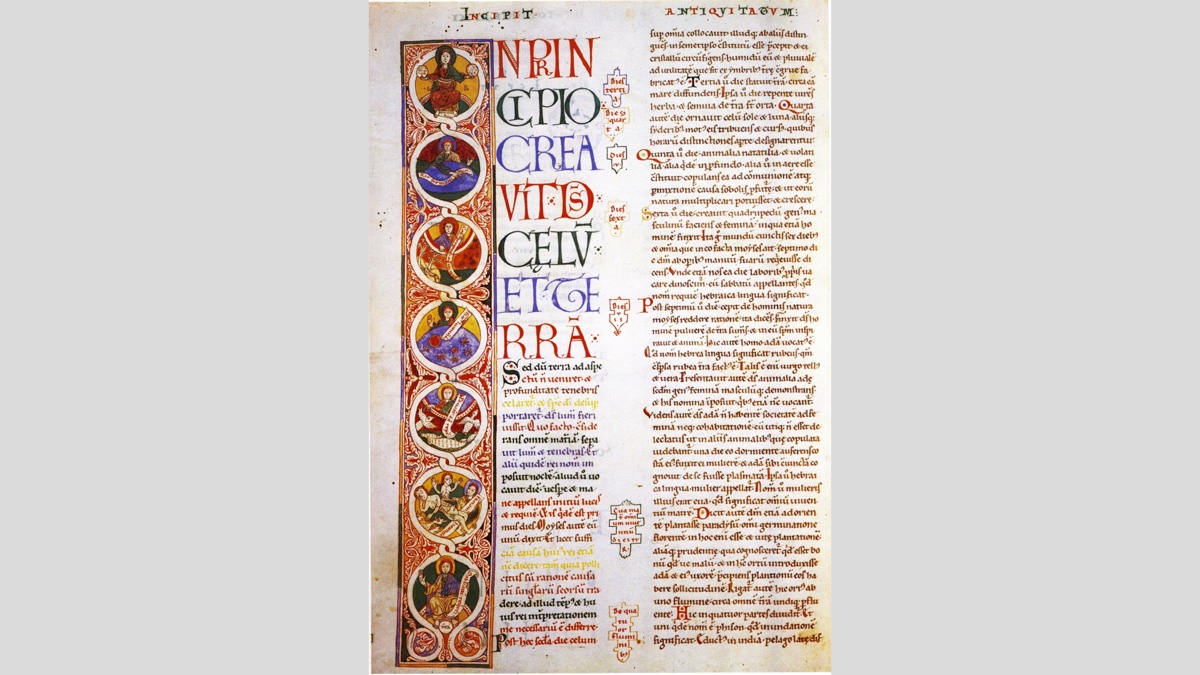
Photo 2: First page of books XI–XVI of Tacitus’ Annals | Source

Photo 3: Josephus: Engraving by John Sartain, 1880 | Source

Photo 4: Antiquities of the Jews: 11th-century illuminated manuscript | Source
Luke Chandler has worked with the North Terrace church of Christ in Tampa, FL, since 2006. He is a professor at Florida College, teaching Biblical Studies and Archaeology. He and his wife Melanie have five children. The church website is here. His Bible, Archaeology and Travel blog is here. Information about his Travel Tours is here. He can be reached here.




By Chris Reeves
Synopsis: In a world today where many married couples are so focused on themselves, it is good for us to learn from Bible couples who let Jesus into their lives and who let the Lord lead their children.
As a married couple with children, what do you want in life for yourselves and for your family? I don’t mean specific physical things like new phones, new clothes, different jobs, more vacations, better cars and homes, reduced debt, etc. I mean, what do you want in the “big picture” of things? What do you want that has to do with your life’s legacy behind you and your soul’s destiny in front of you?
Unfortunately, many couples today with children are focused solely on this life. Sometimes, it’s all about them or physical things. They may not focus on following Jesus now or preparing for eternity later. But in the New Testament, there is a couple who focused on Jesus and they let their sons do the same. The couple to whom I make reference is Zebedee and Salome, the parents of James and John [Note #1]. Let us look at their life and sons and see what we can learn about letting Jesus be first in us today.
When Jesus was calling men to be His disciples and apostles, He called James and John, the sons of Zebedee [Note #2]:
And going on from thence He saw two other brethren, James the son of Zebedee, and John his brother, in the boat with Zebedee, their father, mending their nets; and He called them (Matt. 4:21).
Now the names of the twelve apostles are these: The first, Simon, who is called Peter, and Andrew his brother; James, the son of Zebedee, and John, his brother (Matt. 10:2).
And going on a little further, He saw James, the son of Zebedee, and John, his brother, who also were in the boat mending the nets. And straightway He called them: and they left their father Zebedee in the boat with the hired servants, and went after Him (Mark 1:19-20).
Simon, whom He also named Peter, and Andrew his brother, and James and John, and Philip and Bartholomew (Luke 6:14).
Zebedee was a fisherman on the Sea of Galilee and he trained his sons to work as fishermen [Note #3]. He apparently was a man of success because he had “hired servants” and his wife was likely among the women who supported Jesus and His apostles (Matt. 27:55-56; Mark 15:40-41; Luke 8:2-3). There is a lesson here: Zebedee was a successful businessman and yet he did not stand in the way of letting his two sons become followers of Jesus. He did not put his business over the Lord’s call. He did not train his sons to be selfish and put their career before Jesus. He did not keep his sons nearby thinking that his business would suffer without them. Jesus called James and John and they immediately followed Him, and Zebedee let them go. Impressive!
Today, many couples will put family over faith. I was recently told by an elder in the church how often he had seen couples do that very thing. Zebedee and his wife were willing to practice the principles found in such Scriptures as Matthew 8:22, 10:34-39, 19:29, and Luke 14:26. All these passages speak of putting Jesus first, even over family. Will you and your spouse put Jesus first over all else and raise your children to do the same?
Jesus did not simply want His disciples to follow Him, but He wanted them to be changed in their thinking and character. In the case of James and John, Jesus even changed how they were described. He gave them a nickname:
and James, the son of Zebedee, and John, the brother of James; and them He surnamed Boanerges, which is Sons of thunder (Mark 3:17).
What are some changes we see in these two brothers after Jesus called them? First, these two “sons of thunder” learned to manifest a better attitude toward the lost. Luke records this in 9:51-56:
And it came to pass, when the days were well-nigh come that He should be received up, He stedfastly set His face to go to Jerusalem, and sent messengers before His face: and they went, and entered into a village of the Samaritans, to make ready for Him. And they did not receive Him, because His face was as though He were going to Jerusalem. And when His disciples James and John saw this, they said, Lord, wilt Thou that we bid fire to come down from heaven, and consume them? But He turned and rebuked them. And they went to another village.
Second, these two brothers learned that prominence in the kingdom does not come by having a high position of authority over others, but by serving them (see below).
Third, after the Lord’s ascension, James and John were present with the followers of Jesus in the upper room awaiting the outpouring of the Spirit on the day of Pentecost (Acts 1:13).
Fourth, James was changed from being a simple fisherman to being the first recorded martyr for Jesus among the apostles (Acts 12:2).
Lastly, John was changed. He was taught to change his thinking about who was in support of Jesus (Mark 9:38-40; Luke 9:49-50). He was also changed from a fisherman to the disciple “whom Jesus loved” (John 13:23; 19:26; 20:2; 21:7, 20), the one whom Jesus committed His mother’s care (John 19:26-27), and a bold preacher of the gospel with Peter (Acts 3-4; 8:14; Gal. 2:9). This man would also go on to write the gospel of John, the epistles of John, and the book of Revelation. While writing the book of Revelation, John was imprisoned on the isle of Patmos “for the word of God and the testimony of Jesus” (Rev. 1:1, 4, 9; 22:8). Quite a change in this man!
Couples today need to think about how they will let Jesus change themselves and their children. We need to let Jesus into our home and marriage and take over our family. We need to put Jesus first in our home. Let His word be in us daily. Let His church be a part of our weekly activity. Let His work be a part of our ongoing efforts.
One day the mother of the sons of Zebedee came to Jesus with a request:
Then came to Him the mother of the sons of Zebedee with her sons, worshipping Him, and asking a certain thing of Him. And He said unto her, What wouldest Thou? She saith unto Him, Command that these my two sons may sit, one on Thy right hand, and one on Thy left hand, in Thy kingdom (Matt. 20:20-21).
Like all good mothers, the mother of James and John wanted what she thought was best for her boys. She wanted them to have a place of prominence and authority in Christ’s kingdom [Note #4]. But she and her sons had to learn that greatness in the kingdom comes not with a place or position, but with service and sacrifice (Matt. 20:22-27).
What ambitions do you have for your marriage and your family? So many couples today are fixated on the here and now—for themselves and their children. They get easily caught up in their work, school, hobbies, sports, technology, houses, cars, etc. They are earthly minded in focus. We all need to be more heavenly minded. Like Paul, our overall goals, aims, aspirations, and ambitions in life need to be on living the right way in order to go to heaven (Phil. 3:12-16; Col. 3:1-4). We all need to be thinking more about serving others, not on seeking a higher position for ourselves (Phil. 2:1-5).
At times during Jesus’s ministry, He would separate Peter, James, and John from the other apostles, so they could spend special moments with Him:
And He took with Him Peter and the two sons of Zebedee, and began to be sorrowful and sore troubled (Matt. 26:37).
During Jesus’s ministry, there were several occasions when James and John had the opportunity to share special occasions with Him. They were with Him when Peter’s mother-in-law was healed (Mark 1:29), when Jarius’s daughter was raised (Mark 5:37; Luke 8:51), when Jesus was on the mount of transfiguration (Matt. 17:1; Mark 9:2; Luke 9:28), when He spoke about the temple (Mark 13:3), when He was in the garden of Gethsemane (Mark 14:33), and when He was on the Sea of Tiberius (John 21:2).
Parents, would you allow your children to spend time with Jesus, or would you be selfish and keep them to yourselves? Would you encourage your sons when they leave home to become gospel preachers, elders, deacons, or Bible class teachers? Would you allow your daughters to leave home to marry a preacher and travel to other countries to labor with brethren there? Would you allow your children to grow up, leave home, and be used by Jesus in ways that are best for His cause? Zebedee and Salome did, would you?
Near the cross, there were a number of female followers of Jesus, and the mother of the sons of Zebedee was among them:
among whom was Mary Magdalene, and Mary the mother of James and Joses, and the mother of the sons of Zebedee (Matt. 27:56).
The mother of James and John had supported Jesus throughout His ministry. Now, she stands near the cross, watching Him die. Later, she will be at the tomb of Jesus to anoint His body (Mark 16:1). The mother of James and John let her sons go and be with Jesus and she herself wanted to be with Jesus. Jesus was her focus.
In a world that is mostly concerned with the physical things of this life, can we not have a more spiritual focus on Jesus? Let us all be “crucified” with Christ and make sure He “lives in” us each day (Gal. 2:20). Let us all have the “mind” of Christ in us (Phil. 2:5). Let us all be “looking to” Jesus (Heb. 12:2). Let us all “sanctify” (set apart) Christ as Lord in our hearts (1 Pet. 3:15).
Zebedee and Salome made sure that Jesus was first for them and for their sons. Friend, Jesus is the only hope of the modern home, but we have to give up ourselves and welcome Him into our daily lives. Let Jesus into our marriage and family today and keep Him there!
For those of you who have just gotten married, start a habit early in your marriage of letting Jesus dictate all you do. Decide now that you will allow yourself and your children to be used by Jesus.
For those of you who have been married several decades, take time to reassess your goals and plans and make sure that Jesus is still at the center of your marriage and family.
For those of you who have been married even longer, you can teach others how to let Jesus be at the center of your life.
[Note #1] “Salome” is the name given to Zebedee’s wife by tradition, but not by direct evidence. The reasoning goes something like this: a “Salome” is mentioned near the cross (Mark 15:40) and the “mother of the sons of Zebedee” is mentioned near the cross (Matt. 27:56), so many conclude that they are the same person. She was also present at the tomb (Mark 16:1). Her name is related to the Hebrew word shalom, meaning “peace” (the feminine form of “Solomon”). I follow this tradition here, but I also recognize that we may not actually know her name. Additionally, it should be noted that she is not the “Salome” that danced for Herod in Mark 6. This young woman is not named in the biblical text, but her name is mentioned by Josephus in Antiquities of the Jews, 18.5.4. She was Salome III, the granddaughter of Herod the Great and the daughter of Herodias and Herod Philip. She later married Philip the tetrarch.
[Note #2] All Scripture quotations are taken from the 1901 American Standard Version.
[Note #3] According to Luke 5:10, these men were partners with Peter in fishing.
[Note #4] According to Mark 10:35 and 10:41, James and John themselves were making this same request of Jesus.
Chris Reeves has preached for the Warfield Blvd. church of Christ in Clarksville, TN, since 2016. He and his wife, Cheri, have four children and two grandchildren. His Bible study website is here. The church website is here. He can be reached here.



By Danny Linden
Synopsis: Isaiah 59 shows us God’s attitude toward sin—He will bring terrible punishment against sinners but will not forget those who turn to Him.
In the last section of the book that bears his name, Isaiah prophetically flashed forward to the time after the destruction of Jerusalem and the captivity of God’s people. They would not be able to understand how they were defeated. Did God abandon them? Was He overpowered by another deity? Although they had been warned for generations that their sin was the cause, they would need to be reminded again. What they refused to see before the judgment could be understood in a new light afterward.
For us, Isaiah 59 demonstrates that God goes to war against sin and reveals how this affects us. No prayer or petition can dissuade God from destroying sin, but He will forgive us if we repent.
Behold, the LORD’S hand is not shortened, that it cannot save, or His ear dull, that it cannot hear; but your iniquities have made a separation between you and your God, and your sins have hidden His face from you so that He does not hear (Isa. 59:1-2).
Israel’s defeat could not be explained by any weakness on God’s part. “See now that I, even I, am He, and there is no god beside Me; I kill and I make alive; I wound and I heal; and there is none that can deliver out of My hand” (Deut. 32:39). Nor could it be explained by a lack of faithfulness from God. “Steadfast love will be built up forever; in the heavens You will establish Your faithfulness” (Ps. 89:2). God remains the same; it is the people who have changed and created a separation from God.
The Israelites did not see the seriousness of their sin. They were people without self-reflection who fell but did not rise again (Jer. 8:4-7). As a result, God grew angry with them and His glory left them (Ezek. 10). He would no longer hear their prayers or save them when they cried for help.
For your hands are defiled with blood and your fingers with iniquity; your lips have spoken lies; your tongue mutters wickedness. No one enters suit justly; no one goes to law honestly; they rely on empty pleas, they speak lies, they conceive mischief and give birth to iniquity. They hatch adders’ eggs; they weave the spider’s web; he who eats their eggs dies, and from one that is crushed a viper is hatched. Their webs will not serve as clothing; men will not cover themselves with what they make. Their works are works of iniquity, and deeds of violence are in their hands. Their feet run to evil, and they are swift to shed innocent blood; their thoughts are thoughts of iniquity; desolation and destruction are in their highways. The way of peace they do not know, and there is no justice in their paths; they have made their roads crooked; no one who treads on them knows peace (Isa. 59:3-8).
Why was it only then that God would not hear the prayers of His people? This was not the first time they had sinned, and God is angry at every sin (Ps. 7:11). Indeed, God had judged His people on many occasions before this. He nearly destroyed the entire nation in the wilderness after they worshiped the golden calf (Exod. 32:9-10), sent fire upon the people in the wilderness when they complained (Num. 11:1-3), condemned an entire generation to wander and die instead of crossing over into Canaan (Num. 14:20-38), caused the earth to open up and swallow the malcontents who tried to stir up rebellion against Moses (Num. 16:1-35). Later, He struck down Uzzah for touching the holy ark (2 Sam. 6:6-8). This is just a small sampling of the many expressions of God’s wrath against individuals and nations.
Yet there seems to be something different about this judgment. The rottenness in Judah went deeper than before. This had already happened in the northern kingdom. Assyria had carried Israel into captivity in 722 BC because God had given up on them. There was not enough righteousness to be found for God to be patient and wait for righteous people to influence their neighbors for good. Judah would be next.
This is the basis on which Abraham interceded for Sodom (Gen. 18:17-33). As a righteous man, Abraham did not want to be caught up in God’s judgment against the wicked. Would the presence of a few righteous people be enough for God to hold back His wrath, at least for a time? God’s answer is “Yes,” but the situation in Sodom was worse than Abraham realized. There were not even ten righteous people in the city, so God determined there was no reason to delay His judgment.
The same became true in Israel and, shortly thereafter, Judah. Violence, injustice, and dishonesty were pervasive and extreme. Faithful servants of God were rare and no longer making much impact in their communities. God is a patient God, but He does not wait without a purpose. When there is no hope of repentance, the cup of His wrath overflows (Jer. 25:15-17; Rev. 14:10).
Justice is turned back, and righteousness stands far away; for truth has stumbled in the public squares, and uprightness cannot enter. Truth is lacking, and he who departs from evil makes himself a prey. The LORD saw it, and it displeased Him that there was no justice. He saw that there was no man, and wondered that there was no one to intercede; then His own arm brought Him salvation, and His righteousness upheld Him. He put on righteousness as a breastplate, and a helmet of salvation on His head; He put on garments of vengeance for clothing, and wrapped Himself in zeal as a cloak. According to their deeds, so will He repay, wrath to His adversaries, repayment to His enemies; to the coastlands He will render repayment. So they shall fear the name of the LORD from the west, and His glory from the rising of the sun; for He will come like a rushing stream, which the wind of the LORD drives (Isa. 59:14-19).
When no one interceded to stop the wickedness, God rose up to go to war against sin. He suited Himself up for war, wearing righteousness as His breastplate, salvation crowning His head, vengeance as His clothing, and zeal as a cloak. God repaid His enemies exactly as they deserved.
This image of God displeases many today. It is more palatable to think of God as a loving Father and gracious King; indeed, those are common and accurate portrayals of God directly from the Scriptures. However, it is equally true that God hates sin and is determined to destroy it. This is His unchanging will. Sin must die, and those who hold on to their sin will die with it. Judah was corrupt, so they died in the fire of God’s wrath.
The result was that the LORD’S name would be feared throughout the earth. If He was willing to destroy even His own people and His own temple, who can escape His wrath?
“And a Redeemer will come to Zion, to those in Jacob who turn from transgression,” declares the LORD. “And as for Me, this is My covenant with them,” says the LORD: “My Spirit that is upon you, and My words that I have put in your mouth, shall not depart out of your mouth, or out of the mouth of your offspring, or out of the mouth of your children’s offspring,” says the LORD, “from this time forth and forevermore” (Isa. 59:20-21).
Then, abruptly, this dark chapter takes a bright turn. In their current state, they are doomed to fall victim to God’s mighty hand. Here is an important distinction: God did not declare war against Judah. He declared war against sin. The two were almost one and the same, but there was still an opportunity for redemption in the future.
A few heard the warnings of Isaiah, Jeremiah, Ezekiel, and other prophets and submitted to God. The LORD knew who His faithful ones were and did not abandon them, even though they had to endure the punishment facing the entire nation.
There was also hope in the future of Judah. God had not yet fulfilled the promises to Abraham (Gen. 12:1-3). It would be easy to think that this destruction spelled the end of them forever. God is not like man, though, and He always keeps His promises. Out of captivity and ruin came His promise of redemption and restoration. A remnant would return and rebuild, and God would bring Jesus into the world through them.
Although God is determined to destroy sin, He does not wish to destroy us along with it. If we stubbornly cling to our sin, we will seal our fate. Divine justice will not be denied. Far better for us is to let go of our sin, submit to God, and be transformed by His grace and love. Our sin will die, and we will be thrilled to see it go!
This depiction of God’s armor recalls another, similar image to mind: the armor of God in Ephesians 6:10-18. The resemblance is not coincidental. The armor that we are equipped with is not some second-rate gear that God found lying around and decided to give us. It is the same kind of armor that He dons when He goes out to war. In the battle against sin, we are well-equipped, sustained by divine power, and led by a conquering King who will be victorious in every way. Truly, there is no ruler, authority, cosmic power, or spiritual force of evil that can stand against us.
Danny Linden has worked with the Hebron Lane church of Christ in Shepherdsville, KY, since March 2023. He and his wife, Lauren, have four children. The church website is here. His website is here. He can be reached here.




By Taytum Monden
Synopsis: This article emphasizes the importance of gratitude and rejoicing as commands from God, not suggestions. Gratitude involves recognizing blessings, such as Jesus’s sacrifice, freedom of religion, and material comforts, with Paul’s example of gratitude even in prison highlighted. The author expresses gratitude for friends who support and challenge her, family who teach forgiveness, and fellow Christians who provide community and support. The ultimate gratitude is for Jesus Christ, who died for our sins and exemplifies forgiveness and a life to emulate. Rejoicing is shown through singing, praying, and keeping a gratitude journal. Let us, therefore, practice gratitude and rejoicing as habits, and remember that everyone has something for which they can be grateful, especially Jesus Christ.
Gratitude and rejoicing may seem like simple subjects to discuss, but I would love to stress their importance and why they go together. How many times have you heard lessons or sermons that focus solely on gratitude or rejoicing? We are commanded to rejoice and be grateful. It is not a suggestion or request. It is a command. In fact, we are commanded in 1 Thessalonians 5:16 to “Rejoice always,” and in 1 Thessalonians 5:18 to “give thanks in all circumstances.”
The definition of gratitude is the feeling or quality of being grateful for something or someone (Cambridge Dictionary). Gratitude is something that we should constantly think about, concentrate on, and work on. Why should we be grateful? Of course, the number one reason is that Jesus died for our sins, but there are so many more blessings for which we should be grateful. For instance, consider your freedom of religion, your church or place to worship, and your brothers and sisters in Christ. Reflect on your material blessings like your shelter, the ability to see so many beautiful colors, the sky, the rain, and your comfortable bed.
Paul was grateful even in prison and can be an example for us of how to be grateful even when we are low. In Philippians 4:6 and 11, Paul urges believers to be thankful in their prayers. Following his example, we should be content with what we have, even if it is not a lot.
We typically hear about friends in a negative way, such as peer pressure or being a bad influence, but I want to discuss why I am grateful for my friends. I am grateful for my friends for three main reasons.
First, they ask questions about what I believe. This gives me the opportunity to explain that my beliefs influence how I talk and dress. It also allows me to share my beliefs about Jesus and God and to have Bible studies with them.
Second, I have kind and honest friends who stick with me and support me through whatever I am facing. I trust my friends to tell me when I should think about something before I do it. They help keep me in check.
Third, I have amazing friends in whom I can confide. I trust that they will not make fun of me or share what I have confided in them.
Friends play an especially significant role in our daily lives. We should surround ourselves with people we can trust to keep us accountable and who will be honest with us, even if it means not always telling us what we want to hear.
Are you grateful for your family? Many of us, if not all, would say “Yes!” but how many of us could explain why? I would like to share a couple of reasons why I am grateful for my family.
First, my family has shown me that forgiveness is a big part of life. I have two brothers, and I won’t lie, I have a hard time forgiving them when I get angry with them. However, in Ephesians 4:32, we are told, “Be kind and compassionate to one another, forgiving each other, just as in Christ God forgave you.” We should forgive as Christ forgave.
Second, my family supports me through my hardest times. They support my decisions and help me decide what would be in my best interest. They remind me that I am better and deserve better than how people sometimes may see or treat me.
The third and most important reason I am grateful for my family is that they show me the wonderful love, kindness, and bright light of God.
Not only am I grateful for my family, but I am also thankful for my brothers and sisters in Christ. A couple of weeks ago, we welcomed a new brother in Christ. Unfortunately, a week or two after welcoming our new brother, we received some sad news. During the middle of worship, our preacher announced that our new brother had been involved in a car accident where his car had rolled. While our preacher was up there, he took the opportunity to pray for him. This is one huge reason I am grateful for my church: we do not have to go through hard times alone, and we do not have to grieve and be sad alone either.
Another reason I am grateful for my church is that I have friends to study and learn with. I also have friends of all ages to look up to or to hold me accountable because I know younger children may look up to me just as I look up to my elders. I ask those I look up to questions about the Bible, and I trust that they will guide me in the right direction.
The most important thing I should be grateful for is Jesus. The ultimate sacrifice. There are too many reasons to be grateful for Jesus, so I will just give you three. One reason I am thankful for Jesus is the most well-known reason: He died on the cross and suffered for us. Romans 5:8 says, “God shows His love for us in that while we were still sinners, Christ died for us.” This proves that Jesus died for us, sinners. Another reason I am grateful for Christ is His willingness to forgive others. Before He died on the cross, He asked His Father (God) to forgive them for they know not what they do. Luke 23:34 shows that while knowing what was coming, He was still so forgiving. Lastly, but certainly not least, He is an example we should look up to and strive to be like. 1 John 2:6 says, “whoever says he abides in Him ought to walk in the same way in which He walked.” This is proof that we should be more like Christ. Christ is honest, kind, caring, forgiving, and so much more.
Rejoice Always!
How can I show my gratitude? One way to show gratitude is through rejoicing. The definition of rejoicing is to feel or show great happiness (Cambridge Dictionary). The words joy, joyful, and rejoice are mentioned over 430 times in the ESV. Philippians 4:4 says, “Rejoice in the Lord always; again, I will say, rejoice.” Paul uses the word rejoice twice in one sentence, emphasizing that he wants us to rejoice.
We have so many reasons to rejoice, but how are we to rejoice? Psalms 5:11 says, “But let all who take refuge in You rejoice; let them ever sing for joy, and spread Your protection that those who love Your name may exult You.” This passage suggests one way to rejoice: sing for joy. Psalm 100:1-2 reinforces this: “Make a joyful noise to the Lord, all the earth! Serve the Lord with gladness! Come into His presence with singing!”
Not only can you sing, but you can also pray, as we see in 1 Thessalonians 5:16-18: “Rejoice always, pray without ceasing, give thanks in all circumstances; for this is the will of God in Christ Jesus for you.” You can pray for all the things you have and why you are grateful for them. This can help you realize how important rejoicing is.
Singing and praying are the most common ways to rejoice, but you can also keep a journal. Gratitude journals can help you develop a more grateful and joyful mindset. Not only can you write about what and why you are grateful, but you can also tell others. You could say, “I am so glad I know you,” or “I am so happy I am here with you right now.”
These are some ways I like to rejoice, but there are many ways you can rejoice. What does rejoicing look like for you?
If God thought it was important enough to include in multiple Scriptures, don’t you think we should practice them? Not only should we study gratitude and rejoicing, but we should also make them a habit. 1 John 2:6 says, “Whoever says he abides in Him ought to walk in the same way in which He walked.” How can we walk with Him if we don’t obey His commands?
I encourage you to find things for which you are grateful. If you have things to be grateful for, you will rejoice! Everyone has something for which they can be grateful and thankful.
If you are going through a challenging time, you might be thinking, “What do I have to be grateful for?” Remember, everyone has Jesus Christ to be grateful for—He is our Rock, Cornerstone, Foundation, and the One who died for us.
So, I challenge you for the rest of the week, month, or year to find things for which you are grateful and rejoice in those things.
Bible Hub: Online Bible Study Suite.
“Gratitude.” Cambridge Dictionary.
“Rejoice.” Cambridge Dictionary.
Taytum Monden is a vibrant fourteen-year-old who loves her family, her church, and living life to the fullest. Her faith is the heart of who she is, guiding her through every journey. Taytum brings joy and curiosity wherever she goes. She can be reached here.





By Devin Harber
Synopsis: This article discusses how to respond to questions about the musical portion of Christian worship, emphasizing the need to answer biblically, lovingly, and firmly. It highlights the importance of having a scriptural foundation for our worship, while avoiding arrogance, and maintaining a loving attitude. The author cites New Testament passages to support the practice of singing in worship and addresses objections related to Old Testament examples. He encourages mutual questioning and dialogue based on Scripture, stressing that worship should align with what God has authorized.
When your friend finally visits your church, you should expect some questions. If we are “diligent to present” ourselves as “approved to God,” workers who need not be ashamed (2 Tim. 2:15), then we will always be ready with answers for such occasions (cf. 1 Pet. 3:15). Our friends should ask us about our faith; if they don’t, perhaps we’re not the influences we should be. How should we respond to questions like the one in our title?
If we can’t establish our answers with the text of God, then we have no business practicing it. We must have a precedence in the text, a true “Thus saith the Lord,” otherwise, we are not only wasting our time but dishonoring God. If we are practicing something for which we have no permission from God to do, then we are no better than Nadab and Abihu and their strange fire (see Lev. 10:1-2). We must have a biblical basis for our practice, or we have no basis for it at all.
This isn’t about “Told you so” or “I’ll prove to you that I’m right and you’re wrong!” This is about being faithful to our heavenly Father and honoring our King, Jesus Christ. The love factor enters with our desire for others to experience the assurance of fidelity to the King. We aren’t trying to prove everyone else wrong, make them look as dumb as possible, and rub their noses in it. We are trying to help them be right with the King of kings and Lord of lords. We must check our motives and change them if they aren’t King-directed, God-honoring, and soul-saving.
It’s good to respond biblically and lovingly, but too many flounder on this point. This is not an excuse to be calloused or unkind (see above). We can speak the truth in love (Eph. 4:15), but it is a real temptation in our culture to speak love and no truth. Such is a contradiction; you cannot have love without truth. Stand firm in Scripture. Avoid arrogance or snobbery, but be convinced and faithful to the truth God has revealed. Justifying error doesn’t help anyone.
Let’s put these together. Consider every New Testament passage that addresses music offered by disciples on earth [Note 1]:
And when they had sung a hymn, they went out to the Mount of Olives (Matt. 26:30).
And when they had sung a hymn, they went out to the Mount of Olives (Mark 14:26).
But at midnight Paul and Silas were praying and singing hymns to God, and the prisoners were listening to them (Acts 16:25).
And that the Gentiles might glorify God for His mercy, as it is written: “For this reason I will confess to You among the Gentiles, and sing to Your name” (Rom. 15:9).
What is the conclusion then? I will pray with the spirit, and I will also pray with the understanding. I will sing with the spirit, and I will also sing with the understanding (1 Cor. 14:15).
Speaking to one another in psalms and hymns and spiritual songs, singing and making melody in your heart to the Lord (Eph. 5:19).
Let the word of Christ dwell in you richly in all wisdom, teaching and admonishing one another in psalms and hymns and spiritual songs, singing with grace in your hearts to the Lord (Col. 3:16).
Saying: “I will declare Your name to My brethren; in the midst of the assembly I will sing praise to You” (Heb. 2:12).
Is anyone among you suffering? Let him pray. Is anyone cheerful? Let him sing psalms (Jas. 5:13).
We stand biblically, or we do not stand at all. When a friend asks you why you (or your church) do this, you should take them to the text. “This is why. . .” Ask: “What does the text say?” It says in various ways, “Sing.” That’s it. It doesn’t say anything else. What more should we do with these texts? Should we manipulate them into saying something they don’t? That would be dishonest and God-insulting, not God-honoring. Paul doesn’t say, “Playing and making melody,” he says, “Singing and making melody.” The beauty of this is the all-inclusive nature of New Testament Christianity. Not everyone can pluck the guitar strings, but everyone can play the heartstrings. Not everyone can strike guitar chords, but everyone can use their vocal chords. In New Testament Christianity, we are all called as priests to offer our praise through the great High Priest, Jesus Christ (see 1 Pet. 2:4-10). Each disciple is included in New Testament worship, and we can make a melody in our hearts to the Lord. This is in stark contrast to the separated worship under the old law.
Of course, this brings us to one of the chief objections we must now address: What about Old Testament examples? First, we are no longer under the Old Testament, so our worship is different (cf. Col. 2:13-17). Second, we might find good principles to follow in Old Testament worship, but we do not find our practices there (cf. Heb. 8-10). This is why we don’t offer animal sacrifices or burn incense anymore. Third, the Old Testament followed strict guidelines, and God was explicit about the pattern (see Exodus and Leviticus). Please reread the verses above. Notice the differences? Why does God go to such detail in the Old and hardly any in the New? Is it because He doesn’t care, and we can be willy-nilly with our worship? Surely not! Far too many passages would warn us otherwise. We undeniably have limited information in the New Testament, but it is not irrelevant information. The New Testament’s lack of information is telling because it stands in the shadow cast by the Old Testament’s abundant information.
Jeff Wilson correctly notes:
One of the implications that must be reckoned with as one reads the New Testament looking for the pattern of how God now wishes to be worshipped in the church of Jesus Christ is that the apparent lack of detail in comparison with the extensive Mosaic pattern does not mean that there is no pattern. Rather, the fact that in the Old Testament’s record of the Mosaic covenant and God’s revelation of how He was then to be worshipped was so detailed and extensive teaches us today that God Almighty is more than capable of speaking in great detail and giving elaborate structures and rituals when He so desires. The fact that there is so much less under the New Covenant is not because there is no pattern; rather, the simplicity of the New Covenant worship is itself a crucial part of the pattern [Note 2].
There remains one final observation. You are not the only one who must defend your practices. Your friends should, too. If your friends have the right to question you, you should be able to question them. Loving dialogue is a two-way street. Every view is subject to investigation. It would be poor and inappropriate reasoning to say, “I must defend my practices, but I shouldn’t expect my friends to defend theirs.” Instead, this can be a healthy approach: “I’ll answer some of your questions, but you must answer some of mine.” Work to agree on Scripture as the basis for the discussion. This provides you with a common starting point and will challenge both parties to make their defense from the biblical text. Maybe this idea makes you uneasy because they visited your church, and you didn’t visit theirs. It does not matter; if you can make your case by speaking the truth in love and challenging others compassionately and patiently, you can help them reason through their own views. When answering your religious friends, don’t be afraid to ask some questions of your own! This is the point at which firm conviction is needed.
A question for your friend: “Why do you have a worship band?”
Reread those verses. Where do you see a worship band? Indeed, not everything authorized must be specifically authorized. Make no mistake and don’t misunderstand what I said: everything must be authorized—generally or specifically. If your friend is arguing that it is acceptable to God to employ the jazz band, the full orchestra, the organ, the piano, or the acoustic guitar, the burden of proof rests on their shoulders. There is a difference between stating views and defending views. Make them defend their views and reason through Scripture—but do so with kindness.
Have they always done it this way? Perhaps their denomination or community church has, but a simple brush-up on Christian history reveals instrumental music is not how it has always been done. They like that style of worship. Worship is not about the worshipper but the Worshipped. It’s not about this style over another or my preference over another; it is about what God has asked from His creatures. Finally, does Scripture have to condemn something explicitly for it to be wrong? Certainly not! Nowhere in Scripture does it say, “You shall not do cocaine or heroin.” Nowhere does it say, “You shall not set your annoying coworker’s pants on fire.” But surely both would be wrong! This is a fundamentally flawed and illogical position. God doesn’t have to go line-by-line and identify every wrong choice you could make. The same is true with perversions in local church worship, local church work, church structure, etc. The question is not, and never has been, “Where does God say you couldn’t?” but “Where did God say you could?” It’s only fair that we ask our friends to sincerely and honestly evaluate their beliefs against the revealed truth of Scripture. What does the Bible say on this subject and every subject?
[Note: 1] I use the phrase “Disciples on earth” intentionally. Disciples, because not all of these are about New Testament Christians. The gospel references are still under the Old Law since Jesus hadn’t died yet. On earth, because there is also a passage in Revelation, but it is a vision of heaven in a highly symbolic book, and as such, it doesn’t prove anything for Christians offering worship here on earth (see Rev. 5:8-9). For brief but helpful comments on that text, see Robert Harkrider, Revelation: Truth Commentaries (Bowling Green, KY: Guardian of Truth Foundation, 2008), 74-75; Melvin D. Curry, “Instrumental Music in Worship,” In “True Worship,” ed. Daniel W. Petty Florida College Annual Lectures (Temple Terrace, FL: Florida College Bookstore, 2005).
[Note 2] Wilson, Jeff. “The God of Patterns.” Pressing On Magazine, Edited by Mark Roberts and Warren Berkley. October 2023:13, italics original.
Devan Harber has worked with the Mustang church of Christ since March 2025. He and his wife, Meredith, have three daughters. The church website is here. He can be reached here.




By Shawn Bain
Synopsis: Jesus offered the woman at the well in John 4 something far greater and eternally beneficial than a cup of coffee.
What will save a soul? What will exhort the brethren? How will Christians be spiritually edified? Does pleasing God come through what I see is physically best and favored, or what is spiritually best and favored by God? Is the answer in the latest brew of coffee? Will medium roast or hazelnut flavor foster biblical fellowship? Has caffeine taken the place of the power of the gospel?
This is not to criticize coffee drinkers, but this message examines whether there is spiritual conversion power and growth in Jesus Christ in a coffee bar inside a place of worship or a cup of java from a small serving area in the foyer of a church building. Your friends, my friends, have experienced these church lobby coffee chats and believe there is power in the espresso.
In a world where coffee is more than just a beverage—it’s a ritual—churches are discovering the power of opening coffee houses to serve both spiritual and social needs. These spaces are not just about getting your caffeine fix; they provide a comfortable environment where faith and fellowship blend seamlessly with modern social culture. The rise of church coffee houses represents a shift in how faith communities engage with the public. These spaces provide a comfortable, inclusive setting where coffee and conversation can fuel both social and spiritual connections. As more churches adopt this model, it’s clear that a simple cup of coffee can go beyond being just a drink—it can be a powerful tool for community building, outreach, and even global change (Fabio Correa).
The above describes not only the progression of outreach and connection some churches use to achieve their mission, but it also shows the power of the gospel has been substituted with the power of caffeine to supply the church and its members with increased faith and fellowship. Let us discuss the biblical means of producing faith and fellowship and see if there is authority for a church to promote coffee or a coffee bar.
The New Testament church in Scripture was in the mind of God before the creation of the world (Eph. 3:8-11). One of its missions would be “for the building up of the body of Christ” (Eph. 4:12). In the book of Ephesians, Paul speaks of being “strengthened with power through His Spirit in the inward man” (Eph. 3:17); through “speaking truth in love,” he exhorts his readers to “grow up in all things into Him, who is the head, even Christ” (Eph. 4:15); and urges them to defend against the temptations of Satan by “taking up the whole armor of God.” One piece of that armor is “the sword of the Spirit, which is the word of God” (Eph. 6:13, 17). This refers to the gospel to which the Ephesian elders were exhorted to heed and guide the brethren in Ephesus “which is able to build you up and give you an inheritance among all them that are sanctified” (Acts 20:32). No other power is required or implied as a means of building faith and providing fellowship than God and His will.
Building faith and increasing fellowship in the church of our Lord is the result of receiving God’s word and its practice by Christians. In the church at Corinth, the same held true. Edification was directly related to teaching and preaching the word. “If anyone thinks himself to be a prophet or spiritual, let him acknowledge that the things which I write to you are the commandments of the Lord” (1 Cor. 14:36). No New Testament church today nor the churches in the New Testament were given authority to build up brethren by any other means than the word of God.
We have no authority to put a coffee bar in the category of edification. We might like coffee just as we like food, but food, coffee, snacks, or exercise equipment hold no promise for building us up spiritually. “But food will not commend us to God, neither, if we eat not, are we the worse; nor, if we eat, are we the better” (1 Cor. 8:8). No matter how much we enjoy exercise, coffee, good music, or comedy, the Bible does not indicate that these activities lead to spiritual edification.
When the words faith, fellowship, and edification are used, all of them should be kept in a biblical context, not a way of describing a social adventure at a church-lobby-coffee-bar. Look below at this brief list of places in the New Testament where the word “fellowship” occurs. As these passages are read, never in the context is the mention or implication of a social occasion such as a coffee bar.
Acts 2:42 refers to Christians participating together in those things taught by the apostles.
1 Corinthians 1:9 describes our relationship with God.
1 Corinthians 10:20 says, “I do not want you to have fellowship with demons.”
2 Corinthians 6:14 affirms that righteousness and lawlessness share no fellowship with one another.
2 Corinthians 8:4 refers to benevolence for needy saints.
Galatians 2:9 describes brethren accepting Paul and Barnabas.
Ephesians 3:9 speaks of “the fellowship of the mystery” of the gospel.
Ephesians 5:11 declares that we must have no fellowship with the unfruitful works of darkness but reprove them.
Philippians 1:5 refers to the church at Philippi supporting Paul.
Philippians 2:1 speaks of the fellowship of the Spirit.
Philippians 3:10 describes fellowship in the sufferings of Christ.
1 John 1:3, 6-7 all concern fellowship with God.
Being together socially is a “fellowship” where people can appreciate and enjoy good times with each other, especially among Christians, as is commonly used in modern vocabulary. All those are individual social opportunities and arrangements, and none are authorized as a work of the church. Our hearts need to know what establishes faith and promotes fellowship to be like Christ in whose image Christians are to be fashioned (Eph. 4:13). In a diligent, sincere search of Scripture, a person will find references made to participation. Yet, it is not just “participation” as we might like or prefer. It is participation as God defines to which local churches engage leading to edification.
Some brethren in the church value the opportunity and believe souls are white unto harvest in a coffee shop. True! Souls are everywhere and need teaching. Paul said to the elders of Ephesus, he taught them “publicly, and from house to house” (Acts 20:20). Jesus found Himself in various places teaching others to bring them to believe and have fellowship with God. One such place was at a well, a place where I doubt many of us have guided someone to believe in God and fellowship with Him.
Jesus offered the woman at the well in John 4 something far greater than a cup of coffee. He said to her, “If thou knewest the gift of God, and who it is that saith to thee, Give me to drink; thou wouldest have asked of Him, and He would have given thee living water” (v. 10). Jesus went on further to say, “Every one that drinketh of this water shall thirst again (i.e., the water from the well); but whosoever drinketh of the water that I shall give him shall never thirst; but the water that I shall give him shall become in him a well of water springing up unto eternal life” (vv. 13-14).
At that point, the woman at the well was ready to listen to understand how she may partake of this living water (v. 15). No one had ever offered her this before or anything like it. No relationship she had previously filled the emptiness in her life, although she had been married five times (v. 18). What Jesus offered was something to quench her “parched” life and fill her with joy, peace, and hope. In turn, her belief led to those in the city of Sychar believing in Jesus also (vv. 39-41). All this came about from meeting Jesus at a well and hearing the message of eternal life.
This same offer is given today to everyone. Jesus came to bring us life and have it more abundantly (John 10:10). An offer like that would be hard to turn down, but people do it every day. They turn to another means of feeling good, social acceptance, or personal favor rather than the abundant grace of God. When all resources have been exhausted and feelings of emptiness persists, consider seeking what God offers. He has a bottomless reservoir of blessings available to those who turn in full allegiance to Him and His word of salvation. He wants us to believe in the water He offers. You will never thirst again.
Correa, Fabio. “Coffee and Community: The Rise of Coffee Houses in Churches.” Medium (blog), October 25, 2024. https://medium.com/@fabioc/coffee-and-community-the-rise-of-coffee-houses-in-churches-c2be2a5cb45d.
Shawn Bain has been working with the Veterans Parkway church of Christ in Murfreesboro, TN since September 2022. The church website is here. He can be reached here.


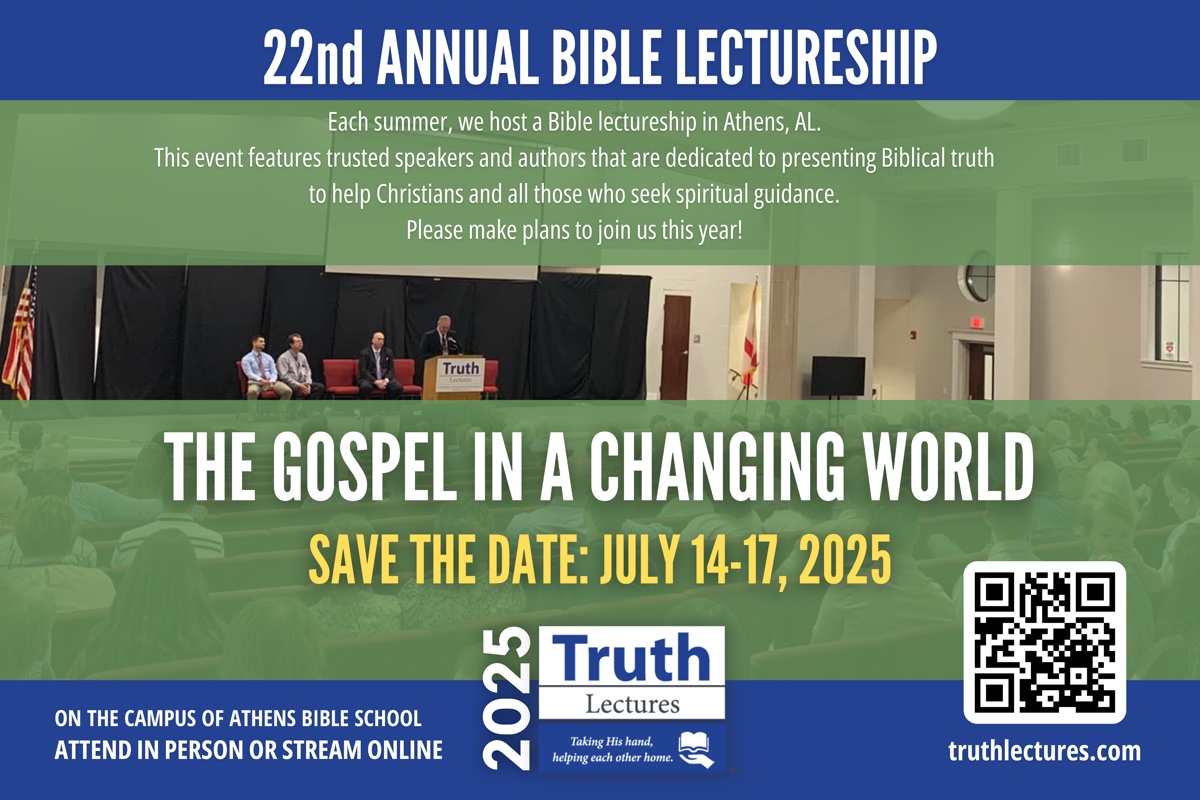
By Joshua Welch
Synopsis: This article is a brief response to our neighbors, new converts, and even seasoned Christians who may question the necessity of the assembly of Christians.
“Do I really need to attend every church service?” This is a common question raised by both new converts and lifelong Christians. Both want to know whether we teach this because it is a tradition of man or the teaching of God’s word. Consider the instruction of Scripture.
Jesus had a “custom” of attending religious special events and synagogue worship. In Luke 2, the family of Jesus takes twelve-year-old Jesus to the Passover Feast. Verse 41 says, “His parents went to Jerusalem every year,” and verse 42 adds, “. . .they went up to Jerusalem according to the custom of the feast.” This text shows it was the habit of the family of Jesus to attend the Feast of the Passover. This trip to the temple environs in Jerusalem gave Jesus the opportunity to “increase in wisdom” (Luke 2:52). He did so by “sitting in the midst of the teachers, both listening to them and asking them questions. All who heard Him were astonished at His understanding and answers” (Luke 2:46-47). We are no longer bound by the Old Testament law to keep such feasts (see Col. 2:16). However, the principle the family of Jesus sets of prioritizing spiritual growth opportunities among God’s people is key.
Two chapters later, as the ministry of Jesus begins at age thirty, Luke 4:16 says, “So He came to Nazareth. . . and as His custom was, He went into the synagogue on the Sabbath day. . .” The Sabbath came every week and was a holy day of rest and worship (Exod. 20:8-11). Jesus made participation in the Sabbath assembly a priority. Notice Jesus was not just an idle synagogue spectator, but He “stood up to read” from the inspired text when given the opportunity (4:16). Just as Jesus took the Sabbath seriously, so we ought to make our Lord’s Day assembly a matter of habit (Rev. 1:10). As 1 John 4:6 says, “He who says he abides in Him ought himself also to walk just as He walked” (NKJV). Jesus assembled. Jesus-followers should assemble.
After the first 3,000 converts were baptized, Acts 2:42 says, “They continued steadfastly in the apostles’ doctrine. . .” These newborn Christians did not just get baptized and scatter. They gathered. Verse 46 tells us where this large group assembled and how often: “So continuing daily with one accord in the temple. . .” This text helps us understand why the regular assembly of the saints was important. These newborn disciples needed continual instruction, which led to continual growth (see Acts 2:47). This came, in part, from their common assembly together.
As the first-century church continued its maturation, the regular, local assembly of believers became both apparent and purposeful. Paul would write to Corinth and say, “For first of all, when you come together as a church. . .” (1 Cor. 11:18). Clearly, this implies the Corinthian church was consistently gathering. Just as Paul and his companions “came together to break bread” in Troas (Acts 20:7), so other local churches where Paul had taught were doing so as well. Later, the Corinthian text would say, “Therefore when you come together in one place. . .” (1 Cor. 11:20). The church regularly assembled. Please note this is not a “virtual assembly” where its participants were in different places, but an assembly where all members could gather “in one place” and participate in the worship as well.
So, what was the purpose of their assembling together? First of all, they were to “proclaim the Lord’s death till He comes” (1 Cor. 11:26). Yet, apparently, in the latter context, more happened in these assemblies than just the sharing of the Lord’s Supper. 1 Corinthians 14 is one of the most instructive chapters concerning the assembly in all the New Testament. In this text, Paul lays down two principles governing the worship assembly and its participants. The first principle, in verse 26, says, “Let all things be done for edification.” The second principle, in verse 40, says, “Let all things be done decently and in order.” The rules prior to these principles are intended to aid the assembled in operating within these inspired guidelines. Consider the first underlying principle: “edification.” What is “edification?” The answer to that question helps us to understand the vital purpose of the assembly. “Edification” is “the act of building, building up” (Thayer). The “assembly,” then, is God’s process of building and strengthening Christians. God uses encouragement, prayer, praise, preaching, and the proclaiming of the Lord’s death to build up worshippers! These activities are the means God uses to accomplish spiritual growth.
Just as a physical body needs regular feeding, so the spiritual body of Christ needs a steady diet of spiritual food for growth. Schools know their students need regular instruction in their courses to grow in their education. Coaches know their teams need regular training sessions, conditioning, and competition to grow in their abilities and team chemistry. This concept should be easy to grasp in the spiritual realm as well. An assembly focused on the teachings and exercise of “apostles, prophets, evangelists, pastors, and teachers” helps us work towards “the equipping of the saints” and “the edifying of the body of Christ” (see Eph. 4:11-12). A steady diet with such instructors is part of God’s maturation process.
A good attitude toward spiritual instruction will yield good results in the heart of a Christian. When we question whether we should have to be together to praise God, it makes one question whether the believer truly understands the precious gift and wondrous grace God has bestowed on us! This should not be a “Do I have to?” issue to be questioned, but an “I want to!” opportunity to be relished. We should say with those in Revelation 4, “You are worthy, O Lord, to receive glory and honor and power. . .” (4:11, NKJV).
Consider an illustration. Imagine a husband and wife have eaten breakfast together one morning. After breakfast, before the two depart for the workday, the wife says, “Can we go eat dinner together again tonight?” The husband replies, “We already ate together once. Do we really have to eat together a second time again?” Does this type of reply indicate sincere love and devotion? Does this man sound enamored with his wife as he complains and looks for a way to evade spending time with her? How would the wife feel after hearing her husband reply to her desire to be together in such a way? Probably the same way Christ feels when the bride of Christ has no desire to spend extra time with Jesus Christ in worship and devotion!
Hebrews 10:24-25 says, “Let us consider one another in order to stir up love and good works, not forsaking the assembling of ourselves together, as is the manner of some, but exhorting one another, and so much the more as you see the Day approaching” (NKJV). The purpose of assembly was not just to get one’s name checked off an attendance sheet, but for mutual encouragement. The author of Hebrews wrote to people who were slipping. They were in danger of apostasy. One of the first signs of a backsliding saint is when the assembly is neglected. Once we allow some other priority to become more important, once one excuse is made, it gets easier to repeat the process over time. Once turns into twice, turns into three times, and eventually may lead to complete absenteeism. Absenteeism makes mutual encouragement impossible.
Be careful not to “forsake” your Lord and the brethren for lesser priorities. That first compromise is often an indication of a spirit of conformity and a weakening love (Rom. 12:1-2). We may sing “I’ll Be A Friend to Jesus,” but what kind of friend keeps missing regular appointments to spend time with his best friends? An absent employee gets fired. An absentee father should be scolded. An absent student is truant. What about an absentee member (see John 15:5-6)?
Jesus calls His disciples to “seek first the kingdom of God” (Matt. 6:33). The “great commandment” Jesus cites is to “love the Lord your God with all your heart, with all your soul, and with all your mind” (Matt. 22:36-38). When God delivered the Decalogue to Moses, one of His first commandments was, “You shall have no other gods before Me” (Exod. 20:3; Deut. 5:7). In this world, many “gods” vie for our time. These “gods” take the form of our bosses, coaches, professors, music directors, celebrities, teachers, and even our family and friends. We must make sure we have a firm grip on our spiritual priorities and be devoted to the King of kings Who takes priority and precedence over any of these “gods.”
To be with God’s people ought to be preferred above being with any other group of people. Romans 12:10 says, “give preference to one another.” King Jesus demands no less than first priority of His citizens. He is a greater King than anyone else who demands your loyalty. Just as there is no greater King than King Jesus, there is no greater family than God’s family. We show we “prefer” them above others when we make assembling with them a matter of priority.
Jesus once asked, “What man is there among you who has one sheep, and if it falls into a pit on the Sabbath, will not lay hold of it and lift it out? Of how much more value then is a man than a sheep?” (Matt. 12:11-12). There are occasions when one is providentially hindered from assembling. Yes, one should attend. Yet, a mother and father should also care for their sick child. A sick spouse may need the help of their spouse. A doctor or nurse may be called in to treat the suffering during assembly times.
What shall we do when there is a conflict between one command over another? Jesus illustrates this complex decision in Matthew 12:11-12. He compassionately quotes a principle from Hosea, stating, “I desire mercy rather than sacrifice” (Matt. 12:7). Applying this principle can be difficult. So, it is important that we be merciful in our judgments and careful in our discernment as we consider such situations. Ask yourself before you absent yourself: did I miss the assembly because this was a humanity issue or was it a priority issue?
How important is the assembly to you? Often, your actions speak louder than your words. May our actions always exalt and prioritize Christ and His people!
Joshua Welch has worked with the Helton Drive church of Christ in Florence, AL, since August 2024 after two decades of preaching in Indiana and Ohio. He and his wife, Johnna, have three children. The church’s website is here. He can be reached here.




By Shawn Chancellor
Synopsis: The author describes the spiritual journey of an individual with whom they studied. She moved from a materialist worldview to agnosticism, and eventually to a belief in God, leading to her baptism. The text highlights the importance of clear communication in church settings, noting that technical or exclusive language can sometimes confuse visitors. However, the author emphasizes the need for churches to educate their members and visitors, using precise biblical language while being mindful of the audience’s background. He concludes by encouraging churches to balance clarity and precision in preaching the gospel, ensuring that biblical truths are communicated effectively.
A few years ago, I had the privilege of baptizing a lady named Sherry Day. Her religious background was complex. In college, she had developed a materialist worldview. Later, she became more agnostic. Yet, over time, she became convinced of the existence of God and began attending various community churches. When I met Sherry, she attended a Christian church in Canyon, Texas. As she studied her Bible more deeply, she began having questions about the various teachings and practices she witnessed there. She reached out to the preacher and did not receive satisfactory answers. This sent her on another journey seeking the truth. Somehow, she found a series of online correspondence courses produced by David Pratte, and he put Sherry in contact with me. After a few studies, she was ready to be baptized.
Sherry was hungry to learn and full of questions. We often joke about how many questions she asked in those first couple of years after she was converted. Sherry is a mature, intelligent woman, so I was impressed by her lack of ego and willingness to admit to her ignorance. Her questions were often about fundamental concepts, they were always insightful, and more often than not, I learned as much as she did from the interaction.
One of our early encounters caught me flatfooted, and I have reflected on it many times since. It was Sunday morning, immediately after services. I was pleased with the sermon I had presented, having already decided it was a home run. Sherry approached me with a concerned look and said something I will never forget. “Sometimes I feel like you speak in code, and everybody knows the code except me.” While I mentally downgraded my home run to a ground ball to first, I asked her what I had said that she didn’t understand. “For starters,” she said, “What does brethren mean, and why do you call people that?”
As we talked about the nature of our relationship in Christ, I couldn’t help but wonder how many visitors had sat through our worship service, wondering what we meant by terminology that many of us had used our entire lives. How often had I preached my heart out to someone who was asking, “Why does he talk so funny?”
Terms such as “denominational,” “unsound,” “authorized,” “autonomous,” “universal (church),” etc. may be utterly unknown to many visitors to our worship services. Likewise, phrases such as “the plan of salvation,” “the Lord’s church,” “faithful congregation,” etc. may be unfamiliar and could feel exclusionary to visitors from our communities. This presents an obvious problem for local churches and preachers. We want our visitors to have a positive experience, feel welcomed, and come back again. We do not want to present ourselves or the gospel obtusely, eliminating any opportunity for further study. At the same time, we must not “shrink from declaring. . . the whole counsel of God” with clarity and precision (Acts 20:2 KJV).
This is not a new problem. I cannot imagine that many of the Gentiles Paul and the other apostles encountered had any idea what the phrase “Holy Spirit” meant. We should also note that much of the New Testament language that describes our faith and practice involved Greek terms retooled to fit the radically different worldview of the gospel. For instance, ekklesia, often translated as “church” in the New Testament, means “called out.” The term would have typically referred to a civic assembly or gathering of citizens, often for political or judicial decision-making, such as in Acts 19:39. However, the New Testament takes the concept of “called out” and applies it to believers who have been called out of the world (see Mounce, 110). Paul uses several terms, such as justification, flesh, and mystery, and gives them a meaning slightly different from their common usage in communicating the gospel message. I do not doubt that both Jews and Gentiles visiting first-century churches would have struggled to understand specific terms just as much as our visitors today might.
Often, language unfamiliar to the uninitiated is simply biblical language used to describe Bible concepts. Terms like “brother” (1 John 4:21) or “sister” (Phile. 2) describe the relationship that fellow Christians share in a manner that should remind us we are brought together through adoption as “children of God” (Rom. 8:14-17, cf. Eph. 1:5). We could, and likely do, use other terms to describe our relationship to one another, but there is a precision in this familial language that other terms lack.
Other terms and phrases that are not found in Scripture are used in an effort to be clear and precise. For instance, the phrase “local church autonomy.” The term “autonomy” does not appear in the text of Scripture; yet, this term allows us to discuss the relationship between local churches with precision and accuracy.
We should also remember that words are vehicles of thought. Our language must accurately convey the concepts we are discussing. When preaching the gospel, we deal with matters of life and death. We need to be as accurate, precise, and clear as we are capable of being. Terms like “sanctify” or “remnant” are rarely used in everyday speech. However, they communicate spiritual ideas with the precision we need when presenting the gospel. “Authority,” “approved example,” and “necessary inference” are all terms that one is unlikely to encounter in a religious context outside of a church of Christ.
Nevertheless, we must also remember that these concepts are rooted in Scripture. This leads to an issue that I encounter regularly in personal work. More and more, I find myself talking with people who are completely unfamiliar with basic Bible concepts. In some cases, this is because they have never attended a church or studied their Bibles, others have spent their lives moving from one religious group to another, and some have been part of one denomination their whole lives and have not been taught anything substantive. I have learned two things from this. First, when the concepts are brand new, extensive explanation is needed regardless of the language used. Second, sharing so-called technical terms in this process gives the student the sense of being an insider and produces a feeling of accomplishment. While we need to be careful not to overwhelm the uninitiated, we must not oversimplify the gospel to a point where it loses its meaning.
There is a temptation for preachers and teachers in local churches to avoid uncommon terms altogether. Before we do that, we should ask ourselves what we are trying to accomplish in our teaching and preaching. If the purpose of our teaching and preaching is to offer life counseling that leaves the hearer feeling emotionally charged and validated (in their present condition), then we should abandon all technical language or any exclusive terminology. However, this would be to reject the purpose and message of the New Testament. The gospel calls sinners to salvation. Local churches are charged with the task of educating people about spiritual matters. To use a “Bible word,” the local church is responsible for edifying its members. Notice Ephesians 4:11-16. Jesus gave “gifts” or offices to the church (v. 11). Each of these offices has to do with the revelation of and instruction in the Scriptures. According to verse 12, the purpose of these gifts is the “equipping” and “building up” (edifying) of the body of Christ. This edification should be sufficient to allow each member to recognize false doctrine when exposed to it (v. 14) and help the body grow (vv. 15-16).
If we make it our goal to simplify the language (and perhaps the message), we risk failing to produce mature, educated disciples who are capable of recognizing and confronting false teaching. Paul’s message in Ephesians 4 should help us to remember that the purpose of our teaching is not to produce satisfied consumers. Instead, we should work to produce qualified teachers. Every educational endeavor utilizes technical language and terms unique to that field of study, which communicate the principles under consideration. Whether we are talking about a fourth-grade grammar class, an air conditioning repair class, or medical students, they must learn technical language to carry out their work.
I hope every unconverted visitor understands the sermon and is encouraged to learn more. At the same time, the local church should aim to help disciples grow and become skilled students and teachers of the gospel. We must not forget the one to reach the other.
A few weeks ago, the sister scheduled to teach our toddler class had a last-minute emergency and could not make it to Bible Class. The two deacons responsible for ensuring each class had a teacher found this out about two minutes before class started. With no notice and no time, they went into a room with six children ages three and under and taught the class.
The class these deacons were scheduled to be in that Sunday discussed the proper use of the church treasury. I never asked them what they taught in the toddler class, but I am sure it had nothing to do with the church treasury. Can you imagine how that would have gone? I have no doubt they went to a simple Bible story and worked through it slowly with lots of illustrations and singing—hoping the children would participate and maybe even understand.
We see this same willingness to adapt to the audience in the New Testament. In Acts 2, Peter preached a sermon laden with Old Testament imagery and quotations. He began by pointing out that the events being witnessed at that moment were the very events Joel had prophesied. This was meaningful and easily understood by a Jewish audience gathered to celebrate the Passover. I doubt a Gentile audience would have understood much, if anything, Peter said that day.
In Acts 17, we read of the apostle Paul preaching in Athens to a Gentile audience. Someone who had never heard of the Old Testament could understand his message. The basic message was the same as Peter’s: salvation is found through faith in and obedience to Jesus Christ; however, the language and approach differed.
If we are studying with non-Christians or teaching a new converts class today, we should take our time and explain concepts carefully and precisely. Hopefully, we will encourage the students to ask questions about anything they do not understand. We also need to take into account their background and personalities. Likewise, if we see visitors from our community in our worship service, we should explain our terminology and simplify our language where appropriate. However, we must not avoid challenging concepts in the name of using simplified language.
Our goal as local churches, teachers, and preachers should be to communicate the Bible story in an understandable way and encourage the listener to dig deeper. To accomplish this, we must ensure our language is accurate, precise, and comprehensible. Occasionally, we may need to simplify our language or take more time to explain our terms. More importantly, we need to ask ourselves, “What is the best way to communicate concepts without losing the full biblical meaning and while fulfilling our mandate to preach the whole counsel of God?” We must be sensitive to our audience, but more importantly, we must be bold and clear in expressing biblical truths.
Mounce, William D. Mounce’s Complete Expository Dictionary of Old & New Testament Words. Grand Rapids, MI: Zondervan, 2006.
Shawn Chancellor has worked with the South Georgia Street church of Christ in Amarillo, TX, since 2014. He and his wife, Bonnie, have one daughter. The church website is here. He can be reached here.



Synopsis: Churches of Christ actually do preach on grace, but they reject Calvinist errors about grace, instead emphasizing the Bible’s teaching that grace is God’s relational gift that calls for an obedient response.
It’s common for visitors who attend our assemblies to have questions. That is good—we welcome questions. Questions start conversations, encourage reflection, and most importantly, cause us to examine carefully what the Bible says. A question that often comes up is, “Why don’t you preach on grace?” That’s a good question, but behind it are some serious misunderstandings. Let’s explore what’s happening with that question—and why it allows us to develop a deeper, richer view of God’s grace.
To begin, it is true that you won’t hear in a church of Christ the same version of “grace” that’s commonly taught in many denominational settings. That’s because much of what people believe about grace comes not from the Bible, but from John Calvin’s theology. Calvin’s ideas—irresistible grace, unconditional election, and once-saved-always-saved—have shaped popular religious thought so deeply that people often assume they must be biblical. However, those doctrines reveal Calvin’s terrible misunderstandings about grace.
Take “irresistible grace,” for instance—the idea that God has predestined who will be saved (the “elect”) and then His grace overpowers the human will and saves them. They do nothing. God does 100% of the saving (because that person was born depraved and can do nothing). Yet that doctrine only makes sense if you first believe people have no free will. However, the Bible affirms repeatedly that human beings can choose. Joshua told Israel, “Choose this day whom you will serve” (Josh. 24:15). Jesus said, “If anyone does not abide in Me, he is thrown away like a branch” (John 15:6). These statements don’t make any sense unless we’re genuinely free to decide. Why are people called to baptism in Acts 2 if they can’t choose God and His way, and why do they need to do that if God has already chosen and saved them?
Even more troubling, if grace is irresistible, then why isn’t everyone saved? After all, 1 Timothy 2:4 says God “desires all people to be saved.” If God wants everyone to be saved, and grace can’t be resisted, then everyone should be saved, right? Unfortunately, Calvinists remain more committed to defending their system than addressing their doctrine’s clear contradiction of the Bible’s teaching.
Tied closely to this is the idea of “once-saved-always-saved.” Calvin taught that once grace has saved you, then you cannot be lost. In contrast, the Bible clearly teaches that people can fall away. Galatians 5:4 says some of the Christians in Galatia had “fallen from grace.” 2 John 9 warns that if we go on beyond the teaching of Christ “we will not have God.” Since salvation can be lost, more of what Calvinism teaches about grace crumbles.
The most pervasive misconception about grace is the thinking that grace and obedience are enemies. We are told that it must be either grace or works. If you insist on any sort of obedience, you’re accused of legalism or trying to earn salvation. Once again Calvinism’s poison seeps into people’s thinking: if salvation is 100% by God’s action, then we can do nothing to receive that grace (and again, how could we if we are born depraved?). This is what everyone is told, but is it what the Bible teaches?
The Bible teaches over and over that grace never nullifies man’s faithful, obedient response. The Old Testament testifies to how God can graciously give and bless, but His people were expected to respond in obedience. For example, Noah “found favor [grace] in the eyes of the Lord” (Gen. 6:8), but he still had to build the ark. Joshua was given Jericho by grace (Josh. 6:2), but the people had to march around the city, blow trumpets, and shout. Naaman was graciously offered cleansing from his leprosy—but only after obeying God’s command to dip in the Jordan seven times (2 Kings 5:14). These aren’t exceptions. They are the pattern.
That pattern continues in the New Testament. When Jesus says in Luke 6:46, “Why do you call Me ‘Lord, Lord,’ and not do what I tell you?” He’s calling for action! When Peter preached the first gospel sermon in Acts 2 and his hearers asked, “What shall we do?”, he didn’t reply, “Do? Nothing! Grace has it all covered.” No—he said, “Repent and be baptized” (verse 38). That wasn’t legalism. No one was earning salvation. It was responding to God’s grace.
This shows us that grace isn’t opposed to effort or obedience. Paul put it this way: “Not all have obeyed the gospel” (Rom. 10:16). That only makes sense if there is such a thing as responding obediently to God’s gracious offer.
So no, we don’t preach Calvin’s version of grace. But that doesn’t mean churches of Christ don’t preach on grace. We just want to preach what the Bible says about it.
A better understanding of grace comes when we see what the term means in Bible times. In the New Testament, “grace” is the Greek word charis, meaning simply “gift.” When Paul or Luke or Peter used the word, they weren’t using an obscure theological term. They were talking about giving. And in the first-century world, gift-giving had very specific expectations and meanings.
In our modern Western minds, a gift is something that comes with no strings attached. The moment you suggest that a gift carries expectations, we recoil. “If there are expectations,” we argue, “then it’s not really a gift.” We like the idea of gifts having “no strings attached.” That’s how we tend to think. This is why so many resist the idea of needing to be baptized to be saved. “If I’m saved by grace then don’t tie strings, like baptism, on my gift!”
However, no one in the New Testament world thought of gifts in that way. In the ancient world charis carried with it two essential truths.
First, gifts were designed to create and nurture relationships. You gave to start a bond. That’s why Paul could refer to the Gentile churches’ monetary help of the impoverished Judean Christians as “grace” (2 Cor. 8:1-7). Paul repeatedly uses the word “gift” (charis) in this text. Today, we might call those funds “humanitarian aid.” Paul calls it a gift because he primarily wants that money to build a connection between Gentile and Jewish brethren. Grace builds relationships.
Secondly, gifts carried an expectation of reciprocity. Seneca, a Roman philosopher, compared giving a gift to playing a game of catch—you throw the ball, and it’s meant to come back. Sirach 12:1-2 says, “Do good to the devout, and you will be repaid—if not by them, certainly by the Most High.” That was the cultural mindset. Paul reflects this in Romans 15:27, where he says Gentiles “owe it” to the Jews to share with them materially since they shared spiritual blessings. That’s reciprocity. In the New Testament world, a gift brought with it the expectation of response. There isn’t “no strings attached” gifting in the Bible.
God’s grace is the ultimate gift to build a relationship (John 3:16), but that doesn’t mean it comes with no expectations. The New Testament is full of language about grace calling us to respond. Titus 2:11-12 says, “The grace of God has appeared. . . training us to renounce ungodliness and worldly passions, and to live self-controlled, upright, and godly lives in the present age” (ESV). Grace is not passive. It works in us, building relationship with God and teaching us how we must respond to Him.
This understanding clears up confusion around verses like Ephesians 2:8-10, which says, “By grace you have been saved through faith. . . not a result of works, so that no one may boast.” Paul isn’t denying the need for obedience. He’s saying we don’t earn salvation—we don’t deserve grace. Just the same, receiving the gift still means stepping into a relationship that includes expectations. Verse 10 says we are “created in Christ Jesus for good works.”
That is why I’m increasingly cautious with the popular definition of grace as “unmerited favor.” That’s not wrong—but it’s incomplete. It reinforces the idea that any human response must necessarily be an attempt to “earn” something. It plays into “no strings attached” thinking. Biblically, grace is better defined as God’s gift that builds a relationship, and it expects our obedient response.
As I have thought through this, I have retired one of my favorite illustrations to show people how grace doesn’t nullify obedience. I would say, “Salvation by grace is like if I put these car keys on the table and told you, ‘If you pick them up you get the car.’ You didn’t earn the car, but you have to pick up the keys to receive it.” Yet in my analogy, you simply drive off. There’s no relationship or expectation of response. Is God giving away cars and we’re just off to the races? That’s not how grace works in the Bible.
A better illustration would be this: imagine a full college scholarship given to a needy student. That gift comes with the expectation that the student will go to class, study, and graduate. That gift will also build a relationship between the donor and the student. When the student graduates can he claim he “earned” his scholarship? Of course not. Still, he never would have received his diploma without the gift. The gift builds a relationship and carries responsibilities.
Realizing what the Bible means when it uses the term “grace” is a game-changer. It moves us out of a transactional view of salvation into a relational understanding. By transaction I am thinking about rescuing someone whose car is in the ditch. We pull them out, accept their thanks, and everyone goes on their way. We saved them, but we don’t invite them to dinner or to move into our home with us! It was a one-time transaction.
That’s not how grace works. Grace is like when a man gives a woman an engagement ring and says, “Would you marry me?” That’s an invitation to a lifelong relationship. That’s what grace is: God’s gift, His invitation to relationship, that expects us to say “Yes!” And just as the woman needs to say “Yes,” and put that ring on and become a wife, we need to respond to God’s grace, too.
Grace builds relationship. Grace expects obedience.
So why don’t churches of Christ preach on grace? The truth is—We Do! We just don’t preach a version of grace that dramatically and repeatedly contradicts so much of the Bible’s teaching.
Grace isn’t about passivity. It is God’s invitation to a new life, a better way, and a deeper relationship with Him in which we must walk in the good works grace calls us to.
Yes, we preach grace. We preach that grace is amazing because it builds relationship and expects our faithful response. That’s what the Bible says, and that is what we preach!
Mark Roberts has worked with the Westside congregation in Irving, Texas, for over thirty years. He and his wife, Dena, have two children and eight grandchildren. Mark is a huge fan of coffee, fountain pens, old movies, and Teddy Roosevelt. He is currently working on the third book in his coffee and Bible series, a book on Revelation. You can follow his work and writings here and listen to his sermons, Bible classes, and podcast via the Westside website.



By David Halbrook
Synopsis: In a culture that values diversity with few limits, why are Christians not working with denominations to spread the gospel?
If you are old enough to remember a Billy Graham crusade coming to town, you know it was the center of activity for many religious groups in the area. It was a frontline, headline interdenominational event in which many Catholic and Protestant groups would participate. Maybe you’ve never heard of such because those crusades are less common now, but similar interdenominational events may occur around various “holy days.” In principle, it is admirable and desirable to bring everyone who follows Jesus together to worship God and teach the lost because Jesus prayed for unity and gave a plan to unify all nations by the gospel (John 17; Rom. 1:16-17). So when we observe, are invited to, or are asked about such events, we must examine whether the modern practice of interdenominational activities agrees with the original principle of unity in Christ.
We must start with Jesus, the chief cornerstone in whom the whole building is joined together (Eph. 2:20-21). Jesus is the Word who was with God and was God, and no one comes to the Father except by Him (John 1:1; 14:6). He died and was raised according to the Scriptures, and without His blood there is no remission of sins (1 Cor. 15:1-4; Rev. 1:5). Jesus has all authority in all matters of spiritual significance, and whatever we do must be done in His name (Matt. 28:18; Col. 3:17). We need confidence in these truths and must hold fast to them! Could we call someone a follower of Jesus who rejects such things?
With Jesus as the foundation, we then learn in Scripture of the church He built by His death and resurrection (Matt. 16:18-19). This is the kingdom prophesied by Daniel as God guided him to interpret the dream of Nebuchadnezzar (Dan. 2:44-45). As Daniel prophesied, so it happened—in the days of the Roman Empire (which followed the Babylonian, Persian, and Grecian Empires), God set up a kingdom which shall never be destroyed. That kingdom consists of people whom He has delivered from the power of darkness and conveyed into the kingdom of the Son of His love (Col. 1:13).
When Jesus sent the apostles out to spread the gospel of this kingdom, they were instructed to convince men to believe that Jesus is the risen Christ having all authority, repent of their sins, and be baptized (Matt. 28:18-20; Mark 16:15-16; Luke 24:46-47). Sinners who are convinced of these things and respond in faith to these instructions are forgiven of their sins. This is the starting point for defining who belongs to Jesus.
In the decades and centuries that followed the spread of the gospel, men departed from the faith and began teaching other doctrines while claiming allegiance to Jesus. In time, the teaching that babies inherit Adam’s “original sin” and guilt led to the practice of infants being “baptized” (though actually, they were only sprinkled with water). The conclusion of this teaching is the belief that infants who are baptized are saved and grow up to believe. Compare that teaching with the message Jesus gave the apostles in Mark 16:15-16. Does it match or contradict Jesus’s teaching?
Hundreds and hundreds of years later, a wave of people protested the corruptions of Catholic leadership and doctrine. Historians call it “The Protestant Reformation,” which resulted in a multiplicity of Protestant churches. But more important than how historians label the efforts and teachings of people in a defined period is the actual teachings and practices of any individual or group. The most prominent teaching that arose from this time is that salvation is by “grace alone” through “faith alone” in “Christ alone.” Application of this principle is the belief that sinners are saved by faith alone, before and without water baptism. Stated another way, this teaching claims that the sinner who believes Jesus is the Christ is saved and will later be baptized. Again, compare that teaching with the message Jesus gave the apostles in Mark 16:16. Does it match or contradict Jesus’s teaching?
So this requires you and me to make a decision. I must not be ashamed of the original message of the gospel (Rom. 1:16-17). This original message puts me in conflict with the religious groups hosting and participating in typical interdenominational events. Usually, the religious groups hosting such events will set this difference aside, but if we consult the teachings of Jesus, do we have authority to set aside contradictions to His original plan to forgive sinners?
Also, consider the assumption of this interdenominational service—that even though the religious groups who have gathered teach and practice different things, we are all united in Jesus, anyway. As I summarized above, some groups tell a sinner to be forgiven by praying. Other groups would tell families to have their baby baptized by a priest so the baby can be saved. Which message will be taught at these events? Is this the kind of unity that is the result of the gospel? Matthew’s record of God’s plan for salvation does not contradict Mark’s or John’s record of God’s plan. Luke’s record does not contradict Matthew’s or John’s record. All of them were writing of one Lord, one faith, one baptism which resulted in one body (Eph. 4:4-5). When religious groups are spreading a message of another Lord, another faith, or another baptism, I cannot be in unity with them. Can you? I can talk to them, listen to them, study with them, and seek to learn together. However, while we are teaching contradictory messages regarding forgiveness, I cannot participate with them in an event that declares we are united. This does not mean that I think I am better than they are. It means that because their teaching on the fundamental subject of God’s forgiveness is different from the Bible, I cannot pretend to be united with them.
“There is one body and one Spirit, just as you were called in one hope of your calling; one Lord, one faith, one baptism; one God and Father of all, who is above all, and through all, and in you all” (Eph. 4:4-6). This is a basic summary of some basic teachings that are essential to the unity God provides by the Spirit (Eph. 4:3). Any individual who rejects that there is one Lord, one Father, and one Spirit cannot be called a follower of Jesus. However, in this text, Paul mentions more than three “ones.” He says there is one faith. This faith is the message God has revealed by Jesus (Gal. 1:23; Jude 3). He says there is one hope, which he defines in 2 Timothy 4:8. He says there is one baptism. This is water baptism and is for the remission of sins (Acts 8:36; 2:38; 22:16). He says there is one body. This is the church, family, and kingdom that belongs to Jesus, which He purchased with His blood, and by which He saves each individual member (Eph. 1:22-23; 2:13, 19; Col. 1:13-14). Which of these seven “ones” may be set aside for the sake of an interdenominational event? If we set one aside, why only one? The result of this approach will not only cause us to participate in interdenominational events, it will also lead us to what is called interfaith events where all the religions (and non-religions) of the world are valued for their own kind of faith, hope, and love.
Also, consider how “one body” must be part of a decision regarding interdenominational events. The claim at these events is that everyone who participates is part of the one body (i.e., church, family, kingdom). Is that true? Is the one body made of parts who were added by sprinkling in their youth, praying a sinner’s prayer, faith alone, or confessing their faith and being baptized? Many people today would say “Yes,” but this is not the diversity that is described in Scripture. “There is neither Jew nor Greek, there is neither slave nor free, there is neither male nor female; for you are all one in Christ Jesus” (Gal. 3:28). In Christ, there is national, economic, and gender diversity, but the head of the body says nothing about diverse plans for forgiveness. One plan for forgiveness results in one body. Many plans for forgiveness are one reason why denominations exist. The plan for forgiveness from Catholics is distinct from the plan for forgiveness from Protestants. That is why they are separated from each other. Sadly, both of their plans are distinct from Jesus’s plan, as is the Muslim’s plan and Buddhist’s plan. That is why they are separated from Jesus and His body. This is not the only difference between the one body and modern religious groups, but it is one of the most basic differences. It is the reason that Christians cannot have spiritual fellowship with denominations.
When our denominational friends notice that we stand apart from other religious groups and ask, “Why don’t you share fellowship with denominations?”, we must speak the truth in love (Eph. 4:15). We must “walk in wisdom toward those who are outside, redeeming the time. Let your speech always be with grace, seasoned with salt, that you may know how you ought to answer each one” (Col. 4:5-6). We must “preach the word! Be ready in season and out of season. Convince, rebuke, exhort, with all longsuffering and teaching” (2 Tim. 4:2).
All Scripture quotations are taken from The New King James Version (NKJV) Nashville: Thomas Nelson, 1982.
David Halbrook has worked among the Chena Small Tracts church of Christ in Fairbanks, Alaska, since 2019. David and his wife, Starla, have three children. The church website is here, and they also have a Facebook page. He can be reached here.



Note: Please send additions, corrections and updates here.
Updated: 5/2/2025
17312 Jones Rd, Athens, AL 35613
Sun. Bible Study 9:30 am | Sun. Worship: 10:20 am & 5:00 pm | Wed. Bible Study 7:00 pm
Evangelist: Jonathan Reeder | Website | 256-233-3160
24190 Wooley Springs Rd, Athens, AL 35613
Sun. Worship 9:30 am & 5:15 pm | Wed. Bible Class 7:00 pm
Evangelists: Bob Watson & Matt Taylor | Website
3955 Pine Lane, Bessemer, AL 35022
Sun. Bible Study 9:10 am | Sun. Worship 10:00 am & 5:00 pm | Wed. Bible Class 7:00 pm
Evangelist: David Deason | 256-497-8127 205-425-2352 | Email | Website
2325 Old Columbiana Rd. (near I-65 & Hwy. 31)
Sun. Bible Study 9:00 am | Worship 10:00 am & 5:00 pm | Wed. Bible Study 7:00 pm
Evangelist: Kyle Pope | 205-822-0018 | Website
19965 Sandlin Rd. Elkmont, AL 35620
Sun. Worship 9:30 am & 3:00 pm | Bible Classes: 10:45 am | Wed. Bible Study 7:00 pm
Evangelist: Lance R. Taylor | 256-777-0990 | Website
851 N. Pine St. (Located next to University campus)
Sun. Bible Study 9:30 am | Worship 10:15 am & 5:00 pm | Wed. Bible Study 7:00 pm
Evangelist: Kenny Moorer | 256-766-0403
601 Pineywood Road, Gardendale, AL, 35071 (Located 10 miles N of Birmingham)
Sun. Bible Study 9:30 am | Worship: 10:25 am & 5:00 pm | Wed. Bible Study: 7:00 pm
Evangelists: Andrew Smith & Jason Shackleford | 205-631-2131 | Website
129 Hillcrest Rd, Mobile, AL 36608
Sun. Worship 9-9:30 am | Bible Study 9:30-10:30 am | Worship 10:30-11:30 am | Wed. Bible Study 7:00 pm
Evangelist: Ken Sils | 765-307-8048 | 251-342-4144 or 342-2041 | Website
271 Highway 65 N, Conway, AR 72032
Sun. Bible Study 9:00 am | Worship 10:00 am & 5:00 pm | Wed. Bible Study 7:00 pm
Evangelist: Bruce Reeves | Bldg: 501-336-0052 | Website
2655 Prince St., Conway, AR 72034
Sun. Worship 9:00 pm | Bible class 9:50 am | Worship & Lord’s Supper: 10:40 am | Wed. Bible Class 7:00 pm
501-450-8640
2323 South 46th St.
Sun. Bible Study 9:45 am | Worship 10:30 am | Wed. Bible Study 7:00 pm
407 Bella Vista Dr.
Sun. Bible Study 9:30 am | Worship 10:15 am & 5:00 pm | Wed. Bible Study 7:00 pm
Evangelist: Norman E. Sewell | 870-741-9104 or 870-741-5151 | Website
514 Airport Rd.
Sun. Bible Study 10:00 am | Worship 11:00 pm & 6:00 pm | Wed. Bible Study 7:00 pm
Evangelist: Dick Blackford | 870-933-9134
145 N. Country Club Rd.
Sun. Bible Study 9:00 am | Worship 10:00 am & 6:00 pm | Wed. Bible Study 7:00 pm
Evangelist: Brenden Ashby | 520-326-3634 | Website
17903 Ibbetson Ave.
Sun. Bible Study 9:45 am | Worship 10:50 am & 6:00 pm | Wed. Bible Study 7:30 pm
562-866-5615 | Website
3433 Studebaker Rd.
Sun. Bible Study 9:50 am | Worship 10:45 am & 5:30 pm | Wed. Bible Study 7:00 pm
JP Flores | 562-420-2363 or Mark Reeves | 562-377-1674 | Website
449 W. Allen Ave., Suite 120, San Dimas, CA 91773
Sun. Bible study 10:00 am | Worship 11:00 pm & 4:00 pm | Wed. Bible Study 7:30 pm
909-788-9978 | Website
Meets at the Fort Collins Senior Center, 1200 Raintree Dr., Fort Collins, CO 80526
Sun. Bible Study 9:30 am | Worship 10:30 am
Evangelist: Richie Thetford | Website
1414 Hawk Parkway, Unit C
Sun. Worship 11:00 pm | Bible Study 2 pm & 1:30 pm
970-249-8116 |
64 Casting Lake Rd.
Sun. Bible Study 9:00 am | Worship 10:00 am & 6:00 pm | Wed. Bible Study 7:00 pm
850-622-3817 | Website | Location change coming in 2022: 497 Church St Santa Rosa Beach, FL 32459
196 Ave C, Geneva, FL 32732
Sun. Bible Study 10:00 am | Worship 10:45 am
(689) 229-9888 | Website
6 Lane Dr., Mary Esther, FL 32569
Sun. Bible Study 9:30 am | Worship 10:30 am & 5:00 pm | Wed. Bible Study 7:00 pm
850-244-9222 | Website | Evangelist: Chris Simmons | Email
3940 S. Bumby Ave.
Sun. Communion: 9:30 am | Bible Study 10:00 am | Praise & Preaching: 10:55 am (No pm Service) | Wed 7:00 pm
Evangelist: Ken Chapman
Office: 407-851-8031 | Website | Note: Please call for current worship and Bible study times.
621 E. Wheeler Rd.
Sun. Bible Study 10:00 am | Worship 10:50 am & 6:00 pm | Wed. Bible Study 7:30 pm
Evangelist: Bobby Witherington | 813-684-1297 | Website
Route 116 (near Callaway Gardens)
Sun. Bible Study 10:00 am | Worship 11:00 pm & 6:00 pm | Wed. Bible Study 7:30 pm
Evangelist: Tommy W. Thomas | 706-628-5117 or 628-5229 |
Meeting at 321 2nd St. S., Ste. 103, Nampa ID 83651
Sun. Bible Study 10:00 am | Worship 11:15 am | Wed. Bible Study 7:00 pm
208-461-1318 | Email | Website or here
Note: Please see website for most current information.
370 N. Shilling | P.O. Box 158-83221
Sun. Bible Study 10:00 am | Worship 11:00 pm | Wed. Bible Study 7:30 pm
208-785-6168 or 681-1552
1310 NE 54th Ave, Des Moines, IA 50313
Sun. Bible Study 9:45 am | Worship 10:40 am | Wed. Bible Study 7:00 pm
515-262-6799 | Website
1236 63rd St. (Dir: 1.5 miles E of I355)
Sun. Bible Study 9:00 am | Worship 9:55 am & 6:00 pm | Wed. Bible Study 7:30 pm
Evangelist: Steve Wolfgang | 630-968-0760 | Website
1100 S. 17th St.
Sun. Bible Study 9:30 am | Worship 10:30 am & 6:00 pm | Wed. Bible Study 7:00 pm
217-234-3702
16224 S Vincennes Ave.
Sun. Bible Study 9:00 am | Worship 10:00 am & 4 pm | Wed. Bible Study 7:00 pm
Evangelist: Donald Hawkins | 708-339-1008 | Website
Meeting @ Sleep Inn Suites and Motel | 1101 North Cummings Lane, Washington, IL 61571
Sun. Worship: 11:30 am | Bible Study: 12:30 pm | Wed. Bible Study 6:30 pm @ home of Tim Sundlie, call for address
Evangelist: Tim Sundlie | 608-796-9028 | Email | Website
407 W Lewis and Clark Parkway, Clarksville, IN 47129
Sun. Bible Study 9:30 am | Worship 10:30 am & 6:00 pm | Wed. Bible Study 7:30 pm
Elders: Allen L. Morris (812) 989-5838 and Stephen W. Nale (502) 727-7559 or (812) 944-2305 | Website
Sun. Bible Study 9:30 am | Worship 10:30 am | Wed. 7:00 pm
765-676-6404 | Website
15530 Herriman Blvd, 46060
Sun. Bible Study 10:00 am | Worship 11:00 am | Wed. Bible Study 7:00 pm
Evangelist: John Smith | Email | 317-501-8035 or 317-501-0249 or 317-701-1204
400 Lafayette Ave. | P.O. Box 34
Sun. Bible Study 9:45 am | Worship 10:30 am & 6:00 pm | Wed. 7:00 pm
812-279-4332
(First St. & Karnes Ct.)
Sun. Bible Study 9:45 am | Worship 10:30 am & 5:00 pm | Wed. Bible Study 7:00 pm
Evangelist: Jeremy Goen | 812-967-3437 or 967-3520 | Website
302 S. Fourth Ave., Mulvane KS 67110 | Mail: PO Box 11
Sun. Bible Classes: 10:00 am | Worship 11:00 am | Wed. Bible Study 7:00 pm
Evangelist: Jay Horsley | 316-644-8503 | Website | Email
5600 SW 17th St, Topeka, KS 66604
Sun. Bible Study 9:15 am | Sun. Worship 10:30 am | Wed. Bible Study 7:00 pm
785-235-8687 or 785-273-7977 | Website
1235 Williams St.
Sun. Worship 10:00 am | Bible Study After am Worship & 6:00 pm | Wed. Bible Study 7:00 pm
Evangelist: Jerid Gunter | 270-274-4451
8081 US Hwy 68-East, Benton, KY 42025
Sun. Bible Study 9:00 am | Worship 10:00 am | Wed. Bible Study 6:00 pm
270-354-9451 | Email | Website | Conveniently located near Kenlake State Resort Park on the western shore of Kentucky Lake.
612 Broadway
Sun. Bible Study 9:45 am | Worship 10:30 am & 5:00 pm | Wed. Bible Study 6:30 pm
Evangelist: Charles J. White | 270-422-3878
107 Sunny Hill Dr.
Worship 9:30 am & 11:30 am | Bible Study 10:30 am | Wed. Bible Study 7:00 pm
Evangelist: Steve Lee | 270-789-1651 | Website
103 N. Main St. | P.O. Box 233
Sun. Bible Study 10:00 am | Worship 10:45 am & 5:00 pm | Wed. Bible Study 7:00 pm
Evangelist: Jarrod Jacobs | 270-589-4167 or 270-274-3065
385 E. Lexington Ave.
Sun. Worship 10:00 am | Bible Study 11:15 am & 5:00 pm | Wed. Bible Study 7:00 pm
Evangelist: B.J. Sipe | 859-236-4204
18 Scott Drive, Florence, KY 41042
Sun. Worship 9:30 am & 5:30 pm | Sun. Bible Study 10:30 am | Wed. Bible Study 7:00 pm
859-371-2095 | Website
1733 Bowling Green Rd.
Sun. Bible Study 9:00 am | Worship 10:00 am & 6:00 pm | Wed. Bible Study 7:00 pm
Evangelist: Steve Monts | 270-776-9393 | Website
733 Mill St. Leitchfield, KY 42754
Sun. Bible Study 9:30 am | Worship 10:00 am Communion 10:55 am | Wed. Bible Study 6:00 pm
270-230-6144 | Website
1803 Dixie Garden Dr.
Sun. Bible Study 9:30 am | Worship 10:30 am & 6:00 pm | Wed. Bible Study 7:00 pm
Evangelist: Michael Hardin | Email | 502-937 2822
3221 East Hebron Lane
Sun. Bible Study 9:00 am | Worship 10:00 am & 5 pm | Wed. Bible Study 7:30 pm
Evangelist: Danny Linden & Ron Halbrook | 502-957-5115 or 502-955-1748 | Website
405 Orice Roth Rd. | 70737 (Baton Rouge area)
Sun. Bible Class 9:30 am | Worship 10:30 am & 6:00 pm | Wed. Bible Study 7:00 pm
Evangelist: R.J. Evans | Email | 225-622-4587
856 Brighton Ave. (Breakwater School) | Leave Maine Turnpike at Exit 48
Sun. Bible Study 10:00 am | Worship 11:00 pm w/ second service immediately following am worship | Mid-week Bible Study (please call for times & places)
207-839-3075 or 839-8409
3084 Creek Drive SE, #1-C, Kentwood, MI 49512 | P.O. Box 8446, Kentwood, Mich. 49508 (Grand Rapids area)
Sun. Worship 11:00 am | Sun. Bible Study 12:30 pm | Wed. Bible Study 7:00 pm
Evangelist: Joseph Gladwell | Email
414 South Main Street
Sun. Bible Study 10:00 am | Worship 11:00 am | Wed. Bible Study 6:00 pm
Evangelist: Ryan Thomas | 810-837-1302 or 989-389-3226 | Website
2820 Grandview Ave, Meridian, MS 39305
Sun. Bible Study 10:00 am | Sun. Worship 11:00 pm | Wed. 6:30 pm
Ron Cooper: 601-934-3675 | Email
Ricky Ethridge: 601-737-5778 | Email
2110 E State Line Rd. (Exit I-55) (Memphis area)
Sun. Bible Study 9:30 am | Worship 10:30 am | Wed. Bible Study 7:00 pm
Evangelist: James A. Brown | Bldg: 662-342-1132
805 Meadow Rd, Severn, MD 21144
Sun. Bible Study 10:00 am | Sun. Worship 11:00 pm & 6:00 pm | Wed. Bible Study 7:30 pm
Evangelist: Brandon Trout | 410-969-1420 or 410-551-6549 | Website
422 N Linton St., Blodgett, MO 63824
Sun. Worship 10:00 am | Wed. Bible Study 7:00 pm
Evangelist: Russell Rice | 573-475-0417
4000 SW Christiansen
Sun. Worship 9:00 pm | Bible Study 10:00 am | Worship 11:00 pm | Wed. Bible Study 7:00 pm
Evangelist: Brett Hogland | 816-228-9262
432 Eagle Rock Rd, Branson, MO 65616
Sun. Worship 9:30 am | Bible Study 10:30 am | Sun. Evening Worship 5:00 pm | Wed. Bible Study 6:00 pm
Evangelist: Philip North | 417-239-1036 | Email | Website
2912 Bloomfield Rd
Sun. Bible Study 9:15 am | Worship 10:00 am | Wed. Bible Study 7:00 pm
Seth McDonald & Jerry Lee Westbrook | 573-837-1001 | Email | Website
703 Harrison St.
Sun. Bible Study 10:00 am | Worship 11:00 pm & 6:00 pm | Wed. Bible Study 7:00 pm
Evangelist: Nolan Glover | 870-650-1648 | Website
685 Sidney St.
Sun. Bible Study 9:30 am | Worship 10:15 am & 5:00 pm | Wed. Bible Study 7:00 pm
Evangelist: Lynn Huggins | 573-265-8628
2727 County Line Rd.
Sun. Bible Study 9:00 am | Worship 9:50 am | Wed. Bible Study 7:00 pm
816-279-4737 | Website
Bell St & S 7th St. Beatrice, NE 68310
Sun. Bible Study 9:00 am | Worship 10:00 am & 6:30 pm
402-233-4102 or 402-228-3827 | Website
5327 S. Tryon Street, Charlotte, NC 28217
Sun. Bible Study 9:30 am | Sun. Worship 10:30 am | Wed. Bible Study 7:30 pm
704-525-5655 | Website
3781 East Highway 27, Iron Station, NC 28080
Sun. Bible Study: 10:00 am | Sun. Worship 11:00 am & 6:00 pm | Wed. Bible Study 7:00 pm
Evangelist: Stan Adams | 704-748-9777 (Bldg) & 704-748-3747 (Jerry) | Email | Website
1031 Welford Dr, Beavercreek, OH 45434 (located a few miles E of Dayton)
Sun. Short Worship: 9:30 am | Bible Study 10:05 am | Sun. Worship 11:00 am | Wed. Bible Study Adults: 1:00 pm & All ages: 7:00 pm
Evangelist: Heath Rogers | 937-426-1422 | Website
13501 Lorain Ave, Cleveland, OH 44111
Sun. Bible Study 10:00 am | Worship 11:00 am | Wed. Bible Study 7:00 pm (Call)
Evangelist: John Dicus | (330) 723-0111 or (330) 590-0227 or (216) 322-9392 | Website
28 W. Main St., Dayton, OH 45449
Sun. Worship 9:00 pm | Bible Study 9:30 am | Worship 10:25 am | Wed. Bible Study 7:00 pm
Evangelists: Michael Grushon 937-866-5162 or Alan Beck 937-469-3311 | Website
6417 Franklin-Lebanon Rd. Franklin, OH 45005
Sun. Bible Study 10:00 am | Worship 10:45 am | Tues. Bible Study 6:30 pm
Evangelist: Josh Lee | 937-789-8055 or 937-746-1249 | Website
1973 W Main St. New Lebanon, OH 45345
Sun. Bible Study 9:30 am | Worship 10:30 am, & 5:00 pm | Wed. Bible Study 7:00 pm
Evangelist: Bruce Hastings | 937-687-7150 or 937-478-0367
80 Sandhill Rd. Reno, OH 45773
Sun. Bible Study 9:30 am | Worship 10:30 am & 6:30 pm | Wed. Bible Study 7:00 pm
Evangelist: Mark Childers | 304-615-1091 | 740-374-9827 | Website
4110 Frey Rd., Northwood, OH 43619 (Toledo Area)
Sun. Worship 11:00 pm
Evangelist: Donald Jarabek | 419-893-3566 & 567-331-2269
33226 Children’s Home Rd., Pomeroy, OH 45769
Sun Worship 10:00 am & 5 pm | Bible Study 11:00 am | Wed. Bible Study 6:00 pm
Jack Hunt | Email | 740-645-4612 | Website
2120 No. A St.
Sun. Bible Study 9:45 am | Worship 10:45 am & 5:30 pm | Wed. Bible Study 7:00 pm
Evangelist: Rob Lungstrum | 918-931-1362 or 918-423-3445
4110 NE 122nd Ave #101, Portland, OR 97230
Sun. Bible Study 10:00 am | Worship 11:00 am | Thur. Bible Study 7:00 pm
Evangelist: Samuel A. Matthews | 971-331-2838 | Bldg: 503-432-8697 | Email | Website
3702 E. Long St.
Sun. Bible Study 9:30 am | Worship 10:30 pm & 5:30 pm | Wed. Bible Study 7:30 pm
Bldg: 541-367-1599 | Email | Website
7222 Germantown Ave, Philadelphia, PA 19119
Sun. Bible Study 10:15 am | Sun. Worship: 11:15 am | Tues. Bible Study: 7:00 pm
Evangelist: James H. Baker, Jr. | 215-248-2026 | Website
3370 Broad St. Extension
Sun. Bible Study 9:30 am | Worship 10:30 am & 5:30 pm | Wed. Bible Study 7:00 pm
Evangelist: A.A. Granke, Jr. | 803-499-6023
4013 Edmund Hwy. (Hwy. 302), West Columbia, SC 29170
Sun. Bible Study 9:30 am | Sun. Worship 10:30 am & 5:00 pm | Wed. Bible Study 7:00 pm
Evangelist: Jerry Cleek | 219-313-1108 | Website
326 Powell Road, Collierville, TN 38017
Sun. Bible Study 9:00 am | Worship 10:00 am | Wed. Bible Study 7:00 pm
Evangelist: Doug Seaton | 901-854-6816 or 901-634-7840
417 Mooresville Pike | (Located .8 mi. N. of Hwy. 50/Jas. Campbell)
Sun. Bible Study 9:30 am | Worship 10:30 am & 3:30 pm | Wed. Bible Study 7:00 pm
931-388-5828 or 931-381-7898 | Website
4894 Hooper Hwy. | 37722 | (Located 15 mi. E. of Gatlinburg on Hwy. 321)
Sun. Bible Study 10am | Worship 11:00 pm & 5:00 pm | Wed. Bible Study 6:00 pm
Evangelist: Olie Williamson | 423-487-5540 or 423-748-0844
350 N Main St. Kingston Springs, TN 37082
Sun. Bible Study 9:00 am | Worship 10:00 am & 5:00 pm | Wed. Bible Study 7:00 pm
108 Locust St.
Sun. Bible Study 9:30 am | Worship 10:30 am & 5:00 pm | Wed. Bible Study 7:00 pm
Evangelist: Daniel H. King, Sr. | 931-379-3704 or 931-964-3924 | Website
1110 Cason Lane
Sun. Bible Study 9:00 am | Worship 10:00 am & 5:00 pm | Wed. Bible Study 7:00 pm
Bldg: 615-896-0090 | Website
2091 Pitts Ln, Murfreesboro, TN 37130 (located at the corner of Northfield Blvd and Pitts Lane)
Sun. Bible Study 9:30 am | Sun. Worship 10:30 am & 6:00 pm | Wed. Bible Study 7:00 pm
Evangelist: David Bunting | 615-893-1200 | Website
7471 Charlotte Pike
Sun. Bible Study 9:00 am | Worship 10:00 am & 5:00 pm | Wed. Bible Study 7:00 pm
Evangelist: Lee Wildman | 615-952-5458 or 615-356-7318
1414 W. Exchange Pkwy
Sun. Bible Study 9:00 am | Worship 10:00 am & 5:00 pm | Wed. Bible Study 7:00 pm
Evangelist: Jerry King 214-504-0443 or 972-727-5355 | Website
4343 S Interstate 35, Alvarado, TX 76065 (Located on the East Service Road off I-35 North of Alvarado)
Mail: I-35 church of Christ, P.O. Box 1269, Alvarado, TX 76009
Sun. Bible Study 10:00 am | Worship 11:00 am | Wed. Bible Study 7:00 pm
682-202-9741 or 817-739-3402 | Website
605 E. Adoue St., Alvin, TX 77511
Sun. Bible Study 9:30 am | Worship 10:30 am & 5:00 pm | Wed. Bible Study 7:30 pm
Evangelist: Mark Mayberry | Email | Website
701 North Pruett St.
Sun. Bible Study 9:45 am | Worship 10:40 am & 6:30 pm | Wed. Bible Study 7:00 pm
Bldg: 281-422-5926 | Weldon: 713-818-1321 | Website
2919 Main St/FM 517 E., Dickinson, TX 77539
Sun. Bible Study 10:00 am | Sunday Worship 11:00 am & 6:00 pm | Wed. Bible Study 7:00 pm
713-298-6673
301 Robison St.
Sun. Bible Study 9:30 am | Worship 10:30 am & 6:00 pm | Wed. Bible Study 7:00 pm
Evangelist: Phillip Stuckey | 361-782-5506 or 361-782-2844 | Website
3277 Pendleton Rd.
Sun. Bible Study 9:30 am | Worship 10:30 am & 5:00 pm | Wed. Bible Study 7:00 pm
915-855-1524
4303 18th St, Bacliff, TX 77518
Sun. Bible Study 9:00 am | Sun. Worship 10:00 am & 6:00 pm | Wed. Bible Study 7:00 pm
Evangelist: Richard Lay | Website
6110 White Settlement Rd. 76114
Sun. Bible Study 9:30 am | Worship 10:30 am & 6:00 pm | Wed. Bible Study 7:30 pm
817-738-7269
Old Granbury Rd Church of Christ
4313 Old Granbury Rd, Granbury, TX 76049
Sun. Bible Study 9:30 am | Sun. Worship 10:30 am | Wed. Bible Study 7:00 pm
Evangelist: Chip Foster | 817-913-4209 or 817-279-3351 | Website
2510 Fry Rd, Houston, TX 77084
Sun. Bible Study 9:45 am | Worship 10:30 am & 6:00 pm | Wed. Bible Study 7:00 pm
Evangelist: David Flatt | Email | Website
6111 Indiana Ave, Lubbock, TX 79413
Sun. Bible Study 10:00 am | Sun. Worship 9:00 am & 11:00 am | Wed. Bible Study 7:00 pm
806-795-3377 | Website
1820 Mansfield Webb Rd, Mansfield, TX 76063
Sun. Bible Study 9:30 am | Sun. Worship: 10:20 am & 5:00 pm | Wed. Bible Study 5:30 pm.
Evangelist: Tom Roberts | 817-996-3926 | Website
612 S Shawnee St, Nacogdoches, TX 75961
Sun. Bible Study 9:45 am | Worship 10:30 am & 6:00 | Wed. Bible Study 6:00 pm
Minister: Van Dennis | 936-615-2950
3831 N.E. Stallings Dr.
Sun. Bible Study 9:30 am | Worship 10:20 am & 6:00 pm | Wed. Bible Study 7:00 pm
Evangelists: Randy Harshbarger & Jay Taylor
268 Utopia Ave. (Dir: I-37 S.E. Exit Pecan Valley)
Sun. Bible Study 9:30 am | Worship 10:30 am & 5:00 pm | Wed. Bible Study 7:00 pm
Evangelist: Jesse Garcia | 210-660 0409
314 N. Tolbert
Sun. Bible Study 9:30 am | Worship 10:30 am & 5:00 pm | Wed. Bible Study 7:00 pm
Evangelist: Ronald Stringer
4404 Twin City Blvd.
Sun. Bible Study 9:30 am | Worship 10:30 am & 6:00 pm | Wed. Bible Study 7:30 pm
Evangelist: Jason Garcia Email or Email | 254-939-0682 | Website
2301 Franklin Dr., Texarkana, AR 71854
Sun. Bible Study 9:30 am | Worship 10:15 am | Wed. Bible Study 7:00 pm
870-772-0746 | Website
340 E Warren St. (in Hewitt, a suburb of Waco)
Sun. Bible Class 9:30 am | Worship 10:30 am & 5:00 pm | Wed. Bible Study 7:00 pm
Evangelist: Marc Smith | 254-292-2482 or 652-7698
4500 Kell West Blvd, Wichita Falls, TX 76309
Sun. Bible Class 9:30 am | Worship 10:30 am & 3:30 pm | Wed. Bible Study 6:30 pm
Evangelist: Dennis L. Scroggins | 512-626- 5702 | Email | Website
Please mail all correspondence to 1504 Hayes St, Wichita Falls, TX 76309
Meeting in the Capital City Grange Hall, 6612 Route 12 Berlin, VT 05602
Sun. Bible Study 9:00 am | Worship 10 am | Tues. Evening in Homes
Evangelist: Open | Website | P.O. Box 70, Williamstown, VT 05679 | For questions or directions: Wade Holt 802-485-4311
217 Taxus St., Chesapeake, VA 23320
Sun. Bible Study 10:00 am | Worship 11:00 am & 5:00 pm | Wed. Bible Study 7:00 pm
Evangelist: Steven Matthews | 757-436-6900 | Website
8330 Doublecreek Court, Chesterfield, VA 23832 (Located in teh Metro Area; Courthouse Rd. at Double Creek Ct. 2.2 miles S of Rt. 288)
Sun. Bible Study 9:30 am | Worship 10:30 am & 5:00 pm | Wed. Bible Study 7:00 pm
Evangalist: Nathan L. Morrison | 804-778-4717 | Website
1208 W. 41st St.
Sun. Bible Study 10:00 am | Worship 11:00 pm & 6:00 pm | Wed. Bible Study 7:00 pm
Evangelist: Jack Bise, Jr.
2970 Old Leaksville Rd.
Sun. Bible Study 10:00 am | Worship 11:00 pm & 5:30 pm | Wed. Bible Study 7:00 pm
276-956-6049 | Website
929 Indiana Ave. NE (5 min. from Roanoke Convention Center)
Sun. 1st Lesson 9:15 am | Bible Study 10:00 am | Worship 11:00 pm | Wed. Bible Study 7:30 pm
Evangelist: Brent Paschall | 540-344-2755 | Website
5652 Haden Rd.
Sun. Bible Study 10:00 am | Worship 11:00 am
Robert Mallard | 757-464-4574
1860 Mt Baker Hwy, Bellingham, WA 98226,
Sun. Bible Study 9:30 am | Worship 10:30 am & 6:00 pm | Wed. Bible Study 7:00 pm
Evangelist: Steven J. Wallace | 360-752-2692 or 806-787-5088 | Website & Website
Meeting at Gray Middle School, 6229 S. Tyler St., Tacoma, WA 98409
Note: Please see webpage for updated meeting location and times.
Sun. Bible Study 10:00 am | Worship 11:00 pm | Wed. Bible Study 7:00 pm (Online)
253-242-3098 | Email | Website
7 Old Davisson Run Rd, Clarksburg, WV 26301
Sun. Bible Study 9:30 am | Worship 10:20 am
304-622-5433 | Website | Email
1929 Morgantown Ave.
Sun. Bible Study 10:00 am | Worship 10:45 am & 6:00 pm | Wed. Bible Study 7:00 pm
304-363-8696 or 304-844-2437
210 Cedar Ave, Moundsville, WV 26041
Sun. Bible Study 9:30 am | Sun. Worship 10:30 am & 6:00 pm | Wed. Bible Study 7:00 pm
Evangelist: Tony Huntsman | 304-845-4940 | Website