(April, 2025 | No. 4 | Vol. 69)
4/1/2025
Truth Magazine (ISSN 1538-0793) is published once a month by Truth Publications, Inc., 103 W. Washington St., Athens, AL 35611.
© 2025 Truth Publications, Inc. All Rights Reserved.
Manuscripts should be sent to the editor, Mark Mayberry, at mark@truthpublications.com. Link.
Subscriptions, renewals & other correspondence should be sent to: Truth Magazine, 103 W. Washington St., Athens, AL 35611 or by emailing us at subscriptions@truthmagazine.com. Link.
Book orders should be sent to: CEI Bookstore | truthbooks.com | Street Address: 103 W. Washington St., Athens, AL 35611 | Phone: (855) 492-6657 | Email: sales@truthbooks.com Link.
Online Website: truthmagazine.com
DISCLAIMER: Books in ads are screened, but an ad does not mean unqualified endorsement. All books should be tested by Scripture. We appreciate readers notifying us if they find some glaring fault in the ads.
By Mark Mayberry
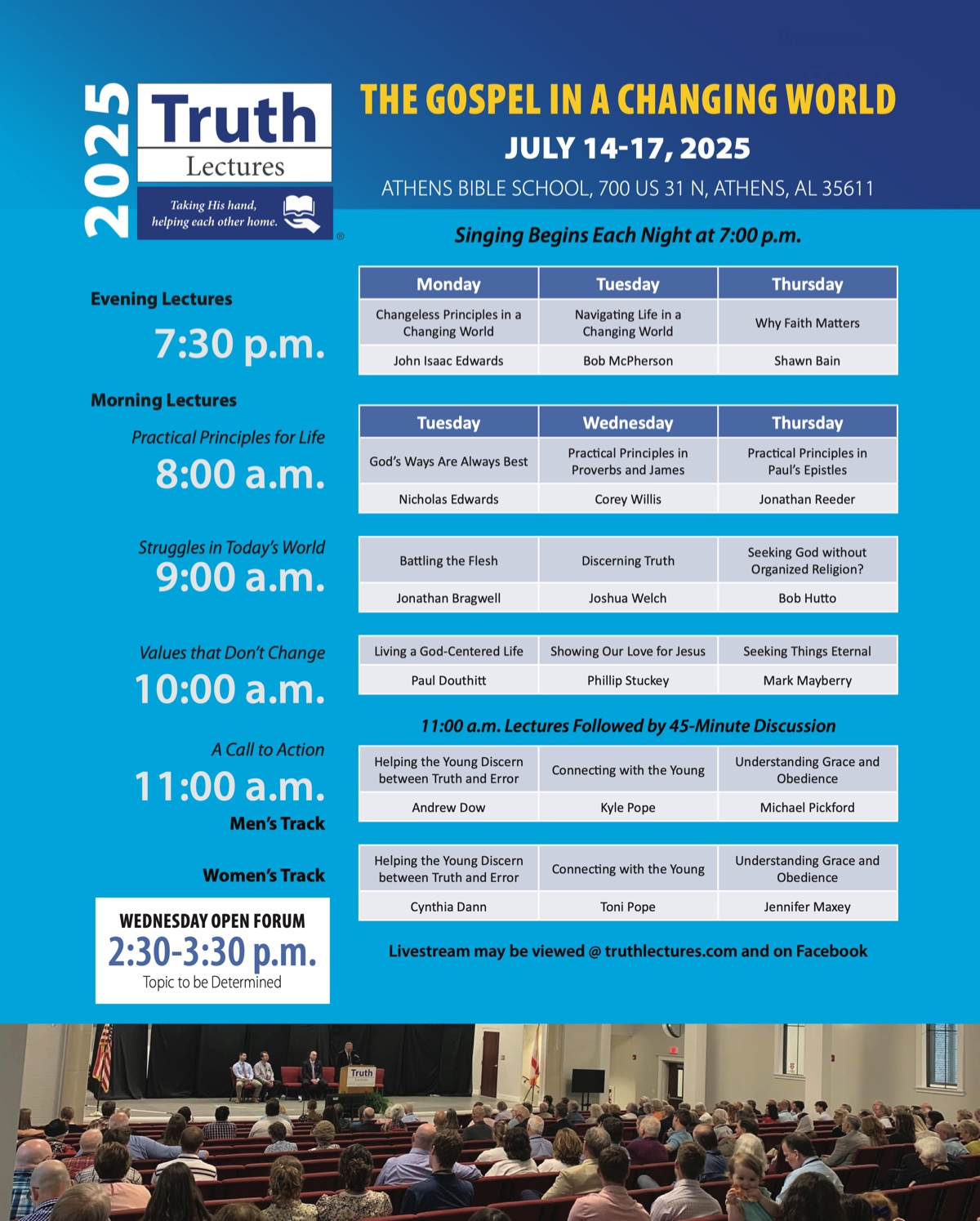
Synopsis: The 2025 Truth Lectures will be held at Athens Bible School in Athens, FL, from July 14-17, 2025. The theme will be “The Gospel in a Changing World.” Elsewhere in this issue, you will find a flyer announcing the speakers and topics that will be addressed. We invite you to attend this series of lessons, trusting that you will benefit spiritually.
In Matthew 13:52, Jesus, speaking to His disciples, said, “Therefore every scribe who has become a disciple of the kingdom of heaven is like a head of a household, who brings out of his treasure things new and old.”
When my birthday rolls around, I have trained my family to purchase new running socks instead of some corny customized “dad tie.” Over time, my wool running socks wear out and develop holes. So, my birthday is a good time to throw out the old ones and replace them with new ones.
Spring is a time for cleaning and culling, refurbishing and replacing. This process of sorting through our possessions describes our evaluation of what retains its value or what can be discarded or given away.
This issue of Truth Magazine contains a series of articles on change, which are designed to compliment the upcoming Truth Lectures that will focus on “The Gospel in a Changing World.” Some things do not change. Some things should change. Some things inevitably change.
The definition of “change” provided by the Concise Oxford English Dictionary covers various aspects of change, from physical alterations and substitutions to financial exchanges and changes in attire: When used as a verb, it means to alter or transform, substitute or switch, or to exchange. When used as a noun, it refers to the action of changing, or the replacement, substitution, or exchange that has taken place.
Examples abound. The moon’s appearance changes as it passes through different phases. Many things change when someone moves from one place to another: mailing address, physical surroundings, circle of associations, etc. When travelling to the Philippines, I visit money changers to convert dollars (USD) to Philippine pesos (PHP). When I figure out a better way to perform the steps involved in editing this magazine, I will change my workflow.
Debates rage in contemporary society on whether we are experiencing significant anthropomorphic climate change, whether gender fluidity is fact or fiction, and whether the US Constitution should be understood by considering the original intent of the founders or as a living document subjected to continual reinterpretation based on today’s accepted dogmas.
The concept of change is often reflected in the arts. Antonio Vivaldi’s “The Four Seasons” concertos depict the characteristics of each season through music. “Spring” bursts with colorful melodies representing flowers, butterflies, and birds, accompanied by the sounds of a babbling stream and spring storms. “Summer” portrays the lethargy caused by high temperatures, with the rhythmic song of the cuckoo, the melody of a lark, and a thunderstorm interrupting a farmer’s sleep. “Autumn” signifies the joy of harvest time, transitioning from jubilant songs and dances to a tranquil melody depicting falling leaves. “Winter” captures the cold and harshness, with scenes of shivering, running to keep warm, and slipping on ice.
Famous works of literature illustrate the concept of change. To Kill a Mockingbird by Harper Lee addressed changes in societal attitudes towards race and justice in the American South during the 1930s. 1984 by George Orwell explored the impact of group-think and totalitarianism on individual freedom and the concept of truth.
In the realm of commerce, businesses must adapt to change or die. The Innovator’s Dilemma by Clayton Christensen explains how established companies can lose market leadership due to disruptive innovation (Kodak, Sears and Roebuck, Blockbuster Video, etc.). The book provides rules for capitalizing on this phenomenon, using examples from successful and failed companies. Christensen recommends that established businesses recognize modern realities, adapt accordingly, and innovate continuously.
Jesus made an interesting statement regarding scribes as ideal teachers: Every scribe who has become a disciple of the kingdom of heaven is like someone who heads up a large household, drawing from his treasury—i.e., his storehouse of accumulated understanding and wisdom—things old and new.
Although the first-century scribes are often depicted as hopelessly corrupt and associated with the Pharisees and Sadducees in their hostility to Jesus, the profession itself was one of honor. Near the end of Old Testament history, when Israel was restored to the land following the Babylonian captivity, Ezra the scribe exemplified nobility and dedication.
Ezra was successful because he “had set his heart to study the law of the LORD and to practice it, and to teach His statutes and ordinances in Israel” (Ezra 7:10). This stands in contrast to the scribes of the New Testament, who often said one thing and did another—preening pretenders in their professed love for God, but inadequate in practice. Had they been like Ezra, they would have revered God’s word and made personal and proper application.
In the New Testament, Jesus is not referred to as a scribe; rather, He is called “Teacher” (didaskalos) forty-one times, “Rabbi” twelve times, and “Rabboni” twice. The term “Rabbi” means “my master, my teacher,” and was used as an honorary title for outstanding teachers of the law during Jesus’s time. The term “Rabboni” is a heightened form of Rabbi, which means “my lord, my master, my teacher.”
Jesus, the Master Teacher, epitomized divine revelation and exemplified noble truth. He is depicted in the opening chapter of John as the Incarnate Word, where it states, “In the beginning was the Word, the Word was with God, the Word was God, and the Word became flesh and dwelt among us” (John 1:1-2, 14).
After completing the Sermon on the Mount, the crowds were astonished at His teaching because He taught them as one having authority and not as the scribes (Matt. 7:28-29). They recognized that Jesus accurately represented God—faithfully announcing and applying the message of Sacred Scripture.
The scribes fell far short of what they should have been, being part of a corrupt religious hierarchy. In Matthew 5:20, He states, “Unless your righteousness surpasses that of the scribes and Pharisees, you will not enter the kingdom of heaven.” We must be sincere, humbly endeavoring to manifest integrity in thought, word, and deed.
Because scribes dedicated their lives to copying and preserving the Sacred Scriptures, they knew it intimately. This familiarity resulted in a firm knowledge base, essential for constant growth in the word of God. As preachers, teachers, and Bible class leaders, we should emulate the qualities of a true student of God’s word.
In 1 Thessalonians 2:3-4, the apostle Paul explains that his ministry was not one in which he sought to promote error or practice impurity; rather, he was driven by a genuine desire to please God, who examines our hearts. May the same be said of us! Brethren, each time you teach, aim to bring out of your treasury of knowledge and life experiences “things old and things new.”
A good teacher avoids becoming stale. Even though he may preach on a familiar theme, he restudies the material afresh. He doesn’t rely upon “dog-eared” sermon notes with hackneyed illustrations and reference to “current events” that occurred decades ago. Don’t mechanically present the same material in the same way to the same audience. Instead, we should apply God’s word in fresh and relevant ways while retaining the timeless truths that Jesus communicated, and the apostles affirmed. Divine truth is constant, yet it remains as relevant today as ever. Therefore, let us “Search the Scriptures!”
In Romans 15:4, we read that the things written in times past were for our learning, teaching us patience and providing us hope. We need to respect the benefit that comes from studying God’s word, as given in the Old Testament. Why rely upon an Encyclopedia of 1000 Sermon Illustrations (of dubious authenticity) when the Old Testament is the “real thing!”
Unfortunately, brethren sometimes ignore the Old Testament—dismissing it as irrelevant. However, properly understanding the Old Testament provides a solid foundation for faithfully serving Christ in the Christian age. The Old Testament reveals the character of God, which is constant. It sets forth principles that are unchanging. The wisdom literature of the Old Testament contains psalms that touch the heart, proverbs that mold our lives, and principles of godly living that are timeless, regardless of the dispensation when they were written.
Referring to 1 Corinthians 10:11, we find that the failures and successes of God’s people in the Old Testament serve as examples for us. This means we can recognize our struggles and learn from their successes. Human nature is constant; we face similar challenges.
The Great Commission underscores the fact that Christ possesses all authority, and His commands are as relevant today as when He gave them. False teaching is a threat to each successive generation. Let’s not deceive ourselves into believing we are immune to the failures of the past, but remain ever vigilant against human philosophies that stand in opposition to divine truths and avoid the empty deceptions and self-made traditions of men (Col. 2:8).
In John 4:13-14, Jesus illustrates our need for spiritual sustenance, just as physical nourishment is needed for our bodies: “Everyone who drinks of this water will thirst again; but whoever drinks of the water that I will give him shall never thirst; but the water that I will give him will become in him a well of water springing up to eternal life.”
The Book of Revelation concludes with the Spirit and the bride saying, “Come.” Readers are invited to partake of the water of life without cost (Rev. 22:17). However, let us recognize that accepting Christ’s offer is not a “one-and-done” experience, but requires lifelong commitment. The Bible serves as a continual source of nourishment and renewal, but only if we do our best to present ourselves to God as one approved by Him—workers who have no need to be ashamed, but those who (like Ezra) properly apply and correctly teach the word of truth (2 Tim. 2:15).
In reflecting upon things old and new, let us recognize there are elements from the past that we must retain and others that we should reject. Some traditions, rituals, and old methods have no place in our spiritual lives today, just as Paul rejected his previous adherence to the Pharisaic traditions.
Rituals to which men cling that conflict with God’s teachings should be laid aside. Worldly attitudes and actions must give way to sanctification. In 1 Corinthians 5, Paul urges the church to remove sinful leaven from its midst, as even a little can lead to spiritual corruption.
Individually, let us recognize that obedience to the gospel involves crucifying the flesh with its affections and lusts. Sin and selfishness once dominated our lives, but in Christ, we are continually challenged to undergo spiritual transformation and renewal (Rom. 12:1-2). Let us embrace the New Covenant and the new life it offers. 2 Corinthians 5:17 reminds us that if anyone is in Christ, he is a new creation; old things have passed away, and all things have become new. Despite our past failures, we can start fresh through Christ, who forgives us and offers new beginnings. The Master Teacher invites us to grow in righteousness, holiness, and truth.
Some things do not change. Some things should change. Some things inevitably change. The truth of the Lord is everlasting—it does not change. Psalm 119 reminds us, “Forever, O Lord, Your word is settled in heaven.” May we be committed to continual spiritual renewal and honest self-examination. As we face the future, let us do so with confidence—clinging to God’s eternal truth while manifesting wise discernment regarding what we keep and what we cast aside.
Mark Mayberry has labored with the Adoue Street church of Christ in Alvin, TX, since 1998, where he serves as the evangelist and an elder. The church website is here. His website is here. He can be reached here.




By Kyle Pope
Synopsis: Many in the religious world have created organizations and institutions that function under the umbrella of local churches and denominations. Sadly, some brethren who once claimed to stand on Scripture alone have now adopted the same practices without biblical authority. Is this a sound choice?
On more than one occasion, in talking with people from a denominational background, when they learn that I am a preacher, they ask if I am involved in various man-made religious organizations. They might ask, “Are you part of Global Mission Outreach?” or, “Does your church have a Young Lion’s program?” [See Note 1]. When they learn that the congregations with which I have labored are not involved with such things, and that I am generally unfamiliar with these kinds of organizations, they seem shocked and puzzled that, as a preacher, I don’t know about things so common in the religious world. Sadly, even among some of our own brethren who long ago began to allow their congregations to support human institutions, if you don’t know about “Loaves and Fishes missions,” or “Christ in the Home outreach,” you are viewed as old-fashioned and out of touch. In our day, brethren who once valued using “Bible names for Bible things” barely speak the same language anymore!
Sometimes organizations of this type are referred to as “para-church” organizations. This very name acknowledges that these entities are not churches, but they are instead falsely viewed as extensions of the church. They either seek to carry out works of the church (under the oversight of their own organization rather than the church) or they simply do good works that are not the responsibility of the church (while soliciting support from the church).
Without question, many human organizations exist that perform good works. There are schools, hospitals, benevolent organizations, publishing houses, and publications that fulfill important functions while existing independently of any local congregation. Such organizations have the right to exist and operate. They need neither the sanction nor the oversight of any local church to do so. Problems arise only when the church involves itself in the support, oversight, or maintenance of these institutions. When that happens, those who respect the authority of Scripture must stand up and oppose this as an unscriptural departure from the true work of the church.
As some would see it, however, the church can’t do some things unless it does them through some separate organization. They imagine that the church is dependent upon “para-church” organizations to do its own work. This raises several questions. If we see it this way, do we think the church is unable to do its own work? Do we imagine the Lord didn’t know how to organize the church to fulfill the tasks He assigned it to perform? Do we think that we have the right to extend the organization of the church in ways that the Lord has not? A study of Scripture reveals that the New Testament church is characterized by its simple organization and purpose. Local churches are organized under the oversight of elders, with deacons and saints (Phil. 1:1), working under the headship of Jesus (Eph. 1:22). They carry out their work of teaching the gospel and building up the body of Christ (Eph. 4:12), with no need for “para-church” organizations to fulfill their divinely ordained purpose. Paul is never identified as the “President and CEO of International Christ to the Gentiles Crusade.” John is not “Executive Director of Agape Outreach.” Peter is not the founder of “Solid Rock Ministries.” Yet, the church in the New Testament did exactly what God intended for it to do. So, if the New Testament church functioned without these things, why do we imagine that we need them?
To many, even raising such questions seems legalistic or as if we are straining out a gnat (cf. Matt. 23:24) or disputing over words (cf. 2 Tim. 2:14). Some might say, “As long as good is being done, what difference does it make?” Church history has shown us that human efforts to expand upon what God set up have led to the denominational chaos that exists today. People saw some good work they thought needed to be done and failed to realize that by creating human organizations to do these works, they would ultimately contribute to disunity. “Para-church” organizations lead to several significant problems:
If parents surrendered to a nanny, a childcare center, or even a grandparent all of their time with their children and their responsibility to raise them, it would be evident that, despite DNA and physical attributes that establish their parenthood, they would not be acting as parents to the children. When the church either branches out into unscriptural works through the extension of “para-church” organizations or abandons scriptural works to human organizations, in the same way, it is not acting as the church. Jesus came to establish His church (Matt. 16:18). He died to purchase this church (Acts 20:28). It is an important institution that acts as the “pillar and ground of the truth” (1 Tim. 3:15). How can we think so little of something for which Jesus shed His blood? How can we appease our conscience into imagining that the Lord will not call us to account if we surrender to organizations of our own creation the responsibilities the Lord has given to His church?
Some might argue, “If the organization in question fulfills a work of the church (e.g., evangelism, or some type of benevolence), isn’t that the same thing as the church carrying out the work?” Imagine there was a business executive who was too busy on his anniversary to take his wife out to dinner. If he sent his assistant to go to dinner with his wife instead, would she feel as if her husband was still “carrying out the work” of a husband? I think not! Do we communicate the same thing to the Lord? Are we too busy with unscriptural things that we must surrender to human institutions our own responsibilities? Do we care so little about our duties that we can give them over to others so easily? What if the man-made organization teaches error? What if it misuses or steals funds? Will the elders of the church assume the liability for such abuse? If not, then how can they claim that dismissing their responsibility to another organization is the same thing as the church “carrying out the work?”
Sadly, many times, churches that have so readily given themselves to such things become little more than clearinghouses for various human institutions. Sunday after Sunday, organization after organization vies for the support of the church. The focus of the eldership shifts away from the spiritual feeding of the flock to the evaluation of which institution is worthy of support. When they choose an assortment of “worthy causes,” these budgetary administrators fold their hands, feeling that they have accomplished their work, when in truth the church may have done nothing.
Historically, Churches of Christ have taken a unique position in the religious world. We have affirmed that the Bible alone is a sufficient guide for doctrine and organization. Just as we have called upon denominations to abandon sprinkling as a substitution for scriptural baptism (i.e., immersion), we have also called upon them to give up their popes, cardinals, synods, conventions, and any other man-made organization that is without biblical authority. If we abandon this position and begin to create human organizations we view as extensions of the church, how can we legitimately call upon denominations to abandon their own creations? Are our creations better than theirs? Is it acceptable for us to act without divine authority but they must not? Or, have we matured to the point that we don’t get “caught up” in such “trivialities”?
As any elder, deacon, or preacher can tell you, the functioning of a local congregation, which involves members from diverse backgrounds and maturity levels working together towards unity of faith, can be complicated. There are feelings that can be hurt, maturity levels that must be considered, and individual abilities, preferences, and desires that must be respected for the overall good of the congregation. These are necessary parts of the church’s work, and there are enough complications without adding unnecessary matters. How many elders and deacons in churches that support “para-church” organizations find their meetings dominated by concerns over the management, regulation, and functioning of these organizations rather than the true work of the church? How many quarrels and divisions have arisen over preferences about how such organizations should operate? How will we explain to the Lord on the day of judgment why we became alienated from a brother or sister for whom Christ died over the workings of some institution of our own creation? Why not avoid all of this and simply follow New Testament patterns?
The names of organizations used in this article are purely fictional. Any similarity to actual organizations is coincidental. These names are intended to illustrate the manner in which such organizations are used.
Kyle Pope preaches for the Vestavia church of Christ in Vestavia Hills, AL. He has written several books published by Truth Publications. Go here for more information. The church website is here. He can be reached here.


By Sherelyn Mayberry
Synopsis: The hymn “Hold to God’s Unchanging Hand” emphasizes the importance of trusting in God’s unwavering nature amidst life’s changes. It highlights that God does not change and encourages believers to trust in Him, who will not forsake them. It advises laying up treasures in heaven rather than on earth, being true to God, and enduring to the end. Let us therefore cling to God, since His promises are an anchor for the soul.
In the hymn, “Hold to God’s Unchanging Hand” (PHSS #312), the writer speaks of hope that is built on eternal things. Life on earth is filled with change, so fix your hope on the unwavering hand of God. Trust in God, who will not forsake you. Lay up treasures in heaven, not on earth below. If you endure to the end with God, you can spend eternity in your glorious heavenly home.
In speaking to King Saul, the prophet Samuel declared, “The Glory of Israel will not lie or change His mind; for He is not a man that He should change His mind” (1 Sam. 15:29). What God says He will do. What He has spoken, He will make good (Num. 23:19). His word is His bond. Pity for man will not cause God to change His judgment. We will be judged with justice according to our ways and deeds (Ezek. 24:14). God holds man accountable for his thoughts and actions. When we reject the Lord, we reap the consequences of our deeds.
Men change for good or bad, the earth also changes, but God does not. Do not associate with those given to change and who are unrepentant. The righteous fall and rise again, but the wicked stumble in times of calamity and will see their ruin (Prov. 24:16, 21-22). The world changes with earthquakes, volcanic eruptions, flooding, and storms at sea (Ps. 46:2-3). Eventually, the sky will vanish like smoke and the earth will wear out like a garment, but salvation will be forever (Isa. 51:6).
God’s purpose for you does not change. He seeks a spiritual relationship with all mankind. The Lord knew that man would sin, so He formulated a plan of redemption before He created the world. He wishes all to come to repentance, so we will not perish (2 Pet. 3:9). Therefore, a Savior was promised, and the resolute God fulfilled this promise through the death of His Son.
Have a hope of eternal life based on God’s promises, which have never failed. He cannot lie, so we can build our faith upon this truth (Titus 1:1-2). Every good gift comes from God, with whom there is no variation or shadow of turning (Jas. 1:17). He is the unchangeable One. What His soul desires, that He does. “When He has tested me, I shall come forth as gold” (Job 23:10, 13-14). Christ, being made perfect through suffering, became the author of salvation to all who obey Him as promised in God’s eternal plan for humanity (Heb. 5:9-10). He has plans for each of us, so build your hope on these plans toward eternity.
Though you walk in the midst of trouble, you can trust in God. His right hand will guide you as you reach out to Him. His lovingkindness is everlasting (Ps. 138:7-8). When you are afraid, trust in God. What can mere men truly do to you that would result in lasting harm? God dries our tears as we cry out to Him. He comes to our aid; our enemies will be turned back (Ps. 56:3-4, 8-9). God alone is your rock and your salvation. Your refuge is in God, so trust in Him at all times; pour out your heart before Him (Ps. 62:6-8). The faithful, having a steadfast mind, God will keep in perfect peace. Trust in the Lord forever, for in Him, we have an everlasting Rock (Isa. 26:3-4).
The Lord does not forsake His godly ones. They are preserved forever (Ps. 37:28). The Lord is with you when you are with Him. If you seek Him, He will let you find Him. Nevertheless, if you forsake Him, He will forsake you (2 Chron. 15:2). Samuel told Israel to not turn aside from following the Lord, because if they did, their efforts would be in vain. He urged them to fear the Lord and serve Him wholeheartedly, remembering the great things God had done for them. If they did wickedly, they would be swept away (1 Sam. 12:20-25). God promised to not forsake Israel if they walked in His statutes and kept His commandments. He would dwell among them (1 Kings 6:12-13).
There are many Bible examples of individuals trusting in the Lord. Moses encouraged Joshua to trust in the Lord. God would not fail him or forsake him, so Joshua need not fear (Deut. 31:8). Shadrach, Meshach, and Abed-nego were delivered by God because they trusted in Him. They were willing to give up their lives rather than serve or worship any other god (Dan. 3:28). Brethren trusted in the Lord during Paul’s imprisonment because of his example of faithful service, even while being in bonds. It gave them courage to speak the word of God without fear (Phil. 1:14). Through difficult times, when others may leave you, cling to the Lord for support.
Jesus told the rich young ruler that to be complete, he needed to sell his earthly possessions, which he valued more than heavenly treasures, and give to the poor. The young man was grieved because he loved his earthly riches more than God (Matt. 19:21-22). Another rich man was used as an example in a parable by Jesus. He needed to give to those in need, not covet this world’s riches. He was admonished to make money belts that do not wear out, holding unfailing treasures in heaven, where no thief can break through and steal and moth cannot destroy. Unfortunately, this rich man stored up treasures for himself and was not rich toward God (Luke 12:21, 33; Matt. 6:20). He needed to learn that his heart would be with what he valued most.
Seek wisdom from God, as for hidden treasure (Prov. 2:4). Paul told Timothy to instruct those rich in this world not to fix their hope on the uncertainty of riches, but on God, who richly supplies all our needs. So, be generous and share, storing up the treasure of a good foundation for the future, so you may obtain eternal life in heaven (1 Tim. 6:17-19). Be born again to a living hope, so you will obtain an imperishable and undefiled inheritance—one that will not fade away but is reserved in heaven for the faithful (1 Pet. 1:3-4).
Trust in the Lord with all your heart. Acknowledge Him; be true to Him; He will make your paths straight (Prov. 3:5-6). He gives a path through life that leads to a heavenly home if we complete our journey with Him. Do not let Satan distract you and cause confusion on your journey through life. If you have been raised up from the watery grave of baptism into Christ, keep seeking the things above. Do not set your mind on things on the earth. Look to Christ, who is seated at the right hand of God (Col. 3:1-4). Those who die in Jesus have hope of forever being with the Lord (1 Thess. 4:13-14, 16-17).
The faithful of past generations trusted in God’s promises. Jeremiah sent a letter to the Israelites in Babylonian exile. It was a message to encourage God’s chosen people so they would realize He had plans for their welfare. They would have a future and hope if they would once again call upon God, pray to Him, and seek Him with their whole heart (Jer. 29:11-13). The heroes of faith in Hebrews 11 based their trust in God’s promises of a better heavenly country. They believed in their God, who prepared a glorious city where they would be welcomed when their faithful journey was completed (Heb. 11:13-16).
Paul said, “Let us not lose heart in doing good, for in due time we will reap if we do not grow weary” (Gal. 6:9). If we endure to the end, having done the will of God, we will receive what was promised—a glorious and eternal inheritance is reserved for the faithful (Heb. 10:36, 39). The one who endures to the end and does not fall away will be saved (Matt. 24:10, 13). So, press toward the goal to attain the prize of the upward call of God in Christ Jesus (Phil. 3:14). Lay aside the sin that ensnares us and run with endurance the race before us, fixing your eyes on Jesus, who is sitting at the right hand of God in heaven (Heb. 12:1-2). Then, when your temporal tent is torn down, you will receive an eternal building from God, a glorious home with the unchanging Lord (2 Cor. 5:1).
God has set eternity in man’s heart, so he has something to look forward to as he labors for good in his lifetime (Eccl. 3:11). The heirs of promise fixed their hope in the unchangeableness of God’s purpose on which He promised and swore. This hope for things eternal is an anchor of the soul, both sure and steadfast (Heb. 6:17-20). Hold to God’s unchanging hand!
Sherelyn is the wife of Mark Mayberry, who labors with the Adoue Street congregation in Alvin, TX, as an evangelist and elder. She labors as a homemaker and Bible class teacher. She and Mark have two sons and daughters-in-law, and two grandchildren. She can be reached here.



By Bruce Reeves
Synopsis: The author explores the story of Balaam, a diviner from Mesopotamia, who was summoned by Balak, the king of Moab, to curse Israel. Instead, Balaam blessed Israel, demonstrating the unstoppable power of God’s blessings. The narrative, found in Numbers 22-24, highlights God’s faithfulness and the importance of adhering to His will. Balaam’s attempts to manipulate God for personal gain are contrasted with the spiritual insight of his donkey, who sees the angel of the Lord when Balaam cannot. It emphasizes the dangers of greed and the necessity of speaking only the word revealed by God. It concludes with a call to surrender our will to God’s purpose and to allow Him to shape our character into the image of Christ.
The Lord’s faithfulness is steadfast, even in the most difficult circumstances. A pivotal story in Numbers reveals the unstoppable power of God’s blessings on His people. This significant account is referenced by New Testament writers to encourage and warn Christians.
Balaam, a famous diviner from Mesopotamia, was summoned by Balak, the king of Moab, to curse Israel. However, instead of cursing God’s people, Balaam blessed them. The story in Numbers 22-24 is carefully crafted, replete with humor, irony, and powerful truths about the Lord. This narrative emphasizes God’s promises to the patriarchs and His covenant people. In Numbers, the renewal of these promises comes at a strategic time. The first wilderness generation had almost entirely passed away, and the new generation needed reassurance that God would fulfill His promises to Israel.
As Numbers 22 opens, Moab is afraid of Israel’s vast army, encamped in the plains just north of Moabite territory (Num. 22:1-3). The Moabites reached out to the Midianites, who lived nearby, warning that the Israelites would devastate the area like a ravenous beast (Num. 22:4). They believed that if the Moabites and Midianites worked together, they could deal with Israel. Balak, the Moabite king, planned to lead the conflict. The elders of Moab and Midian departed with fees for divination and came to Balaam, repeating the king’s offer (Num. 22:7). Such divination was condemned throughout the Old Testament (Deut. 18:10). Balaam told them to spend the night, hoping to receive direction from Yahweh. Balaam’s use of the divine name shows his recognition that Yahweh is Israel’s God. Remarkably, one can speak God’s very words and yet have a heart so hardened that those words take no root there (Num. 22-24; 31:16).
Balaam lived in Pethor and was considered a non-Israelite prophet and diviner of international reputation, believing he could communicate with any god (2 Pet. 2:15-16). A quick survey of these chapters might lead one to think of him as basically good, listening to the Lord’s words and saying only what Yahweh tells him. Yet, on closer inspection, the evidence points to a man motivated by financial gain more than godliness, requiring the Lord to warn him on pain of death not to disobey His commands. The Bible described him as one who “loved the wages of unrighteousness” and engaged in spiritual “madness.” He is described in multiple ways: oracle reciter (gave four major oracles), “seer” (23:3), “sorcerer” (24:1), and priest-diviner (Josh. 13:22).
The Lord spoke to Balaam the night he was invited to help Balak and commanded him not to return with the messengers to curse Israel because God had blessed them (Num. 22:9-13). This alludes to the promises made to Abraham, Isaac, and Jacob (Gen. 12:3; 27:33). When the messengers returned and reported Balaam’s refusal to come, Balak sent another set of more numerous and distinguished messengers (Num. 22:15).
This may have been part of the bargaining process. It should be remembered that Balaam used spiritual practices forbidden to the Israelites and later tried to harm them. Some think his claim that he could only do God’s will should be held with reasonable suspicion. Jay Sklar writes: “At this point, these are more likely the words of a ‘gun for hire’ who names great amounts of silver and gold immediately after mention of his supposed faithfulness to Israel’s God. . . to slyly suggest that buying him off will be very costly” (The Story of God Bible Commentary, 290). The second time Balaam inquired of the Lord, he was told to go but could not curse Israel, only bless the people of God. By allowing him to go, the Lord would bring about a public blessing in the most monumental context.
Milgrom demonstrates that Balaam may have been attempting to interact with Yahweh the way he approached the false gods in the surrounding nations. He writes: “Perhaps the Lord will change His mind. Such indeed is the unspoken premise behind all forms of divination. Repeated omen taking is best attested among the ancient Greeks. . . The difference between Balaam and Israel’s prophets contrasts sharply on this matter. . .” (The JPS Torah Commentary, 189). The God of Israel is not fickle or to be trifled with, but He must be taken at His word.
Although God gave Balaam permission to go (Num. 22:20), we read that the Lord was angry because he was going (Num. 22:22). Verse 35 provides a clue by emphasizing that Balaam was to “speak only” what the Lord told him. Perhaps it was Balaam’s desire to manipulate God for his own purposes that angered the Lord. There are some important observations at this juncture of the story:
The Lord sometimes permits us to do what we desire, but presents obstacles and consequences to teach us vital lessons.
God knew why Balaam was asking again and that it was his own selfish greed.
The Lord also knew how Balaam planned on doing this and that it was through deception (“I won’t, but maybe I will”).
Yahweh also knew this was supposed to happen at the “high places of Baal” (Num. 22:41).
When God allows men to do what He has previously forbidden, it is to fulfill His greater purposes, not to endorse or condone sinful behavior (Acts 5:11; Rom. 11:11; cf. 2 Samuel 24; 1 Chron. 21).
God initially forbade Balaam to go but permitted him to do so for the Lord’s purposes (Num. 22:12). The problem was not that Balaam did not know the will of God; it was that he did not want to do the will of God. This is often our problem when we second guess what God has said in His word. Many false teachings have arisen from dissatisfaction with what the Lord has clearly taught in His word on subjects such as the role of baptism in conversion, the nature of the one true church, the use of instrumental music in worship, the work, worship, and organization of the church, or questions about Jesus’s clear teachings regarding marriage, divorce, and remarriage. This tendency on the part of those who are rebelling against God’s will is not new.
The story now drips with sarcastic irony! Balaam’s donkey is more perceptive than the famed “seer” from Mesopotamia, who stubbornly insists on heading to his own death. There are three encounters between the divine messenger, Balaam and his donkey. In all three, the donkey “sees” the angel while Balaam, the “seer,” is blind to spiritual realities (Num. 22:23, 25, 27). In all three, Balaam beats her for her behavior, oblivious to the fact that she just saved his life. Balaam’s anger boils over when the donkey speaks because “the Lord opened her mouth” (Num. 22:28). Kidner wisely notes, “There seems as little need to fret about the mechanics of this as any other miracle” (Numbers, 50). The miracle underscores the dullness of Balaam in that he argues with a donkey, which should have been a clear sign that God was opposing his actions. You would think that a talking donkey would get his attention! The beast questioned why Balaam had beaten her (Num. 22:28). His next words are especially blind: “Because you have made a mockery of me! If there had been a sword in my hand, I would have killed you by now” (Num. 22:29). First, it was Balaam who was attempting to make a mockery of God for his own selfish ends. Secondly, the very thing he wanted to do to the donkey was what the donkey saved him from, considering the angel in front of him had a drawn sword (Num. 22:26, 31).
Ironically, the donkey was reasoning with a diviner about logic (Num. 22:30). Strange actions by animals were to be a sign for diviners, yet Balaam missed the point that the Lord was emphatically and obviously making. At just this moment, God opened Balaam’s eyes to see the spiritual realities his donkey had been seeing the entire time, and he fell on his face before the angel of the Lord (Num. 22:33-34). Balaam was commanded once again to only speak what the Lord said. The implication is that if Balaam disobeyed God, he would die.
The conversation between Balaam and his donkey is the strangest part of the story. The entire incident was meant to impress him with the necessity of speaking only the word revealed by God. In a skeptical society, we should not be surprised that some question the historicity of this story. However, should believers have questions about the account?
A common question is, “Did the donkey really speak to Balaam?” If we believe in the verbal inspiration of the Scriptures, the answer is “Yes.” As Christians, we recognize that while the miracle is unique, it is no more impossible than the virgin birth of Jesus, the resurrection of Christ, or any other miracle recorded in the word of God.
The real question for the Bible student is, “Why did this happen?” Why would the Lord use a donkey to restrain “the madness of a prophet” (2 Pet. 2:15-16)? The irony of a donkey showing more spiritual insight and awareness of her master’s foolish and self-destructive behavior is compelling. Balaam was a great diviner or seer, but the donkey saw what he could not see and knew what he did not know. God was pleased with the donkey, but not with Balaam. While Balaam wanted to kill the donkey for not cooperating with his selfish agenda, the Lord considered killing Balaam.
Peter warns of those who “forsaking the right way. . . have gone astray, having followed the way of Balaam, the son of Beor, who loved the ways of unrighteousness,” and Jude speaks of those who “have rushed headlong into the error of Balaam” (2 Pet. 2:15; Jude 11). He is a textbook example of Paul’s warning, “For the love of money is the root of all evil” (1 Tim. 6:10a). The apostle identifies the consequences of such an approach when he says that “some people, eager for money, have wandered from the faith and pierced themselves with many griefs” (1 Tim. 6:10). Jesus put it even more plainly: “What good is it for someone to gain the whole world yet forfeit their own soul” (Mark 8:36).
Sometimes greed is seen in our covetousness for financial gain, but it can come in other forms as well. It can manifest itself in an ambitious desire for the praise and adulation of the masses. Those who teach the truth of the gospel will not please those who have “itching ears” (2 Tim. 4:2-5). Yet, some are so desperate for acceptance and popularity that they will compromise, distort, modify, and craft their message to be appealing rather than transformational. When one does this, he is rushing headlong into the error and sin of Balaam.
The blessings of God are not marketable commodities, because He cannot be manipulated. The piercing irony of a famous pagan spiritual leader being more foolish than a donkey is revealing. At the same time, it underscores that the Lord is not subject to the whims of any person, no matter what the world thinks of him. God’s people greatly needed this lesson then, and we need it today. Rather than trying to bend God to our will, we must surrender our selfish will to His sovereign purpose.
The glory of the Bible is that the God it speaks of is both powerful and good, Almighty and caring, the King of kings and yet a compassionate Father. He calls us, in love, to enter into a relationship and fellowship with Him by His grace through faith. Are we willing to allow God to shape our lives, purpose, and character into the image of Christ, or are we rushing headlong into the sin of Balaam?
Kidner, Derek. Leviticus, Numbers, Deuteronomy. Grand Rapids: Eerdmans Publishing Co., 1971.
Milgrom, Jacob. The JPS Torah Commentary: Numbers. Philadelphia: The Jewish Publication Society, 1990.
Sklar, Jay. The Story of God Bible Commentary: Numbers. Grand Rapids: Zondervan Academic, 2023.
Bruce Reeves has labored with the Highway 65 church of Christ in Conway, AR, since 2000. He and his wife, Rachel, have one child. The church website is here. He can be reached here.




By Shane Carrington
Synopsis: By walking into the Garden of Gethsemane with Jesus, we learn how to love the Father and one another even more deeply.
Jesus’s disciples loved Him and followed Him for about three and a half years. While they were filled with devotion, they also wrestled with weaknesses and misunderstandings.
Before arriving at the Garden of Gethsemane, Jesus was honored at Simon’s house in Bethany by a woman “with an alabaster vial of very costly perfume” (Mark 14:3-9). The disciples “indignantly” remarked, “Why has this perfume been wasted? For this perfume might have been sold for over three hundred denarii, and the money given to the poor” (Mark 14:4-5). He revealed their lack of understanding by replying,
Let her alone; why do you bother her? She has done a good deed to Me. For you always have the poor with you, and whenever you wish you can do good to them; but you do not always have Me. She has done what she could; she has anointed My body beforehand for the burial. Truly I say to you, wherever the gospel is preached in the whole world, what this woman has done will also be spoken of in memory of her (Mark 14:6-9).
This woman understood what the other disciples did not, and her example of devotion still illuminates the gospel.
After this, Jesus ate the Passover with the disciples and taught them about the Lord’s Supper (Mark 14:12-26). He also revealed their weaknesses by telling them that not only would He be killed, but that they would be scattered (Mark 14:27). Peter “kept. . . insistently” denying this, but Jesus responded that Peter soon would deny Him three times (Mark 14:29-31). Even though the disciples had the best of intentions, they struggled at the thought of Jesus dying.
From there, the road Jesus took led them to the Garden of Gethsemane. “Gethsemane” means “oil press,” and Luke’s description says they went “to the Mt. of Olives” (Luke 22:39). The location was east of the city of Jerusalem, across the Kidron Valley, and opposite the Temple Mount. He also says that it was Jesus’s “custom” to go there (Luke 22:39). An olive grove on a hill apparently provided a more secluded place for quiet time in prayer to God. Jesus certainly used it that way, saying to them, “Sit here until I have prayed” (Mark 14:32).
When they arrived at the place of prayer, Jesus walked some distance from Peter, James, and John. He entered the garden with the three, but He went in prayer to His Father alone. This was a very difficult time for Jesus.
He. . . began to be very distressed and troubled. And He said to them, “My soul is deeply grieved to the point of death. . .” (Mark 14:33-34).
The intense emotion Christ felt tells us the significance of His suffering, the depth of our sins, and the immense love of God to redeem us. While He understood the weight of His grief, He deserved none of what He faced. Truly,
Our griefs He Himself bore, and our sorrows He carried. . . (Isa. 53:4).
Jesus did for us what we could not do for ourselves.
After declaring His agony to the disciples, Jesus went beyond them to pray.
He. . . fell to the ground and began to pray that if it were possible, the hour might pass Him by. . . “Abba! Father! All things are possible for You; remove this cup from Me. . .” (Mark 14:35-36).
In deep anguish, Jesus lifted this cry to His Father. Throughout all eternity, the joyous fellowship Jesus enjoyed with His heavenly Father was manifested in devoted obedience to Him and loving sacrifice to redeem us.
Although He was a Son, He learned obedience from the things which He suffered. And having been made perfect, He became to all those who obey Him the source of eternal salvation (Heb. 5:8-9).
His obedience made Him the perfect sacrifice. When we obey Him, His blood saves us from our sins.
Christ’s emotions were so intense that He prayed the same basic prayer to His Father three times (Mark 14:37-41), earnestly repeating these words and meaning them every time. Crucifixion was agonizing beyond comprehension; its very thought would induce terror; yet, Jesus was willing to obey the Father completely, saying, “yet not what I will, but what You will” (Mark 14:36). His selfless nature gives us great hope and shapes us into a people who, spiritually, grow to be more like Him (Phil. 2:3-11).
Jesus brought Peter, James, and John with Him into the garden. He needed their companionship and comfort, but the disciples kept falling asleep. When He returned from His first prayer, Jesus said,
Simon, are you asleep? Could you not keep watch for one hour? (Mark 14:37).
Sometimes, when life becomes heart-rending, it helps to know that loved ones are present, even if they say very little. Their very presence can be a way of sharing the burden. While the apostles were near to where Christ prayed, finding them asleep gave Him no comfort. Consequently, He gave them words of wisdom:
Keep watching and praying that you may not come into temptation; the spirit is willing, but the flesh is weak (Mark 14:38).
Jesus would not be with them much longer, and they needed to be prepared for the next phase of their lives. He not only equipped them through instruction, but He also gave the ultimate example of service under the worst of conditions. Sometimes what we need is the example and comfort of other disciples who will “watch and pray” with us.
When Judas appeared with the Jewish soldiers, the solitude was broken and the importance of Jesus’s warnings became obvious. With a kiss, Jesus was betrayed into the hands of the authorities. Judas turned an act reserved for fondness, respect, and affection into betrayal of his “Rabbi” (Mark 14:43-45). Jesus accused His captors of cowardice.
Have you come out with swords and clubs to arrest Me, as you would against a robber? Every day I was with you in the temple teaching, and you did not seize Me. . . (Mark 14:48-49).
They arrested Him privately, indicating that they were concerned about how the crowds would react to their unjust actions. Then the disciples “all left Him and fled” (Mark 14:50), just like Jesus said they would (Mark 14:27-31).
There are many powerful lessons as we journey with Jesus to Gethsemane. Consider what we learn about Jesus from this momentous event. He loved the Father enough to obey Him even to the point of death on the cross. His love for the Father also reverberates in His love for humanity, because His obedience to God was also the means of redeeming the world. Jesus’s patience with the disciples shows that He loved them enough to help them grow into valiant believers. May we show the same patience with our brothers and sisters who struggle but are striving to honor the Lord.
Jesus declared that the first two of God’s commandments are to love God “with all your heart. . . soul. . . mind, and. . . strength” and “one’s neighbor as himself” (Mark 12:31, 33). As we follow Jesus into Gethsemane, we see Him exemplifying both, thus shaping us to become more like Him.
Shane Carrington has worked with the Southside church of Christ in Sulphur Springs, TX, since 1999. He has two children and four grandchildren. The church website is here. He can be reached here.



By Bobby Graham
Synopsis: Brother Graham addresses a seeming contradiction between 1 Peter 4:18 and 1 John 1:9 by explaining that the context of 1 Peter 4:17-18 is about the judgment beginning with God’s house and the suffering of Christians, which demonstrates their righteousness and God’s approval. The term “scarcely saved” refers to the difficulty of their deliverance, not that they are barely saved. He emphasizes that the faithful can be assured of their salvation if they walk in the light and confess their sins, as stated in 1 John 1:4-10 and 2 Peter 1:10-11.
If the righteous one is scarcely saved, where will the ungodly and the sinner appear? (1 Pet. 4:18, NKJV)
If we confess our sins, He is faithful and just to forgive us our sins and to cleanse us from all unrighteousness (1 John 1:9, NKJV)
This question was handed to me, just as it appears above—a quotation of two different verses. The person did say that he was asking about the apparent contradiction between the two verses.
Frequently, what seems to be a contradiction actually turns out to be a misunderstanding of one or both verses. I believe that describes the situation here.
Notice that verse 18 in the first quotation is preceded by another one which supplies helpful information:
For the time has come for judgment to begin at the house of God; and if it begins with us first, what will be the end of those who do not obey the gospel of God? Now “If the righteous one is scarcely saved, where will the ungodly and the sinner appear?” (1 Pet. 4:17-18, NKJV)
Ascertaining the meaning of a passage always depends on determining the meaning of keywords in the verses; in this case, those words are “judgment” and “saved.” To what judgment did Peter refer that would begin next with God’s family/house/household? Likewise, how would they be saved/delivered? We should also ask what relation these words have to the saints’ suffering, which is everywhere present in this First Epistle of Peter.
Establishing the kind of judgment facing God’s people can easily be done. The word for “judgment” here refers to the verdict/sentence of God concerning His people, not to the process of bringing judgment. In this context, God makes that verdict/sentence clear: if they suffer as Christians (4:16), they show themselves to be righteous with His Spirit resting on them (4:14, 18). Though reproached for Christ’s name, they received God’s acknowledgment and approval (4:14). They had nothing of which to be ashamed, because they were glorifying God in the name that they wore (4:16). The blasphemers were acting against God’s glorifiers (4:14). Contextually, we recognize that God has rendered His verdict beforehand to encourage saints.
Suffering by God’s people, as they imitate Christ, is so pervasive in this letter that it could well be said it is soaked with suffering. Each of the five chapters at least mentions suffering or alludes to it (1:6-7; 2:19-23; 3:13-18; 4:1; 5:9-10). Chapter 4 of the letter, moreover, is the crescendo of this theme of suffering (4:12-22).
With a context established as one of suffering wrongfully by God’s people—who are approved by Him but much despised by their persecutors, it becomes obvious that the time has come for judgment to begin at/from God’s house/church. Moving from the lesser to the greater, Peter argues that God’s ringing endorsement of the faithful sufferers leaves no doubt about the hopeless doom of those who were not obeying the gospel of God (Who claimed that it was impossible for people to obey the “good news” or gospel?) Those irreverent and impious ones, who were completely “missing the spiritual mark” set by God, would have nowhere to stand/appear before God (v. 17-18). That they would “scarcely” be saved/delivered simply means that their route of deliverance would be one fraught with difficulty, not that they would barely be saved (v. 18). Verse 18 adapts Proverbs 11:31, a verse with temporal emphasis upon earthly reward, with a shift to moral emphasis focused on heavenly reward.
If the righteous will be recompensed on the earth, how much more the ungodly and the sinner (Prov. 11:31, NKJV).
There need be no doubt concerning the heavenly reward of the faithful. The apostle John said fourteen times in his first letter that a Christian can know he is saved and many other things, if, among other conditions, he walks in the light, including the willingness to confess his sins (1 John 1:4-10). Peter described the salvation of the faithful as an abundant entrance/one richly supplied into the heavenly kingdom (2 Pet. 1:10-11).
Bobby L. Graham actively participates in fill-in preaching, Belize trips, teaching an hour each day at Athens Bible School, and in gospel meeting work. He and his wife, Karen, have three children. He can be reached here.



By Mike Willis
Synopsis: This article discusses the archaeological site of Tell el-Ful, identified as the ancient Gibeah of Benjamin, located three miles north of Jerusalem. It highlights the site’s historical significance, including its mention in the Bible and its role in the narratives of Judges 19-21 and 1 Samuel. The site was first excavated in 1868, with significant contributions from W. F. Albright and Paul Lapp. It describes the violent incident in Gibeah (Judg. 19:22-26) and the subsequent civil war. Additionally, it mentions the construction of a fortress during King Saul’s time and the unfinished palace intended for King Hussein of Jordan halted because of the Six-Day War in 1967. The conclusion emphasizes that the Bible narrates real historical events that occurred in specific locations and times.
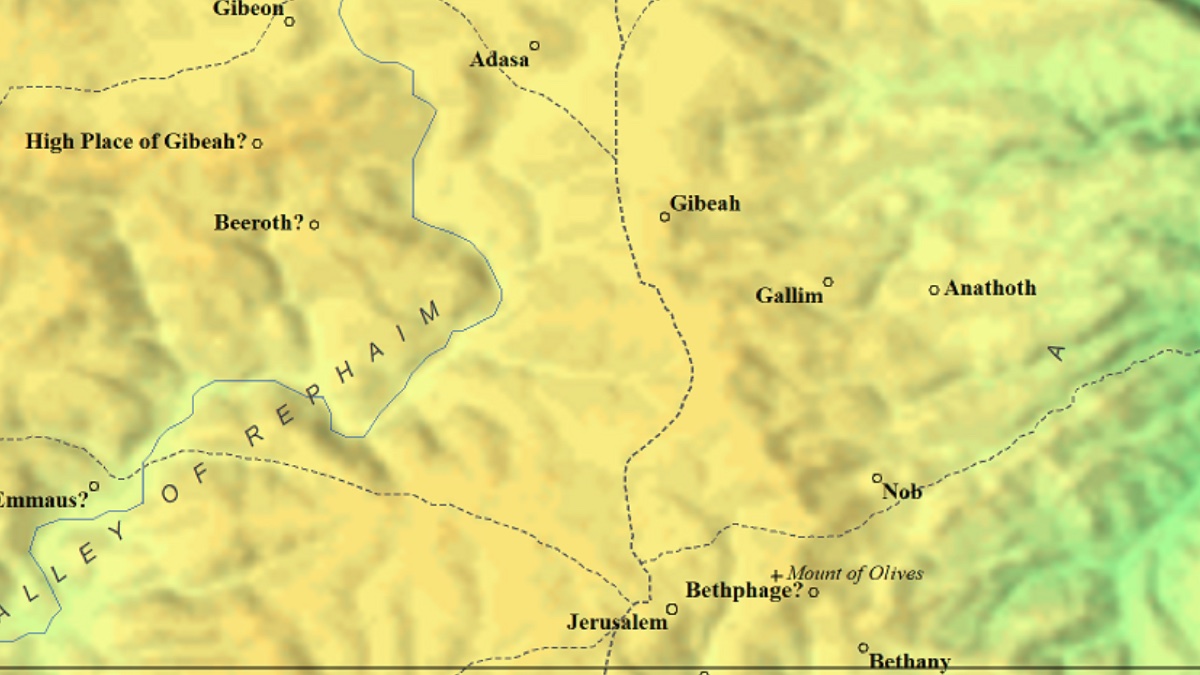
The village of Gibeah is mentioned forty-seven times in the KJV. Since the nineteenth century, scholars have generally identified Tell el-Ful (“Mound of Horse Beans”) as ancient Gibeah. The site is part of a ridge about three miles north of Jerusalem’s Damascus Gate. Nancy L. Lapp wrote, “It stands in some isolation, with no other promontories nearby. It is situated on the crest of a watershed rising 862 m above sea level. On a clear day, from the top of the mound, the Dead Sea is visible to the southeast; northeast, the view is toward Geba and Michmash; northwest lies Nebi Samwil, and there is a commanding view of Jerusalem sprawled over the hills to the south” [Note: 1].
The site was first excavated in a two-week excavation by Charles Warren in 1868, and C. R. Conder described the remains in 1874. Debate over the identification continued until W. F. Albright’s excavation in 1922-1923. Albright’s conclusions were widely accepted until the 1960s, when the debate resurfaced based on continued research. However, Israel Finkelstein challenged these conclusions in his article, “Tell El-Ful Revisited: The Assyrian and Hellenistic Periods (with a New Identification)” [Note: 2].
Significantly, Finkelstein criticized Albright, saying,
In addition to these difficulties, one cannot avoid mentioning the strong theological inclination of both Albright and P. Lapp, which dictated their interpretation of the finds. This is especially clear in their highly literal reading of the biblical episode at Gibeah in Judges 20 and the days of King Saul in 1 Samuel as providing accurate historical descriptions of events that took place in the twelfth and eleventh centuries BCE [Note: 3].
Paul Lapp, who excavated the site in 1964, largely agreed with Albright and significantly added, “no other excavated site in the area indicates occupation in the periods necessary to correlate with the biblical traditions” [Note: 4].
Gibeah lay in the territory given to the tribe of Benjamin (Josh. 15:57). The village is significant in the narrative of Judges 19-21. An Ephraimite had taken a concubine from Bethlehem in Judah, and later, she was unfaithful to him. She left his home and returned to her parents. Four months later, her husband went to ask her to return. The family welcomed the husband and prolonged his stay there for several days. Finally, he determined that he needed to return to his home. The man and his concubine left later in the day than he originally planned, and by sunset, they had traveled the 5-6 miles north to Jerusalem. At the time, Jerusalem was controlled by the Jebusites, so the husband decided that they would go to a city under the possession of the Israelites to spend the night. They journeyed three miles further north and stayed at Gibeah of Benjamin, where a citizen provided them with hospitality.
While at Gibeah, a violent act similar to what happened to the angels who were staying with Lot at Sodom occurred in Genesis 19.
As they were making their hearts merry, behold, the men of the city, worthless fellows, surrounded the house, beating on the door. And they said to the old man, the master of the house, “Bring out the man who came into your house, that we may know him.” And the man, the master of the house, went out to them and said to them, “No, my brothers, do not act so wickedly; since this man has come into my house, do not do this vile thing. Behold, here are my virgin daughter and his concubine. Let me bring them out now. Violate them and do with them what seems good to you, but against this man, do not do this outrageous thing.” However, the men would not listen to him. So the man seized his concubine and made her go out to them. And they knew her and abused her all night until the morning. And as the dawn began to break, they let her go. And as morning appeared, the woman came and fell down at the door of the man’s house where her master was, until it was light (Judg. 19:22-26).
The man took his wife and traveled home. At some point, she died. He cut her body into twelve pieces and sent one to each of the tribes of Israel, appealing for them to punish Gibeah. The tribes assembled at Mizpah and resolved to destroy that wicked town. However, the Benjamites were determined to defend their village, leading to an outbreak of a civil war that almost exterminated the tribe of Benjamin. Fortunately, they were not completely exterminated.
When one comes to 1 Samuel, Gibeah is the hometown of Saul, the first king of Israel (1 Sam. 10:26). The battle fought when Jonathan attacked the Philistine outpost at Michmash was near Gibeah (1 Sam. 13:15). Nancy L. Lapp wrote about a fortress built at Gibeah in the time of King Saul, saying,
The second period, Iron IC (1025-950 BCE), is the period of Saul’s fortress, which was the principal standing ruin at the site. It was largely excavated by Albright, but Lapp generally confirmed his conclusion in 1964 and refined his plans. It is the assignment of the date of construction of this fortress to the time of Saul that is the principal reason for Tell el-Ful’s identification with Gibeah [Note: 5].
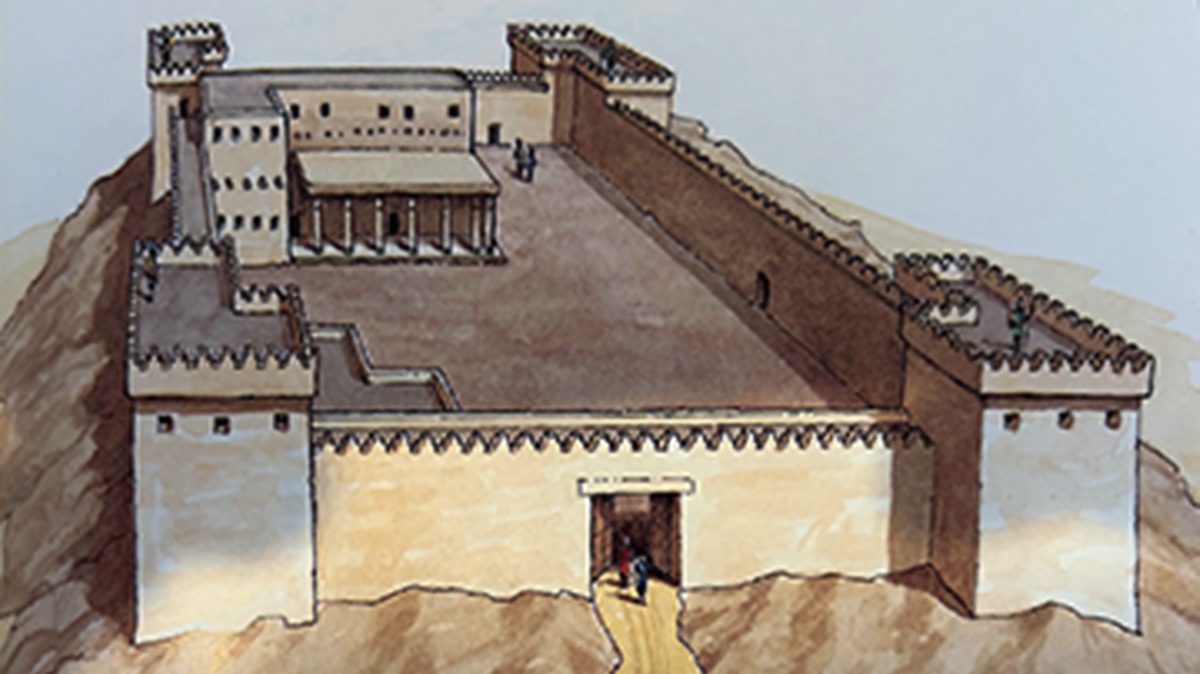
The picture below is taken from Bible Archaeology authored by Alfred Hoerth and John McRay (2005) with this caption:
Artist’s restoration of Saul’s residence at Gibeah. This was found to be small, only 115 by 170 feet (35 by 51 meters), and a fort more than a palace. Nothing found in the excavation would have been out of place in a typical private home of the day. Unfortunately, what remained of the structure was destroyed in the 1960s to make way for a palace King Hussein intended to build on the site. Only a shell of the palace had been erected when the Six-Day War of 1967 brought construction to a permanent halt (113).
The site was chosen for its strategic location and beautiful views. Construction began with the intention of creating a grand architectural masterpiece that would serve as the official holiday retreat for the Jordanian royal family. The design included a three-level structure with arches plated with Jerusalem stone. However, the project was halted in 1967 due to the Six-Day War during which Israel captured the area. As a result, the palace remained unfinished and has since been left in a skeletal, two-story cement structure.
There is nothing particularly important about the village of Gibeah, except to emphasize this point: The Bible narrative is written about events that happened at specific places and times. It is not a book of fairy tales that happened “long, long ago and far, far away.” The events in the biblical text occurred in the land of Canaan/Israel during the time of the transition from leadership by judges to the inauguration of Israel’s first king Saul (1049-1009 BC) [Note: 6].
[Note 1] “Tell El-Ful,” The New Encyclopedia of Archaeological Excavations in the Holy Land (1993), 2:445.
[Note 2] Palestine Exploration Quarterly 143, 2 (2011), 106-118.
[Note 3] Ibid., 109.
[Note 4] Nancy L. Lapp, “Tell El-Ful,” The Oxford Encyclopedia in the Near East (1997), 2:346.
[Note 5] Lapp, op. cit. 346.
[Note 6] I am citing the dates given by Andrew E. Steinmann’s book, From Abraham to Paul, A Biblical Chronology.
Caption: Gibeah of Benjamin in BibleMapper
Caption: Saul’s Palace by Hoerth and Mcray from Bible Archaeology, 113
Caption: Unfinished Palace of Hussein of Jordan
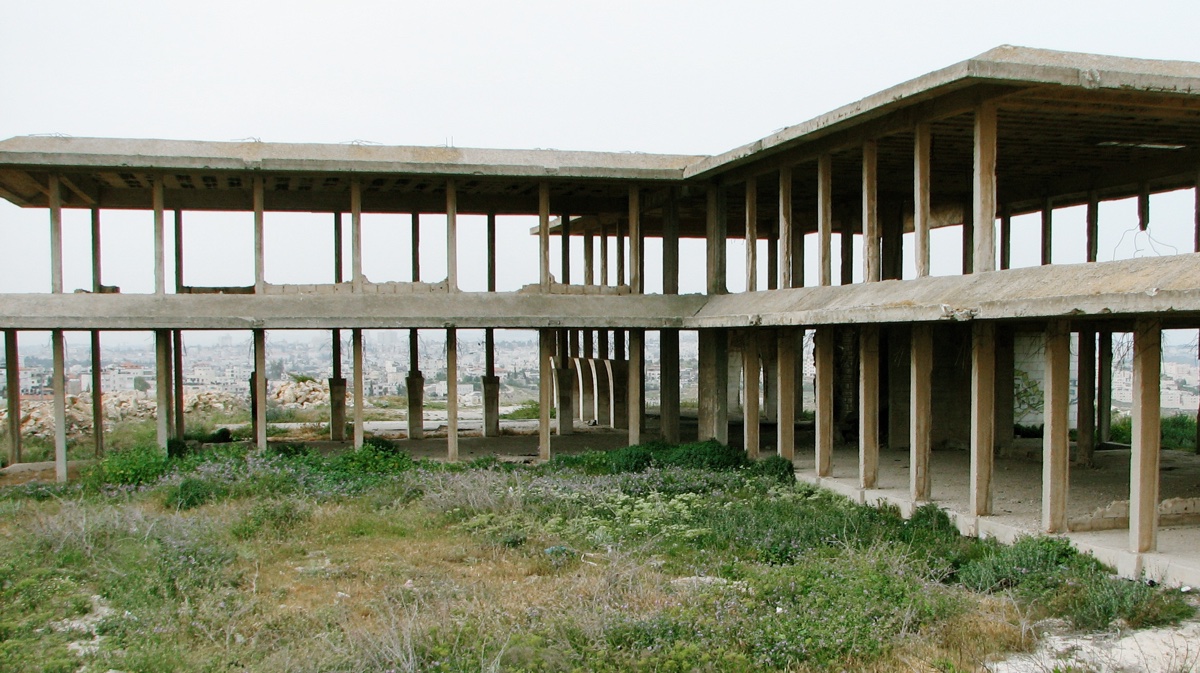
Caption: King Hussein’s Royal Palace in Tell el-Ful via Wikipedia. Licensed under the Creative Commons Attribution-Share Alike 4.0 International license.

Mike Willis served as editor of Truth Magazine for forty years. Presently, he is preaching for the Decatur Township church located southwest of Indianapolis, IN. The church website is here. He can be reached here.


By Chris Reeves
Synopsis: The sin of adultery is one of the great challenges that confront many marriages today. In the Bible, the adultery of David and Bathsheba is well-known by many. By examining their story, we can recognize what they did not guard and what we should guard to keep this terrible sin out of our marriage.
There are many challenges that arise in the lives of married couples. Illness, trauma, life changes, money, arguments over differences, communication, anger, bad habits, employment, raising children, and misplaced priorities can put stress and strain on a marriage. However, one of the greatest challenges that married couples might face may not be among the things just listed. It could be the temptation to commit the sin of adultery. The temptation to have a sexual relationship with someone who is not your lawful spouse has been, and continues to be, a significant challenge for some married couples.
The sexual relationship between a husband and wife goes back to the beginning of time. God made Adam and Eve with the ability to have a beautiful and wholesome sexual relationship (Gen. 1:28; 2:18-24). Everything that God made, including this relationship, was “very good” (Gen. 1:31). The positive view of this relationship is found in other Scriptures like Proverbs 5:15-19, the Song of Solomon, and 1 Corinthians 7:2-5. Yet, with everything good God makes, the devil comes along and wants to turn it into something bad. Satan wants men and women to have sexual relationships (“fornication” or “adultery”) outside of a God-ordained marriage. This is what happened to David and Bathsheba. Their adulterous sex act was at the wrong time and place and with the wrong person. Their later marriage was initiated with lust, not love.
In both testaments of the Bible, the act of adultery is a sin and is condemned by God. It may be popular in the world today, but not with God. In the Old Testament, adultery is repeatedly condemned [Note #1]:
Thou shalt not commit adultery (Exod. 20:14; see also Deut. 5:18).
And the man that committeth adultery with another man’s wife, even he that committeth adultery with his neighbor’s wife, the adulterer and the adulteress shall surely be put to death (Lev. 20:10).
And I will come near to you to judgment; and I will be a swift witness against the sorcerers, and against the adulterers, and against the false swearers, and against those that oppress the hireling in his wages, the widow, and the fatherless, and that turn aside the sojourner from his right, and fear not Me, saith Jehovah of hosts (Mal. 3:5).
In the New Testament, adultery is condemned in the following passages:
Or know ye not that the unrighteous shall not inherit the kingdom of God? Be not deceived: neither fornicators, nor idolaters, nor adulterers, nor effeminate, nor abusers of themselves with men (1 Cor. 6:9).
Let marriage be had in honor among all, and let the bed be undefiled: for fornicators and adulterers God will judge (Heb. 13:4).
Behold, I cast her into a bed, and them that commit adultery with her into great tribulation, except they repent of her works (Rev. 2:22).
So, what can married couples do to guard against adultery? Let us consider from the story of David and Bathsheba, as recorded in 2 Samuel 11-12, what all married couples can do to guard against this sin [Note #2].
Read 2 Samuel 11:1. If a spouse will guard his or her daily schedule and keep busy doing what is right, from morning till night, there will be no time to commit adultery. We are told that David “tarried at Jerusalem” instead of going out to battle with his army, and it was then and there that he committed adultery. David had time in his schedule to commit adultery.
Read 2 Samuel 11:2. If a spouse will guard his or her public appearance, it is less likely that one will cause another to commit adultery. From his rooftop, David saw Bathsheba bathing. Why was she bathing in full view where she could so easily be seen like that? Some people today expose their bodies publicly in such a way as to attract attention. We should never do this. We should dress and act modestly in public. Our dress and demeanor should never intentionally attract lustful eyes.
Read 2 Samuel 11:2-5. If a spouse will guard his or her thoughts about another, it is less likely that adultery will be committed. David fell prey to the devil’s age-old tactic of the lust of the eye, the lust of the flesh, and the pride of life (1 John 2:15-17). He “saw a woman. . . and the woman was very beautiful to look upon.” Next, he “took her.” Lastly, he “lay with her” and she became pregnant [Note #3]. Consider the progression: looking, lingering, lusting, taking, and sinning. This same progression of thought and action is found in the sin of Eve (Gen. 3:6) and the sin of Achan (Josh. 7:20-21) [Note #4].
Read 2 Samuel 11:6-27. If a spouse will guard his or her respect for self and others, then adultery is unlikely to occur. David did not respect himself and the vow of marriage that he had made so many times with so many women. He had so many wives at this time that it was easy for him to commit adultery with this woman [Note #5]. Bathsheba also did not respect herself or Uriah, her husband. Both David and Bathsheba did not respect each other or God and His law. Later, when the king tried to cover up his sin, he did not respect Uriah, one of his loyal soldiers. “Plan B,” delivered by the victim himself, was to put Bathsheba’s husband in a position to be killed in battle and it worked. The apostle Paul wrote, “Love works no ill toward your neighbor. . .” (Rom. 13:10).
Read 2 Samuel 12:1-13. If a spouse will guard his or her conscience regarding sin, one can be forgiven of the sin of adultery. The Lord sent Nathan the prophet to preach to David and expose his sin. Nathan said to David, “Thou art the man” (2 Sam. 12:7). After David was rebuked by Nathan for his sin, and given the consequences of his sin, he said to Nathan, “I have sinned against Jehovah” (2 Sam. 12:13). Upon this confession, the Lord put away David’s sin. We must guard against hardening our hearts or dulling our consciences to adultery or any other sin. In Psalm 32:5, David wrote:
I acknowledged my sin unto Thee, and mine iniquity did I not hide: I said, “I will confess my transgressions unto Jehovah;” and Thou forgavest the iniquity of my sin.
One other place where we read about David’s humble attitude toward his sin of adultery is found in Psalm 51. This psalm is attributed to David, and it speaks of his confession, contrition, and cleansing after his sin with Bathsheba.
Read 2 Samuel 12:14. If a spouse will guard his or her reputation and character and do nothing to ruin it, then adultery will less likely be committed. David damaged his reputation and that of his people. He gave “great occasion to the enemies of Jehovah to blaspheme” (2 Sam. 12:14). A single moment of lust led to disastrous consequences. A spouse must think about this before committing adultery. Just one act will damage your reputation and give the world an opportunity to blaspheme God. Those yet in the world might think, “If this is the way a ‘Christian’ acts, then I don’t want to have anything to do with Christianity.”
The damage to one’s reputation after a sin can be great. The Proverb writer was correct: “He that committeth adultery with a woman is void of understanding: He doeth it who would destroy his own soul” (Prov. 6:32). The inspired apostle:
Thou that sayest a man should not commit adultery, dost thou commit adultery? thou that abhorrest idols, dost thou rob temples? thou who gloriest in the law, through thy transgression of the law dishonorest thou God? For the name of God is blasphemed among the Gentiles because of you. . . (Rom. 2:22-24).
Read 2 Samuel 12:14-23. If a spouse will consider the future consequences of his or her actions and guard what could happen, then adultery will less likely be committed. David had to suffer the unhappy consequences of his one act of lust. This pleasure for a moment brought tragedy for a lifetime. The immediate consequence would be that of the death of his son. The Lord struck him with illness and he died. The delayed consequence would be troubles and death (“the sword shall never depart”) within David’s own family members (2 Sam. 12:10-11). This weakened David’s house and the leadership of the nation as a whole (read 2 Samuel 13-20). The Lord punished David for his sin of adultery.
Today, infidelity brings chaos. What follows are things like guilt, regret, pain, sorrow, anxiety, suspicion, distrust, anger, resentment, and maybe even divorce. This does not even include all the problems (both immediate and long-term) that the children will experience if they are a part of the equation.
The adultery that David committed with Bathsheba was a violation of the seventh and the tenth commandment and it was a sin [Note #6]. 2 Samuel 11:27 reads: “But the thing that David had done displeased Jehovah.” The Lord was displeased with David! Many Christians today know the story of King David. They know the many great things he did from slaying Goliath in his youth to his grand address about the temple in his old age. Nevertheless, David’s sin of adultery stands out and overshadows all the rest. It’s what people remember about David and today’s adulterer in the church.
But for David’s sake the LORD his God gave him a lamp in Jerusalem, to raise up his son after him and to establish Jerusalem; because David did what was right in the sight of the LORD, and had not turned aside from anything that He commanded him all the days of his life, except in the case of Uriah the Hittite (1 Kings 15:4-5).
The beauty of God’s plan of salvation is that any sin can be forgiven. Even if a spouse commits adultery, that spouse can humbly admit wrong and seek forgiveness. The non-Christian adulterer can be forgiven upon repentance and baptism into Christ (1 Cor. 6:9-11) and the erring Christian adulterer can be forgiven upon repentance and prayer (Rev. 2:22). If you have committed adultery, seek the forgiveness based upon God’s conditions of forgiveness. If you have not committed adultery, learn from David and Bathsheba to guard yourself against this terrible sin and maintain a pure and blessed marriage.
For those of you who are new to marriage, know that the devil will use sex outside of marriage to tempt you. Guard yourselves in all the areas here discussed, and adultery will not easily make its way into your marriage.
For those of you who have been married many years, know that the devil can use your many years together against you. He can get you to feel “tired and bored” with your marriage so that you will go out find something “new and thrilling” with someone else. Resist this and continue to work to make your own marriage fresh and exciting.
For those of you who have been married fifty or sixty years, you know how your marriage has been tested, and you can help younger couples to avoid the sexual trap of adultery.
[Note #1] All Scripture quotations are taken from the 1901 American Standard Version.
[Note #2] Another good place in the Bible to learn how adultery occurs and how to avoid it is the book of Proverbs (cf. 2:16-22; 5:1-23; 7:1-27; 9:13-18).
[Note #3] For the meaning of “purified from her uncleanness” in 2 Samuel 11:4, see Leviticus 12:2-5 and 15:19-30.
[Note #4] The other way that adultery can be committed is by putting away (divorcing) your mate for some cause other than fornication and then subsequently remarrying. In this case, the one putting away, the one put away, and the one marrying either of these two commits adultery (Matt. 5:32; 19:9; Mark 10:11-12; Luke 16:18).
[Note #5] David was first married to Michal (1 Sam. 18:27). Then, the six wives of David that he had in Hebron are listed in 2 Samuel 3:2-5. Later, David took more concubines and wives in Jerusalem (2 Sam. 5:13-16). See also 1 Chronicles 3:1-9. The taking of many wives may have led David to be desensitized in his respect of women. In other words, what was Bathsheba to David, married or not, but just another woman with whom to have sex?
[Note #6] For this commandment referenced in the New Testament, see Matthew 5:27; 19:18; Mark 10:19; Luke 18:20; Romans 2:22; 13:9; and James 2:11.
Chris Reeves has preached for the Warfield Blvd. church of Christ in Clarksville, TN, since 2016. He and his wife, Cheri, have four children and two grandchildren. His Bible study website is here. The church website is here. He can be reached here.


By Danny Linden
Synopsis: The story of Samuel’s upbringing from 1 Samuel 1-3 shows us the power of positive and negative influences, but also that the choice to obey God ultimately lies with each person.
Samuel was one of the great prophets of the Old Testament and became famous throughout all Israel (1 Sam. 3:19-21). He led Israel to greater faithfulness, calling on the people to put away their idols and seek reconciliation with God (1 Sam. 7:3-6).
How did he become this hero of faith? When we examine his background and upbringing, we come to two radically different conclusions. From one perspective, his spiritual maturity seems inevitable; from another, it appears impossible. The influences in his life pulled strongly in both directions. In reality, Samuel did not differ from any of us—he had to make his own choices in life, despite the mixed examples around him. A study of 1 Samuel 1-3 reveals this and prompts us to consider our response to the influences in our lives.
Samuel was blessed in a way that many are not—he was born to godly parents. His father, Elkanah, was careful to worship God obediently and regularly. He brought his family each year to Shiloh to fulfill their duty to God (1 Sam. 1:3, 19, 21; Deut. 12:5-7). His mother, Hannah, had a deep relationship with God. When she was in distress, she turned to the LORD, prayed with great emotion, but did not speak against God or stop worshiping (1 Sam. 1:9-19).
The true test of Elkanah’s and Hannah’s faith was seen when her prayer was answered. She begged God to grant her a child and went so far as to vow to give him to the LORD forever (1 Sam. 1:11). That might be an easy thing to promise in a state of despair, but would they follow through when Samuel was born? They even have a couple of ways around the vow if they regret it. There was a provision in the law that allowed Elkanah to invalidate his wife’s vow as foolish and thoughtless (Num. 30:10-15). Another provision allowed a redemption price to be paid as a substitute for the person who had been vowed to the LORD (Lev. 27:1-8). For a few silver shekels (which, admittedly, was a large sum of money), Elkanah and Hannah could have kept their son with them. Yet, they seemingly did not consider these as options. Both parents thought it fitting to honor God by fulfilling the vow. When they brought Samuel to present him to the LORD, they brought triple the mandated offering (cf. Num. 15:8-10). It was evident that they felt no regret or bitterness.
The man Elkanah and all his house went up to offer to the LORD the yearly sacrifice and to pay his vow. But Hannah did not go up, for she said to her husband, “As soon as the child is weaned, I will bring him, so that he may appear in the presence of the LORD and dwell there forever.” Elkanah, her husband, said to her, “Do what seems best to you; wait until you have weaned him; only, may the LORD establish His word.” So the woman remained and nursed her son until she weaned him. And when she weaned him, she took him up with her, along with a three-year-old bull [Note 1], an ephah of flour, and a skin of wine, and she brought him to the house of the LORD at Shiloh. And the child was young. Then they slaughtered the bull, and they brought the child to Eli. And she said, “Oh, my lord! As you live, my lord, I am the woman who was standing here in your presence, praying to the LORD. For this child I prayed, and the LORD has granted me my petition that I made to Him. Therefore I have lent him to the LORD. As long as he lives, he is lent to the LORD” (1 Sam. 1:21-28).
Hannah’s prayer of thanksgiving and praise to God in 1 Samuel 2:1-10 is one of the most inspiring texts in the Old Testament. She must have been an incredible example of faith to Samuel. Every year when they went up to Shiloh, Hannah brought him a new robe. Though she loved him very much and undoubtedly longed to keep him with her, she was supportive of the important work he was learning to do in the tabernacle (1 Sam. 2:18-20).
Samuel’s training in the tabernacle was another area of positive influence. He was being taught by Eli, the high priest emeritus who was by then too old to serve in all the ways he used to but still occupied a place of honor in the judgment seat of the tabernacle (1 Sam. 1:9; cf. 4:18; Deut. 16:18). Who could be better for Samuel to learn how to “minister to the LORD” (1 Sam. 2:11)?
With all these positive examples surrounding Samuel, it seems inevitable that he would “grow both in stature and in favor with the LORD and also with man” (1 Sam. 2:26). However, this is not the only way we can look at Samuel’s early life. What impacted Samuel negatively?
Samuel was born near the end of the age of the judges, a period of spiritual famine in Israel. “In those days, there was no king in Israel. Everyone did what was right in his own eyes” (Judg. 21:25). During his youth, “the word of the LORD was rare in those days; there was no frequent vision” (1 Sam. 3:1). We cannot underestimate the effect of a wicked culture that is distant from God. Without a firm resolve to do otherwise, most people will “Go With the Flow” of those around them. Samuel already started at a disadvantage just from the state of the surrounding nation.
His family was also plagued with tension. Elkanah had taken Peninnah as a second wife because Hannah could not bear children (1 Sam. 1:1-2). This decision led to significant conflict between the two wives (1 Sam. 1:6-7) and stress between Elkanah and Hannah (1 Sam. 1:8). When the LORD answered Hannah’s prayer by giving her Samuel as a son and more children after, that undoubtedly smoothed over some of the conflict in the family. Due to the complexity of personal relationships, lingering issues may have persisted in the family for years to come. Who knows what effect that may have had on Samuel?
Samuel was the protégé of a prestigious priest, but Eli was not without his own flaws. He was at least complicit in the blasphemies of his sons in refusing to restrain them (1 Sam. 3:13). He may also have directly benefited from some of those sins (note 1 Sam. 2:29). If Eli was not able to raise his sons up to honor God, how can Samuel expect to learn from him?
The sins of Hophni and Phinehas that Eli permitted showed great contempt for the LORD. When the people brought their sacrifices, these wicked men took whatever they wanted for themselves and offered the remainder to God. While the priests were due a portion of the meat for themselves after the offering to God was made (cf. Lev. 7:28-36), Hophni and Phinehas turned it around backwards. The offering became food for the priests first, and only then could the leftovers be given to the LORD. Even the people knew that this was wrong:
And if the man said to him, “Let them burn the fat first, and then take as much as you wish,” he would say, “No, you must give now, and if not, I will take it by force.” Thus the sin of the young men was very great in the sight of the LORD, for the men treated the offering of the LORD with contempt” (1 Sam. 2:16-17).
This practice seems to have been widespread during this time and not limited to the sons of Eli—it is called “the custom of the priests” that they did at Shiloh to “all the Israelites who came there” (1 Sam. 2:13-14). Hophni and Phinehas were not the only priests handling sacrifices in Shiloh, but their influence had spread through the priesthood.
On top of this, Hophni and Phinehas also abused their position as prominent priests to commit fornication with the women who served at the entrance to the tabernacle (1 Sam. 2:22; cf. Exod. 38:8). Everyone knew this was occurring (1 Sam. 2:23-24) and even Eli knew this high-handed sin put them in grave danger of the wrath of God (1 Sam. 2:25).
What must it have been for Samuel to grow up in this cultural and religious context? The word of the LORD was not respected, the priests were corrupt, and the aged leader was a coward and a fool. It is remarkable that he had any chance of developing a reverent faith in God. It seems unlikely for a boy raised in such a wicked environment to grow up loving the LORD.
The pressing question is, “Who will you become?” We cannot, for a moment, deny the impact of influence. We are called to be the salt of the earth and the light of the world (Matt. 5:13-16), to avoid hypocrisy (1 Pet. 2:1), and to avoid evil influences that could tear us away from faithfulness to God (1 Cor. 15:33). Yet, we sometimes assign too much credit or blame to the people around us, as if they have removed the necessity or ability to make our own choice to serve God.
In the end, Samuel had to make his own choice. When God called him to be a prophet and gave him his first hard message to proclaim, Samuel was initially afraid and held back (1 Sam. 3:15). At Eli’s urging, he made the right choice (1 Sam. 3:18). It was neither inevitable nor impossible for Samuel to serve the LORD. It was a choice he made that day and every day that followed.
The same is true for us. We all have been influenced by many people in positive and negative ways. Nothing removes the necessity of developing your own faith in God and resolving to obey Him always. Nor can anyone make it impossible for you to repent and submit, no matter how much evil you have witnessed. Despite all the people around you, who will you become?
[Note 1] The KJV, NKJV, ASV, NET, and YLT all follow the Masoretic Text and read “three bulls,” which seems more likely. Compare Numbers 15:8-10 which shows that Hannah brought triple the flour and wine required. One wonders, “Why would she increase the flour and wine offering but not the bull offering?” Poverty is likely the answer.
Danny Linden has worked with the Hebron Lane church of Christ in Shepherdsville, KY, since March 2023. He and his wife, Lauren, have four children. The church website is here. His website is here. He can be reached here.




By Sarah Paschall
Synopsis: This article explores the concept of growth for young Christians by comparing their spiritual journey to the growth of a tree. The roots represent beliefs in God and Jesus, the trunk symbolizes habits aligned with these beliefs, and the branches reflect life priorities. Growth takes time and involves patience and persistence in following God’s will. Overcoming obstacles, such as blight, parasites, nutrient deficiency, and rot, is essential for spiritual health. Practical steps for enabling our spiritual growth include developing strong roots, growing healthy habits, identifying priorities, and nurturing areas for fruit-bearing.
I want to share a study that has been incredibly beneficial for my spiritual journey. I hope and pray it will be for you as well. My goal is for us to explore the concept of growth as young Christians and to better equip us to take advantage of our current season in life to serve our Lord.
When you hear the word “Spring,” what comes to mind? For me, it’s growth, flowers, and green leaves. As young people, we are in this season of growth. Imagine a young tree with an established root system, a trunk, and branches with leaves. This tree represents our life right now. Let’s explore what we can learn from it, from the roots to the top.
Every tree begins as a seed that, when planted and watered, starts to sprout and develop roots, which absorb nutrients from the environment. These roots are the foundation on which we build the rest of our life. What kind of roots do we have? I hope and pray that our roots are our belief in God. These beliefs help us grow and define how we see the world and choose to live. If our belief is in Jesus, we can use the sunlight of His word to nourish us.
Blessed is the man who trusts in the Lord, and whose hope is the Lord. For he shall be like a tree planted by the waters, which spreads out its roots by the river, and will not fear when heat comes; but its leaf will be green, and will not be anxious in the year of drought, nor will cease from yielding fruit (Jer. 17:7-8).
Spiritual roots are crucial because they anchor us and provide stability. In times of trouble or uncertainty, our beliefs keep us grounded. They are the source of our strength and resilience: just as a tree cannot survive without strong roots, we cannot thrive without a solid foundation of faith. What are my beliefs, and how do they shape my choices and the strength of my faith?
The nutrients we acquire from our roots travel through the trunk to the branches, allowing our tree to produce fruit. The trunk symbolizes our habits (repeated actions that reinforce certain thoughts and behaviors). If our habits are built upon our belief in Christ, the trunk will be strong and straight. My habits must be aligned with my beliefs, or I will be unable to support my priorities; just as a crooked trunk will not be strong enough to hold up the branches.
Good habits are essential for spiritual growth. They help us stay focused and disciplined in our walk with Christ. Some examples of good habits include consistent Bible study, frequent prayer, active service to family and church, and diligent work reflecting good morals. On the other hand, bad habits can hinder our growth and lead us astray. These might include excessive social media use, frequent gossip, the constant pursuit of pleasure, or sloth and laziness.
Are my habits aligned with my beliefs? Do I have habits that are hindering my ability to be the Christian I should be? Identifying and cultivating good habits is crucial for a strong and healthy spiritual life.
The branches represent our main life priorities. What do you consider most important in your life? These might include faith, family, or church. It might be completing your education, cultivating your talents, or pursuing your career. To what will you give your time, emotions, resources, and heart? If we use our resources well, we will begin to grow flowers, which are the promise of fruit to come. We can only bear flowers where we put effort.
Our priorities reflect what we value most. They determine how we allocate our time and energy. It’s important regularly to assess our priorities and ensure they align with our beliefs and goals.
You will know them by their fruits. Do men gather grapes from thornbushes or figs from thistles? Even so, every good tree bears good fruit, but a bad tree bears bad fruit. A good tree cannot bear bad fruit, nor can a bad tree bear good fruit (Matt. 7:16-18).
Do my priorities reflect my roots and beliefs? Am I giving my resources to the things I truly value, or are there branches I need to prune (John 15:1-7)? By giving my energy to the things I truly value, I can ensure that my efforts lead to meaningful and lasting growth.
Are we currently bearing all the fruit that we desire? Perhaps we want a relationship or a higher position at work, but God has not given us these things yet. It’s easy to get stuck waiting for God to give us what we want and fail to take advantage of the opportunities to grow right now. God made us for many things, but our purpose is what we can accomplish right now. If God has not given us these things, we are likely not ready for them. If we fail to grow during His gift of waiting, we will never be ready for what He has in store.
Although challenging, waiting is an opportunity for growth. During this time, we can develop patience, perseverance, and trust in God’s timing. Instead of focusing on what we lack, let us focus on what we can do to prepare ourselves for the future. This might involve improving our skills, deepening our faith, or serving others in new ways.
Growth is a time-consuming process that will not always bear fruit immediately. By embracing the season of waiting and smelling the flowers (recognizing progress), we can become stronger and more resilient, ready to bear the fruits that God has planned for us in His time.
Just as getting stuck waiting can be a danger, we can encounter other challenges that can damage our tree and our lives. These include:
Blight: External influences that cause decay, slow growth, or low-quality fruit. Examples include stress, low self-esteem, depression, lack of motivation, and stagnation. Such issues can sap our energy and hinder our progress. It’s important to identify and address these challenges to maintain our spiritual health.
Parasites: Things that suck away our resources and stunt growth. Examples include social media, extraneous distractions, poor time management, and immature friends. These distractions can prevent us from focusing on what truly matters. By setting boundaries and managing our time wisely, we can protect our resources and ensure they are used effectively.
Nutrient Deficiency: Failing to provide proper care of oneself spiritually and physically, leading to stunted growth or deterioration. Examples include lack of spiritual nourishment, failure to care for one’s physical needs, not setting boundaries on our emotional and mental resources, excessive media consumption, bad habits, and incorrect focus. It’s essential for us to prioritize self-care, prayer, and Bible study to stay healthy and strong.
Rot: Foreign entities that eat away at our roots and trunk, destroying us from the inside. Examples include worldly influences, evil companions, bad friends, incorrect priorities, bad habits, and sinful conduct. These negative influences can undermine our faith and lead us astray. By staying vigilant and surrounding ourselves with godly influences, we can protect our spiritual health.
To ensure our tree grows strong and healthy, we need to take practical steps to nurture it.
Develop Your Roots: Reflect on your beliefs and ensure they are strong and well-nourished. Spend time in prayer and Bible study to deepen your faith. Surround yourself with supportive and like-minded individuals who can encourage and uplift you.
Grow Your Trunk: Evaluate your habits and make necessary adjustments. Focus on building good habits that align with your beliefs and support your growth, such as setting goals, creating routines, and seeking accountability from others.
Identify Your Branches: Assess your priorities and ensure they reflect your values and goals. Committing to invest in the areas that are the most important to you, and removing the ones that don’t, will produce fruit and fulfillment for years to come. This might involve setting aside time for family, dedicating resources to help your brethren, or using your talents to serve individuals or the community.
Let Your Flowers Grow: Focus on the areas where you want to bear fruit. Take practical steps to nurture these areas and ensure they receive the attention and care they need. This might involve setting specific goals, seeking opportunities for growth, and staying committed to your efforts. Remember to recognize the beauty of the flowers and the efforts you are making to reach your goals.
As young people, we are in a season of growth. Let us use the time God has given us to bear flowers and fruit in service to Him! By focusing on our roots, trunk, branches, and flowers, we can ensure that our efforts lead to meaningful and lasting growth. This is a process that requires time, effort, and dedication. By staying committed to our beliefs and priorities, we can overcome challenges and bear the fruits that God has planned for us.
And let us not grow weary while doing good, for in due season we shall reap if we do not lose heart (Gal. 6:9).
Sarah Paschall has worshipped with the Blue Ridge Church of Christ in Roanoke, VA, for the past eighteen years. She is the daughter of Brent and Rachel Paschall, and one of five children. The church website is here. She can be reached here.



By David Dann
Synopsis: Though our lives may be filled with constant change from day to day, it is important to understand that God and His word do not change.
Do you understand who God is? Before we can properly discuss God’s nature, character, and word, we need to know that He is the self-existent and eternal Creator, the Ruler of heaven and earth. God spoke through the prophet Malachi, saying, “For I am the LORD, I do not change; Therefore, you are not consumed, O sons of Jacob” (Mal. 3:6, NKJV). This particular characteristic of the Almighty is sometimes referred to as “The Immutability of God.” Merriam-Webster defines “immutable” as “not capable of or susceptible to change.” Human beings are very susceptible to physical, mental, emotional, and moral change. Man’s word is frequently subject to change and is often unreliable. Leaders, politicians, celebrities, co-workers, those with whom we do business, neighbors, friends, and even family members may change their minds, go back on their word, and even lie to our faces. Sometimes their behavior changes drastically for the worse. However, God does not change. The inspired writer of Hebrews underscored this fact with respect to the One who came into the world as God in the flesh, saying, “Jesus Christ is the same yesterday, today, and forever” (Heb. 13:8).
What do we need to know about the unchangeable nature of God and His word? Many things change with time and circumstances. However, God and His word do not change. Please consider what the Bible teaches concerning the unchanging nature of God and His word.
1. God’s covenants with man. God has dealt with man in different ways during different periods of time. The Old Testament is primarily the record of how God established a covenant with Israel at Mount Sinai and how He dealt with His people in this arrangement. However, He planned a change of the covenants, which He announced through the prophet Jeremiah (Jer. 31:31-34). As a result of God’s plan to redeem mankind through Jesus Christ, He established a new covenant so that, “In that He says, ‘a new covenant,’ He has made the first obsolete. Now what is becoming obsolete and growing old is ready to vanish away” (Heb. 8:13). God did not change, but the laws and conditions He set forth for mankind in the new covenant are different from those of the old, which is according to His eternal purpose in Christ.
2. God’s course of action in dealing with man. God has, at various times, changed His course of action in response to man’s pleas and behavior. He agreed to spare the wicked city of Sodom if only ten righteous people could be found there in response to the pleading of Abraham (Gen. 18:23-32). He relented from destroying the Israelites for worshiping the gold calf at Sinai in response to the pleas of Moses (Exod. 32:11-14). He added fifteen years to the earthly life of Hezekiah in response to the righteous king’s prayers (Isa. 38:1-5). He relented from destroying the city of Nineveh when its inhabitants repented at the preaching of Jonah the prophet (Jonah 3:4-10). He sent an angel to release Peter from prison when the members of the Jerusalem church earnestly prayed for his deliverance instead of allowing him to be executed by King Herod Agrippa I (Acts 12:1-12). The Bible teaches that, “The effective, fervent prayer of a righteous man avails much” (Jas. 5:16b). God does not change, but He may intervene to bring about a change in the course of events in response to man’s prayers, pleas, and actions.
3. God’s planned final destiny for man. Concerning the future second coming of Christ, Peter writes, “The day of the Lord will come as a thief in the night, in which the heavens will pass away with a great noise, and the elements will melt with fervent heat; both the earth and the works that are in it will be burned up. . . Nevertheless we, according to His promise, look for new heavens and a new earth in which righteousness dwells” (2 Pet. 3:10, 13). God will not change, but He will change man’s circumstances and abode as the present physical heavens and earth pass away and the righteous are welcomed into His presence while the condemned are separated from Him for eternity (cf. Matt. 25:46).
1. God’s nature. The psalmist spoke to God, saying, “Of old You laid the foundation of the earth, and the heavens are the work of Your hands. They will perish, but You will endure; Yes, they will all grow old like a garment; like a cloak You will change them, and they will be changed. But You are the same, and Your years will have no end” (Ps. 102:25-27). As Moses puts it, “Even from everlasting to everlasting, You are God” (Ps. 90:2). God will always exist and will never cease to be all-powerful, all-seeing, and all-knowing.
2. God’s character. According to Moses, “He is the Rock, His work is perfect; for all His ways are justice, a God of truth and without injustice; righteous and upright is He” (Deut. 32:4). James writes, “Every good gift and every perfect gift is from above, and comes down from the Father of lights, with whom there is no variation or shadow of turning” (Jas. 1:17). God’s perfect character will remain unchanged throughout time and eternity.
3. God’s goodness. The psalmist praised God, saying, “For the word of the LORD is right, and all His work is done in truth. He loves righteousness and justice; the earth is full of the goodness of the LORD” (Ps. 33:4-5). As King David points out, “The goodness of God endures continually” (Ps. 52:1b). Not only will God never stop being God, but He will also never stop being completely good.
4. God’s love. He always seeks and desires what is truly in the best interest of each of us. Love is so defining a characteristic of God’s fundamental nature that the apostle John writes, “We have known and believed the love that God has for us. God is love, and he who abides in love abides in God, and God in him” (1 John 4:16). God’s steadfast love will endure until the end of time and throughout all eternity, because He is the embodiment of what it means to love.
5. God’s holiness. Peter instructs Christians as follows: “As He who called you is holy, you also be holy in all your conduct, because it is written, ‘Be holy, for I am holy’” (1 Pet. 1:15-16; cf. Lev. 11:44). While man is instructed to recognize, learn from, and imitate the holy character of God in being set apart from sin, no one will ever attain to His level of holiness, nor will His holiness ever change.
6. God’s truthfulness. Paul begins his epistle to Titus, saying, by saying, “Paul, a bondservant of God and an apostle of Jesus Christ, according to the faith of God’s elect and the acknowledgment of the truth which accords with godliness, in hope of eternal life which God, who cannot lie, promised before time began” (Titus 2:1-2). Unlike sinful human beings, God simply cannot lie. One thing that can never change about God is that He will always, unfailingly, be truthful.
7. God’s faithfulness. Paul writes, “If we are faithless, He remains faithful; He cannot deny Himself” (2 Tim. 2:13). God will always be true to who He is and will always be there, ready and willing to provide the spiritual help and strength His people need (cf. 1 Cor. 10:13). God will always be trustworthy and dependable and will always be there for His children.
8. God’s word. The psalmist spoke to God, saying, “Forever, O LORD, Your word is settled in heaven. . . The entirety of Your word is truth, and every one of Your righteous judgments endures forever” (Ps. 119:89, 160). Likewise, the inspired writer of Hebrews speaks of “the immutability of His counsel” (Heb. 6:17). Since God doesn’t make mistakes and does not need anything from anyone, He will never be motivated to go back on His word to correct a previous error or try to gain some personal advantage. God’s word will forever endure as settled and unchanging truth (cf. 1 Pet. 1:22-25; Isa. 40:6-8).
1. We can place our full trust and confidence in God. God’s children can find peace and comfort in knowing that He can be depended upon. As King David puts it, “As for God, His way is perfect; the word of the LORD is proven; He is a shield to all who trust in Him” (Ps. 18:30). It is so often the case that it is pointless for us to place our confidence in men who may let us down and disappoint us. Yet, we can live with the peace of mind of knowing that the unchanging and unfailing perfect God whom we serve is completely worthy of our confidence and trust.
2. We can depend on the word and promises of God. His children can rest in the certainty of His instruction and promises. Even Balaam spoke truthfully concerning this, saying, “God is not a man, that He should lie, nor a son of man, that He should repent. Has He said, and will He not do? Or has He spoken, and will He not make it good?” (Num. 23:19). While the world may wonder what the future holds, what happens after death, or may even be anxious over whether this planet can continue to sustain life, the child of God depends upon the promises of God to make sense of present and future realities while living with the hope of eternal life, knowing that His promises will ultimately and definitely be fulfilled when Jesus is revealed from heaven.
3. We can imitate the unchanging character of God. Since God is not like the frail and sinful human heroes who are often placed upon a pedestal only to falter when their flaws are exposed, His children can seek to follow His example of perfection. With this in view, Paul exhorted the Ephesian Christians, saying, “Therefore be imitators of God as dear children” (Eph. 5:1). God’s goodness, steadfast love, holiness, truthfulness, faithfulness, and trustworthiness serve as the standard with which we should all be seeking to align ourselves. We serve a God whose unchanging, perfect character serves as the guiding light for our lives.
One of the most wonderful attributes of Almighty God is that He does not change. We never have to wonder whether He will keep His word, whether He will be there for us in times of need, or whether His promises will be fulfilled. In the constant change we may experience from day to day throughout our earthly lives, the faithful can find overwhelming contentment and consolation in the fact that God and His word do not change.
“Definition of IMMUTABLE,” March 3, 2025. https://www.merriam-webster.com/dictionary/immutable.
David Dann has labored with the recently formed University church of Christ in Athens, GA, since 2021. He and his wife, Cynthia, have been blessed with six children. The church website is here. He can be reached here.



By Daniel H. King, Sr.
Synopsis: The Bible reveals eternal principles and promises that remain unchanged by time, culture, or circumstances because of their divine origin. They provide a steadfast foundation for believers, guiding them through life’s challenges and ensuring their place in God’s Eternal City.
God has, through His written word, revealed to humanity certain eternal principles and given magnificent promises that are inalterable. Without them, His people are rudderless and hopeless.
Time does not change them. Culture does not alter them. Circumstances cannot render them ineffective. This is true because of their divine origin. All human attempts at changing or reinterpreting them should be resisted.
The Bible is not simply a collection of individual literary works. It is the culmination of a historical process of divine insinuation into human experience and a gradual awakening of the human consciousness regarding deity and divine expectation. God wanted people to know about their Maker and come to appreciate His reason for their creation, His relationship with them, and His deep concern for their welfare.
Clearly, He also wanted to make them aware of what He required of them. As the ancient prophet explained: “He has told you, O man, what is good; and what does the Lord require of you but to do justice, and to love kindness, and to walk humbly with your God?” (Micah 6:8). Knowledge is the basis of duty. The two are linked, as are “cause and effect.” Responsibility grows out of our knowledge of God’s will for us.
Hence, we cannot ignore, nor ought we desire to change or alter, any of the principles of divine duty or the attendant promises which inhere in those requirements. The faith was given “once for all” (Jude 3), and on that account, it is essential that we “hear and fear” the God who inspired it and through various media delivered it to the saints (Deut. 4:10; 13:11; 17:13; 19:20; etc.). To make any changes at all to it is a sin, both in the Old Testament and in the New (Deut. 4:2; 12:32; Jer. 26:2; Rev. 22:18-19; Acts 20:20; etc.).
Over the centuries of this revelation of divine truth, the Lord of time and eternity set forth certain central themes that span the ages and, on account of this, have application for people of all epochs of time. It will be readily understood by the reader that these principles have cogency for modern men as well as humans who lived hundreds or even thousands of years ago.
For example, there is the matter of faith and trust in God as Creator. The Bible teaches us both in the Old and New Testaments that we were made by God and that He made us with some purpose in mind for us. That this is correct is not really disputable. Certainly, we did not make ourselves or the universe in which we have our abode. No one believes that. The other theories addressing our beginning, even though they have various fierce advocates, have no real evidence that commends them to the intelligent mind. Loud and vociferous atheists notwithstanding, there is little that we find satisfactory in their specious arguments. Blind chance produces neither order nor synchrony, both of which our living world has in phenomenal abundance. Intelligence itself does not appear in a vacuum. Yet, here we are as intelligent creatures with the capacity to consider our own unique situation and to reckon with the various alternatives to explain it all.
Consequently, we are left to conclude that some magnificent intelligence which surpasses our own immeasurably must have been responsible for our existence as well as being the source from which our own intellectual capabilities were derived. So, believing in God is the first step toward dealing with this deep philosophical question: “By faith we understand that the universe was created by the word of God, so that what is seen was not made out of things that are visible” (Heb. 11:3). Also, “Without faith it is impossible to please Him, for whoever would draw near to God must believe that He exists and that He rewards those who seek Him” (Heb. 11:6).
Dependence and trust in the Creator are also interrelated principles in this regard. As the writer of the Proverbs said, “Trust in the Lord with all your heart, and do not lean on your own understanding. In all your ways acknowledge Him, and He will make straight your paths” (Prov. 3:5-6). Several essential corollaries grow out of this. First, there is the necessity of seeking God’s direction as one considers the various directions one may choose as life is lived and choices are made (Prov. 3:5-8). Second, there is the importance of accepting correction and being guided into better alternatives through His fatherly redirection (Prov. 3:11-12). Third, there is the recognition of His share in our successes in life (Prov. 3:9-10). God made us, and it is essential that we acknowledge His place in our lives (Eccl. 12:13-14).
Another important principle found embedded in the teachings of Scripture is the place of love for God and of one’s fellow creatures. Jesus is most often quoted on these concepts (cf. Matt. 22:37-40; Luke 10:25-28), but the Lord is simply acknowledging and reemphasizing truths that were already present in the literature of the Old Testament (see Deut. 6:5; Lev. 19:18). The thesis which lies behind this notion is that God has blessed us with life and all good things, showing beyond question His affection for us. It is necessarily incumbent on us, therefore, to love Him back. Since God has shown mercy and grace toward us despite our undeserving state, we ought to extend the identical consideration to our fellow beings.
Still another key concept in our dealings with our fellow men has to do with the principle of righteousness, i.e., right and fair behavior toward others. Inevitably, there are going to be winners and losers in the lottery of life. Some will be born into poverty and misery. Others will enjoy wealth and prosperity from childhood onward. Those who have such advantages should be both kind and generous toward those who are less fortunate. The prophet Micah schooled his fellow Israelites with this principle, declaring: “He has told you, O man, what is good; and what does the Lord require of you but to do justice, and to love kindness, and to walk humbly with your God? (6:8). Amos also powerfully intoned his preachment:”Let justice roll down like waters, and righteousness like an ever-flowing stream” (5:24). Kindness and compassion toward others are eternal principles taught throughout Holy Scripture. No age of man can afford to ignore them.
Personal responsibility is also a principle sprinkled throughout the Bible. While there are assuredly times when we may suffer on account of the transgressions and poor judgment of others, by and large, most of the problems that we experience are somehow or other associated with decisions we have made and actions we ourselves have taken. At times, we may try to dodge responsibility, but, in fact, our own decisions very often make us victims of our bad choices. Inevitably, terrible things follow. The prophet Ezekiel taught the importance of taking responsibility for our actions. He wrote, “The soul who sins shall die. The son shall not bear the guilt of the father, nor the father bear the guilt of the son. The righteousness of the righteous shall be upon himself, and the wickedness of the wicked shall be upon himself” (Ezek. 18:20). Trying to blame others for our mistakes is itself an awful mistake. Taking responsibility for our own actions is critical to establishing a right relation with God. Personal repentance for wrongdoing is essential to receiving forgiveness, whether this applies to sins against others or against God.
This suggests another related principle: It is the availability of forgiveness and redemption. As the Lord told ancient Israel, those who repent and show themselves willing to rehabilitate and restructure their lives will find redemption despite their past errors: “Therefore I will judge you, O house of Israel, every one according to his ways, declares the Lord God. Repent and turn from all your transgressions, lest iniquity be your ruin. Cast away from you all the transgressions that you have committed and make yourselves a new heart and a new spirit! Why will you die, O house of Israel? For I have no pleasure in the death of anyone, declares the Lord God; so, turn, and live” (Ezek. 18:30-32). This explains the fact that both Jesus and John the Baptizer began their work of preaching with the most critical word in the language of preaching: “Repent. . .” (Matt. 3:1; 4:17). Peter also stressed the importance of this word in making a new beginning for those whose sins have alienated them from God (Acts 2:38; 3:19).
The God of Scripture is incapable of falsehood. He cannot lie. Paul declared this impossibility in his letter to Titus: “. . .in hope of eternal life, which God, who cannot lie, promised before times eternal” (Titus 1:2). Jesus also asserted the prediction that those who believe in Him and follow His teachings faithfully will inherit life eternal (John 3:16; 5:24; etc.). In the first instance, however, Paul was writing about the promise of eternal life for those who are faithful in Christ Jesus. He claimed that this guarantee was rooted in eternity itself; it was an aspect of the divine plan “before times eternal.” His powerful pronouncement was that the God of Scripture had made this amazing promise, and its certitude was bound up in His inability to say anything false or misleading. God’s people are right to hold on to this divine pledge with total confidence, despite their own unworthiness, because the One who gave it was incapable of being false to His word.
Interestingly, this is only one of many such promises that are found within the pages of the Holy Bible. Through and through, there are assurances of this sort provided for the benefit of the people of God. More promises of this kind than can be counted are treasured by every generation of Christians who spend time poring over the pages of the Book of God.
Just to name a few: God has told us of His faithfulness in never leaving or forsaking us, no matter what circumstances may circumscribe our personal experiences (Heb. 13:5; 1 Cor. 10:13). We should never despair, therefore, because we are never alone. Thus, in the darkest days of his life, shortly before his martyrdom, Paul bemoaned his abandonment by others but relished his confidence in the presence of the Lord. He wrote, “At my first defense, no one took my part, but all forsook me: may it not be laid to their account. But the Lord stood by me and strengthened me; that through me the message might be fully proclaimed, and that all the Gentiles might hear: and I was delivered out of the mouth of the lion. The Lord will deliver me from every evil work and will save me unto His heavenly kingdom: to whom be the glory forever and ever. Amen” (2 Tim. 4:16-18). Even in the face of death, a fortifying confidence may be derived from the promise that the Lord will always be with us, even to the end of the age (Matt. 28:20).
God promises us that He will hear and answer our prayers (Matt. 7:7-8; 1 John 5:14-15). As believers, we have the confidence that our appeals to heaven are never ignored. We are urged, therefore, to continue persistently in our requests, with thanksgiving for those many other already answered petitions: “Pray without ceasing, give thanks in all circumstances; for this is the will of God in Christ Jesus for you” (1 Thess. 5:17-18).
The promise of divine peace is also a strong reminder that God can carry us all the way through the troubles and trials of life. This is no ordinary peace. It is a peace that surpasses all human understanding (Phil. 4:6-7). The world is not able to understand it, or explain it, and certainly will not be able to shake it. It is the foundation of our spiritual confidence whenever we are tried and however we may be tempted. God is on our side, and nothing is able to separate us from Him and His inexplicable affection for us: “For I am sure that neither death nor life, nor angels nor rulers, nor things present nor things to come, nor powers, nor height nor depth, nor anything else in all creation, will be able to separate us from the love of God in Christ Jesus our Lord” (Rom. 8:38-39).
Ultimately, though, the promise that stands out above them all is the assurance that the faithful servant of God will enjoy mastery over both sin and death. This is only hinted at in the Old Testament (Isa. 53:5-6) but acknowledged in fulfillment in Christ Jesus, our Lord and Savior. Said Paul, “For the wages of sin is death, but the gift of God is eternal life in Christ Jesus our Lord” (Rom 6:23). Isaiah predicted this with the following words: “He will swallow up death forever; and the Lord God will wipe away tears from all faces, and the reproach of His people He will take away from all the earth, for the Lord has spoken. It will be said on that day, ‘Behold, this is our God; we have waited for Him, that He might save us. This is the Lord; we have waited for Him; let us be glad and rejoice in His salvation’” (Isa. 25:8-9). Forgiven sinners will know and experience what this means firsthand: “When the perishable puts on the imperishable, and the mortal puts on immortality, then shall come to pass the saying that is written: ‘Death is swallowed up in victory.’ O death, where is your victory? O death, where is your sting? The sting of death is sin, and the power of sin is the law. But thanks be to God, who gives us the victory through our Lord Jesus Christ” (1 Cor. 15:54-57).
This brief article does not begin to exhaust the list of promises that are found in the Bible for the benefit of God’s faithful people. They are virtually beyond counting. Someday they will all be realized in their fullness in that “land that is fairer than day.”
Too, it matters not that there are many people out there today who scoff at them and deem them to be the wishful thinking of silly religious folk. In the end, their loss will be our gain. We need only to live by these eternal principles and cling to these durable promises and our place in God’s Eternal City (Rev. 21:1-4) will be assured. Until then, just know that He “is able to keep you from stumbling and present you blameless before the presence of His glory with great joy” (Jude 1:24). This is one of the greatest of His promises.
Daniel H. King, Sr. lives in Columbia, TN. He and his wife, Donna, have two children. He has preached for the Locust St. church of Christ in Mt. Pleasant, TN, since 2015. Presently, he is also serving as an elder of the congregation. The church website is here. He can be reached here.

By Ron Halbrook
Synopsis: God’s call for men to forsake their sins and obey Him has never changed throughout the history of the world. We must change to conform to Him because He will never change to conform to us.
The gospel of Christ thunders forth God’s demand that sinners must repent or face the certain sentence of eternity in torment in hell with Satan and all of his hosts. Jesus set forth this message in simple and stark terms: “I tell you, Nay: but, except ye repent, ye shall all likewise perish” (Luke 13:3). Yet, God’s call to repent is also a beautiful rescue mission, delivering us from the excruciating miseries of sin. The invitation of Jesus is filled with divine compassion:
Come unto Me, all ye that labour and are heavy laden, and I will give you rest. Take My yoke upon you, and learn of Me; for I am meek and lowly in heart: and ye shall find rest unto your souls (Matt. 11:28-30).
The Bible from Genesis to Revelation records God’s call for sinners to turn from sin to Him. Both the Old and the New Testaments are brimful of this message. Paul observed, “And the Scripture, foreseeing that God would justify the heathen through faith, preached before the gospel unto Abraham, saying, ‘In thee shall all nations be blessed’” (Gal. 3:8). God also preached the gospel in advance when He told Satan, “I will put enmity between thee and the woman, and between thy seed and her seed; it shall bruise thy head, and thou shalt bruise His heel” (Gen. 3:15). God has been calling the human family back to Him from the very moment they turned away from Him. He sent prophets, made promises, and provided types and shadows of the Savior who was to come, always calling men to turn from sin and return to Him.
When sin invaded the world and took men away from God into darkness and futility, God promised to send a Savior and immediately required that sinners offer animal sacrifices as evidence of contrition and an appeal for pardon (Gen. 3:15; 4:3). The human family was taught to bring atoning sacrifices, “implying a conviction of their own sinfulness, confession of transgression, and faith in the promised Deliverer” (Adam Clarke’s Commentary, PowerBibleCD 5.9). Genesis 4 does not elaborate on that meaning because it was well understood by the Jewish audience for whom Moses wrote.
While giving detailed instructions for offering animal sacrifices, Moses explained, “For the life of the flesh is in the blood: and I have given it to you upon the altar to make an atonement for your souls: for it is the blood that maketh an atonement for the soul” (Lev. 17:11). These sacrifices were never intended to be mere rituals performed without truly penitent hearts, for, as David said, “The sacrifices of God are a broken spirit: a broken and a contrite heart, O God, Thou wilt not despise” (Ps. 51:17).
Throughout the Old Testament, God called individuals and nations to turn from their sinful ways and return to Him. In the dark days of Noah, God preached through him for 120 years as he built the ark, calling wicked men to repent and escape the coming flood (Gen. 6; 1 Pet. 3:18-20; 2 Pet. 2:5). Genesis records the lives of men of great faith, such as Abraham, Isaac, and Jacob, including times when they sinned and needed to correct their ways (see Gen. 12:10-20). Moses struck the rock when God said speak to the rock, and God rebuked him (Num. 20:2-13). After Israel entered the Promised Land, their history recorded cycles of apostasy followed by suffering at the hands of their enemies, with periods of return to God, at which time He raised up judges to deliver them (Judg. 2:7-19).
God, through Moses, announced the curses at Mt. Ebal, which would bring Israel to defeat and captivity in a foreign land if they fell into idolatry and immorality (Deut. 28-30). He also promised to restore them to their land “when you and your children return to the LORD your God and obey Him with all your heart and with all your soul according to everything I command you today” (Deut. 30:2, NIV). About 800 years later, Ezekiel poured out his heart, pleading for Judah’s return to God lest they go into Babylonian captivity for 70 years:
Therefore, I will judge you, O house of Israel, every one according to his ways, saith the Lord GOD. Repent and turn yourselves from all your transgressions; so iniquity shall not be your ruin. Cast away from you all your transgressions, whereby ye have transgressed; and make you a new heart and a new spirit: for why will ye die, O house of Israel? For I have no pleasure in the death of him that dieth, saith the Lord GOD: wherefore turn yourselves, and live ye (18:30-32).
Judah did not listen and was carried into captivity. When they returned to God with all of their hearts, He kept His promise to restore them to their land, as recorded in Ezra and Nehemiah.
Malachi’s final message to the Jews admonished them to remember “the law of Moses My servant,” and prophesied the coming of a prophet in the spirit and power of Elijah to reconcile and restore God’s people to Him in the figure of a family restoration (Mal. 4:4-6).
An angel announced to Zacharias that his son John would turn “many of the children of Israel. . . to the Lord their God. And he shall go before Him in spirit and power of Elias, to turn the hearts of the fathers to the children, and the disobedient to the wisdom of the just; to make ready a people prepared for the Lord,” directly quoting Malachi 4 (Luke 1:16-17). The keynote of John’s preaching which gathered God’s people for the appearance of the Messiah was “Repent ye: for the kingdom of heaven is at hand” (Matt. 3:2). Multitudes submitted to his message “and were baptized of him in Jordan, confessing their sins” (Matt. 3:5-6).
The preaching of Jesus continued the theme and emphasis of John: “Repent: for the kingdom of heaven is at hand” (Matt. 4:17). Jesus opened the Sermon on the Mount with a call for disciples to manifest humble, penitent, contrite hearts in order to enter the new kingdom of God: “Blessed are the poor in spirit: for theirs is the kingdom of heaven. Blessed are they that mourn: for they shall be comforted” (Matt. 5:3-4). Knowing the selfish-driven difficulty of purging the heart and life of sin, He predicted that only few people would actually turn from their sins and enter the narrow gate to walk the narrow way to eternal life (Matt. 7:13-14).
Many Jewish leaders wanted a political Messiah who would drive out the Romans and give them exalted seats in a new government which would dominate the world. They bitterly resented all of Jesus’s talk about sin, repentance, and submission to Him as He exposed their worldly mindset: “He said unto them, Ye are from beneath; I am from above: ye are of this world; I am not of this world. I said therefore unto you, that ye shall die in your sins: for if ye believe not that I am He, ye shall die in your sins” (John 8:23-24). When He promised to free them from their sins if they obeyed His teaching, they snarled that “they were never in bondage,” but He pressed the point even harder by insisting, “Most assuredly, I say to you, whoever commits sin is a slave of sin” (John 8:31-34, NKJV). Rejecting the truth which Jesus confirmed by miracles, they harbored murder in their hearts like their father Satan—and Jesus exposed their murderous hearts openly before the people (John 8:44). They slandered Him as a Samaritan and a demoniac (v. 48). When Jesus then affirmed His deity, “they took up stones to cast at Him,” but He escaped (vv. 58-59).
It is clear from the beginning of Christ’s work on earth that the call to repent and turn from sin to God is not well received by the human family! Jesus was ultimately crucified by conniving religious leaders who turned Him over to the civil powers under false charges of insurrection. When He arose, He spent forty more days preparing His disciples to spread the call for men to repent throughout the world to the end of time: “And said unto them, Thus it is written, and thus it behoved Christ to suffer, and to rise from the dead the third day: And that repentance and remission of sins should be preached in His name among all nations, beginning at Jerusalem” (Luke 24:46-47).
Beginning in Jerusalem on the next Pentecost, the apostles proclaimed to thousands of Jews that the Savior had come and offered salvation to all who would turn to God: “Then Peter said unto them, Repent, and be baptized every one of you in the name of Jesus Christ for the remission of sins, and ye shall receive the gift of the Holy Ghost” (Acts 2:38). 3,000 obeyed Christ that day and He added them to His church (Acts 2:41, 47). The message kept spreading and soon reached the Gentile world at the house of Cornelius, where Peter “commanded them to be baptized in the name of the Lord” (Acts 10:48). When Simon reported this good news to the Jewish Christians in Jerusalem, they “glorified God, saying, ‘Then hath God also to the Gentiles granted repentance unto life’” (Acts 11:18).
When Paul preached the gospel to the elite of Athens, Greece, he told them that God “now commandeth all men every where to repent: Because He hath appointed a day, in the which He will judge the world in righteousness by that man whom He hath ordained; whereof He hath given assurance unto all men, in that He hath raised Him from the dead” (Acts 17:30-31). When held by Felix, Governor of Judea, an arrogant ruler of very wicked character, Paul was called to explain the renowned Christ. “As he reasoned of righteousness, temperance, and judgment to come, Felix trembled, and answered, Go thy way for this time; when I have a convenient season, I will call for thee” (Acts 24:25).
God’s call to abandon sin and turn to Him went to poor and rich, low and high, people of all the world without distinction! Men must change to please God!
On many occasions, God’s own people were called to repent and turn from their sins. A converted sorcerer fell back to his old desires to use religion as a moneymaking scheme, and Peter rebuked him, saying, “Repent therefore of this thy wickedness, and pray God, if perhaps the thought of thine heart may be forgiven thee” (Acts 8:22). Once Peter consorted with false teachers among the brethren without exposing their errors, and Paul “withstood him to the face,” rebuking him “before them all” in calling him to correct his conduct (Gal. 2:11-21).
A Christian at Corinth scandalized the church by taking his father’s wife and Paul commanded the church to withdraw their fellowship publicly from this fallen saint (1 Cor. 5). When the man repented, Paul instructed the brethren “to forgive him, and comfort him, lest perhaps such a one should be swallowed up with overmuch sorrow” (2 Cor. 2:7). He also commended this church for correcting many of their errors after his first letter, “For godly sorrow worketh repentance to salvation not to be repented of: but the sorrow of the world worketh death” (2 Cor. 7:10).
Gnostic philosophy offered fellowship with God based on sharing secret knowledge of the unseen world despite continued sinful conduct, but John made it clear we must confess and correct our sins to be right with God (1 John 1:6-10). When such false teachers penetrated churches in the Province of Asia, Christ said through John that He hated such doctrines and He commanded the brethren, “Repent; or else I will come unto thee quickly, and will fight against them with the sword of My mouth” (Rev. 2:16).
God’s call for men to forsake their sins and obey Him has never changed throughout the history of the world. We must change to conform to Him because He will never change to conform to us: “Jesus Christ the same yesterday, and to day, and for ever” (Heb. 13:8). We must submit to Him to live and die in the hope of spending eternity with Him in heaven.
Ron Halbrook has labored with the Hebron Lane church of Christ in Shepherdsville, KY, since 1997, concurrently alongside Danny Linden. Ron and Donna have three children and eleven grandchildren. The church website is here He can be reached here.


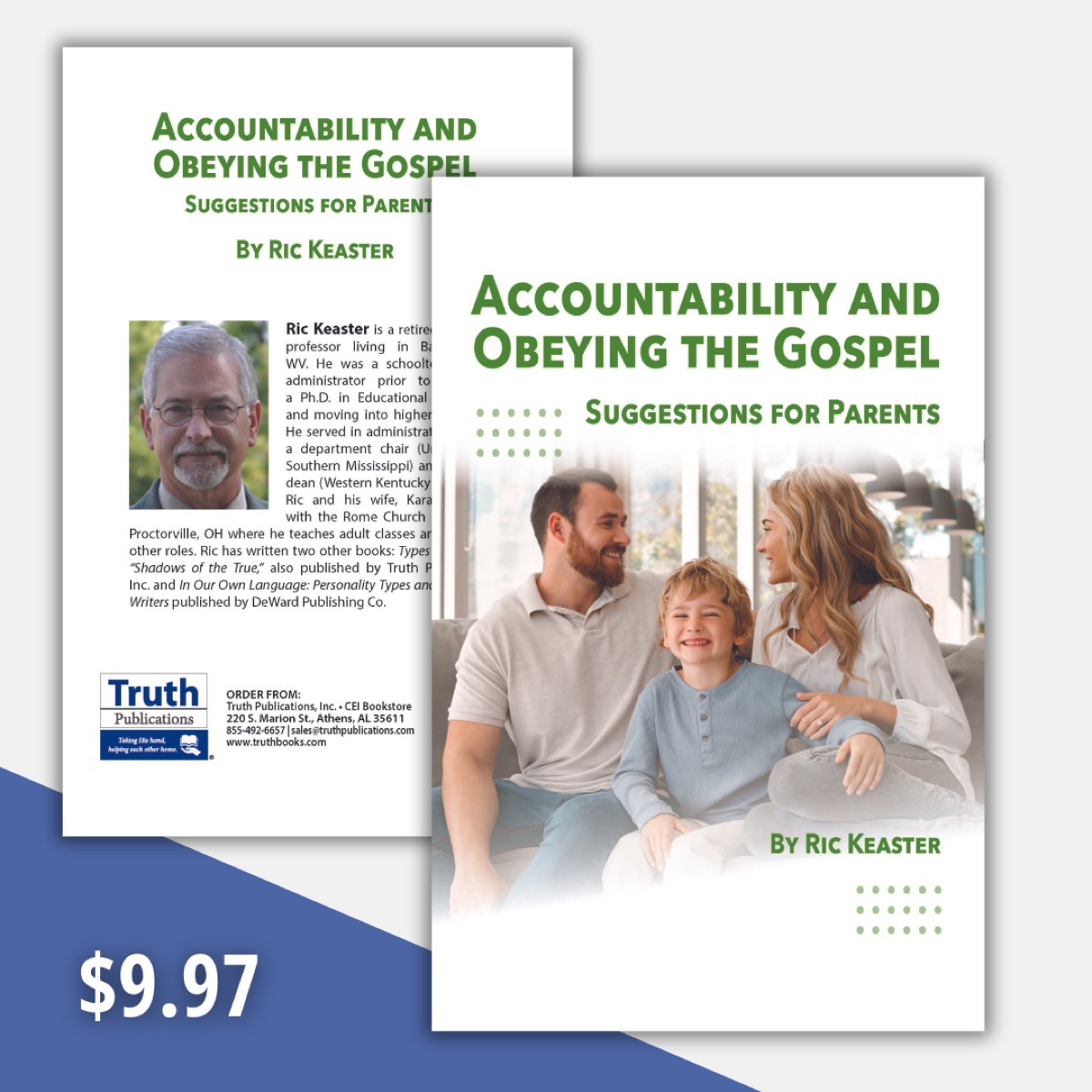
By Kevin Maxey
Synopsis: Deuteronomy 32:9-13 reveals that God, like eagles, purposefully equips us for growth by preparing, stirring, and emptying the nest.
While on vacation in Florida, my five-year-old daughter, Eden, rushed into the house, enthusiastically shouting, “There’s an eagle outside!” Sure enough, a majestic eagle was perched right outside our beach house window, nestled high in the treetops. We had seen eagles before, in photographs and video documentaries. Having grown up in Colorado, I remember seeing occasional eagles soaring far off in the Rocky Mountain horizon. However, this experience was different. A stunning eagle was right outside our window, less than thirty feet away. There is something unique about seeing an eagle up close; something personal, humbling, breathtaking, and heart-stopping. There is something special about seeing one of God’s glorious creatures up close, simply doing what the Creator created it to do. For the rest of our vacation, our family became avid eagle watchers.
This experience inspired me to reflect on eagles, particularly how they intentionally prepare their young for growth. One interesting passage embedded in the middle of a song of Moses in Deuteronomy 32:9-13 speaks of eagles equipping their young for growth. On the same day God commands Moses to go atop Mt. Nebo to die, Moses spoke of eagles.
For the Lord’s portion is His people; Jacob is the place of His inheritance. “He found him in a desert land and in the wasteland, a howling wilderness; He encircled him, He instructed him, He kept him as the apple of His eye. As an eagle stirs up its nest, hovers over its young, spreading out its wings, taking them up, carrying them on its wings, so the Lord alone led him. . . He made him ride in the heights of the earth.
Moses interestingly compares God to an eagle who “stirs up its nest.” What exactly does this mean? How is God like a mother eagle? This passage reveals that God, like eagles, purposefully equips us for growth in three ways: preparing the nest, stirring up the nest, and emptying the nest.
Eagles prepare a nest for the growth of their young. They spend up to three months meticulously building a nest. After carefully selecting a safe location, the mother eagle gathers nesting materials, makes a soft protective bed, and when the time is right, lays her eggs. Thirty-six days later, her baby eaglets hatch. She will spend the next twelve weeks sheltering her young from storms, feeding her young with nourishment, and guarding her young from predators.
God prepared a nest for the growth of Israel. This is the context of the eagle reference in Deuteronomy 32. God took Jacob’s family of seventy during a time of famine, and placed them safely in a protective nest in Goshen (Gen. 45:9-11). When the plagues came, God protected Israel’s nest in Goshen (Exod. 8:22-23).
God prepares a nest for our growth. Surrounded by a barren wasteland of sin, God prepares a nest of safety for us to grow. Newborn Christians find protection, sustenance, and warmth under the wings of Yahweh. “Hide me under the shadow of Your wings” (Ps. 17:8). “The children of men put their trust under the shadow of Your wings” (Ps. 36:7). “In the shadow of Your wings I will make my refuge” (Ps. 57:1-3). Jesus used a similar metaphor: “How often I wanted to gather your children together, as a hen gathers her chicks under her wings” (Matt. 23:37).
Eagles stir the nest for the purpose of growth. After 12 weeks of attentive care, one day the eagle returns to the nest with no food in her beak. She then hovers three feet above the nest, flapping her wings. Next, she starts removing all the comfortable padding in the nest. When she built her nest, she first started with rough broken sticks, prickly thorns, and sharp rocks. Now the eaglets have no food and no soft bed. The eagle mom is “stirring up the nest.” Why? It’s not because she is unloving or uncaring; it is exactly the opposite! They can’t stay in this comfortable nest forever. They must grow and learn to fly!
God stirred up Israel’s nest for the purpose of growth. Israel was not meant to stay in the nest of Goshen forever. They were meant to “fly” to the Promised Land. So, God, like an eagle, hovered over His young and started removing Israel’s protective padding. Hardship, suffering, bitter labor, and cruel slavery followed. God stirred up their nest. Notice the result. Israel cried out to God and was ready to leave the nest (Exod. 3:7-8). It was time for them to fly! The Lord did not want them to remain comfortable in their nest in Egypt. They needed to mount up with wings like eagles and fly to the Promised Land.
God stirs up our nest for the purpose of growth. We want to have comfortable, protected nests without troubles. God, however, comes into our lives at times and stirs up the nest. He allows trials, hardships, thorns, and difficulties to prick us so we can learn to fly. He did this to the early church in Jerusalem. They were growing, and then look what happened in Acts 8:1-4. Persecution came, and Christians had to leave the nest! They were scattered and had to leave the comfort of Jerusalem and spread the gospel. This helps us understand passages that tell us to rejoice even during times of suffering (Jas. 1:2-4; 1 Pet. 4:12-16). When God stirs our nest, we are given the opportunity to grow in patience, character, and hope (Rom. 5:3-4).
Eagles empty the nest for the purpose of growth. Suddenly, the eagle will push the eaglet to the edge of the nest. The eaglet steps to the edge of the nest, looks over the edge, and takes flight. If he has trouble flying, the mom flies under the young eagle and will gently catch him on her wings. The mother eagle is always there helping, encouraging, protecting, and enabling the young eagle to soar.
Young eagles are meant to fly, not stay in the nest. The majestic eagle is one of the most admired of all birds, not because it stays in the nest, but because it soars majestically. The eagle flies ever upward over the expanding horizon, above all other animals. If the eagle never left the nest, it would die. The eagle was not meant to be nest-bound—it was meant to soar.
God emptied Israel’s nest for the purpose of growth. Emptying Israel’s nest in Egypt enabled them to grow as a nation towards the Promised Land. “I bore you on eagles’ wings (out of Egypt) and brought you to Myself” (Exod. 19:4). Sadly, Israel was not ready to fly to the Promised Land, and the older generation ended up wandering and dying in the wilderness.
God empties our nest for the purpose of growth. We are not meant to stay in the nest forever. We must grow and take flight. We are not meant to be earth-bound, earth-satisfied, or earth-fulfilled. As we sing, “This world is not my home, I’m just a passing through,” let us recognize that we are meant to fly heavenward. We are not meant to be fearful, lazy, complacent nest dwellers. We were born to fly, setting our minds on things above (Col. 3:1-3).
Have you stopped growing? Are you comfortable and complacent with your Bible knowledge, prayers, evangelism, involvement with the brethren, etc.? Are you comfortable with certain sins? Are you afraid to jump out of the nest and fly? Just as eagles are not meant to stay in the nest forever, you, too, are not made to stay nest-bound. Find one area you can grow in and commit to it.
What if you are scared to leave the nest and grow? Remember the following three things:
When you leave the nest and take flight, God is still there to catch you. He cares, He watches, He loves, He catches, He saves, He returns, and He renews strength.
Flying is what the eagle is made to do. He is not meant to stay in the nest forever. Likewise, Christians are not meant to be earth-bound, earth-satisfied, earth-fulfilled.
If you don’t leave the nest, you will die. Did you hear that? If you don’t leave the nest, you will die. God stirred up Israel’s nest. They were to fly to the Promised Land, but they didn’t want to fly. The unbelieving generation died in the wilderness.
Learn from God and Jesus. The mother eagle hovers above, teaching her young how to fly. Learn from Jesus who came from heaven to save and serve (1 Cor. 11:1; Phil. 2:1-5). How did Jesus fly?
Learn from God when it is time to fly. The eagle will wait for the right wind in which to fly. It will jump, expand its wings, and let go. . . and the wind will catch it. It will only flap its wings two minutes for every sixty minutes of flight. Eagles effortlessly ride on the wings of the wind. Eagles don’t flap or fight against the wind—they go with it.
Take a leap of faith. Get out of your comfort zone. Do something you have never done before! Grow in hospitality, evangelism, teaching, and church work. Are you flapping against the wind, exhausted and frustrated because you are flying against the will of God? Pick one thing and start. Learn to lead singing, give an invitation, preach a lesson, start a Bible study group, invite people to your home, etc.
Kevin Maxey has worked with the Port Royal church of Christ in Spring Hill, TN, since 2009. He and his wife, Jennifer, have five children. The church website is here. He can be reached here.



By Mike Willis
Synopsis: God has created man to walk through various stages of life during which he is to serve God and grow closer to Him in the process.
A Google search on the stages and seasons of life typically breaks life into seven sections:
Infancy and childhood (0-2 years)
Early childhood (2-6 years)
Middle childhood (6-12 years)
Adolescence and teenage years (12-18 years)
Young adulthood (18-40 years)
Middle adulthood (40-65 years)
Late adulthood (65+ years)
The Bible recognizes the various stages of life in Ecclesiastes 3:1-8:
For everything there is a season, and a time for every matter under heaven: a time to be born, and a time to die; a time to plant, and a time to pluck up what is planted; a time to kill, and a time to heal; a time to break down, and a time to build up; a time to weep, and a time to laugh; a time to mourn, and a time to dance; a time to cast away stones, and a time to gather stones together; a time to embrace, and a time to refrain from embracing; a time to seek, and a time to lose; a time to keep, and a time to cast away; a time to tear, and a time to sew; a time to keep silence, and a time to speak; a time to love, and a time to hate; a time for war, and a time for peace.
We should recognize by this Scripture that God is the One who made us so that we experience the various seasons of life. In His wisdom, He could have made us like other animals who have little to do with their offspring. Some animals lay eggs and never see their offspring; most animals transition from babies to adults much more quickly than humans do. However, God made us just like we are for the good of both the children and the parents.
Scripture does not say which stage of life is best. Rather, it says: “I have seen the business that God has given to the children of man to be busy with. He has made everything beautiful in its time. Also, He has put eternity into man’s heart, yet so that he cannot find out what God has done from the beginning to the end. I perceived that there is nothing better for them than to be joyful and to do good as long as they live; also that everyone should eat and drink and take pleasure in all his toil—this is God’s gift to man” (Eccl. 3:10-13).
Each stage of life is beautiful in its time when it is used to accomplish the purposes that God designed to occur during that period of life. We should embrace the season of life in which we are presently living and accept the responsibilities and opportunities that it provides, being guided by God’s word. As we transition through the seasons of life, they may be like the seasons of the years—you may be ready for spring to come or for the first snow before it finally arrives. Sometimes we are reluctant to accept and embrace the change of seasons of life. Everyone has known some older man throw away his mate and kids in order to chase after a younger woman. You may have laughed at the old man who had gone bald wearing a cheap toupee or have noticed the elderly woman dying her hair rather than embracing the gray hairs she has earned. (I am not saying that there is anything sinful with wearing a toupee or dying one’s hair.)
I have precious memories of my own childhood, although as I advance in years, many of those memories have faded away. I have better memories of watching my own children pass through those phases of life. I remember their first steps, being thankful when we didn’t have to change diapers, watching them learn to ride a bicycle, seeing them catch the bus in front of the house on their first day of school (with tears running down my cheeks), being proud of their good grades at school, laughing at the tenderness of the conscience of my daughter when she would creep back down the stairs and tell me, “I’ve did something wrong. . .” (in contrast, my son refused to squeal on himself). Precious memories, indeed!
These years were the years when their voracious minds learned to read, write, and do arithmetic. They also learned about God. Every day they went to school, we would read a few verses together, have a prayer, and send them to the bus stop. Their lives were shaped by Sandy and my decision to make God first in our lives, so they never asked, “Are we going to church?” They knew that, if the congregation was meeting, we were going to be there. My own parents made that decision before I was born. Service to God was more important than little league practice or games, recreational activities, or any other after-school events.
These were years that we taught our children to memorize the books of the Bible in order to be able to find the passage and follow the preacher as he presented his lesson. When they were old enough to write, they took a notepad to services and wrote down the Scriptures the preacher quoted or referred to in his sermon. They were not reading secular books during the preaching or doing homework. These years in my children’s lives were patterned after what my parents did for us when we were the same age.
Solomon taught, “Rejoice, O young man, in your youth, and let your heart cheer you in the days of your youth. Walk in the ways of your heart and the sight of your eyes. But know that for all these things, God will bring you into judgment. Remove vexation from your heart, and put away pain from your body, for youth and the dawn of life are vanity” (Eccl. 11:9-10). Youth is a fleeting period in life, and it’s important to savor the activities and joys of childhood while it lasts. Eventually, responsibilities like bills and jobs will come, making it difficult to maintain the carefree innocence of youth. About the time I got this figured out, I graduated from high school.
Yes, I can still remember some of the things I experienced. I had learned the gospel and was baptized when I was twelve years old. Yet, when I started passing through junior high and high school, I learned that Satan’s temptations are difficult to resist. I learned to speak the foul speech used by the world. I learned to tell filthy jokes and curse. I was tempted by my own lusts and was not a godly example during my youth. This period of my life does not leave me with pleasant memories. After moving away from my high school friends, I made new friends of godly Christians and was restored to my Lord.
Despite my spiritual failures, thanks to my parents, I learned many things right: respect for my parents, honesty, a good work ethic, etc. When I left high school for college, I was expected to live on my own. Sandy and I married on June 18, 1966 and, because of our mutual commitment to God, we have now been married for almost fifty-nine years. Frankly, we weren’t prepared for marriage, but we stumbled through those early years until we gradually learned how to make it work. We hold to the Bible’s teachings on divorce and remarriage, loving our spouse, and loving our children.
As I reflect on those years, I am reminded of the teaching of Scripture. It is natural for our boys and girls to want to develop relationships that lead to marriage. Sadly, the world’s attitude toward sex is leading many young Christians into sexual immorality. Sometimes an out-of-wedlock marriage leads to abortion, even among Christian girls. God knew the problems of having children outside of wedlock and, therefore, commanded that sexual activity should only occur within the marriage bond. Children need parents who love them, provide for them, are examples for them, and gently correct them to guide them through their teenage years. It is not wise to have teenagers raising babies!
Before I could fathom what was happening, my hair began to fall out, these babies were teenagers, and suddenly, my own children were getting married! I woke up in. . .
At first, we were empty nesters, which had its own advantages, although we had heavy college expenses and weddings to pay for. Sandy and I had more time for the two of us. Solomon wrote, “Enjoy life with the wife whom you love, all the days of your vain life that He has given you under the sun, because that is your portion in life and in your toil at which you toil under the sun. Whatever your hand finds to do, do it with your might, for there is no work or thought or knowledge or wisdom in Sheol, to which you are going” (Eccl. 9:9-10). So, we did. We were able to travel to see parts of the world that particularly interested us (i.e., the Bible lands and their museums). I went back to school and did a second master’s degree and was able to spend more time writing.
There were weddings and our children are blessed with the best mates fitted to them that anyone could imagine. We have been blessed to see our children marry and establish their own families, and give birth to four grandchildren while they were living near enough to us that we could enjoy each other’s company. “Grandchildren are the crown of the aged, and the glory of children is their fathers” (Prov. 17:6). I wish for each reader what the Psalmist wrote, “May you see your children’s children!” (Ps. 128:6).
The years have flown by and the next stage will be seeing my first grandchild get married. I woke one morning and found myself in. . .
It’s not so bad! I have even more precious memories, although sometimes I find my forgetter works better than my rememberer. Names are especially difficult for me, so I always carry my driver’s license so I can remember who I am! Already I have twelve years of experience as one in “late adulthood” and am nearing that rendezvous of which Moses wrote: “The years of our life are seventy, or even by reason of strength eighty; yet their span is but toil and trouble; they are soon gone, and we fly away” (Ps. 90:10).
I like the poem “I’m Not Growing Old” by John E. Roberts (1852-1927),
They say that I am growing old.
I’ve heard them tell it times untold
In language plain and bold.
But I’m not growing old;
This frail old shell in which I dwell
Is growing old I know full well—
But I am not the shell.
What if my hair has turned gray?
Gray hairs are honorable, they say.
What if my eyesight’s growing dim?
I can still see to follow Him
Who sacrificed His life for me
There on the cross of Calvary.
What should I care if Time’s old plow
Has dug some furrows in my brow?
Another house, not made with hand,
Awaits me in the Glory Land.
What though I falter in my walk?
What though my tongue refuse to talk?
I still can tread the narrow way,
I still can watch, and praise and pray.
My hearing may not be as keen
As in the past, it may have been;
Still, I can hear my Savior say,
In whispers soft, “This is the way.”
The outward man, do what I can
To lengthen out this life’s short span,
Shall perish and return to dust
As everything in nature must.
The inward man, the Scriptures say,
Is growing stronger every day.
Then how can I be growing old?
I’m safe within the Savior’s fold.
’Ere long my soul shall fly away
And leave this tenement of clay.
This robe of flesh I’ll drop and rise
To seize the everlasting prize.
I’ll meet you on the streets of gold
And prove that I’m not growing old.
So before I walk away from my keyboard, let me give you a few keys to life, drawn from the wise King Solomon.
Life without God is empty and meaningless (Eccl. 1:1-11, 14). Therefore, do not waste your time trying to find fulfillment in self-indulgence (Eccl. 2:1-11; 5:10-17), pursuit of advanced degrees so people will think you are “somebody” (Eccl. 2:12-17), or being married to your job (Eccl. 2:18-23).
Enjoy your life. This message is repeated several times in the book of Ecclesiastes; the repetition emphasizes its importance.
There is nothing better for a person than that he should eat and drink and find enjoyment in his toil. This also, I saw, is from the hand of God, for apart from Him, who can eat or who can have enjoyment? For to the one who pleases Him God has given wisdom and knowledge and joy, but to the sinner He has given the business of gathering and collecting, only to give to one who pleases God. This also is vanity and a striving after wind (Eccl. 2:24-26).
Behold, what I have seen to be good and fitting is to eat and drink and find enjoyment in all the toil with which one toils under the sun the few days of his life that God has given him, for this is his lot. Everyone also to whom God has given wealth and possessions and power to enjoy them, and to accept his lot and rejoice in his toil—this is the gift of God. For he will not much remember the days of his life because God keeps him occupied with joy in his heart (Eccl. 5:18-20).
In the day of prosperity, be joyful, and in the day of adversity consider: God has made the one as well as the other, so that man may not find out anything that will be after him (Eccl. 7:14).
Go, eat your bread with joy, and drink your wine with a merry heart, for God has already approved what you do. Let your garments be always white. Let not oil be lacking on your head. Enjoy life with the wife whom you love, all the days of your vain life that He has given you under the sun, because that is your portion in life and in your toil at which you toil under the sun. Whatever your hand finds to do, do it with your might, for there is no work or thought or knowledge or wisdom in Sheol, to which you are going (Eccl. 9:7-10).
Recognize that there is a season for everything (Eccl. 3:1-8) and that God “has made everything beautiful in its time. Also, He has put eternity into man’s heart, yet so that he cannot find out what God has done from the beginning to the end. I perceived that there is nothing better for them than to be joyful and to do good as long as they live; also that everyone should eat and drink and take pleasure in all his toil—this is God’s gift to man” (Eccl. 3:11-13).
Accept that there are inequities in life. Don’t waste time complaining that “life isn’t fair.” “Moreover, I saw under the sun that in the place of justice, even there was wickedness, and in the place of righteousness, even there was wickedness. I said in my heart, God will judge the righteous and the wicked, for there is a time for every matter and for every work” (Eccl. 3:15-17). Remember, “Time and chance happen to all men” (Eccl. 9:11).
Accept the limitations of human wisdom. We witness many inequities in life that we cannot and will not understand. “There is a vanity that takes place on earth, that there are righteous people to whom it happens according to the deeds of the wicked, and there are wicked people to whom it happens according to the deeds of the righteous. I said that this also is vanity. And I commend joy, for man has nothing better under the sun but to eat and drink and be joyful, for this will go with him in his toil through the days of his life that God has given him under the sun. . . . then I saw all the work of God, that man cannot find out the work that is done under the sun” (Eccl. 8:14-15, 17).
Accept the mortality of man, including your own, and enjoy the pleasures of life while you have them (Eccl. 9:3). “All go to one place. All are from the dust, and to dust all return. Who knows whether the spirit of man goes upward and the spirit of the beast goes down into the earth? So I saw that there is nothing better than that a man should rejoice in his work, for that is his lot. Who can bring him to see what will be after him?” (Eccl. 3:16-22).
Use the inspired wisdom found in the Bible to navigate through the adventures and pitfalls of life (see Eccl. 4-7). Be sure to read these chapters when you have time to meditate and can assimilate the God-given wisdom they include.
There are so many other important life messages buried in Ecclesiastes, but there is not space enough in this article for me to include all of them. Here is the conclusion of this marvelous book of Ecclesiastes: “The end of the matter; all has been heard. Fear God and keep His commandments, for this is the whole duty of man. For God will bring every deed into judgment, with every secret thing, whether good or evil” (Eccl. 12:13-14).
If you and I follow the Lord’s teaching through the seasons of life, we will not be plagued with regrets and guilt. We will be ready for the next step, the one Lazarus took—“The poor man died and was carried by the angels to Abraham’s side” (Luke 16:22). When death comes to you, be like Stephen: “Behold, I see the heavens opened, and the Son of Man standing at the right hand of God” (Acts 7:56).
It is natural for our survivors to mourn the passing of those whom they love. When a Christian dies, rejoice with him. The Christian has the same hope Paul had when he faced execution under Nero. Here is what he said would happen: “For I am already being poured out as a drink offering, and the time of my departure has come. I have fought the good fight, I have finished the race, I have kept the faith. Henceforth there is laid up for me the crown of righteousness, which the Lord, the righteous judge, will award to me on that day, and not only to me but also to all who have loved His appearing” (2 Tim. 4:6-8). The death of a saint is his transition to being with the Lord. We say, “Parting is such sweet sorrow.” This is especially true in matters of mortality. Yet, how would you act if I were moving away to live on a palatial estate where there would be no wickedness, no unfulfilled needs, and in the best part of the world? Of course, you would miss me but still be happy about what lies ahead. We graduate to glory!
Mike Willis served as editor of Truth Magazine for forty years. Presently, he is preaching for the Decatur Township church located southwest of Indianapolis, IN. The church website is here. He can be reached here.


By Mark Mayberry
Synopsis:This article explores the concept of change in relationships and roles, emphasizing that while God and His word remain constant, our hearts and lives should evolve. It uses Jesus as the perfect example of navigating different stages of life, from His incarnation to His exaltation, highlighting His obedience, sacrifice, and ultimate authority. It discusses Jesus’s youth, transition to adulthood, soul-saving mission, and sacrificial death, and how His roles changed according to God’s purpose. It encourages readers to embrace their roles at different life stages, from youth to adulthood to old age, and to remain faithful and diligent in their responsibilities, drawing inspiration from Jesus’s example.
There are some things that do not change: God and His word. However, there are also things that should change, particularly our hearts and lives. As we navigate through life, our roles and responsibilities inevitably change.
In reflecting on the roles and responsibilities we share as Christians, let us consider the example of Jesus as One who perfectly navigated different stages in His role as our Savior—from His incarnation as a child to His exaltation as King of kings. This serves as a reminder that, as we navigate our own lives, we, too, must respond appropriately to the changing circumstances we inevitably encounter. The example of Jesus is encouraging and serves as a cornerstone for us as we consider how to respond to our life challenges.
At various points in the unfolding of God’s eternal purpose, Jesus found Himself in different positions. He was (and remained) the eternal God, part of the triune Godhead—the Father, Son, and Holy Spirit—unified in creation, revelation of truth, and the redemptive work of salvation. He is the same yesterday, today, and forever; yet, in fulfilling God’s eternal purpose of saving humanity, Jesus has functioned in various capacities.
Jesus, the perfect example, was also qualified to be our perfect sacrifice. He adjusted to the changing circumstances of leaving heaven, coming to earth, enduring a humble existence, and serving as our perfect sacrifice. Jesus lived faithfully through these challenges before being exalted back to the right hand of God.
Hebrews 5 provides insight into our Lord’s example and establishes a firm foundation for how we approach life’s challenges:
Although He was a Son, He learned obedience from the things which He suffered. And having been made perfect, He became to all those who obey Him the source of eternal salvation, being designated by God as a high priest according to the order of Melchizedek (Heb. 5:8-10).
The writer of Hebrews makes several references to Melchizedek, an obscure yet significant Old Testament character. Melchizedek served as both a priest of God and king of the city of Jebus, which would later become Jerusalem. His priesthood was based not on genealogy or lineage, but on the intimate relationship he shared with God. He faithfully served the Lord during a time when many around him did not.
In a similar manner to Melchizedek, Jesus shared a unique and loving relationship with the Father. Throughout His ministry, He often referred to this closeness. For instance, in John 10:30, He declared, “I and the Father are one.”
This unity reflected not only the relationship between Jesus and the Father but is also echoed in Deuteronomy 6:4, where Moses declared, “Hear, O Israel: The Lord our God, the Lord is one.” The Hebrew word echad, here translated “one,” is used of the triune God and also of the unity that exists in marriage: In a healthy marital relationship, two distinct individuals become one in shared commitment and purpose (Gen. 2:24).
Just as Jesus referred to God affectionately as “My Father,” we, too, should cultivate an intimate relationship with Him. The Lord is not a distant Creator who left His handiwork to its own devices; rather, His personal attentiveness is captured beautifully in the words of the Psalmist:
If I take the wings of the dawn, If I dwell in the remotest part of the sea, Even there Your hand will lead me, And Your right hand will lay hold of me (Ps. 139:9-10).
Deism is the belief that God created the universe but does not interfere with its functioning, leaving it to operate according to natural laws. This idea contrasts with the belief in a personal God who is actively involved in the world and in the lives of individuals:
Are not two sparrows sold for a penny? Yet not one of them will fall to the ground apart from the will of your Father. And even the very hairs of your head are all numbered. So don’t be afraid; you are worth more than many sparrows (Matt. 10:29-31, NIV).
In His High Priestly prayer offered before His betrayal, Jesus said:
I glorified You on the earth, having accomplished the work which You have given Me to do. Now, Father, glorify Me together with Yourself, with the glory which I had with You before the world was (John 17:4-5).
Here, we see the deep connection Jesus shares with God the Father—a unity that existed before the creation of the world, when the Father, Son, and Holy Spirit harmoniously planned for humanity’s redemption.
Luke’s narrative of the Lord’s early life focuses on the marvelous events preceding and surrounding His birth, and a significant episode that occurred when He was twelve years old. In Luke 2, Jesus attended the Feast of Passover with His parents. This was a significant annual obligation for citizens of ancient Israel and provided an opportunity for extended families to gather in one place for worship and celebration with pilgrims from all the tribes.
After several days spent in Jerusalem, Jesus, although just a boy, remained behind while His parents began their journey home. Unbeknownst to them, He was in the temple, engaging with teachers, listening to them, and asking insightful questions. When Mary found Him three days later, she expressed her deep concern: “Son, why have you treated us this way? Behold, your father and I have been anxiously looking for You.” However, Jesus responded,
Why did you seek Me? Did you not know that I must be about My Father’s business? (Luke 2:49, NKJV).
Why were you searching for me?” he asked them. Didn’t you know that it was necessary for me to be in my Father’s house? (Luke 2:49, CSB).
Why were you searching for me? Did you not know that it was necessary for me to be in the house of my Father? (Luke 2:49, LEB).
While His parents did not understand the significance of His words, this moment serves as an important reminder of Jesus’s awareness of His divine mission. Despite His profound understanding, Jesus continued to be in subjection to His earthly parents and returned with them to Nazareth.
Jesus manifested a spirit of obedience during His formative years—to His earthly parents and His heavenly Father. His faithfulness as a Son laid a foundation for His earthly ministry. He demonstrated submission not merely for the sake of compliance but also as an example for us to follow.
As individuals mature, there comes a time when their role changes from being a child subject to parents to an adult who makes independent decisions. This transition is captured beautifully in the episode at the wedding in Cana, where Jesus performed His first miracle.
In John 2, Jesus attended a wedding celebration in Cana of Galilee. Over the course of this communal celebration, the wine ran out. His mother approached Him, stating, “They have no wine.” He responded, “What has this concern of yours to do with me, woman? My hour has not yet come” (John 2:4, CSB).
Though His tone might initially seem dismissive to our ears, it is important to understand cultural context. Jesus intended no disrespect for His mother; rather, He was affirming His authority to engage in His divinely ordained mission. His response was a declaration of independence, indicating that from henceforth He would now act under His own authority.
This, the first of His miraculous signs, Jesus performed at Cana in Galilee. He thus revealed His glory, and His disciples put their faith in Him (John 2:11, NIV).
Throughout His ministry, Jesus modeled respect and love for His mother, even entrusting her care to John, the beloved apostle, as He hung on the cross. While He transitioned to adulthood, His love and regard for His earthly family remained evident.
Jesus’s role expanded beyond sonship as He embraced His mission. Approaching the culmination of His ministry, our Lord was undeterred by the troubling realization of what lay ahead. The cross was not something He could avoid while maintaining His oneness with the Father, as it was the Father’s will for Him to die for humanity’s sins.
In fulfilling His role as the Suffering Servant, Jesus faced immense challenges, including the emotional and physical agony of anticipating His impending crucifixion. Fully aware of the enormity of His mission, Jesus did not shy away from the difficulties ahead. Instead, He sought to glorify God through His suffering:
Now My soul has become troubled; and what shall I say, “Father, save Me from this hour”? But for this purpose I came to this hour. Father, glorify Your name. Then a voice came out of heaven: “I have both glorified it, and will glorify it again.” So the crowd of people who stood by and heard it were saying that it had thundered; others were saying, “An angel has spoken to Him.” Jesus answered and said, “This voice has not come for My sake, but for your sakes. Now judgment is upon this world; now the ruler of this world will be cast out. And I, if I am lifted up from the earth, will draw all men to Myself.” But He was saying this to indicate the kind of death by which He was to die (John 12:27-33).
This ultimately led to the culmination of His earthly work. Hebrews 5:8 acknowledges that “though He was a Son, He learned obedience through the things which He suffered.” Through suffering, Jesus moved beyond being merely a Son to becoming the perfect sacrifice for sin. His suffering was essential to His perfection as our Savior (Phil. 2:5-8; cf. Isa. 53:4-5)
Having completed His sacrificial work, Jesus assumed the role of “author” or “source” of eternal salvation (Heb. 5:9-10). The Greek word aitios, here rendered “source” (NASB, ESV, etc.) or “author” (KJV & NKJV), signifies one who is responsible for something (Thomas, 159a) or one who is the cause of something having occurred (BDAG, 31). Note also the introductory clause of this verse: “. . .having been made perfect, He became to all those who obey Him the source of eternal salvation. . .” The Greek verb teleioō, here rendered perfect,” means “to complete an activity, complete, bring to an end, finish, accomplish” (BDAG, 996).
And having been made perfect, He became to all those who obey Him the source of eternal salvation, being designated by God as a high priest according to the order of Melchizedek (Heb. 5:9-10).
After enduring mock trials, in which He was beaten, spat upon, and scourged, Jesus was nailed to a cross—being suspended between heaven and earth for six hours. In John’s description of the closing moments of His agony, the author of the fourth gospel twice employs teleō, a variant form of teleioō which occurs in Hebrews 5:9. It means “to complete an activity or process, bring to an end, finish, complete” (BDAG, 997):
After this, Jesus, knowing that all things had already been accomplished (teleō) to fulfill the Scripture, said, “I am thirsty.” A jar full of sour wine was standing there; so they put a sponge full of the sour wine upon a branch of hyssop and brought it up to His mouth. Therefore, when Jesus had received the sour wine, He said, “It is finished! (teleō)” And He bowed His head and gave up His spirit (John 19:28-30).
Jesus didn’t quit before the job was completed! He didn’t say, “Forget this. I’ve had enough. I’m out of here. I’m going home.” Rather, He remained true to His mission to His last breath.
By fulfilling His purpose in coming to earth, Jesus built upon His previous roles. He serves as our captain, our king, and the one who possesses all authority—roles He will eventually return to the Father. This progression demonstrates how Jesus’s responsibilities changed according to the work He performed at different points in His divine mission. Jesus now occupies a position of supreme authority. The Great Commission and other passages in the New Testament state that all things were subjected to Him, and apart from Him, nothing was made that has been made. He is in a position of complete authority today.
Our Lord exemplifies how roles evolve as we fulfill God’s purposes, showing that each stage of service prepares us for greater responsibilities in His kingdom:
And Jesus came up and spoke to them, saying, “All authority has been given to Me in heaven and on earth. Go therefore and make disciples of all the nations, baptizing them in the name of the Father and the Son and the Holy Spirit, teaching them to observe all that I commanded you; and lo, I am with you always, even to the end of the age” (Matt. 28:18-20).
One day, Jesus will deliver authority back to the Father, and God will be all in all. In this, we see different roles: now He is in a position of supreme authority, later He will deliver that back to the Father (1 Cor. 15:20-28):
But now Christ has been raised from the dead, the first fruits of those who are asleep. For since by a man came death, by a man also came the resurrection of the dead. For as in Adam all die, so also in Christ all will be made alive. But each in his own order: Christ the first fruits, after that those who are Christ’s at His coming, then comes the end, when He hands over the kingdom to the God and Father, when He has abolished all rule and all authority and power. For He must reign until He has put all His enemies under His feet. The last enemy that will be abolished is death. For HE HAS PUT ALL THINGS IN SUBJECTION UNDER HIS FEET. But when He says, “All things are put in subjection,” it is evident that He is excepted who put all things in subjection to Him. When all things are subjected to Him, then the Son Himself also will be subjected to the One who subjected all things to Him, so that God may be all in all (1 Cor. 15:20-28).
In embracing our roles and navigating changing circumstances, we can take comfort in the knowledge that Jesus understands our struggles. His life serves as the perfect model of how to remain faithful and obedient during every stage of life.
Just as Jesus had a relationship with God in heaven and then took on different roles on earth—first, as a child subject to His parents, later as the Master Teacher who guided men to truth, finally culminating in His perfect sacrifice on the cross—we, too, experience various stages in life that bring different roles and responsibilities.
During childhood and adolescence, we are dependent on our parents; as we mature, we gradually reach a point of independence—in which we establish our own homes, marry, and raise families. Eventually, if we are blessed with longevity, we may experience another stage, in which we become increasingly dependent on others for our well-being, health, or provision.
At each stage of our journey—whether we are young (when life is filled with promise and potential), or during adulthood (dealing with an assortment of demanding duties), or nearing the end of our life’s journey (when strength and stamina ebb)—we should seek to serve God and our fellow man, our brothers and sisters, and our families.
The Bible repeatedly emphasizes the importance of honoring and respecting our parents (in particular) and older adults (in general). It highlights the value of obedience, respectfulness, and kindness towards others (young and old, male and female)—promising blessings and longevity in return (Exod. 20:12; Lev. 19:32; Eph. 6:1-3; 1 Tim. 5:1-3):
Honor your father and your mother, so that your days may be long in the land that the LORD your God is giving you (Exod. 20:12).
You shall rise before the aged, and defer to the old; and you shall fear your God: I am the LORD (Lev. 19:32).
Children, obey your parents in the Lord, for this is right. “Honor your father and mother”—this is the first commandment with a promise: “so that it may be well with you and you may live long on the earth” (Eph. 6:1-3).
Do not speak harshly to an older man, but speak to him as to a father, to younger men as brothers, to older women as mothers, to younger women as sisters—with absolute purity. Honor widows who are really widows (1 Tim. 5:1-3).
In Lamentations 3:25-27, Jeremiah offers a poignant reminder for facing adversity: “The LORD is good to those who wait for Him, to the person who seeks Him.” Let us learn to wait silently for the Lord—acknowledging that He has the right to control our lives. Moreover, “It is good for a man that he should bear the yoke in His youth.” Patiently seeking the Lord leads to spiritual growth. Enduring hardships in our formative years builds character and strength.
Enjoy youth and follow your heart, but remember that God brings your actions into judgment. Living joyfully and productively in the present prepares you to face future trials that will inevitably come (Eccl. 11:9-12:1):
Rejoice, young man, during your childhood, and let your heart be pleasant during the days of young manhood. And follow the impulses of your heart and the desires of your eyes. Yet know that God will bring you to judgment for all these things. So, remove grief and anger from your heart and put away pain from your body, because childhood and the prime of life are fleeting. Remember also your Creator in the days of your youth, before the evil days come and the years draw near when you will say, “I have no delight in them” in the future (Eccl. 11:9-12:1).
The writer of Hebrews further emphasizes the importance of discipline during our youth. In chapter 12, verses 4-11, he reminds us that God disciplines those He loves. We learn obedience through confronting challenges, which, when properly faced, mold us into His image. Faithful discipleship demands that we strive against sin and embrace the Lord’s discipline. Recognize that His prescriptions and prohibitions are a sign of His love and a sure path to spiritual growth:
You have not yet resisted to the point of shedding blood in your striving against sin; and you have forgotten the exhortation which is addressed to you as sons, “MY SON, DO NOT REGARD LIGHTLY THE DISCIPLINE OF THE LORD, NOR FAINT WHEN YOU ARE REPROVED BY HIM; FOR THOSE WHOM THE LORD LOVES HE DISCIPLINES, AND HE SCOURGES EVERY SON WHOM HE RECEIVES.” It is for discipline that you endure; God deals with you as with sons; for what son is there whom His father does not discipline?
Transitioning from youth to adulthood, we face increased responsibilities. We must be faithful in our dealings with our brethren, our relationships with our spouses, and our responsibilities toward our children, in the workplace, society, and in relation to civil government.
In Acts 6, we observe the apostles delegating authority to seven trusted men to serve tables, witnessing how shared responsibilities can free spiritual leaders to focus on crucial tasks. Stephen and Philip, after being proven in their roles, later became effective preachers of the gospel, demonstrating that accepting smaller responsibilities opens doors to greater opportunities:
Now at this time, while the disciples were increasing in number, a complaint arose on the part of the Hellenistic Jews against the native Hebrews, because their widows were being overlooked in the daily serving of food. So the twelve summoned the congregation of the disciples and said, “It is not desirable for us to neglect the word of God in order to serve tables. Therefore, brethren, select from among you seven men of good reputation, full of the Spirit and of wisdom, whom we may put in charge of this task. But we will devote ourselves to prayer and to the ministry of the word” (Acts 6:1-4).
When deacons and their qualifications are later described, Paul said they must “first be tested,” showing their leadership ability in areas such as the home, where they keep their children in subjection and respectful. As they grow in areas of service and responsibility, they may eventually take on roles such as elders, watching over the souls of saints:
Deacons likewise must be men of dignity, not double-tongued, or addicted to much wine or fond of sordid gain, but holding to the mystery of the faith with a clear conscience. These men must also first be tested; then let them serve as deacons if they are beyond reproach. . . Deacons must be husbands of only one wife, and good managers of their children and their own households. For those who have served well as deacons obtain for themselves a high standing and great confidence in the faith that is in Christ Jesus (1 Tim. 3:8-13).
Increasing trust is placed in individuals who have repeatedly proven themselves faithful. Jesus said, “He who is faithful in a few things, I will make ruler over many things.” Those who have proven faithful in the exercise of their talents are given additional responsibilities.
As we grow older, we may face physical decline, but this does not diminish our contributions to God’s kingdom. Psalm 71:17-18 reminds us that, even in old age, we can continue impacting the younger generations:
O God, from my youth You have taught me, and I still proclaim Your wondrous deeds. So even to old age and gray hairs, O God, do not forsake me, until I proclaim Your might to all the generations to come. Your power (Ps. 71:17-18).
Proverbs 16:31 highlights that a life well-lived in righteousness adds glory to our age. However, such a crown is conditional:
The silver-haired head is a crown of glory, if it is found in the way of righteousness (Prov. 16:31, NKJV).
Gray hair is a crown of glory; it is gained in a righteous life (Prov. 16:31, NASB, ESV & NRSV).
Gray hair is a glorious crown; it is found in the ways of righteousness (Prov. 16:31).
Older men are to be temperate, dignified, and sensible, while older women are to be reverent and teach the younger women:
Older men are to be temperate, dignified, sensible, sound in faith, in love, in perseverance. Older women likewise are to be reverent in their behavior, not malicious gossips nor enslaved to much wine, teaching what is good, so that they may encourage the young women to love their husbands, to love their children, to be sensible, pure, workers at home, kind, being subject to their own husbands, so that the word of God will not be dishonored (Titus 2:2-5).
In conclusion, regardless of our stage in life, we should faithfully fulfill our roles and responsibilities. Two principles should govern our conduct: (1) Be faithful in your present role and responsibility, no matter how inconsequential it may seem; (2) Do your best at whatever task is at hand.
In the Parable of the Talents, the slaves who had been entrusted with two and five talents used the funds wisely; despite their differences in ability, both were equally praised: “Well done, good and faithful slave. You were faithful with a few things, I will put you in charge of many things; enter into the joy of your master” (Matt. 25:19-30, esp. vv. 21 & 23; cf. Luke 16:10-12).
The meaning of this statement emphasizes the importance of stewardship and faithfulness in small matters. It reflects the biblical principle that God values integrity and diligence in all tasks, regardless of size. When someone is faithful in handling small responsibilities, they demonstrate their reliability and trustworthiness, which leads to greater responsibilities and rewards.
While time and change may conspire to thwart our efforts—and the best-laid plans sometimes fail—Solomon reminds us that the key to success is diligent exertion: “Whatever your hand finds to do, do it with all your might” (Eccl. 9:10-12).
Finally, we can look to Jesus as our perfect example, who fulfilled His duties at every stage of life. Let us strive to imitate His faithfulness. Let us approach life’s changing circumstances with faith, grace, and a spirit of obedience.
Mark Mayberry has labored with the Adoue Street church of Christ in Alvin, TX, since 1998, where he serves as the evangelist and an elder. The church website is here. His website is here. He can be reached here.


11_Monthly_Theme_Lesson_05-Image-B.jpg 

Note: Please send additions, corrections and updates here.
Updated: 4/2/2025
17312 Jones Rd, Athens, AL 35613
Sun. Bible Study 9:30 am | Sun. Worship: 10:20 am & 5:00 pm | Wed. Bible Study 7:00 pm
Evangelist: Jonathan Reeder | Website | 256-233-3160
24190 Wooley Springs Rd, Athens, AL 35613
Sun. Worship 9:30 am & 5:15 pm | Wed. Bible Class 7:00 pm
Evangelists: Bob Watson & Matt Taylor | Website
3955 Pine Lane, Bessemer, AL 35022
Sun. Bible Study 9:10 am | Sun. Worship 10:00 am & 5:00 pm | Wed. Bible Class 7:00 pm
Evangelist: David Deason | 256-497-8127 205-425-2352 | Email | Website
2325 Old Columbiana Rd. (near I-65 & Hwy. 31)
Sun. Bible Study 9:00 am | Worship 10:00 am & 5:00 pm | Wed. Bible Study 7:00 pm
Evangelist: Kyle Pope | 205-822-0018 | Website
19965 Sandlin Rd. Elkmont, AL 35620
Sun. Worship 9:30 am & 3:00 pm | Bible Classes: 10:45 am | Wed. Bible Study 7:00 pm
Evangelist: Lance R. Taylor | 256-777-0990 | Website
851 N. Pine St. (Located next to University campus)
Sun. Bible Study 9:30 am | Worship 10:15 am & 5:00 pm | Wed. Bible Study 7:00 pm
Evangelist: Kenny Moorer | 256-766-0403
601 Pineywood Road, Gardendale, AL, 35071 (Located 10 miles N of Birmingham)
Sun. Bible Study 9:30 am | Worship: 10:25 am & 5:00 pm | Wed. Bible Study: 7:00 pm
Evangelists: Andrew Smith & Jason Shackleford | 205-631-2131 | Website
129 Hillcrest Rd, Mobile, AL 36608
Sun. Worship 9-9:30 am | Bible Study 9:30-10:30 am | Worship 10:30-11:30 am | Wed. Bible Study 7:00 pm
Evangelist: Ken Sils | 765-307-8048 | 251-342-4144 or 342-2041 | Website
271 Highway 65 N, Conway, AR 72032
Sun. Bible Study 9:00 am | Worship 10:00 am & 5:00 pm | Wed. Bible Study 7:00 pm
Evangelist: Bruce Reeves | Bldg: 501-336-0052 | Website
2655 Prince St., Conway, AR 72034
Sun. Worship 9:00 pm | Bible class 9:50 am | Worship & Lord’s Supper: 10:40 am | Wed. Bible Class 7:00 pm
501-450-8640
2323 South 46th St.
Sun. Bible Study 9:45 am | Worship 10:30 am | Wed. Bible Study 7:00 pm
407 Bella Vista Dr.
Sun. Bible Study 9:30 am | Worship 10:15 am & 5:00 pm | Wed. Bible Study 7:00 pm
Evangelist: Norman E. Sewell | 870-741-9104 or 870-741-5151 | Website
514 Airport Rd.
Sun. Bible Study 10:00 am | Worship 11:00 pm & 6:00 pm | Wed. Bible Study 7:00 pm
Evangelist: Dick Blackford | 870-933-9134
145 N. Country Club Rd.
Sun. Bible Study 9:00 am | Worship 10:00 am & 6:00 pm | Wed. Bible Study 7:00 pm
Evangelist: Brenden Ashby | 520-326-3634 | Website
17903 Ibbetson Ave.
Sun. Bible Study 9:45 am | Worship 10:50 am & 6:00 pm | Wed. Bible Study 7:30 pm
562-866-5615 | Website
3433 Studebaker Rd.
Sun. Bible Study 9:50 am | Worship 10:45 am & 5:30 pm | Wed. Bible Study 7:00 pm
JP Flores | 562-420-2363 or Mark Reeves | 562-377-1674 | Website
449 W. Allen Ave., Suite 120, San Dimas, CA 91773
Sun. Bible study 10:00 am | Worship 11:00 pm & 4:00 pm | Wed. Bible Study 7:30 pm
909-788-9978 | Website
Meets at the Fort Collins Senior Center, 1200 Raintree Dr., Fort Collins, CO 80526
Sun. Bible Study 9:30 am | Worship 10:30 am
Evangelist: Richie Thetford | Website
1414 Hawk Parkway, Unit C
Sun. Worship 11:00 pm | Bible Study 2 pm & 1:30 pm
970-249-8116 |
64 Casting Lake Rd.
Sun. Bible Study 9:00 am | Worship 10:00 am & 6:00 pm | Wed. Bible Study 7:00 pm
850-622-3817 | Website | Location change coming in 2022: 497 Church St Santa Rosa Beach, FL 32459
196 Ave C, Geneva, FL 32732
Sun. Bible Study 10:00 am | Worship 10:45 am
(689) 229-9888 | Website
6 Lane Dr., Mary Esther, FL 32569
Sun. Bible Study 9:30 am | Worship 10:30 am & 5:00 pm | Wed. Bible Study 7:00 pm
850-244-9222 | Website | Evangelist: Chris Simmons | Email
3940 S. Bumby Ave.
Sun. Communion: 9:30 am | Bible Study 10:00 am | Praise & Preaching: 10:55 am (No pm Service) | Wed 7:00 pm
Evangelist: Ken Chapman
Office: 407-851-8031 | Website | Note: Please call for current worship and Bible study times.
621 E. Wheeler Rd.
Sun. Bible Study 10:00 am | Worship 10:50 am & 6:00 pm | Wed. Bible Study 7:30 pm
Evangelist: Bobby Witherington | 813-684-1297 | Website
Route 116 (near Callaway Gardens)
Sun. Bible Study 10:00 am | Worship 11:00 pm & 6:00 pm | Wed. Bible Study 7:30 pm
Evangelist: Tommy W. Thomas | 706-628-5117 or 628-5229 |
Meeting at 321 2nd St. S., Ste. 103, Nampa ID 83651
Sun. Bible Study 10:00 am | Worship 11:15 am | Wed. Bible Study 7:00 pm
208-461-1318 | Email | Website or here
Note: Please see website for most current information.
370 N. Shilling | P.O. Box 158-83221
Sun. Bible Study 10:00 am | Worship 11:00 pm | Wed. Bible Study 7:30 pm
208-785-6168 or 681-1552
1310 NE 54th Ave, Des Moines, IA 50313
Sun. Bible Study 9:45 am | Worship 10:40 am | Wed. Bible Study 7:00 pm
515-262-6799 | Website
1236 63rd St. (Dir: 1.5 miles E of I355)
Sun. Bible Study 9:00 am | Worship 9:55 am & 6:00 pm | Wed. Bible Study 7:30 pm
Evangelist: Steve Wolfgang | 630-968-0760 | Website
1100 S. 17th St.
Sun. Bible Study 9:30 am | Worship 10:30 am & 6:00 pm | Wed. Bible Study 7:00 pm
217-234-3702
16224 S Vincennes Ave.
Sun. Bible Study 9:00 am | Worship 10:00 am & 4 pm | Wed. Bible Study 7:00 pm
Evangelist: Donald Hawkins | 708-339-1008 | Website
Meeting @ Sleep Inn Suites and Motel | 1101 North Cummings Lane, Washington, IL 61571
Sun. Worship: 11:30 am | Bible Study: 12:30 pm | Wed. Bible Study 6:30 pm @ home of Tim Sundlie, call for address
Evangelist: Tim Sundlie | 608-796-9028 | Email | Website
407 W Lewis and Clark Parkway, Clarksville, IN 47129
Sun. Bible Study 9:30 am | Worship 10:30 am & 6:00 pm | Wed. Bible Study 7:30 pm
Elders: Allen L. Morris (812) 989-5838 and Stephen W. Nale (502) 727-7559 or (812) 944-2305 | Website
Sun. Bible Study 9:30 am | Worship 10:30 am | Wed. 7:00 pm
765-676-6404 | Website
15530 Herriman Blvd, 46060
Sun. Bible Study 10:00 am | Worship 11:00 am | Wed. Bible Study 7:00 pm
Evangelist: John Smith | Email | 317-501-8035 or 317-501-0249 or 317-701-1204
400 Lafayette Ave. | P.O. Box 34
Sun. Bible Study 9:45 am | Worship 10:30 am & 6:00 pm | Wed. 7:00 pm
812-279-4332
(First St. & Karnes Ct.)
Sun. Bible Study 9:45 am | Worship 10:30 am & 5:00 pm | Wed. Bible Study 7:00 pm
Evangelist: Jeremy Goen | 812-967-3437 or 967-3520 | Website
302 S. Fourth Ave., Mulvane KS 67110 | Mail: PO Box 11
Sun. Bible Classes: 10:00 am | Worship 11:00 am | Wed. Bible Study 7:00 pm
Evangelist: Jay Horsley | 316-644-8503 | Website | Email
5600 SW 17th St, Topeka, KS 66604
Sun. Bible Study 9:15 am | Sun. Worship 10:30 am | Wed. Bible Study 7:00 pm
785-235-8687 or 785-273-7977 | Website
1235 Williams St.
Sun. Worship 10:00 am | Bible Study After am Worship & 6:00 pm | Wed. Bible Study 7:00 pm
Evangelist: Jerid Gunter | 270-274-4451
8081 US Hwy 68-East, Benton, KY 42025
Sun. Bible Study 9:00 am | Worship 10:00 am | Wed. Bible Study 6:00 pm
270-354-9451 | Email | Website | Conveniently located near Kenlake State Resort Park on the western shore of Kentucky Lake.
612 Broadway
Sun. Bible Study 9:45 am | Worship 10:30 am & 5:00 pm | Wed. Bible Study 6:30 pm
Evangelist: Charles J. White | 270-422-3878
107 Sunny Hill Dr.
Worship 9:30 am & 11:30 am | Bible Study 10:30 am | Wed. Bible Study 7:00 pm
Evangelist: Steve Lee | 270-789-1651 | Website
103 N. Main St. | P.O. Box 233
Sun. Bible Study 10:00 am | Worship 10:45 am & 5:00 pm | Wed. Bible Study 7:00 pm
Evangelist: Jarrod Jacobs | 270-589-4167 or 270-274-3065
385 E. Lexington Ave.
Sun. Worship 10:00 am | Bible Study 11:15 am & 5:00 pm | Wed. Bible Study 7:00 pm
Evangelist: B.J. Sipe | 859-236-4204
18 Scott Drive, Florence, KY 41042
Sun. Worship 9:30 am & 5:30 pm | Sun. Bible Study 10:30 am | Wed. Bible Study 7:00 pm
859-371-2095 | Website
1733 Bowling Green Rd.
Sun. Bible Study 9:00 am | Worship 10:00 am & 6:00 pm | Wed. Bible Study 7:00 pm
Evangelist: Steve Monts | 270-776-9393 | Website
733 Mill St. Leitchfield, KY 42754
Sun. Bible Study 9:30 am | Worship 10:00 am Communion 10:55 am | Wed. Bible Study 6:00 pm
270-230-6144 | Website
1803 Dixie Garden Dr.
Sun. Bible Study 9:30 am | Worship 10:30 am & 6:00 pm | Wed. Bible Study 7:00 pm
Evangelist: Michael Hardin | Email | 502-937 2822
3221 East Hebron Lane
Sun. Bible Study 9:00 am | Worship 10:00 am & 5 pm | Wed. Bible Study 7:30 pm
Evangelist: Danny Linden & Ron Halbrook | 502-957-5115 or 502-955-1748 | Website
405 Orice Roth Rd. | 70737 (Baton Rouge area)
Sun. Bible Class 9:30 am | Worship 10:30 am & 6:00 pm | Wed. Bible Study 7:00 pm
Evangelist: R.J. Evans | Email | 225-622-4587
856 Brighton Ave. (Breakwater School) | Leave Maine Turnpike at Exit 48
Sun. Bible Study 10:00 am | Worship 11:00 pm w/ second service immediately following am worship | Mid-week Bible Study (please call for times & places)
207-839-3075 or 839-8409
3084 Creek Drive SE, #1-C, Kentwood, MI 49512 | P.O. Box 8446, Kentwood, Mich. 49508 (Grand Rapids area)
Sun. Worship 11:00 am | Sun. Bible Study 12:30 pm | Wed. Bible Study 7:00 pm
Evangelist: Joseph Gladwell | Email
414 South Main Street
Sun. Bible Study 10:00 am | Worship 11:00 am | Wed. Bible Study 6:00 pm
Evangelist: Ryan Thomas | 810-837-1302 or 989-389-3226 | Website
2820 Grandview Ave, Meridian, MS 39305
Sun. Bible Study 10:00 am | Sun. Worship 11:00 pm | Wed. 6:30 pm
Ron Cooper: 601-934-3675 | Email
Ricky Ethridge: 601-737-5778 | Email
2110 E State Line Rd. (Exit I-55) (Memphis area)
Sun. Bible Study 9:30 am | Worship 10:30 am | Wed. Bible Study 7:00 pm
Evangelist: James A. Brown | Bldg: 662-342-1132
805 Meadow Rd, Severn, MD 21144
Sun. Bible Study 10:00 am | Sun. Worship 11:00 pm & 6:00 pm | Wed. Bible Study 7:30 pm
Evangelist: Brandon Trout | 410-969-1420 or 410-551-6549 | Website
422 N Linton St., Blodgett, MO 63824
Sun. Worship 10:00 am | Wed. Bible Study 7:00 pm
Evangelist: Russell Rice | 573-475-0417
4000 SW Christiansen
Sun. Worship 9:00 pm | Bible Study 10:00 am | Worship 11:00 pm | Wed. Bible Study 7:00 pm
Evangelist: Brett Hogland | 816-228-9262
432 Eagle Rock Rd, Branson, MO 65616
Sun. Worship 9:30 am | Bible Study 10:30 am | Sun. Evening Worship 5:00 pm | Wed. Bible Study 6:00 pm
Evangelist: Philip North | 417-239-1036 | Email | Website
2912 Bloomfield Rd
Sun. Bible Study 9:15 am | Worship 10:00 am | Wed. Bible Study 7:00 pm
Seth McDonald & Jerry Lee Westbrook | 573-837-1001 | Email | Website
703 Harrison St.
Sun. Bible Study 10:00 am | Worship 11:00 pm & 6:00 pm | Wed. Bible Study 7:00 pm
Evangelist: Nolan Glover | 870-650-1648 | Website
685 Sidney St.
Sun. Bible Study 9:30 am | Worship 10:15 am & 5:00 pm | Wed. Bible Study 7:00 pm
Evangelist: Lynn Huggins | 573-265-8628
2727 County Line Rd.
Sun. Bible Study 9:00 am | Worship 9:50 am | Wed. Bible Study 7:00 pm
816-279-4737 | Website
Bell St & S 7th St. Beatrice, NE 68310
Sun. Bible Study 9:00 am | Worship 10:00 am & 6:30 pm
402-233-4102 or 402-228-3827 | Website
5327 S. Tryon Street, Charlotte, NC 28217
Sun. Bible Study 9:30 am | Sun. Worship 10:30 am | Wed. Bible Study 7:30 pm
704-525-5655 | Website
3781 East Highway 27, Iron Station, NC 28080
Sun. Bible Study: 10:00 am | Sun. Worship 11:00 am & 6:00 pm | Wed. Bible Study 7:00 pm
Evangelist: Stan Adams | 704-748-9777 (Bldg) & 704-748-3747 (Jerry) | Email | Website
1031 Welford Dr, Beavercreek, OH 45434 (located a few miles E of Dayton)
Sun. Short Worship: 9:30 am | Bible Study 10:05 am | Sun. Worship 11:00 am | Wed. Bible Study Adults: 1:00 pm & All ages: 7:00 pm
Evangelist: Heath Rogers | 937-426-1422 | Website
13501 Lorain Ave, Cleveland, OH 44111
Sun. Bible Study 10:00 am | Worship 11:00 am | Wed. Bible Study 7:00 pm (Call)
Evangelist: John Dicus | (330) 723-0111 or (330) 590-0227 or (216) 322-9392 | Website
28 W. Main St., Dayton, OH 45449
Sun. Worship 9:00 pm | Bible Study 9:30 am | Worship 10:25 am | Wed. Bible Study 7:00 pm
Evangelists: Michael Grushon 937-866-5162 or Alan Beck 937-469-3311 | Website
6417 Franklin-Lebanon Rd. Franklin, OH 45005
Sun. Bible Study 10:00 am | Worship 10:45 am | Tues. Bible Study 6:30 pm
Evangelist: Josh Lee | 937-789-8055 or 937-746-1249 | Website
1973 W Main St. New Lebanon, OH 45345
Sun. Bible Study 9:30 am | Worship 10:30 am, & 5:00 pm | Wed. Bible Study 7:00 pm
Evangelist: Bruce Hastings | 937-687-7150 or 937-478-0367
80 Sandhill Rd. Reno, OH 45773
Sun. Bible Study 9:30 am | Worship 10:30 am & 6:30 pm | Wed. Bible Study 7:00 pm
Evangelist: Mark Childers | 304-615-1091 | 740-374-9827 | Website
4110 Frey Rd., Northwood, OH 43619 (Toledo Area)
Sun. Worship 11:00 pm
Evangelist: Donald Jarabek | 419-893-3566 & 567-331-2269
33226 Children’s Home Rd., Pomeroy, OH 45769
Sun Worship 10:00 am & 5 pm | Bible Study 11:00 am | Wed. Bible Study 6:00 pm
Jack Hunt | Email | 740-645-4612 | Website
2120 No. A St.
Sun. Bible Study 9:45 am | Worship 10:45 am & 5:30 pm | Wed. Bible Study 7:00 pm
Evangelist: Rob Lungstrum | 918-931-1362 or 918-423-3445
4110 NE 122nd Ave #101, Portland, OR 97230
Sun. Bible Study 10:00 am | Worship 11:00 am | Thur. Bible Study 7:00 pm
Evangelist: Samuel A. Matthews | 971-331-2838 | Bldg: 503-432-8697 | Email | Website
3702 E. Long St.
Sun. Bible Study 9:30 am | Worship 10:30 pm & 5:30 pm | Wed. Bible Study 7:30 pm
Bldg: 541-367-1599 | Email | Website
7222 Germantown Ave, Philadelphia, PA 19119
Sun. Bible Study 10:15 am | Sun. Worship: 11:15 am | Tues. Bible Study: 7:00 pm
Evangelist: James H. Baker, Jr. | 215-248-2026 | Website
3370 Broad St. Extension
Sun. Bible Study 9:30 am | Worship 10:30 am & 5:30 pm | Wed. Bible Study 7:00 pm
Evangelist: A.A. Granke, Jr. | 803-499-6023
4013 Edmund Hwy. (Hwy. 302), West Columbia, SC 29170
Sun. Bible Study 9:30 am | Sun. Worship 10:30 am & 5:00 pm | Wed. Bible Study 7:00 pm
Evangelist: Jerry Cleek | 219-313-1108 | Website
326 Powell Road, Collierville, TN 38017
Sun. Bible Study 9:00 am | Worship 10:00 am | Wed. Bible Study 7:00 pm
Evangelist: Doug Seaton | 901-854-6816 or 901-634-7840
417 Mooresville Pike | (Located .8 mi. N. of Hwy. 50/Jas. Campbell)
Sun. Bible Study 9:30 am | Worship 10:30 am & 3:30 pm | Wed. Bible Study 7:00 pm
931-388-5828 or 931-381-7898 | Website
4894 Hooper Hwy. | 37722 | (Located 15 mi. E. of Gatlinburg on Hwy. 321)
Sun. Bible Study 10am | Worship 11:00 pm & 5:00 pm | Wed. Bible Study 6:00 pm
Evangelist: Olie Williamson | 423-487-5540 or 423-748-0844
350 N Main St. Kingston Springs, TN 37082
Sun. Bible Study 9:00 am | Worship 10:00 am & 5:00 pm | Wed. Bible Study 7:00 pm
108 Locust St.
Sun. Bible Study 9:30 am | Worship 10:30 am & 5:00 pm | Wed. Bible Study 7:00 pm
Evangelist: Daniel H. King, Sr. | 931-379-3704 or 931-964-3924 | Website
1110 Cason Lane
Sun. Bible Study 9:00 am | Worship 10:00 am & 5:00 pm | Wed. Bible Study 7:00 pm
Bldg: 615-896-0090 | Website
2091 Pitts Ln, Murfreesboro, TN 37130 (located at the corner of Northfield Blvd and Pitts Lane)
Sun. Bible Study 9:30 am | Sun. Worship 10:30 am & 6:00 pm | Wed. Bible Study 7:00 pm
Evangelist: David Bunting | 615-893-1200 | Website
7471 Charlotte Pike
Sun. Bible Study 9:00 am | Worship 10:00 am & 5:00 pm | Wed. Bible Study 7:00 pm
Evangelist: Lee Wildman | 615-952-5458 or 615-356-7318
1414 W. Exchange Pkwy
Sun. Bible Study 9:00 am | Worship 10:00 am & 5:00 pm | Wed. Bible Study 7:00 pm
Evangelist: Jerry King 214-504-0443 or 972-727-5355 | Website
4343 S Interstate 35, Alvarado, TX 76065 (Located on the East Service Road off I-35 North of Alvarado)
Mail: I-35 church of Christ, P.O. Box 1269, Alvarado, TX 76009
Sun. Bible Study 10:00 am | Worship 11:00 am | Wed. Bible Study 7:00 pm
682-202-9741 or 817-739-3402 | Website
605 E. Adoue St., Alvin, TX 77511
Sun. Bible Study 9:30 am | Worship 10:30 am & 5:00 pm | Wed. Bible Study 7:30 pm
Evangelist: Mark Mayberry | Email | Website
701 North Pruett St.
Sun. Bible Study 9:45 am | Worship 10:40 am & 6:30 pm | Wed. Bible Study 7:00 pm
Bldg: 281-422-5926 | Weldon: 713-818-1321 | Website
2919 Main St/FM 517 E., Dickinson, TX 77539
Sun. Bible Study 10:00 am | Sunday Worship 11:00 am & 6:00 pm | Wed. Bible Study 7:00 pm
713-298-6673
301 Robison St.
Sun. Bible Study 9:30 am | Worship 10:30 am & 6:00 pm | Wed. Bible Study 7:00 pm
Evangelist: Phillip Stuckey | 361-782-5506 or 361-782-2844 | Website
3277 Pendleton Rd.
Sun. Bible Study 9:30 am | Worship 10:30 am & 5:00 pm | Wed. Bible Study 7:00 pm
915-855-1524
4303 18th St, Bacliff, TX 77518
Sun. Bible Study 9:00 am | Sun. Worship 10:00 am & 6:00 pm | Wed. Bible Study 7:00 pm
Evangelist: Richard Lay | Website
6110 White Settlement Rd. 76114
Sun. Bible Study 9:30 am | Worship 10:30 am & 6:00 pm | Wed. Bible Study 7:30 pm
817-738-7269
Old Granbury Rd Church of Christ
4313 Old Granbury Rd, Granbury, TX 76049
Sun. Bible Study 9:30 am | Sun. Worship 10:30 am | Wed. Bible Study 7:00 pm
Evangelist: Chip Foster | 817-913-4209 or 817-279-3351 | Website
2510 Fry Rd, Houston, TX 77084
Sun. Bible Study 9:45 am | Worship 10:30 am & 6:00 pm | Wed. Bible Study 7:00 pm
Evangelist: David Flatt | Email | Website
6111 Indiana Ave, Lubbock, TX 79413
Sun. Bible Study 10:00 am | Sun. Worship 9:00 am & 11:00 am | Wed. Bible Study 7:00 pm
806-795-3377 | Website
1820 Mansfield Webb Rd, Mansfield, TX 76063
Sun. Bible Study 9:30 am | Sun. Worship: 10:20 am & 5:00 pm | Wed. Bible Study 5:30 pm.
Evangelist: Tom Roberts | 817-996-3926 | Website
612 S Shawnee St, Nacogdoches, TX 75961
Sun. Bible Study 9:45 am | Worship 10:30 am & 6:00 | Wed. Bible Study 6:00 pm
Minister: Van Dennis | 936-615-2950
3831 N.E. Stallings Dr.
Sun. Bible Study 9:30 am | Worship 10:20 am & 6:00 pm | Wed. Bible Study 7:00 pm
Evangelists: Randy Harshbarger & Jay Taylor
268 Utopia Ave. (Dir: I-37 S.E. Exit Pecan Valley)
Sun. Bible Study 9:30 am | Worship 10:30 am & 5:00 pm | Wed. Bible Study 7:00 pm
Evangelist: Jesse Garcia | 210-660 0409
314 N. Tolbert
Sun. Bible Study 9:30 am | Worship 10:30 am & 5:00 pm | Wed. Bible Study 7:00 pm
Evangelist: Ronald Stringer
4404 Twin City Blvd.
Sun. Bible Study 9:30 am | Worship 10:30 am & 6:00 pm | Wed. Bible Study 7:30 pm
Evangelist: Jason Garcia Email or Email | 254-939-0682 | Website
2301 Franklin Dr., Texarkana, AR 71854
Sun. Bible Study 9:30 am | Worship 10:15 am | Wed. Bible Study 7:00 pm
870-772-0746 | Website
340 E Warren St. (in Hewitt, a suburb of Waco)
Sun. Bible Class 9:30 am | Worship 10:30 am & 5:00 pm | Wed. Bible Study 7:00 pm
Evangelist: Marc Smith | 254-292-2482 or 652-7698
4500 Kell West Blvd, Wichita Falls, TX 76309
Sun. Bible Class 9:30 am | Worship 10:30 am & 3:30 pm | Wed. Bible Study 6:30 pm
Evangelist: Dennis L. Scroggins | 512-626- 5702 | Email | Website
Please mail all correspondence to 1504 Hayes St, Wichita Falls, TX 76309
Meeting in the Capital City Grange Hall, 6612 Route 12 Berlin, VT 05602
Sun. Bible Study 9:00 am | Worship 10 am | Tues. Evening in Homes
Evangelist: Open | Website | P.O. Box 70, Williamstown, VT 05679 | For questions or directions: Wade Holt 802-485-4311
217 Taxus St., Chesapeake, VA 23320
Sun. Bible Study 10:00 am | Worship 11:00 am & 5:00 pm | Wed. Bible Study 7:00 pm
Evangelist: Steven Matthews | 757-436-6900 | Website
8330 Doublecreek Court, Chesterfield, VA 23832 (Located in teh Metro Area; Courthouse Rd. at Double Creek Ct. 2.2 miles S of Rt. 288)
Sun. Bible Study 9:30 am | Worship 10:30 am & 5:00 pm | Wed. Bible Study 7:00 pm
Evangalist: Nathan L. Morrison | 804-778-4717 | Website
1208 W. 41st St.
Sun. Bible Study 10:00 am | Worship 11:00 pm & 6:00 pm | Wed. Bible Study 7:00 pm
Evangelist: Jack Bise, Jr.
2970 Old Leaksville Rd.
Sun. Bible Study 10:00 am | Worship 11:00 pm & 5:30 pm | Wed. Bible Study 7:00 pm
276-956-6049 | Website
929 Indiana Ave. NE (5 min. from Roanoke Convention Center)
Sun. 1st Lesson 9:15 am | Bible Study 10:00 am | Worship 11:00 pm | Wed. Bible Study 7:30 pm
Evangelist: Brent Paschall | 540-344-2755 | Website
5652 Haden Rd.
Sun. Bible Study 10:00 am | Worship 11:00 am
Robert Mallard | 757-464-4574
1860 Mt Baker Hwy, Bellingham, WA 98226,
Sun. Bible Study 9:30 am | Worship 10:30 am & 6:00 pm | Wed. Bible Study 7:00 pm
Evangelist: Steven J. Wallace | 360-752-2692 or 806-787-5088 | Website & Website
Meeting at Gray Middle School, 6229 S. Tyler St., Tacoma, WA 98409
Note: Please see webpage for updated meeting location and times.
Sun. Bible Study 10:00 am | Worship 11:00 pm | Wed. Bible Study 7:00 pm (Online)
253-242-3098 | Email | Website
7 Old Davisson Run Rd, Clarksburg, WV 26301
Sun. Bible Study 9:30 am | Worship 10:20 am
304-622-5433 | Website | Email
1929 Morgantown Ave.
Sun. Bible Study 10:00 am | Worship 10:45 am & 6:00 pm | Wed. Bible Study 7:00 pm
304-363-8696 or 304-844-2437
210 Cedar Ave, Moundsville, WV 26041
Sun. Bible Study 9:30 am | Sun. Worship 10:30 am & 6:00 pm | Wed. Bible Study 7:00 pm
Evangelist: Tony Huntsman | 304-845-4940 | Website