(March, 2025 | No. 3 | Vol. 69)
3/1/2025
Truth Magazine (ISSN 1538-0793) is published once a month by Truth Publications, Inc., 103 W. Washington St., Athens, AL 35611.
© 2025 Truth Publications, Inc. All Rights Reserved.
Manuscripts should be sent to the editor, Mark Mayberry, at mark@truthpublications.com. Link.
Subscriptions, renewals & other correspondence should be sent to: Truth Magazine, 103 W. Washington St., Athens, AL 35611 or by emailing us at subscriptions@truthmagazine.com. Link.
Book orders should be sent to: CEI Bookstore | truthbooks.com | Street Address: 103 W. Washington St., Athens, AL 35611 | Phone: (855) 492-6657 | Email: sales@truthbooks.com Link.
Online Website: truthmagazine.com
DISCLAIMER: Books in ads are screened, but an ad does not mean unqualified endorsement. All books should be tested by Scripture. We appreciate readers notifying us if they find some glaring fault in the ads.
The best way to understand the Scriptures is to compare reliable English translations. Immerse yourself in the biblical text, follow cross-references, and, where needed, take advantage of other study tools. Use Bible resources carefully, and if in doubt, check with the local preacher or one of the elders for recommendations.
You and your church need trustworthy resources, so we publish and provide Bible-based materials to help you grow closer to God. CEI Bookstore is our nonprofit religious bookstore and retail supplier of Bibles, books, church supplies, and other religious resources located in Athens, AL. This location also serves as Truth Publications, Inc.’s corporate office and warehouse.
On the night of December 28th, 2024, an EF-1 tornado ripped through downtown Athens, AL leaving a significant path of destruction. In its direct path was our historic CEI Bookstore building. Thankfully, no one was in the building, and no one was harmed in our immediate area. Multiple buildings and businesses were hit and will be affected by this natural disaster.
CEI Bookstore took a direct hit, and we lost our entire roof. This left debris all inside the building and scattered roof pieces and debris all the way into the courthouse square, as well as across the tops of other neighboring buildings.
Over the last two months, our bookstore staff has continued to prepare our new location for opening very soon! They are setting up shelving, fixtures, and receiving new inventory each day to get ready to fully welcome customers. Our new location is the historic Estes & Sons building at 103 W. Washington Street - still in the heart of downtown Athens!
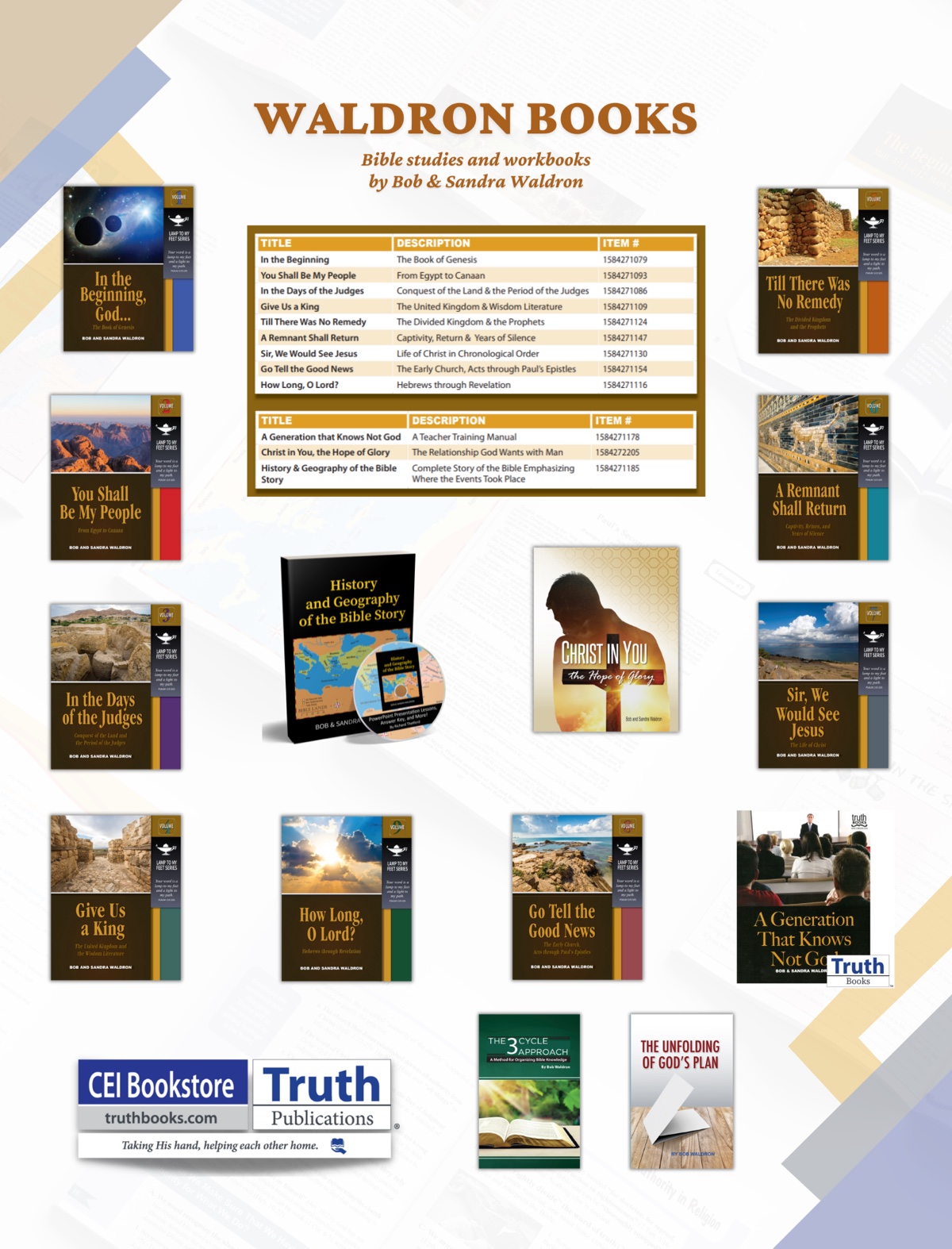
We offer a wide variety of Bible class and study materials, including workbooks designed for children, teenagers, and adults. We publish books for men and women. We offer homeschool products, concordances, dictionaries, history books, handbooks, and other reference materials. Truth Publications also produces the Truth Commentary Series, along with Truth Magazine, which has been in circulation for 69 years. We also host the Truth Lectures at Athens Bible School (ABS) each summer. When searching for reliable Bible study materials, please visit the bookstore in Athens, or our online website.
Let me recommend several Bible resources that would make up a good starter set of Bible study tools. First, select a good Bible dictionary. Over the years, I have found that Nelson’s Illustrated Bible Dictionary or similar works like the Revell Bible Dictionary are useful tools. They are written at a high school level, not requiring scholarly understanding or a deep knowledge of the original languages. Such resources provide brief definitions of words and concise explanations of biblical concepts, people, places, or events, making them a good “go to” tools for study. If you come across an unfamiliar person or place in the biblical text you are studying, a quick way to find a summary article is through these dictionaries, which are usually concisely written and helpful in broadening your understanding.
Second, I recommend getting a good book of maps and charts. These are very helpful in understanding the places where the Bible story unfolds and the routes that Bible characters followed. For example, Abraham’s journey from Ur of the Chaldees to the land of Canaan via the Fertile Crescent becomes clearer if one understands the topography of the Middle East. Carl G. Rasmussen’s Atlas of the Bible, published by Zondervan, offers detailed maps and brief descriptions of the geographical regions in which the Bible story occurs, detailing the peoples and places associated with successive historical periods. Truth Books also offers an excellent set of map books for the Old and New Testaments by Matt Hennecke, available here.
A colorful, well-drawn map book makes it much easier to trace the routes of the patriarchs or follow the descendants of Abraham as they sojourned in Canaan, went down into Egypt, and then came up as a nation, journeyed through the wilderness, conquered the land of promise, experienced the tumultuous time of the judges, stabilized and expanded during the time of the united kingdoms, fragmented during the divided kingdom, were later deported into Assyria and Babylon, and then returned during the Persian Empire. The same is true for following the ministry of Jesus and His journeys through Galilee, Samaria, Judea, and later, the Apostle Paul on his missionary journeys. Such resources do not interfere with biblical teaching (as can commentaries from unreliable sources) but can be very helpful in grounding our understanding of Scripture in the historical context in which the events occurred.
When using Greek lexicons for studying God’s word, it’s important to understand both the proper and improper ways to utilize these tools. With Greek lexicons, we are essentially discussing dictionaries that define the words used in the original biblical texts of the New Testament Greek or the Old Testament Hebrew. Lexicons are useful because they provide distinct shades of meaning to particular words as used in varying contexts. Just as in English, Greek words may have a general meaning but can have different shades of meaning depending where it appears and how it is used in Sacred Scripture.
One of the helpful ways in which lexicons can benefit our study of the Bible is by providing differing definitions. Sometimes a word may have three or four distinct sub-meanings, and lexicons often group passages where the word is used in a similar fashion. This helps us gain a better understanding of the use of words and the varied meanings they can communicate. It is often very helpful to consult several lexicons. For example, we have some old standards that are now in the public domain because of their age.
Strong’s Concordance is a Bible concordance that provides an index of every word in the King James Version (KJV) of the Bible. James Strong, an American theologian, created it. The concordance includes Hebrew and Greek lexicons, which help in studying the Scriptures by providing basic definitions. You can search for words by their Strong’s word number or by the English word.
Other useful older works include Vine’s dictionary and Thayer’s lexicon. Vine’s Expository Dictionary of New Testament Words is a comprehensive reference work by W.E. Vine. It provides detailed definitions and explanations of Greek words used in the New Testament, offering insights into their meanings and usage in various contexts. This dictionary is widely used in biblical studies to help understand the nuances of New Testament Greek and is considered a valuable resource for scholars, pastors, and students. Thayer’s Greek-English Lexicon of the New Testament is a comprehensive lexical work by Joseph Henry Thayer. It was originally published in 1889 and provides dictionary definitions for each Greek word in the New Testament. Known for its scholarly references, etymology, and detailed definitions and usage of words, this lexicon has proven useful to generations of Bible students.
Joseph Henry Thayer offers colorful and vivid descriptions. For example, he defines aselgeia, which in Galatians 5:19 is rendered “lasciviousness” (KJV), “sensuality” (NASB), or “promiscuity” (CSB) as “the conduct and character of one who is aselges (a word which some supposed to be compounded of the alpha prefix [which negates the meaning of the following word] and Selge, the name of a city in Pisidia whose citizens excelled in strictness of morals). It signifies”unbridled lust, excess, licentiousness, lasciviousness, wantonness, outrageousness, shamelessness, insolence. . .” and according to Fritzsche, is used of “wanton (acts or) manners, as filthy words, indecent bodily movements, unchaste handling of males and females, etc.” (Thayer, 79-80).
Another notable example is Thayer’s definition of kōmos, which is rendered “carousing” (NASB) or “revellings” (KJV) in 1 Peter 4:3. After defining it as “a revel” or “carousal,” Thayer adds that the Greek writers properly used it to describe “a nocturnal and riotous procession of half-drunken and frolicsome fellows who after supper parade through the streets with torches and music in honor of Bacchus or some other deity, and sing and play before the houses of their male and female friends; hence used generally, of feasts and drinking-parties that are protracted till late at night and indulge in revelry or revellings” (Thayer, 367).
We also have modern works A Greek-English Lexicon of the New Testament and Other Early Christian Literature. Bauer’s Lexicon, also known as Bauer, Arndt, and Gingrich (BAG) or Bauer-Danker-Arndt-Gingrich (BDAG), is one of the most highly respected dictionaries of Biblical Greek. The original German work was extensively revised by Walter Bauer, and the English edition was translated and adapted by William Arndt and F. Wilbur Gingrich. The second English edition, published in 1979, included contributions from Frederick W. Danker, and the third English edition, published in 2000, is known as BDAG. This lexicon provides comprehensive definitions and usage of Greek words in the New Testament and other early Christian literature.
Comparing definitions from one lexicon to another can be as useful as comparing the different ways a verse is translated into English. However, when using such resources, we need to recognize bias. Anytime we deal with the works of men, there is the potential for the authors to introduce their own ideas into the study of the biblical text rather than drawing out the message that is there. Remember the difference between exegesis and eisegesis. We want to learn what Sacred Scripture says, understand it, and do it, not superimpose our preconceptions upon the text. That is not honest or accurate Bible study. Recognizing bias and understanding the theological perspective of particular authors can sometimes help us navigate comments that seem confusing or contradictory—if they allow their theology to influence how they define biblical words.
Misinterpreting or selectively using lexical entries to support a particular theological stance can be misleading. It’s crucial to approach lexicon entries with an open mind and a willingness to understand the original intent of the text. Therefore, we need to be careful not to cherry-pick a definition or universally apply one meaning to all passages where it occurs, especially when the context clearly indicates a different shade of meaning is intended.
The Greek noun agapē, derived from the verb agapaō refers to “love, goodwill” (Thomas, 26). In the NASB, it is rendered “beloved” (1x), “love” (1x), “love” (112x), “love feasts” (1x), “love’s” (1x).
The first definition that BDAG offers is helpful: Agapē is defined as “the quality of warm regard for and interest in another, esteem, affection, regard, love (without limitation to very intimate relationships, and very seldom in general Greek of sexual attraction).” It can refer to love that flows from human hearts without indicating the one who is the object of such interest. However, sometimes the object is expressly mentioned, including both human beings, and God or Christ. It can also identify love that originates with God and Christ toward humanity, and also the close relationship that exists between God and Christ within the triune Godhead.
However, the second definition that BDAG offers is problematic: The lexicon says agapē can also refer to “a common meal eaten by early Christians in connection with their worship, for the purpose of fostering and expressing mutual affection and concern, fellowship meal, a love-feast.” In discussing this “love feast,” BDAG parenthetically adds, “the details are not discussed in the NT, although Paul implicitly refers to it 1 Corinthians 11:17ff. . .”
When we look more deeply at this alleged definition of agape as referring to a common meal, the only biblical citations offered are Jude 12 and 1 Corinthians 11:17ff, which they say “implicitly refers to” a fellowship meal, or a love-feast. Moreover, they acknowledge “the details are not discussed in the NT.”
This creates a problem for Christians who are committed to following the New Testament pattern. Paul’s point in 1 Corinthians 11 is that the Lord’s Supper, which is a spiritual memorial, is distinct from meals that can be shared on a strictly social basis.
But in giving this instruction, I do not praise you, because you come together not for the better but for the worse. For, in the first place, when you come together as a church, I hear that divisions exist among you; and in part, I believe it. For there must also be factions among you, so that those who are approved may become evident among you. Therefore, when you meet together, it is not to eat the Lord’s Supper, for in your eating, each one takes his own supper first; and one is hungry, and another is drunk (1 Cor. 11:17-21).
Rebuking the Corinthians’ carnal corruption of the Lord’s Supper, the inspired apostle says, “What! Do you not have houses in which to eat and drink? Or do you despise the church of God and shame those who have nothing? What shall I say to you? Shall I praise you? In this I will not praise you” (v. 22).
BDAG rightly acknowledges that “meals accompanied by religious rites and in a religious context were conducted by various social groups among the Greeks from early times.” However, it was different for early Christians. The observance of the Lord’s Supper has a spiritual focus in which we look backward to the cross. Jesus said, “Do this in remembrance of Me.” In observing this memorial meal, we look forward to the Lord’s second coming: “For as often as you eat this bread and drink the cup, you proclaim the Lord’s death until He comes” (v. 26). In observing the Lord’s Supper in the assembly of the saints on the first day of the week, it is an outwardly focused public announcement: “you proclaim the Lord’s death” (v. 26). Disciples must also look inward in honest self-examination: “But a man must examine himself, and in so doing he is to eat of the bread and drink of the cup” (1 Cor. 11:28).
The Corinth church turned this memorial feast into a common meal in which they evidenced base tendencies. They were celebrating it in a biased fashion where one was hungry and another was drunken; by refusing to wait for one another, and shaming those who had nothing, they manifested a spirit of partiality (v. 21-22, 33). Self-indulgent gluttonous inebriation was more characteristic of a feast dedicated to Bacchus than a memorial remembrance of the death of our sinless Savior.
In referring to false teachers who crept in unnoticed, and turned the grace of God into lasciviousness, Jude said:
These are the men who are hidden reefs in your love feasts (agape) when they feast with you without fear, caring for themselves; clouds without water, carried along by winds; autumn trees without fruit, doubly dead, uprooted (Jude 12).
It is biblically inaccurate to define agape, which is rendered “love feast” only in Jude 12, where its contextual meaning obviously refers to the spiritual fellowship that is shared by saints when they come together to worship (and potentially has specific application to the observance of the Lord’s Supper, that was celebrated by the early disciples on the first day of the week), and say it refers to “a common meal.” This definition directly contradicts the teachings of the apostle Paul in 1 Corinthians 11 and is inconsistent with the example of the early church in which we see that the clear emphasis of their assemblies was spiritual.
The Greek word aiōn signifies a time period of “continued duration,” “a space of time,” or “an age” (Thomas, 165). In the NASB, it is rendered “age” (20x), “ages” (6x), “ancient time” (1x), “beginning of time” (1x), “course” (1x), “eternal” (2x), “eternity” (1x), “ever” (2x), “forever” (27x), “forever and ever” (20x), “forevermore” (2x), “long ago” (1x), “never” (1x), “old” (1x), “time” (1x), “world” (7x), “worlds” (1x).
BDAG offers several distinct definitions of aiōn. It can refer to “(1) a long period of time, without reference to beginning or end”—including the distant past (Acts 3:21), or, the time to come which, if it has no end, is also known as eternity (John 6:51). Second, it can refer to “a segment of time as a particular unit of history.” This includes “the present age (nearing its end)” (Luke 20:34) or “the age to come” (Luke 20:35). Third, it can refer to “the world as a spatial concept” (Heb. 1:2). Finally, it is also defined as “the Aeon as a person, the Aeon.”
Three New Testament passages are cited under this heading: Ephesians 2:2; 3:9, and Colossians 1:26.
in which you formerly walked according to the course of this world, according to the prince of the power of the air, of the spirit that is now working in the sons of disobedience (Eph. 2:2).
and to bring to light what is the administration of the mystery which for ages has been hidden in God who created all things (Eph. 3:9).
that is, the mystery which has been hidden from the past ages and generations, but has now been manifested to His saints (Col. 1:26).
In early Gnosticism, the term “Aeon” refers to a series of emanations from the divine being, or God. These emanations, or Aeons, are considered to be spiritual beings or entities that exist in a hierarchy, with each Aeon being progressively less divine as they move further away from the original source. The concept of Aeons was used to explain the relationship between the divine and the material world, with the lowest Aeons being almost corporeal and associated with matter and evil. This dualistic view posited that the spiritual world was good, while the material world was inherently evil.
The inspired authors of the New Testament confronted early Gnosticism in several ways. For instance, in the epistles of John, particularly 1 John, the apostle addresses the Gnostic menace by emphasizing the true knowledge of God. John uses the recurring assertion “we know” to define what constitutes true knowledge, contrasting it with the false teachings of the Gnostics. Paul also addresses early Gnostic views in his letter to the Colossians. He warns against the “elemental spirits of the universe” and the “tradition of men” that the Gnostics promoted. He emphasizes the sufficiency of Christ and the need to be rooted and grounded in Him, rejecting the Gnostic idea that special knowledge, or gnosis, is required for redemption.
We do an injustice to the biblical text by taking a Greek word that appears both in the Bible and in the writings of early Christian literature, some of which were heretical, and interpolating back into the biblical text the misuse of a word or the false concepts associated with a word in uninspired writings. The Scripture is canonical, meaning it is recognized as the inspired Word of God. Many church fathers maintained varying levels of commitment to following the biblical pattern, some of whom were entirely given to false teaching and the acceptance and promotion of the various errors associated with the age, whether it be Gnosticism, Judaism, or other heresies that arose over time. Because this was a Greek-speaking world, they communicated in Koine Greek, but that does not mean their misuse of the word should be read back into the biblical text and made the basis on which we understand the inspired message.
Please note that this has application to the issues discussed in two separate articles that appear in this issue of Truth Magazine. Allen Dvorak offers a warning against some in the brotherhood who are redefining porneia. Steve Wolfgang also refers to the same movement that is afoot among brethren, in which the biblical word porneia is being broadened in its meaning.
This Greek word has a very specific meaning in the Bible. However, outside of the New Testament, one can occasionally find isolated, more generalized uses of the word. However, we should not make the mistake of taking a word that is used very loosely in some esoteric ancient writing, and then superimpose that meaning on Sacred Scripture where contextually it is limited and very specific in scope.
As lexicons go through successive versions, they sometimes alter or change the definitions they assign to words. For example, let’s examine how A Greek-English Lexicon of the New Testament and Other Early Christian Literature by William Arndt et al. has approached the Greek verb psallō, which is translated “making melody” in Ephesians 5:19.
And do not get drunk with wine, for that is dissipation, but be filled with the Spirit, speaking to one another in psalms and hymns and spiritual songs, singing and making melody with your heart to the Lord (Eph. 5:18-19).
The original version, often referred to as BAG (Bauer, Arndt, and Gingrich), was first published in 1957. This edition was a translation and adaptation of Walter Bauer’s German lexicon, Griechisch-deutsches Wörterbuch zu den Schriften des Neuen Testaments und der übrigen urchristlichen Literatur.
The second edition, known as BAGD (Bauer, Arndt, Gingrich, and Danker), was published in 1979. This edition included significant updates and revisions by Frederick W. Danker, who incorporated new findings from papyri and inscriptions, providing a more comprehensive view of the Greek language as used in the New Testament and other early Christian literature.
The third edition, commonly referred to as BDAG (Bauer, Danker, Arndt, and Gingrich), was published in 2000. This edition is considered the most authoritative and comprehensive version. Danker’s extensive knowledge of Greco-Roman literature, papyri, and epigraphs contributed to a more panoramic view of the world of Jesus and the New Testament.
Each version of the lexicon has built upon the previous editions, incorporating new research and discoveries to provide a more accurate and comprehensive understanding of the Greek language as used in the New Testament and other early Christian writings.
However, consider how the different versions of A Greek-English Lexicon of the New Testament and Other Early Christian Literature approach the definition of the Greek word psallō.
The Greek verb psallō, derived from psaō (to rub) means “to pull, twitch, twang, play” (Thomas, 5567). In the NASB, it is rendered “making melody” (1x), “sing” (3x), and “sing praises” (1x).
The original 1957 version of Bauer’s lexicon, often referred to as BAG (Bauer, Arndt, and Gingrich), defines psallō primarily as “to pluck” or “to play a stringed instrument.” This definition emphasizes the physical action of plucking strings, which was the original meaning of the word in classical Greek. The lexicon also notes that in the New Testament, psallō came to mean “to sing” or “to make melody,” reflecting its use in a more general sense of making music.
The second edition, published in 1979 and known as BAGD (Bauer, Arndt, Gingrich, and Danker), expands on the original definition by incorporating more recent scholarly research. This edition acknowledges the classical meaning of psallō as “to pluck” or “to play a stringed instrument” but places greater emphasis on its New Testament usage as “to sing” or “to make melody.”
The 2000 edition of BDAG defines psallō as “to sing” or “to make melody,” with a particular focus on its use in early Christian worship. The lexicon notes that psallō originally referred to plucking strings but evolved to mean singing “with or without instrumental accompaniment, sing, sing praise.”
In discussing Ephesians 5:19, BDAG notes that psallō (making melody) appears with adō (singing), and says, “the question arises whether a contrast between the two words is intended.” Continuing the discussion, they say,
The original meaning of psallō was “pluck,” “play” (a stringed instrument); this persisted at least to the time of Lucian. In the Septuagint (LXX), psallō frequently means “sing,” whether to the accompaniment of an instrument (Ps. 32:2, 97:5 al.) or not, as is usually the case (Ps. 7:18; 9:12; 107:4 al.). This focus on singing continued until psallō in Modern Greek means “sing” exclusively; compare psaltes = singer, chanter, with no reference to instrumental accompaniment.
Although the New Testament does not voice opposition to instrumental music, in view of Christian resistance to mystery cults, as well as Pharisaic aversion to musical instruments in worship, it is likely that some such sense as to make melody is best understood in this Ephesian passage. Those who favor “play” may be relying too much on the earliest meaning of psallō (BDAG, 1096).
Ultimately, the 2000 edition makes the same point as the 1979 version. However, the fact that they say psallō refers to “singing with or without instrumental accompaniment” provides an opening to those who would add instruments of music to Christian worship.
How do other lexicons define this word? According to W. E. Vine, psallō first primarily meant “to twitch, twang,” then, “to play a stringed instrument with the fingers,” and hence, in the Septuagint (LXX), meant “to sing with a harp, sing psalms.” However, in the New Testament, it denotes “to sing a hymn, sing praise;” in Ephesians 5:19, “making melody” (for the preceding word, adō, see SING). Elsewhere, it is rendered “sing” (Rom. 15:9; 1 Cor. 14:15; in Jas. 5:13, ‘let him sing praise’ [RV], ‘let him sing psalms’ [KJV])” (Vine, 402).
The Theological Dictionary of the New Testament, Abridged in One Volume, also affectionately known as “Little Kittel,” discusses the combined usage of psalmos (psalms) and humnos (hymns) along with their verb equivalents. After discussing their usage in the Greek sphere, and in the Old Testament and Judaism, Kittel describes this word group usage in the New Testament:
Humnos occurs only in Colossians 3:16 and Ephesians 5:19. Christ’s word lives in the church’s songs to God, which extol from the heart his saving work (Col. 3:16). In Ephesians 5:19, praise is addressed to the Lord with God’s saving work again as the theme. Emphasis is given in verse 19 by the verbs “singing and making melody” (cf. Ps. 27:6). Psallontes does not now denote literally playing on a stringed instrument, and the psalms, hymns, and spiritual songs hardly refer to different kinds of texts. In 1 Corinthians 14:26, psalmos is a Christian song which the individual sings at worship.
And now my head will be lifted up above my enemies around me, And I will offer in His tent sacrifices with shouts of joy; I will sing, yes, I will sing praises to the LORD (Ps. 27:6).
and for the Gentiles to glorify God for His mercy; as it is written, “THEREFORE I WILL GIVE PRAISE TO YOU AMONG THE GENTILES, AND I WILL SING (psallō) TO YOUR NAME” (Rom. 15:9).
What is the outcome, then? I will pray with the spirit and I will pray with the mind also; I will sing (psallō) with the spirit and I will sing (psallō) with the mind also (1 Cor. 14:15).
What is the outcome then, brethren? When you assemble, each one has a psalm (psalmos), has a teaching, has a revelation, has a tongue, has an interpretation. Let all things be done for edification (1 Cor. 14:26).
speaking to one another in psalms (psalmos) and hymns (humnos) and spiritual songs, singing and making melody (psallō) with your heart to the Lord (Eph. 5:19).
Let the word of Christ richly dwell within you, with all wisdom teaching and admonishing one another with psalms (psalmos) and hymns (humnos) and spiritual songs, singing with thankfulness in your hearts to God (Col. 3:16).
Is anyone among you suffering? Then he must pray. Is anyone cheerful? He is to sing praises (psallō) (Jas. 5:13).
Remember, the best way to understand the Scriptures is to compare reliable English translations. Use Greek resources sparingly, and if in doubt, check with the preacher or an elder. Immerse yourself in the biblical text, follow cross-references, and then, where needed, take advantage of other study resources.
Arndt, William, et al. A Greek-English Lexicon of the New Testament and Other Early Christian Literature (BDAG). Chicago, IL: University of Chicago Press, 2000.
Arndt, William, et al. A Greek-English Lexicon of the New Testament and Other Early Christian Literature. Chicago: University of Chicago Press, 1979.
Kittel, Gerhard, Gerhard Friedrich, and Geoffrey William Bromiley. Theological Dictionary of the New Testament, Abridged in One Volume. Grand Rapids, MI: William B. Eerdmans Publishing Co., 1985.
Thayer, Joseph Henry. A Greek-English Lexicon of the New Testament: Being Grimm’s Wilke’s Clavis Novi Testamenti. New York: Harper & Brothers, 1889 via Logos Bible Software, 2025.
Thomas, Robert L. New American Standard Hebrew-Aramaic and Greek Dictionaries: Updated Edition. Anaheim, CA: Foundation Publications, Inc., 1998.
Vine, W. E., Merrill F. Unger, and William White Jr. Vine’s Complete Expository Dictionary of Old and New Testament Words. Nashville, TN: Thomas Nelson Publishers, 1996.
Mark Mayberry has labored with the Adoue Street church of Christ in Alvin, TX, since 1998, where he serves as the evangelist and an elder. The church website is here. His website is here. He can be reached here.




By Kyle Pope
Synopsis: Did Jesus use the words “Your kingdom come” in the model prayer in a corporate or a personal sense? Within our own culture, if we were to use these words today, how might the prevalence of premillennial error leave the wrong impression to those who might hear us?
In Jesus’s model prayer in Matthew 6:9-13, He prayed, “Your kingdom come. Your will be done on earth as it is in heaven” (v. 10, NKJV). At least as early as 1867, brethren wrestled with the question posed in the title of this article. Is it appropriate to pray this element of the model prayer, or should we no longer make this request since the Lord’s kingdom has now been established in the reign of Jesus Christ over His kingdom—the church? An anonymous article published in Lard’s Quarterly, a journal edited by restorationist preacher Moses Lard (1818-1880), argued for a personal application of the appeal of this prayer, claiming, “so long as there is one sinner unconverted, or one saint unsanctified; so long will we have need for the petition ‘thy kingdom come’” (July 1867, 249). In this, the author was arguing that prayer for the coming of the kingdom was a prayer for individual souls to yield their hearts in submission to Christ as King. Moses Lard, recognizing that some might disagree with this assertion, added an editor’s note after the article arguing, “I cannot pray ‘thy kingdom come;’ but I profoundly can [pray], thy ‘everlasting kingdom’ come” (ibid. 252). In his commentary on Matthew and Mark, the nineteenth-century restorationist preacher, J.W. McGarvey, argued, “it is improper to retain the words, and yet attach to them a sense different from that in which Jesus employed them” (Commentary on Matthew and Mark, 65). In this, McGarvey assumed that Jesus meant these words exclusively of the coming establishment of the Lord’s kingdom, that would come on the Day of Pentecost recorded in Acts 2. The question is, can we determine exactly in what “sense” the Lord originally employed these words? Later, in the same sermon, Jesus used an individual rather than a corporate sense of seeking the kingdom (Matt. 6:33). Jesus commanded individuals to seek and submit their hearts to the Lord’s kingship. Could that have been His meaning in the model prayer? If so, a prayer for the kingdom to come would be a prayer for souls personally to seek the kingship of Christ in their lives.
It may be significant that the words “Your kingdom come” are not repeated later in the New Testament in examples of apostolic prayer. Instead, we find phrases of a slightly different emphasis. Paul used the Aramaic phrase maranatha, “O come Lord” (1 Cor. 16:22). John, near the end of the great vision of Revelation, cried out, “Come Lord Jesus” (Rev. 22:20). Yet, these very writers describe the kingdom as in existence in the first century. Paul told the Colossians that God “delivered us from the power of darkness and conveyed us into the kingdom of the Son of His love” (Col. 1:13). John wrote, “He has made us to be a kingdom, priests to His God and Father; to Him be the glory and the dominion forever and ever. Amen” (Rev. 1:6, NASB). Do these statements show that the apostles recognized that it was no longer necessary to pray for the kingdom to come (in a corporate sense), but that we should pray for Christ’s return in final judgment?
It might be argued that, if “Your kingdom come” is no longer applicable, it destroys the force of Jesus’s model as an example to Christians of all ages. We should note, however, that there are many things for which the emphasis in prayer has changed this side of the cross. McGarvey demonstrates this as it relates to Jesus’s mediation on behalf of Christians. The model prayer makes no mention of prayer in the name of Jesus, but McGarvey notes, “We must also insert the name of Jesus as the mediator through whom we pray: for on the night of the betrayal He taught His disciples to thenceforward ask in His name (John 16:24; see also Col. 3:17)” (ibid., 65). This command of Jesus doesn’t rob the model prayer of its force, but it introduces the relationship of mediation that did not exist until after the cross.
Whether we take the appeal in a corporate or an individual sense, none of us can completely remove ourselves from the environment and culture in which we live and communicate. Words and concepts that attain a specific sense within a culture cannot be wholly divorced from the meaning they hold within that culture. In our day, apostasy within the denominational world has so permeated our culture that many (if not most) in the religious world conceive of the “kingdom” as a future, political, material, and geographically identifiable entity that will come some day in the future. For example, Baptist commentator John R. Rice, in his commentary on Matthew, expresses the typical premillennial view. Commenting on the meaning of the words “Your kingdom come,” he argues, “This is clearly a prayer for the reign of Christ on earth. That kingdom has not yet come” (105). This view, of course, ignores the fact that John and Paul (as noted above) acknowledged that it had come in their day (see Rev. 1:6; Col. 1:13). Modern Jews hold a similar view to that expressed by Rice. Jews today still use the Kaddish—a ritual prayer originally recited at the end of a rabbinical sermon in the synagogue. Its use in early Judaism is attested in the Babylonian Talmud (Sotah 49a). While it is preserved in different forms, a common version prays “may His kingdom come in your lifetime.” If this appeal was offered in the first century, it may indicate the force Jesus’s words would likely have held to His Jewish audience. They were probably accustomed to the anticipation of an earthly political kingdom they hoped would come in the future. The Babylonian Talmud records that the first-century teacher, Johanan ben Zakkai, taught that any ritual prayer must include mention of the kingship of God (Berachoth 40b). Modern Conservative and Orthodox Jews still continue to hope for such an earthly kingdom.
Certainly, we must never allow human misconceptions to determine what we believe and teach. We must proclaim the truth about God’s kingdom, whether or not it runs contrary to popular thinking. However, in every section of the model prayer, Jesus is not dictating the exact words that are to be spoken, but the general elements that constitute acceptable prayer to God. Given that modern Jews and premillennialists apply this appeal in a corporate sense, to use the words “Your kingdom come” today (with no modification) could certainly give the wrong impression to those who hear us.
Kyle Pope preaches for the Vestavia church of Christ in Vestavia Hills, AL. He has written several books published by Truth Publications. Go here for more information. The church website is here. He can be reached here.



By Diana Dow
Synopsis: God designed women to desire children. Knowing that after the joy of having a new baby, everyday life can become challenging, He provided older women as a wealth of experience and love to help the young mother during difficult times.
Is there anything more beautiful than a mother with her young child? We have a little baby boom going on in our congregation. It is such a joy to see these young women take to being mothers as if it is the most natural thing to do. God designed woman for this purpose.
Women have been giving birth and raising babies since the beginning. I have often wondered what it was like for Eve when she gave birth to Cain. She had no midwife, no doctor, not even a mother who had “been there and done that” before her. What a special moment it must have been when she reached down and brought her baby boy to her chest. All the discomfort of the previous months and the pain of labor were forgotten. This tiny human, so vulnerable, was completely dependent on her for nourishment, comfort, and protection. Without reading a book or attending a class, Eve’s maternal instinct kicked in, and she did what came naturally. Wrapping him in her arms, she offered her breast to her rooting baby, and so began a beautiful relationship.
Centuries later, Paul recognized the power of this tender relationship as he compared his care for the Thessalonian brethren with that of a nursing mother: “But we were gentle among you, just as a nursing mother cherishes her own children” (1 Thess. 3:7). He knew that, as newborn babes in Christ, these young Christians needed gentle guidance from one who loved them, and he happily filled that position.
We see throughout history, and know from our own experience, that women desire to have children. This God-designed desire assures the fulfillment of His command to “be fruitful and multiply” and is highlighted in the stories of Sarah, Rachel, and Hannah. Their reactions to giving birth after years of being barren show us just how important being a mother is to women.
Sarah laughed in disbelief when she was told she would have a son at the age of ninety, but when she finally held her baby boy in her arms, she was elated. In her joy, she said, “God has made me laugh, and all who hear will laugh with me” (Gen. 21:6).
Rachel longed for a child. The years of watching her sister and their maidservants give birth again and again resulted in feelings of dishonor and disgrace. At the birth of her long-awaited baby boy, she exclaimed, “God has taken away my reproach” (Gen. 30:23). Lest we think her disgrace at being barren was a cultural phenomenon, the same statement was made nearly two thousand years later when John’s mother, Elizabeth, discovered that she was pregnant even though she was past the age of childbearing. “Thus the Lord has done for me in the days when He looked on me, to take away my reproach among people” (Luke 1:25).
Hannah described herself as “a woman of sorrowful spirit.” God answered her tearful prayers for a child, and she fulfilled her promise to Him by taking Samuel to Eli to be raised in the service of God (1 Sam. 1:15).
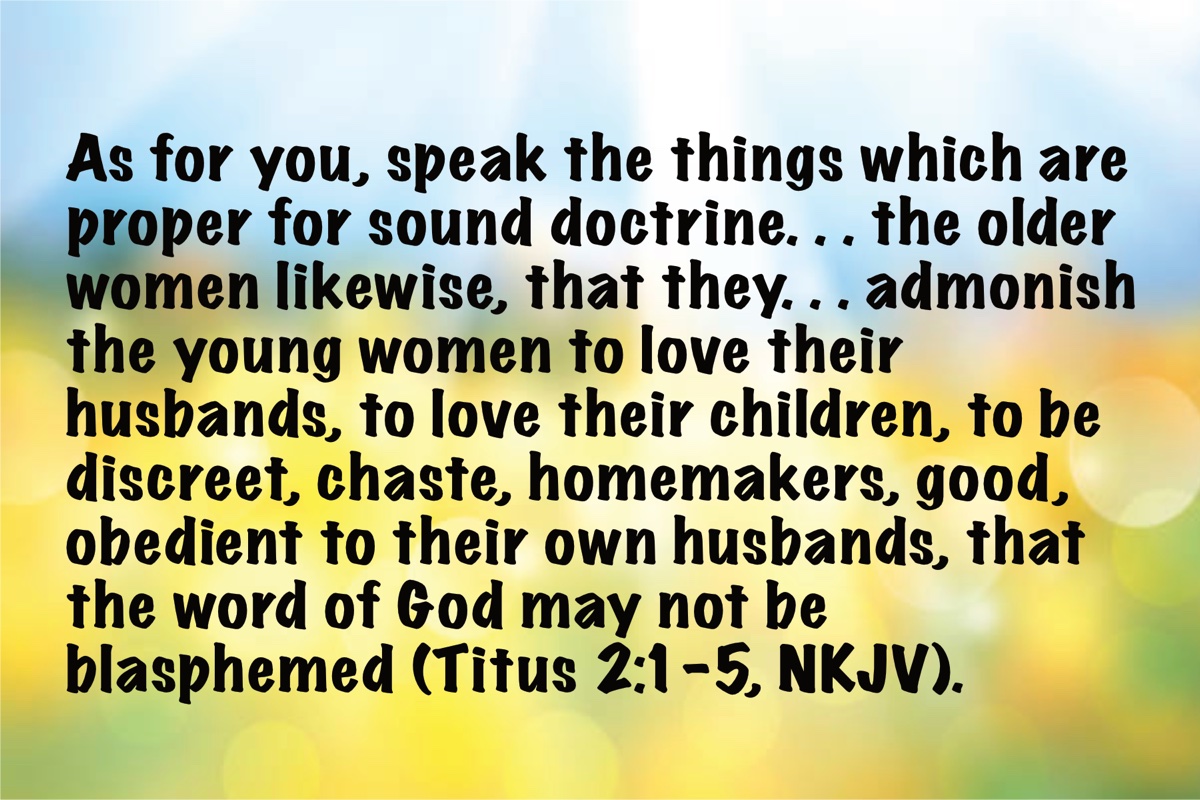
What a blessing for these women. Women who faced the harsh reality that they would live their lives childless had their prayers for a baby answered. What a blessing each one of us receives when we are given children to raise. Truly, our children are gifts from God (Ps. 127:3). Yet, if women desire to have children and realize they are gifts from God, why then did Paul instruct Titus to tell the older women to teach the younger women to love their children? (Titus 2:4). Does not loving our children just come naturally? Yes, and no. There is true joy that comes from giving birth or from being chosen to raise a child, but soon reality sets in, and the hard work begins. Learning from the experience of those who have “been there and done that” can help ease the burden.
Being a mother is a never-ending job. In the earliest stages, there are sleepless nights and exhaustive days. As time goes on, there is disobedience and disrespect that must be reined in. There are days when confrontation is unending, as is also the laundry! There are times when moms just want to take a break. As my mother-in-law used to say when things got overwhelming, “I’m just going to jump in the bayou.” Times such as these require gentle reminding that these challenging days are but for a season. All too soon, our children will be grown and raising families of their own. Cherish these exhaustingly wonderful days.
Children are expensive. Their desire for trinkets, gadgets, and devices grows stronger and more costly as they grow older. These are the days when restraint on the mom’s part is tested. Moms like to make their children happy and enjoy giving them the things and experiences that they want. Toss in some peer pressure from both the child’s and the mom’s peers, and some moms just find it easier to give in, choosing to gratify the child’s every desire to keep peace in the household. Times such as these require gentle reminding that loving our children is teaching them patience, self-control, and how to be good stewards of the money with which God has blessed us.
Children require choices to be made. They need constant supervision for years after they are born. They need to be cared for, protected, and taught that God loves them and that they should love others. He designed the home and family to be the perfect arrangement to meet these needs. Moms can feel like their own ambitions are being pushed to the back burner. Should mom give up her career to give her time and attention to raising her children, or will she choose to hire someone else to raise her child in her place, or is there a compromise that is acceptable to God? Typically, these options mean that the family income is reduced. Either it is reduced to a single income, or a good portion of the second income is used to hire someone to step in as a mom. Times such as these require gentle reminding that we should respect the role God has put us in when He gave us our children and do whatever it takes to fulfill that role.
Paul’s command for older women to teach younger women to love their children is challenging. It is challenging for older women to know the right thing to say and the right time to say it. It is challenging for younger women to take instruction humbly and with an open mind.
Remembering that both women are seeking the same goal—living their life for Christ and raising their children to do the same—can make these sometimes-difficult conversations easier.
As I watch the mothers and babies in our little baby boom, I also see women of all ages coming together to worship God. There is so much experience in our auditorium. Mothers, grandmothers, and great-grandmothers all seeing these precious babies and remembering when they were the exhausted young mom with the precious baby in tow. All cheer the new moms on, being ready to help in any way they can. Passing down knowledge from generation to generation is God’s wisdom on full display.
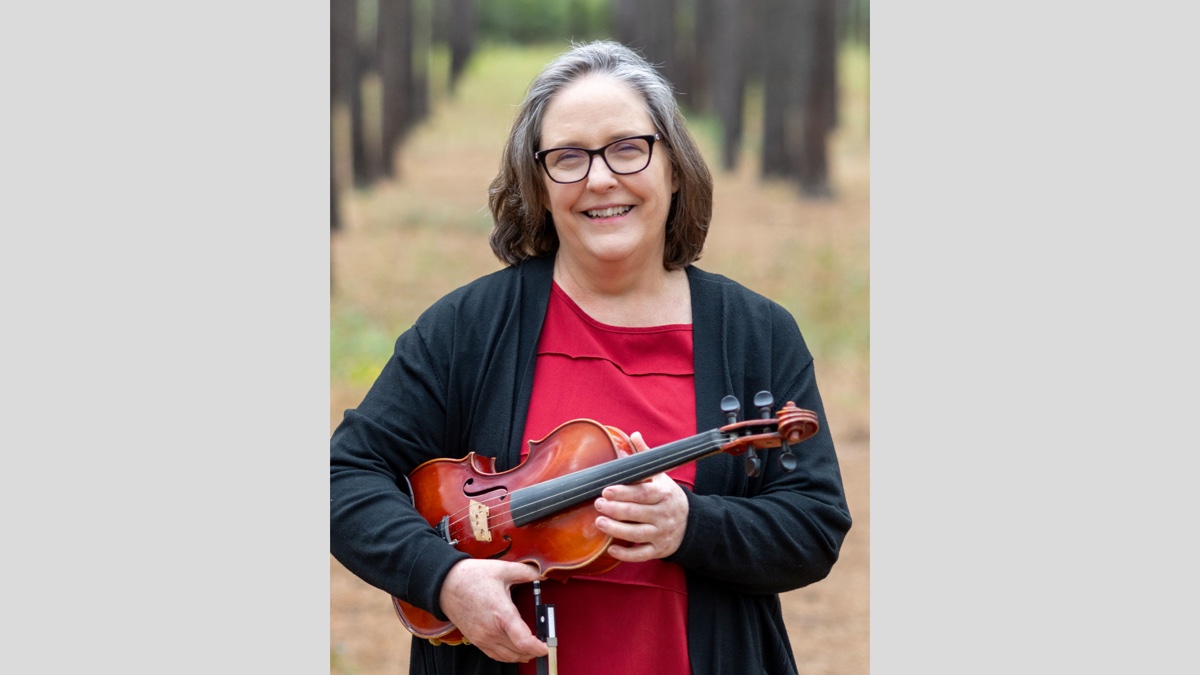
Diana Dow lives in Amarillo, TX, where she teaches private music lessons in her home, online, and at the local community college. She maintains a website about teaching Bible classes here, one about homeschooling here, and one about her music studio here. Diana can be reached here.


By Bruce Reeves
Synopsis: It is vital that our families be taught about the God who delivers us from our enemies, blesses us in adversity, and leads us to His reward in Christ. Our worship of God is grounded in what He has done for us in the past, is doing for us in the present, and will do for us in the future!
The history of God’s people shows that we can experience an amazing turning point in our lives if we return to the God of our salvation (Acts 2:38; 3:19). After seven chapters of Israel’s unfaithfulness and defeat (Num. 14-20), chapter 21 marks a turn that will stretch until chapter 25. Rebellion and judgment will occur occasionally (Num. 21:4-9; 25:1-15), but this section begins with the record of the Israelites defeating the Canaanites in war (Num. 21:1-3) and describes further Israelite victories (Num. 21:21-35). While the first generation continues to pass on, their children get a foretaste of the great deliverance the Lord will provide them in the promised land. Numbers 21 is also known for the bronze serpent story (vv. 4-9), which Jesus used to explain His death and the salvation He offers believers (John 3:14-15).
The Canaanites fight with Israel for the first time since defeating them in Numbers 14:45 and win the initial battle, taking some of the Israelites captive (Num. 21:1). Nevertheless, in a promising sign, the Israelites pray for the Lord’s help instead of grumbling, promising to destroy the cities of the Canaanites (Num. 21:2). Therefore, God granted His people the victory (Num. 21:3). This is another example of the principle of the Lord’s deliverance by grace through the faith of those who serve Him. Did Israel earn or deserve this victory? Of course not. Did they enjoy victory by the power and grace of God? Absolutely! Was it necessary for God’s people to meet the condition of faithful obedience to receive the blessings of His salvation and power? To ask this question is to answer it. Likewise, we will enjoy the blessings, power, and salvation of God through Christ when we demonstrate faith in His promises (Rom. 6:16; Eph. 2:8-9; Heb. 5:8-9).
Israel’s victories quickly turned to tragedy as they abandoned their recently expressed faith (Num. 21:4-9). Having been refused passage through Edom’s territory and not desiring unnecessary conflict, Moses led the people through a far less direct route to Canaan (Num. 20:21). This long route led to Israel’s frustration and grumbling against the Lord and Moses with a familiar line, “Why have You brought us up out of Egypt to die in the wilderness? For there is no food and no water, and we loathe this miserable food” (Num. 21:5). Their current complaints, as was previously the case, were not only aimed at Moses but also at Yahweh (Num. 20:2, 13; 21:5). There are times when God does not take us the most direct route to equip us to fully realize His purpose. He leads us through many trials and tribulations on our way to His eternal rest (Heb. 3:7-4:16).
The Lord immediately brought judgment on Israel by turning the threat of the wilderness against them (Num. 21:6; cf. Deut. 8:15). He sent “fiery serpents among the people and they bit the people so that many people of Israel died” (Num. 21:6). The Scripture uses the term “fiery” as an emphasis on the burning sensation of their venom as their bites left red sores. The term “fiery” is also translated as “venomous” or “poisonous.” As Israel’s sin of complaining continued, God’s judgments occurred more severely and immediately.
God’s people came to Moses confessing their sins and asking for him to intercede for them so the Lord would remove the serpents from among them, and Moses did so (Num. 21:7). In response, the Lord directed Moses to make a bronze serpent and place it on a pole; those bitten needed to look at the serpent to be healed (Num. 21:8-9). While the usage of the bronze serpent seems strange to modern readers, it may not have been foreign to the world in which the Israelites lived. R. Dennis Cole said that in such a ritual, “a form of the source of the disease” was used to counteract the disease itself (1 Sam. 5:6; 6:4-5). It was God who healed the people as conditioned on their obedience to His command. The bronze serpent was kept by the Israelites over the centuries, but it eventually became an object of worship and had to be torn down by Hezekiah. It was called “Nehushtan,” which is similar to the Hebrew words for “bronze” and “serpent” (2 Kings 18:4). It was broken into pieces as part of an effort to reform Israelite worship and abolish existing idolatry.
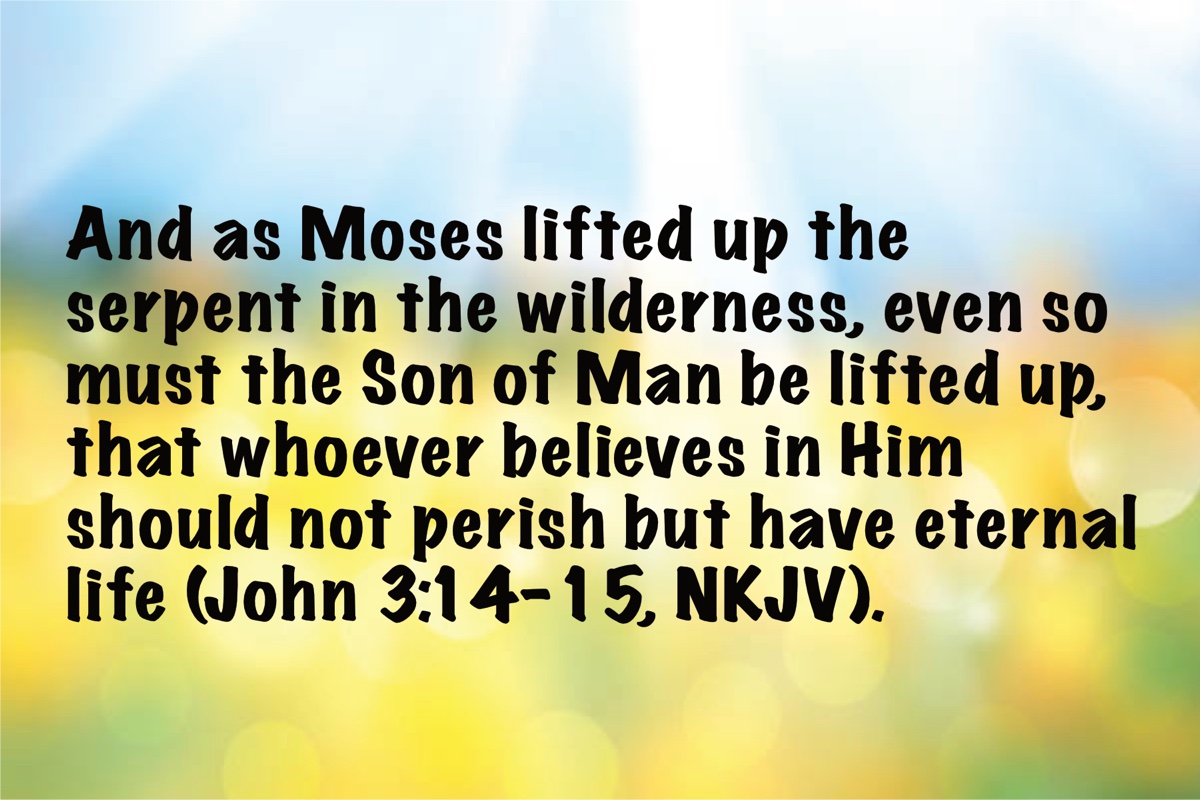
This story foreshadows the spiritual healing we receive from Christ’s sacrifice on the cross. Jesus used the story of Moses and the bronze serpent as an instructive parallel which would be of help to Nicodemus when He says, “No one has ascended into heaven, but He who descended from heaven: the Son of Man. As Moses lifted up the serpent in the wilderness, even so must the Son of Man be lifted up; so that whoever believes will in Him have eternal life” (John 3:13-15). As the Israelites had to obey God’s instructions to be healed, so must sinners today obey the command to believe in Christ to be saved (John 3:16). What God’s justice has demanded, His love has provided. Just as the bronze serpent had been held up to the eyes of the Israelites as the symbol of the serpent plague which had been brought upon them because of their sin against God, Jesus was lifted up for the world to see that those who obediently look to Him in faith might be saved from God’s judgment on sin (John 3:14-17; cf. 8:28; 12:32-34).
Having summarized Israel’s journey to northern Moab (Num. 21:10-20), the next section explains the events that happened along the way (Deut. 2:13-3:29) (Sklar, 279). Sihon, the Amorites’ king, refused the Israelites’ request for safe passage through his territory and came to battle them at Jahaz (Num. 21:22-23). Instead of turning away as they did with Edom, God’s people soundly defeated the Amorites and took over their territory (Num. 20:21). After taking further Amorite territory (Num. 21:32), the Israelites engaged Og, king of Bashan, who ruled over a region east and northeast of the Sea of Galilee. The Lord assured Moses of victory, “Do not fear him, for I have given him into your hand, and all his people and his land; and you shall do to him as you did to Sihon…” (Num. 21:34). Numbers 21:31-35 reveals victories that were meant to embolden the Israelites as they moved into Canaan. They are now in striking distance and Yahweh’s promises will be fulfilled for His people as they serve Him faithfully.
The stories of Israel’s victories were told far and wide. Rahab mentions that she and her people had heard of the triumphs that the Book of Numbers describes:
I know that the Lord has given you the land and that the terror of you has fallen on us, and that all the inhabitants of the land have melted away before you. For we have heard how the Lord dried up the water of the Red Sea before you when you came out of Egypt, and what you did to the two kings of the Amorites who were beyond the Jordan, to Sihon and Og, whom you utterly destroyed. When we heard it, our hearts melted, and no courage remained in any man any longer because of you; for the Lord your God, He is God in heaven above and on earth beneath (Josh. 2:9-11).
These were monumental and impactful affirmations mentioned throughout the Old Testament for Israel to remember because they declared God’s steadfast love and faithfulness to His people, yet we often overlook the details revealed in Numbers. These events are also recounted in Deuteronomy 2:24, 26, 30-32 and Judges 11:19-21. Nehemiah and David both referenced these specific victories in the context of praising the greatness and power of God (Neh. 9:19-31; Ps. 135:5-14; cf. 136:10-26). The history of God’s acts of deliverance for His people matter for us now (Rom. 15:4).
What should we learn from Israel’s victories over her enemies? We will be victorious over all spiritual adversaries if we trust His gracious power and obey His word. We must remember His past faithfulness as we move forward in doing His will. We must tell our children and grandchildren of His mercy and goodness from the past so they will know who He is in their present and future. It is vital that our families be taught about the God who delivers us from our enemies, blesses us in adversity, and leads us to His reward in Christ. Our worship of God is grounded in what the Lord has done for us in the past, is doing for us in the present, and will do for us in the future!
Bruce Reeves has labored with the Highway 65 church of Christ in Conway, AR, since 2000. He and his wife, Rachel, have one child. The church website is here. He can be reached here.


By Shane Carrington
Synopsis: Walking with Jesus into Jerusalem for His triumphal entry teaches us that He is the Davidic King and the Prophet that Moses said would come. It also shows us the importance of being faithful to Jesus as our King and God’s Spokesman.
Jesus had previously entered the city of Jerusalem, but never in this fashion. He had arrived quietly as a baby in arms and later as a twelve-year-old boy. This time, our Lord rode in on the back of a donkey: a humble “beast of burden” (Matt. 21:5). While His reception was befitting royalty, Jesus was “gentle and humble in heart,” providing “rest for your souls” (Matt. 11:29). This humble King of kings and Lord of lords provided victory through death, not earthly conquest.
As Jesus entered Jerusalem, numerous people actively participated. Christ commissioned two unnamed disciples to secure His transport. These same disciples laid their outer garments on the back of the donkey to act as Jesus’s saddle (Matt. 21:6-7). Imagine the scene they beheld as they walked with Him into the city. They had likely never observed anything like that! Jesus was the focal point of the crowd, and the disciples were right there with Him.
The crowds also participated. They removed their outer garments and lined the road with them (Matt. 21:8). These coats, and the palm branches they cut and spread upon the road, made quite the “red carpet” upon which Jesus arrived. They welcomed Him with open arms, praising Him as Christ, their King, declaring:
Hosanna to the Son of David; Blessed is He who comes in the name of the Lord; Hosanna in the highest (Matt. 21:9)!
While they might not have understood all the implications of their words of praise, they confidently believed Jesus was their long-awaited Messiah. When asked who He was, the same crowds said, “This is the prophet Jesus, from Nazareth in Galilee” (Matt. 21:11). “Most of the crowd” (Matt. 21:8) acknowledged Jesus as their King (Zech. 9:9) and Prophet (Deut. 18:15). Numerous people in the city exalted Him this way! Jesus’s reputation preceded Him, but there was more to Christ than the crowds realized.
Many people knew that Jesus was someone great, with a number of them believing Him to be a prophet of God: “John the Baptist… Elijah… Jeremiah… one of the prophets” (Matt. 16:13-14). As He rode into Jerusalem upon a donkey, though, many acknowledged Him as the Messianic King, “the Son of David” (Matt. 21:9), and “the prophet Jesus, from Nazareth in Galilee” (Matt. 21:11). While they did not understand the depth of their claims, the words and life of Jesus clarified the reality embedded in what they declared.
He fulfilled Old Testament prophecies about the Christ:
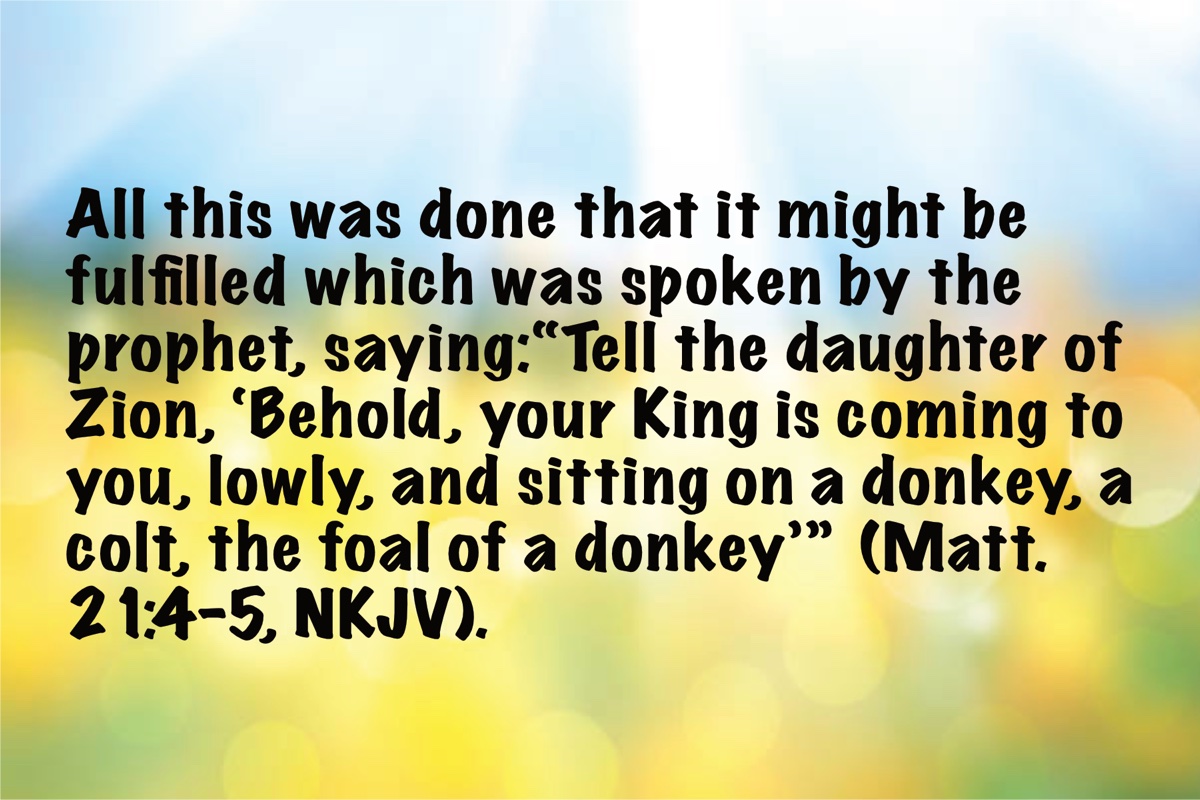
Behold, your King is coming to you, gentle, and mounted on a donkey, even on a colt, the foal of a beast of burden (Matt. 21:5).
The kingship of Jesus is the point of Matthew’s gospel. From beginning to end, he supplied royal facts concerning Jesus:
Jesus is the Christ or Messiah (Matt. 1:1, 6, 16, 18).
Jesus came to establish God’s kingdom (Matt. 3:2; 4:17).
Jesus promised to build His church, giving the apostles the “keys” to this kingdom (Matt. 16:18-20).
Jesus has “all (kingly) authority” in heaven and on earth (Matt. 28:18-20).
As King, Jesus now reigns at the right hand of the Father in heaven (Acts 2:22-36). Peter described Him as “both Lord and Christ” (Acts 2:36). Consequently, He is worthy of our allegiance, submission, humility, and faithfulness.
The crowd proclaimed Jesus as David’s Son:
Hosanna to the Son of David; blessed is He who comes in the name of the Lord; hosanna in the highest (Matt. 21:9).
God promised David that one of his descendants would reign in his place (2 Sam. 7:12-13, 16). Jesus is the ultimate fulfillment of this. He established God’s kingdom (Matt. 16:18-19). He is reigning at God’s right hand (Acts 2:29-36). He is both David’s Lord and descendant (Matt. 22:41-46).
As the King, Jesus possesses two natures: He is both divine (one with God) and human (one with us). Scripture repeatedly emphasizes His humanity. He is David’s Son (Matt. 22:42) who was born miraculously of the virgin Mary (Matt. 1:18-25). As the “one Mediator between God and men” (1 Tim. 2:5), He had to become “the man Christ Jesus” (1 Tim. 2:5). Jesus “gave Himself” in death “as a ransom for all…” (1 Tim. 2:6), and God had to come as man to accomplish that redemption. Since He is described as the “Son of David,” Jesus had to be born into that family lineage to fulfill the prophecies and complete the work we need Him to have accomplished.
God sent many prophets through the ages: spokespersons who revealed His message by inspiration. Moses, Elijah, Isaiah, and Jeremiah fulfilled that role, just to name a few. While God was revealing the New Testament, He inspired many people, from the apostles to members of local congregations like Corinth, to Philip’s “four virgin daughters who were prophetesses” (Acts 21:8). Most of these were speaking prophets, but some of them were writing prophets (Eph. 3:2-5). Whether speaking or writing, each prophet revealed some portion of God’s message.
The prophets listed in the Old Testament Scriptures revealed God’s teaching for people under the first two time periods of God’s work in humanity: the Patriarchal and Mosaic eras. The New Covenant prophets revealed God’s message concerning Jesus: the New Testament Scriptures. No one prophet of either era revealed all of God’s message. However, when Jesus came, He did more. . . much more!
On the day of His triumphal entry into Jerusalem, people acknowledged Him as a prophet:
When He had entered Jerusalem, all the city was stirred, saying, ‘Who is this?’ And the crowds were saying, ‘This is the prophet Jesus, from Nazareth in Galilee’ (Matt. 21:10-11).
God had promised Moses that a Prophet eventually would arise to supersede him as God’s chief spokesman (Deut. 18:15, 18-19). The Jews were anticipating this:
Therefore, when the people saw the sign which He had performed, they said, “This is truly the Prophet who is to come into the world” (John 6:14).
They asked him (i.e., John the Baptizer), “What then? Are you Elijah?” And he said, “I am not.” “Are you the Prophet?” And he answered, “No.” (John 1:21).
As “the Prophet,” Jesus is also described as “the Word” (John 1:1-4, 14-18) who fulfilled what the other prophets could not:
God, after He spoke long ago to the fathers in the prophets in many portions and in many ways, in these last days has spoken to us in His Son, whom He appointed heir of all things… (Heb. 1:1-2).
On the day of His triumphal entry into Jerusalem, the people proclaimed Jesus a prophet. Doubtless, many were thinking He was more.
Listening to a prophet was listening to God, because prophets revealed God’s message by being inspired by the Holy Spirit. How much more true is this of Jesus, God’s ultimate spokesman!
There is more to Jesus than being the Davidic King and Prophet. However, those roles are integral to His nature and work. His triumphal entry into Jerusalem paved the way for His work as the Redeemer and Warrior-King who brought us victory over sin and Satan.
When Jesus entered Jerusalem in the last few days of His life, the people proclaimed Him as King, Son of David, and Prophet. Their words caused two reactions. Many honored Him; some rejected Him. However, a hostile minority had the power and turned the crowd against Jesus. The Jewish leaders rejecting Christ led some others who had previously honored Him to turn away.
What will our response be? Will we sit on the sidelines watching others honor Him, or will we walk with Him? Will we remain loyal, or will we let people of influence turn us away? Christ is worthy of our adoration, respect, and faithfulness. Eternal life hangs in the balance. May we choose Him every day.
Shane Carrington has worked with the Southside church of Christ in Sulphur Springs, TX, since 1999. He has two children and four grandchildren. The church website is here. He can be reached here.


By Bobby Graham
Synopsis: This article recounts brother Graham’s early experiences and influences that shaped his desire to preach the gospel. It highlights the significance of early training, the value of written religious works, and the gradual evolution of church practices that have lead to division in the brotherhood.
Readers have already been introduced to my earliest attempt at “preaching” on that weeping willow stump in our front yard, though it surely fell far below the mark of real preaching. It does, however, illustrate what can happen in childhood when proper influences are present. Whether on that stump or on the steps where we “played church,” my early “preaching” was born of an early desire to proclaim the gospel. I had some immature understanding that I needed to tell people what God wanted them to hear. Why? Because I had been impressed with the importance of salvation and of the gospel as the means to that end by people whom I admired. Given the early training I received, I would never have thought that anything else fills the need that the gospel fills in relation to salvation (Rom. 1:15-16). All such modern substitutes for the gospel are weak and invalid replacements for God’s only means of saving the soul (John 6:44-45; 1 Cor. 1:21).
My first opportunity to speak publicly concerning the Bible was a classroom devotional in my late elementary school years. Miss Earline Rice, who served as the fifth-grade teacher at Oakland Elementary School for many years, followed the same procedure used by all of our teachers in those years of beginning the school day with a devotional. The devotional each morning was arranged by the teacher, but she allowed students in the class to read the Scriptures if they were willing. After I volunteered to speak, she allowed me to lead the devotional. I do not have any recollection of the details of my devotional lesson, but it might have included reading one of the popular passages on such occasions, with some brief comments about the passage. Readings often came from Psalms 1, 15, 19, 23, 24, 100, 117, 121, and from various New Testament passages like Matthew 5:1-12, John 3:16, or one of the accounts of Jesus’ birth. My first attempt in leading a devotional might also have dealt with some matter of controversy like baptism, because I was already aware of the differences among various religious folk on this issue, as well as Bible teaching about it. I was also already talking to friends at school about such differences, even to the point of discussing a disagreement on such matters. I am sure that whatever I said about it would have been quite superficial because, at that time, my understanding was not very advanced. On the other hand, I was certainly nurturing my desire to teach God’s word and my courage to do so in the presence of those who disagreed. While it was not intended to be such, I am now able to view it, nevertheless, as some needed training in public speaking and in a willingness to express what God had said in the Bible in a somewhat adversarial situation.
My first opportunity to teach a Bible lesson in a congregational setting was on a Wednesday night after Bible classes, when the Poplar Street congregation met in the auditorium for a short lesson. At the age of 13, I volunteered to speak, and the elders allowed me to do so. As indicated in chapter 1 of these memoirs, Poplar Street was divided over institutional issues involving the work and organization of the church; but all the elders were willing for me to speak. I’m sure they understood that a young 13-year-old was not going to create a disturbance. I still have the notes which I used on that occasion to speak, when my subject was “God’s Love for Man.” The Bible verse which I wrote under the title of the lesson was John 3:16. Other verses used to prove and explain His love for all were 1 John 4:8, 9, 10, 11, 19. I used Adam and Eve’s transgression of divine law in Genesis 3:24 and its resulting in sin entering the world to lay the foundation for the need for God’s love. I also used God’s deliverance of Lot from Sodom in Genesis 19 to show God’s love. My last example of God’s love came from John 1:29, which portrays Jesus as the sacrificial lamb offered for the world’s sin. I then appealed to people to be moved by that love to obey the gospel of Jesus Christ. I mentioned the death, burial, and resurrection of Christ as placing salvation within man’s reach. I concluded the lesson by enumerating how one obeys the gospel—believing in Jesus Christ (Mark 16:15-16), repenting of sins (Acts 17:39), confessing Christ (Rom. 10:9-10), and being baptized for the remission of sins (Matt. 28:18-19). My closing appeal for people to come to Christ was based on Matthew 11:28-30. Such teaching is still needed when lessons end.
It occurs to me that charges have been made by several progressives and digressives in recent decades that our preaching through the years has been bereft of God’s grace and love. As Bing Crosby’s song said, “’Taint So, Honey, ’Taint So”! I do not remember a time in my life when either the preachers I heard or I failed to credit God for salvation. Such allegations are made by the uninformed! While we are speaking of grace, may we never forget that grace does not rule out either faith or obedience, but it always travels in company with them (Gen. 6:8; Eph. 2:8-10; Jas. 2:18-26; Heb. 5:8-9).
My next few times to present a talk on Wednesday night and my first time to preach a full-length sermon happened at the new College View Church of Christ in Florence, which began in December 1960, after division came at Poplar Street. That division in itself is a story worth telling, though it was not a pleasant experience; but it is essential as the background to my preaching after the 1950s. I remember much of what happened during that division, and I will also depend upon a written history of the Poplar Street congregation to relate that story.
Toward the end of the 1950s, preparation began for a new religious periodical, Searching the Scriptures, edited by H.E. Phillips and James P. Miller, with its publication beginning in 1960. Because of James P. Miller’s earlier meeting at Poplar Street, a connection was formed between Miller and Daddy, resulting in Daddy’s agreement to pay for twenty-five subscriptions to the new paper, which would then be mailed to twenty-five different persons so they could study the current issues. It was rather natural, therefore, for me to read the paper in 1960. Though not a regular reader, I had frequently read issues of the Gospel Advocate in my early teens. Through the latter journal, I had witnessed a new kind of teaching, to which I had not been accustomed in my youth, and the development of church-wide projects (previously unknown to this young person), which required the pooling of funds from many congregations in the hands of a local sponsoring eldership to support some evangelism or benevolence project. On the other hand, the articles which I was reading in Searching the Scriptures presented the old teaching that I had heard and come to believe. As I would much later learn, the Gospel Advocate of the 1950s had strayed from its previous solid moorings in New Testament teaching and had entered the choppy waters of human opinion. Much of it was filled with emotional appeals designed to whip up support for such projects rather than sound teaching from the Bible. In my later research in the much earlier volumes of the Gospel Advocate, I found teaching which sounded quite similar to what I was reading in Searching the Scriptures of the 1960s.
Perhaps the reading of the journals in the late 1950s and in the early 1960s was even then preparing me to write articles in later years. I am certain I learned much sound teaching, even though I was also exposed to some unsound teaching. I had to learn to distinguish between the sound and the unsound. I came to appreciate the value of the written word and of the written Word in article form. There is little doubt in my mind that my writing of articles from 1970 to the present (2024) was strongly influenced by what I read during the 1960s. I also learned to appreciate many sound teachers, as well as remembering their names when I met them in future years: men like W. Curtis Porter, Eugene Britnell, Granville W. Tyler, James P. Miller, H.E. Phillips, James R. Cope, Edgar Srygley, Marshall Patton, Herschel Patton, Franklin T. Puckett, Earl Kimbrough, Tom O’ Neal, Connie Adams, Irven Lee, Leslie Diestelkamp, C.D. Plum, Irvin Himmel, Charles A. Holt, Barney Keith, Yater Tant, W.L. Wharton, Roy Cogdill, Billy Norris, Lindsay Allen, and others became household names because of the written word in journals of their teaching in North Alabama. We often drove some distance to hear some of these men from whom we had read. I also spent many an hour, both by day and by night, reading journals, debates, and other religious works by brethren. It could be truthfully stated that I “cut my teeth” as a young preacher reading such works.
During my high school years, I increased my Bible study and my teaching times because of multiple opportunities to speak. As a member of the College View congregation, I spoke several times, some of them on Wednesdays and others on Sundays. There was always encouragement from our elders, my Bible class teachers, other members of the congregation, relatives in the congregation, and Curtis Flatt, who had preached at Poplar Street for about seven years and then went with the new College View group in 1960. For about thirteen years, his teaching and influence were strong in my young life.
Because of increasing mental abilities and skills from my maturation, the last few years of the 50s and the first six years of the 60s—all during Curtis Flatt’s preaching—I probably was influenced more than at any other time through my graduation from high school. It was during these years that I began paying closer attention to the teaching, studying the Bible for myself, order in lessons, organizing my thoughts into lessons that I would soon present, reading books that would strengthen and encourage me, visiting numerous gospel meetings, becoming acquainted with more gospel preachers, and volunteering to speak in various situations.
It was also during these years at both Poplar Street and College View that I voluntarily began removing Curtis Flatt’s flannel strips from the flannel board, which he used for nearly every lesson, organizing them for their next use, and returning them to him. On some of these occasions, we engaged in a useful discussion about the lesson and other topics needing presentation in the future. From these discussions, I learned much that was useful to a young boy aspiring to preach. During those years, he also gave me a couple of autographed books, which I used much and treasured during my early years of preaching—L. G. Tomlinson’s Churches of Today and Robert Milligan’s New Testament Commentary on Hebrews. The latter of the two was his gift to me upon my high school graduation in 1964. The first book had the full title Churches of Today in the Light of Scripture; it was an early work showing the differences between the church of the New Testament, as designed by the Lord, and the churches of men. Early in my life, therefore, I was caused to consider how denominations, which had derived from men, are lacking in both divine authority and design. I’ll gladly admit that the Hebrews commentary contained much information that I could not understand at the time; but I still read it, and came to understand some of it, leaving the rest of it for a more mature understanding later in life. It was similar to what Brother Homer Hailey used to say to college boys planning to preach, “Work now on memorizing the verse, and learn to hit the bucket with its meaning later.”
Another book which I came to treasure was Volume III of N.B. Hardeman’s Tabernacle Sermons. This frayed well-worn book was a gift from my grandfather, John Noble Graham, after he had practically worn it out by reading it. Though the physical book almost lacked a spine from its much use, the sermons were anything but spineless. All of Hardeman’s sermons were well-planned, brilliantly expressed, and forceful and courageous. I remember frequently reading the book with much delight from the early 1960s because of its distinct ring of truth. There was no mistaking what Hardeman meant in his teaching. Much of his clarity resulted from his superb grammar, his fluent speech, and his clear diction. The rest resulted from his excellent understanding of New Testament teaching, in contrast with human distortions. I determined then that I would try to achieve clarity so that none might misunderstand me, but I know that I have not measured up at all times. I even outlined two or three of his lessons so that I might present them later. His “Development of Ecclesiasticism,” dealing with the historical evolution of the Catholic hierarchy, and “Three Prayers,” connecting the prayers of Jesus, Stephen, and Paul, are lessons which I have sometimes used. Especially significant and helpful to this young person were his three lessons regarding the Restoration Movement because I had not really studied it until that time. Reading that new kind of material thrilled this young reader to the point of motivating further study and research in Restoration History.
I also read and profited from Earl West’s two volumes in The Search for the Ancient Order. His well-researched works provided exciting reading for this young, developing preacher. I began to appreciate the importance of research to document such information. In later years, I did extensive study concerning the history of the churches of the Lord in North Alabama, particularly in Limestone and Lauderdale Counties.
About midway through my junior year at Coffee High School, Brother Granville Allen from the Mount Hope church located on the edge of Tennessee near the Natchez Trace, contacted me about preaching every Sunday evening. Although I didn’t have a car to drive myself to Lutts, Tennessee, I agreed to preach there. At seventeen, I had a few lesson outlines, which I prepared, but I had presented most of them only one time. Diligent study was a habit which I had already acquired; therefore, presenting a lesson each Sunday evening did not pose a major hurdle. The church gave me $2 for each lesson, but I doubt the lessons were worth what they gave me. Toward the end of the summer of 1963, I received another call saying that Granville Allen, who worked at one of the local industrial plants, was planning to stop his preaching for a while, and wondered whether I would speak on Sunday morning and teach the auditorium Bible class. By this time, I was ready to begin my senior year of high school at eighteen, when my regular preaching experience totaled eight months. Somebody might have thought me crazy to accept such a responsibility, but I did so and never looked back. Sometime around the first Sunday of September, I started receiving $5 for the three lessons on each Sunday. By that time, I thought I was in “high cotton,” but financial reality later set in to prevent my expectations from being too high. Young preachers, stay humble and thankful, not demanding, when it comes to your support. Brethren will support you as well as they can in most situations, and the Lord will provide for your needs.
Without a car of my own, but needing transportation for that 20-mile trip, I never failed to have a way to travel. I drove the family car, with my parents sometimes going with me. At other times, different neighbors provided me a way to travel so they could go to hear me preach. Occasionally, a relative would take me there. I never missed preaching because of not having a way to travel.
I continued preaching at Mount Hope until the end of the summer after my graduation. That twenty-month period was a time of much study; listening to older, wiser preachers and my parents; and prayer. I had to develop many lessons out of necessity, but the work was enjoyable for me. I also faced an occasional real test of my knowledge and ability, especially in teaching the Sunday morning Bible class. Two brothers in the flesh were there—Ellis Darby, who opposed institutional practices, and Hobart Darby, who favored them. I remember having to deal with Hobart during the class on more than one occasion. On one such occasion, our study of 2 Corinthians led to his making objections to my teaching that churches help only saints. I had to deal with his objections to the idea of congregational help to relieve just the saints, based on his misuse of 2 Corinthians 9:13’s reference to “all men.” Although my understanding of this grew over the years, even then I understood the basics of the verse and stressed them during the class that morning. Those receiving help from the saints at Corinth were themselves saints, as proved by the verses where the relief was being raised (1 Cor. 16:1-2) and this verse where the recipients were said to pray for their benefactors (2 Cor. 9:14). Most of the people there were kind and understanding toward this young preacher’s efforts, though I am sure they could have made a better choice of the person doing the teaching on those occasions.
A long-established practice at Mount Hope occurred yearly during the month of May, when there was Decoration Day at the cemetery adjoining the church building. This was not a church-sponsored occasion, but it did happen near the building and always drew larger crowds for worship than usual. The people who came brought food from home and spread dinner on some wooden tables built by men from the community located under the trees by the building. Such practice was pretty common in our area at that time. We sometimes visited gospel meetings at Mars Hill, where T. B. Larimore had preached long before. They always had “dinner on the ground” on the Sunday when the meeting started, and our family sometimes accepted an invitation from someone in the Larimore family to visit. These meals were not viewed or implemented as “church” practices, but individual practices. Even several years after I began preaching, both in Alabama, Tennessee, and Florida in the 60s and 70s, I remember such practices being common in rural areas where I was preaching in meetings. It often was expedient to have the meal shortly after morning worship because a singing or an afternoon service soon followed the meal. I well remember a time in the late 60s and early 70s when a change in thinking and practice among brethren began to take place. Brethren started thinking in terms of a “church meal”; and the Gospel Advocate even published an article encouraging congregations to think about including a place for such, a fellowship hall or a kitchen, in their new building plans. It was definitely a heady time when new ways of thinking and doing became dominant among many in the church. Some in the church were even questioning whether they needed Biblical authority for all practices. Even so, I knew of rural congregations in North Alabama that allowed individual funds to be used to construct a facility for such meals, but they absolutely refused to use congregational funds for such purposes. You have to appreciate their effort to maintain a distinction, but later developments often allowed congregational takeover of the facility for its maintenance. Such disregard for the local church’s spiritual nature and work had started, and further developments depicted an even worsened such disregard. It is always the case that when we sow the wind, we reap the whirlwind (Hos. 8:7). The real issue then was what the local church may plan and provide for from its funds, not whether it is sinful to eat something on church property. Even some who oppose eating on church property still fail to understand this issue. That is still the real issue!
Bobby L. Graham actively participates in fill-in preaching, Belize trips, teaching an hour each day at Athens Bible School, and in gospel meeting work. He and his wife, Karen, have three children. He can be reached here.



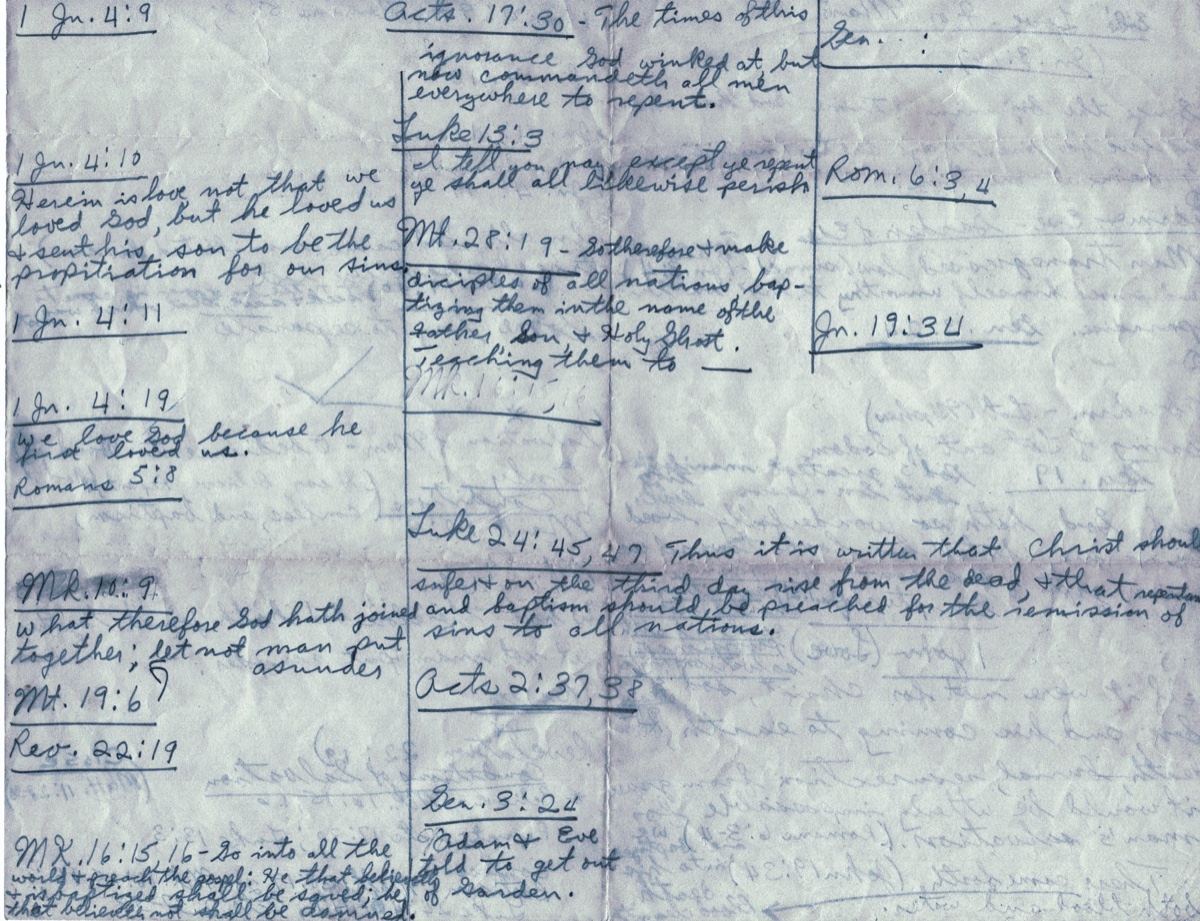
By Leon Mauldin
Synopsis: This article explores the historical and biblical significance of the Hittites, who are mentioned over 60 times in the Old Testament. It distinguishes between two groups of Hittites: one in Canaan and another in Asia Minor and northern Syria. The rediscovery of Hattusha in the modern era and subsequent excavations of the site validate the historical accuracy of the Bible.
The Hittites are mentioned more than 60 times in the Old Testament. Dr. Mark Wilson, a scholar specializing in the region of biblical Turkey, notes: “Biblical references to the Hittites suggest two distinct groups. The first group, descendants of Canaan through their namesake Heth, lived in Canaan” (Wilson, 157). The second group lived in Asia Minor and the upper Euphrates valley of northern Syria.
Following the death and 30-day period of mourning for Moses (Deut. 34), the LORD spoke words of encouragement to his successor, Joshua:
Moses My servant is dead. Now you and all the people prepare to cross over the Jordan to the land I am giving the Israelites. I have given you every place where the sole of your foot treads, just as I promised Moses. Your territory will be from the wilderness and Lebanon to the great Euphrates River—all the land of the Hittites—and west to the Mediterranean Sea (Josh. 1:2-4, CSB).
Holman’s Christian Standard Bible (Study Bible) has the following notation regarding the expression, “land of the Hittites”:
The land of the Hittites [in the above text] seems not to refer to the Hittite Empire of modern Turkey but the Egyptian and later Assyrian usage of this term to describe the region controlled by the Hittites in the western part of modern Syria. These lands and boundaries identify Canaan as it was known both to the Bible (Gen. 10:19; Num. 13:17, 21-22; 34:3-12) and to Egyptian writers of the second millennium BC.
In numerous passages, the Hittites are mentioned as one of several groups populating the land of Canaan. For example, Joshua told the Israelites, “You will know that the living God is among you and that He will certainly dispossess before you the Canaanites, Hittites, Hivites, Perizzites, Girgashites, Amorites, and Jebusites” (Josh. 1:10; cf. Gen. 15:20; Deut. 7:1, etc.).
“Hittite history is divided into four periods: Proto-Hittite (18th century BC), Old Kingdom (1680-1450 BC), Middle Kingdom (1450-1380? BC), and Empire, or New Kingdom (1380-1200 BC)” (Wilson, 155).
Hattusha was the capital of the Hittite Empire from ca. 1650 BC to ca. 1200 BC. It was located in what would be Cappadocia in New Testament times. It is near the modern village of Boğazkale (formerly named Boğazköy). This is a large archaeological site, covering 445 acres, and consisting of an upper city and a lower city.
Archaeological areas of interest include the Lion’s Gate, pictured here. The Lion Gate features two sculptures of standing lions at the entrance. Previously, there would have been an arch above the lions.

Here is the gateway to the Great Temple:
The Great Temple dominates the area:
Here is a view of some of the storerooms of the Great Temple:
Another view of some of the storerooms showing pithoi sunk into the floor:
These containers had a capacity of 530 gallons!

Ironically, it was formerly fashionable for critics to scoff at the mention of Hittites in the Bible, asserting that such people never existed. But Hattusha was “rediscovered” in 1834 by Charles Texier. Excavations were carried out by Ernest Chantre (1893-1894), and then later by Hugo Winckler and Theodor Makridi in 1906, and again in 1911-1912. Others have continued until the present time. This demonstrates that the Bible is actual history, not fiction. It deals with real people, places, and events. You can trust the Bible!
Wilson, Mark. Biblical Turkey: A Guide to the Jewish and Christian Sites of Asia Minor. 4th edition. Ege Yayinlari, 2020.
Leon Mauldin has worked with the Hanceville church of Christ in Hanceville, AL, for over thirty-five years. He and his wife, Linda, have three children and nine grandchildren (one deceased). The church website is here. His personal blog is here and info about his Bible Land Tours is here. He can be reached here.



By Chris Reeves
Synopsis: This article highlights the story of Zacharias and Elizabeth from Luke 1, emphasizing their righteousness and the rewards they received from God. Despite facing challenges such as Elizabeth’s barrenness, they remained faithful and were blessed with a son, John, who would do great things for the Lord. Chris underscores the importance of righteous living for married couples and all Christians. God promises rewards such as a fulfilled life, peace, joy, and divine approval.
The word of God reveals that if we live a righteous life for God, He will reward us. Do you believe that? Do you believe that it pays to live a righteous life? I hope you believe it and live like it, because what God says about that (along with all other things) is true. Consider these Bible passages [Note #1]:
Jehovah hath rewarded me according to my righteousness; according to the cleanness of my hands hath He recompensed me (Ps. 18:20; see also 2 Sam. 22:21).
So that men shall say, Verily there is a reward for the righteous: verily there is a God that judgeth in the earth (Ps. 58:11).
The wicked earneth deceitful wages; but he that soweth righteousness hath a sure reward (Prov. 11:18).
He that receiveth a prophet in the name of a prophet shall receive a prophet’s reward: and he that receiveth a righteous man in the name of a righteous man shall receive a righteous man’s reward (Matt. 10:41).
Truly, the righteous are rewarded by God. We live in a very wicked world, and it is easy to forget that it is worthwhile to live a righteous life. It pays to be different. Married couples need to be reminded today that they can live a righteous life for God. A righteous married couple can accomplish so much good for God and those around them.
In the New Testament, there was a couple named Zacharias and Elizabeth, and their story is told in Luke 1. They were righteous and were rewarded for it. Let’s see what we can learn from them.
First, both of them were righteous; not one, but both. Luke 1:5-6 reads:
There was in the days of Herod, king of Judaea, a certain priest named Zacharias, of the course of Abijah: and he had a wife of the daughters of Aaron, and her name was Elisabeth. And they were both righteous before God, walking in all the commandments and ordinances of the Lord blameless.
This is impressive. Today, we might easily find one spouse or the other who is righteous, but to find both seeking to be righteous is special. Both Zacharias and Elizabeth wanted to serve God faithfully. They both walked in all, not some, of the commandments of God, and they were both blameless in His sight. Does this describe you?
Second, this righteous couple had a problem. Luke 1:7 reads:
And they had no child, because that Elisabeth was barren, and they both were now well stricken in years.
Elizabeth was barren and could not have a child. To want a child and not be able to have one must have surely troubled this woman and her husband. We must recognize the fact that righteous people still have problems, issues, trials, troubles, etc., in life, just like everyone else in the world. Righteous people are no different in this regard. They will suffer ordinary problems just like others around them (1 Pet. 3:14; 4:18). Job was a righteous man, and he suffered. Noah, Lot, David, the prophets, John the Baptist, Jesus, and Paul were all righteous men—and they suffered. Does this describe you?
Third, Zacharias was practicing his righteousness and serving God when the angel of the Lord visited him. Luke 1:8-12 reads:
Now it came to pass, while he executed the priest’s office before God in the order of his course, according to the custom of the priest’s office, his lot was to enter into the temple of the Lord and burn incense. And the whole multitude of the people were praying without at the hour of incense. And there appeared unto him an angel of the Lord standing on the right side of the altar of incense. And Zacharias was troubled when he saw him, and fear fell upon him.
This couple was righteous in the present tense. They were not simply living on a past reputation of being righteous. They were not resting on their laurels. Instead, they were daily serving God. An angel of the Lord appeared to Zacharias with good news “while” (literally, “now”) Zacharias was serving. Zacharias and Elizabeth were blessed “while” he was taking his turn to serve in the temple and “while” he was praying [Note #2]. Does daily righteous living describe you?
This righteous Jewish couple, who was a part of the promised righteous remnant, was soon rewarded by God for their righteous living [Note #3]. Consider now from the text some of the divinely bestowed rewards that this great couple received.
First, their prayers were heard, and they were given a baby boy by God. The “reproach among men” that Elizabeth once experienced would be taken away (Luke 1:24-25), and God “magnified His mercy towards her” (Luke 1:58). This would come as good news to a couple that could not previously have a child. Luke 1:13 reads:
But the angel said unto him, Fear not, Zacharias: because thy supplication is heard, and thy wife Elisabeth shall bear thee a son, and thou shalt call his name John.
Second, they were given a happy life. Their sorrow would be turned into gladness. Luke 1:14 reads:
And thou shalt have joy and gladness; and many shall rejoice at his birth.
Third, they would become the proud parents of a son who would accomplish great things for the Lord, and “the hand of the Lord was with him” (Luke 1:66). This child would grow “strong in spirit” (Luke 1:80). Their life of service to God in the temple would now be expanded to serve others through their son, John. Luke 1:15-17 declares:
For he shall be great in the sight of the Lord, and he shall drink no wine nor strong drink; and he shall be filled with the Holy Spirit, even from his mother’s womb. And many of the children of Israel shall he turn unto the Lord their God. And he shall go before his face in the spirit and power of Elijah, to turn the hearts of the fathers to the children, and the disobedient to walk in the wisdom of the just; to make ready for the Lord a people prepared for Him.
Fourth, they experienced the working and fulfilling of God’s word in their life. God had said that Elizabeth would bear a son, and she did. God said the same thing to Mary, and His word came true. It is a great reward to see God’s word working in one’s life. Luke 1:36-37 reads:
And behold, Elisabeth thy kinswoman, she also hath conceived a son in her old age; and this is the sixth month with her that was called barren. For no word from God shall be void of power.
Lastly, both Elizabeth and Zacharias would be filled with the Holy Spirit and offer a blessing. Elizabeth would bless Mary (Luke 1:39-45) and Zacharias would bless the Lord God (Luke 1:67-79) [Note #4]. What a privilege to be able to offer such inspired blessings!
What we learn from Zacharias and Elizabeth is that rewards follow righteous living. Today, righteous married couples and all faithful Christians will be rewarded greatly by God for their righteous living. They will be rewarded with. . .
A fulfilled life (Matt. 5:6)
Provision from God (Matt. 6:33)
A life of peace and joy (Rom. 14:17)
A sober mind (1 Cor. 15:34)
An armor of protection (2 Cor. 6:7; Eph. 6:14)
A fruitful life in praise to God (2 Cor. 9:10; Phil. 1:11; Heb. 12:11; Jas. 3:18) [Note#5]
A hope of heaven (Gal. 5:5)
A holy, good, and truthful life (Eph. 5:9)
A heavenly crown (2 Tim. 4:8)
Divine approval and recognition (Heb. 11:4, 7, 33)
Answered prayer (Jas. 5:16; 1 Pet. 3:12)
A family of brethren (1 John 2:29)
A home in heaven (Matt. 13:43, 49; 25:46; 2 Pet. 3:13; Rev. 19:8)
When Zacharias offered his well-known “Benedictus” (blessing) to God for the birth of his son, he said something very interesting. All people can be rewarded for their righteous life just like he and Elizabeth were. In Luke 1:74-75, he declares God’s purpose:
To grant unto us that we being delivered out of the hand of our enemies should serve Him without fear, In holiness and righteousness before Him all our days.
Couples today in the Lord’s church should always keep in mind that God wants to reward them in their marriage. But it will take righteous living on our part to bring that about. So many marriages today are suffering from self-imposed heartaches because one spouse or both will not live righteously, according to God’s word. Instead of receiving positive, divine rewards, they experience nothing but problems. Unrighteous behavior leads to fighting, abuse, anger, spite, jealousy, boredom, disrespect, disinterest, growing apart, stress, money problems, grief, lack of communication, lack of intimacy, infidelity, and even divorce.
When we all practice righteous living according to God’s word (Rom. 1:17; 2 Tim. 3:16), we will be rewarded. We must manifest, not a fake righteousness (Luke 20:20), but a genuine righteousness that is acceptable to God (Acts 10:35) and useful in His service (Rom. 6:13, 16, 18-20). Whatever changes we need to make in our marriage to be right with God, let’s make them, so we can experience the great rewards that He has planned for us.
Zacharias means “the Lord remembers,” and Elizabeth means “God is my oath.” Indeed, the Lord God will remember and will keep His oath to reward the righteous!
Those of you who are newly married should set out early in your relationship to act righteously each day, and you will see the rewards from God come to you as He promised.
Those of you who have been married for some time would do well to reassess your attitudes and actions to see if any unrighteous thoughts or behavior are present that are causing problems in your marriage. Remove the unrighteousness quickly and get back to righteous living that brings great rewards.
Those of you who have been married for decades and have lived faithfully to Jesus through the years can speak to others about the many rewards that you have received from God.
[Note #1] All Scripture quotations are taken from the 1901 American Standard Version (ASV).
[Note #2] See 1 Chronicles 24 and 2 Chronicles 8:14 and 31:2, for the practice of dividing the priests into different “courses” to take their turn in serving in the temple.
[Note #3] Joseph (Matt. 1:19) and Simeon (Luke 2:25) were also among the righteous Jewish remnant of the day. For the promised righteous remnant, see passages like Isaiah 1:27; 10:22; 26:2; 32:16-17; 33:5, 15; 45:8; Jeremiah 33:16; Daniel 12:3; Malachi 3:3, 18; etc.
[Note #4] The righteousness of Zacharias is also witnessed in his knowledge of the Old Testament Scriptures that he referenced in his “Benedictus” (Luke 1:67-79).
[Note #5] The Old Testament concept of righteous living that bears the fruits of reward can be found here: Proverbs 11:30; 12:12; Isaiah 3:10; 32:16; and Amos 6:12.
Chris Reeves has preached for the Warfield Blvd. church of Christ in Clarksville, TN, since 2016. He and his wife, Cheri, have four children and two grandchildren. His Bible study website is here. The church website is here. He can be reached here.




By Danny Linden
Synopsis: This article explores John the Baptist’s teachings in John 3:22-36, emphasizing the importance of humility and exalting Jesus. John the Baptist’s role was to prepare the way for Jesus. Believers should imitate John’s humility, recognize their divinely given purpose, and live righteously to bring glory to Jesus in all aspects of life.
The beginning of John 3 is one of the most famous passages in the Bible, but a conversation at the end of the chapter is equally important. John the Baptist makes several profound statements about the relationship between his work and the nature and work of Jesus. There is much within John that is worth imitating.
After this, Jesus and His disciples went into the Judean countryside, and He remained there with them and was baptizing. John was also baptizing at Aeon near Salim, because water was plentiful there, and people were coming and being baptized (for John had not yet been put in prison). Now a discussion arose between some of John’s disciples and a Jew over purification. And they came to John and said to him, “Rabbi, He who was with you across the Jordan, to whom you bore witness—look, He is baptizing, and all are going to Him.” John answered, “A person cannot receive even one thing unless it is given him from heaven. You yourselves bear me witness, that I said, ‘I am not the Christ, but I have been sent before Him’” (John 3:22-28).
The Jews were familiar with the practice of baptism, but always as a step for Gentiles, who were being converted to Judaism as proselytes. John the Baptist and Jesus were baptizing Jews! This was considered bizarre and offensive. In their minds, the Jews were already God’s children, so why would they need to be baptized? Why should they be purified? The message of John was that the Messiah was coming soon, and they all needed to repent of their sins and prepare themselves to follow Him. A short time later, Jesus and began teaching about the kingdom of God and emphasizing the importance of seeking God. Of course, after Jesus’ death and resurrection and the establishment of the church on Pentecost, it was possible for people to be baptized into His death for the remission of sins.
From the Jewish perspective, John and Jesus occupied a similar role in the community. They were outsiders in the religious system and taught a new and strange doctrine that frequently contradicted the traditions of the fathers. They both amassed large followings of common people. It was natural to think that they could be rivals. John’s disciples wondered if John was upset about Jesus stealing his disciples and attracting more attention.
John’s response is revealing. “A person cannot receive even one thing unless it is given him from heaven.” There was no rivalry, because John’s purpose was derived entirely from heaven. It was never about John’s personal popularity or desires. He lived to fulfill the purpose given to him by God—to pave the way for Jesus. Without that divinely ordained mission, John was irrelevant.
Jesus’ mission also came from heaven. The Father planned for Jesus to be incarnated, to teach sinful man, and to die so we could be cleansed. Jesus knew this and submitted to the will of the Father, though He is equal to the Father.
Jesus said to them, “I am the bread of life; whoever comes to Me shall not hunger, and whoever believes in Me shall never thirst. But I said to you that you have seen Me and yet do not believe. All that the Father gives Me will come to Me, and whoever comes to Me I will never cast out. For I have come down from heaven, not to do My own will but the will of Him who sent Me. And this is the will of Him who sent Me, that I should lose nothing of all that He has given Me, but raise it up on the last day. For this is the will of My Father, that everyone who looks on the Son and believes in Him should have eternal life, and I will raise him up on the last day” (John 6:35-40).
The one who has the bride is the bridegroom. The friend of the bridegroom, who stands and hears him, rejoices greatly at the bridegroom’s voice. Therefore, this joy of mine is now complete. He must increase, but I must decrease (John 3:29-30).
John used the analogy of a wedding to describe his relationship with Jesus. Jesus is the groom, the church is the bride (cf. Rev. 19:6-10), while John is the friend of the groom (or what we today might call the best man). The best man occupies a place of some honor, but have you ever been to a wedding where the best man was the center of attention? The best man does some of the preparatory work, yet during the ceremony, he and everyone else in the room fade into the background. It’s all about the union of the groom and his bride.
There was no rivalry—John felt nothing but joy that Jesus’ work was in motion and that the critical moment was drawing near. This is what he (along with the entire world) had been waiting for since the fall of man in Eden.
“He must increase, but I must decrease.” John did more than accept Jesus’ greater purpose. He understood that for the plan to work, he must move out of frame so all attention could be given to Jesus.
He who comes from above is above all. He who is of the earth belongs to the earth and speaks in an earthly way. He who comes from heaven is above all. He bears witness to what He has seen and heard, yet no one receives His testimony. Whoever receives His testimony sets his seal to this, that God is true. For He whom God has sent utters the words of God, for He gives the Spirit without measure. The Father loves the Son and has given all things into His hand (John 3:31-35).
Every analogy breaks down somewhere, and it can actually be useful to identify the point of distinction between the analogy and the reality it is meant to illustrate. In the weddings that we are familiar with, the bride and groom are being honored equally as two individuals who come together and become a family. The wedding of the church and Jesus is a little different. Jesus is by nature above all things. He is God and does not come from this earth like we do. Jesus does something that no one else can do—He utters the words of God who sent Him and gives the Spirit to us abundantly. This wedding is not a mingling of equals! Rather, the focus is on Jesus, shining in His magnificent glory, cleansing us and exalting us to be with Him.
Husbands, love your wives, as Christ loved the church and gave Himself up for her, that He might sanctify her, having cleansed her by the washing of water with the word, so that He might present the church to Himself in splendor, without spot or wrinkle or any such thing, that she might be holy and without blemish (Eph. 5:25-27).
This only makes God’s plan even more incredible. Although we do not deserve to be with Jesus, we can live in His house forever and be joined to Him as family. Praise the Lord for His indescribable blessings!
John’s attitude is worthy of our imitation. It is tempting to think that John is unique in having a divinely ordained purpose, and in a sense, he is. However, the Bible uses similar language to describe our gift from God.
For by grace you have been saved through faith. And this is not your own doing; it is the gift of God, not a result of works so that no one may boast. For we are His workmanship, created in Christ Jesus for good works, which God prepared beforehand, that we should walk in them (Eph. 2:8-10).
My life is not my own! I have been given a purpose and a mission from heaven. I am the workmanship of God, created by Him to live righteously and do good work in the kingdom. This is the foreordination of God, and it is my responsibility to accept that gift and fulfill my purpose.
As John was content to let Jesus take the spotlight, we, too, must continually humble ourselves. There is always more opportunity for self-sacrifice. Jesus is above all, so I must give every day—and every part of life—to Him. I should bring glory to His name in my family, my work, my recreation, my church, and my money. No one can come between me and my Lord. He must increase, but I must decrease.
Because Jesus is from heaven, and above all, there are consequences when we obey or rebel. The last verse in John 3 makes this clear: “Whoever believes in the Son has eternal life; whoever does not obey the Son shall not see life, but the wrath of God remains on him” (John 3:36).
Danny Linden has worked with the Hebron Lane church of Christ in Shepherdsville, KY, since March 2023. He and his wife, Lauren, have four children. The church website is here. His website is here. He can be reached here.


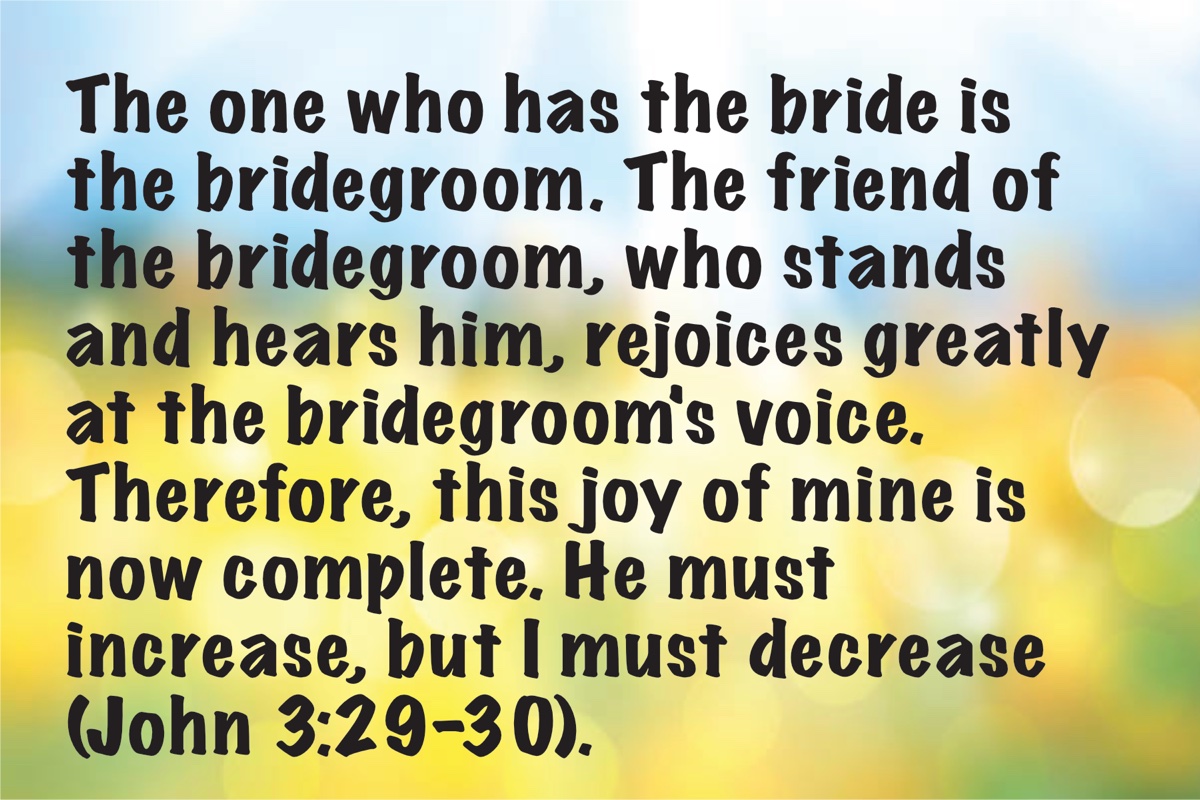

By Collin White
Synopsis: This article discusses the importance of friendships and the impact they have on our lives. It emphasizes the need to choose friends wisely, as they can influence our decisions and moral compass. The author encourages readers to evaluate their friendships and strive to be good friends to others, while also recognizing Jesus as the best friend one could have.
You’d be hard-pressed to make it through life without friends. It’s certainly possible, but a life devoid of friendships is missing out on so much. God noticed that it was not good for Adam to be alone when He made Eve as a companion and partner. Relationships with others are a significant part of life and the human experience. We are social by design, and there’s never been an easier time to make friends all across the world than right now.
Let’s consider the difference between what makes a good friend versus a bad friend, and how to know when it might be time to find new friends. I bring this up because recently I’ve been struggling with letting go of some friends I’ve known for a long time for various reasons. As much of a struggle as it is, and awkward and sad as it may be, the people we consider our friends can affect us. However, before getting into that, let’s look at what the Bible says about friendship.
Proverbs is a treasure trove of wise sayings and advice, and it has a lot to say about friendship. Proverbs 12:26 says, “The righteous should choose his friends carefully, for the way of the wicked leads them astray.” Choosing our friends is an important part of our lives and something into which we should put serious time and thought. While you can’t choose your family, you can choose who you surround yourself with as friends. As Christians, we need to be aware of the kind of people our friends are.
Let’s look at an example of this in the Old Testament. King Rehoboam was the first of many rulers of Judah after the kingdom was divided. In 2 Chronicles 10, we read about an important decision he made regarding his treatment of the people:
Then King Rehoboam consulted with the elders who had served his father Solomon while he was still alive, saying, “How do you counsel me to answer this people?” They spoke to him, saying, “If you will be kind to this people and please them and speak good words to them, then they will be your servants forever.” But he forsook the counsel of the elders which they had given him, and consulted with the young men who grew up with him and served him. So he said to them, “What counsel do you give that we may answer this people, who have spoken to me, saying, ‘Lighten the yoke which your father put on us’?” The young men who grew up with him spoke to him, saying, “Thus you shall say to the people who spoke to you, saying, ‘Your father made our yoke heavy, but you make it lighter for us.’ Thus you shall say to them, ‘My little finger is thicker than my father’s loins! ’Whereas my father loaded you with a heavy yoke, I will add to your yoke; my father disciplined you with whips, but I will discipline you with scorpions.’” So Jeroboam and all the people came to Rehoboam on the third day as the king had directed, saying, “Return to me on the third day.” The king answered them harshly, and King Rehoboam forsook the counsel of the elders. He spoke to them according to the advice of the young men, saying, “My father made your yoke heavy, but I will add to it; my father disciplined you with whips, but I will discipline you with scorpions.” So the king did not listen to the people, for it was a turn of events from God that the LORD might establish His word, which He spoke through Ahijah the Shilonite to Jeroboam the son of Nebat (2 Chron. 10:6-15).
This sad episode is a cautionary tale about someone who lets the influence of wicked friends cause him to make a terrible choice. While none of us might be in a position of power like Rehoboam, the people we surround ourselves with can just as easily cause us to make poor choices. Rehoboam should have read Proverbs 13:20, which says, “Whoever walks with the wise becomes wise, but the companion of fools will suffer harm.”
Even when we’re strong in our faith and stick to our morals, being around a bad friend can be a drag on our mental state and end up being unhealthy for us. I know that, at least for me, I can’t be friends with unkind people, and that’s a big part of why I’m leaving a friend group I’ve known for a long time. Most of them simply don’t show enough kindness to each other or to me. Considering how hard life can be, having a friend who is constantly making fun of others, putting others down, or being hateful to people or groups of people just isn’t worth the commitment of being their friend.
Proverbs 17:17 says, “A friend loves at all times, and a brother is born for adversity.” This verse sets a great standard for the kinds of people we should look to surround ourselves with, as well as what kind of friend we should be to others. Just like any other relationship, friendship is a two-way street. The same verse also talks about how a true friend is one who supports you during adversity, someone who stays with you through thick and thin and everything in between. A genuine friend will be there for you on your worst days—even when you feel you don’t deserve them.
While at the end of the day, we will be judged for our own actions and how we lived our lives, you can still tell a lot about a person by the kind of friends with whom they surround themselves. Like it or not, even our dearest friends in life can be bad examples to us depending on their character. Just like the Bible says in 1 Corinthians 15:33, “Evil company corrupts good habits.” We are constantly under the influence of those around us, and our environment often shapes aspects of who we are. This force of influence gets stronger with people we care about. The closer we are to someone, the more we’ll end up picking things up from them, whether we intend to or not. Such is the danger of being friends with worldly people with a lot of sin in their lives. Whether you’ve got friends who smoke, drink, lie, cheat, steal, or are cruel to others, the result is that they will be a bad influence on you. Even if you never end up doing those things yourself, if you have a good and responsive conscience, you should be bothered when your friends commit evil acts.
A perfect Bible example of this is in 2 Peter 2:
For if God did not spare angels when they sinned, but cast them into hell and committed them to pits of darkness, reserved for judgment; and did not spare the ancient world, but preserved Noah, a preacher of righteousness, with seven others, when He brought a flood upon the world of the ungodly; and if He condemned the cities of Sodom and Gomorrah to destruction by reducing them to ashes, having made them an example to those who would live ungodly lives thereafter; and if He rescued righteous Lot, oppressed by the sensual conduct of unprincipled men (for by what he saw and heard that righteous man, while living among them, felt his righteous soul tormented day after day by their lawless deeds), then the Lord knows how to rescue the godly from temptation, and to keep the unrighteous under punishment for the day of judgment, and especially those who indulge the flesh in its corrupt desires and despise authority (2 Pet. 2:4-9).
Here we are given a more introspective look at Lot and how he felt about his life when he was living in Sodom and Gomorrah. When we read the account of him and his family in Genesis, we clearly see the depravity and inhumane treatment of others by the inhabitants of the town and their eventual judgment and destruction by the hand of God. Yet, in this verse, so many years later, we now see how Lot felt about it. He was tormented because, throughout all of what he went through, Lot still had a righteous soul. Now, I’m sure our friends aren’t out doing the despicable kinds of things the people of Sodom and Gomorrah were doing, but this is still a perfectly applicable and teachable moment for our lesson tonight. People around us who are defiantly living in sin will bring us down if we’re seeking to live righteously—even if they’re our friends.
While we may only be able to control our own actions, we do have a choice. We have the choice to part from people when they commit acts we can’t tolerate, when their bad habits start to rub off on us, or when being around them discourages us spiritually. On the other hand, being a good friend to others can be a blessing to their lives in more ways than we can know. Whether it’s just being there for them during a hard time or perhaps winning them over to Christ and the gospel, there is much we can do to be a good friend to those around us.
As time goes on, we all grow up, and as we grow up, we change. Our values change, our priorities, responsibilities, and outlooks on life can all change. As we change and grow, we need to take a look at with whom we surround ourselves. When we think about certain friends in our lives, we should ask ourselves, “Do I feel discouraged around them?” “Do they often put spiritual stumbling blocks in front of me?” “Do they treat me and others with kindness and respect?” The list goes on of things we need to be aware of when it comes to friends. A good sign that you have a worthwhile friend is if, when you come to them with concerns over their conduct, they listen to you and are willing to compromise or change some part of themselves that upsets you. The Bible is not shy on the topic of stubbornness, and if someone is too stubborn in their ways to change how they act around you, then that might be a sign that things aren’t going to work out between you.
I am not saying that we all need to get rid of any and all of our friends with whom we don’t 100% see eye to eye. Instead, this article is a reminder of the impact other people can have on our lives. Personally, since I’ve stopped hanging out with certain people, I’ve had less guilt, anxiety, and pressure in my day-to-day life, and it’s honestly been freeing in a lot of ways. We could give a hundred different lessons from the Bible on different aspects of what makes a good friend, but I think this is a good spot to wrap things up. I’ll leave you with one last verse, this one also from the book of Proverbs. In chapter 27, verse 19, we read, “Ointment and perfume delight the heart, and the sweetness of a man’s friend gives delight by hearty counsel.” Good friends can truly be one of the best parts of life. We just have to put in the effort to find them and try our best to be a good friend back.
Collin White is a member of the church in Round Lake Beach, IL.


By Allen Dvorak
Synopsis: This article seeks to describe the precise meaning of the Greek word (porneia), translated as “sexual immorality,” which is the only scriptural cause for divorce according to the New Testament. The text surveys three sources of information about the meaning of the word and explores the relationship between the use of pornography and porneia.
“Is it lawful for a man to divorce his wife for just any reason?” After affirming God’s original intent for marriage, Jesus answered the Pharisees’ question by identifying “sexual immorality” as the only acceptable cause for divorce. “And I say to you, whoever divorces his wife, except for sexual immorality, and marries another, commits adultery; and whoever marries her who is divorced commits adultery” (Matt. 19:9; NKJV). Marriages entered after an unscriptural divorce, whether the result of rebellion or a misunderstanding of the meaning of “sexual immorality,” result in adultery. Let us remember that God will judge adulterers (Heb. 13:4).
The Greek word translated as “sexual immorality” in Matthew 19:9 (and 5:32) is porneia (πορνεία). Since it describes the only scriptural cause for divorce, it is critical for us to understand what the word means. What does this word describe? What is included in its meaning?
Although pornography is not a new phenomenon (it was commonplace in ancient Pompeii), in our technologically advanced world, it has moved beyond just “dirty pictures” or salacious stories and now inhabits the arena of video, virtual reality, and is even at times interactive. The global plague of pornography has raised the question of the relationship between pornography and porneia in the context of divorce. The conclusions of those who have wrestled with this question vary. Some affirm that any use of pornography constitutes porneia. Others conclude that the addictive (repetitive/obsessive) use of pornography by an unrepentant individual rises to the level of porneia. Still, others argue that when the use of pornography is acted upon, resulting in self-gratification, it fits the meaning of porneia. In each of these views, there is no actual physical contact between persons, even though there may be “live” viewing of sexual gratification via digital communication. Finally, there are those who believe any use of pornography to be sinful—but not constituting porneia and thus not a scriptural cause for divorce. In light of Matthew 19:9, the relationship between pornography and porneia is not just an academic question; it may well affect the eternal destiny of many people.
We can determine the meaning of any biblical word (Greek) by its definitions in lexicons (dictionaries of Greek words), its translation in various versions, and observing how the word is used in specific contexts of Scripture.
A perusal of more than a dozen lexical sources suggests the following observations: (1) Porneia is often defined with the phrase “sexual intercourse” (e.g., Thayer, BDAG, Vine, Friberg, Moulton & Milligan); (2) another term that appears in multiple definitions of porneia is prostitution (or synonyms such as whoredom or harlotry), evidence that the etymology of the English word “fornication” (originally associated with prostitution) brings the proper idea to the word porneia; and (3) although prostitution brings a specific emphasis to sexual intercourse, some of the definitions given are, in fact, rather general (e.g., unchastity [BDAG & Liddell], sexual immorality [Swanson, Newman], unfaithfulness [Newman]), all of which, however, could also refer to sexual intercourse. In the case of such general definitions, the context in which the word is used could narrow its meaning (e.g., 1 Cor. 6:12-20). These general definitions may be intended to include various circumstances of sexual intercourse or physical, sexual contact in addition to the specific meaning of prostitution (e.g., sodomy [cf. Jude 7], bestiality, pedophilia).
We have already seen that the NKJV (along with the ESV, NIV, HCSB, and ISV) translates porneia as “sexual immorality.” Checking the translation of porneia in Matthew 19:9 in several other versions produces the following results: “fornication” (ASV; KJV; Darby; Wycliffe; D-R), “whoredom” (John Wesley translation; Geneva; YLT), “sexual relations with another man” (NCV), “unchastity” (RSV; NRSV), “immorality” (NET; NASB95), “unfaithfulness” or “unfaithful” (God’s Word Translation; NLT), and “adultery” (The Message). Some of these versions reflect greater effort to give a literal translation than others, but it is also obvious that there is a broad scope of meaning for porneia in those translations, just as in the lexicons. John Wesley’s translation (“whoredom”) is quite specific, while the NET and the NASB95’s translation (“immorality”—a word which encompasses behavior both sexual and non-sexual) is very general. Did porneia carry a more specific meaning in the biblical times?
Dictionary definitions are only the starting point for understanding the meanings of words. A word can sometimes have different shades of meaning depending upon the context in which it is used, with context providing us with important information regarding its meaning.
Genesis 38 relates the story of Judah and Tamar. Tamar, the daughter-in-law of Judah, posed as a prostitute, and Judah, not recognizing her, had relations with her. “About three months later Judah was told, ‘Tamar, your daughter-in-law, has been immoral. Moreover, she is pregnant by immorality.’ And Judah said, ‘Bring her out, and let her be burned’” (v. 24; in the Septuagint [the Greek translation of the Hebrew Scriptures] “has been immoral” is the translation of εκπεπόρνευκεν [a form of a cognate verb of porneia]; “immorality” is the translation of πορνεία). The porneia committed by Tamar and Judah resulted in pregnancy.
Ezekiel 16 uses porneia in its various forms and its cognate verbs in a figurative sense, but the passage clearly gives the sense of the word porneia with its repeated references to prostitution (vv. 15, 22, 24, 25, 31, 33, 34, 36, 39, & 41; note the number of times “played the harlot” [NKJV] appears in the chapter).
In the apocryphal book Sirach (also known as Ecclesiasticus), porneia refers to sexual relations that produce children. “So it is with a woman who leaves her husband and presents him with an heir by another man. For first of all, she has disobeyed the law of the Most High; second, she has committed an offense against her husband; and third, through her fornication (porneia) she has committed adultery and brought forth children by another man” (Sirach 23:22-23; NRSV).
New Testament passages offer similar information about the meaning of porneia. In John 8:41, the Jewish leaders claimed, “We were not born of sexual immorality.” In that context, porneia describes sexual behavior that results in a birth.
Paul told the Corinthians to “flee sexual immorality” (porneia) (1 Cor. 6:18). In the context of that warning, Paul wrote, “Or do you not know that he who is joined to a harlot is one body with her? For ‘the two,’ He says, ‘shall become one flesh’” (v. 16; NKJV). Porneia refers to a sexual sin in which two people have actual physical sexual contact.
In some other New Testament passages, porneia is listed in the company of other words, which would certainly describe pornography. For example, Paul listed porneia alongside impurity and sensuality (Gal. 5:19, ESV). The apostle teamed porneia with the same two words in 2 Corinthians 12:21. To the Colossians, Paul wrote, “Put to death therefore what is earthly in you: sexual immorality, impurity, passion, evil desire and covetousness, which is idolatry (3:5, ESV). He grouped porneia, impurity and covetousness in Ephesians 5:3, affirming in verse five that”everyone who is sexually immoral (pornos—cognate adjective of porneia) or impure has no inheritance in the kingdom. If porneia includes the use of pornography (in any form), why also mention impurity and sensuality? Although impurity and sensuality could describe other behaviors besides the use of pornography, it doesn’t appear that Paul was merely being repetitive in the above passages (i.e., equating porneia with impurity and sensuality), but rather describing different kinds of behavior.
In His mountain sermon, Jesus said, “You have heard that it was said, ‘You shall not commit adultery.’ But I say to you that everyone who looks at a woman with lustful intent has already committed adultery with her in his heart” (Matt. 5:27-28, ESV—note that the word translated “adultery” is not the Greek word porneia). He made a distinction between looking at a woman with lustful intent and the overt act of adultery by qualifying the word “adultery” with the phrase “in his heart.” If Jesus meant to equate lust with adultery, why include the phrase “in his heart”? Why not simply say “adultery”? Clearly, Jesus was not equating the two (i.e., lust and adultery), but pointing to the cause of adultery to emphasize the importance of controlling our thoughts and our actions. Similarly, “looking at a woman,” either in person or via digital means, with lustful intent and even with self-gratification, doesn’t qualify as porneia.
In all the biblical contexts which provide information as to the precise meaning of porneia, the word involves physical, sexual contact. We must define porneia as it was used at the time of the writing of the New Testament. We have no right to redefine the meaning of porneia any more than we are permitted to redefine baptism.
Although the use of pornography (in any of its forms), even with self-gratification, does not fit the meaning of porneia, there is no defense for its use. Such behavior is clearly condemned in the Scriptures as sensuality and lust. Recognizing that the use of pornography is not porneia doesn’t deny the fact that pornography is toxic to marriages and families and brings serious consequences to those involved in its use (cf. Gal. 5:19-21).
Allen Dvorak has worked with the Kelly Spring Road congregation in Harvest, AL, since 2006. He and his wife, Debbie, have two married sons and six wonderful grandchildren. The church website is here. He can be reached here.



By Brandon Slater
Synopsis: This article emphasizes the importance of bearing spiritual fruit as evidence of a righteous life through Jesus. It explains that manifesting the fruit of the Spirit, as described by the apostle Paul, is essential for winning souls and drawing others to God. It highlights the connection between wisdom, bearing fruit, and being a “tree of life” that gives life to others.
The fruit of the righteous is a tree of life, and he who is wise wins souls (Prov. 11:30, NASB).
Hebrew poetry has the divine beauty of rhyming thoughts rather than mere words. In this case, our Lord’s inspired proverb connects “a tree of life” with “winning souls.” This is arresting. Let us examine with care the process of this truth.
First, it is the fruit in one’s life that is the evidence of the essence of the reality within. The apostle Paul identifies and defines true fruit centuries after this proverb was written. It is known to the Christian as the fruit of the Spirit, the Holy Spirit of God.
But the fruit of the Spirit is love, joy, peace, patience, kindness, goodness, faithfulness, gentleness, self-control; against such things there is no law (Gal. 5:22-23).
Now do we see the connection? The inspired proverb promises that the “fruit of the righteous” is a tree of life. Keep in mind we are only made righteous through Jesus, as we see in 2 Corinthians 5:21. Put it this way: the thriving fruit of the Christian who was made righteous through the grace of Jesus is a tree of life. Why is it a tree of life? It is a tree of life because it gives life.
Now let us connect the thoughts of this Hebrew poem:
One who bears fruit rhymes with one who is wise.
One tree of life rhymes with one who saves souls.
You see, if you seek the Lord and His wisdom, you will become wise. This wisdom will inevitably cause you to bear fruit. If you continually bear godly fruit in your life, God promises you will be a tree of that which is truly life. This is what draws souls in.
Jesus said no man comes to the Father unless He draws them (John 6:44). Jesus uses His “trees.” This is what souls are longing for. They long for purpose, meaning, and, more importantly, evidence.
Do not let your mind wander to how many people you have baptized or how the number of people with whom you have had Bible studies. We can make the mistake of attempting to do both of those things with no fruit, no tree, or no wisdom in our life. This is self-defeating. Wisdom is not merely knowledge. Rather, wisdom is the character of God personified.
The true essence of soul-winning is your life rooted and grounded in Jesus. In turn, it is a reflection of Him as a beautiful, flourishing representation.
When I was an atheist, I tried to disprove the Bible. I was proved wrong by my own research and my own attempt to destroy it. However, even after realizing the Bible had to be true, these “truths” of the Bible alone did not cause me to fully submit. I had evidence that the Bible was historically and scientifically sound. I had evidence that the Bible was logically sound. I had evidence that the Bible fully explained the supernatural and eternal. However, I did not encounter the evidence of a genuine Christian.
I did not have evidence of the character of Christ personified. That is, until I met my wife. She was the final factor that gave me confirmation that the God of the Bible was truly the Living God. She was and still is one that completely trusts and rests in God. She is one that has committed to keeping herself pure. She is one that honors the Lord’s commandments and expresses it through obedience according to Scripture.
Did she thoroughly teach me and show me the entire plan of salvation and essential doctrines? No, her preacher did. Did she baptize me? No, her preacher did. Did she save me in the sense that this proverb speaks? Absolutely. She is a righteous woman who bears fruit. She is a tree of life. Hence, she was and is a wise woman who, through the power and grace of Christ, saved my soul. I am eternally grateful. You see, it is the trees of life that give life.
Brandon Slater labors with the Green Meadow church of Christ in San Angelo, TX. He says, “I came to Christianity from atheism in 2006. By attempting to destroy and disprove the Bible, the Bible destroyed my arguments and disproved me. Early in my walk, I developed a love for studying the Scriptures and was eventually asked to preach. I have been a bi-vocational preacher since 2012, and now I am full time.” He and his wife, Heather, have been married for seventeen years. They have four children, from ages 8 to 15. The church website is here. He can be reached here.


By Marc Gibson
Synopsis: A competitive spirit is needed to run a spiritual race that wins an eternal victory, but we must be careful to focus that spirit on competing with, and not against, fellow Christians. We vigorously battle our true adversary, Satan, while controlling our competitive spirit in all areas of life.
Many aspects of life are based on competition. One example that quickly comes to mind is sports. A game, match, or contest is held between two individuals or teams to determine who is superior. The Olympic Games have historically been based on the principle of honorable and fair competition to determine the best athletes in the world in various sports. “March Madness” is a special time each year for college basketball fans as numerous teams compete in a post-season tournament to determine a national champion. During such events, the competitive spirit is high for fans and participating athletes.
Competition can also take place in other areas of life. Students compete for the best grades. Workers compete for sales, raises, and promotions. Ideally, a good spirit should be maintained by all involved, but far too many times, this is not the case. Unfortunately, some manifest attitudes and actions that are less than noble.
A “competitive spirit” is a strong desire to win a competition by defeating opponents who are also trying to win. This competitive spirit is a part of all of us to some extent (some are more competitive than others) but it needs to be controlled and regulated according to the will of God. Paul used a sports metaphor to describe the competitive mindset of a Christian:
Do you not know that those who run in a race all run, but one receives the prize? Run in such a way that you may obtain it. And everyone who competes for the prize is temperate in all things. Now they do it to obtain a perishable crown, but we for an imperishable crown. Therefore, I run thus: not with uncertainty. Thus I fight: not as one who beats the air. But I discipline my body and bring it into subjection, lest when I have preached to others, I myself should become disqualified (1 Cor. 9:24-27, NKJV).
The Greek word translated “competes” is agonizomai, meaning to strive, to struggle, to fight, to labor fervently. “In the Greco-Roman world, the term agon was commonly associated with athletic contests, such as the Olympic Games, where competitors would exert themselves to the utmost to win a prize” (Bible Hub). Our English term “agony” is derived from this word, which highlights the intense exertion that results from a competitive spirit. There is a spiritual race to be won, and the Christian should do everything possible to win that race and receive the imperishable crown.
Identifying and understanding our opponent, the adversary who is trying to defeat us in our race to eternal life, is vitally important. It is none other than Satan himself who seeks the destruction and defeat of God and His people: “Be sober, be vigilant; because your adversary, the devil, walks about like a roaring lion, seeking whom he may devour. Resist him, steadfast in the faith…” (1 Pet. 5:8-9a). Satan actively opposes us daily. To “resist” Satan is to oppose and withstand him, as an athlete would do to a competitor. The Greek word translated “resist” is anthistemi, and the “concept of resistance was often associated with military and athletic imagery, where standing firm against an opponent was crucial” (Bible Hub).
The goal of Satan is to defeat us. We must “strive together for the faith of the gospel, and not in any way [be] terrified by [our] adversaries, which is to them is a proof of perdition, but to [us] of salvation, and that from God” (Phil. 1:27-28). Continual faithfulness and boldness are needed to overcome our adversary and accuser (cf. Rev. 12:9-11). This is the good fight of faith against evil, and Jesus assures us of victory if we abide in His word (1 Tim. 6:12; John 8:31-32; 1 Cor. 15:57-58).
We, as Christians, are to compete to win the prize and overcome Satan, our adversary, but we are not in competition with one another. We are on the same team. I am not trying to defeat you to win that heavenly crown. Our competitive spirits need to be united and focused on defeating the true adversary and running the race to win.
When we turn our competitiveness against one another, we are manifesting a carnal, evil spirit. Unfortunately, many Christians allow their ambitious mindset to manifest itself in sinful ways toward their friends, family, and other Christians. We need to consider soberly our thoughts and actions lest we become overly competitive instead of being Christlike.
At the root of a sinful, competitive spirit is pride and selfishness. If I desire to be first, or preeminent, I will be tempted to assume that position by means that do not seek what is best for others. Diotrephes had this mindset as he opposed the apostle John and other faithful brethren, saying malicious things against them because he could tolerate no rival (3 John 9-10). He saw himself in competition with them. This violates the principle of love, humility, and giving preference to others (Rom. 12:10). We are not interested in what is best for another person when we are trying to “best” them in some area of life. How can this competitive attitude manifest itself in our lives?
Workplaces often involve competition. Employees will try to climb the ladder of success, not caring who they step on to get there. Employers are tempted to engage in dishonest business dealings to get ahead of the competition. Gossip and double-crossing can make office politics an ugly scene.
Christians should strive to be their best in the workplace but never seek to destroy others in the pursuit of a promotion, raise, or job (cf. Eph. 6:5-9; Col. 3:22-25). Are we willing to assist our fellow employees even if it makes them look better than ourselves? We should rejoice, not curse under our breath, when a co-worker receives praise or promotion. If we do our job to the best of our ability, we can thank God and humbly receive whatever praise or promotion men may give us.
An educational environment can foster intense competition. Students compete for top grades and honors. I remember in high school reading the monthly lists of honor students to see if I made it and who else did. Often these competitions are encouraged in classrooms to motivate students to give their very best effort. Teachers and administrators themselves will compete for higher positions that offer better pay and benefits.
Competitions in schools also involve sports and other extracurricular activities. Young men and women feel pressure to compete with one another for dates, popularity, and dominance. Young Christians must be careful not to let their pride override friendships and their determination to set a godly example. Do not let worldly concerns be more important than being a Christlike person in your language, clothing, and attitude. Even parents should be cautioned about being drawn into prideful competitions over grades, honors, or sports. This unduly pressures children and leaves lasting impressions for the worse.
A family unit is to be a loving relationship for all, but it can turn into an unpleasant arena of competition. Children naturally compete for their parents’ affection, but this should not continue into adulthood. Yet, it is sad to see adult “sibling rivalries” tear families apart, where family members never learn to get past their childish competitions trying to outdo each other.
If one sibling becomes better educated, makes more money, has a bigger family, etc., then other siblings fall into the devil’s trap of envy, jealousy, and anger that often boils into turmoil at the worst times (holiday gatherings, reunions, weddings, funerals, etc.). Children get caught in the middle because we mistakenly think our kids must have better toys, more money, fancier clothes, popular friends, and better grades. How foolish, vain, and sinful! Families are not to fight each other, but love and support one another, and our kids need to learn this lesson by watching us. Does Christ rule our home and hearts, or does sinful competition cause tension and division?
Unless you live in the middle of nowhere, you have neighbors. A neighborhood can be filled with constant competition. Let one neighbor buy a new car, paint his house, or remodel his kitchen. You soon see other neighbors following suit, just so the first neighbor doesn’t look better than them. If your neighbor does well, let him know you are happy—don’t plot how you will outdo him for neighborhood bragging rights. Above all, seek the spiritual good of your neighbors by striving to live godly and teaching the gospel message.
It is sad to admit that a sinful, competitive spirit can be found between God’s people in the body of Christ. Preachers can be envious of one another and seek to hurt reputations. Song leaders and class teachers can be jealous of one another’s talents. There can be competition over children, automobiles, and salaries. Families become jealous of other families about earthly matters that should have no effect on our greater fellowship and love in Christ. This indeed is sad, and it is avoidable if we would put Christ and our brethren first.
Christians are to “bear one another’s burdens” (Gal. 6:4), and to “comfort each other and edify one another” (1 Thess. 5:11). Why do we do this? Because, having the mind of Christ, we are to “let nothing be done through selfish ambition or conceit, but in lowliness of mind let each esteem others better than himself. Let each of you look out not only for his own interests but also for the interests of others” (Phil. 2:3-4). I see no worldly competitiveness in this inspired teaching, but only love and compassion for our fellow Christians and their needs.
May we maintain a proper competitive spirit in resisting the devil and gaining eternal victory. Like Paul, we are to “press toward the goal for the prize of the upward call of God in Christ Jesus” (Phil. 3:14). We must fight the good fight and run the race—our victory is found in Jesus.
A competitive spirit directed toward a co-worker, fellow-student, family member, neighbor, or fellow-Christian which results in jealousy, anger, and divisive actions is sinful. Such an attitude is not reflective of Christ, who humbly gave Himself for us so that we might be saved and calls us to manifest the same mindset toward others. Examine your own spirit and remove any carnal competitiveness that would destroy your relationships and your soul. Give glory to God, resist the devil, and run to win!
Marc Gibson has labored with the Seffner church of Christ in Seffner, FL, since 2020. He and his wife, Kellie, have four children and two grandchildren. The church website is here. His website is here. He can be reached here.



By Stan Adams
Synopsis: Psalm 1 reminds us that following God’s directions leads to living a stable, righteous life. It answers the following questions: “Where should I walk?” “Where should I stand?” “Where should I sit?” “What are the results of obedience?” “What are the consequences of rebellion?”
Over my years of preaching, it has been my pleasure and joy often to conduct what we used to call “Bible drill class” with young people. In those classes, there have been many revelations, like the little girl who told me she was not ready to go to heaven. Puzzled, I asked her if she was sure, and she confidently said yes. I asked her why, and she plainly said, “I have to go see my grandma first.” This, among other things, makes these sessions so worthwhile for me—perhaps more than for the young people. I have noted that over the years, these classes have attracted those who are new converts or those who obeyed the gospel late and never learned the memory exercises we emphasize and the “kid’s songs” that help us recall things like the books of the Bible, the apostles, the Ten Commandments, the ten plagues, the seventeen divisions of the Bible, and the judges. If you do not currently have a class like this going, I recommend you do so; it is very profitable.
Psalm 1 has been one passage I have asked the students to commit to memory. It is my belief that in this Psalm is contained everything a person needs to develop and keep the right heart. The heart of the Christian is a very personal thing. No one can change a heart except for each individual disciple. No friend, preacher, or even Christ Himself will intervene in the changing of your heart. The Lord only changes a heart when it is submissive to His will. If someone will not accept the Word, which is God’s power to save (Rom. 16:16), then his heart will never undergo the change needed to be committed and to stay committed to the Lord and be saved.
Think of Psalm 1 as an admonition by a parent to their young child as they go out into the world. The parent warns the child as they leave the house of the danger of going down a certain street. If the child heeds the advice of the parent, he will not go down that street, but if he does it consistently, then the walk down the street will end up with him lingering in places, he has no business being close to and eventually as he becomes deceived and complacent, he will end up actually sitting amid folks with whom he has nothing in common. As long as he lingers there, the more comfortable he will become and the more numb to the danger he is in.
Please note that the departure from the rules of the parent is the beginning point of the young person’s demise. If he never “walks in the counsel of the ungodly, he will not pause and be fascinated by it, nor will he ever sit in the midst of sin and be comfortable doing so.
In 1 Peter 5:8, Peter tells us, “Beware, your adversary, the devil goes about as a roaring lion seeking whom he may devour.” James cites the same progression of pursuing sin when he says, “Each one is tempted when he is drawn away of his own lusts and enticed…” (1:14ff). As is verified by numerous other passages, if we do not take the first step in sin, we will never end up somewhere we never wanted to be. As I heard R.J. Stevens say in a sermon, “Sin will always take you further than you want to go, keep you longer than you want to stay, and cost you more than you are willing to pay.” Wise words, indeed.
If we heed the first three verses, we will be blessed. The term “blessed” is sometimes rendered “happy,” but it goes much deeper. As a matter of fact, a righteous person will not always be thrilled as the world looks at it, but he will be full, rich and blessed as he walks in the law of God and meditates on it daily. His direction has changed; he has become wise and what makes him content has changed. All of this leads to what truly “makes him happy” as the Lord would have him to be.
The picture of this type of person is that he is settled, productive, lively and active in his efforts to be pleasing to God. Note that this comes by his efforts to listen and heed what God says in His word that he meditates on day and night. Being a child is God is not something he does, but it is truly who he is. He has made the Lord His Shepherd, and he hears His voice. He is tuned to that voice.
The sad alternative to the joy of a righteous life with the Lord is not a pretty picture. It is described succinctly in the last three verses. The ungodly are not like the righteous. They are unstable as the wind; they are unsettled and unhappy because they have tuned their heart to the things of the wicked. If they continue this path, they will find nothing that is as full of joy as what the righteous does. In the end, they come to doom. Because God is holy and will not dwell where there is unholiness, this person will never be owned by the Lord and will be sad here and lost in the world to come.
Read Psalm 1 and commit it to memory; it will serve you well as you walk each day. It will come in handy when you are tempted. Read Isaiah 1:30; Jeremiah 17:7-8; and Proverbs 12:3 along with Psalm 1, and these passages will help you see the wisdom of establishing your heart in the ways of the Lord. Look at your life and see what kind of fruit it is producing (Mark 4:20). Remember also what Jesus said in Matthew 13:43: “Then the righteous will shine forth as the sun in the kingdom of their Father. He who has ears to hear, let him hear.” Choose the right road to walk down daily—the narrow one is the only one that pleases God.
Stan Adams has labored with the Maple Street church in Liberty, TX, since 2023, where he serves as the evangelist and one of the elders. He has been preaching full time since 1977 and has labored in Alabama, Texas, Florida, and North Carolina. He and his wife, Carla, have three sons and seven grandchildren. He is the son of Wiley and Wilma Adams. He has numerous relatives who also labor full-time in the preaching of the gospel. The church website is here. He can be reached here.

By Jordan Lawson
Synopsis: This article argues that ethics and morals, which originate from God, are integral to the scientific process. It emphasizes that researchers must make ethical decisions at every step, and unethical behavior, such as publishing false data, has severe consequences. The article questions the origin of ethics and morality, affirming that they come from God, and highlights the logical dilemmas of atheism in the scientific discipline. It concludes that God’s principles are evident in science, government, and personal conscience, and that we cannot escape God’s influence in any aspect of life.
I will state my position at the beginning of the article and present evidence for my conclusion. Here is my position and the core of my argument: God and science are in perfect harmony, and we cannot escape God even in the hard sciences. I conclude this because, in the scientific community, researchers must make ethical and moral choices at every turn.
The discipline of science goes beyond raw data. The raw data is there for us to observe and examine, but it is up to us to make ethical or unethical decisions with the data. Scientists and researchers make ethical choices at every turn. For example, if a researcher has a strong presupposition or bias towards something, he must be able to forego that bias to go where the data leads him. If a scientist clings to his presupposition, even if the data shows that it is incorrect, and then he purposely publishes a coerced, false conclusion based on his bias, that is universally recognized as an unethical decision, and if caught, there are significant consequences.
Scientists also must account for outlying results that incorrect measuring has caused. It would be unethical to publish an entire paper based on one outlier and then give the impression that all the other studies show the same result as the outlier when, in fact, they do not. Even in the hard sciences, researchers face ethical dilemmas. For the conscientious scientific researcher, the ethical dilemma may cause more lost sleep than performing the scientific experiment and research.
We see this pattern of ethics and morals guiding the entire scientific process from beginning to end. There are serious consequences for purposely publishing false information in the scientific community, such as retraction of the paper, loss of research funding, termination of employment, and in severe cases, possibly even legal action and jail time (On Being a Scientist: “Misconduct in Science,” Chapter 11, Page 16).
Where do ethics and morality originate? What is truly right and truly wrong? What do these terms even mean? Who ultimately decides what’s right and wrong? Each individual person? The government? The culture? Are morals absolute or fleeting and situational?
I think we all can agree that it would be objectively wrong and immoral if the entire scientific community decided purposely to publish lies and false data. There are checks and balances in the scientific community and in the laws of the land to guard against a scientist publishing false conclusions to advance his career. It happens, but it is largely viewed as unethical. If one is caught, there will (or should) be severe consequences.
If morals are not absolute (solid, not fleeting), who’s to say that the lying scientist did anything wrong? Why should he be punished? As the overused, pandering, and cliché modern phrase goes, “Who am I to judge?”
Do we see the logical dilemma here? Pure materialism and atheism state that there is no God and everything (including time, chance, energy, rational thought, ideas, stable laws of physics, mathematical truth and numbers, consciousness) came from nothing and no one. Somehow, it all arose out of random chance processes for no reason at all. I’ve even heard the idea that nature itself is intelligent. According to the famed Big Bang pundit and physicist Stephen Hawking, in his book The Theory of Everything, the universe spontaneously created itself out of nothing. Does this make any rational sense?
Where does intelligence come from? Nothing? Mindless purposeless process? If we arose from nothing and non-intelligence, and your brain and mind are the product of random chance and nothing, why even trust your ability to discern reality? Why trust anyone’s ability to discern reality? Why trust the scientific community’s ability to discern reality? What makes the scientists better equipped to achieve this end? Did they evolve to a higher level than you? Can you see the logical dilemma here?
As Dr. John Lennox says, if a scientific researcher conducted his research on a computer that they later found out was the product of nothing, nobody, and some random naturalistic processes, should they trust its answer? You can even personalize this for yourself. If you were seeking an answer to a question on a computer and then you asked the engineers and builders where the computer came from, and they said, “Nothing, just a bunch of random chance over some years, and ya know, out came the computer,” would you trust the computer to give you a correct answer? Of course not!
Can we see the issues with raw atheism in the scientific discipline? I mean atheism carried out to its natural conclusion, not atheists acting “in spite of” their atheism. So, we can see that objectively speaking, morality and ethics are perfectly intertwined in the discipline of science.
Therefore, we must answer the big question. . . Where do morality and ethics ultimately come from? Where does that “sense of ought” to do the right thing come from? Where does the concept of truth come from? As Pontius Pilate said, “What is truth?”
These things come from the eternal God. Jesus said in John 14:6: “I am the way, the truth, and the life…” Jesus revealed that truth originated with Him because He, in fact, is truth. He is truth incarnate. Truth is a person. Truth is found in the face of Jesus Christ (2 Cor. 4:6).
Truth comes from a divine, intelligent mind; it originated with the Logos, the Word, Jesus Christ, the Son of the Living God (John 1:1-5, 14, 17-18, 8:58, Matt. 16:16-18). In fact, to have concepts exist such as truth and falsehood, and even mathematical truth, you must have a mind (i.e., intelligence) outside of the physical “stuff.”
Furthermore, we also must account for the personal aspect of the universe. Human beings are relational beings. We seek relationships. We are happier when we are in fulfilling relationships. We tell personal stories and anecdotes, and we love good stories. Where does this come from? Cold, impersonal nothingness or a personal and living God? Genesis 1 tells us that the person and mind was God. “In the beginning, God created the heavens and the earth.” Genesis 1:26 tells us that “God created man in His own image, in the image of God He created him, male and female He created them.”
God revealed Himself through His Son, the Logos, Jesus Christ. We learn who we are when we learn who He (God and Christ) is. Not the other way around. We learn what truth is by learning about Him and His creation (John 8:31-32; Rom. 1:20-22). Seek Him with all you have. Guard your minds against falsehood. He even invites you to behold His glory and be transformed and shaped into His holy image (2 Cor. 3:18)!
We cannot escape God. Moral principles and ethics guide the entire scientific discipline. As we’ve discussed, morals and ethics come from God, who is truth. No matter where we turn, there He is. You cannot escape God by running to science because His moral principles are there. His clear hand is also there in the various complex processes of nature and the physical world. Who can study the human eye and then honestly reason that pure nothingness and random chance produce such a marvelous instrument?
You cannot escape God by running to the government, for it was God who set up the governments to carry out the laws of the land (Rom. 13). You cannot escape God by hiding under a rock, because eventually your conscience and your critical thinking will gnaw at you, and you will need to search things out. Ecclesiastes says God put eternity in our hearts (Eccl. 3:11). Do not ignore it. Do not ignore Him.
To God be the glory in heaven and on earth (Eph. 3:14, Jude 25)!
On Being a Scientist: Responsible Conduct in Research, Second Edition. Washington, DC: National Academy Press, 1995. https://nap.nationalacademies.org/read/4917/chapter/11.
Jordan Lawson resides in Bowling Green, KY, where he is a member of the Eastside Church of Christ. He currently preaches in various faithful congregations in central Kentucky. He has also preached in the central Florida area, where he grew up. He can be reached here.


By Robin Farris
Synopsis: This very personal article by Robin Farris discusses the profound impact of losing a lifelong spouse and several family members within a short period. The author shares the intense emotional, spiritual, and physical struggles faced during the grieving process, including feelings of vulnerability, excruciating pain, and spiritual challenges. The narrative emphasizes the importance of constant communication with God, the support of loved ones, and the need for self-compassion and patience in grief. The author also highlights the individual nature of grief, the necessity of treating oneself gently, and the eventual healing and spiritual growth that can occur over time.
What have I learned from the sudden loss of my lifelong spouse, my soulmate, my other half? Way too much to discuss briefly. That would require a book. It is nothing like what I thought other people endured whom I had watched going through this. In addition, I lost four family members in a little over a year. It was traumatizing to my mind, emotional stability, spirit, and body. I have never been more vulnerable in my life. I have never been in more excruciating pain. I have never had more struggles spiritually than I have had since Jim died. That has been embarrassing. Who wants to admit that?
My faith and belief never weakened, but my mind wouldn’t work. I felt like I had a knife in my heart and an arm and a leg amputated. All I could do was cry out to God. I didn’t pray individual prayers. I talked to God constantly, like He was right beside me. I poured out my pain and begged for help and relief. It’s the only way I got through it. I kept one foot in the grave with Jim the first year. My health plummeted. I was convinced I would die before the one-year anniversary of his death. I was not only giving away Jim’s things, but I was also giving away many of my things. What kept me going was that Megan needed me, and she cried constantly the entire first year. I had to use what energy I had trying to calm her. I was completely exhausted in every way. Whenever I was not comforting Megan, taking care of her, or trying to comfort one of my sisters on the phone who was dying herself, I needed to cry and sleep.
I couldn’t read the Bible at all. The words looked like scrambled letters on a page. . . gibberish. I managed to go to most services and knew I needed to do so. I put what effort I could into checking on others and encouraging them. For a long while, I could absorb nothing that was said in Bible class. I was just there because I knew I needed to be there. I could absorb only a small fraction of what was preached in a sermon. I was frozen in silence around other people the first year. I couldn’t say what I needed. I could barely put one foot in front of the other. I was grateful for the people who said, “Rest as much as you need to; we love you; I can’t imagine what you are going through.” Others must take their cues from the grieving person to have any idea what is helpful in what is an excruciatingly long process for a widow who has lost a dearly beloved, lifelong spouse. All that anyone could do for me the first year was come and do, come and sit, be with me long enough that something might come out of my mouth.
When I entered the second year, things changed, but it was still excruciating. Trauma triggers buried trauma to come to the surface and then that had to be dealt with. Extreme, unbearable loneliness took over. I couldn’t bear the continued degree of pain from grief, either. I started becoming obsessive about anything that would provide some relief. . . instead of a healthy balance of types of exercise and length of exercise, I would frantically stay on the treadmill for three hours to escape pain every day. As a result of overuse, I fractured my foot. I became obsessive about many types of things. In desperation, I started letting people know that I was beyond lonely. My advice when you hear a widow get to that point. . . don’t leave that person alone for very long. Invite her over. Find ways to include such individuals that are not overwhelming for them. Don’t assume that because they have family nearby that those family members are spending time with that widow. Those family members were wounded too, and nothing is normal in relationships while grieving. I talked to four walls until I was climbing those walls. Understand also, when that widow finally does start letting everything out, it needs to come out. It will be messy and not pretty to listen to. Just be the Christian friend who listens, who doesn’t judge, who doesn’t disappear, who can be empathetic, who is present when wanted, who just does without asking, and who will sit in the deep, dark pit with this person in incredible pain for as long as needed.
I couldn’t even handle memories of my entire adult life with Jim because they increased my pain even more. I couldn’t think about the past for the pain of what I lost; I couldn’t think about the future because it made me feel lonely and desperate; the present was full of all the things you go through with great grief and a battle hour to hour to get through a day. Being reminded that Jim had his heavenly reward, and that I had heaven to look forward to did not help me practically in dealing with the daily agonizing process of grieving. It helps me now, but it did not for a long time.
It’s been a long haul. Grief is individual. The process and time period involved will be different for everyone. It is not a neat one year, five-step process. Time is irrelevant. You must treat yourself gently in your grief, however many years it takes. There are some who won’t treat you gently once they have reached the time limit set in their own minds for your grief. I am just now getting to where the memories of a lifetime don’t hurt and are now healing. Grief is a final act of love. The more love there is, the more deeply you will grieve.
I am moving forward now, keeping Jim in my heart. I can hear and absorb what is being taught in Bible classes and sermons. I gradually moved from being unable to read the Bible, to listening to the Bible on audio, then gradually started reading the Bible again, and just recently started studying the Bible again. My mind is very rusty; I feel weak from lack of spiritual use and don’t trust the degree of my wisdom right now. My mind still feels somewhat traumatized, but much better than it was a year ago. I am very grateful for how much my pain has now decreased. I thank God for that relief.
What I want to remember now is that, eventually, I will be the one being grieved. I want to ask myself, “Am I living a life full of meaningful connections? Am I being the best person I can be at this point for the Lord, for myself, for the people I love, and for those I could help? What am I doing right now to inspire and strengthen those I love to keep living when I am gone? How do I want to be remembered? Am I teaching my loved ones how to treat themselves gently when the time comes that they must grieve for me?”
In conclusion, I will just say that above all, a grieving widow must treat herself with tenderness and with great patience; she must. . . she must believe the Lord loves her, is listening, and is active in her life. It’s taken almost three years for me to get to this point. As much as I have judged myself through this entire process, I believe the Lord never left me, and that is why I am still standing.
Robin Farris is currently a member of the Veterans Parkway congregation in Murfreesboro, TN. She has three children and four grandchildren. Her daughter, Megan, has Down syndrome and lives with her. Her husband, Jim Farris, served as an elder in the church for many years in Illinois before his retirement to Tennessee, rapidly followed by his unexpected death at sixty-six years of age. She can be reached here.
Brother Shawn Bain recently communicated with me, saying, “We have a Bible class twice a month for an older group of Christians. In that class, we discussed lessons learned from experiences and the wisdom we need from God to scripturally handle those experiences.” He included this letter from Sister Farris, stating that she is a sister in Christ who worships in the congregation where he preaches. She had recently shared her struggles with grief and loneliness from the death of her husband. Shawn wondered if I might be interested in sharing her observations in Truth Magazine. As editor, I am happy to do so, hoping that others who face similar challenges can be encouraged by Robin’s journey as she walked through the valley of shadows but was sustained through the watchful care of the Good/Great Shepherd (Psa. 23; John 10:11-18; Heb. 13:20).



By Steve Wolfgang
It is my pleasure to introduce Steve Wolfgang as our speaker for a session on his years of preaching. Steve is well known among us in our churches as a preacher and historian. He has also done a lot of work keeping lines of communication open with our institutional brethren and ensuring that the conversation does not die or end, and I have appreciated that. On a personal note, I have enjoyed a relationship with Steve, a good friendship with Steve for many, many years. We have one of those relationships where we can speak plainly to each other, speak our minds to each other, and even when we are differ, we always part company as good friends. I have always appreciated that so much about Steve, the way he handles himself, and the subjects he is involved in. So, we are going to turn it over to Steve and let him tell us about his experience in his years of preaching.
Thank you, David, for that kind introduction. I appreciate it very much. Thank you all for coming. I am glad to see many people that I have known over my years of preaching. Normally, this is the time where you would thank the lectureship committee and the Bible Department and the college for the invitation. But in this case, accepting this invitation means that I am certifiably and officially old. So, I do not know whether or not I should be thankful for that, but it is a fact of life that we simply cannot avoid. I am glad to be here with you.
A verse that has been a touchstone of mine even before I became a student here, but certainly under Homer Hailey and Melvin Curry and some other individuals here. Since we are in a kind of prophetic lectureship in a way here with the theme of the Minor Prophets, from the post-exilic period: “Ezra had set his heart to study the law of the Lord and to practice it and to teach His statutes and ordinances in Israel” (NASB). I think it sets a kind of tone for that.
You have a handout that is actually a couple of things. The back two pages (you can blame John Weaver for this) are from a conversation a few months ago when John was interviewing me for his restoration history class, and he said, “You should do a CV or a publication list.” What he also said was, “I find your stuff in all these odd places.” It is true, some of them are pretty obscure. So, there is a partial list of anything that you might want to read. I told the library staff that this is probably going to create a stampede to the library and long lines at the checkout counter—but maybe not.
Many people also have asked me for something that I did on my blog maybe ten years ago originally: a list of twenty authors and books that have been formative in my development. I have long since quit recommending books because sometimes people think when you do that you are endorsing everything that is in the book, which obviously is not the case. But I can tell you that these are some that have been influential to me, and there are some notes at the end that explain why they were influential and maybe steer you to some other things. (I should notice from John Weaver’s lecture yesterday, God and Man at Yale by William F. Buckley is actually number seven on this list, and it is an important book that I encountered pretty early on). So anyway, without further ado…
I have not always been old. Those of you who are younger understand that aging is what happens to you as life goes on. Fifty-one years ago, in the first lecture book in this modern period (FC had done a lecture book in 1955, but that never became a series). Beginning in 1974, we have had now fifty lecture books (the Covid year knocked one of them out, so in some ways, this is the 50th anniversary). I was asked to speak on that lectureship. I do not know why Brother Cope thought that I was an expert on Satanism, but that was the topic assigned to me. So, I complied with that, and it is a bit sobering to think about the list of speakers, and to contemplate that so many of these people who have been influential and important in my life are no longer with us and have gone to their reward.
I came here as a student and pulled all sorts of shenanigans and other things. In this picture, that is Skinny Steve holding the ball that a team of us dribbled to St. Pete JC, which was a big rivalry back in the day. You see other people there, including Bill Roper; Roy Dieselkamp is immediately to my right, and some of his relatives are with us today.
I majored in Bette Ashworth, and Bette, my life partner, my lover, my compatriot, is with us today. I cannot say enough about her. When we talk about influencers on my life, not only as a wife and mother to our children, but at some point decided to go back to grad school and get her board certification in psychology and had a thirty-year career as a board-certified psychologist, largely filing down my rough edges. I said once, I think on the “Behold the Man” video series [Note: 2], that she considered me a lifelong reclamation project. At any rate, we have survived children and other sorts of adventures throughout our life together. I will say more about that because I think one of the most important things that I have done, that we have done, is these marriage seminars that we have conducted for decades now over the country, and in Australia, and I want to come back to that.
Of course, most formative on me were my parents. Some of you knew Jim and Jean Wolfgang, now no longer with us, gone to their reward. But also my grandfather: our family history that shows I am actually the ninth generation of the family that came over from Germany and Austria in 1732 through the port of Philadelphia and settled in the Pennsylvania Deutsch (not “Dutch”) country. I am a third generation James, James Otto, Otto as he was called, James Harold, my dad, and now James Stephen. My grandfather was an autodidact, and if you read through this list of twenty books, he is the guy who introduced me on Sunday afternoons, when I would go home with them after morning worship, to Jack Finegan’s Light from the Ancient Past, Earl West’s Search for the Ancient Order. These were all things that I tried to wrap my teenage brain around at a fairly young, developing age.
When my grandfather got out of the Navy after World War I, he moved to Indianapolis off the farm up in Sheridan. They were members of the Christian Church at that point. This is the 49th Street Christian Church bulletin from 1932 showing that he was the financial secretary for this church—until he heard preaching by Robert F. Turner. Robert once told me that my granddad was the first guy that had responded to the invitation when he moved to Indianapolis to preach, in 1938, I think. E.G. Creasy, an old Kentucky preacher, rode the rails up from Horse Cave, Kentucky, bought radio airtime, and rented quarters on New York Street in the—it is probably not politically correct to say this, but at that time it was called—the “Red Man’s Hall” (I hope that does not get us kicked off YouTube). That church has now grown to become “E91”—East 91st Street Christian, an “independent” Christian Church, one of the largest mega-churches in the area. But under the preaching of these brothers, my grandfather, father, and aunt left the Christian church. My grandfather later served as an elder in several churches in Indianapolis (Irvington and later Emerson Avenue). An example of his efforts is this letter where he was trying to schedule a debate between an atheist and G.C. Brewer or W.L. Oliphant.
His daughter, my aunt Ruthanna and her husband Everitt Wood, who were students here in the 1950s, moved to eastern Pennsylvania to Exton (actually first to Avondale and then before that West Chester and other places). This is a picture of Skinny Steve again with my mom and my aunt in New York City—headed to Kennedy Airport for my first trip to Israel in 1967 with Brother Curry and a lot of other people from FC. So, lots of connections to the college, and I want to express my appreciation for that.
And then down to what I call the fourth generation. This is a picture I took in 2017 while Bette and our daughter Lindsay were speaking on this very platform. I did “Papa duty,” and I took the kiddos over to the Legacy Courtyard where you can see the paver stone dedicated to our parents, Bette’s and mine. The young lady center-right in that picture, our granddaughter, Ada, is a student here now. She is sitting over here next to Bette, and I am glad that she is able to join us. There is a generational connection that the college affords that stays with you throughout the years.
Now I need to talk a little about what happened. That is an important incident from my youth. Caleb Robertson did an interview with me that some of you have seen on their YouTube channel [Note: 3]. We talked for about three hours, and I told this story on that YouTube video. The Irvington church in Indianapolis, which is the church I remember as a kid—childhood VBS and Sunday school and so forth. Earl West was the preacher there. Irvington was probably at that time the largest Church of Christ north of the Ohio River, (with the possible exception of Thayer Street in Akron, but I do not know any larger congregation). Irvington was a church of several hundred people meeting in an older, attractive Methodist church building (the Methodists had moved out and built a new building.)
Earl West, as some of you know and as I learned later, was the author of The Search for the Ancient Order series that got me interested in Restoration history. Earl had been a high school friend with my Mom and Dad back to Arsenal Technical days and, in fact, performed their wedding ceremony. My dad came back from World War II. Earl had been to Pepperdine, graduated there, and began to write these volumes that were originally theses written at Butler University. So, my Mom and Dad married. I came along a few years later. According to Earl in the Irvington Bulletin, I was “a mighty good little baby.” Three weeks after my birth, I “did not cry a lick.” I do not remember that, but he is a certified historian, all right. But when Earl left to go teach at Freed-Hardeman, a new preacher came in. My granddad had resigned as an elder over some of the institutional issues and questions, and my Dad, in his thirties at that time and served as the treasurer and a deacon at Irvington, was told that he could either write checks to the orphanages that were being proposed, or he could, if he could not get with the program, turn in the checkbook and go somewhere else if necessary.
Now, for those of you who are younger than I am, you probably do not have adult memories of this division. So, what I am trying to communicate is the fact, first of all, that it is a traumatic, scarring sort of thing. This did not happen just in Indianapolis. I mean, this is all over the country. Nearly every congregation in every city and every hamlet was being challenged with these kinds of issues. Churches were being pushed to support orphanages and other institutions, colleges eventually, homes for the aged, various cooperative television programs, and so forth. I have childhood memories of that—but if you are younger than me, you probably do not remember how horrific, how terrible that was. I still have childhood memories of my Mom and Dad sitting at the kitchen table holding hands and my mom tearfully listening to my dad read his resignation.
Where we wound up was the old North Indianapolis church, which had been one of the churches under the influence of Daniel Sommer and the American Christian Review (later, Apostolic Review). The church had moved to a new location, on Emerson Avenue at 40th Street, when I-65 construction took the old building. So, I began to learn about Daniel Sommer. Now, he was no longer alive. He died eight years before I was born, but his family, his daughter, was still there, still editing the American Christian Review, his old paper at that time. I later wrote Sommer’s biographical entry in the Encyclopedia of the Stone-Campbell Movement, which is one of these thick “doorstop” books, but makes interesting reading in many ways.
Daniel Sommer’s life spanned this whole “middle period” of Restoration history. Born in 1850 when Alexander Campbell was still alive, went to Bethany College only three years after Campbell had died, Sommer became known for some divisive sorts of things. Actually, my Butler University thesis on him is in the library as well as my dissertation, which I will talk about in a minute. So again, if you want to stampede the library, I am sure the librarians will appreciate that.
Because Sommer’s ninety years spanned this whole period of the nineteenth and early-twentieth centuries, he lived to see the end results of what started as differences over what some considered “minor” issues: is it Biblically permissible to use an instrument in worship? Actually, before that, is it okay to have a missionary society for churches to join together in a kind of hierarchical arrangement to evangelize? That was the kind of issue that divided churches at that particular time.
Late in life, Sommer began to reach out to people who differed from him. So, he said at one time, back in the instrumental music controversy,
We will preach wherever, anywhere on this side of the very door of Hades or the brink of Gehenna, in a Romish cathedral or a free thinkers hall or a courthouse or a senate chamber or even a lager beer saloon, anywhere on God’s footstool we will go as the door is opened and preach the gospel, organ or no organ [Note: 4].
There were people who said, “How can you go preach where there is an instrument? These people are digressive!” as the term was used, and Sommer said, “If I get a chance to go and to speak to people who disagree with me or who I do not totally agree with what they are saying, I am going to go do it.” It was not just a kind of braggadocio—this was no brag, just fact. Frederick Kershner, who was a Disciple, Dean of the Butler School of Religion, wrote an obituary of Sommer and said, among other things,
Daniel Sommer had no trace of that ecclesiastical bigotry which refuses to sit on the same platform or speak at the same meeting with another individual suspected of heretical views. Instead of this widely prevalent Pharisaism [in Kershner’s view], the editor of the Apostolic Review would go anywhere he was invited to speak no matter how much he disagreed with the people who were managing the program or the general point of view prevalent in the meeting. In fact, he rightly reasoned that he had the obligation to go and to speak his message [Note: 5].
Now Sommer was gone by the time we came to Emerson Avenue, but one of his students, one of “Daniel Sommer’s boys,” Loren Raines, was preaching at Emerson Avenue and was the one who baptized me—he was my “early teenage years” preacher. Aaron Wesley Dicus was another one of “Daniel Sommer’s boys” who were influential in my family (A.W. Dicus’ son, “Dike,” was a boyhood bud with my Dad). These were educated people, by the way—despite Sommer’s reputation of being opposed to colleges. He was opposed to “Bible colleges,” but not opposed to education generally. So, A.W. Dicus, an Indiana University physics PhD, professor at Tennessee Tech, participated in the Manhattan Project, and then became Dean at FC (I think there is still a building here named Dicus Hall, at least it was so named at one time). Brother Dicus was obviously known for the hymns that he had written, including “Our God He Is Alive.” Loren Raines was an ABD at IU, a school principal and administrator. Sommer’s idea was the church ought to be teaching the Bible, and the reason Bible colleges began was because the church was not doing the job that it was supposed to be doing. I am not going to address that issue, but that gives you some sense of the background of how I grew up and the kind of traumatic and scarring issues that occurred in the institutional controversy.
When I was a teenager, Ferrell Jenkins moved to Indianapolis after Emerson Avenue “swarmed” a new work on the west side of Indianapolis (High School Road) and Loren Raines moved there to preach. I have written about Ferrell in the Festschrift that we did a couple of decades ago for him, and for Melvin Curry as well—two men who influenced me significantly, even before Ferrell came to Florida College to teach. I wrote this:
Ferrell Jenkins moved to Indianapolis to preach for the church where I worshipped while I was in high school and was not only helpful in dealing with specific questions, particularly about creation and evolution issues, but also in demonstrating that one need not check one’s brain at the door in order to be a Christian. That impression was enhanced when I came to FC in ’66 and enrolled in several of Melvin Curry’s courses [Note: 6].
I wrote one of the articles in Melvin’s Festschrift, describing “not only Old and New Testament textual courses, but Greek and Hebrew and other things as well. Melvin, in some ways, was at the core of the curriculum in my experience, and I tried to soak up as much as possible. I went to Israel with him, my first trip in 1967, right after the Six Day War” (in fact, we had to postpone it because of the Six-Day War by about three or four weeks). We were also together in Eastern Europe in 1990; Melvin spoke at the Dallas meeting that I will talk about in just a few moments.
I will say this, not just about Ferrell and Melvin, but the curriculum during those years which included “textual courses from Homer Hailey, Brother Cope even taught courses, Logic with Clinton Hamilton, Edgar Shrigley’s Greek, and Harry Payne, Sr. taught third-year Greek, archaeology with James Hodges, Harry Pickup, Jr., Almon Williams, Art Dowell, and so many others who made FC what it was in the ’60s, laid an intellectual foundation for myself and for others that has stood us in good stead through other academic endeavors.”
To be able to interact with men of this caliber every day was a gift that I can hardly describe. Phil Roberts, another big influence on me, was a fellow student here, and we had all kinds of discussions. But behind all of these, the influence on Phil and on Farrell and on Melvin, of course, was Brother Homer Hailey. Unlike a lot of people who have written about Brother Hailey, I was actually a Hailey student for three years, taking every course that I could with him. Later I wrote his biographical entry in the Encyclopedia of the Stone-Campbell Movement. You see in this photo Brother Cope, Brother Hailey, and Clinton Hamilton—three men who were very influential individuals in my spiritual and academic development.
Bette and I married shortly after we left FC. Her father, W.C. Ashworth, Billy Ashworth, became a great influence in my life. That’s not a great picture, but this was taken in Bette’s high school years at her home in Franklin, Tennessee. Her mother hosted a meal for these preachers (you see Robert Jackson, Billy, Guy Roberson, who was preaching in Franklin at the time, J.P. Miller, Leonard Tyler, and David Claypool). Billy Ashworth was quite influential in my life. I’m going to talk about Ed Harrell in a minute, but that’s how I actually met Ed, through Bette’s father. Billy Ashworth followed Ed Harrell as the preacher at Kingston Springs, west of Nashville, when Ed moved over to East Tennessee. When we came back for one of Ed’s meetings, that’s how we met.
One other person, and there are a lot of other people that I should talk about, but I need to mention Cecil Willis, who was the preacher at Marion, Indiana—the first church that we moved to straight out of Florida College. The first thing that Cecil asked me to do was to hand me the printer’s proofs for the Arlington Meeting book, which was this 1968 meeting with brothers who differed on the “institutional issues.” I had heard Melvin and Clinton Hamilton, who both participated in that, talk about their experiences in the meeting. Now I was reading the printer’s proofs, and made all sorts of chicken tracks on it and turned it back in to him.
I was also a student at Indiana Wesleyan University, so I was interacting with, for the first time, really firsthand with evangelicals, with Arminians. The “Asbury Revival” that was sort of a thing here a couple of years ago, was a pale shadow of the revival of 1970—and Indiana Wesleyan and Asbury were connected. A lot of my fellow students went to Asbury Seminary, and that Holy Spirit revival, as they called it, was there and spilled over to Indiana Wesleyan. Also, Cecil Willis had gone to Butler University and done what became his book on W.W. Otey. So I followed that train of Earl West and Cecil Willis and went to Butler and wrote my master’s thesis on Daniel Sommer. So if you looked at all of these influences, both here at FC and then elsewhere, there is a lot of commonality here, but there are also a lot of differences, if you will, in style and in temperament. And so if you see in me a walking bundle of contradictions, which you surely do, maybe that’s why.
I mentioned Ed Harrell. We met in 1969 at Kingston Springs, and we developed a long relationship. (By the way, John Weaver’s biography of Ed is out, as he mentioned yesterday. It’s a good read). When Ed passed, the Christian Chronicle, which is the largest, most widely circulated paper among churches of Christ, asked me to do a memorial article, and among the things that I said was that “among the most important lessons that he taught me,” in a way echoing Daniel Sommer, was that “it’s possible to seriously disagree with someone over issues and ideas that both consider important without treating each other with contempt.” I wrote some other things as well. “If we fear the neighbors,” Ed taught me, “maybe we should get to know them better.”
Because we were both in the historical profession, where there are three or four major historical associations that conduct annual meetings, three or four times a year, in addition to lectureships and gospel meetings, Ed and I would meet for lunch or breakfast or something at these conventions and we would talk and argue sometimes. We didn’t argue all the time, but we discussed religion and politics and history and all sorts of things. It wasn’t possible to argue with Ed without clarifying your own assumptions and convictions, and that’s the mark of a good conversation partner.
I need to add what the Christian Chronicle did not print in that cutout, namely, that if we’re going to talk to each other forthrightly and without treating each other with contempt, we also need to be able “to forthrightly state uncomfortable and unpopular truths.” You don’t pull your punches; you say what needs to be said.
I get asked about my educational background, so let me just put that out there for whatever it’s worth. I’m kind of twin-tracked. After we left here, I did a double major at Indiana Wesleyan in philosophy and religion, then did some religion degrees in church history at Butler University, and then from The Southern Baptist Theological Seminary, the sort of standard three-year MDiv that’s required of Baptist (and other) preachers. But then I’m also tracked in American intellectual history, history of Darwinism, history of science and technology. It’s what I did my PhD in.
I’ll just say, as I’ve said to young men, “Get all of the formal education that’s useful to you.” But as one old brother said, “Don’t learn too many things that ain’t so” (echoing John Weaver’s lecture yesterday). I would add this, that whatever education you get, put that in the service of the Lord. Put it at the disposal of your fellow Christians. Use it in the Lord’s service. Russ Roberts talked a bit about that yesterday, and I’ll return to that.
Other than FC, by the way, I’ve never moved anywhere just to go to college. I mean, all of those places that I went were where I was actually preaching, and I decided since I’m going to be reading a lot of this stuff anyway, I might as well learn it from people who know something about the subject matter. So, I just took advantage of whatever opportunity was there. In Atlanta that was Emory, in Nashville it was Vanderbilt, in Indianapolis Butler, in Louisville Southern Baptist Seminary, and so forth.
Preaching in these different places took us from Marion, where I worked with Cecil Willis for the first two years, to Atlanta, and we were working in a racially transitioning neighborhood only three years after the MLK assassination. I was doing a lot of home studies with the African-American community in southwest Atlanta. I looked like a cue ball in most of those studies; I was the only white boy in the room most of the time. But then we moved, Bette had some health issues, and when our first child was born, we moved to Nashville. Bette’s dad became an increasingly important influence in my life. Afterward, we moved to Louisville, and labored with the Expressway church where I worked with Connie Adams for four and a half years. Then we moved to Danville, Kentucky, where we stayed for twenty-nine years (working with Kelly Ellis for the first ten years until his death), and then to Chicago at Downers Grove for the last seventeen years.
One of the other hallmarks of my years in preaching would be trying to, what I call “pass the torch.” I’ve had probably 130 students in classes, as well as interns. We had a two-year curriculum at Danville that taught people every book in the Bible. Some of them were combined, but we also did homiletics, and I taught church history, denominational doctrines, and so forth. You may recognize some of these names here. I know Tom Thornhill is here; Jesse Flowers is here. [Greg Prince, Bryan Gibson, Mike Cooner, and others were also present]. My interns included Tom Rainwater, who was here for a while, Ethan Sink, and Mark Russell. Shane Scott was one of my early interns. You could see, even then, as a teenager, the promise of what he was to become. And then some others: this summer Gustav Looper, who was a student here at FC for two years, now at the University of Heidelberg, is going to come back to Chicago and work with us this summer. Steve Wallace was a student, one of the early students in classes, who Russ Roberts talked about yesterday. Steve was in Germany, I think even before Russ and Liz came there. He was very important in the work there for years; After returning to the states, Steve has spent the last decade preaching in the Chicago area.
So if I have a legacy, it’s not really in the publications, although maybe that’s important; I don’t know. They’ll live on as long as there are electrons. But it’s really in the students that I’ve tried to help and influence and pass that torch, if you will. We had a lot of Canadians in classes. Some of you would know Chuck Bartlett in St. Louis, John Maddox, Mark Wallace, and Caleb Stevens more recently. Then we had some women students who came and said, “We don’t want to preach, but we want to be better Bible students and teachers. We want to know more about the Scriptures.” So we were happy to have those as well.
The other hallmark of my years in preaching, I suppose, would be the attempts at dialogue with others, to have the conversation that David McClister referred to, and that goes back to the Sommer influence and the early reading of the Arlington Meeting and then the scheduling of the Nashville and Dallas meetings that I put together. Some questioned my sanity for doing this. Somebody said, “Is Steve trying to sell the farm by having these conversations with institutional preachers?” I’m like, “I couldn’t do that if I wanted to. Anybody know who’s got the deed? How would you do that?” We put together a slate of speakers that, and this is not all of them, Mike Willis, Ron Halbrook, and others were on here, but you look at all of these men who were able expositors of their convictions and their viewpoints. And we brought them together in an attempt to try to say, “Can we arrive at a better understanding for what is dividing us?”
I was very conscious at that time of the fact that Jesus, in the last hours of His life, was praying for unity of believers. It’s as much a part of the Bible as Acts 2:38, and sometimes we don’t pay as much attention to it as we should. We gathered in a business hotel (the DoubleTree) in downtown Nashville. I didn’t want to do it where we go to a church building and everybody sits on one side or the other side and we kind of take sides. I wanted us to be in the coffee shops afterwards, and maybe in each other’s rooms in the hotel. Some of that happened. We had hundreds of people; I think an average of somewhere between 400 and 500, that spilled over out of the ballroom into the lobby area and a lot of singing going on. It was an event in some ways. Some of the younger institutional preachers have discovered the tapes of some of these meetings. We did this again in Dallas in the DoubleTree there at DFW. So all these tapes of the Dallas meeting are on YouTube [Note: 7]; Somebody asked me for the videos of the Nashville Meeting, so that may also come online. As long as there are electrons, this sort of thing is going to live on—providing insights for future generations.
And I’ll say something again about the interview with Caleb Robertson. Caleb starts pulling out all these off-prints of articles that I had long since forgotten that he pulled out of the newspaper in Danville and elsewhere about my various local activities. I would just say to younger preachers, get involved in your local community. Don’t stay in your office all the time. We talked about the preacher-training classes and the African-American preachers that we had brought to Danville to speak there. I was chair of our hospice board for seven years, involved in that. And a pornography debate with the head of the Kentucky ACLU. Bette and I were heavily involved in our schools, so forth and so on. So I hope a hallmark of my preaching years is involvement in local work and the local community to try to spread the gospel there.
I’d also like to talk about overseas evangelism. Russ Roberts talked about it, so I’m not going to touch that, but Jeff Kingry and I were students here together. Some of you remember Jeff. He and Anna almost single-handedly cracked open the door to China in the late 1980s when they were in Shenyang, and invited me to come later. Of course, India was “covered,” you see. I mean, John Humphries had been going there, Ed Harrell starts going there, so it’s only a couple billion people, you know—we got that “covered.” Why not China? So I made some trips there, and then because of Steve Wallace being in Germany, he invited me to come over and we went into Lithuania when the walls started coming down, and into Hungary and Czechoslovakia (when it was still a nation). We were in both what became the Czech Republic and Slovakia.
I also used my academic credentials, as Russ Roberts was talking about yesterday, to do what I could. When we were in China, I was able to say I want to recruit some faculty members. Now we were never able actually to do that, but it got me entree into some things that I would not otherwise have been able to do. So I’ll echo and amen what Russ said: Use your credentials in the secular world to take the gospel wherever it’s possible to do that. I taught history. I was preaching in Australia for a couple of summers at night and then teaching history courses by day at Redlands College. I also did that in Vienna at International Christian University. Use what you have to take advantage of every opportunity.
So enough about me. I would love to talk to you about hymnody, but I simply don’t have the time to do that because I want to talk about a few other things and draw some lessons. Some of you know that I helped to edit this new hymnal, Psalms, Hymns, and Spiritual Songs, that we as editors view as a legacy of sorts, as we say in the Preface: “that our children and grandchildren could use this hymnal after we are gone to grow up into Christ.” We borrowed the title from Alexander Campbell’s nineteenth century hymnal, Psalms, Hymns, and Spiritual Songs [and from the Apostle Paul]. We did a conference (“Lift Every Voice”) here at FC a few years ago that I think, the documents from that are still in the library if you want to look at them, so make a run on the library. I’d also like to talk about elders, but again, time forbids, and I want to speak about some other things.
Let me talk about marriage for just a moment. As I said, when Bette and I do these seminars that we’ve done all over the place, including Australia (which is its own kind of secularized macho male culture—it’s hard to explain to Americans if you haven’t been there), but we emphasize a number of things. We talk about expectations: what are divine expectations and human expectations? If those don’t match when we enter into a marriage relationship, we’re likely to have problems.
We talk about the three C’s of Commitment, Communication, and Conflict resolution. You know the old story about commitment: somebody interviewed an older couple who’d been married over fifty years and were asked, “Have you ever considered divorce?” And they said, “No, no, never considered divorce. Murder, yes! But not divorce.” That’s just not something that’s even under consideration. How do you communicate effectively when the stakes are high? How do you resolve conflicts? We have a saying, “Lovers’ quarrels are a part of love.” That’s an old line actually from Terence, a Latin poet, a Roman poet. But everyone fights, and there are some rules for a “fair” fight.
We also talk about sexuality and the plague of pornography [Note: 8]. I try to emphasize to guys even apart from pornography, you do not need to be looking at anybody else other than your wife. And we talk about a “standard of beauty”—your standard of beauty is your wife. It is not some other woman, some airbrushed beauty or somebody who has their proportions all perfectly rearranged in Photoshop. You use the standard of beauty that God gave you, which is your wife. What that means is if she’s short, then you’re into short. You’re not into tall. You’re not thinking about tall women. If she’s 20, you’re into 20. If she becomes 40, you’re not into 20 anymore. She is your standard of beauty at 40 or 60 or whatever. If she’s skinny, you’re into skinny. If she becomes formerly skinny, then you’re not into skinny anymore, all right? Your standard of beauty is your wife. You don’t need to be, pornography aside, just don’t be comparing and don’t feed the body image sort of plague that we have, don’t do body shaming or that sort of thing. She is your standard of beauty, not anybody else.
We do talk about pornography because it is such a plague on our culture. I preach about it from the pulpit too, not just in our marriage seminars. We have a deacon who came from an institutional background and his mom came to visit us one time when he was in the hospital and I preached on pornography and talked about a lot of this and she came kind of charging into his hotel room and said, “I, for the first time, heard a Church of Christ preacher talk about pornography in the pulpit.” And then she smiled and said, “It’s about time.” And that was probably fifteen years ago.
I want to mention one thing. I feel compelled to say this. This is something Bette and I wrote over twenty years ago when virtually nobody in the conservative brotherhood was, as far as we could tell, talking about pornography. We said,
Some Christians have wondered whether having a virtual or emotional relationship or affair online is tantamount to adultery, particularly when there is real-time talk, which may include mutual masturbation.
Now, let me make this indisputably clear. That’s wrong. It’s a work of the flesh. It is described by several biblical terms. The question is, is it adultery (or fornication)? Does it fit the definition of “porneia”? Is it therefore something that would be biblical or scriptural to divorce and remarry? If it fits that category that Jesus talked about in the Gospels, then it does. That’s the question we’re addressing. Indisputably, the emotional damage inflicted by that kind of behavior really cannot be exaggerated. It’s treachery. It’s devastating to the uninvolved spouse. Indeed, that sense of betrayal reported by Christian women whose husbands are caught up in this is just horrific [Note: 9].
However, the question that we’re trying to address is, and we believe it is difficult to conclude, that this virtual behavior, the adultery of the heart that Jesus talked about, is actually adultery maybe in the same sense that in Matthew 5 and elsewhere that Jesus talks about hating one’s brother. We don’t put people in prison for hating their brother. If they murder, they commit the act, then we put them in prison. So that’s a view that has got some traction these days and there are a number of people—it’s not just one or two people. I want to talk about why that happens and why such ideas get traction with audiences for a view like that. We just don’t see that it’s possible biblically to get to that point, as horrific as it is. I would say to somebody involved in it, stop it, don’t do it, get help. Help is available for that. But is it actually adultery (or fornication)? Is it something that you could divorce and then remarry as per the Lord’s instructions? It’s difficult for me to get my mind around that.
I get asked a lot by younger preachers, “What does the future hold? What do you think is going to be the next set of widespread issues?” Now, I would love to be wrong about this, but it does seem to me pretty obvious that it doesn’t take a prophet to see some of the things that are likely to happen because what’s going on in the “mainstream Churches of Christ” often seeps into non-institutional churches and elsewhere—about instrumental music, the role of women in worship, the hermeneutical questions that arise out of those questions. After all, John Mark Hicks has produced two books on these issues and is preparing a third.
So I go back to this same kind of controversy back in the late nineteenth century in an 1893 article entitled “No Man Wishes Women to Keep Silent in the Churches” [Note: 10]. Advocates who were arguing for instrumental music in missionary societies were also taking the position that women ought to participate publicly even as evangelists, and here’s how they got there: “A principle may set aside an apostolic precept. It may brush aside an apostolic decree. We do that constantly. We follow the apostolic example whenever we like it, and when we do not, we depart from it.”
Now, I’m also going to invoke one of the big influencers in my life, Robert Turner, from an article half a century ago, who warned then, there are some other issues besides instrumental music and women preachers and the sorts of other issues that arise from that. Brother Turner warned about those who were “captured by the system, usually Calvinistic,” he said, “without realizing how extensively the acceptance of a few basic errors would affect the remainder of their study. Preachers draw conclusions on Adamic sin, original sin, grace, the work of the Holy Spirit with no apparent conception of where the logical progression of these ideas may take them. And someone needs to warn our brethren,” he said, “that they are nibbling at and swallowing something that has a hook” [Note: 11].
So as I wrote, I want to be very careful about what I say here, so I’m just going to—I wrote something about this a few months ago. I’m just going to read to you what I said and just set it here. “I confess to being concerned as I read and hear more among present-day churches of Christ, which increasingly sound like the language and ideology of evangelical versions of Calvinism, including once-saved, always-saved ideologies” [Note: 12]. Somebody says, “I’m not a Calvinist. I don’t believe in once-saved, always-saved. But I got a little one saved, always saved in me.” What does that mean? And even when it’s done by those who deny being affected by the dogma.
Sometimes early Stone-Campbell writers are quoted, and I’ll say as a historian, often from secondary sources by those who don’t seem to have actually read what they’re quoting, are speciously accused of “legalism,” which of course is not a biblical term, so you can define it however you want to. People who are bandying it about today borrowed it from Edward Fisher, an early Presbyterian Reformed preacher, and seem to think that’s a good idea, or at least it’s an acceptable idea. In truth, most of these early Stone-Campbell writers left that behind. They were raised in the various Reformed denominations, Presbyterian, Baptist, sometimes Lutheran, that they eventually left and critiqued because of their unbiblical theology [Note: 13].
And today we have some who seem to want to go back to that and think that’s a good idea, to teach some of these Reformed or Calvinistic doctrines. Sometimes this is done even by those who claim that they’re simply following the Bible while proclaiming a “system of grace” and accusing any who dare disagree with them of “legalism,” whatever they mean by that, and “Phariseeism,” whether the accusers actually understand or not what Pharisees taught in reality. Here I’m referencing the so-called new perspectives on Paul. Allegations appear that there is “no preaching on grace,” which usually means the critic’s particular interpretation of grace is not something that they’re hearing or reading [Note: 14]. And sometimes new terms like “Galatianism” are invented or borrowed from denominational sources to prejudice Christians against any who oppose a system promoted accurately or not as free grace.
Such coded buzzwords can rightfully set off alarm bells and attract attention, as it should. Those who understand where such thinking consistently leads, as it should, attract alarm bells by those who are shepherding the flock which is among you.” So when I read that “sound doctrine” has nothing to do with the way a church conducts worship or uses their funds or did their collective work or their organization, it’s disturbing. Go read the chapter in John’s biography of Ed’s debate in India that addressed these issues.
When I read comments about the direct operation of the Holy Spirit—and it’s not just one or two guys now. I mean, this is getting traction in a lot of different places where people talk about the Holy Spirit speaking to me or hands tingling or the walls shaking. Listen, you don’t have to be a “word-only” advocate to wonder, seriously, “Is it the work of the Holy Spirit to cause the walls to shake or to cause some sort of physical sensation or to reveal something that’s maybe not revealed in the Bible?” What happens is we get these kind of non-denial denials where people say, “Well, you misunderstood me,” or, “I could have stated it better. I might have overstated,” and so forth, where there’s this repeated walking back of kind of edgy comments.
I hope you’ll take this in the sense in which I’m offering it—not as just the rant of a grouchy old man. And I also have to say the bottom point on the slide relates to teaching on political involvement: “Do not put your trust in princes” (Ps. 146:3). These nineteenth century preachers who went through the Civil War—in which Americans were killing each other in their own cornfields and peach orchards—they understood that. Regardless of the politics of the day, regardless of how bad things are, politics is not the solution.
I’ll just quote Ed Harrell again, and this may take us to the very end. He said, “A successful liberal leader,” this is historically now, “must move with calculated caution. Many traveled the slow road to denominationalism, who would have been repelled by a rapid and conscious transition. It was certainly the part of wisdom for a progressive leader to move slowly because some which were consciously liberal” [Note: 15]. Ed is speaking here about the ’60s, but I think there are some things we could learn today. They would have “left the church” at one point, but they do not leave today. Why? Because it has become comfortable for them. It may become chic, it may become edgy, it may become heroic to say these things at some point, and why is that? Because audiences are increasingly comfortable with it. I’m reminded of what Jeremiah’s exclamation: “An appalling and a horrible thing has happened to the land. The prophets prophesy falsely. The priests bear rule by their own authority, and My people love to have it so.” The audience changes, it’s not that we simply need to correct a few preachers here and there. What’s often being preached is what the audience wants to hear. Jeremiah asked, “What will you do at the end of it?” (Jer. 5:30-31).
So we’re in these generational divisions that occur in the 1830s and ’90s and 1950s. Every sixty or seventy years, we go through this and nobody has an adult memory of what happened years ago. It goes back to a biblical pattern of the Judges, the people arose that didn’t know Joshua, they didn’t know Moses, Moses might as well have been Adam, Joshua might as well have been Abraham. You know what happened: another generation arose that did not know the Lord and then another generation and they forsook the Lord, the Lord became angry with them, and rightfully punished them (Judg. 2:6-17).
So, lessons learned: mind your marriage, pass the torch, dialogue fairly with others, address recurrent issues (whether it’s instrumental music, the role of women, Calvinism, the Holy Spirit, pornography, whatever it is), and recognize this generational change and other things that I really don’t have time to talk about.
What if all of this happens? What if I’m not wrong? If we get into another major division, the solution to it is to go back to Ezra, to set your heart to know the law of the Lord, to practice it, to teach His statutes and ordinances in Israel, that has always been the power which is in the Word. The Word was true in the time of these Old Testament characters. It was true during the New Testament days, and also during the Restoration. It will be true when the world is on fire and the rocks melt and the seas burn! That is the solution, to go back to the Word, to emphasize the teaching and to rely on the living Word who came to redeem us from our sins.
[Note: 1] This transcript is slightly edited for clarity from a transcription of the video recording, which is viewable here.
[Note: 2] “Behold the Man.” InLight Media. https://inlightmedia.org/behold-the-man/.
[Note: 3] Steve Wolfgang: “Who’s an Anti? Estranged Brotherhoods of the Church of Christ” | Caleb Robertson, 2024. https://www.youtube.com/watch?v=Kkk6Rq8XoTA. Other interviews with Caleb Robertson include Alan Highers, Rubel Shelly, and LaGard Smith.
[Note: 4] Daniel Sommer, “Which is the More Excellent Way?” (American Christian Review, XXX:5 [February 3, 1887], p. 33).
[Note: 5] Frederick D. Kershner, Dean, Butler University School of Religion. (Christian-Evangelist, LXXVII [March 14, 1940], p. 290). Reprinted as Appendix E in James Stephen Wolfgang, “A Life of Humble Fear: The Biography of Daniel Sommer, 1950-1940” (MA Thesis, Butler University, 1975).
[Note: 6] Steve Wolfgang, “Creationism and Churches of Christ,” in Ferrell Jenkins, ed., A Tribute to Melvin Curry (Florida College, 1997), pp. 223-240.
[Note: 7] Dallas Meeting recordings are at “Progressive Primitivist,” available here on YouTube.
[Note: 8] See the Special Issue of Truth Magazine on “Human Sexuality” that Bette and I edited (Volume 59, #9, September 2015) available here.
[Note: 9] Bette and Steve Wolfgang, “Helping Christians Addicted to Pornography,” in The Inspiration and Authority of the Bible: Truth Lectures, 2005 (Bowling Green, KY: Truth Publications), pp. 84-126.
[Note: 10] George Smith, “No Man Wishes Women to Keep Silent in the Churches,” Christian Standard, October 7, 1893, p.798.
[Note: 11] Robert F. Turner, “Theology and the Gospel Preacher,” Vanguard 2:5 (September 9, 1976), pp. 1, 15.
[Note: 12] Steve Wolfgang, “Jesus: Sovereign or Savior?” Truth Magazine, November 2024
[Note: 13] For a more extensive discussion of how Reformed and Restorationist thinkers have related to issues of grace, faith, works, assurance, imputation, and specific central texts, such as Romans 5, see Steve Wolfgang, “Saved By His Life: The Assurance of Our Hope,” in Of First Importance: He Was Raised and Appeared—Studies in the Resurrection (Florida College Annual Lectureship, 2013), pp. 205-258.
[Note: 14] See the special issue of Truth Magazine on “Amazing Grace” which I edited (Volume 58, #5, May 2014) available here.
[Note: 15] Ed Harrell, “Emergence of the Church of Christ Denomination” (reproduced in John B. Weaver, Explorer in Search of Zion: The Spiritual Journey of David Edwin Harrell, Jr. [Temple Terrace: Florida College Press, 2025], pp. 304, 308).
Steve Wolfgang has worked with the church in Downers Grove (in suburban Chicago) since 2008. He and his wife, Bette, have two adult children and three grandchildren. The church website is here. He can be reached here.



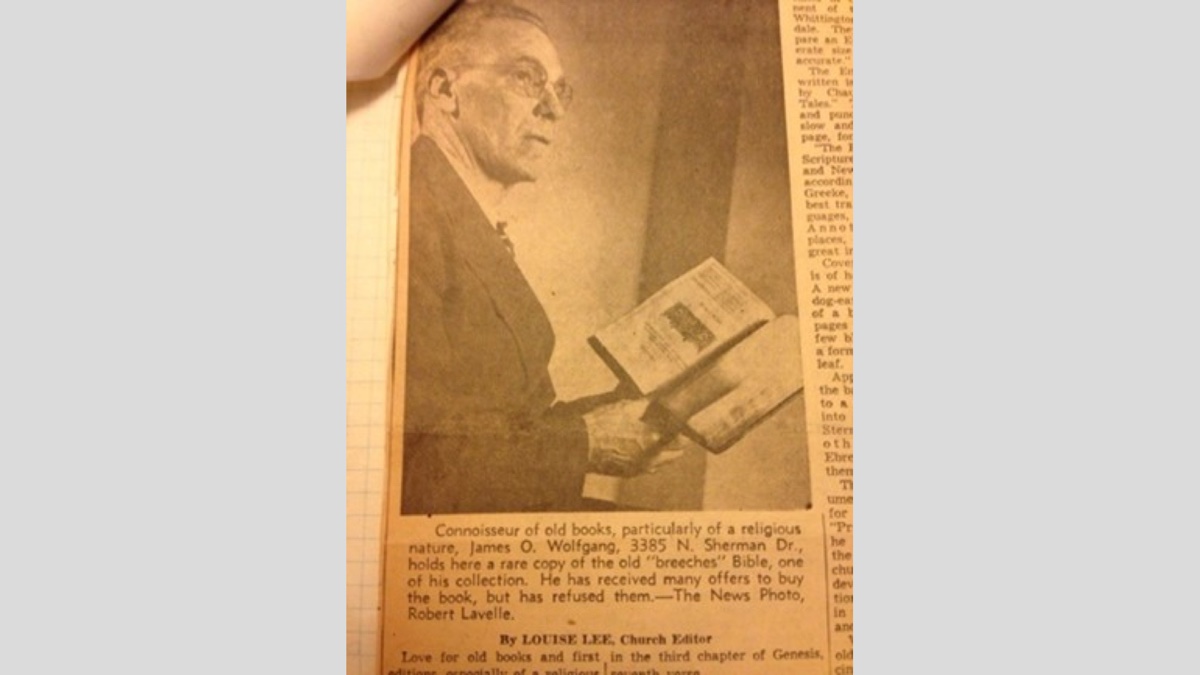

Note: Please send additions, corrections and updates here.
Updated: 1/2/2025
17312 Jones Rd, Athens, AL 35613
Sun. Bible Study 9:30 am | Sun. Worship: 10:20 am & 5:00 pm | Wed. Bible Study 7:00 pm
Evangelist: Jonathan Reeder | Website | 256-233-3160
24190 Wooley Springs Rd, Athens, AL 35613
Sun. Worship 9:30 am & 5:15 pm | Wed. Bible Class 7:00 pm
Evangelists: Bob Watson & Matt Taylor | Website
3955 Pine Lane, Bessemer, AL 35022
Sun. Bible Study 9:10 am | Sun. Worship 10:00 am & 5:00 pm | Wed. Bible Class 7:00 pm
Evangelist: David Deason | 256-497-8127 205-425-2352 | Email | Website
2325 Old Columbiana Rd. (near I-65 & Hwy. 31)
Sun. Bible Study 9:00 am | Worship 10:00 am & 5:00 pm | Wed. Bible Study 7:00 pm
Evangelist: Kyle Pope | 205-822-0018 | Website
19965 Sandlin Rd. Elkmont, AL 35620
Sun. Worship 9:30 am & 3:00 pm | Bible Classes: 10:45 am | Wed. Bible Study 7:00 pm
Evangelist: Lance R. Taylor | 256-777-0990 | Website
851 N. Pine St. (Located next to University campus)
Sun. Bible Study 9:30 am | Worship 10:15 am & 5:00 pm | Wed. Bible Study 7:00 pm
Evangelist: Kenny Moorer | 256-766-0403
601 Pineywood Road, Gardendale, AL, 35071 (Located 10 miles N of Birmingham)
Sun. Bible Study 9:30 am | Worship: 10:25 am & 5:00 pm | Wed. Bible Study: 7:00 pm
Evangelists: Andrew Smith & Jason Shackleford | 205-631-2131 | Website
129 Hillcrest Rd, Mobile, AL 36608
Sun. Worship 9-9:30 am | Bible Study 9:30-10:30 am | Worship 10:30-11:30 am | Wed. Bible Study 7:00 pm
Evangelist: Ken Sils | 765-307-8048 | 251-342-4144 or 342-2041 | Website
271 Highway 65 N, Conway, AR 72032
Sun. Bible Study 9:00 am | Worship 10:00 am & 5:00 pm | Wed. Bible Study 7:00 pm
Evangelist: Bruce Reeves | Bldg: 501-336-0052 | Website
2655 Prince St., Conway, AR 72034
Sun. Worship 9:00 pm | Bible class 9:50 am | Worship & Lord’s Supper: 10:40 am | Wed. Bible Class 7:00 pm
501-450-8640
2323 South 46th St.
Sun. Bible Study 9:45 am | Worship 10:30 am | Wed. Bible Study 7:00 pm
407 Bella Vista Dr.
Sun. Bible Study 9:30 am | Worship 10:15 am & 5:00 pm | Wed. Bible Study 7:00 pm
Evangelist: Norman E. Sewell | 870-741-9104 or 870-741-5151 | Website
514 Airport Rd.
Sun. Bible Study 10:00 am | Worship 11:00 pm & 6:00 pm | Wed. Bible Study 7:00 pm
Evangelist: Dick Blackford | 870-933-9134
145 N. Country Club Rd.
Sun. Bible Study 9:00 am | Worship 10:00 am & 6:00 pm | Wed. Bible Study 7:00 pm
Evangelist: Brenden Ashby | 520-326-3634 | Website
17903 Ibbetson Ave.
Sun. Bible Study 9:45 am | Worship 10:50 am & 6:00 pm | Wed. Bible Study 7:30 pm
562-866-5615 | Website
3433 Studebaker Rd.
Sun. Bible Study 9:50 am | Worship 10:45 am & 5:30 pm | Wed. Bible Study 7:00 pm
JP Flores | 562-420-2363 or Mark Reeves | 562-377-1674 | Website
449 W. Allen Ave., Suite 120, San Dimas, CA 91773
Sun. Bible study 10:00 am | Worship 11:00 pm & 4:00 pm | Wed. Bible Study 7:30 pm
909-788-9978 | Website
Meets at the Fort Collins Senior Center, 1200 Raintree Dr., Fort Collins, CO 80526
Sun. Bible Study 9:30 am | Worship 10:30 am
Evangelist: Richie Thetford | Website
1414 Hawk Parkway, Unit C
Sun. Worship 11:00 pm | Bible Study 2 pm & 1:30 pm
970-249-8116 |
64 Casting Lake Rd.
Sun. Bible Study 9:00 am | Worship 10:00 am & 6:00 pm | Wed. Bible Study 7:00 pm
850-622-3817 | Website | Location change coming in 2022: 497 Church St Santa Rosa Beach, FL 32459
196 Ave C, Geneva, FL 32732
Sun. Bible Study 10:00 am | Worship 10:45 am
(689) 229-9888 | Website
6 Lane Dr., Mary Esther, FL 32569
Sun. Bible Study 9:30 am | Worship 10:30 am & 5:00 pm | Wed. Bible Study 7:00 pm
850-244-9222 | Website | Evangelist: Chris Simmons | Email
3940 S. Bumby Ave.
Sun. Communion: 9:30 am | Bible Study 10:00 am | Praise & Preaching: 10:55 am (No pm Service) | Wed 7:00 pm
Evangelist: Ken Chapman
Office: 407-851-8031 | Website | Note: Please call for current worship and Bible study times.
621 E. Wheeler Rd.
Sun. Bible Study 10:00 am | Worship 10:50 am & 6:00 pm | Wed. Bible Study 7:30 pm
Evangelist: Bobby Witherington | 813-684-1297 | Website
Route 116 (near Callaway Gardens)
Sun. Bible Study 10:00 am | Worship 11:00 pm & 6:00 pm | Wed. Bible Study 7:30 pm
Evangelist: Tommy W. Thomas | 706-628-5117 or 628-5229 |
Meeting at 321 2nd St. S., Ste. 103, Nampa ID 83651
Sun. Bible Study 10:00 am | Worship 11:15 am | Wed. Bible Study 7:00 pm
208-461-1318 | Email | Website or here
Note: Please see website for most current information.
370 N. Shilling | P.O. Box 158-83221
Sun. Bible Study 10:00 am | Worship 11:00 pm | Wed. Bible Study 7:30 pm
208-785-6168 or 681-1552
1310 NE 54th Ave, Des Moines, IA 50313
Sun. Bible Study 9:45 am | Worship 10:40 am | Wed. Bible Study 7:00 pm
515-262-6799 | Website
1236 63rd St. (Dir: 1.5 miles E of I355)
Sun. Bible Study 9:00 am | Worship 9:55 am & 6:00 pm | Wed. Bible Study 7:30 pm
Evangelist: Steve Wolfgang | 630-968-0760 | Website
1100 S. 17th St.
Sun. Bible Study 9:30 am | Worship 10:30 am & 6:00 pm | Wed. Bible Study 7:00 pm
217-234-3702
16224 S Vincennes Ave.
Sun. Bible Study 9:00 am | Worship 10:00 am & 4 pm | Wed. Bible Study 7:00 pm
Evangelist: Donald Hawkins | 708-339-1008 | Website
Meeting @ Sleep Inn Suites and Motel | 1101 North Cummings Lane, Washington, IL 61571
Sun. Worship: 11:30 am | Bible Study: 12:30 pm | Wed. Bible Study 6:30 pm @ home of Tim Sundlie, call for address
Evangelist: Tim Sundlie | 608-796-9028 | Email | Website
407 W Lewis and Clark Parkway, Clarksville, IN 47129
Sun. Bible Study 9:30 am | Worship 10:30 am & 6:00 pm | Wed. Bible Study 7:30 pm
Elders: Allen L. Morris (812) 989-5838 and Stephen W. Nale (502) 727-7559 or (812) 944-2305 | Website
Sun. Bible Study 9:30 am | Worship 10:30 am | Wed. 7:00 pm
765-676-6404 | Website
15530 Herriman Blvd, 46060
Sun. Bible Study 10:00 am | Worship 11:00 am | Wed. Bible Study 7:00 pm
Evangelist: John Smith | Email | 317-501-8035 or 317-501-0249 or 317-701-1204
400 Lafayette Ave. | P.O. Box 34
Sun. Bible Study 9:45 am | Worship 10:30 am & 6:00 pm | Wed. 7:00 pm
812-279-4332
(First St. & Karnes Ct.)
Sun. Bible Study 9:45 am | Worship 10:30 am & 5:00 pm | Wed. Bible Study 7:00 pm
Evangelist: Jeremy Goen | 812-967-3437 or 967-3520 | Website
302 S. Fourth Ave., Mulvane KS 67110 | Mail: PO Box 11
Sun. Bible Classes: 10:00 am | Worship 11:00 am | Wed. Bible Study 7:00 pm
Evangelist: Jay Horsley | 316-644-8503 | Website | Email
5600 SW 17th St, Topeka, KS 66604
Sun. Bible Study 9:15 am | Sun. Worship 10:30 am | Wed. Bible Study 7:00 pm
785-235-8687 or 785-273-7977 | Website
1235 Williams St.
Sun. Worship 10:00 am | Bible Study After am Worship & 6:00 pm | Wed. Bible Study 7:00 pm
Evangelist: Jerid Gunter | 270-274-4451
8081 US Hwy 68-East, Benton, KY 42025
Sun. Bible Study 9:00 am | Worship 10:00 am | Wed. Bible Study 6:00 pm
270-354-9451 | Email | Website | Conveniently located near Kenlake State Resort Park on the western shore of Kentucky Lake.
612 Broadway
Sun. Bible Study 9:45 am | Worship 10:30 am & 5:00 pm | Wed. Bible Study 6:30 pm
Evangelist: Charles J. White | 270-422-3878
107 Sunny Hill Dr.
Worship 9:30 am & 11:30 am | Bible Study 10:30 am | Wed. Bible Study 7:00 pm
Evangelist: Steve Lee | 270-789-1651 | Website
103 N. Main St. | P.O. Box 233
Sun. Bible Study 10:00 am | Worship 10:45 am & 5:00 pm | Wed. Bible Study 7:00 pm
Evangelist: Jarrod Jacobs | 270-589-4167 or 270-274-3065
385 E. Lexington Ave.
Sun. Worship 10:00 am | Bible Study 11:15 am & 5:00 pm | Wed. Bible Study 7:00 pm
Evangelist: B.J. Sipe | 859-236-4204
18 Scott Drive, Florence, KY 41042
Sun. Worship 9:30 am & 5:30 pm | Sun. Bible Study 10:30 am | Wed. Bible Study 7:00 pm
859-371-2095 | Website
1733 Bowling Green Rd.
Sun. Bible Study 9:00 am | Worship 10:00 am & 6:00 pm | Wed. Bible Study 7:00 pm
Evangelist: Steve Monts | 270-776-9393 | Website
733 Mill St. Leitchfield, KY 42754
Sun. Bible Study 9:30 am | Worship 10:00 am Communion 10:55 am | Wed. Bible Study 6:00 pm
270-230-6144 | Website
1803 Dixie Garden Dr.
Sun. Bible Study 9:30 am | Worship 10:30 am & 6:00 pm | Wed. Bible Study 7:00 pm
Evangelist: Michael Hardin | Email | 502-937 2822
3221 East Hebron Lane
Sun. Bible Study 9:00 am | Worship 10:00 am & 5 pm | Wed. Bible Study 7:30 pm
Evangelist: Danny Linden & Ron Halbrook | 502-957-5115 or 502-955-1748 | Website
405 Orice Roth Rd. | 70737 (Baton Rouge area)
Sun. Bible Class 9:30 am | Worship 10:30 am & 6:00 pm | Wed. Bible Study 7:00 pm
Evangelist: R.J. Evans | Email | 225-622-4587
856 Brighton Ave. (Breakwater School) | Leave Maine Turnpike at Exit 48
Sun. Bible Study 10:00 am | Worship 11:00 pm w/ second service immediately following am worship | Mid-week Bible Study (please call for times & places)
207-839-3075 or 839-8409
3084 Creek Drive SE, #1-C, Kentwood, MI 49512 | P.O. Box 8446, Kentwood, Mich. 49508 (Grand Rapids area)
Sun. Worship 11:00 am | Sun. Bible Study 12:30 pm | Wed. Bible Study 7:00 pm
Evangelist: Joseph Gladwell | Email
414 South Main Street
Sun. Bible Study 10:00 am | Worship 11:00 am | Wed. Bible Study 6:00 pm
Evangelist: Ryan Thomas | 810-837-1302 or 989-389-3226 | Website
2820 Grandview Ave, Meridian, MS 39305
Sun. Bible Study 10:00 am | Sun. Worship 11:00 pm | Wed. 6:30 pm
Ron Cooper: 601-934-3675 | Email
Ricky Ethridge: 601-737-5778 | Email
2110 E State Line Rd. (Exit I-55) (Memphis area)
Sun. Bible Study 9:30 am | Worship 10:30 am | Wed. Bible Study 7:00 pm
Evangelist: James A. Brown | Bldg: 662-342-1132
805 Meadow Rd, Severn, MD 21144
Sun. Bible Study 10:00 am | Sun. Worship 11:00 pm & 6:00 pm | Wed. Bible Study 7:30 pm
Evangelist: Brandon Trout | 410-969-1420 or 410-551-6549 | Website
422 N Linton St., Blodgett, MO 63824
Sun. Worship 10:00 am | Wed. Bible Study 7:00 pm
Evangelist: Russell Rice | 573-475-0417
4000 SW Christiansen
Sun. Worship 9:00 pm | Bible Study 10:00 am | Worship 11:00 pm | Wed. Bible Study 7:00 pm
Evangelist: Brett Hogland | 816-228-9262
432 Eagle Rock Rd, Branson, MO 65616
Sun. Worship 9:30 am | Bible Study 10:30 am | Sun. Evening Worship 5:00 pm | Wed. Bible Study 6:00 pm
Evangelist: Philip North | 417-239-1036 | Email | Website
2912 Bloomfield Rd
Sun. Bible Study 9:15 am | Worship 10:00 am | Wed. Bible Study 7:00 pm
Seth McDonald & Jerry Lee Westbrook | 573-837-1001 | Email | Website
703 Harrison St.
Sun. Bible Study 10:00 am | Worship 11:00 pm & 6:00 pm | Wed. Bible Study 7:00 pm
Evangelist: Nolan Glover | 870-650-1648 | Website
685 Sidney St.
Sun. Bible Study 9:30 am | Worship 10:15 am & 5:00 pm | Wed. Bible Study 7:00 pm
Evangelist: Lynn Huggins | 573-265-8628
2727 County Line Rd.
Sun. Bible Study 9:00 am | Worship 9:50 am | Wed. Bible Study 7:00 pm
816-279-4737 | Website
Bell St & S 7th St. Beatrice, NE 68310
Sun. Bible Study 9:00 am | Worship 10:00 am & 6:30 pm
402-233-4102 or 402-228-3827 | Website
5327 S. Tryon Street, Charlotte, NC 28217
Sun. Bible Study 9:30 am | Sun. Worship 10:30 am | Wed. Bible Study 7:30 pm
704-525-5655 | Website
3781 East Highway 27, Iron Station, NC 28080
Sun. Bible Study: 10:00 am | Sun. Worship 11:00 am & 6:00 pm | Wed. Bible Study 7:00 pm
Evangelist: Stan Adams | 704-748-9777 (Bldg) & 704-748-3747 (Jerry) | Email | Website
1031 Welford Dr, Beavercreek, OH 45434 (located a few miles E of Dayton)
Sun. Short Worship: 9:30 am | Bible Study 10:05 am | Sun. Worship 11:00 am | Wed. Bible Study Adults: 1:00 pm & All ages: 7:00 pm
Evangelist: Heath Rogers | 937-426-1422 | Website
13501 Lorain Ave, Cleveland, OH 44111
Sun. Bible Study 10:00 am | Worship 11:00 am | Wed. Bible Study 7:00 pm (Call)
Evangelist: John Dicus | (330) 723-0111 or (330) 590-0227 or (216) 322-9392 | Website
28 W. Main St., Dayton, OH 45449
Sun. Worship 9:00 pm | Bible Study 9:30 am | Worship 10:25 am | Wed. Bible Study 7:00 pm
Evangelists: Michael Grushon 937-866-5162 or Alan Beck 937-469-3311 | Website
6417 Franklin-Lebanon Rd. Franklin, OH 45005
Sun. Bible Study 10:00 am | Worship 10:45 am | Tues. Bible Study 6:30 pm
Evangelist: Josh Lee | 937-789-8055 or 937-746-1249 | Website
1973 W Main St. New Lebanon, OH 45345
Sun. Bible Study 9:30 am | Worship 10:30 am, & 5:00 pm | Wed. Bible Study 7:00 pm
Evangelist: Bruce Hastings | 937-687-7150 or 937-478-0367
80 Sandhill Rd. Reno, OH 45773
Sun. Bible Study 9:30 am | Worship 10:30 am & 6:30 pm | Wed. Bible Study 7:00 pm
Evangelist: Mark Childers | 304-615-1091 | 740-374-9827 | Website
4110 Frey Rd., Northwood, OH 43619 (Toledo Area)
Sun. Worship 11:00 pm
Evangelist: Donald Jarabek | 419-893-3566 & 567-331-2269
33226 Children’s Home Rd., Pomeroy, OH 45769
Sun Worship 10:00 am & 5 pm | Bible Study 11:00 am | Wed. Bible Study 6:00 pm
Jack Hunt | Email | 740-645-4612 | Website
2120 No. A St.
Sun. Bible Study 9:45 am | Worship 10:45 am & 5:30 pm | Wed. Bible Study 7:00 pm
Evangelist: Rob Lungstrum | 918-931-1362 or 918-423-3445
4110 NE 122nd Ave #101, Portland, OR 97230
Sun. Bible Study 10:00 am | Worship 11:00 am | Thur. Bible Study 7:00 pm
Evangelist: Samuel A. Matthews | 971-331-2838 | Bldg: 503-432-8697 | Email | Website
3702 E. Long St.
Sun. Bible Study 9:30 am | Worship 10:30 pm & 5:30 pm | Wed. Bible Study 7:30 pm
Bldg: 541-367-1599 | Email | Website
7222 Germantown Ave, Philadelphia, PA 19119
Sun. Bible Study 10:15 am | Sun. Worship: 11:15 am | Tues. Bible Study: 7:00 pm
Evangelist: James H. Baker, Jr. | 215-248-2026 | Website
3370 Broad St. Extension
Sun. Bible Study 9:30 am | Worship 10:30 am & 5:30 pm | Wed. Bible Study 7:00 pm
Evangelist: A.A. Granke, Jr. | 803-499-6023
4013 Edmund Hwy. (Hwy. 302), West Columbia, SC 29170
Sun. Bible Study 9:30 am | Sun. Worship 10:30 am & 5:00 pm | Wed. Bible Study 7:00 pm
Evangelist: Jerry Cleek | 219-313-1108 | Website
326 Powell Road, Collierville, TN 38017
Sun. Bible Study 9:00 am | Worship 10:00 am | Wed. Bible Study 7:00 pm
Evangelist: Doug Seaton | 901-854-6816 or 901-634-7840
417 Mooresville Pike | (Located .8 mi. N. of Hwy. 50/Jas. Campbell)
Sun. Bible Study 9:30 am | Worship 10:30 am & 3:30 pm | Wed. Bible Study 7:00 pm
931-388-5828 or 931-381-7898 | Website
4894 Hooper Hwy. | 37722 | (Located 15 mi. E. of Gatlinburg on Hwy. 321)
Sun. Bible Study 10am | Worship 11:00 pm & 5:00 pm | Wed. Bible Study 6:00 pm
Evangelist: Olie Williamson | 423-487-5540 or 423-748-0844
350 N Main St. Kingston Springs, TN 37082
Sun. Bible Study 9:00 am | Worship 10:00 am & 5:00 pm | Wed. Bible Study 7:00 pm
108 Locust St.
Sun. Bible Study 9:30 am | Worship 10:30 am & 5:00 pm | Wed. Bible Study 7:00 pm
Evangelist: Daniel H. King, Sr. | 931-379-3704 or 931-964-3924 | Website
1110 Cason Lane
Sun. Bible Study 9:00 am | Worship 10:00 am & 5:00 pm | Wed. Bible Study 7:00 pm
Bldg: 615-896-0090 | Website
2091 Pitts Ln, Murfreesboro, TN 37130 (located at the corner of Northfield Blvd and Pitts Lane)
Sun. Bible Study 9:30 am | Sun. Worship 10:30 am & 6:00 pm | Wed. Bible Study 7:00 pm
Evangelist: David Bunting | 615-893-1200 | Website
7471 Charlotte Pike
Sun. Bible Study 9:00 am | Worship 10:00 am & 5:00 pm | Wed. Bible Study 7:00 pm
Evangelist: Lee Wildman | 615-952-5458 or 615-356-7318
1414 W. Exchange Pkwy
Sun. Bible Study 9:00 am | Worship 10:00 am & 5:00 pm | Wed. Bible Study 7:00 pm
Evangelist: Jerry King 214-504-0443 or 972-727-5355 | Website
4343 S Interstate 35, Alvarado, TX 76065 (Located on the East Service Road off I-35 North of Alvarado)
Mail: I-35 church of Christ, P.O. Box 1269, Alvarado, TX 76009
Sun. Bible Study 10:00 am | Worship 11:00 am | Wed. Bible Study 7:00 pm
682-202-9741 or 817-739-3402 | Website
605 E. Adoue St., Alvin, TX 77511
Sun. Bible Study 9:30 am | Worship 10:30 am & 5:00 pm | Wed. Bible Study 7:30 pm
Evangelist: Mark Mayberry | Email | Website
701 North Pruett St.
Sun. Bible Study 9:45 am | Worship 10:40 am & 6:30 pm | Wed. Bible Study 7:00 pm
Bldg: 281-422-5926 | Weldon: 713-818-1321 | Website
2919 Main St/FM 517 E., Dickinson, TX 77539
Sun. Bible Study 10:00 am | Sunday Worship 11:00 am & 6:00 pm | Wed. Bible Study 7:00 pm
713-298-6673
301 Robison St.
Sun. Bible Study 9:30 am | Worship 10:30 am & 6:00 pm | Wed. Bible Study 7:00 pm
Evangelist: Phillip Stuckey | 361-782-5506 or 361-782-2844 | Website
3277 Pendleton Rd.
Sun. Bible Study 9:30 am | Worship 10:30 am & 5:00 pm | Wed. Bible Study 7:00 pm
915-855-1524
4303 18th St, Bacliff, TX 77518
Sun. Bible Study 9:00 am | Sun. Worship 10:00 am & 6:00 pm | Wed. Bible Study 7:00 pm
Evangelist: Richard Lay | Website
6110 White Settlement Rd. 76114
Sun. Bible Study 9:30 am | Worship 10:30 am & 6:00 pm | Wed. Bible Study 7:30 pm
817-738-7269
Old Granbury Rd Church of Christ
4313 Old Granbury Rd, Granbury, TX 76049
Sun. Bible Study 9:30 am | Sun. Worship 10:30 am | Wed. Bible Study 7:00 pm
Evangelist: Chip Foster | 817-913-4209 or 817-279-3351 | Website
2510 Fry Rd, Houston, TX 77084
Sun. Bible Study 9:45 am | Worship 10:30 am & 6:00 pm | Wed. Bible Study 7:00 pm
Evangelist: David Flatt | Email | Website
6111 Indiana Ave, Lubbock, TX 79413
Sun. Bible Study 10:00 am | Sun. Worship 9:00 am & 11:00 am | Wed. Bible Study 7:00 pm
806-795-3377 | Website
1820 Mansfield Webb Rd, Mansfield, TX 76063
Sun. Bible Study 9:30 am | Sun. Worship: 10:20 am & 5:00 pm | Wed. Bible Study 5:30 pm.
Evangelist: Tom Roberts | 817-996-3926 | Website
612 S Shawnee St, Nacogdoches, TX 75961
Sun. Bible Study 9:45 am | Worship 10:30 am & 6:00 | Wed. Bible Study 6:00 pm
Minister: Van Dennis | 936-615-2950
3831 N.E. Stallings Dr.
Sun. Bible Study 9:30 am | Worship 10:20 am & 6:00 pm | Wed. Bible Study 7:00 pm
Evangelists: Randy Harshbarger & Jay Taylor
268 Utopia Ave. (Dir: I-37 S.E. Exit Pecan Valley)
Sun. Bible Study 9:30 am | Worship 10:30 am & 5:00 pm | Wed. Bible Study 7:00 pm
Evangelist: Jesse Garcia | 210-660 0409
314 N. Tolbert
Sun. Bible Study 9:30 am | Worship 10:30 am & 5:00 pm | Wed. Bible Study 7:00 pm
Evangelist: Ronald Stringer
4404 Twin City Blvd.
Sun. Bible Study 9:30 am | Worship 10:30 am & 6:00 pm | Wed. Bible Study 7:30 pm
Evangelist: Jason Garcia Email or Email | 254-939-0682 | Website
2301 Franklin Dr., Texarkana, AR 71854
Sun. Bible Study 9:30 am | Worship 10:15 am | Wed. Bible Study 7:00 pm
870-772-0746 | Website
340 E Warren St. (in Hewitt, a suburb of Waco)
Sun. Bible Class 9:30 am | Worship 10:30 am & 5:00 pm | Wed. Bible Study 7:00 pm
Evangelist: Marc Smith | 254-292-2482 or 652-7698
4500 Kell West Blvd, Wichita Falls, TX 76309
Sun. Bible Class 9:30 am | Worship 10:30 am & 3:30 pm | Wed. Bible Study 6:30 pm
Evangelist: Dennis L. Scroggins | 512-626- 5702 | Email | Website
Please mail all correspondence to 1504 Hayes St, Wichita Falls, TX 76309
Meeting in the Capital City Grange Hall, 6612 Route 12 Berlin, VT 05602
Sun. Bible Study 9:00 am | Worship 10 am | Tues. Evening in Homes
Evangelist: Open | Website | P.O. Box 70, Williamstown, VT 05679 | For questions or directions: Wade Holt 802-485-4311
217 Taxus St., Chesapeake, VA 23320
Sun. Bible Study 10:00 am | Worship 11:00 am & 5:00 pm | Wed. Bible Study 7:00 pm
Evangelist: Steven Matthews | 757-436-6900 | Website
8330 Doublecreek Court, Chesterfield, VA 23832 (Located in teh Metro Area; Courthouse Rd. at Double Creek Ct. 2.2 miles S of Rt. 288)
Sun. Bible Study 9:30 am | Worship 10:30 am & 5:00 pm | Wed. Bible Study 7:00 pm
Evangalist: Nathan L. Morrison | 804-778-4717 | Website
1208 W. 41st St.
Sun. Bible Study 10:00 am | Worship 11:00 pm & 6:00 pm | Wed. Bible Study 7:00 pm
Evangelist: Jack Bise, Jr.
2970 Old Leaksville Rd.
Sun. Bible Study 10:00 am | Worship 11:00 pm & 5:30 pm | Wed. Bible Study 7:00 pm
276-956-6049 | Website
929 Indiana Ave. NE (5 min. from Roanoke Convention Center)
Sun. 1st Lesson 9:15 am | Bible Study 10:00 am | Worship 11:00 pm | Wed. Bible Study 7:30 pm
Evangelist: Brent Paschall | 540-344-2755 | Website
5652 Haden Rd.
Sun. Bible Study 10:00 am | Worship 11:00 am
Robert Mallard | 757-464-4574
1860 Mt Baker Hwy, Bellingham, WA 98226,
Sun. Bible Study 9:30 am | Worship 10:30 am & 6:00 pm | Wed. Bible Study 7:00 pm
Evangelist: Steven J. Wallace | 360-752-2692 or 806-787-5088 | Website & Website
Meeting at Gray Middle School, 6229 S. Tyler St., Tacoma, WA 98409
Note: Please see webpage for updated meeting location and times.
Sun. Bible Study 10:00 am | Worship 11:00 pm | Wed. Bible Study 7:00 pm (Online)
253-242-3098 | Email | Website
7 Old Davisson Run Rd, Clarksburg, WV 26301
Sun. Bible Study 9:30 am | Worship 10:20 am
304-622-5433 | Website | Email
1929 Morgantown Ave.
Sun. Bible Study 10:00 am | Worship 10:45 am & 6:00 pm | Wed. Bible Study 7:00 pm
304-363-8696 or 304-844-2437
210 Cedar Ave, Moundsville, WV 26041
Sun. Bible Study 9:30 am | Sun. Worship 10:30 am & 6:00 pm | Wed. Bible Study 7:00 pm
Evangelist: Tony Huntsman | 304-845-4940 | Website