(February, 2025 | No. 2 | Vol. 69)
2/1/2025
Truth Magazine (ISSN 1538-0793) is published once a month by Truth Publications, Inc., 220 S. Marion, Athens, AL 35611.
© 2025 Truth Publications, Inc. All Rights Reserved.
Manuscripts should be sent to the editor, Mark Mayberry, at mark@truthpublications.com. Link.
Subscriptions, renewals & other correspondence should be sent to: Truth Magazine, 220 S. Marion, Athens, AL 35611 or by emailing us at subscriptions@truthmagazine.com. Link.
Book orders should be sent to: CEI Bookstore | truthbooks.com | Street Address: 220 S. Marion, Athens, AL 35611 | Phone: (855) 492-6657 | Email: sales@truthbooks.com Link.
Online Website: truthmagazine.com
DISCLAIMER: Books in ads are screened, but an ad does not mean unqualified endorsement. All books should be tested by Scripture. We appreciate readers notifying us if they find some glaring fault in the ads.
By Bruce Reeves
Synopsis: The Spirit’s word has been perfectly and completely confirmed and revealed for our justification and glorification, and we must never minimize His precious words.
Synopsis for Theme Section: This issue of Truth Magazine focuses on the nature and work of the Holy Spirit. Sadly, unscriptural speculation has too often discouraged the Lord’s people from a more comprehensive consideration of the blessings of the Holy Spirit as He convicts, converts, and encourages all those who are faithful children of God. Thanks to Mark Mayberry for the invitation to assemble these topics and writers on this vital issue and to all those who took part. We commend it to you.
Romans 8 is the Christian’s victory cry over this sinful world; it is a spiritual crescendo and celebration of our transformation in Christ. The gospel not only frees us from the penalty of sin; it also liberates us from sin’s dominating power. In Romans 8:1, Paul proclaims, “Therefore there is now no condemnation for those who are in Christ Jesus,” and in Romans 8:35, he rhetorically asks, “Who shall separate us from the love of Christ?” Our Savior has brought us into a fellowship that defeats condemnation and overcomes spiritual separation. We now enjoy spiritual life and reconciliation in Christ.
In Romans 6, Paul describes our spiritual exodus from the slavery of sin, and in Romans 7, he depicts the desperate and lost condition of one seeking to be justified before God through the Law (Rom. 7:14-25)[Note #1]. Now, in Romans 8, the Spirit’s influence through the gospel erupts from the pages of Holy Scripture. The word “spirit” (pneuma) occurs only five times in chapters 1-7 and twice in chapters 9-11, but He is mentioned fourteen times in Romans 8. Paul highlights the life-giving work of the Holy Spirit in the life of the Christian.
The “law of the Spirit of life in Christ,” which has freed us from the dominion of “sin and death,” is the gospel of Christ (Rom. 8:2). Paul speaks of three laws: (1) “The law of the Spirit of life in Christ Jesus,” which is the gospel; (2) “the law of sin and death,” which is the dominating rule of sin (Rom. 7:20-21, 23-24); and (3) the Law of Moses, which is weak through the flesh in that it cannot, in and of itself, remove sin (Rom. 8:3). The absence of the Holy Spirit in 7:14-25, in contrast to 8:1-17, is telling. It is also noteworthy that Paul does not merely describe a person struggling with sin in Romans 7:14-25, but a person “sold into bondage to sin” (Rom. 7:14), spiritually dead (Rom. 7:5-13), ruled by the power of sin (Rom. 7:21), a “prisoner of the law of sin” (Rom. 7:23), who exists in a “wretched” condition (Rom. 7:25)[Note #2]. In contrast, the child of God is to “walk in newness of life” (Rom. 6:4), as he has been “united with Him in the likeness of His death” and “resurrection” and is now “dead to sin,” but “alive to God in Christ Jesus” (Rom. 6:5-11). While we must all fight against sin (Eph. 6:10-17), sin is not to reign over us (Rom. 6:1-7, 11-18). The declaration that “there is now no condemnation for those who are in Christ” who have been “freed from the law of sin and death” is in stark contrast to the previous chapter (Rom. 8:1-2).
Christians are “led by the Spirit” as we surrender to His teaching, influence, and guidance through the “law of the Spirit” in the gospel of Christ. Jesus said, “My words are spirit, and they are life” (John 6:63). Those who claim to be led directly by the Spirit will frequently offer their feelings as proof of His influence. Some confuse their conscience with the direct-miraculous working of the Spirit. Interestingly, even among those who received miraculous gifts in the New Testament, the Lord gave them powers and revelation, not ambiguous feelings to decode. Our conscience itself does not determine right or wrong, but reflects what we believe is right or wrong (Acts 23:1; 1 Tim. 1:12-17). Our conscience is a blessing when it is educated and guided by the Spirit’s word, rather than our subjective feelings (Rom. 9:1; 1 Cor. 2:9-16). Yes, the Spirit produces joy and peace as we submit to the gospel, but this fruit is the effect of walking in the Spirit’s teaching (Gal. 5:16-25). It is not unusual to hear of those attributing their fallible thoughts and feelings to the Holy Spirit with statements such as “the Spirit spoke to my heart,” “the Spirit laid this on my heart,” or “the Spirit moved me to. . .” (Jer. 10:23; 17:9). If we reject the word of God, we are following the flesh, not the Spirit. Careful Bible study and attention to the authority of the Scriptures do not take the Spirit out of our lives; it permits Him to remain in our hearts.
The term “flesh” in this context does not refer to our physical bodies since we can use such to glorify God, but to our attitude or mindset (Rom. 8:11-13). Paul writes, “For those who are according to the flesh set their minds on the things of the flesh. . . for the mind set on the flesh is death. . . because the mind set on the flesh is hostile toward God” (Rom. 8:5, 7). However, those who are spiritually minded think on “the things of the Spirit” (Rom. 8:5). The “things of the Spirit” bring about life and peace and are known by receiving God’s word (Rom. 8:6). In essence, Paul is saying, “For those who are aligned with the flesh are intent on the things of the flesh, while those who are aligned with the Spirit are intent on the things of the Spirit” (Rom. 8:12-13). It is impossible to be led by the Spirit and not be aligned with His teaching. If we live “in the flesh,” we cannot please God (Rom. 8:8, 12-13). Those who argue that we can be filled with the Spirit while we live our lives out of alignment with His teaching are arguing against Paul’s clear statements in this context and may have been influenced by a mystical approach to the Spirit’s work that resembles Gnostic notions more than the Scriptures.
There can be no question, biblically speaking, that the Holy Spirit dwells in believers. Yet, it is fair to ask what that means for God’s people. Indwelling language is relational language.
Believe Me that I am in the Father and the Father is in Me. . . in that day you will know that I am in My Father, and you in Me, and I in you (John 14:10, 20).
As for you, let that abide in you, which you heard from the beginning. If what you heard from the beginning abides in you, you also will abide in the Son and in the Father (1 John 2:24).
Whoever confesses that Jesus is the Son of God, God abides in him, and he in God. We have come to know and have believed the love which God has for us. God is love, and the one who abides in love abides in God and God abides in him (1 John 4:15-16).
Not only is the Holy Spirit described as dwelling in us, but we are also described as dwelling in Him. This type of language speaks of our relationship with the Holy Spirit in the same way as it reflects our relationship with the Father and Christ (Rom. 8:9-11, 14). If being “in the flesh” describes the realm and influence of the flesh, then being “in the Spirit” describes living in the realm and under the influence and teaching of the Spirit. If the Holy Spirit dwelling in us refers to Him literally living in our physical bodies, then what is meant by Christians “living in the Spirit”? How is “living in the Spirit” all that different from us dwelling in God or in Christ? Along this line, it is helpful to consider the parallel texts of Ephesians 5:18-19 and Colossians 3:16-17. We are commanded to “be filled with the Spirit” and “to let the word of Christ dwell in us richly.” One text describes Who is dwelling in us and the other demonstrates how He dwells in us. The truth that the Spirit dwells in us through His message does not deny that He dwells in us. When another person dwells in you, you develop the same attitudes they have about truth, righteousness, and holiness (Rom. 12:1-2; Eph. 4:22-24).
The Bible does not describe the Holy Spirit’s indwelling in us as something mystical or sensational, nor does it present the notion of the Holy Spirit possessing our physical bodies in a literal sense. Anytime one advances the idea that we can know the Spirit is influencing us through our physical senses, we must immediately recognize that there is a fundamental and serious misunderstanding of the Holy Spirit in our lives as Christians today. Because figures of speech are used of our relationship with the Father, Son, or Spirit does not change the reality of the fellowship we enjoy in Christ (1 Cor. 12:13). It is not “courageous” to advance ambiguous and unsettling teachings about the Spirit in private or public; rather, it is courageous to carefully exegete and responsibly examine Scripture in a way that harmonizes with God’s word.
No. It is not a matter of limiting God; it is a matter of the Lord limiting or restraining Himself. For instance, He rested on the seventh day (Gen. 2:1), chose never to destroy the world with a flood again (2 Pet. 3:4-9), and promised to cease the exercise of miraculous spiritual gifts once the completed revelation of His word was received (1 Cor. 13:8-13). Ironically, the very ones that make such charges are themselves limiting God’s power. Can the Spirit not provide us all we need through His word? Can the Creator of the universe not reveal His truth in a way that perfectly teaches, shapes, and orients our minds to His glorious purpose? Paul writes, “For this reason we also constantly thank God that when you received the word of God which you heard from us, you accepted it not as the word of men, but what it really is, the word of God, which also performs its work in you who believe” (1 Thess. 2:13).
The Holy Spirit assures the Christian of his salvation in His word and promises: “For all who are being led by the Spirit of God, these are sons of God. For you have not received a spirit of slavery leading to fear again, but you have received a spirit of adoption as sons by which we cry out, ‘Abba! Father!’ The Spirit Himself testifies with our spirit that we are children of God” (Rom. 8:14-16). This passage is not teaching that the Holy Spirit bears witness to our spirit separate and apart from God’s word, but that the Spirit bears witness with our spirit that we are children of God. Jack Cottrell offers this insight regarding the passage:
“The basic question here is this: to whom is the Spirit’s witness addressed? Most view it as a subjective, experiential testimony of the Spirit directly to our spirit, giving us assurance that we are indeed children of God. I believe this is a false idea. . . Paul here says that the Spirit bears witness along with our spirit, not to our spirit. This cannot be ignored” (The College Press NIV Commentary: Romans, 275).
Thus, the Spirit bears witness through the gospel, and our human spirit testifies whether we have obeyed that message. We are not afraid to proclaim that the Spirit teaches, directs, justifies, sanctifies, redeems, indwells, and bears witness, but neither are we afraid to declare that the Spirit teaches, directs, justifies, sanctifies, redeems, and bears witness through His word! Some have ridiculed the notion by remarking, “Is it just the Bible in me?” It is concerning that brethren would speak in such a dissatisfied way of the all-sufficient word of God. Yes, it is the Spirit’s inspired and revealed word, which is in you. However, consider how amazing it is that the very words of the living God live in our hearts and minds (2 Tim. 3:16-17; Heb. 4:12).
On May 17, 2017, my family and I lost my sweet mother. She passed away with multiple neurological diseases. Several months after she passed away, I went to see my dad. As I walked into the house, I saw him reading the handwritten letters that he and my mom had exchanged when they were dating. It was interesting to see the development of their relationship by reading their letters. Early on, my Mother signed a letter “missing you, Carolyn,” then she wrote, “love, Carolyn,” and in a letter right before they married, she wrote, “Love you always, Carolyn.” As my father was reading these letters again after my mother passed away, I saw tears streaming down the face of a very strong man. What if someone had said, “Carl, those are just letters!” We would think they were extremely insensitive and lacked any understanding of what those letters really meant. The word of God is the inspired revelation of God’s faithfulness, His love and mercy, and His plan for saving humanity. They speak of Jesus’s ultimate sacrifice and a heavenly hope that is incorruptible, imperishable, and reserved in heaven for us (Phil. 2:6-11; Rom. 8:28-38; 1 Pet. 1:3-5). The Spirit’s word has been perfectly and completely confirmed and revealed for our justification and glorification. Let us never minimize His precious words. God’s people should love them, embrace them, and thank God for His blessed Spirit, which has given us God’s will for our lives.
Cottrell, Jack. The College Press NIV Commentary: Romans. Joplin, MO: College Press Publishing Company, 2005.
[Note #1] Paul also makes it clear that an individual cannot be a slave of sin and righteousness at the same time (Rom. 6:18, 20; 8:12-13).
[Note #2] When Paul describes one living “in the flesh” and under the “law of sin and death,” he is not depicting someone who is constantly sinning because of an inherited sinful nature, but one who is living under the condemnation of a law-system without Jesus Christ and His gospel.
Bruce Reeves has labored with the Highway 65 church of Christ in Conway, AR, since 2000. He and his wife, Rachel, have one child. The church website is here. He can be reached here.




By Kyle Pope
Synopsis: In the religious world, great emphasis is often placed on making a contribution anytime a service occurs. What does the Bible teach about the contribution of a local church? What principles should govern giving?
In many churches, any time a congregation comes together, a collection is taken from the members (and even visitors). Often, great effort and motivation are used to persuade those present to give generously. While the Bible clearly teaches that the New Testament church collected money to address the needs of each congregation, does the Bible teach taking up such collections at any (and every) time there is an assembly?
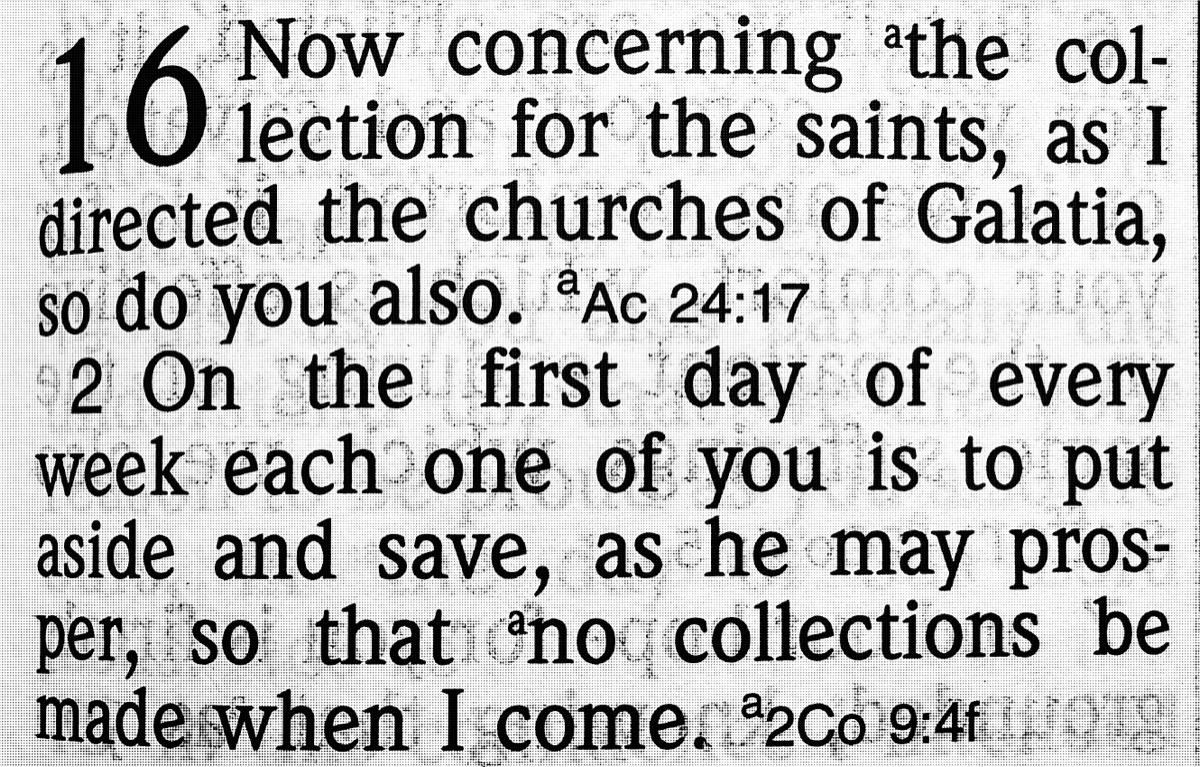
When the apostle Paul wrote to the church in ancient Corinth, he gave them instructions regarding how and when to take up a collection for a need that the church should address. He wrote, “On the first day of the week let each one of you lay something aside, storing up as he may prosper, that there be no collections when I come” (1 Cor. 16:2, NKJV). Although the occasion for this instruction involved a gift that would be sent to Jerusalem, his instruction was not isolated to Corinth alone. In the previous verse, he wrote, “Now concerning the collection for the saints, as I have given orders to the churches of Galatia, so you must do also” (1 Cor. 16:1). While individual generosity should occur as opportunities arise (see Gal. 6:10), this is the only example we have of when the church collection was made. To act within biblical authority, churches should only take up this type of collection on Sunday.
In Paul’s second letter to Corinth, he returned to this subject. While Paul clearly sought to encourage generosity, he tempered it with a powerful qualifier. He says, “So let each one give as he purposes in his heart, not grudgingly or of necessity; for God loves a cheerful giver” (2 Cor. 9:7). We may note three points here. Giving is to occur:
Just as the words of Jesus declared, “But when you do a charitable deed, do not let your left hand know what your right hand is doing” (Matt. 6:3)—the public spectacle of a preacher manipulating an audience, and then focusing attention upon a large contribution, is the exact opposite of what the Lord taught in Matthew 6:3 and through the writings of the apostle Paul.
Certainly, it is appropriate to teach the value and importance of giving. Preachers or elders who do so are doing just what Paul did if they teach the principles and reason for giving. At the same time, any pressure or compulsion to give should only come from a person’s reflection upon his worship of God. A Christian’s giving must not come from “guilt-trips” or “mind-games.” Instead:
When a worshipper leaves an assembly feeling as if he has been pressured and manipulated into giving, God is not pleased with the gift. In such an instance, not only has the one who resents being pressured failed to worship in truth, but the preacher or church leader responsible for that atmosphere stands accountable before God for violating the clear teaching of Scripture. Instead, we should search our hearts, make deliberate plans about what we would like to give, and do it joyfully. Of this attitude, the Hebrew writer tells us, “with such sacrifices God is well pleased” (Heb. 13:16). This is the biblical pattern, and the one which Christians must follow today.
Kyle Pope preaches for the Vestavia church of Christ in Vestavia Hills, AL. He has written several books published by Truth Publications. Go here for more information. The church website is here. He can be reached here.



By Rachel Reeves
Synopsis: Rachel emphasizes the importance of letting one’s light shine in a world filled with darkness, drawing on biblical references to illustrate this point. She encourages women to be a light to their families, friends, and communities by holding fast to the word of God and growing in their relationship with Christ. Wisdom derived from Scripture is infinitely superior to worldly wisdom—empowering godly women to supporting their husbands and nurturing their children spiritually.
Can you think of a time in your childhood when you were in deep darkness? Have you ever taken a cave tour with your family? Somewhere on every such tour, you get down into the deepest part of the cavern, and the guide will turn off the lights. You cannot see anyone or your hands in front of your face. It is an eerie feeling when we cannot see any light. What would this world be like if God’s children never let their light shine to their family, friends, and community? The darkness of this world can be overwhelming (John 1:5). The darkness of shame, guilt, confusion, and sin can be daunting without the light of the gospel (John 3:20-21). We must strive, as women of God, to hold up the light of the gospel to all those around us. Jesus has commanded us in Matthew 5:14-16 to let our light shine in this world. We are not to hide our light from others, but let it shine so we will “glorify our Father who is in heaven.”
The greatest fear of many godly women is the spiritual loss of a loved one, whether that is a parent, child, spouse, or friend. Yet through Christ, we can, as daughters of our Almighty King, strive to fortify our families and loved ones against the dark influences of this world. Paul encouraged the Philippians to “prove yourselves to be blameless and innocent, children of God above reproach in the midst of a crooked and perverse generation, among whom you appear as lights in the world.” How can we accomplish such a task? In verse 16, Paul writes, “holding fast the word of life.”
Whether single, married, or widowed, we all have the obligation as God’s children to let our lights shine. We have been created in the image of our God and are to glorify Him in all aspects of our lives as we mirror His image (Gen. 1:26-28). Before we can be a light to others, we must grow in our relationship with Christ by strengthening our faith (2 Pet. 3:18). Where do we gain spiritual wisdom? Too often, Christians listen to uncertain teachings from popular podcasts or read self-help books more than they do Scripture. We must remember that God’s word is our foundation and standard for spiritual growth (2 Tim. 2:15; 3:16-17). In 1 Corinthians 1:20-25, Paul tells us that God sees the world’s wisdom as foolishness. The Lord has given us everything we need to grow in His grace and the knowledge of His word: “For the word of God is living and active, and sharper than any two-edged sword, even penetrating as far as the division of soul and spirit, of both joints and marrow and able to judge the thoughts and intentions of the heart. And there is no creature hidden from His sight, but all things are open and laid bare to the eyes of Him to whom we must answer” (Heb. 4:12-13). It is a powerful truth to consider the nature of God’s word. It is living, active, and penetrating! The word of God can shape us into beautiful souls that shine brightly in this dark world. If we let man’s wisdom rule our hearts and fail to wield the “sword” that God has given us to defend ourselves, we will be defeated. Too often, we are using a “toy sword” in a fierce spiritual battle between good and evil. If we are unequipped, we will not be able to stand against Satan and all of his crafty deceptions (Eph. 6:11). When we study God’s word, we must honestly strive to allow it to renew, correct, and instruct us so we may grow closer to our heavenly Father (2 Cor. 13:5).
When we surrender to God’s pattern, we protect our marriages from Satan’s blows. Genesis 2 shows the beautiful story of the first marriage, from the creation of Adam to the creation of Eve from his rib. Adam saw Eve and declared how precious she was in his sight, “The man said, ‘This is now bone of my bones and flesh of my flesh; she shall be called Woman because she was taken out of man’” (Gen. 2:23). God designed women to be helpers for our husbands. Godly women are to “cleave” to their husbands and encourage them to be godly leaders. The world’s view of submission is one of oppressive subjugation, but that is not what the Scriptures affirm. Some even say Paul was chauvinistic toward women, but in reality, he was protecting their God-given dignity and grace. We are to follow our husband’s leadership as long as it harmonizes with the will of God. Paul writes: “Wives be subject to your own husbands, as to the Lord. Husbands love your wives just as Christ loved the church and gave Himself up for her. . .” (Eph. 5:22, 23; Titus 2:5). Our Lord and Creator humbled Himself to the will of the Father to the point of leaving the glory of heaven, living as a man, being tortured and even crucified for our sins (Phil. 2:5-8). Why do we think it is beneath us to submit to our husbands?
We glorify God in our marriages as we love our husbands and build them up as the men the Lord would have them to be. Too often, wives attempt to manipulate their husbands into making the decisions that they desire. We must be on guard against Satan’s deception in the philosophies of this world (Col. 2:8-10). If we tear our husbands down in front of others, we hurt him and also ourselves. When we struggle with our attitude toward our husbands, we must reflect inward and on Christ (1 Cor. 11:1-3). Perhaps we should ask ourselves, “Do I need to adjust my attitude? Am I willing to have a tender heart ready to forgive?” Paul encourages us to “be kind one to another, tender-hearted, forgiving each other, just as God in Christ also has forgiven you” (Eph. 4:32). As we strive to be godly wives, we will let our light shine on those around us.
We go to great lengths to feed, clothe, and educate our children. However, providing for our children also means we will provide them with spiritual nurturing and discipline, bringing them up “in the nurture and admonition of the Lord” (Eph. 6:4). God has always commanded His people to educate their children spiritually, as we see in Deuteronomy 6:1-9, because our children are precious gifts given to us by God. We are in a fight for their souls as they grow and mature in a dark world. Training our children begins the day they take their first breath. Before they can grasp the concept of God, they will have learned of His love and grace through the actions of their parents. There is no more powerful example to our children than when they see us study the word of God and hear us pray to our heavenly Father. This is not a time to be trivial as moms in our devotion to God; it is a time to devote ourselves to the vital work of the Lord in the lives of our families. Let us ensure our focus is always Christ-centered as we run the race (Heb. 12:1-2).
Sisters, now is not the time to be reckless with our spiritual health but to dedicate our hearts to the Lord. To be daughters of the Almighty King, we must walk in His light. Walking in the light calls us to fellowship with the Father, His Son, and the family of God (1 John 1:7). Our spiritual relationship is more precious than any other relationship we have in life. When we have spiritual devotion in our relationship with God, our marriages, and those around us, we will let our light shine. The stakes are high for those looking to our light and the path we are traveling. “Then Jesus again spoke to them, saying, ‘I am the light of the world; he who follows Me will not walk in the darkness but will have the Light of Life.’” (John 8:12). Are we leading them toward the glorious light of heaven or an eternity full of suffering and darkness?
Rachel is the wife of Bruce Reeves, who labors with the Hwy 65 congregation in Conway, AR, as an evangelist and elder. She labors as a homemaker and Bible class teacher. She and Bruce have one son. She can be reached here.




By Bruce Reeves
Synopsis: This article highlights Israel’s struggles and God’s guidance during their 38-year journey to the Promised Land, focusing on key events such as Miriam’s death, the people’s complaints about water, and Moses and Aaron’s disobedience. It underscores the importance of obedience, faith, and leadership, drawing parallels to Christian life and the foreshadowing of Christ as the spiritual rock.
Spiritual growth demands faith, sacrifice, and perseverance, which will result in continual progress toward our reward in Christ (Heb. 11:24-26). The book of Numbers provides us with the living story of our God and His people on their journey to the Promised Land. We too must learn to follow Him through the pain of loss, the devotion of transformation, and the hope of our eternal rest (1 Cor. 10:1-13; Heb. 3:6-4:11).
After a thirty-eight-year delay in their travel plans, Israel was on the move again. As we read the book of Numbers, it is fruitful to see the fingerprints of God in every event of Israel’s wandering toward the Promised Land. Gordon Wenham points out that “certain motifs occur in all three travelogues, e.g., battles with enemies. . . complaints about the lack of food and water and its miraculous provision. . . the need for faith. . . and the role of Moses, Aaron, and Miriam” (Numbers, 148). The context under consideration in this article recounts Israel’s third travel narrative. The first travel narrative took the Israelites from Egypt to Sinai (Exod. 12:37-19:1), the second movement was from Sinai to Kadesh (Num. 10:11-12:26), and the third from Kadesh to the plains of Moab (Num. 20:1-22:1).
The earlier narratives describe triumphs that turned into tragedy, whereas in the last travel narrative, tragedy turns into triumph. We see the power of God reawaken Israel’s hope of entering into Canaan. Numbers 20 opens with the record of the congregation of Israel coming to the wilderness of Zin and remaining in Kadesh. It is here that Miriam dies and is buried as we begin to see the passing away of the former generation. Miriam, as Moses’s sister, has been the leading female protagonist in the story of the Exodus, and it is significant that her death should be mentioned (Exod. 2:4-9; Num. 12:1-16). Miriam was a prophetess in her own right among the Lord’s people and showed a heart for God (Exod. 15:20-21). The events of this chapter serve as a reminder of the divine sentence that none of the generation who came out of Egypt, with two exceptions, would enter Canaan and foreshadow the similar fate that would befall her brothers.
This section is introduced with the statement: “There was no water for the congregation,” and as a result, the complaining against Moses and Aaron begins again. There should have been water in Kadesh, but apparently, the springs had dried up. This was a potential life-threatening peril to Israel. This story has resemblances to another occasion in which Israel needed water and, therefore, complained (Exod. 17:1-7). A detailed comparison of the stories shows that the similarities between the two are no more striking than would be expected in two accounts of different events about the same subject. Grumbling and complaining had been a recurring cycle of unbelieving behavior among the Israelites throughout their wanderings (Exod. 15:22-25; 17:1-7; Num. 11:4-6, 18). Moses was surely thinking, “God did not bring you up from Egypt to stay in this terrible place. He brought you up from Egypt to enter the Promised Land, and you refused to go there!”
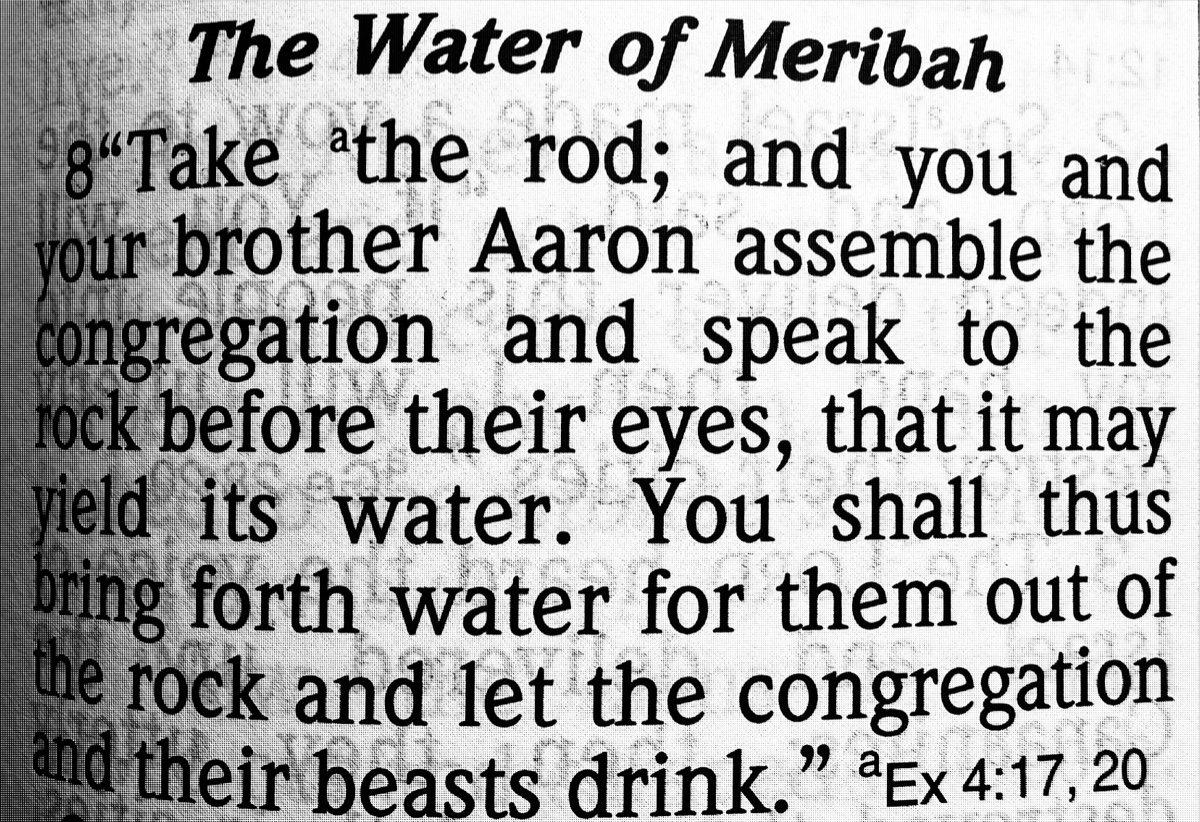
Instead of speaking to the people, Moses and Aaron seek the Lord, who comes in answer to their prayers (Num. 20:6). God commands Moses to take the rod which had been placed before the Lord (cf. Num. 17) and which demonstrated to all the people that Aaron’s family was the Lord’s priests (20:8-9; cf. 17:7, 10). He then tells Moses and Aaron to “speak” to the rock in contrast to Exodus 17, where He told Moses to “strike” the rock (Num. 20:8; cf. Exod. 17:6). Earlier in Numbers, we have seen Israel’s disobedience against God described as their refusal to believe (Num. 14:11). The undergirding principle is that saving trust and belief comprehends obedience (Heb. 3:19-4:11). The same is true of the term “faith” as it is used in the New Testament (John 3:36; Rom. 1:5; 5:1-2; 16:26). Nowhere in Scripture, whether the Old or New Testament is under consideration, do we find the notion that saving faith is a “non-doing trust” or mere mental assent; instead, it is an active, fruitful, and loyal allegiance to God as our King and Lord (Rom. 6:3-4; Gal. 2:20; Jas. 2:14-26).
Gordon Wenham reflecting on this truth comments:
Whereas Christian theologians, following Paul’s supposed distinction, often contrast faith with obedience, this dichotomy is unknown to the Old Testament. Faith is the correct response to God’s word, whether it is a word of promise or a word of command. Psalm 119:66 can say, “I believe in Thy commandments.” The opposite of faith is rebellion or disobedience (e.g. Deut. 9:23; 2 Kings 17:14). Thus, Moses’ failure to carry out the Lord’s instructions precisely was as much an act of unbelief as the people’s failure to trust God’s promises instead of the spies’ pessimistic reports, Numbers 14:11 (Wenham, 169).
Moses took the staff in hand and he and Aaron gathered the people before the rock, but his opening words do not mention Yahweh as he had done in Numbers 16:28-30. It is as if, in his frustration with Israel, he temporarily forgot that God was only using him as an instrument. Note that the beginning of Numbers 20:11 mentions that Moses “lifted up his hand” to strike the rock. Interestingly, the Hebrew term that describes a “defiant” sin means “with a raised arm” (Num. 15:30). When connected with the fact that Moses struck the rock instead of obeying God’s command to speak to it—it becomes clear that he was taking the situation into his own hands and Aaron with him. They were putting themselves in God’s place and while the Lord still provides water for the people, His discipline of Moses and Aaron would be certain. Frustration can lead us to act in ways that we would have never considered if we were not under pressure. This is a sad moment because the very attitude that Moses had dealt with in unbelieving Israel had now led him into a similar spirit in his own walk with the Lord. The role of leadership is to make others better and stronger, not to embrace their base motives and failures, even in our moments of frustration. Perhaps this is why we see that shepherds in a local church are to be mature in their faith and character (1 Tim. 3:1-7; Titus 1:5-11).
What a heartbreaking scene, as the Lord tells Moses that he will not be leading Israel into the Promised Land. Ironically, Moses was so frustrated with the rebellion of Israel that he did not realize he was also involving himself in spiritual rebellion by not sanctifying and honoring the Lord. The psalmist writes of this incident, “They angered him at the waters of Meribah, and it went ill with Moses on their account, for they made his spirit bitter, and he spoke rashly with his lips” (Ps. 106:32-33). The waters are rightly named Meribah in keeping with these events because the term means “quarreling.”
Moses and Aaron’s sin involved at least three offenses: disobedience to the specific command they were given, failure to give God the glory, and a lack of patience. The Lord was showing more compassion with these people, who were possibly the new generation, than Moses and Aaron. These “rebels” entered the land, but Moses and Aaron did not.
A distinction between the two “Meribah” events must be drawn to understand the biblical text (Exod. 17:7; Num. 20:13). In Deuteronomy 32:51, the “Meribah” in Numbers 20 is called “Meribah-Kadesh” (Ezek. 47:19; 48:28). This was almost certainly to distinguish it from the “Meribah” of Exodus 17, which is also mentioned in Deuteronomy 33:8 and Psalm 95:8. There is no contradiction, but simply two similar, but different, events.
The Israelites set out to Kadesh and came to Mount Hor by the border of the land of Edom (Num. 20:22). There God announced the imminent death of Aaron who had been a spokesman for Moses and served as high priest for Israel (Num. 20:23-24). Aaron was also Moses’s brother; therefore, the events of this chapter are very emotional to say the least. The Scriptures describe him as being “gathered to his people,” as well as being prevented from entering the Promised Land. The phrase “gathered to his people” is an interesting Old Testament idiom that describes death (Gen. 25:8, 17; 35:29; 49:33; Num. 27:13; Deut. 32:50).
While Moses had called the people “rebels” at Meribah, Yahweh describes Moses and Aaron as being guilty of rebellion to His commands (Num. 20:24). Often we can see faults in others which we cannot see in ourselves (Gal. 6:1-2). The Lord commands Moses to ascend Mount Hor with both Aaron and Eleazar, Aaron’s son and next in line to be high priest (Num. 3:4). Because the high priest wore special clothing which identified his office and work, this had to be transferred from Aaron to Eleazar (Exod. 29:29; cf. Lev. 8:7-9, 13; 16:32). Moses immediately obeyed the Lord, leading Aaron and Eleazar up the mountain in the view of the people so that the leadership transition would be evident to all (Num. 20:27). The word “strip” occurs over forty times in the Old Testament, and it refers here to something being stripped from someone. There is a sense of consequence, demotion, and punishment for Aaron’s sin. When we consider all the good work Aaron had done but note the severe consequences of his sin, we should appreciate the terrible nature of sin, the importance of reverencing God, and the Lord’s faithful holiness. This was a powerful lesson for ancient Israel, and it is a powerful lesson for Christians today. There was a thirty-day mourning period among the Israelites signaling the significance of Aaron’s service (Num. 20:29).
After reading of Moses’s problems and challenges with the people of Israel during the wandering in the wilderness, we may share in his profound sense of loss in not being able to enter the Promised Land. What lessons should we draw from the story of Moses, Aaron, and Miriam? First, obedience always matters to God (Heb. 5:8-9). Second, we must strive to honor and reverence the Lord in all that we do (1 Cor. 10:30-31; Col. 3:17). Third, even when we are facing frustration and a range of emotions, we must devote ourselves to showing the Lord’s compassion to His people (Eph. 4:32). Finally, we recognize that even the most faithful and dedicated servants of the Lord can sin and, therefore, suffer the consequences of their choices (Ps. 51; 1 John 1:9).
It is also interesting to see the foreshadowing of Christ in this story. For instance, Christ is described as the spiritual rock from which Israel drank (1 Cor. 10:4). Since the Lord provided the water, they drank from His mercy, both figuratively and spiritually, even as they received physical water from a physical rock. Jesus’s salvation and blessings are described as the “rivers of living waters” because we too as Christians partake of the richness of Christ’s blessings in the gospel (John 4:10; 7:38; Eph. 1:3-7).
Paul’s emphasis was on the fact that Israel received God’s blessings from the pre-incarnate Christ in the Old Testament, and yet faced the danger of apostasy if they abandoned the Lord. Likewise, as Christians, our enjoyment of His blessings, partaking of the Lord’s Supper, and participation in His fellowship does not mean that we cannot fall away if we leave our Savior (1 Cor. 10:12-13; 2 Pet. 2:20-22).
Even in this story of God’s judgment, we also see His grace and forgiveness. Our own sins and failures can be extremely discouraging. Satan tempts us in our moments of weakness and vulnerability to give up on the hope of restoration. Yet, great men and women of God have fallen in moments of rebellion or weakness, who were penitent and thus forgiven, cleansed, and renewed. If that is the case for Moses, Aaron, Miriam, David, and Peter, we can also be restored by the mercy of our gracious God!
Bruce Reeves has labored with the Highway 65 church of Christ in Conway, AR, since 2000. He and his wife, Rachel, have one child. The church website is here. He can be reached here.



By Shane Carrington
Synopsis: Important duties can distract us from the most important aspects of life, and the story of Martha and Mary helps us keep our focus on the Lord and His word.
As Jesus journeyed, He encountered people from many walks of life. He met influential businessmen, disabled folks who could not work, godly people who needed guidance, and others who wore a facade of devotion yet needed to repent.
Three friends whom Jesus met along the way were sisters Mary and Martha and their brother Lazarus: “Now Jesus loved Martha and her sister and Lazarus” (John 11:5). The frank exchanges between Martha and Jesus showed how close they were (our text, Luke 10:38-42 and the scene of Lazarus’s resurrection, John 11:1-5, 20-40).
We encounter Mary and Martha in Luke’s account of Jesus’s life, immediately after the good Samaritan story (Luke 10:25-37). As we walk with Jesus to Bethany to visit these dear friends with Him, we learn important lessons that help us in our faith.
Martha welcomed Him into her home (Luke 10:38).
As with all godly women, Martha cared about others. In this way, she imitated the virtuous woman of Proverbs.
She rises also while it is still night and gives food to her household and portions to her maidens (Prov. 31:15).
She extends her hand to the poor, and she stretches out her hands to the needy (Prov. 31:20).
God considers hospitality so important that it is listed as a trait for those who would be elders (1 Tim. 3:2; Titus 1:8). Hospitality might be a lost art among some in our society, but Martha’s gracious and inviting spirit serves as an example for us today. Hospitality may be manifested in many forms, but it comes down to caring about people, spending time with them, and seeing to their needs. Showing kindness to others, both toward fellow disciples and “strangers” (Heb. 13:1-2), is important in our service to God.
She had a sister called Mary, who was seated at the Lord’s feet, listening to His word (Luke 10:39).
Like all godly women, Mary focused on the word of the Lord. In this, she also serves as a great example for us. We need all of God’s word, not just “favorite” passages that are especially appealing to us. We need the comforting passages and the challenging ones. We need the stories of God’s work among His people, and we need the lists of commands. We need the accounts of the work of Jesus while on earth, and we need “the rest of the story” which is found from the book of Acts through the epistles and the book of Revelation (see John 16:12-13). Mary sat at the feet of Jesus and listened intently. May we pick up our Bibles and do the same.
Distraction comes easily for us today. Many important but secondary things vie for our attention—occupation, household duties, civic responsibilities, etc. All of these are significant in our lives, but Jesus taught us to prioritize spiritual concerns in every decision we make (see John 6:27). We might allow “the cares of this world” (Matt. 13:22, NKJV) to captivate us, causing us to miss Sunday Bible class, evening services, or some nights of a gospel meeting. While these are obviously more important, some rationalize their lack of participation by reasoning that they are involved in “truly important matters.” Misplacing priorities in this manner weakens faith and leads to lukewarm service to God.
Like Martha, who was “worried and bothered about so many things” (Luke 10:41), we too may struggle with worries about finances, family, earthly freedom, etc. Jesus reminded Martha that the things of this world will “be taken away” (Luke 10:42) including the immediate responsibilities upon which she was focusing.
The enemy uses earthly distractions, such as fleeting pleasures and activities, to remove our focus from the word and service of the Lord. He dissuades us from eternal matters by urging us to place our emphasis on temporal priorities. Jesus teaches us to use our stewardship of earthly things to focus us on heavenly preparation. One day, we will hand our land, cows, houses, jobs, bank accounts, families, and hospitality duties back to God. We must not allow these to become our primary objectives and separate us from God. Martha’s duties were important. However, Jesus taught her clarity, saying,
one thing is necessary. . . the good part, which shall not be taken away. . . (Luke 10:42).
Mary focused on the eternal word of God, which teaches us to emphazise excellence in serving God in all of our activities. Martha allowed her important responsibilities to distract her from “the good part, which shall not be taken away.”
While Martha struggled somewhat in this encounter, we know that she also had a deep regard for God’s word. She invited Jesus into her home for Him to have a place to teach God’s word. Just before Lazarus’s resurrection, she showed great insight into the word of God. When Jesus told her, “Your brother will rise again” (John 11:23), Martha replied,
I know that he will rise again in the resurrection on the last day (John 11:25).
Even the twelve had not yet arrived at that understanding! Martha was what we would describe as “a good Bible student.”
Further, Jesus taught the importance of assisting faithful disciples so that they may focus on the responsibilities for which they are uniquely equipped. He went so far as to say that, if all we have to give is “a cup of cold water,” we will still be rewarded (Matt. 10:40-42). Why? Because people who are especially equipped to teach God’s word need help in fulfilling their responsibilities. Assisting them gives us a share in the same reward God gives the teachers (see also Phil. 4:14-18).
Martha was not a second-rate disciple. She was faithful in her calling. Nevertheless, even faithful people sometimes need to check their attitudes and sharpen their focus to serve God more fully. In this passage, Jesus helps Martha focus more clearly.
Martha struggled to discern between important duties and her ultimate calling. She had difficulty focusing on eternal matters because other responsibilities demanded her attention. How do we distinguish between the two?
Like Mary, we need to spend a great deal of time reading, studying, and conversing about God’s word. When unique opportunities arise, make good use of them. Jesus was in her house! He would not be there for long. Wisdom demands focusing on His teaching while in His presence. We have unique opportunities as well: Bible classes with fellow disciples, worship assemblies, studies with untaught neighbors, etc. Washing the car, cleaning the house, and mowing the lawn can wait when spiritual opportunities arise. Mary could see this, but Martha struggled.
While we journey with Jesus to Martha’s house, Jesus teaches us that, like Martha, we today have many important responsibilities. God wants us to be good stewards of what He has entrusted to us, but may we, like Mary, focus on important things without losing sight of “the good part, which shall not be taken away. . .” (Luke 10:42).
Shane Carrington has worked with the Southside church of Christ in Sulphur Springs, TX, since 1999. He has two children and four grandchildren. The church website is here. He can be reached here.



Caption: Looking across from a hill just outside Jerusalem, you can see a view of Bethany and in the distance barely see the dead sea.
By Bobby L. Graham
Synopsis: God determines right and wrong based on His own inherently good and righteous character, with no need for external input or consultation. His wisdom and judgments are unsearchable and beyond human understanding. Jesus, as the embodiment of truth, teaches that righteousness and holiness are rooted in God’s character and revealed through His word. Christians are called to conform to God’s perfect standard, which is reflected in Jesus’s sinless life and the Scriptures.
How does God determine right and wrong?
This is an interesting and probing question, demanding that we search the Scriptures to learn, if we can, what might constitute the divine basis of righteousness, as well as other considerations involved in such a matter.
I believe it is safe to assert, as a beginning consideration, that God does not go through a decision process as humans might do. This is true because God does not have to consult anyone, read any experts, survey public opinion to gain a consensus, or receive any other input to decide what He ought to set forth for humans to observe.
Oh, the depth of the riches of the wisdom and knowledge of God! How unsearchable His judgments, and His paths beyond tracing out! Who has known the mind of the Lord? Or who has been His counselor? Who has ever given to God that God should repay them? For from Him and through Him and for Him are all things. To Him be the glory forever! Amen.
Notice that God’s wisdom is so deep that there is no fathoming of His paths or searching out of His ways. No human has ever been qualified to counsel Him on the basis of what he has known of God’s mind; it all is the result of God’s divine revelation (1 Cor. 2:6-13). God has never received any help from humans, so that He owes anything to any person. Whatever benefits people have received from the Lord, including divine instruction, originated with Him, came from Him, and abounds to His honor.
In close connection with this thought, Jesus claimed to be the “way, the truth, and the life,” apart from whom no one comes to the Father (John 14:6). To learn Christ is equivalent to hearing Him and being taught by Him, because the truth is in Jesus (Eph. 4:20-21).
The teaching of how Christians should behave as new people accords with God’s righteousness and true holiness (Eph. 4:24). Moral misbehavior by one of the Lord’s saints is possible; but it always grieves the Holy Spirit, who identifies (“sealed,” from esphragisthēte) them as belonging to God through their identifying conduct, described in the Bible (Eph. 4:30). In a parallel record of instruction concerning the new man, Paul shows God’s ideal is “according to the image of Him who created him” (Col. 3:10).
The basic idea in these instructions to Christians found in Paul’s epistles is that their behavior must conform to God’s perfect standard, first found in His own character and then manifested in Jesus’s sinless life and in God’s perfect word. God is the repository of all wisdom and knowledge, and in Jesus are found “all the treasures of wisdom and knowledge” (Col. 2:3). There is no moral absolute demanded of Christians in the Bible which (1) did not originate in God’s own character and (2) did not appear in Jesus’s life. Likewise, there is no sin of immorality condemned in the Bible which does not fail to accord with God’s character and to harmonize with Jesus’s sinless example. Peter provides this glimpse of how God determines what is commendable and what is condemnable in 1 Peter 1:15-16, which says, “But as He who called you is holy, so be holy in all manner of conversation; Because it is written, Be holy; for I am holy.” John also gives us insight into God’s basis of determining His expectations for us: “Everyone who has this hope in Him purifies himself, just as He is pure” (1 John 3:3). John again connected what God desires of us to what He Himself is: “Beloved, let us love one another, for love is of God” (1 John 4:7).
Why be holy, righteous, meek, pure, and humble? Because God is, and then because He tells us to be in the Bible. We determine what is good and evil from what God has said; but God determines right and wrong from His own character, because the entire Godhead (i.e., God the Father, Jesus Christ the Son, and the Holy Spirit) is innately and inherently good. The foundation of all which is right and wrong lies in God’s righteous character, and its reflection lies in the inspired word of God!
Bobby L. Graham actively participates in fill-in preaching, Belize trips, teaching an hour each day at Athens Bible School, and in gospel meeting work. He and his wife, Karen, have three children. He can be reached here.



By Barry Britnell
Synopsis: One of the more recent discoveries in the city of Caesarea might provide some light on an interesting story from the book of Acts.
I am often asked, “Why do you enjoy traveling to Israel so many times?” Interestingly, the person who asks that question is usually someone who has not had the opportunity to travel to Israel. Because, once you have been, you immediately understand why a student of the Bible would want to return.
My response is typically, “There is so much to learn.” That is the absolute truth. If I were to add up all the time that I have spent in Israel, it would come to about half of a year. Even then, I feel that I have only scratched the surface of what can (and should) be learned.
In reality, I am falling farther and farther behind every day in what I need to learn. Every year, new discoveries are made or things are uncovered that help us to further understand the biblical narrative. Places that I visited on my first trip to Israel in 2010 look completely different now because of the ongoing archaeological work that has been performed.
During the first century, Caesarea was the Roman administrative capital of the area. King Herod spent a lot of time in this city and constructed many items that can still be seen today. Within the past couple of years, some additional archaeological work has been performed around the area of King Herod’s palace in Caesarea.
From all indications, Herod’s palace was a massive structure. It was at least two stories tall, with gardens, pools, and many rooms. The palace sat directly on the shore of the Mediterranean Sea, which would have provided not only beautiful views but also a constant sea breeze, making it a comfortable place to live.
In Acts 21-23, we read of the story of Paul being arrested in Jerusalem. Through a series of interesting events, Paul is eventually taken to the city of Caesarea for trial. Chapter 23 ends with the following statement in verse 35: “He [the governor] commanded him to be guarded in Herod’s praetorium.”
Praetorium is an interesting word. Merriam-Webster provides two definitions. The first states that the word means “an ancient Roman general’s tent in a camp.” The second states that it is “the official residence of an ancient Roman governor.”
Given the context of the passage, it is easy for me to conclude that the second of the two definitions is what should be used here. Paul, at least for some time, was held in Herod’s palace (the praetorium).
Within the last two years, archaeologists have uncovered hallways and rooms in a floor of the palace that is primarily underground. According to the signage at the site, it claims that “the underground structure. . . served as a T-shaped water cistern. After the time of Herod, the cistern was turned into a prison.” The description continues and states that “according to scholars, this may be the place where Paul the apostle was imprisoned (58-60 CE).”
Visitors to the site today can look down into one of the excavation conduits to see a doorway and a hallway. Perhaps at a later time, we will be allowed to observe more of the area.
So, the real question is this: Is this really the area where Paul was imprisoned? I do not know, and no one really knows for sure. However, you can apply a small bit of logic to the situation. So, let us ask the following question: If the palace had a prison in it, where would it be located? Well, it probably would not have been located in a luxurious portion of the building. A prison would likely have been located in an out-of-the-way place, away from officials and palace guests. Therefore, a basement area seems logical.
I also would state that there could also be questions about Paul’s exact accommodations while in the praetorium. It is interesting that Luke (as the writer of Acts) specifically says that Paul was held “in the praetorium.” In Acts 24:27, Luke now says that Paul “was left in prison.” Are these two different words referring to the same location? Alternatively, is it possible that after some time, Paul was moved from the praetorium to a formal prison in town? To be honest, I do not know. As I said in the beginning, there is so much to learn.
Regardless of whether these newly discovered areas are the actual location where Paul was held, it is an interesting find. I look forward to seeing more of it on future visits.

Caption: Herods Palace at Caesarea

Caption: New Excavations at Caesarea
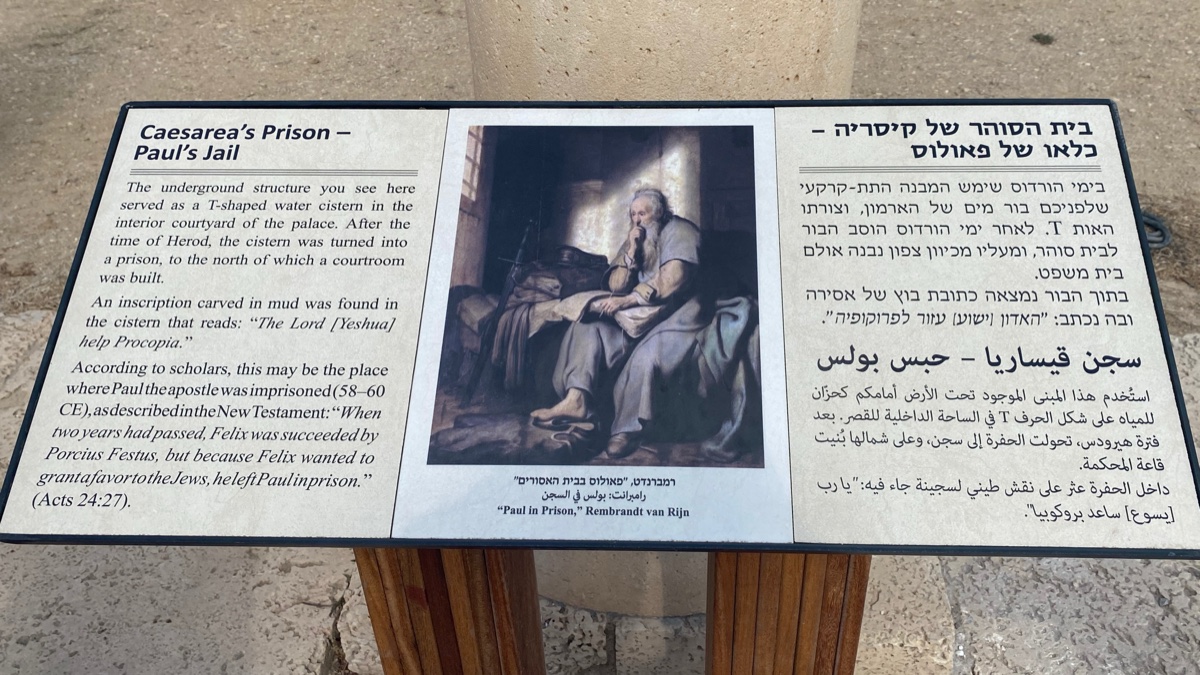
Caption: Signage at Caesarea
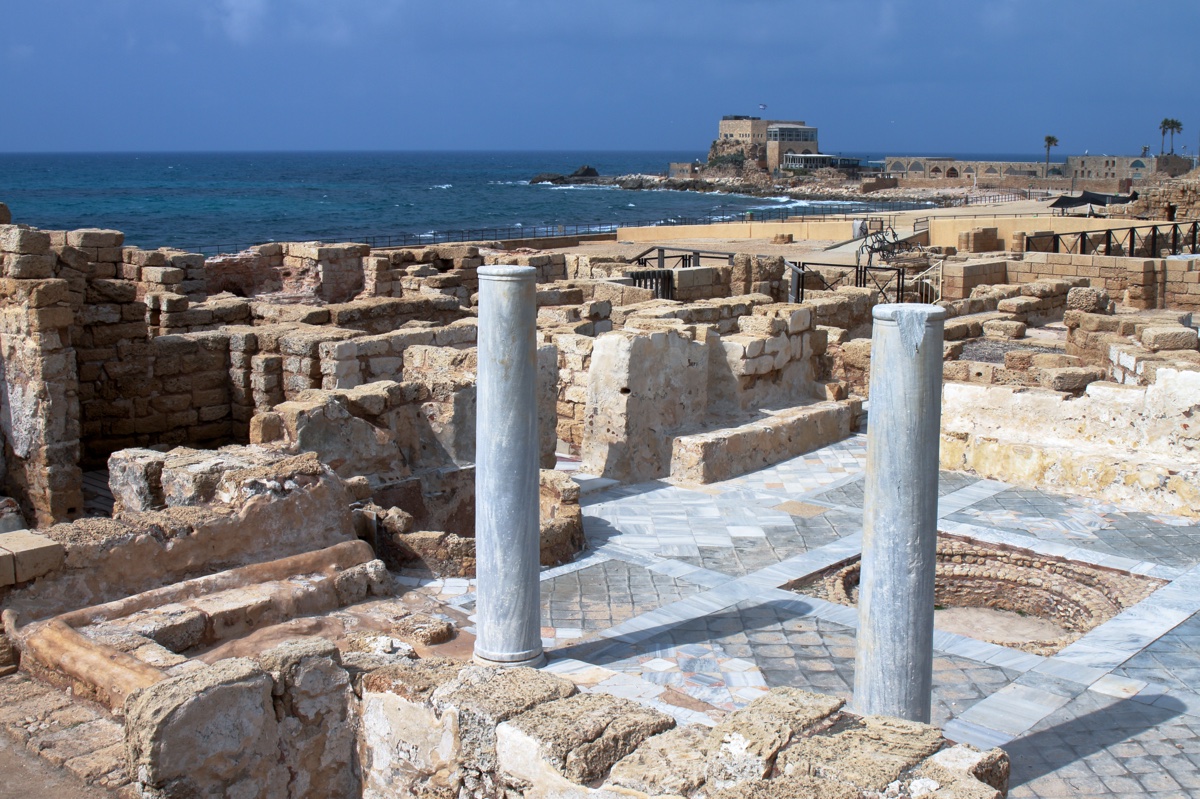
Caption: Roman Ruins at Caesarea in Israel
Barry Britnell is the founder of Exploring Bible Lands, LLC and leads Bible Study tours to the land of Israel. He also works with Appian Media to produce biblically sound videos used in teaching others about the Bible. He and his wife, Tabatha, have three children. They live in Athens, AL, and worship with the Capshaw church of Christ. He can be reached here.


By Danny Linden
Synopsis: The parable of the wicked vinedressers reveals how rebellion grows in unimaginable ways, using perverse logic to justify rebellion, which provokes God to wrath.
In Luke 20, Jesus told a provocative parable that stretched the limits of what His listeners imagined was even possible. The wicked tenants in the story are flagrantly, almost cartoonishly evil—surely no one would ever act so outlandishly and imagine that they could get away with it! As in all parables, the characters may be fictional, but the underlying truth is real. There is real wickedness in the world and it is more common than we want to believe.
And He began to tell the people this parable: “A man planted a vineyard and let it out to tenants and went into another country for a long while. When the time came, he sent a servant to the tenants, so that they would give him some of the fruit of the vineyard. But the tenants beat him and sent him away empty-handed. And he sent another servant. But they also beat and treated him shamefully, and sent him away empty-handed. And he sent yet a third. This one also they wounded and cast out” (Luke 20:9-12).
The initial scene depicts a typical arrangement in first-century Judea. Instead of laboring in the vineyard or letting it lie fallow, the owner rents the land to tenants who will cultivate it and harvest a crop. At the end of the growing season, they will split the harvest according to their agreed-upon terms so that the owner and the tenants both profit. This would not raise any eyebrows, but the way the harvest unfolds deviates sharply from what anyone expects.
It came time for the landowner to collect his share of the harvest, so he sent a servant to do so on his behalf. What should have been a simple transaction deteriorated quickly. The tenants refused to pay, viciously attacked the servant, and ran him out of town. The landowner sent a second and a third representative with the same sad result.
It is fitting that Jesus called this “shameful” behavior. It is both legally and morally outrageous and shows a practiced, evil intent of the heart. Any reasonable judge or common person hearing about this would be scandalized and demand justice. Honorable people would never act this way.
While I can’t imagine tenants behaving this way, Jesus’s intent was to draw their attention to something even more shameful—Israel’s historical rejection of God’s representatives sent to speak on His behalf. The prophets spoke with God-given authority and called Israel to repent lest they face the wrath of God. However, these divinely chosen representatives rarely had much success. They were easy to ignore and even abuse. Most of them lived difficult lives facing slander, imprisonment, physical abuse, and even death. All the while, Israel persisted in evil.
Then the owner of the vineyard said, “What shall I do? I will send my beloved son; perhaps they will respect him.” But when the tenants saw him, they said to themselves, “This is the heir. Let us kill him, so that the inheritance may be ours.” And they threw him out of the vineyard and killed him. What then will the owner of the vineyard do to them? (Luke 20:13-15).
The owner of the vineyard is forced to escalate His demands. The tenants do not properly respect his representatives, but perhaps they will change their tune if he sends his son. His son comes with even more authority. Surely they cannot ignore him and continue their rebellion?
Of course, this doesn’t slow down the wicked tenants. They are even emboldened to escalate their rebellion. They use a perverse logic and believe that it somehow benefits them from killing the landowner’s son. On the shallowest surface level, this might seem to be true. Sometimes when a landowner died without a will or an heir, the tenants could be granted the land they had leased. However, it’s hard to imagine that happening when they are responsible for killing the heir in the first place! Their violent outburst doesn’t put them in line for an inheritance; instead, it places them in serious danger. They kill the son anyway, and Jesus asks an obvious question. What do you suppose that the owner of the vineyard will do next?
This section of the parable is even more preposterous, but it is equally rooted in real-life rebellion. It represents Israel’s ever-increasing spirit of insurrection that led them to reject Jesus, the Son of God and the Messiah for whom they had long waited. They learned nothing from their previous failures. They applied perverse logic that made it seem better to kill Jesus—they would benefit because Jesus was a threat to their way of life. The religious leaders couldn’t maintain their power if the people followed Jesus instead. When He died, they thought their “problem” would go away. However, they didn’t stop to consider, “What would the Father do in response?”
He will come and destroy those tenants and give the vineyard to others. When they heard this, they said, “Surely not!” But He looked directly at them and said, “What then is this that is written: ‘The stone that the builders rejected has become the cornerstone’? Everyone who falls on that stone will be broken to pieces, and when it falls on anyone, it will crush him” (Luke 20:16-18).
Jesus answers His own question with the only reasonable option. The landowner will come in fury, destroy the rebels, and give the blessing of the land they enjoyed to someone else. The people’s response (“Surely not!” or “May it never be!”) does not indicate disagreement with the punishment inflicted. Rather, it is a general statement of horror at the entire story. May this never happen! May no one ever be so shamelessly evil as to deserve such wrath!
Once again, Jesus drives home the point that this is not fictional or hypothetical. He quotes Psalm 118:22, which was originally part of a song of praise to God for lifting them up from being a desperate and despised people of slaves and making them into a great and glorious nation. Their enemies could not stand against them because the LORD was their defender. The twist Jesus applies to this psalm is unique. If God was able to elevate a weak and useless nation and make them successful, what will He do with Jesus, who actually is great and glorious but has been treated as if He is useless? Reject the Son of God at your own peril!
The direct application to Israel is simple. If they reject and kill Jesus, they will face the wrath of God. We know that as a whole, Israel did, in fact, refuse to recognize Jesus as the Son of God and they put Him to death. It didn’t take long for them to suffer the consequences. Just a few decades later, God sent Rome in judgment against Israel. Jerusalem was destroyed, many Jews died, and there was great suffering. None of this was random—it was the direct result of Israel refusing to obey God.
What made Jesus tell the parable on that day to that crowd? The events immediately before and after reveal a great deal.
Before the parable, Jesus was confronted by a group of religious leaders (Luke 20:1-8). They demanded that Jesus reveal who authorized Him to preach and teach. This was not a sincere question about Jesus’s motives or mission, and they did not care about the actual answer. It was an accusation disguised as a question. This is revealed by their response to Jesus’s counter—by what authority did John teach and baptize? The religious leaders were only concerned with the way their answers would be perceived by the people. There was no consideration of the possibility that John was a true prophet (and thus should have been heeded) or a false prophet (and thus should have been silenced and the people properly taught the truth). Because they did not care about authority and truth, Jesus refused to answer their question. What difference would it make when they had already made up their minds?
After hearing the parable, those same religious leaders knew that Jesus was speaking against them (Luke 20:19-26). Rather than feel a pang of guilt and engage in serious self-reflection, they hardened themselves and began looking for the first opportunity to arrest and kill Jesus. They wanted to do so immediately, but first needed to discredit Jesus and turn the crowds against Him so they could preserve their own power and provide cover for their sin. It would take a little time, but eventually they would succeed at eroding Jesus’s popular support and stirring up the people to demand His execution at the hands of the Romans.
The religious leaders were not always so determined in their opposition to Jesus. Just like in the parable, their rejection started with an attitude that gradually developed. Rebellion grows as we feed it and practice it.
Is it any wonder Jesus told this parable about outrageously wicked people? What the people imagined being an exaggerated story was nothing of the sort. Real, stubborn rebellion exists, and, sadly, it’s not rare.
Do we think the Jews are the only guilty people who have rejected Christ? We must listen to the warning in this parable! If our nation rejects Jesus, we are in grave danger. The situation in America is already dire. We have done much to anger God, and we provoke Him every day. Christians must continually pray for God to be patient and merciful toward our nation so that we may bring more to Christ.
This warning applies on a personal level as well. If you reject Jesus, you will face God’s wrath that has filled to the top and is overflowing. Discard whatever perverse logic makes you think that it benefits you from rebelling against Jesus. Instead, be thankful that God has not yet destroyed you and has given you the opportunity to seek Him. Even the people who killed Jesus could repent and be forgiven by the mercy of God (Acts 2:36-41). So can you!
Danny Linden has worked with the Hebron Lane church of Christ in Shepherdsville, KY, since March 2023. He and his wife, Lauren, have four children. The church website is here. His website is here. He can be reached here.



By Jacob Lawrence
Synopsis: Many people mistakenly believe that simply believing in God or being baptized is sufficient for salvation. However, Christians have multiple duties, including spreading the Gospel, supporting fellow Christians, living a faithful life. Ultimately, the most important goal is to reach Heaven by following God’s will, as our efforts are in vain if we do not achieve this.
Many people think that believing in God is all they need to do to become a Christian and inherit salvation. Others believe baptism is the end of their Christian mission. People are being taught and believe these things!
If you go grocery shopping, do you come home, put the groceries on the counter, and think that’s all you need to do? No, there’s more to be done. Clean up the counters. Put the groceries away. Prepare supper. There is always something more to do.
Matthew 28:18-20 says, “Jesus came up and spoke to them, saying, ‘All authority has been given to Me in heaven and on earth. Go therefore and make disciples of all the nations, baptizing them in the name of the Father and the Son and the Holy Spirit, teaching them to observe all that I commanded you; and lo, I am with you always, even to the end of the age.’”
People read this and assume that our mission is to spread the word, which is partially true. To spread the word to as many people as we can is one of our missions. We have many missions as Christians in this world that we have to carry out. I’m going to briefly talk about four of such obligations.
One of our missions as Christians is to spread the word of God to those around us. We can find this in many New Testament passages. Acts 2:36-42 is one of the most fitting passages that evangelists quote to explain that baptism is the means of salvation. Peter preached to the crowd at Pentecost, baptized them, and added three thousand souls to the church. Paul established a church in Ephesus in which he taught and baptized those who heard and heeded the gospel invitation. Those who were added to the church continuously abounded in the faith (Acts 19:1-7; Eph. 1:15-21; Rev. 2:1-3).
In Acts 7:51-60, Stephen preached the word but didn’t baptize anyone. Does this mean he failed to meet Jesus’s command in Matthew 28? No, he tried to reach lost souls, and that’s what matters.
Jesus said to preach the word; He never promised that believing souls would be the product of the preaching. Stephen was not responsible for how the hearers responded to his message.
Acts 2:42-47 says, “All those who had believed were together and had all things in common; and they began selling their property and possessions and were sharing them with all, as anyone might have need. Day by day, continuing with one mind in the temple, and breaking bread from house to house, they were taking their meals together with gladness and sincerity of heart, praising God and having favor with all the people. And the Lord was adding to their number day by day those who were being saved.”
Note that the believers had everything in common, meaning they shared everything. They also made sure none were in need. They took care of each other. Since the early Christians did this, it’s not a stretch to say we need to do the same thing. Not to say we need to sell everything we have and share it with each other, but we should be willing to aid or be there for our brothers and sisters in Christ. We need to share the same fellowship that first-century Christians enjoyed.
In Acts 11:27-30, we see that Barnabas and Saul were sent by the apostles to deliver funds to needy saints and to help them prepare for the upcoming famine. Saul and Barnabas were there for their fellow Christians and aided them during their trials. In 1 Corinthians 16:1-4, Paul commands that the funds set aside from the Corinthian church would go to the needy saints in Jerusalem. Paul and the Corinthian saints were aiding the saints in Jerusalem.
Not only are we supposed to be there for our brethren physically, but James 5:13-20 says we should be there for our fellow saints spiritually as well. We are to be someone that our brothers and sisters can talk to and be free from judgment. We are to pray and help our brethren. If they fall away, then James says we must do everything we can to restore and save their souls.
One of our missions as Christians is not only to worry about our fellow brethren but to make sure we are living a faithful, Christian life. James 2:14-20 explains that we are to live a faithful life to God as a Christian. If we say we believe in God and that we are followers of Him, we demonstrate that by our actions.
Acts 2:42 says, “They were continually devoting themselves to the apostles’ teaching and to fellowship, to the breaking of bread and to prayer.” The believers at Pentecost were baptized, but that wasn’t the end of their story. They continued to devote their lives to the apostles’ teaching and to following God’s commands. It’s the same with us. Our spiritual walk doesn’t end with baptism; rather, it starts with baptism. After initial conversion, we must continue to live a faithful life unto death, just as James 2 describes. 1 Corinthians 4:1-2 explains that it is required of us as Christians to stay faithful: “Let a man regard us in this manner, as servants of Christ and stewards of the mysteries of God. In this case, moreover, it is required of stewards that one be found trustworthy” (1 Cor. 4:1-2).
Our most important goal as stewards of Christ is to reach heaven. How are we to help someone get to heaven if we ourselves aren’t on that same path? If we did that, we would be hypocrites (Matt. 7:1-5).
How do we know if we’re on the path to heaven? Matthew 7:21 states, “Not everyone who says to Me, ‘Lord, Lord,’ will enter the kingdom of heaven, but he who does the will of My Father who is in heaven will enter.” Jesus says that if we do the will of the Father, we will make it to heaven. There is no other way to receive our reward but to do the will of God. If we do the will of God, then it shows that we are being faithful in our lives. What we do on this earth reflects who we are. We must be careful to follow God’s commands so that we can be seen as good Christians, not just by men, but by God.
In order to help others get to heaven, we must make sure that we ourselves are on that path. If you don’t know where you’re at with God and you teach someone else about the path of righteousness, it’s like the blind leading the blind. How can we expect to help someone if we’re not on the path ourselves? We can’t. We must ensure we are on the right path and striving to reach heaven. That is our foremost duty as Christians. If we don’t make it to heaven, all our efforts will have been for naught.
We have multiple duties as Christians. Some of which include being there for our brethren, living a faithful life, spreading the gospel, and getting to heaven. The verses I have listed and many others which you can find in your own personal study all collectively stress the importance of our duties as Christians. In order to prove to God that we want to be in heaven with Him, we must follow His commandments here on earth. If we don’t, we will not be recognized by God at the final judgment.
It’s our decision. It’s our choice to make. Will we show the world that we have a righteous and holy heart that is devoted to God, or will we reveal our worldly cravings and sinful desires and be counted among the lost? At the end, will we be able to look back at our lives and say like Paul did, “I have fought the good fight, I have finished the course, I have kept the faith” (2 Tim. 4:7-8)?
Jacob Lawrence is a seventeen year old junior who worships with the Adoue Street church of Christ in Alvin, TX. He can be reached here.




By Tommy Peeler
Synopsis: This article addresses two main questions: Is the Holy Spirit is a separate Person from the Father and the Son, and is the Holy Spirit is God. Brother Peeler argues that the Holy Spirit is indeed a distinct Person, not merely a force or energy, and provides biblical evidence of the Spirit’s personal attributes and interactions with the Father and the Son. The article also asserts the deity of the Holy Spirit, citing scriptural passages that attribute divine actions and characteristics to Him, thus affirming that the Holy Spirit is God.
In this issue, we explore the Holy Spirit. Other talented writers will address various truths about the Spirit and His work. This article primarily focuses on two questions: First, is the Holy Spirit a separate Person from the Father and the Son? Second, is the Holy Spirit God?
Is God simply one Person who reveals Himself in multiple ways—sometimes as Father, sometimes as Son, and sometimes as Spirit—or is the Spirit a separate Person from the Father and Son? The doctrine that God is one Person who reveals Himself in three different roles is often described as modalism. While the term, person, is difficult to use of God, since we usually infuse the term with the limitations human people experience, I employ it for lack of a better one. In speaking of the Spirit as a Person, I mean that He is not a force or energy, but He thinks (Rom. 8:27), He speaks (Acts 8:29; 13:2; 1 Tim. 4:1), He loves (Rom. 15:30), and He grieves (Eph. 4:30).
In Matthew 3:16-17, Jesus is in the waters of the Jordan, being baptized by John. The Spirit is descending as a dove, and the Father from heaven speaks about Jesus. For those who deny God in three persons, it is hard to explain these incidents in the Bible where Father, Son, and Spirit interact. More frequently, it is the Father and the Son interacting (Matt. 17:1-5; 26:39, 42; Luke 6:12; 10:21; 11:2; 23:34, 46; John 17). How can Jesus say, “I do nothing on My own initiative, but I speak these things as the Father taught Me” (John 8:28), if He and the Father were the same person? Statements in John 4:34; 5:19, 30; 6:38; 8:26; and 12:44 express the same idea as John 8:28.
Matthew 12:31-32 tells us that blasphemy against the Holy Spirit is a greater wrong than speaking against the Son of Man. Blasphemy against the Son can be forgiven, but blasphemy against the Spirit cannot be forgiven. Whatever one thinks the specific sin of “blasphemy of the Spirit” is, obviously this shows that the Son of Man is a distinct Person from the Holy Spirit.
In Matthew 28:18-20, as Jesus commissioned His apostles to preach, He told them to make disciples of all nations. They are to go “baptizing them in the name of the Father and Son and Spirit.” This passage emphasizes both the Oneness and Threeness of God. He mentions the Father, the Son, and Holy Spirit, but notice Jesus uses the singular term name.
In John 14:16-17, Jesus said, “I will ask the Father, and He will give you another Helper, that He may be with you forever.” That Helper is clearly called the “Spirit of truth.” A distinction is made between the Father, the Son, and the Spirit. The Son asks the Father, and the Father sends the Spirit. A distinction is made between the Son and the Spirit since Jesus calls the Spirit “another Helper.”
Romans 8:26-27 records that the Spirit intercedes for us. He intercedes for saints according to God’s will. Does not an intercessor imply at least two parties? With whom does the Spirit intercede if there is only one person in the Godhead?
In 1 Corinthians 12:4-6, Paul declared, “Now there are varieties of gifts, but the same Spirit. And there are varieties of ministries, and the same Lord. There are varieties of effects, but the same God who works all things in all persons.” In 2 Corinthians 13:14, he said, “The grace of the Lord Jesus Christ, and the love of God and the fellowship of the Holy Spirit be with you all.” Ephesians 4:4-6 mentions one Spirit, one Lord, and one God and Father, who is over all and through all and in all.
Notice that in John 14:16-17, and verse 26, the Father is said to give or send the Spirit, but in John 15:26, and 16:7, the Son is said to send the Spirit. Notice also that the Father gives the Spirit in response to a request from the Son in 14:16, and the Father sends the Spirit in Jesus’s name in 14:26. In John 15:26, the Son sends the Spirit from the Father, and the Spirit proceeds from the Father and the Spirit bears witness of the Son. In John 14:18, Jesus says, “I will not leave you as orphans. I will come to you.” The connection with John 14:16-18 leads me to think that Jesus is coming in the person of the Spirit. All of this language shows both the distinct Persons in God and the intimate union between the Father, the Son, and the Spirit. This underscores that Father, Son, and Spirit are one God in three Persons.
The book of Revelation is the “revelation of Jesus Christ, which God gave Him” (1:1). This book is the revelation the Father gave to the Son. There are seven letters written to the churches of Asia in Revelation 2 and 3. In these letters, a title of the risen Christ is given (2:1, 8, 12, 18; 3:1, 7, 14), and then the text gives what Jesus says to the churches. Yet at the conclusion of these letters, the words are said to be the words of the Spirit: “Hear what the Spirit says to the churches” (2:7, 11, 17, 29; 3:6, 13, 22). The words of Jesus and the words of the Spirit are the same.
Matthew 1:18-25 and Luke 1:26-38 narrate the virgin birth of Jesus. The human mother of Jesus was Mary (Matt. 1:16; Luke 1:27). When Mary was told that she would have a Son, she was incredulous. “How can this be, since I am a virgin?” (Luke 1:34). She knew that she had not been with a man, and Joseph knew that he had not been with Mary (Matt. 1:18-19). The conception of the child is attributed to the Holy Spirit in both Matthew (1:18, 20) and Luke (1:35). The virgin birth of Jesus demonstrates the divinity of Jesus (Matt. 1:22-23; Luke 1:32-35). How could Jesus, who was born of the woman Mary but conceived of the Holy Spirit, be “God with us” and “the Son of God” if the Holy Spirit were not God?
In Matthew 12:22-32 and Luke 11:14-26, we find Jesus healing a demon-possessed man who is both blind and mute. The Pharisees accuse Him of casting out demons by the ruler of demons (Matt. 12:24; Luke 11:15). Jesus exposes the foolishness of the charge by saying this would be Satan fighting against Satan (Matt. 12:25-26; Luke 11:17-18). Instead of casting out demons by Beelzebul, Jesus is casting them out by the “finger of God” (Luke 11:20) or “the Spirit of God” (Matt. 12:28). These two accounts seem to equate the Spirit of God with the finger of God.
In the same context, Matthew 12:32 says, “Whoever speaks a word against the Son of Man, it shall be forgiven him; but whoever speaks against the Holy Spirit, it shall not be forgiven him, either in this age or in the age to come.” The passage teaches the deity of the Spirit. In the Bible, the worst thing about sin is that it is against God (Gen. 39:9; 2 Sam. 12:13; Ps. 51:4; 1 Cor. 8:12). If the Son of Man is God in the flesh (Matt. 9:1-8), and speaking against the Spirit is even worse than speaking against the Son, then does that not indicate that the Spirit is God? How could blasphemy of the Spirit be such a grave sin if He is not God?
In Acts 5:3-4, Peter tells Ananias that to lie to the Holy Spirit is not to lie to men, but it is to lie to God. In Acts 5:9, Sapphira is told that by lying she has put to test “the Spirit of the LORD.” To lie to the Holy Spirit or the Spirit of the LORD is to lie to God.
Consider Acts 21:11. In the Old Testament, prophets often introduce their prophecies by saying, “This is what YHWH says” (Jer. 19:1, 15; 20:4; 21:4; 22:1, 3). If the phrase “Thus says the LORD” and its equivalents are counted, they appear over a thousand times in the Old Testament. The Hebrew term is Yahweh, YHWH, or LORD in all capitals in most translations. This word is always used of the true God who reveals Himself to Israel. In Acts 21:11, Agabus is a prophet (Acts 11:27-30; 21:10) who introduces his prophecy by saying, “This is what the Holy Spirit says.” This is obviously meant to be equal to “This is what YHWH says” in the Old Testament prophets. This introductory formula is attributing deity to the Spirit and telling us the words of the Spirit are the words of the LORD.
In Acts 28:25ff, Paul introduces a quotation of Isaiah 6:9-10, by saying, “The Holy Spirit rightly spoke through Isaiah the prophet to your fathers, saying.” Isaiah 6:3, 5, 12 uses the name YHWH, though in Isaiah 6:1, 8, 11 Lord in the Hebrew is another word. The words attributed to Yahweh in Isaiah 6 are attributed to the Holy Spirit in Acts 28. In Isaiah 6 and Acts 28, one activity attributed to the Divine Speaker is healing: “I would heal them.” YHWH is described as One who heals His people (Exod. 15:26; Deut. 32:39; 2 Chron. 7:12-14; Job 5:18; Isa. 30:26; Jer. 30:12-17; 33:5-6; Hos. 6:1-2). The Holy Spirit does things that are attributed to God alone.
In 1 Corinthians 2:10-11, the Spirit is said to search the depths of God. The Spirit knows God as man’s spirit knows him. It is impossible to imagine an angel or any other being spoken of as knowing the depths of God. Romans 8:27, mentioned above, spoke of God knowing the mind of the Spirit. There is intimate knowledge between the Father and the Spirit.
Hebrews 3:7-11, a quotation of Psalm 95:7 says, “Today if you would hear His voice, do not harden your hearts.” To whose voice should the people listen? Psalm 95:6 speaks of “the LORD our Maker” and He is the voice. However, notice that a quote from Psalm 95:7-11 is introduced by the statement, “the Holy Spirit says,” in Hebrews 3:7.
Hebrews 9:8, in summing up the lessons from the tabernacle, says, “The Holy Spirit is signifying this. . .” Obviously, the Spirit is referred to as the author of Scripture which is elsewhere attributed to God (Matt. 4:4; 2 Tim. 3:16-17; 2 Pet. 1:20-21).
Consider Hebrews 10:15-17. Jeremiah 31:31-34 is quoted frequently in the New Testament. The quotation in Jeremiah 31:31 says, “Behold, days are coming, declares the LORD.” The speaker is YHWH. Each of the verses (from 31 to 34) uses the Hebrew term Yahweh. In Jeremiah 31:31-34, the LORD says He brought Israel out of Egypt, was a husband to the people, will put the law into their hearts, be their God, and will forgive their sins. In Hebrews 10:15-17, the New Testament introduces the quotation of Jeremiah 31:31-34 with the words, “the Holy Spirit also testifies to us.” Once again, an Old Testament quote from YHWH is introduced as the words of the Holy Spirit. All things that Yahweh did in Jeremiah 31:31-34 are affirmed to be the work of the Spirit in Hebrews 10:15-17. One thing that He does is forgive sins (Heb. 10:17). We know that forgiveness of sins is a prerogative of God alone (Ps. 103:3; Mark 2:6-7; Luke 7:49). The Holy Spirit does what God alone can do. This is not to say that forgiveness of sins is attributed only to the Holy Spirit. The act of forgiveness is the work of the Father, the Son, and the Spirit, acting together and mercifully forgiving our transgressions.
Tommy Peeler preaches for the Avon Heights church of Christ in Avon, IN. The church website is here. He can be reached here. He adds, “If you have other arguments that you would like to share on these two subjects, feel free to write here or here.”



By Shane Carrington
Synopsis: The Holy Spirit’s activities are clear throughout the Old Testament as He inspired and empowered the prophets and their writings, especially in pointing toward the Christ who would come to redeem the world.
God revealed Himself “in the beginning” (Gen. 1:1), and the text quickly shows that more than one person is described as “God.”
God said, “Let Us make man in Our image, according to Our likeness. . .” (Gen. 1:26-27).
The Hebrew word for “God” used in Genesis 1, elohim, is plural, a truth revealed and affirmed in other passages:
The earth was formless and void, and darkness was over the surface of the deep, and the Spirit of God was moving over the surface of the waters. . . (Gen. 1:2).
Then the Lord God said, “Behold, the man has become like one of Us, knowing good and evil. . .” (Gen. 3:22).
The Lord said, “Behold, they are one people, and they all have the same language. And this is what they began to do, and now nothing which they purpose to do will be impossible for them. Come, let Us go down and there confuse their language, so that they will not understand one another’s speech.” So the Lord scattered them abroad from there over the face of the whole earth. . . (Gen. 11:6-8).
These passages not only demonstrate that the Godhead consists of multiple individuals, but also that the Godhead works together as one. Furthermore, as part of the Godhead, we should understand that the Holy Spirit is as much divine as the Father and the Son.
The Holy Spirit is God. He, the Father, and the Son share this divinity. The New Testament makes this crystal clear, but the Old Testament also speaks of the Spirit’s divine attributes. Consider just a few thoughts from Psalm 139.
The Holy Spirit—“Your Spirit”—is omnipresent, i.e., everywhere at once:
Where can I go from Your Spirit? Or where can I flee from Your presence? (Ps. 139:7).
The Spirit is omniscient, i.e., all-knowing:
O Lord, You have searched me and known me. You know when I sit down and when I rise up; You understand my thought from afar. You scrutinize my path and my lying down, and are intimately acquainted with all my ways. Even before there is a word on my tongue, behold, O Lord, You know it all (Ps. 139:1-4).
Since the thoughts in this passage are connected to the statement, “Where can I go from Your Spirit?” (Ps. 139:7), the Holy Spirit shares this attribute. After saying that “Your Spirit” is inescapable, the Psalmist flows from that to thoughts of the power of God in creation.
The Spirit is omnipotent, i.e., all-powerful, which is repeatedly affirmed in this Psalm:
For You formed my inward parts; You wove me in my mother’s womb. I will give thanks to You, for I am fearfully and wonderfully made; Wonderful are Your works, and my soul knows it very well (Ps. 139:13-14).
You have enclosed me behind and before, and laid Your hand upon me. Such knowledge is too wonderful for me; it is too high, I cannot attain to it (Ps. 139:5-6).
The omnipotence, omniscience, and omnipresence of the Spirit are more fully discussed in the New Testament, but the Old Testament declares that He, as deity, possesses these attributes.
It seems that most people feel more confident in their understanding of the Father and the Son, while finding it difficult to understand the person and work of the Holy Spirit. This is especially true concerning the Spirit’s role in the Old Testament. Typically, what understanding people do have of the Spirit comes from the New Testament. However, there is much to learn about the Spirit from the Old Testament.
The New Testament clearly declares the Holy Spirit’s work of inspiring the apostles and prophets to write the New Testament (Eph. 3:3-5; John 16:12-15; 20:30-31; etc.). The New Testament also declares the work of the Spirit in inspiring the Old Testament prophets’ writings. We can see this in at least two ways.
When Paul affirmed, “All Scripture is inspired by God and profitable for teaching, for reproof, for correction, for training in righteousness; so that the man of God may be adequate, equipped for every good work” (2 Tim. 3:16-17), he included the Old Testament writings, because they were the only completed part of the canon to that point. The New Testament writings were not finished until close to the end of the first century.
Second, Peter discussed the work of the Holy Spirit as reflected in the writings of the Old Testament prophets.
As to this salvation, the prophets who prophesied of the grace that would come to you made careful searches and inquiries, seeking to know what person or time the Spirit of Christ within them was indicating as He predicted the sufferings of Christ and the glories to follow. It was revealed to them that they were not serving themselves, but you, in these things which now have been announced to you through those who preached the gospel to you by the Holy Spirit sent from heaven—things into which angels long to look (1 Pet. 1:10-12).
The amazing work of the Old Testament prophets was to prophesy “of the grace that would come to you” through the “sufferings of Christ and the glories to follow” (1 Pet. 1:10-11). When Isaiah, for example, wrote the suffering Servant passage concerning the death of Jesus (Isa. 53), the prophet was serving us, not himself (1 Pet. 1:12), because what he penned was not fulfilled for another 700 years.
Consequently, Paul told Timothy,
For I am mindful of the sincere faith within you, which first dwelt in your grandmother Lois and your mother Eunice, and I am sure that it is in you as well (2 Tim. 1:5).
You, however, continue in the things you have learned and become convinced of, knowing from whom you have learned them, and that from childhood you have known the sacred writings which are able to give you the wisdom that leads to salvation through faith which is in Christ Jesus (2 Tim. 3:14-15).
In other words, the purpose of the work of the Holy Spirit in inspiring the Old Testament prophets was to lead people to faith in Jesus! Timothy’s mother and grandmother took the purpose of the Spirit in the Old Testament Scriptures seriously, and they taught Timothy about Jesus through those writings.
While both the Old and New Testaments declare the discontinuity between themselves (Jer. 31:31-34; Col. 2:13-17; Eph. 2:11-22), Peter states that there is some sense of continuity between them (1 Pet. 1:10-12). Both speak of Christ, and both were revealed by “the Spirit of Christ” (1 Pet. 1:11) or “the Holy Spirit” (1 Pet. 1:12). Why is the Holy Spirit, in His work of revealing the Old Testament, called “the Spirit of Christ”? Because, hundreds of years before Jesus came, Christ sent the Spirit to reveal the truth about Himself. The Holy Spirit inspired those ancient prophets, and they prophesied about the redeeming work of Jesus. There are literally hundreds of these prophecies in the Old Testament, and the Holy Spirit is responsible for inspiring them all.
The Spirit was very active in the Old Testament. The Holy Spirit not only inspired the Old Testament prophets (Num. 11:29; Neh. 9:30; Zech. 7:12; Acts 28:25; etc.) and their writings (2 Tim. 3:16-17; 1 Pet. 1:10-12), but He also empowered the judges (Judg. 3:10; 6:34; 11:29; 14:6, 19; 15:14).
One of the pivotal prophecies of the Old Testament is in Joel 2, which says:
It will come about after this that I will pour out My Spirit on all mankind; and your sons and daughters will prophesy, your old men will dream dreams, your young men will see visions. Even on the male and female servants, I will pour out My Spirit in those days (Joel 2:28-29).
This was fulfilled in Acts 2 when the Holy Spirit empowered the apostles to speak in tongues and prophesy (cf. Acts 1:2-5, 8; 2:1-4). When challenged by the crowd, Peter responded on their behalf:
Men of Judea and all you who live in Jerusalem, let this be known to you and give heed to my words. For these men are not drunk, as you suppose, for it is only the third hour of the day; but this is what was spoken of through the prophet Joel. . . (Acts 2:14-15).
Peter quoted the very verses from Joel that are cited above, clearly showing that the same Holy Spirit, who was at work in Old Testament times, is also working in the New Covenant.
While the Mosaic system has been fulfilled, we still learn many valuable truths from studying the Spirit’s words in the First Covenant. We need His words to understand many New Testament passages, like Hebrews, Galatians, Revelation, and others. These would be impossible to understand well without some solid Old Testament background. There are also many eternal truths revealed in the Old Testament. Nine of the Ten Commandments, for example, are incorporated into the New Testament. Further, the wise sayings in the Old Testament retain great value, even in the present Christian era. Who would deny the wisdom of Proverbs 3:5-6, which says:
Trust in the Lord with all your heart and do not lean on your own understanding. In all your ways acknowledge Him, and He will make your paths straight.
The Holy Spirit revealed the entire Old Testament, and all the benefits listed above come through His work. We still need those benefits today.
God has revealed Himself in His holiness, glory, power, and grace. As we study the whole of the biblical text, we see one God in three persons: Father, Son, and Holy Spirit. The person and work of the Holy Spirit, even as revealed in the Old Testament, declare His divinity and vital work in our redemption.
Shane Carrington has worked with the Southside church of Christ in Sulphur Springs, TX, since 1999. He has two children and four grandchildren. The church website is here. He can be reached here.



By Joe R. Price
Synopsis: Holy Spirit baptism was a promise fulfilled in the apostles of Jesus Christ, whose powerful effects continue illuminating the world with the saving light of the gospel.
Jesus explained the role of the Holy Spirit in the conviction and conversion of sinners in John 16:8-15, which says,
And when He has come, He will convict the world of sin, and of righteousness, and of judgment: of sin, because they do not believe in Me; of righteousness, because I go to My Father and you see Me no more; of judgment, because the ruler of this world is judged. I still have many things to say to you, but you cannot bear them now. However, when He, the Spirit of truth, has come, He will guide you into all truth; for He will not speak on His own authority, but whatever He hears, He will speak; and He will tell you things to come. He will glorify Me, for He will take of what is Mine and declare it to you. All things that the Father has are Mine. Therefore I said that He will take of Mine and declare it to you.
The Spirit of truth, sent from heaven, would convict the world of sin, righteousness, and judgment. He does this by the truth He revealed to Christ’s apostles and prophets, which was divinely inspired and miraculously confirmed (Heb. 2:3-4; John 14:25-26; 15:26-27; Mark 16:15-20; 2 Tim. 3:16-17). In this work, the Holy Spirit glorifies the Father and the Son (John 16:14-15).
The baptism of the Holy Spirit, which fell upon the apostles in Acts 2, was essential for the Spirit to accomplish His work.
Notably, while baptism “with the Holy Spirit” is inscribed in Scripture (Acts 1:5; 11:16), the phrase “baptism of the Holy Spirit” is not.
Several identifiable, specific items attached to being baptized with the Holy Spirit demand recognition. These details inform us of its purpose, recipients, and fulfillment. Once acknowledged, these details protect Christians against unwarranted assumptions, unscriptural applications, and false expectations concerning the Holy Spirit and His work today.
John the baptizer specifically identified the Messiah as the One with the power to baptize with the Holy Spirit. “I indeed baptize you with water unto repentance, but He who is coming after me is mightier than I, whose sandals I am not worthy to carry. He will baptize you with the Holy Spirit and fire” (Matt. 3:11; cf. Mark 1:8; Luke 3:16; John 1:33).
Jesus promised His apostles they would be baptized with the Holy Spirit. Jesus Christ did not promise to baptize with the Holy Spirit every person saved by the gospel. He promised to baptize His apostles with the Holy Spirit, a promise from the Father (John 14:16-17, 26; 15:26; Luke 24:49; Acts 1:4-5). Before His ascension, Jesus assured and instructed His apostles “to wait for the Promise of the Father, which, He said, you have heard from Me; for John truly baptized with water, but you shall be baptized with the Holy Spirit not many days from now” (Acts 1:4-5). This “power from on high” would enable their work as witnesses of the resurrected Christ (John 15:26-27; Luke 24:49; Acts 1:8; 5:32). This power from heaven, via baptism with the Holy Spirit, came on Pentecost after Christ’s ascension (Acts 2:1-4).
Jesus specified the purposes of baptizing His apostles with the Holy Spirit. Because of this baptism of the apostles, the Holy Spirit would be (1) to reveal all truth to the apostles (John 14:26; 16:13), (2) to inspire their ability to recall, preach, and record for the world the life of Christ and the truth of His gospel (John 14:26; Luke 12:11-12); and (3) to confirm the validity of the gospel they preached (Mark 16:19-20; Heb. 2:3-4). On Pentecost, the apostles were “endued with power from on high” (Luke 24:49; Acts 1:4-5, 8). Paul testified to and affirmed the apostolic powers of revelation, inspiration, and confirmation in 1 Corinthians 2:1-13 (confirmation [vv. 4-5], revelation [vv. 6-12], and inspiration [v. 13]).
Baptism with the Holy Spirit was miraculous and accompanied by observable experiences. When Jesus baptized His apostles with the Holy Spirit on Pentecost,
. . .suddenly there came a sound from heaven, as of a rushing mighty wind, and it filled the whole house where they were sitting. Then there appeared to them divided tongues, as of fire, and one sat upon each of them. And they were all filled with the Holy Spirit and began to speak with other tongues, as the Spirit gave them utterance (Acts 2:2-4).
There was an auditory experience (sound from heaven like a rushing, mighty wind). There was a visual experience (tongues divided like fire does and rested on each of them). There was a verbal experience (the apostles spoke in previously unknown languages).
Baptism with the Holy Spirit was not an occurrence promised to every Christian. Christ never promised to baptize every person saved by the gospel with the Holy Spirit. When the Spirit miraculously fell upon the house of Cornelius (Gentiles), Peter did not recall recent conversions in Lydda and Sharon (Acts 9:35). Instead, he recalled the Pentecost event years earlier when the Spirit came upon Jews (Acts 11:15-17). Thus, on these two extraordinary occasions (Pentecost and at the house of Cornelius), the Lord poured out the gift of His Spirit upon “all flesh” (Jewish and Gentile flesh, [Acts 15:8-9]) in fulfillment of Joel’s prophecy (Joel 2:28; Acts 2:16-17). Christians are not baptized with the Holy Spirit today.
Baptism with the Holy Spirit is not baptism in the name of Jesus Christ (Acts 8:12-13, 14-16). The Samaritans had “received the word of God” and submitted to the baptism authorized by Christ to save their souls, namely, water baptism (Acts 2:38; 8:36-38; 19:5; Acts 22:16; 1 Pet. 3:21). However, they did not receive the Holy Spirit until the apostles Peter and John imparted to them miraculous gifts of the Holy Spirit by laying hands on them. Therefore, honest readers of Scripture must conclude that they were not baptized with the Holy Spirit when they were baptized in the name of the Lord Jesus.
According to Ephesians 4:5, one baptism today is active and available to all men. The question arises whether this “one baptism” is water baptism, baptism with the Holy Spirit, or do these constitute the same event (Allen). The Bible’s answer is not obscure, but revealed in bold relief on the pages of inspiration. The “one baptism” authorized, approved, and available today is the Great Commission’s water baptism, not baptism with the Holy Spirit. The contrasts between these two baptisms verify this truth and settle this matter.
Is commanded of all to be saved (Acts 10:48; Mark 16:15-16)
Is for all the nations (Matt. 28:19)
Is administered by the hands of men (Acts 8:38; 1 Cor. 1:14)
Is not a miracle, but the answer or appeal of a good conscience toward God (Acts 22:16; 1 Pet. 3:21)
Saves the lost (1 Pet. 3:21)
Follows faith in Christ (Mark 16:15-16; Acts 8:36-38)
Is in the name of the Lord Jesus (Acts 10:48; 8:12, 14-16; 19:5-6)
Washes away sins (Acts 2:38; 22:16; Eph. 5:26)
Brings sinners into Christ, into His death, and into death to sin (Rom. 6:3-4)
Is how repentant believers call on the name of the Lord for salvation (Acts 22:16; 2:21, 38, 41)
Is how one puts on Christ (Gal. 3:27)
Is how one is buried with Christ (Col. 2:12; Rom. 6:4)
Is when the circumcision of Christ occurs, and God removes (forgives) past sins (Col. 2:11-13)
Remains in force until Christ returns (Matt. 28:19-20)
Was a promise, not a command, made to the apostles of Christ (Acts 1:4-5)
Was administered by Jesus (Matt. 3:11; Mark 1:8; Luke 3:16; John 1:33)
Was attended by miraculous sound, sight, and verbal events (Acts 2:1-4)
Empowered the apostles to be eyewitnesses of the resurrected Christ, giving them revelation, inspiration, and confirming miracles (Acts 1:8; Mark 16:19-20; 2 Cor. 12:12; Heb. 2:3-4)
Fulfilled its purpose and ended (John 14:16-18, 25-26; 15:26-27; 16:13)
They have different purposes, scopes, and durations. They are not the same. Neither are they combined into one baptism. No Scripture given by the Spirit of God teaches these two baptisms merge into the “one baptism” of Ephesians 4:5.
The promise of Christ baptizing with the Holy Spirit has accomplished its God-given purposes. Its enduring effects remain for the spiritual benefit of the whole world. The gospel the Spirit-baptized apostles preached saves all who believe and obey it (Rom. 1:5; 16:25-26).
The Great Commission’s baptism remains active today. When, with confessed faith, sinners repent and are baptized in water, their sins are forgiven, and the blessings promised by the Spirit of God are obtained (Acts 2:38; 3:19; Gal. 3:14).
Therefore, let us give glory to God. The promised baptism with the Holy Spirit and its fulfillment brings glory and honor to God for His wise and bountiful provisions of redemption in Christ. The Spirit of God continues to play a pivotal role in human salvation.
Were it not for the apostles’ baptism with the Holy Spirit, the saving gospel would have remained an unrevealed mystery (Acts 1:8; Rom. 1:16-17; Eph. 3:3-7).
The Holy Spirit actively convicts and saves sinners by the truth of the gospel He revealed, confirmed, and inspired (John 16:8-13; Acts 2:36-41).
The Holy Spirit teaches sound doctrine through the Scriptures, reproves and corrects our sins, and instructs us in righteousness (2 Tim. 3:16-17).
Through our submission to the teaching of Sacred Scripture, the Holy Spirit leads us to live and bear His fruit each day (Gal. 5:16-26).
These are among the spiritual blessings we have from the Spirit through the Scriptures that would not be ours if Christ had not baptized His apostles with the Holy Spirit. In all of His work, the Holy Spirit glorifies Christ and the Father (John 16:14-15).
God is magnified and glorified when we honor the spiritual provisions given to the world through the power of the apostles’ baptism with the Holy Spirit. We dishonor the Spirit, the Father, and the Son when we distort this baptism.
Instead of diminishing the place, prominence, and power of the apostles’ baptism with the Holy Spirit, we magnify, praise, and thank God for it. By His wisdom and might, the Spirit continues to operate through the word of the truth of the gospel to save the lost and secure the saved (Col. 1:3-6).
Let us thank God that, as His children, we have fellowship with His Spirit. When we live in the truth He gave the world, we have life in Christ and the Spirit’s testimony that we are God’s children and heirs of His blessed, eternal glory (Rom. 8:9-18).
Allen, Matthew. “What Is the Baptism of the Holy Spirit?” From Fear to Faith. https://www.fromfearto.faith/p/what-is-the-baptism-of-the-holy-spirit. Accessed December 26, 2024.
Joe R. Price has worked with the Vegas Drive church of Christ, Las Vegas, NV, since October 2022. He and his wife, Debbie, have four children. His website is here and the church’s website is here. He can be reached here.


By David Dann
Synopsis: In contrast to the unsubstantiated claims made today, the Holy Spirit actually empowered Christians in the days of the apostles with supernatural abilities, in keeping with the fulfillment of God’s purposes.
Do you believe in miracles? The words “miracle” and “miraculous” are often applied to circumstances and events that can actually be explained through natural means. However, according to Scripture, a miracle is a supernatural event. In other words, a miracle is something that goes above and beyond the normal operation of the laws of nature, as illustrated by the miracles of Jesus. He bypassed natural processes when He turned water to wine (John 2:1-11) and when He fed the 5,000 with a minuscule amount of food (Mark 6:34-44). He transcended nature when He caused a man who had been born blind to see (John 9:1-7) and when He Himself walked on water (Matt. 14:25). He went well beyond the operation of the laws of nature when He raised Lazarus from the grave after four days (John 11:38-44). He also bypassed any natural process of healing when He restored the servant of the high priest’s ear, which Peter had cut off (Luke 22:50-51). In each case, a genuine miracle is understood as something that would be impossible under the ordinary operation of the laws of nature.
There have always been false miracle-workers. The false miracle-workers of Pharaoh were impressed when they saw the real miracles God performed through Moses (Exod. 8:19). The false miracle-worker, Simon, was impressed when he saw the genuine miracles performed by Philip (Acts 8:9-13). Jesus said there would be false prophets who would deceive people through their great signs and wonders (Matt. 24:24). Paul warned of those who would perform signs and lying wonders according to the working of Satan (2 Thess. 2:9-10). A certain kind of signs and wonders is still being done today, but they belong to the same category as the lying wonders of which Paul writes. There have always been false miracle-workers in the world, and they are still here today. A scriptural understanding of miracles allows us to determine whether a “miraculous” sign is real or fake.
The Bible speaks of various “gifts” of the Holy Spirit. For example, the inspired writer to the Hebrews speaks of “so great a salvation, which at the first began to be spoken by the Lord, and was confirmed to us by those who heard Him, God also bearing witness both with signs and wonders, with various miracles, and gifts of the Holy Spirit, according to His own will” (Heb. 2:1-4, NKJV). These “gifts of the Holy Spirit” are associated with miraculous “signs and wonders” by which God has borne witness to the truth of the gospel message (v. 4). Nevertheless, as with any topic involving the Holy Spirit, there is a great deal of confusion today concerning miraculous gifts.
Many religious groups and individuals claim that God is bearing witness to them by allowing them to exercise the same miraculous gifts of the Holy Spirit of which the New Testament speaks. Yet, the confusion and contradictions evident in these claims are never adequately explained, as religious groups that contradict one another and the word of God claim that God is bearing witness to them through miraculous gifts of the Holy Spirit. Can the same God at the same time bear witness to the truth of the teachings of all of these religious groups when their teachings directly contradict one another? Amid a discussion centered on the exercise of miraculous gifts of the Holy Spirit, the apostle Paul points out that “God is not the author of confusion” (1 Cor. 14:33). Therefore, whatever confusion exists today concerning miraculous gifts of the Holy Spirit is confusion that has originated with man. Fortunately, the Bible gives a clear explanation of miraculous gifts of the Holy Spirit.
Paul’s first letter to the Corinthians presents a detailed discussion of miraculous spiritual gifts. Chapter 12 names the gifts, points to the Holy Spirit as their Source, and deals with proper and improper attitudes toward the gifts and those who possess them. Chapter 13 discusses the temporary nature of the gifts, emphasizing the need for love to continue to be exercised even after the miraculous gifts have ceased. Chapter 14 deals with the proper use of miraculous gifts in the worship of the local church in the first century AD. The gifts of the Holy Spirit of which Paul writes can be separated into three categories (1 Cor. 12:1-11). These gifts involved intellectual power, including wisdom, knowledge, and faith (vv. 8-9), the exhibition of miraculous faith, including supernatural healing, the working of miracles, prophesying, and the ability to discern between true and false prophets (vv. 9-10), and the miraculous use of language, including the ability to speak in tongues, whereby a man could instantly communicate in a known language he had never studied or learned, along with the ability to interpret other tongues without ever having to learn the languages beforehand (v. 10).
How did people receive the miraculous gifts of the Holy Spirit? It is evident that not every Christian possessed miraculous gifts. The Bible provides clear explanations regarding how the gifts were received.
The New Testament includes only two recorded cases of Holy Spirit baptism (cf. Acts 1:4-5). The first case is that of the apostles having been baptized with the Holy Spirit on the Day of Pentecost following Jesus’s resurrection as they were endued with miraculous power from that day forward (2:1-4, 43). The second case is that of the Gentiles of the household of Cornelius being baptized with the Holy Spirit when Peter began preaching to them, as a sign to the Jewish believers who accompanied Peter (10:44-46; 11:15-16). These are the only two recorded occasions upon which miraculous gifts of the Holy Spirit were imparted in this direct manner.
The gifts of the Holy Spirit were normally imparted through the laying on of the apostles’ hands. The book of Acts indicates that only the apostles performed miracles until they laid their hands on the seven men chosen in Jerusalem, after which Stephen, one of the seven, also began performing miracles (Acts 6:5-8), along with Philip, another of the seven (8:5-6). However, it is evident that Philip could not pass the gifts on to others, as Simon correctly observed “that through the laying on of the apostles’ hands the Holy Spirit was given” (v. 18). Only the apostles had the ability to transmit such gifts to others (vv. 14-19). The consistent pattern seen in the New Testament is that the apostles could impart the gifts of the Holy Spirit to others, but those who received the gifts from the apostles lacked the ability to pass them along to anyone else (cf. 19:4-6; Rom. 12:6; 1:11-12).
The gifts confirmed the truth of the message. Following His resurrection, Jesus explained that His followers would be able to perform miracles. Mark records,
He said to them, “Go into all the world and preach the gospel to every creature. He who believes and is baptized will be saved; but he who does not believe will be condemned. And these signs will follow those who believe: In My name, they will cast out demons; they will speak with new tongues; they will take up serpents; and if they drink anything deadly, it will by no means hurt them; they will lay hands on the sick, and they will recover.” So then, after the Lord had spoken to them, He was received up into heaven, and sat down at the right hand of God. And they went out and preached everywhere, the Lord working with them and confirming the word through the accompanying signs. Amen (Mark 16:15-20).
Mark explains that, as these men preached, the truth of their message was confirmed through the miraculous signs they were able to perform (v. 20). In an age in which the hearers did not yet have access to a copy of the New Testament to consult in order to learn whether or not the message was approved by God, He intervened by using the miraculous gifts of the Holy Spirit to verify that the message was indeed from heaven and not from men (cf. Heb. 2:3-4).
The gifts edified the churches. Paul informed the Corinthian Christians that, when they worshiped together, the exercise of miraculous gifts was for the purpose of building one another up in the faith. With this in view, he writes, “How is it then, brethren? Whenever you come together, each of you has a psalm, has a teaching, has a tongue, has a revelation, has an interpretation. Let all things be done for edification. . . For you can all prophesy one by one, that all may learn and all may be encouraged” (1 Cor. 14:26, 31). In the days of the apostles, churches were established in various places before the Scriptures were completely revealed. These churches needed help in order to receive teaching, guidance, and edification, and that help was provided through the miraculous gifts of the Holy Spirit which enabled members in each congregation to reveal portions of the will of God through prophecy, tongues, and interpretation of tongues.
There is no legitimate purpose for the operation of miraculous gifts of the Holy Spirit today. Miracles were never performed in the Bible just for the sake of doing miracles. Miraculous gifts of the Holy Spirit served the purpose of confirming the word and building up Christians in the faith. What purpose is served by those who claim to have miraculous gifts today? The faith, the complete revelation of the will of God, “was once for all delivered to the saints” (Jude 3). Therefore, those who claim to perform miracles today are not doing so for the same reasons that the true gifts of the Holy Spirit were exercised in the New Testament.
The Bible provides a limited time-frame for the miraculous gifts of the Holy Spirit. Paul writes, “Love never fails. But whether there are prophecies, they will fail; whether there are tongues, they will cease; whether there is knowledge, it will vanish away. For we know in part and we prophesy in part. But when that which is perfect has come, then that which is in part will be done away” (1 Cor. 13:8-10). As Paul indicates, the time would come when prophecy, tongues, and miraculous knowledge would come to an end (v. 8). The miraculous gifts enabled the word of God to be revealed gradually in small pieces and parts (v. 9). The contrast Paul presents is that once the “perfect” or “complete” revelation of God’s will had been accomplished, the partial revelation through miraculous gifts would no longer be needed and would come to an end (v. 10). Since that is the case, there are no miraculous gifts of the Holy Spirit currently in operation today, nor have there been for many centuries dating back to the end of the apostolic era. When the last apostle died at the close of the first century AD, no longer was there anyone alive in the world with the ability to transmit the gifts of the Holy Spirit to others. When the last person who had received the gifts from the apostles died, there was no longer anyone left in the world who possessed the use of the gifts. In this manner, the plan and wisdom of God carefully limited the duration of the miraculous gifts of the Holy Spirit.
Miraculous gifts of the Holy Spirit served vital purposes in the days of the apostles and the infancy of the church. By God’s divine design, their purpose has been served and their use long ago came to an end. In contrast, the need to believe and obey the gospel message has not ended, but continues to be essential. Those seeking salvation shouldn’t expect a miracle. Instead, what is needed is for sinners to respond in faith to the terms of salvation that have been revealed by the Holy Spirit and preserved in the Scriptures.
David Dann has labored with the University church of Christ in Athens, GA, since 2021. He and his wife, Cynthia, have been blessed with six children. The church website is here. He can be reached here.



By Daniel H. King Sr.
Synopsis: This article argues that the Bible is not just an ordinary ancient text but a divine revelation from God, written by human authors under divine inspiration. It emphasizes the Bible’s unique nature, its role as God’s communication to humanity, and its significance as a guide for spiritual life. Brother King highlights the Bible’s unity and harmony, scientific foreknowledge, and fulfilled prophecies as evidence of its divine origin. He concludes by urging readers to recognize the Bible’s divine nature and live according with its teachings.
For many people today, the book we call “The Bible” is not very different from other ancient writings. They may consider it to have some limited historical worth, but not much more than that. Adding insult to injury, professors of the Bible in most schools of divinity and theology today view it not much different from those with little background in Biblical Studies.
In many instances, they are the very ones at fault for this unserious attitude toward the literature. They may have special interest in its contribution to Judeo-Christian civilization and its importance as a work of religious piety, or they may consider it significant because of its historical implications, or its unique insights into the ancient Near Eastern world. However, they do not reverence it or deem it a collection of writings produced any differently than any other work of religious piety from any time period in human history.
This is a most unfortunate reality, for it means that, unlike in earlier periods of history, the Bible has few dedicated advocates to plead the cause for its numerous admirable qualities and argue for its distinctiveness, and even exclusivity, as a revelation from God to man. Previous generations had many such individuals, starting with the age of the great Christian “apologists” (writers who made the case for orthodox Christianity against the theologies and philosophies of its ideological enemies) of the second century and afterward. With this being the case in our own age, it behooves us to stand in the gap as the people of God and persistently and vociferously make the case for the divine inspiration and preservation of God’s message to our unique generation of men and women.
Great books on the topic abound, many of them produced by earlier powerful voices in defense of the word of God, so there is no adequate justification for our standing mute before the people who are dying in sin and spiritual delusion day by day. These works provide us with a ready supply of ammunition to fight in defense of the revelation of the divine mind. We must therefore with both energy and enthusiasm make the case that the written Scriptures, both the Old and New Testaments, are the revealed will of the Almighty, and that as Paul unabashedly proclaimed, they are sufficient to our needs in every facet of spiritual life. This is so in our age, as it was in Paul’s own:
All Scripture is given by inspiration of God, and is profitable for doctrine, for reproof, for correction, for instruction in righteousness, that the man of God may be complete, thoroughly equipped for every good work (2 Tim. 3:16-17, NKJV).
Most everyone would readily agree that the compositions that comprise the two collections of literary works known as the Hebrew Bible and the Greek New Testament were written by a number of human authors. They wrote as we write today, with writing materials such as ink, paper, and pen, no doubt considering what words to use and ideas to present prior to actually setting their thoughts down on the writing medium. The materials themselves were probably quite ordinary at the time, though different from our own day, while in many ways also very similar. Nevertheless, that aspect is of little importance for our purposes in regard to the final product of their compositional activities, because it represented only the material and human side of the equation. To view it in that light, and that light alone, would, however, miss an important dimension and fail utterly to understand why Paul writes about it as he does in his second letter to Timothy. The ancient apostle saw it not in those terms, but saw it instead as possessing an eternal aspect, having a quality that transcends the nature of ordinary writing.
Most importantly, what Paul seems to suggest by his remarks is that there was present in their special cases, an unseen and perhaps even at the time, an unacknowledged (invisible) aspect of the process itself: God was directly and intimately involved. His was the hand that moved their own as it navigated across the pages and penned those words that they produced on those scrolls and in those prophetic poems, historic epics, collections of songs and proverbs, biographies, letters, and other literary materials they formulated.
They were rather ordinary people who sat down to write, but the product of their effort was quite extraordinary, even Herculean, because the hand of God was at work with their own. It could be said that it was a cooperative effort. God was often silent, and sometimes not, but ever active in their individual projects. He was the unseen Presence superintending the whole.
The reader should note that in the text cited above, Paul does not say that the people who wrote were inspired by God. Rather, he declares that the writings themselves are inspired, or “breathed out” (theopneustos) by the Lord. The final product is what He takes responsibility for, not the mere motivation of and influence upon, the human writers. He claims credit for producing the finished work of all the authors and collectors who brought the entirety together for future generations to read and study. Ultimately then, the Bible is God’s book. It is the only one of its kind. Other religious documents may claim divine motivation, but no other is able to establish by means of witness testimony and objective, third-party evidence the reality and authenticity of that claim. More about this aspect of Scripture momentarily.
This leads us to the following conclusion: That the One who initiated the heavens and the earth by His own power and ingenuity and maintains them by His providential care, wished to communicate with those who are the crowning product of His genius, providing them with an understanding both of Himself and of His purpose for them. By means of the ancient prophets and other biblical authors, He made known those truths needed for an appreciation of the divine purpose and will for mankind. What does God want us to know about Himself and what does He expect of us? These two questions are what the Bible is about. Notice that Peter attributes this divine work of communication to the activity of the Holy Spirit:
And we have the prophetic word more fully confirmed, to which you will do well to pay attention as to a lamp shining in a dark place, until the day dawns and the morning star rises in your hearts, knowing this first of all, that no prophecy of Scripture comes from someone’s own interpretation. For no prophecy was ever produced by the will of man, but men spoke from God as they were carried along by the Holy Spirit (2 Pet. 1:19-21).
The identical claim is made regarding the work of the New Testament writers, with the Holy Spirit one against being credited for this behind-the-scenes coordination and revelatory disclosure:
Even so no one knows the things of God except the Spirit of God. Now we have received, not the spirit of the world, but the Spirit who is from God, that we might know the things that have been freely given to us by God. These things we also speak, not in words which man’s wisdom teaches but which the Holy Spirit teaches, comparing spiritual things with spiritual. . . We have the mind of Christ (1 Cor. 2:11b-16).
According to Paul, then, no other source could have been tapped to discover the secrets of divine thoughts other than the Holy Spirit. What we can know about God may start with what we sometimes think of as the “revelation of God in nature,” known about Him through the things that are made (Rom. 1:20), but that is a lower and less precise knowledge of either His being or His will. The higher form of knowledge about Him must naturally arise from His own revelation of Himself. If we are to come to know God and understand Him intimately, He must (on His part) communicate that knowledge to us. There is no other way to obtain it.
One of the most familiar sayings found in the Old Testament prophetic corpus is the expression, “Thus says the Lord Jehovah. . .” (Isa. 7:7; 10:24; 22:15, 16; 28:16; etc.). It appears in some variant form around 888 times in the Bible. Even in terms of a body of literature the size of the Hebrew Bible, that is a lot of occurrences. What does it tell us? What it represents is a passionate claim for the divine origin of what follows from the mouth of the speaker. He does not see himself as speaking on his own initiative. He is speaking on God’s behalf. The Lord God is using him as His mouthpiece.
Admittedly, this is a momentous affirmation for any speaker or writer to put forward, but it is the universal declaration of Sacred Scripture throughout. Hence, it is viewed as providing for the reader and student a “lamp to the feet, and a light to the path” (Ps. 119:105):
For the commandment is a lamp; and the law is light; and reproofs of instruction are the way of life (Prov. 6:23).
Quite literally, the writers of both Testaments assert that the Bible is the instruction manual for a worthwhile life and the guidebook from earth to heavenly glory. Those who argue otherwise simply do not know what they are talking about. Likely they have spent little time between the pages of either.
As we admitted above, the claims of these speakers and writers would be deemed preposterous under ordinary circumstances. Little wonder, then, that many moderns spend little or no time assessing the validity of these averments. With the consequences of being wrong about the matter being what they are, however, in our view, it would be advisable to be more serious about it than most have been. Clearly, eternity is at stake and will be gained or lost depending on how the issue is settled. In past decades, the majority of the reading public was well aware of the considerable evidence available to decide this question. Biblical scholars affirmed it, preachers preached it, and the pews were filled with believers convinced by it. Today, that is no longer the case. Therefore, for our purposes here, it might prove helpful to summarize the major points that have been maintained for centuries to be proof of the value and legitimacy of Holy Scripture. This evidence fits into three basic categories: unity and harmony, scientific foreknowledge, and fulfillment of prophecy.
Regarding its unity and harmony, often it has been observed that the Bible is comprised of 66 books, written over a period of 1600 years, over about 40 generations, by around 40 authors from all walks of life. The various books were authored in many different geographical locations, on three continents at different times, and in three different languages. The subject matter varies greatly. The themes and topics covered widely contrast, from the origin of the universe to the nature of God, from the entrance of sin into the human condition to man’s redemption in Jesus Christ. Paradise is lost in Genesis but regained in Revelation. The Tree of Life is closed to man’s enjoyment in Genesis and opened forevermore in the book of Revelation. Thematically, what begins in the first Testament is completed in the last. The Old Testament is unfinished without the New Testament. The New Testament cannot be comprehended without the Old.
A second consideration is the scientific foreknowledge of the word of God. This is a topic which has been explored by many authors in a host of book-length treatments. It is not our purpose here to deal in any way except shallowly with the subject. Yet, it should be understood that the Bible is in every sense different from other ancient works of literature. Comparatively, there are similarities, of course, but the Bible is distinctly special and fits into a category all by itself.
Scripture does not participate in the ignorant musings of the benighted ancients. It rises above it all. The rotundity of the earth, for example, is noted by the prophet Isaiah (40:22), while the book of Job speaks of the earth being suspended “over empty space” (26:7). The currents of the seas (Ps. 8:8) were not discovered until the modern era, but are mentioned nonchalantly in the Bible. Likewise, the existence of “springs in the seas” was unknown until relatively recently, yet they are alluded to in Scripture (Job 38:16). Many ancients believed that humans were of different races because of their distinct outward traits, (some Nazis believed this in the modern era) but the Bible declared all the human family is “of one blood” (Acts 17:26). We now know this to be true as a scientific fact.
A third incontrovertible proof comes in the form of the fulfilled prophecies which number in the hundreds in the Bible. As we noted above, this was one of Peter’s confident assertions: “we have the word of prophecy made more certain. . .” (2 Pet. 1:9). God claimed the ability to declare the future through His spokesmen the prophets: “Behold the former things are come to pass, and new things do I declare; before they spring forth, I tell you of them” (Isa. 42:9); “I am God, and there is none like Me declaring the end from the beginning, and from ancient times things that are not yet done; saying, My counsel shall stand, and I will do all My pleasure” (Isa. 46:9b-10).
Consequently, the prophets declared the fall of many nations in their prophecies, in some cases, hundreds of years prior to their diminution: Nineveh (Zeph. 2:13-15), Babylon (Isa. 13:17-20), Egypt (Isa. 19:1-4), Tyre (Ezek. 26:2-5), and Jerusalem (Matt. 24:1ff.).
Moreover, Canon Henry Liddon calculated that there are some 332 prophecies from the Old Testament that were fulfilled in the person and ministry of Jesus of Nazareth. The mathematical probability that this number of predictions could have been realized in a single man’s life by chance alone has been calculated as one in 84 times ten to the 123rd power. This would represent the number 84 followed by 123 zeroes. A more recent study counted precisely 351. However they are counted, and with what specificity, the numbers are extraordinary, and the conclusion to be drawn from them is that this is no ordinary book.
Because it is the product of God’s Holy Spirit, the Bible is exclusively God’s book; indeed, it is The Book of Books. Failing to recognize this truth and live accordingly will prove to be life’s grandest mistake for a great number of people. Do not commit that error yourself.
Daniel H. King, Sr. lives in Columbia, TN. He and his wife, Donna, have two children. He has preached for the Locust St. church of Christ in Mt. Pleasant, TN, since 2015. Presently, he is also serving as an elder of the congregation. The church website is here. He can be reached at here.

By Tyler Sams
Synopsis: This article discusses the fundamental importance of man’s conversion to Christ in understanding Christianity and examines the role of the Holy Spirit in this process. While the Holy Spirit is involved in our conversion, His role does not override human free will. In contrast to the biblical view, Reformed Theology posits that humanity is incapable of responding to God’s call without the Holy Spirit’s direct intervention. This theological perspective raises questions about responsibility for the unsaved. Brother Sams reaffirms the Holy Spirit’s role in conversion through the revelation of the gospel of Christ and urges believers to align their understanding with Scripture.
The subject of man’s conversion to Christ is fundamental to understanding Christianity. Consequently, countless pages have been written examining the Bible’s message regarding conversion. Throughout the denominational world, misunderstanding abounds regarding the role of the Holy Spirit in conversion. Sadly, such misunderstanding seems to be gaining a foothold among those who reject denominationalism. What, if anything, does God reveal in His word concerning the role of the Holy Spirit in conversion?
The Greek word strephō simply means “to turn, i.e., to change.” It is used in its common sense in Matthew 5:39 when Jesus encourages us to “turn” the other cheek. Later in Matthew, Jesus employed the same concept, though in a spiritual sense, when describing the change/turn necessary to serve God: “Unless you are converted. . . you will not enter the kingdom of heaven” (18:30). For the purpose of our study, to be converted is to turn to Jesus and receive the forgiveness offered through Him (cf. John 12:40; Acts 15:3; Rom. 16:5).
That the Holy Spirit plays a role in conversion is a fact that must be affirmed by all Bible believers. Jesus reveals that to enter the kingdom of God, one must be “born of water and the Spirit” (John 3:5). Additionally, Paul describes a convert as one who has experienced circumcision “of the heart, by the Spirit, not by the letter” (Rom. 2:29). Later, he observes the moment of conversion in the lives of Christians and notes, “You were washed, you were sanctified, you were justified in the name of the Lord Jesus Christ and in the Spirit of our God” (1 Cor. 6:11). Many other passages can be cited, but these suffice to demonstrate the biblical concept of the Spirit’s role in conversion.
What is the Spirit’s role in conversion? Whatever may be said of His role, we must understand that it does not supplant the free will of man. Jesus’s invitation is for all to come to Him (Matt. 11:28), and our Father, because He desires all to be saved, has created humanity with the ability to choose to follow Jesus (1 Tim. 2:3-4). If the Holy Spirit does not direct conversion by overwhelming the human will, then what role does He play in conversion?
The apostle Paul notes that the Holy Spirit is deeply and intrinsically related to the message which He has inspired. In describing the revealed will of God, Paul praises the Holy Spirit, who “searches all things, even the depths of God,” thus enabling us to understand God’s will because “the thoughts of God no one knows except the Spirit of God” (1 Cor. 2:10-11). Thus, the gospel message of which Paul speaks proceeds forth from “the Spirit, combining spiritual thoughts with spiritual words” (2:13). Through the Spirit’s inspiration, the apostles “had the mind of Christ” (2:16), a blessing we hold in our hands today when we read the gospel (cf. 1 Cor. 1:17; 2:2; 2 Pet. 1:21).
All of this leads us to an unavoidable conclusion. The role of the Spirit in conversion is the message He has inspired. Without the Spirit’s inspired message, we don’t have the mind of Christ. Without the Spirit’s inspired message, we don’t know the thoughts of God. Without the Spirit’s inspired message, we don’t have the gospel of Jesus Christ. With the Spirit’s inspired message, we become aware of sin, recognize our need for a Savior, and understand God’s offer of justification by grace through faith. The role of the Spirit in conversion relates to the message of grace He has inspired.
The system of theology bearing the name of John Calvin has influenced much of the denominational landscape in America. Men like John MacArthur, John Piper, and R.C. Sproul are (or in the case of Sproul, now deceased, “have been”) proponents of Calvinism, closely associated with Reformed Theology. In this system of theology, the role of the Holy Spirit in conversion is seen much differently, due in no small part to the reformed view of human nature.
Reformed theology sees humanity as fundamentally incapable of responding to God’s call to faith through the gospel. In their work, The Five Points of Calvinism: Defined, Defended, Documented, David Steele and Curtis Thomas set forth the reformed view of human nature:
Because of the fall, man is unable of himself to savingly believe the gospel. The sinner is dead, blind, and deaf to the things of God; his heart is deceitful and desperately corrupt. His will is not free, it is in bondage to his evil nature, therefore he will not—indeed, he cannot—choose good over evil in the spiritual realm. Consequently, it takes much more than the Spirit’s assistance to bring a sinner to Christ—it takes regeneration by which the Spirit makes the sinner alive and gives him a new nature. Faith is not something man contributes to salvation but is itself a part of God’s gift of salvation—it is God’s gift to the sinner, not the sinner’s gift to God (Steele and Thomas, 16).
Sproul’s teachings echo Steele and Thomas as he describes human nature as “fallen” and requiring the direct activity of the Holy Spirit to bring about regeneration/conversion:
I don’t believe that God sends the Holy Spirit to regenerate everybody. They will not be regenerated whom the Holy Spirit is not sent to regenerate. And so if God does not choose to indwell a person by the Holy Spirit, that person will not be indwelt by the Holy Spirit (Sproul, 57-58).
Reformed theology sees humanity as fundamentally fallen—wholly incapable of responding in faith to the gospel of Christ. Because of this fallenness, a direct (as opposed to an indirect or mediated experience) operation (activity) of the Holy Spirit is necessary in the life of anyone who would come to faith. John Piper argues the reformed view well when he states:
Fallen human nature is so hostile to God and His demands that it cannot submit to God in faith. We must be born again, born of the Spirit, before we can approve of God’s word and trust Christ. Faith is not the means or the cause of the new birth; it is the result, the fruit of the new birth.
In the same sermon, Piper reveals the vast difference between reformed theology and the true teaching of Scripture. Continuing to argue for the reformed perspective, he summarizes:
What is the role of the Holy Spirit in the new beginning we must all make in order to be saved and filled with all the fullness of God? What is His role in the new birth? . . .the new birth is the result of the free and sovereign work of the Holy Spirit, preceding and enabling our first act of saving faith. We do not bring about the new birth by faith. On the contrary, the Spirit must first create a new person who then, according to his new and spiritual nature, has the desire to believe in Christ.
Reformed theology argues that humanity possesses a fallen nature to such a degree that we “cannot choose good over evil in the spiritual realm.” To overcome this fallenness, the Holy Spirit must come to us by the order of God, and enable us to have faith. This faith, however, is “not something man contributes to salvation but is itself a part of God’s gift of salvation.” Because of the reformed view of human nature, the direct operation of the Holy Spirit, bringing, enabling, and directly producing faith in the heart of the object, is an absolute necessity.
While the reformed mind views the Holy Spirit’s direct role in conversion as lauding the sovereignty of God, an uncomfortable conclusion looms on the horizon. If, as Sproul advocates, God does not “[send] the Holy Spirit to everyone,” who is responsible for the lost? If a man never had the capacity to be saved because God never sent the Holy Spirit to him (despite of him being brought into this world tainted with the sin of Adam), is it the man who is responsible for his unsaved condition? Or is God directly responsible for all the lost because He chose not to send the Holy Spirit to them in order to regenerate them and bring them to faith? The dangers of Calvinism, Reformed Theology, and Neo-Calvinism are real, striking to the very core of the nature, identity, and love of God.
As affirmed earlier, the Holy Spirit does play a role in the conversion of sinners. His role, as revealed in Scripture, is the revelation of the gospel of Christ. When you and I respond to the gospel of Jesus Christ, we are responding to the Spirit (cf. Ephesians 5:26; Titus 3:5). When you and I walk in accordance with the gospel of Christ, we are walking in the Spirit (Gal. 5:24-25). When we rejoice in the word of God, we are rejoicing in the Spirit’s divine work of superintendence and inspiration. Let’s make sure we affirm the work of the Holy Spirit in conversion—and let’s make sure that our affirmation of the Spirit’s work is in line with His revelation.
John Piper. “That Which Is Born of the Spirit Is Spirit.” Desiring God, 22 Feb. 1981, www.desiringgod.org/messages/that-which-is-born-of-the-spirit-is-spirit.
Sproul, R C. Now, That’s a Good Question! Wheaton, IL: Tyndale House Publishers, Inc., 1996 Online.
Steele, David N., and Curtis C. Thomas. Five Points of Calvinism. Phillipsburg, NJ: Presbyterian & Reformed Publishing, 1963, 1980 Online
Tyler Sams has worked with the University Oaks church of Christ in San Antonio, TX, since March 2021. He and his wife, Audrey, have two children. The church website is here. He can be reached here.

By Jordan Shouse
Synopsis: This article explores the concept of the Holy Spirit dwelling in believers, emphasizing that it is not a literal indwelling but the influence of God through His words in our hearts and lives. It traces the idea of God dwelling among His people throughout Scripture, from the Tabernacle and Temple to the person of Jesus Christ. Brother Shouse examines how the terms “dwell” and “indwell” are used in the Bible, often metaphorically, to describe influence rather than physical presence. He concludes that the Holy Spirit, like God the Father and Jesus, dwells in believers through the influence of His words, shaping their thoughts and actions.
The indwelling of the Holy Spirit is one of the most interesting, popular, curious, confusing, and controversial aspects of the Holy Spirit. You have likely heard something about this topic and formed an opinion about it. Even if you do not agree with the conclusions drawn from this study, our goal should be to harmonize fairly what the Scripture states about God dwelling with man, the Spirit dwelling in us, and understand why this matters.
A good starting point for understanding the Spirit dwelling in us is noticing how the idea of God dwelling among His people is described through Scripture. The first indication of God dwelling with man came after He delivered His people from Egyptian captivity. He led them to Mount Sinai, where He expressed His desire to make them into His nation (Exod. 19:4-6). To do so, He delivered to them His commandments, one of which was to construct a special sanctuary or tent for the expressed purpose, “. . .that I may dwell among them” (Exod. 25:8-9). The following chapters are full of intricate details regarding the construction of this tent (Exod. 25-31). Moses and the Israelites were to implement these details and pattern exactly as He showed them. This Tabernacle was to be “holy” (Exod. 29:42-46). It was the place where God would meet with His people, consecrated by His glory (cf. also Lev. 26:11).
Israel broke its covenant with God almost immediately after receiving those instructions, making a golden calf and worshipping it (Exod. 32). Moses interceded with the Lord on behalf of the people, realizing what was at stake, separated from the presence of the Lord (Exod. 33:15-16). After the Tabernacle was constructed, the glory of the Lord filled the tent (Exod. 40:34-35). Isaiah refers to these times as those when God put His Holy Spirit in their midst (Isa. 63:11-14). God’s presence was symbolically among His people, both in the Tabernacle and in the Ark of the Covenant (Exod. 25:22; Josh. 3:7-10; 1 Chron. 28:2; Ps. 99:5).
There are other places the Lord claimed He would dwell among the people:
God would dwell in the land they were to inhabit (Num. 35:34).
God would dwell in the city of Jerusalem (Deut. 12:5, 11; 2 Chron. 6:6; 33:4-5; Ps. 132:7-14).
God would dwell among a specific tribe: Judah (Ps. 114:2).
Approximately 500 years after the construction of the tabernacle, a permanent house of worship was built for God among the people of God—the temple. King Solomon spared no expense on this structure. He drafted 30,000 men (1 Kings 5:13-17); gathered 3,000 talents of gold, 7,000 talents of silver, and 18,000 talents of brass (1 Chron. 29:2-4); and took seven years to construct it (1 Kings 6:37-38). When it was completed and consecrated, Solomon sacrificed so many sheep and oxen they could not be counted or numbered (1 Kings 8:5). As with the tabernacle, God’s presence filled the new sanctuary (1 Kings 8:10-11). Solomon’s prayer of dedication recorded in 1 Kings 8:22-53 shows he understood the significance of God’s presence among His people. Unfortunately, with the passing of time, the people rejected God’s statutes and covenants and the warnings from God’s prophets (2 Kings 17:15). Because of this, the glory of the Lord eventually departed from the temple (Ezek. 10:18-19), and the people were defeated, the temple destroyed, and the nation taken into exile (Jer. 7:1-15; Ps. 78:56-64). Yet woven into the promises of the prophets was a greater temple that was to come (Ezek. 40-43; Zech. 2:10-13). When we consider God dwelling among man, there are repeated statements that suggest why we should be hesitant to interpret God’s dwelling among man as His literal presence (Deut. 33:26-28; Ps. 104:1-5; 139:7-10; Isa. 40:21-22; 66:1-2; Jer. 23:24; Acts 7:47-51; 17:24).
There is one time we do know that God literally dwelled among man—in the person of Jesus Christ, who came and “tabernacled among us” (John 1:14-18). This is especially evident in the dialogue that takes place when Solomon is dedicating the Temple (1 Kings 8:12-13, 27-30). Solomon explains that God’s dwelling in the temple was not in a literal sense. He requested God hear this prayer from His dwelling place of heaven. What does it mean then to say the Temple was God’s dwelling place?
His eyes would be open towards that place (8:29, 52; 9:3).
His name would be there (8:29, 43; 9:3).
He would hear their prayers (8:30, 48, 52).
This place would be holy (8:53, 9:3).
His heart would be there perpetually (9:3).
This is the language of fellowship with God (8:56-61).
These same descriptions are echoed in the New Testament, describing God’s relationship with His people:
His eyes are over the righteous (1 Pet. 3:12).
His name is upon believers (Jas. 2:7; 1 Pet. 4:14-16; Col. 3:17).
His ears are open to the prayer of the righteous (1 Pet. 3:12; 1 John 5:14).
His heart is with His people (John 14:23; Heb. 13:5-6).
His people shall be holy (1 Pet. 1:15-16; 1 Pet. 2:9-10).
This is the language of fellowship with God (1 John 1:5-10).
Our understanding of the meaning of statements declaring that the Spirit dwelling in us is aided by tracing how the word “dwelling” (and the associated concept) is used in Scripture. We see it used in a variety of ways:
Hosea 5:3-4 indicates the spirit of harlotry was within them—figurative language describing the result of a people who had given their hearts to sinful/idolatrous ways.
Daniel 2:22 says light dwells with Him—using light as a metaphor for understanding and truth. Is it that truth literally lives with God, or is it a figurative expression to describe how God is the One who reveals truth?
Romans 7:20 states that sin dwells in me. Is the sin literally living inside my body like a tumor, or is it a heart that has been influenced and accepted the thinking of sin, as in I’ve allowed it in my heart?
In Matthew 15:17-20, Jesus revealed that sin comes from within, i.e., out of the heart.
In Matthew 12:34-35, Jesus also revealed that we speak (and act) out of that which we fill the heart.
In Philippians 3:19, Paul described a people who had given themselves over to the control of their impulses and desires.
Revelation 2:13 is addressed to the church at Pergamum, described as a place where Satan dwells. Did Satan actually live in the city of Sardis, or is it describing the pervasive influence of Satan over the city (where his throne is)?
2 Peter 3:13 refers to the new heavens and new earth “in which righteousness dwells.” Does righteousness dwell in a literal place, or is it describing the character and quality of the place, the opposite of evil—–a place where those who inhabit it are righteous people who demonstrate righteous living?
2 John 2 declares that the truth “abides” or “dwelleth” (KJV) in us. How does truth live in us? Faithful Christians are a people who know and are under the influence, guided by truth. Verse 9 describes those who abide in the doctrine of Christ as having the Son, that is, to believe, practice, and live in harmony with the doctrine of Christ.
Just from these few verses, we can see that the idea of “dwelling” is not always a literal residence. The word can be used to describe the influence that is seen within a person. For someone to say, “I see a lot of your father in you,” does that mean my father lives in my body literally? No. They are describing the influence of my father, his attributes, mannerisms, and characteristics demonstrated in my life.
The idea of “indwelling” is not exclusive to the Holy Spirit. There are several Scriptures that reveal God the Father dwells in us (John 14:23; 2 Cor. 6:16; Eph. 4:6; 1 John 2:24; 3:24; 4:12, 13, 15; Rev. 21:3).
There are also several Scriptures that reveal Jesus dwells in us (John 6:56; 14:20, 23; 15:5; Rom. 8:10; 2 Cor. 13:5; Gal. 2:20; 4:19; Eph. 3:17; Col. 1:27).
For a summary of the above verses, notice the kind of people the Father and the Son indwell. Surely these would be the same kind of people that the Spirit indwells:
The Father dwells in those who are His people (2 Cor. 6:16).
The Father dwells in those who confess Jesus (1 John 4:15).
The Father dwells in those who love Him (1 John 4:23).
The Father dwells in those in whom the word of God abides (John 2:24).
The Father dwells in those who keep His commandments (1 John 3:24; John 14:23).
Jesus dwells in those who have faith (Eph. 3:17).
Jesus dwells in those who put to death the old body of sin (Rom. 8:10).
Jesus dwells in those who bear much spiritual fruit (John 15:5; Gal. 5:22-23).
Here are the Scriptures that mention the indwelling of the Holy Spirit (John 14:17; Rom. 8:9; Rom. 8:11; 1 Cor. 3:16; Eph. 2:22; 2 Tim. 1:14; Jas. 4:5).
The question is, “How does God or the Spirit dwell in us?” I believe the answer becomes simpler when we look at how it is explained that Jesus dwells in us: “That Christ may dwell in your hearts through faith. . .” (Eph. 3:17). Paul affirmed that faith comes through the word of God (Rom. 10:17), and that with the heart man believes (Rom. 10:10). When we plant the word of God in our hearts, listening and following it, Christ is dwelling in us through the word. We carry the influence of Christ in us through the words He gave.
Notice how this is reflected in Jesus’ statement, “If you abide in Me, and My words abide in you” (John 15:5-7)—this is how Christ abides or dwells in us. It is a relationship that exists between us and God when we allow God to rule over our lives through us submitting to His words. We are allowing the influence of Christ through His words to shape our thoughts and decisions. We will know Christ is dwelling in us through the fruit we bear. What are we seeing? Is Christ literally in my body, or is it the influence of Christ through His words in my own life?
We see this concept of indwelling as influence illustrated through Ephesians 5:18-19 and Colossians 3:16. In one, Paul says to be filled with the Spirit; in the other, it is letting the word of Christ dwell in you richly. How is one filled with the Spirit? By letting the Spirit-given word of Christ dwell in us. The world can see God, Christ, and the Holy Spirit’s influence in the way that we live (Acts 4:13; 1 Thess. 1:5-10; 1 Pet. 4:1-5; Gal. 5:16-26).
What does it mean to say the Holy Spirit dwells in us? It’s not the Spirit prompting us through feelings or inner nudges—such claims are foreign to Scripture. To argue that He literally dwells in our bodies doesn’t harmonize with how the concept of dwelling is used throughout the Bible. What seems most consistent with Scripture is to conclude that God dwelling with man is the influence of God through His words in each of our hearts and lives. Romans 6:8-23 is an excellent summary of a life now “in Christ” described as a “slave to God” through “obedience to the form of teaching,” now presenting its life in obedience to God. What is happening in such situations? The soul who obeyed the gospel is now surrendering to God a life of obedience. They are influenced by the Spirit-given truth, allowing it to shape and direct their decisions. They have Christ and the Spirit in them. May we all strive to have God, Christ, and the Spirit dwell in us.
Jordan Shouse has been preaching the gospel since 2009. He has labored with the Campbell Road congregation in Garland, TX, since 2016. He and his wife, Holly, have two sons and two daughters. The church website is here. He can be reached here.


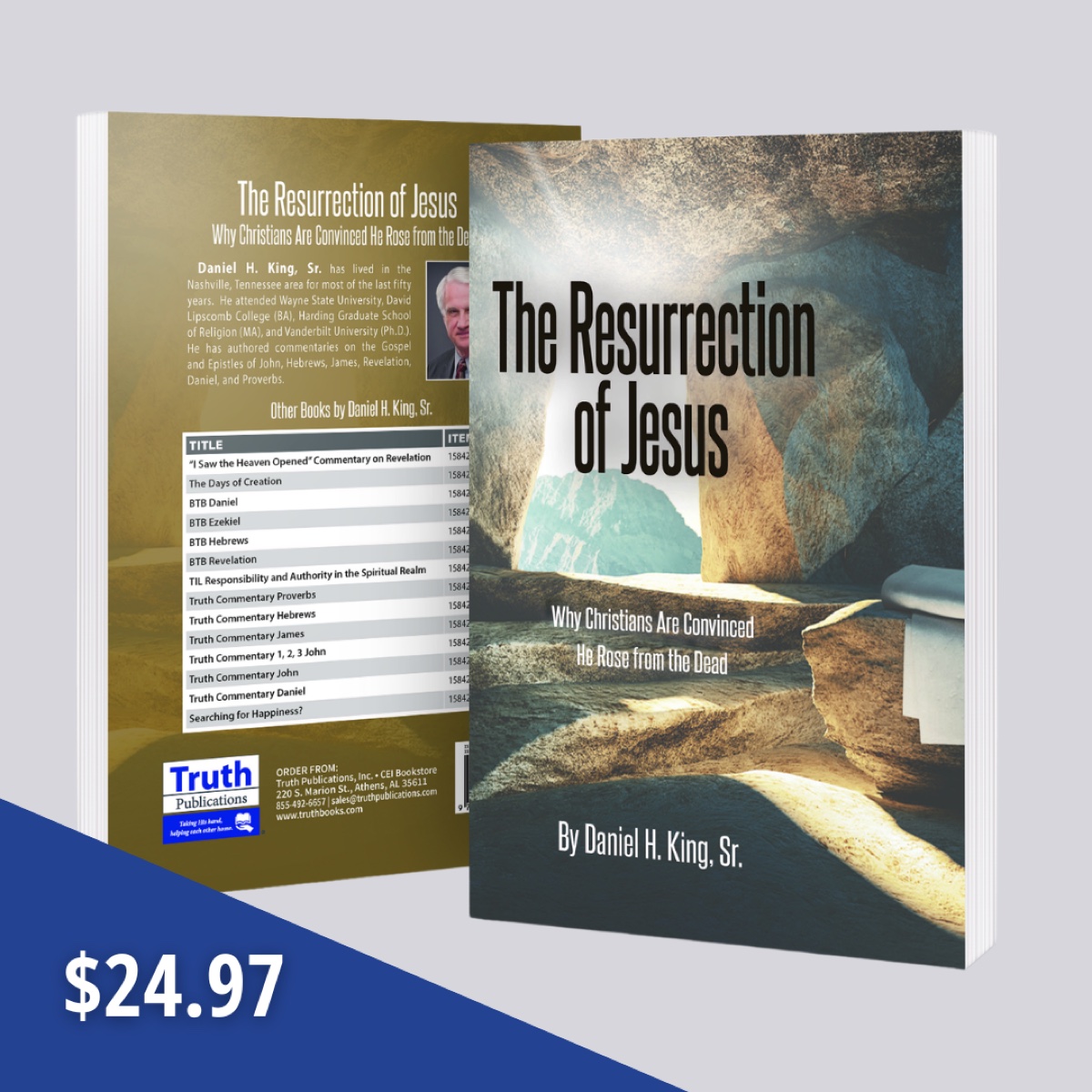
By Shawn Chancellor
Synopsis: This article discusses the Holy Spirit as a divine Person with intelligence and authority, emphasizing the importance of fostering a relationship with the Spirit that embodies love, honor, and obedience. It explores various ways one can sin against the Holy Spirit, including resisting the Spirit (Acts 7:51), grieving the Spirit (Eph. 4:30), and insulting the Spirit of Grace (Heb. 10:29). The document also addresses the unforgivable sin of blasphemy against the Holy Spirit (Matt. 12:31-32; Mark 3:28-29; Luke 12:10), which involves falsely attributing the visible work of the Holy Spirit to Satanic power. The text concludes by highlighting the significance of recognizing and respecting the Spirit’s role in divine revelation and the dangers of rejecting the Spirit’s work. Sinning against Him denies Him the position He deserves in our hearts and lives.
The Holy Spirit is a divine Person with intelligence and authority. Scripture illustrates this by showing that the Spirit can be treated like a person: He can be “insulted” (Heb. 10:29), “grieved” (Eph. 4:30), “resisted” (Acts 7:51), and “blasphemed” (Matt. 12:31; Mark 3:29; Luke 12:10). Given His divine nature, we should foster a relationship with the Holy Spirit that embodies love, honor, and obedience. Therefore, it is essential to understand how to avoid sinning against Him.
In Acts 7, Stephen is on trial for preaching the resurrected Christ. His opponents could not “cope with the wisdom and Spirit with which he was speaking” (Acts 6:10, NASB). Instead of defending himself, Stephen recounted God’s work through the Abrahamic covenant and Israel’s history of rejecting Him and His prophets, highlighting their idolatry.
He concludes with a sharp indictment of his accusers as “stiff-necked and uncircumcised in heart and ears,” referencing the Old Testament’s affirmation that Israel’s disobedience stemmed from a heart problem (Deut. 10:16; Lev. 26:41; Jer. 4:4). The Jews of Stephen’s day were guilty of the same oppositional attitude as they refused to accept the Messiah that the Spirit had revealed and rejected all who were sent to share the message of God with them.
In Ephesians 4:17, Paul warns the Ephesian Christians not to walk as the Gentiles, i.e., as if they were ignorant of the grace of God and the call to holy living. In verses 26-29, he contrasts the behavior of the mind darkened through ignorance with the mind enlightened by the Spirit. Drawing the list to a close, he warns, “Do not grieve the Holy Spirit of God, by whom you were sealed for the day of redemption” (Eph. 4:30). The term translated “grieve” means “to cause severe mental or emotional distress, vex, irritate, offend, insult” (BDAG, 604). Thus, Paul warns these brethren against causing sorrow or emotional pain to the Spirit.
When we sin, we violate the holiness to which we have been called through the work of the Spirit (1 Thess. 3:13). Just as the Father and the Son express their love to us through the redemption offered by the cross, the Spirit expresses His love for us through the written word—revealing our redemption and the holiness God desires. When we act in a way that violates that holiness and rejects that redemption, we cause the Spirit sorrow like a disobedient child causes their parents to grieve.
Beginning in Hebrews 10:19, the inspired writer discusses our access to God as members of the Christian community. In light of that access and the confidence it should inspire, he admonishes us to “draw near” (v. 22) and “hold fast” (v. 23). He then warns that those who forsake the assembly are deserting the community of believers, the opposite of holding fast and drawing near.
To these brethren, he offers a severe warning in verse 26: “For if we go on sinning willfully after receiving the knowledge of the truth, there no longer remains a sacrifice for sins.” “Sinning willfully” is similar to the presumptuous sins mentioned in Exodus 21:14 and Deuteronomy 17:12. Such a sin is committed knowingly and intentionally instead of ignorantly or rashly (see Num. 15:32-41 for an example).
The author’s argument in verses 26-29 is that deserting the community is an act of apostasy that rejects the sacrifice of Christ. This sacrifice provides a way for man to be redeemed from his sins; apart from this sacrifice, there is no hope of salvation. Thus, to act in a way that rejects this sacrifice is to deny the very grace of God.
The Spirit’s role in salvation is alluded to by referring to Him as “the Spirit of grace.” One who rejects the sacrifice of Jesus has rejected the Spirit’s revelation and instruction regarding that salvation, thus mocking or insulting the Spirit Himself.
So far, we have noticed three sins against the Spirit that refer to one’s attitude toward divine revelation. One may reject certain truths the Spirit has revealed, live as if they are ignorant of the life prescribed by the Spirit, or reject the revelation entirely.
The sin of blasphemy against the Spirit deserves special attention in this study for at least two reasons. First, all three passages indicate that this sin will not be forgiven. Second, while this sin bears some relation to those discussed so far, it seems that blasphemy of the Spirit goes beyond one’s attitude toward the written revelation. To understand the nature of this sin, we need to examine all three contexts.
In all three contexts, we find that great crowds are following Jesus. Matthew 12:23 says, “All the crowds were amazed. . .” Mark 3:20 says, “He came home, and the crowd gathered again, to such an extent that they could not even eat a meal.” Luke 12:1 says, “. . .after so many thousands of people had gathered together that they were stepping on one another.”
There is evidence that the accounts do not refer to the same encounter. Mark indicates that the charge that Jesus cast out demons by the ruler of the demons was commonly leveled by the Scribes. The phrase “were saying” is in the imperfect tense, suggesting a continual situation (vv. 22, 30). In both Mark and Luke, the statement is part of a discourse. Matthew connects the statement to a charge regarding a particular miracle.
All three contexts describe a growing current of hostility toward Jesus by the ruling class. In Matthew’s account, the Pharisees charged Jesus with violating the Sabbath (Matt. 12:1-24, esp. v. 24). Luke places the statement in a discourse that begins with “beware of the leaven of the Pharisees” (12:1). Mark attributes the charge to the scribes “who came down from Jerusalem” (3:22).
In Luke, Jesus uses the Messianic title “Son of Man” to describe Himself. This seems particularly significant in verse 10.
In Matthew, Jesus refers to Himself as the Son of Man and connects this to being “Lord of the Sabbath” (v. 8). In verse 23, the crowds wonder if Jesus was the “Son of David,” another Messianic title. In verse 22, Matthew connects the event to his quotation of Isaiah 42:1-4, a passage with deep Messianic significance.
Furthermore, we should consider the role of the Spirit in the incarnation. Three times in the book of Isaiah, the prophet says that God would put His Spirit on the Messiah (Isa. 11:1-4; 42:1-4; 61:1-3). The prophet associates the Spirit’s provision with wisdom, understanding, counsel, might (strength), knowledge, the fear of the Lord, bringing forth justice, bringing the gospel to the afflicted, binding up the brokenhearted, proclaiming liberty to the captives, and proclaiming the favorable year of the Lord. Matthew follows his quotation of Isaiah 42 with the healing of the demon-possessed man, demonstrating how the Spirit was involved (Matt. 12:22-28).
That the Holy Spirit was intimately involved in the mission of the incarnation cannot be denied. Jesus claimed to cast out demons by the Spirit of God and stated that this visible collaboration between the Son of Man and the Spirit of God was evidence of the kingdom’s presence (Matt. 12:28). Kyle Pope states simply that “Jesus was God in the flesh, but it was also said that He did miracles through the Holy Spirit” (Pope, 385). Dan King goes further, stating,
The position of authority enjoyed by Christ has ultimately to do with His relation to the Spirit. Endowments of the Spirit came “by measure” to His servants, the prophets, that is, they were limited as to the gifts thus bestowed. The special intimacy of loving fellowship between the Father and His Son led Him to put “all things into His hand.” None before Him had possessed such a boundless gift of the Spirit, and so none before had enjoyed such limitless spiritual power (King, 113).
We see this pattern in Luke 4. In verse 1, the Spirit led Him into the wilderness to be tempted by Satan. In verse 14, He “returned to Galilee in the power of the Spirit.” Jesus read Isaiah 61, applied it to Himself, and then began casting out demons (Luke 4:18-21, 31-37).
This relationship and collaboration between the Son of Man and the Spirit of God provided incontrovertible proof of Jesus’s identity and mission. Peter points this out twice. In Acts 2:22, he declares that Jesus was “attested to you” by God with miracles, wonders, signs which God performed through Him in their midst. In Acts 10:38, “God anointed Him with the Holy Spirit and with power, and He went about doing good and healing all who were oppressed by the devil, for God was with Him.” Because of this, Jesus can appeal to His works as an external witness to confirm His deity (John 1:1-3; 5:31, 36).
To blaspheme is to speak evil against “to speak in a disrespectful way that demeans, denigrates, maligns” (BDAG). Both Matthew and Mark reveal that these people witnessed the power of the Holy Spirit in action and attributed it to the power of Satan. They were first-hand witnesses of the miracle. Thus, they did not comment on what they had heard; they denied what they had seen with their own eyes. They could not deny the reality of Jesus’s miracles, so they sought to discredit their validity. Mark states that Jesus offered His teaching on blasphemy against the Spirit “because they were saying, ‘He has an unclean spirit.’” Luke broadens this to the Spirit’s work through the apostles, confirming the gospel they presented.
With all of this in mind, we find that blasphemy of the Holy Spirit refers to falsely attributing the visible working of the Holy Spirit to Satanic power by those who witnessed such work. It does not appear from the text that this sin is possible for one to commit today. This was more than saying something foolish, immoral behavior, or even apostasy. This was a sin born of a contempt for God’s Messianic plan that sought not only to discredit the role Jesus played in that plan but to remove God’s ability to confirm the message of redemption. Morna Hooker’s words seem appropriate here:
It is clear from the context, as well as from the editorial note in verse 30, that Mark has interpreted this as the deliberate refusal to acknowledge the activity of God’s Spirit in Jesus’s ministry: it is the attitude which makes a man attribute the work of God to Satan and confuse goodness and evil, truth and falsehood. Such behavior indicates that an individual is guilty of an eternal sin; his attitude of mind is so fixed and obstinate that it forms a permanent obstacle between God and man” (Hooker, 117).
Blasphemy of the Spirit is not a sin we can commit today because we do not witness the Spirit’s miraculous activity first-hand. The Spirit operates in our lives today through His revelation, not ongoing miraculous activity. Thus, we cannot witness and mis-attribute such acts to Satan. However, the mindset that led to this sin can undoubtedly be present today.
For example, many today express dissatisfaction with how God has revealed His will to us. Often, these people will speak with contempt about the idea that being filled with the Spirit refers to the influence of the Spirit through His written revelation. Their lack of contentment with the Spirit’s written revelation leads them to seek signs through various feelings, sensations, and alleged voices. Rarely, if ever, does the message revealed through these experiences agree with what is recorded in Scripture. Such an attitude is a rejection of the Spirit’s work.
We might consider other ways one might reject the Spirit’s work, but we will see the same issue with each example. If we develop a hardness of heart that prevents us from recognizing God’s expression of authority in our lives through the work of His Spirit, we put ourselves in a dangerous position. His message leads us to the cross, brings us to repentance, and offers hope for eternity. We must not develop such “an evil, unbelieving heart that falls away from the living God” (Heb. 3:12).
Arndt, William, et al. A Greek-English Lexicon of the New Testament and Other Early Christian Literature (BDAG). Chicago, IL: University of Chicago Press, 2000.
Hooker, Morna D. The Gospel according to Saint Mark. Black’s New Testament Commentary. London: Continuum, 1991.
King, Daniel H., Sr. John. Truth Commentaries. Athens, AL: Truth Publications, Inc., 2008.
Pope, Kyle. Matthew. Truth Commentaries. Athens, AL: Truth Publications, Inc., 2013.
Shawn Chancellor has worked with the South Georgia Street church of Christ in Amarillo, TX, since 2014. He and his wife, Bonnie, have one child. The church website is here. He can be reached here.

By Elmer Moore
Synopsis: This article discusses the interpretation of the phrase “gift of the Holy Spirit” in Acts 2:38, where Peter commands repentance and baptism for the remission of sins. It explores whether the Holy Spirit Himself is the gift or if the gift is something given by the Holy Spirit. The text examines grammatical considerations, comparisons with other “gift of” passages, and the immediate and remote contexts of the Scripture. It concludes that the gift of the Holy Spirit refers to the salvation promised in Acts 2:21, which is available to both Jews and Gentiles. The document emphasizes that salvation, prophesied and validated by the Holy Spirit, is the gift received by those who comply with the conditions of Acts 2:38.
I am fully aware of the diversity of opinions regarding the statement “gift of the Holy Spirit” in Acts 2:38, where Peter commanded his audience: “Repent ye, and be baptized every one of you in the name of Jesus Christ unto the remission of sins; and you shall receive the gift of the Holy Spirit.” Much has been said and written about the prepositional phrase, “unto the remission of sins.” Even if this phrase was not in the text, one would know why they were to be baptized. The Jews asked a question in verse 37, “What shall we do?” They had been indicted as the murderers of the Divine Son of God. They were in a lost condition and wanted to know what to do to be saved. Peter answered their question, saying, “Repent and be baptized.” This is what they needed to do to have their sins forgiven. The honest and good heart would know this even if the prepositional phrase “unto remission of sins” had not been uttered. I can only ask that you consider this presentation with an open and honest heart.
Our present study will focus on the statement, “. . .and ye shall receive the gift of the Holy Spirit.” What were they promised? Were they promised the Holy Spirit Himself, or were they promised a gift from the Holy Spirit? Was the Spirit Himself the gift, or was He the giver? We will endeavor to answer this question.
Brother Franklin Puckett wrote, “Grammatically it may be either the Holy Spirit Himself, or it may be that which the Holy Spirit gives. The grammar does not determine whether the Holy Spirit is the gift or the giver” (The Holy Spirit, 12-13). On pages 13 and 14, he cites Greek authorities and shows that they conclude “that the distinction between the Subjective and the Objective Genitive depends, not on grammatical, but upon doctrinal reasons, and that these are to be carefully deduced from an accurate comparison of parallel passages” (Winer Grammar of the New Testament Diction, Part III, Sec. 30, 199). I am not willing to allow denominational scholars to determine doctrine for me. Are you? Let us determine the meaning from the New Testament by looking at some parallel passages.
In John 4:10, Jesus said, “If thou knewest the gift of God. . . thou would have asked of Him, and He would have given thee living water.” In Ephesians 4:7, Paul wrote, “Unto each . . . was the grace given according to the measure of the gift of Christ.” In Acts 2:38, Peter said, “Ye shall receive the gift of the Holy Spirit.” In each of the above passages, you have what God, Christ, and the Holy Spirit would give. God was not the gift but the giver; Christ was not the gift but the giver; and likewise, the Holy Spirit was not the gift but the giver. A gift implies a giver. One cannot have a gift without a giver and a receiver. If the Holy Spirit is the gift, then who is the giver? The concept that the Holy Spirit is the gift and not the giver actually makes the gift and the giver one and the same. How can that be? The gift of God was not God but living water that He would give. The gift of Christ was not Christ, but the gifts named in the text. Likewise, the gift of the Holy Spirit was not the Holy Spirit Himself, but the salvation promised in Acts 2:21. I am not aware of any other circumstance where men would argue as they do about the gift and giver of Acts 2:38. If one reads about the gift of the Ford Foundation, he would not think that the Ford Foundation was the gift, but that it was the giver.
The text of Peter’s sermon was this: “It shall be, that whosoever shall call upon the name of the Lord shall be saved” (Acts 2:21; cf. Joel 2:32). In this sermon, he identified the Lord upon whom they were to call, explained the reason they should call on Him, and explained how they were to do it. The emphasis in this passage is on the whosoever, which is comparable to “all nations” in similar passages. Paul wrote there was no distinction between Jew and Greek and that Jesus is “Lord of all, and is rich unto all that call on Him: for, whosoever shall call upon the name of the Lord shall be saved” (Rom. 10:12-13). Thus, he indicates that Joel was showing that both Jew and Gentile would have the right to invoke God’s blessings by doing His will. Notice what Peter says: “For to you is the promise, and to your children, and to all that are afar off, even as many as the Lord our God shall call” (Acts 2:39). What promise is Peter talking about? I submit that he is talking about the promise in Acts 2:21, which involved “whosoever;” i.e., both Jew and Gentile (see Rom. 10:12-13). Who are the recipients of the promise of Acts 2:39? It says the promise is to you (Jews) and to your children (Jews) and to all that are afar off (Gentiles) (see Eph. 2:13). In Acts 2:21, salvation is promised to both Jews and Gentiles. After Peter stated that the baptized would receive the gift of the Holy Spirit, he gave the reason in verse 39 when he said, “For to you is the promise,” referring to the salvation of verse 21. This is not redundant because salvation is sometimes used to indicate a state or condition resulting from the remission of sins (see Luke 1:77).
The salvation of Joel 2:32 is the equivalent of the promised inheritance through Abraham (see Gal. 3:7-14). In Galatians 3:15, this inheritance is said to be the “promise of the Spirit” or that which the Holy Spirit promised through Abraham.
Peter declares that Jesus was exalted to the right hand of God and received the promise of the Holy Spirit. He did not receive the Holy Spirit Himself, but He received that which the Holy Spirit promised. The promise was that He would sit on David’s throne (Acts 2:34-35). This statement was made just five verses before Acts 2:38. The promise of the Spirit is what the Holy Spirit promised, and the gift of the Holy Spirit is what the Holy Spirit gave.
Jesus said to Paul, “. . .to this end have I appeared unto thee, to appoint thee a minister and a witness both of the things wherein thou hast seen Me, and of the things wherein I will appear unto thee; delivering thee from the people, and from the Gentiles unto whom I send thee, to open their eyes, that they may turn from darkness to light and from the power of Satan unto God, that they may receive the remission of sins and an inheritance among them that are sanctified by faith in Me” (Acts 26:16-18). This is a commentary on the gift of the Holy Spirit. Paul was not directed to teach something different from what Peter preached. Rather, the promised inheritance that resulted from their receiving the remission of sins was the gift of the Holy Spirit.
Peter wrote to the elect of God, stating they had been “begotten again unto a living hope by the resurrection of Jesus Christ from the dead, unto an inheritance incorruptible, and undefiled and fadeth not away reserved in heaven for you, who by the power of God are guarded through faith unto salvation ready to be revealed in the last time” (1 Pet. 1:3-5). These brethren were called “children of obedience” (v. 14). They had been redeemed by the precious blood of Jesus (v. 18), having purified their souls by obeying the truth (v. 21). They had been begotten again by the word of God that liveth and abideth forever (v. 21). This is a description of the gift of the Holy Spirit. We are begotten again by the word of God. Obedient children have a living hope based on a living Savior, are promised an inheritance that would not fade away, and are guarded through faith unto a salvation ready to be revealed in the last time.
Peter declares, “Concerning which salvation the prophets sought and searched diligently, who prophesied of the grace that should come unto you: searching what time and manner of time the Spirit of Christ which was in them did point unto, when it testified the suffering of Christ and the glories that should follow them. To whom it was revealed, that not unto themselves, but unto you, did they minister these things, which now have been announced unto you through them that preached the gospel unto you by the Holy Spirit sent forth from heaven; which things angels desire to look into” (1 Pet. 1:10-12).
The Holy Spirit enabled men to prophesy concerning this salvation (2 Pet. 1:20-21). The Holy Spirit enabled men to preach this message of salvation (1 Pet. 1:12). The Holy Spirit validated the message of this great salvation by signs and wonders (Heb. 2:1-4). This is why the salvation mentioned in Acts 2:21 can be, and indeed is, the gift of the Holy Spirit (Acts 2:38).
Salvation was prophesied by the Holy Spirit. Salvation was announced by those who preached the gospel by the Holy Spirit. Their message of salvation was validated by the Holy Spirit. The promise of the gift of the Holy Spirit in Acts 2:38 was not only to those present, but for all who would truly repent and be baptized. Everyone who complies with the conditions of Acts 2:38 receives the gift of the Holy Spirit, and that gift is salvation. Those in Acts 8:16, by being baptized into the name of the Lord Jesus, complied with the conditions of Acts 2:38 and received the gift of the Holy Spirit. However, they had not received the Holy Spirit Himself (Acts 8:17). I believe that this shows that to receive the gift of the Holy Spirit is not necessary to receive the Holy Spirit Himself, but is that which the Holy Spirit gives.
Moore, Elmer. “The Gift of the Holy Spirit in Acts 2:38.” Guardian of Truth Vol. 40, No. 3 (February 1, 1996): 18-19.
Elmer Moore passed from this life into eternity on September 11, 2008, but his writings still encourage and teach His brethren. He was a dear brother, friend, mentor, and teacher to me as a gospel preacher. Anyone who knew Elmer knew that he was an extremely diligent student of the Scriptures, courageous proclaimer of truth, and a dignified and gentlemanly defender of the gospel. His insights into biblical context were apparent, as was His commitment to the integrity of the word of God. Elmer moderated for me in my first debate in 2003 and was respected by all the parties involved in the discussion. He spoke with clarity, precision, and thoughtfulness. His work on subjects such as the Holy Spirit, the nature of the Godhead, miraculous spiritual gifts, institutionalism, the one-cup issue, and host of other topics is still helpful to us today and we commend it to you–Bruce Reeves.
Lessons on the Holy Spirit, by Elmer Moore, is available here This book contains five lessons and 64 charts on the subject of the Holy Spirit. These lessons have been delivered a number of times and this book is the result of many years of work and study on the subject. These lessons are easy to read and understand.

Note: Please send additions, corrections and updates here.
Updated: 1/2/2025
17312 Jones Rd, Athens, AL 35613
Sun. Bible Study 9:30 am | Sun. Worship: 10:20 am & 5:00 pm | Wed. Bible Study 7:00 pm
Evangelist: Jonathan Reeder | Website | 256-233-3160
24190 Wooley Springs Rd, Athens, AL 35613
Sun. Worship 9:30 am & 5:15 pm | Wed. Bible Class 7:00 pm
Evangelists: Bob Watson & Matt Taylor | Website
3955 Pine Lane, Bessemer, AL 35022
Sun. Bible Study 9:10 am | Sun. Worship 10:00 am & 5:00 pm | Wed. Bible Class 7:00 pm
Evangelist: David Deason | 256-497-8127 205-425-2352 | Email | Website
2325 Old Columbiana Rd. (near I-65 & Hwy. 31)
Sun. Bible Study 9:00 am | Worship 10:00 am & 5:00 pm | Wed. Bible Study 7:00 pm
Evangelist: Kyle Pope | 205-822-0018 | Website
19965 Sandlin Rd. Elkmont, AL 35620
Sun. Worship 9:30 am & 3:00 pm | Bible Classes: 10:45 am | Wed. Bible Study 7:00 pm
Evangelist: Lance R. Taylor | 256-777-0990 | Website
851 N. Pine St. (Located next to University campus)
Sun. Bible Study 9:30 am | Worship 10:15 am & 5:00 pm | Wed. Bible Study 7:00 pm
Evangelist: Kenny Moorer | 256-766-0403
601 Pineywood Road, Gardendale, AL, 35071 (Located 10 miles N of Birmingham)
Sun. Bible Study 9:30 am | Worship: 10:25 am & 5:00 pm | Wed. Bible Study: 7:00 pm
Evangelists: Andrew Smith & Jason Shackleford | 205-631-2131 | Website
129 Hillcrest Rd, Mobile, AL 36608
Sun. Worship 9-9:30 am | Bible Study 9:30-10:30 am | Worship 10:30-11:30 am | Wed. Bible Study 7:00 pm
Evangelist: Ken Sils | 765-307-8048 | 251-342-4144 or 342-2041 | Website
271 Highway 65 N, Conway, AR 72032
Sun. Bible Study 9:00 am | Worship 10:00 am & 5:00 pm | Wed. Bible Study 7:00 pm
Evangelist: Bruce Reeves | Bldg: 501-336-0052 | Website
2655 Prince St., Conway, AR 72034
Sun. Worship 9:00 pm | Bible class 9:50 am | Worship & Lord’s Supper: 10:40 am | Wed. Bible Class 7:00 pm
501-450-8640
2323 South 46th St.
Sun. Bible Study 9:45 am | Worship 10:30 am | Wed. Bible Study 7:00 pm
407 Bella Vista Dr.
Sun. Bible Study 9:30 am | Worship 10:15 am & 5:00 pm | Wed. Bible Study 7:00 pm
Evangelist: Norman E. Sewell | 870-741-9104 or 870-741-5151 | Website
514 Airport Rd.
Sun. Bible Study 10:00 am | Worship 11:00 pm & 6:00 pm | Wed. Bible Study 7:00 pm
Evangelist: Dick Blackford | 870-933-9134
145 N. Country Club Rd.
Sun. Bible Study 9:00 am | Worship 10:00 am & 6:00 pm | Wed. Bible Study 7:00 pm
Evangelist: Brenden Ashby | 520-326-3634 | Website
17903 Ibbetson Ave.
Sun. Bible Study 9:45 am | Worship 10:50 am & 6:00 pm | Wed. Bible Study 7:30 pm
562-866-5615 | Website
3433 Studebaker Rd.
Sun. Bible Study 9:50 am | Worship 10:45 am & 5:30 pm | Wed. Bible Study 7:00 pm
JP Flores | 562-420-2363 or Mark Reeves | 562-377-1674 | Website
449 W. Allen Ave., Suite 120, San Dimas, CA 91773
Sun. Bible study 10:00 am | Worship 11:00 pm & 4:00 pm | Wed. Bible Study 7:30 pm
909-788-9978 | Website
Meets at the Fort Collins Senior Center, 1200 Raintree Dr., Fort Collins, CO 80526
Sun. Bible Study 9:30 am | Worship 10:30 am
Evangelist: Richie Thetford | Website
1414 Hawk Parkway, Unit C
Sun. Worship 11:00 pm | Bible Study 2 pm & 1:30 pm
970-249-8116 |
64 Casting Lake Rd.
Sun. Bible Study 9:00 am | Worship 10:00 am & 6:00 pm | Wed. Bible Study 7:00 pm
850-622-3817 | Website | Location change coming in 2022: 497 Church St Santa Rosa Beach, FL 32459
196 Ave C, Geneva, FL 32732
Sun. Bible Study 10:00 am | Worship 10:45 am
(689) 229-9888 | Website
6 Lane Dr., Mary Esther, FL 32569
Sun. Bible Study 9:30 am | Worship 10:30 am & 5:00 pm | Wed. Bible Study 7:00 pm
850-244-9222 | Website | Evangelist: Chris Simmons | Email
3940 S. Bumby Ave.
Sun. Communion: 9:30 am | Bible Study 10:00 am | Praise & Preaching: 10:55 am (No pm Service) | Wed 7:00 pm
Evangelist: Ken Chapman
Office: 407-851-8031 | Website | Note: Please call for current worship and Bible study times.
621 E. Wheeler Rd.
Sun. Bible Study 10:00 am | Worship 10:50 am & 6:00 pm | Wed. Bible Study 7:30 pm
Evangelist: Bobby Witherington | 813-684-1297 | Website
Route 116 (near Callaway Gardens)
Sun. Bible Study 10:00 am | Worship 11:00 pm & 6:00 pm | Wed. Bible Study 7:30 pm
Evangelist: Tommy W. Thomas | 706-628-5117 or 628-5229 |
Meeting at 321 2nd St. S., Ste. 103, Nampa ID 83651
Sun. Bible Study 10:00 am | Worship 11:15 am | Wed. Bible Study 7:00 pm
208-461-1318 | Email | Website or here
Note: Please see website for most current information.
370 N. Shilling | P.O. Box 158-83221
Sun. Bible Study 10:00 am | Worship 11:00 pm | Wed. Bible Study 7:30 pm
208-785-6168 or 681-1552
1310 NE 54th Ave, Des Moines, IA 50313
Sun. Bible Study 9:45 am | Worship 10:40 am | Wed. Bible Study 7:00 pm
515-262-6799 | Website
1236 63rd St. (Dir: 1.5 miles E of I355)
Sun. Bible Study 9:00 am | Worship 9:55 am & 6:00 pm | Wed. Bible Study 7:30 pm
Evangelist: Steve Wolfgang | 630-968-0760 | Website
1100 S. 17th St.
Sun. Bible Study 9:30 am | Worship 10:30 am & 6:00 pm | Wed. Bible Study 7:00 pm
217-234-3702
16224 S Vincennes Ave.
Sun. Bible Study 9:00 am | Worship 10:00 am & 4 pm | Wed. Bible Study 7:00 pm
Evangelist: Donald Hawkins | 708-339-1008 | Website
Meeting @ Sleep Inn Suites and Motel | 1101 North Cummings Lane, Washington, IL 61571
Sun. Worship: 11:30 am | Bible Study: 12:30 pm | Wed. Bible Study 6:30 pm @ home of Tim Sundlie, call for address
Evangelist: Tim Sundlie | 608-796-9028 | Email | Website
407 W Lewis and Clark Parkway, Clarksville, IN 47129
Sun. Bible Study 9:30 am | Worship 10:30 am & 6:00 pm | Wed. Bible Study 7:30 pm
Elders: Allen L. Morris (812) 989-5838 and Stephen W. Nale (502) 727-7559 or (812) 944-2305 | Website
Sun. Bible Study 9:30 am | Worship 10:30 am | Wed. 7:00 pm
765-676-6404 | Website
15530 Herriman Blvd, 46060
Sun. Bible Study 10:00 am | Worship 11:00 am | Wed. Bible Study 7:00 pm
Evangelist: John Smith | Email | 317-501-8035 or 317-501-0249 or 317-701-1204
400 Lafayette Ave. | P.O. Box 34
Sun. Bible Study 9:45 am | Worship 10:30 am & 6:00 pm | Wed. 7:00 pm
812-279-4332
(First St. & Karnes Ct.)
Sun. Bible Study 9:45 am | Worship 10:30 am & 5:00 pm | Wed. Bible Study 7:00 pm
Evangelist: Jeremy Goen | 812-967-3437 or 967-3520 | Website
302 S. Fourth Ave., Mulvane KS 67110 | Mail: PO Box 11
Sun. Bible Classes: 10:00 am | Worship 11:00 am | Wed. Bible Study 7:00 pm
Evangelist: Jay Horsley | 316-644-8503 | Website | Email
5600 SW 17th St, Topeka, KS 66604
Sun. Bible Study 9:15 am | Sun. Worship 10:30 am | Wed. Bible Study 7:00 pm
785-235-8687 or 785-273-7977 | Website
1235 Williams St.
Sun. Worship 10:00 am | Bible Study After am Worship & 6:00 pm | Wed. Bible Study 7:00 pm
Evangelist: Jerid Gunter | 270-274-4451
8081 US Hwy 68-East, Benton, KY 42025
Sun. Bible Study 9:00 am | Worship 10:00 am | Wed. Bible Study 6:00 pm
270-354-9451 | Email | Website | Conveniently located near Kenlake State Resort Park on the western shore of Kentucky Lake.
612 Broadway
Sun. Bible Study 9:45 am | Worship 10:30 am & 5:00 pm | Wed. Bible Study 6:30 pm
Evangelist: Charles J. White | 270-422-3878
107 Sunny Hill Dr.
Worship 9:30 am & 11:30 am | Bible Study 10:30 am | Wed. Bible Study 7:00 pm
Evangelist: Steve Lee | 270-789-1651 | Website
103 N. Main St. | P.O. Box 233
Sun. Bible Study 10:00 am | Worship 10:45 am & 5:00 pm | Wed. Bible Study 7:00 pm
Evangelist: Jarrod Jacobs | 270-589-4167 or 270-274-3065
385 E. Lexington Ave.
Sun. Worship 10:00 am | Bible Study 11:15 am & 5:00 pm | Wed. Bible Study 7:00 pm
Evangelist: B.J. Sipe | 859-236-4204
18 Scott Drive, Florence, KY 41042
Sun. Worship 9:30 am & 5:30 pm | Sun. Bible Study 10:30 am | Wed. Bible Study 7:00 pm
859-371-2095 | Website
1733 Bowling Green Rd.
Sun. Bible Study 9:00 am | Worship 10:00 am & 6:00 pm | Wed. Bible Study 7:00 pm
Evangelist: Steve Monts | 270-776-9393 | Website
733 Mill St. Leitchfield, KY 42754
Sun. Bible Study 9:30 am | Worship 10:00 am Communion 10:55 am | Wed. Bible Study 6:00 pm
270-230-6144 | Website
1803 Dixie Garden Dr.
Sun. Bible Study 9:30 am | Worship 10:30 am & 6:00 pm | Wed. Bible Study 7:00 pm
Evangelist: Michael Hardin | Email | 502-937 2822
3221 East Hebron Lane
Sun. Bible Study 9:00 am | Worship 10:00 am & 5 pm | Wed. Bible Study 7:30 pm
Evangelist: Danny Linden & Ron Halbrook | 502-957-5115 or 502-955-1748 | Website
405 Orice Roth Rd. | 70737 (Baton Rouge area)
Sun. Bible Class 9:30 am | Worship 10:30 am & 6:00 pm | Wed. Bible Study 7:00 pm
Evangelist: R.J. Evans | Email | 225-622-4587
856 Brighton Ave. (Breakwater School) | Leave Maine Turnpike at Exit 48
Sun. Bible Study 10:00 am | Worship 11:00 pm w/ second service immediately following am worship | Mid-week Bible Study (please call for times & places)
207-839-3075 or 839-8409
3084 Creek Drive SE, #1-C, Kentwood, MI 49512 | P.O. Box 8446, Kentwood, Mich. 49508 (Grand Rapids area)
Sun. Worship 11:00 am | Sun. Bible Study 12:30 pm | Wed. Bible Study 7:00 pm
Evangelist: Joseph Gladwell | Email
414 South Main Street
Sun. Bible Study 10:00 am | Worship 11:00 am | Wed. Bible Study 6:00 pm
Evangelist: Ryan Thomas | 810-837-1302 or 989-389-3226 | Website
2820 Grandview Ave, Meridian, MS 39305
Sun. Bible Study 10:00 am | Sun. Worship 11:00 pm | Wed. 6:30 pm
Ron Cooper: 601-934-3675 | Email
Ricky Ethridge: 601-737-5778 | Email
2110 E State Line Rd. (Exit I-55) (Memphis area)
Sun. Bible Study 9:30 am | Worship 10:30 am | Wed. Bible Study 7:00 pm
Evangelist: James A. Brown | Bldg: 662-342-1132
805 Meadow Rd, Severn, MD 21144
Sun. Bible Study 10:00 am | Sun. Worship 11:00 pm & 6:00 pm | Wed. Bible Study 7:30 pm
Evangelist: Brandon Trout | 410-969-1420 or 410-551-6549 | Website
422 N Linton St., Blodgett, MO 63824
Sun. Worship 10:00 am | Wed. Bible Study 7:00 pm
Evangelist: Russell Rice | 573-475-0417
4000 SW Christiansen
Sun. Worship 9:00 pm | Bible Study 10:00 am | Worship 11:00 pm | Wed. Bible Study 7:00 pm
Evangelist: Brett Hogland | 816-228-9262
432 Eagle Rock Rd, Branson, MO 65616
Sun. Worship 9:30 am | Bible Study 10:30 am | Sun. Evening Worship 5:00 pm | Wed. Bible Study 6:00 pm
Evangelist: Philip North | 417-239-1036 | Email | Website
2912 Bloomfield Rd
Sun. Bible Study 9:15 am | Worship 10:00 am | Wed. Bible Study 7:00 pm
Seth McDonald & Jerry Lee Westbrook | 573-837-1001 | Email | Website
703 Harrison St.
Sun. Bible Study 10:00 am | Worship 11:00 pm & 6:00 pm | Wed. Bible Study 7:00 pm
Evangelist: Nolan Glover | 870-650-1648 | Website
685 Sidney St.
Sun. Bible Study 9:30 am | Worship 10:15 am & 5:00 pm | Wed. Bible Study 7:00 pm
Evangelist: Lynn Huggins | 573-265-8628
2727 County Line Rd.
Sun. Bible Study 9:00 am | Worship 9:50 am | Wed. Bible Study 7:00 pm
816-279-4737 | Website
Bell St & S 7th St. Beatrice, NE 68310
Sun. Bible Study 9:00 am | Worship 10:00 am & 6:30 pm
402-233-4102 or 402-228-3827 | Website
5327 S. Tryon Street, Charlotte, NC 28217
Sun. Bible Study 9:30 am | Sun. Worship 10:30 am | Wed. Bible Study 7:30 pm
704-525-5655 | Website
3781 East Highway 27, Iron Station, NC 28080
Sun. Bible Study: 10:00 am | Sun. Worship 11:00 am & 6:00 pm | Wed. Bible Study 7:00 pm
Evangelist: Stan Adams | 704-748-9777 (Bldg) & 704-748-3747 (Jerry) | Email | Website
1031 Welford Dr, Beavercreek, OH 45434 (located a few miles E of Dayton)
Sun. Short Worship: 9:30 am | Bible Study 10:05 am | Sun. Worship 11:00 am | Wed. Bible Study Adults: 1:00 pm & All ages: 7:00 pm
Evangelist: Heath Rogers | 937-426-1422 | Website
13501 Lorain Ave, Cleveland, OH 44111
Sun. Bible Study 10:00 am | Worship 11:00 am | Wed. Bible Study 7:00 pm (Call)
Evangelist: John Dicus | (330) 723-0111 or (330) 590-0227 or (216) 322-9392 | Website
28 W. Main St., Dayton, OH 45449
Sun. Worship 9:00 pm | Bible Study 9:30 am | Worship 10:25 am | Wed. Bible Study 7:00 pm
Evangelists: Michael Grushon 937-866-5162 or Alan Beck 937-469-3311 | Website
6417 Franklin-Lebanon Rd. Franklin, OH 45005
Sun. Bible Study 10:00 am | Worship 10:45 am | Tues. Bible Study 6:30 pm
Evangelist: Josh Lee | 937-789-8055 or 937-746-1249 | Website
1973 W Main St. New Lebanon, OH 45345
Sun. Bible Study 9:30 am | Worship 10:30 am, & 5:00 pm | Wed. Bible Study 7:00 pm
Evangelist: Bruce Hastings | 937-687-7150 or 937-478-0367
80 Sandhill Rd. Reno, OH 45773
Sun. Bible Study 9:30 am | Worship 10:30 am & 6:30 pm | Wed. Bible Study 7:00 pm
Evangelist: Mark Childers | 304-615-1091 | 740-374-9827 | Website
4110 Frey Rd., Northwood, OH 43619 (Toledo Area)
Sun. Worship 11:00 pm
Evangelist: Donald Jarabek | 419-893-3566 & 567-331-2269
33226 Children’s Home Rd., Pomeroy, OH 45769
Sun Worship 10:00 am & 5 pm | Bible Study 11:00 am | Wed. Bible Study 6:00 pm
Jack Hunt | Email | 740-645-4612 | Website
2120 No. A St.
Sun. Bible Study 9:45 am | Worship 10:45 am & 5:30 pm | Wed. Bible Study 7:00 pm
Evangelist: Rob Lungstrum | 918-931-1362 or 918-423-3445
4110 NE 122nd Ave #101, Portland, OR 97230
Sun. Bible Study 10:00 am | Worship 11:00 am | Thur. Bible Study 7:00 pm
Evangelist: Samuel A. Matthews | 971-331-2838 | Bldg: 503-432-8697 | Email | Website
3702 E. Long St.
Sun. Bible Study 9:30 am | Worship 10:30 pm & 5:30 pm | Wed. Bible Study 7:30 pm
Bldg: 541-367-1599 | Email | Website
7222 Germantown Ave, Philadelphia, PA 19119
Sun. Bible Study 10:15 am | Sun. Worship: 11:15 am | Tues. Bible Study: 7:00 pm
Evangelist: James H. Baker, Jr. | 215-248-2026 | Website
3370 Broad St. Extension
Sun. Bible Study 9:30 am | Worship 10:30 am & 5:30 pm | Wed. Bible Study 7:00 pm
Evangelist: A.A. Granke, Jr. | 803-499-6023
4013 Edmund Hwy. (Hwy. 302), West Columbia, SC 29170
Sun. Bible Study 9:30 am | Sun. Worship 10:30 am & 5:00 pm | Wed. Bible Study 7:00 pm
Evangelist: Jerry Cleek | 219-313-1108 | Website
326 Powell Road, Collierville, TN 38017
Sun. Bible Study 9:00 am | Worship 10:00 am | Wed. Bible Study 7:00 pm
Evangelist: Doug Seaton | 901-854-6816 or 901-634-7840
417 Mooresville Pike | (Located .8 mi. N. of Hwy. 50/Jas. Campbell)
Sun. Bible Study 9:30 am | Worship 10:30 am & 3:30 pm | Wed. Bible Study 7:00 pm
931-388-5828 or 931-381-7898 | Website
4894 Hooper Hwy. | 37722 | (Located 15 mi. E. of Gatlinburg on Hwy. 321)
Sun. Bible Study 10am | Worship 11:00 pm & 5:00 pm | Wed. Bible Study 6:00 pm
Evangelist: Olie Williamson | 423-487-5540 or 423-748-0844
350 N Main St. Kingston Springs, TN 37082
Sun. Bible Study 9:00 am | Worship 10:00 am & 5:00 pm | Wed. Bible Study 7:00 pm
108 Locust St.
Sun. Bible Study 9:30 am | Worship 10:30 am & 5:00 pm | Wed. Bible Study 7:00 pm
Evangelist: Daniel H. King, Sr. | 931-379-3704 or 931-964-3924 | Website
1110 Cason Lane
Sun. Bible Study 9:00 am | Worship 10:00 am & 5:00 pm | Wed. Bible Study 7:00 pm
Bldg: 615-896-0090 | Website
2091 Pitts Ln, Murfreesboro, TN 37130 (located at the corner of Northfield Blvd and Pitts Lane)
Sun. Bible Study 9:30 am | Sun. Worship 10:30 am & 6:00 pm | Wed. Bible Study 7:00 pm
Evangelist: David Bunting | 615-893-1200 | Website
7471 Charlotte Pike
Sun. Bible Study 9:00 am | Worship 10:00 am & 5:00 pm | Wed. Bible Study 7:00 pm
Evangelist: Lee Wildman | 615-952-5458 or 615-356-7318
1414 W. Exchange Pkwy
Sun. Bible Study 9:00 am | Worship 10:00 am & 5:00 pm | Wed. Bible Study 7:00 pm
Evangelist: Jerry King 214-504-0443 or 972-727-5355 | Website
4343 S Interstate 35, Alvarado, TX 76065 (Located on the East Service Road off I-35 North of Alvarado)
Mail: I-35 church of Christ, P.O. Box 1269, Alvarado, TX 76009
Sun. Bible Study 10:00 am | Worship 11:00 am | Wed. Bible Study 7:00 pm
682-202-9741 or 817-739-3402 | Website
605 E. Adoue St., Alvin, TX 77511
Sun. Bible Study 9:30 am | Worship 10:30 am & 5:00 pm | Wed. Bible Study 7:30 pm
Evangelist: Mark Mayberry | Email | Website
701 North Pruett St.
Sun. Bible Study 9:45 am | Worship 10:40 am & 6:30 pm | Wed. Bible Study 7:00 pm
Bldg: 281-422-5926 | Weldon: 713-818-1321 | Website
2919 Main St/FM 517 E., Dickinson, TX 77539
Sun. Bible Study 10:00 am | Sunday Worship 11:00 am & 6:00 pm | Wed. Bible Study 7:00 pm
713-298-6673
301 Robison St.
Sun. Bible Study 9:30 am | Worship 10:30 am & 6:00 pm | Wed. Bible Study 7:00 pm
Evangelist: Phillip Stuckey | 361-782-5506 or 361-782-2844 | Website
3277 Pendleton Rd.
Sun. Bible Study 9:30 am | Worship 10:30 am & 5:00 pm | Wed. Bible Study 7:00 pm
915-855-1524
4303 18th St, Bacliff, TX 77518
Sun. Bible Study 9:00 am | Sun. Worship 10:00 am & 6:00 pm | Wed. Bible Study 7:00 pm
Evangelist: Richard Lay | Website
6110 White Settlement Rd. 76114
Sun. Bible Study 9:30 am | Worship 10:30 am & 6:00 pm | Wed. Bible Study 7:30 pm
817-738-7269
Old Granbury Rd Church of Christ
4313 Old Granbury Rd, Granbury, TX 76049
Sun. Bible Study 9:30 am | Sun. Worship 10:30 am | Wed. Bible Study 7:00 pm
Evangelist: Chip Foster | 817-913-4209 or 817-279-3351 | Website
2510 Fry Rd, Houston, TX 77084
Sun. Bible Study 9:45 am | Worship 10:30 am & 6:00 pm | Wed. Bible Study 7:00 pm
Evangelist: David Flatt | Email | Website
6111 Indiana Ave, Lubbock, TX 79413
Sun. Bible Study 10:00 am | Sun. Worship 9:00 am & 11:00 am | Wed. Bible Study 7:00 pm
806-795-3377 | Website
1820 Mansfield Webb Rd, Mansfield, TX 76063
Sun. Bible Study 9:30 am | Sun. Worship: 10:20 am & 5:00 pm | Wed. Bible Study 5:30 pm.
Evangelist: Tom Roberts | 817-996-3926 | Website
612 S Shawnee St, Nacogdoches, TX 75961
Sun. Bible Study 9:45 am | Worship 10:30 am & 6:00 | Wed. Bible Study 6:00 pm
Minister: Van Dennis | 936-615-2950
3831 N.E. Stallings Dr.
Sun. Bible Study 9:30 am | Worship 10:20 am & 6:00 pm | Wed. Bible Study 7:00 pm
Evangelists: Randy Harshbarger & Jay Taylor
268 Utopia Ave. (Dir: I-37 S.E. Exit Pecan Valley)
Sun. Bible Study 9:30 am | Worship 10:30 am & 5:00 pm | Wed. Bible Study 7:00 pm
Evangelist: Jesse Garcia | 210-660 0409
314 N. Tolbert
Sun. Bible Study 9:30 am | Worship 10:30 am & 5:00 pm | Wed. Bible Study 7:00 pm
Evangelist: Ronald Stringer
4404 Twin City Blvd.
Sun. Bible Study 9:30 am | Worship 10:30 am & 6:00 pm | Wed. Bible Study 7:30 pm
Evangelist: Jason Garcia Email or Email | 254-939-0682 | Website
2301 Franklin Dr., Texarkana, AR 71854
Sun. Bible Study 9:30 am | Worship 10:15 am | Wed. Bible Study 7:00 pm
870-772-0746 | Website
340 E Warren St. (in Hewitt, a suburb of Waco)
Sun. Bible Class 9:30 am | Worship 10:30 am & 5:00 pm | Wed. Bible Study 7:00 pm
Evangelist: Marc Smith | 254-292-2482 or 652-7698
4500 Kell West Blvd, Wichita Falls, TX 76309
Sun. Bible Class 9:30 am | Worship 10:30 am & 3:30 pm | Wed. Bible Study 6:30 pm
Evangelist: Dennis L. Scroggins | 512-626- 5702 | Email | Website
Please mail all correspondence to 1504 Hayes St, Wichita Falls, TX 76309
Meeting in the Capital City Grange Hall, 6612 Route 12 Berlin, VT 05602
Sun. Bible Study 9:00 am | Worship 10 am | Tues. Evening in Homes
Evangelist: Open | Website | P.O. Box 70, Williamstown, VT 05679 | For questions or directions: Wade Holt 802-485-4311
217 Taxus St., Chesapeake, VA 23320
Sun. Bible Study 10:00 am | Worship 11:00 am & 5:00 pm | Wed. Bible Study 7:00 pm
Evangelist: Steven Matthews | 757-436-6900 | Website
8330 Doublecreek Court, Chesterfield, VA 23832 (Located in teh Metro Area; Courthouse Rd. at Double Creek Ct. 2.2 miles S of Rt. 288)
Sun. Bible Study 9:30 am | Worship 10:30 am & 5:00 pm | Wed. Bible Study 7:00 pm
Evangalist: Nathan L. Morrison | 804-778-4717 | Website
1208 W. 41st St.
Sun. Bible Study 10:00 am | Worship 11:00 pm & 6:00 pm | Wed. Bible Study 7:00 pm
Evangelist: Jack Bise, Jr.
2970 Old Leaksville Rd.
Sun. Bible Study 10:00 am | Worship 11:00 pm & 5:30 pm | Wed. Bible Study 7:00 pm
276-956-6049 | Website
929 Indiana Ave. NE (5 min. from Roanoke Convention Center)
Sun. 1st Lesson 9:15 am | Bible Study 10:00 am | Worship 11:00 pm | Wed. Bible Study 7:30 pm
Evangelist: Brent Paschall | 540-344-2755 | Website
5652 Haden Rd.
Sun. Bible Study 10:00 am | Worship 11:00 am
Robert Mallard | 757-464-4574
1860 Mt Baker Hwy, Bellingham, WA 98226,
Sun. Bible Study 9:30 am | Worship 10:30 am & 6:00 pm | Wed. Bible Study 7:00 pm
Evangelist: Steven J. Wallace | 360-752-2692 or 806-787-5088 | Website & Website
Meeting at Gray Middle School, 6229 S. Tyler St., Tacoma, WA 98409
Note: Please see webpage for updated meeting location and times.
Sun. Bible Study 10:00 am | Worship 11:00 pm | Wed. Bible Study 7:00 pm (Online)
253-242-3098 | Email | Website
7 Old Davisson Run Rd, Clarksburg, WV 26301
Sun. Bible Study 9:30 am | Worship 10:20 am
304-622-5433 | Website | Email
1929 Morgantown Ave.
Sun. Bible Study 10:00 am | Worship 10:45 am & 6:00 pm | Wed. Bible Study 7:00 pm
304-363-8696 or 304-844-2437
210 Cedar Ave, Moundsville, WV 26041
Sun. Bible Study 9:30 am | Sun. Worship 10:30 am & 6:00 pm | Wed. Bible Study 7:00 pm
Evangelist: Tony Huntsman | 304-845-4940 | Website