(August, 2024 | No. 8 | Vol. 68)
8/1/2024
Truth Magazine (ISSN 1538-0793) is published once a month by Truth Publications, Inc., 220 S. Marion, Athens, AL 35611.
© 2024 Truth Publications, Inc. All Rights Reserved.
Manuscripts should be sent to the editor, Mark Mayberry, at mark@truthpublications.com. Link.
Subscriptions, renewals & other correspondence should be sent to: Truth Magazine, 220 S. Marion, Athens, AL 35611 or by emailing us at subscriptions@truthmagazine.com. Link.
Book orders should be sent to: CEI Bookstore | truthbooks.com | Street Address: 220 S. Marion, Athens, AL 35611 | Phone: (855) 492-6657 | Email: sales@truthbooks.com Link.
Online Website: truthmagazine.com
DISCLAIMER: Books in ads are screened, but an ad does not mean unqualified endorsement. All books should be tested by Scripture. We appreciate readers notifying us if they find some glaring fault in the ads.
By Mark Mayberry
Synopsis: This article, “A Study of Authority,” serves as an introduction to this month’s theme. It explores the concept of authority from divine, human, and satanic perspectives. It highlights God’s rule and His right to punish sinful behavior. It discusses Jesus Christ’s authority as the Son of God, and also touches on how divine authority has been revealed by inspiration, the rights and freedoms of individuals, and the role of civil government. It mentions Satan’s temporary rule over sinful humanity and nations, but reminds the reader of his eventual defeat. It concludes by emphasizing the supreme authority of Jesus Christ and the importance of respecting the gospel message.
Why do faithful gospel preachers spend so much time and effort in talking about authority? Why emphasize the importance of command, example and necessary inference? Why does the Bible warn against the danger of adding to, subtracting from, or otherwise altering the word of God?
The answer to these questions is found in the very meaning and usage of the original word that communicates the concept of authority. The Greek word exousia, here rendered “authority,” is derived from exesti (it is permitted, lawful), and refers to the “power to act” (Thomas, 1849). According to the Lexham Theological Wordbook, “this noun refers to the power or ability to do something, but can also describe the right to exercise authority or rule.” Occurring 133 times in ninety-three verses, this word is rendered “authorities” (7x), “authority” (65x), “charge” (1x), “control” (1x), “domain” (2x), “dominion” (1x), “jurisdiction” (1x), “liberty” (1x), “power” (11x), “powers” (1x), and “right” (11x) in the NASB.
As reflected in the aforementioned definitions, and seen in other lexicons and dictionaries, this word has several distinct meanings. Depending upon the context, it communicates the concepts of:
Authority, i.e., the right to control or command, encompassing absolute power and warrant;
Capability, i.e., the potential or resources to command, control, or to govern, indicating that one possesses ability, might, and power;
Control, i.e., the state of having control over something, including the freedom to make choices and the right to act or manage one’s property as desired;
Power, i.e., the power exercised by rulers or high-ranking officials by virtue of their office—including both human authorities (civil government) and transcendent rulers (God the Father and Jesus Christ).
God’s Wisdom Is Demonstrated through the Church: In Ephesians 3:8-10, Paul expresses humble gratitude for being permitted to preach the unsearchable riches of Christ to the Gentiles. His mission involved revealing the plan of salvation, which had been hidden for ages, but is now revealed through the gospel. Specifically, God’s manifold wisdom is made known by the church “to the rulers and the authorities (Greek exousia) in the heavenly places.” In other words, the church reflects God’s great wisdom, not only to men who dwell upon the earth but also to celestial beings who dwell in heaven. The angelic hosts, who are greater in power and might than mortal man, recognize God’s exalted wisdom and eternal power.
To me, the very least of all saints, this grace was given, to preach to the Gentiles the unfathomable riches of Christ, and to bring to light what is the administration of the mystery which for ages has been hidden in God who created all things; so that the manifold wisdom of God might now be made known through the church to the rulers and the authorities in the heavenly places (Eph. 3:8-10).
God Has the Right to Control Timing: Just before Jesus ascended to heaven, the disciples asked, “Lord, is it at this time You are restoring the kingdom to Israel?” Sidestepping the question, He answered, “It is not for you to know times or epochs which the Father has fixed by His own authority (Greek exousia)” (Acts 1:7). When they received the Holy Spirit on the day of Pentecost, their persistent misunderstandings about the nature of Christ’s kingdom would be replaced by clarity and conviction made possible through divine revelation. For our purposes, we cite this passage as proof that God controls the time of significant spiritual events, such as the outpouring of the Holy Spirit and the establishment of the church.
So when they had come together, they were asking Him, saying, “Lord, is it at this time You are restoring the kingdom to Israel?” He said to them, “It is not for you to know times or epochs which the Father has fixed by His own authority; but you will receive power when the Holy Spirit has come upon you; and you shall be My witnesses both in Jerusalem, and in all Judea and Samaria, and even to the remotest part of the earth” (Acts 1:6-8).
God Has the Right to Control Outcomes: He has the authority to say who will be blessed (the obedient) and cursed (the disobedient). In Romans 9:19-23, Paul argues that God has the right to reward righteous behavior and punish rebellion and disobedience. Since He is the potter and we are the clay, “does not the potter have a right (Greek exousia) over the clay, to make from the same lump one vessel for honorable use and another for common use” (Rom. 9:21)? Abraham’s sons followed two divergent paths: Ishmael chose a path of alienation (Gen. 16:12), while Isaac pursued the promises of God (Heb. 11:9). Similarly, the sons of Isaac (and their descendants) went in very different directions, leading to this divine declaration concerning the two respective nations: “I have loved Jacob, but I have hated Esau” (Mal. 1:2–3; cf. Rom. 9:13).
God Has the Right to Punish Sinful Behavior: Warning against the punishment that awaits the wicked, Jesus said, “Fear the One who, after He has killed, has authority (Greek exousia) to cast into hell; yes, I tell you, fear Him” (Luke 12:5)! The Apocalypse also records God’s temporal judgments upon the Roman empire because of its persecution of the saints (Rev. 6:8; 9:3, 10, 19; 11:6; 14:18; 16:9).
The Roman centurion, who approached Jesus on behalf of his paralyzed servant, possessed a heart of faith and a full understanding of Christ’s expansive authority:
And when Jesus entered Capernaum, a centurion came to Him, imploring Him, and saying, “Lord, my servant is lying paralyzed at home, fearfully tormented.” Jesus said to him, “I will come and heal him.” But the centurion said, “Lord, I am not worthy for You to come under my roof, but just say the word, and my servant will be healed.”For I also am a man under authority, with soldiers under me; and I say to this one, ‘Go!’ and he goes, and to another, ‘Come!’ and he comes, and to my slave, ‘Do this!’ and he does it." Now when Jesus heard this, He marveled and said to those who were following, "Truly I say to you, I have not found such great faith with anyone in Israel (Matt. 8:5-10, esp. v. 9; cf. Luke 7:8).
Jesus Possesses Absolute Authority Because of His Exalted Position as Creator: “For by Him all things were created, both in the heavens and on earth, visible and invisible, whether thrones or dominions or rulers or authorities—all things have been created through Him and for Him” (Col. 1:16).
He Exercises Authority Over His Own Life: “No one has taken it away from Me, but I lay it down on My own initiative. I have authority to lay it down, and I have authority to take it up again. This commandment I received from My Father” (John 10:18).
He Exercises Authority Over All Humanity: On the night of His betrayal, Jesus prayed, “Father, the hour has come; glorify Your Son, that the Son may glorify You, even as You gave Him authority over all flesh, that to all whom You have given Him, He may give eternal life” (John 17:1-2).
He Exercises Authority in Executing Judgment: “He [i.e., the Father] gave Him authority to execute judgment, because He is the Son of Man” (John 5:27).
His Authority Was Demonstrated by His Miracles: When Jesus came to Nazareth, some of the scribes privately accused Him of blasphemy when he said to the paralytic, “Take courage, son; your sins are forgiven. Knowing their thoughts, He said:”Why are you thinking evil in your hearts? Which is easier, to say, ‘Your sins are forgiven,’ or to say, ‘Get up, and walk’? But so that you may know that the Son of Man has authority on earth to forgive sins—then He said to the paralytic, ‘Get up, pick up your bed and go home.’" Amazingly, the paralytic immediately was made well! Observing this miracle, the crowds were “awestruck, and glorified God, who had given such authority to men” (Matt. 9:1–8, esp. v. 6 & 8; cf. Luke 5:17-26, esp. v. 24).
When His authority was questioned, the Lord would often turn the question back upon His accusers, and when they revealed their lack of integrity, He responded appropriately by ending the conversation (Matt. 21:23, 24, 27; Mark 11:28, 29, 33; Luke 20:2, 8). However, on one notable occasion, He pointed to the resurrection as the ultimate sign of His authority:
The Jews then said to Him, “What sign do You show us as your authority for doing these things?” Jesus answered them, “Destroy this temple, and in three days I will raise it up.” The Jews then said, “It took forty-six years to build this temple, and will You raise it up in three days?” But He was speaking of the temple of His body. So when He was raised from the dead, His disciples remembered that He said this; and they believed the Scripture and the word which Jesus had spoken (John 2:18-22).
His Authority Was Reflected in His Message: As Jesus was teaching in the synagogue at Capernaum, the crowds were amazed at His message: “He was teaching them as one having authority, and not as the scribes” (Mark 1:22). Afterwards, Jesus cast an unclean spirit out of a man who was thus possessed. They were all amazed, so that they debated among themselves, saying, “What is this? A new teaching with authority! He commands even the unclean spirits, and they obey Him” (Mark 1:27; cf. Luke 4:36).
When Jesus concluded the Sermon on the Mount, Matthew records, “the crowds were amazed at His teaching; for He was teaching them as one having authority, and not as their scribes” (Matt. 7:28-29). As previously noted, similar language is used to describe the response of those who heard Jesus in the Capernaum synagogue (Mark 1:22; Luke 4:32). In giving the Great Commission, Jesus said, “All authority has been given to Me in heaven and on earth. Go therefore and make disciples of all the nations, baptizing them in the name of the Father and the Son and the Holy Spirit, teaching them to observe all that I commanded you; and lo, I am with you always, even to the end of the age” (Matt. 28:18-20).
Jesus Enjoys an Exalted Position in the Present: He is enthroned “far above all rule and authority and power and dominion, and every name that is named, not only in this age but also in the one to come” (Eph. 1:21). “He is the head over all rule and authority” (Col. 2:10). After ascending to heaven, Jesus sits at God’s right hand, where “angels and authorities and powers had been subjected to Him” (1 Pet. 3:22). Despite persecution and opposition that first century saints experienced here below, Christ’s authority has never faltered:
Then I heard a loud voice in heaven, saying, "Now the salvation, and the power, and the kingdom of our God and the authority of His Christ have come, for the accuser of our brethren has been thrown down, he who accuses them before our God day and night (Rev. 12:10).
Yet, in the Future, His Position Will Be Relinquished: In discussing the certainty of the resurrection, and the Lord’s second coming, Paul said:
But each in his own order: Christ the first fruits, after that those who are Christ’s at His coming, then comes the end, when He hands over the kingdom to the God and Father, when He has abolished all rule and all authority and power. For He must reign until He has put all His enemies under His feet. The last enemy that will be abolished is death. For HE HAS PUT ALL THINGS IN SUBJECTION UNDER HIS FEET. But when He says, “All things are put in subjection,” it is evident that He is excepted who put all things in subjection to Him. When all things are subjected to Him, then the Son Himself also will be subjected to the One who subjected all things to Him, so that God may be all in all (1 Cor. 15:23-28).
In closing his brief letter of exhortation, Jude also spoke of the Father’s absolute authority: “Now to Him who is able to keep you from stumbling, and to make you stand in the presence of His glory blameless with great joy, to the only God our Savior, through Jesus Christ our Lord, be glory, majesty, dominion and authority, before all time and now and forever. Amen” (Jude 24-25).
Authority Has Been Delegated to the Angelic Host: In former times, angels acted as agents of revelation (Acts 7:51-53; Gal. 3:19; Heb. 2:1-4). Sometimes they are commissioned to announce “good news of great joy which will be for all the people” (Luke 2:10). At other times, they serve as harbingers of doom: Near the end of Revelation, John says, “After these things I saw another angel coming down from heaven, having great authority, and the earth was illumined with his glory. And he cried out with a mighty voice, saying, ‘Fallen, fallen is Babylon the great!’” (Rev. 18:1-2a).
Authority Has Been Delegated to the Inspired Apostles: They were given authority over demons and disease (Matt. 10:1; Mark 3:15; 6:7; Luke 9:1; 10:19; 1 Cor. 9:4). They also exercised authority in their preaching and teaching (2 Cor. 10:8; 13:10). In the present dispensation, the gospel message that the apostles and prophets proclaimed came by means of divine revelation:
For I would have you know, brethren, that the gospel which was preached by me is not according to man. For I neither received it from man, nor was I taught it, but I received it through a revelation of Jesus Christ (Gal. 1:11-12).
For to us, God revealed them through the Spirit; for the Spirit searches all things, even the depths of God. For who among men knows the thoughts of a man except the spirit of the man which is in him? Even so, the thoughts of God no one knows except the Spirit of God. Now we have received, not the spirit of the world, but the Spirit who is from God, so that we may know the things freely given to us by God, which things we also speak, not in words taught by human wisdom, but in those taught by the Spirit, combining spiritual thoughts with spiritual words (1 Cor. 2:10-13).
For this reason I, Paul, the prisoner of Christ Jesus for the sake of you Gentiles— if indeed you have heard of the stewardship of God’s grace which was given to me for you; that by revelation there was made known to me the mystery, as I wrote before in brief. By referring to this, when you read you can understand my insight into the mystery of Christ, which in other generations was not made known to the sons of men, as it has now been revealed to His holy apostles and prophets in the Spirit (Eph. 3:1-5).
In addition to divine authority and power, the Greek word exousia also communicates the concept of control, i.e., the state of having control over something, including the freedom to make choices and the right to act or manage one’s property as desired. Sacred Scripture is an expression of divine law, but it also grants certain liberties.
The Declaration of Independence asserts that fundamental rights such as life, liberty, and the pursuit of happiness are granted by a divine Creator, not by human governments. It cites “the Laws of Nature and of Nature’s God” to justify independence, calling upon “the Supreme Judge of the world” and “divine Providence” to underscore the divine origin and safeguarding of these rights. This religious phrasing conveys the founders’ conviction that freedom and self-rule are not merely political goals but moral obligations rooted in a higher divine order.
The apostles enjoyed the rights afforded ordinary men, even if they did not always take advantage of such rights. They enjoyed the right to eat and drink (1 Cor. 9:4). Like disciples in general, the apostles enjoyed the right to choose their marital state—either remaining single or getting married (1 Cor. 7:37; 9:5). They enjoyed the right to receive support (1 Cor. 9:6, 12, 18; 2 Thess. 3:9). In like manner, Christians have the right to make economic decisions for their families: Addressing Ananias, Peter said, “While it [i.e., the property under discussion in Acts 5:1-2] remained unsold, did it not remain your own? And after it was sold, was it not under your control? Why is it that you have conceived this deed in your heart? You have not lied to men but to God” (Acts 5:4).
As free moral agents, we have the ability to choose wisely (1 Cor. 8:8-9) or wrongly (Acts 8:18-19). Individuals have the right to choose to become children of God, and enjoy the blessings that come from such a relationship: “But as many as received Him, to them He gave the right to become children of God, even to those who believe in His name” (John 1:12). Those who choose to remain faithful, despite difficulties and discouragement, will enjoy an eternal reward (Luke 19:17; Rev. 2:26; 20:6; 22:14).
Individuals have the right to serve in various capacities, consistent with competence and qualifications. For example, faithful men could serve as elders, deacons, and evangelists—assuming they have the desire and meet the qualifications. In like manner, Christian women could serve in various roles and responsibilities, even praying or prophesying [if they had received the laying on of the apostles’ hands]—assuming that they did so in a submissive manner that was consistent with apostolic instruction (1 Cor. 11:10).
Masters enjoy the right of delegating authority to subordinates: “It is like a man away on a journey, who upon leaving his house and putting his slaves in charge, assigning to each one his task, also commanded the doorkeeper to stay on the alert” (Mark 13:34).
Members of the Levitical priesthood, who possessed authority under the Mosaic covenant, have none in the Christian dispensation: “We have an altar from which those who serve the tabernacle have no right to eat” (Heb. 13:10).
Because individuals are not always altruistic, human society needs stability and structure. Accordingly, God grants authority to civil government for the purpose of punishing evildoers and being a source of blessing to those who do good (Rom. 13:1-3; Titus 3:1). However, political power can become corrupt, and be exercised improperly, as occurred in Christ’s Passion (Luke 20:20; 23:7; 19:10-11), the persecution of the apostles (Luke 12:11), and the government sanctioned mistreatment of faithful brethren (Acts 9:14; 26:10, 12).
To the degree that men yield to their base desires and embrace evil, Satan exercises power over sinful humanity (Luke 22:53; Acts 26:18; Eph. 2:2; Col. 1:13), and over the nations (Luke 4:6; Eph. 6:12; Col. 2:15). This was especially true in the book of Revelation, where the corrupt Roman Empire focused its fury upon first century saints (Rev. 13:2, 4, 5, 7, 12; 17:12, 13). Despite the devil’s claims to supremacy (Matt. 4:8-10; Luke 4:5-8), he remains an illegitimate usurper. While the ruin he accomplishes is real, Satan’s rule is ephemeral: he is the prince of the power of the air (Eph. 2:1-2). His defeat and doom are certain: the ruler of this world will be cast out (John 12:31). A place of eternal fire has been prepared for the devil and his angels, and those who foolishly choose to follow him (Matt. 25:41).
In contrast with all lesser possessors of power, Jesus Christ is the King of kings, and Lord of lords (1 Tim. 6:13-16; Rev. 17:14). Therefore, it is imperative that we respect the King’s authority (Matt. 28:18-20; 1 Cor. 10:31; Col. 3:17). The characteristics that Jesus manifests as King of kings and Lord of lords are deeply rooted in His divine nature, His teachings, and His actions as depicted in the Bible. He exercises supreme authority and demands that we submit to the same. He is the embodiment of truthfulness and demands that we practice and proclaim the same. He exemplifies humility and service and demands that we cultivate the same. He is the personification of compassion and love and demands that we exhibit the same. He is the source of justice and righteousness and demands that we pursue the same. He offers forgiveness and reconciliation, but demands that we come to Him on His terms.
Merrill, Randall. “Authority,” in Lexham Theological Wordbook. edited by Douglas Mangum et al. in the Lexham Bible Reference Series. Bellingham, WA: Lexham Press, 2014.
Thomas, Robert L. New American Standard Hebrew-Aramaic and Greek Dictionaries: Updated Edition. Anaheim, CA: Foundation Publications, Inc., 1998.




By Kyle Pope
Synopsis: While faith is crucial for salvation, the concept of “faith alone” is biblically inaccurate. God requires obedience to the gospel message. Of course, we are imperfect creatures, but Christ a blueprint for growth, and a procedure for restoration and renewal when we fail.
Since the days of the Protestant Reformation, much of the religious world teaches a doctrine that claims salvation comes by “faith alone.” Is this doctrine what the Bible teaches? Let us look at how four words are used in the New Testament to test this claim. We will survey the words save, saved, saves, and salvation (as found in the NKJV) and note what each text says in order to see if this idea is sound.
What does the New Testament teach may “save” us?
• Jesus (Matt. 1:21).
• Jesus coming into the world (1 Tim. 1:15).
• Coming to God through Jesus (Heb. 7:5).
• Belief (1 Cor. 1:21).
• Fear (Jude 23).
• Turning a sinner from the error of his way (Jas. 5:20).
• The implanted word (Jas. 1:21).
• The one Lawgiver (Jas. 4:12).
• A believing husband or wife (1 Cor. 7:16).
• Losing one’s life (Mark 8:35; Luke 9:24).
In the New Testament, by what is a person said to have been “saved?”
• Enduring to the end (Matt. 10:22; 24:12; Mark 13:13).
• Belief and baptism (Mark 16:16).
• Faith or belief (Luke 7:50; 8:12; 18:42; Acts 16:31).
• Jesus (Luke 3:17; Rom. 5:9).
• The words of Jesus (John 5:34).
• Entrance by Jesus (John 10:9).
• Calling on the name of the Lord (Acts 2:21; Rom. 10:13).
• The name of Jesus (Acts 4:12).
• Words (Acts 11:14).
• The grace of Jesus (Acts 15:11).
• The life of Jesus (Rom. 5:10).
• Hope (Rom. 8:24).
• Belief and confession (Rom. 10:9).
• Holding fast to the gospel (1 Cor. 15:1-2).
• Grace (Eph. 2:5).
• Grace through faith (Eph. 2:8).
• Receiving the love of the truth (2 Thess. 2:10).
• Faith, love, holiness, and self-control (1 Tim. 2:15).
• God’s purpose and grace (2 Tim. 1:9).
• Mercy through the washing of regeneration and renewing of the Holy Spirit (Titus 3:5).
What does the Bible say “saves” a person?
• Baptism through the resurrection of Jesus (1 Pet. 3:21).
What does the Bible say about “salvation”?
• There is a “way of salvation” (Acts 16:17).
• The gospel is “the power of God” to salvation for those who believe (Rom. 1:16).
• Confession is made “unto salvation” (Rom. 10:10).
• Repentance is “to salvation” (2 Cor. 7:10).
• One must “work out” his own salvation (Phil. 2:12).
• Salvation is “through” Jesus (1 Thess. 5:9).
• Salvation is “through sanctification by the Spirit and belief in the truth” (2 Thess. 2:13).
• It is “in Christ Jesus” (2 Tim. 2:10).
• Wisdom “for salvation” is within the Holy Scriptures (2 Tim. 3:15).
• Salvation is “to all who obey Him” (Heb. 5:9).
• The longsuffering of the Lord leads to salvation (2 Pet. 3:15).
• Salvation will come to those kept by the power of God through faith (1 Pet. 1:5).
We see that the Bible lists many things that are involved in salvation. That shows us that it is not correct to claim that salvation is by “faith alone.”
How are we to understand Scriptures such as Ephesians 2:8-9? It teaches, “For by grace you have been saved through faith, and that not of yourselves; it is the gift of God, not of works lest anyone should boast” (NKJV).
The means which God has offered to save us is something for which we can take no credit at all! Since only Jesus’s blood can cover man’s sins, there is nothing we can do to merit our own forgiveness. Nevertheless, God has offered the atoning power of Christ’s blood to man through a system of faith. Jude speaks of this in urging Christians to “contend earnestly for the faith which was once for all delivered to the saints” (Jude 3). This system of faith involves more than what happens in our minds alone; rather it encompasses all that Jesus taught directly and through His apostles.
While it is accurate to say that a person is “saved by faith,” it is wrong to say that we can be “saved by faith alone.” The passages listed above clearly show the error of this idea. It does not rob God of His glory to recognize that He commands of those whom He will save full obedience to the system of faith contained in the gospel. Salvation is not merited by flawless adherence to this system, but obedience is the duty of true disciples of Christ. This is what the Bible teaches and if we are to affirm the truth, we must teach nothing less.
Kyle Pope preaches for the Vestavia church of Christ in Vestavia Hills, AL. He has written several books published by Truth Publications. Go here for more information. The church website is here. He can be reached here.




By Jennifer Maxey
Synopsis: Despite the chaos and confusion of our present cultural moment, our God is cultivating godly femininity among those He “created female.”
Cultura (Latin) denotes “a cultivated land.” Our current American cultura is displaying the handiwork of those who have laboriously cultivated the landscape of human hearts in this country. The yield is gender confusion: transgender, non-binary, agender, pangender, two-spirit, third gender, and an unlimited spectrum of gender identities.
Yet, as the Cultivator of all creation, God originated culture. Our Father is the gardener (John 15:1). In His authority as originator, cultivator, and gardener of His own handiwork, the Most High God defines true cultura: “. . .Male and female He created them” (Gen. 1:27). Certainly, we live in a fallen world, where strong chemicals, endocrine disruptors, profound mental and physical violations of sexuality, and deliberately targeted man-made cultures vehemently de-cultivate God’s order. For so many, the confusion is true confusion, groping in the darkness for answers, clarity, and identity. Waking every day with broken hearts, bewildered bodies, perplexity, mixed messages, and inordinate desires, how can such individuals find a way forward? Thankfully, God invented culture; and “God is not the author of confusion, but of peace” (1 Cor. 14:33).
“Created female” and declared by God to be “very good,” femininity completed God’s creation of humanity in His own image (Gen. 1:27). Whether in society, the church, the home, or the bedroom, God said, “It is not good for the man to be alone. I will make a corresponding help for him” (Gen. 2:18). God created female to be a help.
How do you feel about that? Does this seem demeaning to you—that you were created to be a help? Millennia of real and profound abuses to the role of women threaten to eradicate all traces of the beauty of God’s plan for “female.” The heinous attacks are real, and worldly culture is right to reject the demeaning, often barbaric, assaults upon women. Even so, I invite you to embrace the truth of God’s culture. In Him, “created female” is high and honorable.
Consider the word help (Gen. 2:18), or ezer, meaning “to aid or help.” Employed only twenty-one times in the Old Testament, ezer reflects three facets: (1) God’s purpose for woman (Gen. 2:18, 20); (2) God’s own role in relation to all humanity (most common by far); and, (3) God’s condemnation of false help (Isa. 30:5 Ezek. 12:14). This title is assigned to only God and woman, highlighting the female reflection of God’s image as ezer.
God, our Help, protects. The most-repeated description of this role is “shield,” offering protection from enemies (Ps. 33:20; 70:5; 115:9-11). Woman of God, how can you reflect God by serving as a shield of protection—for your husband? For your children? With your friends? In the church? In the community? In the current cultural moment?
God, our Help, gives happiness and hope (Ps. 146:5). When the low moments invade, He is a ready help (Ps. 70:5). In what ways can you magnify God’s character as a source of happiness and hope to others? What preparatory steps will enable you to be a ready help in low moments?
God, our Help, is from above. He rides the heavens as our help, sending aid (Deut. 33:26; Ps. 20:2). “I lift up my eyes to the hills. Where does my help come from?” (Ps. 121:2). Can you believe that the Exalted One who is above stoops low to serve us? Are you willing to stoop low, rising above your own limitations as an ezer?
God, our Help, is worthy. He is excellent, worth waiting for (Ps. 33:20), and worthy of our trust (Ps. 115:9-11). Like God, will you demonstrate excellency, doing good and not evil, so that the hearts of others safely trust in you (Prov. 31:10-12)?
Femininity is foundational and completing. Truly, God is masculine, mighty, a warrior treading down. His voice thunders. He stretches out heavens and encloses seas. He sends forth wind, rain, snow, hail, and holds the keys to darkness and light (Job 38). God-defined masculinity reflects the image of God. In the same way, God displays attributes that we often associate with femininity:
Mercy and Compassion. His glorious Name, declared before Moses, includes “merciful” (rachum), meaning “full of compassion.” This word derives from rechem, meaning “womb,” which highlights God’s deep connection and maternal sense of care towards His children.
Nurture and Remembrance. In Isaiah 66:13, God declares, “As a mother comforts her child, so I will comfort you.” Again, He reassures, “Can a woman forget her nursing child and have no compassion on the son of her womb? Even these may forget, but I will not forget you. Behold, I have inscribed you on the palms of My hands” (Isa. 49:15).
Fierceness and protection. God encounters His straying children like a bear robbed of her cubs, fierce and determined to bring them back to safety (Hos.13:8). For His faithful ones, He promises: “He will cover you with His feathers, and under His wings you may seek refuge” (Ps. 91:4). Jesus expressed this deep protective desire, even as He wept, “Jerusalem, Jerusalem. . . how often I wanted to gather your children together, as a hen gathers her chicks under her wings” (Matt. 23:37).
Wise and essential. Lady Wisdom declares, “The Lord possessed me at the beginning of His way. . . I was beside Him as a master craftsman.” Wisdom, depicted as feminine and profoundly indispensable, was the daily delight of God, continually rejoicing before Him (Prov. 8:22, 30).
As the final product of God’s creation, the created female brought completion and oneness. This completion and oneness is much more than a flesh-driven, flesh-only relationship. It is a oneness that reflects on earth what is already true in heaven: that true unity exists among a plurality, not in isolation. Adam was alone; and his Creator declared it “not good” until Eve joined him. Adam plus Eve plus God reflected “three are one.”
God is One. “Hear, O Israel! The Lord our God, the Lord is one!” (Deut. 6:4). This critical foundation, “the Lord is one,” illuminates the concept of unity as “three are one.” Though Jehovah is Lord, the singular self-existent One, He is also Elohim, “Gods.”
God created male and female, not only to multiply outward, but to unify inward. Foundationally, this “plural oneness” expands to define families, tribes, nations, and the church. Ultimately, Jesus prayed it this way: “That they all may be one, as you, Father, are in me, and I in you, that they also may be one in us. . .” (John 17:21). Beginning with female, God wove into the creation that every one becomes complete in relationship with others.
Thus, Jehovah, the One True God, is also Elohim, the plural One, in relationship with one nation—who are many though they are one.
Jesus Cultura. As Immanuel, God-with-us, Jesus demonstrated God’s intended culture, as He persistently honored and elevated the role, status, and value of those who were “created female.” Every day, His female disciples walked with Him, inclining to Him, loving Him. Literally, they labored alongside God (Luke 8:2-3). In countless practical ways, Jesus’s culture opened the way for godly femininity to reflect the image of God in role, in character, and in oneness. Let your heart be comforted. Despite the chaos and confusion of our present cultural moment, our God is cultivating godly femininity among those He “created female.”
Jennifer Maxey has been a member of the Port Royal church in Spring Hill, TN, since 2009. The church website is here. She can be reached here.




By Bruce Reeves
Synopsis: The peace we have in God “surpasses all comprehension” and “guards [our] hearts and minds in Christ Jesus.” What a wonderful blessing to be “filled up to all the fullness of God” in the eternal vastness of His love for us (Eph. 3:18-19).
The priestly prayer of Numbers 6:24-26 is beautiful and well known. Yet, many people are surprised to realize it is found in the book of Numbers after two chapters about Israel’s purity and holiness before God. The Lord’s purpose was to bless His people, but the devotion of the priests and Nazirites was intended to encourage all Israelites to serve Yahweh in holiness and sanctification. The prayer is cast in poetic form and is probably one of the oldest poems in Scripture. The Lord’s people today must realize that God’s blessings are found in His call to holiness through His grace (1 Pet. 1:13-18). Since a benediction can be a concluding action, the following verses naturally conclude Numbers 5-6.
Then the Lord spoke to Moses, saying, “Speak to Aaron and to his sons, saying, ‘Thus you shall bless the sons of Israel. You shall say to them: “The Lord bless you and keep you; The Lord make His face shine on you and be gracious to you; the Lord lift up His countenance on you and give you peace.” So, they shall invoke My name on the sons of Israel, and I then will bless them’” (Num. 6:22-27).
The focus of these verses on divine blessing should not be surprising since God’s first words spoken over humanity were words of blessing, and though humanity’s sin brought separation and a curse, He has been relentless in His desire to restore fellowship with mankind (Gen. 1:28; 3:1-19). The priestly prayer for God’s blessing should have reminded His people of the Lord’s promise to Abraham and their covenant with their Creator and Father. God’s blessings for those in Christ should cause us to live in loving faithfulness to our Savior and King as well (Eph. 4:1; Col. 3:17).
The first line of this poem consists of three words, the second line of five words, and the third line of seven words—emphasizing that the Lord’s blessings become richer and richer as they culminate in His peace. Notice the phrases: “bless,” “keep,” “shine,” “be gracious,” “lift up,” and “give peace.” This river of blessing widens and deepens until it finally empties into an ocean of peace—the blessing’s final word. These verses point to the movement of the Lord toward His people as they petition Him for His gracious help. The emphasis on the singular subject (you) in the blessing indicates that God’s blessings come to individuals in the unified fellowship of His people.
There are many psalms that allude to the priestly blessing (Ps. 4:7; 31:17; 80:4, 8, 20). Psalm 67:1-3 explicitly references the prayer from Numbers: “God be gracious to us and bless us and cause His face to shine upon us—that Your way may be known on the earth, Your salvation among all the nations. Let the people praise You, O God; Let all the peoples praise You.” Yahweh’s purpose for Israel was that His holiness and glory be shared throughout the world.
The priests were to say, “The Lord bless you, and keep you.” Although the word “bless” is a general term, other Old Testament passages provide specific examples of what it means in this context. God blessed Israel by providing for them in the promised land (Lev. 26:3-13). The Lord “keeps” us through His watchful eye and gracious protection. He guards us as a watchman overlooks the city. Psalms 121 also alludes to the Numbers text as it highlights and emphasizes God’s protection, provision, and guidance of His people. It beautifully echoes of Numbers 6:24 when it says, “The Lord will protect you from all evil; He will keep your soul. The Lord will guard your going out and your coming in from the time forth and forever.” The keeping or preserving power of God can be seen in various contexts in the Old Testament. The Lord has the power to guard and preserve His faithful servants. He watches over them in battle (1 Sam. 30:23), and cares for His own (Ps. 91:11; 127:1). Yahweh is always faithful, loyal, and steadfast to His covenant with His people (Deut. 7:12; Neh. 1:9; 9:32).
The figurative language used in the prayer gives us spiritual insight into the nature of God’s blessings. The phrase “The Lord make His face shine on you and be gracious to you” is a classic example of the power of biblical figures (Num. 6:25). The expression of a shining face is a human description of God’s pleasure. His “face” represents His presence, and the shining of His grace speaks of the acceptance of a loving Father. Coupled with presence, there is also the concept of light, which is a frequent metaphor associated with the graciousness and goodness of God’s blessings on His people (Ps. 27:1; Isa. 60:19; John 1:1-4; 1 John 1:5; Rev. 22:5). We sometimes read of God hiding His face as a figure of His divine anger (Deut. 31:17-18; Ps. 30:8; 104:29). However, when God smiles upon His people, He grants them grace, deliverance, provision, and protection.
Finally, the priests were instructed to say, “The Lord lift up His countenance on you, and give you peace.” The Hebrew word for “countenance” (paneh) is the same word translated “face” in Numbers 6:25. To “lift up one’s countenance” or “lift up one’s eyes” was an idiom meaning “pay close attention to” (Ps. 4:6; 34:15). The climactic point of the priestly blessing is the word “peace” (shalom). This term means more than mere absence of conflict, but refers to completeness or wholeness in the Lord. “Peace” in this context refers to all the Lord’s good blessings (Jas. 1:17). From start to finish, God’s desire is to bless His children (Matt. 7:7-11).
As we come to the New Covenant, Jesus is the fulfillment of Old Testament promises, prophecies, shadows, and types (Heb. 10:1-3). We participate in all spiritual blessings in the body of Christ (Eph. 1:3). We enjoy these privileges in God’s Son according to His eternal purpose in Christ’s church (Eph. 1:3, 10-11, 22-23; 3:8-11; 4:4). We have been “redeemed through His blood,” having received “the forgiveness of our sins,” and are now living in the “riches of His grace, which He lavished on us” (Eph. 1:7-8). As Christians, we have great promises from the Lord (2 Pet. 1:1-4). God is willing to bless us beyond our imagination in His fellowship and nothing can keep us from enjoying the Lord’s blessings except we ourselves (Rom. 8:35-39; Eph. 3:20-21). If we prove faithless and disobedient, we can expect only what Israel experienced: defeat, disappointment, and failure. However, if we put our trust in Christ as our faithful intercessor, we will enjoy the fullness of His grace and the eternal hope of His assurance (1 Cor. 10:1-13; Col. 2:1-10; Heb. 3:1-4;16; 1 John 5:13).
Indeed, the Lord blesses and keeps us by His power and grace through Jesus Christ. Peter encourages Christians to continue in the faith when he writes: “Who are protected by the power of God through faith for a salvation ready to be revealed in the last time” (1 Pet. 1:5). Jude writes: “Now to Him who is able to keep you from stumbling, and to make you stand in the presence of His glory blameless with great joy, to the only God our Savior, through Jesus Christ our Lord, be glory, majesty, dominion and authority, before all time and now and forever. Amen” (Jude 24-25). Nevertheless, we must do our part to enjoy this divine protection: “But you, beloved, building yourselves up on your most holy faith, praying in the Holy Spirit, keep yourselves in the love of God, waiting anxiously for the mercy of our Lord Jesus Christ to eternal life” (Jude 20-21).
“Therefore, having been justified by faith, we have peace with God through our Lord Jesus Christ, through whom also we have obtained our introduction by faith into this grace in which we stand; and we exult in hope of the glory of God” (Rom. 5:1-2). Jesus Himself is our peace, having united us under the banner of His cross (Eph. 2:14-16). We are now part of the spiritual temple of the Lord, worshipping and serving as a “royal priesthood,” “a holy nation,” and a “special people” (Eph. 2:19-22; 1 Pet. 2:5, 9). The peace we have in God “surpasses all comprehension” and “guards [our] hearts and minds in Christ Jesus.” What a wonderful blessing to be “filled up to all the fullness of God” in the eternal vastness of His love for us (Eph. 3:18-19).
Priests in the Mosaic era interceded on behalf of Israel before God; in a sense, they stood between the people and Yahweh. Now we have the perfect High Priest in Jesus Christ. He not only serves as our High Priest but also our Mediator. Paul writes: “For there is one God, and one mediator also between God and men, the man Christ Jesus” (1 Tim. 2:5). Jesus is uniquely qualified to be our mediator in that He partakes of the nature of both parties He represents, i.e. He is both God and man. To be our High Priest, Christ had to be “taken from among men” (Heb. 5:1-4). As the eternal Word, Jesus “became flesh and dwelt among us” revealing grace and truth (John 1:14, 18). After declaring Christ as the one through whom the Father speaks to us (Heb. 1:2), “through whom He made the worlds” (Heb. 1:2), and the One who is the “radiance of His glory and the exact representation of His nature” and Who even “upholds all things by the word of His power” we are also told that He “was made like His brethren in all things, so that He might become a merciful and faithful high priest in things pertaining to God. . . for since He Himself was tempted in that which He has suffered, He is able to come to the aid of those who are tempted” (Heb. 1:2-3, 8; 2:17-18). The Hebrew writer also tells us that our great high priest, who is the Son of God, has passed through the heavens into the very presence of His Father. He goes on to tell us that we “do not have a high priest who cannot sympathize with our weaknesses, but One who has been tempted in all things as we are, yet without sin” (Heb. 4:14-15). As a result, we can “draw near with confidence to the throne of grace, so that we may receive mercy and find grace to help in time of need” (Heb. 4:16). Thank God for such a sympathetic High Priest and mediator. We have full access to the Father through His sacrifice and will one day enter our eternal rest. Let us read again this beautiful prayer with respect to the great sacrifice and compassion of our Lord Jesus Christ: “The Lord bless you and keep you; the Lord make His face to shine on you and be gracious to you; the Lord lift up His countenance on you and give you peace” (Num. 6:24-26). Seeking to encourage those who suffer for Christ, Paul said, “For God, who said, ‘Light shall shine out of darkness,’ is the One who has shone in our hearts to give the Light of the knowledge of the glory of God in the face of Christ” (2 Cor. 4:6). Let us walk in the blessings of God.
Bruce Reeves has labored with the Highway 65 church of Christ in Conway, AR, since 2000. He and his wife, Rachel, have one child. The church website is here. He can be reached here.




By Shane Carrington
Synopsis: Walking with Jesus through Galilee strengthens us to spread His gospel like Him while living in contrast to our culture.
Home is a place of comfort and security. It is filled with people who know us personally. The comfort we find in the area of our origin can also be, for the very same reason, a source of intimidation—even in one’s hometown (Mark 6:4),
Jesus said to them, “A prophet is not without honor except in his hometown and among his own relatives and in his own household” (Mark 6:4).
Jesus understood this! Regardless of the uphill battles He would fight, the mission of Jesus did not change. Neither does ours! People close to home also need Jesus and His gospel, not just strangers. While there might be some comfort in going to unfamiliar, far-reaching places with the gospel (which Jesus did, and in which we can take part), Jesus taught in His hometown, and we need to teach in ours.
Now after John had been taken into custody, Jesus came into Galilee, preaching the gospel of God, and saying, “The time is fulfilled, and the kingdom of God is at hand; repent and believe in the gospel” (Mark 1:14-15).
Consider three related components of Jesus’s message.
First, He said, “the time is fulfilled” (Mark 1:15). God worked throughout history to bring the world to this point. Because sin entered the world (Gen. 1-3), humanity needs a Savior (Gen. 3:15). From the calling of Abraham (Gen. 12) to Israel’s exodus, to the incarnation of Christ, and throughout the New Testament, the rest of the Bible describes God’s promises, plan, and providence to bring redemption to sinful humanity. We put ourselves in this predicament: “and so death spread to all men, because all sinned” (Rom. 5:12; cf. 3:23). Notwithstanding, Scripture declares “by His wounds you were healed” (1 Pet. 2:24; John 3:16-17). That is why Jesus came (John 1:1-18, 29), and He was born into humanity at exactly the right time.
But when the fullness of the time came, God sent forth His Son, born of a woman, born under the Law, so that He might redeem those who were under the Law, that we might receive the adoption as sons (Gal. 4:4-5; cf. Heb. 1:1-2).
Second, Jesus stated that “the kingdom of God is at hand” (Mark 1:15). When He arrived, God’s reign would come to be known in a new way (Matt. 1:1; 2:1-6; 16:18-20; 21:1-11; etc.)! While Jesus came to rule over everyone (1 Tim. 6:11-16; Rev. 19:11-16), He also established His eternal kingdom (Isa. 2:2-4; Col. 1:13) by building the church (Matt. 16:18-19). He rules in the hearts and lives of His loyal servants (John 18:36). He also wants the balance of humanity to repent of sin and follow Him (2 Pet. 3:9; Matt. 28:18-20; Mark 16:15-16).
Third, Jesus described God’s expectations of hearers: “repent and believe in the gospel” (Mark 1:15). That is the proper response, but what is “the gospel”? “Gospel” means “good news,” but it is more than simply about initial salvation. Redemption from our past sins is only the beginning of the story. God “redeemed” ancient Israel, bringing them “out with a mighty hand. . . from the house of slavery, from the hand of Pharaoh king of Egypt” (Deut. 7:8). Yet, this redemption was only the beginning. Then God blessed them, taught them, and led them toward becoming a kingdom that would honor His name (Num. 6:22-27) and inherit the promised land of Canaan (Gen. 17:8; Josh. 21:43-45). The good news of Jesus follows this pattern. Jesus redeems us from our past sins, shapes us into His image, and leads us toward the promised land of heaven. Jesus is our redeemer King (“Lord and Messiah,” Acts 2:36). He wants us to repent, be baptized, and be loyal to Him. That is the heart of the gospel (Acts 2:37-42).
Rather than doing everything Himself, He called fellow laborers to be associated with Him in sharing His message with the world. He chose the apostles to carry out this important mission. They were His “ambassadors” (2 Cor. 5:20). These men were important in the foundation of the church (Eph. 2:20), and were entrusted with “the keys of the kingdom” (Matt. 16:18-19; 18:18). Their work of revealing and confirming the gospel by the power of the Holy Spirit was integral in this process (Acts 1-2; John 16:7-15; Eph. 3:3-5; Heb. 2:1-4; etc.).
Just as good parents give their children responsibilities to help them mature, Jesus involved the apostles (Matt. 28:18-20), then other disciples (Eph. 4:11-16), in the good work of the kingdom. Good leaders share responsibility with those whom they mentor, and good followers participate quickly and faithfully.
As Jesus entered the synagogue, He showed Himself to differ greatly from the Jewish leaders of His day, because He taught with authority (Matt. 7:28-29). By healing people and casting out demons, He confirmed that He is the Christ and Son of God. As a result, many saw their need for Him, as should we.
He also confronted sin by declaring that all must “repent” (Mark 1:15). Sin is serious and requires immediate attention. First century Jewish culture was critical of some sins, but others went unnoticed—as if they were unimportant. Our culture struggles with similar, selective opposition to sin. Some today seem to have the idea that we can “just believe and come as you are, because change isn’t necessary.” However, that is the opposite of the message of Jesus, even when the sins are socially accepted and widely practiced (Luke 13:1-5).
Jesus confronted Satan (Mark 1:23-28), opposing demonic activity, and the demons recognized Him as “the Holy One of God” (Mark 1:27; cf. Matt. 8:29). Sadly, many Jewish leaders and others in His community did not accept who Jesus was. Neither do some today. They believe in some form of “Jesus,” but not the King described in the New Testament. The real Jesus confronts sin, knowing that the only way for humans to be saved is to repent and turn to God. The false facade that some display does not stand against anything.
In this passage, the authority of Jesus over Satanic forces shows His authority over sin. Satan is the author of sin (Gen. 3), but Jesus rebuked the demon by saying, “Be quiet and come out of him!” (Mark 1:25). That society did not need to hear from Satan or his demons, and neither do we.
Ridding Satan from our lives is no easy task, though. When the demon was cast out, the man went into “convulsions” (Mark 1:26). Becoming whole was a rigorous process, and there were some difficult repercussions. Removing Satan’s influence in our lives is also challenging. As Jesus expressed metaphorically elsewhere, sometimes we have to cut off a foot or a hand or pluck out an eye (Mark 9:42-48). The power of Jesus and His gospel requires serious decisions, but they are essential and completely worthwhile. May we have the faith to submit to Him and be blessed.
As we walk with Jesus, we see how He paved the way for us. He modeled our service to God, and He strengthens us to live for Him. Therefore, let us look to Jesus and live for Him.
Shane Carrington has worked with the Southside church of Christ in Sulphur Springs, TX, since 1999. He has two children and four grandchildren. The church website is here. He can be reached here.



Caption: Sunrise view of the Sea of Galilee, from Mount Arbel (west side). Northern Israel.
By Bobby Graham
Synopsis: Despite assertions to the contrary, the Jerusalem church did not practice communism. The sharing of resources in the early church was voluntary. It was motivated by spiritual principles, not political ideology. The practice was a response to specific circumstances. The sharing involved all believers, not just the wealthy, and was driven by a spirit of love, generosity, and cheerfulness in giving. The text provides examples of both positive (Barnabas) and negative (Ananias and Sapphira) motivations for giving, illustrating that it was a voluntary practice.
Does Acts 4:32-35 give us a model for communism?
The charge has sometimes been made that the Jerusalem church is a model for communism (little “c”), because of the pooling of funds by those in the church to meet the existing needs. According to them, even this was not a godless Communism as practiced in 20th-21st Century China or the USSR/Russia. It was, however, a type of collectivism scattered throughout history which some would re-institute in the modern world. What do the Scriptures say about this “Jerusalem model”?
It might be helpful to find out that the practice of the Jerusalem church, as recorded in Acts 4, had begun in Acts 2:44-45. Careful reading of the text, however, coupled with an understanding context, sheds light on the practice. First, the design of the practice was benevolent, not political, because the pooling of their funds and distributing relief helped the needy Christians (2:44; 6:1-6). Second, it was not restricted to taking from the wealthy, because it involved all believers (2:44). Third, this sharing of funds became necessary with Passover visitors in Jerusalem, who remained longer than their planned short stay of eight to ten days—so that they might learn from the apostles necessary information for their new discipleship under the New Covenant (Matt. 28:20). Fourth, this endeavor surely involved a voluntary sale of possessions, houses, and lands, not a coerced one. Contemplate the principles motivating giving as taught by the apostles: (1) liberality (2 Cor. 8:2); (2) grace (2 Cor. 8:7-9); (3) love (2 Cor. 8:24); (4) zeal (2 Cor. 9:1-2); (5) generosity (2 Cor. 9:6); and (6) cheerfulness (2 Cor. 9:7).
Even the two examples of giving in this situation, as cited by Luke, illustrate for us both the positive and negative motivations driving their giving—Barnabas’s genuine concern for others and the greed of Ananias for money and for fame (Acts 4:36-5:1-11). Commendation rested upon Barnabas’s giving, while condemnation followed the giving of the husband and the wife.
No, we do not have a model for either “Communism” or “communism” in these passages. In fact, it was God’s presence, power, and principles driving the giving of generous Christians. Without God, there would be no grace, no love, no liberality/generosity, or no cheerfulness in giving! All such principles reside in Him and derive from Him.
Bobby L. Graham actively participates in fill-in preaching, Belize trips, teaching an hour each day at Athens Bible School, and in gospel meeting work. He and his wife, Karen, have three children. He can be reached here.




By Mike Willis
Synopsis: This article discusses the limitations of using archaeology to validate the Bible. The author advocates for a balanced approach to biblical archaeology, recognizing its value in providing historical context while acknowledging its limitations in proving theological truths. Brother Willis says, “The following article is quoted from my workbook, Archaeology and the Bible, pp. 7-8 and is used by permission of Truth Publications, Inc.”
One should notice the limitations of archaeology. Many Bible statements are not verifiable (e.g. that the death of Jesus was an atonement). If archaeology is used to “prove” the Bible, we put the authority of Scripture under that of archaeology. The Bible does not need archaeology to prove that it is true!
Not every new discovery in archaeology agrees with the Bible. Some new finds make interpreting the Bible more difficult because what is found appears to disagree with the Bible, or at least one’s interpretation of the Bible. Sometimes a find brings to light a piece of history that must be worked into a culture or political situation that is presently unknown and may not be known for years to come. R. K. Harrison writes,
The reader should beware of the temptation of assuming that all that is necessary for the historicity of given sections of the Old Testament to be made evident to all is for the archaeologist to put his spade into the ground. This view is as ill advised as it is unfortunate, since it is merely a matter of record that the historical picture has, on occasions, become more confused than was the case previously as a consequence of archaeological activity at specific sites (Old Testament Times, 17).
One must be careful not to allow one’s view of the Bible to hinge on whether or not the latest archaeological find agrees with the Bible. It may not.
Though archaeology has provided an important corrective to liberal approaches to the Bible, one should not think that archaeology’s chief contribution is that it “proves” the Bible. Though it can illuminate and illustrate the Bible, it cannot prove theological statements. Alfred J. Hoerth said,
. . .Archaeological apologetics does not live up to its billing. Even if every historical statement in the Bible could be proven true—confirmed—this would still not prove the theological message of the Bible.
There is the tendency by some Christians to assume too much from archaeology. Sometimes the words confirm, prove, authenticate, and substantiate can be employed. It can be proved that historical conditions were such that Solomon could have been as powerful a king as the Bible says he was; but this does not prove that God gave Solomon wisdom. It can be fairly well substantiated that there was a census when Jesus was born; but this confirmation hardly proves His divinity. No archaeological evidence will ever prove the atonement (20).
Hoerth’s cautions about overstating what archaeology has accomplished are needed.
In his 1972 book, The Stones and Scripture, Edwin Yamauchi introduced a chart that shows the relationship between the Bible, inscriptions, and artifacts. Each of these three categories is illustrated by a circle. Some of the things found in the Bible are also mentioned in inscriptions, but not all of them; some of the things found inscribed are mentioned in the Bible, but not all of them. Some artifacts that have been found are mentioned in the Bible, but not all of them, and certainly there is not an artifact found for everything mentioned in the Bible. It would be a mistake to demand that these three circles perfectly overlap so that everything mentioned in the Bible is also found on an inscription or an artifact, or vice versa. However, one should observe that in those areas of overlap, biblical history has shown remarkable agreement with the inscriptions and artifacts, leaving one the impression that in those areas where there is no overlap, the Bible should be trusted.
A word of caution needs to be added about interpretations of archaeological evidences. Neil Asher Silberman said,
Archaeological interpretations, like other scholarly understandings of society and culture, are necessarily formulated in a contemporary context. As such, they cannot help but embody contemporary ideologies and social ideas. The assumptions by which an archaeologist connects a burnt layer with an historically recorded invasion or migration, how he or she explains the significance of a certain distribution of seeds or bones; or how an excavator identifies the function of a certain room or building are all necessarily founded on the scholar’s most basic perceptions of the logic of the world. . . . Thus it might be argued that archaeologists’ interpretations, often based on contemporary social concepts, can reveal as much about the societies in which they are members as about the ancient societies whose cultures they attempt to explain (“Power, Politics and the Past,” The Archaeology of Society in the Holy Land, 9).
Augustin F. C. Holl and Thomas E. Levy agree, emphasizing that “we should drop the pretense of an absolute objectivity” (“Social Change and the Archaeology of the Holy Land,” Ibid. 37).
Harrison, R. K. Old Testament Times. Peabody, MA: Hendrickson Publishers, Inc., 2001.
Hoerth, Alfred J. Archaeology and the Old Testament. Grand Rapids: Baker Book House, 1998.
Levy, Thomas E., editor. The Archaeology of Society in the Holy Land. New York: Continuum, 2003.
Silberman, Neil Asher. “Power, Politics, and the Past: The Social Construction of Antiquity in the Holy Land,” The Archaeology of Society in the Holy Land. New York: Continuum, 2003.
Yamuchi, Edwin. The Stones and the Scripture. Philadelphia: J. B. Lippincott, 1972.
Chart showing the intersection of Tradition (the Biblical Account), Inscriptions, and Materials, by Edwin Yamauchi.

Archeologists Discover Fossil Remains of New Predator Species. Archeological Excavation Digging Site.

Hasmonean palace ancient remains near Jericho, Israel.

Aerial view of the ruins of Massada is a fortress built by Herod the Great on a cliff-top off the coast of the Dead Sea. Destroyed by the Romans in the 1st century AD.

Mike Willis served as editor of Truth Magazine for forty years. Presently, he is preaching for the Decatur Township church southwest of Indianapolis, IN. The church website is here. He can be reached here.


By Danny Linden
Synopsis: The story of Rahab teaches us how to seek deliverance even when we have nothing to offer God.
Rahab is held up in Scripture as an example of working faith that seeks God (Heb. 11:31; Jas. 2:25). Her story in Joshua 2 shows how she sought deliverance from the coming destruction. What can we learn from her new, but certain, trust in God?
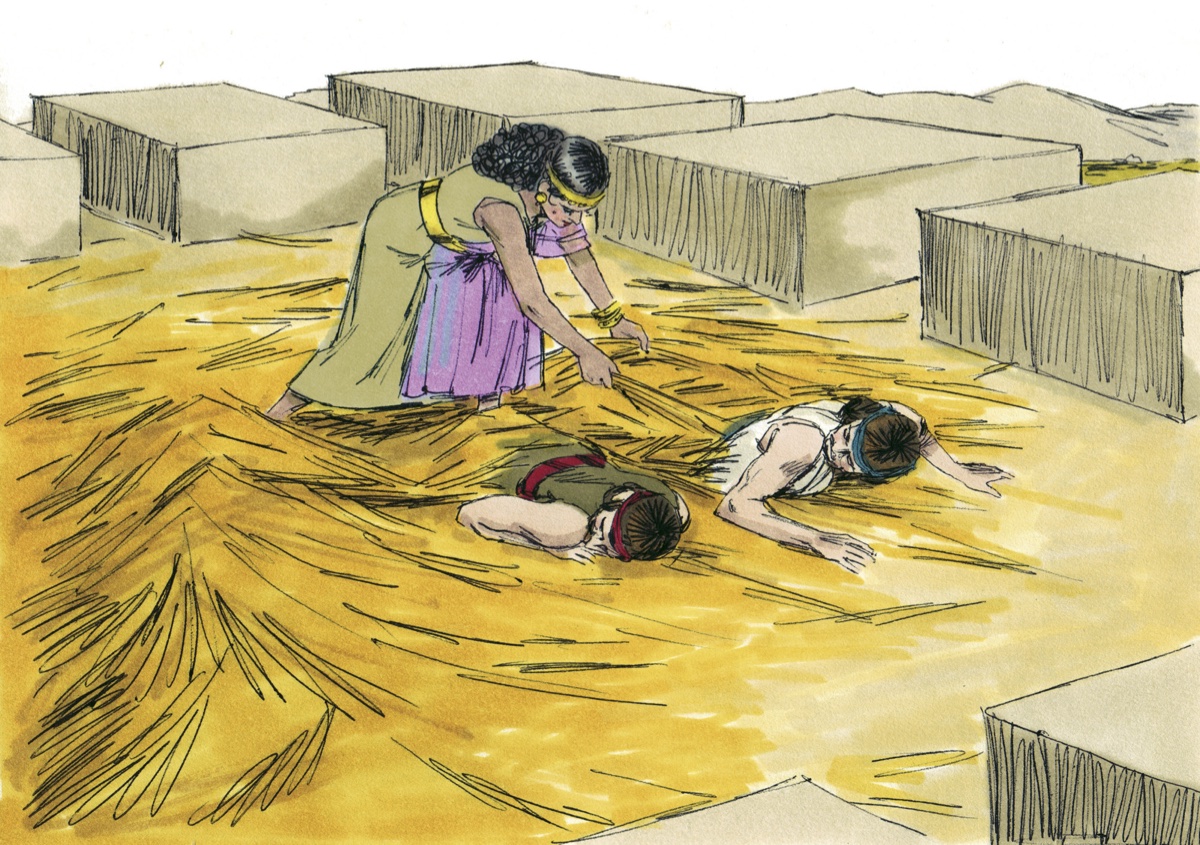
And Joshua, the son of Nun, sent two men secretly from Shittim as spies, saying, “Go, view the land, especially Jericho.” And they went and came into the house of a prostitute whose name was Rahab and lodged there. And it was told to the king of Jericho, “Behold, men of Israel have come here tonight to search out the land.” Then the king of Jericho sent to Rahab, saying, “Bring out the men who have come to you, who entered your house, for they have come to search out all the land.” But the woman had taken the two men and hidden them. And she said, “True, the men came to me, but I did not know where they were from. And when the gate was about to be closed at dark, the men went out. I do not know where the men went. Pursue them quickly, for you will overtake them.” But she had brought them up to the roof and hid them with the stalks of flax that she had laid in order on the roof. So the men pursued after them on the way to the Jordan as far as the fords. And the gate was shut as soon as the pursuers had gone out (Josh. 2:1-7).
Joshua sent two spies into Jericho to gather information before the Israelites made their attack on the city. To avoid attracting attention, they attempted to lie low in a place where it was easy to be anonymous—the house of a prostitute named Rahab. However, the secrecy of their mission did not last, and it wasn’t long before the king’s men were knocking on Rahab’s door.
Rahab’s response has troubled many people. Was her lie defensible? Clearly, it was the simplest way to protect the spies, but does this prove that dishonesty (and maybe even other types of sin) can be justified by extenuating circumstances? The text is notably silent in making any sort of judgment about her lie. Hebrews 11:31 and James 2:25 confirm that her faith is worth imitating, but they do not condone or even address everything that she did.
This should not be a surprising concept for us. Hebrews 11 is sometimes portrayed as a record of the most faithful and righteous people to walk the face of the earth, but even a passing familiarity with those stories quickly reveals this is not the case. Samson was a womanizer with anger issues and a penchant for stirring up conflict. Gideon had to be cajoled into delivering God’s people and, although he was eventually successful, he then elevated himself as a pseudo-king over Israel. Barak was reluctant and weak; Jephthah made a rash vow that cost his daughter her life; David committed adultery and murder; Jacob was known as a deceiver; the Israelites complained, and even Moses overstepped at various times. The Bible treats its heroes as real people and not gilded caricatures. These people also showed incredible faith in their best moments and thus are given as examples for us to follow. Rahab is praised for giving the spies a friendly welcome when she could have immediately turned them away—but this does not validate every decision she made in her life.
Rahab’s lie should be interpreted the same way that her life as a prostitute is. She knows that she wants to follow God (which is described in the next section of the text), but she has not yet given up all of her sin. This is typical of infant faith in God. Jesus describes the seeker of God as one who knows that he is spiritually bankrupt, mourns over his sin, and hungers for transformation (Matt. 5:3, 4, 6). For Rahab, spiritual growth was a process, just as it is for every seeker of God.
The righteous part of Rahab’s attitude was that she knew she wanted to be on God’s side, which meant supporting the work of the spies and seeking deliverance through them. The next section of the text explains her motivation.
Before the men lay down, she came up to them on the roof and said to the men, “I know that the LORD has given you the land, and that the fear of you has fallen upon us, and that all the inhabitants of the land melt away before you. For we have heard how the LORD dried up the water of the Red Sea before you when you came out of Egypt, and what you did to the two kings of the Amorites who were beyond the Jordan, to Sihon and Og, whom you devoted to destruction. And as soon as we heard it, our hearts melted, and there was no spirit left in any man because of you, for the LORD your God, He is God in the heavens above and on the earth beneath. Now then, please swear to me by the LORD that, as I have dealt kindly with you, you also will deal kindly with my father’s house, and give me a sure sign that you will save alive my father and mother, my brothers and sisters, and all who belong to them, and deliver our lives from death.” And the men said to her, “Our life for yours even to death! If you do not tell this business of ours, then when the LORD gives us the land we will deal kindly and faithfully with you” (Josh. 2:8-14).
Rahab showed a new and developing faith in God. Though she was a Canaanite who worshiped the gods of her people, she saw a difference in the power of the one true God. She heard how God led the Israelites out of Egypt through the parting of the Red Sea. She heard how God gave them victory over the kings who resisted them when they tried to pass through peacefully. When Rahab heard these things, her “heart melted” with fear. She decided that resisting the God of the Israelites was foolish and her only hope was seeking peace with Him.
Rahab was not the only one who heard of the power of God; it was common knowledge in Jericho and among the surrounding region. What made Rahab special was that she made the better choice. The rest of the people of Jericho dug in their heels and determined to fight. Their trust was in the strength of their fortress city and their power to resist attackers. Rahab knew that that approach was foolish. If Yahweh can part the sea, He can tear down the walls of Jericho.
Amazingly, Rahab didn’t even know if salvation was possible. She knew very little about Yahweh and had no reason to believe that she would be allowed to escape the coming destruction. Her plea to the spies was not based on her worthiness or inherent right to be saved. It was a cry of desperation. It is similar to the response of the crowd on the day of Pentecost in Acts 2 when Peter told them that they were guilty of killing the Son of God. They were cut to the heart and asked, “Brothers, what shall we do?” Can anything be done, or are we simply doomed? In both cases, the answer was one of good news and hope. Rahab and the killers of Jesus both had an opportunity to be saved, but it would require allegiance and faith.
Then she let them down by a rope through the window, for her house was built into the city wall, so that she lived in the wall. And she said to them, “Go into the hills, or the pursuers will encounter you, and hide there three days until the pursuers have returned. Then afterward you may go your way.” The men said to her, “We will be guiltless with respect to this oath of yours that you have made us swear. Behold, when we come into the land, you shall tie this scarlet cord in the window through which you let us down, and you shall gather into your house your father and mother, your brothers, and all your father’s household. Then if anyone goes out of the doors of your house into the street, his blood shall be on his own head, and we shall be guiltless. But if a hand is laid on anyone who is with you in the house, his blood shall be on our head. But if you tell this business of ours, then we shall be guiltless with respect to your oath that you have made us swear.” And she said, “According to your words, so be it.” Then she sent them away, and they departed. And she tied the scarlet cord in the window (Josh. 2:15-21).
The spies safely left Jericho and reported back to Joshua, but before they did, they gave careful instructions to Rahab. They will keep the vow they made with her, so her salvation will depend on her obedience to the conditions they set forth. She must not betray them—if her allegiance changes, she will lose her deliverance. She must be in the proper place when the destruction comes. All who are in the house will be saved, but everything else will be destroyed. Finally, she must tie a scarlet cord in her window. If they obey these words, Rahab and her family will be saved when Israel’s army marches against Jericho.
Can you imagine Rahab arguing with the spies about the conditions? Why must she be in the house—can’t they come find her wherever she might be? Maybe she doesn’t prefer a scarlet cord to hang from her window—could it be white or green? That conversation never happened because Rahab knew she had no power to dictate the terms of her deliverance. She deserved nothing, yet her pleas for mercy were heard. Why would she quibble over the terms?
The crowd on the day of Pentecost had a similar reaction. They knew they deserved death, but hoped and begged for deliverance. Peter gave them the terms: repent and be baptized in the name of Jesus, and your sins will be forgiven. No sane person who realizes they are facing death would suddenly take offense at such conditions and seek to change them.
Rahab lived in faith, tied the scarlet cord in her window, and waited for the day of deliverance in her home. Would she be forgotten?
The account of the conquest of Jericho doesn’t take place until Joshua 6, but Rahab makes an appearance (Josh. 6:22-25). In the chaos of the battle, Rahab and her family were rescued by the spies. They were not left to die! How easy would it have been for the spies to forget about her, or for Joshua to overrule them and tell them to destroy Rahab and her family, along with everyone else? Instead, her faith was rewarded.
The story does not end here. Rahab escaped death, but where will she go and to whom will she belong? Her salvation included deliverance and the opportunity to live among the Israelites as one of God’s people. She is even named in the lineage of Jesus in the first chapter of Matthew. God’s grace, combined with Rahab’s faith, transformed her from being a lying Canaanite prostitute to an adopted child of God. What greater blessing could she enjoy?
The men and women in Acts 2 who heard the gospel message experienced a similar transformation. They started as doomed murderers and sinners and became believers who could devote themselves to righteousness and praising God in worship and lifestyle (Acts 2:42-47). That transformation is only possible by the power and grace of God.
Perhaps our biggest problem spiritually is that we don’t see ourselves as desperately needing salvation that we don’t deserve. We want to justify ourselves and dictate to God the changes we will and won’t make. We expect to meet God on our own terms. May we learn from Rahab, who saw the power of God, knew her own helplessness, and sought Him in humility.
Danny Linden has worked with the Hebron Lane church of Christ in Shepherdsville, KY, since March 2023. He and his wife, Lauren, have four children. The church website is here. His website is here. He can be reached here.


By McKenzie Henry
Synopsis: This article focuses on those who might feel lost in their sins, but the hopeful terms “washed,” “sanctified,” and “justified” help us realize that there is a way to redemption. Despite past sins, individuals can find hope and a new life through Christ. Let us recognize the immense cost of sin, God’s ability to forgive any wrongdoing, and the necessity of acknowledging one’s sins and seeking repentance. Let us, therefore, seek God’s grace and remain steadfast in our faith.
Or do you not know that the unrighteous will not inherit the kingdom of God? Do not be deceived; neither fornicators, nor idolaters, nor adulterers, nor effeminate, nor homosexuals, nor thieves, nor the covetous, nor drunkards, nor revilers, nor swindlers, will inherit the kingdom of God. Such were some of you; but you were washed, but you were sanctified, but you were justified in the name of the Lord Jesus Christ and in the Spirit of our God (1 Cor. 6:9-11).
One of my favorite verses in the Bible is 1 Corinthians 6:9-11. I chose this title for my article, “Such Were Some of You,” from verse 11. This verse has always resonated in my heart—although we all have sinned and failed, we have a hope for a brighter tomorrow as followers of Christ. The way Paul talks of forgiveness and living a new life in Christ should encourage each of us. He references those Christians who were previously lost in sin, but now they were given a chance for a better life through obedience to God. They were “washed” (baptized), “sanctified” (set apart) and justified (made right) and now are on the right path.
In considering the following points, I hope that it will help each of us on our spiritual journey and striving for our ultimate goal. May we recognize (1) The price paid for our sins and trespasses came at a great cost (Eph. 2:1-7; Col. 1:13-14); (2) God can forgive any and every sin (Ps. 32:1-5; Heb. 10:22-23), and (3) As sinners, we must acknowledge our need for God, confess our transgressions, and seek His favor (Ps. 33:20-22; 1 Pet. 2:25).
When considering the greatest act of love and sacrifice recorded in the Scriptures, we immediately think of our Lord and Savior, Jesus Christ. We were dead (spiritually speaking) in our sins and did not deserve any saving or redemption. Our Lord loves us so much that His Son went through the pain and suffering of being hung on the tree, and Jesus even asked for His enemies to be forgiven. Because of this act of love, His death was a ransom that freed those who were captives in sin, and the guilt that sin holds over our heads. The reason I wanted to include the passage from Ephesians 2, specifically looking at verses 4 and 5, is because we can read of multiple instances where God is “rich in His mercy” and has “great love” for sinners. As imperfect humans, we are prone to label our sins as “unforgivable.” We ask ourselves, “How could God forgive me for this shameful act?” Left to our own accord, we are prone to do what feels good and pleasurable, in the moment of temptation, rather than what is right and what God says is right. Nothing is hidden from God’s sight, so it’s not a matter of deception, as much as it’s a matter of repentance. Were the men that had beaten the Son of God and had shouted, “Crucify Him!” worthy of forgiveness? Yet they received God’s mercy. Have you ever said, “My sin is so terrible, and I’m so ashamed! How could God ever forgive me?” Those are lies that the devil feeds us because he wants us to feel isolated. He wants us to despair. Christ’s death was the greatest act of love and saving all of humanity from spiritual death, so if we think that there is no hope and that forgiveness is unattainable, then why did God show such love by sending His only begotten Son?
How do we know that God can forgive any sin? While there are many biblical examples that we could consider, one man in particular stands out—David. Despite his grievous sins, David received forgiveness. The sequence of sins that I want to discuss are (1) the sexually immoral choice David made with Bathsheba, and (2) his subsequent plot to murder Uriah. God allows us to have free will. We can either choose the narrow way (of righteousness), or the broad way (of death and destruction). We know from God’s word that He provides a way of escape. However, in the moment of temptation, we must choose whether to act on the temptation or to flee.
David chose wrongfully to act when he saw this beautiful woman bathing. Although one of the king’s servants informed him that this woman was already married, David continued to act on his desires. After committing adultery, he attempted to cover up his tracks—ordering that Uriah, Bathsheba’s husband, be placed on the front lines in battle so that he would be killed. So, before we realize it, one sin piles atop another. These failures are all recorded in 2 Samuel 11, but note verse 27, which says, “The thing that David had done was evil in the sight of the Lord.”
By reading the first few verses of Psalm 32, we recognize the guilt and shame that David experienced:
How blessed is he whose transgression is forgiven, whose sin is covered! How blessed is the man to whom the LORD does not impute iniquity, and in whose spirit there is no deceit! When I kept silent about my sin, my body wasted away through my groaning all day long. For day and night Your hand was heavy upon me; my vitality was drained away as with the fever heat of summer. Selah (Ps. 32:1-4).
After God sent Nathan the prophet to confront king David, he finally acknowledged his sin and wrongdoing. David said to Nathan, “I have sinned against the LORD.” Nathan responded, “The LORD also has taken away your sin; you shall not die” (2 Sam. 12:13). However, despite being forgiven, David still had to suffer the consequences of his sins, which included losing his child.
Reiterating our point, David, who was a “man after God’s own heart,” made some very poor choices and was separated from God until he acknowledged his sins and repented. Yet God brought him back into His fold. Just like in David’s condition, God can see into our hearts and He knows when we are truly sorry for our mistakes and we ask for His forgiveness with a sincere heart. This is when we should earnestly pray that we do not repeat these sins.
This last point resonates with me the most because of God’s love and mercy, especially in times of spiritual need. In our weakest moments, when we stray and begin walking down the wrong road, that is when our Lord wants us to seek Him. When we choose to follow our own lusts and desires, we dig a hole for ourselves until that hole is so deep it’s hard to climb out. Satan is the father of lies. He wants us to act defiantly and rebel against God. If we persist in this state, we are setting ourselves up for further alienation.
Paul described himself as the “chief of sinners” because he persecuted the church. Before seeing the Light (literally), he was journeying into another city in order to imprison and murder Christians (Acts 9). After his conversion, Paul worked tirelessly to practice and promote the cause of Christ.
How can we imitate Paul’s faith and strength to fight against the devil’s snares and traps? If we devote every moment, every day, to keep the goal of heaven at the forefront of our minds and to be thankful every day for the Lord’s patience and love towards us. We can see from the several examples in the word that these men who were in a lost state, they knew there was this emptiness in their lives, and by repenting of their mistakes and changing their ways, the hole was filled again. If we know what the Scriptures say about worshipping God wholeheartedly, we cannot toe the line while also having one foot in the world: “No one can serve two masters. . .” (Matt. 6:24) Our purpose as children of God is to “prove ourselves to be blameless and innocent, in the midst of a crooked and perverse generation. . .” (Phil. 2:15). When the devil sees us working hard on our faith and perseverance, he will work harder to bring us down, but we must not give him the opportunity.
Therefore, we should always seek Christ, especially when we are weak, because He is never far from us. Paul’s epistles are my go-to when I need strength and encouragement. The disciples described in 1 Corinthians 6:9-11 needed to change their ways. In like manner, we need encouragement when we’ve hit rock bottom. They had committed terrible sins, but it’s amazing how the power of God’s love can change our hearts. When we fail, we should not feel afraid but confident that God will give us grace and forgiveness, and to feel strong and ultimately, victorious over sin.
While all have sinned and fallen short of God’s glory, He offers us the hope of salvation if we believe and obey His word. As erring Christians, He accepts us back with open arms if we confess our sins and genuinely repent. God wants all to come to repentance. When I read 1 Corinthians 6:11, I feel confident and reassured that whatever sins I have committed, God forgives me and loves me so much. He feels the same for you because "He is there to provide you with grace and encouragement (Jude 1:25).
McKenzie Henry is a member of the Adoue Street church of Christ in Alvin, TX. Her father, Darin, serves as one of the elders of the congregation. She works at Cracker Barrel Restaurant. She can be reached here.




By Tyler Sams
Synopsis: A brief look through history shows the danger of failing to ascertain the will of Jesus concerning His church.
The church is central to Christ’s plan for His people. Twice in His earthly ministry, Jesus spoke specifically about the church (Matt. 16:13-19; 18:15-17). Yet even a brief reading of these two passages reveals that Jesus is using the term “church” in two different senses. How are we to understand this word? Why is it important to understand the distinction Jesus is making?
First, Jesus speaks of the church in the sense of the entire group of saved persons—we might call this the universal church. This is the church Jesus promised to establish which would prevail against Satan and his malignant efforts (Matt. 16:18). Also called “the kingdom” (Matt. 16:19), this entity has been purchased by the blood of Jesus (Acts 20:28). The people that comprise the universal church are redeemed, forgiven of their sins through the sacrifice of Jesus and the grace of God (Col. 1:13-14). Jesus is the head of the universal church, which is also called His “body” (Col. 1:18; Eph. 1:22-23). Other than having Christ as its head, the New Testament reveals no organizational structure for the universal church. As individual citizens of this kingdom and individual members of this universal church, we have responsibilities. The church universal is composed of faithful saints as a whole, but it has no earthly organization. It is the pillar and support of the truth (1 Tim. 3:15), but only functions on a local level. In this way, the term universal church is more descriptive than prescriptive.
The word “church” is also used to describe specific, geographically distinguished groups of believers—we might call this the local church. Jesus’s promise in Matthew 16 was not to build a local church, yet local churches were spoken of and designed by Jesus. For example, as He addressed how to handle matters of sin between brethren, Jesus pointed to an escalating plan of involvement: tell the matter to the brother involved, then two or three witnesses, and then tell it “to the church” (Matt. 18:15-17). Obviously, Jesus is not counseling escalation from two people to four people to all Christians everywhere; rather, Jesus is counseling escalation from two to four to the entire local church. As His directives in Matthew 18 make clear, the local church is just as much a part of heaven’s plan as the universal church.
The local church is distinguished from the universal church in a variety of ways. First, many congregations exist at the local level. In the New Testament, we can read of churches in Jerusalem (Acts 11:22), Corinth (1 Cor. 1:2), Galatia (16:1), and many other cities. While there is only one universal church, one collection of persons saved through Christ, there are multiple local churches. While also having Christ as their head, local churches have a formal work and structure that sets them apart from the universal church. Local churches are expected to assemble with at least weekly frequency, observing the Lord’s Supper and hosting a contribution on Sundays (Acts 20:7; 1 Cor. 11:17-34; 1 Cor. 16:1-2). These congregations are charged with teaching the gospel to the lost (1 Thess. 1:8), building up Christians through the gospel (Acts 11:22), and taking care of needy Christians (1 Tim. 5:16). Local churches in the New Testament are self-governing, answerable only to themselves and to Christ (1 Pet. 5). Local churches are designed to be led by qualified men who exercise oversight over the members of their local congregation (1 Pet. 5:1-3). These men are not at liberty to run local churches after their own devising, but are “under-shepherds,” serving under the authority of the Chief Shepherd to whom they must also give an account (1 Pet. 5:4). Besides pastors/shepherds, local churches are designed to be served by qualified men called deacons. These men are special servants of the church, tasked with handling more temporal matters, allowing pastors/shepherds the time and opportunity to handle more spiritually oriented matters (1 Tim. 3:1-13; cf. Acts 6:1-7).
During the period from AD 90 to 300, following the completion of the New Testament, some local congregations started to undergo transformations. In this period, some churches affirmed a difference between individual Christians and ministers. Suddenly, ministers were referenced as “Father,” and Christians were told that their relationship with God required the influence and intercession of these men. While this was happening, some local churches began elevating one elder/shepherd/bishop above his fellow shepherds in the local church, giving him the singular title “Bishop.” Slowly, this singular bishop oversaw, not only the local flock amongst whom he worked and worshipped but also all churches in a particular geographic area. When doctrinal issues arose in the years after the New Testament canon was completed, the bishops would be called together in conventions to resolve issues that were plaguing churches. Eventually, these conventions became permanent councils/synods, which acted as legislative bodies for the beliefs and practices of local churches. Eventually, from amongst these bishops came patriarchs; and from the patriarchs came the chief of the patriarchs—the pope (Shepherd, 54-57).
Examining the Catholic church today, led by the Vatican, we see an organization that stands in stark contrast to the church of the New Testament. We see names that are inconsistent with New Testament teachings, structures that are antithetical to New Testament instruction, and doctrines that are foreign to Christ and His apostles. “Progress” was made in the post-apostolic era, but this “progress” was away from Christ and His will.
Beginning in earnest in the 1800s, churches of Christ in the USA were challenged by questions of organization, particularly surrounding the American Christian Missionary Society (ACMS). Intended as an organization to help share the gospel, this entity sought contributions from local churches to help it evangelize more effectively. Writing a summary of the meeting in October 1849 which helped produce the ACMS, W.K. Pendleton stated, “There are some duties of the church which a single congregation cannot, by her unaided strength, discharge. . . . A primary object being to devise some scheme for a more effectual proclamation of the gospel in destitute places, both at home and abroad. . .” (West, 173).
Pendleton’s remarks are telling. Long as we might for the “old days,” we often gloss over the challenges and shortcomings of prior generations. Pendleton and others viewed the local church as insufficient in design to accomplish the work of evangelism—at least the kind of evangelism he envisioned.
That some in the audience were aware of the similarity to the slow progression that ushered in Catholicism. A man by the name of R.G. Fife opposed a resolution presented at the 1849 meeting which would have given a voice and a vote to “every properly accredited Christian evangelist and elder of a Christian church.” Fife opposed this because “the adoption of such a resolution would be the beginning of clericalism in the church, and would eventually destroy the equality of the churches” (West, 174).
Despite Fife’s objection, further movement came during the October 1849 meeting, which saw the establishment of the ACMS. Motions and resolutions were put forward to encourage churches “that they not countenance as a preacher any man who was not approved and acknowledged by two or more churches.” Later, another motion was put forward “to the churches that they call in other men when ordaining their evangelists. . . [arguing] that an evangelist was an officer of several congregations and not of one” (West, 176). At the end of the October meeting, a constitution was drafted for the ACMS. Article 7 of the constitution noted that the executive board should “appoint agents and missionaries, fix their compensation, direct and instruct them concerning their particular fields and labors, make all appropriations to be paid out of the Treasury. Equally concerning was the third article, which noted that churches”may appoint a delegate for an annual contribution of ten dollars. Twenty dollars paid at one time shall be requisite to constitute a member of life, and one hundred dollars paid at one time, or a sum which in addition to any previous contribution shall amount to one hundred dollars, shall be required to constitute a director for life" (West, 177). Suddenly, this supposed arm of the church would now be guided and directed by whomever had the deepest pockets.
The missionary society question did not stay contained to Cincinnati, OH, in 1849. Throughout the mid-20th century, and even to today, Christians in local churches have struggled with this issue, albeit at times in different forms: a lodge for unwed mothers or a dormitory for disadvantaged children. Evangelism and caring for the needy are good works to which we are called as Christians (2 Tim. 2:2; Jas. 1:27). The issue today, though, is the same as it was in 1849—namely, “Is this was Jesus wants from His local churches?”
To answer that question, we must first answer this question: how can we discover Christ’s will for local churches that belong to Him? In Scripture, we find Jesus’s message communicated by the Spirit through select authors (cf. John 16:12-15; 2 Pet. 1:20-21). Any person’s will is communicated by telling, showing, and implying. Therefore, we encounter directives (1 Cor. 16:1-2), examples (Acts 20:7), and forced conclusions (1 Tim. 5:16—not everyone is to be relieved by the church) in Scripture which inform us of Christ’s will for His local churches. By utilizing these tools of communication, we can come to a safe and confident understanding of the will of Christ.
When we examine the 1849 controversy in the light of Scripture, we see several failings. First, the idea that money paid could secure greater influence for someone is a concept which has absolutely no biblical support. Should we consider the role of elders in a local congregation as a position of influence, it’s crucial to understand that such standing is attained solely through individual merit and character, as set forth in the biblical qualifications, rather than economic standing or wealth (1 Tim. 2; Titus 1). Beyond that, we see nothing in the New Testament resembling the notion that only men approved and acknowledged by multiple churches should fill the role of an evangelist. Instead, we read of churches which were independent and self-governing, answerable only to themselves and to Jesus. The New Testament knows nothing of local churches surrendering their autonomy to other local churches, a singular body of elders over multiple churches, or para-church organizations. Rather, Jesus’s gospel reveals local churches making decisions for themselves as individual units (Acts 9:26-28), answering only to the elders serving in that local church (1 Pet. 5:2). The overwhelming evidence of congregational independence and the lack of para-church organizations in the New Testament is clear.
Why talk about these matters? Why learn lessons from previous generations? Why talk about the rise of patriarchs, pontiffs, and church-funded organizations? Because these all fundamentally relate to Scripture—and particularly to Jesus’s church. The words of Christ in Matthew 16:18 are clear: “I will build My church.” While this passage is clearly speaking of the church in its universal sense, 1 Peter 5 makes it clear that Jesus is also the head of individual local churches. Whether we are talking about the universal church or the local church, Jesus is the head—it is His church. If we desire, we can change the structure, format, entry requirements, and work of Jesus’s church. However, such a church ceases to be Christ’s church. I don’t want the church of the Vatican. I don’t want the church of Cincinnati, 1849. I don’t want the church of Tyler. I want the church of Jesus, the church that He purchased (Acts 20:28) and the church over which He rules (1 Pet. 5:4).
Shepherd, J.W. The Church, the Falling Away, and the Restoration. Gospel Advocate Company, 1948.
West, Earl Irvin. The Search for the Ancient Order: Volume I. Gospel Light Publishing Company, 2002.
Tyler Sams has worked with the University Oaks church of Christ in San Antonio, TX, since March 2021. He and his wife, Audrey, have two children. The church website is here. He can be reached here.


By David Dann
Synopsis: We must submit to the authority of the Lord in carrying out the vital work He has assigned to each local church.
What is the mission of the local church? The apostle Paul wrote to Timothy concerning the primary purposes of the church, saying, “but if I am delayed, I write so that you may know how you ought to conduct yourself in the house of God, which is the church of the living God, the pillar and ground of the truth” (1 Tim. 3:15, NKJV). Each local church that belongs to Christ has been given the same spiritual mission. Under the direction of the Holy Spirit, the apostles taught the same thing “everywhere in every church” (1 Cor. 4:17). As a result of this consistent instruction, a pattern of authorized practices was established, so that Paul would later direct Timothy to “hold fast the pattern of sound words which you have heard from me, in faith and love which are in Christ Jesus” (2 Tim. 1:13).
Unfortunately, brethren and churches have not always held to this pattern. Some have thought it necessary to adjust the New Testament pattern. Others have ignored the New Testament pattern altogether, seeking to create new patterns for the church to follow. What are the results of these attitudes? The mission of the church has been changed so that, in many cases, the work of the local church now includes projects and methods which are rooted in clear departures from the divinely-authorized pattern.
At the Abilene Christian College lectures of 1938, G.C. Brewer, an influential preacher, reportedly made an appeal for churches to put ACC in their budget, and said that any church refusing to do so had the wrong preacher (Cogdill, Sept. 1947, 7-8). While many influential brethren opposed Brewer’s plan at that time, the practice of churches funding schools, colleges, and universities gradually became commonly accepted by the majority.
The end of the Second World War brought about a renewed evangelistic zeal in many brethren who became intensely interested in taking the gospel to nations that had been devastated by the war. Because of this enthusiasm, many churches employed the “sponsoring church” plan in order to carry out the work of evangelizing the world. In 1947 the Broadway church of Christ in Lubbock, Texas began receiving funds from other local churches so that its elders could oversee those funds and disburse them to preachers for the purpose of directing the work of preaching the gospel in Germany (Kirby, 11 Sept. 1980, 585-587). In this manner, the Broadway congregation became the “sponsoring church” for that work. The Union Ave. church in Memphis, Tennessee, became the sponsoring church for the work in Japan, and began receiving funds from other churches in order to carry out that work (Ibid.). Likewise, the church in Brownfield, Texas became the sponsoring church for the work in Italy (Ibid.). At first, influential brethren, such as Foy E. Wallace, Jr., opposed these plans, comparing them to the centralized work of the Roman Catholic hierarchy and the divisive “missionary society” plans of the nineteenth century (Wallace, 5 May 1949, 3). However, before long, the centralized pooling of the resources of local churches became a widely accepted practice.
In 1951, two young preachers, James Nichols and James Williford, conceived the idea of a nationwide radio program to broadcast the gospel (Kirby, 11 Sept. 1980, 585-587). The plan was to have one church direct and oversee this radio broadcast while receiving funds from other churches to enable it to carry out the work. The Highland Ave. church in Abilene, Texas, sponsored this work and began soliciting funds from at least one thousand other churches to support the work. The radio program was named the “Herald of Truth,” and the first broadcast was in February 1952 (Phillips, 5 Jul. 1990, 405-407). While this centralized approach was also opposed by many, it eventually became a widely accepted practice.
Some churches began building and maintaining institutional homes for orphans, soliciting funds from other churches for the purpose of sponsoring and overseeing the work of caring for the children and operating these homes (Wolfgang, 6 Apr. 1989, 208-211). Brethren who advocated putting the college in the local church’s budget and who promoted the sponsoring church plan, soon realized that the issue of whether or not churches could support orphan homes was an issue that sparked considerable emotion. Writing in favor of churches supporting colleges, N.B. Hardeman drew a parallel between church-funded colleges and church-funded orphan homes, reasoning that, “The same principle that permits one must also permit the other. They must stand or fall together” (Hardeman, 23 Oct. 1947, 844). Again, the funding of orphan homes from the resources of local churches was opposed as being unscriptural by many brethren, but this emotionally charged issue eventually opened the door to support not only this but also many similar practices (Tant, 22 Jun. 1961, 4, 12). Before long, the work of many local churches shifted toward social concerns, including the building of “fellowship halls” and “family life centers” for the entertainment of the members, as well as many other programs designed to address the social ills of society (Wolfgang, 18 May 1989, 296-297, 309-310).
The local church is responsible for the work of evangelism, that is, the spreading of the good news of salvation in Christ. Paul commended the church in Thessalonica, saying, “For from you the word of the Lord has sounded forth, not only in Macedonia and Achaia but also in every place. Your faith toward God has gone out, so that we do not need to say anything” (1 Thess. 1:8). In order to further this aspect of its work, the local church is authorized to support faithful preachers financially, both locally and by sending funds directly to evangelists laboring in different locations (cf. 1 Cor. 9:11-14; 2 Cor. 11:7-8; Phil. 4:15-16). In contrast, the creation of a “missionary society” or “sponsoring church arrangement” to pool the resources of multiple churches for the purpose of carrying out the work of evangelism is a concept that is entirely unauthorized by the New Testament.
Edification has to do with spiritually building up or promoting growth. The local congregation is tasked with strengthening its members in their faith. This is clearly seen in that Paul wrote to the church of Ephesus, saying, “He Himself gave some to be apostles, some prophets, some evangelists, and some pastors and teachers, for the equipping of the saints for the work of ministry, for the edifying of the body of Christ, till we all come to the unity of the faith and of the knowledge of the Son of God, to a perfect man, to the measure of the stature of the fullness of Christ; that we should no longer be children, tossed to and fro and carried about with every wind of doctrine, by the trickery of men, in the cunning craftiness of deceitful plotting, but, speaking the truth in love, may grow up in all things into Him who is the head—Christ—from whom the whole body, joined and knit together by what every joint supplies, according to the effective working by which every part does its share, causes growth of the body for the edifying of itself in love” (Eph. 4:11-16). By assembling for worship (cf. 1 Cor. 14:26; Heb. 10:24-25), through constant teaching (cf. Acts 2:42; 11:25-26), and by correcting those who are in sin (cf. Rom. 16:17; 1 Cor. 5:11; Titus 3:10; 2 Thess. 3:6, 14-15), the local church edifies itself. The word of God simply does not authorize the local church to construct, fund, and maintain schools, camps, or other organizations as a means of performing its work of edification.
Individual Christians can, and should, help with the physical needs of others as opportunity and ability allow (cf. 1 Tim. 5:16; Jas. 1:26-27). However, the benevolent work of the local church as a collective body is limited to providing for needy saints (cf. Acts 2:44-45; 4:32-35; 1 Cor. 16:1-3). Paul affirmed this as the pattern, saying, “Now I am going to Jerusalem to minister to the saints. For it pleased those from Macedonia and Achaia to make a certain contribution for the poor among the saints who are in Jerusalem” (Rom. 15:25-26). The local church may help provide for its own needy members (cf. Acts 6:1-7; 1 Tim. 5:3-16). Additionally, the local church may help provide for needy Christians elsewhere (cf. 1 Cor. 16:1-4). Local churches may scripturally cooperate in benevolence, not by sending their funds to an institution or sponsoring church, but by delivering funds to another church whose members are in need (cf. Acts 11:27-30; 2 Cor. 8:1-5, 16-23). The New Testament does not authorize the church to create and fund additional organizations or institutions to carry out this work, nor does it authorize the church to use its collective funds to provide for the physical needs of non-Christians.
Speaking of the position in which the Father has placed the Son, Paul writes, “He put all things under His feet, and gave Him to be head over all things to the church, which is His body, the fullness of Him who fills all in all” (Eph. 1:22-23). As “head over all things to the church,” Christ has the right to rule and direct the work of each local congregation. This direction is provided through His inspired spokesmen (cf. John 16:13; Phil. 3:16-17; 4:9). To restructure the operation of local churches in order to accommodate the funding and promotion of works and methods foreign to the New Testament is to refuse to submit to the authority of Jesus Christ.
Paul writes, “All Scripture is given by inspiration of God, and is profitable for doctrine, for reproof, for correction, for instruction in righteousness, that the man of God may be complete, thoroughly equipped for every good work” (2 Tim. 3:16-17). Prior to engaging the congregation in any plan or project, it is crucial to address the issue of scriptural approval. Where is the authority for the elders of one local church to sponsor a brotherhood project, which involves soliciting and overseeing the funds and work of other churches, reaching well beyond the oversight of the flock that is among them (cf. 1 Pet. 5:1-4)? Where is the authority for churches to build, fund, and maintain institutions such as schools, colleges, orphan homes, nursing homes, or hospitals? Where is the authority for churches to use their funds and facilities for the purpose of providing entertainment and recreation? Where is the authority for churches to pool their resources through schemes of centralized oversight and control? Where is the authority for churches to engage in the collective work of physically feeding and clothing the world? We have no right to broaden the work of the church to accommodate man’s desires when the Lord has already specified the work in which each church is authorized to engage.
God has given each local church the privilege of carrying out the special mission He has specified in His word. The New Testament tells each church what to do and how to go about doing it. May we guard against the danger of seeking to divert the church’s mission into areas that are unapproved by the Lord. The very best we can ever do is to submit humbly to Christ while enabling the church to carry out the work He has assigned it to perform.
Cogdill, Roy E. “What Does He Want to Debate?” The Bible Banner, vol. 9, no. 7 (1947): 7-8. Accessed June 26, 2024. https://wordsfitlyspoken.org/bible_banner/v9/v9n7p7-8a.html.
Hardeman, N.B. Gospel Advocate, October 23, 1947.
Kirby, Jack H. “History of the Cooperation Issue.” Truth Magazine, vol. 24, no. 36 (1980): 585-587. Accessed June 26, 2024. https://www.truthmagazine.com/archives/volume24/TM024213.html.
Phillips, H.E. “History of the Present Digression.” Guardian of Truth, vol. 34, no. 13 (1990): 405-407. Accessed June 26, 2024. https://www.truthmagazine.com/archives/volume34/GOT034193.html.
Tant, Fanning Yater. “The College Question.” Gospel Guardian, vol. 12, no. 8 (1961): 4, 12. Accessed June 26, 2024. https://www.wordsfitlyspoken.org/gospel_guardian/v13/v13n8p4,12.html.
Wallace, Foy E. Jr. “Editorial.” Gospel Guardian, vol. 1, no. 1 (1949): 3. Accessed June 26, 2024. https://www.wordsfitlyspoken.org/gospel_guardian/v1/v1n1p3.html.
Wolfgang, Steve. “History and Background of the Institutional Controversy (1).” Guardian of Truth, vol. 33, no. 7 (1989): 208-211. Accessed June 26, 2024. https://truthmagazine.com/archives/volume33/GOT033100.html.
Wolfgang, Steve. “History and Background of the Institutional Controversy (4).” Guardian of Truth, vol. 33, no. 10 (1989): 208-211. Accessed June 27, 2024. https://www.truthmagazine.com/archives/volume33/GOT033136.html.
After having worked with churches in Indiana, Canada, Florida, Texas, and Kentucky, David Dann moved to the Athens, Georgia area in August 2021 to work with the recently formed University church of Christ. He and his wife, Cynthia, have been blessed with six children. The church website is here. He can be reached here.



By Mark W. White
Synopsis: Brethren in Christ have been assaulted by novel approaches to Scripture for over a generation and the cumulative effects are devastating to “the faith which was once for all handed down to the saints.”*
My wife and I attended the historic Nashville Meeting in 1988. This was a gathering of brethren from non-institutional and institutional backgrounds to discuss issues over which we disagreed; issues which had broken our association and fellowship with one another. The first attempt at such a study of these questions and issues had occurred twenty-one years earlier in Arlington, Texas, in 1967. A third meeting to gain a better understanding of scriptural teaching on questions surrounding the work and organization of local churches occurred in Dallas, Texas, in 1990. This history is important to understand where we are today, as these divisions persist among brethren in Christ.
At Nashville, I was a young preacher in my second full-time work, laboring with a congregation in Blytheville, Arkansas. Three elders oversaw that church, all of whom stood firmly for the scriptural patterns of church work and organization. They had run the gauntlet of division in the 1950s and 60s, attending debates, evaluating the issues, and fending off harmful influences seeking to make inroads to their flock at Main and Thirteenth. They had a series of solid, faithful preachers throughout their history. Nevertheless, they knew their current preacher needed to be fully aware of these struggles, so they made certain we could attend the Nashville Meeting where such issues would be studied among brethren who differed on such important questions. I was not a complete neophyte regarding these issues, but honestly, I had not borne the battles those elders had fought personally. They sent us to Nashville, where I gained a greater awareness of what was at stake. At the time, I was twenty-nine years old. Many older preachers taught me the truth about “the issues” confronting brethren during my high school and college years. However, none of us were prepared for what we heard and experienced in Nashville in 1988.
This was the first time many of us had even heard the expression “the new hermeneutic.” A few speakers at Nashville among our institutional brethren shocked the audiences with their novel approach to understanding Scripture. Richard Rogers and Bill Swetmon were two Texas preachers leading the charge in this direction, surprising even some of their own institutional brethren with just how liberal their thinking really was. Everyone present realized, for the first time, that this innovative approach to interpreting biblical material was a major leftward shift in the thinking of these brethren. Indeed, they were speaking a new language, expressing ideas learned from liberal theologians. We heard why the New Testament was not composed to be a blueprint or pattern for churches to follow in our modern age. We were encouraged to think of the epistles as “love letters” from God. It was argued, “You do not read a love letter like you would read a law book.” This approach was recommended as the panacea for the division and trouble that our command, example, and necessary inference interpretive model had allegedly brought to brethren through the years. If we would just change our approach to the Scriptures themselves, our problems would vanish.
One unfamiliar with our dividing issues would have judged that CENI (command, example, necessary inference) was just arbitrarily pulled from thin air and forced to be the standard by which Bible authority was comprehended. Obviously, brethren in favor of a “new hermeneutic” were completely unaware that Jesus Himself used this very method of CENI to know the will of His Father from the Old Testament Scriptures, or else they simply rejected it out-of-hand. Furthermore, the apostles and elders employed this approach for discerning divine guidance during the Jerusalem council in Acts 15, where they deliberated on whether it was necessity to circumcise male Gentile converts to Christianity. It became painfully obvious to most of us assembled in Nashville, both non-institutional and institutional brethren alike, that if this “new hermeneutic” caught on, it would result in even greater disparity and division over the issues under consideration. We began to see clearly that the problem was much larger than just church financial support of human institutions, unlimited general benevolence, and “sponsoring church” arrangements for doing the Lord’s work. Institutionalism and inter-congregational cooperative entanglements were just the beginning. These brash promoters of a new hermeneutic had come to adulthood in churches that were no longer preaching about Bible authority. We should not have been so surprised they had wandered into this wilderness.
Today, almost forty years later, the effects of the “new hermeneutic” in “mainstream, institutional” churches are clear. Mainstream brethren have been fighting a war among themselves over the immediate effect of this kind of thinking wherever it has been received. Yet, regardless of their protestations (and excellent rebuttals of the “new hermeneutic”) they were too late to stop the ravaging fires of apostasy. The flames were already beyond control in many places. Abandoning the Lord’s CENI model for establishing Bible authority finally brought instrumental music in worship to the churches influenced by the new hermeneutic. Additionally, the same churches who retired the CENI model and employed a new way of interpreting Scripture found themselves with innovative ideas and practices regarding the role of women in the public worship and leadership of the church. In fact, they abandoned CENI because it was too restrictive for their liking. Using the same new interpretive model, a new acceptance of denominational people as fellow Christians has erupted in many places. Some brethren even began questioning the necessity of immersion in water for salvation. Some do not distinguish New Testament baptism from denominational varieties of baptism. Why be such sticklers for a “pattern” of salvation? Abandoning the New Testament pattern in any area, no matter how small, opens a door through which spiritual serpents come to lay their eggs which later hatch undetected. Indeed, a new generation has arisen in mainstream churches with a new hermeneutic in their minds and mouths. Proponents of this new direction have altered the spiritual landscape. Truly, this reminds me of what occurred in Exodus 1, where it states that a new Pharaoh came to power who neither knew Joseph, nor the things Jehovah God had done for Israel. The result of this was the enslavement of the people of God. Their bondage grew and increased generation by generation. In their case, after four centuries of captivity, God raised up a deliverer through His servant Moses. Yet, the recovery of Israel was certainly never complete nor permanent.
It is frightening to think that the “new hermeneutic” remains a threat. Far from having disappeared, its tentacles reach into “non-institutional” churches at the present time as well. When a false system arises, church history shows that it may take a generation or more before it is believed in places where it was initially opposed. Following the 1988 meeting in Nashville, many preachers in non-institutional churches began to show that a statement popularized by prominent institutional preacher, Batsell Barrett Baxter in the early 1960s—“We do many things for which we have no Bible authority”—had indeed come to fruition. The “chickens had come home to roost,” so to speak. Many people in audiences hearing lessons preached on the “new hermeneutic” in the decade following the Nashville Meeting could see this danger for what it was. They had lived through the division of the 1950s and 1960s. Today, many in our congregations do not have this perspective. Most churches are now composed of members who view that mid-twentieth-century division among disciples historically, if at all, but certainly not personally. In fact, unless they have elders and preachers who keep them informed of these issues, these churches are ripe for the picking if a “new hermeneutic” proponent gains a hearing among them. It is a grave mistake to assume that these things will never bother “us.” Brethren who did not teach their congregations about how to truly establish Bible authority a generation ago made that same miscalculation! How can we imagine we will not suffer the same tragedies if we are not teaching our people how to use the Scriptures the same way Jesus and the apostles used them?
The extreme danger of this philosophy concerning the nature of Scripture is that it leads people to relinquish “the faith once for all delivered to the saints” (Jude 3). God, our heavenly Father, remains constant in our ever-changing world. His word, the Scriptures, are understandable in the same way any other written material is comprehended. God made man with a mind which operates similarly in all cultures and circumstances with the tools of written commands or statements of fact, approved examples, and drawing necessary conclusions from those commands and examples. This is not just true of religious understanding, but of all human communication and comprehension. We use these tools in daily life, sometimes unaware we are even using them! From what we see in the Scriptures, our God thinks and reasons in these ways. Why should we be surprised He communicates with us in His word in the same manner?
The “New Hermeneutic” is long on feelings and emotion, but short on deductive reasoning. Asserting that the Scriptures were not intended to serve as a pattern to be followed, proponents attribute faithful brethren’s interest in reasoning to the influence of sixteenth-century Enlightenment philosophers such as John Locke. The apostle Paul employed these methods centuries before Locke and the Enlightenment period came into being. Acts 17:1-5 gives the record of Paul’s work among the Thessalonians. His method in the Jewish synagogue there was to “reason with them from the Scriptures, explaining and giving evidence that the Christ had to suffer and rise again from the dead . . .” This procedure resulted in some being persuaded of the truth! We should not be surprised. Truth is propositional. Truth is reasonable. Truth is ascertained through reasoning with factual evidence, which is what Paul did. Since “faith comes from hearing, and hearing by the word of Christ” (Rom. 10:17) we must necessarily conclude that any other means utilized to develop faith in a human heart will most certainly fail. If we adapt the “new hermeneutic” and cease our reasoning from the statements and examples of Scripture, necessarily drawing conclusions from them, souls will not be saved. A wide range of errors will go unchallenged, inevitably leading churches deeper into apostasy.
I am thankful that perceptive elders made sure their young preacher was educated about issues of importance “back in the day.” They wanted to be sure the truth was paramount in his mind because that would inform his teaching. We cannot know men’s hearts until they reveal what is in them, but I am more than a little concerned that we presently have congregations which are not being as carefully guarded or shepherded. We have men preaching in our pulpits who minimize the CENI model. What will happen to these congregations when someone comes along promoting a new perspective on Scripture? Many things have changed since 1988, but Satan is still at work. We are currently being tempted by the same Satan who effectively unsettled the minds of our predecessors. The “new hermeneutic” is not so new and novel anymore, but it is still raising its head in some surprising places. Prepare yourselves to stand firmly with the “sword of the Spirit” (Eph. 6:17).
Mark W. White has worked with the Cy-Fair church of Christ in Cypress, TX (located in suburban Houston) since 2013. He and his wife, Beth, have three children and five grandchildren. The church website is here. He can be reached here.


By Ron Halbrook
Synopsis: The majority of churches of Christ in the U.S. have left the spiritual mission that the Lord gave His church and have embraced the social gospel and the institutional church model—providing facilities for day care, secular education, gymnastics, and all sorts of social activities.
Paul relayed greetings from “churches of Christ” as he approached Rome (Rom. 16:16). Each congregation was composed of Christians in a given locality who gathered to worship God under the leadership of local elders with the help of special servants called deacons. Christ alone was head of each church without any interlocking structure, centralized agency, denominational bureau, or human headquarters (Phil. 1:1; Eph. 1:22-23). Each church was designed by God to sound forth the word of the Lord. Several churches sometimes cooperated in supporting a gospel preacher in the field without centralizing their funds through a single church or any kind of human board (1 Thess. 1:8; 2 Cor. 11:8-9).
When the Lord planted these churches and equipped them to preach the gospel, society suffered from many social, economic, political, and educational problems. The Lord did not equip His church to conduct reform movements to resolve these crises. Whether or not those difficulties are solved, man must save his soul. All have sinned and Christ shed His blood for the remission of sins (Rom. 3:23-24; Matt. 26:28). As the pillar and ground of the truth, the church brings men face to face with the crucified and risen Savior (1 Tim. 3:15-16). Men must hear that they can be saved by grace through faith when they repent of their sins, confess Christ, and are baptized in water (Acts 2:38; 19:5; Eph. 2:8-9). Christ adds each one of us to His church and then equips us to grow as Christians, to use our talents to serve God, and to help each other make this journey to heaven (Acts 2:47; 2 Pet. 1:5-11; 1 Pet. 4:10-11).
In the first half of the 1800s, many people turned away from denominationalism and lives of sin. They searched the Scriptures, obeyed the gospel in its original purity, and restored New Testament churches. Social reform movements were developing among some traditional denominations, by rising liberals, and by secular rationalists. They had the idea that churches could both save souls and help to build a great American republic. An interchurch program in Boston in 1826 aimed to alleviate urban poverty. Educational reforms were emphasized and many church-related colleges organized. Other crusades included women’s rights, improved prisons, better hospitals, and a world peace movement. Many denominations got caught up in the national debate of the 1850s-70s over the nature of America’s political union, slavery and antislavery, the War Between the States, and the Reconstruction era.
In the meantime, true churches of Christ kept preaching the gospel and saving souls as God ordained. They had no social agenda, no poverty program, no colleges, and no political platform. They preached Christ to rich and poor, high and low, male and female, free and slave, Northerner and Southerner, Easterner and Westerner.
During 1880-1920, urban poverty and other social problems increased with growing immigration and industrialization. Also, Darwin’s theory of evolution and other attacks on the accuracy of the Bible were becoming more popular. A full-fledged social gospel emerged. The social gospel shifted the emphasis of religion from the enduring problem of man’s sinful ways to the prospect of his perfectibility; from the Bible as the solution for man’s sinfulness to human sources of learning about how to improve mankind (study political science, economics, sociology, psychology, etc.); and from the goal of heaven as man’s all-consuming desire to the goal of better living conditions here and now. The social gospel was always chiefly concerned to discover the truth about society in order to chart programs for ameliorating the country’s social woes (Sydney E. Ahlstrom, A Religious History of the American People [New Haven: Yale University Press, 1972, p. 796).
Spokesmen for this social gospel movement ranged from religious conservatives to moderates to socialists, but it was the preeminent message of many theological liberals who denied the accuracy of the Bible. Not all liberals shared the social gospel vision of man’s perfectibility, but they generally shared its humanitarian impulse. Both liberalism and the social gospel exalt man, his carnal needs, and his rational powers at the expense of God. True churches of Christ have continued to oppose these false movements so that men may continue to hear and obey the gospel of Christ to the saving of their souls.
The Lord organized local churches of Christians to focus on the work of spreading the gospel, worshiping God and edifying saints, and caring for needy brethren. The church is perfectly organized by the Bible pattern to accomplish the work God gave it with elders, deacons, and other Christians cooperating together. God’s simple plan of local church organization is perfectly adapted to the church’s mission, and the mission perfectly suited to the divine plan of organization. Expanding the mission would require additional organization not ordained by God.
The Holy Spirit warned that some elders would pervert the truth and lead brethren to practice error. Satan stays busy promoting apostasy in the church in every generation. Some who depart from the faith continue professing religion (Acts 20:28-30; 2 Thess. 2:1-7; 1 Tim. 4:1). Some ardently claim they are only adjusting the gospel to the times, expanding the mission of the church to win more people, and adapting the organization to meet the needs of modern culture. John condemned such “progress:” “Whosoever transgresseth, and abideth not in the doctrine of Christ hath not God. He that abideth in the doctrine of Christ, he hath both the Father and the Son” (2 John 9).
Churches of Christ in the early decades of the twentieth century roundly condemned the social gospel’s carnality, exaltation of man at God’s expense, and this-worldly focus. One phase of the social gospel movement was the institutional church, a term referring to the desire to organize committees, departments, experts, ministries, and services to cover the entire life of man (Aaron I. Abell, The Urban Impact on American Protestantism 1863-1900 [Cambridge: Harvard University Press, 1943], p. 137). The broadest programs opened the church doors all day every day to provide meals, entertainment, athletics, gymnastics, kindergarten, legal training, police matrons and rescue missions to keep people out of prisons, day nurseries, coffee houses, libraries, health and first-aid instructions, medical clinics, job training and employment bureaus, special services for immigrants—the list is endless.
Institutional churches organized services on local, regional, and even national bases through clubs, societies, boards, bureaus, leagues, and associations of every kind. Facilities were built for child care, abandoned women, schools, and summer vacations for the needy. Church architecture shifted from providing a place for the spiritual work of teaching and worship to accommodate the explosion of new services and programs. Doctrinal concerns were sacrificed in favor of interdenominational cooperation in social ministries and community services.
During this era, churches of Christ almost uniformly rejected the institutional church model.
The social gospel and institutional church concepts left their mark on American religion, taking souls further away from New Testament Christianity. After World War II, many churches of Christ began drifting away from the Bible pattern into apostasy. Initial controversies focused on churches donating funds to colleges such as David Lipscomb College and Abilene Christian College, and also to human organizations for benevolence programs, primarily orphanages and later retirement homes and hospitals in foreign lands. Churches which participated in these practices also began building kitchens to sponsor meals, celebrations, and parties.
Brethren who warned that such practices would lead churches of Christ away from focusing on the saving gospel to the social gospel were labeled “anti,” “anti-orphan,” “orphan haters,” “anti-education,” “anti-youth,” and even “anti-Christ.”
Time has proven the warnings of apostasy to be valid. The majority of churches of Christ in the U.S. have left the spiritual mission God gave His church to embrace the social gospel and the institutional church model—providing facilities for day care, secular education, gymnastics, and all sorts of social activities. The list is endless. One Texas church sponsored a team to aid firefighters on the scene.
A plethora of social service agencies and ministries sponsored by churches of Christ fill the pages of each issue of The Christian Chronicle, “an international newspaper for churches of Christ” (ChristianChronicle.org). Churches donate to such programs as Churches of Christ Disaster Relief Effort (based in Nashville, Tennessee), International Health Care Foundation (Searcy, Arkansas) which sponsors African Christian Hospitals, and many other such organizations. A Columbian church trains women to provide manicures and pedicures to make a living (https://christianchronicle.org/around-the-world-fire-sticks-in-malawi-lads-to-leaders-in-romania-and-more-quick-takes/). The Malawi Project, Inc (Lebanon, Indiana) accepts church funds for “agriculture, education, medicine, food sustainability, famine relief, community development, and the development of church and community leaders” (https://www.malawiproject.org/about-us/). An article on “‘Church of Christ goats’ for Africa” announces churches donating goats to African families to generate income (https://christianchronicle.org/church-christ-goats-africa/).
Churches conduct suppers, parties, and banquets galore. Some churches disguise their facilities for food, fun, and frolic under such names as “fellowship hall,” “all-purpose room,” or “family life center.” A Church of Christ in Angleton, Texas, often promoted dinners, picnics, and banquets for its members and visitors in its bulletin. After the church’s “Wild Game Dinner” and other meals during one month, the editor exulted, “I believe we have eaten more meals as a congregation than we have eaten at home” (Angleton Accents, Feb. 21-Mar. 28, 1989 issues). Rubel Shelly told the Woodmont Hills church in Nashville, Tennessee, that their new facility is not so much “a church building” as “a place to feed and house homeless people,” a place for “community service to take place all day, every day” (Love Lines, Feb. 15, 1989). Many churches offer fully equipped gymnasiums, athletic teams, exercise classes, financial planning, psychology counseling, and more.
The Southside Church of Christ in Ft. Worth, Texas traces its history to 1892, the era when true churches of Christ were separating from apostate churches known as Christian Churches with their human institutions for benevolence and missionary work, social gospel practices, and instrumental music in worship. Now, this very congregation is transitioning into the Christian Church model! It donates funds to such human institutions as schools and missionary organizations (Sunset International Bible Institute, Eastern European Mission, etc.). It “feeds hundreds of families per month through its food pantry and community garden,” conducts “a neighborhood children’s health clinic,” and provides tutoring services. “Social service organizations set up booths for the Day of Hope,” which includes “barbeque” while “children play in bounce houses, get their faces painted and laugh at a clown who makes balloon animals” (https://christianchronicle.org/a-church-for-the-broken-and-hurting/).
In February 2024, ministers and other members of churches of Christ began signing a letter to notify “the Biden administration. . . that the Church of Christ” advocates a ceasefire in the Israel-Hamas war. The letter says the “life and legacy of Christ” requires us to address such matters in preaching the gospel and one advocate explains, “Jesus was a revolutionary. . . an activist. He stood up against the Roman government” (https://christianchronicle.org/black-christians-call-for-permanent-ceasefire-in-the-israeli-palestinian-conflict/). To the contrary, Jesus refused to become a social and political activist when some followers tried to put Him in that role—He insisted that He came to give eternal life (John 6:15, 40).
Let the church be the church. Its work is spiritual. Individual Christians can engage in social services including community benevolence, medical clinics, education, economic training, barbeques, recreation, and all the rest as they may have the ability and the opportunity (Gal. 6:10; 1 Cor. 11:34). “Let not the church be charged” with such activities (1 Tim 5:16). The church is equipped by God to do its own work without donating funds to human institutions for benevolence and spreading the gospel. The church has its own God-given mission and its own God-given organization to fulfill its divine mission.
True churches of Christ proclaim the spiritual gospel of Christ, the only gospel which saves, not the social gospel of man-made religions. Jesus asked whether the baptism of John was “from heaven, or of men” (Matt. 21:25). He knew it was from heaven, revealed by God. Likewise, the saving gospel was revealed by God. The social gospel is of men, not from heaven.
The power to save the lost is the crucified and risen Savior, not the attraction of social services. Jesus Christ promised, “And I, if I be lifted up from the earth, will draw all men unto me” (John 12:32). Let us “not be ashamed of the gospel of Christ, for it is the power of God unto salvation” (Rom. 1:16).
Ron Halbrook has labored with the Hebron Lane church of Christ in Shepherdsville, KY, since 1997, concurrently alongside Danny Linden. Ron and Donna have three children and eleven grandchildren. The church website is here He can be reached here.



By Bruce Reeves
Synopsis: This article reflects on the ongoing relevance of historical controversies within the Churches of Christ, particularly regarding institutionalism and adherence to biblical authority. The author emphasizes the importance of addressing these issues rather than ignoring them, arguing that doing so risks spiritual decline and apostasy. He critiques the tendency to downplay doctrinal discussions and warns against a passive approach in preaching, which may lead to the acceptance of unscriptural practices. Ultimately, brother Reeves calls for a committed and balanced approach to teaching that upholds the authority of Scripture and fosters a deep understanding of the church’s mission in alignment with biblical principles.
I am forty-nine years old and have been preaching for thirty-seven years. Yes, I started very young, thanks to the encouragement of my parents and brethren in Christ. Yet, I did not live in the 1950s and 1960s when so many churches of Christ endured difficult divisions and painful alienation because of issues such as church support of benevolent organizations, the sponsoring church arrangement, church-sponsored recreation, and the building of fellowship halls. However, these issues affected my family deeply. My mother grew up in a congregation that was involved in many practices previously mentioned. When she and my father were newly married, he obeyed the gospel. It did not take long for them to recognize that these were questions that needed to be considered. Therefore, they studied these issues together.
About this time, my parents attended a religious debate between Eugene Britnell and Boyd Morgan in Pocahontas, Arkansas, on the issues that were dividing brethren at the time. That discussion changed their course, and through more study, discussion, and teaching they came to the conviction that the institutional practices of some congregations did not harmonize with the biblical pattern for the work of the local church. Like many others before me, I found it necessary to study these issues for myself. Therefore, I read writings from various perspectives, considered the Scriptures, and came to my own convictions on the matter.
Where does that leave us now in 2024? Where does that leave the congregation with which I presently work? Should I preach on this subject? Does it really matter? Should the shepherds of the Highway 65 church of Christ in Conway, Arkansas, address these issues or ignore them? These are all vital questions to consider?
There is nothing wrong with describing these questions as the “Issues of the 50s and 60s,” but it is important to recognize that this phrase does not convey the notion that these issues no longer exist because they do. It simply means that these issues fomented and erupted during that period. It is perplexing to hear that some desire to dismiss and diminish these issues simply because they began so many years ago. Only one who has embraced the absurd view that we should ignore all controversies and discussions from the past because we somehow are the “enlightened ones” would advance such a dangerous perspective. Without doubt, some would like to eliminate these discussions in order to have open fellowship with those involved in unscriptural activities in the name of “grace,” “love,” and “unity.”
Those who with a broad-brush wish to erase the memory of faithful brethren who stood by their convictions at great personal cost are taking future generations down a path of spiritual destruction and apostasy; sadly, they are not the first to travel this road (Judg. 2:7-10). Can you imagine saying that we should ignore the controversies over the nature of God and Christ in church history? Are we to ignore the fact that the earliest steps of the apostasy of Roman Catholicism had to do with the organization of the local church? The notion that the path to unity is found by ignorantly remaining in the dark regarding past controversies is shockingly jeopardizing. The same is true of those who argue that we should surrender our convictions by sticking our head in the sand. Jesus said, “Let them alone; they are blind guides of the blind. And if a blind man guides a blind man, both will fall into the pit” (Matt. 15:14). Surely, we can have a healthy discussion without proposing such irrational approaches. The issues over institutionalism among churches of Christ revolve around our understanding of the biblical pattern, scriptural authority, and the work and mission of the local church. It is necessary for local congregations to ensure that their collective work is scriptural.
Those who question why we are talking about issues of the past are demonstrating the need for teaching. Our teaching should be done with the right spirit, emphasizing the scriptural and the powerful nature of God’s authorized pattern and plan.
Either we are going to take the matter of the restoration of New Testament Christianity seriously or we are not. Either we are going to accept the truth that the fundamental principles of communication must apply to our interpretation of Scripture, or we are not. If these truths don’t matter, then let’s quit giving lip service to them, forget the whole thing, and do what we want to do, whether or not we have Bible authority for it. On the other hand, if we are serious about following the biblical pattern, then we must do so with all our hearts (Col. 3:17).
We might ask, “Why does it not matter?” There are several reasons some among our brethren are claiming that these issues don’t matter. Let’s explore those reasons:
First, we should ask, “Can we know these things are right?” Are they authorized in the Scriptures? Can we know that using instrumental music to worship God is wrong? If so, how? You might respond that we cannot derive biblical authority for a practice from silence; instrumental music is not found in the New Testament pattern; and that there is no direct command, approved apostolic example, or necessary inference for the use of instrumental music in worship to God. In all these responses, you would be absolutely right. What if I said, “But how can I really know that instrumental music is wrong?” I am sure you would emphasize that, based on the principles of communication, the practice is unauthorized. Are the issues surrounding institutionalism really any different? Do they not involve the very same principles of biblical authority that other issues of import involve?
The appeal to what we cannot know is the heartbeat of postmodernism; moreover, it is a threat to knowing the truth on any subject (John 8:31-32; 1 Thess. 2:13). God’s truth for our worship and work as local congregations has been revealed, and is certainly knowable to those who search the Scriptures (Eph. 5:19; Col. 3:16-17; 1 Tim. 3:1-15; 4:6; 5:1-16; 6:3; 2 Tim. 1:13-14). Such reasoning provides a slippery slope that has no stopping point. We need men in the pulpit and in elderships who know the truth, respect the authority of the Scriptures and the New Testament pattern, not men who are constantly preaching their doubts and uncertainties (Acts 20:27-31; 2 Tim. 2:15; 4:2). Those who share their compromising stances in blogs, private conversations with the young and unsuspecting, and publicly proclaimed sermons are sowing seeds of discord (Rom. 16:17-18). David Lipscomb reportedly wrote: “Apostasies come and will come. They come where the cause is popular, where an ease-loving and popularity-seeking spirit prevails, and always manifest themselves among those who avoid controversy and discussion. To suppress discussion is to deprive truth of all its vantage ground.”
There are many concerns regarding some of the recent defenses of embracing brethren involved in congregational activities which are scripturally unauthorized. Among them is argumentation that justifies unity in diversity and gospel-doctrine distinctions which will accept many other errors as well. For those with limited experience, these ideas may superficially seem new and fresh; in reality, they are worn-out ideas that have been exposed as biblically counterfeit and bankrupt. Those who claim they derived these erroneous defenses from just reading their Bible should be more transparent, as the Scriptures do not support these false doctrines. The history of the teachings of men like Ed Fudge, Leroy Garrett, Carl Ketcherside, Bruce Edwards, and Steve Dewhirst should teach us better. The grace of God is never presented in the New Testament as some sort of umbrella for errors regarding the organization and work of local churches. In Paul’s epistles to the younger preacher Timothy, he declares both God’s grace and the pattern for the organization and work of the local church (1 Tim. 1:12-17; 2:9-11; 3:1-13; 5:1-16). God’s grace instructs and transforms us, but it is not a license for rejecting God’s pattern (Rom. 6:1-2; Titus 2:11-14; Jude 3-4).
It is sad that a chapter that addresses matters of the conscience which will not determine our salvation is used as a “catch all” to justify the error of those who wish to compromise the truth of the gospel. A brief reading of the chapter eliminates the application of Romans 14 to areas of congregational activities which are biblically unauthorized. The issues of this chapter do not impact one’s standing before God (Rom. 14:4), nor are they unclean before God (Rom. 14:14, 20). The apostles never put their teaching concerning the local church into the categories of Romans 14, but in the categories of “the glorious gospel of the blessed gospel,” “the words of the faith and of the sound doctrine which you have been following,” “exhortation and teaching,” “sounds words,” “pattern of sound words,” “the word of truth.” Where will these types of defenses stop?
This question reveals the danger of diminishing the issue. Do we preach what we practice? If we do not, it will not be very long before we won’t be practicing it. There has been an attack against sound gospel preaching, as well as an effort to remove our doctrinal foundations by muzzling the clear and explicit expression of God’s truth even among brethren. While our preaching should be balanced, it must also be faithful to Christ. There are far too many pulpits which have chosen to remain silent on various crucial issues.
The signs of compromise are all around us. Numbers have become more important than the message and churches are offering entertainment rather than true edification. Preachers and elderships are turning to a market driven approach to help them draw people, rather than appealing to the power of in-depth biblical study and God-centered worship. Until this changes—until we return to our calling as God’s people—to go into the world without shame—we will not have the impact on society that we should, and that would be our generation’s greatest loss!
The process on a congregational level of diluting the doctrine of Christ is gradual, but deadly. We begin with a “spoken understanding,” i.e., we know the truth because it is taught clearly and explicitly. Then we move into an “unspoken understanding,” in which we accept certain principles of truth but decide there is no need to teach on them publicly. As a result of this approach, we then are functioning in an “unspoken misunderstanding.” Because various doctrinal subjects and biblical truths are ignored, some very unscriptural concepts are adopted, but no one is yet expressing those concepts, so we are spiritually asleep at the wheel. Then it happens! Elderships, preachers, teachers and whole congregations begin expressing and practicing unbiblical views in a “spoken misunderstanding.” Remember, we did not get here overnight. The solution is biblical, consistent, and convicted teaching.
It is unfortunate that we have a generation of young people growing up in some congregations who never hear why we worship and work as we do. It is as if we think the issues have disappeared and they will learn the truth by osmosis. We have far too many pulpits which are silent regarding biblical teaching on controversial subjects about which brethren should be well-informed. We have been blessed with some very devoted, informed, zealous, and strong young Christians, but it is critical that we recognize our need to “continue in the apostles’ doctrine” (Acts 2:42).
Those who have an agenda may be silent in a setting where mature Christians are present who are skilled in the word of God, but in other settings, they will be more open about their true beliefs. Their aim is to communicate with such deliberate vagueness and ambiguity that they can continue promoting their subtle message of compromise and avoid their God-given responsibility of confronting the mistaken beliefs of weak and ignorant brethren. Instead of correcting error, they promote the same. Yet, when faithful brethren respond to erroneous views, there is an effort to depict them as being “too narrow,” “traditional,” “legalistic,” “unloving,” “mean-spirited,” “stagnant,” etc. Paul wrote, “Now I urge you, brethren, mark those who cause dissensions and hindrances contrary to the doctrine which you learned and turn away from them. For such men are slaves, not of our Lord Christ but of their own appetites; and by their smooth and flattering speech they deceive the hearts of the unsuspecting” (Rom. 16:17-18).
Passivity in teaching ensures compromising weakness. David Tarbet, preacher of the White Oaks congregation in Dallas, Texas, states:
Apostasy only comes after a long absence of decisive doctrinal preaching on subjects the church needs to hear. When the brethren are not reminded of the truth, they forget the reason for opposing error and lose their convictions. Then change agents can begin the steps which inevitably lead to the adoption of instrumental music, women’s leadership roles in worship, ecumenical fellowship, and open membership. It’s been years in many congregations since there has been strong biblical teaching and preaching on these matters. Surely preachers and elders will be held accountable for what is not being taught that ought to be taught."
Any congregation that has a steady diet of non-doctrinal preaching will eventually become weak and leave the truth. This is not the time to shrink back into the spirit of reluctance that pervades many when it comes to speaking out against error. This very disposition is characteristic of those who make snide remarks about conscientious preaching that supports that which is right and exposes what is wrong. Will those who manifest such disparaging attitudes defend the sheep when they are under attack? No! In our desire to encourage unity, we must not dilute the truth (Eph. 4:1-6, 11-16). We can be loving and dignified and yet be firm in our commitment to the authority of the Scriptures.
We must be balanced in our preaching of the gospel, to be sure. However, we cannot fight extremism with a different kind of extremism. Let us give our hearts to the full and uncompromising proclamation of Jesus Christ and His word (John 12:48; 1 Cor. 2:1-2; 2 John 9-11). There are faithful congregations that are striving to teach God’s word conscientiously and passionately. There are committed elderships that are not diminishing the issue, but in grace and love are teaching the truth of God, the transforming power of the gospel, and the amazing authority of the Scriptures. Let’s keep up the good work!
Bruce Reeves has labored with the Highway 65 church of Christ in Conway, AR, since 2000. He and his wife, Rachel, have one child. The church website is here. He can be reached here.


By Steve Wolfgang
Synopsis: This article discusses the historical and ongoing conflicts within the “Churches of Christ” regarding adherence to New Testament teachings versus adopting practices from surrounding religious groups. It highlights three main areas of contention: worship practices (notably the use of instrumental music), organizational structures of churches, and hermeneutical principles guiding scriptural interpretation. The author traces these issues back to biblical times and through various historical periods, including the nineteenth and twentieth centuries, noting how cultural pressures have influenced church practices, such as the role of women in worship. The article concludes that contemporary debates, particularly around women’s participation in church leadership, echo past controversies and reflect a broader struggle between traditional interpretations and modern cultural influences.
In every age, God’s people face the temptation of seeking to be like the surrounding nations. This was true during much of Israel’s history, including the time of the Judges and the dark days of Israel and Judah’s apostasy (see, for example, texts such as Deut. 18:9-14, Lev. 20:24, 1 Sam. 8:4-20, and others). Ezra and Nehemiah confronted this issue after the people returned from captivity and were restored to the land. More recently, it occurred in the nineteenth century as brethren adopted denominational structures such as missionary societies, church-supported colleges along with other institutions, and various denominational practices, including instrumental music and early forms of the “social gospel.” Similar patterns recurred in the twentieth century, and comparable pressures are felt today.
For purposes of this short summary of centuries of conflict, consider how these issues frequently intersect over matters such as (1) the congregational worship of Christians, (2) their collective activities as they work together as a church, and (3) the hermeneutical principles of how to understand the Scriptures.
In many ways, the conflicts of the last two centuries have involved practices and concepts which set apart many “Churches of Christ” from the wider religious groups in “Christendom”—matters which have made Christians who are attempting to follow New Testament teaching distinctive from their religious neighbors in avowedly denominational fellowships. Such matters include acappella singing rather than the use of instrumental music, the role of women as leaders in public worship, and the rejection of church-funded institutions such as colleges, orphanages, and other parachurch “ministries” including media such as radio, television or various publishing ventures, among other things [Note #1].
Historically, the nineteenth century conflicts arose over organizational patterns of the local and regional denominational “associations,” and their larger state and national conventions, each with representation and funds flowing ever upward in the hierarchy. These same organizational structures re-surfaced again in the institution of state missionary boards and ultimately in the American Christian Missionary Society—the denominational labels were simply ripped off and replaced by more palatable terminology. Similar hierarchical patterns emerged when twentieth-century “sponsoring churches” became popular for incorporating the funds and focus of smaller churches into larger “mother-church” congregations up the organizational line. Much of the criticism focused on various abuses and inequities, financial and otherwise, in such arrangements which made relatively easy targets for objectors. However, merely removing such abuses could never resolve the fundamental root issues: churches organized into unscriptural “cooperatives” which are not found in the New Testament [Note #2].
In truth, the fundamentally mistaken notions that the church is composed of all the various congregations (rather than individual Christians, as Scripture teaches) [Note #3] are simply reflective of un-biblical thinking regarding the organization and structure of churches. Promoted by Alexander Campbell (among many others), such concepts of the “universal church” have deep roots in Roman Catholic theology all the way back to the fourth century (if not before) [Note #4].
Various ideologies and opinions which developed in the nineteenth century regarding (1) the nature of the church as a type of social service agency, (2) the roles and functions of preachers and elders, and (3) the relationship of the church to human institutions such as colleges and orphanages, have re-surfaced periodically (though sometimes in different modalities) in the twentieth and twenty-first centuries [Note #5]. In the twentieth century, what began with well-meaning emotional appeals to care for orphan children [Note #6] quickly mushroomed into justifications for church support of colleges and financial donations to sponsoring church evangelistic enterprises.
The use of musical instruments in the public worship of the church is another example of how the divisive issues of an earlier age often resurface in later generations. The nineteenth-century conflicts of instrumental music which divided several religious bodies serve as an instructive example of how developments in wider contexts often affect churches [Note #7].
As several historians of music have noted, “Our current situation in which there is a widespread and often unquestioning acceptance of instruments in worship is ‘a minority position’ in the church’s whole history” [Note #8]. Indeed, in the American context, churches transplanted from European sources did not use instruments: “Seventeenth century New England churches had no organs.” As late as 1800, there were only about twenty organs in New England churches, and they did not become widespread until instrumental music became more culturally acceptable later in the nineteenth century.
As churches in later generations seemingly wanted to outgrow and progress beyond the simple religious practices of their forebears, the desire to be seen as “just as good as” their denominational religious neighbors created tremendous cultural and social pressure for even “restorationist” churches to adopt new practices such as instrumental music. The aspiration to be seen as more sophisticated than “a frontier American sect” [Note #9] caused many churches to adopt such practices.
The hermeneutical principle known (and often ridiculed) as “CENI” (an acronym for Commands, Examples, and Necessary Inferences) has been challenged by some as defective. Indeed, such terms are probably inadequate to describe what it actually means (e.g., divine statements are often expressed not merely in direct commands but in poetry and other genres, rhetorical questions and even broader narrative lessons) [Note #10]. Moreover, there have also been abuses of the principles involved. Sometimes Christians have drawn very unnecessary inferences (conclusions) from the biblical data, often driven as much by extra-biblical social and cultural circumstances.
An example is the often overheated rhetoric which arose in many religious circles a century or more ago in response to “first-wave” feminism, which focused primarily on political rights for middle- and upper-class white women. Assertions abounded about “God’s will” and “biblical truth” mandating that women should not vote, hold political office, or be employed in the public marketplace. In every age, it is often difficult to separate scriptural teaching from cultural prejudices ingrained by social customs.
Often, individuals seeking change, or who are more willing to accommodate the practices of churches to changing cultural norms, have done so by attacking the hermeneutical principles which underlie the teachings and practices being challenged. Those who sought a nineteenth-century form of “equality” for women serve as an example.
A revealing article from that prior controversy provides some insight into the broader hermeneutical conflicts involved in the evolution of the modernistic mentalities which produced the Disciples of Christ denomination. While focusing on an enlarged public role for women in churches, the same expansive hermeneutical principles also allowed nineteenth-century progressives to accommodate a wide range of controversial issues, from instrumental music to the so-called “higher criticism” of Scripture. It contains a candid explanation of how some churches might justify more public participation for women in worship, which observed:
A principle may set aside an apostolic precept. It may brush aside an apostolic decree. We do that constantly. We follow the apostolic example whenever we like it; when we do not, we depart from it [Note #11].
The pendulum of cultural pressure swings in both directions [Note #12]. A contemporary example, derived from John Mark Hicks’ recent book, Women Serving God, is instructive. Hicks invokes a 1907 article from David Lipscomb regarding Miriam’s role in Exodus 15 as an attempt at a sort of historical precedent. He then “extrapolates” from a series of debatable assumptions and not-necessarily-warranted inferences to conclude that women today should lead singing in the assembly of God’s people. To what extent brother Lipscomb might have followed the string of assumptions, brother Hicks does not say, but even invoking him as some sort of authority figure, it is clear that Lipscomb never arrived at the point of advocating women functioning as preachers and elders—positions which brother Hicks’ promotes on the basis of his proposed hermeneutic and other sequences of disputable assumptions. Here is his argument:
“Under the law of Moses,” Lipscomb wrote in 1907, “Miriam sung and improvised and led in the song (Exod. 15:20),” and “the same rule governs [in 1 Cor. 14:34] as in ‘the law’ (of Moses).” To extrapolate from Lipscomb’s point, if Miriam led men in singing and if the same “law” governs the assembly in 1 Corinthians 14:34, then for women to lead singing is no violation of 1 Corinthians 14:34." One supposes that such inferential if-this-and-if-that-then-something-else-must-follow argumentation serves as an (approved?) example of such hermeneutical principles [Note #13].
Make no mistake, this is but “the edge of the wedge” of what is to follow. The current debates among “progressive Churches of Christ” are not limited to whether or not women may lead singing in congregational worship. John Mark makes this very clear in a cleverly-worded conclusion to his book:
God has gifted women with the authority to fully participate in the assembly. There are no timeless blueprint restrictions that exclude women from full participation. . . . Nothing in this book, however, excludes women from this function [serving as elders], and this book provides evidence that supports their inclusion [Note #14].
In many ways, these controversies are reminiscent of similar conflicts more than a century ago, when many women seeking to become preachers eventually departed for less constrained environs in the wider denominational world. The same expansive hermeneutical principles can be (and frequently are) invoked to justify other practices rooted in the contemporary cultural concerns of a post-modern age. Such trends are as old as the ancient Scriptures.
[Note #1] For fuller consideration of some of these matters, I have included some references in the notes to other things I have written in greater detail. If one wishes, consulting those articles will lead to other resources which get deeper into such issues. See Steve Wolfgang, “Good News of Victory,” in The Gospel in the Old Testament: Florida College Annual Lectures, 2003 (Temple Terrace, FL: Florida College, 2003), especially pp. 201-212. For a broader survey, see Steve Wolfgang, “Changes in Evangelism: The American Landscape,” in Refocusing on Evangelism: An Examination of Evangelism in the Twenty-First Century (Athens, AL: Truth Publications, 2015), pp. 19-53.
[Note #2] Bill Humble, The Story of the Restoration (Austin, TX: Firm Foundation, 1969). For explication of such concepts, see the discussion between Robert F. Turner, Roy Lanier, Sr., and Bill Humble in The Arlington Meeting (Orlando, FL: Cogdill Foundation, 1969), pp. 252-295, 306-311.
[Note #3] On Campbell’s influential fallacies regarding church organization (a fundamental but frequently misunderstood concept), see chapters by James W. Adams and Cecil Willis in J.D. Thomas, ed., What Lack We Yet? An Evaluation (Abilene, TX: Biblical Research Press, 1974). Those entries originally appeared as James W. Adams, “The Church and Organizations,” Truth Magazine, XV: 13 (February 4, 1971), pp. 3-9; and Cecil Willis, “The Nature of Church Cooperation, I & II,” Truth Magazine XVII:11&12 (January 18 & January 25, 1973), pp. 3-6 and 3-7.
[Note #4] See Daniel W. Petty, Our Help In Ages Past: A Primer in Church History (Temple Terrace, FL: Florida College Press, 2024). On aspects of Roman Catholicism specifically, see Steve Wolfgang, “Roman Catholicism,” Truth Magazine, January 2024.
[Note #5] Discussion of such issues is the focus of The Simple Pattern, ed. Jim Deason (Amazon, 2012), with articles from Steve Wolfgang, Dan King, L.A. Stauffer, Paul Earnhart, Bill Hall, and Carroll Sutton. A similar collection, Pursuing the Pattern, ed. Jim Deason (Amazon, 2017), included discussion not only from “non-Institutional” speakers but also those from an “institutional” persuasion, including Greg Tidwell (Editor of the Gospel Advocate), Doug Burleson and Donnie DeBord (Freed-Hardeman University), and others.
[Note #6] See Steve Wolfgang, “Ten Things to Know About ‘Orphan-Hating Antis,’” Truth Magazine, January, 2018, pp.32-33.
[Note #7] For more detailed information, with references to other resources, see Steve Wolfgang, “If Instrumental Music Is Unscriptural, Why Have Others Not Seen It?” in Inquire of Past Generations—Lessons From Church History: Florida College Annual Lectures, 2018 (Temple Terrace FL: Florida College Press, 2018.
[Note #8] Calvin Stapert, “Historical and Theological Perspectives on Musical Instruments in Worship,” in Robert Webber, ed., Music and the Arts in Christian Worship (Star Song Publishing Group, 1994, pp. 387-393.
[Note #9] The phrase is from Everett Ferguson, A Cappella Music in the Public Worship of the Church, 4th ed. (Abilene, TX: Desert Willow Publishing, 2013), Kindle edition, p. 98.
[Note #10] Credit Doy Moyer for clarifying the discussion by suggestion the concepts “Tell, Show, and Imply” more accurately depict how communication (whether divine or human) occurs. See chapter 5, “Knowing what God Wants,” in Mind Your King: Lessons and Essays on Biblical Authority (Birmingham, AL: Moyer Press, 2016).
[Note #11] George T. Smith, “No Man Wishes Women to Keep Silence in the Churches,” Christian Standard 29 (October 7, 1893), p. 798.
[Note #12] For further discussion and fuller documentation regarding how far the pendulum is swinging, see Steve Wolfgang, “Aftermath of the Institutional Controversy” and “The Post-Modernist Express into the Twenty-First Century,” Appendices I & II, in L.A. Stauffer, The Restoration Movement: Speaking as the Oracles of God (Waynesville, OH: Spiritbuilding Publishers, 2023), pp. 120-150.
[Note #13] John Mark Hicks, Women Serving God: My Journey in Understanding Their Story in the Bible (Kindle Edition, 2020), p. 131. This work is a second installment in a series which began with Hicks’ Searching for the Pattern. For an able analysis of patterns in Scripture (which considers some of John Mark Hicks’ approach) see Jeff Wilson, “Is There a Pattern?” in Christ and the Church: 2023 Truth Lectures (Athens, AL: Truth Publications, 2023), pp. 139-175.
[Note #14] Hicks, Women Serving God, pp. 207-208. See also Steve Wolfgang, “Progressive Christianity Today,” Truth Magazine, February 2024, pp. 83-90.
Steve Wolfgang has worked with the church in Downers Grove (located in suburban Chicago) since 2008. He and his wife, Bette, have two adult children and three grandchildren. The church website is here. He can be reached here.


By Chris Reeves
Synopsis: The article addresses historical and ongoing divisions within the Churches of Christ, emphasizing the importance of understanding and teaching the biblical principles behind these divisions. The author stresses the continued relevance of these topics and encourages current generations to engage in discussions about them, both locally and globally. The article advocates for a return to New Testament-based church organization and practice. It urges Christians who didn’t experience the institutional conflicts of the 1950s and 60s to learn about these issues and teach others about the proper work and organization of local churches.
By the time I was born in the fall of 1965, the divisions over institutionalism within the churches of Christ had largely become entrenched. They had been raging for about fifteen years, and by the mid-1960s, many brethren had decided one way or another over where they stood on these issues. I grew up among brethren that followed the New Testament pattern for the work and organization of the New Testament church, and I heard about my “liberal” brethren who did not. Before my father, Bill Reeves, passed away, he told me that, in the early years of the “sponsoring church arrangement” (c. 1952), he initially thought it was a good idea. He said that as a child growing up in Covington, KY., was familiar with the “Catholic Hour” radio program that aired across the nation. Upon reaching adulthood, he thought it would be a good idea to have, in his words, a “Church of Christ Hour” sponsored by the Highland church in Abilene, TX. However, he soon learned better from an older preacher, Earl Dale, who taught him that the “sponsoring church arrangement” was without biblical authority. Even though the idea sounded good to my father, and many brethren were getting on board with it, it was still without biblical authority.
When you pass through your town, you may see more than one church building with “Church of Christ” on the sign and you may wonder why there are different churches. Maybe you have been told that the brethren across town are “liberal” or “anti” and you don’t know what that means. It is good to know why brethren are divided and what the issues are that divide them. It is also good for you to know what and why you believe on these same issues. Most importantly, you should know what is authorized in God’s word. Just like Paul did not want brethren to be “ignorant” of various issues and principles (Rom. 1:13; 11:25; 1 Cor. 10:1; 12:1; 2 Cor. 1:8; 1 Thess. 4:13), so we today should not be ignorant of the issues that impact our age.
The following are some of the major issues that have divided brethren and that still need to be studied today: [Note #1]
The all-sufficiency of the local church. The local church should do its own work without building and maintaining human institutions to do the work for it. They may not build benevolent institutions (orphan homes, etc.), evangelistic institutions (Bible colleges), or edification institutions (secular educations schools) that are supported by local congregations.
Cooperation among local churches. Local churches should cooperate together in matters of benevolence and supporting gospel preaching without working through a “sponsoring church” to do it.
The work and mission of the local church. Local churches should limit their work to evangelism, benevolence, and edification and refuse to engage in any other work. The work of the local church is not social reform, recreation, business, secular education, politics, medicine/hospitals, day care centers, ball teams, etc.
Limited benevolence. Local churches should limit their benevolence to assist needy saints, as is the pattern in the New Testament, and allow individuals to help needy saints and non-saints.
Individual action and local church action. Individual Christians may do some things that local churches may not do.
The autonomy and organization of the local church. Elders in a local church should watch over their own flock (which is the extent of their authority), and not try to perform a “brotherhood work” larger than what they can do themselves.
The use of the word “fellowship” in the New Testament. The word “fellowship” (Greek koinonia) found in the New Testament is used of matters pertaining to evangelism, edification, and benevolence, but not of eating together in a “fellowship hall.” Christians in the first century indeed ate together at home, but not as a part of the work of the local church.
The use of the church building. Brethren may assemble in a building for worship and accomplish its authorized work, but the church building should not be used for other purposes.
The church universal and the local church. The church universal is made up of all Christians everywhere and has no organizational structure. The local church is organized with elders leading the congregation. There is no organization other than the local church. Our institutional brethren attempt to activate two or more local churches and band them together to do a “brotherhood” work, but this they should not do.
Bible authority. Local churches should find their authority in the New Testament from divinely-inspired commands and direct statements, approved examples, and necessary inferences. They should find their authority in a generic statement which allows expediencies and in specific statements. They should respect the silence of the Scriptures and refuse to act when the New Testament is silent.
For anyone looking for resources to help learn and understand these issues, may I suggest the following good books that can be ordered from the CEI Bookstore:
Walking by Faith by Roy E. Cogdill; Passing the Torch by Mike Willis; Following God’s Pattern: A Study of the Institutional Issues by Roger Hillis; and, Institutionalism by Jeff Archer.
Congregational Cooperation of the Churches of Christ: A Discussion of Centralization and Sponsoring Church Arrangement by Herbert E. Winkler; Restudying the Issues of the 50’s and 60’s: A Historical Perspective by Bill Hall; The Simple Pattern: A Straight-Forward Explanation of Institutionalism & Related Issues edited by Jim Deason; Pursuing the Pattern edited by Jim Deason; The Arlington Meeting edited by Cecil Willis; and The 1990 Dallas Meeting edited by Wayne Seaton.
The Porter-Dunn Debate on congregational benevolence; the Porter-Woods Debate on church support of orphan homes; the Cogdill-Woods Debate on congregational cooperation; and the Willis-Inman Debate on church support of institutions and the sponsoring church arrangement.
Christians today can reach out to their friends in various churches of Christ and study these issues. Yes, we are to “hold fast the pattern of sound word” (2 Tim. 1:13), but we are also to commit these sound words to faithful men who will be “able to teach others also” (2 Tim. 2:2). We must not keep the pattern of sound words to ourselves; rather, we are obligated to teach the pattern of sound words to others, so they can learn them as well.
Many brethren who attend institutional churches of Christ, especially the younger ones, do not know the issues. They may have heard that they are supposed to stay away from the “anti” brethren across town, but they don’t know why. These brethren need to be taught, and it’s not that difficult to do. Back around 2015, a preacher from an institutional congregation in the city where we lived came to one of our gospel meetings. After the service, I asked him if he would like to get together and study the issues that divided us. He agreed, and we studied once a week for about six weeks. Our studies were cordial and even though neither one of us changed, it was still good for me to try to convince him of the truth. He kept saying that he wished his congregation (who at that time was going “liberal” according to him) would “return to the way things were decades ago.” I encouraged him to go back farther and return to the way things were before the divisions, and even go all the way back to the pattern of the New Testament church.
Faithful brethren today who hold to the New Testament pattern for the work and organization of the local church are studying with others here and abroad about these issues. Some Christians who are engaged in unscriptural practices are willing to study, and some are not. Many brethren here in America who are still supporting institutional practices are unwilling to study these things. They are “tired” of the issues and they don’t want to discuss them anymore. However, there are brethren in other countries who are willing to examine these issues. They are eager to learn and they soak up the truth like a sponge. As men continue to go and carry out the great commission here and abroad, it is good for them to continue teaching on these issues where needed.
In the past few years, sound brethren have been travelling to Ghana, Africa and teaching on these issues. Wayne Seaton has been doing this for years and Steve Walker and I have gone the last two years. Wayne and Steve will be going again in July and August of this year. In addition to regular preaching and personal evangelism, these men have been addressing institutionalism. In particular, our brethren in Ghana have never been taught about the unscriptural arrangements of institutionalism, the sponsoring church, and general benevolence. There are preaching schools in Ghana that are not a part of any local church. There are Church of Christ hospitals and orphanages and local churches will often give money from the Lord’s treasury to non-saints. However, some of our Ghanian preaching brethren, who are humble and open to the truth, have changed and have come to the truth on these matters and other issues. The congregations where they labor have also changed as well. Let us continue to pray that “the word of the Lord may run and be glorified” in that country and in other countries (2 Thess. 3:1). Also, when we study with our erring brethren, let us pray that “God may give them a repentance unto a knowledge of the truth” (2 Tim. 2:25). [Note #2]
Brethren, institutionalism is not a “dead issue,” as some would say. It is very much alive, and it needs to be addressed with God’s word. It was wrong when it was first introduced and it is still wrong today. Today’s generation can know what the issues are, can be willing to study with others about them, and can return to the New Testament pattern when necessary. May the good Lord bless us all to that end.
[Note #1] A scriptural defense for each of these points will not be given here. See the rest of this special issue for a discussion of the Bible passages related to these points.
[Note #2] Osamagbe Lesley Egharevba is a fine young man who preaches in Lagos, Nigeria. He is addressing these issues in his preaching and teaching. He regularly addresses the errors of institutionalism in an electronic magazine he edits called, “Unmasking Sophistry.” You can find his magazine here.
Chris Reeves has preached for the Warfield Blvd. church of Christ in Clarksville, TN, since 2016. He and his wife, Cheri, have four children and two grandchildren. His Bible study website is here. The church website is here. He can be reached here.


By Kyle Pope
Synopsis: This article narrates the author’s personal journey and experiences as a Christian, highlighting the divisions within the church over institutional practices and underscoring his dedication to adhering to biblical teachings.
I was blessed to be born into the home of Christian parents. On my mother’s side, some of her family were members of the Lord’s church going back to some of the early efforts of the Restoration Movement in Kentucky. Her father, Curtis Whisman, operated greenhouses and made his living as a grounds-keeper, but preached throughout his life and served as an elder until his death. My father, J.R. (or Ronnie) Pope, began preaching at the age of sixteen, having come to faith through the influence of my grandmother, Essie Pope, who had left the Baptist church and moved her own husband, J.O. Pope to obedience to the gospel.
When my father first began preaching, the issues that would eventually lead to the institutional division were just beginning. He attended Abilene Christian College with men like Paul Earnhart and Everett Ferguson before the issues would lead such brethren in separate directions. When division first occurred, my father took the non-institutional position. His father-in-law, grandpa Whisman, did not agree with him. My grandmother’s family had been associated with brethren who objected to Bible classes, and my grandfather saw the institutional division as a reflection of the same type of thinking. In the early days of the institutional division, he debated a Birmingham preacher named Frank Smith (the father of F. LaGard Smith). Smith argued for the non-institutional position and my grandfather defended the institutional position.
My dad was an East Texas preacher who, in those years, argued vigorously for the non-institutional position. For twenty years, he preached in Texas, Oklahoma, and Missouri, even publishing a paper called Little Dixie Bible Digest, forcefully arguing the non-institutional position. In 1963, the year I was born, he published a series in Truth Magazine on the Bible class question. I have discovered in old issues of Gospel Guardian, information announcing when and where our family moved at various times as he preached at different congregations in those years. I was too young at the time to know it, but I am told that in those years, these differences between my father’s convictions on these issues and those of my grandfather made for some tense family visits.
For the first years of my life, I was a preacher’s kid. My dad preached for non-institutional congregations in Texas (before my birth) and Oklahoma (until he stopped full-time preaching). Because of some gradual changes in his convictions, some disappointing situations, and pleasant association with institutional brethren, when I was in the third grade my father began worshipping with a large mainstream congregation in Springfield, Missouri, where he taught at a university until his retirement. Eventually, he would serve as an elder at that congregation.
When this change happened in my father’s life, my older brother, Curtis, did not agree with him on these issues. Curtis went to Florida College and, as soon as he was on his own, he began preaching among non-institutional brethren. I grew up among institutional brethren. My wife and I met and married at that congregation where my family attended. Her father also eventually served as an elder there. For our first years of married life, we worshipped and taught Bible classes there. I have uncles and cousins who have preached on both sides of these issues. So, this is a very personal thing.
As a child, I didn’t understand “the issues.” I knew it had something to do with orphans’ homes and something called “The Herald of Truth,” but I didn’t get it. I went one semester to Abilene Christian University, then dropped out of college, moved back to Missouri, and got married. For a few years, my wife and I were actively involved in the church where we grew up but became troubled by moral problems we began to see there. That led us to start looking for another congregation. We visited several and eventually came to a non-institutional group. It was quite different from what we were used to among mainstream churches: There was nothing flashy about their appeal, no emotional or entertaining innovations, just simple Bible teaching and worship. When we left services the first time, I told my wife, “Don’t worry, I don’t want to go there”—but that would soon change dramatically.
My uncle, Wayne Partain, a non-institutional preacher who has devoted his now ninety-eight-year-long life to Spanish work, held a meeting at that congregation. This was in the mid-1980s. We visited during the meeting and my parents invited us, my uncle Wayne, and a former preaching friend of my dad’s, Paul Earnhart, to their house after services. (My father once told me that brother Earnhart was the only non-institutional preacher who ever asked him why he changed position on these issues). That night as I listened to my uncle and brother Earnhart visit, the focus of their discussion impressed me. They talked about their work, the gospel, the truth, and faithfulness. I was used to hearing talk about some new program, or new approach, or innovation—but these men were talking about “the kingdom” and “workers in the vineyard.” I felt like I was listening to the apostle Peter and the apostle Paul discussing their work.
That night had a profound impact on me. It motivated me to go back and visit that non-institutional congregation. I became impressed with the emphasis they placed on the Bible—not pop-psychology or the latest feel-good trends. I still didn’t understand the issues, but these were people who followed what they could read about in the New Testament and had the courage to reject what they couldn’t find contained therein.
For me it was simple—why talk to my friends in the religious world and try to call them out of denominationalism? What makes us unique? If we aren’t different from every other Baptist or Methodist church down the street, how could I call my friends to change? In fact, why not be a member of one of those churches? If we are truly what we claim to be—simply Christians—are we going to be consistent in following the New Testament as our guide?
At that congregation, I started hearing lessons on authority and patterns. Brother Norman Sewell, whom I respect greatly, helped me understand that the New Testament provides a record of what Christians did in the first century. A class was conducted based on material he had written about issues that have caused divisions among brethren. The topic of benevolence was also addressed. The teacher said, “there is no example of money from the collection being given to non-Christians.” I looked at my wife and said, “That can’t be right!” So, I went home and searched and searched and came to realize that was correct. I had been so influenced by the world’s concepts of the work of the church that I thought its primary work was feeding and clothing the world. As the New Testament describes it, as individuals, we are to offer help as we have opportunity, but the work of the church is spiritual. The church is to teach the gospel to the world. Benevolence is not a lure to make people interested in the gospel.
I began studying restoration history. I saw the courage of those who weighed every doctrine and practice by the standard of God’s word, even when it meant throwing away centuries of unscriptural traditions. I began studying early church history. I had a book I had picked up as a kid at the Harding University bookstore called Early Christian Writings. It had texts written right after the New Testament. These texts showed that in matters like free will, baptism, the need for faithfulness, and worship, early Christians followed what the New Testament teaches. It was in organization and church government that the first departures could be seen. It wasn’t anything earth shattering. Initially, such changes were small and subtle. They were probably considered more efficient. I could just hear those early disciples saying, “That’s no big deal!” In fact, these departures set the stage for the most widespread apostasy in all of church history. A distinction was drawn between a “bishop” and the “elders.” While the New Testament equates these roles (1 Pet. 5:1-4), very early on, one bishop was set over a group of elders. This evolved to set a bishop over a city, then over a region, until ultimately the bishop of Rome presumed to set himself as bishop over all churches. From this Roman Catholicism was born.
The New Testament didn’t teach that (as most brethren still recognize), but how could I call my Catholic friends to reject the unscriptural nature of that organization if I accept some other organization not found in Scripture? How could I object to centralization by denominations, yet accept it through schemes by which different congregations band together in centralized projects?
As I was going through this transformation, I worshipped for a few years with the non-institutional congregation in Springfield, and then at the urging of brother Sewell, began preaching on Sunday for a couple of years for a small group north of town while still meeting with them on Wednesdays for Bible classes. In 1989, I began preaching full-time and have done so ever since in Arkansas, Alabama, Kansas, and Texas. During these years, I came to understand something about the challenge of visits with family on the other side of these issues. It isn’t easy to change convictions, but the issue is not about family, or past history—it’s about what the Bible teaches. Can I find it in Scripture? Only then can I consistently call others to be distinct from the religious world’s innovations and alterations of Scripture.
As I write these words, nearly forty years have now passed since those transformative days in my life. Much has changed, but much has not. Institutional brethren are now experiencing another division within their ranks, as a large portion of them are now accepting “progressive” practices such as instrumental music and women in the pulpit. A minority of them reject these things and still believe we should follow New Testament patterns, but they continue to accept institutional innovations. Among non-institutional brethren, I’m not sure we are addressing these things as much as we should. Some voices among us are arguing that these questions only involve “past issues” that should be left behind and no longer need to be discussed or stand as tests of fellowship. Are these issues no longer a problem? Do we no longer need authority for what we do and teach? Other studies in this issue will focus more on the specifics, but let me end with two thoughts.
First, to those championing this call, please understand the personal insult you are leveling at those like me who have changed their life trajectory over these convictions. Were these battles and changes we had to face meaningless? Was all of this wasted energy?No! Certainly, there may have been (and are) ways that issues like the institutional question could and should have been resolved that could have avoided division. When that is possible, it should be pursued, but many, like me, altered family relationships out of a sincere desire to follow God’s word. We cannot be true to our commitment to God and ignore such issues. They reflect a respect for His authority and a love for Him.
Second, the issues have not gone away. Institutions soliciting support from churches have multiplied. The push for social functions and entertainment as works of the church have become more and more normalized in the religious world. New evangelistic innovations that are not found in Scripture arise every day. All of these things were introduced by the denominations long ago—and they do unscriptural innovations far better than we do! Why should we try to imitate them? The very appeal to Scripture that leads us to support scriptural baptism, scriptural worship, and scriptural church organization is involved in every one of the institutional questions. If we are to be distinct and consistent, these issues are as important today as they were years ago.
Kyle Pope preaches for the Vestavia church of Christ in Vestavia Hills, AL. He has written several books published by Truth Publications. Go here for more information. The church website is here. He can be reached here.



By Mike Willis
This article examines the arguments made to prove that it is scriptural for churches of Christ to send funds to a benevolent corporation to take care of the poor (usually orphaned, abandoned, or neglected children). The church’s involvement in supporting benevolent corporations cannot be divorced from the social gospel movement that was spreading among the denominations in the early twentieth century under the leadership of men such as Washington Gladden (1836-1918) and Walter Rauschenbusch (1861-1918). Denominations became more involved in feeding the poor, social justice, helping alcoholics recover, cleaning up the environment, and other good works. So, the churches of Christ aped the denominations which were involved in the social gospel.
As the movement spread among the churches of Christ, suddenly there arose a number of orphan care corporations begging churches to send funds to hire employees to care for the children, build dormitories to house them, and provide food and clothing for those in their care. Today, there are seventy homes supported by churches of Christ to provide care for neglected and abandoned children (See Sources).
Let us acknowledge the need for Christians to be actively involved in helping to meet the needs of orphaned or abandoned children (Exod. 22:24; Deut. 10:18; 14:29; 16:11, 14; Job 29:12 [for additional passages, see “fatherless” in your concordance]). James 1:27 specifically charges Christians as follows: “Religion that is pure and undefiled before God the Father is this: to visit orphans and widows in their affliction, and to keep oneself unstained from the world.” These instructions to care for the most helpless in our society cannot be ignored [Note #1].
Through the years, most states have moved away from institutional care in order to place children in foster homes so that the emotional needs of children can be better provided. Even though most everyone admits that rearing children in family homes is preferred to institutional care, churches of Christ continue to raise funds to put children in institutionalized care.
There is no evidence in the Bible that children were ever put in institutional homes. There is no divine authority for churches sending donations to charitable corporations to care for children. In the mid-twentieth century, some preachers among the churches of Christ justified church support of corporations to care for children by using three Scriptures: James 1:27; Galatians 6:10; and 2 Corinthians 9:13.
The text reads as follows:
But be doers of the word, and not hearers only, deceiving yourselves. For if anyone is a hearer of the word and not a doer, he is like a man who looks intently at his natural face in a mirror. For he looks at himself and goes away and at once forgets what he was like. But the one who looks into the perfect law, the law of liberty, and perseveres, being no hearer who forgets but a doer who acts, he will be blessed in his doing. If anyone thinks he is religious and does not bridle his tongue but deceives his heart, this person’s religion is worthless. Religion that is pure and undefiled before God the Father is this: to visit orphans and widows in their affliction, and to keep oneself unstained from the world (ESV).
An unbiased reading of this text, as demonstrated by the bold-faced words, shows that this passage does not contain instructions about how the church should use its pooled resources, but what the individual Christian is charged with doing. No one disagrees that the individual Christian may send funds to care for orphaned children or take them into his home. What is needing proof is for churches being charged to send funds to a charitable corporation to hire employees to care for the children and to build properties to serve their needs.
Galatians 6:1-10 reads as follows:
Brothers, if anyone is caught in any transgression, you who are spiritual should restore him in a spirit of gentleness. Keep watch on yourself, lest you too be tempted. Bear one another’s burdens, and so fulfill the law of Christ. For if anyone thinks he is something, when he is nothing, he deceives himself. But let each one test his own work, and then his reason to boast will be in himself alone and not in his neighbor. For each will have to bear his own load. Let the one who is taught the word share all good things with the one who teaches. Do not be deceived: God is not mocked, for whatever one sows, that will he also reap. For the one who sows to his own flesh will from the flesh reap corruption, but the one who sows to the Spirit will from the Spirit reap eternal life. And let us not grow weary of doing good, for in due season we will reap, if we do not give up. So then, as we have opportunity, let us do good to everyone, and especially to those who are of the household of faith (ESV).
This passage does not mention orphaned children, but instructs Christians to do good to everyone, but especially to those who are one’s spiritual brethren. However, as was said before, the passage is addressed to Christian individuals, those who have the opportunity and responsibility to help anyone who is in need, regardless of whether or not that person has been baptized. Those advocating that the church sending funds from its collection to the board of a benevolent corporation which then hire employees to take care of children use this passage to justify the idea that church funds can be spent to help non-Christians. The problem is this: this passage is not speaking about church funds at all; it is speaking about individual Christians using their personal resources to do good.
2 Corinthians 9:12-15 reads as follows:
For the ministry of this service is not only supplying the needs of the saints but is also overflowing in many thanksgivings to God. By their approval of this service, they will glorify God because of your submission that comes from your confession of the gospel of Christ, and the generosity of your contribution for them and for all others, while they long for you and pray for you, because of the surpassing grace of God upon you. Thanks be to God for his inexpressible gift! (ESV).
This passage has the potential for authorizing what is being discussed because it is speaking about the use of church funds. The context of 2 Corinthians 8-9 is speaking about a contribution that Paul and his companions raised from the first day of the week collections of churches in Galatia, Corinth, and Macedonia (cf. 1 Cor. 16:1-4; 2 Cor. 8:1-9:15; Rom. 15:25-31) to help the saints at Jerusalem. 2 Corinthians 9:13 was used by those favoring church support of benevolent corporations as a rebuttal to the argument made by those opposed to churches contributing funds to these corporations. The argument that was made was this: The Scriptures authority the church to use its funds to relieve only the needs of saints. God never charged the church with the monumental task of relieving the needs of all the world’s poor. So let’s examine how this passage addresses the subject of whether the church has a responsibility to care for all the poor in the world.
Now concerning the collection for the saints: as I directed the churches of Galatia, so you also are to do. On the first day of every week, each of you is to put something aside and store it up, as he may prosper, so that there will be no collecting when I come. And when I arrive, I will send those whom you accredit by letter to carry your gift to Jerusalem. If it seems advisable that I should go also, they will accompany me (1 Cor. 16:1-4, ESV).
Paul speaks of the contribution, saying that the Corinthians would be “taking part in the relief of the saints” (2 Cor. 8:4), “their need” (2 Cor. 8:14), “the ministry for the saints” (2 Cor. 9:1), and “the needs of the saints” (2 Cor. 9:12). Speaking of the same contribution, Paul wrote that the collection was “bringing aid to the saints” (Rom. 15:25), “for the poor among the saints at Jerusalem” (Rom. 15:26), and “my service for Jerusalem may be acceptable to the saints” (Rom. 15:31). In reference to this gift, Paul added, “For they were pleased to do it, and indeed, they owe it to them. For if the Gentiles have come to share in their spiritual blessings, they ought also to be of service to them in material blessings” (Rom. 15:27). It is in this context that 2 Corinthians 9:13 says, “By their approval of this service, they will glorify God because of your submission that comes from your confession of the gospel of Christ, and the generosity of your contribution for them and for all others” (2 Cor. 9:13).
Because of the proof given by this ministry, they will glorify God for your obedience to your confession of the gospel of Christ and for the liberality of your contribution to them and to all (2 Cor. 9:13, NASB95).
While, through the proof of this ministry, they glorify God for the obedience of your confession to the gospel of Christ, and for your liberal sharing with them and all men (2 Cor. 9:13, NKJV).
By their approval of this service, they will glorify God because of your submission that comes from your confession of the gospel of Christ, and the generosity of your contribution for them and for all others (2 Cor. 9:13, ESV).
The argument that our institutional brethren made was that this contribution taken up by the saints in the various regions Paul preached was intended for both saints and non-Christians. However, the context limits the contribution to saints. The meaning of the text is that the contribution would financially help the poor among the saints but their relieving of the poor among the church at Jerusalem would be appreciated by all the saints in Jerusalem, including those saints not receiving help because they had no need.
Alfred Plummer commented, “Whether kai eis pantas (”and unto all," mw) be a sudden afterthought or not, it points out to the Corinthians that a benefit conferred on the brethren at Jerusalem is a benefit to the whole body of Christians (1 Cor. 12:26)" (Second Epistle to the Corinthians, ICC, 267).
Along the same line, the German commentator H. A. W. Meyer wrote, “The second reason (for praising God, mw) refers to the persons, namely, to them, the receivers themselves in general: and on account of the simplicity of the fellowship (because you held the Christian fellowship in such a sincere and pure manner) they praise God in reference to themselves and to all, so those whom this aplotēs tēs koinōnias (generosity of your contribution) goes to benefit. Paul rightly adds kai eis pantas (and unto all); for by the beneficence towards the Jews the Corinthians showed, in point of fact, that they excluded no Christians from the sincere fellowship of love” (Paul’s Second Epistle to the Corinthians, 610-611).
Not every commentator reaches the same conclusion as Plummer and Meyer, but their works manifest that there is no necessary implication that this contribution was used to relieve the needs of any non-Christians.
Another argument that was posited to authorize sending church funds to a corporate board that would hire employees and build facilities to care for orphaned or abandoned children is this: Jesus miraculously fed the 5,000 (Matt. 14:13-23; Mark 6:30-46; Luke 9:10-17; John 6:1-15) and the 4,000 (Matt. 15:32-38; Mark 8:1-9). However, this is a case of that which proves too much proves nothing! Would Jesus’s healing authorize church contributions to hospital corporations? Would the parable of the Good Samaritan authorize church contributions to hotel and inn corporations? Would the raising of the dead authorize church contributions to funeral homes? Liberal Protestant preachers have used the miracles of Jesus to justify church supported hospitals. (In the area around Indianapolis, these hospitals are supported by denominations: Methodist Hospital, St. Francis Hospital, and St. Vincent Hospital.).
The fact is that the passages used to authorize (by command, example, or necessary inference) a church to send funds to a benevolent corporation which then hires employees to care for the needy and builds facilities to house them do not provide that authority. The unintended consequence of pressing the agenda to have churches send funds to benevolent corporations was the tragedy of dividing the body of Christ. Decisions were made by elders to send a token contribution (sometimes as small as $25 a month) to a benevolent corporation to make a statement that their congregation was aligned with other congregations who believed that churches should send funds from their contribution to the corporation. This decision forced some of the congregation’s members to either violate their conscience or leave that congregation. Men loved their benevolent organization more than they loved their brethren and the peace of the local church. If individuals wanted to send contributions to these benevolent corporations, they were free to do so from their own bank accounts without dividing local churches. Indeed, the division over church support of benevolent corporations was an unnecessary division.
Writing about the divisions within the Corinthian church, Paul said, “If anyone destroys God’s temple, God will destroy him. For God’s temple is holy, and you are that temple” (1 Cor. 3:17). The unity of the local church is precious in the sight of the Lord and its division is condemned.
[Note #1] One organization that works tirelessly to help place children given up for adoption into the home of adoptive parents to be reared in the family environment is Sacred Selections. It was started by David and Dana Carrozza in 1992 and has thus far been involved in the placement of 489 children by raising funds to pay the costs for adoptions so that families can afford to adopt a child (this organization is not funded from the contributions of local churches but by individual and corporate contributions).
“Children’s Homes Affiliated with the churches of Christ.” Internet Ministries. https://directory.church-of-christ.org/childrens-homes/.
Meyer, H.A.W. Critical and Exegetical Hand-Book to the Epistles to the Corinthians. New York: Funk & Wagnalls, Publishers, 1884.
Plummer, Alfred. Second Epistle of St. Paul to the Corinthians, The International Critical Commentary. Edinburgh: T & T Clark, 1956 reprint (originally published in 1915).
Mike Willis served as editor of Truth Magazine for forty years. Presently, he is preaching for the Decatur Township church southwest of Indianapolis, IN. The church website is here. He can be reached here.


by Jim Deason
Synopsis: Institutionalism flourishes where individuals fail in their duty to God.
The Bible places great emphasis upon personal duty to obey God. “Not everyone who says to Me, ‘Lord, Lord,’ will enter the kingdom of heaven, but he who does the will of My father who is in heaven will enter” (Matt. 7:21). The goal of this personal obedience is to transform one into the image of Jesus Christ (Rom. 8:29; 2 Cor. 3:18) and empower him to “become a partaker of the divine nature” (2 Pet. 1:3). It is this process that helps one “grow in the grace and knowledge of our Lord and Savior Jesus Christ” (2 Pet. 3:18), and by it a person “lay(s) aside the old self. . . (to be) renewed in the spirit of your mind, and put on the new self, which in the likeness of God has been created in righteousness and holiness of the truth” (Eph. 4:22-24).
Ultimately, you and I will stand before God to be individually judged: “So then each one of us will give an account of himself to God” (Rom. 14:12). “For we must all appear before the judgment seat of Christ, so that each one may be recompensed for his deeds in the body, according to what he has done, whether good or bad” (2 Cor. 5:10).
“Institutionalism flourishes where individuals fail in their duty to God” is a maxim the origin of which I do not know. It is not to say that certain institutions do not have their place, for they certainly do. Civil government is an institution. However, it does point to a critical consideration in the discussion of local church support of human institutions, the sponsoring church, etc., that came out of the 1950s and 60s and caused a great division in the ranks of God’s people.
Bob Crawley penned an article that appeared in the February 23, 1956 (Vol. 7, No. 41) issue of the Gospel Guardian entitled, “The Individual Equation in Good Works.” Crawley points out, in an excellent way, the nature of the problem. With permission from the editor, I quote it in its entirety here for your consideration:
The Lord“s people in our time face a variety of serious problems. The most imminent threats to the unity of the church are the issues which surround various programs and organizations more or less widely accepted and defended. Among these issues are: (1) the”fund forwarding, sponsoring church" method of doing “mission work,” (2) the arbitrary assumption by a single church of the oversight of “brotherhood wide” programs, and (3) the practice of churches who support and maintain various societies for the doing of social, educational and benevolent work (the line of fellowship was drawn some years ago after some tragic battles against those who practice this in the work of evangelism).
The issues cited may appear to some to be distinct and unrelated. This writer feels, however, that all these are but tentacles of a single monster, the symptoms of a single disease. There is present in all those programs a common tendency, that of delegating to some other person, congregation or organization the actual performance of our work while we simply furnish the financial support. On this basis, various persons and churches have become professional specialists in particular fields, and the rest of us are expected to turn over our resources to them for “a more efficient administration.” This approach is justified through the belief that a noble outcome can legitimize nearly any method employed to achieve it—the ends justify the means. This substitutionary tendency grows out of a misapprehension of the purpose in performing a God given duty.
There are basically two theories of the nature of the duty. One is that the job needs to be done. This places the emphasis upon the work to be accomplished and minimizes the means used to perform it. The disciples of this theory, when challenged about some unscriptural program they support, may adopt the question, “But, won’t you agree that we are doing a good work?” This writer contends that there is no good work when it is done at the expense of loyalty to the word of God.
The other theory of the basis of human duty places the emphasis upon the needs of the person who performs the assigned work. It is upon this basis that we work [on] problems and exercises in school, not that the teacher needs to know the answers, but that we benefit ourselves in development by working them.
God has revealed that we serve Him upon the basis of this latter principle. When Paul declared the true God to the Athenians, he explained that God is not “worshiped with men’s hands as though He needed anything” (Acts 17:25). The need, therefore, is not just for God to be worshiped, but the need is ours to do that worshiping. To the Philippians, Paul wrote that the true need in a preacher’s receiving support from a church is not in the benefit obtained by the preacher but in the good it does the church to have fellowship with him in the work he does (Phil. 4:14-17). It is still “more blessed to give than to receive” (Acts 20:35). Our High Priest could become perfected only by the things which He suffered (Heb. 5:8-9). In order to become the kind of people we need to be, we must develop ourselves in the doing of the things God has given us to do. Hereby do we grow in the grace of the Lord.
Just who shall perform a given work in the Lord’s plan is not an unimportant incidental. This is manifested in the story of the “rich young ruler” (Mark 10:17-22). The issue in this case was not the welfare of the poor, but the preparation of the man himself to inherit eternal life. It was he that lacked something, and that lack could be met only by his personal experience of giving to the poor. Had someone else looked after their needs, he still would have lacked.
Since the duties of the Christian’s life are given [to] us for our spiritual development and benefit, we rob ourselves of the benefit when we delegate our duties to another to perform for us. We have taken the “if you can’t go, then send” attitude toward the great commission until few have been willing to learn the real joy there is in taking the gospel to another. When parents turn over their God-given task of rearing their children to someone else, the child may even benefit in some cases, but look at the tragic loss on the part of the parent of that matchless experience. When the Lord gave the job to the church of taking the gospel to the world, it was not alone for the benefit of the untaught world, for had it been so, He could better have given the job to angels to carry out.
God is not acceptably served by proxy. When I am called upon to sing God’s praise, I do not serve Him by hiring the services of a trained choir. It is because I need to sing, and not just that a song needs to be sung. I cannot pay some priest to pray my prayers for me because the real need is for me to pray. Upon visiting the sick, I have been made to feel that truly it was my good and not theirs that the Lord intended and accomplished. The world needs to be taught the gospel, yes, but more than that, I need to teach it. What Bible teacher has not felt that he began to know God’s word only after teaching it to others? The accomplishment of “pure and undefiled religion” (Jas. 1:27), is not in that the fatherless and widows have been visited, but in that I have visited them, and in that I have kept myself unspotted from the world. Since the benefit to be derived by the doer is a part of the plan of God, the means He gives, and the organization He authorizes, are fully as important as the work itself.
The emphasis in the New Testament is upon a personal direct performance of one’s obligations, and a direct contact with the means employed. The appreciation of this divine emphasis, and the application of its principle to the current problems of the church, would do much to preserve the purity, the unity, and the spiritual vitality of God’s family. In pleading for this, are we hoping for too much?
I say again: “Institutionalism flourishes where individuals fail in their duty to God.” So, to point to the problem is to also point to the solution.
What is the solution to the problem of church supported benevolent institutions? Is it not when families take care of their own, then extend themselves to carrying for other children through foster parenting and adoption? Sacred Selections is an excellent individually supported organization that raises funds to help families adopt where they may not have the fiancial means to do so unaided. No local church funds are needed in this solution.
In the area of evangelism, the solution need not be for churches to pool their funds in an unscriptural sponsoring church arrangement. Local churches can and do send money directly to evangelists in any given field of endeavor. Better yet, let local churches train and send men out into the field to preach! (There is no need for a church funded seminary). I know one church (and many others could be named) that uses more than seventy-five percent of its yearly budget on evangelism.
I agree that there is a need for members in local churches to spend time together outside the assemblies. Rather than spend money on “fellowship halls,” “family life centers,” and the like, is it not to be preferred that we break bread from house to house, eating our meals together with gladness and sincerity of heart (Acts 2:46), actually practicing hospitality (Rom. 12:13; 1 Pet. 4:9). At least two or three times each year, individuals in the church where I preach rent a community center and invite the whole church to join in a potluck, and most churches I know often do something similar. This allows for family life without a “family life center” or “church fellowship hall,” and is nothing to divide over.
Educating our children is vitally important, and it is the responsibility of parents, not the church and not the government, to educate your children. You certainly may choose the public education system to educate your children, most do, but any public school teacher will tell you that without parental involvement, your child’s education is going to suffer. Some choose to homeschool their children, others may choose a private school (such as Athens Bible School, Florida College Academy, Florida College, etc.), but none of these alternatives require the local church to get involved by establishing or funding an institution of secular education.
Ultimately, each Christian must perform his duty to God. This would go a long way to doing away with most issues that have divided brethren since the 1950s and 60s Further, in the personal exercise of our obedience, we then become more and more transformed into the image of Jesus Christ.
Jim Deason began work with the South Cullman church of Christ in Cullman, AL, in 2006 and has served as one of her shepherds since 2010. He and his wife, Paige, have three children and twelve grandchildren. The church website is here. He can be reached here.


Note: Please send additions, corrections and updates here.
Updated: 6/1/2024
17312 Jones Rd, Athens, AL 35613
Sun. Bible Study 9:30 am | Sun. Worship: 10:20 am & 5:00 pm | Wed. Bible Study 7:00 pm
Evangelist: Jonathan Reeder | jonesroadchurch.org | 256-233-3160
514 W Market St, Athens, AL 35611
Sun. Bible Class 9:45 am | Sunday Worship 10:30 am & 5:00 pm | Wed. Bible Study 6:30 pm
Evangelist: David A. Cox | 256-232-1525 | marketstreet-church.com
24190 Wooley Springs Rd, Athens, AL 35613
Sun. Worship 9:30 am & 5:15 pm | Wed. Bible Class 7:00 pm
Evangelists: Bob Watson & Matt Taylor | mtzionchurchofchrist.org
3955 Pine Lane, Bessemer, AL 35022
Sun. Bible Study 9:10 am | Sun. Worship 10:00 am & 5:00 pm | Wed. Bible Class 7:00 pm
Evangelist: David Deason | 256-497-8127 205-425-2352 | Email | Website
2325 Old Columbiana Rd. (near I-65 & Hwy. 31)
Sun. Bible Study 9:00 am | Worship 10:00 am & 5:00 pm | Wed. Bible Study 7:00 pm
Evangelist: Kyle Pope | 205-822-0018 | Website
19965 Sandlin Rd. Elkmont, AL 35620
Sun. Worship 9:30 am & 3:00 pm | Bible Classes: 10:45 am | Wed. Bible Study 7:00 pm
Evangelist: Lance R. Taylor | 256-777-0990 | sandlinroadchurch.com
851 N. Pine St. (Located next to University campus)
Sun. Bible Study 9:30 am | Worship 10:15 am & 5:00 pm | Wed. Bible Study 7:00 pm
Evangelist: Kenny Moorer | 256-766-0403
601 Pineywood Road, Gardendale, AL, 35071 (Located 10 miles N of Birmingham)
Sun. Bible Study 9:30 am | Worship: 10:25 am & 5:00 pm | Wed. Bible Study: 7:00 pm
Evangelists: Andrew Smith & Jason Shackleford | 205-631-2131 | gardendalechurchofchrist.com
129 Hillcrest Rd, Mobile, AL 36608
Sun. Worship 9-9:30 am | Bible Study 9:30-10:30 am | Worship 10:30-11:30 am | Wed. Bible Study 7:00 pm
Evangelist: Ken Sils | 765-307-8048 | 251-342-4144 or 342-2041 | westmobilechurch.com
271 Highway 65 N, Conway, AR 72032
Sun. Bible Study 9:00 am | Worship 10:00 am & 5:00 pm | Wed. Bible Study 7:00 pm
Evangelist: Bruce Reeves | Bldg: 501-336-0052 | hwy65churchofchrist.org
2655 Prince St., Conway, AR 72034
Sun. Worship 9:00 pm | Bible class 9:50 am | Worship & Lord’s Supper: 10:40 am | Wed. Bible Class 7:00 pm
501-450-8640
2323 South 46th St.
Sun. Bible Study 9:45 am | Worship 10:30 am | Wed. Bible Study 7:00 pm
churchofchristfortsmith.com
407 Bella Vista Dr.
Sun. Bible Study 9:30 am | Worship 10:15 am & 5:00 pm | Wed. Bible Study 7:00 pm
Evangelist: Norman E. Sewell | 870-741-9104 or 870-741-5151 | cappsroad.org
514 Airport Rd.
Sun. Bible Study 10:00 am | Worship 11:00 pm & 6:00 pm | Wed. Bible Study 7:00 pm
Evangelist: Dick Blackford | 870-933-9134
145 N. Country Club Rd.
Sun. Bible Study 9:00 am | Worship 10:00 am & 6:00 pm | Wed. Bible Study 7:00 pm
Evangelist: Brenden Ashby | 520-326-3634 | churchofchristtucson.org
17903 Ibbetson Ave.
Sun. Bible Study 9:45 am | Worship 10:50 am & 6:00 pm | Wed. Bible Study 7:30 pm
562-866-5615 | roseavenue.org
3433 Studebaker Rd.
Sun. Bible Study 9:50 am | Worship 10:45 am & 5:30 pm | Wed. Bible Study 7:00 pm
JP Flores | 562-420-2363 or Mark Reeves | 562-377-1674 | justchristians.org
449 W. Allen Ave., Suite 120, San Dimas, CA 91773
Sun. Bible study 10:00 am | Worship 11:00 pm & 4:00 pm | Wed. Bible Study 7:30 pm
909-788-9978 | sandimaschurchofchrist.com
Meets at the Fort Collins Senior Center, 1200 Raintree Dr., Fort Collins, CO 80526
Sun. Bible Study 9:30 am | Worship 10:30 am
Evangelist: Richie Thetford | https://poudrevalleychurchofchrist.org
1414 Hawk Parkway, Unit C
Sun. Worship 11:00 pm | Bible Study 2 pm & 1:30 pm
970-249-8116 | sanjuanchurchofchrist.org
64 Casting Lake Rd.
Sun. Bible Study 9:00 am | Worship 10:00 am & 6:00 pm | Wed. Bible Study 7:00 pm
850-622-3817 | southwaltonchurchofchrist.com | Location change coming in 2022: 497 Church St Santa Rosa Beach, FL 32459
196 Ave C, Geneva, FL 32732
Sun. Bible Study 10:00 am | Worship 10:45 am
(689) 229-9888 | ChurchofChristatGeneva.com
6 Lane Dr., Mary Esther, FL 32569
Sun. Bible Study 9:30 am | Worship 10:30 am & 5:00 pm | Wed. Bible Study 7:00 pm
850-244-9222 | mecoc.org | Evangelist: Chris Simmons | chrissimmons6ten@gmail.com
3940 S. Bumby Ave.
Sun. Communion: 9:30 am | Bible Study 10:00 am | Praise & Preaching: 10:55 am (No pm Service) | Wed 7:00 pm
Evangelist: Ken Chapman
Office: 407-851-8031 | bumby.org | Note: Please call for current worship and Bible study times.
621 E. Wheeler Rd.
Sun. Bible Study 10:00 am | Worship 10:50 am & 6:00 pm | Wed. Bible Study 7:30 pm
Evangelist: Bobby Witherington | 813-684-1297 | seffnercoc.org
Route 116 (near Callaway Gardens)
Sun. Bible Study 10:00 am | Worship 11:00 pm & 6:00 pm | Wed. Bible Study 7:30 pm
Evangelist: Tommy W. Thomas | 706-628-5117 or 628-5229 | pmvchurch.com
370 N. Shilling | P.O. Box 158-83221
Sun. Bible Study 10:00 am | Worship 11:00 pm | Wed. Bible Study 7:30 pm
208-785-6168 or 681-1552
1310 NE 54th Ave, Des Moines, IA 50313
Sun. Bible Study 9:45 am | Worship 10:40 am | Wed. Bible Study 7:00 pm
515-262-6799 | www.dsmcoc.com
1236 63rd St. (Dir: 1.5 miles E of I355)
Sun. Bible Study 9:00 am | Worship 9:55 am & 6:00 pm | Wed. Bible Study 7:30 pm
Evangelist: Steve Wolfgang | 630-968-0760 | dgcoc.org
1100 S. 17th St.
Sun. Bible Study 9:30 am | Worship 10:30 am & 6:00 pm | Wed. Bible Study 7:00 pm
217-234-3702
16224 S Vincennes Ave.
Sun. Bible Study 9:00 am | Worship 10:00 am & 4 pm | Wed. Bible Study 7:00 pm
Evangelist: Donald Hawkins | 708-339-1008 | southeastchurchofchrist.com
Meeting @ Sleep Inn Suites and Motel | 1101 North Cummings Lane, Washington, IL 61571
Sun. Worship: 11:30 am | Bible Study: 12:30 pm | Wed. Bible Study 6:30 pm @ home of Tim Sundlie, call for address
Evangelist: Tim Sundlie | 608-796-9028 | sunbeads1@gmail.com | tazewellcococ.org
407 W Lewis and Clark Parkway, Clarksville, IN 47129
Sun. Bible Study 9:30 am | Worship 10:30 am & 6:00 pm | Wed. Bible Study 7:30 pm
Elders: Allen L. Morris (812) 989-5838 and Stephen W. Nale (502) 727-7559 or (812) 944-2305 | clarksvillechurchofchrist.org
Sun. Bible Study 9:30 am | Worship 10:30 am | Wed. 7:00 pm
765-676-6404 | jamestowncoc.com
15530 Herriman Blvd, 46060
Sun. Bible Study 10:00 am | Worship 11:00 am | Wed. Bible Study 7:00 pm
Evangelist: John Smith | preacherjohn54@att.net | 317-501-8035 or 317-501-0249 or 317-701-1204
400 Lafayette Ave. | P.O. Box 34
Sun. Bible Study 9:45 am | Worship 10:30 am & 6:00 pm | Wed. 7:00 pm
812-279-4332
(First St. & Karnes Ct.)
Sun. Bible Study 9:45 am | Worship 10:30 am & 5:00 pm | Wed. Bible Study 7:00 pm
Evangelist: Jeremy Goen | 812-967-3437 or 967-3520 | pekinchurchofchrist.com
302 S. Fourth Ave., Mulvane KS 67110 | Mail: PO Box 11
Sun. Bible Classes: 10:00 am | Worship 11:00 am | Wed. Bible Study 7:00 pm
Evangelist: Jay Horsley | 316-644-8503 | mulvanechurch.com | mulvanechurch@gmail.com
5600 SW 17th St, Topeka, KS 66604
Sun. Bible Study 9:15 am | Sun. Worship 10:30 am | Wed. Bible Study 7:00 pm
785-235-8687 or 785-273-7977 | 17thstreetchurchofchrist.org
1235 Williams St.
Sun. Worship 10:00 am | Bible Study After am Worship & 6:00 pm | Wed. Bible Study 7:00 pm
Evangelist: Jerid Gunter | 270-274-4451
8081 US Hwy 68-East, Benton, KY 42025
Sun. Bible Study 9:00 am | Worship 10:00 am | Wed. Bible Study 6:00 pm
270-354-9451 | fairdealingmarc@gmail.com | churchofchristatfairdealing.com | Conveniently located near Kenlake State Resort Park on the western shore of Kentucky Lake.
612 Broadway
Sun. Bible Study 9:45 am | Worship 10:30 am & 5:00 pm | Wed. Bible Study 6:30 pm
Evangelist: Charles J. White | 270-422-3878
107 Sunny Hill Dr.
Worship 9:30 am & 11:30 am | Bible Study 10:30 am | Wed. Bible Study 7:00 pm
Evangelist: Steve Lee | 270-789-1651 | sunnyhillcoc.com
103 N. Main St. | P.O. Box 233
Sun. Bible Study 10:00 am | Worship 10:45 am & 5:00 pm | Wed. Bible Study 7:00 pm
Evangelist: Jarrod Jacobs | 270-589-4167 or 270-274-3065
385 E. Lexington Ave.
Sun. Worship 10:00 am | Bible Study 11:15 am & 5:00 pm | Wed. Bible Study 7:00 pm
Evangelist: B.J. Sipe | 859-236-4204
18 Scott Drive, Florence, KY 41042
Sun. Worship 9:30 am & 5:30 pm | Sun. Bible Study 10:30 am | Wed. Bible Study 7:00 pm
859-371-2095 | nkcofc.com
1733 Bowling Green Rd.
Sun. Bible Study 9:00 am | Worship 10:00 am & 6:00 pm | Wed. Bible Study 7:00 pm
Evangelist: Steve Monts | 270-776-9393 | 31wchurchofchrist.com
733 Mill St. Leitchfield, KY 42754
Sun. Bible Study 9:30 am | Worship 10:00 am Communion 10:55 am | Wed. Bible Study 6:00 pm
270-230-6144 | millstreetchurchofchrist.org
1803 Dixie Garden Dr.
Sun. Bible Study 9:30 am | Worship 10:30 am & 6:00 pm | Wed. Bible Study 7:00 pm
Evangelist: Michael Hardin | michaelhardin1123@att.net | 502-937 2822
3221 East Hebron Lane
Sun. Bible Study 9:00 am | Worship 10:00 am & 5 pm | Wed. Bible Study 7:30 pm
Evangelist: Danny Linden & Ron Halbrook | 502-957-5115 or 502-955-1748 | hebronlanechurchofchrist.com
405 Orice Roth Rd. | 70737 (Baton Rouge area)
Sun. Bible Class 9:30 am | Worship 10:30 am & 6:00 pm | Wed. Bible Study 7:00 pm
Evangelist: R.J. Evans | rjevans@eatel.net | 225-622-4587
856 Brighton Ave. (Breakwater School) | Leave Maine Turnpike at Exit 48
Sun. Bible Study 10:00 am | Worship 11:00 pm w/ second service immediately following am worship | Mid-week Bible Study (please call for times & places)
207-839-3075 or 839-8409
3084 Creek Drive SE, #1-C, Kentwood, MI 49512 | P.O. Box 8446, Kentwood, Mich. 49508 (Grand Rapids area)
Sun. Worship 11:00 am | Sun. Bible Study 12:30 pm | Wed. Bible Study 7:00 pm
Evangelist: Joseph Gladwell | cedarsprings98@gmail.com
414 South Main Street
Sun. Bible Study 10:00 am | Worship 11:00 am | Wed. Bible Study 6:00 pm
Evangelist: Ryan Thomas | 810-837-1302 or 989-389-3226 | northernmichiganchurchofchrist.com
2820 Grandview Ave, Meridian, MS 39305
Sun. Bible Study 10:00 am | Sun. Worship 11:00 pm | Wed. 6:30 pm
Ron Cooper: 601-934-3675 | roncooper@bellsouth.net
Ricky Ethridge: 601-737-5778 | rickymarsha@bellsouth.net
2110 E State Line Rd. (Exit I-55) (Memphis area)
Sun. Bible Study 9:30 am | Worship 10:30 am | Wed. Bible Study 7:00 pm
Evangelist: James A. Brown | Bldg: 662-342-1132
805 Meadow Rd, Severn, MD 21144
Sun. Bible Study 10:00 am | Sun. Worship 11:00 pm & 6:00 pm | Wed. Bible Study 7:30 pm
Evangelist: Brandon Trout | 410-969-1420 or 410-551-6549 | swcofchrist.com
422 N Linton St., Blodgett, MO 63824
Sun. Worship 10:00 am | Wed. Bible Study 7:00 pm
Evangelist: Russell Rice | 573-475-0417
4000 SW Christiansen
Sun. Worship 9:00 pm | Bible Study 10:00 am | Worship 11:00 pm | Wed. Bible Study 7:00 pm
Evangelist: Brett Hogland | 816-228-9262
432 Eagle Rock Rd, Branson, MO 65616
Sun. Worship 9:30 am | Bible Study 10:30 am | Sun. Evening Worship 5:00 pm | Wed. Bible Study 6:00 pm
Evangelist: Philip North | 417-239-1036 | primrosenor@suddenink.net | eaglerockroadchurchofchrist.org
2912 Bloomfield Rd
Sun. Bible Study 9:15 am | Worship 10:00 am | Wed. Bible Study 7:00 pm
Seth McDonald & Jerry Lee Westbrook | 573-837-1001 | capecountycoc@gmail.com | capecountycoc.com
703 Harrison St.
Sun. Bible Study 10:00 am | Worship 11:00 pm & 6:00 pm | Wed. Bible Study 7:00 pm
Evangelist: Nolan Glover | 870-650-1648 | westsidechurchofchrist.us
685 Sidney St.
Sun. Bible Study 9:30 am | Worship 10:15 am & 5:00 pm | Wed. Bible Study 7:00 pm
Evangelist: Lynn Huggins | 573-265-8628
2727 County Line Rd.
Sun. Bible Study 9:00 am | Worship 9:50 am | Wed. Bible Study 7:00 pm
816-279-4737 | countylinechurchofchrist.com
Bell St & S 7th St. Beatrice, NE 68310
Sun. Bible Study 9:00 am | Worship 10:00 am & 6:30 pm
402-233-4102 or 402-228-3827 | churchofchrist7bell.org
5327 S. Tryon Street, Charlotte, NC 28217
Sun. Bible Study 9:30 am | Sun. Worship 10:30 am | Wed. Bible Study 7:30 pm
704-525-5655 | charlottechurchofchrist.org
3781 East Highway 27, Iron Station, NC 28080
Sun. Bible Study: 10:00 am | Sun. Worship 11:00 am & 6:00 pm | Wed. Bible Study 7:00 pm
Evangelist: Stan Adams | 704-748-9777 (Bldg) & 704-748-3747 (Jerry) | lincolnncchurch@gmail.com | lincolncoc.com
1031 Welford Dr, Beavercreek, OH 45434 (located a few miles E of Dayton)
Sun. Short Worship: 9:30 am | Bible Study 10:05 am | Sun. Worship 11:00 am | Wed. Bible Study Adults: 1:00 pm & All ages: 7:00 pm
Evangelist: Heath Rogers | 937-426-1422 | https://knollwoodchurch.org
13501 Lorain Ave, Cleveland, OH 44111
Sun. Bible Study 10:00 am | Worship 11:00 am | Wed. Bible Study 7:00 pm (Call)
Evangelist: John Dicus | (330) 723-0111 or (330) 590-0227 or (216) 322-9392 | https://www.lorainave-churchofchrist.com
28 W. Main St., Dayton, OH 45449
Sun. Worship 9:00 pm | Bible Study 9:30 am | Worship 10:25 am | Wed. Bible Study 7:00 pm
Evangelists: Michael Grushon 937-866-5162 or Alan Beck 937-469-3311 | wc-coc.org
6417 Franklin-Lebanon Rd. Franklin, OH 45005
Sun. Bible Study 10:00 am | Worship 10:45 am | Tues. Bible Study 6:30 pm
Evangelist: Josh Lee | 937-789-8055 or 937-746-1249 | franklin-church.org
1973 W Main St. New Lebanon, OH 45345
Sun. Bible Study 9:30 am | Worship 10:30 am, & 5:00 pm | Wed. Bible Study 7:00 pm
Evangelist: Bruce Hastings | 937-687-7150 or 937-478-0367
80 Sandhill Rd. Reno, OH 45773
Sun. Bible Study 9:30 am | Worship 10:30 am & 6:30 pm | Wed. Bible Study 7:00 pm
Evangelist: Mark Childers | 304-615-1091 | 740-374-9827 | mariettarenochurchofchrist.org
4110 Frey Rd., Northwood, OH 43619 (Toledo Area)
Sun. Worship 11:00 pm
Evangelist: Donald Jarabek | 419-893-3566 & 567-331-2269
33226 Children’s Home Rd., Pomeroy, OH 45769
Sun Worship 10:00 am & 5 pm | Bible Study 11:00 am | Wed. Bible Study 6:00 pm
Jack Hunt | wmhunt55@gmail.com | 740-645-4612 | Find us on Facebook!
2120 No. A St.
Sun. Bible Study 9:45 am | Worship 10:45 am & 5:30 pm | Wed. Bible Study 7:00 pm
Evangelist: Rob Lungstrum | 918-931-1362 or 918-423-3445
4110 NE 122nd Ave #101, Portland, OR 97230
Sun. Bible Study 10:00 am | Worship 11:00 am | Thur. Bible Study 7:00 pm
Evangelist: Samuel A. Matthews | 971-331-2838 | Bldg: 503-432-8697 | samatm@comcast.net | libertynwchurchofchrist.org
3702 E. Long St.
Sun. Bible Study 9:30 am | Worship 10:30 pm & 5:30 pm | Wed. Bible Study 7:30 pm
Bldg: 541-367-1599 | http://www.sweethomechurch.com | churchsweethome@yahoo.com
7222 Germantown Ave, Philadelphia, PA 19119
Sun. Bible Study 10:15 am | Sun. Worship: 11:15 am | Tues. Bible Study: 7:00 pm
Evangelist: James H. Baker, Jr. | 215-248-2026 | mtairychurchofchrist.org
3370 Broad St. Extension
Sun. Bible Study 9:30 am | Worship 10:30 am & 5:30 pm | Wed. Bible Study 7:00 pm
Evangelist: A.A. Granke, Jr. | 803-499-6023
4013 Edmund Hwy. (Hwy. 302), West Columbia, SC 29170
Sun. Bible Study 9:30 am | Sun. Worship 10:30 am & 5:00 pm | Wed. Bible Study 7:00 pm
Evangelist: Jerry Cleek | 219-313-1108 | Website
326 Powell Road, Collierville, TN 38017
Sun. Bible Study 9:00 am | Worship 10:00 am | Wed. Bible Study 7:00 pm
Evangelist: Doug Seaton | 901-854-6816 or 901-634-7840
417 Mooresville Pike | (Located .8 mi. N. of Hwy. 50/Jas. Campbell)
Sun. Bible Study 9:30 am | Worship 10:30 am & 3:30 pm | Wed. Bible Study 7:00 pm
931-388-5828 or 931-381-7898 | mooresvillepikecoc.com
4894 Hooper Hwy. | 37722 | (Located 15 mi. E. of Gatlinburg on Hwy. 321)
Sun. Bible Study 10am | Worship 11:00 pm & 5:00 pm | Wed. Bible Study 6:00 pm
Evangelist: Olie Williamson | 423-487-5540 or 423-748-0844
350 N Main St. Kingston Springs, TN 37082
Sun. Bible Study 9:00 am | Worship 10:00 am & 5:00 pm | Wed. Bible Study 7:00 pm
kscoc.com
108 Locust St.
Sun. Bible Study 9:30 am | Worship 10:30 am & 5:00 pm | Wed. Bible Study 7:00 pm
Evangelist: Daniel H. King, Sr. | 931-379-3704 or 931-964-3924 | lscoc.com
1110 Cason Lane
Sun. Bible Study 9:00 am | Worship 10:00 am & 5:00 pm | Wed. Bible Study 7:00 pm
Bldg: 615-896-0090 | casonlanechurch.org
2091 Pitts Ln, Murfreesboro, TN 37130 (located at the corner of Northfield Blvd and Pitts Lane)
Sun. Bible Study 9:30 am | Sun. Worship 10:30 am & 6:00 pm | Wed. Bible Study 7:00 pm
Evangelist: David Bunting | 615-893-1200 | GodsRedeemed.org
7471 Charlotte Pike
Sun. Bible Study 9:00 am | Worship 10:00 am & 5:00 pm | Wed. Bible Study 7:00 pm
Evangelist: Lee Wildman | 615-952-5458 or 615-356-7318
423 Donelson Pike
Sun. Bible Study 9:00 am | Worship 9:55 am & 5:00 pm | Wed. Bible Study 7:00 pm
Evangelist: Johnny Felker | 615-883-3118 | perryheights.faithweb.com
1414 W. Exchange Pkwy
Sun. Bible Study 9:00 am | Worship 10:00 am & 5:00 pm | Wed. Bible Study 7:00 pm
Evangelist: Jerry King 214-504-0443 or 972-727-5355 | twincreekscoc.com
E. Service Rd. off I-35, N. of Alvarado
Sun. Bible Study 10:00 am | Worship 11:00 pm & 6:00 pm | Wed. Bible Study 7:00 pm
817-295-7277 or 790-7253
605 E. Adoue St., Alvin, TX 77511
Sun. Bible Study 9:30 am | Worship 10:30 am & 5:00 pm | Wed. Bible Study 7:30 pm
Evangelist: Mark Mayberry | mark@ascoc.org | ascoc.org
701 North Pruett St.
Sun. Bible Study 9:45 am | Worship 10:40 am & 6:30 pm | Wed. Bible Study 7:00 pm
Bldg: 281-422-5926 | Weldon: 713-818-1321 | biblework.com
2919 Main St/FM 517 E., Dickinson, TX 77539
Sun. Bible Study 10:00 am | Sunday Worship 11:00 am & 6:00 pm | Wed. Bible Study 7:00 pm
713-298-6673
301 Robison St.
Sun. Bible Study 9:30 am | Worship 10:30 am & 6:00 pm | Wed. Bible Study 7:00 pm
Evangelist: Phillip Stuckey | 361-782-5506 or 361-782-2844 | ednachurchofchrist.org
3277 Pendleton Rd.
Sun. Bible Study 9:30 am | Worship 10:30 am & 5:00 pm | Wed. Bible Study 7:00 pm
915-855-1524
4303 18th St, Bacliff, TX 77518
Sun. Bible Study 9:00 am | Sun. Worship 10:00 am & 6:00 pm | Wed. Bible Study 7:00 pm
Evangelist: Richard Lay | bacliffchurchofchrist.org
6110 White Settlement Rd. 76114
Sun. Bible Study 9:30 am | Worship 10:30 am & 6:00 pm | Wed. Bible Study 7:30 pm
817-738-7269
Old Granbury Rd Church of Christ
4313 Old Granbury Rd, Granbury, TX 76049
Sun. Bible Study 9:30 am | Sun. Worship 10:30 am | Wed. Bible Study 7:00 pm
Evangelist: Chip Foster | 817-913-4209 or 817-279-3351 | oldgranburyrdchurch.org
2510 Fry Rd, Houston, TX 77084
Sun. Bible Study 9:45 am | Worship 10:30 am & 6:00 pm | Wed. Bible Study 7:00 pm
Evangelist: David Flatt | fryroad.org | church@fryroad.org
6111 Indiana Ave, Lubbock, TX 79413
Sun. Bible Study 10:00 am | Sun. Worship 9:00 am & 11:00 am | Wed. Bible Study 7:00 pm
806-795-3377 | lubbockchurch.com
1820 Mansfield Webb Rd, Mansfield, TX 76063
Sun. Bible Study 9:30 am | Sun. Worship: 10:20 am & 5:00 pm | Wed. Bible Study 5:30 pm.
Evangelist: Tom Roberts | 817-996-3926 | northsidecofc.us
612 S Shawnee St, Nacogdoches, TX 75961
Sun. Bible Study 9:45 am | Worship 10:30 am & 6:00 | Wed. Bible Study 6:00 pm
Minister: Van Dennis | 936-615-2950
3831 N.E. Stallings Dr.
Sun. Bible Study 9:30 am | Worship 10:20 am & 6:00 pm | Wed. Bible Study 7:00 pm
Evangelists: Randy Harshbarger & Jay Taylor
268 Utopia Ave. (Dir: I-37 S.E. Exit Pecan Valley)
Sun. Bible Study 9:30 am | Worship 10:30 am & 5:00 pm | Wed. Bible Study 7:00 pm
Evangelist: Jesse Garcia | 210-660 0409 | pecanvalleychurchofchrist.org
314 N. Tolbert
Sun. Bible Study 9:30 am | Worship 10:30 am & 5:00 pm | Wed. Bible Study 7:00 pm
Evangelist: Ronald Stringer
4404 Twin City Blvd.
Sun. Bible Study 9:30 am | Worship 10:30 am & 6:00 pm | Wed. Bible Study 7:30 pm
Evangelist: Jason Garcia (yourfriendjgar@gmail.com) or (leonvalleychurch@gmail.com) | 254-939-0682 | leonvalleychurch.org
2301 Franklin Dr., Texarkana, AR 71854
Sun. Bible Study 9:30 am | Worship 10:15 am | Wed. Bible Study 7:00 pm
870-772-0746 | txkchurch.com
340 E Warren St. (in Hewitt, a suburb of Waco)
Sun. Bible Class 9:30 am | Worship 10:30 am & 5:00 pm | Wed. Bible Study 7:00 pm
Evangelist: Marc Smith | 254-292-2482 or 652-7698
4500 Kell West Blvd, Wichita Falls, TX 76309
Sun. Bible Class 9:30 am | Worship 10:30 am & 3:30 pm | Wed. Bible Study 6:30 pm
Evangelist: Dennis L. Scroggins | 512-626- 5702 | dennis.scroggins@gmail.com | floralheightschurchofchrist.org
Please mail all correspondence to 1504 Hayes St, Wichita Falls, TX 76309
Meeting in the Capital City Grange Hall, 6612 Route 12 Berlin, VT 05602
Sun. Bible Study 9:00 am | Worship 10 am | Tues. Evening in Homes
Evangelist: Open | montpelierchurchofchrist.com | P.O. Box 70, Williamstown, VT 05679 | For questions or directions: Wade Holt 802-485-4311
217 Taxus St., Chesapeake, VA 23320
Sun. Bible Study 10:00 am | Worship 11:00 am & 5:00 pm | Wed. Bible Study 7:00 pm
Evangelist: Steven Matthews | 757-436-6900 | tidewaterchurchofchrist.com
8330 Doublecreek Court, Chesterfield, VA 23832 (Located in teh Metro Area; Courthouse Rd. at Double Creek Ct. 2.2 miles S of Rt. 288)
Sun. Bible Study 9:30 am | Worship 10:30 am & 5:00 pm | Wed. Bible Study 7:00 pm
Evangalist: Nathan L. Morrison | 804-778-4717 | courthousechurchofchrist.com
1208 W. 41st St.
Sun. Bible Study 10:00 am | Worship 11:00 pm & 6:00 pm | Wed. Bible Study 7:00 pm
Evangelist: Jack Bise, Jr.
2970 Old Leaksville Rd.
Sun. Bible Study 10:00 am | Worship 11:00 pm & 5:30 pm | Wed. Bible Study 7:00 pm
276-956-6049 | churchofchristatridgeway.com
929 Indiana Ave. NE (5 min. from Roanoke Convention Center)
Sun. 1st Lesson 9:15 am | Bible Study 10:00 am | Worship 11:00 pm | Wed. Bible Study 7:30 pm
Evangelist: Brent Paschall | 540-344-2755 | blueridgecoc.org
5652 Haden Rd.
Sun. Bible Study 10:00 am | Worship 11:00 am
Robert Mallard | 757-464-4574
1860 Mt Baker Hwy, Bellingham, WA 98226,
Sun. Bible Study 9:30 am | Worship 10:30 am & 6:00 pm | Wed. Bible Study 7:00 pm
Evangelist: Steven J. Wallace | 360-752-2692 or 806-787-5088 | mtbakercoc.com & revelationandcreation.com
Meeting at Gray Middle School, 6229 S. Tyler St., Tacoma, WA 98409
Note: Please see webpage for updated meeting location and times.
Sun. Bible Study 10:00 am | Worship 11:00 pm | Wed. Bible Study 7:00 pm (Online)
253-242-3098 | tacomachurch@gmail.com | tacomachurch.com
7 Old Davisson Run Rd, Clarksburg, WV 26301
Sun. Bible Study 9:30 am | Worship 10:20 am
304-622-5433 | wsccoc.com | info@wsccoc.com
1929 Morgantown Ave.
Sun. Bible Study 10:00 am | Worship 10:45 am & 6:00 pm | Wed. Bible Study 7:00 pm
304-363-8696 or 304-844-2437
210 Cedar Ave, Moundsville, WV 26041
Sun. Bible Study 9:30 am | Sun. Worship 10:30 am & 6:00 pm | Wed. Bible Study 7:00 pm
Evangelist: Tony Huntsman | 304-845-4940 | cedarsower.com