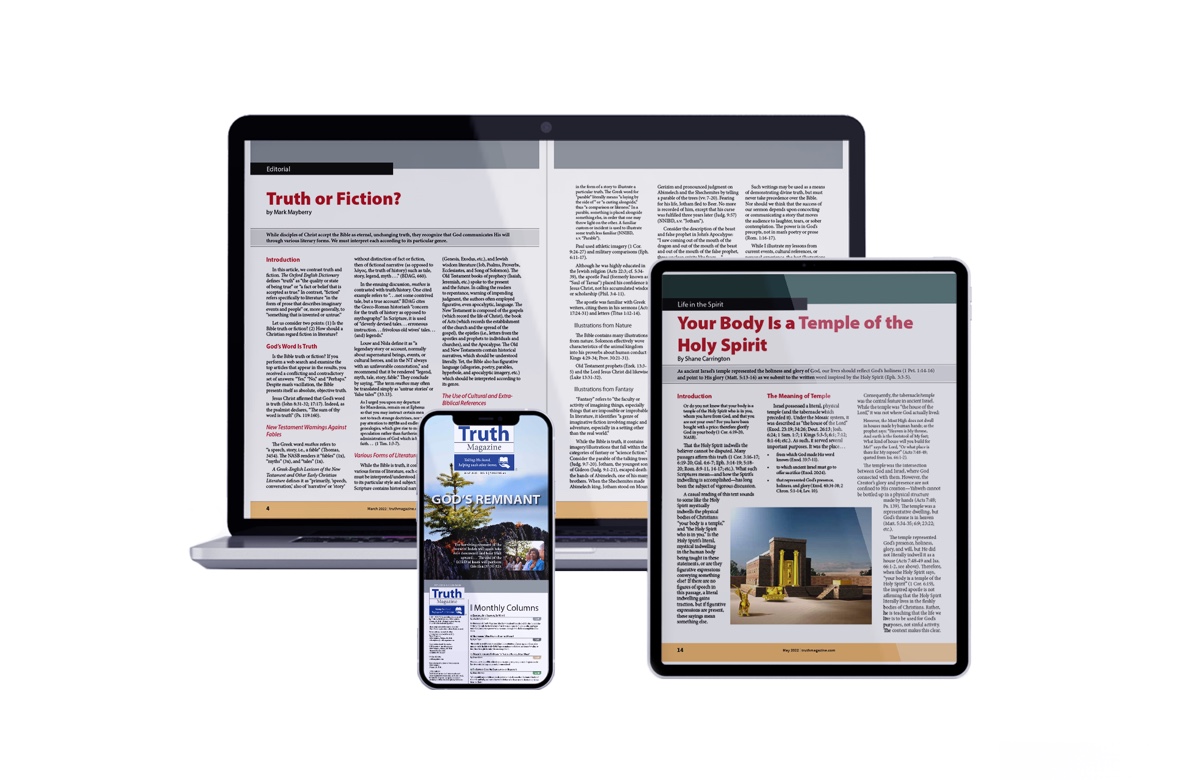
(September, 2023 | No. 9 | Vol. 67)
9/1/2023
Truth Magazine (ISSN 1538-0793) is published once a month by Truth Publications, Inc., 220 S. Marion, Athens, AL 35611. Postage paid at Decatur, AL, and additional mailing offices.
© 2023 Truth Publications, Inc. All Rights Reserved.
Manuscripts should be sent to the editor, Mark Mayberry, at mark@truthpublications.com. Link.
Subscriptions, renewals & other correspondence should be sent to: Truth Magazine, 220 S. Marion, Athens, AL 35611 or by emailing us at subscriptions@truthmagazine.com. Link.
Book orders should be sent to: CEI Bookstore | truthbooks.com | Street Address: 220 S. Marion, Athens, AL 35611 | Phone: (855) 492-6657 | Email: sales@truthbooks.com Link.
Online Website: truthmagazine.com
DISCLAIMER: Books in ads are screened, but an ad does not mean unqualified endorsement. All books should be tested by Scripture. We appreciate readers notifying us if they find some glaring fault in ads.
By Mark Mayberry
Synopsis: While many stress the importance of physical health and fitness, the Bible emphasizes spiritual well-being. Soundness refers to the state of being healthy. From a spiritual standpoint, are we strong or sickly?
Recently, an evangelist among us suggested that the soundness of a local church is not connected with how brethren conduct their worship, or use their funds, or perform their collective work. What does it mean to be sound? What is required of us individually? What is required of us on a congregational or collective basis?
The book of Proverbs repeatedly praises the concept of “sound wisdom” (Prov. 2:7-8; 3:21-22; 8:12-17, esp. v. 14), which necessarily implies its opposite. The self-willed fool quarrels against “all sound wisdom” (Prov. 18:1-2).
In Psalm 38, entitled “A Prayer of a Suffering Penitent, David says,”There is no soundness in my flesh" (Ps. 38:1-8, esp. v. 3 & 7). Why? Because of his sins and transgressions:
O LORD, rebuke me not in Your wrath, And chasten me not in Your burning anger. For Your arrows have sunk deep into me, And Your hand has pressed down on me. There is no soundness in my flesh because of Your indignation; There is no health in my bones because of my sin. For my iniquities are gone over my head; As a heavy burden, they weigh too much for me. My wounds grow foul and fester because of my folly. I am bent over and greatly bowed down; I go mourning all day long. For my loins are filled with burning, and there is no soundness in my flesh. I am benumbed and badly crushed; I groan because of the agitation of my heart (Ps. 38:1-8).
Isaiah depicts wayward Israel as a sick and diseased body:
Alas, sinful nation, people weighed down with iniquity, offspring of evildoers, sons who act corruptly! They have abandoned the LORD, they have despised the Holy One of Israel, they have turned away from Him. Where will you be stricken again as you continue in your rebellion? The whole head is sick and the whole heart is faint. From the sole of the foot even to the head there is nothing sound in it, only bruises, welts and raw wounds, not pressed out or bandaged, nor softened with oil (Isa. 1:4-6).
Through Micah the prophet, God called His people to exemplify “sound wisdom,” but they foolishly pursued a path of self-destructive wickedness (Micah 6:9-13, esp. v. 9).
The Greek verb hugiainō, derived from the noun hugiēs (sound, whole, healthy), means “to be sound, healthy” (Thomas, 5198).
It occurs twelve times in twelve New Testament verses (Luke 5:31; 7:10; 15:27; 1 Tim 1:10; 6:3; 2 Tim. 1:13; 4:3; Titus 1:9, 13; 2:1, 2; 3 John 2), and is rendered “good health” (2x), “safe and sound” (1x), “sound” (8x), “well” (1x) in the NASB.
Bauer offers the following distinctive meanings: “(1) to be in good physical health, be healthy, literally; (2) to be sound or free from error, be correct, figuratively, in the Pastoral Epistles with reference to Christian teaching. Thus, in accord with prevailing usage, Christian teaching is designated as correct instruction, since it is reasonable and appeals to sound intelligence” (BDAG, 1023).
In considering these occurrences, we draw two conclusions: (1) This word is descriptive of physical health and spiritual truth; and, (2) While the former is desirable, the latter is demanded.
As noted in the aforementioned definitions, this word communicates the concept of physical well-being. It occurs three times in the third gospel, which (unsurprisingly) was written by Luke, the beloved physician (Col. 4:2). In explaining why He associated with tax collectors and sinners, Jesus said, “It is not those who are well who need a physician, but those who are sick. I have not come to call the righteous but sinners to repentance” (Luke 5:29-32, esp. v. 31). When Jesus came to Capernaum, friends of a Roman centurion asked the Lord to heal one of his slaves, who was sick and about to die. Impressed with the centurion’s understanding of authority, Jesus said, “I say to you, not even in Israel have I found such great faith.” When those who had been sent returned to the house, they found the slave in good health (Luke 7:1-10, esp. v. 10).
Consider also the Parable of the Prodigal, as recorded in Luke 15. After repenting and returning to his father, a joyful celebration was held because he had come back “safe and sound” (Luke 15:27). Could he be so described while wasting his substance with riotous living? No. Safe and sound describes not only his physical return from a foreign country, but also his spiritual journey from the desert of sorrow and sin. John, the beloved disciple, echoes this dual usage, in addressing Gaius: “Beloved, I pray that in all respects you may prosper and be in good health, just as your soul prospers” (3 John 2).
Recalling the previously discussed definition of hugiainō, let us remember that Bauer says that, in addition to its literal meaning (i.e., to be in good physical health), the word also means “to be sound or free from error, be correct, figuratively, in the Pastoral Epistles (i.e., the letters to Timothy and Titus) with reference to Christian teaching.” The abridged version Theological Dictionary of the New Testament offers this comment on “sound teaching:”
In 1 Timothy 1:10; 6:3; and Titus 2:8, we find the idea of “sound” teaching or words. The reference is to true teaching, not to teaching that makes whole. This teaching, validated by the apostles, is concerned, not with speculation, but with true, rational, and proper life in the world. Being “sound in faith” (Titus 1:13) goes hand in hand with being temperate, serious, and sensible (2:2) (Kittel, 1202-1203).
Let us consider Paul’s discussion of “soundness” (hugiainō) in his letters to Timothy and Titus—two young preachers who were charged with the task of helping local churches set things in order and conform to the divine pattern (1 Tim. 1:10; 6:3; 2 Tim. 1:13; 4:3; Titus 1:9, 13; Titus 2:1, 2).
In these epistles, the apostle Paul repeatedly emphasizes the importance of “sound doctrine/teaching.” This suggests two essentials: (1) to fulfill this mandate, we must advocate sound doctrine/teaching, and (2) we must be sound in faith. For one who identifies as a gospel preacher to come along and suggest that soundness is not connected with how brethren conduct their worship, or use their funds, or perform their collective work is simply erroneous.
Paul’s letters to Timothy and Titus address a variety of issues involving individual and collective responsibilities. Considerable attention is given to the role of women in the assembly (1 Tim. 2:12), the qualification of elders who shepherd local churches (1 Tim. 3:1ff), and deacons who serve local churches (1 Tim. 3:8ff). Paul also emphasizes Timothy’s responsibility (as an evangelist) of conducting himself properly in the house/church of God (1 Tim. 3:14ff). In chapter 5, the inspired apostle distinguishes between individual and congregational responsibilities in the realm of benevolence. He urges brethren to support elders who rule well (1 Tim. 5:17ff) and provides guidelines on how to handle accusations made against elders, and the necessity of confronting elders who sin (1 Tim. 5:19ff). Each of these specifics is connected with sound doctrine.
As I urged you upon my departure for Macedonia, remain on at Ephesus so that you may instruct certain men not to teach strange doctrines, nor to pay attention to myths and endless genealogies, which give rise to mere speculation rather than furthering the administration of God which is by faith. But the goal of our instruction is love from a pure heart and a good conscience and a sincere faith. For some men, straying from these things, have turned aside to fruitless discussion, wanting to be teachers of the Law, even though they do not understand either what they are saying or the matters about which they make confident assertions. But we know that the Law is good, if one uses it lawfully, realizing the fact that law is not made for a righteous person, but for those who are lawless and rebellious, for the ungodly and sinners, for the unholy and profane, for those who kill their fathers or mothers, for murderers and immoral men and homosexuals and kidnappers and liars and perjurers, and whatever else is contrary to sound teaching, according to the glorious gospel of the blessed God, with which I have been entrusted (1 Tim. 1:3-11, esp. v. 10).
According to the apostle Paul, sound teaching stands in opposition to all expressions of immorality (1 Tim. 1:3-11, esp. v 10). In this context, Paul contrasts strange doctrines with sound teaching (v. 3, 10). Unlike those who make ignorant assertions about God’s law, the apostle affirms the proper role of divine revelation: “Law is good if one use it lawfully.” This principle is inclusive of inspired revelation in both the Old and New Covenants. Yes, the Law of Moses had been taken out of the way and nailed to the cross, but it served a good and noble purpose: revealing the holiness of God and the sinfulness of man. In like manner, the Law of Christ serves a good and noble purpose: revealing God’s plan, purpose and precepts in the Christian dispensation. If Timothy wished to further the administration of God which is by faith and fulfill the goal of the instruction (i.e., cultivating love from a pure heart, maintaining a good conscience, and developing a sincere faith), he must make proper application of divine law, his teaching must be sound on issues relating to morality, and he must faithfully proclaim the gospel of Jesus Christ. From the aforementioned context, faithfully teaching on moral issues would equate to sound teaching. Would not the same principle apply to the work, worship, and organization of the church? If not, why not?
Please note that after identifying various moral transgressions, Paul adds, “and whatever else is contrary to sound teaching [that is] according to the glorious gospel of the blessed God.” Although specifics are included, this is not an exhaustive list. The apostolic addendum would include any deviation from divine truth.
In pointing out these things to the brethren, you will be a good servant of Christ Jesus, constantly nourished on the words of the faith and of the sound doctrine which you have been following. But have nothing to do with worldly fables fit only for old women. On the other hand, discipline yourself for the purpose of godliness; for bodily discipline is only of little profit, but godliness is profitable for all things, since it holds promise for the present life and also for the life to come (1 Tim. 4:6-8, esp. v. 6).
If anyone advocates a different doctrine and does not agree with sound words, those of our Lord Jesus Christ, and with the doctrine conforming to godliness, he is conceited and understands nothing; but he has a morbid interest in controversial questions and disputes about words, out of which arise envy, strife, abusive language, evil suspicions, and constant friction between men of depraved mind and deprived of the truth, who suppose that godliness is a means of gain (1 Tim. 6:3-5, esp. v. 3).
Retain the standard of sound words which you have heard from me, in the faith and love which are in Christ Jesus. Guard, through the Holy Spirit who dwells in us, the treasure which has been entrusted to you (2 Tim. 1:13-14).
I solemnly charge you in the presence of God and of Christ Jesus, who is to judge the living and the dead, and by His appearing and His kingdom: preach the word; be ready in season and out of season; reprove, rebuke, exhort, with great patience and instruction. For the time will come when they will not endure sound doctrine; but wanting to have their ears tickled, they will accumulate for themselves teachers in accordance to their own desires, and will turn away their ears from the truth and will turn aside to myths. But you, be sober in all things, endure hardship, do the work of an evangelist, fulfill your ministry (2 Tim. 4:1-5, esp. v. 3).
Paul left Titus on the island of Crete, so that he might “set in order what remains and appoint elders in every city” (Titus 1:5). The qualifications of an overseer include the following: “For the overseer must. . . [hold] fast the faithful word which is in accordance with the teaching, so that he will be able both to exhort in sound doctrine and to refute those who contradict” (Titus 1:7-9, esp. v. 9). Because the inhabitants of Crete shared common spiritual deficiencies (dishonesty, moral degeneration and sloth), Paul said, "For this reason reprove them severely so that they may be sound in the faith (Titus 1:12-13).
The inspired apostle begins the second chapter of Titus by saying, “But as for you, speak the things which are fitting for sound doctrine” (Titus 2:1). Sound doctrine includes instruction that is applicable to older men (v. 2), older women (v. 3), younger women (vv. 4-5), young men (v. 6), evangelists (vv. 7-8), bondservants (vv. 9-10), along with the saints in general (vv. 11-14). The inspired apostle concludes this chapter by saying, “These things speak and exhort and reprove with all authority. Let no one disregard you” (Titus 2:15). Obviously, sound doctrine includes the totality of the gospel message.
What about us? What about our homes and families? What about our local congregations? Are we sound, or are we sickly? As mentioned at the start of our lesson, a well-known preacher among us recently suggested that the soundness of a local church is not connected with how brethren conduct their worship, or use their funds, or perform their collective work. The faulty reasoning he employed is the same as overt false teachers used to avoid the force of 2 John 9-11.
Anyone who goes too far and does not abide in the teaching of Christ does not have God; the one who abides in the teaching, he has both the Father and the Son. If anyone comes to you and does not bring this teaching, do not receive him into your house, and do not give him a greeting; for the one who gives him a greeting participates in his evil deeds (2 John 9-11).
Brethren in the past who pursued a path of compromise in order to broaden the bonds of fellowship (like Ketcherside, Garrett, Fudge, etc.) restricted the application of 2 John 9 to the gnostic heresy, i.e., those who denied the bodily incarnation of Jesus Christ. While “the doctrine of Christ” does, indeed, include who Jesus is (i.e., He is both the Son of Man [fully human] and the Son of God [fully divine]), it also includes what Jesus taught. Jesus warned the disciples, “Watch out and beware of the leaven (i.e., the teaching) of the Pharisees and Sadducees” (Matt. 16:6-12, esp. v. 6 & 12). He was not merely concerned with who they were, but with what they taught! In like manner, “the doctrine/teaching of Christ” is inclusive of the whole New Testament.
In summary, recall the variety of topics discussed in the letters to Timothy and Titus: the proper use of divine law. . . the nature of the gospel message. . . the danger of false teachers like Hymenaeus and Alexander. . . the need for personal holiness and modesty. . . the role of women, and restrictions in the area of teaching or exercising authority over a man. . . the qualification and function of elders and deacons. . . admonitions on how an evangelist ought to conduct himself in the household of God, which is the church of the living God. . . the danger of apostasy, evidenced by subverting God’s word through the use of unauthorized additions and subtractions. . . the importance of giving proper attention to the public reading of Scripture, coupled with exhortation and teaching. . . the distinct responsibilities of the home and the church in the area of benevolence. . . the importance of preaching/teaching sound words, and the danger of advocating a different doctrine. . . the danger of covetousness and the need for contentment. . . And this is only a partial summary of topics discussed in 1 Timothy! These admonitions, which involve both individual and collective responsibility, are an expression of sound doctrine. In reality, the concept of sound doctrine applies not only to the entire message of the Pastoral Epistles but also to the remainder of the New Testament.
If we retain the standard of sound words by continuing to heed the gospel message that was revealed, confirmed and preserved through the agency of the Holy Spirit (2 Tim. 1:13-14), then we will be sound in faith (Titus 1:10-14).
Retain the standard of sound words which you have heard from me, in the faith and love which are in Christ Jesus. Guard, through the Holy Spirit who dwells in us, the treasure which has been entrusted to you (2 Tim. 1:13-14).
For there are many rebellious men, empty talkers and deceivers, especially those of the circumcision, who must be silenced because they are upsetting whole families, teaching things they should not teach for the sake of sordid gain. One of themselves, a prophet of their own, said, “Cretans are always liars, evil beasts, lazy gluttons.” This testimony is true. For this reason reprove them severely so that they may be sound in the faith, not paying attention to Jewish myths and commandments of men who turn away from the truth (Titus 1:10-14).
Bauer, Walter, Frederick W. Danker, William Arndt, and F. Wilbur Gingrich. A Greek-English Lexicon of the New Testament and Other Early Christian Literature (BDAG). Third Edition. Chicago: University of Chicago Press, 2000.
Kittel, Gerhard, Gerhard Friedrich, and Geoffrey William Bromiley. Theological Dictionary of the New Testament, Abridged in One Volume. Grand Rapids, MI: W.B. Eerdmans, 1985
Thomas, Robert L. New American Standard Hebrew-Aramaic and Greek Dictionaries: Updated Edition. Anaheim, CA: Foundation Publications, Inc., 1998.
Mark Mayberry serves as Editor of Truth Magazine. He has labored with the Adoue Street church of Christ in Alvin, TX, since 1998, where he serves as the evangelist and an elder. The church website is here. His website is here. He can be reached here.





By Kyle Pope
Synopsis: A central element of worship under Christ is the observance of the Lord’s Supper. What does the New Testament teach about this memorial? How should it be observed? How does Scripture address false concepts associated with its observance?
As the children of Israel were coming out of their bondage in the land of Egypt, the Lord instituted a memorial that the Israelites were to keep as a reminder of the great deliverance that He granted them from the final plague that struck the Egyptians. While the Lord struck dead the firstborn of everyone in Egypt, those who observed the Lord’s instructions among the Jews were spared this horror. From that time forward, the Jews were to keep the Passover meal each year in memory of when death had “passed over” their people (see Exod. 12). It is not a coincidence that on the night that Jesus observed the Passover with His disciples, He instituted a similar memorial of His death for the children of God under the New Covenant.
The gospels of Matthew, Mark, and Luke all record Jesus’s institution of this memorial (Matt. 26:26-29; Mark 14:22-25; Luke 22:17-20). Additionally, the apostle Paul, in response to the Corinthian’s abuse of the memorial, recounted the Lord’s institution of the Lord’s Supper (1 Cor. 11:23-25). Let us observe what was involved in this institution.
As Jesus met with His disciples on the night before His death, it was to observe the Passover meal. In accordance with the Law of Moses, they had prepared a place for them to eat the meal (Luke 22:8-12). This involved removing all leaven from the house where the memorial was to be observed. The Passover began a period of seven days in which no leaven could be in their houses at all (Exod. 12:6, 15-18).
While eating the Passover, Jesus took of the unleavened bread and gave thanks to God for it. He then broke the bread and gave it to each of the disciples. Both Matthew and Mark record His instruction, “Take, eat” (Matt. 26:26; Mark 14:22). Then Jesus told His disciples, “This is My body.” With this, Jesus set forth the significance of what was being done. The bread was a figure of Jesus’s body that was “given” (Luke 22:19) and “broken” (1 Cor. 11:24) for His disciples. This was not to be done to satisfy hunger, but was to be done “in remembrance” of Jesus.
This cup, Jesus Himself called the “fruit of the vine” (Matt. 26:29; Mark 14:25 and Luke 22:18). It served as a figure of the blood that Jesus would shed for the forgiveness of man’s sins. As with the bread, Paul tells us that Jesus told His disciples, “this do, as often as you drink it, in remembrance of Me” (1 Cor. 11:25).
The Bible offers at least three examples of the observance of the Lord’s Supper among churches in the New Testament: (1) the church in Jerusalem; (2) the church in Troas, and (3) the church in Corinth.
After the outpouring of the Holy Spirit on the day of Pentecost, as recorded in Acts chapter two, the Bible describes the establishment of the church in Jerusalem. After Peter and the others taught the multitude, 3,000 souls heeded their message and were baptized (Acts 2:41). We are then told about the conduct of the church. Included in the list of their activities, we are told that the Christians there continued steadfastly “in the breaking of bread” (Acts 2:42).
As Paul traveled teaching, he came to the ancient city of Troas in modern day Turkey (Acts 20:6). While there, Scripture tells us, “Now on the first day of the week, when the disciples came together to break bread, Paul, ready to depart the next day, spoke to them and continued his message until midnight” (Acts 20:7).
In 1 Corinthians, Paul refers to the Corinthians’ observance of the Lord’s Supper in two passages. The first comes amid a discussion about Christians separating themselves from idolatry. In this passage, Paul emphasizes that, just as partaking of the bread and fruit of the vine unites Christians with the Lord and one another, if they ate things sacrificed to idols, they would be uniting themselves with idolatry (1 Cor. 10:15-22). The second reference addresses how the Corinthians had corrupted the observance of the Lord’s Supper. Instead of treating the Supper as the memorial observance which the Lord intended, they had turned it into a common meal. Paul rebuked them, restated the details of the institution of the memorial, taught them to eat at home for hunger, and commanded them to observe the memorial with the right attitude (1 Cor. 11:17-34).
Paul frequently uses the phrase, as, for example, in 1 Corinthians 11:20, referring to the memorial as “the Lord’s Supper.”
In the tenth chapter of 1 Corinthians, Paul refers to the cup as “the communion of the blood of Christ” (10:16a) and the bread as “the communion of the body of Christ” (10:16b). The word translated “communion” is the Greek word koinōnia most frequently translated “fellowship” in the English New Testament. It is defined as “joint participation" (Thayer). In the institution of the Lord’s Supper, Jesus said,”Assuredly, I say to you, I will no longer drink of the fruit of the vine until that day when I drink it new in the kingdom of God" (Mark 14:25). The Christian who properly partakes of the Lord’s Supper is spiritually participating with Christ in the observance.
In the same passage where Paul speaks of the memorial as the communion of the body and blood of Christ, three other terms are used to refer to the elements of the Lord’s Supper.
The communion of the blood of Christ is identified as “the cup of blessing” (1 Cor. 10:16a).
Five verses later, the same element is referred to as “the cup of the Lord” (1 Cor. 10:21).
When Paul speaks of the communion of the body of Christ, he identifies it as “the bread which we break” (1 Cor. 10:16b).
Although early church writers used the term, the Lord’s Supper was never referred to in Scripture as the Eucharist. This name was derived from the Greek verb translated “given thanks” in two accounts of Jesus’s establishment of the memorial (Luke 22:19; 1 Cor. 11:24). It is not a biblical name for the memorial.
A sacrament is thought to be a religious act by which divine grace is dispensed. While all things that God gives to man can rightly be considered gifts of grace (see Rom. 12:6), the Bible does not teach that partaking of the Lord’s Supper infuses an individual with additional grace. Christians should observe the Lord’s Supper in obedience to Christ and for the edification that it offers to us.
The Roman Catholic Church teaches that the bread and fruit of the vine blessed by a priest are changed into the literal body and blood of Jesus. This stems from a misapplication of our Lord’s words in John 6. While Jesus said, “Most assuredly, I say to you, unless you eat the flesh of the Son of Man and drink His blood, you have no life in you” (John 6:53), nevertheless, at the end of the chapter, He explained to His disciples that He was referring to spiritually feeding upon Jesus’s life and teaching. Near the end of the chapter, He clarifies: “It is the Spirit who gives life; the flesh profits nothing. The words that I speak to you are spirit, and they are life” (John 6:63).
It is clear from Scripture that the observance of the Lord’s Supper was to be a congregational activity. In Paul’s rebuke to the Corinthians, we see that it was to be done when Christians “come together as a church” (1 Cor. 11:18) when they “come together in one place” (1 Cor. 11:20). Disciples were to eat at home to satisfy hunger (1 Cor. 11:34), but when they ate of the memorial, they were to “wait for one another” (1 Cor. 11:33). The only text that indicates a time when the memorial was observed specifies brethren coming together on Sunday—the first day of the week (Acts 20:7). While the phrase “breaking bread” can refer to either the memorial or a common meal, even when the church in Jerusalem met daily in the temple, their meals for hunger were partaken “from house to house” (Acts 2:46).
It is clear that Christians met regularly on Sunday (cf. Acts 20:7; 1 Cor. 16:1-2). The only clear indication of the time upon which the Lord’s Supper was observed is Sunday (Acts 20:7). Given that no particular Sunday is specified, and every week has a “first day of the week,” the only action that would truly comply with the New Testament pattern would be a weekly observance of the memorial.
The Bible teaches that all Christians are priests who offer up spiritual sacrifices to God (1 Pet. 2:5). When Jesus instituted this memorial, He gave both elements to His disciples and instructed them to partake. Matthew even reveals a specific statement He made concerning the cup telling them “drink from it, all of you” (Matt. 26:27). Another person can’t drink the cup for someone else any more than another person can sing, confess Christ, or be baptized for someone else.
It is true that Paul spoke of the fruit of the vine as “the cup [singular] of the Lord” (1 Cor. 10:21) and “the cup [singular] of blessing” (1 Cor. 10:16), but this refers to unity of substance and joint observance among believers, not the singularity of the container holding the substance. Technically, Luke records Jesus’s first instructions concerned dividing the contents of the cup among the disciples who were present. He writes: “Then He took the cup, and gave thanks, and said, ‘Take this and divide it among yourselves’” (Luke 22:17). It is after the supper that He then attached memorial significance to the cup and had them drink from the contents of the cup He had previously divided among them (Luke 22:20).
Some have falsely argued that the container is a figure of the New Covenant based on Jesus’s statement, “This cup is the new covenant in my blood” (Luke 22:20; 1 Cor. 11:25). It is clear from the texts that He is referring to the contents of the cup and not the container. We note that it is called the new covenant “in My blood.” A container does not represent blood. It is the fruit of the vine within the container that does.
The Lord’s Supper is an important demonstration of a Christian’s faith in Christ and hope in His return. Paul taught, “For as often as you eat this bread and drink this cup, you proclaim the Lord’s death till He comes” (1 Cor. 11:26). In its observance, the child of God participates in a regular and personal reminder of what Jesus did for us. This should lead us to recognize our own need to sacrifice for the cause of Christ. May we cherish it and approach it with the reverence and gravity it is due.
Kyle Pope preaches for the Olsen Park church of Christ in Amarillo, TX. He has written several books published by Truth Publications, including Thinking About AD 70: Challenging Realized Eschatology. Go here for more information. The church website is here. He can be reached here.



By Lindsay Mast
Synopsis: Discipleship is less like a 100-yard dash and more like a long distance marathon. Success is not based on short bursts of speed but on strength and stamina—involving both muscles and the mind.
A marathon is a really long race to run. I know, I know. That’s obvious. With a length of 26.2 miles, the average female runner will complete that distance in about four hours and forty-eight minutes. For those of us who are slower than average, it takes, well, longer. There’s a lot of things that can go right in that amount of time. There’s also a lot that can go wrong.
That’s why it’s important to train your mind during a race. The many months of training before a marathon do more than ensure that your lungs and muscles are ready. They also help you know how your mind responds to strenuous exertion. You’re likely to go through a vast array of emotions during the course of a race: excitement, overwhelmed, boredom, happiness, worry, doubt, despair, joy. Some of those will dominate your brain on race day. If they are the negative ones, you need to counteract them.
That’s where hope comes in: Hope helps. It can get you through just about anything. Even in the worst part of the worst race that I’ve run—the one where I had a pinched nerve and completed a much-anticipated race by gently strolling all 13.1 miles—it was hope that carried me through. Then, it was hope that I would get better and run again. Other times, it’s been hope for better weather, or that some new training or nutrition plan would yield faster times.
In our Christian race, hope is fundamental to keeping our sights focused on the finish line. Correctly placed hope that keeps us from becoming prideful, self-reliant, ungrateful or complacent. Romans 15:13 tells us that the God whom we serve is One of hope. It is a part of who He is, and by believing in Him, we will be filled with all joy and peace. The power of the Holy Spirit will cause us not just to have a little hope, but to abound in it.
If you don’t already possess an abundance of hope, try imagining how life would be different if we did. What if, when life threw us a plot twist, we had an abundance of hope that it would yield good things, opportunities to glorify God? It’s a different scenario to what those things often do: leave us wide awake at 3 a.m., wondering how we will deal with things derailing our plan.
What if, as our children grow, we abundantly hope in Him? Hope that He will use their unique talents to serve Him, instead of spending our time “worst-case scenario-ing” things that haven’t yet happened. What if we determine to hope abundantly that, even if they are in a wayward season, God will tenderize their hearts toward Him? Of course, all of that exists alongside teaching, training, prayer, and discretion, but we can sometimes lose sight of the hope that we should have in what He is able to do (Eph. 3:20-21).
What if, as we age, we cultivate hope in our Savior, the Lord Jesus Christ, and the home He has gone to prepare for us? Instead of wistfully looking back on the good ol’ days, why not decide to place our trust in Jesus—who has promised to provide a marvelous place where we can finally experience true rest and beauty—instead of focusing on the brief shadows He has allowed us to enjoy here? Remember, we need not see it to believe it’s there (Heb. 11:1).
Lindsay Mast has dozens of medals from marathons, half marathons and overnight relays, but is eager for the only prize that matters: heaven. She left a career as a broadcast journalist to raise and homeschool her three children. She and her husband, David, worship at the Intown congregation in Atlanta, GA. She can be reached here.





By Bruce Reeves
Synopsis: In the New Testament, God’s grace coupled is coupled with man’s accountability: “So then, my beloved, just as you have always obeyed, not as in my presence only, but now much more in my absence, work out your salvation with fear and trembling; for it is God who is at work in you, both to will and to work for His good pleasure” (Phil. 2:12-13).
Jesus Christ not only “humbled” Himself in the service of others (Phil. 2:1-7), He also perfectly obeyed His Father, even to the point of death on the cross (Phil. 2:8). The encouragement of Philippians 2:12-16 is the third and final targeted exhortation of this immediate context. Our Lord’s radical obedience in the face of suffering is the point of the exhortation of Philippians 2:12-16: “So then, my beloved, just as you have always obeyed. . .” The Philippians’ obedience was a condition of their ultimate salvation, just as Christ’s obedience was necessary for His heavenly exaltation (Phil. 2:9-12). Paul encourages their obedience, both in his presence and absence. Sometimes brethren think that they are complimenting a preacher or teacher by saying, “I don’t know what we will do without you!” For a humble servant of the Lord, this is the last thing he would want to hear. His heart’s desire is to know that although he will be missed, his work and teaching has equipped the brethren to continue in faithfulness to the Lord.
Paul’s phrase, “work out your own salvation with fear and trembling” causes those who have unbiblical views regarding grace and faith much trouble. As a result, their explanations are tenuous and strained. However, once we understand the fullness of the inspired apostle’s usage of the term “faith” then we can see that the context harmoniously depicts a working faith in Christ (Phil. 2:12; cf. Rom. 1:5; 16:26). It is worthwhile to note that when Paul speaks of his “absence,” he is referencing an absence that is caused by imprisonment and potential execution (Phil. 1:25-27). His deep concern is that his brethren continue in devotion to Christ, even when he is temporarily or permanently removed from their presence. When we lose those who have encouraged us in the gospel, Satan will tempt us to become discouraged in the work of the Lord. Yet we must focus our hearts on the proclamation of the gospel and the teaching of the lost more than ever. The legacy of the faithful is to teach other faithful men who will share the gospel, even when they themselves have gone on to their reward (2 Tim. 2:1-2; 4:1-8).
Why does Paul tell the saved to continue to work out their own salvation? In Scripture, the term “salvation” is used in the past, present, and future tenses. For instance, we read of believers having been saved by God’s grace when they obeyed the gospel (Eph. 2:5, 8). Yet, we also read of salvation in the present and ongoing sense, as when Paul writes: “For the word of the cross is foolishness to those who are perishing, but to us who are being saved it is the power of God” (1 Cor. 1:18). In Philippians 2:12, salvation is spoken of in the future tense. It does not suggest that the Philippians had not been saved in the past, or were not presently in a saved condition, but it refers to the completion of their final glorification in eternity (cf. Rom. 8:29-30; Phil. 1:6). In describing the Christian’s future salvation Peter writes, “Though you have not seen Him, you love Him, and though you do not see Him now, but believe in Him, you greatly rejoice with joy inexpressible and full of glory, obtaining as the outcome of your faith the salvation of your souls” (1 Pet. 1:8-9). The Hebrew writer speaks of the salvation that will be realized for God’s people when Jesus comes again: “So Christ also, having been offered once to bear the sins of many, will appear a second time for salvation without reference to sin, to those who eagerly await Him” (Heb. 9:28). When Paul speaks of “working out our own salvation,” he is speaking of salvation in its completion and final glorification. Peter had this in mind as well when he admonished Christians to “give diligence to make your calling and election sure; for if you do these things, you will never fall” (2 Pet. 1:10). The renewed mind bears the fruit of spiritual transformation, but such requires diligent devotion to Christ (Rom. 12:1-2; 2 Cor. 3:18; 2 Pet. 1:1-5).
To work out our own salvation, we must have a deep sense of reverence for Christ. The phrase “fear and trembling” appears together only three other times in Paul’s writings (1 Cor. 2:3; 2 Cor. 7:15; Eph. 6:5), although it is used often in the Old Testament as well (Deut. 20:3; Job 4:14; Ps. 2:11; 55:5; 119:120). When Paul uses this phrase, he is addressing the subject of obedience from the heart (Rom. 6:17). A person with this frame of mind will not be driven away from God, but will draw nearer to Him. As we serve the Lord, we should not be paralyzed by fear, but neither should we forget the seriousness of our work as God’s children, or the greatness of the One whom we serve. May we always offer to Him “an acceptable service with reverence and awe” (Heb. 12:28). Love casts out a tormenting and punishing fear but embraces a reverent fear (Heb. 4:1; 1 John 4:18). The Hebrew writer is careful to strike the balance between our access to God through Jesus as our High Priest and our need to have a healthy reverence for the God of heaven (Heb. 4:14-16; 10:22-23; 12:18-29).
Paul writes, “For it is God who is at work in you, both to will and to work for His good pleasure” (Phil. 2:13). The two emphases are linked: the Philippians are to endure suffering with fear and trembling because God is at work in them. This is not a case of God irresistibly and overwhelmingly dragging the Philippians into salvation. Rather, as God is at work in them through Christ, so they must also express a working faith and labor of love (Gal. 5:6). There is no contradiction between God’s power through the gospel and human obedience to the message of Christ. We experience the influence of God in our lives through the word of truth: “For this reason we also constantly thank God that when you received the word of God which you heard from us, you accepted it not as the word of men, but for what it really is, the word of God, which also performs its work in you who believe” (1 Thess. 2:13). That God uses the means and instrumentality of His word to convert and convict the sinner does not deny that it is His power that saves us (Rom. 1:16; Eph. 6:17; Col. 3:16). Even when Paul says that we have been saved “through sanctification by the Spirit,” he adds, “and belief of the truth” (2 Thess. 2:13; cf. John 17:17-19). This is the way God “works in us” to do His good pleasure and fulfill His purposes (Heb. 4:12). If we are to be blessed by God’s word, our hearing must be mixed with faith (Heb. 4:2-3). Some have recently argued that the Lord’s providential work on our behalf is tantamount to a direct operation of the Holy Spirit on our minds. There is a major leap in logic in this argument that must be recognized. God working on our behalf providentially differs dramatically from a direct operation of the Spirit on our minds. The Lord graciously transforms us through His message, revelation, teaching, and proclamation of the gospel (2 Cor. 3:17-18). When we fully surrender to the word of the cross, we are living for His good pleasure and eternal purpose (Phil. 2:13; cf. Eph. 1:5, 9). To fulfill the “good pleasure” of the Lord is to carry out His gracious will. The entire purpose of divine revelation is to bring men and women into such a relationship with God that His will might be fulfilled by them. This is how the divine mission is brought to fruition.
God wants people to work willingly: “Do all things without grumbling or disputing” (Phil. 2:14). The Greek word for grumbling (gongusmos) refers to the expression of secret and sullen discontent, murmuring, and complaints. The LXX uses this same word to describe the complaining of the Israelites, which led to Paul’s warning: “Nor grumble, as some of them did, and were destroyed by the destroyer” (1 Cor. 10:10). The word “disputing” is translated from a compound Greek word (dialogismos), and refers to inward reasoning of evil thoughts, questioning, and arguing. Paul never defined defending and confirming the gospel as “wrangling;” rather, he warned of those who sowed discord through vain speculations and divisive teachings (Rom. 16:17; Phil. 1:5-7). “Fruitless discussions” over “endless genealogies” were a common problem during this time. Ironically, there are those who speak often of the problem of division who are constantly causing disruption among their brethren through reckless and unwarranted teachings that mislead those who are naïve and young in the faith (1 Tim. 4:6, 14-16). Grumbling and murmuring against the Lord expresses unbelief. Paul’s point in Philippians 2:14 is that, just as the exodus generation failed to endure testing without “grumbling” and as a result did not reach the promised land, Christ-believers who “grumble” will not achieve their final salvation. During the exodus, the Israelites grumbled against Moses and God. Murmuring and complaining can arise from various deficiencies of the heart. Maybe we are simply self-consumed and hyper critical (Matt. 7:1-5; Phil. 2:1-5). Perhaps we assume others are not engaged in the work of the Lord when such is not the case. We hear from time to time of the many things brethren are not doing benevolently, when in fact they are simply following the Lord’s instructions to not constantly market themselves and blow their own trumpet (Matt. 6:3). Perhaps, rather than making arguments based on what we wrongly assume others aren’t doing, we should focus on giving our own hearts to the Lord’s service. While there is a time to identify growth areas, it is not uncommon to hear some publicly grumble and murmur against their brethren to build dissatisfaction in the hearts of the unsuspecting. To work out our own salvation, we must willingly examine ourselves and encourage one another to live faithfully for the Lord (2 Cor. 13:5; Eph. 4:11-16).
Working out our own salvation is a call to action! The Lord calls us to appear as lights in a dark world, “So that you will prove yourselves to be blameless and innocent, children of God above reproach in the midst of a crooked and perverse generation, among whom you appear as lights in the world” (Phil. 1:10-11; 2:15). The phrase “in the midst of a crooked and perverse nation” is taken from the Song of Moses in Deuteronomy 32:5. Christians are being warned to not follow Israel’s evil example (cf. also 1 Cor. 10:1-13). Peter used the term “crooked” to describe the sinful Jews who had crucified Jesus (Acts 2:40). Similarly, the word “perverse” suggests a vessel that is “distorted” and “out of shape.”
Deuteronomy 32:5 identifies the wilderness generation who were guilty of murmuring and complaining against God and Moses. In contrast to falling into such disobedience, children of God are encouraged to shine as bright lights in a dark world. Just as Jesus is the light of the world, so His followers must reflect His light to those in darkness (Matt. 5:13-16; John 8:12; Eph. 5:8; 2 Pet. 2:9). To be “blameless,” “innocent,” and “above reproach” does not demand that we are sinless, but that we are living faithful lives. Not only are elders to be blameless, but all Christians should also strive to be blameless in the sense that no legitimate accusation can be leveled against them. As those who have been cleansed by the blood of Christ and who are striving to conduct pure lives for the Lord, we are described as having been purified in Him (Eph. 1:4; 5:27; 1 John 1:9).
We shine as lights by holding fast to the word of life (Phil. 2:16). The term translated “holding fast” can also be translated as “holding forth” (KJV). The two ideas have great application to our lives: We can only hold forth the word if we hold fast to the word. It is sad to see the attempt by brethren to compromise distinctive aspects of the gospel to broaden their approach to the lost. The problem is that in teaching a compromising message, they are compromising the salvation of lost souls! Paul invested his heart into the spiritual growth of the Philippians. He desired to know that he had not done so in vain. Their devotion to Christ brought him great joy. Working out our own salvation not only glorifies God and saves our souls, but it also encourages those who have sacrificially taught us:
So that in the day of Christ I will have reason to glory because I did not run in vain nor toil in vain. But even if I am being poured out as a drink offering upon the sacrifice and service of your faith, I rejoice and share my joy with you all. You too, I urge you, rejoice in the same way and share your joy with me (Phil. 2:16-18).
The “mind of Christ” is only experienced when we participate in His purpose in our daily lives. The incarnation of Christ does not merely offer a reassuring story of salvation, it is the restoring and transforming gospel. To fully take part in salvation, let us recognize that the working of God is only realized through a working faith. To work out our own salvation is to live out an assured, active, pure, reverent, steadfast and submissive faith in our Lord and Savior Jesus Christ.
Bruce has labored with the Highway 65 church of Christ in Conway, AR, since 2000. He and his wife, Rachel, have one child. The church website is here. He can be reached here.





By Shane Carrington
Synopsis: While we live in an evil and difficult world, God provides tools we can apply through which He will strengthen us to be more like Jesus.
Everyone begins somewhere, and all do not begin at the same place. Over the course of our lives, we face a variety of struggles and opportunities. Some are blessed with family who train them for the Lord. Others have parents with whom Jesus holds little influence. Some start with significant advantages but forfeit those opportunities; others begin with an uphill battle, but find victory through Jesus.
Once we become disciples, though, we all have the same mission: grow to become more like Him! God addresses this:
. . .like newborn babies, long for the pure milk of the word, so that by it you may grow in respect to salvation, if you have tasted the kindness of the Lord (1 Pet. 2:2-3).
The Hebrew writer reproves disciples who remain spiritually immature:
For though by this time you ought to be teachers, you have need again for someone to teach you the elementary principles of the oracles of God, and you have come to need milk and not solid food. For everyone who partakes only of milk is not accustomed to the word of righteousness, for he is an infant. But solid food is for the mature, who because of practice have their senses trained to discern good and evil (Heb. 5:12-14).
In our spiritually deficient world, it is important to consider some areas of growth in which Jesus can strengthen us. Hebrews chapters 5-6 describe tools that assist us to overcome “the sin which so easily entangles us,” aiding us to “run with endurance the race that is set before us” (Heb. 12:1). Consider some of these.
A carpenter possesses tools which he skillfully applies in his trade. Jesus provides tools that help us build spiritually. Consider several tools described in these chapters.
The writer of Hebrews refers to “the elementary principles” of Christianity (Heb. 5:12) and enumerates several of these foundational teachings in the following chapter: “repentance from dead works and of faith toward God, of instruction about washings [baptisms, NKJV and footnotes of several translations] and laying on of hands, and the resurrection of the dead and eternal judgment” (Heb. 6:1-3, NASB).
There are two considerations about “elementary principles” that might prove helpful here. First, the Old Testament rituals find their ultimate fulfillment in Jesus and His gospel (Eph. 2:11-16 with Col. 2:9-17; Heb. 9:1-15), so we need to go beyond those ancient foundations to faith in Jesus. This is an important theme in Hebrews. Second, there are basic principles of the gospel that we must understand in order to be converted to Christ. Once we are converted, we should grow in Him (Matt. 28:18-20). Conversion is the beginning; spiritual growth is the goal, and heaven is the prize (Phil. 3:1-16). We must understand God’s things in His order, and for His purposes.
Practice is a tool of God for our spiritual growth (Heb. 5:12). Young children need practice to ingest solid food. As disciples, we progress from the milk to the meat of the word in the same manner: “practice.” As the writer states, “solid food is for the mature, who because of practice have their senses trained to discern good and evil” (Heb. 5:12). Spiritual training strengthens us to live as disciples. Each aspect of our service to God trains us for both this life and eternity, whether prayer, corporate worship, personal work, or the thought processes required for wise decision-making. Godly experience is incredibly valuable, and this requires practice.
Becoming teachers helps us to grow: “. . .you ought to be teachers. . .” (Heb. 5:12). Developing the ability to teach is part of normal, spiritual growth for disciples, not a mere profession reserved for a few. Christianity is not only a taught religion, it is a teaching religion. In Matthew’s account of the great commission, Jesus tells disciples to make disciples, then instructs those newly converted Christians to do “all that I have commanded you”—which includes making disciples! While each disciple differs in maturity and skill-level when it comes to teaching, all can do something, and all can grow to do more. Parents must teach their children (Eph. 6:4; 2 Tim. 1:5), Christians must illuminate society (Matt. 5:14-16), and early disciples took this mission seriously (Acts 8:4). Teaching not only spreads the gospel; the preparation required of a teacher also strengthens our faith and sharpens our abilities.
God also urges us to “press on to maturity” (Heb. 5:14). To grow, disciples must be focused, active, and persistent. Neither athletes nor musicians accomplish much without great effort. The same is true of disciples. Sometimes it is difficult to do the right thing, but pressing forward strengthens us. Maturity begets maturity. We need wisdom to see the importance of breaking out of our comfort zones. If you will set spiritual goals and consistently work toward them, you will be more like Christ.
God’s warnings also keep us focused:
For in the case of those who have once been enlightened and have tasted of the heavenly gift. . . and then have fallen away, it is impossible to renew them again to repentance (Heb. 6:4-6).
The consequences of ungodly behavior give us reason to pause and ponder our Redeemer, our commitment to Him, and the blessings He affords. God teaches us not only the blessings of obedience but also the bitter fruits of unrighteousness. As the writer says,
“For ground that drinks the rain which often falls on it and brings forth vegetation useful to those for whose sake it is also tilled, receives a blessing from God; but if it yields thorns and thistles, it is worthless and close to being cursed, and it ends up being burned” (Heb. 6:7-8).
Abandoning Jesus also reduces the likelihood of returning (Heb. 6:4-6), but these warnings concerning the fruits of sin are tools of God to keep us focused on Christ. No one puts Christ to shame without putting self to shame.
Focusing on “blessing from God” (Heb. 6:7) moves us toward holiness. God takes care of His people. He always has. He always will.
Make sure that your character is free from the love of money, being content with what you have; for He Himself has said, “I will never desert you, nor will I ever forsake you,” so that we confidently say, “The Lord is my helper, I will not be afraid. What will man do to me?” (Heb. 13:5-6).
God abundantly blesses His children, demonstrating this from the very beginning. Knowing His covenant faithfulness moves those who focus to reciprocate in “faith working through love” (Gal. 5:6), just like Jesus (Heb. 5:8-9).
While God allows us to face the brokenness of this world, He fortifies our faith with a perfectly balanced approach. Spiritually, we begin in different places, but with this mosaic of tools for discipleship, God grows us in every area of service, even areas where weakness seems to prevail. Let us, therefore, trust His grace as revealed in the tools of truth which He has entrusted to us. He will grow us, and we will be more like His Son.
Shane Carrington has labored with the Southside church of Christ in Sulphur Springs, TX, since 1999. He has two children. The church website is here. He can be reached here.





By Bobby L. Graham
Synopsis: In every generation, those who are “men-pleasers” attempt to redefine the work of a preacher. Paul warned, “For the time will come when they will not endure sound doctrine; but wanting to have their ears tickled, they will accumulate for themselves teachers in accordance to their own desires, and will turn away their ears from the truth and will turn aside to myths. But you, be sober in all things, endure hardship, do the work of an evangelist, fulfill your ministry” (2 Tim. 4:3-5).
Some do not consider it important for us to have a preacher. How important is it, and what are his qualifications and duties?
In last month’s column, we tried to show the importance of preaching by examining the words used by inspired writers to indicate what preachers are expected to do and be by the Lord, whether full-time or part-time. We also stressed the divine charge given to preachers in 2 Timothy 4:1-2. Several challenging questions were posed for both the preacher and local congregation to consider, lest man’s will overcome the Lord’s will regarding the work and relationship of the preacher to the church.
It is also significant that the Lord pointed out the trust He has committed to a preacher in passages like 1 Timothy 1:11 and 6:20. Paul knew that the gospel committed to his trust was glorious, and for good reason, ever tried to be true to that trust. He also admonished young Timothy to guard what God had given into his hand as a trust, by avoiding the profane and empty ways of presenting, explaining, and defending the gospel which were practiced by some.
What does God say concerning the qualifications of an evangelist/preacher/minister? While the Lord does not provide us with a checklist of such matters, the Bible says quite a bit about his qualifications.
The man who serves in this capacity must (1) be faithful to the Lord, thus to His word, if he would effectively teach others (2 Tim. 2:2). He must not be the kind of man who sometimes runs hot and sometimes cold. He should be known for his steadfastness in the service to the Lord. The Lord also says that he must (2) be gentle, (3) patient, and (4) humble in his efforts to teach others, making him able (or apt) to teach even those opposing the gospel (2 Tim. 2:24-25). By such measures, he is targeting not his own victory and the opponent’s defeat or embarrassment, but the other’s repentance and acknowledgment of the truth. Being patient means that he will persist in his efforts, forbearing toward the proponent of error, not soon giving up. Humility will cause him to put to death his pride and work for the betterment of one who is in error. Being gentle means he will deal carefully, not caustically, abrasively, or rudely with his opponent. The Master also calls upon the teacher of good things to be sober and watchful in all things (seriously focusing upon what is real), so he can endure afflictions coming his way and complete his ministry (2 Tim. 4:5). Many a preacher has failed to continue and complete his service to the Lord because he lacked the sober-mindedness to see things as they are and stay alert to spiritual perils to himself and to others.
One who is thus spiritually qualified might not measure up to man’s standards, but He will please God. He will be able (1) to guard the gospel entrusted to him (1 Tim. 6:20; 1:14), (2) teach and command it with all authority (1 Tim. 4:11; Titus 2:15), (3) keep the commandment without spot (1 Tim. 6:14), (4) be unashamed of the Lord or of others thus teaching (2 Tim. 1:6), and (5) willingly suffer hardship for the gospel (2 Tim. 1:8).
For all the foregoing reasons, it is imperative that a preacher often meditate on his Golden Text: “Be diligent to present yourself approved to God as a workman who does not need to be ashamed, handling accurately the word of truth” (2 Tim. 2:15).
It is the Lord’s will that each of His children, including each preacher, examine himself often to maintain a clear conscience, a right relationship with Christ, and a fruitful work in the vineyard. The importance of the task and the great need for it demand that each of us be faithful to God in these matters.
Bobby L. Graham actively participates in fill-in preaching, Belize trips, teaching an hour each day at Athens Bible School, and in gospel meeting work. He and his wife, Karen, have three children. He can be reached here.




By Luke Chandler
Synopsis: Archaeology requires physical discoveries to form conclusions or make claims about the past. So far, the search for Noah’s Ark has not produced testable, physical remains that can be examined by trained scholars. A big claim like the discovery of Noah’s Ark needs solid evidence to accompany it.
For hundreds of years, people have sought Noah’s Ark around Mt. Ararat, a peak in eastern Turkey. It would probably be the greatest biblical discovery ever made. Every few years, someone claims to have found the ark, or that they are close to finding it. However, we still have no physical evidence that has been presented openly to analyze and consider. Is it possible we may find it?
There are difficulties that many believers may not have considered in the search for Noah’s ark. For one, the search area for the ark is much larger than generally known. Mount Ararat in eastern Turkey has been called other names since ancient times, and even today is known as Ağrı Dağı (“Mountain of Pain/Sorrow”) in Turkish and Çiyayê Agirî (“Fiery Mountain”) in Kurdish. (The Kurdish name in particular may reflect the peak’s volcanic past.) We have no record of anyone identifying it as “Mt. Ararat” until the twelfth century AD. Lest we believe this is a long time ago, the Bible records the Flood as taking place thousands of years before the twelfth century. This comparatively late identification as Mt. Ararat seems to have been based on a tradition of unknown origin, or perhaps simply because that peak is the tallest in the region. We have no evidence or indication that people in biblical times called that mountain “Ararat.”
A careful reading of the biblical text gives additional perspective. Genesis 8:4 states, “The ark came to rest in the mountains of Ararat.” We should notice the reference to plural “mountains” that indicates a broad area rather than a single peak. Also, the term “Ararat” is the Hebrew version of the name “Urartu,” an ancient kingdom below the Black Sea that stretched through modern-day Turkey, Syria, Armenia, and into Iran. To state the biblical verse more plainly, we are told the ark came to rest “in the mountains of [the kingdom of] Urartu.” This is a vastly bigger region than the famous peak later termed, “Mount Ararat” and expands the search area for the Ark into thousands of square miles.
Records from ancient peoples in the region preserve memories of the ark being located away from the modern Mt. Ararat. Early Syriac and Armenian Christians, along with early Muslims, believed Noah’s Ark rested on Mount Judi (“Cudi Dağı”), an area hundreds of miles south of Mt. Ararat. The ancient Epic of Gilgamesh has a flood story with many similarities to that of the Bible, but states that the ark came to rest on Mount Nisir, an area corresponding to northern Iraq. What should we make of the many ark-hunters who only search around Mt. Ararat? To quote Indiana Jones, they are probably “digging in the wrong place.”
We should consider one other factor in the search for Noah’s ancient ark. After a massive flood as described in the Bible, mature trees would be scarce and lumber would be in short supply. Where would Noah’s family and immediate descendants find a reliable supply of wood for cooking fires, animal pens, and shelters? Most likely, they would have spent many years recycling the ark’s pre-cut lumber. Given that the climate of ancient Urartu was temperate, any remaining material would likely have rotted away over the centuries and millennia. How much of the ark would be left to find in modern times?
Perhaps the net result of the search for Noah’s ark comes to a loss for believers. Many sincere people (along with a few fraudsters) have claimed to find it in various locations, but no one has yet provided clear, unquestioned remains to back up the sensational assertions. Archaeology requires physical evidence that can be analyzed, tested, verified, and debated, yet none exists for the ark. How does this lead the world to view believers who readily embrace unfounded claims of a large boat on a mountain? We should take care to be known as a discerning people, vigorously testing new claims, as did the noble Bereans (Acts 17:11). Perhaps we’ll find traces of it someday, though it seems unlikely. In the end, we needn’t find Noah’s ark to have faith in the story and its message of trust in God.

Caption: Majestic snowcapped Mt. Ararat and monastery Khor Virap, Armenia

Caption: Map of Traditional Mt. Ararat. Noah’s ark is believed by many to rest around the modern Mt. Ararat, but the Bible and other evidence may suggest otherwise.
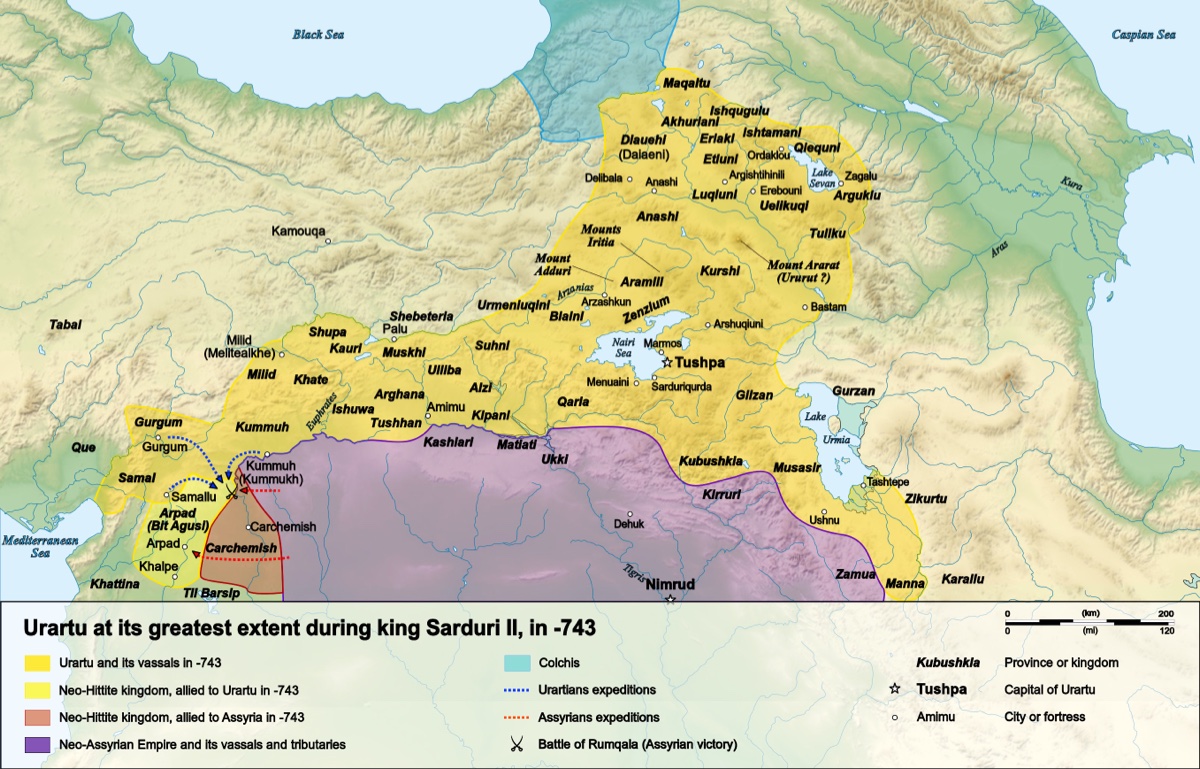
Caption: Map of the Ancient Kingdom of Urartu at its greatest extent. Attribution: © Sémhur / Wikimedia Commons / CC-BY-SA-4.0, or Free Art License.
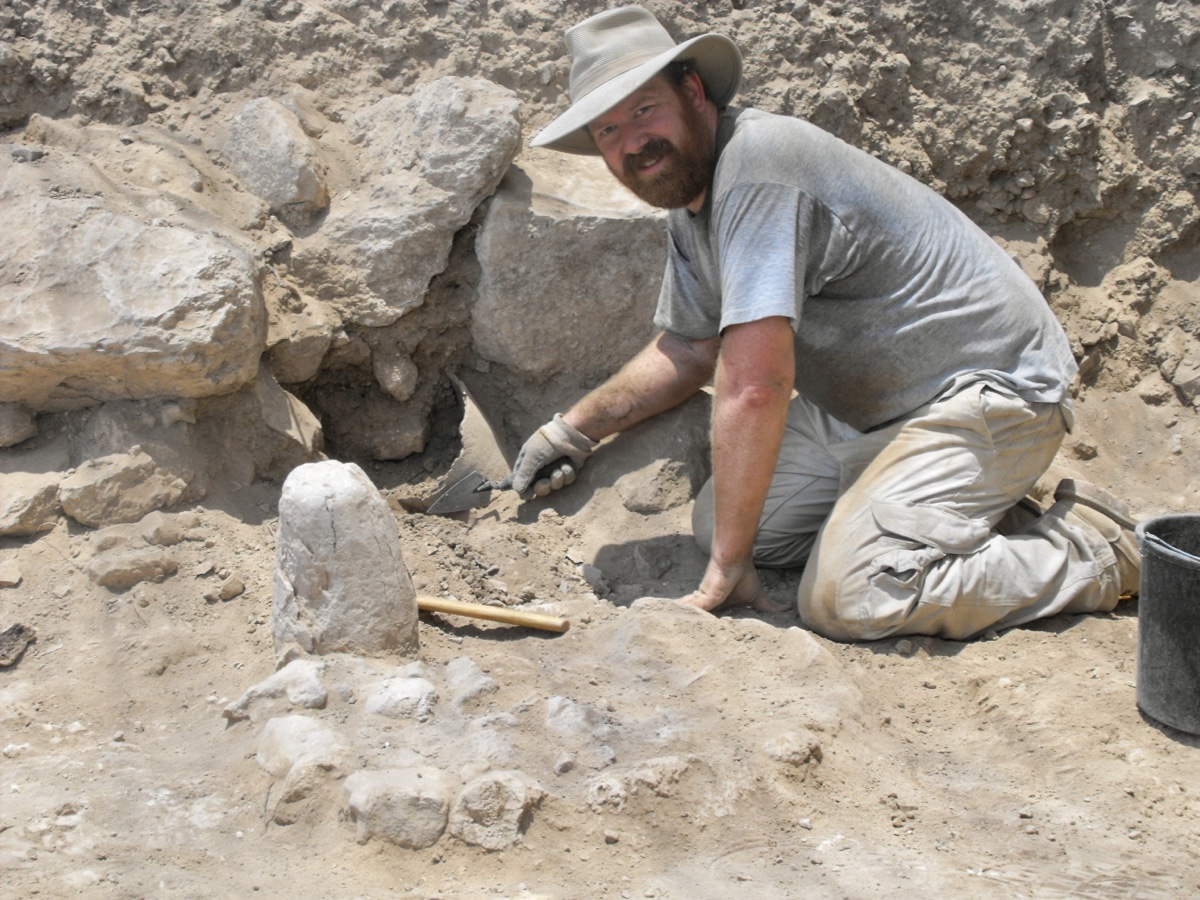
Caption: Luke Chandler at Archaeological Site. Photo by Prof. Jon Waybright.
Luke Chandler has worked with the North Terrace church of Christ near Tampa, FL, since 2006. He and his wife, Melanie, have five children. His websites are: Bible, Archaeology & Travel Blog and Chandler Tours. The church website is here. Luke holds an MA in Ancient History and has worked ten archaeological seasons in Israel. He can be reached here.




By Chris Reeves
Synopsis: As young couples move transition into matrimony, they should continue to communicate, rejoicing in their shared intimacy, while embracing their shared responsibilities.
Last month I wrote an article giving some suggestions for marriage planning. It focused on the importance of marrying a Christian, leaving and cleaving in a new relationship, taking care of your own responsibilities, fulfilling your God-given roles, starting out small, and living on a budget. In this article, I would like to conclude my mentoring advice with a few more suggestions to consider before you get married.
It is better to dwell in the corner of the housetop, than with a contentious woman in a wide house (Prov. 21:9, ASV).
It is better to dwell in a desert land than with a contentious and fretful woman (Prov. 21:19, ASV).
A continual dropping in a very rainy day and a contentious woman are alike (Prov. 27:15, ASV).
There will be times in your marriage when you have problems and disagreements between you and your spouse. This is natural. Therefore, you need to keep openly communicating with each other. Your spouse cannot read your mind. You have to keep talking. By talking, you can work out your differences. Someone may need to clarify himself. Someone may need to apologize. Someone may need to be reminded. One (or both) may need to undergo a change of thinking or behavior. Whatever the situation, talking will help to resolve the contention that exists. Not talking could lead to more problems. While it is easy to “clam up” and be silent, the better thing is to keep talking. You communicated openly during your dating years. Why not keep communicating after you get married? Agree ahead of time to keep communicating.
Live joyfully with the wife whom thou lovest all the days of thy life of vanity, which He hath given thee under the sun, all thy days of vanity: for that is thy portion in life, and in thy labor wherein thou laborest under the sun (Eccl. 9:9, ASV).
After you marry, it is good to continue to “date” each other. Continue to do fun things together like you did before you got married. Yes, there will be additional responsibilities in marriage that must be addressed, like your job, etc. However, you still have to make time for yourselves. You have to “keep the flame” alive, so to speak. Get out and enjoy life together. Don’t allow the responsibilities of life to run you down to where you are simply existing with your spouse without enjoying being with him (or her). I have seen married couples “grow apart” because of their jobs, their hobbies, etc. Dating after marriage will keep this from happening.
Drink waters out of thine own cistern, and running waters out of thine own well. Should thy springs be dispersed abroad, and streams of water in the streets? Let them be for thyself alone, and not for strangers with thee. Let thy fountain be blessed; and rejoice in the wife of thy youth. As a loving hind and a pleasant doe, let her breasts satisfy thee at all times; and be thou ravished always with her love. For why shouldest thou, my son, be ravished with a strange woman, and embrace the bosom of a foreigner? (Prov. 5:15-20, ASV).
It is important to stay sexually satisfied in your marriage. Often, Christians enter marriage not expressing themselves concerning what they want sexually. This may be because many young Christians are taught to not talk about sex when they are growing up in the home. After they get married, they do not talk openly with their spouse about what they want to experience sexually or how often they seek intimacy. Yet, couples need to fulfill each other’s sexual desires. Paul made this point in 1 Corinthians 7:1-5. When one spouse is sexually unsatisfied, that is when he (or she) will seek his gratification elsewhere. This could be with another person or through viewing pornography. Both, of course, are sinful and can lead to other devastating problems. This could all be avoided by being sexually satisfied at home.
Lo, children are a heritage of Jehovah; and the fruit of the womb is His reward. As arrows in the hand of a mighty man, so are the children of youth. Happy is the man that hath his quiver full of them: they shall not be put to shame, when they speak with their enemies in the gate (Ps. 127:3-5, ASV).
News reports and current statistics show that marriage and having children are on the decline in Western cultures. More and more people do not want to get married and have children. Why is this? Barring any health and medical reasons, one factor contributing to this recent choice could be selfishness. Many are more interested in working than in marrying. More young people today have expressed greater interest in a job than in a spouse or having their own children. While work is good, it is sad that many people do not see the value of getting married and having children. Marriage is honorable (Heb. 13:4). Children are a wonderful blessing (Ps. 127 and 128). You have someone beside yourself to love. You have someone to teach you responsibility. You have someone to mold and make into the image of a Christian one day. You have someone to give you grandchildren, which are fun to spoil. You have someone to take care of you in your old age. Having children is truly rewarding.
Now a certain Jew named Apollos, an Alexandrian by race, an eloquent man, came to Ephesus; and he was mighty in the Scriptures. This man had been instructed in the way of the Lord; and being fervent in spirit, he spake and taught accurately the things concerning Jesus, knowing only the baptism of John: and he began to speak boldly in the synagogue. But when Priscilla and Aquila heard him, they took him unto them, and expounded unto him the way of God more accurately (Acts 18:24-26).
The ways of the world can be very influential and weigh heavily on a married couple. There are things like cell phones, computers, social media sites, endless “notifications,” TV, movies, etc., that not only consume our time but also feed us a regular diet of worldliness. All of this is in addition to the worldly people you may have to be around at work. Counteract all of this worldliness with regular spiritual disciplines—like prayer and Bible reading together. Get a regular spiritual “recharge.” Pray together and not just for meals. Read through the Bible together each year. Don’t just read it, but also talk about what you have read, and make applications for your own marriage. Fill out your Bible class lesson together. Teach others God’s word, as did Priscilla and Aquila. Attend gospel meetings together and then talk about the service on the way home. Visit those with needs in the local church. Host a Bible study or singing in your home. With these spiritual disciplines at the center of your life, you will keep the world from negatively affecting your marriage.
And one of them, a lawyer, asked Him a question, trying Him: Teacher, which is the great commandment in the law? And He said unto him, Thou shalt love the Lord thy God with all thy heart, and with all thy soul, and with all thy mind. This is the great and first commandment. And a second like unto it is this, Thou shalt love thy neighbor as thyself. On these two commandments the whole law hangs, and the prophets (Matt. 22:35-40, ASV).
Make sure, when you get married, that you always keep your priorities straight. It is easy after marriage to get focused on yourself. After all, you’ve waited a long time for this, and finally the wedding day has come. It’s “our time,” you are thinking. After marriage, it is easy to focus on yourselves, your work, your free time, your house, your bills, etc. Then, when the children come along, it is easy to get focused on them. They have needs, they take up time, they get sick, they have school, they keep you busy, etc. I’ve seen couples marry and then run “the rat race” wide open, and chase “the American dream” with such fervor that they forget the Lord. It starts with their attendance at church services slacking off and then they quit all together. They will not make time to love and worship God and they will not make time to love and serve their neighbor. Their life is full of themselves only. Remember, a “prudent wife is from the Lord” (Prov. 19:14; see also 18:22). Don’t you think one good way to keep thanking the Lord for the wonderful wife that He gave you is to worship Him each Sunday?
I hope anyone reading these marriage planning articles will consider the beauty of God’s plan for marriage. I also hope that you will one day experience what my wife and I have experienced over the past thirty-five years. Our marriage has not been without its faults and its disagreements. Still, we always come back to the biblical principles that God has given us for marriage, and these principles have kept us together and have kept us enjoying each other’s love. If you will put some time into learning these same principles, you too will experience that wonderful relationship of marriage that goes all the way back to the beginning of time. It was Jesus who said: “Have ye not read, that He who made them from the beginning made them male and female, and said, For this cause shall a man leave his father and mother, and shall cleave to his wife; and the two shall become one flesh? So that they are no more two, but one flesh. What therefore God hath joined together, let not man put asunder” (Matt. 19:4-6). Amen to that!
Chris Reeves has preached for the Warfield Blvd. church of Christ in Clarksville, TN, since 2016. He and his wife, Cheri, have four children and two grandchildren. His Bible study website is here. The church website is here. He can be reached here.





By Abraham Mayberry
Synopsis: By examining the third commandment given at Mount Sinai in its original context, young people can learn that “bearing God’s name” is more than just the words they speak, but encompasses a fully changed identity and lifestyle that is still relevant today.
“What’s in a name? That which we call a rose, by any other word, would smell as sweet” (Shakespeare, 39). This famous quote comes from the popular balcony scene of Romeo and Juliet, where Juliet questions why Romeo must be part of their enemy’s family, the Montagues. Because of her love for Romeo, Juliet believes a “name” is simply a word, and it shouldn’t matter that he is a Montague. Yes, a name is just a word, but I believe it is much more critical to a person than Juliet thinks.
Names are important because they shape our identity. We bear the name given to us from the womb to the tomb. We wear different names in life. My family name is Mayberry, which causes people to think of the Andy Griffith show or my many relatives. When my students hear Mr. Mayberry, they probably think about my classes and the homework I sometimes give them. At work, I wear the name of a Florida College Academy Prep high school teacher. With that, I am responsible for representing that institution’s values in my work. As a member of the University church of Christ in Tampa, I find belonging in a caring church community that strives to follow Christ and support me as one of their own.
Names provide us with identity, help form our values, and give us a sense of belonging and mission. In the Scriptures, God teaches us a lot through names.
Probably, one of the first places when thinking of names in the Bible comes from one of the 10 Commandments given to the nation of Israel, where the LORD says, “You shall not take the name of the LORD your God in vain, for the LORD will not hold him guiltless who takes His name in vain” (Exod. 20:7). Growing up, I usually heard this verse in context to not using God’s name as a swear word. It is a serious offense because it is irreverent and dishonors our Creator. It is crucial how we use God’s name. While that is true, this command is so much more than just saying God’s name irreverently.
Looking at the Hebrew word nasah, here rendered “take,” can mean “to bear, carry, lift up, or take.” Examining other parts of Exodus, we can find how Scripture helps us better understand that this can mean more than just our speech. Compare this to Exodus 28, where we read about the specific clothes assigned to the high priest because of their role and position: “So Aaron shall bear the names of the sons of Israel in the breastpiece of judgment on his heart, when he goes into the Holy Place, to bring them to regular remembrance for the LORD.” Aaron literally carries the names of Israel’s tribes on him. This idea is similar to “carrying the name of the LORD” (Exod. 28:29). As a priest, he was a representative of God to the people of Israel and also a representative of the people before God.
So when God tells His people, “Now therefore, if you will indeed obey my voice and keep my covenant, you shall be my treasured possession among all peoples, for all the earth is mine; and you shall be to me a kingdom of priests and a holy nation. These are the words that you shall speak to the people of Israel” (Exod. 19:5-6). Dr. Carmen Joy Imes presents this concept in her book, Bearing God’s Name, by stating,
By looking at Aaron, every Israelite is reminded of their calling as a nation. Just as he is set apart for service (“holy”), so are they (“a holy nation”). At Sinai, Yahweh claims this nation as His very own and releases them to live out their calling. That calling is to bear Yahweh’s name among the nations, that is, to represent Him well (Imes, 48-52).
God was transforming this group of scattered slaves in Egypt into His holy nation. Israel’s calling at Mount Sinai was to bear the LORD’s name to the rest of the world and represent Him well. God claimed Israel as His people. If they were to live in a way that would be a negative portrayal, that would be a great offense and sin against God. As God’s representatives, they are responsible for accurately representing God.
Looking at the rest of Israel’s history, they failed to fulfill this mission by profaning the name of the LORD. In Ezekiel 36, the prophet reflects on this failure, revealing that God had concern for His holy name because Israel violated and misrepresented God’s holy name among the nations. Because Israel failed to represent God well, God fixed the situation through Jesus.
In the New Testament, the theme of the name continues. Jesus is God that came to earth to save humanity from their sins. The apostle Paul states, “Therefore God has highly exalted him and bestowed on him the name that is above every name, so that at the name of Jesus every knee should bow, in heaven and on earth and under the earth, and every tongue confess that Jesus Christ is Lord, to the glory of God the Father” (Phil. 2:9-11). Paul associates the LORD’s name with Jesus, demonstrating that Jesus is God, and thus worthy of praise.
Jesus taught His disciples to follow His example (John 13:15). That includes making disciples of all nations, baptizing them in the name of the Father, Son, and Holy Spirit, and teaching them all He commanded (Matt. 28:19-20). Through putting on our faith in baptism, the Holy Spirit marks us as a name-bearer for Yahweh (Eph. 1:13). Dr. Imes compares this to an invisible, spiritual tattoo showing whose we are (Imes, 180). God calls Paul a chosen instrument to carry the name to the world (Acts 9:15). Just like Israel was supposed to represent God to the nations, the church is also to represent Jesus to the world. Instead of gathering at Mount Sinai, where the people symbolically receive the name in the Old Testament, in Revelation, the faithful continue to bear the LORD’s name at Mt. Zion (Rev. 14) (Imes, 180-181).
Taking the name of God is central to the story of the Bible and the responsibility of all Christians today. When we fail to live as God wants us to, the result is the same as that of Israel—God’s name is dishonored and blasphemed. Our bad examples and hypocrisy can lead others away from God. Because we call ourselves Christians, that gives us an identity that shapes our values and mission to live a holy life and represent God well.
Just like Israel, God calls us to live a transformed life that well represents Him. This calling to represent Him well covers all aspects of our lives.
We can carry His name through our speech. That includes sharing the gospel with others, constantly praising God for His blessings, and not using God’s name as a swear word. Whether in the line at Publix, eating lunch with friends at school, posting on Instagram, or conversing with coworkers, we should incorporate Christ in every single conversation. It can be as simple as thanking God for a beautiful day, tasty food, or my presenting the Good News. Our words can tell others about the awesome God that we follow.
Another way we can bear God’s name is through our dress. Do our clothes direct others to God or ourselves? What do our clothes communicate by their brand’s ethical practices, length, tightness, images, or messages?
Last, we can be a representative of God through our actions. We should follow Christ’s example of forgiveness, obedience, self-control, patience, and sacrifice. Living as a name-bearer for Christ should make us stand out. We are to be a representative of His kingdom and can find belonging, support, and unity in God’s church as we strive to bear God’s name well.
Paul’s wisdom for this type of life is that in “whatever you do, in word or deed, do everything in the name of the Lord Jesus, giving thanks to God the Father through Him” (Col. 3:17). Although Shakespeare’s Juliet believed names shouldn’t mean much, the spiritual name we wear is essential to our calling in our Christian walk.
All Scriptures are quoted from the English Standard Version (ESV). Wheaton, IL: Crossway Bibles, 2016.
Imes, Carmen Joy. Bearing God’s Name: Why Sinai Still Matters. Dower’s Grove, IL: InterVarsity Press Academic, 2019.
Shakespeare, William. Romeo and Juliet. New York: Penguin Press, 2016.
Abraham Mayberry grew up in Nashville, TN. He attended Lipscomb Academy K-12 and Florida College between 2019-2022. At FC, he received his BA with a major in History and with minors in Biblical Literature and Education. He now works as a high school teacher at Florida College Academy Prep in Temple Terrace, FL. For more information on the Academy, go here. He can be reached here.






By Joe R. Price
Synopsis: The public invitation is a vital part of preaching the gospel of Christ. Yet today, the gospel invitation is often diminished or depreciated. Drowning men need a lifeline. Dying men need to know of the hope that is offered through Jesus Christ.
It would seem some Christians, including some elders and gospel preachers, are becoming increasingly comfortable with not explaining and extending a public invitation to obey the gospel when concluding gospel sermons.
Some tell us that offering a public invitation is a relatively recent phenomenon. This conclusion is likely so within the context of a historical analysis of denominations and their “altar call.” However, divine truth is not established and verified by the historical practices of American denominations or historical practices within American Restorationism. We are concerned with (and want a Bible answer to) the question of whether we have Bible authority to offer public gospel invitations.
Is it scriptural to urge sinners to “come forward” and obey God when we preach the gospel? The answer may seem self-evident, yet, we wish to “test all things” and “hold fast what is good” (1 Thess. 5:21). If Bible approval exists for public invitations to obey the gospel, is it an optional matter of judgment, or a mere tradition of churches of Christ? If Bible authority exists for preaching gospel invitations, we must do so (Col. 3:17). Put another way, what if we do not offer the gospel invitation when we preach? Are we following a Bible pattern by not so doing? What Scripture provides such a Bible pattern of abstinence?
What does Scripture say about the origin of the public invitation to obey the gospel? The first gospel sermons (preached by the apostles) after the ascension of Jesus made public appeals to sinners to “call on the name of the Lord” to be saved (Acts 2:21-22, 36-39). Note this summary statement: “And with many other words, he testified and exhorted them, saying, ‘Be saved from this perverse generation’” (Acts 2:40). That is the origin of the public gospel invitation.
Our Master said, “Come unto Me all you who labor and are heavy laden, and I will give you rest. Take My yoke upon you and learn from Me, for I am gentle and lowly in heart, and you will find rest for your souls. For My yoke is easy and My burden is light” (Matt. 11:28-30). Jesus publicly invited people to come to Him. We may confidently follow His example and invite sinners to come to Jesus for salvation. Indeed, we must!
The three thousand souls who gladly received the word of God on Pentecost had to identify themselves to the apostles in some way, or else they would not have known who wanted to repent and be baptized (Acts 2:41). Whether by raising their hand, coming forward, or going to the rear—it makes no difference. They identified themselves as believers who wanted to be saved (repent and be baptized) by publicly responding to the public call of the gospel to be saved.
The New Testament contains additional gospel invitations (both public and private): Acts 3:19-26; 8:5-8; 8:35-37; 13:43; 22:15-16; 24:24-25; 26:20; 28:27-29; Rev. 22:17. These show that gospel preaching includes pleas to sinners to respond in faith and be saved (John 6:45). In the New Testament, sinners were invited (i.e., urged, persuaded, encouraged, instructed) to obey the gospel immediately. Should we not do the same?
I am unaware of brethren who say we should not offer a gospel invitation when we preach. To my knowledge, no one says the public invitation is unauthorized and against the will of God. Yet, there seems to be a significant number of gospel sermons being presented with no gospel invitation offered to the audience. Many conclude with the general summation, “If you have a need, come forward while we stand and sing,” offering no elaboration or explanation about the need, why a need exists, and how to remedy said need. Why is there a growing absence of gospel invitations from preachers?
Some brethren seem convinced that the public invitation to obey the gospel is optional (a late arrival on the preaching scene), designed to be an emotional appeal rather than a genuine plea to respond in faith to obey Christ. While the origin and use of the public invitation among denominations are associated with unbiblical emotionalism and other false teachings (including how to be saved), the public invitation to obey the gospel of Christ did not originate in frontier America.
Perhaps we are hearing fewer gospel invitations because we do not want to deal with the “messy” circumstances of people’s lives? We want to present the gospel in a positive light, so we are tempted not to fully identify sin, explain its effects, and call sinners to obey Christ to be saved (Heb. 5:9)? If this is the state of affairs when we preach, we have abandoned the calling of the gospel (2 Tim. 4:1-5).
Could is be that the gospel invitation is becoming extinct in some pulpits because preaching has taken on an air of academia that is void of pressing appeals to repent or perish? For some, preaching has become the equivalent of giving a lecture, presenting a paper, offering a viewpoint, and analyzing positions instead of proclaiming the gospel with its necessary reproofs, rebukes, and exhortations that urgently call sinners to repentance (2 Tim. 4:2-4; 2 Cor. 6:2; Heb. 3:12-13; Acts 2:40). We would do well to recall that telling or hearing some new thing is not gospel preaching, but the ruminations of “this-world” oriented philosophers (Acts 17:21, 30-34; 1 Cor. 1:18-25). Such exercises rarely lend themselves to declaring absolute truth and the necessity of obedience to be saved (Acts 17:30-32). When churches advertise gospel meetings by introducing a preacher’s academic achievements to the community, is God’s word or human accomplishments offered to give credibility and incentive to hear the gospel? We know that the identifying marks of an evangelist are not educational degrees conferred by men (John 7:15; Acts 4:13; 1 Cor. 2:1-5). Why are they being used by some to introduce preachers?
We are not binding a “church of Christ tradition” or mimicking American evangelicalism when we publicly invite, urge, and persuade sinners to come to Christ. Preaching the gospel demands that we do so (2 Tim. 4:2). When we preach the word, we must identify sin (i.e., reprove), present the need for change (i.e., rebuke), and urge sinners to obey the gospel plan of salvation (i.e., exhort). Do not let any preaching opportunity pass without urging sinners to believe and obey the gospel. “Knowing therefore the terror of the Lord, we persuade men” (2 Cor. 5:11). May we always urge sinners to come and draw from the wells of salvation (Isa. 12:3; John 4:13).
The Spirit and the bride say, “Come!” Let him who hears say, “Come!” Let him who thirsts come. Whoever desires, let him take the water of life freely (Rev. 22:17).
Joe has worked with the Vegas Drive church of Christ in Las Vegas, NV, since October 2022. His website is here. The church website is here. He can be reached via email here.


By Greg Prince
Synopsis: Understanding faith as blind trust, especially when the way forward looks uncertain or tough, leaves us unprepared to endure. Paul calls on the experience of Habakkuk to inform our understanding of faith in the gospel message.
In the whole of Scripture, there are particular verses or statements that reveal profound truths about the LORD God and His relationship with His righteous people. We find one of those in the opening of Paul’s letter to the Romans (1:16-17). As he leans into the language of a new kingdom (1:7) and emphasizes the importance of spreading the good news (1:15) of a new king (1:3, thus fulfilling 2 Samuel 7:1-17), Paul says that his ultimate calling as an apostle is “to bring about the obedience of faith for the sake of His name among all the nations” (1:5).
Having assured the Romans that he is dedicated to the care and strengthening of their faith (Rom 1:7-15), Paul affirms in Romans 1:16-17 that he is not ashamed of the gospel, because it serves a great role in the salvation of all and builds faith for the children of God. Within this statement, Paul quotes the words of the prophet Habakkuk 2:4. By taking time to consider carefully the words of Habakkuk, our spiritual vision becomes more focused. Through this lens, Paul leads the readers of his letter to better understand true faith. As we study the prophet Habakkuk, the truth about faith will come into focus. Faith is not simply a blind trust in God when life is difficult or uncertain. Rather, both Paul and Habakkuk would encourage us to define faith as being so strongly rooted in the knowledge of God’s fidelity to His promises that we walk boldly in the path of righteousness, even when we cannot see His immediate action in the trials and difficult situations we face.
The record of Habakkuk’s prophecy begins with the prophet addressing the LORD in prayer. Habakkuk is raw in his lament before God (1:1-4). While being oppressed by Assyria, Egypt, and a wicked King Jehoiakim, Habakkuk had been trying for some time to request relief from the Lord. He cries out, “How long shall I cry for help, and you will not hear?” (1:2). Having grown weary of the oppression, Habakkuk turns to God, though it seems to take a tone of frustration and not express a full faith in God’s plan. He even asks the age-old question, “Why do you make me see iniquity?” (1:3). We don’t have to think hard, or long, to recall times when we have been so frustrated by our circumstances and situations that we have asked similar questions of God.
The Lord answers by a call to look again and see that He is at work (1:5-11). Unfortunately for Habakkuk, and the people of Judah, God does not relent from His planned judgement against His wicked people. We can only imagine that Habakkuk was hoping for a response from God that would reveal that relief was imminent, or at least not too far in the future. However, Habakkuk receives news worse than that—news that the situation is about to get worse. Which raises a question; how would we react if God didn’t answer our prayers with “I’m giving you what you are asking for” or “not yet,” but “it’s going to get worse?”
Habakkuk doesn’t understand how this can be the response he is getting from God (1:12-2:1). In fact, as he recognizes the Chaldeans (Babylonians) are intended as a judgement against the wickedness from which he sought relief, this understanding presents another challenge and a new question: How can a Holy God continue to watch as a wicked nation judges a more righteous nation? (1:12-13) More to the point, Habakkuk asks if this pattern of judgement is going to continue without mercy?
In preparing for God’s response, Habakkuk manifests the attitude we should have when honestly seeking answers from God. He says, “I will take my stand at my watchpost” and look and see what you are doing, and consider how I will respond to what you say next (2:1). Changing his perspective, Habakkuk climbs to the watchtower, where he would stand still and attempt to see the situation from the Lord’s perspective. Instead of trying to persist in proving his point, Habakkuk carefully considers how God will answer his complaint. He challenges himself to reconsider his perspective—and openly accept God’s response and the knowledge He imparts through His word. The most impactful move we can make in a time of trial is to remove ourselves from the situation to gain perspective, commune with God in prayer, and seek to see our life through the lens of God’s word.
The Lord responds to Habakkuk with a vision of the judgement that is to come. In fact, the Lord clarifies that He will cast judgment on all wickedness, not just the more wicked nations. This is a theme that is also borne out in Romans 1-3, in that all unrighteousness will be judged. In Habakkuk 2:6-20, we read the language of the woes, or warnings. Not only do the nations that oppress Israel stand indicted, but also those among God’s chosen people who have turned away from His righteous standard. The theme throughout these warnings is turning to our own pride and ideas or serving our own gain and wealth, but ignoring the LORD, will bring judgement and wrath to each of us.
The only way to survive the judgement of the LORD, the day of the LORD, is through faith. God clarifies that a puffed-up soul is not upright, “But the righteous shall live by faith” (2:4)
Recognizing the error of his understanding of his current distress, Habakkuk offers a wonderful insight into true faith. Consider his renewed spirit in his third prayer to God as Habakkuk begins by recalling the stories he had heard of God bringing the people out of Egypt to Mt. Paran (Sinai), descending into the presence of the people in a cloud of thunder and lightning, and the plagues and pestilence that God cast on the wicked nation of Egypt (3:2-5). Habakkuk recognizes God’s glory and power in every situation through His ability to measure the earth, shake up the nations, find a people that He would love, wage war on their behalf, and mightily overwhelm any foe (3:6-15). Even though Habakkuk is struck with fear and awe in view of God’s strength and control (3:16), he recognized a unifying truth revealed about God.
The simple truth is that in every situation, Habakkuk says, “you rode. . . on your chariot of salvation” (3:8), “you went out for the salvation of your people” (3:13), “for the salvation of your anointed” (3:13), and “I will take joy in the God of my salvation” (3:18). It is the last of the salvation statements that encapsulate the full value of Habakkuk’s faith in the Lord, despite the seemingly endless oppression and destruction all around him and in the nation of Israel. It is as though Habakkuk is proclaiming that he will no longer doubt the Lord, because the Lord has proven His dedication to the salvation of His people.
Habakkuk summarizes his faith by proclaiming his trust in the LORD. If the blessing of food and protection were to end, Habakkuk knows that the LORD will strengthen and guide his steps on even the most treacherous of paths (3:17-19). He clarifies for us that his faith is not built on seeing a peaceful path or physical comforts in front of him. Rather, faith is knowing how God has been faithful to His promises and His unwavering concern for the salvation of His people, even when faced with destruction and captivity at the hand of Egypt, Assyria, Babylon, or even Satan. Which brings a richness to the statement Paul makes when reminding the Corinthians that this life and body we live in is nothing compared to the home that waits for us in heaven, “for we walk by faith, not by sight” (2 Cor. 5:7).
Returning to our text in Romans, Paul declares that we should never be afraid to walk by faith and to use every opportunity to speak about the gospel of Christ. Because in Christ, God showed “the immeasurable greatness of His power” (Eph. 1:19-23) to bring salvation to everyone who will believe and endure in faith. For us to endure the trials that lay ahead, or to find peace in the middle of the struggles today, there is only one way that we can shore up our faith. I encourage each of us to stop relying on “blind faith.” Instead, grow in your knowledge of the faithfulness of God daily, so that you will build up a faith of great strength (Rom. 10:17).
The Holy Bible: English Standard Version (ESV). (2001) 2016. Wheaton, IL: Crossway, a publishing ministry of Good News Publishers.
Greg Prince has just completed a summer working with the Downers Grove church of Christ in Downers Grove, IL. He is entering the work of full-time evangelism following a background of fifteen years in business administration. He can be reached here.


By Glendol McClure
Synopsis: The harm caused by murmuring is often not recognized or regarded by those who take part in this form of sinful speech.
Neither murmur ye, as some of them also murmured, and were destroyed of the destroyer (1 Cor. 10:10, KJV).
When the apostle Paul penned his first letter to the brethren in Corinth, he addressed many problems among them. He rebuked them for being divisive and contentious (1 Cor. 1 & 3), for being fleshly minded (1 Cor. 2-3), for tolerating fornication (1 Cor. 5), for going to law one against another (1 Cor. 6), for despising the church and polluting the Lord’s Supper (1 Cor. 11), and for doubting the resurrection (1 Cor. 15)—just to name a few.
In our text, Paul reminds the Corinthians of how the Israelites murmured in the wilderness (Num. 14:1-2). Mentioning various sins that they committed during this time, Paul warns the Corinthian brethren with these words: “Now these things were our examples, to the intent we should not lust after evil things, as they also lusted” (v. 6). Again, “Now all these things happened unto them for ensamples: and they are written for our admonition, upon whom the ends of the world are come” (v. 11). Of course, the examples the Israelites (which Paul urges us to heed) are not recorded for us to follow but to avoid! Specifically, let us consider Paul’s rebuke concerning murmuring: “Neither murmur ye, as some of them also murmured, and were destroyed of the destroyer.”
Much is said about the sin of murmuring in the Old Testament. The harm caused by murmuring is often not realized or regarded by those who partake in this evil. Let us consider this sin, so that we can better understand (1) God’s hatred of murmuring, (2) the damage it can cause, and, (3) encourage those who are guilty of this sin to repent.
In the opening chapters of Deuteronomy, Moses looks retrospectively at events that occurred during the forty years’ journey from Sinai to Moab. He recalls the Lord’s call to the Israelites to take possession of the land of Canaan and how they refused to enter the land to take it because of the evil report of the ten spies who feared the sons of Anak. Joshua and Caleb alone gave a good report saying, “Only rebel not ye against the LORD, neither fear ye the people of the land; for they are bread for us: their defence is departed from them, and the LORD is with us: fear them not” (Num. 14:9). In Deuteronomy 1:26-38, Moses recalls this period of rebellion which stemmed from their murmuring. This section of Scripture shows that murmuring is sinful and leads to destruction (1 Cor. 10:10).
In Numbers 14:26, Moses wrote, “Notwithstanding ye would not go up, but rebelled against the commandment of the LORD your God.” Rebellion is a common practice among many, and a serious matter, especially when it is against God. King Saul rebelled when he disobeyed God’s command, “Go and smite Amalek, and utterly destroy all that they have, and spare them not; but slay both man and woman, infant and suckling, ox and sheep, camel and donkey” (1 Sam. 15:3). Instead of obeying God, “Saul and the people spared Agag, and the best of the sheep, and of the oxen, and of the fatlings, and the lambs, and all that was good, and would not utterly destroy them: but everything that was vile and refuse, that they destroyed utterly” (1 Sam. 15:9). Samuel confronted Saul, rebuking him at the Lord’s direction, saying, “Behold, to obey is better than sacrifice, and to hearken than the fat of rams. For rebellion is as the sin of witchcraft, and stubbornness is as iniquity and idolatry. Because thou hast rejected the word of the LORD, He hath also rejected thee from being king” (1 Sam. 15:22-23). Remember, murmuring is “against the Lord” (Exod. 16:8).
In Numbers 14:27, Moses said, “Ye murmured in your tents, and said, ‘Because the LORD hated us, He hath brought us forth out of the land of Egypt, to deliver us into the hand of the Amorites, to destroy us.’” The Israelites were guilty of murmuring in their tents (i.e., privately), which generated an evil imagination about the Lord’s plans for them, even though He had promised to bless them and give them the land. When brethren murmur, they often do it “under their breath,” or in a private setting among others who agree with them. Often, they do not have all the facts of the particular situation concerning which they are murmuring, and, as a result, sow sinful seeds of discord (Prov. 6:14, 19; 16:28). Remember, we reap what we sow, and if the seeds of discord and strife are sown, discord and strife will be produced (Gal. 6:7-8). Rather, sow righteousness, and you will reap a sure reward (Prov. 11:18; Jas. 3:13-18).
In Deuteronomy 1:27, the text says, “Ye murmured in your tents, and said, ‘Because the LORD hated us, He hath brought us forth out of the land of Egypt, to deliver us into the hand of the Amorites, to destroy us.’” This text reveals a notable assumption of the Israelites—“the Lord hated us.” No, He loved them! He heard their crying, sighing, and groaning while in Egyptian bondage (Exod. 2:23-25). Because of His love, He delivered them from the bondage of the Egyptians. Likewise, God, in His love for man, has revealed a plan whereby we can be delivered from the bondage of sin through faith in Christ. Many today murmur and complain about God’s plan of salvation by denying the necessity of water baptism for the remission of sins (Acts 2:38; 22:16; Mark 16:15-16; Rom. 3:24-25). Be content with God’s way and obey Him. Remember the words of Solomon, “There is a way that seemeth right unto a man, but the end thereof are the ways of death” (Prov. 14:12; 16:25).
In Deuteronomy 1:28, the text says, “Whither shall we go up? Our brethren have discouraged our heart, saying, ‘The people is greater and taller than we; the cities are great and walled up to heaven; and moreover, we have seen the sons of the Anakims there.’” The faithless spies who doubted were a discouragement to their brethren. In Numbers 13:30, Caleb said, “Let us go up at once, and possess it; for we are well able to overcome it.” However, the faithless and murmuring spies said, “We be not able to go up against the people; for they are stronger than we” (Num. 13:31). Verses 32-33 of this chapter records the “evil report of the land” these murmurers brought forth.
God’s people were not content to be free of Egyptian bondage. Despite having been delivered and set free from Pharaoh’s rule, the murmuring of God’s people caused them to lose faith in Moses as a leader and doubt God’s protection and sovereignty. There are many cases of murmuring by the Israelites. In Numbers 12, Miriam and Aaron murmured against Moses because he married an Ethiopian woman. When Miriam was struck with leprosy (v. 10), Aaron confessed their sins and pleaded to Moses for her to be cleansed (vv. 11-15). In Numbers 16, Korah and his company of cohorts murmured and rebelled against God when they made false accusations against God’s appointed leader, Moses. It is clear from the rebellion of Korah that they were not content with their assigned Levitical duties. The rebellion that stemmed from this murmuring resulted in severe punishment when God caused the ground to open up and swallow them. The two-hundred and fifty men who offered incense were consumed by fire from the Lord (v. 35). As we read further into this chapter, the next day, the people murmured against Moses and Aaron, and fourteen thousand died by the ensuing plague before it was stayed (vv. 46-50).
Murmuring causes the reputations of good, faithful people to suffer lasting damage and results in discord among God’s people! Is there any wonder why Jesus warned of evils which proceed out of the mouth come from the heart (Matt. 15:18-20)? James also warned of the dangers of the tongue (Jas. 3:1-12). Nothing profitable comes from murmuring! Can you see how harmful murmuring is and why God’s word warns against this sin? May we all obey Jesus’s words—“murmur not among yourselves” (John 6:43). Consider the admonition of the apostle Paul who wrote, “Do all things without murmurings and disputings: That ye may be blameless and harmless, the sons of God, without rebuke, in the midst of a crooked and perverse nation, among whom ye shine as lights in the world” (Phil. 2:14-15). Brethren, “Think on these things!”
All Scripture citations are from The Holy Bible: King James Version (KJV).
Tommy Glendol McClure has preached for the South Washington Street church of Christ in Lodi, CA, since 2016. He is encouraged by his wife, Rowena. The church website is here. He can be reached here.

By Jacob Hudgins
Synopsis: Jesus’s parable of the seed growing shows us how the kingdom works—even when we don’t fully understand.
Jesus often explains the kingdom by comparing it to seeds. The kingdom is like a man sowing seed in a variety of soils (Mark 4:3) or like a mustard seed with its explosive, exponential growth (Mark 4:31-32). Yet this parable, unique to Mark, takes a different approach to the seed:
The kingdom of God is as if a man should scatter seed on the ground. He sleeps and rises night and day, and the seed sprouts and grows; he knows not how. The earth produces by itself, first the blade, then the ear, then the full grain in the ear. But when the grain is ripe, at once he puts in the sickle, because the harvest has come (Mark 4:26-29).
Jesus is discussing how God is at work in the world, especially through His word and people. What He reveals is surprising, eye-opening, and humbling—yet also encouraging and affirming. How does the kingdom work?
Jesus’s story is like a time-lapse video. The farmer scatters his seed, then we see time pass quickly: “He sleeps and rises night and day, and the seed sprouts and grows; he knows not how” (Mark 4:27). This is what seeds do; they “sprout and grow.” Jesus also describes stages of the growth—“first the blade, then the ear, then the full grain in the ear” (Mark 4:28). Growth is not immediate. Something small does not become something big in an instant. Nevertheless, we notice the progression as the seed becomes something it was not before. God’s power and work is like a seed. It is not stagnant. It grows.
This is the obvious force of Jesus’s agricultural parables. What begins as a seed bears fruit “thirtyfold and sixtyfold and a hundredfold” (Mark 4:20). What begins as a mustard seed “grows up and becomes larger than all the garden plants and puts out large branches” (Mark 4:32). God’s powerful word is like this. It is dynamic, vibrant, and alive. It presses forward inexorably. It spreads and sprouts and becomes something far greater than its beginnings. This is how the kingdom itself works, beginning with a handful of Galilean peasants and spreading, multiplying, and ever expanding over the face of the known world. It is also how the kingdom works in our hearts. Small ideas—that there is a God, that He loves me, that He has a will for my life—take root and spread. Those little thoughts affect everything, taking over my thinking, my marriage, my speech, my moral choices and my sense of purpose for my life.
When we see this dramatic growth, we know God is at work. When we are not growing, we must ask: What’s going wrong?
Jesus also stresses that the farmer does not do anything to make the seed grow. “The kingdom of God is as if a man should scatter seed on the ground. He sleeps and rises night and day, and the seed sprouts and grows; he knows not how” (Mark 4:26-27). He sows the seed, then tends to other things. It is not his effort that propels the kingdom forward. He sows the seed, and at the right time reaps it, but he does not make it grow.
Jesus adds that “he knows not how.” This is the same term Jesus uses in Mark 4:13: “Do you not understand this parable? How then will you understand all the parables?” We struggle to understand and know. There is mystery involved in God’s work. What is God up to in the world? What is God doing in winning this (or that) person to Him? What is God accomplishing among the nations? We do not know. Yet, what we know is that the growth Jesus described still happens all the time, all around us. The statement, “he knows not how” is no insult to farmers, who have a deep understanding of their work and the nature of agriculture. We know how to harness the awesome forces of nature, but even today, we do not know exactly how or why they work the way they do. That is the kingdom: it grows mysteriously.
Jesus also stresses that “the earth produces by itself” (Mark 4:28). Some versions render this term “by itself” as “spontaneously” or “without visible cause” or “without his help.” The earth does this regularly; just leave the ground alone and something will likely grow there. “The earth produces by itself.” We watch in wonder as a little seed becomes a blade, then an ear, then a full grain. How does this work—even without our assistance or understanding? We do not know!
This still surprises us. We often think that God should act in big, bold ways. He should answer all of my questions. He should permanently resolve all the heartache in the world. Yet God has revealed himself by coming to earth as a Man, living in relative obscurity, and dying in shame for others’ sins. Will the kingdom be big, bold, impressive, or violent? No, it is “not coming in ways that can be observed” (Luke 17:20). It grows mysteriously. It grows like “leaven that a woman took and hid” (Matt. 13:33). We do not always know how God does His work, but we trust the One who operates behind His word and work.
“But when the grain is ripe, at once he puts in the sickle, because the harvest has come” (Mark 4:29). We have shifted focus back to the farmer. It is time to put the sickle in and gather what has been growing. It is a reminder that all growth has a direction, endpoint, and goal. The kingdom grows toward a harvest.
Usually Jesus depicts this as fruit. When we obey the word of the gospel, that word bears its fruit (Mark 4:20). When lives are changed, new deeds are done, sins are conquered, and new attitudes are embraced, the word bears fruit. When we see this growth, it reminds us that God has an ultimate goal for our character. He wants us to grow toward “the measure of the stature of the fullness of Christ” (Eph. 4:13) and to be “conformed to the image of His Son” (Rom. 8:29). If God has started this work in me, it is proof that He has a direction and goal for me.
Jesus’s phrase, “he puts in the sickle” (Mark 4:29), is almost an exact quote of an Old Testament prophecy: “Put in the sickle, for the harvest is ripe. Go in, tread, for the winepress is full. The vats overflow, for their evil is great” (Joel 3:13). Joel’s context is describing God’s judgment of the world in the “day of the LORD.” Jesus’s words point toward the fact that there will be a time in which God puts the sickle in and reaps the harvest. Every time we see the growth of God’s word, it reminds us that He is doing something in the world and it will have an endpoint. Every good work we see, every evil thing we see redeemed, every step toward maturity and goodness we are given is a down payment on what is ahead.
Jesus’s odd little parable emphasizes how our lack of full understanding may be a part of ordinary discipleship. However, What If We Don’t Fully Understand?
“He knows not how” means that there will be mystery. We try to understand, but some things may remain beyond our comprehension. We may have global questions. We may have Bible questions. We may have personal questions, but we can still trust that God is going to do what He promised, keep drawing people to Him, and do what is best for us.
The farmer does not let his ignorance keep him from doing his work—sowing the seed and reaping the harvest. Each of us has his own work to do on our character, in our homes, and in our communities. God will do the higher-level work of making my work into something useful to Him; my job is to tackle the jobs in front of me.
Like the farmer, when we see growth, change, and movement toward God’s purposes, we can give God glory. We can acknowledge that we are not the ones responsible (1 Cor. 3:6-7). God is at work blessing, saving, healing, answering prayer, bearing fruit in people through His Spirit, and ruling in the kingdom of men. I may not understand it all, but I can recognize His work.
The essential question is, “Will I keep following Jesus—even when I don’t fully understand?”
Jacob Hudgins has worked with the Twin City church of Christ in College Station, TX, since 2021. He and his wife, Sarah, have three children. His website is here. The church website is here. He can be reached here.

By Mike Richardson
Synopsis: When I asked Mike if he would write an article on how the Holy Spirit operates on Christians, he replied, “I accept the assignment with some trepidation. I doubt my feeble efforts will be adequate, but I will give it a shot.” Brother Richardson had done an excellent job in addressing a difficult topic. Accordingly, I commend his article for your edification.–Editor.
When I first started preaching the gospel of Christ, I recall some advice I was given. Don’t preach too much on the Revelation letter and do not preach too much on the Holy Spirit. I believe this advice was given to help a young preacher not become too embroiled in controversies concerning which he might be unable to respond adequately. I willingly confess there is still a lot about the Revelation letter that I do not fully grasp; however, there is a lot I can understand, and it is beneficial to my spiritual life. Likewise, regarding the Holy Spirit, I may not know everything about Him, but I know some things from the Word of God that have helped me and have built up my faith. I do not believe that I will answer all the questions that we might have about the Holy Spirit. As a friend wrote to me, “Finite beings cannot fathom the actuality of a non-sensory Being.” There are some things we want to understand and explain that are just beyond our grasp. The Holy Spirit is the Great Revealer, and He has revealed the Word of God to us through the inspiration of the writers of God. He has revealed truth, including that about Himself.
I assure you that all I know about the Holy Spirit is what has been revealed in the Scripture. In 1 Corinthians 2:10-12, Paul explains that all we know is what God has revealed to us through His Spirit. He asks, “For what man knows the things of a man except the spirit of the man which is in him? Even so, no one knows the things of God except the Spirit of God” (v. 11). All I know about you is what you have revealed to me. Everything else is presumption. Conjuncture and presumption are dangerous ways to define someone without possessing enough information to make an inference. You may have a feeling about me you don’t like, but that does not establish it as truth. How you feel about me does not define who I am and, on a greater scale, how we feel about God does not define Him. God Has revealed Himself through the Holy Spirit. His word also communicates what we need to know in order to be saved from our sins, how to be spiritually alive, and share a right relationship with Him. While we only know about God what His Spirit has revealed to us, that does not work in reverse. God knows our thoughts, our heart, our intentions; however, we cannot know His—except by divine revelation (Isa. 55:8-9; Eph. 3:1-5).
The Spirit works in unison with the Father and the Son (e.g., look at creation and the baptism of Jesus). There is a danger when we isolate the Spirit from the Father and the Son. We ought not neglect Him, but we also ought not isolate Him from the other members of the Godhead. The Father sent the Son; the Son sent the Spirit; and Jesus tells us why He did so: the Spirit would guide the apostles into all truth (John 16:7-15). Notice Jesus said the Spirit does not speak on His own authority, but speaks what comes from the Son (v. 13). He was sent to glorify Christ (v. 14). His revelation gave the apostles comfort. They were sorrowful that Jesus had been crucified, but the Holy Spirit revealed the meaning and truth of what His crucifixion and resurrection meant to those who obey and follow Him. His revelation, recorded by inspired men, should also comfort us.
It is a grand thought to consider that the Father (1 John 4:12-16), Son (Col. 1:27; Rom. 8:10), and Spirit (Rom. 8:9-11; 1 Cor. 6:19) all dwell in the Christian. There is a lot of confusion about this, but let us observe what the Spirit has revealed so we can gain a good understanding. The Spirit dwells or leads us as we submit to His teaching. In writing to the Galatians, Paul instructs them to walk in the Spirt (Gal. 5:16). The flesh wars with the Spirit (Gal. 5:17), but if we are led by the Spirit (Gal. 5:18; Rom. 8:14), we will not do the works of the flesh, but will produce the fruit of the Spirit. We allow the Spirit of God to change our spirit (the inner man) by applying His word. This spiritual transformation is powerful (Eph. 4:17-24). If we are not being transformed, we are resisting the Holy Spirit (Acts 7:51) and we are grieving the Holy Spirit (Eph. 4:30).
Some express frustration when someone states that the Holy Spirit works and operates through the word that has been revealed. Do we think the Spirit’s work through the word is not enough? The Hebrew writer states the word is sufficient: “For the word of God is living and powerful, and sharper than any two-edged sword, piercing even to the division of soul and spirit, and of joints and marrow, and is a discerner of the thoughts and intents of the heart” (Heb. 4:12). Paul tells us that the sword of the Spirit is the word of God (Eph. 6:17). Through the inspiration of the Holy Spirit, Paul tells us where the power lies. In writing to the church at Rome, he declared, “I am not ashamed of the gospel of Christ, for it is the power of God to salvation for everyone who believes, to the Jew first and also to the Greek” (Rom. 1:16).
The Holy Spirit revealed objective truth that was recorded by which all should live. Those who recorded the truth confirmed it by miracles and signs (Mark 16:15-20; Heb. 2:3-4). The gospel message that I preach today has already been confirmed. There is no new revelation, nor does there need to be. The Spirit can still convict people by the word (John 16:8-11).
Feelings are subjective and can mislead us. There have been times I have not felt saved. I have been baptized; I had confessed sin and repented, but still felt lost. That is when I check the facts of God’s book. I have done all I was told to do by the Spirit to remove the stain of sin. There is nothing more I can do except believe the word God has given me. The word states, “If we confess our sins, He is faithful and just to forgive us our sins and to cleanse us from all unrighteousness” (1 John 1:9). Do my feelings override God’s faithfulness? One may feel saved, but they have not obeyed that form of doctrine which has been revealed (Rom. 6:17). They have not put Christ on in baptism. The question, then, is, “What is the standard?” Is it their feelings, or is it the inspired word that has been revealed by the Holy Spirit?
It is not limiting the power of God to say that the Spirit uses the word to work. If anything, it shows the power is still available to us! Miracles did not convert people in the early days of Christianity; only the gospel did that. We still have the power available to us today. The Spirit is still working—He employs the word of God (2 Tim. 3:16-17). When Phillip went to Samaria, he preached Christ (Acts 8:4). When he was alone in the desert with the eunuch, he preached Christ (Acts 8:35). Notice that the Spirit sent Phillip to preach the word (v. 29). Could not the Spirit Himself have come upon the eunuch in some direct way? Of course, He could have, but that is not the way God has chosen to reveal Himself. Just because God can do something doesn’t mean He will do it that way. I do not question the power of God, but I am just as wrong to question His method. It’s not a matter of what God can do; it is a matter of what God said to do. When I put my faith in the revealed word, then I have reason to rejoice. After the eunuch obeyed the gospel, he went on his way rejoicing (v. 39)
In Ephesians 5:18, Paul wrote: “Do not be drunk with wine, in which is dissipation; but be filled with the Spirit.” Instead of being under the influence of alcohol, put yourself under the influence of the Holy Spirit. Being drunk with wine is wasteful, being filled with the Spirit is profitable (2 Tim. 3:16). The command to be filled with the Spirit implies that I must do something to be filled. What must I do? I must yield myself to the revelation of God’s word. When I am filled with the Spirit, then I will produce the fruit of the Spirit (Gal. 5:22-23). Exuberance and excitement are not always indicative of a Spirit-filled life. Some people quietly go about bearing the fruit of the spirit, and living according the revelation of the Spirit. Let us be careful not to let denominational influences lead us away from what the Bible says is a Spirit-filled life. I know someone is Spirit-filled if they produce the fruit described in Galatians 5. If I am Spirit-filled, I won’t have to promote it, because people can see it in the fruit I bear.
There is a consequence of not being filled with the Spirit. James declares, “For as the body without the spirit is dead, so faith without works is dead also” (2:26). At physical death, the spirit departs the body. A body without the spirit is a corpse. In like manner, we know one is spiritually dead when the Holy Spirit has departed from his life. Such individuals no longer submit themselves to the teaching of the Spirit, and, instead of walking in the Spirit (Gal. 5:16), they walk according to the course of this world, according to the prince of the power of air, the spirit that now works in the sons of disobedience (Eph. 2:1-2). Notice that Paul refers to “the spirit that now works in the sons of disobedience.” There is the Holy Spirit that leads us to life, and there is the spirit of disobedience that leads to death. You either are filled with the Spirit of God or you are filled with the spirit of disobedience. Someone can know the Scripture, but not allow the Spirit to operate through the word to change him. There are many individuals and local churches, like the church in Sardis in Revelation 3, who have a name that they are alive, but they are dead. It is sad to think that there may be some local churches where the Spirit has departed and no one noticed. They do not want solid meat, they don’t even want milk, they want candy (1 Cor. 3:1-3). They don’t want sound doctrine, they want “fables” (2 Tim. 4:2-4). Instead of letting the Spirit convict through divine revelation, they want soothing words.
What God has revealed to me through His word and creation is enough for me to stand in awe of His majesty (Ps. 19:1). I don’t need to add any superficial or artificial sensations. “Feelings” of unworthiness and wonder fill my soul when I see Him as He is through His revelation. How much the more when I finally see Him as is (1 John 3:1-2). I am thankful for the work of the Holy Spirit.
Mike Richardson preaches for the Kemper Heights church of Christ in Madison, TN. He and his wife, Mary, have two sons. The church website is here. He can be reached at here.


By Chris Reeves
Synopsis: Some brethren today are teaching that a married person can divorce his (or her) spouse for being addicted to pornography. Does the Greek word porneia (translated “fornication” or “sexual immorality”) used in the Bible allow for the putting away of a mate for being addicted to pornography?
It has come to my attention that some brethren today are teaching that a married person can scripturally divorce his (or her) spouse for being addicted to pornography. Is this biblical? Sound brethren in the past, with but a few exceptions, have never said that such was grounds for divorce. Have some brethren discovered something in the Bible that the rest of us have never seen? Or, is this teaching, in fact, error?
This teaching is causing division in the Lord’s church and it is becoming a local church issue. I know of at least one congregation that has divided over this teaching and has caused brethren in their area not to be in fellowship with each other. We need to set aside our emotions and think rationally about what the Scriptures teach about the cause for divorce. It doesn’t matter “how we feel” or “what we think” or “what’s in our heart.” What matters is what the Scriptures teach.
Some brethren have begun to argue that since the English word “pornography” comes from the Greek word porneia, that pornography is included in the definition of porneia. Since porneia is the Greek word Jesus used for the cause of divorce (putting away) in Matthew 5:32 and 19:9, they argue that pornography is included in the cause for divorce. This sounds good, but is this argument sound and valid? No, it is not.
Our English words “pornography” and “pornographic” come from the Greek word porneia. There is no debate here. However, just because an English word comes from a Greek word (many of our English words come from Greek and Latin roots), doesn’t mean that when a Greek word was used in the first century, that it contains the modern English word. You don’t read back into the Greek words of the New Testament the meaning and definition of modern English words. You find the meaning of the Greek word as it was used in the first century and in its biblical context and stay with that.
Take, for example, the English word “pharmacy.” This English word comes from the Greek word pharmakeia that Paul used in Galatians 5:20 (see also Rev. 18:22). Since our English word “pharmacy” comes from the Greek word pharmakeia, and since you get your prescription drugs from a pharmacy, does that mean that using prescription drugs is a work of the flesh? Of course not. The Greek word pharmakeia is translated “sorcery” because, in its first century and biblical context, it meant the use of drugs, medicines, and spells as it related to the practice of magic, enchantments, and sorcery.
Consider the English word “baptism.” Today, the English word “baptism” includes, in its definition, the act of sprinkling or pouring water. Collins English Dictionary includes the following in its definition of baptism: “the symbolic application of water to the head. . . sprinkling with water.” Yet, in the New Testament, the Greek words baptisma (noun) and baptizo (verb) mean “to dip or immerse.” They do not mean “sprinkle with water.” You do not use modern English words and their definitions from English dictionaries to understand the meanings of New Testament Greek words. If you do, you are engaged in sloppy and irresponsible Bible study and teaching.
In studying the New Testament, we must use standard definitions of Greek words that are defined by reputable Greek lexicons, not English dictionaries. Brethren have known this and practiced this for many years, and yet, today, some are ignoring this standard practice and have begun to define porneia in such a way that it was not used in the New Testament. Some brethren are now redefining porneia to include the modern practice of viewing pornography. This is similar to some people today in our society who are redefining the meaning of “man” and “woman” or “male” and “female.” When you allow people to redefine the original meanings of words, then you allow them to change doctrines and practices.
So, what does the Greek word porneia mean that Jesus used in Matthew 5:32 and 19:9? It signified. . .
“any kind of illegitimate sexual intercourse” (Mounce, 268);
“of illicit sexual intercourse in general” (Thayer, 532);
“of every kind of unlawful sexual intercourse” (BDAG, 693);
“unlawful sexual intercourse generally” (Moulton and Milligan, 529);
“illicit sexual intercourse” (Vine, 252);
“illegitimate sexual intercourse” (Reisser, 500).
The key part of the definition that you need to understand is the word “intercourse.” Porneia is not simply sexual thoughts, sexual looks, or sexual conversations. Porneia (fornication), in its literal sense, is sexual intercourse. In fact, porneia came from the Greek porne and pornos which referred to prostitutes, whores, or harlots. The porne (female prostitute) was “any woman indulging in unlawful sexual intercourse, whether for gain or for lust” (532). The pornos (male prostitute) was “a man who indulges in unlawful sexual intercourse, a fornicator” (Thayer, 532). So, the porneia that Jesus was talking about in Matthew 5:32 and 19:9 refers to “extra-marital intercourse on the part of the wife” (Hauck/Schultz, 592).
Even if a person “acts out” (masturbation) while viewing pornography, it is still not intercourse. That porneia is sexual intercourse can be clearly seen in John 8:41. Here, the Jews said to Jesus: “we were not born of fornication” (porneia). Viewing pornography, as bad as that practice is, will never lead to someone being born, but sexual intercourse between a man and a woman can certainly lead to someone being born. Also in 1 Corinthians 6:18, Paul writes: “Flee fornication . . . he that commits fornication sins against his own body.” This, according to Thayer, means “to give oneself to unlawful sexual intercourse” (532). Later, Paul writes that the solution to porneia (unlawful sexual intercourse) is for each man to have his own wife in which their bodies may be given to each other for lawful sexual intercourse and gratification (1 Cor. 7:1-5). Consider the use of porneia in Jude 7 (ekporneuó, to give oneself over to fornication). Here, the reference is to men “having gone after strange flesh” because they were engaging in homosexual intercourse (Gen. 19).
What about the words “sexual immorality” used in some Bibles for porneia? Wouldn’t pornography be included in the word “immorality”? Some brethren are arguing from modern versions which use “sexual immorality” (ESV, NASB, NIV, etc.) to translate porneia instead of “fornication.” They say that pornography is immoral, so it is included in “sexual immorality.” While it is true that pornography is immoral, still it is not an act of sexual intercourse. Pornography is lust (Matt. 5:28), it is “lasciviousness” (Gal. 5:19), and it is “uncleanness, passion, evil desire” (Col. 3:5), but it is not sexual intercourse.
Without question, pornography is bad. Yet, emotions and terrible situations do not change the meaning of the Greek word porneia. We are not ignoring the problem of the lust of the eye (as some are being accused of doing). Pornography is destructive to oneself and to others and causes great pain, heartache, and trauma. Yet, we cannot change what porneia actually means. To say that we are ignoring the problem of pornography is a distraction. We can properly deal with the problem of pornography in a person’s life and maintain a proper view of porneia at the same time.
Some brethren are now beginning to castigate and criticize elderships and congregations for not supporting women. They are saying that if you do not allow a woman to divorce her husband for being addicted to pornography, then you do not care about women. This is simply not true. We care greatly about the pain caused to women, but we also care about rightly dividing the word of God. It’s not either/or, it is both. If truth be told, you really don’t care about women when you give them an erroneous cause for divorce.
Some are now saying, “Brother so-and-so and sister so-and-so have told me that I can divorce my mate for being addicted to pornography.” That may be the case, but the Lord has not told you that you can do it. The solution to pornography addiction that some brethren are now advocating is divorce, but this is not God’s solution.
Well-meaning brethren who are trying to help with the problem of pornography are actually creating another problem. They are adding to the number of causes for divorce, and where does it end? What other practices short of sexual intercourse can now be included in the cause for divorce? Can you divorce your spouse for going to a strip club? Can you divorce your spouse for having phone sex? Also, one must ask, “What constitutes addiction?” Some brethren say you can divorce your mate if they are addicted to pornography, but how many times does it take to become addicted? Some brethren say that the viewing of pornography has to include masturbation before it can be a cause for divorce. Who is going to make the rules? Will we allow the brethren teaching this doctrine to be our judges of all these things?
Consider what brother Ron Halbrook wrote years ago about this matter:
On the other hand, we must guard against overreacting to the sin of pornography by expanding the definition of fornication to include conduct short of illicit sexual intercourse. In an effort to tighten the restraint against pornography, we must not loosen the restraint against divorce and remarriage. We must strive with all of our might against pornography, and strive equally against broadening the ground for divorce and remarriage beyond the act of formication (Halbrook, 18).
I call upon my brethren who are advocating this teaching to cease from this line of argumentation. You are adding to the word of God by saying that porneia includes being addicted to pornography. You are causing people to sin by telling them to divorce their mates for being addicted to pornography. They will be putting asunder unscripturally what God has joined together and they will be committing adultery when they remarry, all because of your ill-advised counsel. You will be held accountable for leading them down this erroneous path. You are dividing the Lord’s body.
Brethren, let us help and support anyone and everyone who has been hurt and traumatized by the painful and devastating effects of pornography. At the same time, let us never broaden the definition of porneia to include activities that it did not originally include, and let us never add causes for divorce to the one cause that Jesus gave in Scripture.
Arndt, William F. and F. Wilbur Gingrich. A Greek-English Lexicon of the New Testament and Other Early Christian Literature. Second Edition. Chicago, IL: The University of Chicago Press, 1979.
“Baptism.” Collins English Dictionary—Complete and Unabridged, 12th Edition 2014. https://www.thefreedictionary.com/baptism
Halbrook, Ron. “Pornography and Fornication: Two Deadly Sins.” Truth Magazine, July 4, 2002, 18.
Hauck, Friedrich and Siegfried Schulz. “Porneia.” Theological Dictionary of the New Testament. Volume 6. Gerhard Kittel and Gerhard Friedrich, Editors. Grand Rapids, MI: William B. Eerdmans Publishing Company, 1968.
Moulton, J.H. and G. Milligan. Vocabulary of the Greek Testament. Peabody, MA: Hendrickson Publishers, 2004.
Mounce, William D. Mounce’s Complete Dictionary of Old and New Testament Words. Grand Rapids, MI: Zondervan Publishing House, 2006.
Reisser, H. “Porneuō” The New International Dictionary of New Testament Theology. Volume 1. Colin Brown, Editor. Grand Rapids, MI: Zondervan Publishing House, 1986.
Thayer, Joseph Henry. A Greek-English Lexicon of the New Testament. Grand Rapids, MI: Baker Book House, 1977.
Vine, W. E. An Expository Dictionary of New Testament Words. Nashville, TN: Thomas Nelson Publishers, 1985.
Chris Reeves has preached for the Warfield Blvd. church of Christ in Clarksville, TN, since 2016. He and his wife, Cheri, have four children and two grandchildren. His Bible study website is here. The church website is here. He can be reached here.




Note: Send additions, corrections and updates Here
Updated: 9/1/2023
17312 Jones Rd, Athens, AL 35613
Sun. Bible Study 9:30 am | Sun. Worship: 10:20 am & 5:00 pm | Wed. Bible Study 7:00 pm
Evangelist: John Gibson | jonesroadchurch.org
514 W Market St, Athens, AL 35611
Sun. Bible Class 9:45 am | Sunday Worship 10:30 am & 5:00 pm | Wed. Bible Study 6:30 pm
Evangelist: David A. Cox | 256-232-1525 | marketstreet-church.com
24190 Wooley Springs Rd, Athens, AL 35613
Sun. Worship 9:30 am & 5:15 pm | Wed. Bible Class 7:00 pm
Evangelists: Bob Watson & Matt Taylor | mtzionchurchofchrist.org
2325 Old Columbiana Rd. (near I-65 & Hwy. 31)
Sun. Bible Study 9:00 am | Worship 10:00 am & 5:00 pm | Wed. Bible Study 7:00 pm
Evangelists: Zack Lee | 205-822-0018
19965 Sandlin Rd. Elkmont, AL 35620
Sun. Worship 9:30 am & 3:00 pm | Bible Classes: 10:45 am | Wed. Bible Study 7:00 pm
Evangelist: Lance R. Taylor | 256-777-0990 | sandlinroadchurch.com
851 N. Pine St. (Located next to University campus)
Sun. Bible Study 9:30 am | Worship 10:15 am & 5:00 pm | Wed. Bible Study 7:00 pm
Evangelist: Kenny Moorer | 256-766-0403
601 Pineywood Road, Gardendale, AL, 35071 (Located 10 miles N of Birmingham)
Sun. Bible Study 9:30 am | Worship: 10:25 am & 5:00 pm | Wed. Bible Study: 7:00 pm
Evangelists: Andrew Smith & Jason Shackleford | 205-631-2131 | gardendalechurchofchrist.com
129 Hillcrest Rd, Mobile, AL 36608
Sun. Worship 9-9:30 am | Bible Study 9:30-10:30 am | Worship 10:30-11:30 am | Wed. Bible Study 7:00 pm
Evangelist: Ken Sils | 765-307-8048 | 251-342-4144 or 342-2041 | westmobilechurch.com
271 Highway 65 N, Conway, AR 72032
Sun. Bible Study 9:00 am | Worship 10:00 am & 5:00 pm | Wed. Bible Study 7:00 pm
Evangelist: Bruce Reeves | Bldg: 501-336-0052 | hwy65churchofchrist.org
2655 Prince St., Conway, AR 72034
Sun. Worship 9:00 pm | Bible class 9:50 am | Worship & Lord’s Supper: 10:40 am | Wed. Bible Class 7:00 pm
501-450-8640
2323 South 46th St.
Sun. Bible Study 9:45 am | Worship 10:30 am & 5:00 pm | Wed. Bible Study 7:00 pm
Evangelist: John Hagenbuch | Bldg: 479-782-0588 | churchofchristfortsmith.com
407 Bella Vista Dr.
Sun. Bible Study 9:30 am | Worship 10:15 am & 5:00 pm | Wed. Bible Study 7:00 pm
Evangelist: Norman E. Sewell | 870-741-9104 or 870-741-5151 | cappsroad.org
514 Airport Rd.
Sun. Bible Study 10:00 am | Worship 11:00 pm & 6:00 pm | Wed. Bible Study 7:00 pm
Evangelist: Dick Blackford | 870-933-9134
4341 S Camden Rd.
Sun. Bible Study 9:45 am | Worship 10:45 am & 5:00 pm | Wed. Bible Study 7:00 pm
Evangelist: Clarence W. Sell | 870-879-2097
145 N. Country Club Rd.
Sun. Bible Study 9:00 am | Worship 10:00 am & 6:00 pm | Wed. Bible Study 7:00 pm
Evangelist: Brenden Ashby | 520-326-3634 | churchofchristtucson.org
17903 Ibbetson Ave.
Sun. Bible Study 9:45 am | Worship 10:50 am & 6:00 pm | Wed. Bible Study 7:30 pm
562-866-5615 | roseavenue.org
3433 Studebaker Rd.
Sun. Bible Study 9:50 am | Worship 10:45 am & 5:30 pm | Wed. Bible Study 7:00 pm
JP Flores | 562-420-2363 or Mark Reeves | 562-377-1674 | justchristians.org
449 W. Allen Ave., Suite 120, San Dimas, CA 91773
Sun. Bible study 10:00 am | Worship 11:00 pm & 4:00 pm | Wed. Bible Study 7:30 pm
909-788-9978 | sandimaschurchofchrist.com
126 West Harvard St. | Suite 6
Sun. Bible Study 9:30 am | Worship 10:30 am
Evangelist: Richie Thetford | poudrevalleychurchofchrist.org
1414 Hawk Parkway, Unit C
Sun. Worship 11:00 pm | Bible Study 2 pm & 1:30 pm
970-249-8116 | sanjuanchurchofchrist.org
64 Casting Lake Rd.
Sun. Bible Study 9:00 am | Worship 10:00 am & 6:00 pm | Wed. Bible Study 7:00 pm
850-622-3817 | southwaltonchurchofchrist.com | Location change coming in 2022: 497 Church St Santa Rosa Beach, FL 32459
Ave. C & 2nd St.
Sun. Bible Study 9:30 am | Worship 10:45 am | 407-349-9998
6 Lane Dr., Mary Esther, FL 32569
Sun. Bible Study 9:30 am | Worship 10:30 am & 5:00 pm | Wed. Bible Study 7:00 pm
850-244-9222 | mecoc.org | Evangelist: Chris Simmons | chrissimmons6ten@gmail.com
3940 S. Bumby Ave.
Sun. Communion: 9:30 am | Bible Study 10:00 am | Praise & Preaching: 10:55 am (No pm Service) | Wed 7:00 pm
Evangelist: Ken Chapman
Office: 407-851-8031 | bumby.org | Note: Please call for current worship and Bible study times.
8910 Front Beach Rd.
Sun. Bible Study 10:00 am | Worship 11:00 pm & 6:00 pm | Wed. Bible Study 7:00 pm
850-234-2521
621 E. Wheeler Rd.
Sun. Bible Study 10:00 am | Worship 10:50 am & 6:00 pm | Wed. Bible Study 7:30 pm
Evangelist: Bobby Witherington | 813-684-1297 | seffnercoc.org
Route 116 (near Callaway Gardens)
Sun. Bible Study 10:00 am | Worship 11:00 pm & 6:00 pm | Wed. Bible Study 7:30 pm
Evangelist: Tommy W. Thomas | 706-628-5117 or 628-5229 | pmvchurch.com
370 N. Shilling | P.O. Box 158-83221
Sun. Bible Study 10:00 am | Worship 11:00 pm | Wed. Bible Study 7:30 pm
208-785-6168 or 681-1552
1310 N.E. 54th Ave.
Sun. Bible Study 9:30 am | Worship 10:40 am | Wed. Bible Study 7:00 pm
515-262-6799
1236 63rd St. (Dir: 1.5 miles E of I355)
Sun. Bible Study 9:00 am | Worship 9:55 am & 6:00 pm | Wed. Bible Study 7:30 pm
Evangelist: Steve Wolfgang | 630-968-0760 | dgcoc.org
796 Prairie Ave.
Glen Ellyn, IL 60137
Sun. Bible Study 9:30 am | Sun. Worship 10:30 am & 5:00 pm
Evangelist: Keith E. Brown | 630-858-2290 & 630-377-3990
1100 S. 17th St.
Sun. Bible Study 9:30 am | Worship 10:30 am & 6:00 pm | Wed. Bible Study 7:00 pm
217-234-3702
16224 S Vincennes Ave.
Sun. Bible Study 9:00 am | Worship 10:00 am & 4 pm | Wed. Bible Study 7:00 pm
Evangelist: Donald Hawkins | 708-339-1008 | southeastchurchofchrist.com
Meeting @ Sleep Inn Suites and Motel | 1101 North Cummings Lane, Washington, IL 61571
Sun. Worship: 11:30 am | Bible Study: 12:30 pm | Wed. Bible Study 6:30 pm @ home of Tim Sundlie, call for address
Evangelist: Tim Sundlie | 608-796-9028 | sunbeads1@gmail.com | tazewellcococ.org
407 W. Lewis & Clark Parkway, 47129
Sun. Bible Study 9:30 am | Worship 10:30 am & 6:00 pm | Wed. Bible Study 7:30 pm
Evangelist: Brian Anderson | 812-944-2305 or 812-948-9917 | clarksvillechurchofchrist.org
Sun. Bible Study 9:30 am | Worship 10:30 am | Wed. 7:00 pm
765-676-6404 | jamestowncoc.com
15530 Herriman Blvd, 46060
Sun. Bible Study 10:00 am | Worship 11:00 am | Wed. Bible Study 7:00 pm
Evangelist: John Smith | preacherjohn54@att.net | 317-501-8035 or 317-501-0249 or 317-701-1204
400 Lafayette Ave. | P.O. Box 34
Sun. Bible Study 9:45 am | Worship 10:30 am & 6:00 pm | Wed. 7:00 pm
812-279-4332
(First St. & Karnes Ct.)
Sun. Bible Study 9:45 am | Worship 10:30 am & 5:00 pm | Wed. Bible Study 7:00 pm
Evangelist: Jeremy Goen | 812-967-3437 or 967-3520 | pekinchurchofchrist.com
302 S. Fourth Ave., Mulvane KS 67110 | Mail: PO Box 11
Sun. Bible Classes: 10:00 am | Worship 11:00 am | Wed. Bible Study 7:00 pm
Evangelist: Jay Horsley | 316-644-8503 | mulvanechurch.com | mulvanechurch@gmail.com
5600 SW 17th St, Topeka, KS 66604
Sun. Bible Study 9:15 am | Sun. Worship 10:30 am | Wed. Bible Study 7:00 pm
785-235-8687 or 785-273-7977 | 17thstreetchurchofchrist.org
1235 Williams St.
Sun. Worship 10:00 am | Bible Study After am Worship & 6:00 pm | Wed. Bible Study 7:00 pm
Evangelist: Jerid Gunter | 270-274-4451
8081 US Hwy 68-East, Benton, KY 42025
Sun. Bible Study 9:00 am | Worship 10:00 am | Wed. Bible Study 6:00 pm
270-354-9451 | fairdealingmarc@gmail.com | churchofchristatfairdealing.com | Conveniently located near Kenlake State Resort Park on the western shore of Kentucky Lake.
612 Broadway
Sun. Bible Study 9:45 am | Worship 10:30 am & 5:00 pm | Wed. Bible Study 6:30 pm
Evangelist: Charles J. White | 270-422-3878
107 Sunny Hill Dr.
Worship 9:30 am & 11:30 am | Bible Study 10:30 am | Wed. Bible Study 7:00 pm
Evangelist: Steve Lee | 270-789-1651 | sunnyhillcoc.com
103 N. Main St. | P.O. Box 233
Sun. Bible Study 10:00 am | Worship 10:45 am & 5:00 pm | Wed. Bible Study 7:00 pm
Evangelist: Jarrod Jacobs | 270-589-4167 or 270-274-3065
385 E. Lexington Ave.
Sun. Worship 10:00 am | Bible Study 11:15 am & 5:00 pm | Wed. Bible Study 7:00 pm
Evangelist: B.J. Sipe | 859-236-4204
18 Scott Drive, Florence, KY 41042
Sun. Worship 9:30 am & 5:30 pm | Sun. Bible Study 10:30 am | Wed. Bible Study 7:00 pm
859-371-2095 | nkcofc.com
1733 Bowling Green Rd.
Sun. Bible Study 9:00 am | Worship 10:00 am & 6:00 pm | Wed. Bible Study 7:00 pm
Evangelist: Steve Monts | 270-776-9393 | 31wchurchofchrist.com
733 Mill St. Hwy 62 E.
Sun. Bible Study 10:00 am | Worship 10:55 am & 5:00 pm | Wed. Bible Study 7:00 pm
Evangelist: Dan McMahan | 270-971-1492 | millstreetchurchofchrist.org
1803 Dixie Garden Dr.
Sun. Bible Study 9:30 am | Worship 10:30 am & 6:00 pm | Wed. Bible Study 7:00 pm
Evangelist: Michael Hardin | michaelhardin1123@att.net | 502-937 2822
3221 East Hebron Lane
Sun. Bible Study 9:00 am | Worship 10:00 am & 5 pm | Wed. Bible Study 7:30 pm
Evangelist: Danny Linden & Ron Halbrook | 502-957-5115 or 502-955-1748 | hebronlanechurchofchrist.com
405 Orice Roth Rd. | 70737 (Baton Rouge area)
Sun. Bible Class 9:30 am | Worship 10:30 am & 6:00 pm | Wed. Bible Study 7:00 pm
Evangelist: R.J. Evans | rjevans@eatel.net | 225-622-4587
12095 Texas Hwy. (Hwy. 6 W.)
12 miles west of Many
Sun. Bible Study 10:00 am | Worship 11:00 pm & 5:00 pm | Wed. Bible Study 7:00 pm
318-256-9396
856 Brighton Ave. (Breakwater School) | Leave Maine Turnpike at Exit 48
Sun. Bible Study 10:00 am | Worship 11:00 pm w/ second service immediately following am worship | Mid-week Bible Study (please call for times & places)
207-839-3075 or 839-8409
3084 Creek Drive SE, #1-C, Kentwood, MI 49512 | P.O. Box 8446, Kentwood, Mich. 49508 (Grand Rapids area)
Sun. Worship 11:00 am | Sun. Bible Study 12:30 pm | Wed. Bible Study 7:00 pm
Evangelist: Joseph Gladwell | cedarsprings98@gmail.com
414 South Main Street
Sun. Bible Study 10:00 am | Worship 11:00 am | Wed. Bible Study 6:00 pm
Evangelist: Ryan Thomas | 810-837-1302 or 989-389-3226 | northernmichiganchurchofchrist.com
301 N McRaven Rd, Clinton, MS 39056 (Located near I-20, Exit 36).
Sun. Bible Study 9:00 am | Worship 10:00 am | Wed. Bible Study 7:00 pm
Evangelist: Brent Dyer | 601-925-9757 | mcravenroadchurchofchrist.org | All services broadcast live on FaceBook
2914 7th St.
Sun. Bible Study 9:00 am | Worship 10:00 am
2820 Grandview Ave.
Sun. Bible Study 10:00 am | Sun. Worship 11:00 pm | Wed. 6:30 pm
Ron Cooper: 601-934-3675 | roncooper@bellsouth.net
Ricky Ethridge: 601-737-5778 | rickymarsha@bellsouth.net
2110 E State Line Rd. (Exit I-55) (Memphis area)
Sun. Bible Study 9:30 am | Worship 10:30 am | Wed. Bible Study 7:00 pm
Evangelist: James A. Brown | Bldg: 662-342-1132
805 Meadow Rd, Severn, MD 21144
Sun. Bible Study 10:00 am | Sun. Worship 11:00 pm & 6:00 pm | Wed. Bible Study 7:30 pm
Evangelist: Brandon Trout | 410-969-1420 or 410-551-6549 | swcofchrist.com
422 N Linton St., Blodgett, MO 63824
Sun. Worship 10:00 am | Wed. Bible Study 7:00 pm
Evangelist: Russell Rice | 573-475-0417
4000 SW Christiansen
Sun. Worship 9:00 pm | Bible Study 10:00 am | Worship 11:00 pm | Wed. Bible Study 7:00 pm
Evangelist: Brett Hogland | 816-228-9262
432 Eagle Rock Rd.
Sun. Worship 9:30 am | Bible Study 10:30 am | Sun. Evening Worship 2 pm | Wed. Bible Study 6:00 pm
Evangelist: Philip North | 417-239-1036 | primrosenor@suddenink.net | eaglerockroadchurchofchrist.org
2912 Bloomfield Rd
Sun. Bible Study 9:15 am | Worship 10:00 am | Wed. Bible Study 7:00 pm
Seth McDonald & Jerry Lee Westbrook | 573-837-1001 | capecountycoc@gmail.com | capecountycoc.com
217 N. Orchard Blvd.
Sun. Bible Study 9:00 am & 10:00 am | Worship 11:00 pm | Wed. Bible Study 7:00 pm
Evangelist: Walter Myers | 417-830-8972 or 417-736-2663
703 Harrison St.
Sun. Bible Study 10:00 am | Worship 11:00 pm & 6:00 pm | Wed. Bible Study 7:00 pm
Evangelist: Nolan Glover | 573-888-6778 or 870-650-1648 | westsidechurchofchrist.us
685 Sidney St.
Sun. Bible Study 9:30 am | Worship 10:15 am & 5:00 pm | Wed. Bible Study 7:00 pm
Evangelist: Lynn Huggins | 573-265-8628
2727 County Line Rd.
Sun. Bible Study 9:00 am | Worship 9:50 am | Wed. Bible Study 7:00 pm
816-279-4737 | countylinechurchofchrist.com
Bell St & S 7th St. Beatrice, NE 68310
Sun. Bible Study 9:00 am | Worship 10:00 am & 6:30 pm
402-233-4102 or 402-228-3827 | churchofchrist7bell.org
5327 S. Tryon Street, Charlotte, NC 28217
Sun. Bible Study 9:30 am | Sun. Worship 10:30 am | Wed. Bible Study 7:30 pm
704-525-5655 | charlottechurchofchrist.org
3781 East Highway 27, Iron Station, NC 28080
Sun. Bible Study: 10:00 am | Sun. Worship 11:00 am & 6:00 pm | Wed. Bible Study 7:00 pm
Evangelist: Stan Adams | 704-748-9777 (Bldg) & 704-748-3747 (Jerry) | lincolnncchurch@gmail.com | lincolncoc.com
1031 Welford Dr, Beavercreek, OH 45434 (located a few miles E of Dayton)
Sun. Short Worship: 9:30 am | Bible Study 10:05 am | Sun. Worship 11:00 am | Wed. Bible Study Adults: 1:00 pm & All ages: 7:00 pm
Evangelist: Heath Rogers | 937-426-1422 | knollwoodchurch.org
28 W. Main St., Dayton, OH 45449
Sun. Worship 9:00 pm | Bible Study 9:30 am | Worship 10:25 am | Wed. Bible Study 7:00 pm
Evangelists: Michael Grushon 937-866-5162 or Alan Beck 937-469-3311 | wc-coc.org
6417 Franklin-Lebanon Rd. Franklin, OH 45005
Sun. Bible Study 10:00 am | Worship 10:45 am | Tues. Bible Study 6:30 pm
Evangelist: Josh Lee | 937-789-8055 or 937-746-1249 | franklin-church.org
687 Mansfield-Lucas Rd. Mansfield, OH 44907
Sun. Bible Study 10:00 am | Worship 10:45 am | Wed. Bible Study 4:30 pm
James Bond: 419-564-3878 | Mr. Kim Walton: 419-651-3488 | Bldg: 419-522-8982 | northsidecofc.us
1973 W Main St. New Lebanon, OH 45345
Sun. Bible Study 9:30 am | Worship 10:30 am, & 5:00 pm | Wed. Bible Study 7:00 pm
Evangelist: Bruce Hastings | 937-687-7150 or 937-478-0367
80 Sandhill Rd. Reno, OH 45773
Sun. Bible Study 9:30 am | Worship 10:30 am & 6:30 pm | Wed. Bible Study 7:00 pm
Evangelist: Mark Childers | 304-615-1091 | 740-374-9827 | mariettarenochurchofchrist.org
4110 Frey Rd., Northwood, OH 43619 (Toledo Area)
Sun. Bible Study 10:00 am | Worship 11:00 pm & 6:00 pm | Wed. Bible Study 7:00 pm
Evangelist: Donald Jarabek | 419-893-3566 & 567-694-5062
33226 Children’s Home Rd., Pomeroy, OH 45769
Sun Worship 10:00 am & 5 pm | Bible Study 11:00 am | Wed. Bible Study 6:00 pm
Jack Hunt | wmhunt55@gmail.com | 740-645-4612 | Find us on Facebook!
2120 No. A St.
Sun. Bible Study 9:45 am | Worship 10:45 am & 5:30 pm | Wed. Bible Study 7:00 pm
Evangelist: Rob Lungstrum | 918-931-1362 or 918-423-3445
4110 NE 122nd Ave #101, Portland, OR 97230
Sun. Bible Study 10:00 am | Worship 11:00 am | Thur. Bible Study 7:00 pm
Evangelist: Samuel A. Matthews | 971-331-2838 | Bldg: 503-432-8697 | samatm@comcast.net | libertynwchurchofchrist.org
3702 E. Long St.
Sun. Bible Study 10:00 am | Worship 11:00 pm & 7:00 pm | Wed. Bible Study 7:30 pm
Bldg: 541-367-1599
7222 Germantown Ave, Philadelphia, PA 19119
Sun. Bible Study 10:15 am | Sun. Worship: 11:15 am | Tues. Bible Study: 7:00 pm
Evangelist: James H. Baker, Jr. | 215-248-2026 | mtairychurchofchrist.org
3370 Broad St. Extension
Sun. Bible Study 9:30 am | Worship 10:30 am & 5:30 pm | Wed. Bible Study 7:00 pm
Evangelist: A.A. Granke, Jr. | 803-499-6023
4013 Edmund Hwy. (Hwy. 302)
Note: See our web site for current assembly schedule.
Evangelist: Terry W. Benton | 803-834-6978 | airport-church-of-christ.com
417 Mooresville Pike | (Located .8 mi. N. of Hwy. 50/Jas. Campbell)
Sun. Bible Study 9:30 am | Worship 10:30 am & 3:30 pm | Wed. Bible Study 7:00 pm
931-388-5828 or 931-381-7898 | mooresvillepikecoc.com
4894 Hooper Hwy. | 37722 | (Located 15 mi. E. of Gatlinburg on Hwy. 321)
Sun. Bible Study 10am | Worship 11:00 pm & 5:00 pm | Wed. Bible Study 6:00 pm
Evangelist: Olie Williamson | 423-487-5540 or 423-748-0844
350 North Main St.
Sun. Bible Study 9:00 am | Worship 10:00 am & 5:00 pm | Wed. Bible Study 7:00 pm
Evangelist: Steve Walker | kscoc.com
108 Locust St.
Sun. Bible Study 9:30 am | Worship 10:30 am & 5:00 pm | Wed. Bible Study 7:00 pm
Evangelist: Daniel H. King, Sr. | 931-379-3704 or 931-964-3924 | lscoc.com
1110 Cason Lane
Sun. Bible Study 9:00 am | Worship 10:00 am & 5:00 pm | Wed. Bible Study 7:00 pm
Bldg: 615-896-0090 | casonlanechurch.org
2091 Pitts Ln, Murfreesboro, TN 37130 (located at the corner of Northfield Blvd and Pitts Lane)
Sun. Bible Study 9:30 am | Sun. Worship 10:30 am & 6:00 pm | Wed. Bible Study 7:00 pm
Evangelist: David Bunting | 615-893-1200 | GodsRedeemed.org
7471 Charlotte Pike
Sun. Bible Study 9:00 am | Worship 10:00 am & 5:00 pm | Wed. Bible Study 7:00 pm
Evangelist: Lee Wildman | 615-952-5458 or 615-356-7318
423 Donelson Pike
Sun. Bible Study 9:00 am | Worship 9:55 am & 6:00 pm | Wed. Bible Study 7:00 pm
Evangelist: Johnny Felker | 615-883-3118 | perryheights.faithweb.com
1414 W. Exchange Pkwy
Sun. Bible Study 9:00 am | Worship 10:00 am & 5:00 pm | Wed. Bible Study 7:00 pm
Evangelist: Jerry King 214-504-0443 or 972-727-5355 | twincreekscoc.com
E. Service Rd. off I-35, N. of Alvarado
Sun. Bible Study 10:00 am | Worship 11:00 pm & 6:00 pm | Wed. Bible Study 7:00 pm
817-295-7277 or 790-7253
605 E. Adoue St., Alvin, TX 77511
Sun. Bible Study 9:30 am | Worship 10:30 am & 5:00 pm | Wed. Bible Study 7:30 pm
Evangelist: Mark Mayberry | mark@ascoc.org | ascoc.org
701 North Pruett St.
Sun. Bible Study 9:45 am | Worship 10:40 am & 6:30 pm | Wed. Bible Study 7:00 pm
Bldg: 281-422-5926 | Weldon: 713-818-1321 | biblework.com
3060 Dowlen Rd.
Sun. Bible Study 9:30 am | Worship 10:30 am & 6:00 pm | Wed. Bible Study 7:00 pm
Evangelist: Max Dawson | 409-866-1996 | dowlenroad.com
2919 Main St/FM 517 E., Dickinson, TX 77539
Sun. Bible Study 10:00 am | Sunday Worship 11:00 am & 6:00 pm | Wed. Bible Study 7:00 pm
713-298-6673
301 Robison St.
Sun. Bible Study 9:30 am | Worship 10:30 am & 6:00 pm | Wed. Bible Study 7:00 pm
Evangelist: Phillip Stuckey | 361-782-5506 or 361-782-2844 | ednachurchofchrist.org
3277 Pendleton Rd.
Sun. Bible Study 9:30 am | Worship 10:30 am & 5:00 pm | Wed. Bible Study 7:00 pm
915-855-1524
4303 18th St, Bacliff, TX 77518
Sun. Bible Study 9:00 am | Sun. Worship 10:00 am & 6:00 pm | Wed. Bible Study 7:00 pm
Evangelist: Richard Lay | bacliffchurchofchrist.org
6110 White Settlement Rd. 76114
Sun. Bible Study 9:30 am | Worship 10:30 am & 6:00 pm | Wed. Bible Study 7:30 pm
817-738-7269
Old Granbury Rd Church of Christ
4313 Old Granbury Rd, Granbury, TX 76049
Sun. Bible Study 9:30 am | Sun. Worship 10:30 am & 6:00 pm | Wed. Bible Study 7:00 pm
Evangelist: Chip Foster | 817-913-4209 or 817-279-3351 | oldgranburyrdchurch.org
2510 Fry Rd, Houston, TX 77084
Sun. Bible Study 9:45 am | Worship 10:30 am & 6:00 pm | Wed. Bible Study 7:00 pm
Evangelist: David Flatt | fryroad.org | church@fryroad.org
2320 Imperial Dr. (Located close to DFW Airport)
Sun. Bible Study 9:00 am | Worship 9:50 am & 6:00 pm | Wed. Bible Study 7:30 pm
Evangelist: Mark Roberts | 972-986-9131 | justchristians.com
6111 Indiana Ave, Lubbock, TX 79413
Sun. Bible Study 10:00 am | Sun. Worship 9:00 am & 11:00 am | Wed. Bible Study 7:00 pm
806-795-3377 | lubbockchurch.com
1820 Mansfield Webb Rd, Mansfield, TX 76063
Sun. Bible Study 9:30 am | Sun. Worship: 10:20 am & 5:00 pm | Wed. Bible Study 5:30 pm.
Evangelist: Tom Roberts | 817-996-3926 | northsidecofc.us
612 S Shawnee St, Nacogdoches, TX 75961
Sun. Bible Study 9:45 am | Worship 10:30 am & 6:00 | Wed. Bible Study 6:00 pm
Minister: Van Dennis | 936-615-2950
3831 N.E. Stallings Dr.
Sun. Bible Study 9:30 am | Worship 10:20 am & 6:00 pm | Wed. Bible Study 7:00 pm
Evangelists: Randy Harshbarger & Jay Taylor
268 Utopia Ave. (Dir: I-37 S.E. Exit Pecan Valley)
Sun. Bible Study 9:30 am | Worship 10:30 am & 5:00 pm | Wed. Bible Study 7:00 pm
Evangelist: Jesse Garcia | 210-660 0409 | pecanvalleychurchofchrist.org
314 N. Tolbert
Sun. Bible Study 9:30 am | Worship 10:30 am & 5:00 pm | Wed. Bible Study 7:00 pm
Evangelist: Ronald Stringer
4404 Twin City Blvd.
Sun. Bible Study 9:30 am | Worship 10:30 am & 6:00 pm | Wed. Bible Study 7:30 pm
Evangelist: Jason Garcia (yourfriendjgar@gmail.com) or (leonvalleychurch@gmail.com) | 254-939-0682 | leonvalleychurch.org
2301 Franklin Dr.
Sun. Bible Study 9:30 am | Worship 10:15 am | Wed. Bible Study 7:00 pm
Evangelist: Bryan Garlock | 870-772-0746 | txkchurch.com
340 E Warren St. (in Hewitt, a suburb of Waco)
Sun. Bible Class 9:30 am | Worship 10:30 am & 5:00 pm | Wed. Bible Study 7:00 pm
Evangelist: Marc Smith | 254-292-2482 or 652-7698
Meeting in the Capital City Grange Hall, 6612 Route 12 Berlin, VT 05602
Sun. Bible Study 9:00 am | Worship 10 am | Tues. Evening in Homes
Evangelist: Open | montpelierchurchofchrist.com | P.O. Box 70, Williamstown, VT 05679 | For questions or directions: Wade Holt 802-485-4311
217 Taxus St.
Sun. Bible Study 10:00 am | Worship 11:00 pm & 6:00 pm | Wed. Bible Study 7:00 pm
Evangelist: Steven Matthews | 757-436-6900 | tidewaterchurchofchrist.com
8330 Doublecreek Court, Chesterfield, VA 23832 (Located in teh Metro Area; Courthouse Rd. at Double Creek Ct. 2.2 miles S of Rt. 288)
Sun. Bible Study 9:30 am | Worship 10:30 am & 5:00 pm | Wed. Bible Study 7:00 pm
Evangalist: Nathan L. Morrison | 804-778-4717 | courthousechurchofchrist.com
1208 W. 41st St.
Sun. Bible Study 10:00 am | Worship 11:00 pm & 6:00 pm | Wed. Bible Study 7:00 pm
Evangelist: Jack Bise, Jr. | 804-233-5959
2970 Old Leaksville Rd.
Sun. Bible Study 10:00 am | Worship 11:00 pm & 5:30 pm | Wed. Bible Study 7:00 pm
276-956-6049 | churchofchristatridgeway.com
929 Indiana Ave. NE (5 min. from Roanoke Convention Center)
Sun. 1st Lesson 9:15 am | Bible Study 10:00 am | Worship 11:00 pm | Wed. Bible Study 7:30 pm
Evangelist: Brent Paschall | 540-344-2755 | blueridgecoc.org
5652 Haden Rd.
Sun. Bible Study 10:00 am | Worship 11:00 pm
Robert Mallard | 757-464-4574
1860 Mt. Baker Hwy.
Sun. Bible Study 9:30 am | Worship 10:30 am & 6:00 pm | Wed. Bible Study 7:00 pm
Evangelist: Joe Price | 360-752-2692 or 360-920-6965 | bibleanswer.com/mtbaker
Meeting at Gray Middle School, 6229 S. Tyler St., Tacoma, WA 98409
Note: Please see webpage for updated meeting location and times.
Sun. Bible Study 10:00 am | Worship 11:00 pm | Wed. Bible Study 7:00 pm (Online)
253-242-3098 | tacomachurch@gmail.com | tacomachurch.com
7 Old Davisson Run Rd
Sun. Worship 9:30 am
304-622-5433 | westsidechurchofchristwv.net
1929 Morgantown Ave.
Sun. Bible Study 10:00 am | Worship 10:45 am & 6:00 pm | Wed. Bible Study 7:00 pm
304-363-8696 or 304-844-2437
210 Cedar Ave, Moundsville, WV 26041
Sun. Bible Study 9:30 am | Sun. Worship 10:30 am & 6:00 pm | Wed. Bible Study 7:00 pm
Evangelist: Tony Huntsman | 304-845-4940 | cedarsower.com
803 20A Ave NE, Calgary AB T2E 1S1
Sun. Bible Study 10:00 am | Sun. Worship 11:00 am & 6:00 pm | Wed. Bible Study 7:00 pm
Evangelist: Eric Castillo | +1-403-619-1249 | churchofchristcalgary.com