
By Greg Prince
Synopsis: Understanding faith as blind trust, especially when the way forward looks uncertain or tough, leaves us unprepared to endure. Paul calls on the experience of Habakkuk to inform our understanding of faith in the gospel message.
In the whole of Scripture, there are particular verses or statements that reveal profound truths about the LORD God and His relationship with His righteous people. We find one of those in the opening of Paul’s letter to the Romans (1:16-17). As he leans into the language of a new kingdom (1:7) and emphasizes the importance of spreading the good news (1:15) of a new king (1:3, thus fulfilling 2 Samuel 7:1-17), Paul says that his ultimate calling as an apostle is “to bring about the obedience of faith for the sake of His name among all the nations” (1:5).
Having assured the Romans that he is dedicated to the care and strengthening of their faith (Rom 1:7-15), Paul affirms in Romans 1:16-17 that he is not ashamed of the gospel, because it serves a great role in the salvation of all and builds faith for the children of God. Within this statement, Paul quotes the words of the prophet Habakkuk 2:4. By taking time to consider carefully the words of Habakkuk, our spiritual vision becomes more focused. Through this lens, Paul leads the readers of his letter to better understand true faith. As we study the prophet Habakkuk, the truth about faith will come into focus. Faith is not simply a blind trust in God when life is difficult or uncertain. Rather, both Paul and Habakkuk would encourage us to define faith as being so strongly rooted in the knowledge of God’s fidelity to His promises that we walk boldly in the path of righteousness, even when we cannot see His immediate action in the trials and difficult situations we face.
The record of Habakkuk’s prophecy begins with the prophet addressing the LORD in prayer. Habakkuk is raw in his lament before God (1:1-4). While being oppressed by Assyria, Egypt, and a wicked King Jehoiakim, Habakkuk had been trying for some time to request relief from the Lord. He cries out, “How long shall I cry for help, and you will not hear?” (1:2). Having grown weary of the oppression, Habakkuk turns to God, though it seems to take a tone of frustration and not express a full faith in God’s plan. He even asks the age-old question, “Why do you make me see iniquity?” (1:3). We don’t have to think hard, or long, to recall times when we have been so frustrated by our circumstances and situations that we have asked similar questions of God.
The Lord answers by a call to look again and see that He is at work (1:5-11). Unfortunately for Habakkuk, and the people of Judah, God does not relent from His planned judgement against His wicked people. We can only imagine that Habakkuk was hoping for a response from God that would reveal that relief was imminent, or at least not too far in the future. However, Habakkuk receives news worse than that—news that the situation is about to get worse. Which raises a question; how would we react if God didn’t answer our prayers with “I’m giving you what you are asking for” or “not yet,” but “it’s going to get worse?”
Habakkuk doesn’t understand how this can be the response he is getting from God (1:12-2:1). In fact, as he recognizes the Chaldeans (Babylonians) are intended as a judgement against the wickedness from which he sought relief, this understanding presents another challenge and a new question: How can a Holy God continue to watch as a wicked nation judges a more righteous nation? (1:12-13) More to the point, Habakkuk asks if this pattern of judgement is going to continue without mercy?
In preparing for God’s response, Habakkuk manifests the attitude we should have when honestly seeking answers from God. He says, “I will take my stand at my watchpost” and look and see what you are doing, and consider how I will respond to what you say next (2:1). Changing his perspective, Habakkuk climbs to the watchtower, where he would stand still and attempt to see the situation from the Lord’s perspective. Instead of trying to persist in proving his point, Habakkuk carefully considers how God will answer his complaint. He challenges himself to reconsider his perspective—and openly accept God’s response and the knowledge He imparts through His word. The most impactful move we can make in a time of trial is to remove ourselves from the situation to gain perspective, commune with God in prayer, and seek to see our life through the lens of God’s word.
The Lord responds to Habakkuk with a vision of the judgement that is to come. In fact, the Lord clarifies that He will cast judgment on all wickedness, not just the more wicked nations. This is a theme that is also borne out in Romans 1-3, in that all unrighteousness will be judged. In Habakkuk 2:6-20, we read the language of the woes, or warnings. Not only do the nations that oppress Israel stand indicted, but also those among God’s chosen people who have turned away from His righteous standard. The theme throughout these warnings is turning to our own pride and ideas or serving our own gain and wealth, but ignoring the LORD, will bring judgement and wrath to each of us.
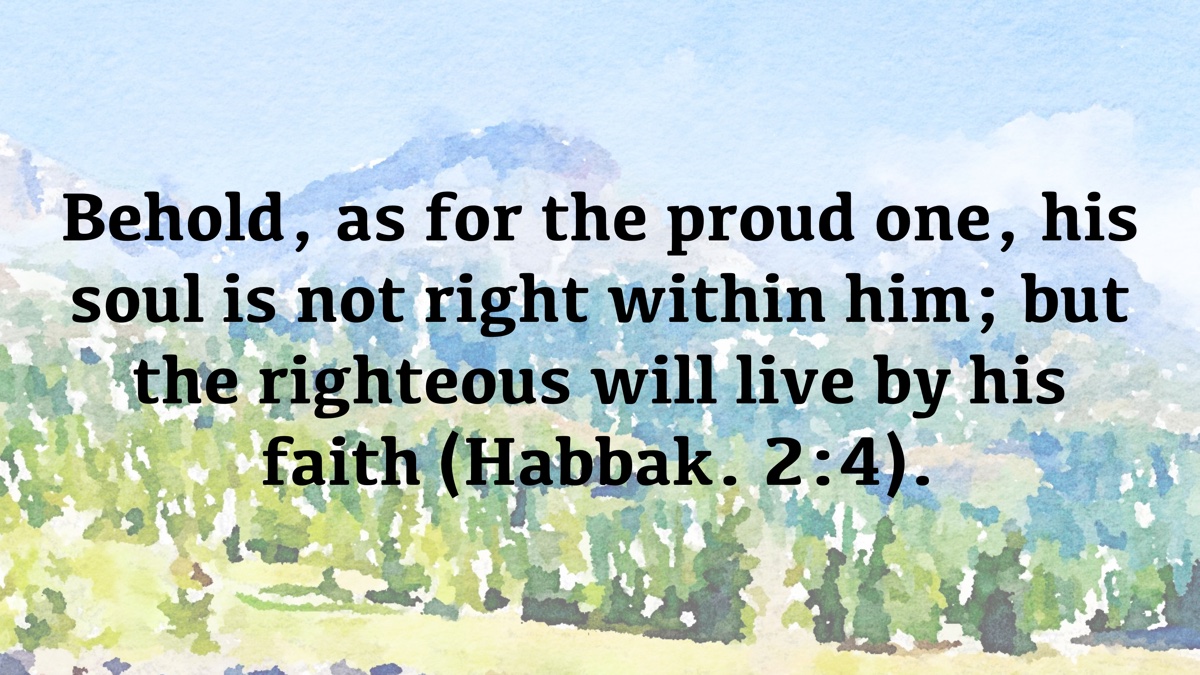
The only way to survive the judgement of the LORD, the day of the LORD, is through faith. God clarifies that a puffed-up soul is not upright, “But the righteous shall live by faith” (2:4)
Recognizing the error of his understanding of his current distress, Habakkuk offers a wonderful insight into true faith. Consider his renewed spirit in his third prayer to God as Habakkuk begins by recalling the stories he had heard of God bringing the people out of Egypt to Mt. Paran (Sinai), descending into the presence of the people in a cloud of thunder and lightning, and the plagues and pestilence that God cast on the wicked nation of Egypt (3:2-5). Habakkuk recognizes God’s glory and power in every situation through His ability to measure the earth, shake up the nations, find a people that He would love, wage war on their behalf, and mightily overwhelm any foe (3:6-15). Even though Habakkuk is struck with fear and awe in view of God’s strength and control (3:16), he recognized a unifying truth revealed about God.
The simple truth is that in every situation, Habakkuk says, “you rode. . . on your chariot of salvation” (3:8), “you went out for the salvation of your people” (3:13), “for the salvation of your anointed” (3:13), and “I will take joy in the God of my salvation” (3:18). It is the last of the salvation statements that encapsulate the full value of Habakkuk’s faith in the Lord, despite the seemingly endless oppression and destruction all around him and in the nation of Israel. It is as though Habakkuk is proclaiming that he will no longer doubt the Lord, because the Lord has proven His dedication to the salvation of His people.
Habakkuk summarizes his faith by proclaiming his trust in the LORD. If the blessing of food and protection were to end, Habakkuk knows that the LORD will strengthen and guide his steps on even the most treacherous of paths (3:17-19). He clarifies for us that his faith is not built on seeing a peaceful path or physical comforts in front of him. Rather, faith is knowing how God has been faithful to His promises and His unwavering concern for the salvation of His people, even when faced with destruction and captivity at the hand of Egypt, Assyria, Babylon, or even Satan. Which brings a richness to the statement Paul makes when reminding the Corinthians that this life and body we live in is nothing compared to the home that waits for us in heaven, “for we walk by faith, not by sight” (2 Cor. 5:7).
Returning to our text in Romans, Paul declares that we should never be afraid to walk by faith and to use every opportunity to speak about the gospel of Christ. Because in Christ, God showed “the immeasurable greatness of His power” (Eph. 1:19-23) to bring salvation to everyone who will believe and endure in faith. For us to endure the trials that lay ahead, or to find peace in the middle of the struggles today, there is only one way that we can shore up our faith. I encourage each of us to stop relying on “blind faith.” Instead, grow in your knowledge of the faithfulness of God daily, so that you will build up a faith of great strength (Rom. 10:17).
The Holy Bible: English Standard Version (ESV). (2001) 2016. Wheaton, IL: Crossway, a publishing ministry of Good News Publishers.
Greg Prince has just completed a summer working with the Downers Grove church of Christ in Downers Grove, IL. He is entering the work of full-time evangelism following a background of fifteen years in business administration. He can be reached here.