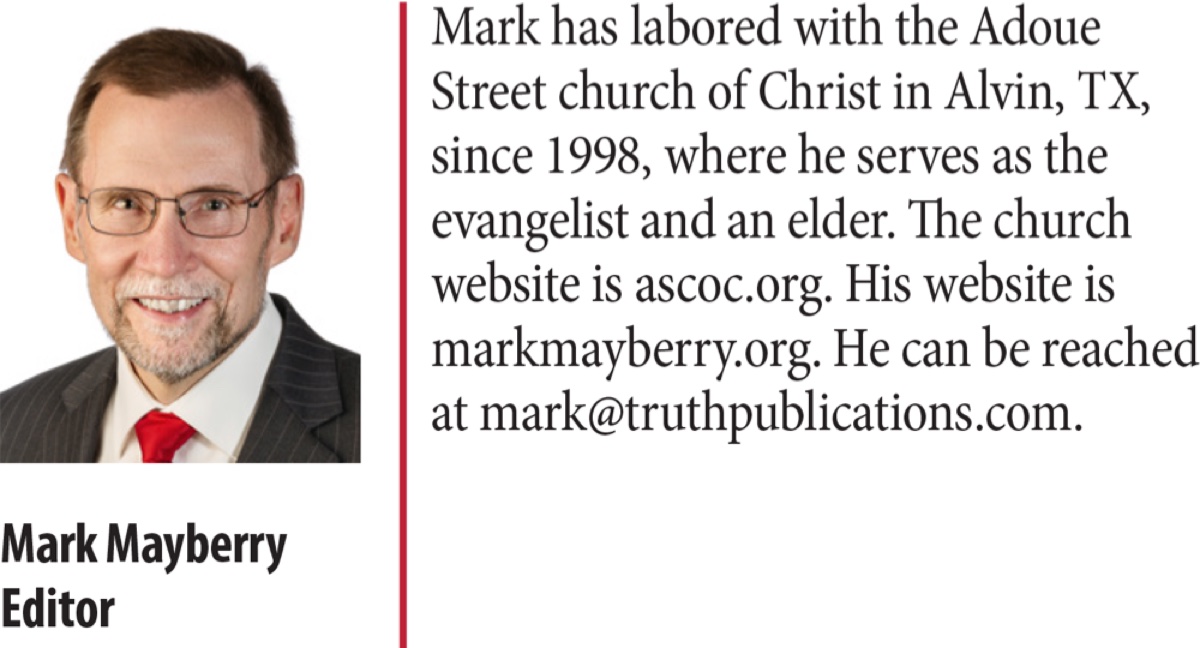
By Mark Mayberry
Synopsis: While brethren may sometimes become weary of lessons of Bible authority, they serve as an essential reminder of fundamental truths.
Ingratitude, inattentiveness, and insolence are reoccurring failures of humanity—especially among those who are young and inexperienced. Sadly, many in our present age are neither thankful nor thoughtful. We boast of our superiority to past generations, discounting their hard-won victories, denying their enduring legacy, and dreaming that we can construct a better world based upon the fiction that our ephemeral ideas are better than the real world experience of our fathers. Yet, through pride and perversity, we become forgetful—ignoring the principles that brought success to past generations, while repeating their failures, and falling into the same traps that have repeatedly ensnared God’s people when they drifted into apostasy. This was true of ancient Israel (Deut. 6:4-15). It was a threat to the first-century church (Acts 20:28-32). It remains a peril today (Heb. 2:1-4).
Recently, a relatively young preacher in a neighboring state presented a lesson at his home congregation entitled, “It’s Deeper than That,” in which he dismissed preaching on Bible authority as irrelevant and unnecessary. Remember, he labors for a non-institutional church of Christ that exists because faithful brethren in past generations courageously stood against error and fought the battle for truth. Reflecting on his experience of growing up in the Lord’s church, this young preacher said,
When I was growing up, a lot of the teaching that was being done, at that time was more about what we can’t do or shouldn’t do as far as the worship assemblies, than it was about reaching for something that we should be doing. . . A lot of the teaching was done about things that are unauthorized, things that are not allowed in worship. . . It always confused me as to why we had to have that same lesson so frequently. . . You probably remember lessons like that from when you were growing up. You probably remember Bible classes—entire quarters that were spent on talking about these kinds of things. . . You remember lessons where the word “authority” was mentioned many, many, many times. And it was dissected and things were drilled down. And you remember lessons about gopher wood, and red heifers, and strange fire. And you remember about all of those examples that we see that talk about how God views things in relation to what He said, in relation to what He hasn’t said and how He interacts with His people based on those things.
And. . .
And if you have been paying attention very long at all, you know that I have not done lessons like that. I have not done lessons where I used gopher wood as an example of God’s authority and what He has spoken. You’ve never heard me do a lesson on specific or generic authority. We’ve not had any lessons on instrumental music or how the church should spend its money. And I admit to that, that those lessons have not been taught. . . Why have we not had a lesson on instrumental music? Why have we not had a lesson on how to spend church funds? Why have we not talked about generic and specific authority? My answer to that is, “It’s a whole lot deeper than that. . .”
But. . .
Having attacked the foundation of biblical authority, this brother offered nothing of substance to take its place.
Let us distinguish between the deep things of God and the deep things of Satan. Men often exalt their own wisdom, while discounting the revelation of God’s mind that was given by the Holy Spirit. We are not left without guidance, because “the Spirit searches all things, even the depths of God. . .” (1 Cor. 2:10).
In contrast, men often rationalize false doctrine and corrupt practices: Addressing the spiritual deficiencies at Thyatira, the Lord chastised the church for tolerating a woman identified as Jezebel, “who calls herself a prophetess, and she teaches and leads My bond-servants astray so that they commit acts of immorality and eat things sacrificed to idols” (Rev. 2:20). After describing the dire consequences that would befall Jezebel and her followers, Jesus addresses the faithful remnant: “But I say to you, the rest who are in Thyatira, who do not hold this teaching, who have not known the deep things of Satan, as they call them—I place no other burden on you. Nevertheless, what you have, hold fast until I come” (Rev. 2:24-25).
So, the Bible speaks of the deep things of God and also the deep things of Satan. Pride often blinds us to its peril. As Paul said, “The word of the cross is foolishness to those who are perishing, but to us who are being saved it is the power of God” (1 Cor. 1:18). Those who pursue the path of apostasy often manifest a condescending spirit toward those who simply seek to follow God’s pattern. In the dark days preceding the Babylonian captivity, Jeremiah called Israel to return unto God: “Stand by the ways and see and ask for the ancient paths, where the good way is, and walk in it; and you will find rest for your souls.” Because they refused to listen, calamity and disaster lay ahead (Jer. 6:16-19; 18:15-17).
Thus says the LORD, “Stand by the ways and see and ask for the ancient paths, where the good way is, and walk in it; and you will find rest for your souls. But they said, ‘We will not walk in it.’ And I set watchmen over you, saying, ‘Listen to the sound of the trumpet!’ But they said, ‘We will not listen.’ Therefore hear, O nations, and know, O congregation, what is among them. Hear, O earth: behold, I am bringing disaster on this people, the fruit of their plans, because they have not listened to My words, and as for My law, they have rejected it also” (Jer. 6:16-19).
For My people have forgotten Me, they burn incense to worthless gods, and they have stumbled from their ways, from the ancient paths, to walk in bypaths, not on a highway, to make their land a desolation, an object of perpetual hissing; Everyone who passes by it will be astonished and shake his head. Like an east wind, I will scatter them before the enemy; I will show them My back and not My face in the day of their calamity (Jer. 18:15-17).
We must preach on Bible authority because God is our Creator. He is the Potter and we are the clay (Isa. 64:8). We are in no position to consider ourselves His equal or question His word or ways.
Woe to those who deeply hide their plans from the LORD, and whose deeds are done in a dark place, and they say, “Who sees us?” or “Who knows us?” You turn things around! Shall the potter be considered as equal with the clay, that what is made would say to its maker, “He did not make me;” or what is formed say to Him who formed it, “He has no understanding?” (Isa. 29:15-16).
Mortal man often manifests the defiant spirit of a rebellious teenager:
Woe to the one who quarrels with his Maker—an earthenware vessel among the vessels of earth! Will the clay say to the potter, “What are you doing?” or the thing you are making say, “He has no hands”? Woe to him who says to a father, “What are you begetting?” or to a woman, “To what are you giving birth?” (Isa. 45:9-10).
For clay to be suitable for the potter’s wheel, it must possess proper plasticity: (1) being sufficiently pliable to conform to the will of the potter, and (2) being sufficiently cohesive to maintain its shape. The same principles apply spiritually. We must conform to the image of His Son, and we must have enough internal consistency (i.e., grit) to maintain our shape when we stand on our own.
Paul said, “Thanks be to God that though you were slaves of sin, you became obedient from the heart to that form of teaching to which you were committed, and having been freed from sin, you became slaves of righteousness” (Rom. 6:17-18). The Greek word tupos, here translated “form,” suggests a model or pattern (BDAG, 1020), or a “form” or mold (Vine, 202). Thayer says it refers to “the teaching which embodies the sum and substance of religion and represents it to the mind” and further states that, in a technical sense, it refers to “the pattern in conformity to which a thing must be made” (Thayer, 632).
God is the Potter. We are the clay. We must be pliable enough to conform to His will. If viewed from another standpoint, the gospel is the mold. Like liquid clay that is poured into a mold, we must be conformed to the doctrine of Christ as revealed in the New Testament.
We must preach on Bible authority because Christ is our King. The events associated with Jesus’s triumphal entry into Jerusalem fulfilled the Messianic prophecy of Israel’s coming King:
This took place to fulfill what was spoken through the prophet: “SAY TO THE DAUGHTER OF ZION, ‘BEHOLD YOUR KING IS COMING TO YOU, GENTLE, AND MOUNTED ON A DONKEY, EVEN ON A COLT, THE FOAL OF A BEAST OF BURDEN’” (Matt. 21:4-5; cf. John 12:12-15).
The inspired apostle Paul praised the Lord Jesus Christ as “He who is the blessed and only Sovereign, the King of kings and Lord of lords, who alone possesses immortality and dwells in unapproachable light, whom no man has seen or can see. To Him be honor and eternal dominion! Amen” (1 Tim. 6:15-16). While sinful men rebel against the Lord’s anointed (cf. Ps. 2), faithful disciples respect Christ’s authority and obey Him in all things. In giving the Great Commission, Jesus said:
All authority has been given to Me in heaven and on earth. Go therefore and make disciples of all the nations, baptizing them in the name of the Father and the Son and the Holy Spirit, teaching them to observe all that I commanded you; and lo, I am with you always, even to the end of the age (Matt. 28:18-20).
Jesus possesses all authority. The apostles were commanded to go unto all the world and make disciples of all nations. A disciple is a learner (i.e., one who sits at the Master’s feet). Accepting the yoke of submission and service, he becomes an active learner. The Greek word manthanō, translated “learn,” means “to gain knowledge or skill by instruction” (BDAG, 615).
The term “mathematics” (i.e., the science of quantity; the abstract science which investigates the concepts of numerical and spatial relations) derives from this same Greek word. One does not master mathematics by simply making up their own set of subjective rules (such as asserting “two plus two equals five”) but by respecting the rules that govern this abstract science. In the same manner, there are rules that govern communication. While some may criticize the authoritative concept of “Command, Example, and Necessary Inference” (C.E.N.I.), these are the tools of communication—not only in the study of God’s word but also in everyday discourse.
We must preach on Bible authority because the Holy Spirit is our Guide. In 1 Corinthians 2:6-16, the apostle Paul describes the nature of New Testament inspiration:
Yet we do speak wisdom among those who are mature; a wisdom, however, not of this age nor of the rulers of this age, who are passing away; but we speak God’s wisdom in a mystery, the hidden wisdom which God predestined before the ages to our glory; the wisdom which none of the rulers of this age has understood; for if they had understood it they would not have crucified the Lord of glory; but just as it is written, THINGS WHICH EYE HAS NOT SEEN AND EAR HAS NOT HEARD, AND which HAVE NOT ENTERED THE HEART OF MAN, ALL THAT GOD HAS PREPARED FOR THOSE WHO LOVE HIM. For to us God revealed them through the Spirit; for the Spirit searches all things, even the depths of God. For who among men knows the thoughts of a man except the spirit of the man which is in him? Even so the thoughts of God no one knows except the Spirit of God. Now we have received, not the spirit of the world, but the Spirit who is from God, so that we may know the things freely given to us by God, which things we also speak, not in words taught by human wisdom, but in those taught by the Spirit, combining spiritual thoughts with spiritual words. But a natural man does not accept the things of the Spirit of God, for they are foolishness to him; and he cannot understand them, because they are spiritually appraised. But he who is spiritual appraises all things, yet he himself is appraised by no one. For WHO HAS KNOWN THE MIND OF THE LORD, THAT HE WILL INSTRUCT HIM? But we have the mind of Christ (1 Cor. 2:6-16).
Furthermore, in the epistle to the Ephesians, Paul made three significant statements: (1) Along with the other apostles and prophets, Paul served as an agent of revelation; (2) by referring to this, when we read, we can understand his insights into the mystery of Christ (i.e., truths that were previously hidden, but now have been revealed); and, (3) proper understanding is not only possible, it is imperative.
For this reason I, Paul, the prisoner of Christ Jesus for the sake of you Gentiles—if indeed you have heard of the stewardship of God’s grace which was given to me for you; that by revelation there was made known to me the mystery, as I wrote before in brief. By referring to this, when you read you can understand my insight into the mystery of Christ, which in other generations was not made known to the sons of men, as it has now been revealed to His holy apostles and prophets in the Spirit (Eph. 3:1-5).
Therefore, be careful how you walk, not as unwise men but as wise, making the most of your time, because the days are evil. So then do not be foolish, but understand what the will of the Lord is (Eph. 5:15-17).
The Holy Scriptures present a unified theme. When the Old and New Testaments are taken together, we observe God’s grand, overarching plan of redemption. The Bible not only reveals God’s perfection, but also the universality of sin. Despite man’s prowess and potential, his accomplishments are fleeting, his days are numbered, his character is flawed. From its opening pages (which record Adam and Eve’s transgression in the garden) to its closing chapter (which portrays the heavenly restoration of Eden), the divinely inspired message points to a Deliverer who will crush the head of the serpent (Satan), and through the promised seed of Abraham (Jesus Christ), bring a blessing upon the entire world.
Blessed be the God and Father of our Lord Jesus Christ, who has blessed us with every spiritual blessing in the heavenly places in Christ, just as He chose us in Him before the foundation of the world, that we would be holy and blameless before Him. In love (Eph. 1:3-4).
If you address as Father the One who impartially judges according to each one’s work, conduct yourselves in fear during the time of your stay on earth; knowing that you were not redeemed with perishable things like silver or gold from your futile way of life inherited from your forefathers, but with precious blood, as of a lamb unblemished and spotless, the blood of Christ. For He was foreknown before the foundation of the world, but has appeared in these last times for the sake of you (1 Pet. 1:17-20).
Please recall the statement of our critical brother who decried the use of such Bible examples:
You remember lessons about gopher wood, and red heifers, and strange fire. . . And if you have been paying attention very long at all, you know that I have not done lessons like that. I have not done lessons where I used gopher wood as an example of God’s authority and what He has spoken. You’ve never heard me do a lesson on specific or generic authority. We’ve not had any lessons on instrumental music or how the church should spend its money. And I admit to that, that those lessons have not been taught. . .
What about this? Are evangelists like me, who have presented repeated lessons on the need for Bible authority, and have cited Old Testament examples that reference gopher wood and strange fire just a bunch of country bumpkins? Those who are enamored with the “deeper” insights of popular evangelical pastors seem allergic to such a simplistic approach. Yet, this peril is perennial:
For the word of the cross is foolishness to those who are perishing, but to us who are being saved, it is the power of God. For it is written, “I will destroy the wisdom of the wise, And the cleverness of the clever I will set aside.” Where is the wise man? Where is the scribe? Where is the debater of this age? Has not God made foolish the wisdom of the world? For since in the wisdom of God the world through its wisdom did not come to know God, God was well-pleased through the foolishness of the message preached to save those who believe (1 Cor. 1:18-21).
Although the Old Testament records God’s dealings with mankind from ages past, consistencies may be seen, despite the dispensational differences. Why was Abel’s sacrifice accepted while Cain’s was rejected? Why was Noah saved by water while the antediluvian world perished? Why were Nadab and Abihu destroyed by fire? Finally, what’s the deal with the red heifer?
God accepted the offering of Abel but rejected the offering of Cain (Gen. 4:3-5). Why? Because Abel acted by faith—following God’s instructions while Cain did not (Heb. 11:4; cf. Rom. 10:17).
So it came about in the course of time that Cain brought an offering to the LORD of the fruit of the ground. Abel, on his part, also brought of the firstlings of his flock and of their fat portions. And the LORD had regard for Abel and for his offering; but for Cain and for his offering, He had no regard. . . (Gen. 4:3-5).
By faith Abel offered to God a better sacrifice than Cain, through which he obtained the testimony that he was righteous, God testifying about his gifts, and through faith, though he is dead, he still speaks (Heb. 11:4).
So faith comes from hearing, and hearing by the word of Christ (Rom. 10:17).
Why was Noah saved by water while others died in the deluge? Noah found favor in God’s eyes because he was righteous and walked with God (Gen. 6:8-9). He followed God’s instructions regarding the ark (i.e., its construction and dimensions) and its contents (i.e., his family, the animals and birds [two of every clean kind, seven of every unclean kind], plus provision for them all) (Gen. 6:19-21; 7:1-3).
God specified that Noah build the ark of gopher wood. What kind of wood was that? We don’t know. Koehler says it refers to “an unknown species of tree used for building the ark” (HALOT, 200). However, rest assured that Noah understood God’s instructions, and that he followed them explicitly: “Thus Noah did; according to all that God had commanded him, so he did” (Gen. 6:14-22, esp. v. 22). Accordingly, Noah is counted as a hero of faith:
By faith Noah, being warned by God about things not yet seen, in reverence prepared an ark for the salvation of his household, by which he condemned the world, and became an heir of the righteousness which is according to faith (Heb. 11:7).
What about Nadab and Abihu, the sons of Aaron, who were divinely executed because they offered strange fire before the Lord? God gave specific instructions regarding the construction of the tabernacle and the worship that was offered therein.
According to all that I am going to show you, as the pattern of the tabernacle and the pattern of all its furniture, just so you shall construct it (Exod. 25:9).
See that you make them after the pattern for them, which was shown to you on the mountain (Exod. 25:40).
Then you shall erect the tabernacle according to its plan which you have been shown in the mountain (Exod. 26:30).
Then the LORD spoke to Moses, saying, “Speak to Aaron and say to him, ‘When you mount the lamps, the seven lamps will give light in the front of the lampstand.’” Aaron therefore did so; he mounted its lamps at the front of the lampstand, just as the LORD had commanded Moses. Now this was the workmanship of the lampstand, hammered work of gold; from its base to its flowers, it was hammered work; according to the pattern which the LORD had shown Moses, so he made the lampstand (Num. 8:1-4).
God destroyed Nadab and Abihu, and then did not permit Aaron to engage in the normal expressions of grief. This served as an object lesson to Israel (and ultimately, to us) of the need for full obedience: “By those who come near Me I will be treated as holy, And before all the people I will be honored” (Lev. 10:1-7).
Now Nadab and Abihu, the sons of Aaron, took their respective firepans, and after putting fire in them, placed incense on it and offered strange fire before the LORD, which He had not commanded them. And fire came out from the presence of the LORD and consumed them, and they died before the LORD. Then Moses said to Aaron, “It is what the LORD spoke, saying, ‘By those who come near Me I will be treated as holy, And before all the people I will be honored.’” So Aaron, therefore, kept silent. Moses called also to Mishael and Elzaphan, the sons of Aaron’s uncle Uzziel, and said to them, “Come forward, carry your relatives away from the front of the sanctuary to the outside of the camp.” So they came forward and carried them still in their tunics to the outside of the camp, as Moses had said. Then Moses said to Aaron and to his sons Eleazar and Ithamar, “Do not uncover your heads nor tear your clothes, so that you will not die and that He will not become wrathful against all the congregation. But your kinsmen, the whole house of Israel, shall bewail the burning which the LORD has brought about. You shall not even go out from the doorway of the tent of the meeting, or you will die; for the LORD’S anointing oil is upon you.” So they did according to the word of Moses (Lev. 10:3).
Afterwards, God reiterated the procedures that Aaron and other priests must follow in Old Testament worship, including specific instructions regarding the incense offering: “He shall take a firepan full of coals of fire from upon the altar before the LORD and two handfuls of finely ground sweet incense, and bring it inside the veil. He shall put the incense on the fire before the LORD, that the cloud of incense may cover the mercy seat that is on the ark of the testimony, otherwise he will die” (Lev. 16:1-13, esp. v. 13).
Instructions regarding the Old Testament ritual of the red heifer, while less familiar to modern day disciples, was equally precise (Num. 19:1-10). Animal sacrifices are no longer operative since Jesus offered Himself as a perfect sacrifice (Heb. 9:23-10:10). However, obedience to God’s pattern remains relevant in the Christian dispensation.
For whatever was written in earlier times was written for our instruction, so that through perseverance and the encouragement of the Scriptures we might have hope. Now may the God who gives perseverance and encouragement grant you to be of the same mind with one another according to Christ Jesus, so that with one accord you may with one voice glorify the God and Father of our Lord Jesus Christ (Rom. 15:4-6).
From the beginning to the end of Sacred Scripture, obedience is rewarded, disobedience is punished. The people of God must do what He says, and follow the divinely revealed pattern, not substitute their own preferences. Sadly, history has a habit of repeating itself (2 Chron. 36:15-16; Hos. 4:6). Therefore, we need regular reminders (2 Pet. 1:13-15; 3:1-2).
I consider it right, as long as I am in this earthly dwelling, to stir you up by way of reminder, knowing that the laying aside of my earthly dwelling is imminent, as also our Lord Jesus Christ has made clear to me. And I will also be diligent that at any time after my departure you will be able to call these things to mind (2 Pet. 1:13-15).
This is now, beloved, the second letter I am writing to you in which I am stirring up your sincere mind by way of reminder, that you should remember the words spoken beforehand by the holy prophets and the commandment of the Lord and Savior spoken by your apostles (2 Pet. 3:1-2).
Let us continue to emphasize basic Bible doctrines. May our preaching be based upon a “book, chapter and verse” approach. Our duty is to speak the utterances of God—providing a “Thus saith the Lord. . .” for all that we proclaim and practice.
Whoever speaks is to do so as one who is speaking the utterances of God; whoever serves is to do so as one who is serving by the strength which God supplies; so that in all things God may be glorified through Jesus Christ, to whom belongs the glory and dominion forever and ever. Amen (1 Pet. 4:11).
Aaron, Elijah. “It’s a Lot Deeper Than That.” Northside church of Christ. Conway, AR. March 21, 2023. Available online at https://www.northsidecofc.com/sermons/its-a-lot-deeper-than-that/
Arndt, William, et al. A Greek-English Lexicon of the New Testament and Other Early Christian Literature (BDAG). Chicago, IL: University of Chicago Press, 2000.
Koehler, Ludwig, et al. The Hebrew and Aramaic Lexicon of the Old Testament (HALOT). Leiden: E.J. Brill, 1994-2000.
Thayer, Joseph Henry. A Greek-English Lexicon of the New Testament: Being Grimm’s Wilke’s Clavis Novi Testamenti. New York: Harper & Brothers., 1889 via Logos Bible Software.
Vine, W. E., Merrill F. Unger, and William White Jr. Vine’s Complete Expository Dictionary of Old and New Testament Words. Nashville, TN: Thomas Nelson Publishers, 1996.