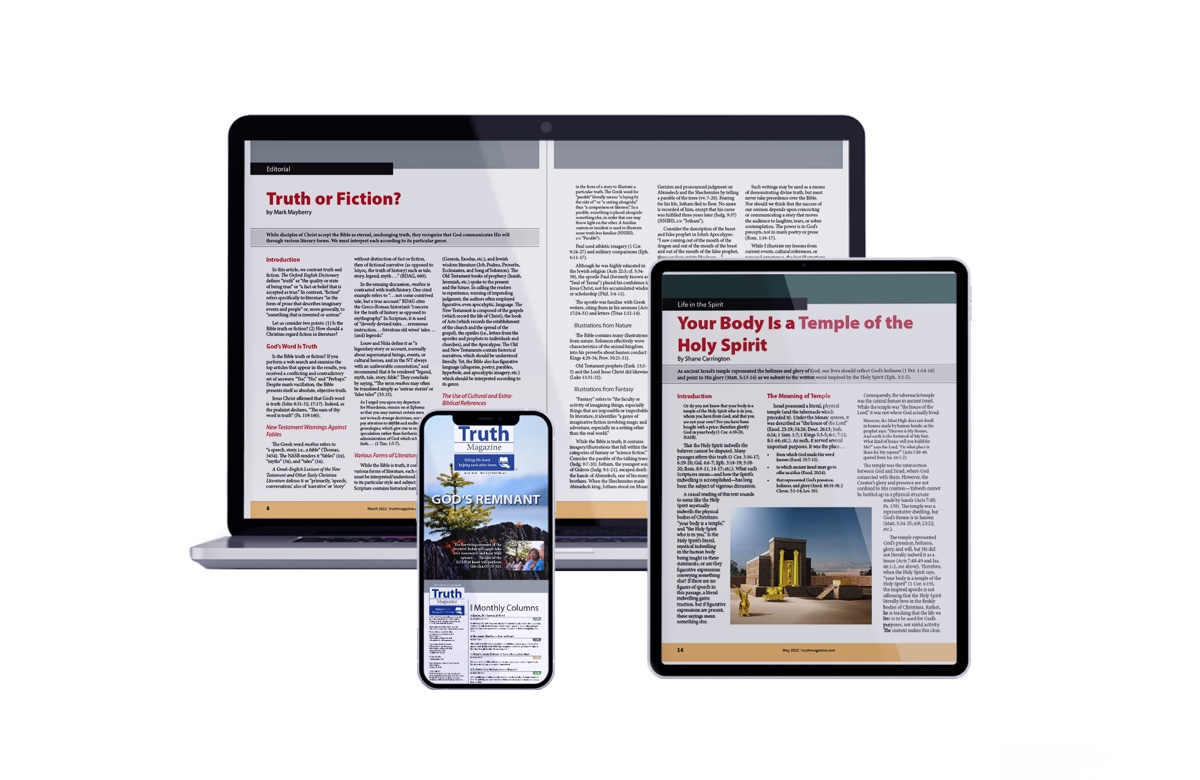
(May, 2023 | No. 5 | Vol. 67)
5/1/2023
Truth Magazine (ISSN 1538-0793) is published once a month by Truth Publications, Inc., 220 S. Marion, Athens, AL 35611. Postage paid at Decatur, AL, and additional mailing offices.
Copyright 2023 Truth Publications, Inc. All Rights Reserved.
Manuscripts should be sent to the editor, Mark Mayberry, at mark@truthpublications.com. Link.
Subscriptions, renewals and other correspondence should be sent to: Truth Magazine, 220 S. Marion, Athens, AL 35611 or by emailing us at subscriptions@truthmagazine.com. Link.
Book orders should be sent to: CEI Bookstore | truthbooks.com | Street Address: 220 S. Marion, Athens, AL 35611 | Phone: (855) 492-6657 | Email: sales@truthbooks.com Link.
Online Website: truthmagazine.com
DISCLAIMER: Books in ads are screened but an ad does not mean unqualified endorsement. All books should be tested by Scripture. We appreciate readers notifying us if they find some glaring fault in ads.

By Mark Mayberry
Synopsis: The 2023-05 May issue of Truth Magazine focuses on “The Minor Prophets.” Specifically, it deals with those prophets who served God’s purposes between 845 BC and 745 BC. The remaining six will be addressed in a special issue later this fall.
What is a prophet? What is prophecy? What were the characteristics of a true prophet?
From a biblical standpoint, a prophet is a spokesmen for God, i.e., one who speaks by divine inspiration—accurately relating the past, addressing the present, and predicting the future. The Hebrew word nabi, occurring 314 times in the Old Testament, refers to “a spokesman, speaker, or prophet” (Thomas, 5030). According to the TWOT, “the essential idea in the word is that of an authorized spokesman” (Culver, 544). The Greek noun prophētēs, occurring 144 times in the New Testament, a compound of pro (before) and phēmi (to declare), refers to “a prophet (an interpreter or forth-teller of the divine will)” (Thomas, 4396). Louw and Nida define it as “one who proclaims inspired utterances on behalf of God” (53.79). Arndt says it signifies “a proclaimer or expounder of divine matters or concerns that could not ordinarily be known except by special revelation” and is specifically defined as “(1) a person inspired to proclaim or reveal divine will or purpose; or (2) by metonymy, the writings of prophets” (BDAG, 890-891).
The Greek verb prophēteuō, occurring twenty-eight times in the New Testament, means “to foretell, tell forth, prophesy” (Thomas, 4395). BDAG says it means “(1) to proclaim an inspired revelation or prophesy; (2) to tell about something that is hidden from view; (3) to foretell something that lies in the future” (BDAG, 890).
True prophets served as God’s mouthpiece, i.e., His spokesmen (Jer. 1:9-10; cf. Exod. 4:10-16; 6:28-7:2). The Holy Spirit inspired true prophets to communicated heaven’s message to humanity. David, the sweet psalmist of Israel, declared, “The Spirit of the LORD spoke by me, and His word was on my tongue” (2 Sam. 23:1-2). In delivering the plans of the temple complex to Solomon, “All this,” said David, “the LORD made me understand in writing by His hand upon me, all the details of this pattern” (1 Chron. 28:11-19, esp. v. 19). Describing the prophetic word as a lamp shining in a dark place, Peter said, “no prophecy of Scripture is a matter of one’s own interpretation, for no prophecy was ever made by an act of human will, but men moved by the Holy Spirit spoke from God” (2 Pet. 1:19-21).
True prophets accurately related the past, addressed the needs of the present, and offered precise predictions of the future (Isa. 41:21-29; 42:5-9; 43:8-13). The apostles of Christ were similarly gifted (John 14:25-26; 16:12-14; 1 Tim. 4:1-3).
True prophets communicated God’s will by various means and measures—through dreams, visions, and dark sayings, and also directly and openly (Num. 12:1-8; Joel 2:28-29; Matt. 17:1-8; Heb. 1:1-4).
True prophets enjoy a divine commission, proclaiming the message that God entrusted them to deliver (2 Sam. 7:1-7; Jer. 1:4-10; Ezek. 1:1-3). In the NASB, the expression, “the word of the Lord came to. . .” occurs eighty-three times in the Old Testament.
Whether foretelling the future, concentrating on current circumstances, or pondering the past, true prophets proclaim a message that is consistent with the rest of divine revelation (Deut. 13:1-5; 18:20-22; Isa. 8:19-20).
True prophets present a complete message, proclaiming all that God commanded, omitting not a word (Jer. 1:17-19; 26:1-6; 42:4-6).
True prophets offer a corrective message, destroying and overthrowing all that is evil, building and planting that which is good (Jer. 1:9-10; 25:4-7; 44:4-6).
When opposed by sinful men, true prophets do not cower in fear but courageously communicate God’s word to commoners and kings (Ezek. 2:1-7; 3:4-11; Mic. 3:5-8).
The Bible contains many noble examples of those who served as prophets: Abraham (Gen. 20:7), Moses (Deut. 34:10-12), Samuel (1 Sam. 3:19-21), Saul (1 Sam. 10:5-6, 10-12; 19:23-24), Gad (1 Sam. 22:5; 2 Sam. 24:11), Nathan (2 Sam. 7:2; 12:25; 1 Kings 1:8, 10, 22-23, 32, 34, 38, 44-45), Ahijah the Shilonite (1 Kings 11:29; 14:2, 18), Jehu (1 Kings 16:7, 12), Elijah (1 Kings 18:22, 36), Elisha (1 Kings 19:16; 2 Kings 3:11), Micaiah (1 Kings 22: 7-8, 13), Jonah (2 Kings 14:25), Isaiah (2 Kings 19:2), Shemaiah (2 Chron. 12:5), Iddo (2 Chron. 13:22), Oded (2 Chron. 15:8), Jeremiah (2 Chron. 36:12), Haggai (Ezra 5:1-2), along with the sons of the prophets (2 Kings 2:5, etc.), and various other unnamed individuals (1 Kings 18:3-4, 13; 20:13, 22).
However, Jesus Christ is the greatest example of one who holds the prophetic office: “God, after He spoke long ago to the fathers in the prophets in many portions and in many ways, in these last days has spoken to us in His Son, whom He appointed heir of all things, through whom also He made the world” (Heb. 1:1-2).
His position is unparalleled and His authority is absolute (Deut. 18:15-19; Acts 3:17-26). Not only is Jesus the central focus of prophecy (Gen. 3:15; 12:3; 49:10; etc.), as an eternal member of the Triune Godhead and the Incarnate Word, He is the central source of prophecy (John 1:14-18; Heb. 1:1-2).
The Lord Jesus Christ is the One whom Moses foreshadowed:
The Lord your God will raise up for you a prophet like me from among you, from your countrymen, you shall listen to him. This is according to all that you asked of the Lord your God in Horeb on the day of the assembly, saying, “Let me not hear again the voice of the Lord my God, let me not see this great fire anymore, or I will die.” The Lord said to me, “They have spoken well. I will raise up a prophet from among their countrymen like you, and I will put My words in his mouth, and he shall speak to them all that I command him. It shall come about that whoever will not listen to My words which he shall speak in My name, I Myself will require it of him” (Deut. 18:15-19).
In his second sermon recorded in Acts, Peter declared that Jesus is the Seed of Abraham and the Prophet whom God would raise up in the period of restoration. Utter destruction will befall those who refuse to heed His message, while abundant blessings belong to all who turn from their wicked ways:
Therefore, repent and return, so that your sins may be wiped away, in order that times of refreshing may come from the presence of the Lord; and that He may send Jesus, the Christ appointed for you, whom heaven must receive until the period of restoration of all things about which God spoke by the mouth of His holy prophets from ancient time. Moses said, “The Lord God will raise up for you a prophet like me from your brethren; to Him you shall give heed to everything He says to you. And it will be that every soul that does not heed that prophet shall be utterly destroyed from among the people.” And likewise, all the prophets who have spoken, from Samuel and his successors onward, also announced these days. It is you who are the sons of the prophets and of the covenant which God made with your fathers, saying to Abraham, “And in your seed all the families of the earth shall be blessed.” For you first, God raised up His Servant and sent Him to bless you by turning every one of you from your wicked ways (Acts 3:19-26).
True prophets were persecuted (2 Chron. 36:15-16; Matt. 5:11-12; Acts 7:52; Heb. 11:32-40; Jas. 5:10).
True prophets were threatened (2 Chron. 25:15-16; Jer. 26:7-8).
True prophets were mistreated (Jer. 37:21; 38:6, 9).
True prophets were beaten (Jer. 20:1-2).
True prophets were arrested (Jer. 37:13-14).
True prophets were imprisoned (1 Kings 22:26-28; 2 Chron. 16:10; Jer. 32:2-3).
True prophets were killed (1 Kings 19:10, 14; 2 Kings 9:7; 2 Chron. 24:20-21; Neh. 9:26; Matt. 23:37).
Like the true prophets of old, we must willingly endure affliction for the cause of Christ (Heb. 11:32-40; Jas. 5:10-11).
In both the Old and New Testaments, false prophets fall under consistent condemnation (Ezek. 13; Matt. 7:15-20). They may be temporarily popular but are terminally ineffective:
An appalling and horrible thing has happened in the land: The prophets prophesy falsely, and the priests rule on their own authority; and My people love it so! But what will you do at the end of it? (Jer. 5:30-31).
“Behold, I am against those who have prophesied false dreams,” declares the LORD, “and related them and led My people astray by their falsehoods and reckless boasting; yet I did not send them or command them, nor do they furnish this people the slightest benefit,” declares the LORD (Jer. 23:26-32).
False teachers/prophets display the following deficiencies: (1) They make a false claim to inspiration (Jer. 23:16-22; 27:14-15; 29:8-9). (2) They evidence falseness of character (Jer. 6:13-15; 23:11-15; Isa. 28:7-8; 56:9-12). (3) They proclaim a message with false content (Jer. 14:13-15; 23:25-32; Lam. 2:13-14). Sometimes, these shortcomings are obvious. Sometimes the picture is muddled.
What about the prophets of Baal and the Asherah? Their claim, character and content were all false. As a result, the sentence of death fell upon them and their followers (Jer. 2:7-8; 23:13-15; 1 Kings 18:17-20, 40).
What about Balaam, the son of Beor? Balaam was indeed a vehicle through whom Jehovah occasionally spoke (Num. 22:1-21; etc.). While his character was false (2 Pet. 2:15-16; Jude 11), the content of his public proclamations was true (Num. 23:7-10; etc.). Yet, his private counsel to King Balak contradicted God’s pattern of morality (Num. 25:1-3; 31:15-16; Rev. 2:14-16). The consequence of his counsel brought death and destruction to all involved (Num. 25:1-9; 31:7-17).
What about the old prophet from Bethel? His claim to the prophetic office was true, his character/motivation is “complicated” (he respected the young prophet but lacked personal honesty), but the content of his message was false. The consequences of his message brought death to the young prophet who heeded his words (1 Kings 13).
In summary, note the differences in the aforementioned examples regarding claim, character, and content. However, the consistent marks of a false prophet involve content and consequences. A false prophet is one who promotes false doctrine that results in spiritual death.
While the prophetic office is now historic (1 Cor. 13:8-10; Jas. 1:25), the message of those who spoke by inspiration is preserved in the pages of Holy Scripture (Eph. 3:1-5; 4:11-16). Let us remember, revere, and obediently respond to the inspired message:
So we have the prophetic word made more sure, to which you do well to pay attention as to a lamp shining in a dark place, until the day dawns and the morning star arises in your hearts. But know this first of all, that no prophecy of Scripture is a matter of one’s own interpretation, for no prophecy was ever made by an act of human will, but men moved by the Holy Spirit spoke from God (2 Pet. 1:19-21).
This is now, beloved, the second letter I am writing to you in which I am stirring up your sincere mind by way of reminder, that you should remember the words spoken beforehand by the holy prophets and the commandment of the Lord and Savior spoken by your apostles (2 Pet. 3:1-2).
Genuine disciples will study to show themselves approved unto God (2 Tim. 2:15), and will faithfully preach the word, reproving, rebuking, exhorting, with patience and instruction (2 Tim. 4:1-5). Truth may be proclaimed sincerely or in pretense (Phil. 1:15-18). Error may be promoted through ignorance (Matt. 7:21-23) or malice (Acts 13:6-10). May we recognize that the preaching of truth liberates (John 8:31-32) while the proclamation of error enslaves (2 Pet. 2:1-3).
Let us, therefore, guard against those who would speak perverse things, and remain ever committed to the word of Christ (Acts 20:28-32). Unfortunately, many today want a soft, self-serving message like King Ahab (1 Kings 22:1-40), and the Israelites of old (Isa. 30:9-17). Do not be led astray by false prophets, whose message is rooted in the lust of the flesh, the lust of the eyes, and the pride of life. Listen to the voice of God’s prophets, whose message is preserved in the pages of Sacred Scripture. Above all, be attentive and obedient to Jesus Christ, the Prophet who stands supreme above all others, and who will judge the world in righteousness on that final day.
Arndt, William, et al. A Greek-English Lexicon of the New Testament and Other Early Christian Literature (BDAG). Chicago, IL: University of Chicago Press, 2000.
Culver, Robert D. “Prophet” in Theological Wordbook of the Old Testament (TWOT), ed. by R. Laird Harris, Gleason L. Archer Jr., and Bruce K. Waltke. Chicago: Moody Press, 1999.
Louw, Johannes P. and Eugene Albert Nida. Greek-English Lexicon of the New Testament: Based on Semantic Domains. New York: United Bible Societies, 1996.
Thomas, Robert L. New American Standard Hebrew-Aramaic and Greek Dictionaries: Updated Edition. Anaheim, CA: Foundation Publications, Inc., 1998.


By Kyle Pope
Synopsis: Matthew 7:6 is a challenging command. What is Jesus teaching in this text, and how should it be applied in the life of a Christian? In this study, we dig into our Lord’s powerful command about dogs, pearls, and swine.
Near the end of the Sermon on the Mount, Jesus gave a command to His disciples that presents some questions and challenges to all who would follow Him. He declares, “Do not give what is holy to the dogs; nor cast your pearls before swine, lest they trample them under their feet, and turn and tear you in pieces” (Matt. 7:6, NKJV). What is the Lord teaching here, and how should it be applied in our lives?
These words come at the end of a section on judging others (7:1-6) and just before the charge to “Ask, and it will be given to you; seek, and you will find; knock, and it will be opened to you” (7:7), which begins a new section on God’s willingness to provide for His children (7:7-11).
How does this command fit into instructions about judging others? The Lord begins with the prohibition, “Judge not, that you be not judged” (7:1), warning that our own judgment by God will be determined by the attitude we show in our judgment of others (7:2). Ironically, this command about what we give to “dogs” and “swine” requires that we make some judgments about how to treat different people. Clearly, Jesus is not condemning all types of judgment (cf. John 7:24), but the harshness of our judgment (7:2) or making hypocritical judgments focusing on the “speck” in someone else’s eye while ignoring the “plank” in our own eye (7:3-5).
If Jesus is referring back to what He has just taught, His words about “dogs” and “swine” may relate directly to what He has just said about the type judgments Christians should not make. Harsh or hypocritical judgment of others may be like taking a holy and precious thing (such as God’s forgiveness) and abusing it in such a way that it becomes self-destructive. If so, this may be understood as a different way of restating His earlier words—“with the measure you use, it will be measured back to you” (7:2b).
On the other hand, it may be that, as Jesus ends this section, He slightly shifts the focus away from personal judgment of others to the consequences of subjecting ourselves to the judgment of others. Dogs were often used as a figure of that which was unclean or sinful (cf. Phil. 3:2; Rev. 22:15). Swine were not only unclean to eat (Lev. 11:7; Deut. 14:8), they were also dangerous. In the Greek translation of the Old Testament done before the time of Jesus, as Hushai warned Absalom about pursuing David, the fleeing king was compared to “a bear robbed of her cubs in the field and as a savage sow in the plain” (2 Sam. 17:8). In the United States, feral hogs have attacked and even killed people. When Christians interact with unbelievers, their reaction to what we consider “holy” or precious may provide opportunities for them to “trample” those things “under their feet” and abuse and persecute us. This is the most common interpretation of Jesus’s command in this text.
If Jesus was merely restating His teaching on avoiding harsh or hypocritical judgments, the application is clear. Do we expect God’s mercy but refuse to give it to others? James echoed the Lord’s teaching, affirming that “judgment is without mercy to the one who has shown no mercy,” adding that “mercy triumphs over judgment” (Jas. 2:13). No one likes to be mistreated or wronged, but we all need the mercy of God. Do we give what we hope to receive, or do we hold a grudge and burn wrongs done to us deeply into our hearts and memories?
Some judgments have nothing to do with a wrong done to us but to God or others. In the time of Jesus, some “trusted in themselves that they were righteous, and despised others” (Luke 18:9). Jesus told the parable of the Pharisee and the Tax Collector to rebuke this spirit, ending with the warning, “everyone who exalts himself will be humbled, and he who humbles himself will be exalted” (Luke 18:9-14). Harsh judgment of others may one day cause us to be humbled. If we act as if we could never fall, we will be humiliated when our self-confidence fails. Hypocritical judgment can also lead to humiliation. As we overlook our own sins while unmercifully condemning others, when the truth of our deeds is exposed, our self-exaltation will result in being torn “in pieces” in shame and embarrassment.
If instead, Jesus shifts to focus on the consequences of being judged by others, this is a call to use wisdom and discretion in our dealings with those in the world. Certainly, Christians are to be light in the midst of darkness (Matt. 5:14-16). We must not hide that light “under a basket” (5:15), but does that mean we subject ourselves to every opportunity for abuse and persecution that comes along? Later, Jesus would say to the Twelve, “Behold, I send you out as sheep in the midst of wolves. Therefore, be wise as serpents and harmless as doves” (Matt. 10:16). How should this wisdom be used “in the midst of wolves”? Sometimes it must involve choosing when to speak and when to avoid the opportunity to be abused. On the same occasion, He also told them, “When they persecute you in this city, flee to another” (Matt. 10:23a). Disciples are still “the light of the world” even when they choose to avoid some situations that lead only to rejection and abuse of the truth.
Why would Jesus speak of fellow human beings as “dogs” or “swine”? Is He teaching us to view some people in this way? We must remember that Jesus “knew all men” (John 2:24). He could know who would choose not to accept the truth of the gospel. In such cases, even the best efforts to enlighten and teach them would never result in changing their rebellious hearts. We can’t know that, but we can evaluate behavior. Jesus is not teaching His disciples to make judgments about matters only God can know, such as the heart of another person. He is teaching His disciples to be good stewards of the time and opportunities set before them. A Christian could easily exhaust all of his time and energy on the stubborn, rebellious heart of one we might hope to convert, while missing the good and honest hearts all around us. We are to judge some as “dogs” or “swine,” not because of their value—all souls are made in the image of God (Jas. 3:9). We judge them in this way based on their reaction to “what is holy” and the danger they pose to our efforts.
This is often a difficult course to determine. We live in a time when we now have abundant opportunities to reach the lost with the gospel. Yet, with these opportunities, we are also seeing an increasing hatred, aggression, and opposition to faith in Christ. When should we act on opportunities and when should we “flee” to pursue other opportunities? Perhaps a few questions can be helpful:
Do I honestly hope to bring a soul to Christ, or am I just looking for a fight? Paul taught, “a servant of the Lord must not quarrel but be gentle to all, able to teach, patient, in humility correcting those who are in opposition, if God perhaps will grant them repentance, so that they may know the truth, and that they may come to their senses and escape the snare of the devil, having been taken captive by him to do his will” (2 Tim. 2:24-26).
Are they open and receptive or disrespectful and abusive? Does their reaction stem from misunderstanding or an attempt to harm our efforts? Paul told the Jews of Pisidian Antioch, “It was necessary that the word of God should be spoken to you first; but since you reject it, and judge yourselves unworthy of everlasting life, behold, we turn to the Gentiles” (Acts 13:46). Some today will make the same choice, and we must turn our efforts to others.
If I believed as the unbeliever does, how would I need someone to speak to me in order for my heart to change? Jesus commanded, “whatever you want men to do to you, do also to them, for this is the Law and the Prophets” (Matt. 7:12).
Is this the best use of the time God has given me? Am I missing more productive opportunities because of the time I have devoted to this interaction with someone? Christians must “Walk in wisdom toward those who are outside, redeeming the time. Let your speech always be with grace, seasoned with salt, that you may know how you ought to answer each one” (Col. 4:5-6). Our time is a precious and limited resource. We must use it wisely.
Have I judged the person’s response to be unproductive, or am I ashamed to stand up for the truth? Jesus warned, “whoever is ashamed of Me and My words, of him the Son of Man will be ashamed when He comes in His own glory, and in His Father’s, and of the holy angels” (Luke 9:26). May each of us always have the courage to speak the truth without fear, but the wisdom to know when to speak and when to refuse to “cast your pearls before swine.”


By Diana Dow
Synopsis: Communication is a vital skill and a lifelong learning process. Make it a priority in the education of your child.
Previously, we discussed the “whys” and “wherefores” of home schooling. It’s time to delve into the nitty gritty of the “whats.” What are we going to teach the children? Resources abound, including lists of what a child needs to know and boxed-curriculum that covers all the basics. While these are helpful, I would like to take a different approach. We are told by Solomon to “train up a child in the way he should go. . .” What skills will my child need to support his family, run her household, build solid relationships, serve God faithfully? We are going to consider the skills our children will need and, from there, build a plan to help achieve them.
The most fundamental of all skills is communication. From the first cry, newborn babies communicate with their parents. Soon the child is forming words, building complex sentences and carrying on well-thought-out discussions with loved ones. The growth from the newborn cries to the talkative five-year-old is quite astounding. In those first five years, the child learns by imitating those around him. He learns by trial and error. The more proficient he becomes, the more easily understood he is, which brings the immediate gratification of having been understood.
During this time of learning to talk, another communication skill is being developed: The child is learning to listen. Listening requires one to turn his attention from himself to another person. The listener must learn to show empathy for the speaker, to evidence humility in acquiescing to another’s thoughts, and a willingness to follow directions when appropriate. Patient parental guidance in this area is essential for developing good listening skills.
As speaking and listening skills continue to grow, the time comes when a child is ready to read. Reading allows a child to learn from others who live far away—both in distance and in time. Most importantly, learning to read gives the child the ability to read the inspired words of God.
There are differences of opinion on how to go about teaching a child to read. Books have been written and programs produced that guarantee the child’s success. While these varying opinions may make the task seem daunting, teaching reading boils down to some basic steps. In fact, teaching anything is the process of “dividing the data.” Take what needs to be taught, divide it into its simplest form and build from there.
Reading is simply a matter of learning the sounds of the letters, the diphthongs (ae, ou, oa, etc.), the digraphs (ck, th, br, etc.), the basic rules (silent e, bossy r, etc.) and practicing putting them together. In other words, phonics. Phonics is like a secret code. When the code is cracked, reading progresses at an astonishing rate, limited only by the availability of reading material and the child’s desire to read.
While it is easy and often a lot of fun to use a fancy phonics program with all the bells and whistles, it isn’t necessary. For many years, children were taught to read with just a Bible. The key to teaching reading is not how much money is spent, but how consistently the lessons are presented.
Timing is important in learning to read. Just as talking happens at varying ages, so does reading. It is important to take cues from your child. Just because the neighbor’s child learned to read at age five does not mean that your child will do the same. Some children are ready at age three, while others do much better if reading instruction is delayed to as late as nine years old. Pushing a child to learn to read before he is ready can cause lifelong difficulties with reading and learning.
When your child was learning to talk, he was imitating you. The same goes for reading. Let your child see you read. If he sees you reading, he will want to read as well. Read to your child. He will associate reading with the comfort of snuggling up next to you. Read simple children’s books, pointing to each word as you go, reinforcing the idea of reading from left to right. Discuss the illustrations and how they relate to the story. Read chapter books that allow him to get fully engrossed in the story, forming pictures in his mind based only on the descriptions the author offers. Read with fluency and enthusiasm, using voice inflection to bring the story to life. Ask your child to narrate back what he heard, giving him practice in forming complex thoughts and speaking them aloud. Narration is a first step to writing well.
The next significant challenge of communication is learning to express oneself through writing. Like reading, your child’s readiness to write is essential. Forming letters is hard for developing hands. Putting those letters in the correct order to form words is quite a feat. While many have difficulty, spelling is essential to writing. The more a child sees the words spelled correctly, the easier spelling will be. Reading boosts spelling. If spelling remains a problem, it can improve when the computer is used for writing. As spell check signals a misspelled word, the child is given the opportunity to correct the error immediately, building confidence and satisfaction in a job well done.
Copy work and dictation are natural methods of learning to spell and write well. Begin copying short sentences using simple words. Gradually transitioning to dictation, increasing the length and complexity to include paragraphs and essays from the wisest thinkers, both past and present. The Bible is an excellent resource for these writing activities. In this way, children learn to write, just as they learn to speak, through imitation. With well-written works as a model, the child learns to write well. It can be tedious and challenging, but the benefits will be impressive.
Communication is a vital skill and a lifelong learning process. Make it a priority in the education of your child. While your child is learning, you might be pleasantly surprised to find that your communication skills are improving as well.



By Bruce Reeves
Synopsis: With this issue, Bruce begins a new study of Paul’s letter to the Philippians, which is scheduled to run for a year. This material should be helpful and encouraging to modern-day saints who are seeking to mirror Christ in their daily lives.
We live in a world that has been overwhelmed with sadness, dissatisfaction, and disillusionment. This is the case primarily because of the corruption and deception of sin. However, the gospel offers a joy that supersedes and transcends the world around us (Phil. 4:5-7, 13). The epistle to the Philippians has strengthened and encouraged God’s people since it was written. In this letter, the Holy Spirit reveals the heart of God and Christ in the lives of His people. We look forward to delving into the beauties and blessings of the book of Philippians in coming issues. It is my sincere hope that this study will draw us all closer to our Savior and to one another.
Philippi was located in eastern Macedonia, about ten miles inland from the Aegean Sea, and from the Gulf of Neapolis. The city was situated on a broad flat plain enclosed by mountains on all sides, resting on a hill that dominated the plain. Philippi was a Roman colony, which means it was a miniature resemblance of Rome in its architecture and attitude. Thus, there were many privileges in being a citizen of a Roman colony. Paul’s first visit to Philippi was on his second missionary journey (Acts 16:9-12; 17:1). Although the initial converts were Jews or Jewish proselytes (Acts 16:13-15), most of the congregation was composed of Gentile believers. Paul most probably wrote this epistle in AD 62, near the end of his first Roman imprisonment. What a tremendous blessing it is to know that Paul’s epistle of joy was written while he was imprisoned for the sake of the gospel.
Philippians emphasizes themes such as “joy (the term occurs sixteen times in the epistle),”participation” (Phil. 1:5; 2:1; 3:10), and “the mind of Christ” (Phil. 2:5). Stress is placed on our fellowship in the gospel (Phil. 1:3-8), eternal hope despite suffering for Christ (Phil. 1:21-23), the unity of love (Phil. 2:1-5), and the incarnation of Christ as the model for our lives (Phil. 2:5-8).
Key Themes in Philippians:
Joy (1:4, 18, 25; 2:2, 17-18, 28; 3:1; 4:1, 4)
Sharing/participation (1:5, 7; 2:1; 3:10; 4:14)
Gospel (1:5, 7, 12, 16, 27; 2:22; 4:3, 15)
Thinking/mind (1:7; 2:2, 5; 3:15, 19; 4:2, 8)
Imprisonment (1:7, 12-14, 16-17, 19-26, 30; 2:17; 4:14)
Compassion/love (1:8-9, 16; 2:1-2, 12; 4:1)
The epistle begins with Paul’s prayer for the brethren at Philippi and presents a beautiful and vivid description of the joy grounded and settled in the Lord (Phil. 4:4). The joy produced by the Holy Spirit in the gospel is not a transient emotional feeling, but an unwavering constant. It is not produced by ideal circumstances, but by the presence of God in our fellowship with Him. True joy is the product of a life surrendered to the Lord (Gal. 5:22; Phil. 4:2).
Our nearness to God determines the quality and nature of our joy. Paul knew that inexpressible and irrepressible joy—we can too. This fruit of the Spirit is an abiding delight and peaceful fulfillment that flows from a soul imprinted with God’s word. Although we will experience fiery trials and turbulent storms, we can be filled with the joy of Christ (Phil. 1:12-23; Jas. 1:2-4; 1 Pet. 1:6-9).
As the apostle wrote from prison to the Philippians, he was filled with joy when he considered their faithful obedience to God (Phil. 1:3-7). Paul serves as an illustration of the nature of true joy in our God, i.e., it is not circumstances-based. Trials do not erode joy in the lives of the faithful, they refine and renew it (2 Cor. 4:16-18). When tribulations interact with the faith of Christians, they may even intensify the believer’s joy and hope (Rom. 5:3-5). How is this possible? It is by the amazing power of God’s purpose (1 Pet. 1:5). Trials can lead us to cast off our confidence in our circumstances and ground ourselves entirely, absolutely, and completely in the mercy and grace of our Lord! Think of Paul in prison, debarred from the work he loved. Ponder how divisive brothers exploited his absence—seeking to grieve him by preaching the very gospel of peace out of contention and strife. Yet his heart was so running over with joy that he was filling others up with it (Phil. 1:15-17).
Paul focused on the positive experiences with the Philippians. He proclaimed and rejoiced in his relationship with the Lord when he said, “I thank my God in all remembrance of you” (1:3). He was likewise joyful regarding the brethren at Philippi, because he focused on the richness of their faith and the generosity of their graciousness. These brethren were not without problems—they struggled with some level of disunity (1:27; 2:1-4; 4:2). Yet, this congregation loved the Lord. Paul practiced what he preached in Philippians 4:7-9 by focusing his mind on godly and virtuous things. He surely remembered that faithful woman Lydia, as her heart was opened by the Spirit’s gospel (Acts 16:13-15). The memory of the jailor in the dark dungeon of prison being converted to Christ undoubtedly led him to thank God for His grace (16:30-31). The memories of the Philippians’ generosity in supporting the gospel’s work filled Paul’s heart with thanksgiving (Phil. 4:15-16). The ability to recall the good in others, rather than being embittered and dwelling on those who were motivated out of selfish ambition, had to be challenging. He mentioned those who, through the preaching of the gospel, desired to add affliction to his bonds. Yet, he focused on the goodness of his faithful brethren and the advancement of the gospel into new areas (Phil. 1:12-18; 4:3). The Lord’s providence was cutting fresh paths in unimaginable ways through the suffering of His people, and Paul trusted that the gospel would continue to reach the lost.
The heart of the Christian must savor the love, sacrifice, care, and gentleness in others (Phil. 4:10). The mind that sees only negative things in others is miserable and bitter. Acknowledging good is not manufactured, and it doesn’t eliminate our responsibility to restore or correct one another (Gal. 2:11-14; 6:1-2), but it is essential to be the encouragers that God wants us to be (Eph. 4:11-16).
There is a supreme blessing in praying for brothers and sisters in Christ (Eph. 6:18). The term for “prayer” in Philippians 1:4 is used twice in this verse and is the term for supplication, indicating an earnest request addressed to God (1 Tim. 2:1; Heb. 5:7-9). Paul’s adversarial circumstances did not prevent him from praying for others. Do we find delight in praying for our brethren in Christ, or are we too consumed with our own lives? Paul even shed tears for those who had left the Lord and were enemies of the cross (Phil. 3:18). It was his faith and rejoicing in the will of God that led him to be selfless concerning others (Phil. 2:2-4). The selfish life is a joyless life!
There is great joy in supporting the gospel. Many scholars interpret this passage as referring merely to personal sanctification. Even if such is the case, salvation is conditioned upon our faithfulness (Phil. 2:12). However, throughout the book of Philippians, and especially considering the context of the introduction found in Philippians 1:3-8, as well as the concluding section in Philippians 4:10-19, this section may well reference the Philippians’ emotional, spiritual, and financial support of the advancement of the gospel (Phil. 1:3).
The consistency of their fellowship with Paul had not been forgotten. The Philippians had supported him consistently in the preaching of the gospel “from the first day until now. . .” (1:5; 4:15). Their “fellowship” or “participation” in the “defense” of the truth was lovingly expressed in support of the faithful preaching of the word of God (Rom. 15:27). It is noteworthy to consider the parallels contextually and linguistically between Philippians 1:3-7 and 2 Corinthians 8-9. Paul is assuring his supporters that their good work will be used by God to impact the ministry of Christ to the world.
Paul had complete confidence in the Philippians, because God was working through their faith: “For I am confident of this very thing. . . for it is only right for me to feel this way about you all. . .” (Phil. 1:6-7). He had witnessed a consistent pattern of behavior in these brethren, and therefore, he had confidence regarding their future faithfulness. The Philippians were “partakers of grace” with Paul in the proclamation of Christ. They not only were concerned about meeting Paul’s needs, but they also cared deeply about spreading the gospel. They not only financially supported him, but also were his spiritual partners and supporters in the “defense” and “confirmation” of the gospel as well. God will bring to completion the efforts of those who support the spread of the gospel.
Paul’s affection for the Philippians emanated from his relationship with Christ, “For God is my witness, how I long for you all with the affection of Jesus Christ.” The apostle’s deep love for the Philippians was modeled after “the mind of Christ” (Phil. 2:1-5). A lack of love toward brethren in Christ reveals a problem in our relationship with the Lord Himself. This “affection” is the product of a sacrificial love for God. We see it in the love of Timothy (Phil. 2:19-24), Epaphroditus (Phil. 2:25-30), as well as that of Paul, for the family of God (Phil. 4:1).
There are signs that suggest we lack such brotherly affection: Are we unconcerned when others are straying away from the truth (Jas. 5:19-20; Gal. 6:1-3)? Are we unmerciful toward the struggles of our brethren (1 Cor. 12:25-26)? Are we forsaking of fellowship with other believers (Heb. 10:24-25)? If so, we need an immediate “attitude adjustment!”
It is impossible to live faithfully to the Lord apart from the family of God. To be in the continual fellowship of those who are joint heirs of Christ—people who love, care for, understand, pray for, and support each other, who minister and fight the good fight together, is to be assured of abundant and abiding joy (Heb. 10:24-25).
Spiritual growth leads us to “abound more and more.” No matter how long we have been disciples of the Lord, we continue to develop as students, followers, and servants of our King. We are to grow in the expression of love for our Redeemer and His people. Paul helps us to see that love is not superficial but harmonizes with truth and wise judgment. He speaks of the discernment of love when he mentions their need to abound in “real knowledge and all discernment, so that you may approve the things that are excellent” (Phil. 1:9). The idea is that we grow so that, as believers, we can live our lives at the highest level of spiritual devotion to Christ. This type of devotion brings about intense focus and prevents preoccupation with the countless distractions that inevitably come our way. Tragically, some Christians are led from one thing to another, bouncing from one commitment or interest to another. They wander about continually reacting to whatever circumstances come their way or to whatever idea strikes their mind.
It is not only a matter of refusing evil, but also refusing those things that are counter-productive to our spiritual well-being. When John Wesley went away to Oxford, his mother, Susanna, wisely wrote in one of her many letters to him: “Whatever weakens your reason, impairs the tenderness of your conscience, obscures your sense of God, or takes off the delight of spiritual things, whatever increases the authority of your body over your mind, that thing is sin.”
We are to grow in the sincerity of love. Paul writes, “. . .in order to be sincere and blameless until the day of Christ” (1:10-11). Love is to express itself in integrity, faithfulness, and righteousness (1 Cor. 13:4-7). The term “sincere” refers to pure motivation, without hidden agendas or pretense (1 Pet. 1:22). The term “sincere” meant “without wax” during the first century. John MacArthur writes,
In ancient Rome, fine pottery was relatively thin and fragile and often developed cracks while being fired. Unscrupulous shops would fill the cracks with a hard, dark wax, which would be concealed when the object was painted or glazed, but would melt when the pottery was filled with something hot. In ordinary light, the deception was usually undetectable, but when held up to the sunlight it was clearly exposed, because the wax appeared darker. Reputable dealers would often stamp their products “without wax” as a guarantee of high quality (Philippians, 51).
The result of our growth in the fellowship of the gospel is the glorification of God and fruitfulness for His name! Paul writes, “So that you may approve the things that are excellent, in order to be sincere and blameless until the day of Christ; having been filled with the fruit of righteousness which comes through Jesus Christ, to the glory and praise of God” (Phil. 1:10-11).
MacArthur, John. The MacArthur New Testament Commentary: Philippians. Chicago: Moody Publishers, 2001.

By Shane Carrington
Synopsis: The divine Jesus came as man to give us an opportunity for redemption and spiritual stability that only His death could provide.
While visiting a dear sister in the hospital, she asked me, a newly grieving widower, “So, tell me how you are doing?” I replied, “You know.” She nodded her head slowly, saying, “Yes, I sure do.” Her best friend was also visiting her that day, and she also understands. We visited about this for several minutes, and I told these two wonderful ladies, “As soon as Kelly passed, I looked at both of you differently.” Why? Because now I was beginning to understand the loss, struggles, and lack of equilibrium that they have both known for over a decade. Walking a mile in someone else’s shoes is hard work, but it is often necessary in order to understand their experience.
This is one powerful reason Jesus came.
For we do not have a high priest who cannot sympathize with our weaknesses, but One who has been tempted in all things as we are, yet without sin. Therefore, let us draw near with confidence to the throne of grace, so that we may receive mercy and find grace to help in time of need (Heb. 4:15-16).
Thank God that Jesus walked many miles in our shoes. Through the incarnation, God came to earth as man.
The Word became flesh, and dwelt among us, and we saw His glory, glory as of the only begotten from the Father, full of grace and truth (John 1:14).
This wonder of wonders and mystery of mysteries deserves our utmost attention, and should elicit humility, faith, love, and praise. God coming in the flesh was essential to providing our redemption. Incarnation more fully declares His glory and honor, revealing much about God that we would not know as well otherwise.
The writer of Hebrews describes both Jesus’s divinity (Heb. 1, last month’s focus) and humanity (Heb. 2). Both His divinity and humanity are foundational for our firm faith in this uncertain and temporary world. We need God incarnate! Consider truths demanding this that wonderfully fortify our faith.
God had to come as man. The Hebrew writer illuminates several reasons for this in chapter 2.
Therefore, He had to be made like His brethren in all things, so that He might become a merciful and faithful high priest in things pertaining to God, to make propitiation for the sins of the people. For since He Himself was tempted in that which He has suffered, He is able to come to the aid of those who are tempted (Heb. 2:17-18).
Jesus had to be “temtped in all things as we are, yet without sin” (Heb. 4:14-16; cf. 1 John 2:15-17). One who has been tempted and resisted has felt the full force of temptation. Becoming a man, Jesus faced the human experience. God became man to walk a mile in our shoes.
Jesus had to be identified with us to lead and save us.
But we do see Him who was made for a little while lower than the angels, namely, Jesus, because of the suffering of death crowned with glory and honor, so that by the grace of God He might taste death for everyone. For it was fitting for Him, for whom are all things, and through whom are all things, in bringing many sons to glory, to perfect the author of their salvation through sufferings. For both He who sanctifies and those who are sanctified are all from one Father; for which reason, He is not ashamed to call them brethren. . . For since He Himself was tempted in that which He has suffered, He is able to come to the aid of those who are tempted (Heb. 2:9-10, 18).
Through the incarnation, Jesus “was made for a little while lower than the angels” (Heb. 2:9). This subjected Jesus to suffering, without which He could not be our savior. “For it was fitting for Him, for whom are all things, and through whom are all things, in bringing many sons to glory, to perfect the author of their salvation through sufferings” (Heb. 2:10). This verse references Christ’s divinity (“for whom are all things, and through whom are all things”), a facet of His nature which Jesus never forfeited. It also mentions His humanity (“to perfect the author of their salvation through sufferings”), without which God could not have died for us.
We see the glory of Jesus (Heb. 2:9) in His willingness to suffer and conquer the trials and temptations of life that humans face. Through His suffering, Jesus provides us with victory (Heb. 2:18).
Jesus died to take away our sins. If God had not come as man, He could not have accomplished this. God cannot die, so becoming man was essential to our redemption.
He is the radiance of His glory and the exact representation of His nature [His divinity, sc], and upholds all things by the word of His power. When He had made purification of sins [His humanity, sc], He sat down at the right hand of the Majesty on high. . . (Heb. 1:3).
Therefore, He had to be made like His brethren in all things [His humanity, sc], so that He might become a merciful and faithful high priest in things pertaining to God, to make propitiation for the sins of the people (Heb. 2:17).
God became man without forfeiting His divine nature. Only then could Jesus be our atoning sacrifice. What a gift (see Heb. 9:19-23)!
As God, Jesus is eternally exalted, but incarnation, sufferings, and death declare His glory even more fully. God’s willingness to engage humanity from the inside, becoming one of us in order to die for us, shows us the glory of God in surprising ways.
But we do see Him who was made for a little while lower than the angels, namely, Jesus, because of the suffering of death crowned with glory and honor, so that by the grace of God He might taste death for everyone (Heb. 2:9).
Crucifixion was designed to humiliate, yet, through suffering that tortuous death, we see His exalted nature through His gracious sacrifice (Heb. 2:9). Thus, He is exalted as our leader (Heb. 2:10). We praise His name (Heb. 2:14-17) because Jesus defeated the devil (our tempter), sin (our barrier), and death (our dreaded consequence). Jesus is eternally exalted in heaven (Heb. 1:3-4), and He brings us to glory (Heb. 2:10). What a gift!
God incarnate became our ultimate example
. . .let us run with endurance the race that is set before us, fixing our eyes on Jesus, the author and perfecter of faith, who for the joy set before Him endured the cross, despising the shame, and has sat down at the right hand of the throne of God (Heb. 12:1b-2).
Someone says, “But I’m only human! I can’t follow Jesus’s example!” While none follow Him perfectly, with His help (and through prayer and perseverance), we can grow in Him and be more like Him. Jesus shows us what humanity should be, and His example helps us grow closer to that ideal.
To summarize all the above, Jesus became man to aid us.
For since He Himself was tempted in that which He has suffered, He is able to come to the aid of those who are tempted (Heb. 2:18).
The divine Jesus had to become truly human for very important reasons: to be our high priest and our mediator.
For every high priest taken from among men is appointed on behalf of men in things pertaining to God, in order to offer both gifts and sacrifices for sins. . . (Heb. 5:1-10; cf. 7:23-28; 9:11-17).
For there is one God, and one mediator also between God and men, the man Christ Jesus, who gave Himself as a ransom for all, the testimony given at the proper time (1 Tim. 2:5-6; 3:16).
Jesus helps us through His sacrifice, His word, His example, His people, and prayer. The incarnation allowed Him to bring all this help to earth. What a blessing (Heb. 4:14-16)!
That dear sister I visited in the hospital understands my struggle, because she is living that experience. Jesus walked a mile in our shoes, and He understands ours, but with an important difference. Jesus did not just share in the human experience of living and dying—He arose from the grave defeating Satan, sin, and death. His victory, though, was not just a personal accomplishment. His victory redeems those who would follow Him as our true King.
God, in His full glory, is untouchable (Exod. 19:12-13; Heb. 12:18-29). “No one has seen God at any time. . .” (John 1:18a).
Yet the incarnate Jesus renders God approachable: “. . .the only begotten God who is in the bosom of the Father, He has explained Him” (John 1:18b).
As both divine and human, Jesus shows us the true nature of God and the true nature of humanity. This grants us clearer understanding of God—and leads us to become the people God would have us be (Rom. 8:29-30).
God, in His grace and mercy, loved us enough to come as one of us in order to save us. Jesus showed us what it means to be truly human and follow God, while never forfeiting His divinity. This emboldens us with firm faith that strengthens us to overcome in this fallen world. On Jesus the Christ, the solid Rock, we stand! What a blessing!



By Bobby L. Graham
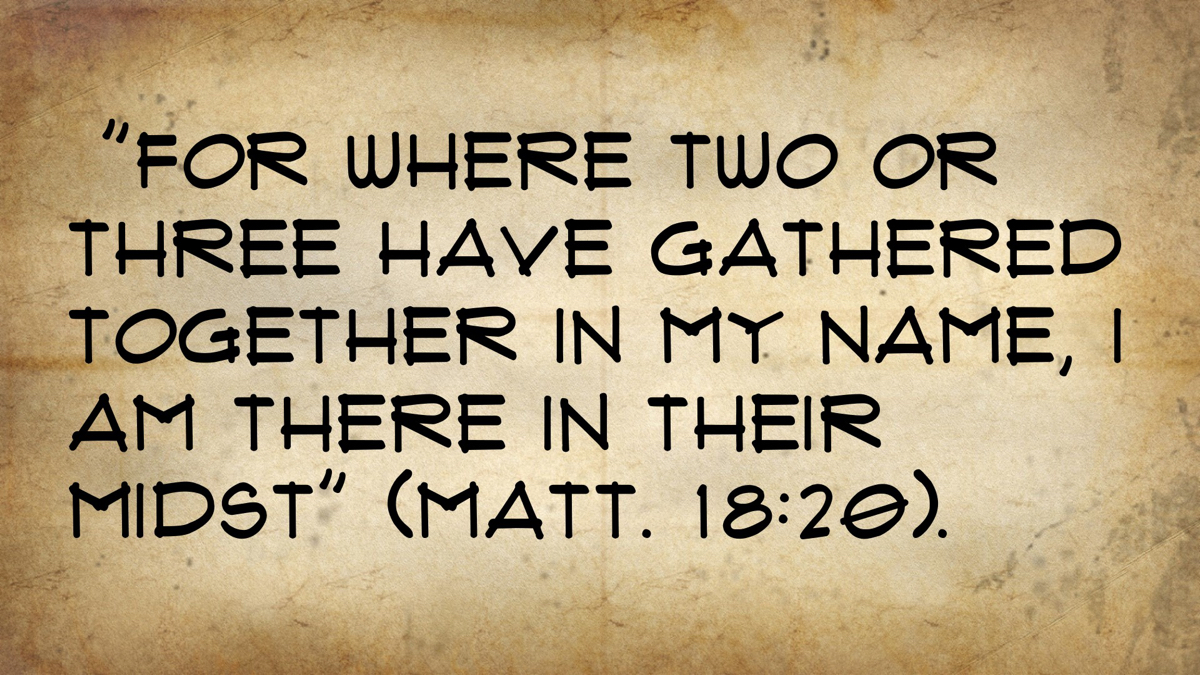
I often hear people state, at church and other places, that when two or more are gathered in His name, He is in the midst of them. I take Matthew 18:20 to be Jesus talking to His apostles. The preceding and following verses endow the apostles with powers we do not possess. Do you believe it is safe to assume that the same applies to us today when we are gathered together? Or, is He in our midst representatively while remaining in Heaven?
Matthew 18:20 certainly expresses divine truth, but it has often been forced into a duty and place which its Speaker never intended. Perhaps a general study of the principle would help all of us.
The omnipresence of God is a teaching found throughout the Bible (Ps. 139:7-12; Matt. 28:20; Heb. 13:5), but this statement by our Lord in Matthew 18 is more than His general omnipresence. While it may be true that a small congregation of two or three saints enjoys access to the throne of grace, this verse is not a definition of what constitutes a local church. Though it might be possible for Christians to approach God in worship apart from the local church, Jesus did not here sanction our discounting of the corporate worship in a local assembly that we might shortchange God while enjoying personal time or pleasures, as on a hunting/fishing outing or a golfing weekend. Too often, the assumption of many has been that the Lord is there to bless our experiences, as long as we give Him a few moments of time to “take the communion.” In such cases, it seems wise to state that such shallow-minded attempts to strain a passage for a singular, selfish purpose should rather give way to sober-minded efforts to devote ourselves to God and to His Son, who devoted His all to us.
And not only as we had hoped, but they first gave themselves to the Lord, and then to us by the will of God (2 Cor. 8:5).
I speak not by commandment, but I am testing the sincerity of your love by the diligence of others. For you know the grace of our Lord Jesus Christ, that though He was rich, yet for your sakes He became poor, that you through His poverty might become rich (2 Cor. 8:8-9).
Casting down arguments and every high thing that exalts itself against the knowledge of God, bringing every thought into captivity to the obedience of Christ (2 Cor. 10:5).
Establishing the context of our verse will prove helpful in determining its limitations, if any. Earlier in the eighteenth chapter of Matthew, Jesus began dealing with the primary virtue of humility (18:1-6) and then warned about the seriousness of causing others to stumble (18:7-14). In the present paragraph where verse 20 appears (18:15-20), the Lord gave instructions on dealing with offenders—-a three-step procedure for gaining the offending brother. Step three of the procedure directs the offended person to take the matter to the church, in the hope that the offender will hear the church’s plea for restoration (v. 17). A refusal on his part to listen to the church, however, means that the impenitent party must be counted as a lost one (“a Gentile and publican”), subject to disciplinary action. The joint decision of the church to act for the restoration of the offender, expressed in verse 17, is what Jesus described in terms of binding and loosing in verse 18. Such is the case because the church acts and speaks in agreement with the teaching of the Lord’s apostles, just as Peter was instructed in the same language in Matthew 16:19. What Peter was given in”the keys of the kingdom” in chapter 16, all apostles were granted in chapter 18. Congregational discipline is God’s will, because the apostles taught it and encouraged it (1 Cor. 5:3-5, 7-13; 2 Thess. 3:14-150), just as Jesus did so here.
In this context of church discipline, Jesus assured those hearing him, including those obeying him in future times, that their efforts enjoyed the Father’s approval. The two agreeing on earth may well refer to the earlier step in the disciplinary process in verse 16, as well to the larger group in the church making an appeal to the sinful brother in verse 17, and likely praying to God in such a matter (reasoning from a smaller to the larger group in the procedure; if God takes an interest in what the smaller group is doing, then He surely is interested in the larger group). The principle is that brethren acting, speaking, and praying in harmony with the Lord’s will in this matter enjoy God’s approval and presence, for “there am I in the midst of them.”
No, Jesus did not here establish the number of disciples needed to make up a church, nor did He refer to the matter of worship per se in His statements. He certainly did not here encourage spiritual slothfulness regarding assembling with the saints. It may well be, however, that the assurance of God’s presence and approval would apply to other authorized endeavors carried out in His name (Col. 3:17).

By Luke Chandler
Synopsis: Luke leads us on a virtual tour of the Pergamon Museum in Berlin, which has a world class collection of biblical artifacts.
One of the world’s best museums for biblical archaeology is the Pergamon Museum in Berlin. It is part of a museum complex on an island in the city’s downtown. Though not as famous as London’s British Museum or the Louvre in Paris, it boasts an impressive collection of artifacts and architecture that connects to the Bible.
The museum gets its name from the biblical city of Pergamum, home to one of the seven churches mentioned in Revelation. German scholars excavated this magnificent city in the late nineteenth and early twentieth centuries and sent many discoveries back to Berlin. The museum’s impressive collection includes discoveries from throughout the ancient world. Here are three special highlights with biblical connections.
The greatest find from ancient Pergamum was the massive, multi-level Altar of Zeus, which may have been the “Throne of Satan” mentioned in Revelation 2:13. The altar was accessed by a 65-foot (20-meter) marble staircase and was decorated with columns and statuary all around. It sat on a prominent point of Pergamum’s acropolis. The continual sacrifices offered there produced constant, ascending smoke that was visible throughout the city.
The museum wing with the Altar of Zeus has been closed for renovations since 2005, but is scheduled to open by 2027. For the past several years, a temporary exhibit has been open across the street that shows some of the altar’s statuary and reliefs. The temporary exhibit also features an impressive 360 degree artistic view of how Pergamum appeared in Roman times, including the Zeus Altar being used for pagan sacrifices.
The Ishtar Gate was the official ceremonial entrance to the city of Babylon, with the main palace just inside. This visually stunning city gate boasted a top-to-bottom facade of blue-glazed brick and was decorated with colored brick reliefs of lions and mythical creatures. The full structure comprised an impressive outer gate and a larger inner gate. A paved, similarly decorated Processional Way over half a mile long led to the gate. Daniel and his companions, and kings like Nebuchadnezzar and Belshazzar, would have passed many times through this very gate.
The Germans brought the entire outer gate back to Berlin and reconstructed it inside the museum’s southern wing, along with portions of the Processional Street reliefs. Some of the blue bricks in the reconstructed gate are modern replicas, but many are original, as are the creatures represented on and around it.
Visitors to the Pergamon Museum can walk under the very gate used by Daniel and other biblical people, and see the same decorative reliefs they saw with their own eyes. Additionally, decorated reliefs from the palace’s Throne Room are displayed in the museum on both sides of the gate. The lion reliefs from the Throne Room feature flared tails and terrifying faces, which would have impressed all who approached the King of Babylon. It is remarkable to consider that these Throne-Room lions would certainly have been seen by Daniel himself in the presence of King Nebuchadnezzar.
The biblical Pharaoh, Shishak (also known as Sheshonq I), gave asylum to Jeroboam (1 Kings 11:40) and later plundered Judah of Solomon’s wealth during the time of King Rehoboam (1 Kings 14:25-29; 2 Chron. 12:1-12). A stone chest from Shishak’s tomb is on display in the museum’s Egyptian wing. Inscriptions reveal that it originally contained the Canopic jars with organs from Shishak’s mummified remains! The Canopic jars are gone, but we can still see this most personal object belonging to a Pharaoh who interacted with two biblical kings.
There is much more in the Pergamon Museum that connects with the Bible, but you will need to hurry if you want to visit anytime soon. The entire museum will close this October for three and a half years to undergo extensive repairs and renovations. Parts of the museum should reopen in 2027, but the southern wing with the Ishtar Gate will be closed to visitors for fourteen years—until 2037!


Image-1 Caption: Ishtar Gate by Luke Chandler

Image-2 Caption: Processional Street by Luke Chandler

Image-3 Caption: Lion from Throne Room by Luke Chandler

Image-4 Caption: Marduk Image on Ishtar Gate by Luke Chandler

Image-5 Caption: Jehoiachin Ration Tablet by Luke Chandler

Image-6 Caption: Shishak Tomb Stone Chest by Luke Chandler

Image-7 Caption: Pergamum Great Altar by A.D. Riddle BiblePlaces.com

By Chris Reeves
Synopsis: Hospitality used to be fairly commonplace in the Lord’s church years ago, but today not so much. Why is that, and what can we do to get hospitality back in our lives?
Do not neglect hospitality to strangers, for by this some have entertained angels without knowing it (Heb. 13:2, NASB).
I remember, when I was about ten years old, my father was working with the church in Southport, Indiana. Among the members there was the wife of one of the elders, Eva Miller. This fine lady, “Sister Miller,” as I always heard her called, managed a KFC restaurant and a pizza place. The Millers would regularly have singings in their home, and “Sister Miller” would always have KFC buckets or a stack of pizza boxes set out for those who came. Can you image the delight of a 10-year-old standing in front of all that fried chicken or pizza? Wow, I can still smell it to this day!
If you ask older, faithful brethren, “What are some of your fondest memories of being in the Lord’s church?” I’m sure that many of them would tell you stories involving the hospitality they experienced with other brethren. Will we, or our children, have similar precious memories in the future? Will we look back and remember the laughter and special times of friends together, the smell of good food, or the excitement of knowing that you were invited to “Sister Miller’s” house after the church service?
Our English word “hospitality” comes from the Latin hospitium, meaning a lodging. In the Bible, the English translation “hospitality” comes from two main Greek words. The first Greek word is xenia, meaning “lodging” (Acts 28:23; Phile. 22). The Greek verb xenizo, means “to entertain; receive as a guest; to lodge” (Acts 10:6, 18, 23, 32; 21:16; 28:7; Heb. 13:2). Other related Greek words are xenodokeo, meaning to “lodge [receive] strangers” (1 Tim. 5:10) and xenos, meaning “stranger” (Matt. 25:35, 38, 43, 44; Rom. 16:23; 3 John 5). The emphasis in these words is on the lodging of strangers.
The second Greek word translated “hospitality” is philoxenia, meaning “love of strangers” (Rom. 12:13; Heb. 13:2). Other related Greek words are philoxenos, meaning “to exhibit hospitality” (1 Tim. 3:2; Titus 1:8; 1 Pet. 4:9); philagathos, meaning “lover of good” (Titus 1:8); philanthropia, meaning “love toward men” (Acts 28:2); philanthropos, meaning “love toward men” (Acts 27:3); and, philophronos, meaning “courteous” (Acts 28:7). The emphasis in these words is on the love for strangers.
What are the basic meanings conveyed by these original Greek words? First, there is a proper attitude—one is a lover of good, courteous, welcoming, and generous. Second, there is a proper action—one feeds, offers rest, entertains, lodges, and gives shelter. Third, there is a proper audience—guests, friends, neighbors, strangers, and the poor. Note that many of these Greek words focus on strangers, not just family and friends that we know well.
God’s faithful people in the Old Testament were hospitable. Abraham (Gen. 18:1-8), Lot (Gen. 19:1-11; see Judg. 19:22ff), Rebekah (Gen. 24:15-27), Reuel (Exod. 2:16-22), the Israelites (Deut. 10:13-19; 15:11), Manoah (Judg. 13:15), the Shunamite woman (2 Kings 4:8-13), Nehemiah (Neh. 5:17ff), Job (Job 31:16-23, 31-32), and the worthy woman (Prov. 31:20), were all hospitable.
Why was hospitality provided in the Old Testament world? It was provided because this was mostly a nomadic (traveling) culture, and inns were rare. People needed a place to stay. What was provided? Bread, water, meat, curds, and milk were offered to the guests. Their feet were washed, their heads were anointed with oil, and rest and refreshments were provided. Their animals were given food and water. Travelers needed accommodations, protection, and asylum.
God’s faithful people in the New Testament times were also hospitable. Matthew (Luke 5:29-32), the Good Samaritan (Luke 10:30-35), Simon the tanner (Acts 10:5-6, 23), Cornelius, Lydia, and the Jailor (Acts 10:48; 16:15, 34, 40), Philip and Mnason (Acts 21:8, 16), the barbarians and Publius (Acts 28:1-10), Philemon (Phile. 22), and Gaius (Rom. 16:23; 3 John 5-8; see Lk.10:7) were all hospitable.
Why was hospitality provided in New Testament times? It was provided because persecution scattered Christians and they needed to travel. There were also itinerate (traveling) preachers to care for. Poverty and poor public assistance programs were common among many people and they needed help. There were also inns with low standards that were unsafe for lodging. What was provided? Food, care for the body, and lodging.
When you read in your Bible about godly people offering hospitality to others, you notice that they are offering more than just a meal in their home to their friends. They are providing much more, and we need to consider doing the same today when necessary. Burton Scott Easton wrote: “The ‘hospitality’ of today, by which is meant the entertainment of friends or relatives, hardly comes within the biblical use of the term as denoting a special virtue” (Easton, ISBE, 1433).
In the New Testament, hospitality is expected of all the members of the church. Elders (1 Tim. 3:2; Titus 1:8), widows (1 Tim. 5:10), and all Christians (Matt. 25:35, 40; Rom. 12:13; 1 Pet. 4:9; Heb. 13:2) are to practice hospitality. No one is exempt from showing hospitality! The work of hospitality is the work of the individual (Acts 2:46; 1 Cor. 11:22, 34)—not the local church, so let’s be busy doing hospitality. Let us show hospitality to our brethren (1 Pet. 4:9), to strangers (Heb. 13:2), and to the poor (Luke 14:12-14). Let’s be given to (pursuing) hospitality. Let’s do it with love (Rom. 12:9; Heb. 13:1; 1 Pet. 4:8), let’s do it without murmuring or complaining (1 Pet. 4:9), and let’s do it, not looking for a payback. Let’s do hospitality in our home and outside our home (Luke 10:35; Matt. 25:35-36).
There are some people today who are not hospitable because they are not willing to associate with certain kinds of people (prejudice). They are not willing to care for the needs of others (uncompassionate, unloving), to sacrifice time, money, or energy, to prepare (selfishness), to be generous (greedy; Prov. 22:9; Acts 20:35; Eph. 4:28), to trust anyone (cynical), or to be available and connected with others (disconnected). Others are not hospitable because they want personal family ties only. Some are too busy with work, school, hobbies, etc. Others are too focused on their technology to care for others (TV, cell phones, tablets, etc.). Many are living their “life in the fast lane,” and don’t have time for others. Brethren, we can do better than this.
Let me offer you some tips on how you can get started being more hospitable with others. First, eliminate excuses. If you can’t cook food well, buy it. If you are shy or timid, have others present. If you have a small house, start with a just a few people. If you are single, have a mixed group present. If you have a non-Christian spouse, go out with others to a restaurant. Are you ashamed or embarrassed of your house? Don’t be. God sees your heart, not your house.
I would also recommend that you set some goals. Plan, purpose, and pray about your hospitality. Set dates and create occasions to be hospitable. Involve your children. Determine to serve all the members in your local church, not just your clique. Determine to serve the visitors (gospel preacher, non-member visitors, new converts, foreign evangelists). Save up and send money or supplies to poorer brethren in other countries. Also, you can always go when invited by others to eat together.
Brethren, we must fulfill the New Testament command to be hospitable. Are we providing encouragement, support, the fulfillment of needs, and refreshment for others? Hospitality is a way to show our stewardship to God and our faith and love to others (Jas. 2:15). It is a way to serve Jesus himself (Matt. 10:40; 25:40; Luke 24:29-31), and be rewarded in the judgment day (Matt. 25:31-46; Luke 14:14).
I’m so thankful to godly Christians like “Sister Miller,” my parents, my in-laws, and many other brethren who taught me what hospitality is all about. Now I want to pass this practice on to my children. Brethren, we live in a world where people are becoming increasingly self-centered and isolated. Let’s all go out and show our world how to love strangers.
Easton, Burton Scott. “Hospitality, Host,” in The International Standard Bible Encyclopaedia (ISBE). Edited by James Orr et al. Chicago: The Howard-Severance Company, 1915.


By Raven Willis
Synopsis: Modesty reveals a lot about our true intentions. Christians must embrace God’s way of modesty to be a true example to others.
Modesty is defined by humility and decency in dress, language, and behavior. Instead of drawing attention to oneself, Christians (male and female alike) should learn to shift the focus away from self.
To be faithful followers of God, believers must express their modesty in the ways which God instructs. This applies to both men and women.
Modesty is a biblical concept. We should always want to elevate God and lower ourselves; however, this is a lot easier said than done. The idea of modesty is first expressed in Genesis 3:7 when, as a result of eating fruit from the tree of the knowledge of good and evil, Adam and Eve recognized that they were naked. They sewed fig leaves together to cover their nakedness because they knew they were immodest in the presence of the Lord.
Later in the Scriptures, Moses showed the priests what modesty should look like. “You shall make for them linen breeches to cover their bare flesh; they shall reach from the loins even to the thighs” (Exod. 28:42). Their clothing covered “even to the thighs.” This clothing was required to present oneself as holy when entering the Tabernacle, so the priests had to make sure their attire was respectful towards the Lord. Our daily dress should demonstrate our reverence to God. What better way can we, as Christians, show which master we follow than by dressing in a Christ-like manner? We should cover ourselves because it is a divine command and shows honor to the One we serve.
1 Timothy 2:9-10 says, “Likewise, I want women to adorn themselves with proper clothing, modestly and discreetly, not with braided hair and gold or pearls or costly garments, but rather by means of good works, as is proper for women making a claim to godliness.” These verses do not teach that one cannot braid her hair or have nice things; rather, they teach us that what is inside matters the most. We should not be parading around trying to flaunt the money we possess or the body God has given us. Instead, we should praise God for what He has graciously provided by humbling ourselves and keeping our priorities straight. 1 Samuel 16:7 communicates that the Lord looks at one’s heart. Proverbs 31:30 says, “Charm is deceitful and beauty is vain, but a woman who fears the Lord is to be praised.” Both concepts reveal God’s true feelings about what is most important to Him. From a biblical standpoint, a woman is beautiful if her heart is beautiful. God looks on one’s heart and not upon her appearance. One’s appearance sometimes reflects attitudes of the heart that are contrary to God. Unfortunately, we sometimes spend too much time focusing on things that contribute nothing to our salvation. We may even jeopardize that salvation. Since outward beauty is unimportant to God, why do we emphasize it so much, even as Christians?
It is important to note that modesty involves more than just one’s outward appearance, but is also reflected in our attitudes and actions. Modesty involves a sense of humility and self-awareness, recognizing that our gifts and talents are given to us by God. We should be used for His glory, not for making a fashion statement or attracting a man’s attention. Our dress should demonstrate a willingness to put the needs of others ahead of our own selfish desires, to serve and love others as did Christ. When one is truly modest acting with humility, one’s pride will be put aside in order to lift up others. It is crucial to maintain a heart of humility as our Lord requires.
Lust strongly plagues our world. Countless people wear revealing clothing that invites the eyes of weak and longing individuals. The story of David and Bathsheba is a great example of this. In 1 Samuel 11, David first saw Bathsheba through a window as she was bathing. What David saw evoked sexual passions. These caused him to spiral downward into committing many sinful acts. Lust may start as an innocent glance, but it can turn into an intentional gaze. As the story progresses, David went out of his way to seek Bathsheba. In the end, David had Bathsheba’s husband killed to cover his sin of adultery with the woman for whom he longed. David’s original intentions were likely not to murder a man, although the succession of events resulted in him doing so. We can apply this example to today. Lust may not lead us to kill another (although it may, as occurs in an unwanted pregnancy ended by an abortion). However, lust can certainly lead us down a path we do not want to travel. All of this began when Bathsheba was bathing herself where others could see. Even though she was not intending to sin, her nakedness still had a great impact on David. This example should remind one that what you decide to wear, or not wear, can lead to another’s temptation. As Christians, our example should encourage others to gravitate closer to God, not lead them further astray.
In our everyday lives, it is nearly impossible not to notice the immodesty that is ever-present. It has become “trendy” to wear less and less clothing. This should not be true for God’s people. The less clothing one has on, the more enticing that person is to wandering eyes. Christian men and women should wear appropriate clothing so that others will not look upon us with lustful longing. Not only this, but we also must guard against looking with lust upon others. As in the example of David and Bathsheba, he would not have gone as far as he did if he had not been looking at Bathsheba improperly. We need to be careful about what attracts our gaze—whether it be the people around us, the shows we watch, or the websites we visit.
Christians are supposed to differ from the world. We should have a light that is unlike those living for themselves. Romans 12:2 reminds us not to be conformed to the styles and ethical practices of our contemporary age, saying, “Do not be conformed to this world, but be transformed by the renewing of your mind, so that you may prove what the will of God is, that which is good and acceptable and perfect.” Our service to God will show others who we are and what God requires. That is powerful! As saved individuals, we should behave in ways that glorify our Heavenly Father. Just because the world dresses in opposition to what God wants does not mean we have to do the same. We should stand with God and not the unbelieving world. It should please us to do so, because Christians are made to be sanctified, i.e., set apart.
If one is tempted to dress immodestly, he needs to evaluate why he wishes to appear to people in this way. Are we seeking to tempt others to lust? Do we want to look like the world? 1 Corinthians 6:19-20 reads, “Or do you not know that your body is a temple of the Holy Spirit who is in you, whom you have from God, and that you are not your own? For you have been bought with a price; therefore, glorify God in your body.” First, it is good to keep in mind that modesty is for both genders, as Paul is the one preaching this message. Second, since our bodies are not our own, we should not seek things to please ourselves, but we should be listening to God’s instructions for how we are to take care of the bodies we have been given. This includes how we dress. Christians must not follow the world, but follow God, since He is the one providing the way of escape. In conclusion, I want to leave you with this question: Is the world defining your dress—or is God?


By Alan Yeater
Synopsis: In the book of Obadiah, God pronounces judgment upon Edom for her pride and perversity.
Obadiah deals with the conflict between Edom and Israel. Although these two nations shared kinship via their progenitors, Esau and Jacob, strife marred their relationship. Obadiah’s message is that Edom will be humbled, but Judah (i.e., God’s chosen people) remains central to God’s eternal purpose.
Obadiah, the prophet, appears fourth in the sequence of the twelve minor prophets. We know nothing about him other than that the Holy Spirit guided the words of his book. Obadiah means “servant of the Lord.” The name Obadiah refers to at least thirteen different men in the Old Testament text. We do not know if any of these is the author of this little poem. Edomites are the descendants of Esau. By the first century AD, the few remaining descendants of Esau were known as Idumeans.
Regarding the date of this document, three plausible options present themselves. One is around 850 BC when Shishak invaded Judah (1 Kings 14:25). The place of the book in the minor prophets may suggest an early date. A second option is the defeat of Amaziah (2 Kings 14:8-14), and the third during the days of Nebuchadnezzar in 586 BC. The calamity spoken of here seems to refer to the dark days of 586 when Judah was fleeing the hordes of Babylonians, only to be slain by their brothers, the Edomites. To help little ones—and the rest of us—remember the contents of the book, the authors of Our Spiritual Heritage suggest remembering Obadiah as “Oh Bad Edom.”
The book of Obadiah is the shortest document in the Hebrew Bible, with only twenty-one verses. Obadiah calls upon his readers “to see” the vision of this message (Obad. 1). This is one of seven Old Testament documents that are not quoted in the New Testament. However, this document was well attested regarding its inspiration prior to the coming of Christ. Obadiah is an oracle against a foreign nation called into judgment for its abuses against the people of God. The basic message is composed of two simple parts:
Despite their strategic mountainous location (v. 3) and proverbial wisdom (v. 8), Edom will be brought down and driven out of their red rock fortress, later known as Petra, by the Nabateans. The prophet sees the calamity as a divine punishment for Edom’s cruelties toward Israel.
This prediction of the Day of the Lord with the restoration and victory of Israel. This document, unlike other prophets, has no correction for Israel or a call for her to return to the Lord. His burden is entirely focused upon the doom of Edom. Please note that its purpose seems not to warn the Edomites but to comfort Israel. In simple terms, the documents’ purpose is to raze Edom and raise Israel.
You may have noticed the similar language in Jeremiah 49:7-16 and Obadiah 1-9. Both prophets address Edom. Both writers are independently driven by the Holy Spirit to condemn the arrogance and presumed wisdom of Edom.
The conflicts between Israel and Edom can be traced back to the prenatal struggle of their ancestors, Jacob and Esau (Genesis 25). These two “peoples” are brethren. The Edomite was not to be abhorred, nor was Israel to take Edom’s territory (Deut. 23:7-8), despite the fact that Edom refused to allow Israel to pass through their land during the wilderness wandering (Num. 20). Edom held on to its anger and wrath against Israel for over a millennium. Amos refers to the resulting judgment of God based upon the wrath of Edom against Israel in Amos 1:11-12. However, the actions of Edom during the Babylonian period seem to be remembered most bitterly by Israel. Edomites joined the Babylonians in the devastation and then moved into the vacuum when Judah was carried away captive (Ps. 137:7; Ezek. 35:1-15). Some Judeans attempted to find temporary refuge in Edom, but were unwelcome there (Jer. 40:11). By the time of Malachi, Edom had suffered a devastating defeat (Mal.1:2-5).
The Nabateans at some point took over Edom and, by 312 BC, the nation was called Idumea. The Idumeans supplied history with Herod, who became king of the Jews. The Herod family, although rulers over Palestine, via Roman domination, were well acquainted with the Hebrew Scriptures. The Herod clan, whom some of the Jews (i.e., the Herodians) considered friends, were enemies of God and sought to destroy Jesus, killed His cousin, John, executed the apostle James and held court in a trial of the apostle Paul. God eventually crushed the rule of the family of Herod the Great over God’s greater people, Israel. Edom was no more, but the true Israelites, the people of God, will not only survive, but thrive in God’s kingdom.
The poet Obadiah presents moving imagery as God portrays the downfall of Edom. First, Edom’s “presumptuous heart” (HCSB) will bring them down from the high cliffs of their red rock empire. Obadiah portrays Edom as a soaring eagle with her nest among the stars. Her false trust in her mountain stronghold would be crushed by the tools at God’s disposal. The allies of Edom will be the very ones who will accomplish the destruction declared by the divine King.
The extent of the destruction occurs in a series of events disclosed over a period of time. Like most empires, this one will not collapse all at once. The thieves would take what they wanted, and little would be left after the grapes of wrath were gleaned. Esau will be pillaged and his hidden treasures searched out (Obad. 6). The allies would turn on Edom and deceive and conquer him (v. 7). Edom’s wise men have failed to protect their mountain domain. This judgment is from the Lord and it is His order to cut off Esau (vv. 8-9).
The pride of Edom leads to the ugly lack of brotherly love (vv. 10-14). He refused to aid when Judah was pillaged, rather he stood by and gloated over the misfortune. God condemns rejoicing over a brother’s calamity (Prov. 17:5). Edomites not only rejoiced over the calamity that befell Israel; they also participated in the violence against Judah (vv. 13-14). Edom is condemned for gloating over the day of his brother’s calamity (v. 12). This day of the Lord for the wicked is a day of facing God in judgment. This threat announced by the prophet is that, as Edom has done, it shall be done to him.
The second section of this short poem is an apocalyptic picture of the Day of the Lord. As typical of this style of writing, the enemy of God, Edom, will drink of the cup of God’s wrath. This judgment of doom is seen in (Jer. 25:15ff; Ps. 75:8). This portrait continues in the New Testament in Revelation 14:10. Here, as elsewhere in the prophets, “the Day of the Lord is a day within history after which history will continue” (Jack Lewis).
The contrasting fate of Esau and Jacob declares the elevation and vindication of Jacob and the complete annihilation of the descendants of Esau (vv. 17-18). In contrast to the demise of Edom, the prophet promises a return of exiles from Judah and Joseph—to possess the land from the mountains of Esau to the coast of Phoenicia and the land of Gilead.
Saviors (i.e., deliverers) will ascend Mt. Zion to rule, and “the kingdom will be the Lord’s.” This portends the greater kingdom rule that came with the Messiah. Promises of an enduring kingdom directed by the Son of God (also identified as the Son of David, and the Son of Man), who received the throne from His Father, are found in Isaiah 2, Joel 2, Daniel 2 and 7, and come together in Acts 2. Jesus of Nazareth, the ultimate son of David, now sits upon His throne and serves as our Deliverer and King who has come to rescue His people from all oppressors, including Satan and those whom he uses to mock, discourage and persecute.
The true Israel (Rom. 2:28-29; ch. 9-11) will be vindicated based on trust in Christ that “whoever will call upon the name of the Lord will be saved.” What is entailed in that calling is stated in Acts 2:38-47. It is through the power of God and the resurrection of Christ that we may be extricated from the dominion of darkness and transferred into the kingdom of the Son whom God loves (Col. 1:13-14). This redemption results in the forgiveness of our sins in and through Christ. Obedient submission to king Jesus is imperative.
The evil attitudes that Esau (and Edom) manifested against those who seek the Lord still remain on the earth. I would be remiss not to observe that Jacob, the person and the nation, did not always seek and trust the Lord. In contrast, Esau was of a different spirit or mindset: “See to it that no one comes short of the grace of God; that no root of bitterness springing up causes trouble, and by it many be defiled; that there be no immoral or godless person like Esau, who sold his own birthright for a single meal” (Heb. 12:15-16). Esau failed to consider the consequence of poor choices and allowed bitterness to infect his heart. We must, however, “pursue peace with all men, and the sanctification without which no one will see the Lord. See to it that no one comes short of the grace of God; that no root of bitterness springing up causes trouble, and by it many be defiled” (Heb. 12:14-15).
“Obadiah is a standing rebuke to the spirit who prefers not to become involved in the problems of others, but it is even more a rebuke to him who finds a sadistic joy in the misfortunes of another” (Lewis). It is a delusion for nations to think that, due to position or power, they are not vulnerable to God’s judgment. God will judge the wicked and will preserve the righteous in the kingdom of His dear Son.
Lewis, Jack. The Minor Prophets. 10th Ed. Grand Rapids, MI: Baker Book House, 1966, 1992.
The Holy Bible: Holman Christian Standard Version (HCSV). Nashville: Holman Bible Publishers, 2009.



by David Diestelkamp
Synopsis: The prophet Joel presents God’s intimidating judgment and the promise of deliverance, salvation, and His Spirit for those who turn to Him with their whole hearts.
When life seems messed up and things seem to be getting worse and worse, the book of Joel is for you. When you wonder what physical suffering should cause you to consider, the book of Joel is for you. When you think God isn’t the answer to your problems, the book of Joel is for you.
If you think life is difficult, that’s nothing new. Joel begins by asking the old men of Judah if they had ever seen anything like the recent devastating three waves of locusts that left virtually nothing behind them.
Closing your eyes to problems isn’t the answer. Joel wants drunkards to feel that there is nothing for them to drink. They are to see the fields and grain are ruined, new wine is dried up, there is no oil. They have hit rock bottom like a virgin whose betrothed has died, like a farmer or vinedresser whose crops and fruit are all destroyed.
Allow suffering and loss to turn you to God, not away from Him. Even though famine had left Judah with nothing to sacrifice to God, Joel tells the priests to, “Put on sackcloth and lament. . .” (1:13, ESV). They are to “Consecrate a fast, call a sacred assembly,” gather the elders and those living in the land to the house of the Lord, and “cry out to the Lord” (1:14). Things that turn people of the world away from God turn His people to Him.
Physical trials and suffering should remind you that we are fragile and we cannot survive God’s wrath and judgment, which are far more devastating than physical catastrophes. Joel writes, “Alas for the day! For the day of the Lord is at hand” (1:15). It’s an “Oh no!” moment of destruction from God. It’s not simply the locusts and famine—food is already cut off, the animals are groaning, the fields are scorched, and the brooks are dried up. Judah should have been reminded by these that they should fear the day of the Lord which would be far worse!
Life can get so bad that you may think it can’t get worse, but we have to see that God’s judgment will be far worse than anything we can imagine, if we abandon Him. Joel tries to magnify God’s judgment by describing a terrifying physical army. “The day of the Lord” is alarming, dark and gloomy. His army is great and strong, like no army that has ever been, or ever will be. They are like horses, like roaring chariots, mighty men who run, climb, and march without breaking ranks. “The earth quakes before them, the heavens tremble; the sun and moon grow dark, and the stars diminish their brightness” (2:10). Truly, “. . . the day of the Lord is great and very terrible,” and it begs us to ask, “Who can endure it?” (2:11).
When you are feeling the terror of your sinfulness, turning back to God is the answer. “Turn to Me with all your heart, with fasting, with weeping, and with mourning” (2:12). Joel says “rend your heart” and not just tear your outward clothing in mourning. This is to be a deep, brokenhearted, humble, genuine sorrow for sin that is in response to God’s grace, mercy, slowness to anger, great kindness, and willingness to relent from doing harm. Joel urges them to reach out to God in fasts, and in a “sacred assembly” that gathers literally everyone—from the elders and priests to the children, nursing babes, bridegrooms, and brides.
“Turn to me with all your heart” may be intimidating to you—it’s a big commitment. Joel assures, “Then the Lord will be zealous for His land, and pity His people” (2:18). The reasons for reproach will be taken away, and blessings will overflow. The “northern army” will be removed “far from you.” Joy and gladness will return to the “children of Zion.” People will see that “the Lord has done marvelous things!” (2:21). Repentance turns fear of judgment to praising “the name of the Lord your God, Who has dealt wondrously with you” (2:26). “Then you shall know that I am in the midst of Israel: I am the Lord your God and there is no other” (2:27).
During times of suffering or threats of judgment, God can feel far from you, but He promises His Spirit. To penitent Israel God says, “It shall come to pass afterward that I will pour out My Spirit on all flesh” (2:28). The time will come when God will return to His people and it will be obvious: sons and daughters will prophesy, old men will experience dreams, and young men will see visions. “I will show wonders in the heavens and in the earth. . .” (2:30-31). Figurative apocalyptic language is used to describe the magnitude of “the coming of the great and awesome day of the Lord” (2:31): Blood, fire, smoke, darkened sun, and the moon into blood. These are images of intimidating and awe-striking power.
You may not believe it, but Joel is about salvation—Israel’s and ours. “It shall come to pass that whoever calls on the name of the Lord shall be saved” (2:32). Israel was looking at famine and devastation, but if they turned back to God, “in Mount Zion and in Jerusalem, there shall be deliverance” (2:32). Judgment of sin is real; so are God’s mercy, grace, and deliverance. There will be a “remnant whom the Lord calls” (2:32).
As tempting as it may be during times of suffering or deprivation, you do not want to side with God’s enemies. Joel warns that God would judge the nations who scattered His people and sold them, took their land, and violently shed innocent blood, because “their wickedness is great” (3:13). The nations will be gathered in “the valley of decision” and a roar of the Lord from Zion will shake everything, “But the Lord will be a shelter for His people” (3:16). God’s enemies will experience desolation, but a new era of holiness and blessing will open for His people, and it “shall flow from the house of the Lord” (3:18).
Joel was written for our learning (Rom. 15:4). It is one of the hardest prophets to date. Although this locust plague was especially severe, similar (though lesser) events were frequent. Additionally, the apocalyptic language can be challenging to interpret. However, the lessons concerning the certainty of God’s judgment, the consistency of His justice, and the need for His people to repent and remain faithful are painfully clear in Joel.
Joel looks to their future when “it shall come to pass afterward” (2:28) that there is the outpouring of God’s Spirit, deliverance, salvation, and abundant blessings. Israel waited a long time for that day to dawn and finally, when the Holy Spirit was poured out on the Day of Pentecost in Acts 2, Peter was moved by the Spirit to say, “this is what was spoken by the prophet Joel: ‘And it shall come to pass in the last days, says God, that I will pour out of My Spirit on all flesh’” (Acts 2:16-17). The days of Joel had begun!
There is a lot of controversy surrounding what is said in Joel 2 and Acts 2 concerning the Holy Spirit and miraculous gifts. It is often forgotten that the miraculous gifts were not an end in themselves, but were intended to be evidence of the outpouring of the Spirit. Furthermore, the outpouring of the Spirit also wasn’t an end, but evidenced that the day had come when “whoever calls on the name of the Lord shall be saved” (Joel 2:32; Acts 2:21). In rejecting Jesus, Israel had once more rejected their God and faced His judgment for their sins. When Peter exhorted those on Pentecost to “Repent, and each of you be baptized in the name of Jesus Christ for the forgiveness of your sins; and you will receive the gift of the Holy Spirit. For the promise is for you and your children and for all who are far off, as many as the Lord our God will call to Himself” (Acts 2:38–39)—he was reaching back to Joel’s, “lament,” “mourn,” “be ashamed,” “rend your hearts,” and “return to me” in obedience, and “call on the name of the Lord.” They did that when they “received his word and were baptized” (Acts 2:41). God’s Spirit has returned to His spiritual Israel, and through Christ, He has brought overflowing blessing: deliverance and salvation from their sins that shake heaven and earth! Through obedience to the gospel, we have access to that for which the prophets looked and longed (1 Pet. 1:10-12).


By Joe Greer
Synopsis: The story of the prophet Jonah provides an insightful look at God’s mercy and how He offers it to man.
Many of us know the story of Jonah and his plight of spending three days in the belly of a great fish. Perhaps we have taught this lesson to young children and watched in amazement (or maybe amusement) as their eyes grow big, while thinking about what it would be like to be swallowed like Jonah and then spit out on dry ground. To those young and old alike, it truly is an amazing story with powerful applications of our need to obey God. While we rightfully make application of that point, one that is sometimes overlooked is God’s mercy—which is the essence of the message.
Jonah, to be sure, was reluctant to fulfill his role as God’s spokesman. He was a prophet who turned away, literally, from going to Nineveh to deliver God’s message of impending judgment on this Assyrian city. Jonah was a Jewish patriot who seemingly would rather see his enemy suffer God’s wrath than to deliver a message that might cause their repentance. His actions reveal a spirit contrary to that of God’s—his cold, callous, and calculating attitude was opposite to the grace that flows from the Creator of all things. Think about how we see God’s mercy displayed in the book of Jonah.
Jonah defiantly turned away from what God wanted him to do. He paints a clear picture of what rebellion toward God looks like—turning from God and going in a totally opposite direction. Admittedly, it is easy for us to look at Jonah, point a finger at him, and say, “What are you doing?” Clearly, his choices were foolish. We see why God’s wrath was released on him. Yet, to be honest, are we different? Have we deluded ourselves into thinking that we could be judged with a soft hand when we defy the will of God?
For many of us, it is only when we have been brought low that we seek God and turn to Him, the same that could be said of Jonah. When Jonah humbled himself and submitted to God’s will, God responded immediately. From inside the fish, Jonah prayed to the Lord his God. He said: “In my distress I called to the Lord, and He answered me. From the depths of the grave I called for help, and you listened to my cry. . . And the Lord commanded the fish, and it vomited Jonah onto dry land” (Jonah 2:1-2, 10, NIV).
From the belly of that great fish, contrite prayers ascended on high to the ears of God. His response was not because Jonah was so good, as he has clearly proven otherwise, but because God’s mercy is so great. In Jonah, we see a change of heart, a humbling of self and recognition that “salvation comes from the Lord” (v. 9), and Jonah was introduced to the mercy of Jehovah God.
Assyria represented a powerful and wicked nation feared by many. During this period, it was a looming threat to Israel. In about fifty years, Assyria would conquer Israel and carry them into captivity. While we understand Jonah’s reluctance to preach hope to the very ones who posed such a threat to his people, God did not ask his opinion on the matter. God wanted His messaged preached. “Then the word of the Lord came to Jonah a second time. Go to the great city of Nineveh and proclaim to it the message I give you. This time, Jonah obeyed the word of the Lord.”He proclaimed: Forty more days and Nineveh will be overturned. The Ninevites believed God. They declared a fast, and all of them, from the greatest to the least, put on sackcloth” (Jonah 3:1-5, NIV).
It is amazing to picture in our mind—this great and powerful city, that seemingly once had no fear, bowing to the God of all creation. Even the king humbled himself, removed his royal robes, covered himself in sackcloth and ashes and made a proclamation: “Let everyone call urgently on God. Let them give up their evil ways and their violence. Who knows? God may yet relent and with compassion turn from his fierce anger so that we will not perish” (Jonah 3:8b-9, NIV). Approaching God with a contrite heart and humble attitude is always wise.
We see unfolding what is a reoccurring pattern—God’s willingness to extend mercy to those undeserving to be its recipient, and that His grace and compassion are always great to the repentant. “When God saw what they did and how they turned from their evil ways, He had compassion and did not bring upon them the destruction He has threatened” (Jonah 3:10, NIV).
While the God of heaven always looks favorably upon those who are meek and humble in spirit, the Ninevites’ response was not what Jonah wanted to see. Jonah was obedient to deliver God’s message, but he was still dealing with a serious heart problem. “But Jonah was greatly displeased and became angry” (Jonah 4:1, NIV). How could Jonah possibly be angry at the repentance of the people? Well, that will remain a discussion for a later time while we focus instead on God’s mercy in this story.
In this case, as always, God’s grace and compassion are without equal. His concern is saving the lost, offering a way for the sinful to draw near to Him—not by compromising His holiness, but by presenting a way for sinful man to leave that life behind, and turn to Him. What was the focus of our righteous God? “But Nineveh has more than a hundred and twenty thousand people who cannot tell their right hand from their left, and many cattle as well. Should I not be concerned about that great city?” (Jonah 4:11 NIV). The answer is of course, yes! Certainly, God is concerned about the many in that city and the 120,000 innocent souls (presumably children), and all the rest of His creation as well. God’s mercy. . . What can we say!?
So, what does this mean to you and me? God’s grace and mercy, which we can never appreciate too much, should cause us to fall on our knees in thanksgiving. If God can offer his mercy to a repentant Jonah, or to an incredibly wicked city willing to turn and worship Him, just think of what He would be willing to do for you and me. Oh, but He already has!
To be clear, we are not deserving. Neither can we perform enough good works to overcome our sins. Rather, by turning to Him, we can accept grace that He generously offers and be recipients of His exceedingly great mercy. We would not be the first—no, not at all—but heirs, none the less, of God’s abiding love toward all His creation. So great is His love for man that He gave the most precious and valuable gift that could ever be offered—His only begotten Son. If we choose to be in Him, we have everlasting life (John 3:16).
Remember the words of the apostle to those early disciples who were so troubled with sin that they were covered in it. In Ephesians 2, Paul paints this picture of a people “dead in trespasses and sins. . . walking according to the course of this world” (vv. 1-2). Is it only the early disciples who were battling the scourge of sin? No, it is our problem too. Let us thank God for His great love for us, and also for His mercy—but His mercy is nothing new. We read about it even in times long ago, like when a great fish swallowed a disobedient prophet who himself became a needed recipient of God’s mercy. . . even as we need it today. Thank God for His undeniable love for the sinful and lost, for grace that is immeasurable, and for mercy that is rich and draws us to Him.
But God, who is rich in mercy, because of His great love with which He loved us, even when we were dead in trespasses, has made us alive together with Christ (by grace you have been saved), and has raised us up together, and made us sit together in the heavenly places in Christ Jesus, that in the ages to come He might show the exceeding riches of His grace in His kindness toward us through Christ Jesus (Eph. 2:4-7, NKJV).


By Kevin Kay
Synopsis: Although Amos was a simple man, he denounced the sins of God’s people and their neighbors in moving and memorable language.
He was a sheep breeder and a grower of sycamore trees, neither a prophet, nor the son of a prophet, until God said, “Go, prophesy to My people Israel” (7:14-15)1. He lived in the town of Tekoa, six miles south of Bethlehem and twelve miles south of Jerusalem. So, he was a “southerner” sent north to prophesy against the northern kingdom of Israel. He prophesied during the reigns of Uzziah, the king of Judah and Jeroboam II2, the king of Israel (1:1) when both kingdoms were powerful, prosperous, and at peace with one another.
Israel was at her zenith both politically and economically. As a result, the wealthy slept on beds of ivory (6:4) in their winter and summer houses inlayed with ivory (3:15); they drank wine from their lush vineyards (5:11) and sang songs to the sound of instruments that they invented for themselves (6:5). However, morally and spiritually, Israel was rotten to the core (3:9-10).
His name, Amos, means “burden bearer,” and oh, what a burden he bore primarily against Israel, but also against her neighboring nations! Unlike some prophetic books, his book can be easily outlined. It has:
An Introduction (1:1-2)
Eight Oracles of Judgment (1:3-2:16)
Three Sermons of Judgment (3:1-6:14)
Five Visions of Judgment (7:1-9:10)
A Promise of Restoration (9:11-15)
Amos begins his warnings of judgment with the ominous words: “The Lord roars from Zion and utters His voice from Jerusalem; The pastures of the shepherds mourn, and the top of Carmel withers” (1:2) With that said, Amos begins to pronounce God’s oracles of doom upon the neighboring nations of Israel, then Judah, and finally and primarily, Israel. He begins each oracle with God’s words, “For three transgressions. . . and for four, I will not turn away its punishment” (1:3, 6, 9, 11, 13; 2:1, 4, 6), as if to say the cup of iniquity for each of these nations is now full to overflowing. Each oracle identifies the wicked city, cities, or nation and the wickedness for which each will be punished.
Damascus [Syria] will be punished because she threshed Gilead with implements of iron (1:3-5).
Gaza, Ashdod, Ashkelon, and Ekron [Philistia] will be punished because they took captives and delivered them up to Edom (1:6-8).
Tyre [Phoenicia] will be punished because she delivered up the whole captivity to Edom and did not remember the covenant of brotherhood3 (1:9-10).
Edom will be punished because he pursued his brother4 with the sword and cast off all pity (1:11-12).
The people of Ammon will be punished because they ripped open the wombs of pregnant women that they might enlarge their territory (1:13-15).
Moab will be punished because he burned the bones of the king of Edom to lime (2:1-3).
Judah will be punished because they despised God’s law and did not keep His commandments (2:4-5).
Israel will be punished because they oppressed the poor, committed immorality, engaged in idolatry, and corrupted the prophets and Nazirites, despite the graciousness of God who had conquered the Amorites, delivered them from Egyptian bondage, and led them forty years through the wilderness (2:6-16).
Following these oracles of doom, Amos delivers three sermons of judgment. Each one begins with the admonition, “Hear this word. . .” (3:1; 4:1; 5:1). Each one identifies the cause(s) for judgment, and each one promises judgment (3:11; 4:12; 5:16; 6:7).
The First Sermon (3:1-15): Despite God’s adoption and deliverance of Israel from Egyptian bondage (3:1-2), because “they do not know to do right” (3:10), they will be plundered and carried away captive (3:11-12).
The Second Sermon (4:1-13): Because of the callous oppression of the poor by the wealthy women of Israel, they will be taken away with “fishhooks” (4:2).
The Third Sermon (5:1-6:14): Despite repeated calls for repentance (5:4, 6, 14-15, 24), a lamentation is taken up against Israel because, unless she repents, she will be sent “into captivity beyond Damascus” (5:27).
After these three sermons of judgment, five visions are shown to Amos to drive home the point that God’s judgment on wicked Israel is irrevocable, and this tragic fact is highlighted by the sad words, “I will not again pass by them any more” (7:8; 8:2).
The Vision of Locusts (7:1-3)
The Vision of the Devouring Fire (7:1-3)
The Vision of the Plumb Line (7:7-9)
An Interlude: Amaziah’s Complaint (8:1-14)
The Vision of the Summer Fruit (7:1-3)
The Vision of the Smitten Sanctuary (9:1-10)
The book ends with a promise of future restoration and the establishment of utopian conditions for God’s people (9:11-15). This tiny sliver of sunlight is all that breaks the dark clouds of judgment in Amos’s prophecy of doom and gloom for Israel. Yet in wrath, God will remember mercy (Hab. 3:2). Throughout his book, Amos paints a stark contrast between the sinfulness of man and the righteousness of God.
Israel was guilty of oppression (2:6-7; 5:11; 8:4-6), insensitivity (4:1; 6:4-7), immorality (2:7b), idolatry (2:8; 5:26)5, ingratitude (2:9-10), irreverence (2:11-12; 5:21-23), insincerity (5:21-24)6, impenitence (4:6-12), indifference (6:1-6), injustice (5:7, 12; 6:12), avarice and dishonest business practices (8:4-6), violence and robbery (3:10), hatred of righteous rebukers (5:10), pride (6:8), ad infinitum ad nauseum.
Yet, despite Israel’s horrible sins, God was righteous in His dealings with His people, and His righteousness was showed in several ways.
God’s righteousness was demonstrated in His graciousness to His people. He delivered Israel from Egyptian bondage, defeated her enemies, adopted her as His own special people (2:9-10; 3:1), gave her a law to follow (2:4; cf. Deut. 4:8), led her through the wilderness to the Promised Land (2:9-10; 3:1-2), and blessed her beyond measure when she faithfully followed His law.
God’s righteousness was demonstrated in His repeated efforts to bring His people to repentance. Throughout their history, God repeatedly sent His prophets to call His people back to Him (5:4-6; 7:15; Jer. 35:15). When they spurned His prophets’ message, He unleashed the curses of the covenant, afflicting Israel with famine (4:6; cf. Lev. 26:26), drought (4:7-8; cf. Deut. 28:23-24), blight, mildew and locusts (4:9; cf. Deut. 28:22, 38-39, 42), plague and sword (4:10; Lev. 26:21; Deut. 28:21, 27, 59-61) and even the overthrow of some (4:11; cf. Lev. 26:25, 33; Deut. 28:22; 29:23), not to destroy them but to chasten them. Sadly, and tragically, it was all to no avail, which prompted God’s lament, “Yet you have not returned to Me” (4:6, 8-11).
God’s righteousness was demonstrated not only in His punishment of the wicked neighboring nations but also in His punishment of His own people. The psalmist declares that righteousness and justice are the foundation of God’s throne, and as a result, the righteous must be blessed (Ps. 89:14) and the wicked must be punished (Ps. 97:2). Because God is righteous and had blessed Israel, He had to punish them for their sins (3:1-2).
God’s righteousness was demonstrated in His promise of future restoration and blessing. Although Israel did not repent, and they were carried away into Assyrian Captivity, the book of Amos ends with the promise of a bright future for the faithful. God promised that the tabernacle of David that had fallen down would be raised up from its ruins and rebuilt (Amos 9:11-15). We need not wonder about when this promise was fulfilled, because James quotes this passage and argues that it was being fulfilled in the first century as Gentiles were becoming citizens in the Messianic kingdom (Acts 15:13-17).
God’s righteousness must be demonstrated in God’s people. God wants His children to look and act like their Father. He wants His character to be recreated in us. Therefore, we must seek good and not evil (5:14), hate evil and love good (5:15), establish justice in the gate (5:15), and let justice run down like water and righteousness like a mighty stream (5:24). If this does not occur in our lives, then the words of Amos will apply to us, “Prepare to meet your God, O Israel” (4:12) for “The end has come upon My people Israel; I will not pass by them anymore” (8:2).


By Chuck Durham
Synopsis: Not only were the prophets forth tellers and fore tellers, they bore extraordinary burdens in fulfilling their duty to God. Hosea came to know God’s heartache at Israel’s apostasy.
There are two discernable features of the book of Hosea. The first is judgment. Hosea is the prophet of the decline and fall of the northern kingdom (Israel). He is also the only prophet from Israel to write to Israel. The second feature of the book is Love. Hosea tells a unique love story in the Old Testament. It is the story of Hosea’s love for his unfaithful wife (Gomer) that parallels God’s love for His adulterous wife, Israel. The book vividly illustrates the long-suffering lovingkindness and fidelity of the God of Heaven. “The prophecy of Hosea comes first in the biblical order of the Minor Prophets. Rightly so. It is not the first of the twelve either to be written or spoken, but it is first in regard to its message, being what I have called ‘the second greatest story in the Bible’” (Boice, 1:13).
Hosea’s name means “salvation or deliverance.” It was Joshua’s name (Hoshea) before Moses changed it to “Jehovah saves” (Num. 13:8, 16). It is generally believed that Hosea was a citizen of the northern kingdom because of his reference to the ruler in Samaria as “our king” (7:5). Judah is mentioned only incidentally, whereas the focus of the book is on Israel. He must have occupied some position of distinction, though it is not revealed in the book. Some have assumed that he may have been a priest because of his high regard for the priestly responsibility to provide instruction in God’s word to the people and their dereliction of duty regarding this sacred obligation.
Hosea is usually dated 750-725 BC because of the kings listed in his book. He prophesied shortly after Amos, and he was contemporary with the prophets Isaiah and Micah, who both prophesied to Judah. The fall of Israel is predicted, but had not happened at the time the book is compiled (cf. 9:17; 10:6).
For the governing kings and politics of the time, read 2 Kings 14-17 and 2 Chronicles 26-29. Jeroboam II was a powerful king (793-753 BC), who expanded the borders of the northern kingdom to its extent under David’s and Solomon’s empire. It was a period of great economic prosperity. However, following his reign, there was a series of assassinations, with only one king of Israel’s final six kings dying a natural death. The last king, Hoshea, rebelled against Assyria and was arrested and deported. Samaria was besieged for three years, finally falling in 722 BC. Homer Hailey writes: “These were trying years of political conniving and intrigue, of anarchy and rebellion, of treachery and murder. God was completely left out of the people’s thinking” (The Minor Prophets, 130).
The religion and moral life of the nation was one of total apostasy from God. Baalism ruled the day. The degrading effect upon family life of the immoral rituals of Baal worship with “sacred” prostitutes would have been incalculable (4:11-13). The people built many high places (4:4-9) where these immoral rituals occurred (8:11; 10:1). The priests failed miserably in their duty to instruct the people in the word of God. They were greedy only for corrupt gain (4:4-9; 5:1; 6:9). The consequent decline in moral values is seen in the list of crimes Hosea records—murder, drunkenness, dishonesty in business, adultery, thievery, etc.
God wouldn’t command a prophet to marry an unchaste woman (cf. Lev. 21:7, 14). Hosea’s ministry would have been shattered. People then would look at him like they look at a preacher today who is caught in adultery. The objection to this is that the book of Hosea is presented in a straight-forward, narrative-type fashion that gives no indication that Hosea’s marriage was symbolic rather than literal and factual.
Some have suggested that she could have been a Baal prostitute. The International Standard Bible Encyclopedia states: “. . .the most natural reading of 1:2 is that Hosea actually was told to marry a woman known as a prostitute. . . the whole point lies in the repulsiveness of the act, just as Israel’s harlotry was repulsive to Yahweh” (s.v., “Hosea”). The objection to this is that God wouldn’t command Hosea to do something inherently wrong. The answer to this objection is that God commanded Abraham to offer up Isaac as a sacrifice to God. God could have allowed that scenario to play through to the end (cf. Heb. 11:17-19).
The symbolism means unfaithfulness to God and His covenant with Israel. The Bible does use the idea of “adultery” to symbolize “spiritual unfaithfulness to God” (Ezek. 16; Jas. 4:4). Leon Wood rightly objects to this viewpoint: “One has to wonder, however, if the difficulty of seeing God as commanding a marriage to a woman ethically unchaste is any greater than the difficulty of seeing Him as commanding marriage to a woman religiously unchaste” (The Prophets of Israel, 279). (See 2 Cor. 6:14-18.)
This view seems to best fit the text. It shows the important parallel between Hosea’s life and God’s relationship with His people (cf. 1:2, 6, 7, 9; 2:1-13). God had taken Israel in a “pure” condition (Jer. 2:2-3), but she gradually became unfaithful to Him. Hosea’s life played out this same soap opera experience. Homer Hailey writes: “. . .a daughter of the age, one brought up under the influence of idolatry and in whose character would have been planted the seeds of immorality” (128).
The threat of divine retribution was intended to arouse the conscience of Israel. Hosea’s preaching was to “storm the will, prick the conscience and move the hearer to repentance.”The principal significance of Hosea as a prophet is that he sounded a final call to Israel for repentance. . . the people would have to heed him or else the crushing punishment would fall” (Wood, 282).
Can we ever truly enter the silent sanctuary of another’s mind? Hosea lets us. Through the portal of his deep agony and abiding love for Gomer, we glimpse the tears of God. We see the Man of Sorrows, One who was acquainted with grief for the sins of His people. Grief for the hardness of their hearts, but always the grief of unfailing love. If we look closely at Hosea, we see the tears that fell to the ground around the feet of hardened soldiers, impenitent priests and elders (Matt. 27:41); the lost sheep of the house of Israel. We see the heart and soul of God! The greatest story ever told is of the cross of Jesus. The second greatest story is the love of Hosea for his unfaithful wife. Hosea came to know what God felt and experienced in His centuries-long struggle with His adulterous people. Hosea points us to the cross of Jesus and screams at us: “God loves like this!” “‘Come back,’ he pleads, ‘Come back; if you only know how God loves you, you would come back’” (Robinson, 26).
The holiness of God must judge sin, but that is not the end of the story. There is coming mercy, but it will not detract from the judgment that must fall. Nevertheless, God is a God of hope. Hosea closes by looking beyond impending judgment to a day of mercy, forgiveness and restoration.
How is the book divided? Chapters 1-3 tell the story of the messenger and Chapters 4-14 tell his message. The first section is a spiritual autobiography mixed with preaching and prophecy. The second section is a series of warnings and promises from the heart of the prophet who has been allowed to share the innermost heart of God—“. . .wrung from a heart which through the anguish of outraged human love has won its way into the secret of the love divine” (Robinson, 22).
Ball, E. “Hosea,” in The International Standard Bible Encyclopedia, Revised. Edited by Geoffrey W. Bromiley. Grand Rapids, MI: Wm. B. Eerdmans, 1979-1988.
Boice, James Montgomery. The Minor Prophets: An Expositional Commentary, Hosea-Jonah. Grand Rapids, MI: Baker Publishing Group, 1983.
Hailey, Homer. A Commentary on the Minor Prophets. Grand Rapids, MI: Baker Publishing Group, 1972.
Robinson, George L. The Twelve Minor Prophets. Grand Rapids, MI: Baker Publishing Group, 1983.
Wood, Leon. The Prophets of Israel. Grand Rapids, MI: Baker Publishing Group, 1979.



by Bob McPherson
Synopsis: Micah’s vision of God’s mountain includes a time element, a location identifier, and describes its exalted nature and universal reach in a way that confirms the fulfillment of this prophecy in the establishment of the New Testament church.
We know little about Micah beyond his name and hometown, Moresheth, in the territory of Judah. While he used kings of Judah to identify the times in which he prophesied, the word of the Lord that came to Micah concerned both the northern and southern kingdoms, represented by their capitals—Samaria and Jerusalem (1:1). Micah began prophesying prior to the fall of Samaria (722 BC) and continued through the reign of Hezekiah, suggesting a range for his work of 730-700 BC. He was a rural contemporary of the urban, courtly Isaiah and addressed the same subject, but in a more succinct manner. Micah’s message traverses an arc familiar to students of the prophets—coming judgment, plaintive warning, and hope of future restoration and blessing.
Micah begins with a pronouncement of the coming destruction of Samaria. Israel’s idolatry (1:7), injustice, false prophets, and merciless rulers (2:1-3:8) had brought the northern kingdom to the point that “her wound is incurable” (1:9). Unfortunately, Judah was just as bad (3:10-11). Just as he had pronounced destruction on Samaria (1:6), Micah proclaims pending judgment upon the wicked rulers and greedy priests in Jerusalem. “Therefore, on account of you Zion will be plowed as a field, Jerusalem will become a heap of ruins, and the mountain of the temple will become high places of a forest” (3:12). The sobering image of Zion, the temple mount, overgrown and lying in ruins, provides a stark contrast for the vision of Micah 4:1-2. The NASB chapter heading is “Peaceful Latter Days,” and the vision describes a peaceful, prosperous future for the peoples of many nations emanating from Jerusalem. The physical mountain of the house of the Lord will be destroyed, but another mountain of Jehovah’s house will be established and exalted. Micah’s vision of God’s mountain provides a time element, a location identifier, and describes its preeminent nature and universal reach. God’s mountain of Micah 4 can be fully realized only in the establishment of the New Testament church.
With emphatic certainty, Micah (like the parallel passage in Isaiah 2:1-4) sets the time of the vision, “it will come about in the last days” (4:1). The term “last days” or “latter days” (ESV, NKJV) is the common way the prophets wrote of the times of the Messiah (cf. Isa. 2:2; Dan. 2:28; Acts 2:17; Heb. 1:1-2). It refers to the end of the Mosaic era and the beginning of a new age, a new spiritual order. Daniel refines the time in his interpretation of King Nebuchadnezzar’s dream of the great statue. It would be in “the latter days” (Dan. 2:28) of the fourth world empire, Rome, that God would set up His kingdom. That kingdom is shown to be spiritual and eternal in nature as it “will never be destroyed, and that kingdom will not be left for another people; it will crush and put an end to all these kingdoms, but it will itself endure forever” (Dan. 2:44).
On Pentecost, Peter leveraged the “last days” language of the prophets to tie the beginning of the spiritual, Messianic kingdom to Joel’s promise of the Spirit:
“And it shall be in the last days,” God says, “that I will pour forth of my spirit on all mankind; and your sons and your daughters shall prophesy, and your young men shall see visions, and your old men shall dream dreams; even on my bondslaves, both men and women, I will in those days pour forth of my spirit and they shall prophesy. And I will grant wonders in the sky above and signs on the earth below, blood, and fire, and vapor of smoke. The sun will be turned into darkness and the moon into blood, before the great and glorious day of the lord shall come. And it shall be that everyone who calls on the name of the lord will be saved” (Acts 2:17-21).
The “last days” points to the beginning of a new spiritual order, the eternal Messianic kingdom announced by the outpouring of the Holy Spirit. The “last days” points to the establishment of the church.
In place of the physical mountain of the temple that would be destroyed (3:12), a new spiritual mountain of “the house of the LORD” (or kingdom, 4:8) would come. The figure of a mountain is used to represent the permanence (Ps. 90:2), power (Isa. 40:12), and authority (Nah. 1:5) of the Lord. God’s mountain will be established as “chief” of the mountains, elevated above all other worldly kingdoms, powers, and authorities. Those in the church “have come to Mount Zion and to the city of the living God, the heavenly Jerusalem” (Heb. 12:22). It is in a spiritual sense the mountain of the house of the Lord would stand preeminent. The word “chief” carries the connotation of “choicest” or “best,” means “head,” and is elsewhere translated “top,” “topmost” and even “summit.” Indeed, God’s eternal, spiritual mountain, a kingdom made “without hands” (Dan. 2:45), the church will endure supreme. “Therefore, since we receive a kingdom which cannot be shaken, let us show gratitude, by which we may offer to God an acceptable service with reverence and awe” (Heb. 12:28).
The universal citizenry of God’s mountain is fulfilled in the church. The “peoples” (4:1) that would one day “stream into it” are the same as the “many nations” that will come and say, “Come and let us go up to the mountain of the LORD” (4:2). God’s Spirit would be poured forth “on all mankind” (Joel 2:32; Acts 2:17), not just upon descendants of Abraham. Thus, God’s appointment of Paul as “a chosen instrument of Mine, to bear My name before the Gentiles” (Acts 9:15) and the events at the house of Cornelius, the first Gentile convert, where Peter said, “the Holy Spirit fell upon them just as He did upon us at the beginning” (Acts 11:15). Peter’s audience correctly inferred, “Well then, God has granted to the Gentiles also the repentance that leads to life” (Acts 11:18). A spiritual kingdom made up of men and women from every nation who “come” to be taught “about His ways” and who “walk in His paths” is a precise description of the church (Rom. 3:22; Gal. 3:26-29; 1 Cor. 12:13; Col. 3:11). God’s mountain would not expand through conquest, but through instruction and personal transformation.
The location element of the prophecy is clear as God’s mountain would have its beginnings in Zion but would expand as the word of the Lord radiated forth from Jerusalem—the setting for fulfillment of Joel’s prophecy (Acts 2:16-17). Peter ends his quotation of Joel 2 in the middle of verse 32, however, the remainder of Joel 2:32 strengthens the link between Acts 2, Joel 2, and Micah 4:1-2. Regarding hope to be found on Zion and in Jerusalem, it reads, “for on Mount Zion and in Jerusalem there will be those who escape” (Joel 2:32b). It was in Jerusalem that the Spirit fell on the Apostles at Pentecost (Acts 2:5) and it was “in the temple” where the first believers continued day by day (Acts 2:46).
Jesus referred to this characteristic of His kingdom during His ministry when He said, “repentance for forgiveness of sins would be proclaimed in His name to all the nations, beginning from Jerusalem” (Luke 24:47). However, the new, spiritual “mountain of the LORD” would not be limited to a physical location. Jesus told the Samaritan woman that geography would no longer be a required element of true worship, “But an hour is coming, and now is, when the true worshipers will worship the Father in spirit and truth; for such people, the Father seeks to be His worshipers. God is spirit, and those who worship Him must worship in spirit and truth” (John 4:23-25). After His resurrection, Christ’s words to His Apostles provide an outline for the book of Acts: “You shall be My witnesses both in Jerusalem, and in all Judea and Samaria, and even to the remotest part of the earth” (Acts 1:8). We see the growth of the church as the word of God spread beyond Jerusalem into Judea with the early disciples (Acts 8:4), into Samaria through Philip (Acts 8:5-40), and across the Roman world by the work of Paul and his fellow-laborers (Acts 11-28; Col. 1:6, 23).
Micah’s vision of God’s mountain was for the last days, when the eternal house of the Lord would be established. The Lord’s house would be exalted above all other mountains and peoples of many nations would flow into it as the word of the Lord called them to learn His ways and walk in His paths. All of this would begin in Jerusalem. God’s mountain of Micah 4:1-2 can be fully realized only in the establishment and growth of the New Testament church.