(April, 2023 | No. 4 | Vol. 67)
4/1/2023
Truth Magazine (ISSN 1538-0793) is published once a month by Truth Publications, Inc., 220 S. Marion, Athens, AL 35611. Postage paid at Decatur, AL, and additional mailing offices.
© 2023 Truth Publications, Inc. All Rights Reserved.
Manuscripts should be sent to the editor, Mark Mayberry, at mark@truthpublications.com. Link.
Subscriptions, renewals & other correspondence should be sent to: Truth Magazine, 220 S. Marion, Athens, AL 35611 or by emailing us at subscriptions@truthmagazine.com. Link.
Book orders should be sent to: CEI Bookstore | truthbooks.com | Street Address: 220 S. Marion, Athens, AL 35611 | Phone: (855) 492-6657 | Email: sales@truthbooks.com Link.
Online Website: truthmagazine.com
DISCLAIMER: Books in ads are screened but an ad does not mean unqualified endorsement. All books should be tested by Scripture. We appreciate readers notifying us if they find some glaring fault in ads.
By Mark Mayberry
Synopsis: While many cling to a denominational concept of the church, the Scriptures present a dramatically different picture. According to the inspired apostle Paul, the church of Christ reflects the manifold wisdom of God. This issue of Truth Magazine focuses on the distinctive characteristics of the New Testament church.
In contrast with those who depreciate and devalue the church, let us ponder the praise that Paul bestowed upon the body and bride of Christ:
To me, the very least of all saints, this grace was given, to preach to the Gentiles the unfathomable riches of Christ, and to bring to light what is the administration of the mystery which for ages has been hidden in God who created all things; so that the manifold wisdom of God might now be made known through the church to the rulers and the authorities in the heavenly places. This was in accordance with the eternal purpose which He carried out in Christ Jesus our Lord (Eph. 3:8-11).
Paul’s epistles to the Ephesians and Colossians are complimentary companion volumes, with the former focusing upon the body and bride of Christ (i.e., the church) while the latter highlights the Head (i.e., the Lord Jesus Christ). The church brings to light the administration of the mystery: God’s purpose and plan, which were hidden in ages past, are now made manifest. The church reveals and reflects Christ’s unfathomable riches and God’s manifold wisdom.
The gospel of Christ unveils the “mystery.” Although God’s purpose and plans were previously hidden, they are now revealed:
He made known to us the mystery of His will, according to His kind intention which He purposed in Him (Eph. 1:9).
that by revelation there was made known to me the mystery, as I wrote before in brief (Eph. 3:3).
By referring to this, when you read, you can understand my insight into the mystery of Christ (Eph. 3:4).
and to bring to light what is the administration of the mystery which for ages has been hidden in God who created all things (Eph. 3:9).
This mystery is great; but I am speaking with reference to Christ and the church (Eph. 5:32).
and pray on my behalf, that utterance may be given to me in the opening of my mouth, to make known with boldness the mystery of the gospel (Eph. 6:19).
Proper understanding and implementation of the mystery requires a certain mindset—namely, that of an obedient disciple. In presenting the parable of the sower, Jesus concluded by saying, “He who has ears, let him hear” (Matt. 13:9). Afterwards, the disciples asked, “Why do You speak to them in parables?” Jesus’s answer is instructive:
To you it has been granted to know the mysteries of the kingdom of heaven, but to them it has not been granted. For whoever has, to him more shall be given, and he will have an abundance; but whoever does not have, even what he has shall be taken away from him. Therefore I speak to them in parables; because while seeing they do not see, and while hearing they do not hear, nor do they understand. In their case the prophecy of Isaiah is being fulfilled, which says, “YOU WILL KEEP ON HEARING, BUT WILL NOT UNDERSTAND; YOU WILL KEEP ON SEEING, BUT WILL NOT PERCEIVE; FOR THE HEART OF THIS PEOPLE HAS BECOME DULL, WITH THEIR EARS THEY SCARCELY HEAR, AND THEY HAVE CLOSED THEIR EYES, OTHERWISE THEY WOULD SEE WITH THEIR EYES, HEAR WITH THEIR EARS, AND UNDERSTAND WITH THEIR HEART AND RETURN, AND I WOULD HEAL THEM.” But blessed are your eyes, because they see; and your ears, because they hear. For truly I say to you that many prophets and righteous men desired to see what you see, and did not see it, and to hear what you hear, and did not hear it (Matt. 13:10-17).
Why do some perceive and others do not? (1) Because some do not manifest a humble and obedient spirit (Matt. 7:24-27); (2) because some, like the scribes and Pharisees, are wedded to their pre-conceived ideas (Matt. 15:8-9); and, (3) because not all respond to the Lord’s message with the hearing of faith (Rom. 10:14-17; Gal. 3:1-5).
Paul exclaimed,
To me, the very least of all saints, this grace was given, to preach to the Gentiles the unfathomable riches of Christ, and to bring to light what is the administration of the mystery which for ages has been hidden in God who created all things (Eph. 3:8-9).
The Greek word oikonomia, here translated “administration,” refers to (1) “responsibility of management,” i.e., the management of a household, stewardship, or (2) “the state of being arranged,” i.e., an arrangement, order, plan” (BDAG, 697). God’s purpose and plan was not accidental or ad hoc. In Raiders of the Lost Ark (1981), as Indiana Jones and his Egyptian friend, Sallah, are trying to discover the Well of Souls while escaping detection by the Nazis, Indy responds to Sallah’s question (What do we do?), by saying, “I don’t know. I’m making this up as I go.” We may operate by the seat of our pants, act on the spur of the moment, and attempt to fly blindfolded—but God never does! His plan was formulated before the foundation of the world: “Blessed be the God and Father of our Lord Jesus Christ, who has blessed us with every spiritual blessing in the heavenly places in Christ, just as He chose us in Him before the foundation of the world, that we would be holy and blameless before Him. . .” (Eph. 1:3-4). His works were finished before the foundation of the world (Heb. 4:1-3). God’s eternal purpose, which He carried out in Christ Jesus, included the church—not as an afterthought, but as an essential part of His plan: “so that the manifold wisdom of God might now be made known through the church to the rulers and the authorities in the heavenly places. This was in accordance with the eternal purpose which He carried out in Christ Jesus our Lord in whom we have boldness and confident access through faith in Him” (Eph. 3:10-12).
What is the meaning of “manifold”? The English word has relevance in many fields of study. In MECHANICS, it can refer to “a pipe or chamber branching into several openings, (in an internal combustion engine) the part conveying air and fuel from the carburetor to the cylinders or that leading from the cylinders to the exhaust pipe.” In MATHEMATICS, it refers to “a collection of points forming a certain kind of set, such as those of a topologically closed surface or an analog of this in three or more dimensions.” In Kantian philosophy, it refers to “the sum of the particulars furnished by sense before they have been unified by the synthesis of the understanding.” In normal literary usage it is a synonym for “many and various.”
However, the Greek word polupoikilos, occurring only here in the New Testament and translated “manifold,” describes an object “of differing colors” (Thomas, 4182). It is a compound of polus (much, many) and poikilos (many colored). Alternatively, Arndt says it “pertains to being diversified, (very) many-sided” (BDAG, 847). Offering advice on how the biblical text can be translated, Louw and Nida define it as “pertaining to that which is different in a number of ways,” and recommend it be rendered as “many and diverse, manifold, many-sided” (58.46, 590).
Like a well-cut diamond achieves brilliance because the angles of the stone reflect light to the viewer, the New Testament church reflects the manifold wisdom of God. Its design is magnificently manifest from every angle! In its simplicity, it is profound. In its purpose, it is perfect.
This word occurs ten times in the New Testament. Jesus healed various diseases (Matt. 4:24; Mark 1:34; Luke 4:40). The inspired message of the apostles and prophets was confirmed by various miracles (Heb. 2:4). Men and women can be led astray by various sinful impulses (2 Tim. 3:6), lusts (Titus 3:3), and false doctrines (Heb. 13:9). Saints undergo assorted trials (Jas. 1:2; 1 Pet. 1:6). Finally, the church reveals God’s manifold wisdom (Eph. 3:10-11), and through His manifold grace, we are empowered to serve one another (1 Pet. 4:10).
so that the manifold wisdom of God might now be made known through the church to the rulers and the authorities in the heavenly places. This was in accordance with the eternal purpose which He carried out in Christ Jesus our Lord (Eph. 3:10-11).
As each one has received a special gift, employ it in serving one another as good stewards of the manifold grace of God (1 Pet. 4:10).
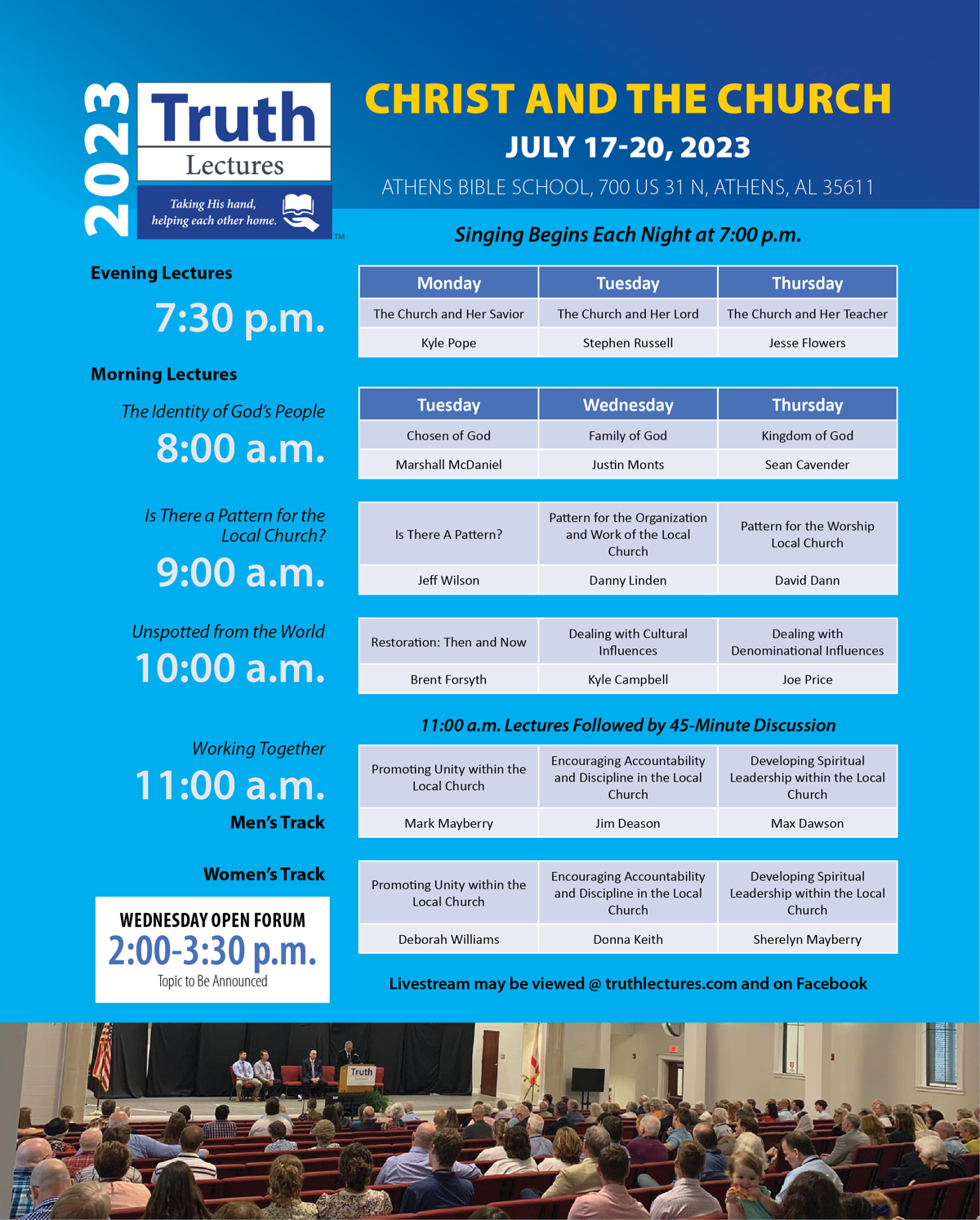
The April issue of Truth Magazine focuses on “The Church of Christ.” These articles compliment the theme of the upcoming 2023 Truth Lectures: “Christ and the Church.” These six articles address the distinctive characteristics of the Lord’s church as set forth in the New Testament. While these lessons are familiar to many of us, they involve fundamental truths that need to be emphasized and reemphasized to each successive generation:
I consider it right, as long as I am in this earthly dwelling, to stir you up by way of reminder, knowing that the laying aside of my earthly dwelling is imminent, as also our Lord Jesus Christ has made clear to me. And I will also be diligent that at any time after my departure you will be able to call these things to mind (2 Pet. 1:13-15).
Before the foundation of the world, God formulated His plan of redemption—choosing to save those who choose to share a relationship with Jesus Christ (Eph. 1:3-6). The church was anticipated in Old Testament prophecy, often using kingdom imagery. The church was established by Jesus Christ (Matt. 16:16-18) and purchased with His blood (Acts 20:28). It is built upon the foundation of the apostles and prophets, with Jesus Christ being the cornerstone (Eph. 2:19-22).
Christ is the head of the body, the church (Eph. 5:23-24; Col. 1:18). Since He possesses all authority (Matt. 28:18-20), everything that we preach and practice must harmonize with His will (Col. 3:16). Those who deviate from the doctrine/teaching of Christ face catastrophic consequences (2 John 9-11).
Each congregation is independent and autonomous, answerable directly to Jesus Christ—its Captain and King. When fully organized, local congregations enjoy the leadership and oversight provided by its elders (1 Pet. 5:1-3; Acts 20:28-30), who are assisted by deacons/servants (Acts 6:1; Phil. 1:1; 1 Tim. 3:8-13). Evangelists and teachers provide necessary instruction to its members who actively serve (Eph. 4:11-16).
The church’s primary duty is evangelism, i.e., proclaiming and promoting the gospel of Jesus Christ. In giving the Great Commission, Jesus commanded the disciples: “Go therefore and make disciples of all the nations, baptizing them in the name of the Father and the Son and the Holy Spirit. . .” (Matt. 28:18-20, esp. v. 18). In like manner, the apostle Paul exhorted Timothy: “Preach the word; be ready in season and out of season; reprove, rebuke, exhort, with great patience and instruction” (2 Tim. 4:1-4, esp. v. 2).
Edification (i.e., the act of building up) is also suggested in the latter part of the Great Commission: “teaching them to observe all that I commanded you” (Matt. 28:18-20, esp. v. 20). Gospel preaching is both instructive and corrective. When reproofs and rebukes must be administered, we should cultivate the spirit of Paul: “For this reason I am writing these things while absent, so that when present I need not use severity, in accordance with the authority which the Lord gave me for building up (oikodomē, i.e., edification) and not for tearing down” (2 Cor. 13:10). His letter to the Ephesians repeatedly emphasizes the importance of edification (Eph. 4:12, 16, 29).
While the gospel cultivates a spirit of self-reliance (Gal. 6:5; 2 Thess. 3:10-12), the church comes to the aid of its own in emergency circumstances (Acts 4:32-35; 1 Cor. 16:1-2; etc.). In addition, it provides ongoing help to those who are “widows indeed” (1 Tim. 5:3-15).
The church that belongs to Christ will worship in spirit and truth (John 4:23-24). Scriptural worship includes: (1) offering prayers to God through Jesus Christ (Acts 2:42; 12:5; etc.); (2) praising God in psalms, hymns and spiritual songs (Eph. 5:19; Col. 3:16); (3) proclaiming the gospel, i.e., the teaching of Jesus Christ and the instruction that came through the inspired apostles and prophets (Acts 2:42; Rom. 1:16-17); (4) observing the Lord’s supper on a weekly basis (Acts 20:7; 1 Cor. 11:23-28); and (5) laying by in store on the first day of the week (1 Cor. 16:1-2; 2 Cor. 8-9).
In the New Testament, members of the church are identified with the following terms: branches of the Vine (John 15:1-8), brethren (1 Cor. 1:10), Christians (Acts 11:26), citizens in God’s kingdom (Col. 3:20), disciples of the Lord Jesus (Acts 9:1), laborers in God’s vineyard (Matt. 20:1-16), members of Christ’s body (Rom. 12:4-5), priests in God’s temple (1 Pet. 2:5, 9), saints in God’s service (Rom. 1:7), soldiers of the cross (2 Tim. 2:3), etc. Each term describes the relationship we share vertically with Jesus Christ or horizontally with one another.
Membership in the Lord’s church is conditioned upon hearing the gospel message, responding by faith, repenting of one’s sins, confessing one’s faith in Christ, and being baptized for the remission of sins. Discipleship demands active obedience and humble submission, perfecting holiness in the fear of God, dedication, diligence, growth and maturity, etc.
The distinctive characteristics of the New Testament church starkly contrast with false concepts that exist within the broader religious world.



By Kyle Pope
Synopsis: The Bible teaches that faith is essential to salvation, but how does Scripture define saving faith? What does it involve and how is it manifested? In what must we put our faith and is it grounded in our feelings and emotions or in an objective standard? This study explores these important questions about faith in Christ.
Faith is at the heart of man’s relationship with God. The Hebrew writer taught, “without faith it is impossible to please Him, for he who comes to God must believe that He is, and that He is a rewarder of those who diligently seek Him” (Heb. 11:6-7, NKJV). With the coming of Jesus, the characteristics of faith that please God became much more focused. This side of the cross, faith means more than just believing there is a God. Jesus said, “no man comes to the Father except through Me” (John 14:6). That means now, in order to please God, one must believe in Jesus.
Does that just mean believing that Jesus was a real person? No, the faith one has in Jesus must also be focused. 1 John 5:5 asks (and then answers) the question, “who is he who overcomes the world, but he who believes that Jesus is the Son of God?” The type of faith that is pleasing to God doesn’t just acknowledge that Jesus was a good man, or a wise philosopher, or a prophet—but affirms that He is “the Son of God.” Sadly, many people in our world believe in a Jesus who is not Divine. That is not the Jesus of the New Testament, nor the character of the faith that pleases God.
Scripture, however, focuses this even further. Peter and Paul both quote Isaiah 28:16, “whoever believes on Him will not be put to shame” (Rom. 9:33; 1 Pet. 2:6). How does one believe “on” Jesus? The Bible teaches, “the way of man is not in himself; It is not in man who walks to direct his own steps” (Jer. 10:23). Humans do not possess an innate guidance system. Moreover, we are incapable of erasing our own offenses that are committed against God. The preacher in Ecclesiastes said, “Consider the work of God; for who can make straight what He has made crooked?” (Eccl. 7:13). When God defines behavior that we have committed as “crooked,” we cannot make it “straight.” This is the problem of sin. All morally capable and accountable souls, at some point in life, sin—“all have sinned and fall short of the glory of God” (Rom. 3:23). How then can one be made “straight” in his relationship with God? He must believe “on” Jesus as the source of atonement, redemption, and reconciliation.
This is where Jesus’s teaching comes into play. He taught:
And if anyone hears My words and does not believe, I do not judge him; for I did not come to judge the world but to save the world. He who rejects Me, and does not receive My words, has that which judges him—the word that I have spoken will judge him in the last day (John 12:47-48).
Believing “on” Jesus means that one believes and trusts His word. If I should say, “I want salvation—so I will believe in Jesus, but I don’t have to accept and follow everything He taught!”—I don’t really believe “on” Jesus.
That tells us that part of having a faith that pleases God means that I must “diligently seek Him” as we noted above. This is not something distinct from faith, but how the kind of faith that God accepts is actualized. Remember, the Hebrew writer said, “without faith it is impossible to please Him,” then explains the kind of faith that pleases God—“for he who comes to God must believe that He is, and that He is a rewarder of those who diligently seek Him” (Heb. 11:6-7). If I don’t believe “that He is,” I don’t have a faith that pleases God. If I don’t believe He rewards “those who diligently seek Him,” I don’t have a faith that pleases God. Through seeking to know and understand God’s revealed word in the Bible, one is “diligently” seeking Him. Through striving to carefully and obediently follow what is found within Scripture, one is “diligently” seeking Him. Sadly, many misunderstand this and assert, “That’s legalism!” However, we aren’t talking about trusting in ourselves. Instead, the way that we demonstrate love for and faith in Jesus is by a diligence to understand and follow all of His will.
The Bible refers to personal faith and to the system of faith revealed in the gospel. Jude wrote that Christians must “contend earnestly for the faith which was once for all delivered to the saints” (Jude 3). To have a faith that pleases God, one must not “depart from the faith” (1 Tim. 4:1) as Paul foretold that some would do. To have a faith that pleases God, one must have courage to confess this faith before others (Matt. 10:32). To have a faith that pleases God, one must remain “steadfast in the faith” (1 Pet. 5:9). These things make it clear that saving faith (or pleasing faith) is more than just a condition purely within our minds. James declared that demons believe, but their faith is not pleasing to God (Jas. 2:19). Some of the Jewish leaders believed in Jesus, but out of fear, refused to confess Him (John 12:42). Jesus taught, “Therefore whoever confesses Me before men, him I will also confess before My Father who is in heaven. But whoever denies Me before men, him I will also deny before My Father who is in heaven” (Matt. 10:32-33). So pleasing faith “on” Jesus involves certain actions that demonstrate that faith.
Is that meritorious salvation? Is that salvation by works? No, but it is a type of faith which meets God’s definition, not man’s definition. When our world advocates “salvation by faith only” they are using a definition of faith that is never taught in Scripture. Many don’t realize that the only passage in Scripture that uses the phrase “faith only” does not teach that salvation is by “faith only.” James 2:24 declares, “a man is justified by works and not faith only.” Only a few verses before this, James explained it further by using the example of Abraham—whose faith in God throughout Scripture is offered as an example that all true believers should follow. James taught that Abraham’s “faith was working together with his works, and by works faith was made perfect” (Jas. 2:22). The kind of faith that is pleasing to God is “made perfect” (i.e., made complete) by works of obedience. Obedience merits nothing, but is simply the duty of those who serve God in Christ.
In Luke 17, Jesus’s apostles plead with Him to “increase our faith” (v. 5). After describing the great power of faith (v. 6), He asks, “Which of you, having a servant plowing or tending sheep, will say to him when he has come in from the field, ‘Come at once and sit down to eat’?” (v. 7). What does this have to do with faith? He asks further,
But will he not rather say to him, “Prepare something for my supper, and gird yourself and serve me till I have eaten and drunk, and afterward you will eat and drink”? Does he thank that servant because he did the things that were commanded him? I think not (vv. 8-9).
How will this increase their faith? He is talking about work and service. Finally, He explains, “So likewise you, when you have done all those things which you are commanded, say, ‘We are unprofitable servants. We have done what was our duty to do’” (v. 10). In this context, Jesus never uses the word “faith” but describes the attitude, the mindset, the service, and obedience that a pleasing faith will demonstrate. Obedience is “our duty to do.” It does not merit anything—obedient servants are still “unprofitable servants” but servants who don’t strive to do “all those things” which they “are commanded” don’t have a faith that pleases God. What kind of faith do you have? What kind of faith do I have?


By Sherelyn Mayberry
Synopsis: The Bible portrays believers in different ways: members of God’s family, disciples of the Master Teacher, laborers in His vineyard, etc. One of the most powerful images is militaristic: Christ, the Captain of our salvation, leads His army into battle against the forces of darkness and error.
In the hymn, “O Church, Arise” (PHSS, no. 524), the writer refers to Christians who collectively compose the church as soldiers of the cross. Good soldiers should be active in their service, willing to suffer hardship, and seeking first the kingdom in their daily life to be pleasing to the Lord who enlisted them (2 Tim. 2:3-4). Paul speaks of Epaphroditus, his brother, fellow worker, and fellow soldier in the Lord’s army (Phil. 2:25). He was also a messenger and minister to Paul’s needs. These attributes made him a good soldier—one who could both promote and defend the cause of Christ. We all are called in service to be soldiers of Jesus Christ. This call to be saved in service is through the message preached. This message of Christ crucified, the gospel, is full of power and wisdom and is stronger than men (1 Cor. 1:21-25; Rom. 1:16).
As soldiers of the cross, we must put on the whole armor of God in order to wage war against the devil. We look to the captain of our salvation, Jesus Christ, to lead us to glory (Heb. 2:10). In Ephesians 6:10-17, we learn of the weapons of our warfare and who we wage war against. Relying upon the power of God’s might, we can be strong (v. 10). The armor that God provides gives us the ability to stand against Satan’s crafty devices (v. 11). Our battle is against the spiritual world forces of darkness and wickedness that are led by the devil (v. 12). With full armor, we can stand firm and be strong (v. 13). We stand with our waist girded with truth and wearing the breastplate of righteousness (v. 14). This is defensive armor to protect our heart. Our feet are shod with the gospel of peace, so we can go forward in spreading the word (v. 15). We take up the shield of faith to defend against the fiery darts of Satan (v. 16). We are preparing to battle!
Good soldiers, obedient believers, show sincere, fervent love for brethren (1 Pet. 1:22-23). This battle cry of love for one another covers a multitude of sins, as we reach out to those in darkness and they turn to God (1 Pet. 4:8; Jas. 5:20). Donning our helmet, the hope of salvation, we advance into battle, and are destined to victory through Jesus if we stand and fight, and don’t give place to the devil (1 Thess. 5:8-9; Eph. 4:27). Wielding the sword of the Spirit, the word of God, we wage war against the enemy (Eph. 6:17) and seek to turn wounded hearts to the Lord. This word of God judges our thoughts and intentions (Heb. 4:12). Will we be obedient to its commandments and win the victory? Will we be disobedient and suffer defeat?
The heroes of faith in Hebrews 11 prevailed through trials—conquered kingdoms, quenched the power of fire, became mighty in war, put armies to flight, and from weakness were made strong—all by the strength given by God. Having a living hope through the resurrection of Jesus, the chosen of God are protected by Him through their faith. Though distressed by trials, they are tested, resulting in praise, honor, and glory (1 Pet. 1:3-7). Condemnation brought on by sin is swallowed up in victory through Christ’s death (1 Cor. 15:54-57). Through belief in the Savior born of God, we can overcome the world (1 John 5:4-5). Tribulation, persecution, peril, or sword cannot separate us from the love of Him who died for us. We will overwhelmingly conquer with Christ as our Captain and King (Rom. 8:35-39). He will receive the conquering nations as His inheritance (Ps. 2:8).
Love and mercy meet at the cross where God’s Son was stricken. God loved the world so much that He willingly gave His Only Begotten Son to die on the cruel tree for our sins. We deserve to perish and yet, God mercifully offers a means of salvation through belief in His Son (John 3:16). Grace and truth are realized through Jesus Christ, who takes away the sins of the world (John 1:17, 29). The grace of God appears, bringing salvation to all. As we live godly lives, we have a blessed hope of one day seeing Jesus, who gave Himself for us (Titus 2:11-14).
Through His resurrection, Christ was victorious over Satan. Genesis 3:15 provides the first prophecy of this triumph. As the seed of woman, Jesus Christ would bruise the serpent on the head—a triumphant death blow. Satan had bruised Jesus on the heel by His death on the cross. Yet, even this seeming success was short-lived: Christ the Conqueror arose! Ultimately, Satan will be crushed for eternity by the God of peace (Rom. 16:20). Through Christ, we can have confidence in victory. Christ rides victoriously for the cause of truth, meekness, and righteousness and His foes are vanquished (Ps. 45:3-5). The victors look forward to the day when every eye will see Him coming in the clouds (Rev. 1:7). The Lord will descend from heaven with a shout, and the dead in Christ will rise first. Then, the faithful who remain will be caught up with them to meet the Lord in the air and forever be with the Lord (1 Thess. 4:16-17).
We should run life’s race with strength that the Lord provides through His word and in prayer. In every circumstance, we must learn to be content in trial through the grace God that provides (Phil. 4:11-13). Run to win the prize. Exercise self-control in all things and discipline your words and deeds, attitudes and actions. Run the race with endurance (1 Cor. 9:24-27). “Press toward the mark for the prize of the high calling of God in Christ Jesus” (Phil. 3:14 KJV). Surrounded by a cloud of faithful witnesses gone before, we hear of previous victories. So, do not let the hurdles of life burden you and entangle you again in sin. Fix your eyes on Jesus and do not grow weary and lose heart (Heb. 12:1-3). Have a hope of standing in His glorious presence for eternity, having won the victory through Him.


By Bruce Reeves
Synopsis: Those who attempt to divorce daily discipleship from in-depth biblical teaching will inevitably pursue a path of superficiality that dilutes and compromises what it means to be a true follower of Jesus.
It has been a blessing to explore the nature of God, sacrifice of Christ, and fullness of our salvation in this column as we have contrasted biblical teaching with Calvinistic teachings. Sadly, there are those both in the pew and pulpit who have come to believe that reviewing false doctrines like Calvinism is a waste of time and has no bearing on our daily discipleship. This absence of comprehensive teaching creates a context that exposes the vulnerable to deception. Changing terminology and offering empty denials may mislead the naïve, but if the concepts are expressing error, it is still error. Paul writes, “Now I urge you, brethren, keep your eye on those who cause dissensions and hindrances contrary to the teaching which you learned, and turn away from them. For such men are slaves, not of our Lord Jesus Christ but of their own appetites; and by their smooth and flattering speech they deceive the hearts of the unsuspecting” (Rom. 16:17-18). Admiring the majestic beauty of God’s powerful reign, matchless love, generous grace, and amazing salvation shapes everything about our lives as children of God (Eph. 5:1-2). Therefore, any teaching that undermines, distorts, or attacks the moral and ethical goodness of our Father must be repudiated.
In this final article of our theme, “The Love of God,” let us consider Calvinism’s impact on our everyday life. While proponents of Reformed Theology attempt to discount the practical consequences of their doctrine; the inconsistencies of Calvinism remain and should be considered. The consequences of unbiblical teachings about God, sin, humanity, and salvation can be riveting and critical to our walk with our Savior.
The following questions are worthy of consideration:
How should we understand God’s love for the unconverted?
Can we tell a person, with certainty, that Jesus died for them?
What should we say to someone who has been sexually abused?
How should we interpret this abuse theologically?
Did God predetermine and cause the perpetrator to abuse others?
Is God the first cause of all evil?
Why evangelize the lost?
Does God redemptively love all of humanity?
Are we ultimately responsible for our behavior?
Does prayer have the potential to influence the mind of God?
These are questions that those who proclaim the true and living God to a sinful world must contemplate. Skeptics prefer to attack the Calvinistic interpretation of God, rather than the biblical presentation of His nature and works. Understanding the scope of God’s love and the power of the gospel is crucial to our work as the Lord’s people. Let us discuss two major areas of our discipleship that are influenced by Calvinism, i.e., evangelism and our interpretation of suffering in a wicked world.
Reformed Theology cannot make coherent sense of its claim that God genuinely offers salvation to those He has not unconditionally chosen. Calvinism teaches that all people are born totally depraved and disabled and thus lack the freedom to choose faith in Christ. The reason for this belief is the doctrine’s contention that only those who have been unconditionally elected are given the irresistible and direct operation of the Holy Spirit, which provides the gift of faith for salvation. We are told that the outward call of the gospel is expressed to all, but only the unconditionally elected will receive the irresistible inward call of grace. The logical conclusion is that God invites humanity to come to salvation, knowing from eternity that the vast majority cannot come because of His determinative will. He calls most of humanity to come to Him having ordained that they cannot come and then condemns them for not doing what they were unable to do! Does this fit with the loving and compassionate God who is revealed in Scripture? Certainly not.
Although many Calvinists tell people they can know God loves them, they do so despite their doctrine, not because of it. Reducing God’s love to physical blessings alone is disingenuous considering our desperate need for forgiveness, yet this is what Calvinists must do in speaking of the Lord’s universal love for humanity. Writers such as John Piper and John MacArthur will argue that we have been commanded to preach the gospel and that it is during such preaching that the Spirit operates on the elect. Yet, the inconsistency is glaring and obvious. According to their teaching, God does not have redemptive love for anyone else and refuses to enable them to do what He commands because He has foreordained their destruction (Acts 17:24-31; 2 Pet. 3:9; 1 John 2:1-2). Thankfully, the true gospel of Christ proclaims the universal and genuine offer of redemption to all those who will come (John 3:16; 1 Tim. 2:1-5; 2 Pet. 3:9; Rev. 22:17). Instead of affirming “Whosoever will. . .”, Calvinism distorts the gospel of grace and debases the Lord’s lovingkindness.
The problem of evil challenges views ranging from theism to agnosticism to atheism. The question of suffering has been a favorite weapon in the skeptic’s arsenal as long as atheists have been doing battle with believers. Ironically, the question backfires on those who deny the existence of God (Reeves, Why Does God Allow Suffering, 64). Critics of theism have often claimed that evil is incompatible with the existence of a loving Creator. According to non-believers, “If there were a God who had the attributes the Bible says He has—omnipotence and perfect goodness—then there would be no evil. For if He is omnipotent, then it seems He has the power to do anything possible, including eradicate all wickedness. If He is perfectly good, then He is opposed to evil and would want to remove it. Yet, because there obviously is evil, there is no such God.” This intellectual challenge requires a rational response that will allow God’s existence to be compatible with the existence of evil (Walls and Dongell, Why I Am Not A Calvinist, 203-215).
We should understand that God having all power does not mean that He always exercises it, especially when it would violate either His nature or greater purposes (Gen. 2:2; Heb. 6:17-19; 2 Pet. 3:1-9; 1 John 1:5), neither does His goodness always conform to our flawed sense of temporary fulfillment (Prov. 14:12; Isa. 55:8-9; 2 Cor. 12:7-10). Interestingly, for the atheist to appeal to the concepts of “goodness,” “justice,” or “morality” is to plagiarize the attributes of God in arguing against Him. The mission of God is to call humanity to a loving relationship with Him, which requires human freedom. As a result, He tolerates many difficult things for the consummation of His divine purpose (Rom. 8:24-38).
Reformed theologians cannot argue that evil exists to preserve human freewill, but that God has predetermined and unchangeably foreordained evil. In fact, Calvinists unashamedly assert that God is the first cause of evil and Satan and men are only secondary causes. With such a doctrine, we ask, “Who is the real devil?” The most powerful moral argument against atheism evaporates with Reformed Theology. Please note: this is not merely a theological, philosophical, or academic discussion. It is also very practical—deeply influencing and shaping how we view the surrounding world, the experience of suffering, and even how we comfort those who are in grief. Those who attempt to divorce daily discipleship from in-depth biblical teaching will head down a path of superficiality that dilutes and compromises what it means to be a true follower of Jesus.
There are other approaches that uphold God’s sovereignty, human freedom, and the realities of sin around us. From a biblical and moral sense, they are much more encouraging. We are not seeking to elevate our thoughts above God’s wisdom, but allow God’s word to transform and instruct our understanding. When our perspectives are refined and revised by Scripture, we will be more and more like Christ (Col. 3:16).
Living by faith does not remove all tensions, struggles, and questions. The apostle Paul reminds us that although we live in a world of decay and struggle, we have a living hope of our future redemption (Rom. 8:23-25). A proper understanding of the biblical message brings hope, but the teaching that God is the first cause of evil has profoundly disturbing implications. Jerry L. Walls and Joseph R. Dongell, in their work “Why I Am Not A Calvinist” cite hypothetical, but real scenarios that bring the problems of Calvinism to light in real time and real life. For example, consider “a teenager who is paralyzed in an automobile accident because the brakes in his car failed,” or “a young girl who is sexually abused by her uncle.” We have all known people who have experienced similar devastation and tragedies. It is one thing to understand these situations as the result of God’s permissive will, although they disgust Him, and which He will judge in the end (2 Thess. 1:6-9). It is something entirely different to argue that God unchangeably foreordained all these kinds of events. Although there are human choices that anger God, they are still within the realm of His sovereignty in that He allows them, but will hold us accountable for our decisions (2 Cor. 5:10-11).
Can we not see that Calvinism completely changes a balanced and reasonable approach to our daily perspectives of life and God? “This teaching is beset with practical inconsistencies that mirror its logical contradictions. This is another powerful reason not to be a Calvinist” (Wall and Dongell, 215).
God’s love is seen in His Son, in His gospel, and in His works. What we believe about His personality and attributes is deeply impactful every day of our lives. It truly informs and matures our faith and shapes our decisions every day. It leads us to God-centered worship, Christ-focused relationships, and blessed fellowship with our Redeemer. Peter writes, “After you have suffered for a little while, the God of all grace, who called you to His eternal glory in Christ, will Himself perfect, confirm, and strengthen and establish you. To Him be dominion forever and ever. Amen” (1 Pet. 5:10-11).
Reeves, Bruce. “Why Does God Allow Suffering?” in Is It Reasonable To Believe In God. Athens: Truth Publications, Inc, 2022 (pages, 49-64).
Walls, Jerry L., and Joseph R. Dongell. Why I Am Not A Calvinist. Downers Grove, Illinois: InterVarsity, 2004.


By Shane Carrington
Synopsis: In a world so riddled with temptation and sin, Jesus, God’s divine Son (as depicted in Hebrews 1), offers us a firm foundation for victory through faith.
This world is broken. It happened in Genesis 3 with the first human transgression of God’s holy commandment. They set aside His protective, enriching, gracious word for Satan’s allurement and the possibility of something “more.” Eve and Adam forfeited innocence and communion with God for the thrill of transgression. Temporary pleasure collapsed into brokenness and heartache for them and for us. We feel the effects of their sin in the struggles and catastrophes of this world (Gen. 3:16-19), and join them in sin through personal transgression (Rom. 5:12).
Into the darkness of this broken world, God came again, this time in human form (Heb. 1-2), to bring “life and immortality to light” through the eternal Son in His everlasting gospel (2 Tim. 1:7-10). God’s grace and mercy abound in the face of Jesus the Christ.
For God, who said, “Light shall shine out of darkness,” is the One who has shone in our hearts to give the Light of the knowledge of the glory of God in the face of Christ (2 Cor. 4:6).
While we live in a broken world, and we struggle with brokenness in our own lives, Jesus came to provide us with spiritual healing, stability, and hope. Christ is our foundation (1 Cor. 3:11), the cornerstone of the church (Eph. 2:20), whose word gives us stability now and toward eternity (Matt. 7:24-29). We need firm faith in a fallen world, and Jesus is the focus of our strength.
We live in hope, and this hope finds beautiful and powerful expression in the letter to the Hebrews. It shows us several aspects of God’s grace that should give us hope as we navigate this broken world. Consider a few of these from Hebrews chapter one that declare the deity of Christ and affirm that He is our foundation for firm faith in a fallen world.
Jesus has a dual nature: He is divine (Heb. 1) and He became human (Heb. 2), which will be our emphasis next month. As Elmer Moore used to say, quoting Luther Blackmon, “Jesus is God as God is and man as man ought to be.” The One who is eternally God had to take on the nature of humanity in order to be the mediator between God and humanity. Hebrews 1 emphasizes the eternal divinity of Jesus. Consider three of the descriptions of Christ in this chapter that show He is God. Jesus is. . .
Just like the letters, alpha and omega, begin and end the Greek alphabet, Jesus is both the Creator (Heb. 1:2,10; cf. John 1:1-4) and Culminator (Heb. 1:10-12; cf. 2 Pet. 3; 1 Thess. 4), not only of our spiritual purpose but also of the physical universe (2 Pet. 3:10-13). Jesus is the one “through whom” the Father “made the worlds” (Heb. 1:2). The Father says of Jesus, “You, Lord, in the beginning laid the foundation of the earth, and the heavens are the works of your hands” (Heb. 1:10). He is also the one who will oversee the perishing of the heavens and earth (Heb. 1:10-11) and “roll them up” (Heb. 1:10-12) when time itself ends. As Lord over creation, Jesus gives us firm footing in an uncertain world.
The term “Yahweh” (YHWH or LORD in all capital letters) or “Jehovah,” “the divine. . . or covenantal name” (Vines, 140) of God, appears almost 7,000 times in the Hebrew Bible. The term is associated with God’s eternal nature in the burning bush passage (Exod. 3:13-15). Interestingly, Jesus describes Himself as the “I AM” (John 8:58), connecting Himself with these passages and affirming His own divine nature. Hebrews 1:10-12 describes Jesus as “LORD” of creation, but the passage from which these verses originate (Ps. 102:22-27) uses “God” (Ps. 102:24) and “LORD” (YHWH, Ps. 102:22) interchangeably. Jesus is Jehovah (Yahweh)! As one of the three with divine nature, Jesus provides us with a firm foundation for faith in this fallen world.
Jesus is declared to be God’s Son in many and varied ways in Hebrews 1:1-8, but what does that mean? In that context, it means Jesus is God’s heir (v. 2), the creator (v. 2), “the brightness of His glory and the express image” of the Father’s person (v. 3), the sustainer (v. 3), our redeemer (v. 3), the one enthroned at God’s right hand (v. 3), and the one superior to the angels (v. 4).
That Jesus is God’s Son also suggests two more essentials:
He is God (Heb. 1:8; cf. John 8:58).
He is worthy of worship (Heb. 1:6; cf. Matt. 14:33).
As God’s divine Son, Jesus is well-equipped to strengthen our faith while living in this fallen world. Trust Him, love Him, and serve Him!
I just lost Kelly, my dear wife of thirty-five years, to cancer. Her funeral was February 20th. The ravages of cancer took a toll on her body for four and one-half years. We have experienced the evidences of this fallen world, but, because we live by faith and not by sight, these inspired words emboldened us then and continue to infuse life into me now:
Therefore, we do not lose heart, but though our outer man is decaying, yet our inner man is being renewed day by day (2 Cor. 4:3).
Sight looks at the outward appearance. Faith looks to truths that remain invisible to earthly vision. Sight sees the toll cancer takes on the body. Faith draws us nearer to God in prayer, gratitude, the instructions and promises of His written word, and godly living. Sight focuses on earthly tragedy and disappointment. Faith uses these as catalysts to help us focus on God, trust in Him, and grow to be more like Jesus. That’s what Kelly did; that’s what we did together.
In this broken world, we need a firm faith—grounded in who God is and rooted in His holy word. Jesus is God, and He lived and died to redeem us! Life will ebb and flow with happiness and heartache, but with Jesus as the anchor of our souls, we have stability and strength in Him to face today. Like Kelly, we can have peace. Over the last few days of her life, many times she said, “My prayer is to wake up with Jesus in glory.” God finally answered her prayer. Through faith, she lived and died in peace. Trust Jesus like that, and He will strengthen you for life, both now and eternally.
We live in a fallen, broken world, but through Jesus, God’s divine Son, we find strength, hope, and eternal life. Like Edward Mote and William Bradbury eloquently wrote so long ago, “On Christ, the Solid Rock, I stand; All other ground is sinking sand.” To that, may we all say, “Amen”!
Vine, W. E., Merrill F. Unger, and William White Jr. Vine’s Complete Expository Dictionary of Old and New Testament Words. Nashville, TN: Thomas Nelson, 1996.



By Bobby L. Graham
My sister’s church has a series on Genesis. The young man teaching the course believes Ham had sex with his mother. In researching this, I find others also believe this to be true. We are not given any further explanation of what act occurred. Thus, I would be nervous about drawing conclusions and publicly stating them. . . . What are your thoughts?
First, please note that alcohol created this mockery (Prov. 20:1)! In the response that some have made to the statement in Genesis 9:22, we see (once again) how humans speculate in the absence of any basis for so doing. Various wild theories, ungrounded in the text or in the context, suppose what might have happened; but they shed no true light. Read the verse in question: “Ham, the father of Canaan, saw the nakedness of his father, and told his two brothers outside.” Nothing said in the verse or in the surrounding context directly states or implies homosexuality or incest. One must read these ideas into the passage instead of relying upon what it actually states. Another theory asserts that Ham castrated his father; and still another, that he magically rendered him impotent. All such guesses belong to the realm of fiction, make believe, and pretend.
One cause for these unjustified theories is that men equate “Ham. . . saw the nakedness and his father” with what Leviticus calls “uncovering the nakedness” of one’s father or mother. In this setting, they are not equal to each other in the absence of contextual backing! The word used here for nakedness involves the exposure of the body in a shameful way. The problem comes in making Ham the one who perpetrated the shameful act. He did not cause his father’s nakedness, though he saw it. After seeing it, he reacted in a way that was disrespectful toward Noah. His inner sense of purity and modesty should have resulted in a different outcome. Instead, Ham was disrespectful of his father. In contrast, Shem and Japheth reacted in a more respectful manner by simply covering their father. Their action was designed to prevent anyone’s seeing Noah’s nakedness again. Absolutely nothing indicates that Ham uncovered his nakedness or that he committed sodomy with Noah or incest with either parent.
Here are the pertinent passages concerning “uncovering nakedness” from Leviticus:
The nakedness of your father or the nakedness of your mother you shall not uncover. She is your mother; you shall not uncover her nakedness (Lev. 18:7).
If a man takes his sister, his father’s daughter or his mother’s daughter, and sees her nakedness and she sees his nakedness, it is a wicked thing. And they shall be cut off in the sight of their people (Lev. 20:17).
These verses demonstrate that the words “sees her nakedness,” in the given context, can mean what “uncover the nakedness” means. In Genesis 9:22, however, the contextual underpinning is missing, thus leaving “sees” to mean simply observed or beheld. Mike Willis states as much in his commentary on Genesis:
In Leviticus 18:7 and 20:17 there is an interplay between “see (one’s) nakedness”and “uncover (one’s) nakedness,” both of which are used to describe sexual intercourse with a near relative. However, to treat “saw the nakedness” with sexual incest in Genesis 9 is “almost impossible to square it with biblical story (Hamilton 1:322) because there is neither incest nor sodomy involved” (Willis, 362).
The fictions of denominationalism and other man-made religions have arisen throughout history in the same ways upon which we have here focused. May we all be cautious and careful to test all things by God’s word! Let us not read into the biblical text things that are not there (Deut. 4:2; Prov. 30:6).




By Trent and Rebekah Dutton
Synopsis: Archaeology helps us humanize the characters in the biblical narrative, including the reminder that children in the biblical world grew and played just as our children do today.
The biblical text serves a vital purpose, and that is to unveil the nature of God and His intentions for humanity. However, in remaining true to its purpose, much detail about daily life is deliberately excluded. Archaeology serves to fill those gaps. By examining finds, we discern the daily rituals of the ancients, which help bring the biblical world to life. This aids our understanding and adds a layer of humanity to individuals whom we often forget were flesh and blood, just as we are.
We can find an example of this humanization of Scripture by studying childhood in the ancient world. We have all been children ourselves, and recall the games we played, favorite toys, and our relationship with the surrounding world. Those of us who have children of our own also understand the love—and sometimes loss—intrinsic to parenthood. Just so in the biblical world, the children of promise, such as Isaac, Samuel, and even Jesus, lived, laughed, and were loved by the parents who reared them.
One of the most important developmental skills for a child is play, which is often simple mimicry of the adult activities around them. Children then, as now, were presented with toys crafted by grownups. They made dolls of many materials, such as bone and clay. By the Roman era, baby dolls were no less beautiful than today, made of ivory with articulated limbs. These were often presented to girls who played at motherhood until the time of their own betrothal, when they “sacrificed” their childhood toys to the household goddesses. Other toys include animal figurines, some with wheels and strings for pulling, spinners and tops, as well as game boards that were enjoyed by adults and children alike. The presence of toys and games in the archaeological record tells us that the children were not just viewed from a utilitarian perspective, meant for farm or household labor. Not only were they permitted to play, they were encouraged to do so by the adults who around them.
Nevertheless, that did not mean that all of life was play. Children in the Old Testament world grew up in an agrarian society, where each family member contributed to the work. Young children were given tasks and play time close to home, while older children and adolescents of both sexes strayed further to shepherd animals and gather supplies. Older girls seemed especially tasked with gathering water for the family’s needs—a time-consuming and exhausting job that freed the older women for more skilled housekeeping tasks. Girls would also be trained in those duties, work that could be performed while expecting or caring for children, including weaving and food preparation and preservation, while boys learned more physically taxing and far-flung labor, such as sowing and reaping as well as warfare.
Children were not just trained for survival and subsistence, but also required education. Most people in the ancient world had a basic level of literacy in order to produce the receipts and promissary notes necessary for trade. Most of those educated beyond simple words and ciphers were males, though women, such as priestesses, prophetesses, merchants, and princesses, were also trained in scribal arts. Training in skilled writing began in childhood, and depending on the complexity of the student’s intended role, study and practice could take many years. Like today, students spent hours reading and writing under the tutelage of instructors. A popular Sumerian writing exercise describes the daily life of a scribal schoolboy:
Schoolboy, where did you go from earliest days?
I went to school.
What did you do in school?
I read my tablet, ate my lunch, prepared my tablet, wrote it, finished it. . .
He who was in charge of drawing said, “Why, when I was not here, did you stand up?”
Caned me
. . .He who was in charge of the Sumerian said, “You spoke. . .”
Caned me.
Sadly, in the ancient world, infant mortality was high (averaging 50% but rising to 85% during times of duress). Yet, this potential for loss did not result in callousness among adults. In his poignant Consolation, Plutarch speaks to his wife of his grief at the loss of their beloved two-year-old daughter and asks that she receive the proper funerary rites. Their small remains were given similar honors as adults, complete with miniature jewelry and small vessels for food and drink. Tiny mummies in diminutive sarcophagi have been uncovered in Egypt. Levantine infants and toddlers under the age of four were encapsulated in storage jars buried within the walls of the family compound. Some scholars hold that the spirit of the child was believed to protect the household, or that the household continued to protect the child. One such jar recovered in Ashkelon even bears the carved images of Anubis and an offering table, symbols meant to guard the child’s passage into the afterlife.
It is often easy to separate the biblical narrative and its characters from reality, though we acknowledge its truth and have faith that the described events occurred. Archaeology aids us in overcoming this error by reminding us that the story is real and that we share a bond of both humanity and fellowship with those who people it.

Caption Image #1: A collection of pull-toys, dolls, and games from the Iron Age.
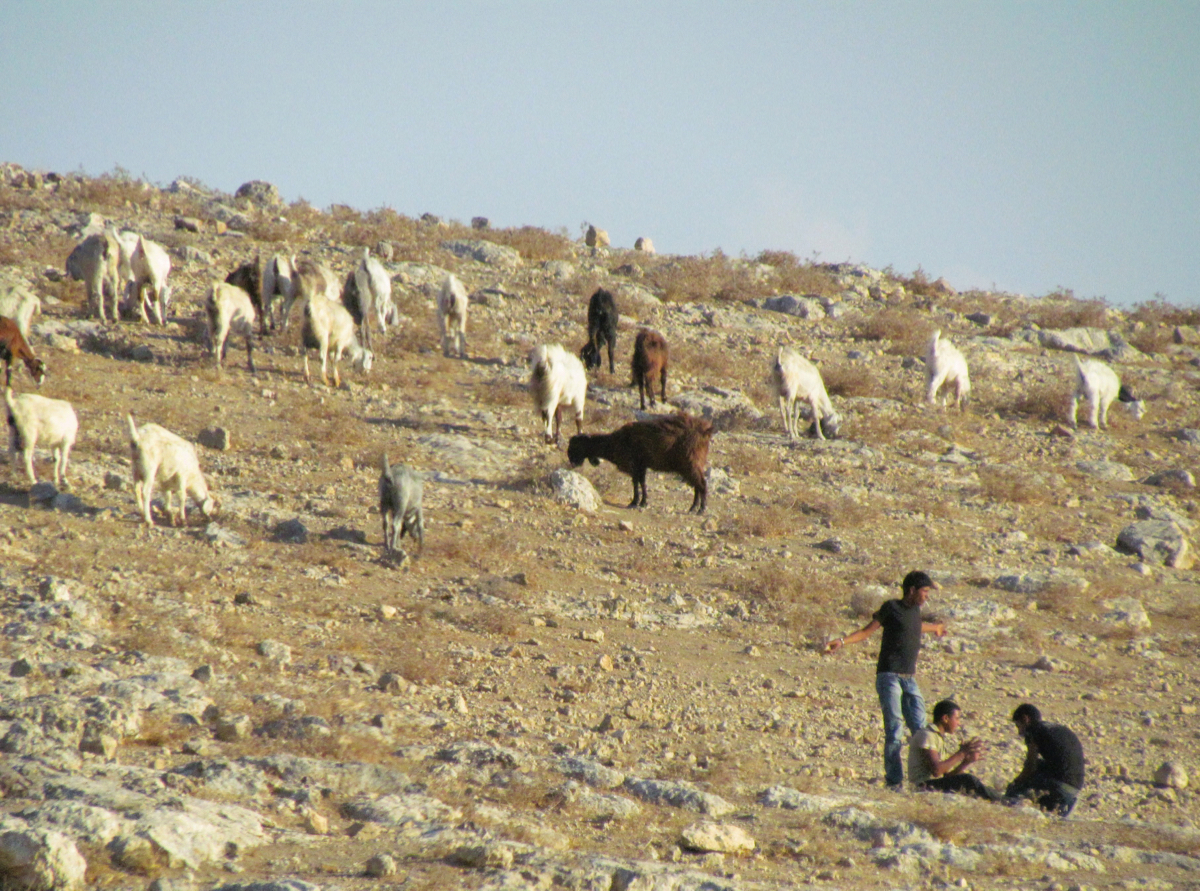
Caption Image #2: Like these Bedouin teenagers, older children were often tasked with watching the family herds, and were probably just as easily distracted.

Caption Image #3: School exercises were written on round clay tablets, though this tablet features an elaborate doodle rather than the child’s assignment.

Caption Image #4: This infant burial jar features an inscribed Anubis on one side and a sacrificial table on the other to ensure that the child inside had a safe passage to the afterlife.

By Chris Reeves
Synopsis: Anyone in today’s crazy world who wants to date needs to think about two things: good dating behavior (be a faithful Christian) and good mate selection (marry a faithful Christian).
When I was young, I remember hearing that it was important for a person to grow up and marry a faithful Christian. Folks in the church would say something like, “It’s not a sin to marry a non-Christian, but it is certainly an unwise thing to do.” I believe that was great advice then, and it remains so today.
However, I wonder if parents and brethren are giving this same advice to our young people today. I am aware of several cases recently where Christians have married non-Christians, members of denominations, and even unbelievers. Is that advice to marry a faithful Christian no longer valid? Is it still unwise to marry a non-Christian? Does it not matter anymore whom a Christian chooses to marry?
If I had a chance to mentor someone concerning their dating, I would say this: Be a good faithful Christian when you are on a date, but also desire that the other person be a faithful Christian as well. Let me take some space here to talk about two very important matters concerning dating: (1) good dating behavior, and (2) good mate selection. These matters would apply to anyone young or old who finds himself in a position to date.
When you go out on a date, determine ahead of time not to do anything on a date that is ungodly. So many today want to have their date engage in alcohol, drugs, foul language, heavy touching (that which arouses desire), and even sex. A Christian must say “No” to these things and mean it. A Christian must know what to do before the date, during the date, and after the date.
Have your Christian values and standards of right and wrong firmly in place (Rom. 12:9; Heb. 5:14; 1 Pet. 3:11; 3 John 11).
Know that genuine beauty is reflected in inward godliness (1 Sam. 16:7; Prov. 11:22; 31:30; 1 Tim. 2:9-10; 1 Pet. 3:3-4).
Know what you really want from this relationship: a spouse or just a friend (Amos 3:3; Prov. 18:22; 19:14).
Pray for wisdom to act properly (Phil. 4:6; Jas. 1:5).
Remain pure in body and mind (Prov. 1:10; Matt. 5:28; 1 Cor. 6:18; 1 Thess. 4:3; Gal. 5:19; Phil. 4:8; 2 Tim. 2:22; Heb. 13:4).
Remember who you are as a Christian (1 Tim. 4:12).
Remember that God is watching you (Prov. 15:3; Eccl. 11:9-12:1).
Know what true love is—not selfish, but selfless and sacrificial (1 Cor. 13:4-5).
Stay busy doing wholesome activities (1 Tim. 5:13, 15).
Not rush things, but take your time and don’t force love (Song of Sol. 2:7; 3:5; 8:4).
Not allow yourself to be influenced to do evil just because you are “in love” (Exod. 34:16; Deut. 7:4; 1 Kings 11:1-4; 21:25; 2 Kings 8:18; Neh. 13:23-24; 1 Cor. 15:33).
Now, let’s take the matter of good mate selection. Who are you going to marry? Since we do not live in a culture of arranged marriages, we typically marry the person we date. Will you be dating a faithful Christian? Will you be converting your date to Christ? Next to becoming a Christian, marriage is the second most important decision you will ever make in life. Critical decisions demand critical preparation. Your marital choice may affect where you spend eternity.
Often more time goes into preparing for a 35-minute wedding ceremony than into preparing for a lifelong relationship! Marriage is often not viewed as an important decision because it can be broken so easily by divorce. Start by seeking help from the Lord (Prov. 8:22; 19:14). Careful mate selection lays a solid foundation for a lasting marriage. Let us consider three biblical principles for finding a mate.
First, date and marry someone who is scripturally eligible for marriage. A person who is scripturally eligible is one who has never married before (Gen. 2:24), one who has put away (divorced) their mate for fornication (Matt. 5:32; 19:9), and one whose spouse has died (Rom. 7:2-3; 1 Cor. 7:39). All other marriages are adulterous marriages (Heb. 13:4).
Second, date and marry someone who is a faithful Christian. We acknowledge that a Christian married to a non-Christian is allowed by God; it is not a sin (1 Cor. 7:12-14). Nevertheless, it is a less than an ideal relationship that has built-in problems (1 Cor. 7:15; 1 Pet. 3:1). Marrying a faithful Christian is the wise thing (1 Cor. 9:5; 14:34-35; 1 Pet. 3:7). I did not say a “Christian,” but a “faithful Christian.” Marrying someone who was merely baptized guarantees nothing. Does this Christian show evidence of the “fruit of the Spirit” (Gal. 5:22-23)? Is your potential spouse truly committed to Christ?
If you marry someone who is not a faithful Christian, they may keep you from attending worship services, giving properly, praying, Bible study, the Lord’s work, obeying God’s word on marriage, being moral, godly friends, raising your children properly, etc. You may convert a non-Christian after you marry—or you may not. If you plan to change your husband (or wife), the statistics are not in your favor. Also, there will always be emotional turmoil knowing that an unbelieving spouse will be lost in hell.
After marriage, you will have two basic tasks: help your spouse go to heaven and help your children go to heaven. So you must ask yourself: Will my spouse help me go to heaven? Will pleasing my spouse conflict with my goal of pleasing God? Will my spouse be a blessing or a burden? Will my spouse be a source of spiritual strength or a stumbling-block? Is he (or she) worth going to hell? Yes, you can choose a non-Christian and help them be converted to the Lord. However, do this before you marry.
Third, date and marry someone who is mature. Does this person have a mature understanding of biblical marriage (Gen. 2:18-24)? Does this person maturely accept the biblical responsibilities of marriage for the husband, the wife, and the parent (1 Cor. 7:1-5; Eph. 5:22-6:4; Col. 3:18-21; 1 Tim. 3:1-3; 5:14; Titus 1:5-9; 2:4; 1 Pet. 3:1-6)?
To those who want to date, I offer a few suggestions. If you have not made a dating choice, take your time and choose wisely. Be patient and pray. Set your standards before you get emotionally involved with someone and don’t change your standards. You can also go where other like-minded Christians are and meet them. If you have already made a choice and you now realize that it’s no good, work it out, or break up. You can get over a breakup in this life. However, you will not be able to change God’s eternal judgment against your bad marriage in the life to come. It is better to marry later in life, or not marry at all, than to lose your soul and the souls of your children because of a bad marriage.
Parents and grandparents, start teaching your children and grandchildren early in life what to look for in a mate. Let’s also teach these principles regularly in the local church. Marriage is a wonderful, God-given relationship. When two godly and faithful Christians date and subsequently marry, they will have a much better chance of pleasing the Lord all throughout their life.
There are so many older Christian couples today who have remained faithful to each other and to Christ because they were both faithful Christians when they first married. They have also raised godly children who then, in turn, marry faithful Christians as well. This is what you want, and this is what the Lord wants.
Those of you who want to date, let me encourage you to slow down and take your time to find a faithful Christian to marry. Yes, it may take more time, more effort, and more patience, but it can be done. This world in which we live is very hard on Christians. We need all the help we can get to remain faithful to the Lord. Pick someone who will truly help you get to heaven and not someone who may hinder you from that goal.


By Emma Wallace
Synopsis: The college years of a young Christian can be a rewarding experience; they can also be wrought with spiritual temptations. Finding a local congregation of saints to hold you accountable is imperative.
This past fall, I moved to a new city and began my freshman year at Texas A&M University. That came with an array of new challenges and responsibilities, including finding a new church, finding housing, and picking friends. It was a hard adjustment moving away from the home and church I had been part of for so long. I am blessed to have found a strong congregation who helps keep me grounded in my faith and growing my wisdom in Christ. Although a smaller congregation, the Southwest church of Christ has provided a blend of mature and young Christians, including ten college-age peers who help support each another in our spiritual journeys.
We need to remain accountable, prioritizing our spiritual well-being while also balancing the newfound responsibilities, challenges, and freedoms of a college student, away from home for the first time. Sometimes, especially at a young age, we can become more susceptible to falling short. Therefore, it is crucial to surround yourselves with loving Christians who will help hold each other accountable.
As iron sharpens iron, so one person sharpens another (Prov. 27:17).
2 Timothy 3:16-17 says, “All Scripture is given by the inspiration of God, and is profitable for doctrine, for reproof, for correction, for instruction in righteousness, that the man of God may be complete, thoroughly equipped for every good work.” Paul, in 1 Corinthians 11:1, speaks about how we should be imitators of Christ. He is the standard and we should strive to help others just as He did. We should desire perfection for the whole body of Christ, just as Christ is. The body of Christ, made up by each individual of the church, should be unified (1 Cor. 12:20-27). This can be furthered through the act of correction for the growth of His body (Eph. 4:12-16).
God created us with the intentions that we help one another when we may fall (Eccl. 4:9-10). Throughout Scripture, we can see many examples of lifting a brother or sister up through correction. In 2 Samuel 12, Nathan rebuked David for his hypocritical anger and the sins that he had committed (adultery, attempted cover-up, and murder). David responded with humility, saying, “I have sinned against the Lord” (v. 13). We can assume it was difficult for Nathan to stand up to David, but because of his love for his king and the Lord, he focused David’s attention upon his assorted wrongs to lead him to repentance. In Galatians 2, Paul corrected Peter for refusing to eat with the Gentiles, as it contradicted what they had been preaching, that the gospel was for all, including Gentiles. We can learn from the attitudes of those throughout Scripture that we should correct those who are doing wrong as well as listen to those trying to help our souls.
Live in harmony with one another. Do not be haughty, but associate with the lowly. Never be wise in your own sight (Rom. 12:16).
Holding each other accountable is not always pleasant. It’s easy to avoid confrontation as “no chastening seems to be joyful for the presence, but painful,” however the “peaceable fruit of righteousness” that this yields should motivate us to help one another (Heb. 12:11). Attempting to correct someone might also be scary. My fear of ruining friendships has previously hindered me from speaking up to help a brother or sister. However, our desire to help one’s soul towards God and following His commandments should outweigh the fear of their response. Hebrews 10:24 emphasizes how we, as servants of the Lord, should willingly and eagerly fulfill this command by teaching, correcting, and helping one another.
Before approaching a brother or sister, may we should examine our mindset. What is the goal? What do I hope to gain out of the interaction? Do you desire to be right and prove someone else wrong? Do you desire to start arguments? As we read in 2 Timothy 2:23-26, Paul exhorts Timothy to “avoid foolish and ignorant disputes” and emphasizes that a servant of the Lord should humbly correct those in opposition so that “they may come to their senses and escape the snare of the devil.” We should desire to help straighten someone’s path, helping them grow in the Lord (Gal. 6:1-2).
Christ provides an outline for us to follow whenever we notice a brother or sister is in sin or needs to be corrected. Beginning in Matthew 18:15, Jesus taught His disciples this process. First, we should go to them alone, addressing the issue, following afterwards with the company of one or two more, then taking the matter to the church if they do not choose to listen to wise counsel.
Let all that you do be done in love (1 Cor. 16:14).
It is important that love guides our hearts whenever keeping others accountable. We need to offer correction in a gentle and loving manner. It is a commandment for us to love one another, just as Christ loved us (John 13:34). If we truly love and care for one another, we will correct them out of concern for their soul. As mentioned in Hebrews 10:24, we are to “consider one another in order to stir up love and good works.”
Let the righteous strike me; it shall be a kindness. And let him rebuke me; it shall be as excellent oil; let my head not refuse it (Ps. 141:5).
It is also important that we, when accepting correction, have an open heart and self-reflecting attitude concerning what is being brought forward. It is easy for us to get embarrassed or offended, leading us to ignore and oppose wise counsel. We should recall how Solomon speaks of those who reject and accept instruction. He compares those who love wisdom to those who hate correction, which he calls stupid (Prov. 12:1). He compares the fool who despises instruction to the prudent who receive correction (Prov. 15:5). He compares those who fear the Lord and gain understanding to those who disdain instruction and despise their own souls (Prov. 15:32). Should we be like the wise, who fear the Lord and listen to correction? Or should we be like fools who despise our own souls? Proverbs 8:33 gives us the answer clearly, saying that we are to be wise and hear instruction, while not neglecting it.
He who walks with wise men will be wise, but the companion of fools will be destroyed (Prov. 13:20).
As young Christian, it is important to choose our surroundings carefully. The physical environment and people with which we choose to surround ourselves affect more than we may realize, which can be both good or bad influences on our lives. If we put ourselves in bad situations with immorality of any sort around us, we are more likely to give in to the desires of the world. Paul reminds us of this in 1 Corinthians 15:33, saying, “Bad company corrupts good morals.” However, when we surround ourselves with people of like minds and like precious faith, we will be positively influenced and encouraged, helping us move towards the finish line—heaven. Choosing a sound and faithful church with members who will further your spiritual journey should be a priority.
Another factor that should be prioritized for young adults, especially when away from home for the first time, is their living situation. This comes with a variety of factors, including the location, accessibility, and the influences of potential roommates. The housing situation I would have during these years played a big role in my college decision. I am blessed that my temporary home-away-from-home is filled with other Christians who can lift me up and keep me accountable, as well as being close to a local congregation which can build me up towards the Lord.
Whether babes in Christ or even wise elders, we need to make sure our priorities are firm and decisions will help lead us down the right path. Choosing our surroundings wisely will give us the opportunities to both help keep others accountable and allow us to be guided back if we falter.



By Mike Willis
Synopsis: The Lord promised to set up a kingdom to be ruled by a descendant of David. He fulfilled that promise when He established the kingdom of God, the church, on the Pentecost following Jesus’s resurrection.
We are living at a time in American history when more people are leaving institutional religion than are joining it. Many who profess faith in God and Jesus Christ are walking away from the church. They have stopped attending worship services, and no longer fulfill their spiritual and financial obligations. This is a case of throwing out the baby with the bath water!
Paul wrote about the church of the Lord saying, “that through the church the manifold wisdom of God might now be made known to the rulers and authorities in the heavenly places. This was according to the eternal purpose that He has realized in Christ Jesus our Lord” (Eph. 3:10-11). God’s eternal plan and purpose was to save mankind through the sacrifice of Jesus. The blood that was shed on Calvary purchased the church (Acts 20:28), so Jesus is the Savior of the body of Christ, the church (Eph. 1:22-23; 5:23), and the church is the “fullness of Him who fills all in all” (Eph. 1:23). The sense is that the church is the fulfillment of God’s eternal plan through Jesus Christ.
In the Old Testament, the Lord foretold the coming of the Messiah and of His plan to establish an eternal kingdom that can never be destroyed.
God promised that a descendant of David would sit on the throne of David and rule a kingdom: “He shall build a house for my name, and I will establish the throne of His kingdom forever. . . . And your house and your kingdom shall be made sure forever before me. Your throne shall be established forever’” (2 Sam. 7:13, 16).
Not only did Isaiah the prophet warn of a time when Judah would be destroyed, he looked beyond the destruction of Jerusalem to a time when God’s kingdom would be exalted: “It shall come to pass in the latter days that the mountain of the house of the LORD shall be established as the highest of the mountains, and shall be lifted up above the hills; and all the nations shall flow to it, and many peoples shall come, and say: ‘Come, let us go up to the mountain of the LORD, to the house of the God of Jacob, that He may teach us His ways and that we may walk in His paths.’ For out of Zion shall go forth the law, and the word of the LORD from Jerusalem. He shall judge between the nations, and shall decide disputes for many peoples; and they shall beat their swords into plowshares, and their spears into pruning hooks; nation shall not lift up sword against nation, neither shall they learn war anymore” (Isa. 2:2-4).
Note these salient points: (a) The kingdom will be exalted in the latter (or last) days; (b) The kingdom will not be tottering, but firmly established; (c) It will be exalted above all other kingdoms; (d) All nations (both Jews and Gentiles) will flow into it; (e) They will worship the God of Jacob; (f) The word of God will go forth from Jerusalem; (g) It will be a peaceful kingdom, not established through military might.
Just a few chapters later, Isaiah added, “For to us a child is born, to us a son is given; and the government shall be upon His shoulder, and His name shall be called Wonderful Counselor, Mighty God, Everlasting Father, Prince of Peace. Of the increase of His government and of peace, there will be no end, on the throne of David and over His kingdom, to establish it and to uphold it with justice and with righteousness from this time forth and forevermore. The zeal of the LORD of hosts will do this” (Isa. 9:6-7). No male child born could be called by such exalted titles as “Mighty God” other than the Lord Jesus. He is the one sitting on the throne of David, having established His throne forever.
Daniel interpreted a dream of the Babylonian King Nebuchadnezzar explaining that his dream depicted the successive appearances of four world kingdoms: (a) Babylon (606-536 BC); (b) Medo-Persian (636-325 BC); (c) Macedonian or Grecian (325-63 BC); (d) Roman 63 BC-AD 476). Speaking of the Roman empire, Daniel explained, “And in the days of those (Roman, mw) kings, the God of heaven will set up a kingdom that shall never be destroyed, nor shall the kingdom be left to another people. It shall break in pieces all these kingdoms and bring them to an end, and it shall stand forever, just as you saw that a stone was cut from a mountain by no human hand, and that it broke in pieces the iron, the bronze, the clay, the silver, and the gold. A great God has made known to the king what shall be after this. The dream is certain, and its interpretation sure” (Dan. 2:44-45).
Daniel foretold that the kingdom would come when the Son of Man ascended into heaven: “I saw in the night visions, and behold, with the clouds of heaven there came One like a son of man, and He came to the Ancient of Days and was presented before Him. And to Him was given dominion and glory and a kingdom, that all peoples, nations, and languages should serve Him; His dominion is an everlasting dominion, which shall not pass away, and His kingdom one that shall not be destroyed” (Dan. 7:13-14). The “One like a son of man” is Jesus after “He came to the Ancient of Days,” at His ascension into heaven (Acts 1:10-11). This marked the beginning of the Messiah’s dominion over a kingdom that included all people, which could not be destroyed, but would last forever. From these verses, note the following: (a) God set up a kingdom; (b) It will last forever.
The gospels record the birth narratives of both John the Baptist and Jesus. When each began his public ministry, his message was, “Repent, for the kingdom of heaven is at hand” (Matt. 3:2; 4:17). The perfect tense of the Greek verb rendered “is at hand” is described by R.T. France as follows: “This time has now come: is at hand does not do justice to the perfect tense of engizo, which means literally ‘has come near’” (Matthew: An Introduction and Commentary, 96). The coming of the forerunner to the Messiah and the Messiah’s coming itself were the beginning of the work that eventuated in the establishment of the divine kingdom. Jesus never intended to build an earthly, political kingdom with a standing army to conquer surrounding nations. He said, “My kingdom is not of this world. If my kingdom were of this world, my servants would have been fighting, that I might not be delivered over to the Jews. But my kingdom is not from the world” (John 18:36). Jesus announced that the kingdom would come with power: “Truly, I say to you, there are some standing here who will not taste death until they see the kingdom of God after it has come with power” (Mark 9:1).
That day of Pentecost began with miraculous events—the sound of a rushing, mighty wind; tongues as of fire resting on the apostles, which empowered them to speak in tongues (languages) that they had never learned (Acts 2:1-4). Luke recorded the sermon that Peter delivered on that day. He called the events of that day the “last days” (or “latter days”) in prophecy. After quoting from Joel 2:28-32, Peter announced “this is what was uttered through the prophet Joel” and then applied the passage about the “last days” to the events occurring on Pentecost. Next, he quoted from David (cf. Ps. 16:8-11) and announced what was occurring on that day:
Brothers, I may say to you with confidence about the patriarch David that he both died and was buried, and his tomb is with us to this day. Being therefore a prophet, and knowing that God had sworn with an oath to him that He would set one of his descendants on his throne, he foresaw and spoke about the resurrection of the Christ, that He was not abandoned to Hades, nor did His flesh see corruption. This Jesus God raised up, and of that we all are witnesses. Being therefore exalted at the right hand of God, and having received from the Father the promise of the Holy Spirit, He has poured out this that you yourselves are seeing and hearing. For David did not ascend into the heavens, but he himself says, “The Lord said to my Lord, ‘Sit at my right hand, until I make your enemies your footstool.’” Let all the house of Israel therefore know for certain that God has made Him both Lord and Christ, this Jesus whom you crucified (Acts 2:29-33).
On Pentecost, the apostle Peter used the keys of the kingdom (Matt. 16:18) to open the gates to the Jews—3,000 of whom chose to obey the gospel; later, he opened the gates to the Gentiles when he preached to Cornelius (Acts 10:1-11:18).
The events of Acts 2 fulfill the words of prophecy: (a) It is the right place, Jerusalem (Isa. 2:3); (b) It is the right time, after the Messiah has ascended into heaven, during the last days when God speaks to us through His Son (Heb. 1:2); (c) It is the right event, the child that was known as Mighty God began reigning over His Messianic kingdom (Isa. 9:6-7); (d) It announced a kingdom that included Gentiles (Acts 2:39); (e) It announced an everlasting kingdom, a kingdom that cannot be shaken (Heb. 12:28); (f) It came with power—miraculous signs preceding the apostles speaking under the influence of God’s Holy Spirit to announce the beginning of the kingdom (Mark 9:1; Acts 1:8; 2:1-4). Peter described the events of Acts 2 as the “beginning” (Acts 11:15)—the beginning of the Lord’s church.
The “kingdom” of Jesus is used in many verses to mean the same as the church (Matt. 16:18-19). In a letter addressed to the church at Colossae, Paul said, “He has delivered us from the domain of darkness and transferred us to the kingdom of His beloved Son, in whom we have redemption, the forgiveness of sins” (Col. 1:13-14). Compare these two statements: Those who are born again are added to the kingdom (John 3:3, 5); those who are baptized are immersed “into one body” (a figure frequently used for the church) (1 Cor. 12:13). Though sometimes used of heaven, the kingdom frequently refers to the church, either in its local or universal sense.
Three thousand people were baptized on Pentecost, as those saved were added to the church (Acts 2:47, KJV, NKJV). The word “church” had appeared only twice in the gospels (Matt. 16:18; 18:17), but appears 112 times in the rest of the New Testament to describe both the local churches and the universal church. Why would anyone who wishes to please and honor Christ decide to turn his back on Jesus’s church?



By Daniel H. King, Sr.
Synopsis: The Bible refers to those who serve as the head of peoples, tribes, nations, households, families, etc. While men may hold positions of limited authority in the political, economic, or familial realms, the Lord’s authority is absolute—He is King of kings and Lord of Lords.
Like so many other things in human experience, the simple thesis that Christ is the “head over all things to the church” (Eph. 1:22) has met with mixed reviews in the thinking of modern men. In real terms, it is not generally taken with great seriousness by people who otherwise may seem to be serious about many other matters. With this particular idea, however, they may think that they are honoring this principle without actually doing so.
Let us set forth this proposition by first analyzing the pair of texts which lie at the basis of the concept itself. First, there is the text referred to above:
And He put all things under His feet and gave Him as head over all things to the church, which is His body, the fullness of Him who fills all in all (Eph. 1:22-23).
A second passage is very similar:
And He is the head of the body, the church. He is the beginning, the firstborn from the dead, that in everything He might be preeminent. For in Him all the fullness of God was pleased to dwell (Col. 1:18-19).
Both references declare that Jesus Christ is the head of the church. Even though both passages add other observations, this is clearly the central point which the author intends to set forth. We all understand the force of this concept, for it is with us every moment of every day. It is the head of our body, with the brain as the central processing unit (to borrow an illustration from modern computer nomenclature), which gives the orders to all the rest of the human anatomy. The human body functions as it does because the brain tells the various parts what to do and when to do it. If the hand were to begin doing things that the brain did not order it to do, then we would immediately suspect that something was out of order. A doctor would be called, and a cause would be sought for this unacceptable behavior. Some illness or damage would be thought responsible for the problem. A diagnosis would be made, and corrective action taken to deal with the issue.
Likewise, the body of Christ, the church, must always be submissive to the authority of its head, Jesus. When this is not the case, something is wrong. That is never the norm. Nor can it ever be viewed as such. It will be remembered that when the Lord commissioned His apostles to preach the gospel to the world, He began with the fact that He possessed all authority: “All authority in heaven and on earth has been given to Me. Go therefore and make disciples of all nations. . .” (Matt. 28:18-19a). As Paul said in the citation from Colossians, “For in Him all the fullness of God was pleased to dwell” (Col. 1:19). The headship of the church is with God, not with man. Therefore, any human contrivance that attempts to thwart the purpose of the Lord in this matter is to be seen as rebellion against the divine order for the church. In this respect, it is important to observe that divine control in this area is to be complete and total. Christ was given to be the head in regard to “all things” (everything) having to do with the church. The final word is always His and never ours. Otherwise, His headship is a mere formality and not an actual fact. Unfortunately, in our day, many find themselves in this very predicament relative to the Lord’s position in the church. He is Lord and Christ in name only, but not in reality. The decision-making process is taken over in its entirety by ordinary men and their institutions of church government, which were created over the years by imaginative religious authorities but having no justification in either Scripture or logic.
All that is taught and practiced in the context of the church must be sanctioned by Him. This is done by reckoning it to be in harmony with His will: “Whatever you do, in word or deed, do everything in the name of the Lord Jesus, giving thanks to God the Father through Him” (Col. 3:17). There is no other way to know His will than to find scriptural backing for what we say and do. The twenty-seven books of the New Testament represent “the Last Will and Testament of Jesus Christ,” left at the end of the first century by His faithful apostles and prophets in order to be precisely that for people of every generation afterward. It represents a “perfect law” (Jas. 1:25), making the man of God complete, equipped fully for the task of teaching and training in righteousness (2 Tim. 3:16-17), having been granted “all things that pertain to life and godliness” (2 Pet. 1:3). When one has imbibed it through study and reflection, a knowledge of the will of Christ will have been gained, along with “His precious and very great promises” so that all those who do so will “become partakers of the divine nature,” i.e., we will be like Jesus in all those ways He would have us so to be (2 Pet. 1:4).
The head of the human body gives the orders and the other parts of it follow those orders. That is the nature of a body and its head. Likewise, Paul explains to us that Jesus Christ “is the head of all rule and authority” (Col. 2:10), saying also, “you are complete in Him.” No other rule or authority is able to compete with Him. In Him is the “fullness” or the “plenitude” of Godhood and Godhead. In terms of being God, there is nothing that He lacks—including the full authority and power of the divine. Even the unseen beings of the ephemeral world are subject to Him: “For by Him all things were created, in heaven and on earth, visible and invisible, whether thrones or dominions or rulers or authorities—all things were created through Him and for Him. And He is before all things, and in Him all things hold together” (Col. 1:16-17).
Moreover, when addressing this subject in the Epistle to the Colossians, Paul warned of the danger that some might be “taken captive” by “philosophy and empty deceit, according to human tradition, according to the elemental spirits of the world, and not according to Christ” (Col. 2:8). He stresses that the body must be held together by a singular submission to that One who is its head. Other allurements may challenge His authority, but they must not be permitted to prevail. The body must always submit itself to its head, and the head is Christ.
In yet another place, the apostle declares that “the husband is the head of the wife even as Christ is the head of the church, His body, and is Himself its Savior. Now as the church submits to Christ, so also wives should submit in everything to their husbands” (Eph. 5:23-24). Notice, please, that the submission of the church to Christ “in everything” is an assumption that is basic to this passage. It is the operational premise of the author and cannot be thought otherwise. The church submits to Christ because He is its head.
Hence, the doctrine and practice of the church must be defined and delineated by Jesus Christ. It is not within the purview of this assumption for a human board of directors, cardinals, or bishops to prescribe or proscribe what are to be the beliefs and practices of the church of Christ. Popes, presidents, kings, and queens have no business interfering with the business of the church. Through His inspired apostles, Jesus has set forth the manner in which the church is to operate in this world. Such functionaries as these are not identified in the New Testament as the means whereby the church is to be ruled and its business administered.
With these facts of the case before us, we are led to two undeniable truths which must be accepted by all concerned parties involved. First, the beliefs of the church must be identical with the faith of Jesus Christ. Credal concepts that have evolved over the centuries are not to be associated with the doctrine of Christ. Rather, the faith of the first apostles and of the early church as they were promulgated amongst the early Christians by the medium of the Holy Spirit is to be the faith of every age of man: “. . .contend earnestly for the faith once for all delivered to the saints” (Jude 3). If Christ is the head of the church, then it is He who must determine the content of its faith—not the ebb and flow of human consciousness or of human imagination.
Second, the practices of the church must also be consistent with the apostolic precedents. Modern churchmen may feel that the practices of the ancient church are not sufficiently “up to date” in their means and methods to induce contemporary men and women to obey the gospel of Christ. They may also feel constrained by what they consider to be the limitations of apostolic precedents, but if Jesus Christ is the head of the church, then we must be satisfied with only that. Progressive attitudes that “push beyond” the New Testament limitations run the risk of being something other than “the teaching of Christ” (2 John 9-11). The apostle John warned that God would not be with us if we do so. Let us be satisfied with the boundaries of New Testament doctrine and practice, so that we may continue to honor Christ as the head over the church.


By Gary Watt
Synopsis: The New Testament sets forth the organization of our Lord’s church. It is complete, simple, effective, and easily understandable. Sadly, many have lost sight of Jesus’s plan for His church, and with it, the salvation of their souls.
The concept of organization is all around us. Imagine the confusion that would result if grocery stores did not organize their products in similar categories for shoppers. Or, what if airlines allowed their pilots to take off and land whenever and wherever they desired? Air travel would be chaos for travelers and aircraft maintenance would be “catch as catch can.” Or, what if libraries placed books on their shelves in no particular order and with no reference to their location? Would you like to live in such chaos and disorder?
In my youth, I played in school bands from elementary school through college. In all cases, the band depended upon proper organization to function effectively. It was arranged in sections of like instruments. Leadership structure started with the director in charge, followed by his assistants, and then musicians who also served as section leaders. If the band was marching, a drum major led the way while giving commands to start the music and/or change direction. Staff ensured that correct music by instrument type was distributed to the players. Others confirmed that all musicians’ uniform items were clean, complete, properly sized, and delivered well before a performance. Without such organization, musical dissonance and haphazard appearance would have certainly resulted.
In my later youth, I served as a military aircraft pilot. Few other entities are more organized than the military, in part, because of the large number of personnel, the complexity of the equipment, and the potential use of deadly force. The US Air Force operated with a clear hierarchy of authority and the strict expectation of obedience to achieve a specific mission.
My later corporate career took me through companies of various sizes, both in the USA and Europe. The common factor in all the companies was some form of organization, with authority exercised by various levels of management. Employees did not run around willy-nilly doing whatever they chose whenever they chose.
Common among the preceding examples of organization is their man-made origin. Using their God-given free will and intellect, men, by their own authority, organize people and tasks to accomplish goals. Organizational structures and rules support the accomplishment of those goals. History records this type of collective behavior practiced for millennia throughout the world—in civilized societies and more primitive regions.
This is certainly not limited to humans. One of our sons is an amateur beekeeper. The organization of a working beehive is truly amazing to behold, with thousands of bees going about their tasks in an orderly fashion. Consider also the highly complex order of the universe. Examples of organization in God’s creation are almost unlimited.
What does this have to do with our Lord’s church? I am unaware of the words “organize” or “organization” appearing in any reliable direct translations of the Old and New Testaments. The words appear in some recent paraphrases of the Bible masquerading as translations. The critical difference being that translations trace directly back to writing inspired by the Holy Spirit, while paraphrases arise from the work of uninspired men.
Nevertheless, the concept of organization in worship to God appears in Sacred Scripture. For thousands of years, God has told man through His word, conveyed by various means, how He desires to be worshipped. For example, as we find in the Old Testament period of the Law of Moses, God gave exacting organizational instructions for the support of acceptable worship to Him. These included the design and use of the tabernacle and its contents (Exod. 25:9-27:21; 30:1-6), the role of priests (Exod. 28:1-29:35; 30:7-10, 17-21), the offering of sacrifices (Exod. 29:36-46), and the time of worship (Exod. 31:12-17). Man’s role was to acknowledge God’s supreme authority and to follow His specific instructions.
God’s authority continued through the subsequent earthly life and teaching of His son, Jesus Christ (Matt. 3:16; 28:18). Christ’s time on earth changed the ongoing influence of the Law of Moses, as the apostle Paul reminded the churches in Galatia (Gal. 3:23-25). Although it has residual value (Rom. 15:4), the Old Law was replaced by God with a new covenant with all mankind, the law of Christ (John 8:31-36). It provides new instructions for acceptable worship, beginning with the establishment by Jesus of His church (Matt. 16:16-19). This statement by Jesus, the Son of God, was manifested shortly after His death on the cross (Acts 2:36-47).
The description of the Lord’s church is fully contained in the New Testament. It was penned by men inspired by the Holy Spirit (2 Tim. 3:16) and was completed by the time of their death in the first century. There have been no subsequent revelations from God, Jesus, or the Holy Spirit.
Jesus created one church (Eph. 1:22-23; 4:4), not a church with divisions later added by men. Every such division, a denomination, includes in its history the primary influence of uninspired men in creating its foundational beliefs, thus supplementing the Bible. Denominationalism has no scriptural origin, and thus, no divine authority for its existence. As our Lord’s gospel spread in the first century, multiple locations of His church were established for worship and spiritual work of local Christians (Acts 16:5; Gal. 1:2; 1 Cor. 16:19; Rev. 1:4). Each of these individual churches was autonomous and the Scriptures record no overseeing organization as often found in denominationalism. Nor does one local congregation of believers have oversight of any other church. The common factor among these local churches was their conformance to the Lord’s design—nothing more, nothing less.
The organization, albeit not called by that term, of His church is striking in its simplicity (1 Cor. 14:40). At its core, the church is the collective of its local members. The church is not its meeting place. Our Lord clearly desired that His church was for all mankind for all time (Matt. 28:19-20). Members are those who fully follow His instructions: hearing His word (Rom. 10:17), believing His word (John 20:30-31), repenting of their sins (Acts 17:30), confessing His deity as the Son of God (Acts 8:37), be baptized by immersion in water for the remission of their sins (Acts 2:38; 8:38-39), and remaining faithful (Rev. 2:10). Having done all the preceding actions, all members are called Christians (Acts 11:26). Lest there be confusion (1 Cor. 14:33), this is not the same as the broader man-made term for all who profess Christianity. All members may also be referred to as saints (Eph. 4:12). Again, to avoid confusion, this has no relationship whatsoever to a process of sainthood created by mortal man.
Jesus specified roles for members so that the works of His church can be accomplished (Eph. 4:11-16; 1 Cor. 12:27-28). The role of apostle has long since ended with the deaths of those named as such in the New Testament (Matt. 10:2-4; Acts 1:23-26; 14:13; Gal. 1:19). The prophetic office also ended long ago with the fulfillment of all prophecies recorded in the Old Testament, and the finished work of those who served in a similar New Testament capacity (Acts 11:27; 13:1; 1 Cor. 12:28; etc.). Man’s continued use of titles such as Apostle and Prophet in some religious groups propagates error that conflicts with God’s word.
The roles of evangelist and teacher carry on in the Lord’s church “for the equipping of the saints for the work of ministry, for the edifying of the body of Christ” (Eph. 4:12). Paul reminded Timothy of some of the crucial duties of an evangelist (2 Tim. 4:2-5). Jesus is the Christian’s greatest example of a teacher. The Hebrew writer stressed the importance of teachers being mature and well grounded in the Scriptures (Heb. 5:12-14).
Paul’s letter to the Ephesian church also mentions the role of pastors (Eph. 4:12). A careful study of the New Testament reveals this to be a single role interchangeably referred to as pastor, elder, bishop, shepherd, or overseer (Acts 14:23; 20:17, 28; Phil. 1:1; 1 Tim 3:1). This is the primary leadership role in local congregations of God’s people (1 Pet. 5:2, NASB]; Heb. 13:17). Our Lord has given specific instructions in His word for the qualifications of those serving in this role (1 Tim. 3:2-7; Titus 1:6-9). Man continues to misuse these as titles in various denominations. Some incorrectly make pastor, minister, and evangelist interchangeable. Others apply bishop and elder to some who are female, or unmarried, or spiritually immature because of their youth, thus violating the qualifications in God’s word.
Another role in the Lord’s church is that of deacon (Phil. 1:1). It is a role of specific service to their local church (1 Tim. 3:13; Acts 6:1-6). Again, our Lord has given clear instructions in His word for the qualifications of deacons (1 Tim. 3:8-13). How then can other religious groups give this title to some who are female, or unmarried, or childless? Does God’s word count for nothing?
Thus, we see the organization of our Lord’s church. It is complete, effective, simple, and easily understandable. Local groups of Christians bound together by God’s word, led by elders, with evangelists, deacons, and teachers—all in service to our Lord.
However, we all have friends, acquaintances, and perhaps family members who attend various denominational and non-denominational churches. That such churches exist speaks to man’s abuse of his God-given free will and disregard for the instructions in His word. Throughout history, man seems unable or unwilling to resist either denying or “tweaking” God’s word. Following are those who tweak the tweakers who have gone before. . . all the while either ignoring or moving further and further away from the truth of His word.
For a word that does not appear in the New Testament, these men have, nevertheless, built ever bigger and more complex ecclesiastical and para-church organizations. Where in the New Testament do we find church boards, councils, synods, parishes, conventions, committees, dioceses, convocations, assemblies, ministries, and such like? Nowhere! Where in the New Testament do we find hierarchal organizational structures directing and funding the work of local churches, even worldwide? Nowhere! Where in the New Testament, after the death of Christ, do we find an individual person deemed to be God’s personal representative on earth? Nowhere! Where in the New Testament do we find church use of manuals, directives, catechisms, articles of faith, constitutions, creeds, books to supplement the Bible, and such like? Nowhere!
Yet man, under the banner of Christianity, continues to insist that the church created by Jesus Christ can take many acceptable names and forms. Further, those who adopt a progressive mentality believe that church must be modernized by men from time to time and organized (or reorganized) to meet the ever-changing spiritual and social needs of the greatest number of people. When will men ever learn they cannot start with their desired outcome and then work backward to justify it with only that Scripture which supports their desired result? They simply do not have the scriptural authority to do so! Those who reject divine revelation, abandon the ancient paths, and pursue their apostate longings have long since lost sight of Jesus’s plan for the organization of His church, and with it, the salvation of their souls.
Note: all Scripture references are NKJV


By Scott Willis
Synopsis: In order for any organization to be effective, it must remain true to its task. The Lord’s church has a clear mission and mandate: It seeks to evangelize the lost, edify the saved, and assist needy saints in emergency or extenuating circumstances.
And He gave the apostles, the prophets, the evangelists, the shepherds and teachers, to equip the saints for the work of ministry, for building up the body of Christ, until we all attain to the unity of the faith and of the knowledge of the Son of God, to mature manhood, to the measure of the stature of the fullness of Christ, so that we may no longer be children, tossed to and fro by the waves and carried about by every wind of doctrine, by human cunning, by craftiness in deceitful schemes (Eph. 4:11-14, ESV).
Jesus promised to establish His church in Matthew 16:18. After He returned to heaven, it was established as recorded in Acts 2. In Ephesians 4:11-14, the inspired apostle Paul provides an outline for the mission and work of the church. He outlines that the purpose of the church is “to equip the saints” (edify, develop to maturity), “for the work of ministry” (serving the needs of other, benevolence), and “for building up the body of Christ” (evangelism, spreading the gospel). Here, we have summarized God’s plan for the church. He provided the apostles and prophets, those granted the gift of prophecy in the first century (which ultimately resulted in the completed written word [Eph. 3:3-5; 2 Pet. 1:3]), evangelists, shepherds and teachers to help accomplish the mission. Colly Caldwell, in his commentary on Ephesians, said,
The Lord’s purpose in giving functionaries to Christians was not to institutionalize the church, to establish superior positions or offices for some exalted members, or to create a priestly caste to be distinguished from the laity. The gifts (functionaries) are given because of the necessity of their work (function). Provision is made for the body’s spiritual work and those who were to accomplish these special functions were to possess certain qualities. These operations did not spring up by themselves or on the basis of human will. They existed in the mind of the Lord from the beginning and did not result from the church’s development through the ages, as some contend (Caldwell, 246).
God planned from before the world began that the church would be involved in this work (Eph. 1:10-11). To accomplish it, the church needed to be prepared to do so, and that was the role of those listed in Ephesians 4:11, to get the church ready to fulfill its mission. Brother Caldwell continued:
As we have already seen, the gifts were functionaries: apostles, prophets, evangelists, pastors, and teachers (Eph. 4:8,11). The purpose for giving the gifts is clearly stated. They were given for (pros) the perfecting of the saints. When the saints are equipped, the perfected saints are motivated by it unto (eis) the work of ministering, and thus unto (eis) the building up of the body of Christ (Caldwell, 249).
It is important for us to understand what God wanted from the church, which was purchased with the blood of Jesus. Let us examine these assigned tasks so that we might understand them better and put them into practice.
The first duty listed by Paul is “to equip the saints.” To equip is to prepare or bring to a state of spiritual maturity where one is capable and ready to accomplish God’s purpose. We find that Jesus also addressed this need in the Great Commission. There He stated, “teaching them to observe all that I commanded you” (Matt. 28:20). The process of teaching God’s word to disciples prepares us for accomplishing His will, both collectively and individually. In 2 Timothy 2:15, we are reminded that diligent attention and study of God’s word allows us to handle it correctly and, therefore, obey it. We must put forth the effort to increase our knowledge and application of God’s will in our lives. Doing so prepares us for an increasing effectiveness, bringing honor and glory to God. Three times in Ephesians 4, Paul calls for us to be equipped or built-up (Eph. 4:12, 16, 29). The reason is to ensure we are ready to accomplish God’s plan. The writer of Hebrews rebukes those who did not grow to maturity but still required ongoing feeding as would a baby (Heb. 5:12-14). Achieving growth and spiritual maturity should be the goal of all Christians and churches. When the church conducts worship services and Bible studies, it honors and glorifies God, but also seeks to fulfill this command to equip and perfect the saints. Are you taking advantage of these opportunities to grow as you should? Are you increasing your effectiveness in carrying out God’s plan for you?
We are to mature “for the work of ministry.” This is the second duty outlined in Ephesians 4. The meaning of ministry is to serve, relieve, or aid. The church is to provide benevolent support for brethren who are in need. Service and care for others is a central theme in the teaching of Jesus. The parable of the Good Samaritan immediately comes to mind. Jesus taught that we should care for our neighbors and defined them as anyone in need. That is an individual duty we all have. Collectively, our responsibility is directed at needy saints.
However, as Christianity grew in America (and other places around the world as well) general benevolence became a focal point of the work of denominational churches. Most of those groups established food pantries, hospitals, and other facilities to address the needs of their fellow man. However, is that what God intended? Did He assign to the church the responsibility of relieving mankind of these needs? We have Scripture to provide that answer. We find examples of first century churches fulfilling benevolent duty but in a much different way than what we see in modern denominational churches.
In Scripture, we see the church coming to the aid of fellow Christians in need. Very early after the church was established in Acts, needs arose among the brethren. Acts 4:32-34 provides examples of disciples caring for one another. Christians relieving the needs of other Christians. In other New Testament passages, we find the same pattern of benevolent support. In 1 Corinthians 16:1-4, Paul instructed disciples in Achaia to collect financial gifts to be shared with those in Judea who were in need. Further, we find the church aiding widows who have no other resources to meet their needs (1 Tim. 5:3-15). Note that in this example, individuals are charged with first tending to the needs of their families and other members so that the church is not charged with that responsibility. Certainly there is a role for the church in benevolence, but it is not what we see so often in America because of our relative affluence. The church is to care for the needs of fellow Christians.
In our text, Paul next says the work of the church is “for building up the body of Christ.” This brings us back to the foundational purpose of the church. Jesus said, “Go therefore and make disciples of all nations, baptizing them in the name of the Father and of the Son and of the Holy Spirit” (Matt. 28:19). The apostle Paul instructed Timothy by saying,
I charge you in the presence of God and of Christ Jesus, who is to judge the living and the dead, and by His appearing and His kingdom: preach the word; be ready in season and out of season; reprove, rebuke, and exhort, with complete patience and teaching. For the time is coming when people will not endure sound teaching, but having itching ears they will accumulate for themselves teachers to suit their own passions, and will turn away from listening to the truth and wander off into myths (2 Tim. 4:1-4).
This too has both an individual and collective (church) charge. We are to be busy sharing the gospel with all whom we encounter. We cannot neglect this work! The church must be diligent and faithful in carrying out this duty. The New Testament provides examples of churches fulfilling this duty through the activities of worship (Acts 20:7) and by sending out preachers to spread the gospel (Acts 13:1-3). First century congregations engaged directly with those who were sent to preach (Phil. 4:14-16). In modern religious practice, we have the establishment of man-made institutions to carry out evangelism, receiving funds from churches, sending funds to evangelists, acting as intermediaries. That is not how God designed and implemented it in the New Testament church.
My purpose in this article is to highlight what God has charged the church to do. Bible teaching sharply contrasts with various errors that have become associated with the work of the church. All we have room for here is to make a brief comparison. While we cannot fully examine the erroneous practices found in religion today, Ephesians 4:11-14 provides a concise outline of what God expects us to do. Let us devote ourselves to fulfill God’s plan for the work of the church.
Caldwell, Colly. Truth Commentaries: Ephesians. Edited by Mike Willis. Athens, AL: Truth Publications, Inc., 2018.



By Steve Wolfgang
Synopsis: Humans have far too often substituted their own forms of worship for what God has clearly revealed about how we should worship Him.
Humans, it seems, have always and universally been worshipping creatures. Archaeological ruins, ancient histories, and biblical texts bear witness to the human worship of rocks and trees, mountains and stars, animals and other objects, and ultimately, even man himself and the works of his hands—ironically using the intelligence and resources God Himself created (see Isa. 44:9-20; Ezek. 8:5-18). Problems with worship that God does not accept are as old as Cain and Abel (Gen. 4:1-16; Heb. 11:4). Humans have long “worshiped and served the creature rather than the Creator”—which, in turn, has produced all sorts of sin and depravity (Rom. 1:18-32).
Early in the Old Testament, Noah, Abraham, Isaac, Jacob, and others built altars to worship God (Gen. 8:20; 12:7-8; 13:18; 26:25; 35:1-7). Yet, by the close of the Old Testament, God’s own people had abandoned divinely authorized worship for the perversions of pagan idolatry—even sacrificing their own children (2 Kings 17:7-23).
When God revealed His covenant through Moses, He prescribed various worship activities and procedures. These involved Levitical priests, replete with elaborate vestments and ornaments, animal sacrifices, decorative yet functional utensils, incense, and instrumental music. These practices, specified and authorized by Yahweh, were to set Israel apart from her idolatrous neighbors, including Egypt whence they came from bondage, as well as the Canaanite nations which they were ordered to displace from the land that God had promised them.
The works of human hand can be impressive, as anyone who has ever visited Notre Dame in Paris, the “Orthodox” cathedrals of Moscow’s Kremlin, the Dome of the Rock or Hagia Sophia, or any of the numerous Buddhist pagodas or Hindu temples can attest. However, as Paul admonished his audience of heathen worshipers in Athens, God has no need of human temples or ingenuity (Acts 17:24).
By consulting various dictionaries, one finds definitions of “worship” which say something like “acts of religious devotion usually directed towards a deity, often involving one or more activities such as veneration, adoration, and praise”—concepts deriving from Old English, meaning to venerate or show honor to someone deemed to have “worthiness or worth-ship.”
The translation of Greek terms into English has sometimes caused confusion. Jesus answered Satan, “It is written, ‘You shall worship the Lord your God, and Him only shall you serve’” (Luke 4:8).The Lord here used two terms (proskuneo = “worship,” and latrueo = “serve”). Some people have confused and conflated the two terms, as sometimes seen in the flippant bumper-sticker theology, “all of life is worship.” Romans 12:1, which in some translations renders latreia as “worship,” is often cited as proof. While latreia can refer to worship (as in Rom. 9:4 or Heb. 9:1), it more generally refers to “service” (John 16:2; see also Luke 1:74). Indeed, the verb form latreuo is contrasted with the usual word for worship (proskuneo) in texts such as Romans 1:25 (see also Matt. 4:10 or Luke 4:8). These passages indicate that while all of life indeed should be service to God, not everything we do in life is worship. I might mow a neighbor’s lawn, or bring food to a sick Christian—but these are acts of service, not worship of God.
Biblical information about worship indicates that specific acts of worship involve times and places, beginnings and endings. God instructed Moses to “come up to the LORD [with priests and elders] and worship from afar” (Exod. 24:1). Abraham had earlier told his servants that he and Isaac would “go over there and worship and come again to you” (Gen. 22:5). Following his son’s death, David “went into the house of the LORD and worshiped. He then went to his own house” (2 Sam. 12:20). Wise men came from afar to Bethlehem, from one place to another, to worship Jesus (Matt. 2:2), and when they found Him, they worshiped Him (Matt. 2:11)—rather than all along their journey. Biblical worship is portrayed as occurring at specific times and places (see John 12:20; Acts 8:27; 24:11).
The worship of Almighty God is one of the most important things that Christians do. While it is true that a single disciple can certainly worship God individually, and worship should not be confined only to what happens within the four walls of a building (Rom. 12:2), there is a special sense in which Christians act together congregationally, worshipping collectively. It is also true that, in some ways, what a Christian does in any aspect of life should glorify God and constitutes “service.” However, what we do together as Christians in acts of worship specified in the New Testament is quite distinct from”glorifying God” by mowing the yard of an elderly Christian or washing a neighbor’s car as an act of service.
In the New Testament, worship by Christians is described in simple terms. After hearing and accepting the truth of the gospel, new believers identified with Christ’s death, burial, and resurrection through baptism (Matt. 28:19-20). The Lord also instructed His followers to observe the Lord’s Supper (Matt. 26:17-30; Mark 14:12-26; Luke 22:7-39), and they did so on the first day of the week (Acts 20:7). In addition, assembled congregations of baptized believers worshiped by singing “psalms and hymns and spiritual songs” (Eph. 5:19), and praying corporately (1 Cor. 14:15, 19), giving free-will offerings (1 Cor 16:1-2; 2 Cor. 8:1-15) and hearing the preaching and teaching of the word and the reading of Scripture (Acts 20:7; 1 Tim. 4:13).
Thus, Christians gather on the Lord’s day, just as early disciples did from the beginning of the New Testament church. They do this to (1) commune in the Lord’s supper, (2) offer prayers to God, (3) study and teach the revealed word, and (4) give of their earthly finances in order to (a) spread the gospel, (b) edify other Christians, and (c) accomplish scriptural benevolent works. These all constitute acts of worship as exemplified and commanded in the New Testament.
In contrast, humans have added, subtracted, divided and multiplied a seemingly endless number of distortions, corruptions, substitutions, and perversions of divinely appointed worship. These include, but are not limited to, the performance of the Catholic “Mass” with its ornate ritual “sacraments,” including “Eucharist” with its theology of transubstantiation, idolatrous figurines, burning incense, various ornate liturgical formalities, instrumental music, “mourners benches” to “pray through,” mindless vain repetitions, pseudo-language phonemes passed off as “speaking in tongues,” fund-raising car washes and pancake breakfasts substituting for free-will offerings, rock music “praise bands” replete with sensational smoke-and-light shows, entertainment dramas masquerading as worship, and so much else—all of it foreign to the simplicity of New Testament worship.
The most fundamental thing an ekklesia (church) does is to assemble. In those first-day-of-the-week assemblies, Christians devoted themselves to prayer (Acts 2:42; 12:5), and attended to the teaching and proclamation of the gospel revealed by the Spirit to apostles and prophets (Acts 2:42; Rom. 1:15-16).
Just the Lord and His disciples “sang a hymn” after the Lord’s Supper (Matt. 26:30), so early Christians were taught “to let the word of Christ dwell in you, teaching and admonishing one another” in psalms, hymns, and spiritual songs, singing and making melody with the heart as well as the voice (Eph. 5:18-20; Col. 3:16)—offering a “sacrifice of praise” by the “fruit of the lips” (Heb. 13:15).
Paul, as an apostle “untimely born” (1 Cor. 15:8), was not present when the Lord modeled the supper (Matt. 26:26-29). Nevertheless, he said, “I received from the Lord what I also delivered to you” regarding the nature and features of the Lord’s Supper, relating by inspiration of the Spirit the Lord’s activities on that dark betrayal night (1 Cor. 11:17-34).
Early Christians were taught to give with abounding liberality (2 Cor. 8:2), with a ready mind (8:12), not sparingly but cheerfully (9:6-7). The immediate context of those instructions was relief for impoverished Christians in Jerusalem (see also Rom. 15:25-27). Yet Paul reminded those same Corinthian Christians that he had taken wages from other churches “to serve you” (2 Cor. 11:8-9)—as when the financial support Silas and Timothy brought from Macedonia allowed Paul to abandon tentmaking and begin “devoting himself completely to the word” (Acts 18:5, NASB)—or what is otherwise known as “full-time preaching.”
One of the joys of serving God as Christians is assembling with fellow Christians to worship together. May we make every effort to worship “in Spirit and truth” (John 4:24).



By Thomas Mitchell
Synopsis: God has provided a way for sinful man to find forgiveness and share fellowship with Him. To this end, He intends that all believers be faithful members of Christ’s church.
For as we have many members in one body, but all the members do not have the same function, so we, being many, are one body in Christ, and individually members of one another (Rom. 12:1-5).
This short passage is selected at the beginning of this writing to help us recognize the important pleading of the apostle Paul, as he writes to the local congregation of God’s people who make up the church of Christ in Rome. He speaks to each member, offering guidance concerning their individual responsibilities before the Lord. Even as we individually are members of one another, collectively we compose the body of Christ. This privilege requires our willingness to sacrifice all things physical, making them inferior to our higher priority of serving the Lord in obedience to His covenant.
Using this context, let us focus our minds upon the word member or membership. In the world around us, countless organizations have established terms by which individuals qualify for membership. Each of those physical organizations has their bylaws, rules, regulations, stipulations, etc. that must be followed and adhered to by their respective members. Now, turning our attention to the Bible, consider the promises that God made to righteous Abraham. The descendants of Abraham were to be God’s chosen and elect people (Gen. 22:17; Acts 7). Through their physical birth, they enjoyed a covenant relationship with God. Yet, upon reaching maturity, they needed to be taught how to be obedient and faithfully follow God’s covenant. They were members and had a membership with the people of God. Scripture shows that this was an essential part of His dealings with mankind in the process of bringing our Savior into the world. There are many lessons that we can learn regarding God’s expectations toward those with whom He shared a covenantal relationship in the Old Testament (Rom. 15:4). It must be understood that with membership comes the responsibility of being obedient to God. The consequences of not following those God-given regulations must be recognized as well. As we continue to focus upon membership, let’s recognize the difference between being in a covenant relationship with God (i.e., members), as opposed to being out of a covenant relationship with God (i.e., non-members).
Throughout the Old Testament, we see the power of God demonstrated in fulfilling His great promises (Ps. 66, etc.). It records God’s dealing with the Hebrews (Deut. 7: 6, 8). It provides for us with a history of Abraham’s descendants, specifically the Jewish nation, through which came the Messiah.
In contrast, the New Covenant, intended for all mankind, reveals the life, labors and teachings of Jesus Christ (Heb. 8:6-13). If individuals conformed to these covenants, they were recognized as members of the same. The entry process was different between the two covenants. In the first, the members were physically born into a covenant relationship with God, while the second is available to all nationalities of people, which required a different method of entry in obtaining membership. By God’s power, came Jesus, who taught that a person must be born again, i.e., born of the Spirit (John 3:1-6).
John 17 records the Lord’s prayer that was offered just prior to His betrayal, arrest, and crucifixion. Knowing that His death was imminent, Jesus showed deep concern for His disciples. He prayed, not only for them, but for all people who might believe thereafter—extending even to our day and time (John 17:17-23). Jesus prayed for unity, agreement, oneness for His apostles, and for all who would believe and obey the truth.
It is important that we do not misunderstand the things that transpired following our Lord’s Prayer. Jesus was arrested, unfairly tried, and crucified. He died, was buried, and then arose. In being raised to life again, Jesus showed His power over death. He dwelt an additional forty days on earth, and then ascended into heaven. Those occurrences had been foretold many years before by God’s holy prophets.
Jesus instructed His apostles to wait in Jerusalem until they received the baptism of the Holy Spirit (Acts 1:3-5), fulfilling His previous promises (cf. John 16:12-14). Then, when the apostles were baptized with the Holy Spirit, recorded in Acts 2, they were blessed with supernatural powers which proved their preaching came from the Lord. Obedience to that preaching provided salvation to some 3,000 individuals who believed, repented, and were baptized. The Lord added those who were being saved to the church of Christ, and thus, they became members of Christ’s body.
The purpose of these miracles was to prove the words of truth that were spoken by His apostles, and show that these divine instructions came from above (Mark 16:20). Supernatural powers were temporary measures, serving until the completed word of God had been revealed (1 Cor. 12-14).
Caution! Many people living in times past and today have not understood these points. This is a great tragedy because it can affect one’s eternal destiny. Generally, the problem involves a misunderstanding of 1 Corinthians 12-14, and specifically, a misunderstanding of 1 Corinthians 13:10. By not understanding the purpose of the supernatural gifts that were given to first century Christians, many draw the wrong conclusion regarding what “that which is perfect” is describing. We must understand that this verse is referring to the completed word of God. Unfortunately, many are deceived by false teachers who assert that it is referring to the second coming of our Lord. One can only imagine the terrible repercussions that will result from such a misunderstanding. Consequently, the members of false denominations develop the attitude that it doesn’t matter what you believe as long as you are sincere, and that when the Lord comes back, we will have 1,000 years under Jesus’s reign to get things right (which also reflects a misunderstanding of Rev. 20). The gospel of Christ, as revealed to us in the New Testament, is Christ’s complete and final revelation! It represents God’s will to us. The men who wrote the gospel for us were blessed with supernatural capabilities to prove their writings to be the truth, the word of God (Rom. 1:16-17; 2 Tim. 3:16-17).
Jesus is the head over his perfect and complete body, the church (Eph. 1:22-23). By inspiration, Paul said, “As the body is one and has many members, but all the members of that one body, being many, are one body, so also is Christ. For by one Spirit, we were all baptized into one body—whether Jews or Greeks, whether slaves are free, and have all been made to drink into one spirit. For in fact, the body is not one member but many” (1 Cor. 12:12-14). From a biblical perspective, there is only one body or church, which is also identified as the kingdom of God/Christ. Hence, you read of “laborers” in God’s vineyard (Matt. 20), “branches” of the Vine (John 15), “disciples” of the Lord Jesus (Acts 9), “Christians” (Acts 11), “saints” (Rom. 1), “brethren” (1 Cor. 1:10), those who enjoy “citizenship” in God’s Kingdom (Phil. 3:20), “priests” in God’s temple (1 Pet. 2), etc.
God requires that we obey the gospel. What a blessing it is to become part of the one fold, the house of God, the family of God, the building of God, the temple of God, His husbandry, etc. While these are all figurative expressions, the idea that God’s people must be united as one is fully maintained in all of them.
Becoming a member requires one’s obedience to the Lord. The gospel of Christ requires that we must hear (Mark 16:15-16) and understand the gospel (i.e., the truth as revealed in New Testament (1 John 4:6, etc.), put our faith/belief in the truths contained therein (John 20:30-31; Heb. 11:6; Acts 16:31). Furthermore, we must repent, i.e., turn from our sinful ways (Luke 13:2-5; Acts 2:38; 17:30-31), confess that Jesus is the Christ, the son of God (Matt. 10:32; Acts8:37; Rom. 10:9-10), and be buried in the waters of baptism for the forgiveness of sins (Acts 2:38; 22:16; Rom. 6:3-6; 1 Pet. 3:21).
In submitting to these steps, we become members of the body of Christ, His church (Gal. 3:26-27). Then we must continue living righteous and godly lives. When we stumble and sin, let us repent and pray to God through Christ for forgiveness. As members of the church, we must continue rendering faithful service to our God of heaven until death (Titus 2:11-14; Col. 3:1-25; Eph. 4:21-25; Rev. 2:10). We must be doers of the word of God, and not hearers only (Jas. 1:22). The Lord is our judge, and He knows all those who are members of His body (Rev. 21:22-27). Because of Christ’s love and sacrifice, we can look forward, with a sure hope, to spending eternity with Him in heaven.