
(March, 2023 | No. 3 | Vol. 67)
3/1/2023
Truth Magazine (ISSN 1538-0793) is published once a month by Truth Publications, Inc., 220 S. Marion, Athens, AL 35611. Postage paid at Decatur, AL, and additional mailing offices.
© 2023 Truth Publications, Inc. All Rights Reserved.
Manuscripts should be sent to the editor, Mark Mayberry, at mark@truthpublications.com. Link.
Subscriptions, renewals & other correspondence should be sent to: Truth Magazine, 220 S. Marion, Athens, AL 35611 or by emailing us at subscriptions@truthmagazine.com. Link.
Book orders should be sent to: CEI Bookstore | truthbooks.com | Street Address: 220 S. Marion, Athens, AL 35611 | Phone: (855) 492-6657 | Email: sales@truthbooks.com Link.
Online Website: truthmagazine.com
DISCLAIMER: Books in ads are screened, but an ad does not mean unqualified endorsement. All books should be tested by Scripture. We appreciate readers notifying us if they find some glaring fault in ads.
By Mark Mayberry
Synopsis: Spending a day at the courthouse, and observing our judicial system provided an excellent reminder of nature of evidence in relation to our faith and spiritual convictions.
On Monday, January 23, 2023, I was summoned to the Brazoria County Courthouse in Angleton, TX, for potential jury service. Judge Justin R. Gilbert, who presides over the 412th District Court in Brazoria County, addressed the assembly of over 200 individuals who, like me, had received a jury summons. He provided us with instructions, administered the requisite oath, and divided the assembly into several seventy member pools that were assigned to various courtrooms in which cases were scheduled to be tried. From each pool, twelve jurors and two alternates would be chosen to hear the evidence and decide the fate of those who had been indicted and were scheduled to be tried by a jury of their peers.
During his orientation speech, Judge Gilbert described the privileges we enjoy in the United States of America. Our constitution guarantees certain rights, including the right of trial by jury. He traced the history of this right, from the Magna Carta, a charter of liberties to which the English barons forced King John to give his assent in June, 1215, at Runnymede. This seminal document became the foundation of the liberties that we enjoy today, including the right to trial by jury.
The Magna Carta, also known as the English Great Charter, was the “charter of English liberties granted by King John on June 15, 1215, under threat of civil war and reissued, with alterations, in 1216, 1217, and 1225. By declaring the sovereign to be subject to the rule of law and documenting the liberties held by”free men,” the Magna Carta provided the foundation for individual rights in Anglo-American jurisprudence (Britannica.com).
The right to trial by a jury of one’s peers was also important to the founding fathers of the United States. Three separate provisions of the U.S. Constitution provide for the right to a trial by jury.
Article III, Sec. 2 provides: “The trial of all crimes, except in cases of impeachment, shall be by jury; and such trial shall be held in the State where the said crimes shall have been committed.”
The Sixth Amendment says: “In all criminal prosecutions, the accused shall enjoy the right to a speedy and public trial, by an impartial jury of the State and district wherein the crime shall have been committed. . .”
Finally, for civil matters, the Seventh Amendment provides: “In suits at common law, where the value in controversy shall exceed twenty dollars, the right of trial by jury shall be preserved, and no fact tried by a jury, shall be otherwise re-examined in any court of the United States, than according to the rules of the common law.”
Attempting to offset the sense of frustration that often accompanies the reception of a jury summons, Judge Gilbert sought to inspire a sense of devotion and duty in the hearts of the assembly. He said,
“We live in the greatest nation in the world. We live in the greatest state in the greatest nation in the world. We live in the greatest county in the greatest state in the greatest nation in the world.”
Granted, Judge Gilbert was seeking to motivate the audience, many who doubtlessly would rather not spend the day (and potentially the following week or so) at the county courthouse. Yet, while cynics might characterize his comments as corny, I appreciated the reminder. In an age when woke progressives view the United States as the source of evil in the modern world, I am grateful for sincere expressions of patriotism.
As Christians, we should view our service to God in a similar manner. It is a privilege to be counted as children of God and disciples of the Lord Jesus Christ. With these privileges come responsibilities, which should not be viewed as burdensome duties, but blessed opportunities (Heb. 12:18-24).
For you have not come to a mountain that can be touched and to a blazing fire, and to darkness and gloom and whirlwind, and to the blast of a trumpet and the sound of words which sound was such that those who heard begged that no further word be spoken to them. For they could not bear the command, “IF EVEN A BEAST TOUCHES THE MOUNTAIN, IT WILL BE STONED.” And so terrible was the sight that Moses said, “I AM FULL OF FEAR and trembling.” But you have come to Mount Zion and to the city of the living God, the heavenly Jerusalem, and to myriads of angels, to the general assembly and church of the firstborn who are enrolled in heaven, and to God, the Judge of all, and to the spirits of the righteous made perfect, and to Jesus, the mediator of a new covenant, and to the sprinkled blood, which speaks better than the blood of Abel (Heb. 12:18-24).
The liberties we enjoy as American citizens were purchased at a high cost. Freedom from the curse of sin came at even a higher cost (2 Cor. 5:14-15). This recognition should cause us to embrace our spiritual responsibilities: living righteously, attending faithfully, giving generously, laboring diligently, etc.
For the love of Christ controls us, having concluded this, that one died for all, therefore all died; and He died for all, so that they who live might no longer live for themselves, but for Him who died and rose again on their behalf (2 Cor. 5:14-15).
When the orientation was completed, the assembly was dismissed until later in the day, when each prospective juror was to report to the courtroom to which he had been assigned.
I was assigned to Judge Gilbert’s courtroom, located on the second floor of the courthouse. I showed up at 11:45 a.m. and after standing around for another forty-five minutes, was ushered into his courtroom, where we spent Monday afternoon, receiving further instructions from the judge, and listening to presentations by both the prosecuting and defense attorneys who were assigned to this case.
Larry Dale King, Jr. was being tried by the State of Texas—having been indicted for “tampering with physical evidence,” a second degree felony that carried a prison sentence of two to twenty years, and a fine of 10,000 USD, if the defendant was convicted. Legalistic language masked the seriousness of this offense. The physical evidence that Mr. King allegedly tampered with was a corpse.
Voir dire, which lasted all afternoon, is the preliminary phase of a jury trial in which the jurors are examined and selected. The judge, the prosecutor, and the defense attorneys all spoke to the potential jurors. As Bryan Rock, a prosecutor for the State of Texas, explained, “voir dire” simply means “to speak our mind and tell the truth.”
According to the American Heritage Dictionary, this portion of a trial is:
The formal examination of a prospective juror under oath to determine suitability for jury service or of a prospective witness under oath to determine competence to give testimony.
The prosecutor and defense attorneys each addressed the pool of potential jurors, setting forth principles that we were obligated to follow if they selected us to serve. Through asking questions and soliciting responses, the prosecution and defense teams were seeking to winnow out anyone who evidenced clear bias, and would therefore be unqualified to fulfill this important civic duty.
Our pool of seventy potential jurors was composed of a diverse group of Brazoria county residents. We differed in race and ethnicity. Some were Caucasian, Black, Hispanic, Asian. The economic status of the jury pool was also diverse, ranging from restaurant workers to medical researchers. One young lady worked at What-A-Burger. One man was a heart surgeon at M. D. Anderson. There were truck drivers and teachers, students and retirees, etc. When the twelve jurors and two alternates were finally selected, they reflected the same diversity.
In a similar manner, the church is composed of people from all backgrounds. Yet, despite our differences, if we are committed to Christian principles, we can also work together to accomplish God’s will (John 10:16; Acts 13:1-3; Gal. 3:28).
I have other sheep, which are not of this fold; I must bring them also, and they will hear My voice; and they will become one flock with one shepherd (John 10:16).
Now there were at Antioch, in the church that was there, prophets and teachers: Barnabas, and Simeon who was called Niger, and Lucius of Cyrene, and Manaen who had been brought up with Herod the tetrarch, and Saul. While they were ministering to the Lord and fasting, the Holy Spirit said, “Set apart for Me Barnabas and Saul for the work to which I have called them.” Then, when they had fasted and prayed and laid their hands on them, they sent them away (Acts 13:1-3).
There is neither Jew nor Greek, there is neither slave nor free man, there is neither male nor female; for you are all one in Christ Jesus (Gal. 3:28).
Both the prosecution and the defense teams stressed the importance of a jury being willing to be fair and open-minded of the evidence as they reach a verdict. If convicted, the individual standing trial might spend the next twenty years behind bars.
Mr. Lintton, the defense attorney, went around the room, moving his hand in a back-and-forth fashion, asking, “Are you willing to listen to both sides of the story and honestly consider the evidence presented by the prosecution and the defense?” In like manner, believers are obligated to approach God’s word with the same open-minded spirit (Acts 10:33; 17:11-12).
So I sent for you immediately, and you have been kind enough to come. Now then, we are all here present before God to hear all that you have been commanded by the Lord (Acts 10:33).
Now these were more noble-minded than those in Thessalonica, for they received the word with great eagerness, examining the Scriptures daily to see whether these things were so. Therefore, many of them believed, along with a number of prominent Greek women and men (Acts 17:11-12).
Our duty as jurors was set forth as follows: We were obligated to (1) judge the facts with an open-mind (2) follow the judge’s instructions, (3) listen to the witnesses that would be called to testify, and weigh the evidence that would be presented, (4) assign credibility to the witnesses, and finally, (5) to reach a verdict. If the jury concludes that the state has proven its case beyond a reasonable doubt, they are obligated to return a guilty verdict.
We were reminded that proof of the defendant’s guilt does not mean 100% certainty, but is based upon a presentation of evidence that is counted as credible beyond a resonable doubt. Otherwise, if 100% certainty was required, each juror would need to witness of the event.
Types of evidence: (1) direct evidence; (2) circumstantial evidence. Direct evidence comes from an eyewitness who declares, “I saw it happen!” Everything else is circumstantial evidence, which is not enough to secure a conviction.
Jury members must not engage in speculation, but they can make deductions based upon evidence, and draw inferences. Juries must use their common sense to determine the guilt or innocence of the accused.
This is exactly how we come to believe the gospel message and how we establish Bible authority. We don’t engage in speculation, or listen to hearsay, or give credence to outside sources, or societal pressures, but rely exclusively upon the testimony of God’s word to reach our verdict of what is truth and what is error (Isa. 8:19-20).
When they say to you, “Consult the mediums and the spiritists who whisper and mutter,” should not a people consult their God? Should they consult the dead on behalf of the living? To the law and to the testimony! If they do not speak according to this word, it is because they have no dawn (Isa. 8:19-20).
Furthermore, we use these same common sense methods in establishing Bible authority: heeding commands, following examples, drawing inferences.
In a similar manner, we are called to weigh the evidence of Christ’s resurrection. None of us witnessed His ministry, arrest, trial, death, burial, resurrection, and ascension. Therefore, we must rely upon physical evidence and the testimony of witnesses.
How do we explain the empty tomb of Jesus? Are the witnesses competent? Are they credible? Is their testimony consistent?
What ulterior motives would have caused Peter or Paul to offer false testimony about the risen Savior? What would motivate such perjury? Riches? Power? Position?
Peter gave up a successful fishing business to become a follower of Jesus Christ. Paul was a rising star of Judaism, had achieved power and position—if not fame and fortune. Yet both sacrificed their earthly ambitions on the altar of discipleship (Mark 10:28-30; Phil. 3:2-8).
Peter began to say to Him, “Behold, we have left everything and followed You.” Jesus said, “Truly I say to you, there is no one who has left house or brothers or sisters or mother or father or children or farms, for My sake and for the gospel’s sake, but that he will receive a hundred times as much now in the present age, houses and brothers and sisters and mothers and children and farms, along with persecutions; and in the age to come, eternal life (Mark 10:28-30).
Beware of the dogs, beware of the evil workers, beware of the false circumcision; for we are the true circumcision, who worship in the Spirit of God and glory in Christ Jesus and put no confidence in the flesh, although I myself might have confidence even in the flesh. If anyone else has a mind to put confidence in the flesh, I far more: circumcised the eighth day, of the nation of Israel, of the tribe of Benjamin, a Hebrew of Hebrews; as to the Law, a Pharisee; as to zeal, a persecutor of the church; as to the righteousness which is in the Law, found blameless. But whatever things were gain to me, those things I have counted as loss for the sake of Christ. More than that, I count all things to be loss in view of the surpassing value of knowing Christ Jesus my Lord, for whom I have suffered the loss of all things, and count them but rubbish so that I may gain Christ (Phil. 3:2-8).
Christian faith is based upon a solid evidentiary foundation, but ultimately, we walk by faith and not by sight (2 Cor. 5:7).
When “doubting” Thomas encountered the risen Savior, conviction quickly supplanted skepticism. Jesus said, “Reach here with your finger, and see My hands; and reach here your hand and put it into My side; and do not be unbelieving, but believing.” In response, Thomas answered, “My Lord and my God!” Jesus said to him, “Because you have seen Me, have you believed? Blessed are they who did not see, and yet believed” (John 20:19-29, esp. v. 29).
No one living in the post-apostolic era has seen Jesus Christ. Nevertheless, Christian faith has a solid foundation. The physical universe declares God’s glory. The Bible is such a glorious, life-changing, and transcendent message, it could never have originated with mortal men. Creditable wittness testify to the life, death and resurrection of our Lord.
Now faith is the assurance of things hoped for, the conviction of things not seen. For by it, the men of old gained approval (Heb. 11:1-2).
“Constitution Annotated.” Congress.gov. https://constitution.congress.gov/constitution/.
“Magna Carta.” Britannica.com. https://www.britannica.com/topic/Magna-Carta.
“Voir dire.” The American Heritage Dictionary of the English Language, Fifth Edition. HarperCollins Publishers, 2022.



By Kyle Pope
Synopsis: Over the course of our lives, things will happen that we didn’t expect and for which we were not prepared. Such challenges have the potential of changing our view of life and our place in this world. How will we handle them?
Chris Peltz is a preacher friend of mine who works in Springfield, Missouri, with the Southside church of Christ. I don’t know him extremely well, but we’ve shared meals and visited together at different times when I’ve gone to see my family in Springfield. Chris is totally blind. He wasn’t born blind, but when he was young, while out hunting with his family, the shock blast from a nearby shotgun damaged something in his eyes that, at first, caused him to lose most of his vision, then eventually made him go completely blind.
Despite being faced with what most of us would consider an insurmountable obstacle, Chris is amazing! He has adapted to this challenging condition in ways that would seem impossible to many of us. His wife helps him in many ways, but he writes his own sermons, designs the church’s website, and teaches and preaches with an aptitude that surpasses many of us who don’t have this type of impairment.
Chris illustrates something that I think all of us must eventually confront. In some way or the other, we will face “the crossroads of adversity.” At some point and time, something will happen to each of us that we did not expect and for which we had not prepared. It will be something unpleasant. It will be something that changes how we view our life, our self image, and how we understand our place in this world. When it happens, whether or not we realize it, we stand at a crossroads. We will either accept it and adapt to the new and different role that life calls upon us to fill or we will spend the rest of our lives following a path of regret, disappointment, and resentment in a hopeless desire to go back to some point in the past that we feel has been lost.
How can we prepare for these crossroads? How can we avoid choosing the wrong path? Scripture offers us guidance.
Long ago Job said, “Man who is born of woman is of few days and full of trouble” (Job 14:1, NKJV). Yet, when Job faced such trouble, it took his wife by surprise. She thought all was lost and urged him to throw away his integrity and “curse God and die!” (Job 2:9). Job was standing at a crossroads and the one who should have encouraged him just made things worse. Job didn’t have any superhuman abilities, he just made the right choice. He asked her, “Shall we indeed accept good from God, and shall we not accept adversity?” (Job 2:10b). We shouldn’t let the inevitability of hardships rob us of life’s joys, but neither should we allow it to take us by surprise.
What makes adversity so bad? It changes things. It makes things harder or even impossible. Adversity is frightening. It takes us places we’ve never been before, and, like a child scared of the dark, we imagine the worst kinds of monsters and dangerous creatures lurking in the shadows. Jesus would have us to take hold of a faith that brings us through such frightful times. In talking about the reality of persecution, Paul wrote:
Yet in all these things we are more than conquerors through Him who loved us. For I am persuaded that neither death nor life, nor angels nor principalities nor powers, nor things present nor things to come, nor height nor depth, nor any other created thing, shall be able to separate us from the love of God which is in Christ Jesus our Lord (Rom. 8:37-39).
The Christian is on the winning side. We know Him who conquered it all (see 1 Cor. 15:24). In fact, the Christian is a conqueror. Yes, “more than” a conqueror, but only if we fight. Adversity only wins if we allow it to. It doesn’t have to win!
David prayed:
LORD, make me to know my end, and what is the measure of my days, that I may know how frail I am. Indeed, You have made my days as handbreadths, and my age is as nothing before You; certainly every man at his best state is but vapor. Surely, every man walks about like a shadow; surely they busy themselves in vain; he heaps up riches, and does not know who will gather them. And now, Lord, what do I wait for? My hope is in you (Ps. 39:4-7).
What is the shape of vapor? That’s a hard question to answer. It is always changing. Yet, that’s how David described our lives even in our “best state.” Think about David. He was a young shepherd. He was a courageous warrior. He was a gifted psalmist. He was a mighty king. He was a father of rebellious children. He was the man who planned the building of the temple. He was an old man who could no longer keep himself warm. David was all these things. Yet, ultimately, he was “a vapor that appears for a little time and then vanishes away” (Jas. 4:14).
Far too often, we imagine our life as something that is fixed and stable. As children, we don’t want that. We want to grow up. Yet, when we grow old, we long to be young again. The child can’t enjoy the joys adulthood offers. The young adult can’t view life with the wisdom that old age brings. Isn’t it better simply to cling to the joys of the present (whatever they may be) than to allow the hardships of adversity to blind us to those joys? We can only do that if we let go of the illusion that life is some constant and unchanging ideal.
The darker path at these crossroads of adversity calls upon us to draw all our attention inward. How does this set back make us feel? How were we mistreated? How unfair is this circumstance to us? The alternative is not to ignore how adversity makes us feel, but it refuses to allow our own feelings to become all that matters. Paul wrote, “Let each of you look out not only for his own interests but also for the interests of others” (Phil. 2:4). Some of the most selfless souls in this life are often those faced with the deepest hardships. They have learned that an inward focus is often destructive, while concern with others and other things helps the heart through difficulties. The Preacher of Ecclesiastes explained that work and industry in life are a gift given by God so that man “will not dwell unduly on the days of his life, because God keeps him busy with the joy of his heart” (Eccl. 5:20). Keep your hands busy, your heart open, and your eyes looking to others, not just on your own problems.
Paul urged the Colossians, “Set your mind on things above, not on things on the earth. For you died, and your life is hidden with Christ in God” (Col. 3:2-3). Adversity can easily draw our focus downward. We see all the things that are not as they should be. Our thoughts grew dark and gloomy and all hope of anything ever being better is lost. Just before these verses, Paul wrote, “If then you were raised with Christ, seek those things which are above, where Christ is, sitting at the right hand of God” (Col. 3:1). The Christian’s spiritual resurrection as a child of God should lead us to focus on Christ above all other things. The circumstances, afflictions, and hardships of this life are only temporary for the disciple of Christ. We must avoid any path that would divert our attention away from Him.
One of the most devastating aspects of the modern religious mindset is that it has led many to dismiss the role of the local church in the lives of Christians. This leads us to imagine that we don’t need anyone else. We can be Christians on our own, and that faith is purely personal, with no collective responsibilities. This creates an almost Buddhist perspective of Christian faith, but that’s not what the Bible teaches.
As God intends it, Christians in a local church are to, “Be kindly affectionate to one another with brotherly love, in honor giving preference to one another” (Rom.12:10). We are not to forsake “the assembling of ourselves together” but to be diligent in “exhorting one another” (Heb. 10:25). However, what if it is other Christians that are the source of our adversity? That’s sometimes what happens in families, but that doesn’t mean we stop being family. The wise man taught, “A friend loves at all times, and a brother is born for adversity” (Prov. 17:17). As brothers and sisters, we must “warn those who are unruly, comfort the fainthearted, uphold the weak, be patient with all” (1 Thess. 5:14). We are not alone. Jesus promised, “I am with you always, even to the end of the age” (Matt. 28:20b). We can walk that better path through the difficulties of adversity because, as Christians, we can know that the Lord goes with us.
It is a strange tendency we often have—when adversity comes as unpleasant and hard, it becomes the focus of our thoughts. If people are the source of our trials, they become our obsession. If circumstances are the source, they become all we can see. When it’s health, we only think about what hurts, no longer functions, or that which causes problems. When we do this, we allow these things to determine who we are. Certainly, some trials will demand a large measure of our attention, but we don’t have to give them every part of us. Paul told the Corinthians, “We are hard-pressed on every side, yet not crushed; we are perplexed, but not in despair; persecuted, but not forsaken; struck down, but not destroyed” (2 Cor. 4:8-9). How could he feel that way? In the previous verses, he explained that “the light of the knowledge of the glory of God in the face of Jesus Christ” (4:6), as seen in the heart of the Christian, is a “treasure in earthen vessels, that the excellence of the power may be of God and not of us” (4:7). We should let faith define us, not adversity.
Undoubtedly, the greatest source of adversity in our lives will come from our adversary—the devil. Peter warns, “Be sober, be vigilant; because your adversary the devil walks about like a roaring lion, seeking whom he may devour” (1 Pet. 5:8). While, to some extent, Scripture teaches that now, under Christ’s reign, Satan’s direct power is restricted (see Zech. 13:1-3; Rev. 20:1-3), that doesn’t mean he is no longer on the prowl. When adversity leads us to discouragement; when adversity leads us into sin; when adversity leads us to give up; when adversity leads us to resentment; when adversity leads us to separation from other Christians; Satan has won!
Peter goes on to encourage, “Resist him, steadfast in the faith, knowing that the same sufferings are experienced by your brotherhood in the world” (1 Pet. 5:9). When we reach that crossroads in our own life, although it will be something very different for each one of us, may we each be “steadfast in the faith” to “resist him.” Adversity (and the adversary) doesn’t have to win. For the Christian there are yet unknown joys, new opportunities, and countless ways to glorify our God and spread the light of His gospel in this life. In the life to come there awaits, “glory, honor, and immortality” (Rom. 2:7). Although adversity will come to all of us, it doesn’t have to define us, if when faced with that crossroads we choose to walk the path of joy, hope, and faith in Christ. May we each seek and take that path.



by Lindsay Mast
Synopsis: Prayer was an important part of Paul’s spiritual race, as it should also be for believers today.
Do you ever wonder what Paul was thinking when he spoke of “running the race?” He was Roman, living in ancient times. I feel quite certain there were no race expos, no fancy running shoes or Gatorade or AirPods. No giant inflatable start lines, or mile markers, or t-shirts at the finish. Yet, I’d like to think that at the very least there were pre-determined start times and distances, and a general knowledge of where the course would go.
Sometimes in our Christian walk, it can seem like we don’t even have those things. God certainly knows when we will cross the finish line, and he knows what course we will take to get there. However, the way is not always so clear to us.
What are we to do? How are we to gain clarity when the path we are on is anything but clear? What do we do when a sudden loss leaves us blindsided? How do we respond when faced with major choices that seem to have no obvious answer? Our human minds crave clarity, but in a dark world, it’s hard to know the right path to take.
I wish I could tell you actions to take to deal with your loss or make your choices clear. Sadly, I don’t have the ability to do that. What I can tell you is: when we crave clarity, we need to ask God to grant it to us. Prayer is the best path to take when things get muddy.
When we start our prayers with words that remind us of God’s place—and ours—in the cosmic order (see the Lord’s prayer or God’s words about Himself in Exodus 34 to start), it is a reset to the anxious thoughts that would place ourselves at the center of the universe. These thoughts remind us that God is sovereign and we are below Him, deeply cared for by Him. That shift in thinking exalts God in His proper place and reminds us of the power of the One whom we serve.
Psalm 62:8 tells us we can trust in Him at all times—we can pour our hearts out to Him. Is there any human who truly wants to hear us spewing out every thought that lodges in the recesses of our brain? Maybe if we have a great parent or a very compassionate spouse, we can get away with a few sessions of verbal processing. God actually wants to be the One we trust to listen, no matter the hour or how many times we’ve brought them up before. We are invited to bring Him all these inner matters. Who better to spitball ideas with than the One who has the answers? With whom is it better to explore all the possibilities than the One who knows the ultimate outcome?
There’s no guarantee that we will get answers from God on a timeline that suits our own. Psalm 22:2 and Jesus in the garden confirm that. Yet, when my prayers are saturated with thanksgiving for His faithful love and care for humankind, His people, and me personally, it builds my trust that He will be there for me and reveal His will as I continue to trust and serve Him.
When we have contemplated God’s greatness, spoken honestly with the One who wants to grant us good things, and who has been faithful in the past, we can turn to what we want and lay that at the feet of our Creator. This may be something completely different from what we had thought. Or—it may still be unknown to us. In those times, a simple request for clarity, that “thy will be done” can often allow us to experience the wonder of God and the Holy Spirit working in our lives.
Prayer may not lead to instant satisfaction every time, but alongside searching the Scripture and wise counsel, it’s the coping mechanism every Christian should first employ if we ever want any satisfaction at all. Because more than just coping, prayer is the tremendous gift of access we have only through our Savior, Jesus. It allows both of us to know our hearts fully and to trust Him more by surrendering to His guidance.
1 Corinthians 14:33 tells us that God is not a God of confusion, but of peace. When you can’t see the finish line, or even the path, cry out to Him! As much and as often as you need to. Give it to Him. Leave it with Him, and let Him open your eyes to where He would have you go.




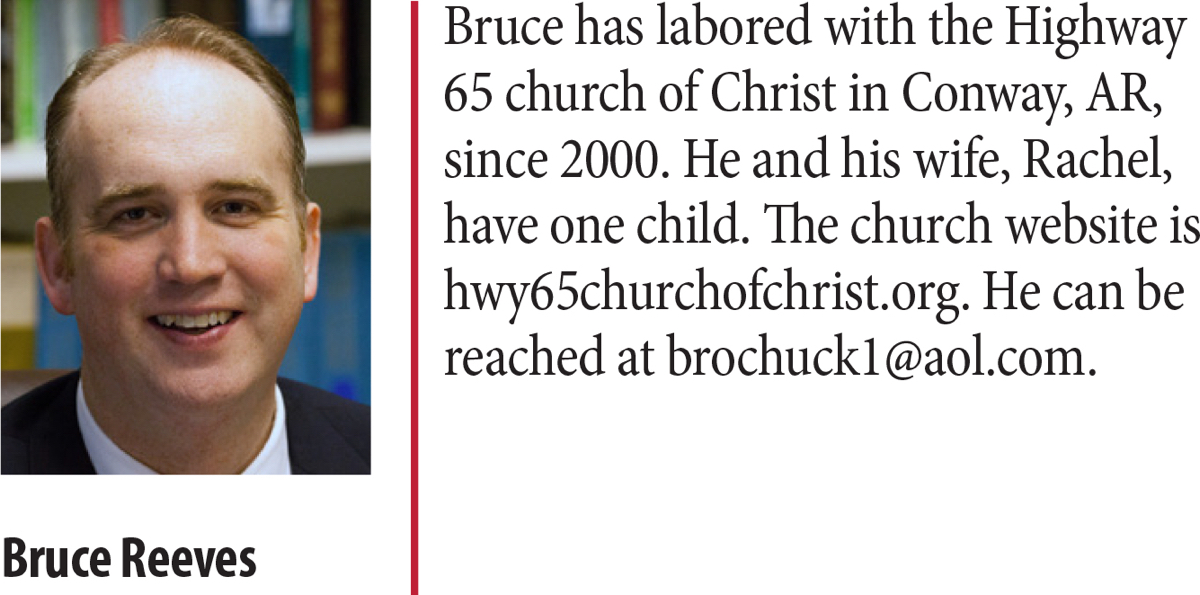
by Bruce Reeves
Synopsis: To walk in sin is to walk away from God, and to walk away from God is to walk away from our fundamental identity because of the Lord’s creation.
In this column, we have addressed the errors of Calvinism both in the religious world at large and among churches of Christ. I hope that our study has helped shape our understanding of God, the nature of humanity, grace, faith, salvation, and God’s purposes for us. Once we see that God redemptively loves us all and that Jesus sacrificed Himself for the entire world, what should we do? The love of God appeals to us to be renewed in the image of God through Christ.
I can remember my dad telling me when I was younger, “Bruce, remember who you are.” I knew exactly what he meant. He was encouraging me to remember how I should conduct myself, what my spiritual purpose was, and the importance of having a godly conscience. Our greatest problems result from a spiritual identity crisis. Knowing who we are affects how we live now and how we value our future relationships and spiritual condition.
As human beings, we sustain a unique relationship with our Creator: “Then God said, ‘Let us make man in our image, according to our likeness. . .’ God created man in His own image, in the image of God He created him; male and female He created them” (Gen. 1:26-27). Since we have been created in the image of God, we have also been called to have a relationship with Him. If we reject God’s truth, we reject the very purpose for which we have been created. Our entire existence is summed up in the dual responsibility of fearing God and keeping His commandments (Eccl. 12:13-14).
Biblically, sin is presented as humanity’s failure to be who we were created to be by God (Rom. 3:23). To walk in sin is to walk away from God, and to walk away from God is to walk away from our fundamental identity by virtue of the Lord’s creation. Although sin does not change our human nature, it violates God’s design and purpose for our lives. As we reach out to the Savior, He leads us out of the darkness of sin into the light of God’s glory (Eph. 4:17-19; 2 Cor. 4:4-6).
In examining our lives, it becomes obvious that we often fall short of God’s image? It is at this point that some important questions arise in our minds: (1) “How can I be more like Christ?” (2) “Where do I begin my relationship with God?” (3) “What does it mean to grow spiritually?”
It is not uncommon to hear, “I am only human!” Usually, that statement is offered as a reason for our mistakes. Yet, to be human is to be a bearer of the image of God. Our identity is not only presented in the creation account of Genesis, but is also highlighted by the Psalmist and New Testament writers (Ps. 8; 1 Cor. 11:7).
It is awe-inspiring to realize that God loved us so much that He gave His only begotten Son for our salvation (John 3:16). The fullness of God’s grace and truth is seen in Jesus Christ (John 14:9; Heb. 1:1-2). John declares that “the Word became flesh and dwelt among us, and we saw His glory, glory as of the only begotten from the Father full of grace and truth” (John 1:14). The term “dwelt” can more precisely be understood as “to tabernacle among us.” God’s presence in the incarnation is emphasized as an echo of His dwelling among His people in the past, but it is explained as the most amazing event in human history (2 Cor. 8:9; Phil. 2:5-8). The selflessness of the Son of God is not restricted to one act, but to the eternal relationship of the Father, Son, and Holy Spirit. The humility of Christ was not foreign to His nature as God; it was in harmony with His divine identity as the Messiah (Ps. 113:5-8).
We pursue God’s image by striving to imitate the love of Christ (Eph. 5:1-2). When we are tempted to sin, we must remember Jesus’s sinless example in His own moments of temptation (Heb. 2:17-18; 4:14-16). When Satan attempted to ensnare Jesus with deceptive enticements, our Lord wielded the “sword of the Spirit, which is the word of God” (Matt. 4:1-11; Eph. 6:17). We, too, can use the “sword of the Spirit” in victory over temptation.
When we are faced with the suffering of trials, we must again look to the example of Jesus and walk in His steps (1 Pet. 2:21-23). What an encouragement to know that our Savior endured the human experiences of temptation, disappointment, and suffering that are common to humanity! The one who was “holy, innocent, undefiled, separated from sinners and exalted above the heavens,” also, “in the days of His flesh, offered up prayers and supplications with loud crying and tears to the One who was able to save Him from death, and He was heard because of His piety. Although He was a Son, He learned obedience from the things which He suffered” (Heb. 5:8-9; 7:26).
Although we fall short of God’s glory from time to time, we can overcome sin by following Jesus’s example and trusting God’s promises (1 Cor. 10:13). According to the apostle, God will not allow us to experience a superhuman temptation beyond our ability to resist, but will provide a way of escape. We find that way of escape by trusting God, following Jesus’s example, obeying His word, focusing spiritually, and praying. When we feel alone, hurt, or weak, the Lord’s example will lead us from the valley of despair to the mountain of peace. Let us always remember that the One who is in us is greater than the one who is in the world (1 John 4:4; 5:4).
The only way to know how to pursue the image of God in Christ is through the teaching of God’s word. A high view of Scripture increases our appreciation for God’s grace toward us (Rom. 1:16-17; 2 Tim. 3:16-17). Jesus said, “The words that I have spoken to you are spirit and are life” (John 6:63).
The powerful effect of God’s word in the lives of believers is a blessing which none of us should take for granted. Paul wrote, “For this reason we also constantly thank God that when you received the word of God which you heard from us, you accepted it not as the word of men but for what it really is, the word of God, which also performs its work in you who believe” (2 Thess. 2:13). The Spirit does not lead through subjective feelings, but the objective word of God (Eph. 5:18; Col. 3:16).
Often people will say things like, “The Spirit spoke to me,” “I can feel the Spirit’s leading,” “the Spirit moved me,” or “the Spirit laid something on my heart,” etc. When we follow the truth of the gospel, we will serve God emotionally and passionately, but our emotions or conscience do not—in and of themselves—serve as an infallible guide. Our feelings are unreliable, and we can deceive ourselves (Prov. 14:12; Jer. 17:9; Jas. 1:22). The conscience does not determine truth, but tells us if we are violating what we believe to be true. Our conscience is truly profitable when it is trained and disciplined by the word of God (Ps. 119:11; Acts 23:1; 24:16; Rom. 2:15; 10:1-3). When we fully surrender to the gospel, we will express a zealous faith, penitent heart, and a courageous trust in our God. Authentic spiritual experience is processed through the word of God.
To “walk in the Spirit,” “be led by the Spirit,” and “live in the Spirit” are to surrender to the influence and teaching of the “law of the Spirit” in the gospel (Rom. 8:2, 14; Gal. 5:16, 18, 25). The Hebrew writer speaks of the power of God’s word, “For the word of God is living and active and sharper than any two-edged sword, and piercing as far as the division of soul and spirit, of both joints and marrow, and able to judge the thoughts and intentions of the heart” (Heb. 4:12). God’s word exposes and reveals the deepest recesses of our heart to lead us to our compassionate High Priest and our Sabbath rest (Heb. 4:1-11, 15). God is shaping us into the image of His Son in our character and hope of the resurrection (Rom. 8:23-29; cf. 1 Cor. 15:49; Phil. 3:20-21; 1 John 3:1-2).
How can we be conformed to God’s image when we have sinned against Him? Isaiah declares that sin separates us from God (Isa. 59:1-2). Thank God for Jesus Christ and His mercy in the forgiveness of our sins (Acts 2:38; 22:16; Rom. 8:1-2; Eph. 1:4, 7)! He not only grants the forgiveness of our sins but also the transformation of our souls. The purpose of Paul’s teaching was to see that Christ was “formed” in believers (Gal. 4:19, 20). Similarly, he encourages the Colossians toward maturity in the Lord, “We proclaim Him, admonishing every man and teaching every man with all wisdom, so that we may present every man complete in Christ. For this purpose, also I labor, striving according to His power, which mightily works within me” (Col. 1:28-20). The gospel has the power to change our lives forever (Rom. 1:16; 2 Cor. 3:18).
We pursue the fullness of God’s image in our lives through faith in Christ. Saving faith gives full loyalty to Jesus as King and Lord (Acts 2:36; Phil. 2:9-11). The apostles never viewed faith as a non-doing trust; rather, they proclaimed faith as a total response of obedience to the gospel (Rom. 1:5; 6:16; 16:26). The apostle Paul describes the faith that justifies the sinner with metaphors such as crucifixion, death, and resurrection (Rom. 6:1-7). In His description of faith, Paul writes, “. . .let not sin reign in your mortal bodies. . .” (Rom. 6:12), and “. . .for sin shall not be master over you. . .” (Rom. 6:14). This interpretation of faith depicts our participation in Christ’s love, sacrifice, and resurrection. The inspired writers never associated obedience to the gospel with the “law of works” but consistently associated it with the faith that justifies (Rom. 3:27-28; Gal. 3:10-12, 26-27). We cannot proclaim faith in Christ and fail to emphasize His authority as King (Matt. 8:5-13; Col. 3:17). Therefore, the New Testament describes faith in terms of being “crucified with Christ” and living in the “power of His resurrection and the fellowship of His sufferings, being conformed to His death” (Phil. 3:8-10).
As Christians, we strive to put Christ on in our conduct, both morally and ethically. Those who live their lives without Christ are described as being “darkened in their understanding. . . because of the hardness of their heart. . .” having “given themselves over to sensuality for the practice of every kind of impurity and greediness” (Eph. 4:18-19). Although, the Gentiles were “professing to be wise, they became fools, and exchanged the glory of the incorruptible God for an image in the form of corruptible man. . . therefore God gave them over in the lusts of their hearts to impurity, so that their bodies would be dishonored among them. For they exchanged the truth of God for a lie and worshipped and served the creature rather than the Creator, who is blessed forever amen. . . and just as they did not see fit to acknowledge God any longer, God gave them over to a depraved mind, to do those things which are not proper. . .” (Rom. 1:22-25, 28). Rather than recognizing that they had been created in the image of God, they sought to fashion God according to the image of creation. The renewal of our mind leads us to live in the likeness of God and His love (Rom. 12:1-2; Eph. 5:1-2).
As we devote our lives to the Lord, we will glorify Him (1 Cor. 6:18-20), we will worship Him (Heb. 10:25), and we will walk in harmony with His holiness (1 Pet. 1:13-18). Let’s remember who we are as God’s creation as we pursue His image in our lives.


By Bruce Reeves
Synopsis: Kelly (Ward) Carrington lived from January 7, 1964 to February 15, 2023. She was a faithful Christian, and beloved wife of Shane. Kelly is here remembered by two of her closest friends, Bruce and Rachel Reeves.
The Lord broke the mold with Kelly Carrington. She touched those who knew her with that “big personality,” “beautiful smile,” “contagious sense of humor,” “amazing compassion,” and “uncompromising conviction.” Judging by the hundreds who attended her visitation and funeral services, Kelly touched the lives of more people than she ever imagined. Compressing Kelly’s life into a few words is impossible, but to reflect on the goodness of her influence and dedication to the Lord is an honor and blessing.
Solomon wrote, “It is better to go to a house of mourning than to go to a house of feasting, because that is the end of every man, and the living takes it to heart” (Eccl. 9:1-2). It is certainly right for us to sorrow, yet we do not sorrow as the world does. We rejoice and celebrate Kelly’s life, victory, hope, and blessed Savior.
The apostle John encourages us when he says, “Here is the perseverance of the saints who keep the commandments of God and their faith in Jesus. And I heard a voice from heaven, saying, ‘Write, ’Blessed are the dead who die in the Lord from now on!’ ‘Yes,’ says the Spirit, ‘so that they may rest from their labors, for their deeds follow with them’” (Rev. 14:13).
Kelly’s confidence in “eternal life” resulted from her faith in Christ. John writes, “He who believes in the Son has eternal life; but he who does not obey the Son will not see life. . .” (John 3:36). John assures believers of the divine promise of God, “This is the promise which He Himself made to us: eternal life” (1 John 2:25). “Eternal life” does not merely describe longevity, but peace, fellowship, and eternity with God. Although we all deserve eternal condemnation, Jesus died to bring us to salvation and life (John 3:16).
Kelly lived her life with the joy of hope and the resolve of a faithful heart, regardless of her circumstances. She took Scripture to heart when Paul wrote, “Rejoice in the Lord always; again, I say, ’rejoice” (Phil. 4:4).
This life presents us with trials and struggles, which we may not have seen coming, but Christ offers us “eternal life.” When the fiercest storms gather around us, the anchor of our soul remains steadfast and sure (Heb. 6:18-20). Kelly said one of the hardest things that she ever did was thank God for her diagnosis—not because she believed God was responsible for her sickness but because her illness took her faith to new heights: “Therefore, we do not lose heart, but though our outer man is decaying, yet our inner man is being renewed day by day. For momentary, light affliction is producing for us an eternal weight of glory far beyond all comparison, while we look not at the things which are seen, but at the things which are not seen; for the things which are seen are temporal, but the things which are not seen are eternal” (2 Cor. 4:16-18). It is one thing to read and preach about our steadfast hope, but when you see it in the life of a faithful Christian like Kelly, it is a beautiful acknowledgement of the power of God’s faithfulness.
This kind of faith does not happen by accident; it is built by God’s grace and providence: Kelly trusted in the Lord, not this life, and you could see it in her reliance on God’s word. She read, listened, and meditated on God’s truth (Ps. 1). In her commute to work, she listened to audio recordings of Scripture and then she wanted to discuss it. She saw the inseparable connection between faith and God’s word (Rom. 10:17). Kelly did not read God’s word merely as an academic exercise; she read it to get closer to God and to grow in her faith! You couldn’t talk to Kelly for long without sensing her confidence in God’s power in prayer. She would say, “I need those prayers.”
John wrote, “And the testimony is this, that God has given us eternal life. . . these things I have written to you who believe in the name of the Son of God, so that you may know that you have eternal life” (1 John 5:11-13). Shortly before her death, after experiencing several long, hard days, in which she seemed to have reached the end of her journey, Kelly said, “Bruce, I was disappointed when I woke up today. I just want to go to glory.” Paul, himself, shared similar feelings when he wrote of this hope (Phil. 1:21-23).
Why do God’s people live in this kind of assurance? It is a living trust in the Lord’s faithfulness and promises (1 Cor. 1:9). Kelly obeyed the gospel of Christ at twelve years old and lived with her eyes securely focused on Him. Kelly would want me to tell you what she did to become a Christian and why. She believed in Jesus Christ as God’s divine Son and that faith was expressed in true repentance (John 3:16; 2 Pet. 3:9). As a result, she confessed her faith in Jesus as God’s Son and her Savior (Rom. 10:9-10).
Based upon an understanding derived from reading the Scriptures, Kelly was baptized into Christ for the forgiveness of her sins and entered the resurrection life of her Lord (Acts 22:16; Rom. 6:3-4; Col. 2:11-13).
The way for us to honor Kelly’s legacy is to follow Christ: “Be imitators of me, just as I also am of Christ” (1 Cor. 11:1). While she examined herself, she knew from her reading of Scripture and the living of her life that she was in fellowship with God.
Kelly lived with a resilient joy as a passionate disciple of Jesus. Her faith was always growing. Shane and Kelly have shown us all how God can refine our faith even in our suffering (1 Pet. 1:6-9). Kelly had a plaque displayed in her kitchen that tells her story—it was given to her by Patti Sells through Michelle Blackman here in Sulphur Springs. Patti battled cancer herself and she and Kelly would talk frequently. It is entitled,
It cannot cripple love.
It cannot shatter hope.
It cannot dissolve faith.
It cannot destroy peace.
It cannot kill friendship.
It cannot suppress memories.
It cannot silence courage.
It cannot invade the soul.
It cannot steal eternal life.
It cannot conquer the spirit.
Kelly was supportive, honest, loving, but truthful. Few friends will really tell you the truth. Kelly was that kind of friend.
Kelly worked as a supervising Lab Tech for thirty years and both loved and was loved by those with whom she worked. She was gifted at working with children. Her co-workers described her abilities to soothe children as “the Kelly thing.” When a child was worried about the needles, she would sing to them, and they would completely relax.
She loved to laugh, but she was content to just sit and sip a cup of coffee while she visited with friends. Kelly loved antique stores no matter where they were, and she enjoyed looking at old quilts. It was always a joy to talk about memories with Kelly. She would talk about her parents and grandparents, her sisters, her friends. Hospitality came naturally to Kelly because she enjoyed serving others.
Kelly faced cancer with amazing resiliency, and Shane was with her every step of the way. She dearly loved her husband and children and gave her whole heart to respect and love Shane as her husband, brother in Christ, and best friend. Her heart’s desire was that her daughters be godly women who trusted in the Lord and graciously touched the lives of others with goodness. She loved every moment with her grandkids: “Ruby, Truett, and Dale” were so special to her. Kelly was so thankful to know that her dear friends would be there for Shane and her girls in the coming days.
Satan desires suffering to destroy our faith, but God intends for it to grow our faith. Shane and Kelly did not allow Satan to have an inch of their lives during their trials. In one of Shane’s last emails, he wrote,
Please pray for Kelly’s comfort and a peaceful hour to depart when the time comes. Our cup overflows, and Kelly and I realize how richly blessed we are in Christ and with people we love and who love us. Today Kelly said she will depart this world with no regrets. May we all live for the Lord and have the same attitude. We love you all, our dear ones. Thank you for enriching our lives! May you rest well. Yours always, Shane and Kelly.
Kelly loved Shane dearly, and she loved her family with her whole heart, but she was tired of the suffering of this worn-out world. Paul had similar feelings about this world and his hope of resurrection, “For indeed while we are in this tent, we groan, being burdened, because we do not want to be unclothed, but to be clothed, so that what is mortal will be swallowed up by life” (2 Cor. 5:4).
Shane and Kelly have had a wonderful marriage in the Lord (Eccl. 9:9). They exemplified the heart of Christ in their marriage and home (Eph. 5:22-33). What a blessing to see a marriage that has shown grace and commitment, love and resolve, mercy, and conviction! Shane sacrificially cared for Kelly—showing the depth of God’s love in their marriage. They reassured each other from beginning to end.
Kelly faced death with confidence because she believed in the resurrection to come. The New Testament teaches that in eternity, we will have a resurrection body like the glorified resurrection body of Jesus. Paul writes, “Who will transform the body of our humble state into conformity with the body of his glory. . .” (Phil. 3:20-21; cf. 1 John 3:2). Likewise, we read in 1 Corinthians 15:42-48 that our mortal, corruptible, perishable, and weak bodies will be raised as immortal, incorruptible, imperishable, and powerful bodies. Our resurrection bodies are “spiritual” in the sense that our glorified bodies will be able to function in the spiritual realm. Paul had confidence in his future resurrection, and we can too (2 Cor. 5:1-2).
The apostle invites us to “comfort one another with these words” concerning the return of Christ and the future resurrection (1 Thess. 4:13-18). The Lord does not want us to worry about the condition of the faithful after death, but to be filled with comfort and confidence. The Lord expects that we will grieve, but not as those who are hopeless. There can be different kinds of grief, i.e., cold grief versus warm grief. Cold grief is full of guilt and regret. However, warm grief is filled with joy and love. We will miss Kelly, but we are filled with God’s peace and hope for the future. When my wife, Rachel, and I were sharing our goodbyes with Kelly for now—she said, “Oh dear Rachel, don’t cry for me. . .” Rachel said, “I’m not crying for you, I’m crying for us.” Grief and sorrow can bring hard days, but God’s hope and comfort will shine through the darkness, and we can join with the prophet, Habakkuk, “Yet I will rejoice in the God of my salvation.”
The sharpness of our current grief will be transformed into tears of joy, and the warmth of God’s love will fill the hearts of those who love Kelly so dearly. In heaven, our faith will have turned to sight, our hope will have been fulfilled, but our love will continue on throughout eternity! “Blessed be the God and Father of our Lord Jesus Christ, the Father of mercies and God of all comfort, who comforts us in all our affliction so that we will be able to comfort those who are in any affliction with the comfort with which we ourselves are comforted by God” (2 Cor. 1:3). If we could only see Kelly now in the paradise of Abraham’s bosom, in the fellowship of her Savior, with no pain and no tears, we would see her great blessing. She is not missing us; we are missing her. Nevertheless, one day we will see her in the land of eternal rest as we bask in the light of His love and presence of His glory! (2 Tim. 4:6-8).
by Luther F. Beecher (1813–1903)
What is dying?
I am standing on the seashore.
A ship sails to the morning breeze and starts for the ocean.
She is an object, and I stand watching her
Till, at last, she fades from the horizon,
And someone at my side says, “She is gone!” Gone where?
Gone from my sight, that is all;
She is just as large in the masts, hull and spars as she was when I saw her,
And just as able to bear her load of living freight to its destination.
The diminished size and total loss of sight is in me, not in her;
And just at the moment when someone at my side says, “She is gone,”
There are others who are watching her coming,
And other voices take up a glad shout,
“There she comes”—and that is dying.
By Rachel Reeves
The book of Proverbs has much wisdom in describing the blessings of life. Proverbs 17:17 says, “A friend loves at all times. . .” God’s family is a beautiful blessing to Christians. Through the Lord’s family, Bruce and I have made many friends over the years. We became good friends with Shane and Kelly Carrington several years ago. They have been fellow workers in the Lord’s church. We have gone on several vacations making priceless memories. They have been with us through significant losses and shared in life’s precious blessings. Their marriage has shown a beautiful love that endures to the very end of life. I want to share a few thoughts about my sweet friend Kelly. There are not enough words to describe this remarkable and godly woman.
“Be hospitable to one another without complaint” (1 Pet. 4:9). Anyone who knew Kelly knows she loved to entertain. She received so much joy out of hosting in her home. She was one of the most hospitable ladies I have ever met and immediately made you feel at home. Kelly, by example, taught so many young ladies how to be a gracious hostess. She would cook a meal for Sunday lunch for her family, but she also would invite members of the church over. It may have been someone from their Southside church family or visitors who had stopped to worship on their way through town. A couple of weeks before she passed away, we were blessed with the opportunity to see her one last time. Many people stopped by to see Shane and Kelly that weekend. There was a young couple there; as they said goodbye, she told Kelly, “Thank you for teaching me how to cook.” That has been etched in my mind: a faithful sister fulfilling her role in teaching a younger woman, as we find in the Scriptures. Kelly taught us that showing hospitality did not mean having everything perfect or providing a huge, elaborate meal. It was about sharing with others with a joyful and kind heart.
Kelly was a sincere friend. She would be honest with you about the advice she would give. “Ointment and perfume delight the heart, and the sweetness of a man’s friend gives delight by hearty counsel” (Prov. 27:9). Her counsel was always based on the word of God. Kelly was an honest friend; she would tell you the truth even when it hurt. “Iron sharpens iron, and a friend sharpens a friend” (Prov. 28:17). She knew how to bring you comfort during heartbreak, but she also could celebrate big and bring so much joy to your day. She was a very giving and generous child of God. Kelly used her talent for cooking, sewing, and her love for people to give back to others.
There are examples in Scripture teaching us that we should hold the word of God near to our hearts and meditate on it day and night (Deut. 6:5-7). Anyone around Kelly knew she treasured the word of God and saw the value and need to teach others about the gospel. She was always ready to discuss the Bible and sought to learn more about it. I remember one day when we were shopping at an antique store (which we often did together). As she was checking out, she started talking to the cashier. She said, “We enjoyed walking through your store. What a beautiful day the Lord has given us today! Do you have a church family?” She invited the lady to worship and talked with her about the Bible. She was not afraid to share God’s word with anyone.
As Kelly battled cancer in the last four and a half years, she taught many important lessons. She taught me that no matter what trial I am facing in life, my husband should still be a priority. I remember she and Shane came to stay with us for a few days and we had our cups of tea, sat on the couch, and visited. Kelly had already had one major surgery and was having treatments. Kelly said she wanted to continue to be a good wife to Shane while she was battling cancer. She knew there were going to be some hard times, and she would not feel good. Yet, as the woman in Proverbs 31, she continued to show honor and love to Shane as her husband. She did not want to neglect him because of her cancer, surgeries, or treatment. She was the opposite of Job’s wife, and, out of her great love for Shane, wanted to love him with her heart and actions.
Kelly supported, encouraged, and worked with Shane in God’s kingdom as she had done their entire marriage. She loved and honored Shane as her husband to the very end of her life. Even when frail, she talked to him about the Bible, and they prayed together. Kelly was ready to be with the Lord, but she still had that one concern about her family being ok, which is a genuine consideration when we part from loved ones. Even Jesus hanging on the cross had concern for His mother’s well-being, “When Jesus then saw His mother, and the disciple whom He loved standing nearby, He said to His mother, ‘Woman, behold, your son!’ Then He said to the disciple, ‘Behold, your mother!’ From that hour the disciple took her into his own household” (John 19:26-27 ).
About one and a half years after Kelly’s diagnosis, she said, “You know, I thought I had a strong faith in God before cancer. However, I realized I did not have complete faith in God to have the confidence in whatever happens that God is in control. It is one thing to say, ‘I trust God completely,’ and to really trust Him.” Kelly did not give in to Satan to allow doubts to arise about God’s love or His promises to us. She continued to pray and diligently study His word fervently. She persevered to live each day as if it were her last, chose joy, loved Shane wholeheartedly, and continued to support her family. Some of our last conversations were about her confidence in God’s promise of heaven. She said, “I am so tired. I want to go to glory. I was disappointed when I opened my eyes this morning and was still here.” As a friend, I am sad that she is not with us anymore, but I would not have chosen for her to stay here and continue to suffer from cancer. Knowing our departure from one another would be temporary helped me to comfort her. When we talked, I told Kelly, “I know, sister, you are almost done. You have run the race, fought a good fight, and are so close to finishing the course. To you, it will be as a blink when we see each other again.” She was ready to be in the arms of Jesus and to have her final rest. I hope and pray that at the end of my life, I can have faith in God and confidence in my salvation to say, “I was disappointed today when I opened my eyes, and I was not with Jesus.”
Kelly’s legacy of faith has been evident to those who knew her, both in her life and even in her memorial service. Praise God for His steadfast love and faithful promises. As Kelly’s favorite song says, “How great Thou art, my Savior God to Thee, how great Thou art, then sings my soul, my Savior God to Thee, how great Thou art, how great Thou art.”
Note from Shane: Please give Corey Blakes photo credit for the couple shot. And Derik Moore for Kelly’s, if you don’t mind.






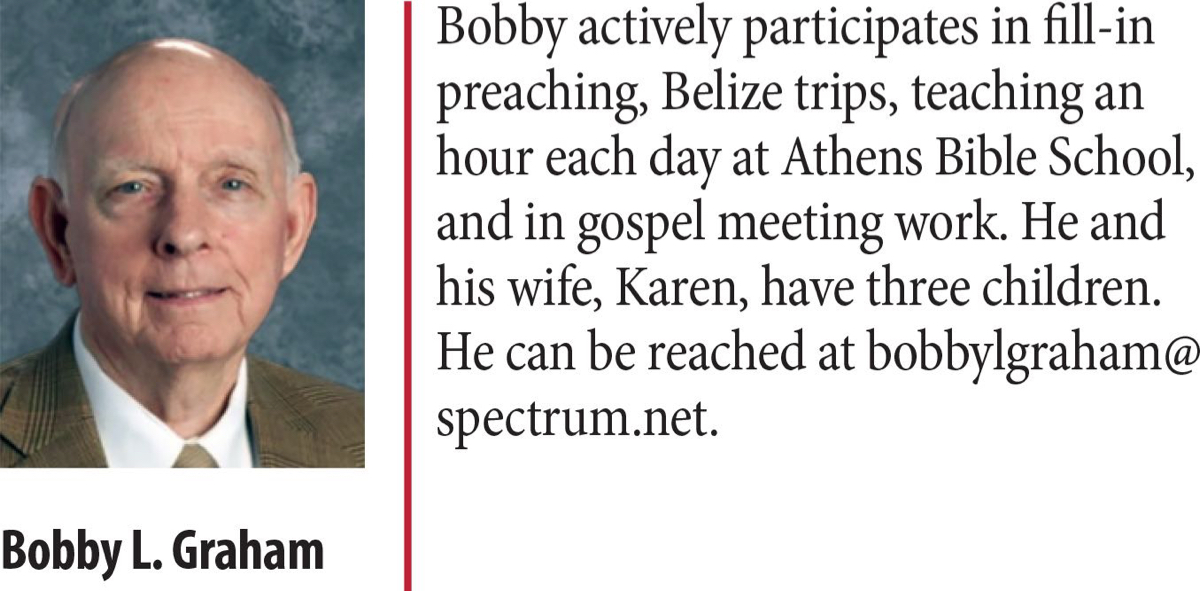
By Bobby L. Graham
Synopsis: Was Adam Standing Beside Eve When She Was Tempted?
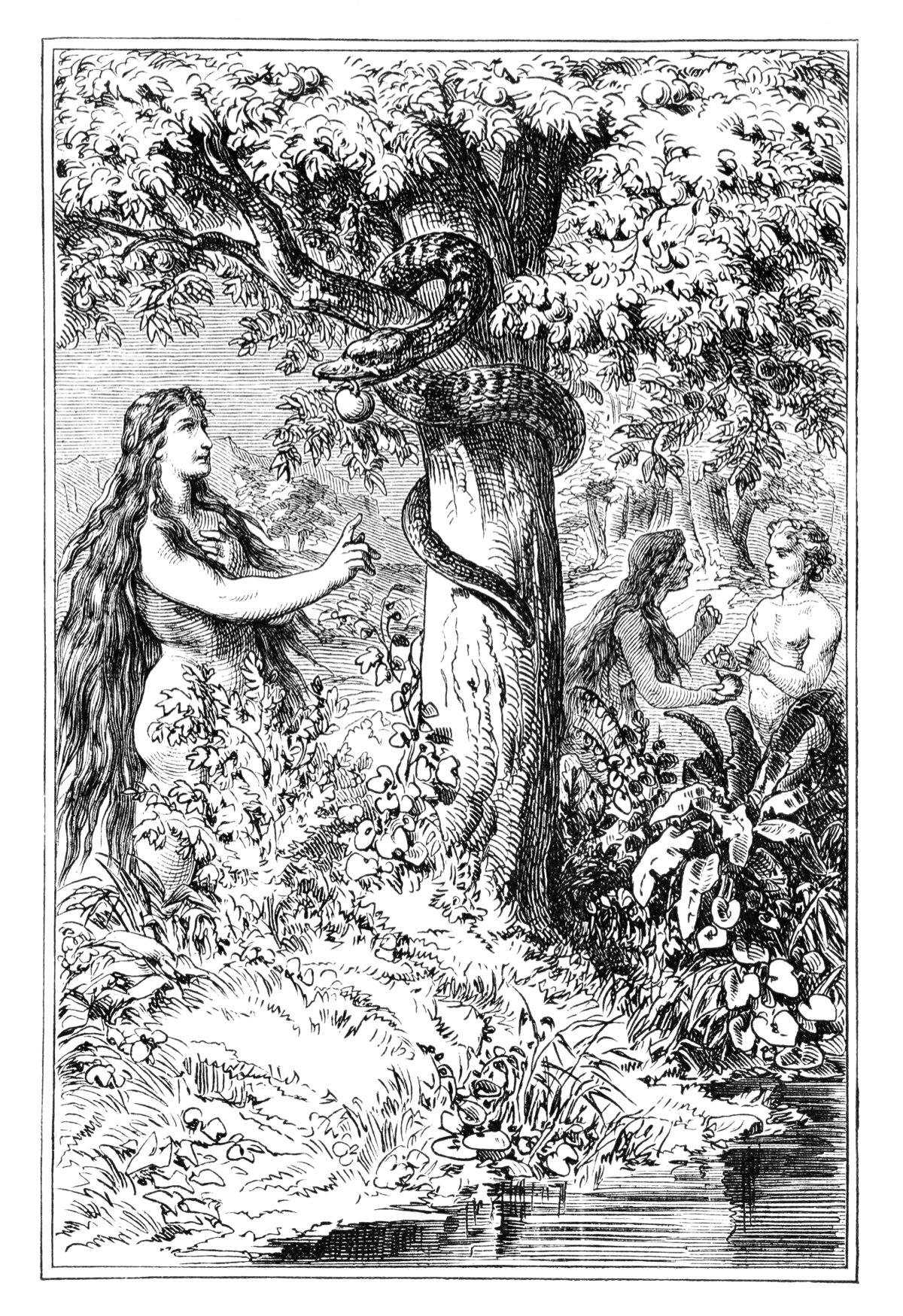
Was Adam standing by Eve’s side when the serpent approached Eve in the garden?
The short answer to this question is that I do not know. Read the verse in question, as it is translated in two different versions, and consider the question for yourself.
So when the woman saw that the tree was good for food, that it was pleasant to the eyes, and a tree desirable to make one wise, she took of its fruit and ate. She also gave to her husband with her, and he ate (Gen. 3:6, NKJV).
So when the woman saw that the tree was good for food, and that it was a delight to the eyes, and that the tree was to be desired to make one wise, she took of its fruit and ate, and she also gave some to her husband who was with her, and he ate (Gen. 3:6, ESV).
The italicized phrases in the two renderings, when compared, bring clarity to what is happening in the account. At the time when Satan tempted her, all we know is that Eve was there. We also soon learn that Adam was present with Eve when she yielded to temptation and then enticed her husband to commit sin. The question remains unanswered: Was Adam there when Satan spoke to Eve to draw her into sin, or did he enter the scene after her temptation?
We simply do not know! It would be conjecture/supposition to say that he was there earlier. Commentators can be cited on both sides of this question, but they know no more than we know, because they have no more information available to them than we have. Furthermore, I will state that it makes little difference whether Adam was present with Eve at that earlier time. We know that he heard God’s instructions/warning (Gen. 2:16-17), just as we know that Eve knew of the same (3:3-4). Each one sinned in eating contrary to God’s instructions (Jas. 4:17; 1 John 3:4).
Whereas it makes little difference in this case, as earlier noted, conjecture/supposition has often become the father of false teaching/practice. It is because of supposition that many believe in infant salvation, infant baptism, a special clergy class, sprinkling and pouring instead of immersion, various forms of religious hierarchy rather than local oversight by elders/overseers/shepherds, salvation by faith alone, the right of local churches to surrender their work—-in part or in total—to human organizations, etc. There cannot be found clear biblical teaching for any of these questioned practices; the only basis upon which they stand is man’s conjecture/supposition. Such makes for a stunningly weak foundation!
The chief problem with conjecture is that it lacks the certainty and force of Scripture. It is not the same as Scripture, but it is human guesswork concerning what the Scripture teaches. The huge gap between the Lord’s words to Peter and what people thought he meant by those words well illustrates the problem of conjecture and the weakness of anything based upon it (John 21:20-23). All must resolve to leave conjecture/supposition out of their Bible-study toolbox.




By Leon Mauldin
Synopsis: Shishak is the first Pharoah mentioned by name in the Bible, and left his own record at Karnak in Thebes of his invasion of Israel. His burial was at biblical Tanis/Zoan, and his sarcophagus is still there.
As most readers know, “Pharaoh” was not a personal name but a dynastic title designating the king of Egypt. The first biblical mention of a Pharaoh is Genesis 12:15, in the days of Abraham’s sojourn into Egypt. Other subsequent pharaohs are mentioned as time goes on, including the events in Joseph’s life, and later in the time of Moses and the Exodus.
The first Pharaoh mentioned by name is Shishak. He reigned during Egypt’s 22nd dynasty, which was a Libyan dynasty. His reign began in 946 BC. In his twenty-first year, he invaded Judah, which was 925 BC.
Solomon’s adversary, Jeroboam, “arose and fled into Egypt, to Shishak king of Egypt, and was in Egypt until the death of Solomon” (1 Kings 11:40). Solomon was succeeded by his son Rehoboam, and Pharaoh Shishak was again mentioned in Scripture: “It happened in the fifth year of King Rehoboam that Shishak, king of Egypt, came up against Jerusalem. And he took away the treasures of the house of the LORD and the treasures of the king’s house; he took away everything. He also took away all the gold shields which Solomon had made” (14:25-26). God allowed this invasion of Jerusalem because of Judah’s unfaithfulness (2 Chron. 12:2). The text explains, “Then Shemaiah the prophet came to Rehoboam and to the princes of Judah, who had gathered at Jerusalem because of Shishak, and said to them,”Thus says the LORD, ‘You abandoned me, so I have abandoned you to the hand of Shishak’” (2 Chron. 12:5).
When Shishak returned to the capital of Thebes (ESV, “No” in NKJV), at Karnak he recorded his victory, including the listing not only of cities of Judah, but of many Israelite cities as well. Our photo shows the Shishak Inscription.
The site of Tanis/Zoan is to be associated within the area of Goshen, where the Israelites had lived for some time and were living at the time of the Exodus. “Marvelous things He did in the sight of their fathers, In the land of Egypt, in the field of Zoan” (Ps. 78:12). Tanis is the site where Shishak was entombed. Our photos show the entrance into Tanis, and also the sarcophagus of Shishak!
This is a fascinating example of how archaeology can enhance our understanding of the biblical text, as well as underscore the fact that the Bible is factual. While we do not depend on archaeology to “prove” the Bible, as it stands on its own merit, this “intersection” of biblical history with secular records has an important place in the discipline of apologetics.



By Chris Reeves
Synopsis: God made us and He knows that hard work is good for the mind and the body. God’s way is the way of work, not laziness.
“Boys, get to work!” When I was young, my brothers and I would often hear these words from my father. He would give us a job, but we would be playing around, doing something else. Then he would come along and say, “Boys, get to work!” We took the approach of so many people today—neglecting the importance of work. We had an important job to do around the house, but we spent our time playing. Since we were immature, we needed to learn to grow up and see the value of work.
The recent pandemic has caused many people to become lazy. When government officials “shut down” the country (don’t go to work, don’t go to school, don’t go to church, etc.), many people used that as an excuse to stop working, and to this day, have still not gone back to work. Many people are actually being paid to stay at home and do nothing. Can you believe it? Their laziness is being funded by tax dollars. Hard-working Americans are paying their fellow-Americans to stay at home and be lazy. That’s messed up.
Actually, laziness and slothfulness have been around a long time even before the pandemic. However, it’s not God’s way. God’s way is a way of work. Of course, there are some limited exceptions to this and legitimate reasons for one not to work. A person may have a true handicap, a person may be severely ill, or a person may be elderly or retired. Cases like this aside, the average person should be busy working. Since God made us, He knows that work is good for the mind and the body. If I had the opportunity to mentor someone about his general approach to life, I would recommend that he have a healthy respect for work.
God has always commended work and condemned laziness all throughout the Bible. In the Old Testament, laziness is condemned in Scriptures like: “Go to the ant, thou sluggard; consider her ways” (Prov. 6:6; cf. also vv. 7-11; 10:4-5, 26; 12:11, 24, 27; 13:4; 14:23; 15:19; 18:9; 19:15, 24; 20:4, 13; 21:17, 25; 22:13; 24:30-34; 26:13-16; Eccl. 10:18). In the New Testament, laziness is condemned in Scriptures like: “For even when we were with you, this we commanded you, if any will not work, neither let him eat” (2 Thess. 3:10; cf. also Matt. 20:6; 21:28; 25:24-30; Mark 13:34; Acts 20:34-35; 1 Cor. 4:12; Eph. 4:28; 6:5-9; Col. 3:22-4:1; 1 Thess. 4:11; 2 Thess. 3:6-9; 1 Tim. 5:8-16; Titus 2:9-10). So, what work do we need to be doing?
There’s work to be done in life. Work is good for each one of us. Part of the duty communicated in Paul’s admonition, “Each one will bear his own load” (Gal. 6:5), is having a job to support ourselves and/or our loved-ones. Believe it or not, God ordained work from the very beginning of time with Adam and Eve. He placed them in the garden of Eden “to dress it and to keep it” (Gen. 2:15). Although we are not given the details, they had work to perform.
It is important for parents to train their children to be workers from their very early years. Even toddlers can be given chores to do as work. There are regular times throughout the day when children need to turn off the TV, stop playing video games, put down the cell phone, and help Mom and Dad with some work. Here are a few suggestions for parents with children:
Give them chores to do, starting at an early age.
Let them do as much of the work for themselves as possible. Don’t do it all for them.
If they make a mess, make them clean it up.
Encourage them to take great care in their work, do their best, do a good job, and complete their task—no partial or half-way work. Work with all your might (Eccl. 9:10; Col. 3:23). Leave a faithful, i.e., trustworthy, legacy in all you do (3 John 5).
Teach them to do their chores on their own without having to be told each time to do them.
Help them know that there is a time for everything. There is work time and play time, not just play time all the time. Work first, then play.
As they get older, tell them that one day they will need to get their own job and their own place to live. You will not be their “meal ticket” for the rest of their life.
There’s work to be done in becoming a Christian. Obeying the gospel is work. Obedient belief (faith) is a “work of God” (John 6:27-29). One must work repentance (2 Cor. 7:10), and one must “work righteousness” (Acts 10:35), which includes baptism (Acts 10:48). There’s also work to be done in remaining faithful as a Christian. A faithful Christian does good works to let his light shine (Matt. 5:16). Like Dorcas, let’s all be full of good works toward others (Acts 9:36). Let’s have a faith “working through love” (Gal. 5:6).
There’s work to be done in the home, taking care of the children and keeping the house in order. Mothers are to be “workers at home” (Titus 2:5). They are to be house managers (1 Tim. 5:14). Fathers are also supposed to nurture their children (Eph. 6:4-5) and rule their own house (1 Tim. 5). This all takes work.
There’s work to do in the Lord’s kingdom and vineyard. Just as Jesus worked hard in His kingdom (John 4:34; 5:17; 9:4; 10:25-38; 14:10-12; 17:4), so we too must work hard in His kingdom. God has prepared good works for His church to do and we need to get busy doing them (Eph. 2:10). Like John Mark, who withdrew and went not with Paul and Barnabas to the work (Acts 15:38), some brethren today withdraw and let others do all the work. Brethren, we can do better than this. Let’s all be “fellow-workers in Christ” (Rom. 16:3) and let’s be “abounding in the work of the Lord” (1 Cor. 15:58; 16:10).
There’s work to do for local church leaders. Men, if you don’t want to work in the local church, then don’t allow yourself to be in positions of leadership. If you don’t want to actually do the work of an evangelist, then don’t go into preaching. If you don’t want to actually labor and work to shepherd the flock, then don’t allow your name to be nominated for the eldership. If you don’t want to actually serve the needs of the local members, then don’t allow your name to be nominated for the role of deacon. Like Ephesus, maybe it’s time for some local churches to “repent and do the first works” (Rev. 2:5). Let’s not be slack in the work of the Lord (Jer. 48:10), but let us all do “the work of ministering” (Eph. 4:12).
Yes, I can still hear those words of my father to this day. . . “Boys, get to work!” At the time, I didn’t realize how right he was to say that to us children. I didn’t like hearing those words, but I’m glad now he said them. I also know how right he was to instill in us the important character trait of hard work.
Hard work is rewarding and it will be rewarded one day by the good Lord: “Blessed are the dead who die in the Lord from henceforth: yea, saith the Spirit, that they may rest from their labors; for their works follow with them” (Rev. 14:13). Just as God worked first, then rested (Gen. 2:2-3), faithful Christians will do the same. So. . . Get to work! You’ll be glad one day you did.



By Owen Partain
Synopsis: Worry is a problem for people of every age, but can be especially accute when we are young. Jesus provides encouragement, and shows us how to conquer anxiety.
Why do we, as humans, worry about the things about our earthly life when our focus should be on things higher and finer than the physical?
Let us think for a minute what heaven is like. It is a holy city built by God (Heb. 11:10, 16; Rev. 21:2). It has many dwelling places (John 14:2). It contains “the river of the water of life, clear as crystal, coming from the throne of God and of the Lamb. . .” and the tree of life (Rev. 22:1-2). It is a place where we will see God’s holy face (Rev. 22:4). It is a place that contains pearly gates and a street of gold (Rev. 21:21). It is the “perfection of beauty” (Ps. 50:2). It contains armies “clothed in fine linen, white and clean” led by our Lord and Savior (Rev. 19:11-14). This is what our eternal home looks like, and it is much finer than anything here on earth.
That being said, why do we continuously worry about the things in our lives on this earth? Let’s look towards Matthew chapter 6, verses 25-34.
“And why are you worried. . . ?” Jesus asks this question in verse 28. He explains how God cared for, and provided for, even the smallest things of nature. If God fed the birds of the air, clothed the lilies of the field, and cloaks the hills with billions of blades of grass, then wouldn’t we be worth much more in His eyes? Considering the extent to which He cares for the other parts of His creation, will He not also provide for even our smallest needs? Since God made us in His image, we are the most important parts of His magnificent and majestic creation. Of course, He will provide for us! We must dwell on this thought at all times, remembering who our Creator is. God will provide for our physical needs. He will nourish us spiritually. So, there is no reason for us to worry about the trivial things in life, or even fret over the bigger problems that are beyond our control. God sees the bigger picture. He holds our lives in His hands. Therefore, let us learn to trust Him.
Trust in the LORD and do good; dwell in the land and cultivate faithfulness. Delight yourself in the LORD, trust also in Him, and He will do it (Ps. 37:3-5).
Often we worry about the uncertain things in life—the hypothetical. “How will this go?” “What is going to happen to me if. . . ?” “What if something bad happens?” Consider the example of Joshua. God continually reassured Moses’s successor that He would guide him every step of the way:
Just as I have been with Moses, I will be with you; I will not fail you or forsake you. . . Have I not commanded you? Be strong and courageous! Do not tremble or be dismayed, for the LORD your God is with you wherever you go (Josh. 1:5b, 9).
Isaiah 41:10 states, “Do not fear, for I am with you; do not anxiously look about you, for I am your God. I will strengthen you, surely I will help you, surely I will uphold you with My righteous right hand.” As God was the source of Israel’s strength, let us recognize that He is the source of our strength as well. Furthermore, we should pray daily for more of that strength whenever trials come in life:
Be anxious for nothing, but in everything by prayer and supplication with thanksgiving, let your requests be made known to God. And the peace of God, which surpasses all comprehension, will guard your hearts and your minds in Christ Jesus (Phil. 4:6-7).
In Luke 22, when our Lord was praying in the Garden of Gethsemane, we see the anxiety and agony that was building up in His heart: “. . .He was praying very fervently; and His sweat became like drops of blood, falling down upon the ground” (v. 44). Anticipating the ordeal that lay ahead, Jesus suffered intensely. He was pleading for God’s help.
Earlier, at the beginning of His ministry, Jesus Christ was tempted by the devil himself in the wilderness (Matt. 4:1-11). Satan was trying his hardest to cause Jesus to stumble. Prior to this encounter, Jesus had fasted for forty days and forty nights. With considerable understatement, the biblical text says, “He then became hungry” (v. 2). Yet, despite His weakened state, Jesus held His ground, refrained from giving in to Satan’s temptations, and backed His every statement with Scripture. Jesus set an example of how to handle difficulties. Our Lord suffered much worse than we have or ever will. This is a pattern for us on how we should handle our daily worries and trials in life.
Hebrews 4:15 states, “For we do not have a high priest who cannot sympathize with our weaknesses, but One who has been tempted in all things as we are, yet without sin.” Yes, Jesus was tempted as we are today; but He did not let it overcome Him. Through it all, He was without sin. “For since He Himself was tempted in that which He has suffered, He is able to come to the aid of those who are tempted.”
What does worrying say about our character? What does worrying say about our faith, or lack thereof? Ultimately, it accomplishes nothing. In fact, by worrying, we take away valuable minutes of our life that could otherwise be used in a spiritually productive manner. Similarly, Matthew 6:27 states, “Which of you, by being worried, can add a single hour to his life?” Again, worrying accomplishes nothing! It consumes our mind with unnecessary and narcissistic thoughts. “Look at the birds of the air, that they do not reap nor gather into barns, and yet your heavenly Father feeds them. . .” (Matt. 6:26). Birds and beasts have no soul. They are incapable of being spiritually productive. Yet, God provides for them and supplies their physical needs. “Are you not worth much more than they?”(Matt. 6:26). Worrying is foolish. Worrying is faithless.
Read the Bible. Read, study, and dwell on verses that help specifically with worry and anxiety, or whatever the issue at hand might be.
Pray about it. Pray about it daily. Don’t approach this prayer by putting a check mark in the box, but pray fervently and truly think about the things for which you are praying. Don’t forget to glorify God in the process!
Talk to others around you about your struggles, including spiritually minded friends, family, or the elders of your local congregation. Seek their spiritual guidance on the issue.
Find examples in the Bible of individuals who struggled with the same (or similar) issues that you face. Study how they handled them.
Finally, take time to recognize all the ways in which God has already blessed you. Realize that He is in control. He will provide for you. Regardless of how you want things to unfold, acknowledge that His ways are best. God knows what is best for us at all times. Let us, therefore, learn to trust in His plan.
As humans, we naturally drift off into worrying about the things in our life. We worry about how we look. We worry about what other people think of us. We worry about what they say about us. We worry about our financial status. With high schoolers, we worry about what college route we should take. We worry about our future careers, and wonder if we will be successful.
The point that Jesus emphasizes several times in the New Testament is to put these worries behind us. “Seek first His kingdom and His righteousness, and all these things will be added to you. So do not worry about tomorrow; for tomorrow will care for itself. Each day has enough trouble of its own” (Matt. 6:33-34). Trust in God, do His will, and He will provide for you.


By David Weaks
Synopsis: Sin is an ever-present problem in the life of Christians. The devil, our enemy, will never stop trying to destroy God’s people by luring us into sin. Here are some thoughts on how we can overcome sin and thwart the devil’s advances.
In recent months, I have written articles for the West Columbia bulletin on the subjects of “addiction,” “social drinking,” and “pornography.” How does one overcome these and other sins? Paul the apostle said that every temptation is common to man and with every temptation there is the way of escape (1 Cor. 10:13).
So, how does one overcome the temptation to sin? How does an individual overcome the addiction that often comes along with certain kinds of sin? I would like to suggest a few things that would be helpful.
The Bible commands sinners to repent (Luke 13:3, 5; Acts 2:38; 17:30). A Christian must crucify (put to death) the old man of sin (Rom. 6:6; Eph. 4:22; Col. 3:9). He is not allowed to walk anymore in those sins that he has buried (Rom. 6:1-2). A Christian once walked according to the course of this world, living according to the lusts of the flesh (Eph. 2:2-3), but not anymore. He has changed!
The burden of responsibility for quitting sin lies with the sinner himself. However, there is more to the story. We have the aid of a compassionate God to help us when we sin.
Some of the best advice you received as a child is helpful even in old age: “Remember who you are!” You have put on Christ and have put off the old man of sin (Eph. 4:22; Col. 3:9-10). You cannot walk in sin anymore once we have put it to death. We must walk in “newness of life” (Rom. 6:1-4). Remember that the next time you are tempted. Resolve in your mind to live like a Christian—avoiding activities that are sinful and inconsistent with our calling.
In Colossians 3:4, the inspired apostle said, “When Christ, who is our life, is revealed, then you also will be revealed with Him in glory.” As long as you think of Jesus as merely a “part” of your life, you will feel some leeway to dabble in the passing pleasure of sin (Heb. 11:25). The knowledge that upon your obedience to the gospel of Christ, you made Christ your life, changes the complete picture. You belong to His service now (Rom. 12:1-2). This is your reason for living. Sin is incompatible with that profession.
Paul said that you will someday give an answer for the things done in the body, whether good or bad (2 Cor. 10:4; Rev. 22:14). You will be judged against the things written in the Bible. Your place in the Lamb’s book of life depends on how you have lived (Rev. 20:12-15). Never forget that the record of your life is on file with the Lord. Remember that the judge is always watching.
The psalmist said there is nowhere you can go where you can escape from God and His notice (Ps. 139:7-12). One of the things that makes sin so “easy” to commit is the seeming anonymity of it. Sin would not be so easy if you knew that your mother, father, your spouse, or your brethren were right there looking over your shoulder when you were tempted. Anonymity is a lie; somebody usually always knows what we are up to. Even if you “got away with it” with people, God still knows what you did and your sin is an affront to God (Gen. 6:6; Prov. 6:16-19; Heb. 3:10).
Jesus was tempted in all points as we are, yet without sin (Heb. 4:15). Therefore, He can sympathize with our weaknesses. Jesus is a merciful and faithful high priest who aids those who are being tempted (Heb. 2:17-18).
Peter advises a sinner to humble himself “under the mighty hand of God, that He may exalt you in due time, casting all your care upon Him, for He cares for you” (1 Pet. 5:6-7). Sin creates anxiety and grief in one whose conscience is sensitive and alert. Sinners have a compassionate High Priest in Jesus Christ, and He is our “propitiation” (Rom. 3:25; Heb. 2:17; 1 John 2:2; 4:10). This knowledge provides comfort, and it emboldens a sinner to repent. A propitiation is a gift or offering for sin.
The Lord is “long-suffering toward us, not willing that any should perish, but that all should come to repentance” (2 Pet. 3:9). God desires all men to repent and to come to the knowledge of the truth (1 Tim. 2:4). The longsuffering of our Lord is salvation (2 Pet. 3:15). God wanted to forgive the wicked generation of Noah before the flood came. Noah preached righteousness while he built the ark (2 Pet. 2:5). This window of opportunity was an expression of God’s mercy and patience. Sinners were being given the chance to repent and receive the mercy of God, but they refused it.
Repent and simply quit! Yes, it is as simple—and as hard—as that. Smokers who quit said they went “cold turkey,” never to smoke another cigarette. Some people will think this is over-simplification where all sin is concerned, but it isn’t. The prospect of an early grave induced the smoker to quit. Shouldn’t your knowledge of your sin’s final end: death (Rom. 6:23), be enough for you to just stop? Sin never gives you anything, and it robs you of eternal life (Rom. 6:23; 2 Thess. 1:7-9). No matter how powerful the call of sin may be, the call of the gospel is more powerful, and it will enable you to reject sin (Heb. 9:15).
Repentance and correction is an act of the will. It is proper to pray to God for strength and for help, but in the end, you must quit sinning. Every temptation is common to man, but it is up to the disciple to find the way of escape. Righteousness is a matter of choosing the “narrow gate which leads to life” (Matt. 7:13-14).
Paul fretted about the struggle between the flesh and the spirit which raged within him. What he desired to do, in his service to Christ, was often in conflict with the appetites of his flesh (cf. Rom. 7:14ff). He delighted in the law of God according to the inward man (v. 22), but the carnal appetites which he possessed warred with this holy desire (v. 23). He was left to cry out in anguish: “O wretched man that I am! Who shall deliver me from this body of death?” (v. 24). The fight against sin is hard, but you must never surrender!
Paul said, “Be anxious for nothing, but in everything by prayer and supplication with thanksgiving let your requests be made known to God” (Phil. 4:6). God compels us to pray to Him. The Creator of heaven and earth knows the end of all things from the beginning (Isa. 45:10), so He certainly knows what you need before you ask Him (Matt. 6:9), yet He expects you to ask Him for what you need (vv. 10-13). God promises to give good gifts, including forgiveness, to those who ask Him (Matt. 7:11). Therefore, in times of trouble, your first thought should be to pray for God’s help.
Psalm 119 is a beautiful meditation on the power of God’s law. David was wiser than his enemies and his teachers because he loved and studied the law of God (Ps. 119:98-100). David knew that God’s word was strength to resist sin: “Your word I have hidden in my heart, that I might not sin against You” (v. 11). Do you study the word and commit it to memory so that you can strengthen yourself against the efforts of the devil? Paul said that the sword of the Spirit is the word of God, and you must wield it vigilantly to resist the devil (Eph. 6:17).
The battle against sin can be won or lost by your attachments. Jesus said that it would be better to enter life without eyes or hands than to let these parts of your body be the avenues for you to sin (Matt. 5:29-30). The context follows hard on the heels of Jesus’s warning of the sin of looking with lust on a woman (vv. 27-28). It would be better to be blind than to have no ability to resist looking lustfully at women.
Maybe the modern corollary is that you need to get rid of your smart phone and to cancel your social media accounts. The internet and smart phones are useful tools, but they are also the means by which pornography and other evil things are accessed. A recent study aimed at tracking cell phone mania concluded that the average person “touches, swipes, or taps” his phone an average of 2,600 times a day! Is this you? Maybe this is the source of your greatest weakness toward sin. If so, throw that phone away if you have to. It would be better to enter into life without web access than to have it and to be cast into hell!
Don’t hide with your sin in a dark corner (Eph. 5:12). Pornography used to be accessible only in private, and in dark places. Now, it is available to anyone who has a cell phone. You may not find the strength within yourself to resist the sin, but the fact that others are watching can give you a little introspection. Elders in the church watch for your soul (Heb. 13:17). Their instruction makes you strong in the faith (Eph. 4:11-16). Your relationship with other Christians aids you in resisting sin. Knowing others consider themselves your “keeper” can be a powerful resource against sin in your life (Gen. 4:9).
It is important that you honor your commitment to your mate (Matt. 19:6). Pornography is not the actual act of fornication, but it surely leads to it, and it can be viewed as a violation of the trust of your mate in you. That knowledge should help you resist.
Ask yourself when you are tempted to sin: “How will this affect everyone in my life? How will this affect my relationship with my mate, my children, my brethren, my friends?” David’s sin with Bathsheba resulted in the death of his son (2 Sam. 11:14). Indeed, David’s home life was a mess after the Bathsheba incident. Nathan foretold that the “sword” would not depart from David’s home (v. 10). David’s child died, and surely, David’s troubles with his other children, Amnon, Tamar, Absalom, and Adonijah, had their roots in this sin of David.
Brethren, you are not helpless in the face of the fiercest temptations or the most powerful of sins. There is much that you can do to divest your life of evil. Will you remember your commitment to God and put sin away from your life? If you want to go to heaven, there is simply no other option. You must be faithful to God. You must forsake sin.
Your enemy, the devil, is implacable. He is always on the prowl seeking whom he may devour. Resisting him can seem endless and exhausting, but the Bible says a Christian’s life is a race to be run with endurance (Heb. 12:1). God has given you every tool that you need in order to be faithful. You can indeed resist the devil, and he will flee from you (Jas. 4:7; 1 Pet. 5:9).
There is no sin that has overtaken you except what is common to man. Will you seek the way of escape? You must!


By Jeremy Paschall
Synopsis: Within three generations, Israel fell from favor to judgment. From whence came such a dramatic fall? What can we learn from this tragic tale?
Israel was once a nation highly favored by God—the fulfillment of Abrahamic promises, superintended in Egypt, rescued from captivity, delivered at the Red Sea, and witness of the Lord’s glory at Mount Sinai. They wandered in the wilderness forty years, receiving water from rocks, manna and quail from heaven, during which time their feet did not swell and their clothes did not wear out. They were given victory at Jericho, entrance to the promised land, and power to dispossess the inhabitants of Canaan.
Then the sons of Israel did evil in the sight of the Lord and served the Baals, and they forsook the Lord, the God of their fathers, who had brought them out of the land of Egypt, and followed other gods from among the gods of the peoples who were around them, and bowed themselves down to them; thus, they provoked the Lord to anger. So they forsook the Lord and served Baal and the Ashtaroth. The anger of the Lord burned against Israel, and He gave them into the hands of plunderers who plundered them; and He sold them into the hands of their enemies around them, so that they could no longer stand before their enemies. Wherever they went, the hand of the Lord was against them for evil, as the Lord had spoken and as the Lord had sworn to them, so that they were severely distressed (Judg. 2:11-15).
How did these people, once so highly favored by God, reach this point—forsaking the Lord, serving the worthless gods of their neighbors, and suffering the Lord’s judgment? Where did it all begin? From what roots did their apostasy spring, and what can we learn from them?
The word of the Lord specifically provided for the training of Israel’s future generations. Primary responsibility was given to parents and grandparents (Deut. 4:9-10; 6:1-9, 20-25; 11:18-21; 12:28; 32:44-47), but this burden also fell to priests and elders (31:9-13), as a fail-safe in cases of family negligence (v. 13) or pagan upbringing (v. 12). God was serious about the spiritual education of His people (Ps. 78:5-8). Joshua, his contemporaries, and their immediate successors took this charge seriously (Josh. 24:31; Judg. 2:7), but one generation’s responsibility does not guarantee the next.
All that generation also were gathered to their fathers; and there arose another generation after them who did not know the Lord, nor yet the work which He had done for Israel (Judg. 2:10).
Israel collectively failed. Certainly, the parents, priests, and elders were guilty; but so was the entire nation, by not demanding the fulfillment of responsibilities and not holding accountable the feckless. Because Israel was faithless and rebellious, consequences immediately followed (Judg. 2:11-15).
Israel’s apostasy sprang from roots of defective spiritual education, a pattern repeated throughout their history (Isa. 1:3; 5:13; Jer. 4:22; 5:4; 8:7; 9:3, 6; Hos. 4:1, 6, 14; Mal. 2:7-8), and we would do well to learn from their mistakes. God’s people apostatize through ignorance and perversion of His word, so the next generation’s faithfulness largely (though not entirely) depends upon this generation’s parents (Ps. 127:3; Prov. 22:6; Eph. 6:4), teachers (1 Tim. 4:16, 2 Tim. 4:1-5), elders (Acts 20:28-32; 1 Thess. 5:12-13; Heb. 13:17), and “Israel of God” (Gal. 6:16; 1 Pet. 2:2).
Israel was warned, “Then it shall come about when the Lord your God brings you into the land which He swore to your fathers, Abraham, Isaac and Jacob, to give you, great and splendid cities which you did not build, and houses full of all good things which you did not fill, and hewn cisterns which you did not dig, vineyards and olive trees which you did not plant, and you eat and are satisfied, then watch yourself, that you do not forget the Lord who brought you from the land of Egypt . . .” (Deut. 6:10-15; cf. 8:11-20).
The Lord explicitly and repeatedly cautioned Israel concerning the promised land’s material luxuries. After forty years of wilderness wandering, tent dwelling, and military conflict, Canaan’s cities, houses, cisterns, and produce would prove intoxicating and disarming. Deliberate care was necessary to resist their charms, avoid complacency, and remember the Giver of “every good thing given and every perfect gift” (Jas. 1:17).
Nonetheless, Israel’s apostasy sprang from their circumstances of ease. They had little more than entered the land, conquered territory, and begun to enjoy its produce when their vile spirit of self-sufficiency rebelled against God. We would do well to learn from their mistakes. Circumstances of both material ease (1 Tim. 6:17-19) and spiritual ease (Acts 20:28-32) remain perilous today, and we too must beware.
Moses clearly instructed Israel, “You shall do what is right and good in the sight of the Lord . . . by driving out all your enemies from before you, as the Lord has spoken” (Deut. 6:18-19). Israel’s enemies, seven nations then dwelling in Canaan, were to be utterly destroyed—without covenant, mercy, or intermarriage—and their influence purged, lest any vestige become a stumbling block for God’s people (7:1-5, 16), “For you are a holy people to the Lord your God” (7:6).
Despite God’s unequivocal expectation, Israel’s abject negligence is chronicled in Judges 1:21-36. The Lord’s conviction and judgment of their disobedience follows (2:1-2), announcing the consequences of their sin: “they will become as thorns in your sides and their gods will be a snare to you” (v. 3).
Israel’s apostasy sprang from their tolerance of evil, allowing its influence to persist among them and ultimately defile the holiness God desired for them. Tolerance became acceptance, acceptance became embrace, and embrace became practice. Again, we would do well to learn from their mistakes. Evil cannot be tolerated among us, in either moral matters (1 Cor. 5:1-13) or doctrinal concerns (1 Cor. 15:12, 33; 2 John 9-11), “but like the Holy One who called you, be holy yourselves also in all your behavior” (1 Pet. 1:15).
Israel was exhorted, “The graven images of their gods you are to burn with fire; you shall not covet the silver or the gold that is on them, nor take it for yourselves, or you will be snared by it. . . you shall utterly detest it and you shall utterly abhor it, for it is something banned” (Deut. 7:25). Shiny things (literally and metaphorically) call for attention and demand our devotion, perfectly suiting them for idolatry. Accordingly, Israel was warned to keep themselves from the temptation (cf. Exod. 20:2-6; Deut. 5:6-10).
Outside the walls of Jericho, Israel was warned again by Joshua, “The city shall be under the ban, it and all that is in it belongs to the Lord. . . But as for you, only keep yourselves from the things under the ban, so that you do not covet them. . . But all the silver and gold and articles of bronze and iron are holy to the Lord” (Josh. 6:17-19). Nonetheless, at first opportunity to demonstrate faithfulness in this ordinance, Achan “took some of the things under the ban” (7:1) and brought a curse upon himself, his household, and his nation (v. 2-26).
Apostasy sprang from worldly attractions, birthing idolatry—not necessarily replacing the Lord entirely, but competing for the affection of which only He is truly worthy. Certainly we would do well to learn from their mistakes. Worldly attractions remain (1 John 2:16)—carnal, material, intellectual, and emotional—and we are amply warned of their menace (1 Tim. 6:9-10; 2 Tim. 4:9-10; Jas. 4:4).
“Be of sober spirit, be on the alert. Your adversary, the devil, prowls around like a roaring lion, seeking someone to devour” (1 Pet. 5:8). Satan is a cunning, opportunistic, and experienced adversary, plying his craft with tremendous skill. The Bible is littered with those who have fallen prey to his wiles, so we must beware.
Twenty years ago, I cut down an overgrown holly tree, but for months afterward, sprigs kept springing from the stump. I repeatedly mowed them down, but they always returned. That is, until I hired someone to grind the stump down to the roots, and then the sprigs never returned.
When apostasy springs—in your personal life, in your family, or in your local church—cut it down quickly and efficiently. Even if you desire to eradicate the issue and prevent its return, you must address the roots.
All Scripture quotations are from the New American Standard Bible 1995 Update (NASB),x by The Lockman Foundation. Used by permission.



By Joshua Gurtler
Synopsis: The multiverse is postulated by atheists as the only alternative to an intelligent designer; however, they also admit that the idea of the multiverse is unscientific, thus, there must be a God.
In discussing the universe with an atheistic colleague of mine, we broached the subject of the expanding universe and the boundary that must exist; hence, I asked him what he thought existed outside that boundary. He retorted, “the multiverse, of course.” The idea of the multiverse is that there is an infinite number of alternate universes that are also expanding like variously sized holes in an infinitely large block of Swiss cheese. If you talk to any atheist, you find that the idea of the multiverse serves as a cornerstone of their belief system. Nevertheless, the multiverse is complete fiction—a product of their own imagination: wholly unscientific and, in fact, proves, rather than disproves, the existence of God. Why?
The anthropic principle states that the universe is finely tuned for biological life by fundamental, natural, mathematical constants. In other words, the physics of our universe has the precise calculations necessary for life to exist. If these constants were off even by minutely small increments, life would not be possible and we would not be here. So how do we explain the fact that our universe is precisely tuned for life? The Christian answers, “an intelligent designer,” while the atheist responds, “the multiverse.” The idea is that if there were an infinite number of expanding universes, there would exist in at least one, if not more, of these universes, the precise universal, mathematical constants necessary for life. Physicist Steven Weinberg, in conversation with Richard Dawkins, argued, “If you discovered a really impressive fine-tuning. . . I think you’d be left with only two explanations: a benevolent designer or a multiverse.”[1] As cosmologist Bernard Carr from Queen Mary University of London put it, “If you don’t want God, you’d better have a multiverse.”[2] Score one for the atheists! Not so fast.
Science hinges on the scientific method and the ability to make empirically testable predictions. The multiverse is a desperate attempt to escape the clear implications of an intelligent designer, back of our “privileged planet.” In recent years, several secular critics have come out opposing the multiverse idea as being untestable, and thus unscientific. Cosmologist and mathematician, George Ellis, writing in Scientific American stated, “The key step in justifying a multiverse is extrapolation from the known to the unknown, from testable to untestable,” and “none of the claims made my multiverse enthusiasts can be directly substantiated.”[3] Physicist Mark Buchanan stated, “These other domains—or ‘universes’—could well exist, although we currently have no observational evidence for them. . . there does seem to be something a little questionable with this vast multiplication of multiverses. . . In a sense, multiverse enthusiasts take a ‘leap of faith’ every bit as big as the leap to believing in a creator. . .”[4]
Remarkably, the very ones who regularly tout the “science,” and besmirch believers as rejecting science in favor of a fairy tale Creator, and argue that intelligent design can’t be mentioned in the classroom because it is “unscientific,” are now in the fiction-writing business themselves, fully dispensing with the scientific method in order to prop up their anti-God hypothesis. Astrophysicists Adam Riess and Mario Livio admitted, “Even just mentioning the multiverse idea. . . raises the blood pressure of some physicists. The notion seems hard to swallow and harder to test—perhaps signifying the end of the classical scientific method as we know it.”[5] The end of the scientific method? Ellis adds to this dilemma, stating, “Proponents of the multiverse. . . are implicitly redefining what is meant by”science”. . . The various “proofs,” in effect, propose that we should accept a theoretical explanation instead of insisting on observational testing. Such testing has, until now, been the central requirement of the scientific endeavor, and we abandon it at our peril. If we weaken the requirement of solid data, we weaken the core reason for the success of science over the past centuries.”[3] Theoretical physicist Lee Smolin, writing in an article entitled, “You Think There’s A Multiverse? Get Real,” adds to the chorus, postulating, “the multiverse fails as a scientific hypothesis. . . And thus with an infinite ensemble of unobservable entities we leave the domain of science behind.”[6]
While it’s clear that the multiverse idea is unscientific, some attempt to redefine science out of the classically understood method of empirical observation to the purely untestable and theoretical—read, science fiction. Ellis, again, explains, “A remarkable fact about our universe is that physical constants have just the right values needed to allow for complex structures, including living things. . . I agree that the multiverse is a possible valid explanation. . . arguably, it is the only scientifically based option we have right now. But we have no hope of testing it observationally.”[3] In the same breath, Ellis says that the multiverse is a “scientifically based” option and that it is not observationally testable. In effect, he is saying the multiverse is science that does not follow the scientific method, thus a scientific newspeak.
Over and over, the secularists readily admit that the multiverse must be accepted because the only alternative, an intelligent designer, is out of the question. Why? Why should God be banished with a wave of the hand? Because it goes against their worldview—their belief system, in which they only have faith in the natural, the material world, which excludes anything supernatural. Nevertheless, that puts belief in God and the multiverse in the same category: a belief system—religion. Cosmologist Paul Davies admitted, “Clearly, then, both religion and science are founded on faith—namely, on belief in the existence of something outside the universe, like an unexplained God or an unexplained set of physical laws, maybe even a huge ensemble of unseen universes, too.”[7] Thus, in a strange turn of events, the multiverse concept becomes the creationist’s best friend.
So why do secularists reject God to opt for a fairy tale alternative? The apostle Paul explains this in Romans 1:21, “because, although they knew God, they did not glorify Him as God, nor were thankful, but became futile in their thoughts, and their foolish hearts were darkened.” Atheists know the only alternative is God, but because of their anti-God prejudices, their thoughts become futile, wasteful, empty, and they resort to science fiction over their own principle of Occam’s Razor, which argues that the simplest, most obvious answer is the best explanation. This explanation is clearly spelled out in the previous verse of Romans 1, which some call the “intelligent design verse” of the Bible, “For since the creation of the world His invisible attributes are clearly seen, being understood by the things that are made, even His eternal power and Godhead, so that they are without excuse.”
Let’s let the skeptics make the concluding argument for us, “Here’s the dilemma: if the universe began with a quantum particle blipping into existence, inflating godlessly into space-time and a whole zoo of materials, then why is it so well suited for life? For medieval philosophers, the purported perfection of the universe was the key to proving the existence of God. The universe is so fit for intelligent life that it must be the product of a powerful, benevolent external deity. Or, as popular theology might put it today: all this can’t be an accident.”[8] Does this not echo the Psalmist? “The heavens declare the glory of God; and the firmament shows His handiwork. Day unto day utters speech, and night unto night reveals knowledge. There is no speech nor language where their voice is not heard. Their line has gone out through all the earth, and their words to the end of the world” (Ps. 19:1-4).
Gefter, Amanda. “Why It’s Not as Simple as God versus the Multiverse.” New Scientist. 2685:48, Dec. 6, 2008. https://www.newscientist.com/article/mg20026852-500-why-its-not-as-simple-as-god-vs-the-multiverse.
As quoted in Tim Folger. “Science’s Alternative to an Intelligent Creator: The Multiverse Theory.” DiscoverMagazine.com, Nov. 10, 2008. https://www.discovermagazine.com/the-sciences/sciences-alternative-to-an-intelligent-creator-the-multiverse-theory.
Ellis, George F.R. “Does the Multiverse Really Exist?” Scientific American. 305[2]:39-43, 2011. https://www.scientificamerican.com/article/does-the-multiverse-really-exist.
Buchanan, Mark. “When Does Multiverse Speculation Cross into Fantasy?” New Scientist. 221[2952]:46-47, Jan. 18, 2014. https://www.newscientist.com/article/mg22129520-900-when-does-multiverse-speculation-cross-into-fantasy.
Riess, Adam G., and Mario Livio. “The Puzzle of Dark Energy.” Scientific American. 314[3]:38-43, 2016. Republished at https://www.scientificamerican.com/article/dark-energy-no-answers-but-more-questions.
Smolin, Lee. “You Think There’s a Multiverse? Get Real.” New Scientist. 225[3004]:24-25, Jan. 17, 2015. https://www.newscientist.com/article/mg22530040-200-you-think-theres-a-multiverse-get-real.
Davies, Paul. “Taking Science on Faith.” The New York Times, Nov. 24, 2007. https://www.nytimes.com/2007/11/24/opinion/24davies.html.
Rubenstein, Mary-Jane. “God versus the Multiverse: the 2500 Year War.” New Scientist, 228[3052/3053]:64,Dec. 19/26, 2015. https://www.newscientist.com/article/mg22830520-800-god-vs-the-multiverse-the-2500-year-war.



By Kyle Campbell
Synopsis: Daniel possessed an “extraordinary spirit,” and if we can mimic his spirit, it’ll produce four astounding benefits for us, our churches, and our communities.
Both the hummingbird and the vulture fly over the desert. All vultures see is rotting meat, because that’s what they look for—they thrive on that diet. Hummingbirds ignore the smelly flesh of dead animals. Instead, they look for the colorful blossoms of desert plants. The vultures live on what was—the past. They fill themselves with what is dead and gone. Hummingbirds live on what is—new life. They fill themselves with freshness and vitality. Each bird finds what it’s looking for. We all do.
Everyone who approaches the Bible hopefully does so to find a higher purpose for living. God gave us both testaments to have a storehouse of wisdom that will point us toward godly purpose. Daniel is a fantastic example of one who demonstrated godly purpose.
Daniel isn’t a great example by accident. The narrative of Daniel in the lion’s den begins by recounting the efforts of Darius to organize his kingdom after the takeover of Babylon by Persia in Daniel 5. After setting 127 satraps over his kingdom, it says of Daniel, “Then this Daniel began distinguishing himself among the commissioners and satraps because he possessed an extraordinary spirit, and the king intended to appoint him over the entire kingdom” (v. 3, NASB; cf. 5:12).
What does an “extraordinary spirit” mean? In short, it means a mental disposition of godliness, righteousness, and eminent spirituality. Learning from Daniel’s example and developing this spirit within yourself can result in four outstanding benefits.
Society is increasingly more skeptical than in previous generations. An “extraordinary spirit” doesn’t ignore important issues and downplay crucial questions from those younger, dismissing their doubt and missing a golden opportunity to establish them in the faith. God vanquishes doubt by giving us a revelation that can be examined and substantiated (Luke 1:1-4; Acts 1:1-3; 2 Pet. 1:16).
Sometimes our doubt isn’t in the word, but in us. God’s here to help by giving us the option to pray, gain wisdom, and diminish doubt (Jas. 1:5-6; cf. Daniel 6:10; 9:3). He furthermore assures us that when we follow His directions on courage (Josh. 1:9), He will be with us (Isa. 41:10).
An “extraordinary spirit” seeks answers and then integrates them into a maturing faith. There are only two times recorded in the Bible when Jesus marveled at anything. He marveled at the people’s great unbelief (Mark 6:6), and He marveled at a Gentile soldier’s great faith (Matt. 8:10). In what extreme will you be? The disciples had issues with doubt (Luke 24:38; John 20:27), and so will we. The “extraordinary spirit” can repair doubt when it arises in the heart.
Self-control is not only a fruit of the Spirit (Gal. 5:22-23); it’s also on Peter’s list of attributes that Christians develop to “make their call and election sure” (2 Pet. 1:6, 10). Daniel decided as a young man to not defile himself with the delicacies of Babylon (Dan. 1:8). This self-control resulted in favor of man and God.
Your “extraordinary spirit,” which is shown in your ability to reign in thoughts, words, and actions, will produce a strength of character that will pay rich dividends in your life, and save you a lot of self-inflicted pain. In turn, this will make other’s lives happier and more fulfilling.
The “snare of the devil” (1 Tim. 3:7; 2 Tim. 2:26) is Satan’s tactic to overwhelm and discredit us. The “roaring lion” can be resisted by those who are “steadfast in the faith” (1 Pet. 5:8-9). Daniel’s “extraordinary spirit” kept him from compromise when his life and faith were on the line.
James 1:14-15 explains that we sin when we give in to temptation. The “extraordinary spirit” knows how to set the mind on things above (Col. 3:2) and draw near to God (Jas. 4:8). It also knows that the wisest course of action with temptation is often to flee (1 Cor. 6:18; cf. Gen. 39:12). An “extraordinary spirit” won’t keep you from sinning entirely (1 John 1:8), but it’ll give you much greater power to overcome the evil one (1 John 2:13-14; 4:1-4).
The Bible spends a remarkable amount of time encouraging obedience to Jesus Christ. Once that obedience is activated, Scripture turns its attention to saints holding on to their salvation. This is why standing fast in doctrine is so important (Titus 2:1, 7).
Paul told Timothy, “Take heed to yourself and to the doctrine. Continue in them, for in doing this you will save both yourself and those who hear you” (1 Tim. 4:16). False doctrine destroys the faith of God’s saints, which is why it must be resisted (2 Tim. 2:17-18). An “extraordinary spirit” cares about true doctrine and won’t fellowship false doctrine (Eph. 5:11).
Because culture is always fluid, Christians are presented with various questions and challenges to their faith. Some of these will include “macro issues” (which pit Christians against the larger religious world) like the reliability of the Bible, the believability of the miracles of creation and the resurrection, the true nature of the church of Christ, the use of musical instruments when we worship, and the essentiality of baptism.
Other challenges include “micro issues” (which Christians discuss and dispute among themselves) such as divorce and remarriage, the existence of hell, the AD 70 doctrine, the deity of Christ, and the nature of the new heavens and new earth.
Bible writers warned that people would turn away from sound doctrine (2 Tim. 4:1-5; Jude 3-4). An “extraordinary spirit” will defend true doctrine against postmodernism, which postulates that people can believe any doctrine they wish, so long as they don’t insist that their doctrine is right and others are wrong.
The mission of Christ is advanced by teaching non-Christians and Christians. Matthew 28:19-20 is the mission of the kingdom: “Go, therefore, and make disciples of all the nations, baptizing them in the name of the Father and the Son and the Holy Spirit, teaching them to follow all that I commanded you; and behold, I am with you always, to the end of the age.”
The “extraordinary spirit” will move you to not only overcome the fear and embarrassment of asking a non-Christian to study the Bible, but it’ll also move you to teach and edify Christians where you worship. Almost every church with which I’ve come in contact desperately needs well-grounded saints who can communicate the word to younger generations, which brings them to maturity and solidifies the body of Christ (Eph. 4:11-16).
Daniel’s prophecies bothered him greatly (Dan. 4:19; 7:15, 28; 8:27; 10:2-3, 8, 16-17). At times, he didn’t know how to process the information God gave him. However, he was committed to the mission of telling both kings and the common people what God wanted them to know.
Don’t forget the promise that Christ will be with us as we make disciples. Proverbs 11:30 says, “He who wins souls is wise.” That’s another way of saying that it shows an “extraordinary spirit.”
There’s a couple of observations that need to be made before this article closes. First, as has been pointed out, Daniel’s “extraordinary spirit” reached all the way back to when he was a very young man. The time span between chapter 1 and 6 is approximately seventy years. Time didn’t destroy his spirit. Neither did his exposure to the pagan society of Babylonia. He was the living embodiment of Romans 12:1-2, which says, “Therefore I urge you, brothers and sisters, by the mercies of God, to present your bodies as a living and holy sacrifice, acceptable to God, which is your spiritual service of worship. And do not be conformed to this world, but be transformed by the renewing of your mind, so that you may prove what the will of God is, that which is good and acceptable and perfect.”
Second, there’s nothing in Daniel’s “extraordinary spirit” that can’t be replicated in you today. Our culture is arguably more righteous than Daniel’s exile culture, so I know that you’re capable of becoming a partaker of the “extraordinary spirit” of Daniel. The benefits of having this spirit within yourself will be seen in your family, church, and community. It’s difficult, but it’s not impossible. Once you develop the “extraordinary spirit,” you can then pass it along to others.
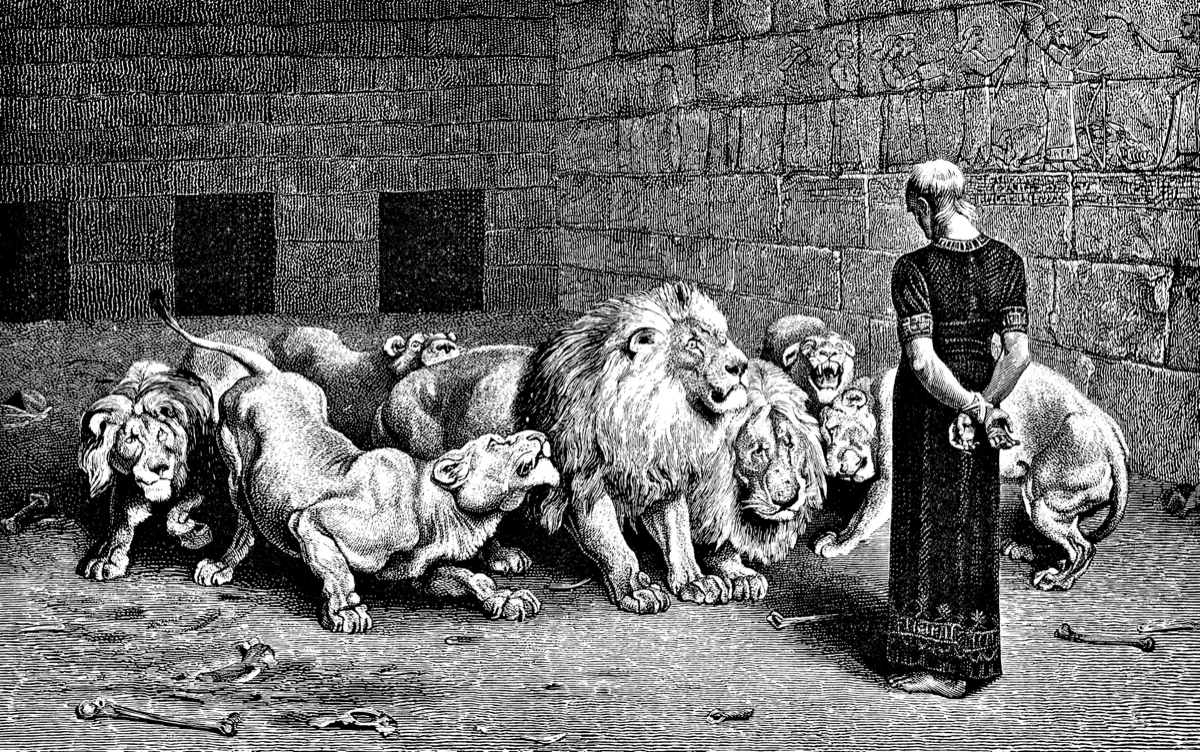


By Mike Richardson
Synopsis: Jesus is the Bridegroom and the church is His bride. Our conduct and communication with either honor our Lord or bring reproach upon His name.
When I was asked if I would contribute to this issue of Truth Magazine, I considered what my subject might be. My mind went to a sermon I preached back in 2006. I recall getting the idea from a book I had read and thought about the applications to our day. I found the outline in an old briefcase and, as I looked over it, I was somewhat disheartened. What seemed like a major issue then has really picked up steam today.
Imagine attending a wedding. The bride is arrayed in a beautiful white wedding gown, ready to go down the aisle to be presented to the groom. As she begins to walk down the aisle, people on both sides of her begin to throw mud at her. She ducks down, but the people’s aim is good and they continue to sling mud at her. The white dress that symbolizes purity is now stained with common dirt and mud. The damage is done, and that which is to be white and glorious is now darkened with stains of mud.
In John 3:29, John the Baptist declared that he was not the Christ, but Jesus is. John called Jesus the Bridegroom. “He who has the bride is the bridegroom; but the friend of the bridegroom, who stands and hears him, rejoices greatly because of the bridegroom’s voice. Therefore, this joy of mine is fulfilled.” Jesus is the Bridegroom. John was the best man. The church is His bride. What is the church? It is the collective group of redeemed people.
In Ephesians 5:25-27, Paul writes, ” Husbands, love your wives, just as Christ also loved the church and gave Himself for her, that He might sanctify and cleanse her with the washing of water by the word, that He might present her to Himself a glorious church, not having spot or wrinkle or any such thing, but that she should be holy and without blemish. . . ” The church is to be pure for the bridegroom.
In Revelation 19:7-8 the church has made herself ready for the day the Groom will come for the marriage feast. Her attire is clean and bright, this being the righteous acts of the saints. In Revelation 21:2, we again see a picture of the bride adorned for her groom. John 14:1-5 is written in similar language. In biblical times, a groom, after the engagement “contract,” would go prepare a place (house), come back for her after it was completed, and then the wedded pair would begin their lives together.
We can expect the world to sling mud at the church, but what is hurtful is to see so many who are saints in the household of God throw mud. I understand the difference between the universal and local church. I know the universal church is perfect in every way, while local churches may have issues and are not perfect. A pervasive problem today is that issues are being handled, but often inappropriately. There are issues that arise and must be dealt with, but the way we deal with them is of the utmost importance. When we paint with broad brushes accusations against the church or when we take to social media to air grievances without going to individuals, we need to be careful lest we be guilty of slinging mud on the bride of Christ. Consider some instances where mud is slung on the church, the Bride of Christ.
When a child of God continues in sin, it undoubtedly puts a stain on the church. In Revelation 3, most of the saints in Sardis were living in sin and were told to repent. However, Revelation 3:4 tells us there were a few who had not defiled their garments. Then the Divine Record states that he who overcomes will be clothed in white garments, and the Lord said He would not blot their names out of the Book of Life. It’s one thing to fall short and get back up, repent and seek to live for the glory of God; it’s another to stay in the wallow of sin. Peter stated, “It has happened to them according to the true proverb: ‘A dog returns to his own vomit,’ and, ‘a sow, having washed, to her wallowing in the mire’” (2 Pet. 2:22). You cannot live in the filth of sin and glorify God. Our sins are washed away in baptism. We are now to walk in newness of life, not going back to a life of sin and continuing therein (Rom. 6:1-9).
My heart is made to sorrow over so many who no longer come together with the saints to worship God. I understand there are many who cannot attend due to illness, etc., but there is a difference between cannot and won’t! With social media and other outlets, it can be tempting to stay home and watch services from the couch. I hear the argument being made, “I can worship there just as well.” As one brother said, “You can see the fire, but you cannot feel its warmth.” We are commanded to come together, and there is wisdom in that. What an insult to the rest of the brethren to say (in essence), “I don’t want to be with you and I don’t need your fellowship.” Forsaking the assembly is throwing mud at the Bride.
There have always been and always will be complainers, those who are not satisfied unless things are done their way. This is often a general dissatisfaction rather than issues of Bible doctrine. If we complain to the world about the church (or post on social media our dissatisfaction with the church) what do we think the lost will think of the body of Christ? Have we come to believe that the church only exists for our needs and not for the glory of God (Eph. 3:21)? People complain, “I didn’t get anything out of the service” or “I wasn’t edified.” The question is: did you put anything into the worship and who did you edify? If in your marriage you are only concerned about self and never show love to your spouse, you have acted against the will of God and the purpose of marriage. In religion, if we do not put Christ first, but are more concerned about self, that too is against the will of God and the ultimate purpose of the church. Yes, we must be honest that local churches have problems, but the church is precious. Jesus loves and cherishes the church (Eph. 5:29). When we complain about the church, we complain about what Jesus died to purchase (Matt.16:18; Acts 20:28). As a member of the body of Christ, do we deliberately throw mud at our brethren and ourselves? Are we making filthy that which Christ came to redeem and cleanse from sin (Rev. 1:5)?
When we stop and observe what mud slinging does, it is a heartbreaking picture.
In Ephesians 6:10-18 we are instructed to put on the whole armor of God and stand against the enemy. One cannot prepare to face the enemy if they are too busy throwing mud at the Bride. The devil loves it when we do his work for him. Let us be careful lest we make a mess of what Christ died to purify and sanctify. We must stand for truth and defend truth, but in doing so, let us not stain the church.
Many use the complaints and accusations against the church as an excuse to avoid religion. This is only an excuse and not a reason, but it is not tear-jerking that many see the mud on the garment instead of the beauty of the family of God?
Imagine if someone was throwing mud on your spouse or a loved one. Would it not hurt you to see your loved one mistreated? Think about how the Lord must feel when mud is thrown on His Bride. We need to be careful how we speak about the church of our Lord. The Groom will come one day to take His bride home. Are we ready for the Wedding Feast?


By Steve Lee
Synopsis: The world pays tribute to productivity, but procrastination remains a problem—especially in the spiritual realm. Let us, therefore, recognize that today (not tomorrow, or “when I get around to it”) is the day of action and accountability.
The word procrastination means, “the action of delaying or postponing something” (New Oxford American Dictionary). The word “procrastination” is not found in the Bible. So, you may ask, “Why are you writing about a non-biblical word in a religious magazine?” While the word itself is not found in Scripture, the concept and principle is there. We will look at a few examples in this article.
It is easy to fall into the trap of procrastination. The motto of some folks is, “Why do today what I can put off until tomorrow?” Solomon described the sluggard: “Yet a little sleep, a little slumber, a little folding of the hands to sleep. . .” (Prov. 6:10 KJV). Let me suggest that laziness could be a close relative of procrastination! I suppose there are some things that could be delayed that may only have trivial consequences, but sometimes people put off important tasks for too long and then the time of opportunity runs out. Have we ever put off, or delayed, going to visit a weak or struggling Christian until they finally harden their hearts to the point of no return? Have we ever delayed going to visit the sick or shut-ins, thinking I’ll do that tomorrow, only to see that person pass from the scenes of this life and now the opportunity has passed? What about the opportunity that we may waste to reach out to a non-Christian to study with them about the truth and hopefully see them render obedience to the gospel, only for them to lose interest and they never obey? Space does not permit me to write about the times we put off doing more Bible reading and study, more time in prayer and meditation, believing we will have more opportunities tomorrow. Sadly, I think we all have found ourselves in these situations.
Let’s consider a couple of biblical examples of not delaying. In Acts 22, the apostle Paul was given an opportunity to address the Jews and answer the false charges levied against him by the Jews of Asia. He recounts his life before and after his conversion to the Lord. In that process, he tells the part of the story where Ananias, acting under Christ’s direction (Acts 9:10-18), came and said, “Now why tarriest thou? Arise, and be baptized, and wash away thy sins, calling on the name of the Lord” (22:16; cf. Acts 9:17-18 KJV). Paul wasted no time in obeying the gospel. He obeyed immediately. When we are confronted with sin, do we delay repenting or do we take care of the matter straightaway?
Consider the admonition in Hebrews 3. The writer is admonishing his readers, and by extension, us, to be faithful and not to be hardened through the deceitfulness of sin, or be led astray by an evil heart of unbelief. He encourages Christians to continue exhorting one another. Interestingly enough, the writer uses the word, “today.” He did not say this could be handled tomorrow, next week, or some timein the future. We are to admonish one another daily, “while it is called today!” I wonder if there are any unfaithful brethren today who might be faithful today if someone had taken the advantage of the opportunity when it arose, instead of thinking, “I’ll visit that weak brother or sister tomorrow or maybe next week.” It certainly should make us give serious thought about putting off or delaying the need to admonish one daily. If you or I know of someone who needs encouraging, let’s do it now. Do it today!
Briefly, I would like to consider a couple of examples in the Bible of people who delayed and put off a decision to do what is right. The first example is Felix in Acts 24. The apostle Paul was brought before the governor in essence to give a defense of himself after he was accused of being a seditious man and a “ringleader of the sect of the Nazarenes” (Acts 24:5). Paul speaks to the governor and tells him his story, and defends his actions. After Felix heard these things and after he had a “more perfect knowledge of the way” (24:22), he deferred them until Lysias, the chief captain, should come down. The next time that Paul talks to Felix, Felix had brought his wife with him. Paul spoke and “reasoned of righteousness, temperance and judgment to come,” Felix trembled, and told Paul to go his way and when he had a convenient season, he would call for him (24:25). Sadly, we have no record of Felix obeying the gospel. He put off an opportunity to obey and may have never done so.
The other example is also found in the book of Acts. This time it is king Agrippa, before whom Paul appears to give a defense against the charges that are being leveled against him. This incident is found in Acts 26. When Paul was permitted to speak, he respectfully gave the king a history lesson—while focusing upon his own conversion. After a lengthy dissertation, Paul asks Agrippa if he believed the prophets—even affirming that he knew that the king believed (v. 27). King Agrippa responded to the apostle, “You almost persuade me to become a Christian” (v. 28). In response, the apostle stated his desire that Agrippa would be, not almost, but altogether as he was, except for his bonds (v. 29). Like Felix, we have no record of Agrippa obeying the gospel. Both Felix and Agrippa had opportunities to become Christians, but delayed their response, and may have kept delaying until it was too late.
Friend, if you, or someone you know, need to submit oneself to God in obedience, do not delay. Tomorrow, or a better time, may never come. Procrastination may dull the desire to obey God. Obey God and do it now!


17312 Jones Rd, Athens, AL 35613
Sun. Bible Study 9:30 am | Sun. Worship: 10:20 am & 5:00 pm | Wed. Bible Study 7:00 pm
Evangelist: John Gibson | jonesroadchurch.org
514 W Market St, Athens, AL 35611
Sun. Bible Class 9:45 am | Sunday Worship 10:30 am & 5:00 pm | Wed. Bible Study 7:00 pm
Evangelist: David A. Cox | 256-232-1525 | marketstreet-church.com
24190 Wooley Springs Rd, Athens, AL 35613
Sun. Worship 9:30 am & 5:15 pm | Wed. Bible Class 7:00 pm
Evangelists: Bob Watson & Matt Taylor | mtzionchurchofchrist.org
2325 Old Columbiana Rd. (near I-65 & Hwy. 31)
Sun. Bible Study 9:00 am | Worship 10:00 am & 5:00 pm | Wed. Bible Study 7:00 pm
Evangelists: Zack Lee | 205-822-0018
19965 Sandlin Rd. Elkmont, AL 35620
Sun. Bible Class 10:00 am Worship: 11:00 pm & 5:00 pm (Worship & Study) | Wed. Bible Study 7:00 pm
Evangelist: Lance R. Taylor | 256-777-0990 | sandlinroadhchurch.com
851 N. Pine St. (Located next to University campus)
Sun. Bible Study 9:30 am | Worship 10:15 am & 5:00 pm | Wed. Bible Study 7:00 pm
Evangelist: Kenny Moorer | 256-766-0403
601 Pineywood Road, Gardendale, AL, 35071 (Located 10 miles N of Birmingham)
Sun. Bible Study 9:30 am | Worship: 10:25 am & 5:00 pm | Wed. Bible Study: 7:00 pm
Evangelists: Andrew Smith & Jason Shackleford | 205-631-2131 | gardendalechurchofchrist.com
129 Hillcrest Rd, Mobile, AL 36608
Sun. Worship 9-9:30 am | Bible Study 9:30-10:30 am | Worship 10:30-11:30 am | Wed. Bible Study 7:00 pm
Evangelist: Ken Sils | 765-307-8048 | 251-342-4144 or 342-2041 | westmobilechurch.com
271 Highway 65 N, Conway, AR 72032
Sun. Bible Study 9:00 am | Worship 10:00 am & 5:00 pm | Wed. Bible Study 7:00 pm
Evangelist: Bruce Reeves | Bldg: 501-336-0052 | hwy65churchofchrist.org
2655 Prince St., Conway, AR 72034
Sun. Worship 9:00 pm | Bible class 9:50 am | Worship & Lord’s Supper: 10:40 am | Wed. Bible Class 7:00 pm
501-450-8640
2323 South 46th St.
Sun. Bible Study 9:45 am | Worship 10:30 am & 5:00 pm | Wed. Bible Study 7:00 pm
Evangelist: John Hagenbuch | Bldg: 479-782-0588 | churchofchristfortsmith.com
407 Bella Vista Dr.
Sun. Bible Study 9:30 am | Worship 10:15 am & 5:00 pm | Wed. Bible Study 7:00 pm
Evangelist: Norman E. Sewell | 870-741-9104 or 870-741-5151 | cappsroad.org
514 Airport Rd.
Sun. Bible Study 10:00 am | Worship 11:00 pm & 6:00 pm | Wed. Bible Study 7:00 pm
Evangelist: Dick Blackford | 870-933-9134
4341 S Camden Rd.
Sun. Bible Study 9:45 am | Worship 10:45 am & 5:00 pm | Wed. Bible Study 7:00 pm
Evangelist: Clarence W. Sell | 870-879-2097
145 N. Country Club Rd.
Sun. Bible Study 9:00 am | Worship 10:00 am & 6:00 pm | Wed. Bible Study 7:00 pm
Evangelist: Brenden Ashby | 520-326-3634 | churchofchristtucson.org
17903 Ibbetson Ave.
Sun. Bible Study 9:45 am | Worship 10:50 am & 6:00 pm | Wed. Bible Study 7:30 pm
562-866-5615 | roseavenue.org
3433 Studebaker Rd.
Sun. Bible Study 9:50 am | Worship 10:45 am & 5:30 pm | Wed. Bible Study 7:00 pm
JP Flores | 562-420-2363 or Mark Reeves | 562-377-1674 | justchristians.org
449 W. Allen Ave., Suite 120, San Dimas, CA 91773
Sun. Bible study 10:00 am | Worship 11:00 pm & 4:00 pm | Wed. Bible Study 7:30 pm
909-788-9978 | sandimaschurchofchrist.com
126 West Harvard St. | Suite 6
Sun. Bible Study 9:30 am | Worship 10:30 am
Evangelist: Richie Thetford | poudrevalleychurchofchrist.org
1414 Hawk Parkway, Unit C
Sun. Worship 11:00 pm | Bible Study 2 pm & 1:30 pm
970-249-8116 | sanjuanchurchofchrist.org
64 Casting Lake Rd.
Sun. Bible Study 9:00 am | Worship 10:00 am & 6:00 pm | Wed. Bible Study 7:00 pm
850-622-3817 | southwaltonchurchofchrist.com | Location change coming in 2022: 497 Church St Santa Rosa Beach, FL 32459
Ave. C & 2nd St.
Sun. Bible Study 9:30 am | Worship 10:45 am | 407-349-9998
6 Ln. Dr.
Sun. Bible Study 9:30 am | Worship 10:30 am & 5:00 pm | Wed. Bible Study 7:00 pm
Evangelist: Joey Rankin 850-244-9222
3940 S. Bumby Ave.
Sun. Communion: 9:30 am | Bible Study 10:00 am | Praise & Preaching: 10:55 am (No pm Service) | Wed 7:00 pm
Evangelist: Ken Chapman
Office: 407-851-8031 | bumby.org | Note: Please call for current worship and Bible study times.
8910 Front Beach Rd.
Sun. Bible Study 10:00 am | Worship 11:00 pm & 6:00 pm | Wed. Bible Study 7:00 pm
850-234-2521
621 E. Wheeler Rd.
Sun. Bible Study 10:00 am | Worship 10:50 am & 6:00 pm | Wed. Bible Study 7:30 pm
Evangelist: Bobby Witherington | 813-684-1297 | seffnercoc.org
Route 116 (near Callaway Gardens)
Sun. Bible Study 10:00 am | Worship 11:00 pm & 6:00 pm | Wed. Bible Study 7:30 pm
Evangelist: Tommy W. Thomas | 706-628-5117 or 628-5229 | pmvchurch.com
370 N. Shilling | P.O. Box 158-83221
Sun. Bible Study 10:00 am | Worship 11:00 pm | Wed. Bible Study 7:30 pm
208-785-6168 or 681-1552
1310 N.E. 54th Ave.
Sun. Bible Study 9:30 am | Worship 10:40 am | Wed. Bible Study 7:00 pm
515-262-6799
1236 63rd St. (Dir: 1.5 miles E of I355)
Sun. Bible Study 9:00 am | Worship 9:55 am & 6:00 pm | Wed. Bible Study 7:30 pm
Evangelist: Steve Wolfgang | 630-968-0760 | dgcoc.org
796 Prairie Ave.
Glen Ellyn, IL 60137
Sun. Bible Study 9:30 am | Sun. Worship 10:30 am & 5:00 pm
Evangelist: Keith E. Brown | 630-858-2290 & 630-377-3990
1100 S. 17th St.
Sun. Bible Study 9:30 am | Worship 10:30 am & 6:00 pm | Wed. Bible Study 7:00 pm
217-234-3702
16224 S Vincennes Ave.
Sun. Bible Study 9:00 am | Worship 10:00 am & 4 pm | Wed. Bible Study 7:00 pm
Evangelist: Donald Hawkins | 708-339-1008 | southeastchurchofchrist.com
Meeting @ Sleep Inn Suites and Motel | 1101 North Cummings Lane, Washington, IL 61571
Sun. Worship: 11:30 am | Bible Study: 12:30 pm | Wed. Bible Study 6:30 pm @ home of Tim Sundlie, call for address
Evangelist: Tim Sundlie | 608-796-9028 | sunbeads1@gmail.com | tazewellcococ.org
407 W. Lewis & Clark Parkway, 47129
Sun. Bible Study 9:30 am | Worship 10:30 am & 6:00 pm | Wed. Bible Study 7:30 pm
Evangelist: Brian Anderson | 812-944-2305 or 812-948-9917 | clarksvillechurchofchrist.org
Sun. Bible Study 9:30 am | Worship 10:30 am | Wed. 7:00 pm
765-676-6404 | jamestowncoc.com
15530 Herriman Blvd, 46060
Sun. Bible Study 10:00 am | Worship 11:00 am | Wed. Bible Study 7:00 pm
Evangelist: John Smith | preacherjohn54@att.net | 317-501-8035 or 317-501-0249 or 317-701-1204
400 Lafayette Ave. | P.O. Box 34
Sun. Bible Study 9:45 am | Worship 10:30 am & 6:00 pm | Wed. 7:00 pm
812-279-4332
(First St. & Karnes Ct.)
Sun. Bible Study 9:45 am | Worship 10:30 am & 5:00 pm | Wed. Bible Study 7:00 pm
Evangelist: Jeremy Goen | 812-967-3437 or 967-3520 | pekinchurchofchrist.com
5600 SW 17th St, Topeka, KS 66604
Sun. Bible Study 9:15 am | Sun. Worship 10:30 am | Wed. Bible Study 7:00 pm
785-235-8687 or 785-273-7977 | 17thstreetchurchofchrist.org
1235 Williams St.
Sun. Worship 10:00 am | Bible Study After am Worship & 6:00 pm | Wed. Bible Study 7:00 pm
Evangelist: Jerid Gunter | 270-274-4451
8081 US Hwy 68-East, Benton, KY 42025
Sun. Bible Study 9:00 am | Worship 10:00 am | Wed. Bible Study 6:00 pm
270-354-9451 | fairdealingmarc@gmail.com | churchofchristatfairdealing.com | Conveniently located near Kenlake State Resort Park on the western shore of Kentucky Lake.
612 Broadway
Sun. Bible Study 9:45 am | Worship 10:30 am & 5:00 pm | Wed. Bible Study 6:30 pm
Evangelist: Charles J. White | 270-422-3878
107 Sunny Hill Dr.
Worship 9:30 am & 11:30 am | Bible Study 10:30 am | Wed. Bible Study 7:00 pm
Evangelist: Steve Lee | 270-789-1651 | sunnyhillcoc.com
103 N. Main St. | P.O. Box 233
Sun. Bible Study 10:00 am | Worship 10:45 am & 5:00 pm | Wed. Bible Study 7:00 pm
Evangelist: Jarrod Jacobs | 270-589-4167 or 270-274-3065
385 E. Lexington Ave.
Sun. Worship 10:00 am | Bible Study 11:15 am & 5:00 pm | Wed. Bible Study 7:00 pm
Evangelist: B.J. Sipe | 859-236-4204
18 Scott Drive, Florence, KY 41042
Sun. Worship 9:30 am & 5:30 pm | Sun. Bible Study 10:30 am | Wed. Bible Study 7:00 pm
859-371-2095 | nkcofc.com
1733 Bowling Green Rd.
Sun. Bible Study 9:00 am | Worship 10:00 am & 6:00 pm | Wed. Bible Study 7:00 pm
Evangelist: Steve Monts | 270-776-9393 | 31wchurchofchrist.com
733 Mill St. Hwy 62 E.
Sun. Bible Study 10:00 am | Worship 10:55 am & 5:00 pm | Wed. Bible Study 7:00 pm
Evangelist: Dan McMahan | 270-971-1492 | millstreetchurchofchrist.org
1803 Dixie Garden Dr.
Sun. Bible Study 9:30 am | Worship 10:30 am & 6:00 pm | Wed. Bible Study 7:00 pm
Evangelist: Michael Hardin | michaelhardin1123@att.net | 502-937 2822
3221 East Hebron Lane
Sun. Bible Study 9:00 am | Worship 10:00 am & 5 pm | Wed. Bible Study 7:30 pm
Evangelist: Ron Halbrook & Connie W. Adams | 502-957-5115 or 502-955-1748 | hebronlanechurchofchrist.com
405 Orice Roth Rd. | 70737 (Baton Rouge area)
Sun. Bible Class 9:30 am | Worship 10:30 am & 6:00 pm | Wed. Bible Study 7:00 pm
Evangelist: R.J. Evans | rjevans@eatel.net | 225-622-4587
12095 Texas Hwy. (Hwy. 6 W.)
12 miles west of Many
Sun. Bible Study 10:00 am | Worship 11:00 pm & 5:00 pm | Wed. Bible Study 7:00 pm
318-256-9396
856 Brighton Ave. (Breakwater School) | Leave Maine Turnpike at Exit 48
Sun. Bible Study 10:00 am | Worship 11:00 pm w/ second service immediately following am worship | Mid-week Bible Study (please call for times & places)
207-839-3075 or 839-8409
3084 Creek Drive SE, #1-C, Kentwood, MI 49512 | P.O. Box 8446, Kentwood, Mich. 49508 (Grand Rapids area)
Sun. Worship 11:00 am | Sun. Bible Study 12:30 pm | Wed. Bible Study 7:00 pm
Evangelist: Joseph Gladwell | cedarsprings98@gmail.com
414 South Main Street
Sun. Bible Study 10:00 am | Worship 11:00 am | Wed. Bible Study 6:00 pm
Evangelist: Ryan Thomas | 810-837-1302 or 989-389-3226 | northernmichiganchurchofchrist.com
301 McRaven Rd. (I20, exit 36)
Sun. Bible Study 9:00 am | Worship 10:00 am & 6:00 pm | Wed. Bible Study 7:00 pm
Evangelist: Leonard White | 601-925-9757 or 924-2645
2914 7th St.
Sun. Bible Study 9:00 am | Worship 10:00 am
2820 Grandview Ave.
Sun. Bible Study 10:00 am | Sun. Worship 11:00 pm | Wed. 6:30 pm
Ron Cooper: 601-934-3675 | roncooper@bellsouth.net
Ricky Ethridge: 601-737-5778 | rickymarsha@bellsouth.net
2110 E State Line Rd. (Exit I-55) (Memphis area)
Sun. Bible Study 9:30 am | Worship 10:30 am | Wed. Bible Study 7:00 pm
Evangelist: James A. Brown | Bldg: 662-342-1132
805 Meadow Rd, Severn, MD 21144
Sun. Bible Study 10:00 am | Sun. Worship 11:00 pm & 6:00 pm | Wed. Bible Study 7:30 pm
Evangelist: Brandon Trout | 410-969-1420 or 410-551-6549 | swcofchrist.com
422 N Linton St., Blodgett, MO 63824
Sun. Worship 10:00 am | Wed. Bible Study 7:00 pm
Evangelist: Russell Rice | 573-475-0417
4000 SW Christiansen
Sun. Worship 9:00 pm | Bible Study 10:00 am | Worship 11:00 pm | Wed. Bible Study 7:00 pm
Evangelist: Brett Hogland | 816-228-9262
432 Eagle Rock Rd.
Sun. Worship 9:30 am | Bible Study 10:30 am | Sun. Evening Worship 2 pm | Wed. Bible Study 6:00 pm
Evangelist: Philip North | 417-239-1036 | primrosenor@suddenink.net | eaglerockroadchurchofchrist.org
2912 Bloomfield Rd
Sun. Bible Study 9:15 am | Worship 10:00 am | Wed. Bible Study 7:00 pm
Seth McDonald & Jerry Lee Westbrook | 573-837-1001 | capecountycoc@gmail.com | capecountycoc.com
217 N. Orchard Blvd.
Sun. Bible Study 9:00 am & 10:00 am | Worship 11:00 pm | Wed. Bible Study 7:00 pm
Evangelist: Walter Myers | 417-830-8972 or 417-736-2663
703 Harrison St.
Sun. Bible Study 10:00 am | Worship 11:00 pm & 6:00 pm | Wed. Bible Study 7:00 pm
Evangelist: Nolan Glover | 573-888-6778 or 870-650-1648 | westsidechurchofchrist.us
685 Sidney St.
Sun. Bible Study 9:30 am | Worship 10:15 am & 5:00 pm | Wed. Bible Study 7:00 pm
Evangelist: Lynn Huggins | 573-265-8628
2727 County Line Rd.
Sun. Bible Study 9:00 am | Worship 9:50 am | Wed. Bible Study 7:00 pm
816-279-4737 | countylinechurchofchrist.com
Bell St & S 7th St. Beatrice, NE 68310
Sun. Bible Study 9:00 am | Worship 10:00 am & 6:30 pm
402-233-4102 or 402-228-3827 | churchofchrist7bell.org
5327 S. Tryon Street, Charlotte, NC 28217
Sun. Bible Study 9:30 am | Sun. Worship 10:30 am | Wed. Bible Study 7:30 pm
704-525-5655 | charlottechurchofchrist.org
3781 East Highway 27, Iron Station, NC 28080
Sun. Bible Study: 10:00 am | Sun. Worship 11:00 am & 6:00 pm | Wed. Bible Study 7:00 pm
Evangelist: Stan Adams | 704-748-9777 (Bldg) & 704-748-3747 (Jerry) | lincolnncchurch@gmail.com | lincolncoc.com
1031 Welford Dr, Beavercreek, OH 45434 (located a few miles E of Dayton)
Sun. Short Worship: 9:30 am | Bible Study 10:05 am | Sun. Worship 11:00 am | Wed. Bible Study Adults: 1:00 pm & All ages: 7:00 pm
Evangelist: Heath Rogers | 937-426-1422 | knollwoodchurch.org
28 W. Main St., Dayton, OH 45449
Sun. Worship 9:00 pm | Bible Study 9:30 am | Worship 10:25 am | Wed. Bible Study 7:00 pm
Evangelists: Michael Grushon 937-866-5162 or Alan Beck 937-469-3311 | wc-coc.org
6417 Franklin-Lebanon Rd. Franklin, OH 45005
Sun. Bible Study 10:00 am | Worship 10:45 am | Tues. Bible Study 6:30 pm
Evangelist: Josh Lee | 937-789-8055 or 937-746-1249 | franklin-church.org
687 Mansfield-Lucas Rd. Mansfield, OH 44907
Sun. Bible Study 10:00 am | Worship 10:45 am | Wed. Bible Study 4:30 pm
James Bond: 419-564-3878 | Mr. Kim Walton: 419-651-3488 | Bldg: 419-522-8982 | northsidecofc.us
1973 W Main St. New Lebanon, OH 45345
Sun. Bible Study 9:30 am | Worship 10:30 am, & 5:00 pm | Wed. Bible Study 7:00 pm
Evangelist: Bruce Hastings | 937-687-7150 or 937-478-0367
80 Sandhill Rd. Reno, OH 45773
Sun. Bible Study 9:30 am | Worship 10:30 am & 6:30 pm | Wed. Bible Study 7:00 pm
Evangelist: Mark Childers | 304-615-1091 | 740-374-9827 | mariettarenochurchofchrist.org
4110 Frey Rd., Northwood, OH 43619 (Toledo Area)
Sun. Bible Study 10:00 am | Worship 11:00 pm & 6:00 pm | Wed. Bible Study 7:00 pm
Evangelist: Donald Jarabek | 419-893-3566 & 567-694-5062
33226 Children’s Home Rd., Pomeroy, OH 45769
Sun Worship 10:00 am & 5 pm | Bible Study 11:00 am | Wed. Bible Study 6:00 pm
Jack Hunt | wmhunt55@gmail.com | 740-645-4612 | Find us on Facebook!
2120 No. A St.
Sun. Bible Study 9:45 am | Worship 10:45 am & 5:30 pm | Wed. Bible Study 7:00 pm
Evangelist: Rob Lungstrum | 918-931-1362 or 918-423-3445
4110 NE 122nd Ave #101, Portland, OR 97230
Sun. Bible Study 10:00 am | Worship 11:00 am | Thur. Bible Study 7:00 pm
Evangelist: Samuel A. Matthews | 971-331-2838 | Bldg: 503-432-8697 | samatm@comcast.net | libertynwchurchofchrist.org
3702 E. Long St.
Sun. Bible Study 10:00 am | Worship 11:00 pm & 7:00 pm | Wed. Bible Study 7:30 pm
Bldg: 541-367-1599
7222 Germantown Ave, Philadelphia, PA 19119
Sun. Bible Study 10:15 am | Sun. Worship: 11:15 am | Tues. Bible Study: 7:00 pm
Evangelist: James H. Baker, Jr. | 215-248-2026 | mtairychurchofchrist.org
3370 Broad St. Extension
Sun. Bible Study 9:30 am | Worship 10:30 am & 5:30 pm | Wed. Bible Study 7:00 pm
Evangelist: A.A. Granke, Jr. | 803-499-6023
4013 Edmund Hwy. (Hwy. 302)
Note: See our web site for current assembly schedule.
Evangelist: Terry W. Benton | 803-834-6978 | airport-church-of-christ.com
417 Mooresville Pike | (Located .8 mi. N. of Hwy. 50/Jas. Campbell)
Sun. Bible Study 9:30 am | Worship 10:30 am & 3:30 pm | Wed. Bible Study 7:00 pm
931-388-5828 or 931-381-7898 | mooresvillepikecoc.com
4894 Hooper Hwy. | 37722 | (Located 15 mi. E. of Gatlinburg on Hwy. 321)
Sun. Bible Study 10am | Worship 11:00 pm & 5:00 pm | Wed. Bible Study 6:00 pm
Evangelist: Olie Williamson | 423-487-5540 or 423-748-0844
350 North Main St.
Sun. Bible Study 9:00 am | Worship 10:00 am & 5:00 pm | Wed. Bible Study 7:00 pm
Evangelist: Steve Walker | kscoc.com
108 Locust St.
Sun. Bible Study 9:30 am | Worship 10:30 am & 5:00 pm | Wed. Bible Study 7:00 pm
Evangelist: Daniel H. King, Sr. | 931-379-3704 or 931-964-3924 | lscoc.com
1110 Cason Lane
Sun. Bible Study 9:00 am | Worship 10:00 am & 5:00 pm | Wed. Bible Study 7:00 pm
Bldg: 615-896-0090 | casonlanechurch.org
2091 Pitts Ln, Murfreesboro, TN 37130 (located at the corner of Northfield Blvd and Pitts Lane)
Sun. Bible Study 9:30 am | Sun. Worship 10:30 am & 6:00 pm | Wed. Bible Study 7:00 pm
Evangelist: David Bunting | 615-893-1200 | GodsRedeemed.org
7471 Charlotte Pike
Sun. Bible Study 9:00 am | Worship 10:00 am & 5:00 pm | Wed. Bible Study 7:00 pm
Evangelist: Lee Wildman | 615-952-5458 or 615-356-7318
423 Donelson Pike
Sun. Bible Study 9:00 am | Worship 9:55 am & 6:00 pm | Wed. Bible Study 7:00 pm
Evangelist: Johnny Felker | 615-883-3118 | perryheights.faithweb.com
1414 W. Exchange Pkwy
Sun. Bible Study 9:00 am | Worship 10:00 am & 5:00 pm | Wed. Bible Study 7:00 pm
Evangelist: Jerry King 214-504-0443 or 972-727-5355 | twincreekscoc.com
E. Service Rd. off I-35, N. of Alvarado
Sun. Bible Study 10:00 am | Worship 11:00 pm & 6:00 pm | Wed. Bible Study 7:00 pm
817-295-7277 or 790-7253
605 E. Adoue St., Alvin, TX 77511
Sun. Bible Study 9:30 am | Worship 10:30 am & 5:00 pm | Wed. Bible Study 7:30 pm
Evangelist: Mark Mayberry | mark@ascoc.org | ascoc.org
701 North Pruett St.
Sun. Bible Study 9:45 am | Worship 10:40 am & 6:30 pm | Wed. Bible Study 7:00 pm
Bldg: 281-422-5926 | Weldon: 713-818-1321 | biblework.com
3060 Dowlen Rd.
Sun. Bible Study 9:30 am | Worship 10:30 am & 6:00 pm | Wed. Bible Study 7:00 pm
Evangelist: Max Dawson | 409-866-1996 | dowlenroad.com
2919 Main St/FM 517 E., Dickinson, TX 77539
Sun. Bible Study 10:00 am | Sunday Worship 11:00 am & 6:00 pm | Wed. Bible Study 7:00 pm
713-298-6673
301 Robison St.
Sun. Bible Study 9:30 am | Worship 10:30 am & 6:00 pm | Wed. Bible Study 7:00 pm
Evangelist: Phillip Stuckey | 361-782-5506 or 361-782-2844 | ednachurchofchrist.org
3277 Pendleton Rd.
Sun. Bible Study 9:30 am | Worship 10:30 am & 5:00 pm | Wed. Bible Study 7:00 pm
915-855-1524
4303 18th St, Bacliff, TX 77518
Sun. Bible Study 9:00 am | Sun. Worship 10:00 am & 6:00 pm | Wed. Bible Study 7:00 pm
Evangelist: Richard Lay | bacliffchurchofchrist.org
6110 White Settlement Rd. 76114
Sun. Bible Study 9:30 am | Worship 10:30 am & 6:00 pm | Wed. Bible Study 7:30 pm
817-738-7269
Old Granbury Rd Church of Christ
4313 Old Granbury Rd, Granbury, TX 76049
Sun. Bible Study 9:30 am | Sun. Worship 10:30 am & 6:00 pm | Wed. Bible Study 7:00 pm
Evangelist: Chip Foster | 817-913-4209 or 817-279-3351 | oldgranburyrdchurch.org
2510 Fry Rd, Houston, TX 77084
Sun. Bible Study 9:45 am | Worship 10:30 am & 6:00 pm | Wed. Bible Study 7:00 pm
Evangelist: David Flatt | fryroad.org | church@fryroad.org
2320 Imperial Dr. (Located close to DFW Airport)
Sun. Bible Study 9:00 am | Worship 9:50 am & 6:00 pm | Wed. Bible Study 7:30 pm
Evangelist: Mark Roberts | 972-986-9131 | justchristians.com
6111 Indiana Ave, Lubbock, TX 79413
Sun. Bible Study 10:00 am | Sun. Worship 9:00 am & 11:00 pm | Wed. Bible Study 7:00 pm
806-795-3377 | lubbockchurch.com
1820 Mansfield Webb Rd, Mansfield, TX 76063
Sun. Bible Study 9:30 am | Sun. Worship: 10:20 am & 5:00 pm | Wed. Bible Study 5:30 pm.
Evangelist: Tom Roberts | 817-996-3926 | northsidecofc.us
612 S Shawnee St, Nacogdoches, TX 75961
Sun. Bible Study 9:45 am | Worship 10:30 am & 6:00 | Wed. Bible Study 6:00 pm
Minister: Van Dennis | 936-615-2950
3831 N.E. Stallings Dr.
Sun. Bible Study 9:30 am | Worship 10:20 am & 6:00 pm | Wed. Bible Study 7:00 pm
Evangelists: Randy Harshbarger & Jay Taylor
268 Utopia Ave. (Dir: I-37 S.E. Exit Pecan Valley)
Sun. Bible Study 9:30 am | Worship 10:30 am & 5:00 pm | Wed. Bible Study 7:00 pm
Evangelist: Jesse Garcia | 210-660 0409 | pecanvalleychurchofchrist.org
314 N. Tolbert
Sun. Bible Study 9:30 am | Worship 10:30 am & 5:00 pm | Wed. Bible Study 7:00 pm
Evangelist: Ronald Stringer
4404 Twin City Blvd.
Sun. Bible Study 9:30 am | Worship 10:30 am & 6:00 pm | Wed. Bible Study 7:30 pm
Evangelist: Jason Garcia (yourfriendjgar@gmail.com) or (leonvalleychurch@gmail.com) | 254-939-0682 | leonvalleychurch.org
2301 Franklin Dr.
Sun. Bible Study 9:30 am | Worship 10:15 am | Wed. Bible Study 7:00 pm
Evangelist: Bryan Garlock | 870-772-0746 | txkchurch.com
340 E Warren St. (in Hewitt, a suburb of Waco)
Sun. Bible Class 9:30 am | Worship 10:30 am & 5:00 pm | Wed. Bible Study 7:00 pm
Evangelist: Marc Smith | 254-292-2482 or 652-7698
Meeting in the Capital City Grange Hall, 6612 Route 12 Berlin, VT 05602
Sun. Bible Study 9:00 am | Worship 10 am | Tues. Evening in Homes
Evangelist: Open | montpelierchurchofchrist.com | P.O. Box 70, Williamstown, VT 05679 | For questions or directions: Wade Holt 802-485-4311
217 Taxus St.
Sun. Bible Study 10:00 am | Worship 11:00 pm & 6:00 pm | Wed. Bible Study 7:00 pm
Evangelist: Steven Matthews | 757-436-6900 | tidewaterchurchofchrist.com
8330 Doublecreek Court, Chesterfield, VA 23832 (Located in teh Metro Area; Courthouse Rd. at Double Creek Ct. 2.2 miles S of Rt. 288)
Sun. Bible Study 9:30 am | Worship 10:30 am & 5:00 pm | Wed. Bible Study 7:00 pm
Evangalist: Nathan L. Morrison | 804-778-4717 | courthousechurchofchrist.com
1208 W. 41st St.
Sun. Bible Study 10:00 am | Worship 11:00 pm & 6:00 pm | Wed. Bible Study 7:00 pm
Evangelist: Jack Bise, Jr. | 804-233-5959
2970 Old Leaksville Rd.
Sun. Bible Study 10:00 am | Worship 11:00 pm & 5:30 pm | Wed. Bible Study 7:00 pm
276-956-6049 | churchofchristatridgeway.com
929 Indiana Ave. N.E. (5 min. from Roanoke Convention Center)
Sun. 1st Lesson 9:15 am | Bible Study 10:00 am | Worship 11:00 pm | Wed. Bible Study 7:30 pm
Evangelist: Brent Paschall | 540-344-2755 | blueridgecoc.org
5652 Haden Rd.
Sun. Bible Study 10:00 am | Worship 11:00 pm
Robert Mallard | 757-464-4574
1860 Mt. Baker Hwy.
Sun. Bible Study 9:30 am | Worship 10:30 am & 6:00 pm | Wed. Bible Study 7:00 pm
Evangelist: Joe Price | 360-752-2692 or 360-920-6965 | bibleanswer.com/mtbaker
Meeting at Gray Middle School, 6229 S. Tyler St., Tacoma, WA 98409
Note: Please see webpage for updated meeting location and times.
Sun. Bible Study 10:00 am | Worship 11:00 pm | Wed. Bible Study 7:00 pm (Online)
253-242-3098 | tacomachurch@gmail.com | tacomachurch.com
7 Old Davisson Run Rd
Sun. Worship 9:30 am
304-622-5433 | westsidechurchofchristwv.net
1929 Morgantown Ave.
Sun. Bible Study 10:00 am | Worship 10:45 am & 6:00 pm | Wed. Bible Study 7:00 pm
304-363-8696 or 304-844-2437
210 Cedar Ave, Moundsville, WV 26041
Sun. Bible Study 9:30 am | Sun. Worship 10:30 am & 6:00 pm | Wed. Bible Study 7:00 pm
Evangelist: Tony Huntsman | 304-845-4940 | cedarsower.com
803 20A Ave NE, Calgary AB T2E 1S1
Sun. Bible Study 10:00 am | Sun. Worship 11:00 am & 6:00 pm | Wed. Bible Study 7:00 pm
Evangelist: Eric Castillo | +1-403-619-1249 | churchofchristcalgary.com