
(February, 2023 | No. 2 | Vol. 67)
2/1/2023
Truth Magazine (ISSN 1538-0793) is published once a month by Truth Publications, Inc., 220 S. Marion, Athens, AL 35611. Postage paid at Decatur, AL, and additional mailing offices.
© 2023 Truth Publications, Inc. All Rights Reserved.
Manuscripts should be sent to the editor, Mark Mayberry, at email.
Subscriptions, renewals & other correspondence should be sent to: Truth Magazine, 220 S. Marion, Athens, AL 35611 or by emailing us at email.
Book orders should be sent to: CEI Bookstore | truthbooks.com | Street Address: 220 S. Marion, Athens, AL 35611 | Phone: (855) 492-6657 | email.
Online Website: truthmagazine.com
DISCLAIMER: Books in ads are screened, but an ad does not mean unqualified endorsement. All books should be tested by Scripture. We appreciate readers notifying us if they find some glaring fault in the ads.
By Mark Mayberry
Synopsis: In today’s religious landscape, traditional denominations face declining memberships, while non-denominational churches are gaining adherents. What is a denomination? What does it mean for someone to have a denominational or non-denominational mindset? How is the religious landscape changing?
The Lexham Glossary of Theology defines denomination as “a group of churches organized under a larger entity (the denomination) on the basis of shared beliefs or practices.” For example, the Anglican Communion (which includes the Episcopalian church, the Church of England, the Church of Ireland, the Church of Canada, etc.) has over 85 million members and is headquartered in London, England.
Oxford’s English Dictionary says that a denomination is “a recognized autonomous branch of the Christian Church.” Another meaning, “the face value of a banknote, coin, or postage stamp,” suggests the underlying division that is inherent in denominationalism. Just as coins have different values (penny, nickel, dime, quarter, etc.), and banknotes come in different denominations ($1, $5, $10, $20, etc.), the religious world is divided into different alliances, groups, conventions, synods, etc.
While modern man celebrates such diversity, the divided state of Christendom is diametrically opposed to the unity for which Christ prayed: “I do not ask on behalf of these alone, but for those also who believe in Me through their word; that they may all be one; even as You, Father, are in Me and I in You, that they also may be in Us, so that the world may believe that You sent Me” (John 17:20–21).
So, if the adjective “denominational” means “relating to or according to the principles of a particular religious denomination,” then the term “non-denominational” refers to a church, individual or group that is “open or acceptable to people of any Christian denomination.” Non-denominational churches do not follow one particular set of church doctrines, nor is their membership restricted to those who are affiliated with one particular religious denomination. Almost anyone is accepted into their fellowship, regardless of their affiliations or belief systems.
Non-denominational groups often adopt names like Calvary Chapel, Crosspoint Church, Grace Church, Grace Family Church, Lakewood Church, Lifepoint Church, New Hope Church, One Life Church, One Living Church, Sagemont Church, The Harbor, The Vineyard, etc. Such groups may, in fact, be affiliated with traditional denominations, but many have a local or limited organizational structure. What are some of the significant characteristics of non-denominational churches in today’s religious environment?
Many churches today are personality driven, i.e., centered around a popular and charismatic leader, such as: Rick Warren (preacher and author, who founded the Saddleback Church in Lake Forest, CA), or Joel Osteen (a promoter of prosperity theology, who is associated with Lakewood Church in Houston, TX, and is known for his weekly televised services and several best-selling books). Other names of note include Andy Stanley, Charles Swindoll, John Piper, Max Lacado, Tim Keller, Tony Evans, etc.
Yet, the apostle Paul expressly rejected this kind of personality-dominated ministry: “my message and my preaching were not in persuasive words of wisdom, but in demonstration of the Spirit and of power, so that your faith would not rest on the wisdom of men, but on the power of God” (1 Cor. 2:1-5, esp. vv. 4-5). Later, he said, “We do not preach ourselves but Christ Jesus as Lord, and ourselves as your bond-servants for Jesus’s sake” (2 Cor. 4:5-7).
Just as the multitudes followed Jesus for the loaves and fishes, many today are seeking to satisfy their craving for fun, food and entertainment-oriented worship assemblies. Yet, our emphasis should be on the spiritual rather than physical: “Truly, truly, I say to you, you seek Me, not because you saw signs, but because you ate of the loaves and were filled. Do not work for the food which perishes, but for the food which endures to eternal life, which the Son of Man will give to you, for on Him the Father, God, has set His seal” (John 6:22-27, esp. vv. 26-27).
Many religious groups, including denominational and non-denominational groups, are culturally accommodative. Like the ancient Israelites, who said, “We will be like the nations, like the tribes of the lands, serving wood and stone,” many today adopt the morality and mores of the surrounding society. While this may make us more attractive in the eyes of men, it has the opposite effect with God: “Shall I be inquired of by you, O house of Israel? As I live,” declares the Lord GOD, “I will not be inquired of by you” (Ezek. 20:27-38, esp. vv. 30-31). In other words, He would not hear their prayers or accept their worship.
Denominational groups typically have a centralized hierarchy which directs individual congregations, often imposing a uniform liturgy upon their worship services. Non-denominational groups typically have a smaller and more localized structure, often patterned on the mother church and satellite arrangement.
Nevertheless, all organizational arrangements that extend beyond the local congregation violate the biblical pattern: “From Miletus he (i.e., Paul) sent to Ephesus and called to him the elders of the church. And when they had come to him, he said to them. . . Be on guard for yourselves and for all the flock, among which the Holy Spirit has made you overseers, to shepherd the church of God which He purchased with His own blood. . .” (Acts 20:17-18, 28-32). The apostle Peter offered similar counsel: “Therefore, I exhort the elders among you, as your fellow elder and witness of the sufferings of Christ, and a partaker also of the glory that is to be revealed, shepherd the flock of God among you. . .” (1 Pet. 5:1-3).
Non-denominational churches are more open to doctrinal diversity than creedally-defined denominations of the past. Like the Colossian heresy, many religious groups today have adopted a theological smorgasbord (i.e., like a luncheon or supper buffet offering a variety of foods and dishes). In contrast, the Lord’s church must contend earnestly for the faith that was once delivered to the saints (Jude 3-4).
Many non-denominational churches, especially the mega-churches, cater to the felt needs of their adherents. Yet, this approach turns religion upon its head—focusing upon the creature rather than the Creator. All who attempt to remake God in their own image inevitably become spiritually insensible—deaf to divine truth, blind to heaven’s will, unresponsive to God’s word (Ps. 50:16-23).
In yesteryear, brethren stressed the uniqueness of the Lord’s church by saying, “We are neither Catholic, Protestant, or Jewish. Instead, we preach non-denominational Christianity.” Language often evolves over time, and today, “non-denominational” carries an entirely different meaning. The current religious environment requires a more precise expression.
The church that we read of in the New Testament is not a denomination. In seeking to win souls for Christ, we are not asking them to join one denomination that is part of a broader mosaic of Christendom. Rather, we are calling believers back to the Bible. Through emphasizing the biblical pattern for the work, worship and organization of the church, our goal is to restore the New Testament church—doing Bible things in Bible ways, and calling Bible things by Bible names. Therefore, let us be conformed to the divine pattern set forth in the Sacred Scriptures. Recognizing the peril of will-worship, may we be fully devoted to seeking God’s will as revealed through His word.
Mangum, Douglas. The Lexham Glossary of Theology. Bellingham, WA: Lexham Press, 2014.
Soanes, Catherine, and Angus Stevenson, eds. Concise Oxford English Dictionary. Oxford: Oxford University Press, 2004.



By Kyle Pope
Synopsis: A challenging text, from the standpoint of manuscript evidence, is 1 John 5:7-8a. This study explores why it is disputed, why some translations delete it, and why is it present in some texts in order to understand more clearly the evidence in favor of (or opposed to) its inclusion in the biblical text.
One of the most problematic texts in the entire New Testament, from the standpoint of manuscript evidence, is a passage found in the King James (KJV) and New King James Versions (NKJV), but omitted in virtually every other English translation since the American Standard Version of 1901. Indicated in bold in the chart below, the disputed text includes most of 1 John 5:7 and the first part of 5:8 (as numbered in the NKJV). This passage is usually referred to as the Johannine (jô-hanən) Comma. Why is this passage disputed, why do some translations delete it, and why is it present in some texts?
| 1 John 5:6-8 (NKJV) | 1 John 5:6-8 (NASB95) |
|---|---|
| This is He who came by water and blood—Jesus Christ; not only by water, but by water and blood. And it is the Spirit who bears witness, because the Spirit is truth. | (6) This is the One who came by water and blood, Jesus Christ; not with the water only, but with the water and with the blood. It is the Spirit who testifies, because the Spirit is the truth. |
| (7) For there are three that bear witness in heaven: the Father, the Word, and the Holy Spirit; and these three are one. | (7) For there are three that testify: |
| (8) And there are three that bear witness on earth: the Spirit, the water, and the blood; and these three agree as one. | (8) the Spirit and the water and the blood; and the three are in agreement. |
The strongest argument against the inclusion of the Johannine Comma in the biblical text is the fact that the passage is absent from all known surviving Greek manuscripts prior to around AD 900.1 There is also no undisputed quote of this passage by early church writers prior to around AD 370, when it is quoted by the Spanish bishop Priscillian in his Liber Apologeticus (1.4). Although the passage is present in approximately 95% of the estimated 10,000 Latin manuscripts that have survived, it is absent from the two oldest Vulgate manuscripts: Codex Fuldensis (ca. 541-46) and Codex Amiatinus (ca. 716). It is also absent from surviving manuscripts of ancient translations, such as the Syriac, Coptic, and Ethiopic. This has led the majority of modern scholars to argue that the passage was either brought into the text accidentally through a marginal comment being mistakenly included in the text, or as a deliberate addition during some period when the triune nature of God was under debate.
While this evidence might seem conclusive, a closer look at the facts demands that we use great caution before rejecting this text too quickly. First, while it is true that the Johannine Comma is present in only 10-11 late copies of the 5,600 surviving Greek New Testament manuscripts, we should note that only around 500 of these actually include 1 John. Most are fragmentary in nature and not full volumes of all New Testament books. Of these, only ten are themselves earlier than the 10th century.2 One of these, the 4th century Codex Vaticanus has three dots in the margin to the left of the words “there are three,” which Philip B. Payne and Paul Canart have proven was a technique used as a scribal notation to show an awareness of alternate readings (112-13).3
The earliest surviving Greek manuscripts of 1 John date to the time of Priscillian’s undisputed quote of 1 John 5:7. This demands that we consider—if Priscillian quoted this passage, would it not indicate its existence before his time and the time these Greek manuscripts were copied? Opponents to inclusion once argued that Priscillian himself had written the passage, but defenders of the text argue that earlier references to it prove its existence long before his time. For example, some time around AD 177, Athenagoras, in his Plea for the Christians, wrote of the unity of the Father, the Word, and the Holy Spirit (10), which some have argued is an allusion to this text. Tertullian, around 215, in his work Against Praxeas, while commenting on the Father, Son, and Holy Spirit, wrote, “the three are one” (25)—using the very wording of this passage. A similar quote is found in a work attributed to Origen (ca. 184-253), but possibly written by one of his students called Selecta in Psalmos, which says of the Father, Son, and Holy Spirit, “for the three are one” (12.1633, on Ps. 122). Perhaps the most compelling example of this is in a text written about 250 by Cyprian, known as his Treatise. He writes, “The Lord says, ‘I and the Father are one,’ and again, of the Father, and of the Son, and of the Holy Spirit it is written, ‘and the three are one’” (1.6, Pope). Cyprian’s first quote is from John 10:30, but only in the Johannine Comma is it “written” of the Father, Son, and Holy Spirit, “and the three are one.” Finally, Athanasius (ca. 296-373) who opposed the teachings of Arius denying the Deity of Christ, speaking of baptism, referred to the “Thrice-Blessed Name” offered at baptism (i.e., Father, Son, and Holy Spirit), going on to claim, “John affirms, ‘and the three are one’” (Disputatio Contra Arium 28.500, Pope). We must consider, where did John affirm this if not in the Johannine Comma? It is worth noting that, while Tertullian and Cyprian wrote in Latin, Athenagoras, Origen, and Athanasius wrote in Greek. If these represent allusions to 1 John 5:7 they show its existence in Greek well before the time the manuscripts we have today were copied.
When it comes to Latin evidence, opponents to inclusion note its absence from the oldest Vulgate manuscript, Codex Fuldensis (ca. 541-46). There is a puzzling irony when it comes to this manuscript. The Vulgate was an official Latin version produced under the scholarly work of Jerome between AD 380-400. It was intended to correct flaws that had crept into Latin translations prior to this time. Jerome consulted Greek manuscripts to compare readings and wrote prologues attached to many Vulgate manuscripts that explain his work. In the prologue attached to Fuldensis, when speaking about such errors, Jerome claims:
. . .In that place where we read what is put down about the oneness of the Trinity in the First Epistle of John. . .we find there is much error from true faith by unfaithful translators, putting down in their own edition only three words, that is, ‘water, blood, and Spirit,’ and omitting the witness of the ‘Father and Word and Spirit’. . .” (Prologue to the Canonical Epistles, Pope).
Jerome claims here that “unfaithful translators” omitted the Johannine Comma. Ironically, while Codex Fuldensis preserves Jerome’s prologue, it omits 1 John 5:7! Critics used to argue that this prologue was not written by Jerome, but its presence in a manuscript as early as Fuldensis has challenged that argument. If it is genuine, Jerome claims that some were omitting the passage in his day. Of the few remnants of pre-Vulgate old Latin that have survived, even opponents of inclusion acknowledge its presence in Codex Speculum (ca. 400), Codex Legionensis (ca. 650), and Codex Monacensis (ca. 650). Defenders of inclusion argue that this supports Jerome’s claim that the passage existed well before the Vulgate was produced.
A final problem, if this text was not original, is grammatical in nature. Unlike English, in ancient Greek, many words had the grammatical genders of masculine, feminine, or neuter. In languages that assign gender to words, pronouns, adjectives, participles, definite articles, and sometimes even numbers, the gender must agree with the nouns they modify. Just as we would not say, “She is a good man,” confusion of grammatical gender would have been considered coarse, awkward, and improper to the ancient reader. In this passage, the word translated “three” is the Greek word treis, the masculine form of the word meaning “three.” The problem is, if this passage was not in the original text as John wrote it, the use of this masculine form creates an awkward gender confusion that is difficult to explain. Each of the words that follow it—Spirit, water, and blood are neuter in gender. So, we would not expect a masculine numeral to start this list, but instead the neuter form tria. However, if it was original, the words Father and Word are masculine, so we would expect such a list to start with a masculine form. Is this a clue that the text was omitted by some unscrupulous editor who forgot to eliminate this gender confusion? Some would argue, “Yes!”4 If they are correct, then at some point very early in its history the Johannine Comma was omitted from many Greek manuscripts (whether by accident or deliberate alteration) and preserved for the most part only in Latin translation.

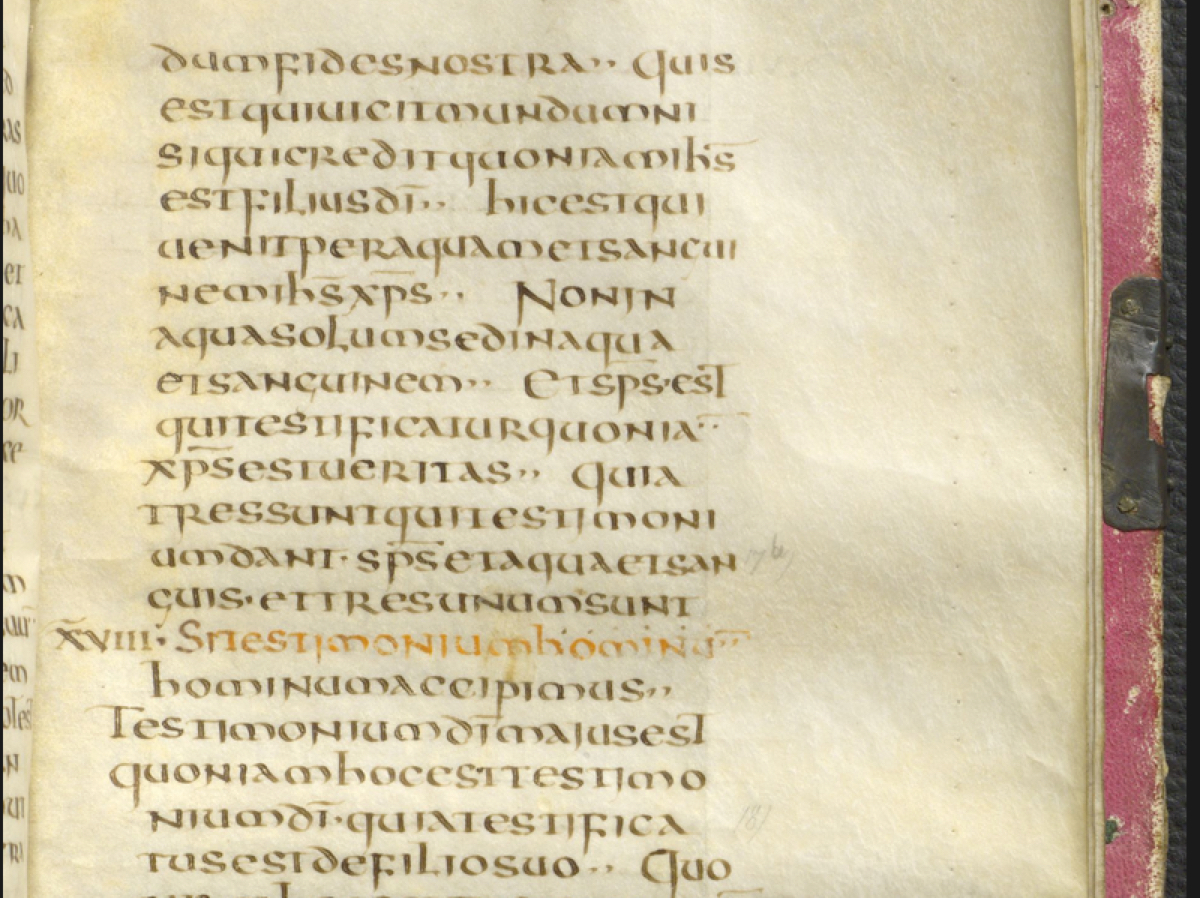

Note: the endnotes for Kyle’s article appear at end of the single page browser version following the last article in the theme section.

By Diana Dow
Synopsis: Teaching by example and observation how to start and how to maintain a friendship is an integral part of a homeschool family’s life.
Relationships are important. People need each other. We desire to surround ourselves with people we love. God knew this when He gave Eve to Adam, creating the first family. The family offers parents and children a God-designed inner circle who love and care for each other.
And the LORD God said, “It is not good that man should be alone; I will make him a helper comparable to him” (Gen. 2:18).
For those of “like precious faith,” we fill the area just outside the innermost circle with our brethren. God designed the church to support each other, love each other, help each other go to heaven. This is where our first group of friends outside our family will be found. Our children need to be encouraged to build relationships with old and young alike among our brethren. We need to be teaching our children that their brethren are their best friends.
This requires spending time together, i.e., time inside and outside the regularly scheduled worship services.
Be kindly affectionate to one another with brotherly love, in honor giving preference to one another (Rom. 12:10).
With our inner circle designated by God and our second circle determined when we chose to follow God, what about other relationships? How do we choose with whom to become friends with whom to keep at arm’s distance?
Friends can be a blessing if chosen wisely. A friend can warn of bad choices. A friend can encourage excellence. A friend can make one a better person.
As iron sharpens iron, so a man sharpens the countenance of his friend (Prov. 27:17).
Alternatively, friends can also be a curse. A friend can encourage dangerous and immoral behavior. A friend can cause one to turn from God.
Do not be deceived: Evil company corrupts good habits (1 Cor. 15:33).
Parents must teach their children how to choose friends and how to develop friendships. Homeschool parents proactively guide the relationship process when they participate with their children in various activities. Through example, the parent can teach how to approach new people, how to listen to others, how to engage in friendly conversation, and how to be a friend.
A man who has friends must himself be friendly. . . (Prov. 18:24).
How does a homeschool family go about forming relationships with those outside their family? Where do they go to meet other people?
I have heard it said that, for two people to form a friendship, they need to be with each other in seven different settings. Sitting in the same Bible class for seven weeks or attending seven park days is not enough to form a friendship. Yet, if the two people go to a variety of events (like attending a couple of park days, a field trip, a teen devotional, a couple of Bible classes, and even running into each other at the store), these shared experiences increase the chance of forming a bond, which, if nurtured, will grow into a solid relationship—a friendship.
There are obvious activities that bring children with common interests together. 4-H, Scouts, sports, are some in which public, private and homeschool children participate together. For the homeschool family, it takes a little detective work to find out how to get involved, but once the right contacts are made, they can be a great addition to the education of the children. There are also many activities open to homeschool students exclusively. Finding these can be a little more difficult, but well worth the effort.
Back in the day, in the early 1990s, communication among homeschoolers was initiated through word of mouth. Once the connection was made, strong bonds were created with those of similar educational philosophies. There were fewer people homeschooling back then. Most who didn’t frowned on it. Here in Texas, it had only recently become legal. We stayed connected through support group newsletters delivered to our front door by the mailman. Archaic, I know. Eventually, these support groups created websites that allowed newcomers who move to town, as well as residents who are new to homeschooling, to find them easily. As social media platforms arose, snail mail newsletters became obsolete and eventually most websites did as well. Today, a quick search of Facebook for homeschool groups in your area can get you connected with the locals in no time.
These means of communication, past and present, have allowed homeschoolers to create communities of like-minded families. Field trips, music groups, sports days, park days, moms’ night out, etc. are classic group activities used in the past and the present by many homeschool families. A prevalent method homeschoolers are using today is joining a co-op. A co-op is simply a group of families who have chosen to pool their talents and resources to provide a variety of learning opportunities for their children. All the previous activities listed (and more) can be included in one day in one location. Each co-op has its own style. Finding one that fits your family is like discovering a treasure.
Sounds like fun, doesn’t it? It is. Getting together with others of like mind can be uplifting. Moms can discuss everything from child-rearing to curriculum to raising chickens. Friendships are made. Children can practice their relationship-building skills with others from all age groups while learning new things. Friendships are made.
Two words of warning. First, it is important to note that not every activity marketed toward homeschoolers will encourage the same values that you are trying to instill in your child. There are many people choosing to homeschool who have no plans to put God first in their lives. In fact, there are many who directly oppose Him. Second, outside activities can be time-consuming. It is easy, in trying to fill a void in your child’s social life, to over schedule. This can leave little time for relationship building with your family and brethren. Choose wisely.



By Bruce Reeves
Synopsis: Biblical warnings against apostasy should cause us to be discouraged, but challenge us to focus on Christ and the hope He affords. We do not live in His grace by ignoring reality, but by embracing the sacrifice of Jesus and giving our hearts to Him.
The God of our salvation is divinely powerful, steadfastly faithful, eternally loving, and compassionately reassuring. However, there is something else. He is also relational (Gen. 1:26-28; 1 Cor. 1:9). Our heavenly Father graciously seeks fellowship with those who choose to love Him (Josh. 24:14-16; Matt. 11:28-30). The Lord created us for communion, not manipulation. His grace is not a cruel abuse of power, but an offer of cleansing, transformation, and restoration (Rom. 12:1-2; 2 Cor. 3:18; 2 Pet.1:4). His sovereignty is seen in His love and holiness, His power is witnessed in His sacrifice and resurrection, and His purpose is accomplished through persuasion, not compulsion. Ironically, in attempting to defend the final premise of Calvin’s view of the T.U.L.I.P, i.e., “Perseverance of the Saints,” proponents of Reformed Theology not only distort the Scriptures but also rob their followers of any real assurance of salvation.
The pressing questions are:
Can a believer become an unbeliever?
Will the Lord disinherit those who abandon Him?
Are there conditions connected with walking by faith?
In our study of 1 Corinthians and Galatians, we have seen the divine beauty and powerful renewal of God’s grace in changing lives, as well as the call to faithfulness in our walk with the Lord (Eph. 4:1-2). In this article, we progress further into the writings of Paul and Peter as we consider the Spirit’s encouragement and warnings.
In Romans, the unity of all believers is emphasized by highlighting humanity’s sin-problem and the need we all have for Jesus Christ as our Savior (Rom. 1-3). The gospel of grace calls us to “the obedience of faith” and “newness of life” (Rom. 1:5, 16-17; 6:1-17; 16:26). While some appeal to this book to support the impossibility of apostasy, the epistle not only fails to support this teaching, but it also entirely refutes it. Paul writes, “For those who are according to the flesh set their minds on the things of the flesh, but those who are according to the Spirit, the things of the Spirit. For the mind set on the flesh is death, but the mind set on the Spirit is life and peace” (Rom. 8:5-6). Then he warns Christians of a return to a fleshly mindset, “So then, brethren, we are under obligation, not to the flesh, to live according to the flesh—for if you are living according to the flesh, you must die; but if by the Spirit you are putting to death the deeds of the body, you will live” (Rom. 8:12-13). Why warn “brethren” of a scenario that is impossible?
It is noteworthy that in his treatment of God’s corporate election in Romans 9-11, Paul drives home the conditional, but gracious, calling of the gospel. There can be an unhealthy arrogance among those who subscribe to the doctrines of unconditional election and, once saved, always saved. Interestingly, that is the very thing against which Paul warns believers: “Do not be arrogant toward the branches; but if you are arrogant, remember that it is not you who supports the root, but the root supports you” (Rom. 11:18). Had it not been for God’s purpose in the Abrahamic promises through Israel, Christ would not have come into the world (Rom. 1:1-3; 9:4-5; 11:28-32). Jewish unbelief at large would affect their personal salvation, but it would not change the fact that the Messianic lineage blessed all those who believe in Jesus (Rom. 3:1-3; 9:16). Thus, there was no room for pride. Paul declares that if “God did not spare the natural branches, He will not spare you either” (Rom. 11:21). We are encouraged to remember that they were “broken off for their unbelief, but you stand by your faith. Do not be conceited, but fear” (Rom. 11:20). If Jewish unbelievers would turn to Christ, they would be grafted in again, whereas, if Gentile believers fell into unbelief, they would be lost (Rom. 11:23-24). Once again, why the warning if it were impossible?
This one text completely dismantles the entire system of Reformed Theology. It denies total inability because each of us can choose faith or unbelief. It denies unconditional election because the condition of faith determines if we are among God’s chosen people. It shows that Jesus’s atoning sacrifice is available to “whosoever will” (Matt. 16:25; Rev. 22:17, KJV). It reproves any concept of irresistible grace because we each decide if we will be unified with Christ or not. Finally, it undermines the Calvinistic doctrine of the perseverance of the saints because it emphasizes the need to continue in the faith. We must accept Christ’s goodness and severity, “Behold, then, the kindness and severity of God; to those who fell, severity, but to you, God’s kindness, if you continue in His kindness; otherwise, you also will be cut off” (Rom. 11:22). If it is impossible for those who are saved to fall into unbelief and be cut off from God’s saving grace, why did Paul write as though it were a real possibility? Was he being dishonest, mis-characterizing his audience, or is Reformed Theology false?
The Hebrew writer presents the superiority and greatness of Christ’s divinity, incarnation, priesthood, mediation, covenant, rest, and hope with exhortations and warnings. If a child of God cannot turn back to the unbelief of the world and be lost, how do we read a book like Hebrews? If there was ever a New Testament epistle that gave this doctrine a daunting and clear problem, it is this one.
Who is being addressed in this letter?
“Holy brethren” (3:1,12)
Believers “confessing” Christ as High Priest (3:1)
“Partakers of the heavenly calling” (3:1)
“Partakers of Christ” (3:14)
“Enlightened,” who “tasted the heavenly gift,” and were “partakers of the Holy Spirit,” and “tasted the good word of God” (6:4;10:32)
Received “the knowledge of the truth” (experiential, saving, relational knowledge) (Heb. 10:26)
Why spend so much time considering a hypothetical danger? The term “beware” is a genuine caution to believers (Heb. 2:1; 4:1, 11; 6:11-12; 10:23-25, 36-39). Who else is being encouraged in the context by the phrase, “lest any of you be hardened through the deceitfulness of sin” (Heb. 3:13)? Is it the saved person who could be deceived by sin and lost, or the unsaved who is already lost? Those identified as “holy brethren” and “partakers of the heavenly calling” are exhorted to “fear lest any of you seem to come short of it.” The “let us” phrases are significant in the encouragement given in Hebrews: “let us fear” (Heb. 4:1), “let us be diligent to enter that rest” (Heb. 4:11), “let us hold fast our confession” (Heb. 4:14; 10:22-23), and “let us consider one another” (Heb. 10:24). If we were never saved, why encourage us to hold fast to a confession which we have never genuinely made? If those who have made confession of Christ will never cease to hold it fast, why the exhortation? The only reasonable conclusion is that those who are faithful must, by God’s grace, continue in steadfast love for Him.
The Hebrew writer again addresses those “brethren” who had “entered. . . the Holiest by the blood of Jesus, by a new and living way” having Christ as their “High Priest over the house of God (Heb. 10:19-21). These are justified believers, who are to”draw near with a sincere heart in full assurance of faith, having. . . hearts sprinkled from an evil conscience and. . . bodies washed with pure water” (Heb. 10:22). Hearers are warned, “For if we sin willfully after we have received the knowledge of the truth, there no longer remains a sacrifice for sins. . .” (Heb. 10:26). This willful sin refers to those who depart from God in unbelief after having received “saving knowledge.” They will not merely receive earthly punishment, but eternal condemnation (Heb. 10:27, 31). To profane the sacrifice of Christ, through which one had been sanctified, demands prior salvation (Heb. 10:29, cf., 10:10, 14). The efforts to argue that the term “sanctified” refers to Jesus or only applies to those who thought they were “sanctified” is an appalling abuse and reckless twisting of a clear passage of Holy Scripture.
The Christian can choose to turn his back on the means of justification (Heb. 10:26), trample the Son of God underfoot (Heb. 10:29), consider the blood of the covenant by which he was sanctified a common thing (Heb. 10:29), and both insult and resist the Spirit of grace (Heb. 10:29). If such is done without subsequent repentance, the departing Christian will experience the certain judgment of God (Heb. 6:4-6; 10:27, 30-31) and a worse punishment than physical death (Heb. 10:28-29). Living by faith is a choice! How can someone retreat from a place they have never occupied (Heb. 10:32-39)? We join with the Hebrews writer as he proclaims, “Beloved, we are confident of better things concerning you, the things that accompany salvation, though we speak in this manner” (Heb. 6:9).
Peter addresses his epistle to those who had “obtained like precious faith” with the apostles (2 Pet. 1:1-2). They were presently participating in the grace and peace of Christ “through the knowledge of God and of Jesus our Lord” (2 Pet. 1:2). The term for “knowledge” (epignosis) refers to saving, experiential knowledge, not a mere possession of facts (1 Tim. 2:4; Heb. 10:26, 2 Pet. 1:2-3; 2:20).
“In the knowledge of God and of Jesus Christ our Lord” we enjoy:
“Grace and peace” (2 Pet. 1:2)
“Divine power” (2 Pet. 1:3)
Fruitfulness (2 Pet. 1:8)
Escape from the corruption and pollution of the world (2 Pet. 1:4; 2:18-22)
The new birth (2 Pet. 1:3)
The divine call of the gospel (2 Pet. 1:3)
Great and precious promises of God (2 Pet. 1:4)
Forgiveness through the cleansing blood of Christ (2 Pet. 1:9)
Participation in the divine nature (2 Pet. 1:4)
Identity as the chosen and elect (2 Pet. 1:10-11)
Stability of faith (2 Pet. 1:12-15)
Yet, with all that said, Peter warns his readers of the danger of being “entangled again” in their former corruption (2 Pet. 2:18-20) even though they had experienced the “saving knowledge” of God. How would one be “entangled again” in the bondage of sin if they had never truly been delivered from it? How would the “latter end be worse for them than the beginning” if they had never been saved in the first place? How would the proverbs in these verses apply if the Calvinistic teaching of “once saved, always saved” were true? According to many, the sow was never truly washed, but the Scripture says the opposite. Clearly, one can revert to a former fallen spiritual condition if they do not treasure the mercy of the Lord.
These divine warnings are not intended to discourage or disillusion us, but call us to focus on Christ and the hope we enjoy in His love. We do not live in His grace by ignoring reality, but by embracing the sacrifice of Jesus and giving our hearts to Him. Rather than allowing those who are “untaught and unstable” to distort and twist the Scriptures to their own destruction in the name of “grace,” we must heed God’s word (2 Pet. 3:16). Peter writes, “You therefore, beloved, seeing you know these things beforehand, beware lest you also, being led away with the error of the wicked, fall from your own steadfastness; but grow in the grace and knowledge of our Lord and Savior Jesus Christ. To Him be the glory, both now and forever. Amen” (2 Pet. 3:17-18).




By Shane Carrington
Synopsis: The Holy Spirit guides us to the ultimate victory of our final resurrection through “the message of truth, the gospel of your salvation” (Eph. 1:13; Rom. 8:2).
As sojourners dwelling in a broken world, we experience a great deal of loss. We suffer in our health, homes, and hearts. At times, fault may lie with us; in other instances, we might be innocent observers. Such is our lot in life.
Sin complicates this picture. Whether ours or someone else’s, sin is sometimes at the heart of our struggles. Since entering the scene (Gen. 3), sin has contributed to our challenges (remember Gen. 4-11). Fortunately, it can be forgiven and eternal consequences erased, but earthly consequences may remain for a lifetime, continuing to compound our struggles with temptation.
But in all these things we overwhelmingly conquer through Him who loved us (Rom. 8:37).
God, through His Son and the revealing work of the Spirit, entrusts us with the tools of victory. We overcome through God’s mercy and grace.
In Romans 8, Paul discusses the Holy Spirit’s work in our hope. He is integral to our direction, protection, and consolation. Consider three things from this great text.
Therefore, there is now no condemnation for those who are in Christ Jesus. For the law of the Spirit of life in Christ Jesus has set you free from the law of sin and of death (Rom. 8:1-2).
We are familiar with the Father’s saving plan (Rom. 1:1-4, 16-17; Eph. 1:3-6) and Christ’s redeeming work (Rom. 7:24-25a; Eph. 1:6-7), but the Holy Spirit also plays an essential role in our forgiveness. There is “no condemnation. . . in Christ Jesus” is further explained: “For the law of the Spirit of life in Christ Jesus has set you free. . .”! How would we know of redemption in Jesus apart from the work of the Holy Spirit? Thankfully, He revealed the gospel of our redemption (Rom. 1:16-17; John 16:13-15; Eph. 3:3-5; 6:17).
. . .the mind set on the Spirit is life and peace (Rom. 8:6).
. . .if by the Spirit you are putting to death the deeds of the body, you will live (Rom. 8:13b).
Becoming a Christian is only the beginning of our journey. Walking in the Spirit demands transformation. We must grow into the image of Christ (Rom. 8:29-30; 12:1-2; Eph. 4:11-16). The Holy Spirit plays a vital role in this.
Sound physical health requires proper nutrition and exercise. The same necessities lead to spiritual soundness. God’s word supplies the nutrition we need for spiritual health and growth. Jesus, quoting Deuteronomy 8:3, said, “Man shall not live on bread alone, but on every word that proceeds out of the mouth of God” (Matt. 4:4). Christians should crave the “milk” of God’s word to grow from spiritual infancy to adulthood (1 Pet. 2:1-2). Believers need to graduate from “only milk” to “solid food” in order to become “mature” in Christ (Heb. 5:12-14). Spiritual maturity includes disciples having “their senses trained [”exercised,” NKJV] to discern good and evil” (Heb. 5:14) through “practice.” We need spiritual exercise to progress from the “milk” of the word to “solid food” in order to grow in discernment.
From where does this spiritual nourishment come? The “law of the Spirit of life in Christ Jesus has set you free from the law of sin and death” (Rom. 8:2). The Holy Spirit revealed the “perfect law of liberty” (Jas. 1:25) by inspiring the apostles and prophets to both speak and write it (Eph. 3:5). By reading, we understand this message (Eph. 3:3-5) and “grow in respect to salvation” (1 Pet. 1:22-2:2).
We are strengthened by the Holy Spirit, being vitalized by God’s word. Cleaving to His precious word, we “walk. . . according to the Spirit” (Rom. 8:4) and “set” our “minds on the things. . . of the Spirit” (Rom. 8:5). This focus brings us “life and peace” (Rom. 8:6). God’s people have always known that His word has such power (Deut. 8:3). The New Testament more fully discloses that the Holy Spirit has always been the revealer of this life-giving, strength-infusing word (John 16:13-15; 20:30-31).
. . .we ourselves, having the first fruits of the Spirit, even we ourselves groan within ourselves, waiting eagerly for our adoption as sons, the redemption of our body (Rom. 8:23).
There is a lot of groaning in Romans 8:
Christians face the struggle of walking in the flesh versus walking in the spirit (8:3-17).
We groan, experiencing “the sufferings of this present time” (Rom. 8:18).
Through the use of personification, “creation” (8:18-25) groans.
As disciples of Christ, “having the first fruits of the Spirit, even we ourselves groan within ourselves. . .” (Rom. 8:23). Instead of being limited to the apostles, this applies to all believers (see Rom. 1:13-15; 7:4; 8:1-4; 12:1-3; 1 Cor. 16:15; Gal. 5:22-25; Eph. 5:6-13; Phil. 1:9-11; Col. 1:3-10; Jas. 1:18; Rev. 14:4).
Even the faithful struggle with the burden (2 Cor. 5:4) of “groanings too deep for words” when they pray (Rom. 8:26-27, 34).
We also groan in “tribulation, distress, persecution, famine, nakedness, peril, or sword” (Rom. 8:35), “being put to death all day long” and “considered sheep to be slaughtered” (Rom. 8:36).
As followers of Jesus, we understand struggles. In Christ, we embrace hope.
Every reputable commentator recognizes a powerful use of personification in this passage through the use of the word “creation” (Rom. 8:19-23). Personification is when human attributes are given to non-human objects. In high school, my English teacher’s wall donned a poster of a football wearing a royal crown and holding a scepter, exclaiming, “Personification: ‘In the fall, King Football reigns.’” In Texas, that is the truth!
Yet, the power of personification is not in merely giving human attributes to non-human objects. It also indicates man’s reaction to the object under discussion. During fall, football is “king” in Texas, because people are consumed with football. Similarly, God making “the dawn and the sunset shout for joy” means, “They who dwell in the ends of the earth stand in awe of Your signs” (Ps. 65:8) as they behold His beauty and power in both dawn and sunset. Additionally, “The mountains skipped like rams. . .” (Ps. 114:4) describes the joy of God’s ancient people “When Israel went forth from Egypt” (Ps. 114:1-2), being delivered by His hand.
In Romans 8, humans are the ones in peril; Christians are the ones with hope. Rocks, trees, and flowers are not the subjects of hope in this chapter, so when Paul writes, “the creation itself also will be set free from its slavery to corruption into the freedom of the glory of the children of God” (Rom. 8:21), he is not describing a future renovation of the material world. Rather, this context describes hope for disciples, who are part of this creation, yet living in hope of final victory: “the freedom of the glory of the children of God.” That is personification!
To summarize,
“The anxious longing of the creation” describes God’s people awaiting their hope as His children (Rom. 8:19). So also with “. . .the glory that is to be revealed to us” (Rom. 8:18). This anticipates the final resurrection!
Paul’s statement, “. . .the creation was subjected to futility,” describes the struggle Christians face in this broken world, while still retaining ultimate hope (Rom. 8:20; cf. 8:24-25). This anticipates the final resurrection!
His assertion, “the creation itself also will be set free from its slavery to corruption,” describes the hope of Christians, because we will ultimately experience “the freedom of the glory of the children of God” (Rom. 8:21). This anticipates the final resurrection!
When the inspired apostle says “the whole creation groans” (Rom. 8:22), he means that all humanity experiences anguish in this life. Even “we ourselves, having the first fruits of the Spirit” (Rom. 8:23) means that disciples are not exempted from this groaning. Yet, we do so with hope, for we are “waiting eagerly for our adoption as sons, the redemption of our body” (Rom. 8:23). This anticipates the final resurrection!
This moves us to wait eagerly and persevere for this hope (Rom. 8:24-25) which is described in this great section as. . .
“the glory that is to be revealed to us” (Rom. 8:18).
“the revealing of the sons of God” (Rom. 8:19).
being “set free from its [by personification, ”our”—SC] slavery to corruption into the freedom of the glory of the children of God” (Rom. 8:21).
“our adoption as sons, the redemption of our body” (Rom. 8:23), which is our final, bodily resurrection (cf. 1 Cor. 15; 2 Cor. 4:16-5:11).
What a blessed hope Jesus, through the Spirit, gives! In this usage of figurative language, God powerfully declares our eternal hope in Jesus!
This passage extensively discusses the victory of Christians (Rom. 8:1-18; 23-39). Rather than viewing the four verses in between (Rom. 8:19-22) as a discussion of victory for the flowers, trees, rivers, etc. in a renovated earth theory, why not view those verses contextually, through the lens of personification, as describing Christians and their victory through Christ? We are new creations in Christ (2 Cor. 5:17) living in a broken, temporary creation (2 Pet. 3:3-13), awaiting deliverance through resurrection (1 Cor. 15) to share in eternal glory with Jesus in heaven (1 Thess. 4:13-18; John 14:1-6; 17:4-5; 1 Pet. 1:3-4). We groan, but in hope!
Discipleship is not always easy, but the Spirit brings us victory. Our struggles give way to glory (Rom. 8:16, 18, 21, 28-30), which endues us with hope (8:20, 24-25), “life and peace” (Rom. 8:6), and “a spirit of adoption as sons by which we cry out, ‘Abba! Father!’” (Rom. 8:15). Through the plan of our Heavenly Father, the redeeming work of our Lord and Savior Jesus Christ, and the life-giving word inspired by the Holy Spirit, we have a rich heritage in Christ. May we live in this hope by honoring God with our entire being.




By Bobby Graham
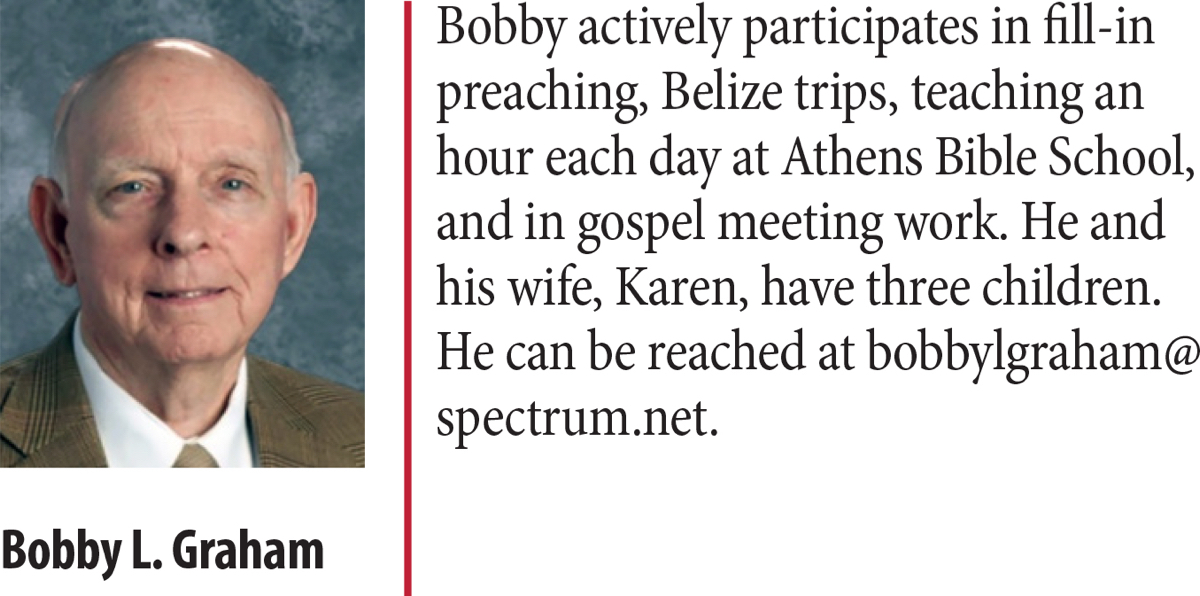
Was it just the apostles or the 120 disciples who were baptized in the Holy Spirit in Acts 2?
Though it is correct that the 120 were gathered with the apostles in chapter 1, it cannot be established that they were present on Pentecost some days later when the Holy Spirit descended in fulfillment of the Lord’s promise (Acts 1:5; 2:1-4; John 14-16). Neither were they mentioned in Acts 2, nor is there any reason to conclude they were then present with the twelve apostles. On the other hand, there is much evidence to conclude that it was the twelve who were being immersed in the Holy Spirit.
The original promise of Holy Sprit baptism given by John concerning the work of Jesus Christ, in contrast to John’s own work, certainly was later narrowed by Jesus Himself when speaking to the twelve about the work which they would begin on Pentecost (Acts 1:5).
The gathering of the apostles and the 120 in Acts 1:15ff was preparatory to the events of Pentecost. The first chapter closes by referring to the apostles in verse 26, now supplemented by the Lord’s choice of Matthias, evidently focusing upon the very ones with whom Luke would start his presentation of Pentecost events in chapter two.
Because pronouns have antecedents (nouns or pronouns referred to), we look for the antecedent of “they”in Acts 2:1. The rule is to find the closest noun or pronoun to which “they” could refer. It is the noun “apostles” in Acts 1:26. Nowhere do the 120 appear after the sole mention in 1:15. Because of the time lapse between the events in chapter one and chapter two, it becomes imperative to omit the 120 as a possible identification of “they” in chapter two.
Chapter two furnishes multiple references to the apostles: they were all together in one place (v. 1); the sound of a rushing strong wind filled the house where they were sitting (v. 2); tongues appeared and rested upon each of them (v. 3); now filled with the Spirit, they spoke in other languages, as the Spirit caused them to speak (v. 4); the ones thus speaking were Galileans, as the apostles were (v. 7; cf. 1:11); Peter and the eleven other apostles spoke in explanation and defense of the events of the day (v. 14); the “they” of Luke’s account now become “we” in Peter’s affirmation, because he associates himself with the other apostles as witnesses of the resurrected Jesus (v. 32).
To deduce that more than the apostles were included in the fulfillment of the Lord’s promise of baptism in the Holy Spirit is to strain the passages where the promise and those where its fulfillment appear. This is how many false ideas/doctrines begin: by reading into passages what is not necessarily implied therein.
There is an adequate basis for teaching that the apostles received Holy Spirit baptism in Acts 2, but there is no foundation for affirming that others did!


By Barry Britnell
Synopsis: The tomb of Lazarus may be difficult to visit, but if you can get there, it can teach you life’s most important lesson.
I love leading Bible study tours to Israel. I love helping my travelers understand the land better and how it relates to Scripture. Probably one of the hardest jobs is deciding what to see. With so much to see in Israel, I have to be very selective about how to spend our time. Unfortunately, there are a few places that we cannot regularly visit. One of those places is Bethany.
The town of Bethany sits on the southeastern slope of the Mount of Olives. In the book of John, we learn that the city was about two miles from Jerusalem (John 11:18). Jesus would often visit this city. Not only did He have friends who lived there, but its location allowed Him to be close to Jerusalem, while being far enough away from the crowds to relax.
Today, visiting the town of Bethany is not as easy as one might think. Theoretically, if you were standing on the top of the Mount of Olives, you should be able to walk east a few minutes and arrive in the city. Unfortunately, because of political turmoil, a protective barrier wall was built just outside the city of Bethany in 2004. That wall has turned the simple 10-minute walk from the Mount of Olives into a complicated 40-minute bus ride. Consequently, as tourism dropped off, economic growth in the city has been curtailed.
In John 11, we read the touching story of Jesus traveling to the town of Bethany to visit His friends, Mary, Martha, and Lazarus. Sadly, Lazarus had passed away a few days before Jesus’s arrival. Being overcome with grief, sharing in Mary’s sense of loss, Jesus wept (v. 35). Then our Lord raised His friend from the dead, saying, “Lazarus, come forth” (vs. 43)!
In 2017, I traveled to Bethany as part of a trip with the Appian Media team. We went there to film a scene for our Following the Messiah video series at the tomb of Lazarus.
To access the tomb, we had to walk several minutes before coming to a rock opening under a nondescript metallic sign that simply said, “Lazarus Tomb.” Entering the opening, we descended a couple dozen uneven steps to a small outer room perhaps six feet across. In the bottom of the floor were three small steps. By descending those steps and crawling on our knees for several feet, we entered a small rock-encased inner chamber. Tradition holds that the outer room was the vestibule with the inner chamber being the actual burial room, which contained the body of Lazarus.
There is probably no way to prove conclusively if this site is the actual location of the events recorded in John 11. Even if it is authentic, the rooms and the area around the tomb would have been changed over the centuries. Therefore, it currently looks nothing like what it would have during the time of Jesus.
So, why bring all of this up? Well, think about the irony. If you travel to Bethany today and ask to see the tomb of Lazarus, no one asks you if you want to see his final tomb. They automatically know that you are asking about his first tomb. If you ask to be taken to his final tomb, no one knows where it is located. Everyone who has already died has a final tomb, or a place that contains their earthly remains. However, Lazarus was special. He had a first tomb, and he had a final tomb.
What was the difference between these two tombs? Simple. The difference was Jesus.
Lazarus’ first tomb was his final tomb until Jesus came to Bethany and raised him from the dead. Subsequently, Lazarus would need another final tomb. A tomb that would be eventually forgotten in history because it did not have what the first tomb had: Jesus.
What is the lesson we can learn from the arduous journey into Bethany to see the tomb of Lazarus? In every aspect of life. . . and even in death. . . Jesus is what makes all the difference.



Image 3: Inner Chamber


By Chris Reeves
Synopsis: Parenting is filled with “fun times” and some “not-so-fun times.” Yet, there is no need for worry because God provides three biblical principles to help parents through all such times.
Despite what you might have heard from some in our society, being a parent is wonderful. Children are such a blessing and a heritage from the Lord (Ps. 127:3)! They can love you like no other can. I was blessed to be one of eight children—“Thanks Dad and Mom!” When I think of the four children that have been born to my wife and me, I feel blessed as well.
Parenting is pleasing and beautiful. It is very rewarding and filled with “fun times.” There are all the hugs, the kisses, and the “I love you’s.” There are memorable moments, play times, story times, craft times, family outings, and vacation times together.
Nonetheless, parenting also includes “not-so-fun times.” There are times of disobedience, pouting, crying, hitting, acting out, frustration, rebellion, arguing, disagreement, etc. Without doubt, parenting is sometimes tiring and difficult. Yet, we must press on through the hard times of parenting. If we do what is right, even though it is hard, we as parents will be rewarded with children who grow to love the Lord.
I think the “fun times” of parenting are pretty much common sense and natural. However, the “not-so-fun times” may be a little more challenging to navigate, so let me offer some mentoring advice in those areas. Like Eli (1 Sam. 3:13) and David (1 Kings 1:6), many parents today take a passive and permissive approach to parenting, so it would do us all well to remember the following three biblical principles.
Today, I see many parents who are not disciplining their children. Discipline is simply teaching and training with words. It also contains a corporal punishment component. There are several places in Sacred Scripture which offer divine counsel on raising your children in the right way. Here, let me just focus on what I call “proverbs on parenting.”
First, there are proverbs telling parents that they should teach and train their children to know the right information: namely, God’s word. Fathers and mothers are to “train up a child in the way that he should go. . .” (Prov. 22:6; see also Prov. 1:8-9; 4:1-4; 6:20-23; 13:1).
Second, there are the proverbs telling parents that they should reprove and rebuke their children (Prov. 3:11-12; 15:5). Sometimes children misbehave and parents should firmly say “No!” and mean it. Parents, it’s O.K. to scold, reprimand, and be critical of your child’s bad behavior. Parents, love your children enough to say “No!” to anything that will hurt them physically or spiritually. Set your rules and boundaries. Then keep them. Never make empty promises or idle threats. Don’t lump all behavior in the “it was just an accident” or “they just have a free spirit” categories. Some behavior is purely misbehavior, and it needs to be treated as such.
Third, there are proverbs telling parents that they should corporally discipline their children (Prov. 13:24; 19:18; 22:15; 23:13-14; 29:15, 17). If there is one area of parenting today that is sorely lacking, it is this: corporal punishment (spanking). Yes, the rod (spanking) that is encouraged in these proverbs is just as much God’s wisdom as any other part of the Bible. That doesn’t mean you should physically abuse your child, but sometimes a child needs a good spanking on the back side.
When you spank, be in control, be firm, be consistent, and be immediate. State your disappointment in the child clearly and the need for a change of behavior without using demeaning language. Explain why you are spanking and use it as an opportunity to teach. Give positive reinforcement and reaffirm your love for them. Start early in life. Later, as they get older, you can transition to other forms of punishment, such as removing their privileges, their cell phone and TV time, etc. Parents, love your children enough to discipline them when necessary.
Today, I see many parents who are taking care of the physical needs of their children, which is commendable; however, they are not taking care of their child’s spiritual needs. Remember to focus on the spiritual over the physical. Our children need physical things like food, shelter, and clothing, of course. Yes, when they get older, they may need other things too, like the dreaded cell phone. Yet, in providing all these physical things, parents must never neglect their primary duty: causing their children to focus on God, His word, and His worship.
Here are a few things that parents can do to emphasize spiritual-mindedness in their children. First, parents can purpose that they and their children will put God first in their hearts (Matt. 22:37). Second, parents should be spiritually minded themselves (2 Tim. 1:5; 3:15). Children should see their parents reading the Bible at home, praying often, attending worship services regularly, doing good works toward others, talking about spiritual things in the car, or at home, and taking part in singings, gospel meetings, home Bible studies, or visitations. Parents, include your children in these activities as well. Third, parents can control worldly minded influences that often come into the home. They can give their children refuge and protection from the worldliness that is often associated with friends, social media, the internet, technology, cell phones, education, etc.
In the Old Testament, we read of the heinous and grotesque act of child sacrifice (Lev. 18:21; Deut. 18:10; 2 Kings 16:3; etc.). Can you believe that Canaanite and Israelite parents would burn their own children? It’s outrageous! Nevertheless, many parents today continue to sacrifice their children—Not literally, but spiritually! They sacrifice their children on the altar of contemporary ideologies (trans-genderism), work, time, popularity, materialism, education, pleasure, and permissiveness. Some parents are “without natural affection” (Rom. 1:31) and do not truly love their children (Titus 2:4). Parents, focus on your child’s spiritual-mindedness and never sacrifice them on the altar of the world.
Today, I see many parents who are more worried about their child’s outward appearance than in cultivating their inward character. They give their children all the nicest clothes, food, toys, and other things, but fail to develop their child’s inner character. They are concerned with their child’s physical, social, and academic growth, but not their spiritual or religious growth (see Luke 2:52).
Consider a few basic things that children must learn as they are growing in order to develop their inner character, be right with God, and go to heaven. Children must learn basic respect for authority and for others. Children must learn the basic capacity to believe (trust) in God and care for others. Children must develop a proper view of self, friends, work, and life. Children must learn basic character values such as honesty, kindness, truth, love, sacrifice, hard work, generosity, optimism, perseverance, orderliness, responsibility, modesty, loyalty, patience, justice, humility, friendship, and patriotism. Children must learn basic practices or habits like daily Bible reading, prayer, worshipping God, and godly living. Finally, children must learn the answers to life’s basic questions like, “Who am I?” “Where did I come from?” “Why am I here?” and “Where am I going after I die?” Parents, if you don’t teach these basic things to your children, who will? Give priority to your child’s inward character development.
I could say much more, but these three biblical principles will give parents a good starting point for raising godly children. My closing prayer for all parents is taken from Psalm 115:14, which reads, “The Lord increase you more and more, you and your children.” I truly believe if we, as parents, give our children discipline, spiritual-mindedness, and inward character, the good Lord will bless us and increase us bountifully.


By Ethan Maxey
Synopsis: Something that I have battled since coming to college is anxiety. I know that God has provided me with lots of opportunities to grow in this. Satan will always provide many reasons to be anxious.
Last semester I was overcome with intense anxiety. Every day was such a battle. I would wake up in dread of my life and of the day, suffer mentally all day, and then go to sleep in fear that the next day would be the same.
I remember one particular day that was probably the worst of them all. It was a Friday. I slept in until 2:00 in the afternoon. I skipped all my classes. I was seriously planning to stay in my room all day. I was anxious about my life, and I was afraid to leave my room. I did not want to see anyone because I did not want anyone to see me.
I remember sitting on my couch, reading my Bible, and praying. I was flipping through pages, searching and praying for something from God. . . anything. . . but found no answers. Then I prayed to God again, and said something like, “God, I know You can do all things. I know that Your word is living and active. I am feeling so anxious and lost. I don’t know what to do. I’m having such a difficult time seeing what You want me to do. Please help me.” I opened my Bible. What did I open to? Matthew 6. Right there screaming at me from the page, “Therefore I tell you, do not be anxious about your life” (Matt. 6:25, emphasis mine—EM). I literally and immediately responded, “How!!!???” I continued reading. Jesus instructed me to “. . .look at the birds” (Matt. 6:26).
So, I thought to myself: “I need to go look at some birds!” I immediately got up. I grabbed my keys and hit the road—hunting for birds. I eventually discovered this park about five minutes from school that had a plethora of birds. Specifically, there were these white birds with long red beaks and radiant blue eyes. Most people think they are annoying, but they became extremely special to me. Nearly every day for the following two weeks, I went to look at those birds. I would talk to God about my life and record my thoughts in a journal. I learned some things by watching these birds.
While looking at the birds, I remember thinking to myself, “Why does this bird have no problems?” I would come to the park feeling like my world was ending, and these birds were always there, just living their lives. That sometimes annoyed me, i.e., God’s creation being constant. Then I realized. . . This bird doesn’t have problems because God provides everything it needs to be fulfilled! “Look at the birds of the air. They neither sow nor reap nor gather into barns, and yet your heavenly Father feeds them. Are you not of more value than they?” (Matt. 6:26). God provides for the birds. “Who provides for the raven its prey when its young ones cry to God for help, and wander about for lack of food” (Job. 38:41).
I then asked myself, “Why does this bird even exist? Why does it do what it does?” because God so made it. Then it hit me: If this bird isn’t anxious about life and if God gives it everything, it needs to live a fulfilled life on earth. . . why am I anxious? Am I not of more value than many birds? Jesus so affirmed. God takes care of His creation. He also cares for us. He gives us everything we need to live a fulfilled life—just like the birds. . . but way more!
Job affirmed that even birds proclaim the works and wisdom of God. “But now ask. . . the birds of the air, and they will tell you. . . that the hand of the LORD has done this, in whose hand is the life of every living thing, And the breath of all mankind? . . . With Him are wisdom and strength. He has counsel and understanding (Job 12:7-13). As a part of God’s creation, birds declare the glory, the power, and the invisible attributes of God (Ps. 19:1f; Rom. 1:20).
Why do we get anxious? Satan loves anxiety. Why? Because anxiety causes us to be distracted. Anxiety is distraction. When I am anxious, I am not thinking about God, or His will for me, or the promises He made to me. I am not thinking about people surrounding me. All I can think about is. . . whatever is giving me anxiety.
We don’t notice the amazing things with which God has filled our lives every moment. Someone once told me:
It’s amazing being a Christian because our past is forgiven, our future is in God’s hands, and all that leaves is the present moment in which we live. If, in that moment, you’re doing your best to love God and others, then you can truly be anxious for nothing. Why? Because, if God returned at that very moment, you would spend eternity with Him!
That is why God says in Philippians 4:6-7, “Be anxious for nothing, but in everything with prayer and supplication with thanksgiving let your requests be made known to God” (emphasis mine—EM). Focus on the good and the blessings that God has bestowed upon you. When we get anxious, it is always because our attention is diverted to something outside of our present control. So, we have to give it to God, who is always in control!
1 Peter 5:6-7 says it this way, “Humble yourselves, therefore, under the mighty hand of God so that at the proper time He may exalt you, casting all your anxieties on Him, because He cares for you.” Our duty is clear: be humble and give the cares of our hearts to God. He will take care of us. Later, Peter says that Christians find comfort even in times of distress, “. . .knowing that the same kinds of sufferings are being experienced by your brothers in the world” (1 Pet. 5:9).
As followers of Jesus, we want to love everybody and bring them closer to Him. Young people, Satan will try hard to keep you distracted by various things. Therefore, “be sober-minded; be watchful. Your adversary the devil prowls around like a roaring lion, seeking someone to devour” (1 Pet. 5:8). He attempts to keep us looking only inward. Instead, when you feel anxious or worried or insecure, look upward, give your cares to God, and then look outward. “Submit yourselves therefore to God. Resist the devil, and he will flee from you. Draw near to God, and He will draw near to you” (Jas. 4:7-8). So, the next time you feel anxiety, don’t forget to “look at the birds.”


By Mark Mayberry
Synopsis: This issue of Truth Magazine focuses upon the danger of drifting toward denominationalism. Like ancient Israel, who rejected God’s order because they wanted to be like the surrounding nations, some among God’s people today want to remake the church into a denominational mode.
Brethren who drift into denominationalism question the legitimacy of command, example, and necessary inferences (CENI), harping upon alleged inconsistencies, offering objections, but providing no solutions. In the end, those who adopt such a mindset “throw the baby out with the bath water” and embrace a host of unscriptural innovations. In contrast, brethren who remain faithful will recognize that Jesus, the apostles, and the entirety of divine revelation rely upon these three methods of establishing authority.
In this context, deconstruction means to “analyze (a text or a conceptual system) by deconstruction, typically in order to expose its hidden internal assumptions and contradictions and subvert its apparent significance or unity.” Brethren who drift into denominationalism frequently redefine the church, gospel preaching, scriptural worship, and local leadership—replacing the New Testament pattern with whatever contemporary model is currently in vogue. In contrast, brethren who remain faithful will continue to seek a “Thus saith the Lord” for all that they preach and practice.
Dabbling means literally to “immerse (one’s hands or feet) partially in water and move them around gently,” or figuratively, it means to “take part in an activity in a casual or superficial way.” Brethren who drift into denominationalism gradually adopt Calvinistic concepts. Of course, they deny the charge, and know enough to reject the full five-point package, but still absorb Calvinistic language and terminology, the assumptions of popular denominational authors. Brethren who remain faithful will be attuned to terminology that is based on erroneous assumptions and will take necessary precautions.
Brethren who drift into denominationalism frequently dismiss the writings of faithful brethren, past and present. They refuse to hear or heed the warnings of loyal gospel evangelists and elders. They are unaware (or unconcerned) that they are traveling in a direction that leads away from the old paths (i.e., the straight and narrow way that leads to life). Brethren who remain faithful recognize the historical cycles of apostasy that have affected God’s people (both in the biblical record and, more recently, in restoration history) and will take necessary precautions.
Brethren who drift into denominationalism frequently seek spiritual enlightenment from denominational scholars, popular evangelical writers, or the latest YouTube sensations. They rarely recognize the doctrinal assumptions behind the messages they indiscriminately devour from Amazon and the internet. In contrast, faithful brethren will avoid the trap to which Jeremiah alluded: “For My people have committed two evils: They have forsaken Me, the fountain of living waters, to hew for themselves cisterns, broken cisterns that can hold no water” (Jer. 2:13). Instead, they will seek to fulfill the apostolic mandate: “Be diligent to present yourself approved to God as a workman who does not need to be ashamed, accurately handling the word of truth” (2 Tim. 2:15).
Brethren who drift into denominationalism frequently emphasize subjective feelings (that arise from within their quivering hearts or tingling fingertips) over objective truth (that comes from the revealed inspired message of Sacred Scripture), and then legitimize the former by asserting that they originate with the Holy Spirit. While acknowledging that we all have subjective (i.e., personal) convictions, faithful brethren understand those views must be based upon a proper application of an objective standard: “For I am not ashamed of the gospel, for it is the power of God for salvation to everyone who believes, to the Jew first and also to the Greek. For in it, the righteousness of God is revealed from faith to faith; as it is written, ‘BUT THE RIGHTEOUS man SHALL LIVE BY FAITH’” (Rom. 1:16-17).

By Kyle Pope
Synopsis: Some argue that it is unscriptural to look to commands, examples, and inferences as a way to determine Bible authority. Is their claim valid? Is this a modern innovation? Should disciples of Christ reject this approach to biblical interpretation?
CENI is a popular abbreviation referring to the different classifications of evidence used to establish Bible authority. It stands for “direct COMMAND, approved apostolic EXAMPLE, and NECESSARY INFERENCE.” In some circles, CENI is now a bad word. It is a target for attack. Those who believe in it are said to be “legalists” or “Pharisees” who stand in the way of true “progress,” growth, and love. These voices argue that it is an unscriptural, man-made construct, reflecting modern Western thought born out of the Enlightenment but foreign to the biblical world. In their way of thinking, serving Christ demands a rejection and deconstruction of what they see as a “flawed” method of interpretation (or hermeneutic). Is this appraisal of CENI valid? Is it indeed an unbiblical approach to interpretation? What alternatives are we to consider if we are urged to disregard the commands, examples, and inferences offered in Scripture?
To answer these objections, we must first recognize why a sound approach to biblical interpretation is needed. If all that our God expects in service to Him is a broad, varied, and general affection directed towards Him, then differences in personal belief and doctrine, variations in collective practice, and application (or neglect) of biblical principles don’t even matter. However, consider a few warnings and instructions we find in Scripture that paint a much different picture:
The apostle Paul warned Timothy, “For the time will come when they will not endure sound doctrine, but according to their own desires, because they have itching ears, they will heap up for themselves teachers; and they will turn their ears away from the truth, and be turned aside to fables” (2 Tim. 4:3-4, NKJV). How are we to determine what constitutes a turning “away from the truth” and a rejection of “sound doctrine”?
Paul wrote, “All Scripture is given by inspiration of God, and is profitable for doctrine, for reproof, for correction, for instruction in righteousness, that the man of God may be complete, thoroughly equipped for every good work” (2 Tim. 3:16-17). The words that were being penned by inspired writers when Paul wrote this would come to be included within what he called “All Scripture.” Peter included Paul’s epistles within a reference to “Scriptures” (2 Pet. 3:16), and Paul himself told the Corinthians, “the things which I write to you are the commandments of the Lord” (1 Cor. 14:37b). So, the Bible is designed to equip the child of God for “every good work.”
Speaking of his own knowledge of God’s revelation to him, Paul told the Ephesians, “when you read, you may understand my knowledge in the mystery of Christ” (Eph. 3:4). While Scripture is special and unique in that it was produced by the inspiration of the Holy Spirit (cf. 2 Pet. 1:21), it is not a riddle or puzzle that cannot be discerned without miraculous help. It is a written document that can be understood just as one interprets and grasps any other written material.
The apostle John taught, “Whoever transgresses and does not abide in the doctrine of Christ does not have God. He who abides in the doctrine of Christ has both the Father and the Son. If anyone comes to you and does not bring this doctrine, do not receive him into your house nor greet him; for he who greets him shares in his evil deeds” (2 John 9-11). Peter warned that some “twist” the Scriptures “to their own destruction” (2 Pet. 3:16). Paul charged Timothy: “Be diligent to present yourself approved to God, a worker who does not need to be ashamed, rightly dividing the word of truth. But shun profane and idle babblings, for they will increase to more ungodliness” (2 Tim. 2:15-16). If it is possible to “twist” Scripture to one’s “destruction,” or share in the “evil deeds” of one who “transgresses” the doctrine of Christ, how are we to identify the “word of truth” from “profane and idle babblings”?
On the night of His betrayal, after praying for His apostles, Jesus also prayed “for those who will believe in Me through their word; that they all may be one, as You, Father, are in Me, and I in You; that they also may be one in Us, that the world may believe that You sent Me” (John 17:20b-21). Paul told the divided Corinthians, “Now I plead with you, brethren, by the name of our Lord Jesus Christ, that you all speak the same thing, and that there be no divisions among you, but that you be perfectly joined together in the same mind and in the same judgment” (1 Cor. 1:10). He taught the same “ways of Christ”—“everywhere in every church” (1 Cor. 4:17b). Is that still possible or are we to imagine that Christ is now pleased with division and different doctrines “everywhere in every church”?
We will return to these points momentarily, but let’s consider the charge that using commands, examples, and inferences to discern biblical authority is a modern innovation. I must admit that I would find this almost humorous if it didn’t have such serious consequences. Would we accuse the physicists who first discovered electrons of introducing a modern innovation? Of course not! They simply identified within the natural world something that had existed from the time of creation. In the same way, we might admit that using the words, “approved apostolic example,” or “necessary inference,” are relatively modern ways of identifying biblical evidence, but the evidence has been there since the formation of the biblical text. Did ancient writers respect these types of evidence? Absolutely!
In Mosaic Law, the Lord taught, “Every commandment which I command you today you must be careful to observe, that you may live and multiply, and go in and possess the land of which the LORD swore to your fathers” (Deut. 8:1). Under Christ, the apostles were to make disciples, “teaching them to observe all things that I have commanded you” (Matt. 28:20a). Does this mean only things that were directly stated by Jesus while He was on earth? No. Remember, Paul said, “the things which I write to you are the commandments of the Lord” (1 Cor. 14:37b). Does this mean any direct statement in Scripture is binding? No, some commands recorded therein are the commandments of men (cf. Acts 4:18; 5:27-28). In such cases, “We ought to obey God rather than men” (Acts 5:29). Isn’t that “legalistic” or being a “Pharisee”? No, it is love. Jesus said, “If you love Me, you will keep My commandments” (John 14:15, NASB). So, it is scriptural to look to direct commands to establish Bible authority.
In washing the disciples’ feet, Jesus said, “I have given you an example, that you should do as I have done to you” (John 13:15, NKJV). Paul told the Corinthians, “Imitate me, just as I also imitate Christ” (1 Cor. 11:1). Does this mean that every apostolic example should be followed? No. At first the apostles deserted Jesus (Mark 14:50), betrayed Him (John 18:5), or denied Him (Luke 21:61-62). Later, Peter was not “straightforward about the truth of the gospel” (Gal. 2:15). Those are examples identified in Scripture as bad examples. We should not follow them. In contrast, Paul told the Philippians, “The things which you learned and received and heard and saw in me, these do, and the God of peace will be with you” (Phil. 4:9). So, yes, it is scriptural to follow approved apostolic examples.
An inference is defined as “a conclusion reached on the basis of evidence and reasoning” (New Oxford American Dictionary). No major English translation uses the word “inference,” but several use the word “conclusion.” Solomon ends his own inspired book by writing, “Let us hear the conclusion of the whole matter: Fear God and keep His commandments, for this is man’s all” (Eccl. 12:13). He draws the inspired inference from what has previously been written that reverence and obedience are the “whole duty of man” (KJV). In teaching the Corinthians that prayer and song without understanding are useless, Paul asks, “What is [the conclusion] then? I will pray with the spirit, and I will also pray with the understanding. I will sing with the spirit, and I will also sing with the understanding” (1 Cor. 14:15, NKJV). We note that the editors of the NKJV supply the words “the conclusion.” NASB instead uses the words “the outcome.” The text is literally just the question, “What is it then?” (KJV) or “So what shall I do?” (NIV). Paul asks the reader to draw an inference and explains the conclusion that one should draw. Perhaps the best example of an inescapable conclusion in the New Testament is found in Galatians 3:16, where Paul draws the inference that the promise of blessing in Abraham’s “Seed” (not “to seeds”) pointed specifically to Christ. Here, a conclusion is drawn based on the singular form of one word! Clearly, it is scriptural to look to necessary inferences to establish biblical authority.
As you listen to the arguments made by critics of CENI, I think there are a few things they overlook.
Ours is not the first generation that has sought an alternative to objectively following the text of Scripture. Catholic and Eastern Orthodox theology rests on the premise that Scripture and church tradition stand as co-equal sources for establishing divine authority. Are we to accept that alternative? If so, how do we explain dramatic changes and departures from consistent teaching within church tradition?
Some critics charge members of the church with being inconsistent when citing evidence from early church writers in support of the Lord’s Supper on Sunday or non-instrumental worship under Christ. The early church did not form in a vacuum. The writings that have been preserved after the New Testament demonstrate both the earliest departures from the apostolic patterns and examples of early adherence to the teaching and practices of the first century. No, they are not equal in authority to the words of Scripture, but it is reasonable to consider their claims in evaluating biblical evidence (just as they often inform us about biblical vocabulary).
A premise of Calvinistic and Charismatic theology is that man cannot understand Scripture without the supernatural assistance of the Holy Spirit. That was not true in the New Testament. Paul taught that “faith comes by hearing and hearing by the word of God” (Rom. 10:17). He told the Ephesians, “when you read you can understand” the things he wrote to them (Eph. 3:4). Now, not all critics of CENI are Calvinists or Charismatics, but we must not ignore that often these same voices devote much energy to convincing their listeners that the Holy Spirit stands ready to “do more” in their lives than they have “allowed Him to” in the past. Is their alternative to CENI a reliance upon where they perceive the Holy Spirit is leading them? If so, isn’t it interesting that so many of these claiming to rely more on the leading of the Holy Spirit almost universally are led to reject principles demonstrated in the text inspired by the Holy Spirit? Have we forgotten that, “God is not the author of confusion but of peace, as in all the churches of the saints” (1 Cor. 14:33)? I fear that often, the motive behind this opposition to CENI stems from a personal desire to do things brethren through the years have deemed unscriptural. If so, and they are interpreting their own strong desires as the leading of the Holy Spirit, I would call them to remember the warning given to Ezekiel, “Thus says the Lord GOD: ‘Woe to the foolish prophets, who follow their own spirit and have seen nothing!’” (Ezek. 13:3).
If the inspired text is not a document that can be evaluated and understood by carefully considering what it states directly, describes through narrative, allowing the reader to draw conclusions from things it indirectly addresses, then what is it? Is it a code? Is it one big metaphor? Is it meant to entertain? Is it a fable to lead us to a larger moral truth, irrespective of the specifics it uses to tell us the story? Over the years, many have tried to reduce the Bible to things such as these and far worse. If that is what the Bible is, then nothing really matters! You do your thing, I’ll do mine!
The problem is that this not what Scripture says about itself. Jesus said we will be judged by His words (John 12:47-48). He said His disciples must follow His commands (Matt. 28:20). Will those who exhort us to reject CENI argue with Jesus? No, but they will probably argue about which commands to follow. Isn’t that the point? Isn’t that using CENI? How can you prove to me, or how can I prove to you that something is binding? By appealing to biblical evidence! So, you say “not all examples are binding!” Fair enough. If we see biblical variation in following a command (eg., where to meet) we can conclude that there are multiple ways to keep the command. Yet, if it’s done only one way, where is your proof that I can rest my soul upon the fact that we can do it many different ways?
Let’s return to the five points we mentioned in the beginning. Many who champion this “anti-CENI” cause will describe past dark experiences in their lives that they now look upon with regret. They mock past efforts to refute denominational error. They ridicule efforts to establish authority for what we do and quickly zero in on perceived inconsistencies. Certainly, human beings can be inconsistent, unloving, or short-sighted in their efforts to stand firmly upon God’s word, but does that mean we reject the effort altogether?
So, if we reject CENI, how do we determine that one has turned “from the truth”? Are not those calling us to reject it accusing us of turning “from the truth”? To what can they appeal? If we must reject CENI, then they had better not point to any commands, examples, or inferences! If we reject CENI, how can we use Scripture to equip us for “every good work”? If we cannot appeal to what it directly states, describes, or infers, what’s left? Yes, it is challenging work to study Scripture. Yes, it can be discouraging when people disagree, dispute, and divide over interpretation, but if we reject CENI, how can we still believe that Scripture can be understood? Yes, we must consider issues of generic versus specific authority. Yes, we must respect the silence of Scripture with consistency and reason. However, if we must reject CENI, how are we to reject error? How can we if there is no objective way to determine error? Are we to accept the post-modernistic view that there is no such thing as absolute truth? If so, isn’t that, in itself, a truth statement? If we reject CENI, how can we still affirm that Jesus desires unity in doctrine and practice? Proponents of this deconstruction argue that rejecting CENI promotes unity, but in reality, that is just a façade. It is easy to act as if we are all united if we never talk about our differences, or seriously try to resolve them. That is not unity, and it is not what Christ prayed for on the night of His betrayal.
Yes, we must maintain consistency. Yes, we must approach all study and teaching of God’s word with kindness, patience, and humility, but the answer is not to throw away a commitment to consider honestly what God desires for His people, as revealed in the pages of Scripture. This hard work is our duty if we are truly to learn from “the grace of God that brings salvation” that “has appeared to all men, teaching us that, denying ungodliness and worldly lusts, we should live soberly, righteously, and godly in the present age” (Titus 2:11-12). May God help us to do this unto His glory.


By Mark Roberts
Synopsis: Simply stated, deconstruction denies man’s ability to understand the biblical text and opens it to a limitless range of interpretations—rejecting as invalid the traditional method of seeking certainty through reading, reasoning, and rational comprehension.
Paul warns of people who are “burdened with sins and led astray by various passions, always learning and never able to arrive at a knowledge of the truth” (2 Tim. 3:1ff). Those words from long ago ring with force today because they perfectly describe the deconstruction movement.
Deconstruction is now the buzzword on center stage in many conversations and social media posts. What is “deconstruction” all about?
The term “deconstruction” traces its roots to a French philosopher in the 1960s named Jacques Derrida. He argued that objective truth does not exist because whenever someone speaks or writes, they cannot help but inject their ideas, biases, and agenda into what they communicate. Thus, no one sees reality as it is. We only see it through our own life experiences and beliefs. Derrida argued that to get at the “real” meaning, a listener or reader must “deconstruct” the text of the prejudices that have been loaded into the language. All of this fed into the post-modern movement that announced there is no such thing as absolute truth.
The kind of deconstruction that is dominating the religious world today picks up on this theme. It majors in tearing down belief and especially loves asserting there is no objective truth. As the term has moved into common usage, it signals a dismantling of traditional ways of thinking about Christianity. Even the most foundational beliefs (faith in the inspiration of the Bible, the existence of God, or the sinfulness of homosexuality) become open questions. Unfortunately, the questions never seem to be answered, and people who deconstruct their faith almost always exit Christianity. A big part of this may be the refusal to listen to authority figures (because they are biased and pressing their own agenda). That means when someone is deconstructing his faith, he will refuse help from the very ones who could help him!
Thus, the deconstruction we are concerned about in this article is the process of critically re-examining everything about one’s Christian faith with the probable intent of leaving Christianity.
Deconstruction is not limited to young people, but there is no doubt the effect is greatest there. Lifeway Research found that two-thirds of American young adults who attended a Protestant church as teenagers say they dropped out for at least a year between the ages of 18 and 22. A 2018 Barna Group study reveals that only 14 percent of Millennials believe the Bible is the literal word of God. Young people are “checking out” of faith in droves. Concerns over racial justice, homosexuality, and gender issues are causing many of our youth to decide Christianity is not for them. Congregations that are not paying attention to these matters, and addressing the questions of teenagers and young couples, will reap a bitter harvest of lost souls as this generation deconstructs and discards their faith.
Deconstruction is a complex problem. In some ways, it is not the problem but only the very visible (and painful) symptom of many other issues. This article cannot examine everything that is driving deconstruction, but we can identify several of its chief causes.
The church is designed by God to be a place of nurturing and instruction (Gal. 6:1-2; Eph. 4:11-16; Acts 20:28) so that disciples can grow in their Christ-likeness. When the church fails to meet this obligation, problems will follow, especially if issues with abuse are present. Abusive or manipulative church leaders, covering up sin and coercing people into silence, create an unhealthy environment people will want to leave. Disillusionment with church leaders kicks the exit door wide open. Further, churches that suppress honest questioning and treat everything as of first-order importance (and demand conformity) also push disciples out of the Kingdom. Thinking “I have doubts but I can’t express them here” causes doubts to fester and silently destroy faith.
It is very important to note that politics intruding into church life is often a direct cause of people deconstructing faith. Young people are dramatically turned off by extremism and labeling other political persuasions as wrong or evil. Survey after survey shows that politics in the church is virtually guaranteed to drive people away.
This is a good place to note the value of solid, biblical teaching that is delivered in a usable way and with good applications. This should be at the forefront of every church’s efforts. Jesus questioned the teaching of His day when, in the Sermon on the Mount, He repeatedly said, “you have heard. . . but I say” (Matt. 5:21ff). One could argue that He was deconstructing the teaching and belief system of His day (because He was!). Yet Jesus does not say that it is impossible to know what to believe, that there are no absolutes, or that everyone is free to do as he pleases. Instead, Jesus taught the truth! We might even note how often Jesus took sincere questions and carefully responded to them (see John 4). Listening and responding to the doubts and fears in someone’s heart matters.
Churches that are failing to teach and apply truth to the questions that young people are constantly being bombarded with because they limit their lessons to rehearsing past battles while neglecting present ones are failing to teach the whole counsel of God. Churches that are substituting politics for Scripture, or who are demeaning and attacking those “outside” the faith with epithets and slurs, only reinforce that we are not the people of God. Church leaders building their own little kingdom instead of God’s kingdom can be sure their hypocrisy will be seen through and many will want no part of it. We may shake our heads when people in these situations deconstruct their faith, but congregations that fail their members will answer for their part in helping people lose their faith!
When the Puritans landed in Massachusetts in 1630, everyone was required by law to attend church. Sinful behavior was punished publicly and severely. The values of the community and the values of Scripture were (somewhat) aligned, providing strong pressure for the average Puritan to behave. Those days are long past. Among millennials, the “default setting” is “I don’t attend church.” Our culture praises homosexual and transgender behavior, and it denounces as judgmental all who would say otherwise. Society pushes hard against the way of discipleship and many are feeling that pressure. The serpent asked, “Did God really say?” causing Adam and Eve to question the Lord’s word (Gen. 3:1). He then answered his own question with a lie. Our surrounding culture is constantly lying about God, His existence, and what He has said. Ideas like “love is love” (which has become a statement of empowerment for the people of the LGBTQ+ community) and “Jesus never condemned homosexuality” and “we shouldn’t judge people” are popularized in every available media channel. Famous former pastors, teachers, and celebrities who have left “Christianity” to embrace the LGBTQ lifestyle and/or faith of every stripe and persuasion have become so common the term “EXvangelical” has gone mainstream.
The internet is, of course, partly to blame for this shift in our culture. The omnipresence of the internet means that people will be exposed to information that directly contradicts and assaults Christianity. Young people cannot be sealed in a bubble and kept from it. They will learn of viewpoints that differ from ours, they will hear the lies of the serpent, and they will be challenged with extremely sophisticated arguments and evidence for those beliefs.
In the last year, I have studied with a young man who deconstructed his faith and became an atheist. In our conversations, he ran out advanced arguments for atheism and was prepared to meet common objections to atheism with ready-made answers. However, probing his defenses caused him to admit that he had not read deeply or studied much on atheism, but was merely regurgitating material that he had seen on internet forums. His arguments were badly flawed, but they sounded plausible in the atheist forums he visited regularly. Parroting this material confirmed him in his newfound atheism and made him feel intellectually superior to people of faith. In years past, someone in his shoes could not possibly have challenged faith with the questions he raised, or answered the evidence for God’s existence as he did, without a trip to a major public library and hours of research. Now a few clicks take one to a website that will load the gullible with all sorts of quick “answers” to what Christians might ask or say.
It is easy to write off all who leave the faith by saying, “they just want to sin.” In truth, that may play a role. Demas left Paul because he loved “this present world” (2 Tim. 4:10). The temptations of the flesh are powerful and can draw a person away from Christ (1 John 2:16). However, not everyone who doubts their faith is already in sin and simply looking to justify his lifestyle. We need to remember that society’s pressure has made doubt itself very cool. The person who asks questions of what should be long settled is made to be a hero. Announcing you no longer believe homosexuality or abortion is wrong, saying you side with evolutionary theory because it is scientific, or that you no longer want to be part of something that condemns people to hell marks you as liberated and as an independent thinker. A good example of this is found in the very public exit from faith by two popular YouTubers, Rhett and Link. In their announcement, they admitted to being fearful and uncertain about how their deconstruction of Christianity would be received. Sadly, the comments under the video posts are full of commendations. Comment after comment says “That’s how I feel,” “This is so relatable. Thank you for your humility and vulnerability” and, “Thank you for your bravery.” If someone articulates a biblical position (particularly about sexuality and gender issues) that person will be castigated. Yet when a person raises questions about faith and then decides to leave the faith, he will be acclaimed and lauded. No one asks if they even attempted to find answers to their questions. If someone says, “I have doubts,” that is considered a legitimate exit ramp from Christianity. This is the work of darkness and comes from a heart that loves self and not the truth. Paul says such people will be deceived because “they refused to love the truth and so be saved” (2 Thess. 2:10).
The answer to today’s wave of deconstruction is obvious: we must help disciples construct a strong, rigorous faith that is not destroyed by culture’s latest fads, nor by a desire for the praise of people (see John 12:42-43), or the passing pleasures of sin. Part of that kind of construction work is done by helping brethren re-construct their faith when it has been challenged. The Bereans provide a model for all of this. Acts 17:11 affirms, “These Jews were more noble than those in Thessalonica; they received the word with all eagerness, examining the Scriptures daily to see if these things were so.” The challenge and questions about the Jewish faith that Paul and Silas’ preaching raised were met by examining the word of God, leading to the building of a new and more mature faith that was solid, real, and genuine. That kind of faith will not be deconstructed or demolished. May the Lord bless us in our homes and in our churches to follow this Berean model.

By Heath Rogers
Synopsis: Calvinism continues to be a subtle threat. When this grid is imposed upon Scriptures, it corrupts not only our view of the biblical text but also our self-understanding.
We live in an amazing time of unlimited access to information. Anyone can produce and upload content to the internet through various platforms for free. This content can be accessed and consumed by others on a scale that was unheard of years ago. While there are blessings to living in this Information Age, it requires that Christians be discerning readers, hearers, and viewers.
When Christians venture away from teachings produced by faithful brethren, they subject themselves to doctrinal error. If they are not careful, this error will take seed in their hearts. Instead of searching the Scriptures to make sure what they have heard is the truth (Acts 17:11), some will allow these newly found ideas to determine the meaning of Scripture.
Calvinism is a false theological system permeating the denominational world. While some adherents reject the full five points of Calvinism (Total Hereditary Depravity, Unconditional Election, Limited Atonement of the Blood of Christ, Irresistible Grace, and Perseverance of the Saints), they zealously uphold some of these errors.
Unfortunately, we sometimes hear brethren question the validity of Calvinistic ideas. If not quickly corrected, these brethren will become unsatisfied with the Lord’s church and drift away into denominationalism. Such problems are caused when brethren dabble in Calvinism. The word dabble means to “take part in an activity in a casual or superficial way.” Christians who talk with denominational friends, read popular books written by evangelicals, or view such religious content on the internet, will be introduced to, and bombarded with, various teachings that are rooted in Calvinism. When these errors are not corrected with the truth of Scripture, such hearts can drift away into error. These seeds of Calvinism sown into the hearts of brethren can be detected in various ways.
For instance, the false belief that we are led by the Holy Spirit in a manner separate and apart from the word of God can be traced to the influence of Calvinism. Calvinists believe unregenerate man is incapable of responding in obedience to the gospel call. It requires a direct operation of the Holy Spirit to make us alive spiritually and causes us to respond in obedience. Unfortunately, some Christians haven’t studied and learned what the Bible actually says about the way the Holy Spirit influences man today. This vacuum is easily filled with Calvinistic error. It is becoming more common to hear Christians claim the Holy Spirit is operating in their hearts and lives in a manner separate and apart from the word of God.
Calvinists explain that our struggle with sin and temptation results from everyone being born with a sinful nature inherited from Adam. In years past, many Christians recommended that my wife and I read books by Dr. James Dobson to help us in raising our children. We found Dr. Dobson’s material to be filled with references to children’s “inbred sinful nature” as being the cause for their tantrums, disrespect, rebellion, and disobedience. These affirmations are from the false doctrine of Calvinism.
Preachers and Bible students must be careful of the Calvinism found in many commentaries. Old standards, like Clark, Barnes, Pulpit Commentary, etc., are full of Calvinist errors. More modern popular authors like Wiersbe, Stott, and MacArthur are also Calvinistic. I have these books in my library and have benefitted from some writings by these authors. These resources are helpful, but they must be used with discernment. If not, Calvinistic ideas can easily creep into our sermons and Bible classes from these sources. Not only are we blessed to live in a time of unlimited access to information, we are also blessed to live in a time in which numerous commentaries and Bible study materials have been written by faithful brethren. Why aren’t these resources being recommended and preferred over Calvinistic sources?
The influence of Calvinism is also present in some of our hymns. I have heard a few hymns penned by denominational writers claim that our sins are covered by the blood of Jesus. The idea is that Christ hides our sins from God. When He looks down on us, He doesn’t see our imperfections; He only sees the perfection of His Son. This is Calvinism’s false view of how we are made righteous before God. In contrast, the Bible plainly teaches that our sins are washed away in the blood of Christ, not covered. “To Him who loved us and washed us from our sins in His own blood” (Rev. 1:5b). “If we walk in the light as He is in the light, we have fellowship with one another, and the blood of Jesus Christ His Son cleanses us from all sin” (1 John 1:7). Please note, the blood of Jesus Christ cleanses us, not covers us. “Such were some of you. But you were washed, but you were sanctified, but you were justified in the name of the Lord Jesus and by the Spirit of our God” (1 Cor. 6:11). “Washed,” “sanctified,” “justified”—not covered. We must be extremely careful of the influence of Calvinism from hymns.
Calvinism is popular because it removes man’s responsibility. If I am born a sinner, and I can’t be saved unless God wants to save me personally, and once I am saved, there is no way I can be lost—there isn’t anything left for me to do. In contrast, the Bible plainly teaches that we are capable of choosing to obey or reject God (Deut. 30:19; Acts 7:51). Christians are responsible for confessing and repenting of their sins to receive God’s forgiveness (1 John 1:9; Acts 8:22). We are admonished to examine ourselves (2 Cor. 13:5). Like David, our prayer should be that we would become aware of our secret faults and correct them (Ps. 19:12). We decide whether we will be conformed to this world or transformed by the renewing of our minds (Rom. 12:2). Calvinism says all of this is impossible.
False views of grace and works relating to our salvation come from Calvinism. The Bible teaches that grace is a gift. It is when God gives us something, not because we have earned it, but because it pleases Him to give it. Grace can’t be earned. “Now to him who works, the wages are not counted as grace but as debt. But to him who does not work but believes on Him who justifies the ungodly, his faith is accounted for righteousness” (Rom. 4:4-5).
Nevertheless, this doesn’t mean God’s grace is offered without conditions. For instance, God gave Israel the city of Jericho. “The Lord said to Joshua: ‘See! I have given Jericho into your hand, its king, and the mighty men of valor’” (Josh. 6:2, emphasis mine—HR). It was a gift of God’s grace. However, to receive it, they had to meet conditions; they had to march around the city, blow horns, and shout (vv. 3-5). They did not earn the city, but they received it from God when they met His conditions. Salvation is offered freely. It can’t be earned. It can only be received when we meet the conditions that have been set forth in the gospel. “Having been perfected, He became the author of eternal salvation to all who obey Him” (Heb. 5:9).
Calvinism also portrays grace as being at odds with every kind of law. “Therefore, we conclude that a man is justified by faith apart from the deeds of the law” (Rom. 3:28, c.f. Eph. 2:8-9). However, a close look at the context of both Romans and Ephesians shows that the law being discussed is the Law of Moses, not law in general. Any attempt to pursue righteousness through a law that is void of the blood of Christ requires perfection, which would negate grace. However, salvation by God’s grace is obtained through the law of Christ.
While no faithful Christian would claim to believe in “Once Saved, Always Saved” many seem to live as if they accept this error. Christians can take joy and comfort in the assurance of their salvation. “These things I have written to you who believe in the name of the Son of God, that you may know that you have eternal life, and that you may continue to believe in the name of the Son of God” (1 John 5:13, emphasis mine—HR). However, this salvation must never be taken for granted. We can fall away. Christians can sometimes take an attitude of “I’ll sin today and repent for it tomorrow.” Granted, we may be sarcastically joking with such an attitude, but our Calvinistic friends aren’t joking. They are serious. Soon, drifting brethren won’t be joking either.
Brethren, we need to be very careful about the things we allow to influence us. Choosing religious books, blogs, podcasts, on-line videos, etc., over sinful or secular ones is commendable, but they are not without dangers. Today, as much as ever, Christians must be discerning consumers of such material. Before we imbibe in these products, we must first ground ourselves in the truth of God’s word. There are plenty of books, commentaries, periodicals, blogs, sermons, etc. produced by faithful Christians for us to consume during our day. However, even when reading after and listening to brethren, we must still consult the word of God and make sure we are hearing the truth. “These were more fair-minded than those in Thessalonica, in that they received the word with all readiness, and searched the Scriptures daily to find out whether these things were so” (Acts 17:11).

By Mark W. White
Synopsis: When one rejects faithful, scriptural counsel, and embraces the false and speculative assumptions of contemporary evangelical thought, he follows a predictable path to spiritual ruin.
Solomon’s son, Rehoboam, was the successor to his father’s throne. However, he inherited more than a monarchy. Along with sitting on the throne of Israel, Rehoboam received the accumulated tensions and troubles of Solomon’s reign. Second Chronicles 10:4 records a challenge issued from Jeroboam to the new king:
Your father made our yoke heavy; now, therefore, lighten the burdensome service of your father and his heavy yoke, which he put on us, and we will serve you.
Perhaps this inexperienced prince-become-king Rehoboam was previously unaware of the burdens the people were bearing because of his father’s taxation. Perhaps his own privileged status blinded him to the sufferings of the common people. However, his consultation with the elders of Israel who stood before his father Solomon should have educated and informed his decision regarding Jeroboam’s request. The elders said to Rehoboam, “If you are kind to these people, and please them, and speak good words to them, they will be your servants forever” (2 Chron. 10:7).
Ignoring this good advice, Rehoboam:
rejected the counsel which the elders had given him and consulted the young men who had grown up with him, who stood before him. And he said to them, “What advice do you give? How should we answer this people who have spoken to me, saying,”Lighten the yoke which your father put on us?” Then the young men who had grown up with him spoke to him, saying, “Thus you should speak to the people who have spoken to you, saying,”Your father made our yoke heavy, but you make it lighter on us”—thus you shall to them: “My little finger shall be thicker than my father’s waist! And now, whereas my father put a heavy yoke on you, I will add to your yoke; my father chastised you with whips, but I will chastise you with scourges!”” (2 Chron. 10:8-11).
Rehoboam’s rejection of wise counsel and his pursuit of unwise advisors was the dividing wedge that separated the two kingdoms of Judah and Israel. As is usually the case, there was more at work there than just a foolish king’s youthful arrogance and inexperience, but we are left to wonder just how different circumstances might have been had Rehoboam mustered the humility and good sense to listen to experienced counselors. Fools do not listen to, nor solicit, wisdom. They are nearly always victims of their own folly.
The kingdom of God today has a wealth of wisdom available to it in the holy Scriptures. New Testament records of the successes and failures of first century churches of Christ are the places we should turn to again and again today to learn what will please or displease our King.
Besides inspired Scripture, brethren have a virtual abundance of uninspired, but wise counsel available in the sermons, articles, commentaries, blogs, magazines, and other publications which are circulated among us. Nearly every article written, or every sermon preached (if done well) includes applications of the inspired word of God to present-day situations and problems facing the kingdom of God. There is plenty of advice available, and because it is given by men, it can be both wise and unwise. Every Christian must make an evaluation of any advice given by men by judging how it compares with divine revelation.
When older brethren in the Lord share their experiences of what works or what does not, we should give them the respect of listening to their counsel. Just as a fish eater may need to spit out a few bones instead of swallowing them, so we must do as the ancient Bereans did. “They received the word with all readiness and searched the Scriptures daily to find out whether these things were so” (Acts 17:11). Sifting through advice to find the gems of wisdom we are needing is a lifelong endeavor. None of us outgrows the need to seek wise, faithful counsel.
It is disturbing to hear brethren denigrate the work and counsel of faithful men and women of our past. I once heard an aspiring gospel preacher say that he had no use for reading McGarvey, Lard, Lipscomb, Whiteside, Cogdill, Adams, or Turner—to name only a few. He scoffed at the logical, propositional truth of Hardeman’s Tabernacle Sermons from the 1920s. He grew up, as did I, listening to the preaching of Bennie Lee Fudge, Irven Lee, Granville Tyler, Alvin Holt, and many other faithful stalwarts. He came to despise the characteristics of their teaching. However, he seemed to have plenty of interest in the writings and counsel of evangelical denominational scholars, writing and counsel which could not even tell people what they must do to be saved!
Tracking this aspiring preacher’s trajectory over the years, it was no wonder at all to me that in time, and with enough of such poisonous influences, he landed in a Baptist church. Swindoll, Piper, MacArthur, Hybels, and other modern preachers eventually became more meaningful to him than the inspired counsel of Paul, Peter, James, and John. Attempts to dissuade that aspiring preacher were rebuffed by charging faithful counselors with legalism, a lack of spirituality, hatred, and academic ignorance. This once-beloved brother in Christ left our fellowship for the “greener pastures” of evangelical denominationalism.
He was neither the first nor the last to do so. When we “grow up” to become ashamed of our “spiritual roots” and to be embarrassed by plain, to-the-point Bible preaching and teaching, this is what can be expected. The last conversation I was allowed to have with this brother, he tearfully told me how sorry he was for my ignorance, and how thankful he was for his own “enlightenment.” He no longer wanted my counsel, for it was not to his liking.
Did our forebears always get it right? Were they free of logical mistakes? Did they never stumble intellectually? To affirm that they were always right and never wrong would be dishonest. Like us, they moved and lived with what knowledge they had attained and did the best they could with it. A future generation will be able to say the same of us if we would be humble enough to admit it. Our forebears got a lot of things right, maybe far more than most of us realize! They exercised sound logic when most religious thinkers around them were caught up in a “better-felt-than-told” religious “experience.” They were not possessed of degreed worldly wisdom, but they made it their aim “not to know anything. . . except Jesus Christ and Him crucified” (1 Cor. 2:2). Paul would write, “For you see your calling, brethren, that not many wise according to the flesh, not many mighty, not many noble, are called” (1 Cor. 1:26). This was no excuse for self-imposed ignorance then, nor today. It was not a call to become sloppy with scholarship. The man who is wise in his own eyes will not see God’s wisdom. “But of Him you are in Christ Jesus, who became for us wisdom from God. . . that as it is written, ’He who glories, let him glory in the Lord” (1 Cor. 1:30-31). It is foolish for us to ignore the wisdom of Scripture and of our own church history. We are not the first people to seek a restoration of the ancient order of Christianity. God willing, we shall not be the last.
Humility is always the key ingredient in serving God. A humble man seeks God’s will above His own, knowing “it is not in man who walks to direct his own steps. O Lord, correct me” (Jer. 10:23-24). Godly elders do not always successfully restore wandering sheep because they are dealing with proud hearts whose mantra is, “the heart wants what the heart wants.” Preachers of the word can make every scriptural point, logical argument, and persuasive appeal available, but if they are preaching to arrogant people who desire a God who conforms to their own wills, the word will condemn, instead of saving them. Even Jesus encountered this kind of heart, and He warned faithful Sowers that the seed of God’s word might be scattered into unreceptive places (Luke 8:11-15). Modern shepherds and evangelists will encounter flocks who will not do as they are taught. Jeremiah faced such a reception with his prophetic messages to Judah. He preached, “Stand in the ways and see, and ask for the old paths, where the good way is, and walk in it; then you will find rest for your souls. But they said, ‘We will not walk in it’” (Jer. 6:16). Of course, we know the awful fate of Judah. Why must we learn the hard way that the same fate of exile and punishment awaits those who turn aside from wise and faithful counsel today? Wisdom demands we learn from the mistakes of others.
Many people today will politely listen to wise counsel, but will not utilize what they hear. Just as a grandson might patiently listen affectionately to a wise old granddad—all the while knowing that once the speech is finished, he will go ahead and do what he intended to do anyway—there are those who only pretend to listen to wisdom. Someone reading these words may be contemplating a departure from “the faith which was once for all delivered to the saints” (Jude 3). You may have had someone lovingly plead with you to beware of the direction in which you are heading. Please listen to your loving, faithful counselors. Some of these counselors may even be Christians who learned the hard way that “the way of the unfaithful is hard” (Prov. 13:15). If you ever want to do the wise thing instead of the foolish thing, please do it now! Listen to those who want what is best for you, both now and eternally.


Joe R. Price
Synopsis: When Israel occupied Canaan, they gained access to physical cisterns that they they did not dig. Unfortunately, with the passing of time, they turned aside to idolatry—hewing for themselves broken spiritual cisterns.
Jeremiah proclaimed God’s curse upon one who “trusts in man and makes flesh his strength, whose heart departs from the Lord” (Jer. 17:5). His soul is like a desert shrub, parched and lifeless (Jer. 17:6). In contrast, “the man who trusts in the Lord” is “like a tree planted by the waters” (Jer. 17:7). He flourishes and survives when the heat of trouble comes because the Lord is “the fountain of living waters” (Jer. 17:7-8, 13).
God’s ancient people abandoned Him by trusting in men. God likened this to making and using broken cisterns. (A cistern was a deep pit or well, carved out of the rock, used to store water from the winter rains, for consumption and personal use.) Instead of drinking from the God-provided reservoir of living water, His people carved out “broken cisterns” that contained no water for their souls (Jer. 2:13). Israel exchanged her bountiful blessings for broken cisterns that could never refresh the nation (Jer. 2:1-13). Drinking from the broken cistern of idolatry brought Israel into Assyrian captivity (Jer. 2:9-19). Drinking from the broken cisterns of immorality and idolatry defiled and diminished Judah (Jer. 2:20-28). Their stubborn refusal to remember the Lord and submit to His word led to their spiritual and national demise (Jer. 2:29-37).
Even today, Christians should ponder and heed the prophet’s warning against building and imbibing from broken cisterns that do not satisfy the soul or please the Lord. Instead, we must inform and strengthen our faith through diligent attention and obedience to God’s word (2 Tim. 2:15).
We dare not abandon the apostolic traditions, i.e., those revealed from heaven (1 Cor. 11:1-2; 2 Thess. 2:15; 3:4, 6, 14) for the wisdom of men (Jer. 10:23; 17:9; 1 Cor. 1:18-25; Col. 2:8). Shall the church (the Israel of God) drink the water of life from the wells of salvation (found in “the word of the truth of the gospel”) or turn to the broken cisterns of men that deplete and deprive souls of eternal life (Isa. 12:3; 55:1; John 4:10, 14; 7:37; Col. 1:5-6)?
Consider some broken cisterns from which brethren have sought spiritual refreshment but found nothing that soothes the soul.
Pilate’s skepticism (“What is truth?”) holds sway over untold souls (John 18:38). His skepticism aligns with the belief that one can make truth be whatever one wishes it to be. Unfortunately, this view of truth is influencing Christians. This failing source of spiritual refreshment leaves disciples questioning whether the truth can be known and is absolute. They wonder, speculate, and postulate whether God’s truth is revealed and applied by commands, approved examples, and necessary inferences. Some disparage “CENI,” while others conclude it is just the wisdom of men. Yet, Scripture shows the apostles of Christ used each of these techniques to teach the truth and resist error (Acts 15:7-21). We are confident we can follow their teachings and examples in faith and, like the early church, be blessed by God (1 Cor. 11:1; Phil. 4:9).
This broken cistern leads some to reject Bible patterns and influences others to nibble around the edges of abandoning them. God’s word is not ambiguous on this point: “Hold fast the pattern of sound words which you have heard from me, in faith and love which are in Christ Jesus” (2 Tim. 1:13). What takes the place of Bible patterns when they are thrown aside? Only the broken cisterns of faulty theological assumptions and self-defined truth are left. If history informs the future, we can expect hearts to be deceived by the commands of men instead of demanding a “thus saith the Lord” for all that we say and do (Jer. 17:9; Matt. 15:8-9; Col. 2:20-23; 3:16-17).
Christians who are “unskilled in the word of righteousness” are more easily persuaded to adopt terms and concepts that stray from the word of truth (Heb. 5:13). The internet has become a powerful vehicle to deliver the influences of error into the attitudes, vocabulary, teaching, and practice of some brethren.
For example, Calvinism is at the heart of most denominational teachers’ and preachers’ books, online publications, and YouTube content. The framework of Calvinism is T-U-L-I-P (total hereditary depravity, unconditional election, limited atonement, irresistible grace, and the perseverance of the saints). By failing to scripturally define grace, faith, and work (among other things), Calvinism advances a false hope in God’s grace (Rom. 3:23-26; 4:1-8; 6:1-2; Eph. 2:8-10; Titus 3:4-5; Jas. 2:14-26). The “true grace of God” in which we stand through obedient faith is ridiculed as legalistic traditionalism (1 Pet. 5:12).
The teaching that God imputes His righteousness (i.e., the righteousness of Christ) to believers is a false doctrine of Calvinism. It is not sound doctrine (1 Tim. 6:3; Titus 2:1). Scripture teaches a person’s faith (not God’s righteousness) is accounted (imputed) to him for righteousness when he believes (Rom. 4:5). The faith God imputes to one for righteousness is reflected in obedience to the will of God. Otherwise, it is not saving faith at all (Jas. 2:14-26).
The gospel reveals the “righteousness of God,” that is, the process by which God acquits (forgives, justifies) sinners in Christ and counts us righteous before Him. That is how God saves us: “by grace, through faith” (Rom. 1:16-17; 3:21-26; 6:17-18; 10:3-4, 16-17; Eph. 2:8-9). God did not say, “I will put my righteousness upon you,” or, “I will see you as holy, though you are not holy.” Instead, Scripture affirms God sees our (obedient) faith and counts us righteous (Rom. 4:1-8). This is accomplished in Christ as His blood washes away our sins when we are baptized into His death (Acts 22:16; 18:8; 1 Cor. 6:9-11; Eph. 1:4-7; Rom. 6:3-4, 17-18).
Do not go to a Calvinist to refresh your soul with the mercy and love of God’s grace. You will be left with distortions and denials of “the righteousness of God” revealed in the Savior’s gospel (Rom. 1:16-17; 10:3, 16).
This amounts to accepting division as the will of God (John 17:20-21; Eph. 4:1-6; 1 Cor. 1:10). This spiritually bankrupt view offers many ways to be united in fellowship on our way to heaven. A good conscience and personal sincerity are deemed superior to doctrinal accuracy. Yet, there are not many ways to heaven. Jesus is the Way to the Father (John 14:6). His way is narrow, and few find it, but many souls travel the broad way that leads to death (Matt. 7:13-14). By failing to do the will of the Father, many religious people will not enter the kingdom of heaven (Matt. 7:21-23).
Many misidentify emotional reactions as divine interventions. The human heart can overwhelm rational observations and scriptural guidance (Prov. 14:12; Jer. 17:9). Some brethren are convinced that a feeling, an event, or a physical sensation that they experienced was the Holy Spirit working directly on them. Some have even claimed to receive direct messages from God. Rarely do they consider such a conclusion is a “lying wonder” and “strong delusion, that they should believe a lie” (2 Thess. 2:9-11.) We urge those who interpret emotions and experiences as the indwelling power of the Holy Spirit to test this conclusion with the Scriptures (1 Thess. 5:21). God’s word teaches that the Holy Spirit works in our lives through the truth that He revealed, confirmed, and inspired—not by what we feel and think (John 16:8-13; Acts 23:1; 26:9; 1 Thess. 2:13). The sword of the Spirit is the word of God, not what we feel in our bodies or our hearts (Eph. 6:18).
Emotionalism invariably increases a casual approach to worship. The personal nature of worship should not be interpreted to allow irreverent words and disruptive conduct when “the whole church comes together in one place” (1 Cor. 14:23, 26). Everything we do in our assembled worship is for edification, and should be accomplished without confusion. Decency and orderliness are to be maintained as we worship the Lord God (1 Cor. 14:26, 33, 40). Many denominations have long ago turned their worship assemblies into light shows with musical bands and stage performances. Worship is not entertainment. It is not a spectator sport with an audience and performers. Outbursts of clapping and other displays that praise people are foreign to New Testament worship.
The truth of the gospel is practical—calling us to implant the word of God in our hearts and lives by laying aside sin and becoming “doers of the word” (Jas. 1:21-22; Eph. 4:1). Preaching the gospel places demands upon the hearers (Acts 2:36-38, 40). The cistern of positivism refuses to make applications that reprove and rebuke sin, thus failing to fully satisfy our spiritual needs (2 Tim. 4:2-5). Proclaiming the whole counsel of God includes warnings and rebukes of false doctrine as well as immorality (Acts 20:27-31). Cries of “‘Peace, peace!’ When there is no peace” distort and destroy the power of the gospel to save (Jer. 6:14; 2 Cor. 6:17-7:1). We must not be ashamed of the gospel. Rather, let us fearlessly instruct and expose all types of sin as we preach Jesus Christ (Rom. 1:16; 1 Cor. 2:2; 3:1-4; 4:6; Eph. 5:11).
Scripture warns, “Therefore, we must give the more earnest heed to the things we have heard (from the Lord Jesus and His inspired apostles and prophets), lest we drift away” (Heb. 2:1, 2-4). Seeking spiritual enlightenment from denominational scholars, popular evangelical writers, and the latest YouTube sensations hastens drifting away from “the things you learned and received and heard and saw” in the apostles of Christ (Phil. 4:9). Those who are untaught and unstable rarely recognize the doctrinal assumptions behind the messages they indiscriminately devour from Google, Amazon, Facebook, YouTube, and the internet. We must arm ourselves with truth, not the tantalizing speculations and assumptions that are driven by human will, experiences, and emotions (Jer. 6:16; 10:23).
Faithful brethren will avoid the trap to which Jeremiah alluded: “For My people have committed two evils: they have forsaken Me, the fountain of living waters, to hew for themselves cisterns, broken cisterns that can hold no water” (Jer. 2:13). Instead, they will seek to fulfill the apostolic mandate Paul issued to Timothy: “Be diligent to present yourself approved to God as a workman who does not need to be ashamed, accurately handling the word of truth” (2 Tim. 2:15, NASV).

By Jeff Wilson
Synopsis: God created us with emotions, feelings and effections—which impact our relationship with Him and others. Yet, spiritual fellowship with our Lord and our brethren is founded upon the objective standard of revealed truth.
One of the most significant things that determines the course and outcome of our lives is how we discern and decide. On what basis do we make our decisions? What are the deep, often unspoken, and even unawares assumptions and values that underwrite why we choose to do what we do? In what authority are those assumptions and values grounded? Where do they come from? Where do they lead us?
One hallmark of the decaying culture that we live in is the replacement of objective authority with subjective legitimation. That subjective legitimation is typically grounded in our emotions—how we feel about something. We certainly see the consequences of this in the increasing social and political chaos of recent years. Young people in today’s society are commonly told (in secular education and by contemporary culture) that there are no absolutes, no transcendent frame of reference, and therefore no way to meaningfully and authoritatively speak of right and wrong, let alone good and evil. We find ourselves more and more in an era aptly described by the ancient refrain from the book of Judges: “In those days there was no king in Israel. Everyone did what was right in his own eyes” (Judg. 17:6; 21:25). Our culture calls us to be “true to ourselves,” “follow our hearts,” etc.
That refrain well captures an inescapable reality: if we do not submit to some form of authority exterior to ourselves (like a king), then we will invariably each follow the implicit authority of ourselves and our own desires and feelings (“. . .right in his own eyes”). One of the most obvious consequences of this move of authority into the supposed autonomous self is that it is becoming progressively harder to reason with people because they view their desires (what they want) and how they feel as sufficient grounds to justify whatever it is they are doing. Appealing to objective standards such as Scripture holds little weight, and even when people might acknowledge Scripture, they may well ignore its plain teaching by declaring that they are following “what it means to them” as though meaning itself is ultimately subjective. Everyone has “his own truth.”
It is anathema these days to suggest that people should tame and change their emotions: such would be challenging and denying their “authentic selves.” Yet Scripture certainly teaches that we must do exactly that: control and discipline our emotions. As a quick example, God asks the sulking prophet Jonah if he is right to be angry (Jonah 4:4, 9). Clearly, the Lord believed that Jonah could discipline and develop his emotions—learning to be angry at the right time at the right things in the right way.
One way of describing the emotionally oriented, subjective, self-oriented authority in our culture—particularly as it pertains to religion—is through a concept called Moral Therapeutic Deism (MTD). The term was coined in a 2005 book called Soul Searching: The Religious and Spiritual Lives of Teenagers by sociologists Christian Smith and Melinda Denton. In the book, they summarized the findings of their large-scale surveying of the nature of religious belief in the then-rising generation as reducible to these five basic ideas: “A God exists who created and order the world and watches over human life on earth;” “God wants people to be good, nice, and fair to each other, as taught in the Bible and by most world religions;” “The central goal of life is to be happy and to feel good about oneself;” “God does not need to be particularly involved in one’s life except when He is needed to resolve a problem;” “Good people go to heaven when they die.” Thus, the title the authors ascribed to such a belief system: moral, because it has some vaguely defined goal of being “good;” therapeutic, because it partakes of our culture’s obsession with psychological well-being and self-esteem, i.e., “happiness;” and deism, because it believes in a “God,” even though he is not the God who objectively defines Himself and His nature through Scripture.
This is as apt a short description as I know of for grasping the spirit of the age when it comes to religion. Its authority is found primarily in one’s self—there is no emphasis on an external authority like the biblical text for defining what is “good” or how we will be judged when eternal destinies are meted out. Perhaps, most crucially, the goal of life is not to live a Christ-shaped, others-focused, sacrificially-losing-self-in-the-loving-obedience-of-God type life. The goal is to be happy and feel good about one’s self—all self-oriented concepts with emotional uplift and pleasure are the measuring stick of religious accomplishment.
There are two areas I particularly want to highlight in discussing the danger of dwelling on our emotions. The first is in the area of religious “experience.” Many religious groups emphasize the emotional over the doctrinal—attracting attendees and members not with the unvarnished gospel but with emotional experiences through music, lights, hype-type sermons. The service becomes a de facto performance. Then, often enough, the Holy Spirit is brought into the mix as well, with people being taught to believe and expect that the Spirit will give some sort of personal religious experience or feeling. In short, religion is reduced to how it makes you feel rather than calling you to repent of your sin and conform your will to God’s.
The other aspect of the focus on emotions and emotionalism that I see is the growing use of, and influence of, various forms of counseling among brethren. This matter is much more subtle and requires nuance. I want to tread lightly and carefully here. I recognize that there are various mental health issues that are painful to live with and require legitimate forms of intervention—medical and otherwise. Schizophrenia, bi-polar, clinical depression, autism, developmental disorders, and so forth are real and people can benefit from various treatments.
However, with that crucial caveat stated, there is still, in my experience, a growing reliance by many on various forms of counseling for various matters. I am speaking of a general trend I have noticed among us, not passing judgment on every person’s individual situation. The danger here is that much counseling/therapy—even by so-called “Christian” counselors—is ultimately based on various assumptions about human nature and what constitutes mental health, as well as various psychological theories that are reductionistic and do not take into full account what it means that humans bear the image of God. In short, counseling can often define people’s well-being in primarily emotional terms rather than the scriptural worldview that calls us to deny ourselves, endure hardship for the gospel, and suffer for righteousness’ sake—even unto death, if necessary.
I knowingly risk outrage by some for even stating this, but to my mind, it is evidence of how dependent some have become on the therapeutic framework for their own emotional stability. While I do not have all the answers, or the space presently to balance legitimate mental health care with worldly philosophies masquerading as paths to psychological well-being, I believe that the psychological view of mental health is eclipsing the Bible’s worldview among more and more of us. As evidence, just consider how much of psychology’s and counseling’s vocabulary is coming to replace the Bible’s vocabulary—what used to be “sin” is now “addiction.” There is no “disease” called “alcoholism” in the Bible; rather, Scripture refers to the sin of drunkenness which God declares must be stopped. There are no “addictions” in the Bible; instead, there is just slavery to sin (Rom. 6:16–23). We are medicalizing away sin and we need to recognize how our subtly shifting vocabulary—often employed to soften the emotional blow of confronting sin—is itself an early form of accepting the world’s version of reality.
In our therapeutic culture, the supremacy of emotions means that upsetting someone emotionally is more and more considered on par with physical violence. So we soft-pedal the emotionally troubling truth about sin and the world. That words like “sin,” “judgment,” “hell,” and so forth are becoming more rarely spoken and taught among us is yet further evidence of the softening of the truth for what are emotional reasons. Such words are hard to hear, so we no longer speak them: just like Felix listening to Paul in the first century, unvarnished truth can make the stubborn heart uncomfortable—even fearful (cf. Acts 24:24–25).
In his short novella, The Ball and The Cross, written a century ago, G. K. Chesterton rightly saw the danger in the then-new-and-emerging science of psychology to redefine reality and mental health in ways that were themselves unreal—to allow man to define himself rather than to be defined by God through Scripture. Thus, in his story, Chesterton had the devil become incarnate as a psychologist. The power to “scientifically” decide and declare what is mentally healthy (taking that authority away from Scripture) is the power to define what is “good” for man.
Similarly, sociologist Philip Rieff, writing in The Triumph of the Therapeutic in the mid-twentieth century, noted the growing influence of psychology on how we define ourselves: “Religious man was born to be saved; psychological man is born to be pleased. The difference was established long ago, when ‘I believe,’ the cry of the ascetic, lost precedence to ‘one feels,’ the caveat of the therapeutic. If the therapeutic is to win out, then surely the psychotherapist will be his secular spiritual guide.” It is significant that by the 1960s, Rieff—who was himself an atheist—recognized the tension between the therapeutic and the truly religious worldview.
A specific example of the incursion of the authority of counseling into the church involves the matter of marriage. Marriage is a spiritual and biblical matter long before it is a legal, sociological, or psychological matter. Scripture defines roles that are to be fulfilled in marriage and yet culture has emphasized subjective emotional fulfillment over objective duty to one’s spouse. Just watch any so-called romantic comedy to see how outsized the emphasis on emotional and romantic fulfillment trumps the drudgery of sacrificing oneself—and one’s happiness—for one’s spouse. Yet, I wonder at how many preachers and elders are becoming more comfortable outsourcing marital counseling to “experts” outside the congregation. How many Christians are spending more time reading secular books on marriage by “experts” than they are studying Scripture and repenting of their own sins in their marriages? No one denies that there are bad marriages where one spouse refuses to repent and that can cause great suffering; however, that reality does not change Scripture’s teachings regarding the permanent nature of marriage or one’s duty to fulfill one’s marital role regardless of the other person’s substantial sin. Ultimately, the therapeutic mindset must bow to the fact that the Bible calls us to suffer for righteousness’ sake if necessary (Matt. 5:10; 1 Pet. 3:14; 2 Tim. 4:5). Jesus achieved our salvation only by practicing this reality Himself (Heb. 12:3). We can either grow strong in faith as we take part in Christ’s sufferings in this life (2 Cor. 1:5; 2 Cor. 4:10-11; Col. 1:24; 1 Pet. 4:13), or we can choose a “therapeutic victim mentality,” which is much easier and more satisfying emotionally. Early Christians suffered much, but they did not “process their trauma,” but actually were told to find joy in their trials because of the spiritual good that enduring hardship and suffering can do for us if we are thinking scripturally and not worldly (Jas. 1:2-4).
I am not saying there is never a place for counseling. Still, I perceive a growing struggle for authority among God’s people between the therapeutic perspective and the biblical perspective. I literally once observed a woman declare more confidence in her counselor than in her elders. Counseling often brings with it a “therapeutic” mindset that quickly creates a worldview and an emotional state that is contrary to Scripture. Perhaps more needs to be said to develop this point at another time.
In reality, there is nothing truly new about any of this. Both the Old Testament (particularly the prophets) and the New Testament (particularly Paul) attest to this.
In Isaiah 30:9-11, God described His people thusly:
For they are a rebellious people, lying children, children unwilling to hear the instruction of the Lord; who say to the seers, “Do not see,” and to the prophets, “Do not prophesy to us what is right; speak to us smooth things, prophesy illusions, leave the way, turn aside from the path, let us hear no more about the Holy One of Israel.”
Similarly, and more familiarly, Paul told Timothy near the end of his final letter that “the time is coming when people will not endure sound teaching, but having itching ears they will accumulate for themselves teachers to suit their own passions, and will turn away from listening to the truth and wander off into myths” (2 Tim. 4:3-4). If it was possible in the first century to “accumulate. . . teachers to suit their own passions,” how much more is that a danger today with the internet and all manner of false—but emotionally pleasing—teaching readily accessible?
As much as we rightly fault preachers who use emotionalism in a worldly way to attract hearers and water down the word of God, we also need to challenge hearers on this count. Worldly preachers manipulate emotions because there is an audience for such preaching and teaching. In reality, we like emotionally appealing words. We want to be promised comfort, not called to repentance. We want to feel good about ourselves, not have the light of God’s holiness shined on our sinful impurities that yet need to be purged.
An important point to be raised here. False teachers who use emotions to manipulate their hearers certainly lead people astray. Yet, in Scripture, the problem is the audience for false teaching as much as the false teacher himself. There is a sense in which I am less worried about the individual preacher who seeks to excite his audience with preaching about religious prayer experiences that make his hands tingle, than I am about the appetite for such teaching among brethren in the first place. I am less concerned about an individual preacher than I am about the troubling lack of scriptural groundedness and spiritual discernment among preachers and elders more broadly in continuing to use and support such a man. The existence of such preaching among us (and the willingness of brethren to accept it) is as much a symptom of large-scale spiritual decay as it is the sole and singular cause of apostasy. The Lord has a history of giving people what they want—as a form of judgment—just as Israel declared its desire for a king like all the nations and was given the disastrous Saul (cf, 1 Kings 22:18-22; Isa. 6:9-10; Ezek. 14:7-11; 2 Thess. 2:9-12). I worry that perhaps the rise of such teachers among us might lead to the same outcome.
We are already becoming corrupted by the spirit of the age in that too many want emotional peace and comfort and shallow “encouragement” rather than truth that wounds our egos and pricks our emotions even as it purifies us for the presence of the only One who is Holy. “Blessed are those who mourn,” said the One who is Himself the only Way, Truth, and Life. Too many want the “peace” of proof-texted life-hacks, self-care, self-esteem, self-fulfillment.
The Christian life is not about avoiding suffering but overcoming it through faithful endurance. As the apostle Peter taught, the one who has suffered has ceased from sin (1 Pet. 4:1). As the Hebrew writer admonished: “For you have need of endurance, so that when you have done the will of God, you may receive what is promised” (Heb. 10:36).
Chesterton, G. K. The Ball and The Cross. New York: John Lane Co., 1909.
Rieff, Philip. The Triumph of the Therapeutic: Uses of Faith after Freud. University Of Chicago Press, 1987.
Smith, Christian, and Melinda Lundquist Denton. Soul Searching: The Religious and Spiritual Lives of American Teenagers Reprint Edition. Oxford University Press, 2009.





Greek evidence: Biblical MSS—61 (ca. 1520); 88m (ca. 1000, margin ca. 1500), 177m (ca. 1000, margin ca. 1500), 221m (ca. 900, margin ca. 14-1500), 429m (ca. 1300, margin ca. 1500), 629 (ca. 13-1400), 636m (ca. 1500, margin ca. 1500), 918 (ca. 1500), 2318 (ca. 1700), 2473 (ca. 1700); Lectionaries—60 (1021), 173 (ca. 900).↩︎
Early Greek Manuscripts that Include 1 John: à (ca. 300), A (ca. 400), B (ca. 300), K (ca. 800), L (ca. 700), P (ca. 800), Ø (ca. 800), 048 (ca. 400), 049 (ca. 800), 0296 (ca. 500).↩︎
Payne, B. Philip and Paul Canart. “The Originality of Text-Critical Symbols in Codex Vaticanus,” Novum Testamentum 42 (2000): 105-13.↩︎
A problem with this argument is the fact that if the comma was original, we still must explain why both forms of the word “three” are masculine. Proponents argue that the inclusion of the neuter word Spirit following the two masculine words Father and Word would “masculinize” the word Spirit. Since the word Spirit starts the second list, it is argued that this “masculinization” would continue by attraction into the second list. While this may be the explanation, Augustine around AD 390, while writing about 1 John 5:8, argued that Spirit symbolically referred to God the Father, water referred to the Holy Spirit, and blood referred to Jesus (Against Maximinium, 2.22.3). While this was supposition on his part, if these three were intended to symbolize Deity in any way, we would not be surprised to see a masculine term applied to these neuter words.↩︎