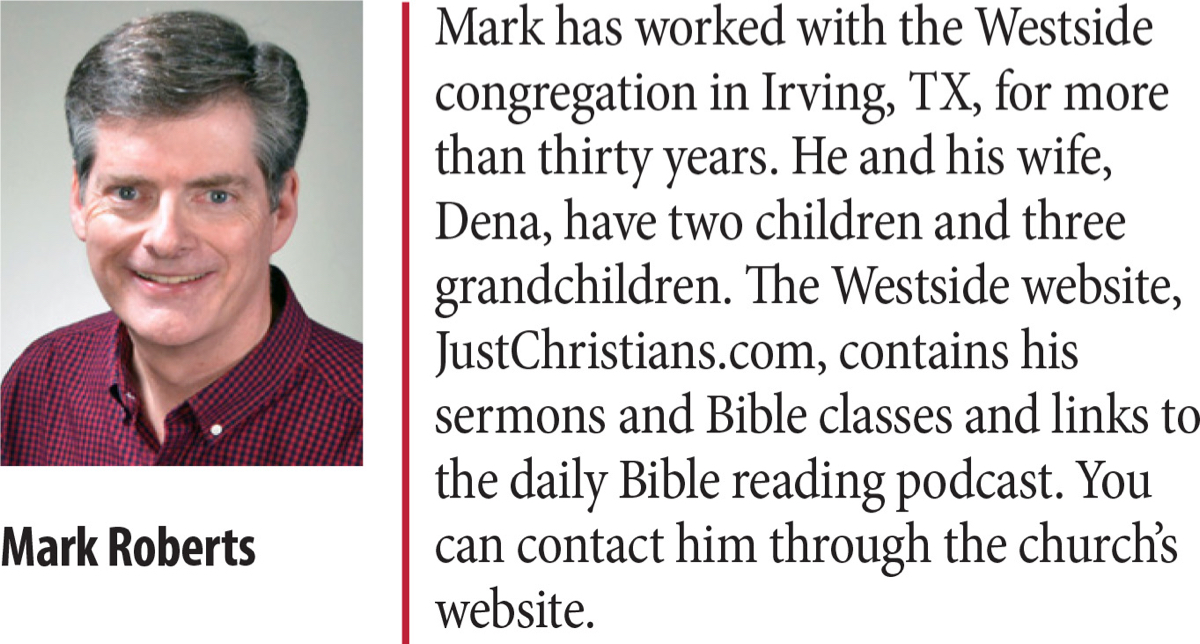
By Mark Roberts
Synopsis: Simply stated, deconstruction denies man’s ability to understand the biblical text and opens it to a limitless range of interpretations—rejecting as invalid the traditional method of seeking certainty through reading, reasoning, and rational comprehension.
Paul warns of people who are “burdened with sins and led astray by various passions, always learning and never able to arrive at a knowledge of the truth” (2 Tim. 3:1ff). Those words from long ago ring with force today because they perfectly describe the deconstruction movement.
Deconstruction is now the buzzword on center stage in many conversations and social media posts. What is “deconstruction” all about?
The term “deconstruction” traces its roots to a French philosopher in the 1960s named Jacques Derrida. He argued that objective truth does not exist because whenever someone speaks or writes, they cannot help but inject their ideas, biases, and agenda into what they communicate. Thus, no one sees reality as it is. We only see it through our own life experiences and beliefs. Derrida argued that to get at the “real” meaning, a listener or reader must “deconstruct” the text of the prejudices that have been loaded into the language. All of this fed into the post-modern movement that announced there is no such thing as absolute truth.
The kind of deconstruction that is dominating the religious world today picks up on this theme. It majors in tearing down belief and especially loves asserting there is no objective truth. As the term has moved into common usage, it signals a dismantling of traditional ways of thinking about Christianity. Even the most foundational beliefs (faith in the inspiration of the Bible, the existence of God, or the sinfulness of homosexuality) become open questions. Unfortunately, the questions never seem to be answered, and people who deconstruct their faith almost always exit Christianity. A big part of this may be the refusal to listen to authority figures (because they are biased and pressing their own agenda). That means when someone is deconstructing his faith, he will refuse help from the very ones who could help him!
Thus, the deconstruction we are concerned about in this article is the process of critically re-examining everything about one’s Christian faith with the probable intent of leaving Christianity.
Deconstruction is not limited to young people, but there is no doubt the effect is greatest there. Lifeway Research found that two-thirds of American young adults who attended a Protestant church as teenagers say they dropped out for at least a year between the ages of 18 and 22. A 2018 Barna Group study reveals that only 14 percent of Millennials believe the Bible is the literal word of God. Young people are “checking out” of faith in droves. Concerns over racial justice, homosexuality, and gender issues are causing many of our youth to decide Christianity is not for them. Congregations that are not paying attention to these matters, and addressing the questions of teenagers and young couples, will reap a bitter harvest of lost souls as this generation deconstructs and discards their faith.
Deconstruction is a complex problem. In some ways, it is not the problem but only the very visible (and painful) symptom of many other issues. This article cannot examine everything that is driving deconstruction, but we can identify several of its chief causes.
The church is designed by God to be a place of nurturing and instruction (Gal. 6:1-2; Eph. 4:11-16; Acts 20:28) so that disciples can grow in their Christ-likeness. When the church fails to meet this obligation, problems will follow, especially if issues with abuse are present. Abusive or manipulative church leaders, covering up sin and coercing people into silence, create an unhealthy environment people will want to leave. Disillusionment with church leaders kicks the exit door wide open. Further, churches that suppress honest questioning and treat everything as of first-order importance (and demand conformity) also push disciples out of the Kingdom. Thinking “I have doubts but I can’t express them here” causes doubts to fester and silently destroy faith.
It is very important to note that politics intruding into church life is often a direct cause of people deconstructing faith. Young people are dramatically turned off by extremism and labeling other political persuasions as wrong or evil. Survey after survey shows that politics in the church is virtually guaranteed to drive people away.
This is a good place to note the value of solid, biblical teaching that is delivered in a usable way and with good applications. This should be at the forefront of every church’s efforts. Jesus questioned the teaching of His day when, in the Sermon on the Mount, He repeatedly said, “you have heard. . . but I say” (Matt. 5:21ff). One could argue that He was deconstructing the teaching and belief system of His day (because He was!). Yet Jesus does not say that it is impossible to know what to believe, that there are no absolutes, or that everyone is free to do as he pleases. Instead, Jesus taught the truth! We might even note how often Jesus took sincere questions and carefully responded to them (see John 4). Listening and responding to the doubts and fears in someone’s heart matters.
Churches that are failing to teach and apply truth to the questions that young people are constantly being bombarded with because they limit their lessons to rehearsing past battles while neglecting present ones are failing to teach the whole counsel of God. Churches that are substituting politics for Scripture, or who are demeaning and attacking those “outside” the faith with epithets and slurs, only reinforce that we are not the people of God. Church leaders building their own little kingdom instead of God’s kingdom can be sure their hypocrisy will be seen through and many will want no part of it. We may shake our heads when people in these situations deconstruct their faith, but congregations that fail their members will answer for their part in helping people lose their faith!
When the Puritans landed in Massachusetts in 1630, everyone was required by law to attend church. Sinful behavior was punished publicly and severely. The values of the community and the values of Scripture were (somewhat) aligned, providing strong pressure for the average Puritan to behave. Those days are long past. Among millennials, the “default setting” is “I don’t attend church.” Our culture praises homosexual and transgender behavior, and it denounces as judgmental all who would say otherwise. Society pushes hard against the way of discipleship and many are feeling that pressure. The serpent asked, “Did God really say?” causing Adam and Eve to question the Lord’s word (Gen. 3:1). He then answered his own question with a lie. Our surrounding culture is constantly lying about God, His existence, and what He has said. Ideas like “love is love” (which has become a statement of empowerment for the people of the LGBTQ+ community) and “Jesus never condemned homosexuality” and “we shouldn’t judge people” are popularized in every available media channel. Famous former pastors, teachers, and celebrities who have left “Christianity” to embrace the LGBTQ lifestyle and/or faith of every stripe and persuasion have become so common the term “EXvangelical” has gone mainstream.
The internet is, of course, partly to blame for this shift in our culture. The omnipresence of the internet means that people will be exposed to information that directly contradicts and assaults Christianity. Young people cannot be sealed in a bubble and kept from it. They will learn of viewpoints that differ from ours, they will hear the lies of the serpent, and they will be challenged with extremely sophisticated arguments and evidence for those beliefs.
In the last year, I have studied with a young man who deconstructed his faith and became an atheist. In our conversations, he ran out advanced arguments for atheism and was prepared to meet common objections to atheism with ready-made answers. However, probing his defenses caused him to admit that he had not read deeply or studied much on atheism, but was merely regurgitating material that he had seen on internet forums. His arguments were badly flawed, but they sounded plausible in the atheist forums he visited regularly. Parroting this material confirmed him in his newfound atheism and made him feel intellectually superior to people of faith. In years past, someone in his shoes could not possibly have challenged faith with the questions he raised, or answered the evidence for God’s existence as he did, without a trip to a major public library and hours of research. Now a few clicks take one to a website that will load the gullible with all sorts of quick “answers” to what Christians might ask or say.
It is easy to write off all who leave the faith by saying, “they just want to sin.” In truth, that may play a role. Demas left Paul because he loved “this present world” (2 Tim. 4:10). The temptations of the flesh are powerful and can draw a person away from Christ (1 John 2:16). However, not everyone who doubts their faith is already in sin and simply looking to justify his lifestyle. We need to remember that society’s pressure has made doubt itself very cool. The person who asks questions of what should be long settled is made to be a hero. Announcing you no longer believe homosexuality or abortion is wrong, saying you side with evolutionary theory because it is scientific, or that you no longer want to be part of something that condemns people to hell marks you as liberated and as an independent thinker. A good example of this is found in the very public exit from faith by two popular YouTubers, Rhett and Link. In their announcement, they admitted to being fearful and uncertain about how their deconstruction of Christianity would be received. Sadly, the comments under the video posts are full of commendations. Comment after comment says “That’s how I feel,” “This is so relatable. Thank you for your humility and vulnerability” and, “Thank you for your bravery.” If someone articulates a biblical position (particularly about sexuality and gender issues) that person will be castigated. Yet when a person raises questions about faith and then decides to leave the faith, he will be acclaimed and lauded. No one asks if they even attempted to find answers to their questions. If someone says, “I have doubts,” that is considered a legitimate exit ramp from Christianity. This is the work of darkness and comes from a heart that loves self and not the truth. Paul says such people will be deceived because “they refused to love the truth and so be saved” (2 Thess. 2:10).
The answer to today’s wave of deconstruction is obvious: we must help disciples construct a strong, rigorous faith that is not destroyed by culture’s latest fads, nor by a desire for the praise of people (see John 12:42-43), or the passing pleasures of sin. Part of that kind of construction work is done by helping brethren re-construct their faith when it has been challenged. The Bereans provide a model for all of this. Acts 17:11 affirms, “These Jews were more noble than those in Thessalonica; they received the word with all eagerness, examining the Scriptures daily to see if these things were so.” The challenge and questions about the Jewish faith that Paul and Silas’ preaching raised were met by examining the word of God, leading to the building of a new and more mature faith that was solid, real, and genuine. That kind of faith will not be deconstructed or demolished. May the Lord bless us in our homes and in our churches to follow this Berean model.