By Caleb Wray
Synopsis: Consider how Almighty God manifested the most powerful emotion for all mankind.
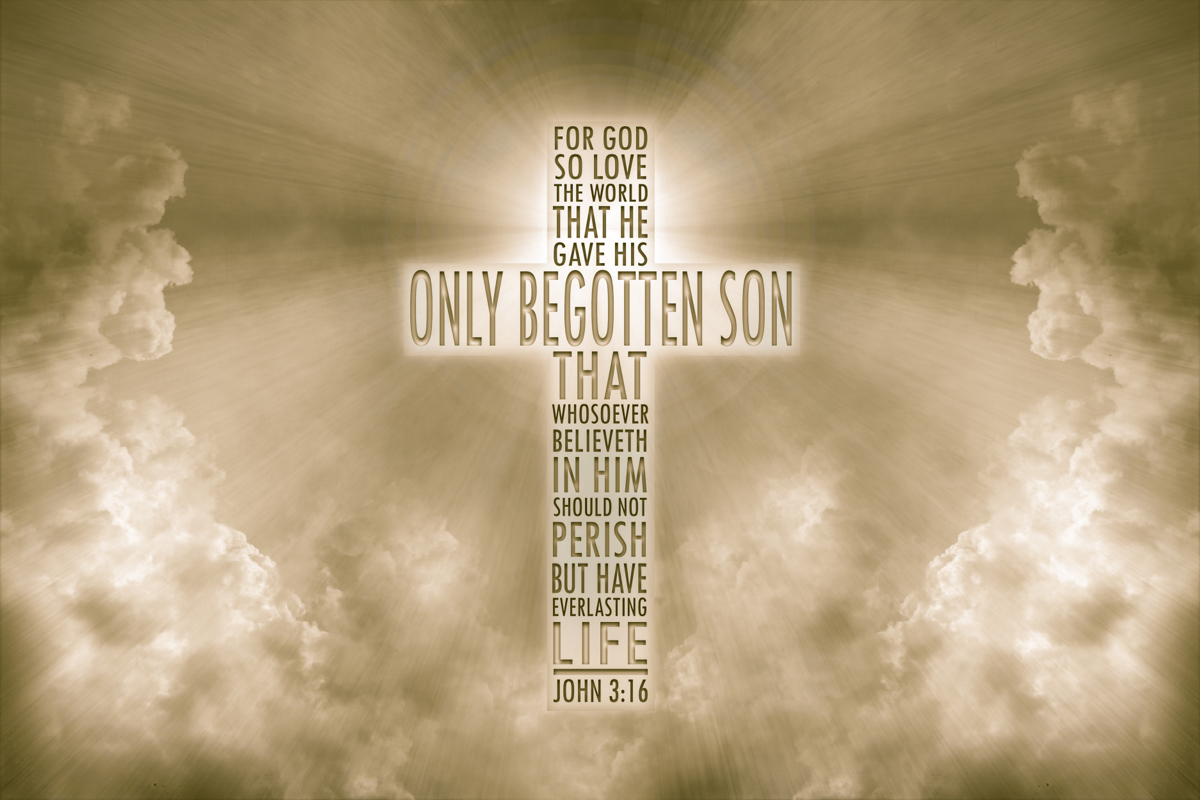
For God so loved the world, that He gave His only begotten Son, that whoever believes in Him shall not perish, but have eternal life (John 3:16, NASB).
In these few simplistic words recorded by John the Lord’s teaching, much can be said about the magnificent plan of the Creator, beginning with a recognition of the Creator Himself.
Throughout history, mankind has sought to know the origin of the universe. Even amongst our agnostic and atheistic friends and colleagues, there is much speculation and consideration given to how the earth and surrounding heavenly bodies came into existence. In the various mythologies, there are a variety of different stories on the creation of everything around us. Many mythologies give credit to multiple “gods” for the creation of various pieces. In many of these ancient beliefs, it was a rarity for one “god” to be listed as the sole designer. However, Scripture declares, “In the beginning God (Elohim) created the heavens and the earth” (Gen. 1:1). Elohim, or the Mighty One, is seen as the Greatest Being with infinite power and evidenced by the creation around the globe.
The book of Daniel describes how the four youths of Judah are taken into the service of King Nebuchadnezzar, where they will become learned men of the way of the Chaldeans. In that opening of the book, there is a change of names that occurs for each of them. Their names, which honor the true God, El Shaddai (God Almighty), are changed into references to different Chaldean idols. In particular, one is worthy of discussion: Mishael means “Who is what God is?” whereas Meshach, according to several scholars, means, “Who is what the moon god is?” It is interesting to note that when changed, this name pays honor to but one pagan God. Polytheism limits the powers and abilities of their deities. Claiming that a force of nature, place, animal, or characteristic belongs to only to the domain of one or two deities—which shows how truly insufficient that deity is. How impressive is a well-run facility, a home, a workplace, a project, when it is done by one individual as opposed to the work of many? Truly, the completed, perfect item that is done by one individual is far more impressive.
Egyptian mythology has over eight hundred deities. Spanning more than multiple millennia and thirty-two dynasties, Egypt’s history relied heavily on their mythology. Although Akhenaten (Amenhotep IV) lead Egypt to adopt a monotheistic religion for a short time, most of Egypt’s history was steeped in polytheism, assigning deities of the river, sons of Horus to guard the organs in the afterlife, and more. In examining the final plague on Egypt, there is no doubt of who the true, superior being was and is today.
When God Almighty spoke to Moses and Aaron in Exodus 12:12, He stated that, in this final plague upon Egypt, He would execute judgment upon Egypt, and on all the gods of Egypt. Through the plagues, Israel’s God manifested superiority over the pagan gods of Egypt. As the plagues devastated the realms of several Egyptian deities, clearly, judgment had come upon them.
The apostle Paul told the men of Athens at Mars Hill, “This unknown God I now proclaim to you.” God Almighty is able to create the entire world, to fashion humanity and give each person a free will, to control the rulers and principalities, to be all powerful, all knowing, and ever present. God is far beyond the comprehension of our mortal minds. Everywhere across this planet sings of His praise. In Acts 17:24-25, Paul informs the men of Athens that this true God is not one who lives in objects made by human hands. His being cannot be symbolized by a graven image. Such things cannot communicate His glory. He is far beyond what man can imagine and create. He is the infinite creator of the universe.
Love is a simple word, yet it is so complex. First and foremost, God teaches us what love is and reveals the impact of love. Peter instructs us to love each other because love covers a multitude of sins (1 Pet. 4:8). In writing about love, John reminds us that we love because God first loved us (1 John 4:19). Our love for one another is to be an imitation of the love of the Father.
How can one be assured that God manifests love towards us? In another comparison to a pagan deities, consider Elijah’s encounter with the prophets of Baal. Four hundred and fifty priests of Baal cried loudly, beseeching a god who could not answer them. They made loud intercession, seeking an answer, the symbol of the power of Baal. Elijah called to God, who immediately responded and showed His ability. In the ensuing passage of 1 Kings 19, Elijah fled from the presence of Jezebel, who has threatened his life. When the angel of the Lord came and ministered to Elijah, the Lord’s servant was ready for his end. He besought the Lord to take his life, for he did not differ from his fathers. God made provision for Elijah, who then journeyed to Horeb to stand before the Lord.
In this passage, when God asked Elijah what he was doing there (i.e., why had he fled?), God showed His magnificent power. Elijah saw a strong wind that tore the mountains, an earthquake, and a great fire (vv. 11-12). Yet, Scripture declares that the Lord was not in these manifestations of power. After the fire, there was “the sound of a low whisper” (ESV). Immediately, “when Elijah heard it, he wrapped his face in his cloak and went out and stood at the entrance of the cave” (v. 13).
Why did Elijah hide his face, unless he recognized that the Lord was present in the whisper? Have you ever stopped to consider how close one must be to hear a whisper, and understand its meaning and implication? God was present with Elijah despite the prophet’s despair. That is merely one instance of many in which we clearly see God with His people.
God is surely capable of emotion, as evidenced throughout Scripture. Consider Genesis 6. Upon seeing the wickedness of man’s heart, God Almighty regretted that He made man. Yet, frequently manifested long-suffering towards His people. Moved by the groaning of the Israelites in Egypt, God sent Moses and Aaron to deliver them (Exod. 2:24). In Jonah’s misplaced complaint of God’s willingness to relent, and not pour out His wrath upon Nineveh, he says, “I knew that You are a gracious God and merciful, slow to anger and abounding in steadfast love, and relenting from disaster” (Jonah 4:2b). While Jonah stated this as a criticism, it is God’s crowning characteristic: He abounds in steadfast, unwavering love.
Amidst judgments pronounced upon Israel and Judah in the Minor Prophets, there are continual glimpses of the remnant, and the salvation that they will experience. Throughout history, it is undeniable that God loves His people. To accomplish His purposes, God provided a plan that would offer salvation to all people.
From cover to cover of our Bibles, there is but one central theme: redemption. The Greatest Being shows His eternal love for His creation. He desires all be saved, so that all may experience the love of the Father. In Jesus’s parable of the prodigal son, the Father’s love for His wayward child never ceased. Why else would He look out daily for His son to return? In a similar manner, the Great Almighty God has never ceased to love His people. Reading through the book of Hosea will show the personal relationship that God so desperately desires from His people, and the implications of the relationship between Creator and creation. Near the middle of that letter, He says, “I desire compassion, not sacrifice.” Words that Jesus spoke on two occasions (Matt. 9:9-13; 12:1-7) which remind us of what John writes: “We love because He first loved us.” God’s love has never wavered for any of us so may we have full assurance of the fact that The Greatest Being Manifested the Greatest Emotion for you and me.
Redford, Donald B. Akhenaten: The Heretic King. Princeton, NJ: Princeton University Press, 1987.