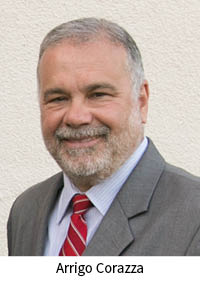
Arrigo Corazza has been preaching at Pisa, Italy, for seventeen years. He is married to Patrizia Gabriele and they have two girls, Deborah and Simona, ages 34 and 30.
It is an honor for me to describe briefly my father’s activity in the Kingdom of God. As we will see, due to historical condition, his was a very unusual experience.
Alessandro (a.k.a. Sandro) Corazza was born in Frascati (Rome) on February 21, 1926. Frascati is a very pleasant little town (population 2009: 19,830) located 12 miles southeast of Rome on the Alban Hills close to the ancient city of Tusculum (Roman times). Famous for its history and for the many notable villas, built from the 16th century onward by the princes of the Roman Catholic Church (Popes, cardinals, and Roman nobles), Frascati was the headquarters of Albert Kesselring (1885-1960), the overall German commander in the Mediterranean theatre during World War II. This led to the disastrous bombing of Frascati on September 8, 1943, the very day of the announced Armistice between Italy and the Allied Forces.
Sandro was the last of five children in the richest family of Frascati. His father, a professional violinist who played with Puccini, Mascagni, and Toscanini, was the owner of stores and houses (my first cousin still owns my grandfather’s Stradivari). One of Sandro’s brothers, who taught chemistry to Mussolini’s sons, was the founder of the Democratic Christian Party, the ruling political force in Italy for almost fifty years. To complete the wealthy status of the Corazza family and for the full pleasure of Sandro’s mother, a very devout Catholic lady, a priest was needed. Thus, Sandro, who was extremely brilliant minded, was sent, with other kids of similar social status, to the local Seminary. It was the “fatal” year 1936, when Mussolini proclaimed the return of the Empire on the Seven Hills after conquering Ethiopia. Disgracefully, all the kids in the Seminary went through the terrible experience of physical abuse. As a result of it, Sandro felt a profound disgust for the Catholic Church and for everything it represented (God included).
Twelve years later (1948), while he was working in one of his father’s stores (photo shop), Sandro met a young, very tall, skinny boy from Texas, who had problems with his camera. But they could not communicate. To make short a long story, the two became friends to the point of Sandro teaching Italian to the American and vice versa. What was the common ground? The Bible. The smart American, who turned out to be a gospel preacher of the Church of Christ living close by my grandfather’s store, propose to read the Bible both in English and in Italian. So, when they arrived at 1 Timothy 3, Sandro, who had never read the Bible, like the rest of Italians, learned that the bishop must be married. In that very second, his life changed and the life of many of his family after him.
On March 21, 1949, he was baptized according to the New Testament and was the only Italian worshiping with the group of American preachers who had settled in Frascati. He married my mother, Elisabetta, soon after and began preaching in the north of Italy, in Milano. Returning to Rome, he began serving the local Church of Christ together with American missionaries. In 1953, my brother, Stefano, was born; in 1955 I was born in front of the Colosseum. An Italian-American doctor helped my mother to deliver me.
In the Fifties the preaching of the Gospel in Italy produced good results: from North to South, more than fifty Churches were founded. It was a difficult time, though: Italian authorities, led by the Catholic Church, were refusing visas to Americans, kicking them out of the country, closing sometimes the meeting places of the brethren. One of the legacies of Fascism was the Concordat with the Roman Catholic Church (February 11, 1929) by which Catholicism became the official religion of Italy (until 1984). It is worth noting that 95% of the population was Catholic by then. Other religious expressions were merely tolerated, if not persecuted. This climate remained even after the coming of democracy in Italy after twenty-two years of fascism. In the Sixties things got better for the Italian brethren regarding external foes, but a new, terrible danger came from within: liberalism and institutionalism etc. (a Bible School was created in Florence). These new enemies were brought in the life of the churches through the influence of American missionaries, who held the economical possibilities (support for Italian preachers, funds, etc.). My father, who had given up all of his family richness because of irreconcilable divergences with his mother (my grandfather had earlier died in 1945, age sixty), was depending on American support. Though he did not agree with what was going on and grew in open conflict with the U.S. brethren serving in Italy, he went back to secular work, being fully convinced that there was no way to dialogue with American preachers. He believed that all the American preachers were liberals in their attitude toward the Gospel. but he was wrong. Brother Rodolfo Berdini (Church of Christ, Aprilia) and brother Antonino Buta (Church of Christ, Messina), two preachers his age, and brother Roberto Tondelli, a very young preacher (Church of Christ, Pomezia), came in possession of a copy of a magazine, Searching the Scriptures, edited by brother H. E. Phillips and brother Connie W. Adams. This paper was instrumental to some Italian preachers (also to brother Vincenzo Ruggiero, in the Naples area) in knowing that fighting was going on among American brethren on the institutional issue. These Italian brethren informed Sandro of the new discovery. It came to pass that several American brethren were invited to preach in Italy – I could remember here the likes of Connie Adams, James W. Adams, Roy E. Cogdill, H. E. Phillips, Foy Vinson, and Robert Harkrider.
The above listed Italian brethren began to struggle for the Biblical truth with a new awareness, knowledge and understanding of the issue they were facing. A newspaper edited by Sandro, Sentieri Diritti (Straight Paths), began to circulate among the Italian brotherhood. Sentieri Diritti was well received, thanks to the good contribution of the Italian preachers involved against institutionalism. In the same time, a new generation of Italian preachers grew. Taken to study in the U.S.A. by Roy Cogdill (myself) and by H. E. Phillips (my brother Stefano and Gianni Berdini), these very young preachers began to move around, serving some churches that got interested in leaving institutionalism. Thus Gianni Berdini went to Trieste, Stefano Corazza to Udine (where Valerio Marchi, a new preacher came from), myself to Alessandria. It was the beginning of the Eighties.
My father is the only preacher still alive among those of his age. We, the young ones by then, are getting “mature,” after almost forty years of full-time service. The American brethren, in this long span of time, have kept supporting us faithfully. Our preaching in Italy is still pioneering, after sixty-five years. It is still extremely difficult to preach in Italy. While it is true that the sound preaching of the gospel is difficult everywhere, it is also true that Italy is a unique country. Made in Italy does not refer only to Ferrari, fashion, food, Rome, Florence, Pisa, Siena, Venice, Naples, Pompeii, etc., but also to the Roman Empire, the Roman Catholic Church, the Mafia and Fascism – truly historical creations of the Italians. To change things in the most Catholic country in the world takes a long time. We talk about “mentality.” “The history of mentalities is the history of slowness in history” (Jacques Les Goff). Probably we won’t see such a radical change in our earthly lives.
Nowadays, things keep going on well in those Italian churches of Christ that oppose liberalism. From time to time, we have internal problems (that is physiological, in church life), but liberalism and institutionalism have been banned forever (nevertheless, we are always aware of the danger of these heretical ways of living the faith in Jesus Christ; we are very cautious).
Before closing a few remarks need to be made.
1. Sandro is still active in the kingdom, notwithstanding his age. He has produced, through the years, an impressive work of translation in Italian of the major good books written by faithful American brethren – commentaries like Truth Commentaries, Roy Cogdill’s groundbreaking works, etc. Together with my brother Stefano, he’s one of the Elders at Via Sannio Church of Christ in Rome. He has been serving the Lord since 1949. His work has stood the test of time so far.
2. The name of the young, tall, skinny boy from Seagraves, Texas who converted my father was Wyndal H. Hudson. He was born in 1928 and passed away some time ago. He deserves to be remembered here for the tremendous effect he had in the life of my father (and, consequently, of my family). I want to acknowledge with joy and gratitude Sandro’s and Wyndal’s efforts in the Kingdom of God.
3. None of my father’s original family ever obeyed the Gospel. Instead, all from my mother’s family (but one) obeyed the Gospel. Stefano and I have children who became Christians; we are now granddaddies. My granddaughter, Sara (born January 15, 2014), is always present at the worship services in Pisa. Sometimes I look at her and see in her blue eyes the greatness of the gospel, which started out in my family with my dad obeying the gospel. Everything started out when a tall, skinny boy from Texas went in the photo shop owned by my grandfather because his camera would not work properly and was served by Alessandro Corazza.
4. One last curiosity: Alessandro Corazza can be translated in English with Alessandro Breastplate. Nomen omen, would the Latin say. It means: “the name is a sign” of the person who bears it. That was really true for my dad. Hope and pray it can be also for my brother and for myself looking always for the justice of God.